Britain’s Secret Role In Yugoslavia’s Destruction
By Kit Klarenberg | Global Delinquents | January 6, 2026
December 23rd marked the 35th anniversary of an independence referendum in Slovenia, then a Yugoslav republic. In all, 88.5% of registered voters – 95.7% of participants – said “da” to secession. The plebiscite prompted Ljubljana’s formal declaration of independence, and ensuing Ten Day War between Slovene territorial defence forces and the Yugoslav federal army. This was the spark that triggered bitter, bloody interethnic conflicts throughout Yugoslavia over the subsequent decade, and the multiethnic socialist federation’s ultimate destruction.
In May 2000, Britain’s Observer exposed how in the Ten Day War’s leadup, London secretly supplied Slovenia with tactical military communications equipment worth millions, to assist Ljubljana’s impending battle against the Yugoslav military. The disclosure elicited outcry, as London was officially at the time committed to preserving Yugoslavia, leading international efforts to prevent the country descending into fractious civil wars. The clandestine provision was at direct odds with this public-stated policy, which included unbending support for an arms embargo on the region.
Responding to the news, former British Foreign Secretary David Owen, who served as the EU’s lead peace negotiator during the Bosnian war, said he was “surprised” London covertly undermined her formal commitment to keeping Yugoslavia “together”. He nonetheless downplayed the assistance, noting what Britain supplied “was not aggressive” – “radios not guns”. Owen therefore argued the shipment “sails close to the border but does not cross it.” By contrast, the Observer reported the communications equipment “played a vital role” in Slovenia’s victory over Yugoslav forces.
This was because Ljubljana won the Ten Day War not via conventional military means, but a wide-ranging, devastatingly effective international propaganda campaign. In physical terms, the brief conflict consisted exclusively of minor skirmishes, and was largely bloodless, with just 44 Yugoslav soldiers and 18 Slovene territorials killed. One would not have known this from contemporary Western media reporting though, which relentlessly portrayed Slovenia as fighting countless grand military engagements against Belgrade’s barbarous invaders, and pluckily prevailing.
British military communications equipment greatly facilitated this informational onslaught. The psychological battlefield’s centrality to Ljubljana’s successful independence struggle had a resounding impact on Slovenia’s fellow breakaway Yugoslav republics. Engendering maximum international sympathy while demonising Belgrade became a core component of Albanian Kosovar, Bosniak and Croat war strategies. In Sarajevo, secessionist authorities deliberately immiserated the local population to create emotionally impactful images for global broadcast. Meanwhile, its military routinely carried out false flags, including targeting civilians with sniper fire. As Canadian UN peacekeepers on-the-ground directly observed:
“The [Bosniaks] are not above firing on their own people or UN areas and then claiming the Serbs are the guilty party in order to gain further Western sympathy. The [Bosniaks] often site their artillery extremely close to UN buildings and sensitive areas such as hospitals in the hope that Serb counter-bombardment fire will hit these sites under the gaze of the international media.”
Ljubljana’s triumph left an enduring impression upon the British too. In multiple proxy conflicts since, London has taken the lead on psychological warfare, in particular atrocity propaganda, vilifying official enemies and justifying intervention and regime change. Since February 2022, a secret Ministry of Defence-created military and intelligence cell, Project Alchemy, has endeavoured to “keep Ukraine fighting at all costs.” Fundamental to this effort are “information operations” designed to convince Western citizens, and Ukrainians themselves, Kiev can somehow defeat Russia, by grossly distorting reality on-the-ground.
‘Quite Incredible’
A memory-holed July 1991 report from now-defunct British newspaper The European – “Lies Win Balkan War Of Words” – lays out in forensic detail how Slovenia’s propaganda war was fought and won. The operation’s “nerve-centre” was “an underground conference complex deep below the streets of Ljubljana.” Here, dozens of Slovene Information Ministry apparatchiks “worked tirelessly” to provide over 1,000 foreign journalists with a relentless barrage of information about the conflict – particularly Yugoslav war crimes, and Slovene military victories – supposedly taking place above ground.
Wild figures on reported “tanks hit, shots fired, prisoners taken” by Ljubljana were supplied hourly. Meanwhile, the Slovenes struck up a chummy rapport with their overseas guests, portraying themselves “as clean-limbed, tanned church-goers who only wanted to live peacefully and democratically in their Alpine idyll of mountains, lakes and meadows.” They claimed to be under attack by “ruthless Communists… dirty, unshaven brutes who dropped cluster bombs on innocent civilians… [and] sought to inflict [their] intolerant religious fanaticism and alphabet of squiggly lines on Europe.”
Ljubljana “needed a bloody, dramatic conflict to ensure the world did not lose interest” in their independence crusade. Thus, “they showered the media with details of battles that had often never taken place,” frequently “enlivening the day” with lurid, often unfalsifiable assertions, such as Belgrade landing “squads of special troops in plain clothes” across the country “to terrorise the population,” or plotting to target a local nuclear power plant and create a Chernobyl-style disaster. Journalists dutifully amplified these dubious claims as fact internationally.
Such was the deluge, “it was possible to report the war without ever venturing above ground” – “but, for those who did venture into the sunlight, the bunker war often seemed a fantasy.” For example, Western news outlets widely covered a purportedly “major battle” at Jezersko, a municipality near Austria. When The European visited the area subsequently, “greatly surprised” local Slovene militiamen instead described a brief tussle with a few Yugoslav soldiers over a borderpost in which “no one had been hurt.”
Throughout the Ten Day War, the Western-backed separatist government of neighbouring Croatia was “carefully analysing” Ljubljana’s informational offensive. They concluded the conflict’s “decisive engagements, which virtually guaranteed Slovenia’s independence, took place in the pages of the foreign media and, even more important, in the news bulletins of the major television networks.” Zagreb duly launched its own “propaganda blitz”. Croat officials were instructed “to hold twice-daily press conferences, which should be as colourful and dramatic as possible,” while Western journalists were given tours by soldiers:
“Everywhere, in town halls, hotel foyers and crouching nervously behind roadblocks, Croat mayors, police chiefs and militia officers… hold press conferences or hand out neatly-typed news bulletins to tell the world of the latest atrocities by Serbian extremists and of unprovoked attacks by the [Yugoslav] army… The Croats’ strategy today is clear. They are bombarding the world with information, which is usually so petty it seems it must be true.”
For example, Croatia’s state media agency Hina pumped out “extraordinarily detailed accounts of the fighting allegedly taking place in the countryside,” with an emphasis on “trivial” incidents. Typically, it was “impossible to check most of these reports precisely because the clashes were so minor that, even if they happened, they left no mark.” This inconsequential, unverifiable cavalcade was occasionally interspersed with “quite incredible allegations”, such as Belgrade having flooded the republic with “hired assassins” drawn from the ranks of Romania’s notorious Communist-era Securitate.
‘Managed Understanding’
The “grotesque caricatures” of Yugoslav forces, and Serbs more generally, as uniquely bloodthirsty monsters peddled by “brilliant” propagandists in Ljubljana and Zagreb took “hold of the public imagination in the West”, transforming “complex” interethnic struggles “into a straightforward battle between the forces of light (Slovenes and Croats) and darkness (Serbs).” This fraudulent dichotomy was exploited even more perniciously during the Bosnian civil war, and subsequent Kosovo ‘crisis’, during which atrocity propaganda served to justify and sustain NATO’s criminal 78-day-long bombing of Belgrade in 1999.
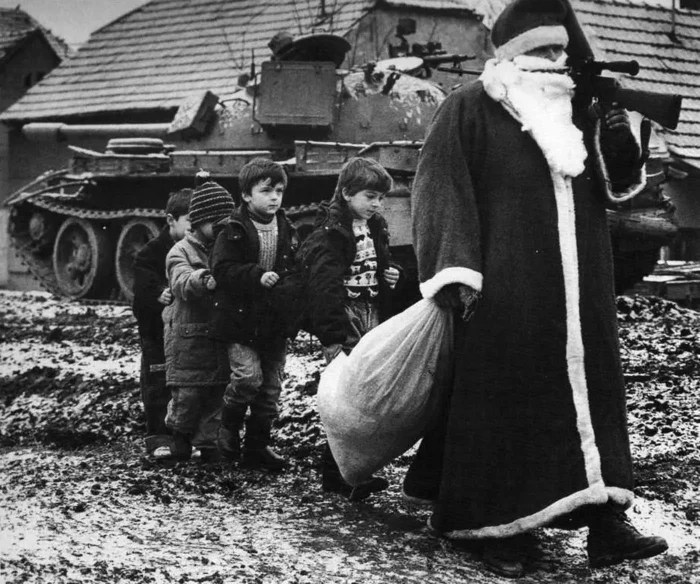
An impactful staged photo, Croatia, Christmas 1992
The European concluded by noting reliance on psychological manipulation to win wars created a “major problem”. Namely, while “a daily publicity blitz of exaggerations and lies may win international support… it will do nothing to heal the divisions which are ripping the country apart.” Locking-in overseas sympathy made Western-backed leaders in the former Yugoslavia less willing to accept negotiated settlements, and keep brutal internecine battles grinding on, safe in the knowledge further carnage only strengthened their position, in information warfare terms.
Notably, a key propaganda strategy for Croats and Slovenes, per The European, was to portray Yugoslav forces “as incompetent and thuggish.” An identical disinformation dynamic played out during the first 18 months of the Ukraine proxy war. As a November 2023 NATO paper on “Humour In Online Information Warfare” revealed, the military alliance and its Kiev puppets specifically sought to weaponise “humour and mockery”, emphasising “Russian failures” and “Ukrainian determination” in media reporting and online, from the conflict’s inception.
These efforts augmented “the responsiveness and impact” of Ukraine’s “information campaigns,” proving “instrumental” in Kiev securing “US-made F-16 combat aircraft” in August 2023, among other Western arms shipments. The NATO paper makes clear weaponisation of mockery is a long-running objective for the alliance, citing a 2017 study, “Stratcom Laughs”, which outlines methods of exploiting “humour” as a military “communications tool”. Four years later, an official Ukrainian government website entry boasted of how such methods can “influence your opinion”:
“How does propagandistic humor work? Relieves tension, makes perception less critical. Uses common contexts to convey messages with which the audience agrees. Simplifies everything to the ‘obvious’. Creates clear groups: strong and intelligent ‘we’ and clumsy and stupid ‘they’. Of course, the audience associates itself with the former and begins to despise the latter. Simplified managed understanding is easily disseminated by the audience and creates the necessary social context for propagandists.”
Atrocity propaganda has also played a crucial role in prolonging the unwinnable quagmire at unsustainable economic, human, and material cost. In April 2022, British intelligence exploited the ever-mysterious Bucha incident to sabotage fruitful peace talks between Kiev and Moscow, framing the apparent killing of innocent civilians in the town as somehow genocidal. At the time, a US Defense Intelligence Agency apparatchik lamented how the “Bucha Effect” had “led to frozen negotiations and a skewed view of the war” – apparently unaware this was London’s precise objective.
Collapsing Empire: RIP ‘Overt Operations’
By Kit Klarenberg | Al Mayadeen | December 30, 2024
In recent months, a remarkable development in the Empire’s decline has gone almost entirely unnoticed. The National Endowment for Democracy’s grant database has been removed from the web. Until recently, a searchable interface allowed visitors to view detailed records of Washington-funded NGOs, civil society, and media projects in particular countries – covering most of the world – the sums involved, and entities responsible for delivering them. This resource has now inexplicably vanished, and with it, enormous amounts of incontrovertible, self-incriminating evidence of destructive US skullduggery abroad.
Take for example NED grant records for Georgia, the site of recent repeated color revolution efforts, at the forefront of which were Endowment-bankrolled organizations. While still accessible via internet archives, they were deleted during the summer. Today, visitors to associated URLs are redirected to a brief entry simply titled “Eurasia”. The accompanying text describes in very broad terms the Endowment’s aims regionally and the total being spent, but the crucial questions of where and on what aren’t clarified. In a comic hypocrisy too, the blurb boldly states:
“The heart of NED’s work in the region is the need to maintain access to objective information for local populations. Across the region, government actors are attempting to limit the space for citizens to distribute information and communicate freely online.”
Resultantly, independent academics, activists, researchers, and journalists have been deprived of an invaluable resource for tracking and exposing the Empire’s machinations. Yet, the Endowment incinerating its public paper trail can only be considered a significant victory for these same actors. NED’s explicit and avowed raison d’être was to do publicly what US intelligence did – and in many cases still does – covertly. Now, after 40 years of wreaking havoc worldwide in service of the Empire, the CIA front has been forced underground, defeating its entire purpose.
‘Spyless Coups’
NED was founded in November 1983, after the CIA became embroiled in a series of embarrassing public scandals. Then-Agency director William Casey was central to its construction. His objective was to create a public mechanism to conduct traditional CIA meddling overseas, except out in the open. Ever since, the Endowment has financed countless opposition groups, activist movements, media outlets, and trade unions to the tune of millions to engage in propaganda and political activism, to disrupt, destabilize, and displace ‘enemy’ regimes the world over.
The NED’s true nature was openly acknowledged by the mainstream media for many years. In June 1986, Endowment’s president Carl Gershman told the New York Times, “It would be terrible for democratic groups around the world” to be subsidized by the CIA. The exposure of such connivances meant they had been “discontinued”, and farmed out to NED. Several high-ranking interviewees strenuously denied there was any connection between NED and the Agency, although the outlet acknowledged many Endowment programs seemed “superficially similar” to past CIA operations.
At this time, NED was hard at work killing off Communism in the Soviet Union, Warsaw Pact, and Yugoslavia. This included for instance enormous investment in Poland’s famous Solidarity trade union, which became a global emblem of anti-Communist resistance. In September 1991, the Washington Post published a highly laudatory appraisal of these efforts, stating the “political miracles” the Endowment achieved in the former Soviet sphere had ushered in a “new world of spyless coups” and “innocence abroad”:
“The old era of covert action is dead. The world doesn’t run in secret anymore. We are now living in the age of Overt Action… When such activities are done overtly, the flap potential is close to zero. Openness is its own protection. Covert funding for these groups would have been the kiss of death, if discovered. Overt funding, it would seem, has been a kiss of life.”
NED proceeded to take down a number of governments throughout the 1990s and 2000s, very overtly. In many cases, mainstream outlets published highly revealing accounts detailing precisely how. In Ukraine in November 2004, Endowment-trained and bankrolled activists forced a rerun of that year’s presidential election. As The Guardian jubilantly reported, the entire effort was “an American creation” and “sophisticated and brilliantly conceived exercise in Western branding and mass marketing,” which had been repeatedly deployed in the new millennium to “topple unsavoury regimes”:
“Funded and organised by the US government, deploying US consultancies, pollsters, diplomats, the two big American parties and US non-government organisations…the operation – engineering democracy through the ballot box and civil disobedience – is now so slick that the methods have matured into a template for winning other people’s elections.”
‘Kiss of Death’
The next year, USAID published a slick magazine, Democracy Rising, bragging extensively about how it and NED were fundamental to a wave of revolutions in Georgia, Kyrgyzstan, Lebanon, Yugoslavia, and elsewhere during the first years of the 21st century. Fast forward to February 2014, and Ukraine’s government once again fell victim to an Endowment-orchestrated coup, in the form of the Maidan ‘revolution’. Yet, the media either ignored the irrefutable US role in fomenting the upheaval or dismissed the proposition as “Russian disinformation” or conspiracy theory.
This is despite contemporary polls never showing majority Ukrainian support for the Maidan protests; ousted President Viktor Yanukovych remaining the most popular politician in the country until his last day in office; every actor at Maidan’s forefront, including the individuals who started the demonstrations, receiving NED or USAID funding; leaders of US-financed organizations in the country openly advertising their desire to overthrow Yanukovych in the years prior; and the Endowment pumping around $20 million into the country in 2013 alone.
This mass omertà, which has intensified since, may be attributable to ever-rising hostility towards NED by foreign governments and populations, and associated efforts to restrict or outright proscribe the organization. The reality of the Endowment’s raison d’être and modus operandi has thus not only become unsayable but must be vehemently denied by Western journalists. Representatively, a July 2015 Guardian report on Russia banning NED quite unbelievably relied on a brief quote from the organization’s own website to describe its operations.
While the mainstream media may have remained silent on the NED’s mephitic influence overseas over the past decade, the same is not true of independent academics, activists, researchers, and journalists. The Endowment grant database served as an invaluable tool for keeping a close eye on Washington’s international intrigues and mapping the personal and organizational connections of agents and entities of influence. Meanwhile, NED’s status as a CIA front could be simply proven, via multiple public admissions of its own leaders.
Whenever protests erupted somewhere in the world and received widespread Western news coverage, concerned citizens could consult the NED grant database and find in the overwhelming majority of cases, most if not all individuals and groups quoted in media reports were in receipt of Endowment funding. While impossible to quantify, it would be unsurprising if dissident voices calling attention to this fact have averted color revolution efforts, disrupted external meddling campaigns, protected popular governments and political figures, and more.
Of course, despite NED brazenly purging evidence of its vast operations from the web, that conniving continues apace regardless, covertly. One might even argue the Endowment’s chicanery is all the more dangerous now, given individuals and organizations can conceal their funding sources. But the move amply shows NED today cannot withstand the slightest public scrutiny, which its very existence was intended to exemplify. It demonstrates that “overt operations” with open US funding are now the “kiss of death” the Endowment was meant to replace.
Blair, UK Government Warned Over NATO War Crimes in Belgrade
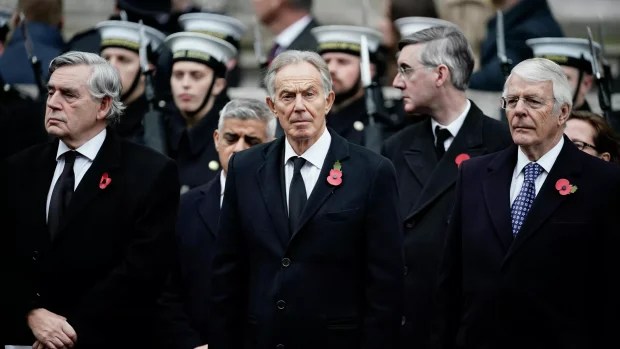
© Aaron Chown
By John Miles – Sputnik – 16.08.2024
As NATO aggression in the former Yugoslavia fully unmasked the alliance as a tool of Western imperialism, newly-released documents reveal controversial former UK Prime Minister Tony Blair was warned of the possible legal consequences of the bombing of a state-owned broadcaster in Belgrade.
“Twenty five years ago, NATO bombed the main studio of Yugoslavia’s state-owned broadcasting company, Radio-Television Serbia (RTS),” writes the independent outlet Declassified UK. “The attack at 2am on 23 April 1999 came amid Bill Clinton and Tony Blair’s ‘humanitarian intervention’ in Kosovo.”
“16 media workers were killed and 19 injured in the strike on RTS, which remains the single most controversial event in NATO’s 78-day military campaign,” notes journalist John McEvoy.
The UK and allied NATO forces claimed to be acting in the interest of protecting ethnic Albanians as ethnic violence broke out on all sides during the breakup of the former socialist Yugoslav republic. But President Slobodan Milošević remained a conspicuous holdout as newly-independent states deregulated their economies in line with neoliberal economic policy advocated by Western governments.
The United States would back numerous “color revolutions” after the fall of the Eastern Bloc, with wealthy donors like George Soros encouraging and standing to benefit from economic liberalization enforced by Western-led institutions like the International Monetary Fund.
The case of Milošević demonstrates a scenario during which the United States was willing to employ substantial military force to seek regime change, paving the way for NATO aggression in countries like Libya and Afghanistan.
Blair claimed the destruction of the RTS headquarters and other civilian targets was justified in the name of dismantling the “dictatorship” of Milošević. Sixteen media workers were killed during the bombing, which Amnesty International labeled a “war crime.”
“Killing journalists does not stop censorship, it only brings more repression,” claimed the International Federation of Journalists in a statement.
“We do not see how the suppression of news sources can serve any useful purpose,” said European Broadcasting Union president Albert Scharf. “Over and beyond the deaths involved, the EBU is concerned about any attempts to limit the rights of audiences to full news services.”
Declassified files now reveal that UK Prime Minister Tony Blair was warned against the depraved attack at the time by British attorney general John Morris, who questioned how the destruction of the broadcast headquarters was related to NATO’s purported cause in ensuring “relief of humanitarian need in Kosovo.”
The UK and the United States launched the illegal act of aggression in Belgrade without a required UN Security Council resolution, demonstrating the lengths NATO was willing to go to to ensure Western hegemony after the end of the Cold War.
“We are moving towards a situation where our aim will become removing Milosevic,” admitted Blair in a note at the time, revealing that regime change was the ultimate motive of the assault. “Plainly Milosevic will threaten the stability of the region as long as he remains.”
NATO forces would go on to strike a number of other civilian targets including Belgrade’s Hotel Jugoslavija and Montenegro’s main airport, with little apparent concern for the climbing death toll. Thousands were killed or wounded by the end of the campaign while elevated rates of cancer and birth defects are still observed due to NATO’s highly controversial use of depleted uranium.
The UK would become the first of multiple Western countries to recognize the disputed breakaway territory of Kosovo in 2008. Future leader of the territory Hashim Thaci, who played a key role during the NATO aggression via his leadership of the so-called Kosovo Liberation Army, is currently on trial on war crimes charges at The Hague.
The International Criminal Tribunal for the Former Yugoslavia, under intense pressure from the United States, would controversially decide against investigating the bombing of the RTS as a war crime.
Why Did Washington Insist on the Kosovo War?
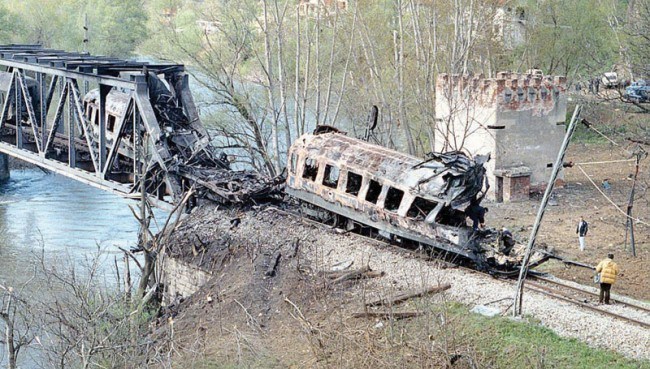
By James George Jatras | Ron Paul Institute | April 9, 2024
The following remarks were delivered at a conference marking the 25th anniversary of the NATO bombing of Serbia: “The 1999 Red-Green Bombing Terror against Serbia,” held on March 20, 2024, at the Bundestag in Berlin hosted by MdB Dr. Rainer Rothfuß and his Alternative for Germany parliamentary group.
In 2004, I appeared as the second defense witness called by Slobodan Milošević at his so-called “trial” before the so-called “International Criminal Tribunal for the former Yugoslavia” at The Hague My testimony was not as an expert witness but as a witness of fact concerning the formulation and implementation of US and western policy. I addressed one specific charge: that – beginning no later than October 1998 – Mr. Milošević was the initiator of a criminal conspiracy to drive the Albanians out of Kosovo and Metohija on the basis of their ethnicity.
There was one little problem with this accusation: there was absolutely zero direct evidence for it. No written order to this effect was ever produced. No person testified as to having received, transmitted, or even heard of such an instruction. Rather, the claim was based solely on circumstantial inferences of events starting from October 1998.
Thus, the heart of my testimony related to a paper I issued on August 12, 1998, as an analyst at the US Senate Republican Policy Committee, titled “Bosnia II: The Clinton Administration Sets Course for NATO Intervention in Kosovo.” In that paper, working solely from open sources, I detailed how, at that time – fully two months before the Milošević-led supposed “criminal conspiracy” came into effect —
“ … planning for a U.S.-led NATO intervention in Kosovo is now largely in place, …. The only missing element appears to be an event—with suitably vivid media coverage—that would make intervention politically salable, even imperative, in the same way that [the] Administration finally decided on intervention in Bosnia in 1995 after a series of ‘Serb mortar attacks’ took the lives of dozens of civilians—attacks, which, upon closer examination, may in fact have been the work of the Muslim regime in Sarajevo, the main beneficiary of the intervention. . . That the Administration is waiting for a similar ‘trigger’ in Kosovo is increasingly obvious: [As reported in the Washington Post, August 4, 1998], ‘A senior U.S. Defense Department official who briefed reporters on July 15 noted that “we’re not anywhere near making a decision for any kind of armed intervention in Kosovo right now, … [but] I think if some levels of atrocities were reached that would be intolerable, that would probably be a trigger”.’ ”
Now, if I was aware of this as early as August 1998, so were a lot of other people in Washington. I submitted to the “Tribunal” that in light of my paper, all interpretations of events would have to be drastically reevaluated. The issue wasn’t any longer whether Belgrade was planning an expulsion but that Washington was looking for a pretext for aggression.
(My cross-examination by prosecutor Geoffrey Nice (later Sir, based on his work at The Hague), asked me barely a word about my testimony. Rather, he interrogated me about my ethnic origins (Greek, from four Spartan grandparents), my religion (Orthodox Christian), and my opinions about the Islamic challenge to European, Christian civilization (negative).)
As we know, in due course the suitable “trigger” was found, with the so-called “Račak massacre” of January 1999. The key figure in “selling” Račak was William Walker. As described by Mark Ames and Matt Taibbi (now of Rolling Stone) in their article “Meet Mr. Massacre,” published in the now-defunct The Exile of February 10, 2000:
Years from now, when the war in Serbia is over and the dust has settled, historians will point to January 15, 1999 as the day the American Death Star became fully operational.
That was the date on which an American diplomat named William Walker brought his OSCE war crimes verification team to a tiny Kosovar village called Račak to investigate an alleged Serb massacre of ethnic Albanian peasants. After a brief review of the town’s 40-odd bullet-ridden corpses, Walker searched out the nearest television camera and essentially fired the starting gun for the war.
From what I saw, I do not hesitate to describe the crime as a massacre, a crime against humanity,’ he said. ‘Nor do I hesitate to accuse the government security forces of responsibility.’
We all know how Washington responded to Walker’s verdict; it quickly set its military machine in motion, and started sending out menacing invitations to its NATO friends to join the upcoming war party.
Focus on that phrase: “the American Death Star became fully operational.” Kosovo became the template that we then took on the road in one form or another in Afghanistan, Iraq, Libya, Syria, Yemen. Ukraine.
But the question still lingers: Why? Why was Washington so insistent that we and our NATO satelli– oops – “allies” needed to launch that war? Why did then-Secretary of State Madeleine Albright reveal in confidence, according to a reliable source, that at Rambouillet “We intentionally set the bar too high for the Serbs to comply. They need some bombing, and that’s what they are going to get”?
Some people will tell you it was about putting a NATO base, Camp Bondsteel, in a strategic location. Or that we wanted to clear the way for an East-West energy pipeline across the Balkans. Or that we coveted the mineral wealth of the Trepča mines. Or to secure the transit route for Afghan opium processed into heroin bound for Europe.
Certainly, all of our various interventions line a lot of a pockets, but in more than three decades of work in and around the Washington apparat, I never heard anyone point to such concrete and, frankly, normal if immoral imperial considerations.
Rather, answers must instead be sought within the larger perspective of American policy since the end of the first Cold War in 1991 and the development of the current one in the course of the 1990s: the American “unipolar moment,” as the bipartisan US policy nomenklatura sought to consolidate and perpetuate its hegemonic control over the entire planet, taking advantage of the vacuum left by the demise of the USSR. Perhaps the fullest expression of this was a 1996 Foreign Affairs article by neoconservative ideologists William Kristol and Robert Kagan (NOTE: Victoria Nuland’s husband), misleadingly titled “Toward a Neo-Reaganite Foreign Policy,” in which they called for the US to establish and maintain indefinitely “benevolent global hegemony” — in other words, perpetual American world domination.
Kristol and Kagan laid out virtually all of the elements that have guided US global policy during the ensuing years. It is no accident that Republican neoconservatives were enthusiastic supporters of Bill Clinton’s Balkan interventions of the 1990s, under the guidance of people like then-Secretary of State Madeleine Albright, who once opined regarding the sanctions-related deaths of a half million Iraqi children that “the price is worth it.” In the US establishment, there is little dissent on either side of the partisan aisle with Albright’s view that a militant United States has a special wisdom: “If we have to use force, it is because we are America; we are the indispensable nation. We stand tall and we see further than other countries into the future …”
The result is a kind of neo-Bolshevik ideology, where, as the vanguard of all progressive humanity, the US leadership class sees itself as the midwife of history. America took the path (as characterized by Russian Foreign Minister Sergey Lavrov) of the “replication of the experience of Bolshevism and Trotskyism”—morphing ourselves into a new Evil Empire in place of the old one. (Anyone familiar with the origins of America’s neoconservatives understands that the Trotskyite reference is not just rhetorical.)
Which brings us back to the “Why?” regarding Kosovo. When the dissolution of Yugoslavia kicked off in June 1991, largely at the initiative of Austria and Germany, official Washington was terrified that with the end of the Soviet bloc Europe might become “whole and free” – but without us. What then could be the future of Lord Hastings Lionel Ismay’s mission for NATO of keeping the Americans in Europe, the Russians out, and the Germans down? Europe, the crown jewel of the Global American Empire was slipping away.
Hence, as former Chairman of the Senate Foreign Relations Committee Richard Lugar (R-Indiana) indicated, NATO needed to go “out of area or out of business.” Starting in spring 1992, Washington moved swiftly to expand the conflict from Slovenia and Croatia (where it had been relatively contained) to Bosnia and Herzegovina. There the US became the vociferous champion of the Muslim faction, illegally shipping in al-Qaeda fighters and Iranian weapons via covert C-130 flights into Tuzla. We then engaged in a little demonstrative bombing of the Bosnian Serbs to set the stage for the Dayton Agreement. The arsonist sets the fire, so then he can be the hero rushing to the rescue: “See, you silly ‘dispensable’ European children? You just can’t get along without us …”
Following Dayton, Kosovo was the other shoe that needed to drop – with appropriate violence – to ensure that Europe was totally, abjectly, humiliatingly subservient to the United States through NATO, with the passive complicity of NATO’s concubine, the European Union. The corollary was that, just as the Serbs had no legitimate voice in determining post-Yugoslav structures, the Russians understood they had no legitimate voice in European security arrangements. These would be decided without them.
Now, of course, with defeat looming in Ukraine and with the broader Middle East on the edge of a regional conflagration, with many in Washington beating the drums for war with Iran or even China, the Global American Empire’s “unipolar” moment is coming to an end, one way or the other, either with a bang or with a whimper. Unfortunately, neither in Washington, nor in Berlin or other European capitals, with the exception of Budapest, are decisions made by people who can be regarded as mentally and morally healthy human beings, much less patriots.
The next few months and years promise to be a period of disorder and acute danger. The question is, can we – Americans and Europeans alike – find a path to governance that can secure a future for our peoples?
Samantha Power and the Power of a Word
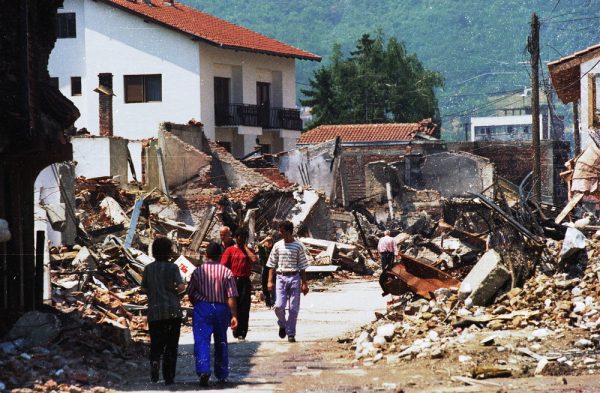
BY DIANA JOHNSTONE • UNZ REVIEW • APRIL 3, 2024
Twenty-five years ago, NATO was bombing Serbia as the first performance in its new role. The collapse of the Soviet Union had deprived the military alliance of its initial official role of defending its member states from a theoretical communist threat. Under no threat and devoid of UN Security Council approval, NATO assumed the self-ordained role of virtuous defender of allegedly oppressed minorities by bombing what was left of largely dismantled Yugoslavia in the spring of 1999 on behalf of Albanian rebels in the Serbian province of Kosovo.
NATO’s air attacks on the Balkan nation were the practical application of a new post-Cold War doctrine. To succeed, this doctrine relied on Western media to report on crisis areas with the appropriate mixture of exaggerations, omissions and outright lies to justify NATO’s virtuous interventions. The military industrial complex could breathe easy and a new generation of journalists began successful careers eagerly spinning their reports to serve the new humanitarian war ideology.
None was more successful than Dublin-born Samantha Power, whose novice reports from Bosnia in the mid-1990s provided the basis for her 2002 book on “genocide” which “quickly became an international sensation, glowingly reviewed almost everywhere, a huge bestseller that won her a Pulitzer Prize and launched her career as a leading figure in human rights doctrine.” She has gone on from one top governmental post to another, a Washington star, urging the United States to intervene on moral grounds.
Samantha Power owes her remarkable success to her talent as a writer, her ambition, her striking presence, but not least to the man at the origins of the whole humanitarian war policy.
That was none other than Morton Isaac Abramowitz, a highly influential member of the foreign policy establishment and the main inventor of what would become the “R2P” (Responsibility to Protect) doctrine. The crucial policy contribution of Abramowitz is explained at the start of my 2002 book, Fools’ Crusade, as follows:[1]
As president of the Carnegie Endowment for International Peace in the early 1990s, Abramowitz headed a project to develop a new U.S. foreign policy for the post-Cold War era. Rather than identifying “threats”, especially at a time when few threats could be seen, a successful new policy needed to combine promotion of U.S. interests with proclamation of U.S. “ideals”.
Theory and Practice
At the Carnegie Endowment in 1992, Abramowitz published the theory of the new U.S. “humanitarian intervention” policy as Self-Determination in the New World Order.
“The vision of a ‘new world order’ since 1990 has been a world with one superpower – the United States – in which the rule of law supplants the rule of the jungle, disputes are settled peacefully, aggression is firmly met by collective resistance, and all people are justly treated.”
That sounds very nice. But put into practice, “collective resistance” means NATO, and “all people are treated justly” depends on Washington’s preferences. The new rules-based order was not to be confused with traditional international law, based on national sovereignty. Globalization was making national sovereignty outdated (except for the United States). “Ideals” make rules more flexible.
The sovereign nation is being broken down subtly by the pressures of economic globalization. It may also be undermined from within, by domestic insurgencies. In the post-Cold War world, the Carnegie Endowment study noted, “groups within states are staking claims to independence, greater autonomy, or the overthrow of an existing government, all in the name of self-determination”. […] In the future, the authors announced, “humanitarian intervention will become increasingly unavoidable”. The United States will have the final word as to when and how to intervene.
Abramowitz subsequently helped put his theory into practice in crumbling Yugoslavia. He was the eminence grise behind U.S. diplomats, steering the events leading to the “Kosovo war” that split the province of Kosovo off from Serbia. He was advisor to the Kosovo Albanian delegation at the imitation “peace negotiations” staged at Rambouillet to provide an excuse for the bombing of Serbia. The moderate Albanian Kosovo leader Ibrahim Rugova was replaced by the armed gangster, Hashim Thaci. Secretary of State Madeleine Albright set terms no Serbian leader could accept, demanding the right to station NATO troops over the entire country, with full impunity. The Serb side was then blamed for the failure, and NATO began to bomb on March 24, 1999.
Samantha Steals her Way into Bosnia
Back in 1992, fresh out of Yale, 22-year-old Samantha Power was given a position as intern in the office of Abramowitz at the Carnegie Endowment. As a proofreader, she quickly absorbed the new official doctrine. At that time, her boss was obsessed with the conflicts in Bosnia as implicating the future of NATO. Determined to get to Bosnia where the action was, Samantha stole stationery from the neighboring office of Foreign Policy magazine and forged a letter from the editor to the head of the UN Press Office, asking that the UN provide her, as Foreign Policy’s “Balkan correspondent,” with “all necessary access.”[2]
From that time on, her work functioned precisely to advance the new “humanitarian intervention” policy of her mentor, Morton Abramowitz. She recalls that his influence helped her get increasingly important assignments – most crucially, writing about the Srebrenica massacre for The Washington Post.
With the Srebrenica reports, the term “genocide” emerged as the power word that could give NATO its new mission.
The Western press corps based in Sarajevo tended to become emotionally involved with the Muslim side which was its principal news source. Missing from their dispatches were reports on Muslim massacres of Serbs villages or on the well-armed Islamic fighters who joined the Muslim side from Afghanistan and Arab countries, some of them settling permanently in Bosnia.
When Bosnian Serb forces captured the Muslim base at Srebrenica in July 1995, they evacuated women, children and the aged to safety, while men fled, fearing retaliation. Many were killed in unclear circumstances.
Without reference to such context, Western media focused on reports of a massacre of 8,000 male prisoners as a unique event which branded the Serbs as the guilty party in the three-sided civil war. With the Srebrenica reports, the term “genocide” emerged as the power word that could give NATO its new mission.
Calling Srebrenica “genocide” provided the argument for NATO bombing: if Serbs committed genocide in Bosnia, it implied that Serbs were genocidal and risked committing genocide in Kosovo unless NATO intervened. This theory was supported by wildly inaccurate accusations voiced by leading Western politicians during the bombing campaign.
That was the story that was sold to the public by politicians and the media. From the start, the Serb majority in Yugoslavia had been portrayed as invaders in their own country, with everyone else as victims. Thus was destroyed the last semi-socialist, nonaligned country in Europe.
The Kosovo war indeed combined U.S. “interests and ideals”. The ideals were preventing a genocide that never would have taken place (and also, incidentally, preventing a negotiation that could have settled the whole conflict as well). The interests included the immediate construction by the Americans of a giant U.S. military base on the territory of Kosovo, once Serbian forces were obliged to leave.
Genocide and R2P
Samantha Power’s 2002 book was subtitled “America in the Age of Genocide”. To speak of the present as an “age of genocide” is wildly melodramatic, but the purpose is to place virtuous America in the center of drastic moral demands. America must save the world from its genocidal self. “Genocide” was thereby promoted as the most potent pretext for U.S. military intervention – precisely by deploring its absence, both in Bosnia and more convincingly, in Rwanda. The Clinton administration was certainly not going to intervene in Rwanda, because the bloody chaos was in fact favoring the conquest of Rwanda by Paul Kagame and his army, which had invaded Rwanda from Uganda in 1990. Kagame was a favored client of the United States. There was no reason for Washington to interfere with Kagame’s victory.
But the “failure to stop genocide” was an appeal to the liberal conscience to intervene later on, whenever the U.S. was in need a powerful argument to get rid of a someone it wanted to get rid of. Moammer Gaddafi had been on the U.S.-UK hit list for decades, but had made concessions to gain reconciliation. But when Gaddafi’s usual fundamentalist Islamic opponents in Tripoli used the 2011 “Arab spring” to raise protests, the “threat of genocide” alarm was raised on their behalf. In Washington, action to stop Gaddafi from “committing genocide” was urged by Hillary Clinton, Susan Rice and Samantha Power, while Bernard Henri Lévy raised the alarm in Paris. NATO rose to the challenge, destroyed the most economically successful country on the African continent and murdered its leader, creating a flood of refugees to Europe and other disasters. Most of the liberal left cheered.
Today it is widely recognized that the Irak war was based on deceit and ended in disaster. Other U.S. wars are mostly conceded to have been unfortunate mistakes. There are doubts about Libya, due mainly to the refugee flow. But the destruction of Yugoslavia, and in particular the 1999 “Kosovo war”, is still widely accepted in the West as what it was arranged to appear: NATO’s generous humanitarian intervention to prevent “genocide” by racist Serbs against the oppressed Albanian minority.
The distortions of the Bosnia conflict and the Kosovo war were precisely the practical application of the Abramowitz policy: promote minority rebellions to break down national sovereignty and change governments the U.S. doesn’t like, while supplying NATO with a new geographically unlimited mission of “humanitarian intervention”. Yugoslavia was the starting point of the whole aggressive post-Cold War U.S. policy as “single superpower” determining the world order, using the idealistic pretexts set out by Abramowitz. Young Samantha Power, who was very smart, got the point and ambitiously cheated her way into a supporting role as reporter in the Bosnia spectacle, which she eventually transformed into an astonishingly successful career.
I was in Kosovo on my own in months prior to the NATO bombardment and saw quite clearly that in that small province, the Serbs were a frightened minority while Albanians were already tasting their future triumph. There was absolutely no danger of a Serbian “genocide” of Albanians. But Western editors kept sending in ignorant young aspiring journalists, on the lookout for some “Serb atrocity” that could advance their budding career. Editors rejected any report that went in a different direction. It was at that time just plain impossible to publish an unbiased report. I know from experience.
Above all, breaking up Yugoslavia was an exercise in subsequent efforts to undermine the Russian Federation, by inciting the Federation’s ethnic minorities against the Russians. Ukraine was the crucial battering ram. I always used to think of Ukraine when studying the conflicts in the Krajina regions of Croatia and Bosnia, as both words have the same root (border land) and suffered from similar conflicts, notably in World War II. Western powers had revived the Nazi-supported Croatian nationalism against the Serbs to break up Yugoslavia. They would revive much more virulent Nazi-supported Ukrainian nationalism against Russian-speakers in Eastern Ukraine, in an effort to weaken and eventually even break up the Russian Federation.
And for the United States, the humanitarian “ideals” of supporting minorities would be compensated by the major strategic “interest” of eventually gaining control of Crimea, and with it, Russia’s main naval base in Sebastopol. Putin did what any Russian leader not brain-dead would have done: he headed off this disaster by mobilizing the Russian inhabitants of Crimea to vote to return to Russia, which they had never chosen to leave. This obvious act of self-determination is denounced in the West as an invasion.
The Ideological Backlash
Unfortunately, the blatantly tragic misuse of the “humanitarian intervention” or R2P doctrine in Libya has not managed to achieve its discredit. It is threatened now by the danger that it is changing sides in the very global conflicts it has stimulated.
The referendum in Crimea was a democratic measure of self-determination that fit the Abramowitz standards. The Russian “Special Military Operation” in Ukraine in 2022 was partially motivated by the sort of consideration featured in the Abramowitz doctrine: defense of the population of Donbas, under attack from an ultranationalist regime in Kiev. Of course, Western governments and media have simply totally ignored any Russia appeal to the ideals of human rights and self-determination, which they consider their own private property as self-declared unique “democracies”. Russia is classed as an “autocracy” whose interests must be malevolent and thus don’t count.
A greater threat to the West’s self-proclaimed monopoly on virtue is coming from Israel’s merciless attack on the people of Gaza. Most of the Global South and growing sections of Western populations are horrified by Israel’s destruction of hospitals, mass murder of children and efforts to starve the Palestinians. They see Israel, with full Western backing, committing Genocide – the real thing this time, out in the open, blatant and unrelenting.
The NATO war machine may have to conjure up a new set of moralizing pretexts for its aggressions.
Notes
[1] See Fools’ Crusade: Yugoslavia, NATO and Western Delusions, Pluto Press, 2002, pp 9-10; Monthly Review 2003
[2] Here, with William Burns, Samantha Power discusses her new autobiography The Education of an Idealist and recalls her short term working for Abramowitz at the Carnegie Endowment. https://carnegieendowment.org/2019/09/13/samantha-power-on-education-of-idealist-event-7178
Moscow calls out US’ rules-based order in Europe
BY M. K. BHADRAKUMAR | INDIAN PUNCHLINE | MARCH 27, 2023
Baroness Goldie is an experienced Scottish politician and life peer who served as Leader of the Scottish Conservative Party from 2005 to 2011 and as the UK’s Minister of State for Defence since 2019. She is anything but a party girl like Liz Truss who often had to swallow her indiscreet words betraying ignorance.
Certainly, Baroness Goldie understood perfectly well the implications of what she put down in a written statement at the House of Lords on March 20 in her answer to Lord Hylton’s seemingly innocuous question: “To ask His Majesty’s Government whether any of the ammunition currently being supplied to Ukraine contains depleted uranium.” (By the way, Lord Hylton is one of 92 hereditary peers elected to remain in the House of Lords; he is currently the longest-serving Crossbench member of the House of Lords, since 1968, and is a dynamic campaigner for peace and the interests of the vulnerable and the marginalised.)
It is a fair guess that the UK Defence Secretary Ben Wallace kept 10 Downing Street informed — and even more important, had prior consultations and concurrence with his US counterpart, Secretary of Defence Lloyd Austin — before Baroness Goldie made the statement.
Both Wallace and Austin are military people and understand why ammunition tipped with “depleted uranium” is needed in the current stage of the proxy war in Ukraine if at all Kiev is to launch a “credible counter-offensive” in spring when the tide of the war has distinctly turned in Russia’s favour.
Equally, both must be well aware that the legality of the NATO intervention in Yugoslavia is still an open issue. In response to NATO’s bombing campaign, former Yugoslavia instituted proceedings before the International Court of Justice on April 29, 1999, against the ten NATO members directly involved in the attack — Belgium, Canada, France, Germany, Italy, the Netherlands, Portugal, Spain, the UK, and the US — citing a series of violations of the law of nations (which included the obligation not to use prohibited weapons.)
Although the ICJ rejected Belgrade’s request for provisional measures, it, nonetheless, declared itself profoundly concerned with the use of force in Yugoslavia, which “under the present circumstances … raises very serious issues of international law.” Suffice to say, the cases brought by Yugoslavia against the NATO respondents still remain on the ICJ’s docket although the petitioner got dismembered.
Make no mistake, Washington and London are consciously repeating the war crime in the former Yugoslavia. The Anglo-Saxon clique’s core objective is a calculated escalation of the proxy war that is certain to draw forth a robust reaction by Moscow, as predictable as night follows day.
Indeed, that is precisely what happened when Russian President Vladimir Putin announced on Saturday that Russia will deploy its tactical nuclear weapons in Belarus. Putin linked this to a request from Belarus in reaction to Baroness Goldie’s statement in London a week ago.
More importantly, Putin also drew the analogy of the US placing its tactical nuclear weapons on the territories of the allied NATO countries for decades.
The EU and NATO went ballistic after Putin’s disclosure. EU’s chief diplomat Josep Borrell said on Sunday called out Moscow’s decision as “an irresponsible escalation and threat to European security.” He threatened to impose “further sanctions” against Belarus!
A NATO spokeswoman called Moscow’s decision “dangerous and irresponsible.” Interestingly, though, the Biden administration neatly side-stepped the issue, focusing instead that the US has not seen any signs that Russia has moved nuclear weapons to Belarus or anywhere else!
In good measure, National Security Council spokesperson John Kirby added, “We’ve in fact seen no indication he (Putin) has any intention to use nuclear weapons, period, inside Ukraine.”
But then, Putin also made it clear that Russia would first complete construction on a storage facility in Belarus for the tactical nuclear weapons by July 1.
Kirby is fudging. What is the game plan? First, the Anglo-Saxon clique would hope that the issue will create further antagonism in Europe against Russia and Putin personally and would rally European countries behind the Biden administration at a time when fault lines were appearing within the transatlantic alliance over a protracted war in Ukraine that might be catastrophic for European economies.
Washington is hard-pressed to respond to Putin’s remark that Russia is only doing something that the US has been doing for decades. The point is, a mutual commitment not to deploy nuclear weapons in third countries was one of the proposals Moscow made to Washington in December 2021, alongside a commitment that Ukraine would not join NATO. The US ignored it and precipitated the Russian special military operation in Ukraine.
The crux of the matter is, as with the Cuban missile crisis of 1962, the Russian decision on tactical nuclear weapons in Belarus is retaliatory, drawing attention to the US missiles stationed close to its borders. (An estimated 100 nuclear weapons are stored in vaults in five European countries — Belgium, Germany, Italy, Netherlands and Turkey.)
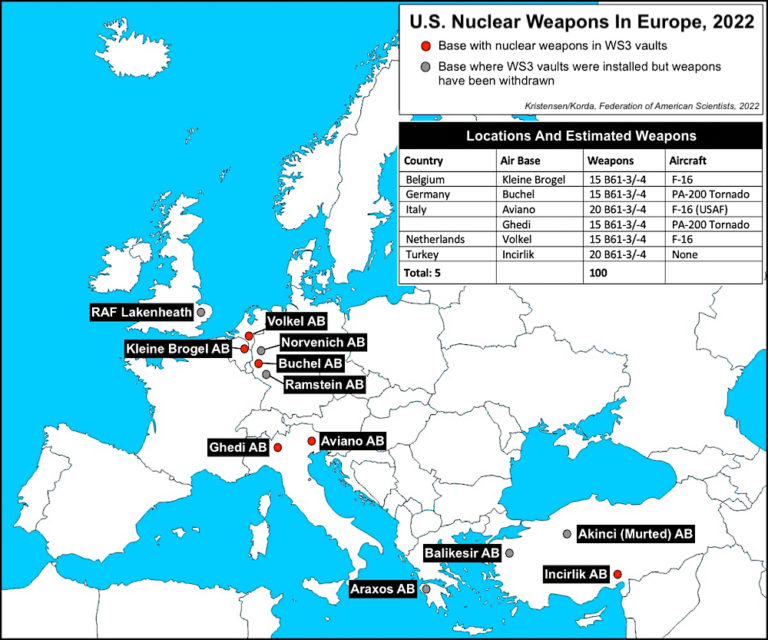
Worse still, the US practices a controversial arrangement known as “nuclear sharing”, under which it installs nuclear equipment on fighter jets of select non-nuclear NATO countries and train their pilots to carry out nuclear strike with US nuclear bombs. This is when the US, being a party to the nuclear Non-Proliferation Treaty (NPT), has promised not to hand over nuclear weapons to other countries, and the non-nuclear countries in the NATO’s sharing arrangement have themselves promised not to receive nuclear weapons from the nuclear weapon states!
NATO declared last year that seven NATO countries have contributed dual-capable aircraft to the nuclear sharing mission. These countries are believed to be the US, Belgium, Germany, Italy, Netherlands, Turkey and Greece. And all are signatories to the NPT!
Welcome to the rules based order! What is perfectly permissible to the “collective West” is forbidden for Russia!
Finally, the diplomatic pirouette has yet another dimension: Britain’s decision to send depleted uranium weaponry to Ukraine is confirming its reputation as the most reckless and unscrupulous state in the whole NATO alliance.
For, there is no question that depleted uranium munitions are radioactive and toxic and their heavy use in the Yugoslavia and Iraq wars has been linked to birth defects and cancers. It has been tied to “the highest rate of genetic damage in any population ever studied” in Fallujah, the city subjected to two brutal US sieges during the invasion of Iraq.
Ironically, the toxicity of depleted uranium munitions has been accepted by many NATO countries and the European Parliament has called for its use to be banned. So, what is Britain up to, behaving like an outlier?
The heart of the matter is that Britain is creating conditions in Europe to base nuclear-armed US bombers in Britain at Lakenheath in Suffolk (which were removed in 1991 in line with the Intermediate Nuclear Forces treaty.)
At a time when the peace movement in Britain is moribund, count on the Russian retaliation to deploy tactical nuclear weapons in Belarus to trigger calls for yet another tit for tat escalation from warmongers and Russophobes. Expect the US bombers to return to Lakenheath in a near future.
No Guilt, No Shame: Western Leaders’ Excuses for NATO Bombing of Yugoslavia
Sputnik – March 24, 2023
Air attacks by NATO forces on Yugoslavia began this day 24 years ago. Between 1,200 and 2,500 people died within two months, and many more saw their lives crumbling into pieces when the US-led coalition unleashed war and destruction in the midst of Europe.
The decision to bomb Yugoslavia was made without the approval of the UN Security Council, and the order was issued to the commander of the allied forces, US General Wesley Clark, by NATO Secretary General Javier Solana.
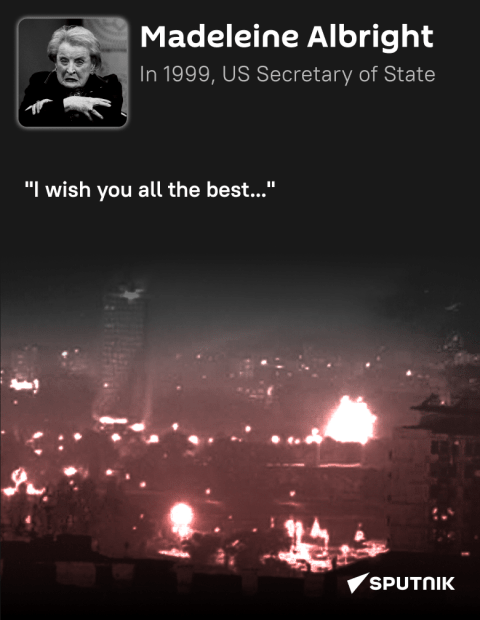
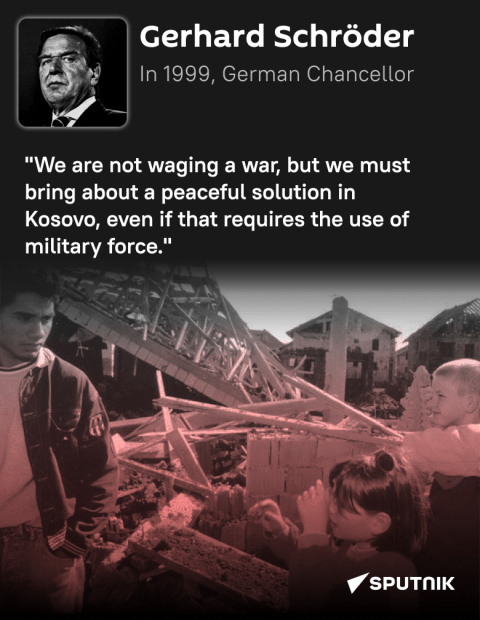
Politicians, generals, and journalists from Europe and America engaged in an abominable competition, trying to justify the massacre and sugar-coat the violation of international laws.
The claims of the then-leaders of Western countries are displayed in this Sputnik gallery – alongside the results of the alliance’s brutal operation.


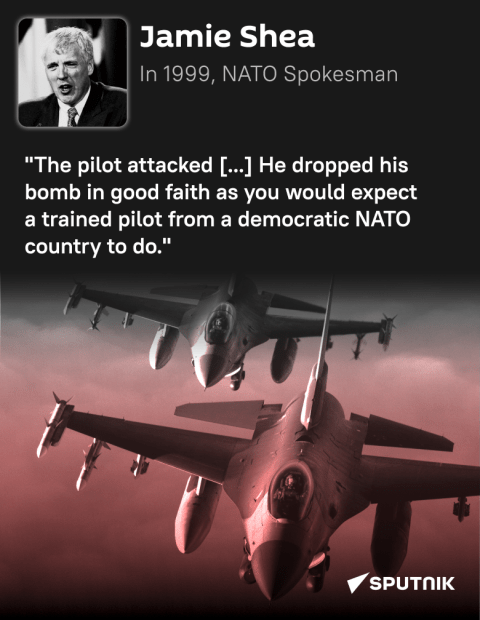


The Specter of Germany Is Rising
By Diana Johnstone | Consortium News | September 12, 2022
The European Union is girding for a long war against Russia that appears clearly contrary to European economic interests and social stability. A war that is apparently irrational – as many are – has deep emotional roots and claims ideological justification. Such wars are hard to end because they extend outside the range of rationality.
For decades after the Soviet Union entered Berlin and decisively defeated the Third Reich, Soviet leaders worried about the threat of “German revanchism.” Since World War II could be seen as German revenge for being deprived of victory in World War I, couldn’t aggressive German Drang nach Osten be revived, especially if it enjoyed Anglo-American support? There had always been a minority in U.S. and U.K. power circles that would have liked to complete Hitler’s war against the Soviet Union.
It was not the desire to spread communism, but the need for a buffer zone to stand in the way of such dangers that was the primary motivation for the ongoing Soviet political and military clampdown on the tier of countries from Poland to Bulgaria that the Red Army had wrested from Nazi occupation.
This concern waned considerably in the early 1980s as a young German generation took to the streets in peace demonstrations against the stationing of nuclear “Euromissiles” which could increase the risk of nuclear war on German soil. The movement created the image of a new peaceful Germany. I believe that Mikhail Gorbachev took this transformation seriously.
On June 15, 1989, Gorbachev came to Bonn, which was then the modest capital of a deceptively modest West Germany. Apparently delighted with the warm and friendly welcome, Gorbachev stopped to shake hands with people along the way in that peaceful university town that had been the scene of large peace demonstrations.
I was there and experienced his unusually warm, firm handshake and eager smile. I have no doubt that Gorbachev sincerely believed in a “common European home” where East and West Europe could live happily side by side united by some sort of democratic socialism.
Gorbachev died at age 91 two weeks ago, on Aug. 30. His dream of Russia and Germany living happily in their “common European home” had soon been fatally undermined by the Clinton administration’s go-ahead to eastward expansion of NATO. But the day before Gorbachev’s death, leading German politicians in Prague wiped out any hope of such a happy end by proclaiming their leadership of a Europe dedicated to combating the Russian enemy.
These were politicians from the very parties – the SPD (Social Democratic Party) and the Greens – that took the lead in the 1980s peace movement.
German Europe Must Expand Eastward
German Chancellor Olaf Scholz is a colorless SPD politician, but his Aug. 29 speech in Prague was inflammatory in its implications. Scholz called for an expanded, militarized European Union under German leadership. He claimed that the Russian operation in Ukraine raised the question of “where the dividing line will be in the future between this free Europe and a neo-imperial autocracy.” We cannot simply watch, he said, “as free countries are wiped off the map and disappear behind walls or iron curtains.”
(Note: the conflict in Ukraine is clearly the unfinished business of the collapse of the Soviet Union, aggravated by malicious outside provocation. As in the Cold War, Moscow’s defensive reactions are interpreted as harbingers of Russian invasion of Europe, and thus a pretext for arms buildups.)
To meet this imaginary threat, Germany will lead an expanded, militarized EU. First, Scholz told his European audience in the Czech capital, “I am committed to the enlargement of the European Union to include the states of the Western Balkans, Ukraine, Moldova and, in the long term, Georgia”. Worrying about Russia moving the dividing line West is a bit odd while planning to incorporate three former Soviet States, one of which (Georgia) is geographically and culturally very remote from Europe but on Russia’s doorstep.
2022 Fall Fund Drive
In the “Western Balkans”, Albania and four extremely weak statelets left from former Yugoslavia (North Macedonia, Montenegro, Bosnia-Herzegovina and widely unrecognized Kosovo) mainly produce emigrants and are far from EU economic and social standards. Kosovo and Bosnia are militarily occupied de facto NATO protectorates. Serbia, more solid than the others, shows no signs of renouncing its beneficial relations with Russia and China, and popular enthusiasm for “Europe” among Serbs has faded.
Adding these member states will achieve “a stronger, more sovereign, geopolitical European Union,” said Scholz. A “more geopolitical Germany” is more like it. As the EU grows eastward, Germany is “in the center” and will do everything to bring them all together. So, in addition to enlargement, Scholz calls for “a gradual shift to majority decisions in common foreign policy” to replace the unanimity required today.
What this means should be obvious to the French. Historically, the French have defended the consensus rule so as not to be dragged into a foreign policy they don’t want. French leaders have exalted the mythical “Franco-German couple” as guarantor of European harmony, mainly to keep German ambitions under control.
But Scholz says he doesn’t want “an EU of exclusive states or directorates,” which implies the final divorce of that “couple.” With an EU of 30 or 36 states, he notes, “fast and pragmatic action is needed.” And he can be sure that German influence on most of these poor, indebted and often corrupt new Member States will produce the needed majority.
France has always hoped for an EU security force separate from NATO in which the French military would play a leading role. But Germany has other ideas. “NATO remains the guarantor of our security,” said Scholz, rejoicing that President Biden is “a convinced trans-atlanticist.”
“Every improvement, every unification of European defense structures within the EU framework strengthens NATO,” Scholz said. “Together with other EU partners, Germany will therefore ensure that the EU’s planned rapid reaction force is operational in 2025 and will then also provide its core.
This requires a clear command structure. Germany will face up to this responsibility “when we lead the rapid reaction force in 2025,” Scholz said. It has already been decided that Germany will support Lithuania with a rapidly deployable brigade and NATO with further forces in a high state of readiness.
Serving to Lead … Where?
In short, Germany’s military buildup will give substance to Robert Habeck’s notorious statement in Washington last March that: “The stronger Germany serves, the greater its role.” The Green’s Habeck is Germany’s economics minister and the second most powerful figure in Germany’s current government.
The remark was well understood in Washington: by serving the U.S.-led Western empire, Germany is strengthening its role as European leader. Just as the U.S. arms, trains and occupies Germany, Germany will provide the same services for smaller EU states, notably to its east.
Since the start of the Russian operation in Ukraine, German politician Ursula von der Leyen has used her position as head of the EU Commission to impose ever more drastic sanctions on Russia, leading to the threat of a serious European energy crisis this winter. Her hostility to Russia seems boundless. In Kiev last April she called for rapid EU membership for Ukraine, notoriously the most corrupt country in Europe and far from meeting EU standards. She proclaimed that “Russia will descend into economic, financial and technological decay, while Ukraine is marching towards a European future.” For von der Leyen, Ukraine is “fighting our war.” All of this goes far beyond her authority to speak for the EU’s 27 Members, but nobody stops her.
Germany’s Green Party foreign minister Annalena Baerbock is every bit as intent on “ruining Russia.” Proponent of a “feminist foreign policy”, Baerbock expresses policy in personal terms. “If I give the promise to people in Ukraine, we stand with you as long as you need us,” she told the U.S. National Endowment for Democracy (NED)-sponsored Forum 2000 in Prague on Aug. 31, speaking in English. “Then I want to deliver no matter what my German voters think, but I want to deliver to the people of Ukraine.”
“People will go on the street and say, we cannot pay our energy prices, and I will say, ‘Yes I know so we will help you with social measures. […] We will stand with Ukraine and this means the sanctions will stay also til winter time even if it gets really tough for politicians.’”
Certainly, support for Ukraine is strong in Germany, but perhaps because of the looming energy shortage, a recent Forsa poll indicates that some 77 percent of Germans would favor diplomatic efforts to end the war – which should be the business of the foreign minister. But Baerbock shows no interest in diplomacy, only in “strategic failure” for Russia – however long it takes.
In the 1980s peace movement, a generation of Germans was distancing itself from that of their parents and vowed to overcome “enemy images” inherited from past wars. Curiously, Baerbock, born in 1980, has referred to her grandfather who fought in the Wehrmacht as somehow having contributed to European unity. Is this the generational pendulum?
The Little Revanchists
There is reason to surmise that current German Russophobia draws much of its legitimization from the Russophobia of former Nazi allies in smaller European countries.
While German anti-Russian revanchism may have taken a couple of generations to assert itself, there were a number of smaller, more obscure revanchisms that flourished at the end of the European war that were incorporated into United States Cold War operations. Those little revanchisms were not subjected to the denazification gestures or Holocaust guilt imposed on Germany. Rather, they were welcomed by the C.I.A., Radio Free Europe and Congressional committees for their fervent anticommunism. They were strengthened politically in the United States by anticommunist diasporas from Eastern Europe.
Of these, the Ukrainian diaspora was surely the largest, the most intensely political and the most influential, in both Canada and the American Middle West. Ukrainian fascists who had previously collaborated with Nazi invaders were the most numerous and active, leading the Bloc of Anti-Bolshevik Nations with links to German, British and U.S. Intelligence.
Eastern European Galicia, not to be confused with Spanish Galicia, has been back and forth part of Russia and Poland for centuries. After World War II it was divided between Poland and Ukraine. Ukrainian Galicia is the center of a virulent brand of Ukrainian nationalism, whose principal World War II hero was Stepan Bandera. This nationalism can properly be called “fascist” not simply because of superficial signs – its symbols, salutes or tatoos – but because it has always been fundamentally racist and violent.
Incited by Western powers, Poland, Lithuania and the Habsburg Empire, the key to Ukrainian nationalism was that it was Western, and thus superior. Since Ukrainians and Russians stem from the same population, pro-Western Ukrainian ultra-nationalism was built on imaginary myths of racial differences: Ukrainians were the true Western whatever-it-was, whereas Russians were mixed with “Mongols” and thus an inferior race. Banderist Ukrainian nationalists have openly called for elimination of Russians as such, as inferior beings.
So long as the Soviet Union existed, Ukrainian racial hatred of Russians had anticommunism as its cover, and Western intelligence agencies could support them on the “pure” ideological grounds of the fight against Bolshevism and Communism. But now that Russia is no longer ruled by communists, the mask has fallen, and the racist nature of Ukrainian ultra-nationalism is visible – for all who want to see it.
However, Western leaders and media are determined not to notice.
Ukraine is not just like any Western country. It is deeply and dramatically divided between Donbass in the East, Russian territories given to Ukraine by the Soviet Union, and the anti-Russian West, where Galicia is located. Russia’s defense of Donbass, wise or unwise, by no means indicates a Russian intention to invade other countries. This false alarm is the pretext for the remilitarization of Germany in alliance with the Anglo-Saxon powers against Russia.
The Yugoslav Prelude
This process began in the 1990s, with the breakup of Yugoslavia.
Yugoslavia was not a member of the Soviet bloc. Precisely for that reason, the country got loans from the West which in the 1970s led to a debt crisis in which the leaders of each of the six federated republics wanted to shove the debt onto others. This favored separatist tendencies in the relatively rich Slovenian and Croatian republics, tendencies enforced by ethnic chauvinism and encouragement from outside powers, especially Germany.
During World War II, German occupation had split the country apart. Serbia, allied to France and Britain in World War I, was subject to a punishing occupation. Idyllic Slovenia was absorbed into the Third Reich, while Germany supported an independent Croatia, ruled by the fascist Ustasha party, which included most of Bosnia, scene of the bloodiest internal fighting. When the war ended, many Croatian Ustasha emigrated to Germany, the United States and Canada, never giving up the hope of reviving secessionist Croatian nationalism.
In Washington in the 1990s, members of Congress got their impressions of Yugoslavia from a single expert: 35-year-old Croatian-American Mira Baratta, assistant to Sen. Bob Dole (Republican presidential candidate in 1996). Baratta’s grandfather had been an important Ustasha officer in Bosnia and her father was active in the Croatian diaspora in California. Baratta won over not only Dole but virtually the whole Congress to the Croatian version of Yugoslav conflicts blaming everything on the Serbs.
In Europe, Germans and Austrians, most notably Otto von Habsburg, heir to the defunct Austro-Hungarian Empire and member of the European Parliament from Bavaria, succeeded in portraying Serbs as the villains, thus achieving an effective revenge against their historic World War I enemy, Serbia. In the West, it became usual to identify Serbia as “Russia’s historic ally”, forgetting that in recent history Serbia’s closest allies were Britain and especially France.
In September 1991, a leading German Christian Democratic politician and constitutional lawyer explained why Germany should promote the breakup of Yugoslavia by recognizing the Slovenian and Croat secessionist Yugoslav republics. (Former CDU Minister of Defense Rupert Scholz at the 6th Fürstenfeldbrucker Symposium for the Leadership of the German Military and Business, held September 23 – 24, 1991.)
By ending the division of Germany, Rupert Scholz said, “We have, so to speak, overcome and mastered the most important consequences of the Second World War … but in other areas we are still dealing with the consequences of the First World War” – which, he noted “started in Serbia.”
“Yugoslavia, as a consequence of the First World War, is a very artificial construction, never compatible with the idea of self-determination,” Rupert Scholz said. He concluded: “In my opinion, Slovenia and Croatia must be immediately recognized internationally. (…) When this recognition has taken place, the Yugoslavian conflict will no longer be a domestic Yugoslav problem, where no international intervention can be permitted.”
And indeed, recognition was followed by massive Western intervention which continues to this day. By taking sides, Germany, the United States and NATO ultimately produced a disastrous result, a half dozen statelets, with many unsettled issues and heavily dependent on Western powers. Bosnia-Herzegovina is under military occupation as well as the dictates of a “High Representative” who happens to be German. It has lost about half its population to emigration.
Only Serbia shows signs of independence, refusing to join in Western sanctions on Russia, despite heavy pressure. For Washington strategists the breakup of Yugoslavia was an exercise in using ethnic divisions to break up larger entities, the USSR and then Russia.
Humanitarian Bombing
Western politicians and media persuaded the public that the 1999 NATO bombing of Serbia was a “humanitarian” war, generously waged to “protect the Kosovars” (after multiple assassinations by armed secessionists provoked Serbian authorities into the inevitable repression used as pretext for the bombing).
But the real point of the Kosovo war was that it transformed NATO from a defensive into an aggressive alliance, ready to wage war anywhere, without U.N. mandate, on whatever pretext it chose.
This lesson was clear to the Russians. After the Kosovo war, NATO could no longer credibly claim that it was a purely “defensive” alliance.
As soon as Serbian President Milosevic, to save his country’s infrastructure from NATO destruction, agreed to allow NATO troops to enter Kosovo, the U.S. unceremoniously grabbed a huge swath territory to build the its first big U.S. military base in the Balkans. NATO troops are still there.
Just as the United States rushed to build that base in Kosovo, it was clear what to expect of the U.S. after it succeeded in 2014 to install a government in Kiev eager to join NATO. This would be the opportunity for the U.S. to take over the Russian naval base in Crimea. Since it was known that the majority of the population in Crimea wanted to return to Russia (as it had from 1783 to 1954), Putin was able to forestall this threat by holding a popular referendum confirming its return.
East European Revanchism Captures the EU
The call by German Chancellor Scholz to enlarge the European Union by up to nine new members recalls the enlargements of 2004 and 2007 that brought in twelve new members, nine of them from the former Soviet bloc, including the three Baltic States once part of the Soviet Union.
That enlargement already shifted the balance eastward and enhanced German influence. In particular, the political elites of Poland and especially the three Baltic States, were heavily under the influence of the United States and Britain, where many had lived in exile during Soviet rule. They brought into EU institutions a new wave of fanatic anticommunism, not always distinguishable from Russophobia.
The European Parliament, obsessed with virtue signaling in regard to human rights, was particularly receptive to the zealous anti-totalitarianism of its new Eastern European members.
Revanchism and the Memory Weapon
As an aspect of anti-communist lustration, or purges, Eastern European States sponsored “Memory Institutes” devoted to denouncing the crimes of communism. Of course, such campaigns were used by far-right politicians to cast suspicion on the left in general. As explained by European scholar Zoltan Dujisin, “anticommunist memory entrepreneurs” at the head of these institutes succeeded in lifting their public information activities from the national, to the European Union level, using Western bans on Holocaust denial to complain, that while Nazi crimes had been condemned and punished at Nuremberg, communist crimes had not.
The tactic of the anti-communist entrepreneurs was to demand that references to the Holocaust be accompanied by denunciations of the Gulag. This campaign had to deal with a delicate contradiction since it tended to challenge the uniqueness of the Holocaust, a dogma essential to gaining financial and political support from West European memory institutes.
In 2008, the EP adopted a resolution establishing August 23 as “European Day of Remembrance for the victims of Stalinism and Nazism” – for the first time adopting what had been a fairly isolated far right equation. A 2009 EP resolution on “European Conscience and Totalitarianism” called for support of national institutes specializing in totalitarian history.
Dujisin explains, “Europe is now haunted by the specter of a new memory. The Holocaust’s singular standing as a negative founding formula of European integration, the culmination of long-standing efforts from prominent Western leaders … is increasingly challenged by a memory of communism, which disputes its uniqueness.”
East European memory institutes together formed the “Platform of European Memory and Conscience,” which between 2012 and 2016 organized a series of exhibits on “Totalitarianism in Europe: Fascism—Nazism—Communism,” traveling to museums, memorials, foundations, city halls, parliaments, cultural centers, and universities in 15 European countries, supposedly to “improve public awareness and education about the gravest crimes committed by the totalitarian dictatorships.”
Under this influence, the European Parliament on Sept. 19, 2019 adopted a resolution “on the importance of European Remembrance for the Future of Europe” that went far beyond equating political crimes by proclaiming a distinctly Polish interpretation of history as European Union policy. It goes so far as to proclaim that the Molotov-Ribbentrop pact is responsible for World War II – and thus Soviet Russia is as guilty of the war as Nazi Germany.
The resolution,
“Stresses that the Second World War, the most devastating war in Europe’s history, was started as an immediate result of the notorious Nazi-Soviet Treaty on Non-Aggression of 23 August 1939, also known as the Molotov-Ribbentrop Pact, and its secret protocols, whereby two totalitarian regimes that shared the goal of world conquest divided Europe into two zones of influence;”
It further:
“Recalls that the Nazi and communist regimes carried out mass murders, genocide and deportations and caused a loss of life and freedom in the 20th century on a scale unseen in human history, and recalls the horrific crime of the Holocaust perpetrated by the Nazi regime; condemns in the strongest terms the acts of aggression, crimes against humanity and mass human rights violations perpetrated by the Nazi, communist and other totalitarian regimes;”
This of course not only directly contradicts the Russian celebration of the “Great Patriotic War” to defeat the Nazi invasion, it also took issue with the recent efforts of Russian President Vladimir Putin to put the Molotov-Ribbentrop agreement in the context of prior refusals of Eastern European states, notably Poland, to ally with Moscow against Hitler.
But the EP resolution:
“Is deeply concerned about the efforts of the current Russian leadership to distort historical facts and whitewash crimes committed by the Soviet totalitarian regime and considers them a dangerous component of the information war waged against democratic Europe that aims to divide Europe, and therefore calls on the Commission to decisively counteract these efforts;”
Thus the importance of Memory for the future, turns out to be an ideological declaration of war against Russia based on interpretations of World War II, especially since the memory entrepreneurs implicitly suggest that the past crimes of communism deserve punishment – like the crimes of Nazism. It is not impossible that this line of thought arouses some tacit satisfaction among certain individuals in Germany.
When Western leaders speak of “economic war against Russia,” or “ruining Russia” by arming and supporting Ukraine, one wonders whether they are consciously preparing World War III, or trying to provide a new ending to World War II. Or will the two merge?
As it shapes up, with NATO openly trying to “overextend” and thus defeat Russia with a war of attrition in Ukraine, it is somewhat as if Britain and the United States, some 80 years later, switched sides and joined German-dominated Europe to wage war against Russia, alongside the heirs to Eastern European anticommunism, some of whom were allied to Nazi Germany.
History may help understand events, but the cult of memory easily becomes the cult of revenge. Revenge is a circle with no end. It uses the past to kill the future. Europe needs clear heads looking to the future, able to understand the present.
Diana Johnstone was press secretary of the Green Group in the European Parliament from 1989 to 1996. In her latest book, Circle in the Darkness: Memoirs of a World Watcher (Clarity Press, 2020), she recounts key episodes in the transformation of the German Green Party from a peace to a war party. Her other books include Fools’ Crusade: Yugoslavia, NATO and Western Delusions (Pluto/Monthly Review) and in co-authorship with her father, Paul H. Johnstone, From MAD to Madness: Inside Pentagon Nuclear War Planning (Clarity Press). She can be reached at diana.johnstone@wanadoo.fr
Featured Video
Laith Marouf: Hezbollah’s position on US-Iran ceasefire
or go to
Aletho News Archives – Video-Images
From the Archives
The Dirty Little Secret behind the “Global Terrorism Index”
The Omission of Israeli Terrorism in the Occupied Palestinian Territories
By Karin Brothers | Global Research | December 6, 2014
… The Israeli settlements — all of which are illegal – have been identified as a major impediment to peace. The refusal of a major “global” terrorism report to name the Israeli settlers as one of the groups most responsible for terrorism not only misrepresents a major source of regional violence but exposes the Global Terrorism Index as a propaganda tool that supports a U.S. agenda.
In recent years, governments have been attempting to thwart terrorism by blocking supportive fund-raising. When it comes to Israeli settlements, however, the US and Canada actually encourage fund-raising by giving organizations (such as Christian Friends of Israeli Communities (CFOIC) and the Jewish National Fund) financial support in the form of donor tax-deductions.
Charities which provide funds for the Israeli settlements should be regarded as terror-financing organizations. They should not only lose their tax-deductible status, but they should be banned because they support the violation of international humanitarian law. The terror-financing laws that are being strictly enforced for Muslim charities should be applied to Christian and Jewish charities as well. … Read full article
Blog Roll
 Aletho News
- How UK Regulator Ofcom Quietly Bypassed International Law to Police American Speech
- The Black Cube Files: How Former Mossad Operatives Flipped a Nation
- Laith Marouf: Hezbollah’s position on US-Iran ceasefire: What you’re not being told
- Israel’s priority lies in destroying chances of peace between Iran, US: Ex-UN nuclear chief
- Ceasefire for all or for none: Iran shuts Hormuz over Lebanon attacks
- Strait of Hormuz is Iran’s ‘nuclear weapon’ that forced US retreat: Medvedev
- Energy crisis will last for months – Kremlin envoy
- Europe’s quiet role in the war on Iran
- Forty days that shook the Empire: How Iran turned the tables on US and prevailed
- Netanyahu unilaterally declares Lebanon outside of ceasefire deal
- If Americans Knew
- This is ceasefire? Israel’s biggest massacre yet in Lebanon, another journalist killed in Gaza – Daily Update
- Tucker Carlson on Israel: This Is the Behavior of an Ally? Really?
- Gazans face a triple crisis: severe shortages of water and bread, healthcare in tatters
- NY Times reports how Netanyahu took the US into Iran War
- A sigh of relief over Iran, but Gaza and Lebanon in dire straits – Daily Update
- Thousands dead and neighborhoods razed to the ground: Aid agencies fear southern Lebanon is becoming the new Gaza
- The war the US is fighting for Israel could cost trillions
- ‘Cigarette Burns, Nail Wounds’: Toddler Tortured in Gaza to Coerce Father
- Trump Says US Sent ‘a Lot of Guns’ to Protesters in Iran
- Israeli forces destroy 17 UN peacekeeper cameras in south Lebanon
- No Tricks Zone
- An Inconvenient Tree: Uncovered In Alps… Europe Much Warmer Than Today 6000 Years Ago
- New Study Reports A 60% Slowdown In Greenland’s Ice Loss Rate In The Last Decade
- Low Intensity Tornado Wrecks Major Solar Farm, Creating A Potential Toxic Dump
- New Study Finds Warming Saves Lives…Cold Temperatures 12 Times More Deadly Than Excess Heat
- German Science Blog Accuses PIK Climate Institute Of Hallucinating Climate Tipping Points
- Devastating Assessment Of Comirnaty Vaccine By Former Senior Pfizer Europe Toxicologist
- New Study: CO2 Is ‘Effectively Negligible’ As An Explanatory Climate Change Factor Since 2000
- Former Pfizer Toxicologist Dr. Helmut Sterz Tells Bundestag Hearing Pfizer Vaccine Should Have Never Been Approved
- Energy Expert: Germany’s Nuclear Phaseout Was A “500 Billion Euro Mistake”
- New Research: South Australia’s Mid-Holocene Sea Surface Temperatures Were 4°C Warmer Than Today
 Aletho News
