‘Israel’ barred from tourism fair in Italy over war on Gaza
Al Mayadeen | September 21, 2025
“Israel” has been reportedly excluded from a tourism fair in Italy, a decision reported following a public appeal from the mayor of Rimini on Thursday, who urged the event’s organizers to cancel “Israel’s” participation in the TTG Travel Experience over the war on Gaza.
In a joint statement posted on Facebook, Mayor Jamil Sadegholvaad and the head of the Emilia-Romagna region, Michele De Pascal,e argued that an Israeli presence would represent “inequality”, urging the event’s organizers, the Italian Exhibition Group (IEG), to reconsider the inclusion of the “Israel” stand.
“We really don’t think that today it is ethically and morally acceptable to propose as holiday destinations places of war, terror and death,” the pair stated.
This comes as part of a broader international boycott movement against “Israel”, in response to its crimes and brutal war on Gaza, which has claimed the lives of more than 65,000 people since October 7th with many uncounted victims still buried under the rubble.
‘Israel’ faces international boycotts worldwide and sector-wide
A coalition of advocacy organizations and fan groups launched a billboard in New York’s Times Square on September 17, kicking off their #GameOverIsrael campaign with a call for European soccer federations to boycott “Israel” in the months leading up to the World Cup.
Campaigners are urging soccer federations across multiple European nations, including Belgium, England, France, Greece, Ireland, Italy, Norway, Scotland, and Spain, to institute a comprehensive boycott of the Israeli national team and to prohibit Israeli players from participating in their domestic competitions, a direct response to the ongoing genocide in Gaza.
In a significant escalation of the cultural boycott against “Israel”, Spain’s public broadcaster RTVE has officially announced it will boycott the Eurovision 2026 Song Contest if “Israel” is allowed to take part, a move that makes Spain the first of the competition’s major contributors to commit to such a stance. This position has been further supported by signals from Ireland and Slovenia that they would also withdraw from the contest if the Israeli occupation is allowed to participate.
The boycott has also affected academia, with the head of the Scientific Council at “Israel’s” Weizmann Institute, Nir Davidzon, revealing that the research center suffered heavy destruction during Iran’s recent retaliation and is now facing mounting isolation from the international academic community.
In an interview for Israeli Channel 12 on September 13, Nir Davidzon stated that the Weizmann Institute, long considered one of “Israel’s” most internationally connected scientific institutions, is now being increasingly boycotted by universities and research centers abroad.
“Everything that was built over decades is collapsing because of the war in Gaza,” he said. “Even good friends are telling us they can no longer work with us.”
Hundreds of actors, directors, and film workers have pledged to refuse any collaboration with Israeli cultural institutions, which they accuse of being complicit in genocide and apartheid against the Palestinian people.
This initiative has drawn support from over 1,200 signatories, including acclaimed directors like Yorgos Lanthimos, Ava DuVernay, Asif Kapadia, Boots Riley, and Joshua Oppenheimer. Prominent actors such as Olivia Colman, Mark Ruffalo, Tilda Swinton, Javier Bardem, Ayo Edebiri, Riz Ahmed, Josh O’Connor, Cynthia Nixon, Julie Christie, Ilana Glazer, Rebecca Hall, Aimee Lou Wood, and Debra Winger also signed the pledge.
Israeli trade relations collapse amid war on Gaza, global boycotts
Al Mayadeen | September 21, 2025
“Israel’s” trade relations are suffering a serious deterioration in recent weeks, with deals and meetings being canceled even with historically “friendly” nations, amid an atmosphere of secrecy and embarrassment.
Israeli exporters have revealed that companies in Europe and the United States have refused to renew export contracts, while marketing networks have announced a halt to the import of Israeli products “until further notice.”
In this context, Ynet reported that a delegation of experts from the Moody’s rating agency visited Tel Aviv and left with very worrying impressions of the possibility of a rating reduction soon. One official said, “It will be a miracle if a reduction is not made within two weeks.”
A senior economic official who met with Moody’s representatives pointed to extreme concern over the massive rise in defense spending during the war on Gaza, confirming it represents a critical turning point.
The official warned that the Israeli government could lose all control over budget management, threatening a huge rise in the deficit and an accumulation of debt.
Israeli trademarks take heavy blows
The president of the Israeli Manufacturers Association, Ron Tomer, confirmed that the Israeli brand has been severely damaged, warning that the economy could be set back by years. Tomer also pointed to a shocking request from a supposedly “friendly country” to erase any images of meetings with Israeli companies to avoid political embarrassment.
An exporter explained that the situation has deteriorated significantly since the announcement of the intent to occupy Gaza and with the increasing spread of videos documenting the bombing of buildings and mosques and the deaths of civilians.
The exporter added that the footage from Gaza can no longer be overlooked and that they are now destined to complete isolation and feel shunned all over the world.
71% of scrapped deals connected to war on Gaza
According to a survey prepared by the Israeli Manufacturers Association, which included 132 industrialists, nearly half of all exporters have lost deals or not had their contracts renewed, while 71% of them indicated the cancellations were for political reasons related to the war on Gaza.
The European Union was the most proactive in cancellations, as 84 percent of industrialists reported losing contracts there, while 31 percent were surprised by similar decisions from clients in the United States, according to the survey.
The survey also indicated that 76 percent of exporters have seen their exports directly harmed, with the impact exceeding 40 percent of total exports for some of them.
The survey further revealed that more than half of all new clients now refuse to deal with Israeli companies, while 49 percent of exporters are facing unprecedented logistical difficulties with shipping, customs, and ports.
Economic analyses link this crisis to the repercussions of the war on the Gaza Strip and statements by Israeli Prime Minister Benjamin Netanyahu about turning “Israel” into a closed system, which has alarmed investors over rising security expenditures and a worsening deficit.
Imagine There Was A Violent Cult Committing Atrocities with Impunity
By Caitlin Johnstone | September 20, 2025
Imagine there was a violent cult that used scriptures from an ancient religion to convince its followers to do evil things.
Imagine the cult was given its own state.
Imagine the cult was given machine guns, tanks and war planes.
Imagine the cult obtained nuclear weapons.
Imagine the cult started committing genocide against the indigenous people who’d been living in the area where the cult’s state was established.
Imagine the cult had huge branches in the most powerful nation on earth, and the powerful nation defended the cult no matter what it did.
Imagine the cult flipped out and started relentlessly attacking and invading the surrounding nations.
Imagine the cult had so much influence and support in western society that western governments and institutions would censor, silence, fire, marginalize and deport anyone who criticized the cult’s actions.
Imagine the western media sympathized highly with the cult and spent the entire time framing its atrocities as entirely reasonable defensive actions, and framing critics of the cult as malicious bigots.
Imagine the cult kept getting crazier and crazier and more and more violent, but nobody could find a way to stop it because its actions were backed by this giant western power structure.
That’d suck, huh?
I think that’d be just about the most bat shit insane situation anyone could possibly imagine.
A nuclear-armed death cult just murdering and massacring mountains of human beings with total impunity, backed by the most powerful people on earth? That would be an unfathomable madness.
If someone made a movie about such a thing I’d stop watching halfway through, because I would find it too unbelievable.
I’d be like, come on man. Come up with a more realistic plot line. And come up with a more believable antagonist; nobody is that evil.
I’d be like come on Hollywood, you seriously expect me to maintain my suspension of disbelief when you’re putting out a movie about these cartoonishly evil bad guys who blow up hospitals and assassinate journalists and murder humanitarian workers and deliberately massacre starving civilians seeking food?
I’d be like, you really expect me to believe a violent cult could get all this power and do all these evil things and get away with it, just by lying about it all the time? Eventually people would stop believing their lies!
I’d be like, somebody would stop them. Not only does this movie have unbelievable antagonists, it also lacks any believable protagonists. Basic human decency would compel the world to stop all these atrocities being committed right out in the open. Where are the heroes in this story?
And then I’d storm out of the movie theater, glad to be outside that horrible fictional world where such freakish absurdities were taking place.
And then I’d stand in the parking lot and look up at the sky, and thank God I’m back in reality again.
SNSC says Iran will suspend cooperation with IAEA after re-imposition of sanctions
Press TV – September 20, 2025
Iran’s Supreme National Security Council (SNSC) says Tehran will suspend its cooperation with the International Atomic Energy Agency (IAEA) after the United Nations Security Council voted not to permanently lift sanctions on Tehran.
In a statement on Saturday, Iran’s top security body condemned the “ill-considered” moves by Britain, France, and Germany —known as the E3— regarding the Islamic Republic’s peaceful nuclear program.
On Friday, the 15-member Security Council failed to adopt a resolution that would have prevented the reimposition of UN sanctions on Iran after the E3 triggered the “snapback” mechanism, accusing Tehran of failing to comply with the 2015 deal, formally called the Joint Comprehensive Plan of Action (JCPOA).
Iran rejected the illegitimate move by the European troika, pointing out that the United States had already pulled out of the deal and accusing the European trio of siding with illegal sanctions instead of honoring their own commitments.
In a Saturday session, chaired by President Masoud Pezeshkian, the SNSC addressed the latest situation in the region and the Israeli regime’s adventurism, the statement said.
“Despite [Iranian] Foreign Ministry’s cooperation with the Agency and the proposals presented to settle the [nuclear] issue, the actions of European countries have effectively suspended the path of cooperation with the Agency,” the SNSC emphasized.
According to the statement, Iran’s top security body tasked the Ministry of Foreign Affairs with continuing its consultations within the framework of the SNSC decisions to safeguard the national interests.
It added that Iran’s foreign policy under the current circumstances will be based on cooperation to establish peace and stability in the region.
Earlier on Saturday, Pezeshkian said Tehran can overcome any re-imposition of sanctions and will never surrender to excessive demands.
“We should believe that we can overcome obstacles and that the ill-wishers of this territory cannot block our way,” the president added.
The SNSC was formally put in charge of overseeing cooperation with the IAEA in July, following a series of illegal and unprovoked Israeli and US attacks on Iranian nuclear facilities.
The shift came after Iran’s Parliament passed legislation on July 2, requiring that all IAEA inspection requests be reviewed and approved by the SNSC.
Another Canadian Antisemite
By David Skrbina | The Occidental Observer | September 19, 2025
As a small break from the tedium of the Charlie Kirk fiasco, here’s a little news item from Canada that didn’t quite make its way into the broader MSM. On Monday September 15, CBC Radio broadcast a French-language television program Sur le Terrain (‘On the Ground’), hosted by Christian Latreille, that covered Marco Rubio’s latest visit to Israel. Their correspondent in Washington was a female reporter, Elisa Serret, who has served as a national correspondent for the CBC for over 10 years. By all accounts, she is an experienced and well-respected journalist.
At one point in the program, Latreille asked Serret why Americans “have such difficulty distancing themselves from Israel, even in the most difficult moments”—such as in the midst of an ongoing genocide. She replied:
My understanding, and that of multiple analysts here in the United States, is that it is the Israelis, the Jews, that heavily finance American politics. There is a big machine behind them, making it very difficult for Americans to detach themselves from Israel’s positions. It is really the money here in the United States. The big cities are run by Jews. Hollywood is run by Jews.
Well. What impudence: to speak some truth, live, to a national television audience. Predictably, the Canadian Jewish Lobby jumped all over this incident. The Centre for Israel and Jewish Affairs (CIJA) declared that “antisemitism is absolutely unacceptable” and called for “immediate and unequivocal condemnation from all relevant [Canadian] leaders.” In an online statement, the group said that “Antisemitism is corroding the fabric of society”; they demanded that the CBC “take concrete steps to ensure that neither such comments—nor the systemic issues that enabled them to be aired—are ever allowed again on Canadian airwaves.” The B’nai Brith of Canada said it was “deeply irresponsible and dangerous,” calling her remarks “textbook antisemitic conspiracy theories.” They demanded an on-air retraction stating that the comments were “false, hateful, and unacceptable.”
Also predictably, Canadian authorities immediately caved in to pressure. Writing on X, Heritage Minister Steven Guilbeault said “The words used last night were pernicious antisemitic tropes and have absolutely no place on Canadian airwaves.” A few hours later, the CBC released a statement saying that Serret’s analysis “led to stereotypical, antisemitic, false, and harmful allegations against Jewish communities.” Conservative deputy leader and Jewish lesbian Melissa Lantsman called for her to be fired. Serret was, of course, promptly “relieved of her duties until further notice.” The Canadian Jewish Lobby, it seems, has nearly as much power internally as the US Jewish Lobby has here.
We can understand the Lobby’s reaction—it definitely makes things look bad for the Jews. “Antisemitic” (yes, thankfully), “harmful” (yes), “hurtful” (yes)… but “false”? That is, was she wrong? Did Serret speak some actual truth, or was it all just “trope”? Let’s walk through each of her assertions.
First: “Israelis/Jews heavily finance American politics.” This is undeniably true. According to a 2020 report by Jewish researcher Gil Troy, American Jews provide a huge proportion of political donations: around 25% for Republicans and 50% or more for Democrats. Indeed, the Democrats are particularly captive to Jewish money; other sources claim that their Jewish share runs “as much as 60%,” “over 60%,” up to 70% of “large contributions,” and perhaps as high as 80-90% for certain elections.[1] Such figures are surely underestimates, given how much dark money and laundered donations make their way into politicians’ pockets.
But Republicans are obviously not free from such influence. Trump received considerable funding from wealthy Jews, including the likes of Bernie Marcus (deceased), Miriam Adelson (Sheldon Adelson’s wife; Adelson is deceased), Carl Icahn, Paul Singer, Robert Kraft, Steve Witkoff, Howard Lutnik, Jacob Helberg, Bill Ackman, Ron Lauder, and Marc Rowan. Most notably, in the latter phases of last year’s election, Miriam Adelson made good on her pledge of $100 million to Trump’s campaign.
Let there be no doubt: Jews are the dominant donors in American politics for both parties, and this is a key factor underlying the subservient compliance of our elected officials.
Second: “a big machine.” The US Jewish Lobby is indeed a big machine, centered on the American Israel Public Affairs Committee, or AIPAC. AIPAC has its own political action committee (the “AIPAC PAC”) to make donations, and its own super-PAC, the United Democracy Project (UDP); jointly, these two components spent at least $125 million in the last election cycle. AIPAC has minders or staff members in the offices of nearly every Congressman, and it works to defeat unfriendly legislators—most recently, Cori Bush and Jamaal Bowman. Other influential Jewish groups include the American Jewish Committee (AJC), the Anti-Defamation League (ADL), the Council of Presidents (COP), the Union for Reform Judaism (URJ), the Orthodox Union (OU), and the Jewish Agency for Israel (JAFI). Other groups such as the Southern Poverty Law Center (SPLC) receive considerable Jewish funding and thus work to serve Jewish interests. Additionally, we have “liberal” Jewish organizations like Jewish Voices for Peace (JVP) and J-Street that work to advance Jewish aims. A big machine indeed.
Third: “very difficult for Americans to detach.” Most Americans, especially the young, are increasingly moving toward anti-Israel and even anti-Jewish views. US approval for Israeli actions in Gaza recently hit a new low of 32%, down from 50% early in the conflict. Only 9% of those 18-34 approve of the actions, showing a notable “detachment” among American youth. A recent poll showed that 30% of Americans believe that “Jews have too much power.” And perhaps most notoriously, a 2023 survey found that 20% of American youth believe that the Holocaust was “a myth.” The American people, especially the youth, do not find it very hard to detach from the Israeli megalith.
American politicians, however, are another story. Having been heavily funded, and even pre-selected, to be pro-Israel and pro-Jewish, Congressmen routinely vote 80%, 90%, even 100% in favor of Jewish interests. Apart from a few renegades in the US House, like Thomas Massie and Rashida Tlaib, Congress is thoroughly unable to detach from Jewish interests. The two major parties, who disagree on nearly every other point, readily find common ground when it comes to Jewish and Israeli concerns.
The only real “detachment” problem in the US today is the one from Jewish money in politics. Excluding such money would be obvious in any rational governmental system. Unfortunately today in the US, we are governed by an irrational system, one in which the process of change is corrupted and blocked by the same money that creates the problem in the first place. In other words, wealthy Jews, who now effectively control Congress and the Executive branch, will naturally stop any efforts to reform the system in such a way that might decrease their power. They control both the system and the means to change the system; this is political corruption beyond belief, and it suggests that only governmental collapse or civil war will improve things.
Fourth: “it is really the money.” Yes, as noted above. American Jews own or control as much as 50% of the $175 trillion in total personal wealth in this country. They comprise half or more of the richest Americans, including the new #1, Larry Ellison, who recently clocked in at $390 billion[2] and is now buying up media. If the 6 million or so Jewish-Americans own or control, say, $90 trillion, this yields a staggering average of $15 million in assets for every Jewish man, woman, and child. The average Jewish family of four thus holds about $60 million in wealth. Little wonder that they can afford such hefty political donations.
Fifth: “the big cities are run by Jews.” Serret has overreached here a bit. Of the 50 largest cities in the US, only three have Jewish mayors: San Francisco (Daniel Lurie), Louisville (Craig Greenberg), and Minneapolis (Jacob Frey). But several other large cities have significant Jewish populations and thus are certainly run in accord with their interests, including New York (10.8% Jewish, for the larger metropolitan area), Miami (8.7%), Philadelphia (6.8%), Boston (5.2%), Los Angeles (4.7%), Washington DC (4.7%), and Baltimore (4.1%). (I would note that, based on empirical and anecdotal evidence, for any demographic unit in which Jews exceed even 1%, they certainly dominate political and economic activities.) Additionally, there are a number of Jewish governors, and they clearly have influence over the major cities in their respective states: Jared Polis (Colorado); J. B. Pritzker (Illinois); Josh Green (Hawaii); Josh Shapiro (Pennsylvania); Josh Stein (North Carolina); and Matt Meyer (Delaware). On the other hand, there are large cities with relatively few Jews, including Indianapolis, Memphis, and Austin. Thus, it is something of a mixed bag, but Jewish interests unquestionably dominate in New York, LA, Miami, DC, Philly, San Francisco, and Boston.
Sixth: “Hollywood is run by Jews.” Nothing more need be said. Actually, it would have been better if Serret had said, “American media is run by Jews”; we can infer that this is what she meant. One need only look at the largest media conglomerates: Disney/ABC, run by Bob Iger, Alan Horn, and Alan Braverman; Warner Discovery, run by David Zaslav; NBC/Universal, run by Mark Lazarus, Bonnie Hammer, and via Comcast, Brian Roberts; and Paramount, run by Shari Redstone. Furthermore, the new Skydance/Paramount corporation will be run by billionaire Larry Ellison’s son, David, and his new management team includes Jeff Shell, Josh Greenstein, and Dana Goldberg. Case closed. This lock on American media, which includes news and entertainment, explains why most Americans are utterly unaware of the situational dominance by Jews. Very little truth slips out; and when it does, as in this case, the censors and “editors” step in to squelch the story and contain the damage.
Elisa Serret is a heroine. We owe her much gratitude for her few seconds of truth-telling on a national media stage. For now, the Jews have black-bagged her, but we can only hope that she reemerges stronger than before—perhaps as a new media star in North America, perhaps as a new, strong voice in defense of truth, honesty, and justice.
David Skrbina, PhD, is a retired professor of philosophy. For more on his work and writings, see www.davidskrbina.com
Notes
[1] Cited in Washington Post (13 Mar 2003, p. A1); Jewish Power in America (2008) by R. Feingold, p. 4; The Hill (30 Mar 2004, p. 1); Passionate Attachment (1992) by Ball and Ball, p. 218—respectively.
[2] Ellison regularly swaps places with Elon Musk, depending on the vagaries of the stock market. If one man owns nearly half a trillion dollars, we can easily see how 6 million Jews might own $80 or $90 trillion.
Israel forced displacement of over quarter-million Palestinians from Gaza City, says government media office

Palestinians flee to the south following intensified Israeli airstrikes and the start of ground operations in Gaza City on September 19, 2025. [Mohammed Nassar – Anadolu Agency]
MEMO |September 20, 2025
Israel has forcibly displaced 270,000 Palestinians from Gaza City toward the south under threat of bombardment and genocide, the Gaza Government Media Office said Saturday, Anadolu reports.
In a statement, the office said more than 900,000 Palestinians remain in Gaza City and northern areas, refusing to leave despite the ongoing destruction and “crimes of permanent forced displacement.”
“While thousands have fled south due to heavy Israeli airstrikes, at least 22,000 have since returned to Gaza City after moving belongings to the south,” it said, citing the absence of basic necessities there.
The office highlighted that the Al-Mawasi area in Khan Younis and Rafah, promoted by Israel as a “safe humanitarian zone,” has instead been bombed more than 110 times, leaving over 2,000 people dead.
It said the area lacks hospitals, infrastructure, clean water, food, housing, electricity, and education, making life “almost impossible.”
According to the office, Israel has allocated just 12% of Gaza’s total area as “shelter zones” while attempting to force over 1.7 million people into them, comparing these to “concentration camps” aimed at depopulating Gaza City and the north.
The office condemned Israel’s actions as “a full-fledged war crime and crime against humanity,” blaming “Israel, its ally the US, and other states supporting the war” for the consequences.
It called on the international community, the UN, and international courts to take “serious and effective measures” to halt the crimes, hold Israeli leaders accountable, and guarantee Palestinians’ right to remain in their land with safety and dignity.
Israel has been waging a devastating genocidal war on the Gaza Strip since October 2023, killing more than 65,000 Palestinians, most of them women and children, according to the Gaza Health Ministry.
Donald Trump corrects Victor Hugo: “Those who live are those who surrender”
By Lama El Horr – New Eastern Outlook – September 20, 2025
The torment that Washington and its satellites inflict on the peoples of the world is so outrageous that it reveals the disarray of the supremacist bloc, which seems to be playing its final card: The resuscitation of a wrecked Empire.
This playbook for restoring fallen hegemony consists of “negotiating” with Beijing through a means of coercion dear to Washington: blackmail. This is done by orchestrating, directly or through proxies, state terrorism of unbridled savagery in every corner of the world where the supremacy of the Euro-Atlantic oligarchy is threatened. In other words, in every corner of the world.
The ensuing funeral ceremonies, also orchestrated by the Axis of the Fallen Hegemon, aim to impose as an irreversible reality the losses of territory, fundamental rights, and power that these destructions and killings are supposed to inflict on the BRICS, the global South, and, of course, China.
“Give me the moon,” Trump asks Xi
Observing the conflagration of conflicts surrounding China, there is no doubt that Washington has raised its level of aggression a notch. The nature of the crises encircling Chinese territory indicates that the US administration has moved from “courteous” blackmail to “martial” blackmail.
“Courteous” blackmail is a traditional coercive tool used by Washington. It might look something like this: “China will be able to strengthen its cooperation with the European Union if it renounces buying Russian energy,” and aims, in this case, to kill two birds with one stone, i.e., to subjugate both Beijing and Moscow.
But this type of blackmail also manifests itself in more ambiguous ways: this is the case with Trump’s announcement of an agreement with Armenia, which has reportedly ceded the development and management of the Zangezur corridor to Washington for a period of 99 years. It goes without saying that such an agreement, if confirmed, can only arouse the fears of Beijing and Moscow and the categorical rejection of Tehran, since it leaves open the threat of an American presence in the South Caucasus. Admittedly, this may be a warning to Beijing and Moscow regarding their security collaboration with Iran: “If you strengthen Tehran’s defense capabilities against Israel, we will deploy troops between Armenia and Iran.” But it may also be that Washington has drawn a parallel with South America: “If China goes ahead with the bio-oceanic rail corridor project, which is supposed to link Brazil to the port of Chancay via Bolivia, there will be a NATO presence on Iran’s northwestern borders”—with all the security implications that such a deployment would entail for Iran, for the North-South corridor, and for the BRI network in Central Asia.
When this “polite” blackmail fails to achieve the set objective, Washington changes its modus operandi. Most recently, for example, Trump asked his satellites to outsource pressure against Beijing: “The G7/NATO/EU bloc must impose sanctions on China and India to force them to turn their backs on Russia.”
But the American modus operandi can also involve resorting to “martial” blackmail. This type of blackmail is more complex than the previous one. While it also involves coercion, it relies on brute force, and it is not always easy to discern the actors or their true level of involvement.
Suddenly, a succession of violent events occurs in more or less strategic areas, which seem to reshuffle the cards of the regional geopolitical chessboard. This is the case of the countless military assaults in West Asia—Palestine, Lebanon, Syria, Yemen, Iran, and Qatar. It is also the case, in South and Southeast Asia, of the India/Pakistan or Cambodia/Thailand conflict; of the declaration of martial law by former President Yoon in South Korea; of the color revolutions in Sri Lanka, Bangladesh, and Nepal; of the sporadic riots in Mongolia; of the war of attrition in Myanmar; or of the insurrection in Indonesia, a member of the BRICS, on the eve of the Tianjin summit.
From these upheavals, in which Washington’s involvement through regional and local channels has been widely demonstrated (see the work of Brian Berletic), Washington’s ulterior motives become apparent. Although the terms of this “martial” blackmail are never fully acknowledged, it is easy to guess its content:
- If you ostracize the dollar in your trade with the BRICS and Africa, we will undermine the BRI infrastructure all around your borders;
- Give us shares in your strategic companies, or we will escalate the trade war against Chinese technology and the maritime industry;
- We demand the lion’s share of the New Polar Silk Road, or failing that, we will form a military alliance with Somaliland and Taiwan;
- Stay away from South America and Venezuela, or we will provoke “incidents” on your borders, like in Qatar and Poland, to strengthen the defenses of the countries hosting our military bases.
And so on. These muscular blackmails—in this case, fictions, even if they are inspired by reality—are based on objectives so extreme that they are completely out of reach. They therefore resemble far-fetched threats. Yet, the Axis of the Fallen Hegemon continues to resort to these methods of intimidation, no doubt because they provide it with an excellent pretext to pursue its real objective, which is to intensify hostilities against China.
The objective, in fact, is not the resolution of crises, but their intensification, the Atlantic bloc being convinced that the spread of chaos is the only means within its reach to restore its supremacy. Moreover, the United States is all the less inclined to renounce subjugation by war, or “peace through strength,” as it demonstrates daily through its Israeli clone, its true ambition: to annihilate any desire for diplomacy – even if it means bombing the place where the negotiations are to be held.
For Washington, mourning must precede death
In the midst of these hostilities, it is important not to lose sight of the ultimate goal of the Empire in its death throes: to shift toward a fait accompli by decreeing the death of struggles that are still ongoing. The objective is therefore to push China—and, with it, the rest of the world—into confusing the destruction and killings caused by Atlanticist savagery with defeat.
Clearly, the imperialist bloc is going through a phase of such acute megalomania that it is incapable of making rational decisions. The slightest sign of life from its geopolitical adversaries is perceived as an existential threat. One need only look at the unspeakable abominations that torment the Palestinian people, and that torment us all, to realize how worrying it is to leave the fate of humanity in the crime-hungry hands of the Axis of the Fallen Hegemon.
Under these circumstances, it is up to China, the BRICS, and the Global South to restore what can be restored of human dignity, since “Those who live are those who struggle.”
Lama El Horr, PhD, is the Founding Editor of China Beyond the Wall. She is a geopolitical consultant and analyst specializing in Chinese foreign policy and geopolitics
Follow new articles on our Telegram channel
Infiltration: A Cardinal Function of the Zionist Movement
By David Miller | MintPress News | September 16, 2025
What is the function of the Zionist movement? Let’s start with four statements that together define what the Zionist movement does by adding its functions cumulatively.
The Zionist movement creates and sustains the “Israel lobby” to extend its ideological and political reach, shaping both foreign and domestic policy in the countries where it operates. It provides material support for ethnic cleansing and genocide, funneling millions each year through charities that aid in land theft and war crimes. It grooms children and youth into ideological loyalists through a vast network of schools, synagogues, youth groups and settler recruitment programs, including Birthright tours, the Masa journey and the Lone Soldier Program. Beyond all this, the movement systematically dispatches its adherents into broader society as lifelong agents of Zionist ideology. This is not a metaphor. It is infiltration.
This concept of infiltration extends beyond the traditional intelligence model of recruiting agents for covert missions—though that, too, remains part of it. It also involves utilizing individuals who are, in a sense, sleeper agents, ready to be activated.
But it is more than that in the sense that, in many cases, the sleepers don’t need an actual tap on the shoulder to partake in a particular mission. They are already primed to act when the interests of the so-called Jewish state are threatened, or even merely imagined to be.
They are primed by their often decades-long experience of radicalization and grooming to become believing ideological Zionists. In other words, this is a multifaceted and profound level of infiltration cultivated from childhood and reinforced throughout every stage of life.
To understand how such a system came into being, we must examine the origins and evolution of the Zionist movement itself.
The Zionist movement
Even the most hardline Zionists and the most revolutionary socialists agree on one point: before 1948, the Zionist movement functioned as a coordinated political force. It organized and executed the Nakba—the ethnic cleansing and mass displacement of Palestinians—in order to establish what it called the state of Israel. Zionists, of course, reject this terminology, but the historical record is clear.
With its primary objective achieved in 1948, the movement briefly considered dissolving. However, at the World Zionist Congress in Jerusalem in 1951, delegates chose to continue and redefine new goals for the future.
This led to the creation of the “Jerusalem Program,” which formally codified the movement’s new objectives. Alongside it, the Israeli parliament enacted the World Zionist Organization–Jewish Agency (Status) Law to govern the relationship between the “state of Israel” and the Zionist movement. That law remains in effect today, shaping the global Zionist movement’s operations and responsibilities.
1951 Congress
At the World Zionist Congress held in Jerusalem on Sept. 24, 1951, the movement faced a crossroads. With the founding of the state of Israel three years earlier, delegates debated whether the Zionist movement had fulfilled its purpose and should dissolve or reconstitute itself with new goals. In practice, by a vote of 286 to 0, with the remaining 438 delegates abstaining, the Congress resolved to continue its proceedings.
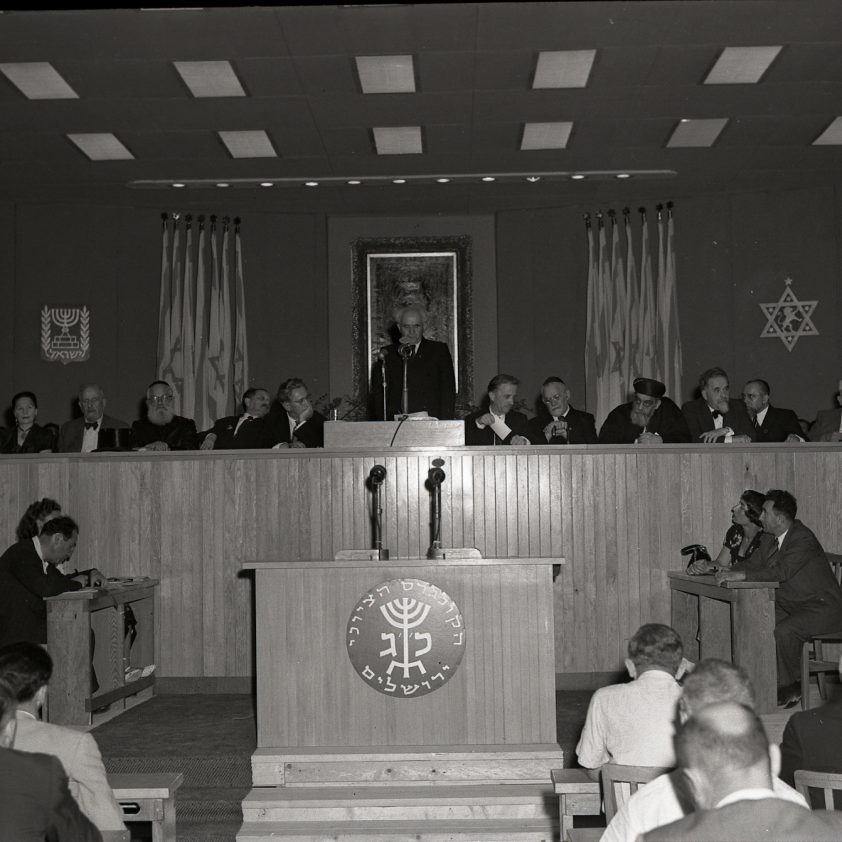
David Ben Gurion speaks at the 1951 World Zionist Congress, 13 August 1951. Source | Wikimedia Commons
It adopted a new set of objectives to reorient the movement. These were defined as: the strengthening of the state of Israel, the ingathering of the exiles in Eretz Yisrael, and the fostering of the unity of the Jewish people.
This moment marked the transformation of Zionism from a settler-colonial movement into a global ideological infrastructure. It was no longer just about building a state; it was about embedding that state into the hearts, minds, and institutions of Jews worldwide.
The status of the Zionist movement
The law passed by the Knesset to formalize the relationship between the Zionist movement and the state of Israel spelled out the obligations of both parties. It designated the World Zionist Organization as the authorized body responsible for developing and settling the land, absorbing immigrants from the diaspora, and coordinating the work of Jewish institutions operating within Israel.
Crucially, the law affirmed that the state of Israel “expects the cooperation of all Jews, as individuals and groups, in building up the State.” It further stipulated that the World Zionist Organization “requires full cooperation and coordination on its part with the state of Israel and its Government, in accordance with the laws of the State.” To that end, the law mandated the creation of a formal committee to coordinate activities between the Israeli government and the Zionist movement’s executive leadership.
In other words, the state of Israel and the World Zionist Organization, as a matter of law, are required to work together, and, also as expressed in law, both bodies expect the cooperation of “all Jews.” The extent to which this expectation is met remains an empirical question.
First established at the 1951 Zionist Congress and enacted in 1953, the Jerusalem Program laid out the operational aims of the World Zionist Organization. This foundational document was later revised in 1968 and again in 2004 to reflect the movement’s evolving priorities. These revisions formalized a series of ideological commitments still in effect today, collectively referred to as the “foundations of Zionism.”
Among these are the preservation of Jewish unity and its enduring bond to Eretz Yisrael, as well as the centrality of the state of Israel, specifically Jerusalem, in Jewish national life. The program affirms support for mass aliyah from all countries and the absorption of Jewish immigrants into Israeli society. It calls for strengthening Israel as a Jewish, Zionist, and democratic state; promoting Jewish, Hebrew, and Zionist education to preserve the distinctiveness of the Jewish people; and defending the rights of Jews globally while combating antisemitism. Most revealingly, it asserts that “settling the country” remains a core expression of practical Zionism.
These principles are intended to guide Zionist activity both within Israel and throughout the world. To make the role of individual Zionists abroad absolutely clear, the movement later published a separate guide detailing their personal responsibilities outside of occupied Palestine.
Duties of the individual Zionist
The duties of the individual Zionist were first codified in a 1972 policy document “approved at the 28th Zionist Congress.” They were later adopted as an integral part of the resolutions of the 29th Congress in 1978. The resolution outlined personal obligations derived from the Jerusalem Program and from formal membership in a Zionist organization.
Among these duties was the call to make aliyah—that is, to become a settler colonist in occupied Palestine. Others included joining local Zionist federations or affiliated groups, actively promoting the movement’s ideological program, and ensuring children received Zionist, Hebrew and Jewish education designed to reinforce loyalty to Israel. Zionists were also expected to donate financially through established channels such as Keren Hayesod, the Jewish National Fund or their local branches, in order to consolidate Israel’s economy and fund its expansionist aims.
With the exception of physically becoming a settler colonist, all of these duties amount to an explicit call for infiltration of host societies. Perhaps the most direct duty, however, is “to strengthen Zionist influence within the community.” This likely refers to the “Jewish community” rather than broader society. Even so, it is still a call to expand the influence of Zionism on society as a whole.
One might reasonably ask how much attention ordinary Zionists pay to such calls. Are these dry, dead words, left to gather dust in the Central Zionist Archives in Al Quds? Or do they still animate the central activities of the movement today? Let us take a look.
Here is a 1961 report from the Jewish Chronicle about a Zionist meeting in Glasgow, which came to hand as I was writing this. I present it as an example of the movement’s thinking and practical activities. The meeting was specifically designed as an educational Zionist event and expounded a particular set of ideas.

A Zionist Federation meeting in Glasgow, reported in the Jewish Chronicle, Oct. 20, 1961, p. 14
The measures which would have to be taken if children in the Diaspora were to remain Jews were discussed by Professor Ernst Simon, of the Hebrew University, when he gave an address at a meeting held in the Central Hotel last week in connection with the Zionist Federation’s Education Fortnight. Mr. Edward Woolfson, President of the Glasgow Zionist Federation, was in the chair. Outlining a practical programme for bringing up children as Jews, Dr. Simon declared that this would have to start with the education of expectant Jewish mothers and fathers at child guidance clinics. As a result, children from their earliest years would be reared in an atmosphere where they would see all the symbols and customs of Jewish life observed. This would then be followed by the children being sent to a Jewish or Hebrew Kindergarten, and then to a Jewish day school. Another important part in the programme, Dr. Simon went on, would be the creation of a Jewish resurgence…
In this view, Zionist education required that children remain Jewish, making “Jewish education” crucial for the movement. A 1961 report reflected this, the year before the British Zionist Federation founded Scotland’s first and only Jewish school, Calderwood Lodge. Is that commitment to inculcating Zionism still present today?
A lifelong commitment to the genocidal ideology
It certainly is. Although Calderwood Lodge was taken over by the local authority in 1982, it remains a Zionist school today. It collaborates with the United Jewish Israel Appeal (UJIA), Maccabi, Mitzvah Day, the Scottish Jewish Youth Alliance (SJYA) and other Zionist groups. (The SJYA is itself a collaboration between Glasgow Maccabi and UJIA Scotland, both Zionist organizations.) The school also marks Israeli Independence Day (Yom Ha’atzmaut) and the “liberation” of Jerusalem (Yom Yerushalayim)—their term for the illegal occupation of East Jerusalem in 1967.

Celebrating the creation of the Zionist entity in Calderwood Primary School, 2025, with Shayna Conn (right) of the Scottish Jewish Youth Alliance. Source | Facebook | Jewish Telegraph
The UJIA is the U.K. outpost of one of Israel’s four “national institutions,” established to create and sustain the state of Israel. It serves as the U.K. affiliate of Keren Hayesod, which raises funds to finance settlement in Palestine. In its 2018–19 annual report, UJIA described its mission as developing a “lifelong connection” between Israel and the “diaspora” community, beginning with children as young as four. Of 12 school programs run by UJIA, nine are in primary schools, reaching thousands of pupils.
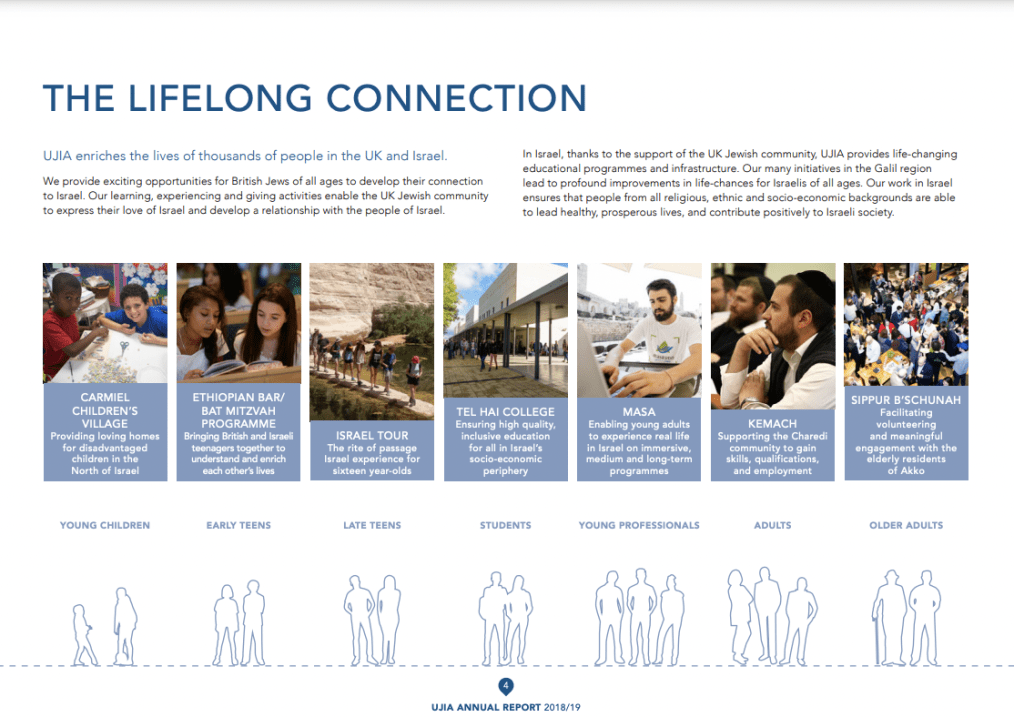
From A Lifetime of Connection: UJIA Annual Report 2018-19. Source | United Jewish Israel Appeal

“Strong British Jewry with a lifelong commitment to Israel.” Source | United Jewish Israel Appeal
Does it work?
Varying statistics suggest that between 60% and 90% of British Jews—or perhaps more—identify as some form of Zionist.
Research by Pew in the United States in 2021 found that “eight in ten U.S. Jews say caring about Israel is an essential or important part of what being Jewish means to them. Nearly six in ten say they personally feel an emotional attachment to Israel.” In the United Kingdom, a 2024 study by the Institute for Jewish Policy Research reported that “73% say they feel very or somewhat attached to the country. However, the proportion identifying as ‘Zionists’ has fallen from 72% to 63% over the past decade.”
Ultra-Zionists often claim that even more Jews identify as Zionist. For example, the so-called Campaign Against Antisemitism conducted a survey in late 2023 that produced even higher figures. It reportedly “revealed that 97% of British Jews feel ‘personally connected’ to events happening in Israel … 80% of respondents considered themselves to be a Zionist.”
It appears that the activities of the UJIA and the wider Zionist movement are proving effective. Yet after two years of livestreamed genocide, there is also growing unrest and dissent within the Jewish community, particularly among the young. A recent poll cited in the Jewish Chronicle found that “only” 57% of Jews in their twenties “identified with Zionism.”
Nevertheless, the extent of Zionist adherence is still far too large. This means there are Zionists throughout the social structure of most advanced nations, even when the Jewish population is very small, as in the United Kingdom, where it has fallen to 0.4%. In the United States, Jews make up about 2.4% of the population.
The uncomfortable truth is that the Zionist movement urges its adherents to infiltrate the societies where they live and to display their commitment to its racist ideology at every possible turn. As the UJIA examples above show, they encourage a lifelong commitment to Israel. But is that the so-called dual loyalty “trope”—the allegedly racist claim that Jews are more loyal to the state of Israel than to the countries in which they reside?
Only if we say it, if they say it, it’s fine—nothing to see here. As Pat Buchanan once remarked in a debate with Ralph Nader, “dual loyalty would be an improvement.”
The fact remains that the Zionist movement promotes commitment to both the ideology and the practice of Zionism, even when this runs counter to the interests of the host nation. In the case of the state, this is true in most instances. In the case of the citizenry, it is true in all.
Meet the Zionist Infiltrators
Some within the movement consider the term “infiltration” outdated, arguing that it implies a deliberate Zionist strategy. Yet this article has shown that such a strategy does exist. The question, however, is how conscious or deliberate it is. The evidence suggests there are different types of infiltration and different kinds of infiltrators.
We can begin with those directly or indirectly engaged in specific forms of infiltration on behalf of agencies of the Zionist entity. Their activities align more closely with the traditional sense of the term. From there, we turn to those with looser ties to the movement as a whole. In what follows, I outline six types of infiltration.
Direct Service to the Zionist Entity
The most obvious form of infiltration is direct service to the Zionist entity through collaboration with its intelligence agencies. One example is the Ofer family, which breached U.S. sanctions to deliver Mossad agents and weapons for subversion and assassination operations in Iran. Another involves activities linked to Jeffrey Epstein, who gathered sexual kompromat for Israeli intelligence.
Mossad also relies on Sayanim, its informal helpers abroad, most famously Robert Maxwell. Beyond this, thousands of Zionists work with the Israeli Ministry of Diaspora Affairs and its predecessor, the Ministry of Strategic Affairs. Their operations range from propaganda and lobbying to trolling, doxxing and lawfare.
One such network is the Combat Antisemitism Movement, which has nearly 1,000 members and operates in a “joint venture” with Voices of Israel, a company run by the Ministry of Diaspora Affairs. In total, many thousands of Zionist groups are engaged in this form of activity.
Tech Start-ups as a Zionist Strategy
Service is also given directly to the Zionist entity through the creation of tech start-ups founded by former intelligence personnel. This has long been a strategy of Unit 8200, Israel’s signals intelligence agency. Today, there are hundreds of such firms in the tech industry. Some have become widely and controversially known, including Cellebrite, NICE, Toka, and the NSO Group, maker of the Pegasus surveillance product. One online listing of 28 such firms records a combined value of $208 billion.
The covert use of this vast surveillance apparatus by the Zionist regime has been widely noted. Investigative reports also show that significant numbers of Zionist infiltrators—including former occupation forces members, intelligence operatives and others—have secured senior positions across mainstream media and Big Tech. These include Google, Apple, Facebook/Meta, Microsoft, TikTok and more.
Emissaries of the Zionist Project
There is also a civilian equivalent of the Sayanim, known as Shlichim, or emissaries. The Jewish Agency—one of the four pillars of the formal Zionist movement—sends Shlichim from occupied Palestine to build what it calls “living bridges to Israel.” These emissaries are placed in schools, synagogues, JCCs, camps, universities, youth movements and Federations across the globe.
In 2021, the Union of Jewish Students, the Zionist student group in the U.K., reported hosting two Shlichim from the Jewish Agency. The recently revealed diary of Israel’s ambassador to the U.K. even records a “goodbye breakfast” she hosted in July 2024 for Shlichim returning to the Zionist entity after completing their tours of duty.
Other Zionist groups also send emissaries. The World Mizrachi Movement, for example, sent about 300 last year. The Haredi sect Chabad—described by critics as a genocidal cult—uses the same term for its global network of emissaries. According to Chabad itself, “Today, 4,900 Chabad-Lubavitch emissary families, or shluchim, operate 3,500 institutions in 100 countries and territories, with activities in many more.
Zionist Family Networks
Another form of service to the genocide comes through Zionist family networks in the West, particularly via philanthropic giving. Family foundations funnel money to Zionist organizations, all of which effectively encourage genocide.
One example is the many millions donated by Sheldon and Miriam Adelson to pro-Zionist political candidates. “I’m a one-issue person. That issue is Israel,” Adelson said in 2017. In the U.K., millions are given by the Lewis family, which owns River Island, and the Wolfson family, which owns Next, to support the genocide. Their contributions directly fund the occupation forces as well as settlement construction and ethnic cleansing in the West Bank.
Millions more are spent by Zionist family foundations to spread Islamophobia—through the Policy Exchange and the Henry Jackson Society in the U.K., and through the so-called Islamophobia network in the U.S. Additional funds go toward indoctrinating Jewish children through nurseries, schools, youth groups, student groups and “Birthright” tours, which promote the racist belief that Jews have a birthright to steal Palestinian land and kill Palestinian children.
Zionist billionaire families dominate this giving, but many thousands of others also contribute through large and small Zionist charities and causes. In the U.K., there are an estimated 3,000 such organizations, and in the U.S., there are likely more than 10,000. A preliminary compilation of data on U.S. Zionist groups is available here.
Defending Zionism Over the Life Course
The final form of infiltration is tied directly to the Zionist strategy of ensuring that all Jews make an enduring, lifelong commitment to Israel. As this article has shown, this has been central to the Zionist movement since at least 1951 and remains so today. Zionists expect all Jews to act on behalf of Israel whenever called upon—or whenever they perceive Zionist interests to be under threat.
Practically, this means service to Zionism through daily professional, political and social activities, wherever Zionists find themselves: in the media, political parties, business, finance, schools, universities and civil society, including left-wing and so-called “anti-racist” organizations.
In other words, Zionists throughout the social structure are engaged in subversion and infiltration. One example is the Jewish network within the U.K. civil service. Although set up by the civil service itself, it is in practice run by and for Zionists rather than Jews. Similar patterns exist in universities, the media, the legal profession, finance, industry and other institutions across society.
When the time comes for the proverbial tap on the shoulder, how many who have passed through Zionist indoctrination will fail to respond “appropriately”? To ask the question is almost to invite disbelief. In many cases, no tap on the shoulder is even required. Across the BBC, the media, the entertainment world, the civil service, politics, finance and other commanding heights of society, there are Zionists who are ideologically committed. For them, it makes perfect sense to “do the right thing” when the moment arrives.
The fact remains that the Zionist movement encourages loyalty to its ideology and its program of action even when these run counter to the interests of the host state—or, in all cases, to the interests of its citizenry.
Can we trust Zionists?
In the end, no Zionist can be trusted. Do we imagine that they are not also infiltrating the left? The Palestine solidarity movement? The anti-war movement?
Zionism is, at its core, a racist ideology. No matter how hard “liberal,” “socialist,” or “leftist” Zionists try to disguise it, that racism always reveals itself—whether in adopting Zionist positions in their professional lives or in subverting and sabotaging pro-Palestine activism in political life.
This has historically meant that the anti-racist movement and the Palestine solidarity movement have been weak on the question of Zionism. It was a major mistake for the “left” in the U.K. and elsewhere not to confront Zionism head-on earlier. Today, we face a significant struggle to cleanse the left and the anti-imperialist movement of both Zionists and Zionist assumptions—ideas that have seeped out of the movement and into the consciousness of many non-Zionist, or even anti-Zionist, socialist activists.
This process has been underway for many decades. However, this is not the place for a detailed analysis of the Jewish left or of Zionist penetration of the non-Jewish left. A fuller exposition will be needed in another article. For now, it is enough to point to the need for a material and maximalist anti-Zionism.
Infiltration today
The traditional forms of infiltration used by intelligence services continue—covert spies, informers and, in the case of the Zionists, the widespread penetration of the tech industry by alumni of Unit 8200. In addition, the Zionist movement makes extensive use of emissaries, both through the mainstream movement and through more marginal elements such as the Chabad-Lubavitch cult, as we have seen.
But in addition to this—as this article has argued—there is an effort to recruit all Jews into a “lifelong connection” to “Israel.” In practical terms, the movement treats all Jews as potential resources. This is why so much effort is devoted to grooming and radicalization through nurseries, schools, synagogues, youth and student groups, and the wide array of Zionist lobby groups and charities.
They attempt to radicalize Jews such that they will put Israel first wherever they end up in the social structure. And given that Jews are systematically advantaged in the social structure across the West, this has the potential to be a very powerful set of relations. I submit that infiltration is a cardinal principle of the Zionist movement, and it helps to explain how Zionist individuals and ideas are so heavily embedded in political, civil, economic and cultural life in Western nations.
Knowing your enemy is the first step toward defeating them—and toward dislodging Zionism from its entrenched status and role in society.
Professor David Miller is a non-resident Senior Research Fellow at the Centre for Islam and Global Affairs at Istanbul Zaim University and a former Professor of Political Sociology at the University of Bristol. He is a broadcaster, writer and investigative researcher; the producer of the weekly show Palestine Declassified on PressTV; and the co-director of Public Interest Investigations, of which spinwatch.org and powerbase.info are projects. He tweets @Tracking_Power.
UN Security Council votes to reimpose nuclear sanctions on Iran
Al Mayadeen | September 19, 2025
The United Nations Security Council voted on Friday to reimpose nuclear sanctions on Iran, citing its alleged violations of the 2015 Joint Comprehensive Plan of Action (JCPOA).
The move, driven by Britain, France, and Germany, has sparked sharp criticism from Russia, China, and Iran, highlighting deepening divisions within the international community over the future of Iran’s peaceful nuclear program.
The three European signatories to the JCPOA called for the activation of the snapback mechanism, falsely claiming that Iran had breached commitments made under the 2015 deal, which was designed to prevent Tehran from acquiring nuclear weapons capabilities.
The European powers alleged that Iran’s advancements in uranium enrichment and reduced cooperation with the International Atomic Energy Agency (IAEA) constitute material violations of the agreement.
Iran, Russia, and China push back
In response, Iranian Foreign Minister Abbas Araghchi stated that Tehran had presented a “fair and balanced” proposal to European nations aimed at preventing the reimposition of sanctions.
Russia’s UN Ambassador, Vasily Nebenzia, rejected the European-led move, saying, “There are no grounds for reinstating UN sanctions on Iran.” He emphasized that the E3’s push for snapback sanctions has no legal authority and affirmed that Moscow would not recognize it.
Russia also called on Security Council members to support a joint Russian-Chinese draft resolution on Iran, offering an alternative diplomatic track to avoid escalation.
China’s envoy emphasized that pressure on Iran must stop and urged Tehran to reaffirm the peaceful nature of its nuclear program, noting Iran’s declared willingness to cooperate.
Iran maintains that its nuclear program remains peaceful and has accused Western powers of double standards and bad faith. Chinese Ambassador to the UN echoed this stance, stating, “It was the United States that withdrew from the agreement, attacked Iran militarily, and disrupted negotiations.”
China’s envoy also called on the European trio to immediately withdraw their notifications to reinstate sanctions, stressing that “pressure is not the solution.”
Snapback could nullify Cairo agreement
Al Mayadeen’s sources warned on Thursday that activating the snapback sanctions mechanism would nullify the Cairo Agreement and end cooperation between the IAEA and Tehran.
This would prevent international inspectors from accessing sensitive facilities, escalating the standoff even further.
According to the sources, the diplomatic window with Iran remains open, but indicators point to the potential activation of the snapback sanctions mechanism. They argued this is largely because Washington is steering the European Troika in the talks.
The sources warned that Washington is expected to call on Tehran to resume negotiations after activating the snapback mechanism, aiming to impose its conditions from what it perceives as a position of strength. They described this approach as a serious miscalculation of Iran’s stance and the way Tehran would respond.
Trump Is Preparing a $6 Billion Arms Package for Israel
By Kyle Anzalone | The Libertarian Institute | September 19, 2025
The White House informed Congress that it is preparing a massive arms sale to Israel, including attack helicopters and military vehicles. The weapons will be paid for with US military aid.
According to the Wall Street Journal, the total value of the weapons deal is $6 billion. The sale is $3.8 billion for 30 AH-64 Apache helicopters and $1.9 billion deal for 3,250 infantry assault vehicles.
Washington will pay for the arms with foreign military financing. The US provides Israel with at least $3.8 billion in military aid annually. Washington boosted assistance to Tel Aviv following the October 7 Hamas attack. In the first year of the Israeli onslaught in Gaza, the US sent Israel nearly $18 billion in aid. The weapons will begin arriving in Israel in two to three years.
The report of the package follows Israel’s attempt to assassinate Hamas leadership in Qatar. The strikes angered Doha, a major non-NATO US ally. Qatar has also committed to investing $1 trillion in the US economy and gifted Trump a luxury aircraft.
Additionally, the assassination attempt prevented Trump from initiating talks to end the war in Gaza and free the Israeli hostages. The strike occurred as the Hamas leadership was meeting to discuss a proposal sent by Trump. Qatar said the attempted assassination ended any chances of reaching a hostage agreement.
The White House has pushed Congressional leadership to endorse the sale even after the Israeli strike in Qatar.
Israel is in the process of ethnically cleansing Palestinians from Gaza. The onslaught has primarily been conducted by Israel using American weapons. A large number of civilians have been killed by Israeli forces. Additionally, an Israeli siege of Gaza has created a famine, and hundreds of Palestinians have starved to death.
Since taking office, Trump has approved multiple arms sales to Israel, including a sale of $3 billion in bombs.
Bernie Sanders Is A Ghoulish Zionist
By Caitlin Johnstone | September 18, 2025
Bernie Sanders finally issued a statement acknowledging the indisputable fact that Israel is committing genocide in Gaza after two years of adamantly refusing to do so. The statement begins as follows:
“Hamas, a terrorist organization, began this war with its brutal attack on October 7, 2023, which killed 1,200 innocent people and took 250 hostages. Israel, as any other country, had a right to defend itself from Hamas.
But,”
Dude goes two years refusing to call a genocide a genocide, then issues a statement which begins by placing blame for the genocide on the victims of said genocide. He also lumps the hundreds of IDF troops slain in the attack in with “innocent people”, ignores the large percentage of the death toll that would have been killed by Israeli troops under the Hannibal Directive, and babbles about Israel’s “right to defend itself” against an occupied population.
The rest of the statement is standard liberal Zionist fare, acknowledging the horror of the situation in Gaza while blaming it all on Benjamin Netanyahu and not the murderous apartheid state which would be doing what it’s doing with or without Netanyahu. It’s just progressive-sounding Israel apologia accompanied by a denunciation driven by the inability to escape finally calling this thing what it is.
This is the face of what passes for the “left” in modern US politics. Absolutely ghoulish.
Israeli Finance Minister Bezalel Smotrich described Gaza as a “real estate bonanza” on Wednesday, saying Israel is in talks with the United States negotiating how the two countries will divide up the enclave.
“We are checking how this becomes a real estate bonanza — I’m not joking — and pays for itself,” Smotrich said, adding, “I’ve begun negotiations with the Americans, and I’m saying this seriously, because we paid a lot of money for this war. We need to work out how we share percentages on the land. The demolition phase, the first stage of urban renewal, we’ve already done. Now we need to build.”
It’s absolutely incredible how often Smotrich and his buddy Itamar Ben-Gvir will just come out and admit that Israel is doing the thing everyone says it’s doing. If this information had come out as a WikiLeaks drop or something it would have been a bombshell revelation, and this guy is right here just bloody saying it.
There’s another report from Haaretz about the horrific things Israeli soldiers say they’ve been doing to civilians in Gaza, including descriptions of the murders of children.
Whenever I read these accounts I can’t help thinking about how there are westerners joining the IDF to participate in this genocide. People travel to Israel to massacre civilians and then fly back home to their real countries and resume their lives as though nothing happened, like they went backpacking in Europe or something. And now they walk among us in our communities, and we’re supposed to be fine with it.
❖
Netanyahu says he has been invited to visit with President Trump for the fourth time this year. At this point they should just save on jet fuel and move him into a room in the White House.
❖
Trump is repeatedly bombing civilian vessels under the ridiculous justification that drug traffickers are “terrorists”, without even providing evidence that they are drug traffickers. Trump has now admitted to the US bombing three Venezuelan boats on these completely evidence-free grounds.
When Yemen was attacking ships to enforce a blockade against a genocide, Trump declared them all terrorists and massacred hundreds of civilians. Now Trump is attacking civilian boats and calling them the terrorists.
❖
Ask a scientist when the universe began and they’ll tell you 13.8 billion years ago.
Ask a Young Earth creationist when the universe began and they’ll tell you six thousand years ago.
Ask a Zionist when the universe began and they’ll tell you October 7, 2023.
US foreign affairs committee approves expansion of secretive arms stockpile for Israel
The Cradle | September 19, 2025
The US House Foreign Affairs Committee (HFAC) on 19 September voted 27-24 to approve the State Department Reauthorization bill (H.R. 5300), which, among other provisions, permits unlimited transfers of US arms to a special Israel-based stockpile in the next fiscal year.
“This bill is not just a reform for today, it is a lasting framework that will strengthen the State Department and benefit every commander-in-chief who follows,” HFAC Chairman and former Israeli army soldier Brian Mast said following the vote.
Hidden deep within the State Department funding bill is a provision that calls for repealing oversight controls on “defense articles” transferred to the War Reserve Stock for Allies-Israel (WRSA-I) – a US “emergency” stockpile that Tel Aviv has been significantly relying on since the start of its genocide of Palestinians in Gaza.
“[This is] the least transparent mechanism of providing arms to Israel,” former State Department official Josh Paul told Responsible Statecraft earlier this week.
In December 2023, Paul told The Guardian that Washington was dipping into WRSA-I to restock quickly-depleting munitions Israel has kept dropping inside the Gaza Strip.
“We sort of retroactively build a foreign military sales case, which may or may not need to be notified to Congress, depending on what they took and what quantities […] There’s none of the conventional arms transfer policy review that would normally happen […] Essentially, it’s take what you can and we’ll sort it out later,” Paul said at the time.
Created in the 1980s to supply the US military in case of a regional war, the WRSA-I is the largest node in a global network of US weapons caches. Its full contents are not publicly disclosed.
In August, an investigation by the Department of War’s Office of the Inspector General found that “the Army, Navy, and Air Force appointed officials to account for WRSA-I inventory, but those officials did not consistently comply with property accountability requirements.”
“In addition, the DoD OIG found that Service officials did not conduct all required inventories between FY 2022 and FY 2024,” the report highlights.
By 2024, former US president Joe Biden’s administration had temporarily lifted restrictions on the value and type of US weapons transferred to WRSA-I each year. It also bypassed transparency rules by splitting up larger transfers into smaller packages that fell under the $25 million threshold, which would have required notifying Congress.
H.R. 5300 seeks to build atop those provisions to reduce congressional oversight further and allow Israel unrestricted access to the strategic stockpile.
Since October 2023, Israel has acquired a vast amount of US-made weapons from WRSA-I, fueling what experts describe as the most intense bombing campaign of the 21st century.
HFAC members approved the State Department funding bill just days after an official UN commission of inquiry determined Israel is violating the genocide convention in Gaza.
“The Commission concludes that the Israeli authorities and Israeli security forces have the genocidal intent to destroy, in whole or in part, the Palestinians in the Gaza Strip,” the report found.
Featured Video
Elijah Magnier: Yemen’s strikes are shattering Saudi Arabia’s long-term strategy
or go to
Aletho News Archives – Video-Images
From the Archives
British weapons and personnel doing much of the killing in Yemen
Press TV – June 18, 2019
A detailed report published by the Guardian newspaper has shown how Britain is massively contributing to Saudi Arabia’s devastating war on Yemen as it suggests that London is not only supplying the bombs that fall on Yemenis, but it provides the personnel and expertise that keep the war going.
The comprehensive report by Arron Merat published on Tuesday showed that Britain was doing much of the killing in Yemen as the country continues to provide Saudi Arabia with everything it needs to turn its southern impoverished neighbor into a graveyard.
“Every day Yemen is hit by British bombs – dropped by British planes that are flown by British-trained pilots and maintained and prepared inside Saudi Arabia by thousands of British contractors,” said Merat in the report. … continue
Blog Roll
 Aletho News
- Netizens condemn Japanese drama for projecting Japan’s wartime atrocities onto Chinese characters
- Racist Seinfeld Dances for Joy as Bibi Unveils His New Map
- A West Bank War for Netanyahu’s Election Campaign, Could It Backfire?
- Yemen denounces European Parliament’s ‘hypocritical’ push to blacklist Ansarullah
- Qalibaf: UAE’s UN bid aims to ‘clear the runway’ for ‘Greater Israel’, whitewash genocide
- Pakistan reopens Iran border after boosting security: Report
- Why are so many Brazilians voting for Flávio Bolsonaro?
- Democrats Put Anti-Russia Agenda Ahead of American Workers
- Elijah Magnier: Yemen’s Strikes Are Shattering Saudi Arabia’s Long-Term Strategy
- Pentagon designates Chinese cultural centers national security threat
- If Americans Knew
- An error has occurred; the feed is probably down. Try again later.
- No Tricks Zone
- Sudden Stratospheric Warming, Powerful El Niño Combination May Lead To Extreme Europe Cold, Energy Crisis!
- Two New Studies Find Thwaites Glacier Melt Cannot Be Driven By Human Activity Or A Warming Ocean
- E-Cars Reduce CO2 Emissions By Only 41% Compared To Internal Combustion Engine Vehicles
- Predictions Made By Renowned Climate Professor Over Past Decades Have Been Proven To Be Poor
- New Study Suggests Large Regions Of The Pacific Ocean Have Been Cooling For The Last 80 Years
- Germany’s Green Energy Debacle: High Energy Costs Force Kahla Porzellan to Close After 182 Years!
- New Study: 50 Years Of The Most Aggressive ‘Net Zero’ Policies Can Only Affect The Global Climate By 0.03°C
- US September “Heat” Was No Record…Many Records Set Decades Ago
- Latest European Green Energy Debacle; Portugal’s Largest Flagship Solar Park Insolvent!
- Green Energy Debacle: German Expert Professor Fritz Vahrenholt Warns Of Severe Economic And Social Consequences

