US vetoes UN Security Council resolution demanding Gaza ceasefire
Press TV – September 18, 2025
The United States has exercised its veto power to block a United Nations Security Council resolution calling for an immediate, unconditional, and permanent ceasefire in the Gaza Strip, marking the sixth such veto since the onset of the genocide nearly two years ago.
The resolution was drafted by the Council’s ten non-permanent members—Algeria, Denmark, Greece, Guyana, Pakistan, Panama, Republic of Korea, Sierra Leone, Slovenia, and Somalia—and was backed by 14 of 15 council members. The US vetoed it on Thursday.
The resolution demanded the unrestricted entry and distribution of humanitarian aid into Gaza and emphasized the restoration of essential services amid a confirmed famine and escalating military operations.
The resolution urged all parties to comply with the ceasefire and called for the safe, unhindered delivery of aid by the UN and its partners, in accordance with international humanitarian law and principles of humanity, neutrality, impartiality, and independence.
It further stressed the need to lift all Israeli restrictions on aid and restore vital services across the territory.
Speaking on behalf of the sponsoring nations before the vote, Denmark’s Permanent Representative to the UN, Christina Markus Lassen, highlighted the dire humanitarian crisis driving the initiative. “We represent the will and expectations of the General Assembly members who elected us,” she said. “The catastrophic situation in Gaza is what drives us to act today.”
After the veto, Lassen added, “Even though this resolution was not adopted today… 14 members of this Council have sent a clear message. We want to see an immediate and lasting ceasefire, the immediate and unconditional release of all hostages, and the urgent lifting of all restrictions on humanitarian aid.”
The Republic of Korea’s ambassador, Sangjin Kim, who holds the rotating presidency of the Security Council, noted the historic significance of the session.
“This meeting marked the 10,000th session in the Council’s history,” he said, also pointing to its coincidence with the 80th anniversary of the United Nations’ founding and the eve of the General Assembly’s high-level week.
He urged members to honor these milestones by fulfilling the Council’s mandate to maintain international peace and security.
US representative Morgan Ortagus described the resolution as “unacceptable,” arguing it failed to condemn Hamas or acknowledge Israel’s right to self-defense.
“Hamas is responsible for starting and continuing this war,” Ortagus stated. “Israel has accepted the proposed terms that would end the war, but Hamas continues to reject them. This war could end today if Hamas freed the hostages and laid down its arms.”
The veto has drawn sharp criticism internationally, with many accusing the US of enabling the ongoing genocide.
Palestinian advocates and human rights observers on social media platforms labeled the action as “complicit in devastation” and a “green light for continuation of crimes,” calling for alternative measures through the UN General Assembly.
Others highlighted the US’s history of shielding Israel, noting this as the 43rd veto on measures against Israel.
Since the Israeli regime launched its genocidal campaign in Gaza on October 7, 2023, it has killed 65,062 people and wounded 165,697, most of them women and children.
California governor set to sign bill restricting teaching of Palestinian history in schools
By Brooke Anderson | The New Arab | September 16, 2025
Rights advocates are raising concerns over what they say could be a troubling precedent if a bill is signed restricting the teaching of Palestinian history in classrooms in California.
The bill, AB 715, was voted through in the state’s Democratic-majority senate and assembly late Friday night and is now set to be signed by Governor Gavin Newsom.
Those opposing the measure have argued that it could stifle classroom discussions on Palestinians, Islamophobia and other sensitive topics; equate criticism of Israel with antisemitism; and make instructors vulnerable to complaints by imposing vague rules.
Over the last several months, it has faced strong opposition from more than 100 grassroots organisations, including the California Teachers Association, the California Faculty Association, California Federation of Teachers, Association of California School Administrators, California School Boards Association, California Nurses Association, and the American Civil Liberties Union. They have staged regular demonstrations at the state capitol in Sacramento.
Those supporting the bill include the Jewish Federation, the Jewish Community Relations Council, Mosaic United and the Anti-Defamation League. Though they were far fewer, they were able to exert more influence.
“They’re passing anti-education bills. The organising around it has been strong. The entire education community is against it, but it was still passed,” Mirvette Judeh, chair of the Arab American Caucus of the California Democratic Party, told The New Arab.
“They’re not listening to voters. This is a bill that’s unconstitutional. Today it’s education about Palestinian history. Tomorrow it could be something else. To punish teachers to teach about genocide is absolutely insane,” she said.
“History is history. It has to be taught. If people were taught about this in school, the mass dehumanisation of Palestinians would not be happening. They’re taking our rights here at home. This is your America. Take it back,” said Judeh, herself a Palestinian American.
So far, the governor has not indicated whether he will sign the bill, and civil rights advocates that oppose it are hoping there’s still a chance he will not sign it.
“Lawmakers heard overwhelming opposition—8 to 1 from public commenters—and warnings from their own colleagues about the bill’s chilling effect on education. Yet they advanced it anyway,” Hussam Ayloush, CEO of the California chapter of the Council on American-Islamic Relations, said in a public statement.
“This is now Governor Newsom’s test. He can either side with educators, civil rights advocates, and students whose voices are at risk of being silenced—or he can greenlight censorship that will make classrooms less free and less inclusive,” Ayloush added.
If signed, which could happen as early as this week, the bill’s supporters hope that it could be a blueprint for other states to pass similar legislation. This bill comes four years after the introduction in grade schools of ethnic studies, which have included material on Palestine, leading to controversy and the introduction of AB 715.
In other news related to free speech, a new bill introduced in Congress by Representative Brian Mast of Florida would allow Secretary of State Marco Rubio to strip immigrants of US citizenship if what they say is deemed to be terrorism. The move, which has been condemned by free speech advocates such as the ACLU, appears to be aimed at student activists.
Israel Wants ‘Aerial Corridor’ Over Syria to Strike Iran
By Kyle Anzalone | The Libertarian Institute | September 17, 2025
Tel Aviv’s primary objective in discussions with Damascus is to establish an aerial corridor over Syria so Israel can restart its war against Iran.
Axios reports that Israel presented the Syrian government, led by Ahmed al-Sharaa, with a maximalist agreement that would establish a no-fly zone over Syria. Additionally, Tel Aviv wants a large swath of Syria, from the Israeli border to Damascus, to become a demilitarized zone.
An Israeli source told the outlet that an essential part of the agreement will be maintaining the ability to use Syrian airspace to attack Iran. “A central principle of the Israeli proposal is maintaining an aerial corridor to Iran via Syria, which would allow for potential future Israeli strikes in Iran,” they said.
Israeli Prime Minister Benjamin Netanyahu started an unprovoked war with Iran in June. Tel Aviv targeted leadership in Tehran, nuclear facilities, and scientists. President Donald Trump joined the war by striking three Iranian nuclear sites that Israel lacked the military capability to destroy.
Israeli forces currently occupy southern Syria. Israel promised to withdraw its troops from Syria if Damascus accepted the agreement. On Wednesday, Sharaa said a deal with Israel was possible “in the coming days.”
Tel Aviv made a similar agreement with Hezbollah, where Israeli soldiers were scheduled to withdraw from South Lebanon after Hezbollah moved its forces out of the region. However, after the Hezbollah withdrawal, Tel Aviv maintained its occupation. Israel is now demanding that Hezbollah entirely disarm.
The Israeli invasion of Syria began after President Bashar al-Assad was overthrown by al-Sharaa last year. Al-Sharaa, formerly Abu Mohammad al-Jolani, is the founder of al-Qaeda’s Syria affiliate. President Donald Trump has met with Sharaa and lifted some sanctions on Syria in a push to get Damascus to make a deal with Tel Aviv.
Israel to flood Gaza City with ‘unprecedented’ number of booby-trapped vehicles: Report
The Cradle | September 17, 2025
The Israeli military is set to deploy an “unprecedented” number of remote-controlled armored personnel carriers (APCs) loaded with explosives into Gaza City as part of operation “Gideon’s Chariots 2,” Hebrew news outlet Walla reported on 17 September.
This is part of the first stage of a three-stage plan drafted by Major General Yaniv Asor to “conquer” the largest city in the strip, where hundreds of thousands of Palestinians remain trapped or refuse to be displaced.
“The ‘fire phase’ focuses on the massive destruction of terrorist infrastructure — mainly at night — using various methods, including above and below ground robots,” Walla reports, citing military sources that said “Gaza has never been hit like this before. This is only the second night.”
Referred to as “booby-trapped robots” in Gaza, the decommissioned APCs are rigged with explosives and remotely driven deep into urban areas before being detonated, causing massive explosions and widespread destruction.
“The Israeli army sends the robots near our homes, which stay parked there to terrorize us. The army doesn’t detonate them right away, waiting for fear to push us to flee. When people don’t leave, the army detonates the robots, regardless of whether there are civilians in the area,” Abdulwahhab Ismail, a resident of the Saftawi area in northwestern Gaza, told Mondoweiss last month.
The Israeli military calls this practice “suicide APCs.” According to Walla, Tel Aviv has stationed a large number of these vehicles outside the Gaza separation line.
“Acting on orders from IDF Southern Command chief Maj.-Gen. Yaniv Asor, the deployment of these vehicles has surged, with officers in the field reporting that their usage has tripled. Forces on the ground have testified to the movement of hundreds of these explosive-laden APCs toward the Gaza border,” the Jerusalem Post reported earlier this month.
In August, reports in Hebrew media revealed that Israeli arms companies were planning to expand production of tanks and APCs with a budget exceeding $1.3 billion.
At least 100 booby-trapped robots were used in densely populated areas inside Gaza between 13 August and 3 September alone, according to Gaza’s Government Media Office.
“Before now, the army used to blow up one or two buildings with the robots. Now they destroy dozens of buildings at once. Robots and warplanes are working together to destroy every place in Gaza City,” Ismail described.
Thursday’s report from Walla added that the “second stage” of the southern command’s plan calls for the occupation of Gaza City by the invading troops, while the third stage “is currently classified as high security and combines military capabilities that we have not yet seen in the Israeli war repertoire.”
Did Israel Murder Charlie Kirk?

By W.M. Peterson | Truth Blitzkrieg | September 16, 2025
“Terror is theater… Theater’s a con trick… Do you know what that means? Con trick? You’ve been deceived.”
– John le Carré, The Little Drummer Girl, (1983)
A provision authorizing extrajudicial murder exists within Jewish law. Din rodef — “law of the pursuer,” permits the killing of those who are deemed a threat to individual Jews or the Jewish state, without the benefit of due process.
A dramatic example of this occurred on November 4, 1995, when Talmudic law student Yigal Amir assassinated Prime Minister Yitzhak Rabin at a political rally in Tel Aviv. During his trial, Amir invoked din rodef as a legal defense in an attempt to justify his murder of Rabin. The basis of Amir’s argument was that Rabin, by signing the Oslo Accords and relinquishing much of the West Bank to Palestinian rule, had endangered Jewish lives and should therefore be considered a ‘pursuer.’
Although Amir was convicted and sentenced to life in prison, many radical right-wing Israelis have campaigned for clemency on his behalf, including Itamar ben-Gvir, Netanyahu’s Minister of National Security.
In the book Torat Hamelekh (The King’s Torah), Rabbis Yitzhak Shapira and Yosef Elitzur explain that din rodef “applies even when the pursuer is not threatening to kill directly, but only indirectly… anyone who weakens our own state by word or similar action is considered a pursuer.” [Emphasis supplied][1]
Is it possible that Charlie Kirk came to be regarded as a ‘pursuer’ by certain Zionist heavyweights, resulting in his untimely death?
Few can say for sure, and those who can surely won’t. However, it’s interesting that a day after Kirk was shot, General Michael Flynn indicated that federal law enforcement suspected the murder may have had a foreign signature:

Which foreign country, pray tell, is notorious for assassinating political figures across the globe, going so far as to gun down a sitting US President in a grisly public spectacle? History itself is reason enough to consider Israeli collusion in Kirk’s assassination plausible, if not entirely demonstrable. Respected scholar Ron Unz reveals in his latest article ‘The Assassination of Charlie Kirk’ how a number of people in and around the Trump Administration seem to agree:
“Earlier this year I’d published an article summarizing Israel’s long history of high-profile political assassinations, a record unmatched in all of world history, and this particular incident certainly fit very well into that pattern… Therefore, a few hours after hearing of Kirk’s death, I very gingerly raised these possibilities with someone well situated in conservative circles who personally knew Kirk, and was shocked by his response. He unequivocally told me that everyone in Kirk’s circle, even including important Trump Administration officials, suspected that Israel had probably killed the young conservative leader.”
I’ve seen many people online ask the question: why would Israel wish to kill one of its most stalwart defenders on the American right?
It’s true that for almost the entirety of his career Kirk was a beneficiary of Zionist largesse, allowing him to grow his Turning Point USA organization into “the largest Conservative student movement in the US, with groups at more than 3,500 universities and high schools.” Kirk would often attribute TPUSA’s success to his friend and mentor David Horowitz, conceding that “without David Horowitz, I’m not sure Turning Point USA would exist.” Relationships like these went a long way towards ensuring Charlie stayed on message whenever the subject of Israel was raised. (Like for example, when he dismissed the 1967 Israeli attack on the USS Liberty as a “conspiracy theory.”)
But running interference for a terrorist state engaged in an ongoing genocide will eventually begin to wear on the conscience of any halfway decent man, and in more recent years Kirk had begun to wander off the Zionist reservation. In fact, on his final podcast with Ben Shapiro, recorded one day before his death, Kirk suggested that people ought to be more critical of media reports regarding Israel:
“One thing a friend said to me… is Charlie, we pushed back against the media on Covid, on lockdowns, on Ukraine, on the border… maybe we should also ask a question: is the media totally presenting the truth when it comes to Israel? Just a question. You know, maybe we shouldn’t believe everything the media says because I know I’ve been conditioned to ask a lot more critical questions over the last couple of years.”[2]
Kirk’s statement to Shapiro supports the idea that he may have started reexamining some of the positions he’d been paid so handsomely to embrace.
Having never paid much attention to Charlie Kirk, considering him the archetypical shabbos goy sucking on the teat of ZOG, I was rather surprised this week when I watched numerous videos of the TPUSA founder criticizing Jews as a group, claiming at times that Jewish communities promoted “hatred against whites”; that “Jews control… the colleges, the nonprofits, the movies, Hollywood, all of it”; and insinuating that Israel’s military stood down and allowed the 10/7 Hamas attack to occur. In one instance, Kirk described the intense backlash he received from his Jewish donors after hosting Israel-critical commentators Dave Smith, Megyn Kelly and Tucker Carlson at his TPUSA Action Summit in July, during which the guest speakers “denounced Israel’s blood-soaked assault on the besieged Gaza Strip, branded Jeffrey Epstein as an Israeli intelligence asset, and openly taunted Zionist billionaires like Bill Ackman for ‘getting away with scams’ despite having ‘no actual skills,’” according to The Grayzone’s Max Blumenthal and Anya Parampil.
A few weeks after the conference, a visibly shaken Kirk appeared on former Fox News host Megyn Kelly’s podcast and addressed some of the harassments he’d been subjected to:
“The more that you guys privately and publicly call our character into question — which is not isolated, it would be one thing if it were just one text, or two texts; it is dozens of texts — then we start to say, ‘woah, hold the boat here,’…To be fair, some really good Jewish friends say, ‘that’s not all of us’…But these are leaders here. These are stakeholders… I have less ability… to criticize the Israeli government than actual Israelis do. And that’s really, really, weird…That’s not right.”
Kirk’s increasingly independent statements, coupled with his defense of irredeemable “anti-Semites” Candace Owens and Tucker Carlson, strongly suggests that his time as an obedient goyische dupe was nearing its end. Perhaps this explains why in early 2025, Benjamin Netanyahu tried to purchase Kirk’s compliance:
Charlie Kirk rejected an offer earlier this year from Israeli Prime Minister Benjamin Netanyahu to arrange a massive new infusion of Zionist money into his Turning Point USA (TPUSA) organization, America’s largest conservative youth association, according to a longtime friend of the slain commentator speaking on the condition of anonymity. The source told The Grayzone that the late pro-Trump influencer believed Netanyahu was trying to cow him into silence as he began to publicly question Israel’s overwhelming influence in Washington and demanded more space to criticize it.
In the weeks leading up to his September 10 assassination, Kirk had come to loathe the Israeli leader, regarding him as a “bully,” the source said. Kirk was disgusted by what he witnessed inside the Trump administration, where Netanyahu sought to personally dictate the president’s personnel decisions, and weaponized Israeli assets like billionaire donor Miriam Adelson to keep the White House firmly under its thumb.
According to Kirk’s friend, who also enjoyed access to President Donald Trump and his inner circle, Kirk strongly warned Trump last June against bombing Iran on Israel’s behalf. “Charlie was the only person who did that,” they said, recalling how Trump “barked at him” in response and angrily shut down the conversation. The source believes the incident confirmed in Kirk’s mind that the president of the United States had fallen under the control of a malign foreign power, and was leading his own country into a series of disastrous conflicts.
By the following month, Kirk had become the target of a sustained private campaign of intimidation and free-floating fury by wealthy and powerful allies of Netanyahu — figures he described in an interview as Jewish “leaders” and “stakeholders.”
“He was afraid of them.” the source emphasized. [Source]
Thirty-three hours after supposedly killing Charlie Kirk with a single .30-06 caliber round fired from a Mauser 98 bolt-action rifle, 22-year-old Tyler Robinson was taken into custody and charged with multiple felonies, including suspicion of aggravated murder, felony discharge of a firearm, and obstruction of justice. The official story claims that Robinson’s father, a registered Republican and supporter of Donald Trump, recognized his son in images released by the FBI, whereupon he confronted the newly minted murder suspect and persuaded him to confide in a youth pastor who also happens to work with the Washington County Sheriff’s Office and the U.S. Marshals Service. Interestingly, Zionist billionaire Bill Ackman, who had reportedly been feuding with Kirk shortly before his death, contributed $1 million to the FBI reward for information leading to the capture of Charlie Kirk’s assassin. That money will apparently go to Tyler Robinson’s father.
Following Robinson’s arrest it was reported that federal authorities were in possession of evidence collected from his roommate showing he had divulged details of his plan to assassinate Kirk over the social messaging platform Discord. His alleged plans included, “a need to retrieve a rifle from a drop point, leaving the rifle in a bush… and a message referring to having left the rifle wrapped in a towel.” Discord, however, claimed that it’s platform was not in fact used by Tyler Robinson either to plan the murder of Charlie Kirk or to hide the evidence after the fact. A Discord spokesman, dispatched to set the record straight, told American tabloid news outfit TMZ:
“In the course of our investigation we identified a Discord account associated with the suspect, but have found no evidence that the suspect planned this incident or promoted violence on Discord… The messages referenced in recent reporting about planning details do not appear to be Discord messages. These were communications between the suspect’s roommate and a friend after the shooting, where the roommate was recounting the contents of a note the suspect had left elsewhere.”
FBI Director Kash Patel has said that although the incriminating note was destroyed, federal investigators have ‘forensic evidence’ proving it existed, and furthermore, they have been able to confirm through an “aggressive interview process” what its contents were. Meanwhile, on September 15 the Washington Post published messages supposedly sent by Robinson on Discord discussing the murder plot, which obviously contradicts the company’s previous position.
Other striking anomalies exist in what has begun to emerge as the official story.
For starters, security camera videos showing Robinson jumping off the roof where the sniper shot was supposedly fired from show no evidence that he was in possession of a high-powered bolt-action rifle. Yet we’re told the murder weapon was found in a wooded area near the campus, fully assembled and wrapped in a towel. Are we to believe that upon shooting Kirk, Robinson disassembled his firearm, fled the scene without being detected, reassembled his firearm, wrapped it in a towel and ditched it in the woods? How does that make any sense?
Equally perplexing is the immediate apprehension by police of an elderly Jewish man who had reportedly confessed to shooting Kirk. The man, 71-year-old George Zinn, is a well-known political agitator with a history of disrupting public events. Attendees who witnessed his arrest claim the obstreperous geriatric was challenging police to shoot him, and was acting in a thoroughly unhinged manner. Shortly thereafter, Zinn was booked by the Utah Valley University Police on an obstruction of justice charge and cleared as a person of interest. It’s possible Zinn’s erratic behavior was a calculated diversion, allowing the shooter to flee the scene in the critical moments after Kirk was shot.[3]

George Zinn reportedly told police he wanted to cause a distraction for the real gunman
And then there’s the story of the private jet that departed Provo Airport (PVU) — located eight miles from the UVU campus where Kirk was speaking — an hour after the shooting. According to FlightRadar24, a private Bombardier Challenger 300 departed PVU just after 1 p.m. local time and illegally switched off its transponder 30 minutes into flight, rendering itself undetectable by radar. Colson Thayer, a writer for American weekly magazine People, reported:
“Around 1:43 p.m. local time, as the jet approached the northern border of Arizona, the plane turned off its Automatic Dependent Surveillance-Broadcast (ADS-B), which provides positioning information between the aircraft and air traffic control. Tracking information for the aircraft reappeared shortly after 2:30 p.m. local time as the plane departed Page Municipal Airport (PGA) in Arizona back towards Provo. The plane landed back in Provo at 3:06 p.m. local time, according to FlightRadar24.”
Writing for online newspaper The Latin Times, journalist Matias Civita provides additional background information about the owner of the plane:
The jet is registered to “N888KG” LLC, which shares a Lehi, Utah address with the Derek and Shelaine Maxfield Family Foundation, which runs the Saprea non-profit organization to help survivors of sexual abuse. Many have pointed to the foundation’s numerous connections to Israel as a cause for suspicion… X user, @jonnysocialism, added that “It appears the private jet that took off after the assassination and stopped tracking was owned by the Derek & Shelaine Maxfield Foundation. They run a nonprofit called Saprea that focuses on victims of child sex abuse & have pictures of themselves visiting Israel on Facebook.”
In 2022, Saprea also launched its first-ever “kosher retreat” that offers kosher food developed “closely with Rabbi Avremi Zippel at Chabad Lubavitch of Utah.”
It’s unlikely we’ll ever be able to prove beyond a shadow of a doubt who actually fired the shot that killed Charlie Kirk or why.
When contemplating the many improbabilities and contradictions woven into the unfolding narrative I’m reminded of an episode of 60 Minutes that aired in September 2024, in which Lesley Stahl interviewed a former Mossad case officer identified only as ‘Michael.’ While explaining Israel’s extensive covert action and disinformation campaign vis-à-vis the infamous ‘Lebanon Pager Plot,’ Michael said,
“We create a pretend world… We are a global production company. We write the screenplay, we’re the directors, we’re the producers, we’re the main actors, and the world is our stage.”
Indeed.
Counterterrorism expert and former deputy chairman of Kroll Associates, Brian Jenkins, once observed that “terrorism is aimed at the people watching, not at the actual victims.” Thanks in part to British journalist Russell Warren Howe’s 1974 television interview with future Israeli Prime Minister Menachem Begin (not to mention decades of observable phenomena), it’s no secret who the world leader of terrorism is. Begin, the founder of Israel’s Likud Party, was head of the Zionist paramilitary organization Irgun when it bombed the King David Hotel in 1946, killing 91 people and injuring dozens more. Today the Likud government of Benjamin Netanyahu is orchestrating a genocide in Gaza and a larger regional war of aggression made possible by the rudimentary 10/7 Hamas offensive during which Israeli military forces stood down and allowed the attack to transpire for several hours without any meaningful response.
It’s precisely due to its history of political assassinations and false flag terror attacks that Israel has once again emerged among ‘conspiracy theorists’ as a leading suspect in an historic crime. Having already gotten away with the murder of more than 200 journalists in Gaza since ‘war’ began in October 2023, what would possibly deter them from killing one more?
Notes
[1] For a detailed study on the influence of ultra-Orthodox Judaism inside of Israel, see Jewish Fundamentalism in Israel, by Israel Shahak and Norton Mezvinsky.
[2] Ben Shapiro has announced he “will be picking up Charlie’s bloody microphone” and replacing Kirk on the college campus circuit.
[3] George Zinn cuts a suspicious figure. In response to a question about a meme connecting Zinn to 9/11 and the Boston Bombing, Grok AI replied, “Based on my review of multiple sources, George Zinn was a witness to the 9/11 attacks and described seeing the planes hit the towers. He was arrested in 2013 for emailing a bomb threat “joke” to the Salt Lake City Marathon shortly after the Boston bombing, pleading guilty to a terrorism charge and receiving probation.”
‘Bot army’ flooding social media with pro-Israeli propaganda: Report
Press TV – September 16, 2025
An American “public relations” firm closely allied with the Democratic Party is in contract with the Israeli regime to flood social media platforms with pro-Tel Aviv propaganda, using a “bot army,” a report says.
The two sides’ contract, now in the fifth month of its conclusion, is worth a whopping $600,000, Sludge, an investigative journalism outlet, reported on Monday, citing a Foreign Agents Registration Act filing.
The report identified the company as Washington-based SKDKnickerbocker LLC that subcontracts through French “PR firm” Havas under its parent Stagwell Global, a similar US-based company.
The “bot-based program” targets the most popular social media platforms, including Instagram, TikTok, LinkedIn, and YouTube.
The program is tasked with “flooding the zone” with content promoting the Israeli foreign ministry’s pro-regime messaging.
“Automated tools will increase the visibility of targeted posts, while SKDK also coaches Israeli ‘civil society spokespeople,’ tests social media influencers, and arranges outreach to ‘journalists’ at outlets like BBC, CNN, Fox, and the Associated Press,” the report added.
History repeats itself
The campaign, Sludge wrote, “mirrors influence tactics previously documented in pro-Israel campaigns.”
Earlier this month, a report revealed a subversive Israeli intelligence foray aimed at recruiting Iranians, which used an American comedian as its cover and the exiled son of Iran’s former US-backed monarch as a central pawn.
Grayzone, an independent news website, carried the report on September 8, saying the campaign sought to bait Iranian nuclear scientists and security officials among their other compatriots by enticing them to turn on their own country’s Islamic establishment.
The bid primarily used ads placed by Atlanta-based comedian and influencer Desi Banks, who enjoys a nine-million-plus Instagram following.
Sludge also cited a May 2024 Al Jazeera investigation showing how AI-powered “superbots” were targeting pro-Palestinian accounts, replying rapidly with pro-Israeli messages, and using large language models to appear human.
The outlet, meanwhile, delved into the roots of the SKDK and related pro-Israeli figures.
The SKDK was registered earlier this year as a “foreign agent” for the Israeli regime, making Tel Aviv its sole foreign regime client. The company works on outreach to platforms like NPR, MSNBC, Fox News, and X to promote the Israeli narrative.
Also, according to the report, Stagwell was founded by a longtime ally of the Israeli regime’s ruling Likud party, Mark Penn. The company also operates “Targeted Victory,” a Republican-aligned affiliate working on similar outreach for Havas.
Israel launches ground offensive in Gaza City
Press TV – September 16, 2025
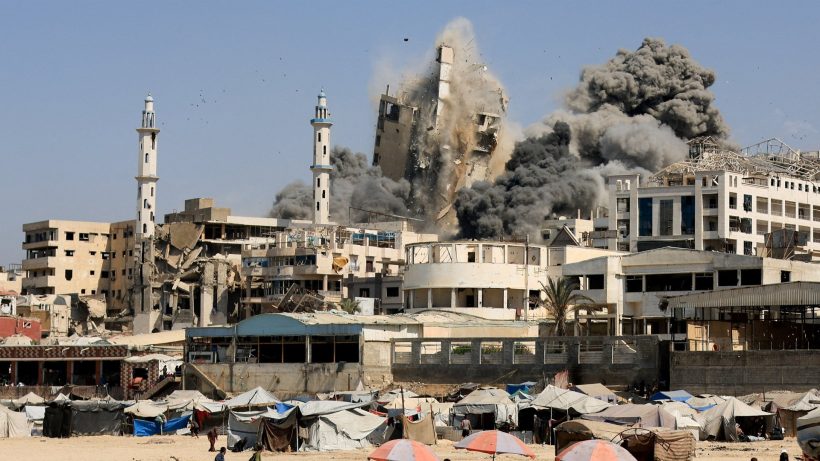
Gaza City was engulfed in flames before dawn on Tuesday as Israel launched a new ground offensive, killing dozens of civilians and burying families under the rubble.
Palestinian residents reported heavy strikes across the city overnight, when the military unleashed a massive bombardment as its ground forces moved deeper into the territory’s largest urban hub.
The military said the number of soldiers would rise in the coming days to confront up to 3,000 Hamas fighters in the area. According to a military official, the offensive is “the main phase of the plan for Gaza City.”
Gaza City’s Shifa Hospital said it received the bodies of 20 people killed in a strike that hit multiple houses in a western neighborhood, with another 90 wounded arriving at the facility on Tuesday.
“A very tough night in Gaza,” Dr. Mohamed Abu Selmiyah, director of Shifa Hospital, told The Associated Press.
“The bombing did not stop for a single moment,” he said. “There are still bodies under the rubble.”
Witnesses said the regime’s overnight bombing reduced a residential block in the north of Gaza City to mounds of rubble.
Palestinian resident Abu Abd Zaqout told AFP that about 50 people — including women and children — were inside a residential building when it was struck overnight.
“I don’t know why they bombed it,” he said. “Why kill children sleeping safely like that, turning them into body parts? We pulled the children out in pieces.”
Meanwhile, Israel’s minister of military affairs, Israel Katz, said in a post on X that the military “strikes with an iron fist” at what he described as “terrorist infrastructure” in Gaza City.
He said the offensive is aimed at creating “the conditions for the release of the hostages and the defeat of Hamas.”
“We will not relent and we will not go back — until the completion of the mission,” Katz threatened, saying, “Gaza is burning.”
Israel has long accused Hamas of building military infrastructure inside civilian areas, especially in Gaza City — allegations the resistance group repeatedly denies.
The overnight offensive came only hours after US Secretary of State Marco Rubio put the Trump administration’s full support behind Benjamin Netanyahu in a visit to al-Quds on Monday.
Rubio said Washington’s priorities were the liberation of Israeli hostages and the destruction of Hamas.
However, the UN rapporteur on human rights in the occupied territories, Francesca Albanese, said the aim of the Gaza City offensive is to make it uninhabitable.
“This is the last piece of Gaza that needs to be rendered unlivable,” Albanese said on Monday.
Residents still in the city were warned they must leave and head south.
Washington based think tanks advocate war on Lebanon
By Robert Inlakesh | Al Mayadeen | September 16, 2025
Despite the approval of a plan submitted on September 5, by the Lebanese Armed Forces, to disarm Hezbollah, the United States and Israeli regime are not satisfied with the move. What they had hoped for was an aggressive and destructive plot that could have plunged the nation into chaos.
The United States has been pushing the Lebanese government to order the full disarmament of Hezbollah, doing so without providing any tangible guarantees or even allowing Beirut to draft its own national defence strategy. Simply put, the US Trump administration hopes to pursue, through diplomacy, what the Israelis failed to achieve during their war of aggression against Lebanon.
While Lebanese Prime Minister Nawaf Salam has decided to take his orders from the United States on the question of disarmament, it is clear that the plan which was recently adopted by the Lebanese Armed Forces does not meet the standards set by the United States, and by extension, the Israelis.
The plan is supposedly divided into four separate phases, beginning in south of the Litani River. However, the plan was not revealed publicly, and there appears to be no specific deadline as to when Lebanon will achieve its stated mission. Everything has remained quite vague.
This predicament has now sparked outrage amongst Washington-based pro-war think tanks that have a significant impact on the US’s foreign policy decisions.
Take the Zionist Lobby cut out think tank, the Washington Institute for Near East Policy (WINEP), for example. Their most recent article on the issue is titled “Without a Hezbollah Disarmament Deadline, Lebanon Should Face Repercussions”.
The WINEP piece argues that the US government should pressure the Lebanese Army to take escalatory measures that would inevitably result in violent armed clashes with Hezbollah, including seizing a military position north of the Litani River as an initial step toward disarmament, and setting a specific deadline for this process.
The author of the piece, Hanin Ghaddar, writing for the Zionist think tank, advocates weaponising US aid to Lebanon by making it conditional on disarmament demands. She goes even further, arguing that the US should go after Lebanese Parliament Speaker, Nabih Berri, in order to turn the Amal Movement against Hezbollah and to destroy the Shia alliance in the upcoming elections. It is also noted that additional sanctions should be used to the effect of going after Lebanese Shia elected officials. This is a clear call for election interference.
Another notable piece was recently published by Haaretz and reposted by the infamous Zionist think tank, the Foundation for Defense of Democracies (FDD). The author of the piece, entitled “Why Israel Shouldn’t Celebrate Lebanon’s Promise to Disarm Hezbollah Just Yet”, was written by FDD senior fellow David Daoud.
In this article, the FDD think tank senior fellow argues that the Israeli regime should continue bombing Hezbollah sites throughout Lebanese territory and aim at significantly weakening the Lebanese resistance group in order to pave the way towards the Lebanese Armed Forces being able to carry out the rest of the job.
In the WINEP piece, delusional depictions of the Lebanese military’s capabilities when it comes to fighting a war with Hezbollah, use the likes of LAF’s operation in the Nahr al-Bared refugee camp, back in 2007, and the Army’s clashes with ISIS – in which Hezbollah fought alongside them – as examples of how they could prove successful. However, Daoud is less delusional and sets forth a strategy that allows for the Israelis to do all of the heavy lifting instead.
The Atlantic Council think tank has meanwhile been promoting the false idea that the Lebanese public, with the exception of the nation’s Shia population, are in favour of Hezbollah disarmament and that the resistance group has been all but defeated. Completely contradicting this notion however, is the fact that 58% of the Lebanese public polled said they oppose Hezbollah’s disarmament without a national defense strategy.
Even more revealing, however, was that the data published by Lebanon’s Consultative Center for Studies and Documentation exposed that 71.7% said they don’t believe the Lebanese army could defend the country from an Israeli attack, and 76% answered that they didn’t believe Lebanon’s diplomatic maneuvers could stop the Zionist regime from attacking.
The gap here, between 58% that opposed disarmament and the 71.7% to 76% that answered the way they did above, indicates that the respondents answered the disarmament question based upon emotion rather than logic, which could largely be attributed to the effectiveness of anti-Hezbollah propaganda.
Other Washington-based think tanks have also been active on this issue, including the most influential think tank over the Trump administration, the Heritage Foundation. In its case, it openly praised US President Donald Trump for his efforts to expel UNIFIL forces from Lebanon, which will occur under a phasing out approach come the end of 2026.
Across all of the prominent Washington-based Zionist think tanks, the message appears uniform, they all seek further pressure upon Beirut in order to force it to disarm Hezbollah, against the wishes of the majority of the Lebanese public.
The US is directly meddling in Lebanon’s affairs and its moves, including threatening Beirut with another Israeli war, are tantamount to violations of the nation’s sovereignty, in addition to being anti-democratic. For all the talk about “sovereignty”, Lebanese Prime Minister Nawaf Salam and his ilk have remained silent about the US imposing its will on Lebanon, nor do they have a strategy to liberate their territory in the south, or even stop the daily Israeli airstrikes carried out on Lebanese lands.
Qatar After the Airstrikes: Assessing Viable Responses to Israeli Aggression
By Abbas Hashemite – New Eastern Outlook – September 16, 2025
Since the Israeli attack on Doha, the Arab world has been looking for a collective response. However, the Arab states have limited viable options available due to their over-reliance on the US.
Israel’s Attack on Doha: A Dangerous New Precedent in the Gulf
The Israeli attack on Qatar last week astonished the whole world. Doha has long been seen as a mediator, as it played a constructive role in establishing peace between different conflicting parties, including the United States and the Taliban. It was also playing a mediatory role between Hamas and Israel. Hamas leadership was present in Doha to discuss the peace proposal presented by the Trump administration. However, the Israeli government conducted airstrikes in Doha on the building in which the Hamas leadership was present. Although the Hamas leadership survived the attack, these airstrikes raised serious concerns about the sovereignty and security of the Gulf States.
The Gulf countries have largely been reliant on the US alliance for their security. The latter supplies most of the arms and weapons to these countries. However, the US air defense system did not intercept any Israeli missiles during the recent strikes in Doha, implying that the US security guarantees to the Gulf States are selective and are only motivated to counter threats emanating from Iran. Moreover, this demonstrates that the US green-lighted the Netanyahu administration to conduct these criminal strikes in an affluent neighborhood in Doha.
Although the Trump administration has denied all the claims about the US support to the Israeli government in these strikes, and it has condemned this move in the United Nations, the US Secretary of State, Marco Rubio, is on a two-day visit to Israel to ensure continued US support to the Zionist state. This further demonstrates that the United States prioritizes Israel over its Arab allies, and all its airbases in the Gulf countries are actually to protect Israel against the regional threats.
Limited Military Options and Growing Frustration
Qatar’s Prime Minister Sheikh Mohammed bin Abdulrahman bin Jassim Al Thani described the Israeli attacks on Hamas leadership in Doha as “state terrorism that is being exerted by someone like Netanyahu.” He further stated, “I think that we have reached a decisive moment. There should be retaliation from the whole region in the face of those barbaric actions that only [reflect] one thing: It reflects the barbarism of this person that is leading the region, unfortunately, to a point where we cannot address any situation, and we cannot repair anything, and we cannot work within the frameworks of international laws. He just violates all those international laws.”
A strong response by Qatar and Arab states is mandatory to ensure their sovereignty and security in the future. However, given the Arab states’ overreliance on the US security guarantees and arms, they are left with very few options to retaliate against Israel. A military response to Israel is impossible for the Gulf States, as they do not possess enough military capabilities. Moreover, the US would never allow them to collectively attack Israel. Therefore, a collective military response could lead to internal security threats due to the presence of the US airbases in these countries.
Strategic Realignment: From US Dependence to Eastern Alliances
The Gulf States, however, could push Israel towards regional diplomatic isolation. The UAE, Bahrain, Morocco, and Sudan established diplomatic relations with Israel in 2020, following the Abraham Accords, which were mediated by the United States. The UAE summoned the Israeli diplomat to denounce these airstrikes in Doha. Mohammed bin Zayed Al Nahyan, the President of the UAE, visited Qatar within 24 hours of the attack to discuss the situation. The UAE and other Arab states could limit or downgrade their diplomatic relations with Israel in retaliation for these attacks.
Qatar has already lobbied for a unanimous UN statement condemning the illegal Israeli attack in Doha. It will also host an Arab-Islamic summit in Doha to coordinate a collective response to Israeli attacks. Leaders from almost all the Islamic countries, including KSA, Pakistan, Turkey, and Iran, are expected to attend this extraordinary summit. Moreover, the Gulf States could also join the International Court of Justice’s cases against Israel, further building pressure on the Zionist state to halt its genocide and occupation in Palestine.
Gulf States, especially Qatar, the UAE, the KSA, and Kuwait, hold significant economic leverage over Israel due to their energy resources. They could use their economic leverage to impose trade and economic sanctions on Israel by boycotting companies that have stakes in the Israeli economy. Qatar, Saudi Arabia, and the UAE pledged a collective investment of $3 trillion in the US economy during Trump’s last visit to the region. The intention behind this investment was to strengthen relations with the United States. However, the recent failure of the US to protect Qatar from Israeli attack could result in the Gulf nations’ quest for new global allies.
Over the past few years, the world has witnessed unprecedented economic growth in Russia and China. In 2023, China brokered a peace deal between Iran and Saudi Arabia to normalize their bilateral diplomatic relations. Russia, on its part, has emerged as a strong military and diplomatic power on the global stage. The two new superpowers of the world are already aligned with the Palestine policy of the Muslim world. Moreover, they possess unmatchable military power. The recent US failure to protect Qatar from Israeli attacks has provided the Arab states with a new direction to expand their diplomatic and strategic ties. They could engage with Russia and China to strengthen their defense sector and expand their diplomatic clout. This would not only prove detrimental for Israel but would also hurt the US regional and global interests.
Аbbas Hashemite – is a political observer and research analyst for regional and global geopolitical issues. He is currently working as an independent researcher and journalist
Iran clarifies stance after joint Doha statement, rejects ‘two-state’ solution to Palestinian issue
Press TV – September 16, 2025
Iran has clarified its stance on a joint statement from a Doha summit held in the wake of the Israeli regime’s assault on Qatar, rejecting the “two-state” solution concerning the Palestinian issue and and US’s self-proclaimed “peace” efforts.
The Foreign Ministry issued the remarks on Tuesday, distancing the Islamic Republic from references made in the statement to the so-called “two-state solution,” reiterating support for Palestinians’ right to resistance, and ruling out any prospect of recognition of the regime.
It also dismissed the existence of any genuine intention on the part of Washington to resolve the situation created by the regime’s barbarity throughout the West Asia region, including across the occupied Palestinian territories.
‘Two-state solution’ a non-starter
Reasserting the Islamic Republic’s continued unwavering support for the Palestinian cause of liberation from Israeli occupation and aggression, the ministry said the country would under no circumstances abandon its staunch belief that Palestinians were absolutely entitled to exercise their inherent right to self-determination.
Therefore, Tehran keeps holding fast to its principled position that the only “true and sustainable” solution to the Palestinian issue rests in the creation of a “unified democratic government” in the occupied territories.
Such a government should receive its mandate from the outcome of a referendum partaken by all Palestinians inside the territories as well as the Palestinian diaspora, and, hence, end up representing “all Palestinians,” the ministry said.
Therefore, it said, Tehran utterly dismisses the “two-state solution,” supported by the United States and its allies, and the concepts proposed as part of such “solution,” including those mentioned in the Doha statement.
It named one of those concepts as “establishment of the State of Palestine along the lines of June 4, 1967,” which ignores the vast Palestinian territories that the regime had already occupied in 1948 and continues to occupy.
Also, the Islamic Republic spurns the idea that Palestinians’ future capital should be confined to just the eastern part of the holy occupied city of al-Quds, the ministry added.
“The so-called ‘two-state’ solution would not resolve the Palestinian issue,” it specified.
‘Israeli barbarity necessitates resistance’
Iran, meanwhile, continues to uphold Palestinians’ entitlement to employ “whatever necessary vehicle” towards realizing their inalienable right to self-determination and ridding themselves of foreign colonialism, the ministry stated.
Those rights that are enjoyed by “any peaceable nation” include the right to resist, it noted, adding, “Given the barbarity exercised by the occupying regime’s forces, nothing should serve to restrict this right.”
“It is also our shared duty under international law to support this aspiration,” it said, and also repeated Tehran’s categorical rejection of any potential recognition of the regime.
‘US no ‘peace’ partner’
Finally, the ministry underlined that the policies and actions of the United States have contributed to the continuation and backing of the Israeli regime’s aggression against the Palestinian people, rather than subduing it.
“In light of this reality, the Islamic Republic holds that the United States cannot be recognized or regarded as a credible or impartial party in advancing a just and lasting peace in this conflict.”
“We request the summit’s secretariat to include the Iranian delegation’s reservations in its final report.”
The emergency Arab-Islamic summit was held in the Qatari capital on Monday to address the regime’s recent deadly attacks on the city, which targeted the Palestinian resistance movement Hamas’ leadership, among Tel Aviv’s other atrocities throughout the West Asia region.
Grossi, again? Iran’s new IAEA deal reeks of JCPOA 2.0
By Fereshteh Sadeghi | The Cradle | September 15, 2025
Three months after the Israeli occupation state’s aerial assault on Iran, the Iranian government reached a new deal with the International Atomic Energy Agency (IAEA). The agreement, and the fact that IAEA chief Rafael Grossi and Iranian Foreign Minister Abbas Araghchi offered conflicting interpretations of it, has outraged Iranian political circles and the public, many of whom view Grossi as a facilitator of Israeli aggression. Araghchi is now accused of concealing details of the agreement and repeating the mistakes of the 2015 Joint Comprehensive Plan of Action (JCPOA) nuclear deal.
Iran signs surprise deal with IAEA after Israeli strikes
During a brief visit to Egypt on 12 September, Araghchi shook hands with Grossi as they announced a deal on the resumption of UN inspections of Iran’s nuclear program. The agreement was significant as Tehran had halted its cooperation with the IAEA in the wake of the Israeli aggression in June, and a parliamentary vote had suspended international inspections. The vote had been ratified after the cessation of the 12-day war between Iran and the occupation state in late June, amid accusations that the IAEA was sharing intelligence on their nuclear facilities and scientists with Israel and the US. Iranian officials claimed two IAEA inspectors smuggled classified documents on the Fordow nuclear site to Vienna. Iran revoked their licenses, but the agency took no punitive action. Fordow was later bombed by US B-52 bombers. Grossi’s 12 June report to the IAEA Board of Governors, which accused Iran of failing to meet its safeguards obligations, is widely seen as having paved the way for the 12-day Israel–Iran war that started one day after on 13 June. The agency’s refusal to condemn Tel Aviv’s attacks deepened Iranian distrust.
E3 pushes for sanctions as Iran tries to avoid snapback
As Iran withdrew from indirect nuclear talks with the US and halted cooperation with the IAEA, Germany, France, and Britain (the E3) announced their intention to reinstate UN sanctions. Those sanctions had been suspended under the 2015 JCPOA. The E3 said it would trigger the snapback mechanism before its expiry in mid-October, claiming that Iran had failed to uphold its commitments.
Seeking to avoid further sanctions, Iran agreed to engage the E3 in talks in late August. In exchange for Iranian cooperation with the IAEA, clarification on 440 kilograms of highly enriched uranium stockpiled before the Israeli attack, and a return to US negotiations, the Europeans offered to extend the snapback deadline by six months. Iran rejected the offer. The E3 then launched the snapback process but gave Iran a 30-day deadline to comply with the UN atomic watchdog’s demands. A week later, IAEA inspectors were scheduled to visit Iran to supervise fuel replacement at the Bushehr nuclear power plant. Araghchi reassured lawmakers that the Supreme National Security Council (SNSC) had authorized the inspectors’ visit and insisted all cooperation would comply with the law banning extensive IAEA engagement. A source close to the Iranian Foreign Ministry tells The Cradle that inspectors had also planned to visit other facilities, including the Tehran Research Reactor, but those plans were quietly scrapped under parliamentary pressure. Then, without warning, the Araghchi–Grossi agreement in Cairo was revealed, shocking Iranian society. The deal guarantees renewed Iranian cooperation with the IAEA.
Parliament sidelined, backlash intensifies
One day before Araghchi’s Cairo trip on 9 September, parliamentarian Hussein-Ali Haji-Deligani warned that a new IAEA deal was imminent – one that violated Iranian law and did not protect national rights. He warned Araghchi against signing or risking impeachment. Once news of the agreement broke, reports surfaced that the Iranian legislature, the Majlis, would close for three weeks for lawmakers to visit their constituencies. Critics alleged this was a calculated move to shield the Cairo agreement from scrutiny.
While the Foreign Ministry and the SNSC remained silent, Grossi publicly elaborated:
“The technical document would include access to all facilities and installations in Iran and contemplates the required reporting on all the attacked facilities including the nuclear material present at those and that will open the way for respective inspections and access.”
That statement drew sharp rebuke. Tehran MP Amir-Hussein Sabeti said, “This passive and weak settlement to renew cooperation with the IAEA contradicts national interests, paves the way for new [Israeli] strikes, and clearly violates the law.”
In a televised debate, Araghchi attempted to allay the criticism, claiming the deal was approved by the SNSC. He dismissed Grossi’s remarks as “his own interpretation of the text”, adding, “from now on, the IAEA should request access to each nuclear site and the SNSC will review the requests case by case.”
The Iranian top diplomat stressed that “as long as Iran has not implemented environmental and safety measures at the attacked facilities, the IAEA will not be granted permission to visit them.” He insisted the agreement had nothing to do with the E3’s ultimatum; nevertheless, he contradicted himself by stating, “This settlement will be declared null and void if the Snapback mechanism goes into effect.”
Araghchi faces mounting calls for impeachment
Araghchi’s inconsistent justifications failed to quell the backlash. His repeated references to the SNSC did little to calm MPs. And in Iranian politics, it is an unprecedented event. Tehran’s Hamid Rasaei posted on X, “Ambiguities remain despite Araghchi’s explanations. Therefore, the Foreign Ministry must publish the text of the agreement.” He added sarcastically, “We usually kept deals secret for fear of the enemies. But since the other party is Grossi – the Israeli spy – there’s no reason to hide this deal from the public.” His colleague, Kamran Ghazanfari, went further to threaten Araghchi, “either deny Grossi’s remarks and share the signed document with lawmakers, or get prepared for your impeachment. We are not treating our national interests flippantly.”
Keyhan newspaper openly called the Cairo deal “invalid” because it does not meet the requirements of the Iranian law. Rajanews compared the Cairo document with Lausanne’s nuclear deal, adding, “Back in 2015, the government of Hassan Rouhani and then FM [Mohammad Javad] Zarif refused to publish the relevant fact sheet. Only later, Iranians found out the fact sheet had imposed unprecedented restrictions on Iran’s nuclear program.”
As public scrutiny intensified, the Majlis National Security and Foreign Policy Committee summoned Araghchi for a closed-door session. He described the three-hour meeting as “very good and constructive” but revealed no details. According to reports, “Araghchi provided the committee with the text of the memorandum” and “it was decided that cooperation with the IAEA remain only in the framework of the law and its implementation depends on non-happening of the Snapback.” That reassurance did little to assuage critics. Rasaei summed up the mood with a blunt X post, “The three-hour session finished. It’s the JCPOA all over again.”
On 14 September, the SNSC issued a statement indicating that its Nuclear Committee had ratified the Cairo agreement, adding “the committee is backed by the SNSC whose decisions are confirmed by Iran’s leader [Ali Khamenei].” Yet, the statement also stressed that should any hostile action be taken against the Islamic Republic and its nuclear facilities, including the reinstatement of the terminated resolutions of the UN Security Council, the implementation of the arrangements would be suspended. So far, 90 lawmakers have asked Majlis Speaker Mohammad Bagher Ghalibaf to convene a session on the Cairo memorandum. Ghalibaf has yet to comply.
In a country still reeling from the JCPOA’s consequences, lawmakers are increasingly determined to block another unilateral, opaque agreement made without parliamentary oversight.
The US State Department’s Growing Thoughtcrimes Obsession
By Adam Dick | Peace and Prosperity Blog | September 16, 2025
The Trump administration’s Department of State has been placing a high priority on denying the granting of visas to, and revoking visas from, people who have said things critical of the Israel government, including the Israel government’s war activities. That looks like it is an early step of a trend at the United States government department. In a new Fox News interview this week, Secretary of State Marco Rubio announced his desire that the State Department would make an addition to the list of thoughtcrimes for which visas may be denied and revoked.
Rubio stated:
We should not be giving visas to people who are gonna come to the United States and do things like celebrate the murder, the execution, the assassination of a political figure. We should not. And, if they’re already here, we should be revoking their visa.
The strange thing is that the United States government and its tied-at-the-hip Israel government have a longtime penchant for undertaking just such murders, executions, and assassinations. People’s approval of those killings, though, should not be expected to cause much of a stir at the State Department. Don’t hold your breath for expressed approval of the assassination (ordered by Trump in his first presidential term) of Iran General Qassim Suleimani, for example, to result in denials or revocations of visas. The same goes for expressed approval of recent killings by the Israel government of “political figures” in Lebanon, Iran, and Yemen.
Rubio suggested immediately after his comment regarding changes in visas policy that the thoughtcrimes punished could expand into a much longer list. “Why would we want to bring people into our country that are gonna engage in negative and destructive behavior?” he declared. “Negative and destructive behavior” sure is a broad category. How close to qualifying to be Rubio’s bestie will someone have to come to make the visa cut?
Featured Video
Elijah Magnier: Yemen’s strikes are shattering Saudi Arabia’s long-term strategy
or go to
Aletho News Archives – Video-Images
From the Archives
British weapons and personnel doing much of the killing in Yemen
Press TV – June 18, 2019
A detailed report published by the Guardian newspaper has shown how Britain is massively contributing to Saudi Arabia’s devastating war on Yemen as it suggests that London is not only supplying the bombs that fall on Yemenis, but it provides the personnel and expertise that keep the war going.
The comprehensive report by Arron Merat published on Tuesday showed that Britain was doing much of the killing in Yemen as the country continues to provide Saudi Arabia with everything it needs to turn its southern impoverished neighbor into a graveyard.
“Every day Yemen is hit by British bombs – dropped by British planes that are flown by British-trained pilots and maintained and prepared inside Saudi Arabia by thousands of British contractors,” said Merat in the report. … continue
Blog Roll
 Aletho News
- Netizens condemn Japanese drama for projecting Japan’s wartime atrocities onto Chinese characters
- Racist Seinfeld Dances for Joy as Bibi Unveils His New Map
- A West Bank War for Netanyahu’s Election Campaign, Could It Backfire?
- Yemen denounces European Parliament’s ‘hypocritical’ push to blacklist Ansarullah
- Qalibaf: UAE’s UN bid aims to ‘clear the runway’ for ‘Greater Israel’, whitewash genocide
- Pakistan reopens Iran border after boosting security: Report
- Why are so many Brazilians voting for Flávio Bolsonaro?
- Democrats Put Anti-Russia Agenda Ahead of American Workers
- Elijah Magnier: Yemen’s Strikes Are Shattering Saudi Arabia’s Long-Term Strategy
- Pentagon designates Chinese cultural centers national security threat
- If Americans Knew
- Latest updates from Israeli assault on West Bank
- Tourism Ministry launches free food truck tour in US
- “So Much Worse Than People Realize”: Never-Before-Seen Images Reveal Damage at U.S. Bases as Troops Describe Being Abandoned
- UK Bell Review Confirms Only Anti-Israel Attitudes Are Rising, Not Antisemitism
- DAILY UPDATE: Latest essential news on Palestine, Israel, & region
- DAILY UPDATE: Latest essential news on Palestine, Israel, & region
- Damning report shows the media must confront its failures on Gaza
- BBC senior broadcaster speaks out on Gaza coverage
- Netanyahu vows vast West Bank invasion in response to 20-minute skirmish that left 2 Israeli soldiers and 2 Palestinian fighters dead
- Tied up and tortured: Israel using US-made electroshock weapons on Palestinian detainees
- No Tricks Zone
- Sudden Stratospheric Warming, Powerful El Niño Combination May Lead To Extreme Europe Cold, Energy Crisis!
- Two New Studies Find Thwaites Glacier Melt Cannot Be Driven By Human Activity Or A Warming Ocean
- E-Cars Reduce CO2 Emissions By Only 41% Compared To Internal Combustion Engine Vehicles
- Predictions Made By Renowned Climate Professor Over Past Decades Have Been Proven To Be Poor
- New Study Suggests Large Regions Of The Pacific Ocean Have Been Cooling For The Last 80 Years
- Germany’s Green Energy Debacle: High Energy Costs Force Kahla Porzellan to Close After 182 Years!
- New Study: 50 Years Of The Most Aggressive ‘Net Zero’ Policies Can Only Affect The Global Climate By 0.03°C
- US September “Heat” Was No Record…Many Records Set Decades Ago
- Latest European Green Energy Debacle; Portugal’s Largest Flagship Solar Park Insolvent!
- Green Energy Debacle: German Expert Professor Fritz Vahrenholt Warns Of Severe Economic And Social Consequences

