Scott Ritter Hiding the Dominant Minority Behind Geopolitics?
Peace Activists Forced to Hide the Jewish Geopolitical Dots?
By Geurt de Wit | Ruling Elite Studies | January 18, 2026
Introduction
All political scientists and historians agree that some minorities have historically been able to dominate their host nations. Notable modern examples include the Spanish in South America, overseas Chinese in Southeast Asia, and Tutsis in Central Africa. Sometimes host nations rise against a dominant minority, as seen in Southeast Asia, where local populations have implemented various quotas and measures—such as Malaysia’s Bumiputera policies—to curb the economic and social influence of the ethnic Chinese community.
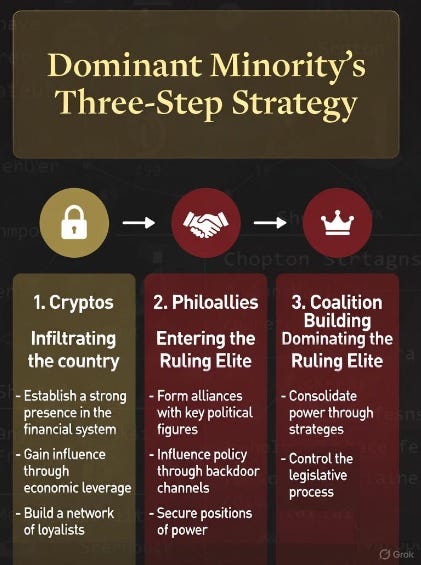
Jews
There is another significant example of a dominant minority, yet naming it remains a taboo: the Jewish elite in the West. This group exerts influence through economic and media power, a “Culture of Critique,” and its maneuvers within the geopolitical “Great Game”. U.S. foreign policy, for instance, appears heavily influenced by Jewish Zionists, compelling even the supposedly “America First” Trump administration to adopt “Israel First” policies. While parts of the peace movement have begun to note the Jewish role in fomenting conflicts also beyond the Middle East, many activists still fail to see the broader connections. The conflicts in Ukraine and Taiwan are directly linked to the crisis in the Middle East.
The reason is simple: Jewish led neoconservative and neoliberal forces aligned with Israel seek to weaken Russia and China, both of which support Iran and the Shia “Axis of Resistance” in the Middle East. Consequently, the West attempts to encircle Russia and China with military bases and hostile alliances while undermining their economies through sanctions and high tariffs to facilitate regime change.
This is nothing new. For centuries, Jews have viewed Russia and China as “antisemitic” for opposing Jewish attempts to become a dominant minority within their borders. Historically, this has manifested as a prolonged struggle. Jewish elite dynasties like the Rothschilds, Sassoons and Kadooreis, for example, pushed Western empires to subjugate China during its “Century of Humiliation.” Similarly, they managed to organize various wars against Russia including the first Crimean War in the 1850’s and then later the Jewish led Bolshevik and Oligarch takeovers in the 1920’s and 90’s. The present Ukraine War is just the latest in a series of conflicts and wars between Jews and Russia going back a millennium.
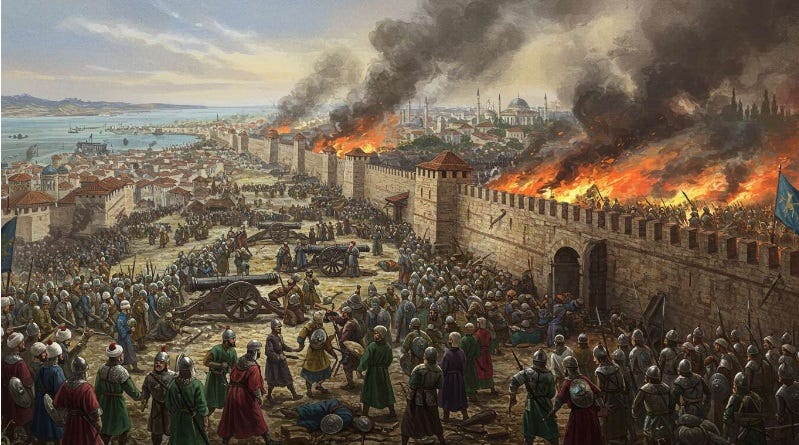
The obvious Jewish role in geopolitics and various wars has always been known to political scientists and historians. It is also common knowledge in many parts of the world such as in Eastern Europe, China and the Arab world. However, in America the Jewish dominant minority has achieved such power that both academia and media now avoid the subject entirely. Only occasionally does the American public hear about it through random outbursts, such as Mel Gibson’s criticism of the Jewish role in instigating wars.
Putin and Xi
Under the leadership of Vladimir Putin and Xi Jinping, Russia and China have regained their independence and power. Their geopolitical support for the Axis of Resistance has drawn the ire of Zionist Jews running Great Game geopolitics, while their nationalist anti-liberal policies have alienated liberal Jewish factions running the Culture of Critique movements. As a result, the Jewish dominated Western academia and media has totally demonized both nations, while Jewish led neoconservatives and neoliberals push for their encirclement and the targeting of their global allies.
The influence of Jewish dominant minority behind these conflicts remains such a taboo that even peace activists often ignore it. This gives Zionists a carte blanche to pursue military and cultural wars, regime change operations and proxy wars aimed at isolating Russia and China. By refusing to “connect the dots,” Western peace activists effectively allow this dominant minority to continue pushing for perpetual war.
Scott Ritter
In recent years, the peace movement has been bolstered by former UN weapons inspector Scott Ritter. A prolific advocate, Ritter has tirelessly warned against the dangers of nuclear war, organized demonstrations and personally lobbied Congress. Despite his background as a leftist philosemitic Democrat, he has significantly influenced the Republican “MAGA” movement toward anti-war policies.
Ritter has gained a massive following as a commentator on the Ukraine War. However, during the conflict’s first year, he remained silent on the Jewish and even Israeli connection, blaming only the CIA, MI6 and the U.S. and British governments. In this, he was joined by libertarian figures like Andrew Napolitano and Lew Rockwell, who focus on American “Primacists” rather than identifying a dominant minority.
Traditionally, both leftists and libertarians have avoided identifying the Jewish dominant minority to avoid being labeled as antisemitic. It was only during the recent genocide in Gaza that Ritter began to explicitly critique Israel’s geopolitical role, though he has yet to identify the dominant minority or even connect these dots to the broader global landscape.
Silent Peace Activists
Some suggest that platform policies, such as those on YouTube, drive this reticence. Peace activists like Andrew Napolitano, Alexander Mercouris, and Danny Haiphong reach hundreds of thousands of viewers daily through their Youtube channels. Openly discussing Jewish dominant minority and connecting Jewish geopolitical dots could lead to deplatforming and lost revenue. However, this doesn’t fully explain the silence, as they could simultaneously use alternative platforms like Rumble, X or Locals—a strategy successfully employed by the famous anti-Zionist, Candace Owens. Unsurprisingly she has been branded an “anti-Semite” by many Jewish organizations.

Alexander Mercouris
Another explanation is ideological. Many activists from leftist or libertarian backgrounds may instinctively view the concept of a “dominant minority” as inherently racist. The most dramatic example of this is the leftist peace activist and popular YouTube commentator Alexander Mercouris, who for years was oblivious to the Jewish connection. However, a few months ago, due to audience feedback, he admitted on his channel that he had never even thought about a possible connection between the Ukraine War and the Middle East Crises.
Afterward, he has not talked about the subject anymore, though he does seem to increasingly speak in code. For example, he repeatedly emphasizes that his channel will be shut down if he analyzes the Epstein case too deeply. At the same time, he seems to spell “Epstein” in the Jewish-German way, making Epstein’s ethnic background clearer. Mercouris also has the revealing habit of always following the arch-neocon warmonger Lindsey Graham’s name with the name Richard Blumenthal, possibly hinting that Graham is influenced by him and other Jews to a significant extent.
The third explanation for not openly noticing the dominant minority is that many prominent peace activists hope to attract the support of wealthy, anti-Zionist Jewish donors to finance the movement, a development that has yet to materialize.
Debanking
Certainly, the fourth and most important explanation is fear. Leading peace activists face tremendous pressure from various sides. Ironically, this pressure appears stronger in America than in Europe, despite stricter official censorship in Europe. However, Europeans benefit from strong employment and social security protections against firings and debanking. In America, people’s lives are more precarious and heavily dependent on high incomes, making it easier to intimidate them with threats to their reputation, job, income, or even bank accounts. The American media rarely discusses this, but hundreds of politically incorrect individuals have been debanked—not only in Canada but also in the U.S. Scott Ritter has now joined their ranks.
In the above video Scott Ritter recalls his days as a highly connected American intelligence operative, working closely with the CIA, Israelis, and even the White House. He emphasizes that he was once the “Golden Boy” of intelligence, privy to “everything.” Clearly, he must be aware of America’s dominant minority and their potential to ignite a nuclear war. Yet, despite recent escalations in Eastern Europe and the Middle East, Ritter in this video claims that the main problem is America itself, with Trump as a “prisoner of the CIA”—not the Mossad, Israel, or even the Zionists.
The next day, however, Ritter appeared in an interview with Andrew Napolitano. He admitted that after being debanked, he fell into depression and briefly felt hopeless, especially as his wife had grown weary of the persecution that had affected their entire family for decades. At that point, Napolitano played a clip of Jonathan Greenblatt, the Jewish ADL’s chairman, boasting about the organization’s role in training American police and officials. This ignited Ritter, who then openly declared that Zionists are running the American government.
Trump’s chess moves
At the same time, Ritter suggested there might still be hope. He noted that many parts of the government resent Zionist dominance, and even Donald Trump could be among them. That wouldn’t be surprising, given Trump’s ego—he can’t be pleased with how Netanyahu and many other Jews publicly humiliate him. Being Israel’s bitch cannot be fun.
It could even be that Trump is deliberately undermining American influence abroad through his erratic behavior, bullying threats, and tariffs. After all, U.S. foreign policy is thoroughly dominated by Zionists, so disrupting the entire system might be the only way to halt it. For instance, threatening to annex Greenland would certainly fracture or weaken NATO, making it harder for EU NATO countries to sustain their warmongering. Perhaps Trump truly seeks peace through a “Fortress America” approach, dividing the world among American, Russian and Chinese spheres of influence. Maybe he’s really playing four-dimensional chess, with method to his madness. Of course, the alternative is that he’s simply a madman. As Scott Ritter admits, he doesn’t know—and neither does anyone else. Probably not even Trump himself.
People worldwide are deeply divided over Donald Trump. Some view him as a mastermind playing four-dimensional chess to save the world, while others see him as a narcissistic bumbler who sows chaos wherever he goes. So, which perspective aligns more closely with the truth? We do not know but let’s first assume that Donald Trump is a rational player in do…
Conclusion
Many in the peace movement believe that concealing the Jewish dominant minority and obscuring its role in numerous wars is essential for peace. However, this strategy may backfire, giving that minority a free hand to escalate proxy conflicts and try again and again to push the world toward “limited” nuclear war.
People often demand perfection from their heroes, which is counterproductive. No one is a superman—not even Scott Ritter. Of course, he must consider his family. Of course, he has been reticent about exposing Jewish power. The same applies to all other peace activists. But gradually, things are changing on both the left and right. They are beginning to point out the man and group behind the curtain.
In any case, peace activists perform invaluable work and deserve unwavering support. After all, they do what they humanly can. Without them—especially Scott Ritter—a nuclear war might already have begun.
The War On Free Speech In Australia Is Getting Cartoonishly Absurd
By Caitlin Johnstone | January 17, 2026
A mentally disabled Australian woman is being prosecuted for antisemitic hate crimes after accidentally pocket-dialing a Jewish nutritionist, resulting in a blank voicemail which caused the nutritionist “immediate fear and nervousness” because she thought some of the background noises in the recording sounded a bit like gunshots.
We’re being told we need more of this. There’s “hate speech” legislation presently in the works to make this worse. Australia’s controversial Combatting Antisemitism, Hate and Extremism Bill appears to be explicitly crafted to dramatically increase the scale, frequency and consequences of the exact sort of dynamics we’re seeing in this case, and to eradicate opposition to Israel throughout the nation.
This is how overextended Australia’s freakout over “antisemitism” already is. You can literally just be sitting there not saying or doing anything and still find yourself getting arrested and prosecuted for an antisemitic hate crime. They have the authority to do this presently, under the laws that already exist. The argument for this bill is that our present horrifyingly tyrannical and abusive system is insufficiently authoritarian and tyrannical, and that prosecutors need more power to police speech far more forcefully.
Australians are being asked to trust a system that would take a woman with an intellectual disability to prosecution in a court of law over an accidental butt-dial to a person of Jewish faith with the authority to send people to prison for years over their political speech. And this is happening after we just spent years watching Australian authorities roll out authoritarian measures to stomp out criticism of Israel and quash protests against an active genocide.
This is madness, and it needs to be brought to a screeching halt. Immediately. This entire country has lost its damn mind.
The Bondi attack isn’t the reason, it’s the excuse. All these laws being rolled out to stomp out criticism of Israel in Australia were sought for years before the shooting occurred.
Immediately after the attack last month I tweeted, “Not a lot of info about the Bondi shooting yet but it’s safe to assume it will be used as an excuse to target pro-Palestine activists and further outlaw criticism of Israel in Australia, as has been happening to a greater and greater extent in this country for the last two years.”
They could have proved me wrong, but instead they’ve spent this entire time proving me one hundred percent correct. The frenzied efforts to crush anti-genocide protests and silence speech that is critical of Israel and Zionism in these subsequent weeks has plainly established this.
There is no connection between pro-Palestine demonstrations and the Bondi attack. None. It had nothing to do with Palestinians, and it had nothing to do with anti-genocide demonstrations. It’s a completely made-up claim that Israel’s supporters have been circulating in Australian consciousness through sheer repetition. They’re just pretending to believe it’s true in order to promote the information interests of a genocidal apartheid state.
Israel’s supporters need to use propaganda, deception, censorship and oppression to promote their agendas, because it’s all they have. They don’t have truth. They don’t have arguments. They don’t have morality. All they have is brute force. They are shoving support for Israel and its atrocities down our throats whether we like it or not, and if we refuse what we’re being force-fed they will punish us. That’s the only tool in their toolbox.
This needs to be ferociously opposed. The more Israel and its supporters work to assault our right to oppose their abuses, the more aggressively we need to oppose them. We are no longer fighting against war and genocide in the middle east, we are fighting against an assault on our own civil rights. It’s personal now. They’re coming for us directly.
Palestinian prisoners in 2025: Shocking figures and escalating violations
Palestinian Information Center – January 17, 2026
RAMALLAH – The Asra Media Office has revealed alarming data regarding the situation of Palestinian prisoners up to the end of 2025, noting that their number has reached approximately 9,300 prisoners, nearly half of whom are held in detention without charge or trial amid an unprecedented expansion in the use of administrative detention and arbitrary classifications, including the so-called “unlawful combatant.”
In a report issued today, Saturday, the office explained that the Israeli occupation authorities have escalated their repressive policies by targeting women, children, journalists, and medical personnel, alongside systematic violations inside prisons. These violations include physical and psychological torture, deliberate medical neglect, starvation, detention under inhumane conditions, sexual assaults, the denial of visits, restrictions on lawyers’ work, and obstruction of the tasks of the International Committee of the Red Cross.
According to official data, since 1967 and up to the end of 2025, around 323 prisoners have died inside Israeli prisons, including 86 prisoners since 2023 and 32 during 2025 alone. The occupation authorities continue to withhold the bodies of 94 prisoners, constituting a grave violation of international humanitarian law, amid documented cases of direct killing, torture, and medical neglect leading to death.
The Asra Media Office noted that by mid-January 2026, the number of martyrs of the prisoners’ movement had risen to 324, including 87 since the war of genocide, with the continued withholding of 95 bodies under a policy of collective punishment prohibited under international law.
Despite the release of 3,745 prisoners during exchange deals in 2025, the Office confirmed that the occupation continued its policies of deportation and re-arrest, alongside the enactment of dangerous repressive legislation, including calls for the execution of prisoners, the extension of administrative detention periods, the revocation of citizenship, and the targeting of human rights institutions working on prisoners’ issues.
The Office called on the international community to assume its legal and moral responsibilities and to take immediate action to hold the occupation authorities accountable for these crimes, ensure the urgent release of sick prisoners, children, and women, and impose independent international monitoring over Israeli prisons.
US announces Gaza ‘Board of Peace’ amid ongoing Israeli ceasefire breaches
Press TV – January 17, 2026
The administration of US President Donald Trump has announced the executive members of Gaza’s so-called Board of Peace, a body purportedly tasked with managing transitional governance in the territory, as Israel continues to violate its ceasefire agreement with Hamas.
On Friday, the White House published the names of the Gaza Strip’s so-called “Board of Peace” members and the head of the National Committee for the Administration of Gaza (NCAG), marking the launch of the second phase of Trump’s 20-point plan for Gaza.
Ali Sha’ath, a former Palestinian deputy minister in the Palestinian Authority (PA), will lead the NCAG, according to the White House.
The so-called Board of Peace will be chaired by Trump himself, with key members including Secretary of State Marco Rubio, Trump’s special envoy Steve Witkoff, Trump’s son-in-law Jared Kushner, and former UK Prime Minister Tony Blair.
The statement also listed members of a “Gaza Executive Board”: Turkish Foreign Minister Hakan Fidan; United Arab Emirates’ Minister of State for International Cooperation Reem Al-Hashimy; veteran Qatari diplomat Ali Al-Thawadi; Egypt’s intelligence chief Hassan Rashad; UAE-based Bulgarian diplomat and former UN envoy Nickolay Mladenov; Cypriot-Israeli businessman Yakir Gabay; Dutch politician Sigrid Kaag; as well as Witkoff, Kushner, and Blair.
Mladenov will act as High Representative for Gaza, linking the Board of Peace with the NCAG, while Major General Jasper Jeffers will lead the International Stabilization Force (ISF).
The US also appointed Aryeh Lightstone and Josh Gruenbaum as senior advisers to the Board of Peace to supervise “day-to-day strategy and operations.”
More appointments to the Executive Board and the Gaza Executive Board are expected in the coming weeks.
The announcement follows Witkoff’s Wednesday statement launching the second phase of the Gaza ceasefire plan.
The second phase is said to focus on “demilitarisation, technocratic governance, and reconstruction.”
However, most of the goals in Trump’s 20-point plan that became the basis for a ceasefire in Gaza three months ago never became a reality on the ground.
Phase one was designed to immediately halt the fighting, facilitate the exchange of Israeli and Palestinian captives, set a boundary for Israeli withdrawal from parts of Gaza, allow the full entry of humanitarian aid, and open the Rafah crossing between Gaza and Egypt.
While the daily number of Israeli attacks has decreased since the start of the ceasefire, Israel has killed at least 451 Palestinians and injured 1,251 – an average of nearly five killed every day – since October 10.
Under the ceasefire deal, Hamas released all 20 living Israeli captives in exchange for nearly 2,000 Palestinian prisoners.
Hamas has also returned 27 of the 28 bodies of deceased captives, while the search is still on for the remaining body, believed to be buried under the rubble of buildings bombed by Israel.
However, according to Hamas, Israel has failed to release all women and child prisoners as stipulated in the agreement.
Moreover, the Israeli military did not fully withdraw its troops to an area dubbed the “yellow line” and continues to restrict aid.
The opening of the Rafah crossing did not happen, either.
Since Israel launched its genocidal campaign on October 7, 2023, more than 71,000 Palestinians have been killed and over 172,000 wounded, the majority of them women and children.
Hamas: Israeli minister’s boasting over Gaza’s destruction an open admission of genocide
Palestinian Information Center – January 17, 2026
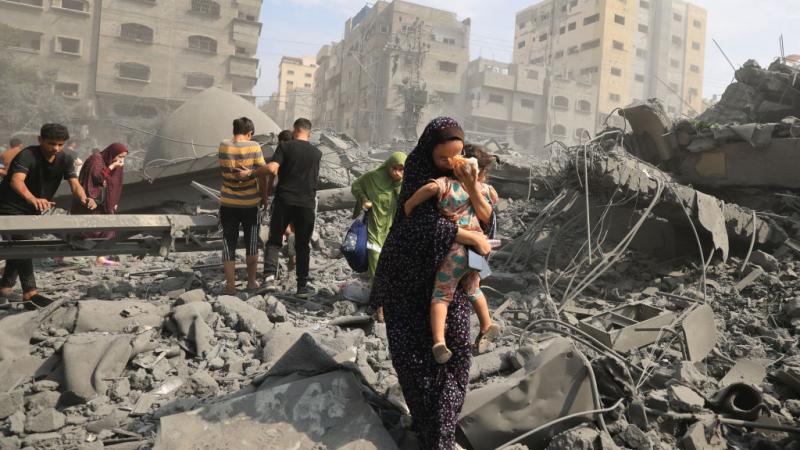
GAZA – Hamas spokesperson Hazem Qassem said on Saturday that the Israeli war minister’s public boasting about the destruction of the Gaza Strip, and his congratulation to the soldiers for criminal acts, amounts to an explicit and unprecedented admission of genocide.
Qassem said the remarks, made in light of revelations by Western media about the scale of devastation in Gaza, constitute further proof of a level of contempt for international law and humanitarian norms unseen in modern history.
He added that what has unfolded in the Gaza Strip, genocide and ethnic cleansing, constitutes a full-fledged crime under international law, now accompanied by a clear and public confession from those responsible. This, he said, necessitates genuine accountability for the entire Israeli occupation system behind these crimes.
Israel launched a genocide in the Gaza Strip in October 2023 that continued for more than two years, resulting in the killing of more than 71,000 Palestinians and the wounding of over 171,000 others. The assault caused massive destruction to approximately 90 percent of Gaza’s civilian infrastructure, with the United Nations estimating reconstruction costs at around $70bn.
Latest US-backed regime change operation in Iran hits the wall
By Samuel Geddes | Al Mayadeen | January 17, 2026
Having bombed the country in 2025, “Israel” and the US seemed to think that provoking street violence would have more success at collapsing the Iranian state. Instead, it fizzled almost instantly.
We have been here at least half a dozen times in the past two decades. Street protests in Iran over an internal economic, social or political issue emerge, gather a degree of momentum in urban areas and the Western propaganda system declares that the protests have “shifted” from their initial focus, to calls for the repudiation of the Islamic Revolution and the end of the political system it created. European and American politicians issue their empty statements of solidarity with the Iranian people and unilaterally decide that the Islamic Republic has “lost its legitimacy,” that its fall is simply a matter of “when,” not “if.” We have seen this narrative played out often enough to recognize it never survives contact with the real world.
The source of the persistent delusion that the Islamic Republic is about to fall comes not only from the Euro-American elite class wishing it to be so, but also from its deferral to the “analysis” of segments of the diaspora whose own political objectives are detached from reality.
Whether it is protests over the government’s handling of the economy, energy blackouts, or the water crisis, most external observers are incapable of viewing each individual issue through any lens other than that of regime change.
This time around the US and Israelis, in coopting the protests to destabilize the country through street violence, have not even bothered to hide their involvement. It has also not helped the West’s case that it is now feigning “humanitarian concern” for the rights of Iranian citizens while it has spent more than two years facilitating the ongoing slaughter and starvation of Gaza’s population. Any observer following both issues can detect the dissonance and conclude what is motivating the frantic calls to escalate the situation into military intervention. That is, the desire to crush a state and society that has resisted Western dominance for more than four-and-a-half decades.
The brazenness of the West’s affected concern for the well-being of the Iranian public is particularly galling in light of the sanctions. If Iranians’ living standards were really of any concern to Washington, London or Brussels, they would start by unconditionally ending their economic strangulation in effect against the country. The truth is that the suffering and misery engendered by the sanctions is entirely the point. As well as stifling the development of an independent state outside the globalized-Western economy, the siege is specifically intended to make living conditions unbearable for the average Iranian so that they are incentivized to undermine the Islamic Republic. The continuation of the sanctions is a barely disguised punishment of the Iranian public for not pursuing the West’s geopolitical goal of regime-change for them.
Were it not glaringly obvious to the Trump administration before the latest unrest, it surely is now that the exiled political diaspora most actively pushing for the fall of the Islamic Republic through Western military action are entirely incapable of political organization. Even the least crazed fan of the defunct Pahlavi dynasty is pathologically hostile to the terrorist personality cult of the MEK, as much as they are to the Islamic Republic itself. There simply is no political alternative, to say nothing of whether it even has any domestic support, waiting to replace the Islamic Republic.
Flush from the “success” of his abducting Venezuelan president Maduro, Trump seemed temporarily convinced he might have a similar option here, to carry out a meaningless military stunt for which he can take credit and declare “victory.” His problem is that there is no level of open military action against Iran that would allow him to do this without igniting a regional war that destroys the global economy.
This realization, if he has come to it, would explain his backtracking on the red lines he set, that any executions would trigger US attacks. If a controlled, stage-managed performance is his goal, as it almost always is, then the confrontation with Iran leaves him with no viable option but to back down.
The absence of any realistic military option has now seen both the US and Europe revert to their standard tactic; the intensification of the sanctions they have used to punish the Iranian people. Trump’s latest declaration of a 25% tariff on any country trading with Iran is his way of giving himself an off-ramp, for now, from a crisis that is largely of his making.
Figures behind massacre of starving Gazans now shaping US Gaza plan
Press TV – January 16, 2026
Many of the figures now being elevated as key figures in Washington’s proposed postwar administration for Gaza were architects of the Gaza Humanitarian Foundation (GHF), a US-Israeli aid operation under which Palestinian civilians were repeatedly killed while attempting to access food.
According to the Financial Times, individuals shaping the new Gaza executive committee were directly involved in designing and promoting GHF, a scheme that operated for months inside Israeli-controlled areas of the strip.
GHF was presented as a humanitarian workaround after Israel restricted UN and NGO aid access. In practice, it forced starving Palestinians to travel through militarized corridors to tightly controlled distribution hubs, where limited food was handed out under the watch of Israeli troops and US contractors.
Gaza health officials reported that hundreds of Palestinians were killed along access routes to these sites, while some estimates place the death toll at close to 2,000 over six months.
Israeli authorities denied deliberate targeting and disputed casualty figures, even as repeated shootings were documented near GHF hubs.
Despite the collapse of the foundation in November, the same network behind it is now shaping Gaza’s future governance.
The planned executive committee, operating under a Trump-led “Board of Peace,” is being influenced by Roman Gofman, Israeli prime minister Benjamin Netanyahu’s chief military adviser and a nominee to head the Mossad; US-Israeli venture capitalist Michael Eisenberg; US-Israeli policymaker Aryeh Lightstone; and Israeli tech entrepreneur Liran Tancman, who has links to Israeli intelligence.
All four were involved in establishing or promoting GHF.
The executive committee is expected to include Palestinian technocrats tasked with replacing Hamas in civil administration under the second phase of a US-brokered ceasefire.
Eighteen Palestinian figures have reportedly received invitations, with former Palestinian Authority planning official Ali Shaath designated to head the body and retired intelligence officer Mohammed Nisman expected to oversee security.
Meetings are scheduled to take place in Cairo, while the committee is set to operate under direct US supervision.
The push comes as Israel continues to violate the ceasefire. Since the truce was announced in October, Israeli forces have killed more than 440 Palestinians and injured over 1,200, according to Gaza’s Health Ministry.
Israeli troops were supposed to withdraw to designated lines and halt attacks during the first phase of the agreement, but instead have expanded their presence, destroyed thousands of buildings, and constructed new military outposts inside Gaza.
Humanitarian commitments under the ceasefire have also gone unmet. Of the 57,000 aid trucks stipulated in the agreement, fewer than 25,000 have been allowed into Gaza, according to the Government Media Office.
Promised increases to 4,200 trucks per week have not materialized, while Israel has announced plans to bar dozens of international NGOs from operating in the strip. The blockade remains in place, exacerbating food insecurity, medical shortages, and displacement.
Former UN envoy and Bulgarian defense minister Nickolay Mladenov is set to be named “high representative” for Gaza, overseeing a 14-member Palestinian technocratic committee responsible for day-to-day governance.
The broader “Board of Peace,” expected to include Trump and 15 international leaders, has been delayed, reportedly due to regional tensions and Trump’s threats of military action against Iran.
The US team driving Gaza policy answers directly to Jared Kushner, with much of the planning conducted outside formal diplomatic and military coordination channels.
Meanwhile, Israeli media have reported that the army has drawn up plans for a renewed assault on Gaza aimed at seizing additional territory, even as Washington announces the start of the ceasefire’s second phase.
Hamas and other Palestinian factions, meeting in Cairo, have focused discussions on reopening crossings, ensuring aid entry, and securing Israeli withdrawal, while Israeli artillery and gunfire continue to target multiple areas across the strip.
“Real men go to Tehran” — The Zion-Con fantasy of regime change in Iran
By Junaid S. Ahmad | MEMO | January 16, 2026
“Anyone can go to Baghdad. Real men go to Tehran.”
It is difficult to imagine a sentence that more perfectly distils the arrested adolescence of American neoconservatism. Equal parts locker-room bravado and imperial hallucination, the phrase belongs to the same intellectual ecosystem as Rambo sequels, Tom Clancy paperbacks, and the enduring belief that history naturally submits to men armed with air superiority and a television-ready talking point.
The slogan has circulated for decades among Washington’s most aggressively incurious minds. Iraq was merely the appetizer. Tehran was always the entrée — the Everest of regime change, the final boss in a video game played by men who have never once paid the price of defeat.
Iran is not different merely because of its size, its population, or its terrain — though the Zagros Mountains are far less forgiving than the streets of Fallujah. Iran is different because it has refused, stubbornly and at enormous cost, to internalise the post–Cold War catechism: accept American primacy, subcontract your sovereignty, and call the arrangement “integration into the international order.”
For the ‘Zion-Cons’ — Zionist neoconservatives — this refusal is not simply strategic defiance. It is psychological heresy.
The theology of regime change
Neoconservatism is not a foreign-policy framework. It is a belief system. Like all theologies, it comes equipped with sacred texts, sanctioned demons, and end-times fantasies. Iran occupies a unique place in this cosmology: simultaneously an ideological abomination and a geopolitical temptation too intoxicating to abandon.
The Islamic Republic represents everything neocon thought cannot tolerate — an independent regional power immune to Western legitimacy rituals, rooted in a civilizational memory more than a millennium older than Washington itself. That it is also openly hostile to Israel, and persistently aligned with Palestinian resistance, elevates Iran from problem to obsession.
This obsession is always framed as concern. Concern for democracy. Concern for women’s rights. Concern for regional stability. Yet the concern follows a suspiciously selective pattern. It spikes when Iranian women protest. It flattens when women in Gaza are buried beneath concrete and shrapnel. It demands sanctions in the name of “helping the Iranian people” while celebrating the annihilation of Iran’s middle class as a strategic achievement.
This is not hypocrisy. It is architecture.
Sanctions are not a failed alternative to regime change; they are its slow-motion variant. When bombing proves politically inconvenient, starvation becomes policy. When diplomacy threatens stabilisation, diplomacy must be sabotaged. Engagement is dangerous precisely because it works. The objective is not reform. The objective is obliteration.
Israel’s strategic mirage
For Israel’s security establishment, Iran is the final unresolved obstacle in a region otherwise disciplined into submission. Egypt neutralised. Syria pulverised. Iraq shattered and held together with duct tape. Lebanon perpetually destabilised. Only Iran remains intact and intolerably autonomous.
The idea that Israel’s posture toward Iran has ever been defensive borders on parody. The fear is not that Iran will strike tomorrow; it is that Iran will exist coherently ten years from now.
This explains the fixation on Iran’s air defences, its scientists, its infrastructure. The logic is brutally simple: a state that cannot defend itself cannot act independently. A state that cannot act independently can eventually be wrecked, partitioned, and remade.
But here the fantasy collides with reality. Iran is not Syria. It is not Libya. It is not Iraq circa 2003 — hollowed out by sanctions and ruled by a dictatorship so despised that collapse felt like relief. Iran, like all societies, contains fractures and rivalries. But fragmented societies do not automatically disintegrate. Quite often — especially under existential threat — they consolidate. External assault does not reliably dissolve states. Sometimes it forges them.
The opposition mirage
Every regime-change project requires a hero. In Iran’s case, while ritualistic nods are made toward protesters with genuine grievances, the starring role is awkwardly reserved for an exile aristocracy whose Twitter/X followings vastly exceed their domestic relevance.
Reza Pahlavi is marketed like a Silicon Valley prototype: sleek, Western-approved, and permanently “almost ready.” His appeal thrives in think tanks, donor salons, and Israeli conference halls. Inside Iran, his name provokes neither mass devotion nor visceral hatred — just indifference at best, uncontrollable laughter at worst.
This is the core contradiction of Washington’s Iran policy: regime change without revolution; installation without legitimacy; democracy without the inconvenience of mass politics.
The resulting strategy is perversely elegant in its cynicism — wait for collapse while ensuring no alternative survives long enough to govern.
Civil war option
What follows regime collapse? Zion-Con discourse treats the question like a software update users will sort out later. Something, it is assumed, will emerge. Something manageable. Something vaguely liberal.
History offers no such reassurance
Iran’s disintegration would not yield a liberal republic — and it is not meant to. It would yield precisely what Zion-Cons privately welcome: centrifugal violence, ethnic fragmentation, militia economies, refugee flows that would make Syria look like a rehearsal dinner. Kurdish separatism. Baloch insurgency. Nuclear insecurity. The scenario reads less like a transition plan than a controlled demolition spiralling out of control.
For Washington and Tel Aviv, this is not a deterrent. It is an acceptable – perhaps even desirable – outcome. A broken Iran is preferable to a strong one, even if the shards cut indiscriminately.
The masculinity problem
“Real men go to Tehran” is not merely rhetoric. It is theatre. It reflects a masculinity crisis at the heart of American empire — a compulsion to prove relevance through violence because legitimacy has evaporated.
Short wars. Clean optics. Cinematic strikes. The problem with Iran is that it refuses to follow the script. There is no “Mission Accomplished” banner waiting in the Persian Gulf. There is only attrition, retaliation, and the dawning realisation that power is not a substitute for strategy.
The endgame nobody admits
The scarcely concealed truth is that regime change in Iran is not primarily about Iran. It is about preserving Zionist hegemony in the region. An Iran that survives sanctions, absorbs pressure, and refuses submission is contagious. It teaches others that defiance is survivable.
That lesson is intolerable
So, the fantasy endures. The slogans recycle. The men who went to Baghdad insist they are wiser now — just before deliberately repeating the same catastrophe, only on a grander scale.
But Tehran is not a sequel. It is a reckoning. And this time, the audience will not be so forgiving.
US Sending Troops to Middle East Over Trump’s Threats Against Iran – Reports
Sputnik – 16.01.2026
WASHINGTON – The United States is sending troops to the Middle East over the consideration of potential strikes on Iran by President Donald Trump, Fox News reported on Thursday, citing military sources.
At least one US aircraft carrier is moving toward the region amid the growing tensions, the report said.
“US military assets are preparing to move to the Middle East, likely to include at least one aircraft carrier and additional missile defense systems that will operate from air, land and sea,” Fox News’ Chief National Security Correspondent Jennifer Griffin said on air.
However, it is unknown whether it is USS Abraham Lincoln, which is currently operating in the South China Sea, or one of the two carriers that left US bases earlier this week, the report added.
President Donald Trump has been presented with military options and favors any action being “swift and decisive,” while avoiding a wider regional war, according to the report.
Iranian state media, cited by Fox News, issued a warning to Washington: “You hit. We hit.”
Leaked files tie Epstein to Israel-UAE backchannel and possible kompromat
MEMO | January 15, 2026
The notorious sex offender Jeffrey Epstein, widely believed to be an Israeli intelligence asset, played a behind-the-scenes role in nurturing the secret relationship between Israel and the United Arab Emirates (UAE) years before the 2020 Abraham Accords, newly leaked communications reveal.
The revelations emerge from newly obtained material published by Drop Site News as part of an ongoing investigation into Epstein’s political and intelligence connections. The documents, spanning more than a decade, shed light on Epstein’s long-standing friendship with Sultan Ahmed bin Sulayem, the powerful head of the UAE’s DP World, and suggest that Epstein used his connections to promote Israeli commercial, military and surveillance technology in Emirati‑controlled logistics hubs.
Leaked emails show that Epstein not only facilitated strategic ties between Israel and the UAE, but also operated in a context ripe for the gathering or circulation of compromising material—so-called kompromat—on powerful elites. In one exchange, Sulayem joked about wanting “some PUSSYNESS” rather than “BUSINESS” in reference to a mutual female contact. Epstein responded approvingly: “praise Allah, there are still people like you.”
Epstein, who was later found to have registered a neighbouring private island in Sulayem’s name, also forwarded sexually explicit material from a separate scandal involving a Liberian official to JPMorgan executive Jes Staley—further showing his role in distributing content of a compromising nature among political and financial elites.
These instances, coupled with Epstein’s facilitation of meetings and shared travel among Israeli, Emirati and Western intelligence-linked figures, have raised serious questions about whether personal vulnerabilities were exploited to advance geopolitical objectives.
The leaks show Epstein’s efforts to insert Israeli strategic interests into UAE-led economic expansion across the Red Sea and Horn of Africa, including in Somaliland and Djibouti. These moves are thought to be essential in laying the groundwork for the UAE’s more recent push to recognise Somaliland as an independent state, a move formally backed by Israel last month.
The emails further reveal Epstein’s attempt to broker investment from Emirati elites in Israeli cybersecurity firm Carbyne, which later received backing from the UAE following the Abraham Accords. The company was founded by a former officer of Israel’s Unit 8200, the military’s elite signals intelligence division responsible for electronic surveillance, cyber operations and mass data collection on Palestinians and other regional targets.
Carbyne has since received millions of dollars in investment from Emirati‑linked entities, raising concerns that surveillance and data‑gathering technologies closely associated with Israeli military intelligence are being embedded within port operations and security infrastructure under UAE control.
Evidence of Epstein arranging high-level meetings between former Israeli Prime Minister Ehud Barak and Sulayem further demonstrates his role in establishing personal connections that would later underpin formal diplomatic ties.
In one such exchange, Epstein emailed Barak suggesting, “He is the right hand of Maktoum. I think you should meet,” referring to Sheikh Mohammed bin Rashid Al Maktoum, the ruler of Dubai and the UAE’s vice president and prime minister. Barak would later go on to serve as chairman of Carbyne.
Drop Site reports also highlight Epstein’s apparent efforts to provide Emirati elites with access to elite Israeli medical care, using personal contacts to connect Sulayem’s family with neurologists in Israel. This level of trust, the investigation notes, served as a platform for deeper strategic cooperation.
The timing of Epstein’s involvement is significant. Following his 2009 conviction, he re-emerged into elite circles and intensified efforts to build influence across political, financial and intelligence networks. One of Epstein’s key associates, Sulayem, would go on to become a vocal proponent of normalising ties with Israel, including publicly backing the recognition of Somaliland.
This revelation comes amid growing scrutiny of how the Abraham Accords were shaped not just by public diplomacy but by decades of covert networking, influence operations and shared intelligence priorities between Israel and Abu Dhabi. The UAE has long sought regional dominance through military and commercial control of key sea lanes, a vision increasingly aligned with Israel’s own strategic ambitions.
Drop Site hints at the possible use of kompromat and coercion as tools of statecraft by Israeli agencies operating through proxies like Epstein. While no direct evidence of blackmail has yet emerged, the deeply personal nature of Epstein’s relationships and the sensitive political contexts involved raise serious concerns.
As Israel continues to entrench its military presence in Somaliland, with UAE support, the long-term consequences of these covert partnerships are becoming ever more apparent, not just for Palestinians but for the future of the Horn of Africa.
Report: Kurdish Fighters Have Been Entering Iran From Iraq and Clashing With the IRGC
By Dave DeCamp | The Libertarian Institute | January 14, 2026
Turkish intelligence has warned Iran’s Islamic Revolutionary Guard Corps (IRGC) that Kurdish fighters have been entering Iran from Iraq amid protests inside Iran, Reuters reported on Wednesday.
An unnamed senior Iranian official speaking to the outlet said that the IRGC has been clashing with armed Kurdish fighters dispatched from both Iraq and Turkey. The Kurdistan Freedom Party, or PAK, a Kurdish Iranian separatist group mainly based in Iraq, has been claiming that its armed wing has been conducting operations against Iranian forces.
On Tuesday, the PAK claimed its forces launched an attack on an IRGC base in western Iran. The Reuters report and claims of Kurdish attacks come as Tehran is accusing the US and Israel of arming “terorrists” inside Iran who have attacked Iranian security forces.
The US has a significant presence in Iraqi Kurdistan, including a military base and an $800 million consulate compound that it opened in December. The Israeli Mossad is also known for having a presence in the area, and Iran claimed that it attacked a Mossad base in Iraqi Kurdistan in 2024.
The Mossad has a long history of covert operations inside Iran, and a Farsi-language X account affiliated with the Israeli spy agency suggested it had operatives on the ground in Iran when the protests first broke out. “Let’s come out to the streets together. The time has come. We are with you. Not just from afar and verbally. We are with you in the field as well,” the account said on December 29.
Israel’s Channel 14 has reported that “foreign actors” have armed protesters in Iran and said that’s the reason why hundreds of Iranian security personnel have been killed.
“We reported tonight on Channel 14: foreign actors are arming the protesters in Iran with live firearms, which is the reason for the hundreds of regime personnel killed,” Channel 14 reporter Tamir Morag wrote on X on Tuesday. “Everyone is free to guess who is behind it.”
Villains of Judea: Paul Singer’s Empire of Debt & Demographic Replacement
Paul Singer is the embodiment of Jewish plutocracy
José Niño Unfiltered | January 12, 2026
Paul Elliott Singer stands as one of the most influential figures in global finance. The Jewish billionaire hedge fund manager has amassed a fortune estimated at $6.2 billion to $6.7 billion by purchasing distressed sovereign debt and corporate bonds at deep discounts, then pursuing ruthless legal campaigns to extract full repayment plus interest.
Born August 22, 1944, in Teaneck, New Jersey, Singer transformed a $1.3 million startup in 1977 into Elliott Management, a hedge fund empire managing approximately $65.5 billion to $72 billion in assets.
Yet Singer does more than just make financial moves. He has emerged as a kingmaker in Republican politics, becoming the second-largest GOP donor in 2016, and a major force behind AIPAC, immigration reform, and LGBT rights advocacy. His business model has devastated entire communities from Sidney, Nebraska, to Buenos Aires, Argentina. His political activism spans seemingly contradictory causes, supporting both hawkish pro-Israel policies and same-sex marriage rights. His most recent venture, the $5.9 billion purchase of Venezuela’s Citgo assets, positions him to reap billions from the Trump administration’s military intervention in Venezuela.
Singer’s business model has earned him the moniker vulture capitalist. In the 1990s, Singer began leaving his mark after purchasing $20 million in Peruvian sovereign debt. Through aggressive litigation, he eventually secured a payout of $58 million, nearly triple his investment. A U.S. court revealed that Elliott’s purchase of Peruvian debt was made with the explicit intention of pursuing full repayment through lawsuits. Investigative journalist Greg Palast reported that Singer’s lawyer allegedly told him Singer allowed Peru’s President Alberto Fujimori, who fled the country ahead of murder charges, to escape in return for ordering Peru’s treasury to pay Singer $58 million.
Between 2002 and 2003, Singer earned over $100 million from a $30 million investment in Congo-Brazzaville debt. But his most audacious campaign targeted Argentina. After Argentina’s 2001 economic crisis, Singer purchased distressed bonds for approximately $117 million. He refused to participate in debt restructuring agreements that other creditors accepted, instead pursuing full repayment through international courts. The campaign culminated in a 2016 settlement that netted Elliott Management $2.4 billion, a staggering 1,270 percent return.
Singer’s tactics proved extraordinary even by hedge fund standards. In 2012, Elliott successfully convinced a Ghanaian court to detain the Argentine naval training vessel ARA Libertad with 220 crew members aboard, demanding $20 million for its release. Then-Argentine President Cristina Fernández de Kirchner refused to pay Singer’s fund, calling Elliott and similar firms “financial terrorists” and vulture funds. The Obama administration and Secretary of State Hillary Clinton demanded courts dismiss Singer’s attempt to bankrupt Argentina, but Singer’s legal campaign ultimately prevailed.
Pro-Israel Bankroller
Singer has emerged as one of the most significant donors to pro-Israel causes in the United States. Through The Paul E. Singer Foundation, he has donated approximately $300 million since 2010. Singer donated $2 million to AIPAC and contributed $3 million to AIPAC’s super PAC, United Democracy Project, since 2022, making him tied for AIPAC’s third-largest donor. He serves on the board of directors of the Republican Jewish Coalition and co-founded Start-Up Nation Central, an organization dedicated to connecting Israeli innovation with global markets.
Singer has also been a major funder of the Foundation for Defense of Democracies, a neoconservative think tank advocating hawkish policies aligned with Israeli interests. From 2008 to 2011, Singer contributed $3.6 million to FDD, making him the organization’s second-largest donor. The organization has been described by former Secretary of State Colin Powell’s chief of staff Lawrence Wilkerson as a fervent advocate for war against Iran. At the Jewish Funders Network in Jerusalem, Singer stated that “Israel may be the only insurance policy all Jews, everywhere, can rely upon for the safety and continuity of Judaism.”
Promoter of LGBT Degeneracy and Mass Migration
Like many Jewish plutocrats, Singer became a significant supporter of LGBT causes after his son Andrew came out as a homosexual. In 2012, Singer provided $1 million to start American Unity PAC, whose sole mission was to encourage Republican candidates to support same-sex marriage. From 2012 to 2015, he contributed over $5.5 million to this organization. In 2013, Singer donated $500,000 to the Human Rights Campaign. Since 2001, Singer has donated more than $11 million toward legalizing homosexual marriage and supporting LGBT causes.
Singer’s crusade to redefine marriage within Republican ranks was just one facet of his broader agenda; he soon pivoted to advocating mass immigration to transform America’s demographics. In 2013, Singer made a six-figure donation to the National Immigration Forum to support comprehensive immigration reform, better known as amnesty. As one of the first high-profile Republican megadonors to publicly back amnesty, Singer worked to marshal conservative support for an overhaul of federal laws. In 2014, Singer formed the American Opportunity Alliance, bringing together wealthy Republican donors who shared his support for LGBTQ rights, immigration reform, and Israel.
Singer’s Looting of Sidney, Nebraska
Singer’s domestic business dealings generated controversies as devastating as his international operations. In 2015, Elliott Management acquired an 11 percent stake in outdoor retailer Cabela’s and forced a merger with Bass Pro Shops that devastated Sidney, Nebraska, where Cabela’s was headquartered. The town experienced massive job losses, a significant housing value collapse, and economic depression. According to court filings, Elliott pressured Cabela’s board to sell the company until the board relented. The merger resulted in Elliott making nearly $100 million profit. Residents told Fox News producers that the hedge fund destroyed their town, with one saying, “If money is that big of a God to him, he is a pretty sick human being.”
Tucker Carlson’s Exposé
In December 2019, Fox News host Tucker Carlson devoted a major investigative segment to Paul Singer, focusing on the Cabela’s case. Carlson described Singer’s business model as “vulture capitalism” that involves “buying large stakes in American companies, firing workers, driving up short-term share prices, and in some cases, taking government bailouts.” He stated, “It bears no resemblance whatsoever to the capitalism we were promised in school. It creates nothing. It destroys entire cities. It couldn’t be uglier or more destructive.”
Carlson emphasized Singer’s political power, noting that “people like Paul Singer have tremendous influence over our political process.” He revealed that Singer was “the second largest donor to the Republican Party in 2016 and has given millions to a super PAC that supports Republican senators. Carlson noted, “You may never have heard of Paul Singer, which tells you a lot in itself, but in Washington he is rock star famous.”
As Carlson was producing the segment, he reported being warned repeatedly by people around Washington, “Don’t criticize Paul Singer, that’s not a good idea.” During the broadcast, Carlson received a text from a very well-known person in Washington saying, “Holy smokes, I can’t believe you’re doing this. I’m afraid of Paul Singer.”
Venezuela and Citgo
One of Singer’s most recent controversial business deals involves Venezuela’s Citgo Petroleum. In November 2025, Elliott Investment Management won a court-mandated auction to purchase Citgo for $5.9 billion. Citgo represents the crown jewel of Venezuela’s international oil assets, owning three major Gulf Coast refineries with capacity to process 800,000 barrels per day, 43 oil terminals, and over 4,000 gas stations.
Singer acquired Citgo at what multiple sources describe as a major discount. Court advisors estimated Citgo’s actual value at approximately $13 billion, while Venezuelan officials valued the assets at $18 billion to $20 billion. This means Singer paid roughly 45 percent of the estimated market value.
A highly controversial aspect of the sale involves Robert Pincus, the court-appointed special master who oversaw the auction and recommended Singer’s bid. Pincus sits on the national board of directors of AIPAC. Gold Reserve Inc., a competing bidder that offered $7.9 billion, filed motions to disqualify Pincus for conflicts of interest. Venezuela rejected the sale’s legitimacy, calling it a “fraudulent process” and the “theft of the century.”
Trump’s Venezuela Intervention is Singer’s Wet Dream
The timing of events raised serious questions about the relationship between Singer’s Citgo purchase and Trump administration actions. In 2024, Singer donated $5 million to Trump’s super PAC and contributed $37 million to support Republican congressional candidates. On January 3, 2026, U.S. armed forces conducted a military raid in Caracas, capturing Venezuelan President Nicolás Maduro.
The removal of Maduro positions Singer to reap enormous profits. Economist Paul Krugman noted, “If Trump lifts that embargo, Singer will receive a huge windfall.” Within days of Maduro’s capture, Trump announced that Venezuela would be turning over between 30 and 50 million barrels of oil to the United States.
Rep. Thomas Massie (R-KY), who is a staunch opponent of the intervention in Venezuela, also caught on to how Singer stands to benefit from military action against Venezuela. He tweeted on January 4, 2026, “According to Grok, Paul Singer, globalist Republican mega-donor who’s already spent $1,000,000 to defeat me in the next election, stands to make billions of dollars on his distressed CITGO investment, now that this administration has taken over Venezuela.”
As Massie noted, Singer has ponied up $1 million to MAGA KY, a super PAC seeking to unseat the Kentucky congressman. Singer and his fellow Zionist Jews view Massie as an obstacle to further consolidating Jewish supremacy in the halls of Congress.
All told, Singer is the embodiment of Jewish plutocracy. He bankrolls the West’s demise through his advocacy of LGBT degeneracy, mass migration, never-ending wars on behalf of world Jewry, and vulture finance. Americans must awaken to these existential threats, revoke their elite privileges, and halt the Great Replacement before it consigns our polities to historical oblivion.
Featured Video
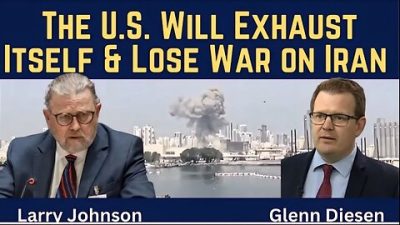
Larry Johnson: The U.S. Will Exhaust Itself & Lose War Against Iran
or go to
Aletho News Archives – Video-Images
From the Archives
Revealed: Israel’s hidden history of attacks on Iran
By Robert Inlakesh | MintPress News | April 17, 2024
Iran’s retaliatory attack on Israel was framed in the West as a reckless attempt to spark a major regional war, but in reality, Israel has been attacking Iran for decades.
As is routinely the case with Western-backed wars, the corporate media’s timeline begins at the moment that suits their narrative. We have seen this play out recently, with the attempt to rob the Gaza war of all contexts before October 7, 2023. Similarly, when it comes to Israel’s conflict with Iran, the two have been embroiled in what is referred to as a “shadow war,” the details of which are pretty shocking. … continue
Blog Roll
 Aletho News
- Trump bit off more than he can chew with Iran – ex-Pentagon analyst
- Murdering Khamenei Will Kill Trump’s Presidency
- Unexpected Iranian reaction paralyzed Americans and Israelis on the first day of war
- Larry Johnson: The U.S. Will Exhaust Itself & Lose War Against Iran
- In The Name of ‘Helping Iran’, The U.S. And Israel Slaughter Over 100 Iranian Schoolgirls
- Why are Americans killing and dying for Israel, again?
- Timing of US-Israel attack on Iran bears symbolic meaning in Judaism
- 70 martyrs, 90 wounded in US-Israeli strike on elementary school
- Did Israel Just Forfeit Its ‘Right To Exist’? — Carlson’s Interview with Huckabee
- Trump Starts a Major Regime-Change War with Iran, Serving Neoconservatism and Israel
- If Americans Knew
- When Presbyterians Fought Christian Zionism
- Israel starts another war on Iran – Not a ceasefire Day 141
- ‘Terror Was Needed to Make Arabs Leave’: What the Israeli Army Did in 1948, Revealed
- 17,000 Unaccompanied Orphans in Gaza, in World’s Biggest Orphan Crisis
- Israeli leaders want to buy global legitimacy – Not a ceasefire Day 140
- Israel warns of a Ramadan escalation — while doing everything to provoke one
- Democrats Should Release Their 2024 Election Autopsy – and Stop the Gaza Denial
- Israel responsible for 2/3 of press killings worldwide – Not a ceasefire Day 139
- Are the Jews indigenous to Palestine?
- AIPAC Wants to Kill a Bill that would Ensure Israel Complies with Ceasefire
- No Tricks Zone
- Glaciers Worldwide Are Suddendly Surging, Experts Blame Warming!
- Surprising Discovery: Sahara Is Greening…Billions Of Trees Where Once Thought To Be Barren
- New Research Reaffirms Clouds, Aerosols, And Surface Solar Radiation Are ‘Driving The Climate System’
- Germany: Electric Car Catches Fire At Charging Station, Sets Off Local “Inferno”, Widespread Damage
- New Study: Canada’s New Brunswick Was 1°C Warmer Than Today During The Medieval Warm Period
- Coal Power Back In Trend As Globe Tries To Keep Pace With Growing Demand For Power
- New Study: A 4°C Warmer Beaufort Sea Had ‘No Sea Ice’ 11,700 – 8200 Years Ago
- Unfudging The Data: Dutch Meteorological Institute Reinstates Early 20th Centruy Heat Waves It Had Erased Earlier
- German Gas Crisis…Chancellor Merz Allegedly Bans Gas Debate Ahead of Elections!
- Pollen Reconstructions Show The Last Glacial’s Warming Events Were Global, 10x Greater Than Modern
 Aletho News