Iran spokesman slams Canada’s participation in war on Iran despite Trump’s hostility
Press TV – August 16, 2026
Iran’s Foreign Ministry spokesman has issued a critique of Canada’s participation in the US-led war against Iran, highlighting the contradiction between Ottawa’s military cooperation with Washington and the Trump administration’s ongoing economic and diplomatic assault on Canadian sovereignty.
In a pointed social media post on Monday, Esmaeil Baqaei, spokesman for Iran’s Foreign Ministry, mocked Canada’s submissive stance toward the United States despite repeated humiliations from President Donald Trump.
“Washington calls Canada its 51st state; Washington imposes tariffs on Canadian goods; Washington insults Canada and threatens to punish it over wildfire smoke,” Baqaei wrote, accompanying his statement with an image of a hockey match. “Ottawa’s response: Understood, Sir!”
The Iranian spokesman’s remarks come amid escalating US economic aggression against its northern neighbor. President Trump has repeatedly suggested that Canada should become the “51st U.S. state,” proposing to erase the 5,525-mile-long border that separates the two nations.
Most recently, on July 20, 2026, Trump invoked Section 338 of the Tariff Act of 1930 to impose devastating 50% additional tariffs on certain Canadian imports, further straining ties with America’s second-largest trade partner.
The administration has also threatened to impose 100% tariffs on all Canadian imports should Ottawa finalize certain trade agreements.
Trump has even blamed Canada for wildfire smoke affecting the United States, accusing Ottawa of “wilful negligence” over forest management and threatening additional punitive measures.
Ottawa’s military complicity
Despite this relentless hostility, Canada has positioned itself as a willing participant in the US-led military campaign against Iran.
On March 19, 2026, Canadian Prime Minister Mark Carney stated that Canada is willing “to contribute to efforts to reopen the Strait of Hormuz,” signaling Ottawa’s readiness to support US military objectives in the region.
While Canadian officials have publicly claimed that the country was “not consulted, did not participate, and has no plans to participate in the offensive actions against Iran,” experts have pointed out that Canada’s military is deeply integrated into American command structures.
A Canadian military base, Camp Canada, located within the Ali Al Salem Air Base in Kuwait, was struck by Iranian missiles on March 2, 2026, revealing the extent of Canada’s involvement in the conflict zone.
Additionally, a Canadian colonel’s receipt of a military medal raised questions about Canada’s actual role in supporting US operations against Iran.
Baqaei’s critique drew a sharp analogy to Canada’s beloved national pastime, stating: “THIS IS NOT HOCKEY NIGHT IN CANADA; IT IS WASHINGTON’S FARM TEAM.”
The irony has not been lost on Canadian observers. Despite Trump’s economic warfare against Canada, which has contributed to the country slipping into technical recession, Ottawa continues to align itself with Washington’s [actually Israel’s] military agenda.
Domestically, the Iran war has raised energy prices and inflation in Canada, leading to elevated transportation costs and food prices for Canadian consumers.
Public opinion remains strongly opposed to military involvement, with nearly six in ten Canadians (58%) opposing US and Israeli bombing of Iran.
Seyed M. Marandi: Iran & Yemen Unleash a New Offensive Strategy
Glenn Diesen | August 16, 2026
Prof. Seyed Mohammad Marandi is a professor at Tehran University and a former advisor to Iran’s nuclear negotiation team.
Glenn Diesen clip channel: https://www.youtube.com/@Prof.GlennDiesenClips
Follow Prof. Glenn Diesen:
- Substack: https://glenndiesen.substack.com/
- X/Twitter: https://x.com/Glenn_Diesen
- Patreon: https://www.patreon.com/glenndiesen
Support the research by Prof. Glenn Diesen:
- PayPal: https://www.paypal.com/paypalme/glenndiesen
- Buy me a Coffee: buymeacoffee.com/gdieseng
- Go Fund Me: https://gofund.me/09ea012f
- Buy merchandise: https://diesen-shop.fourthwall.com/en-nok
Ben-Gvir pushes for killing 30-40 Palestinians every night

Al Mayadeen | August 16, 2026
Israeli Police Minister Itamar Ben-Gvir openly called for intensified killings and permanent Israeli settlement across Gaza, saying “targeted killings should be carried out in Gaza” and advocating that “every night” 30 or 40 Palestinians should be killed.
He went further, declaring that “all of Gaza” should be “Israeli territory” with settlements throughout the Strip, while calling for Palestinians to be encouraged to leave and promising he’ll “turn the world upside down” to execute Palestinians.
“In my imagination, I see all of Gaza as ours, with settlements, not only in the Gush Katif area, but throughout Gaza. Encourage as much emigration as possible, send them back to their countries, and the terrorists? No emigration and no nothing kill them one by one,” Ben-Gvir said.
Ben-Gvir endorses executions of Palestinians in brutal ‘justice’ call
Ben-Gvir endorsed executions by hanging, repeatedly saying Palestinians “don’t deserve to live,” while admitting he was “glad things are bad for them” and arguing that “the death penalty” is the only path toward “justice”.
A rhetoric with grave human rights implications
The remarks represent a striking escalation in rhetoric from a senior Israeli minister, openly advocating killings, executions, and the permanent settlement of Gaza while describing Palestinians as people who “don’t deserve to live.”
Such statements raise grave concerns under international human rights and humanitarian law, which protect the right to life and prohibit arbitrary killing, collective punishment, and the forced displacement of civilians.
The United Nations has identified killings of civilians, collective punishment, incitement to violence, and the denial of essential resources as matters requiring investigation under international law.
Ben-Gvir’s Gaza agenda draws alarm over ethnic cleansing of Palestinians
Beyond their brutality, Ben-Gvir’s comments raise a fundamental question about the consequences of treating an entire civilian population as a target for punishment.
The call to make Gaza “Israeli territory” while encouraging Palestinians to leave, coupled with advocacy for repeated killings and executions, points to a vision in which Palestinians’ basic rights and protections are subordinated to territorial and political aims.
The remarks therefore go beyond inflammatory language, raising serious concerns about the lives of Palestinians under Israeli occupation and the extent to which such rhetoric can normalize the targeting, killing, and forced displacement of civilians.
Why you are being lied to about Yemen and the implications of its liberation
By Robert Inlakesh – Al Mayadeen – August 16, 2026
The Yemeni Armed Forces’ campaign to liberate their nation and end the Saudi-led blockade could be one of the most important events for the Arab world in decades. Not only will it have major implications for the ongoing regional war, but it also has the potential to dramatically reshape the region.
In July, the collapse of the Yemen-Saudi ceasefire agreement, which had been in place since 2022, was triggered by a strategic mistake committed by Riyadh. While Iran sought to break the inhuman blockade on Yemen through landing civilian airliners in the nation’s capital, Saudi Arabia’s air force rushed to bombard Sanaa International Airport. The Saudis may not have known it, but their irrational actions strung them up in a strategically placed trap.
Not only had the Sanaa government been coordinating a general mobilization, but its Armed Forces decided to directly retaliate by striking vital Saudi oil infrastructure and imposing a counter-blockade on their opponents to the north. The Yemeni Armed Forces then decided to take it a step further, committing round-the-clock ballistic missile and drone strikes that inflicted hundreds of casualties on Saudi-proxy forces inside Yemen and even advanced to liberate more of their nation’s territory.
Saudi Arabia is now unable to transit the Bab al-Mandab Strait, and its ability to export oil has been severed, representing a serious economic blow. Riyadh is now facing an unprecedented predicament, as Ansar Allah imposes an equation whereby Saudi violations of Yemeni airspace are met with direct strikes on oil infrastructure.
The reason why this all matters so much is that since 2015, the so-called “International Community” has rallied behind Saudi Arabia and its GCC allies. The global media have also participated in the facade, pretending as if some rebel group that they call “the Houthis” were fighting against an “internationally recognized government.” Why they kept up their lies is simple: without full control over their nation and its resources, the Sanaa government was simply not as valuable a partner as the Arab Gulf States, so everyone played along.
Nobody cared to point out that “the Houthis” is not an accurate name for Ansar Allah, that they aren’t simply a group of “rebels” but run a government that rules over the largest portion of the Yemeni population, or that two-thirds of the nation’s Armed Forces sided with them. Neither will they tell you that the so-called “Yemen Presidential Leadership Council” was created in the Ritz-Carlton Hotel in Riyadh and that its undemocratically selected leader lives in Saudi Arabia.
In fact, the idea that the Saudi-proxy forces in Yemen are the legitimate representatives of the nation and are somehow a sovereign government is even more outlandish than when most of the Western world randomly decided that Juan Guaidó was the “internationally recognised” President of Venezuela.
But none of this will even end up mattering if Ansar Allah succeeds in uniting Yemen and reaching an agreement to liberate its territory from its US-Israeli-backed aggressors. The reason why the Arab regimes, alongside the US-UK-EU-Israeli alliance, have fought against the government in Sanaa is that they all fear the consequences of their success.
Yemen will be the only Arab nation that will not only oppose US imperialism and support the regional resistance, but will also actively fight the Israelis and work to combat the “Greater Israel Project.” The only Arab government that dared to open fire on the Israelis or impose a blockade on them, in support of Gaza, was the Sanaa government in Yemen. All the others that fought for Gaza were non-state actors.
A strong and united Yemen, with access to its resources and the ability to continue developing its military capabilities, will without a doubt be the biggest threat to US-Israeli hegemony in the Arab World. Yet, it will also spell another equation: it could well serve as an example to populations throughout the region, as to what is possible if the people fight for their liberation. No prospect frightens the Arab regimes more than this.
The impact Yemen can have on global trade, oil markets, regional power equations and ultimately the Palestinian cause for national liberation, all have the Zionist allied powers shaking in their boots. For so long, the Yemeni issue has been ignored, but that could soon dramatically change.
CENTCOM Map Shows Gaza and West Bank as Part of Israel
Sputnik – 16.08.2026
US Central Command appears to have failed geography again, posting a map of the Middle East in which the Gaza Strip and the West Bank are shown as Israeli territory.
The map accompanied a post on X about the CENTCOM commander’s 10-day trip to a region torn by the US-Israeli aggression against Iran.
In the image, the Palestinian enclave and the West Bank are not separated from Israel by the border lines used elsewhere on the map.
The omission is striking, as Gaza and the West Bank remain central to the Palestinian question and the wider regional crisis.
Israel continues its [genocidal] war on Gaza and Lebanon with full US support.
EU faces criticism for secret police data talks with Israel: Report
MEMO | August 15, 2026
The European Commission has been negotiating a secret agreement to share sensitive personal data with Israel’s police service, despite internal legal warnings that the deal could violate international law and put Palestinians at risk, according to a new report by civil rights group Statewatch published by Novara Media.
The draft agreement, originally negotiated with the European police agency Europol, would allow the exchange of biometric data, genetic information, location data, political views, and personal details.
Critical research indicates the deal has progressed despite a 2022 ruling by the Council of the EU’s Legal Service which deemed the proposal legally untenable.
It warned that the agreement risks legitimizing Israel’s illegal occupation of Palestinian territories and would undermine the Palestinian people’s right to self-determination.
Concerns have been raised about the potential misuse of data collected by EU police missions operating in the West Bank and the Gaza Strip city of Rafah. Experts warn that if handed to Israeli authorities, the information could feed into existing military surveillance systems used against the Palestinian population.
“The data transferred via the agreement could be used as intelligence to support decisions to attack and kill Palestinians,” legal expert Eitan Diamond told Novara Media. “The EU would run the risk of arbitrarily depriving people of their freedom and subjecting them to systematic ill-treatment under hellish conditions in detention.”
Palestinian lawyer Raji Sourani condemned the talks, telling Novara Media that “the intended cooperation is rooted in the racist colonial mentality of Europe, and turns against us Palestinians, the victims of genocide.”
While the draft text tried to exclude the use of shared data in occupied territories, it contained broad exceptions for “imminent danger to life” and the prevention or prosecution of general crimes. European legal experts called the exceptions far too vague.
The negotiations build on a narrower 2018 arrangement that explicitly excluded personal data sharing and the occupied territories. Critics said the commission’s continued pursuit of the expanded deal breaches its own diplomatic policy and ignores recent rulings by international courts.
Douwe Korff, a legal scholar affiliated with Yale University, called the commission’s position “deeply concerning,” pointing to the risk of sharing sensitive information with a state “credibly accused of genocide and other crimes.”
Since October 2023, an Israeli genocide has killed 73,389 Palestinians and injured 174,266 others according to Gaza’s Health Ministry.
Despite a ceasefire signed in October 2025, Israeli attacks have continued in Gaza, causing further casualties and damage to infrastructure.
Israel Rejects 15-Point Gaza Deal, Insists on War, Genocide, and Economic Armageddon
By Kevin Barrett | American Free Press | August 15, 2026
No-one has ever accused President Donald Trump of being anti-Israel. Trump has supported Israeli extremism far more than any other US president. In 2017 he moved the US embassy to Occupied Jerusalem, an extreme violation of US policy, international consensus, and international law. He strong-armed regional nations to establish “normal” relations with genocidal Israel, against the wishes of more than 95% of their populations. And he has waged relentless war on Iran on behalf of Israel, setting the stage for the current countdown to global economic catastrophe.
But all of that isn’t enough for Israeli Prime Minister Netanyahu, who fancies himself Trump’s boss. On August 9, Netanyahu arrogantly rejected Trump’s 15-point Gaza peace plan, thumbing his nose at Trump himself and the Board of Peace that Trump chairs.
Since the Trump-brokered “ceasefire” of October 10, 2025, Israel has killed 1,258 people in Gaza. Trump has remained silent. But now, the stakes are higher. To end his disastrous war on Iran, Trump needs to comply with the first term of the Memorandum of Understanding that he signed, mandating “permanent termination of military operations on all fronts” by both parties and their allies.
In other words, Israel must cease firing at Palestinians and Lebanese people, or Iran will continue to throttle global supply chains via the Strait of Hormuz and the Bab al-Mandab. If the Americans want to stop the bleeding, they must force Israel to withdraw from Gaza and South Lebanon and stop attacking Palestinians in the Occupied West Bank.
To prevent economic Armageddon, Trump needs to compel Israel to withdraw from Gaza in accordance with his 15-point plan. That plan is laid out in stages, with Israeli withdrawal and Hamas disarmament happening simultaneously and in parallel. Hamas will relinquish its heavy equipment and weapons during Israel’s withdrawal, but it is not required to give up the small guns it needs to ensure that its people are not exterminated by ISIS terrorists in the pay of Israel.
Hamas accepted Trump’s peace agreement even though it had to give up its only leverage, its Israeli hostages. But Israel refuses to implement the deal. It continues committing genocide, deliberately slaughtering hundreds of women and children while destroying infrastructure and preventing humanitarian aid from entering.
Before August 9, Israel had pretended to accept Trump’s deal, while muttering curses under its breath. But now it is openly refusing. Israel is telling Trump, and the world economy, to go get stuffed. Retired Maj. Gen. Giora Eiland, a former head of Israel’s National Security Council, explains: “Israel has no interest in Gaza being rebuilt, it is better for us that it be destroyed for generations to come.”
Trump’s Board of Peace Roadmap document states: “Israel shall fully complete, without delay, all remaining commitments.” The Board’s original language, which is still in effect, required Israel’s “full withdrawal” from Gaza, but last week it changed the wording to mere “withdrawal” under pressure from Netanyahu.
But small changes in wording won’t alter the underlying reality. Israel needs to get out of Gaza—and stop killing Palestinian and Lebanese people—or Iran will strangle the world’s economy, maximizing damage to the US and its allies.
Given the stakes, Netanyahu’s willingness to raise his middle finger at the US president is bizarre. Israel is a small country. It is immensely vulnerable to American economic, diplomatic, and military pressure. American taxpayers have been keeping it afloat ever since it metastasized in 1948. It is universally reviled in West Asia, and despised by ever-growing majorities everywhere else.
Netanyahu’s paradise for pedophiles and dog rapists wouldn’t last five days without American taxpayer support. Yet it is prepared to destroy the world economy, and with it the Trump Administration, so it can continue committing genocide and waging wars of aggression.
Trump should exit the Iran war smoothly and painlessly by transferring the pain to Israel. What Iran wants is a new regional order that will prevent further aggression against it. Trump could achieve that, and avoid the humiliation of a complete US withdrawal from the region, by making Israel, not the US, the loser of the war Israel started. How? Simple. Just put all of America’s economic, diplomatic, and (if necessary) military power behind a draconian ultimatum to Tel Aviv: “Withdraw to your pre-1967 borders within the next two weeks, declare those as your permanent borders, and disavow the Greater Israel Project, or face complete obliteration.” A roundup of the Israeli agents who currently infest America’s media and financial sectors, authorized by an executive order declaring Israel’s occupation of the US a national emergency, would drive the point home.
Can Trump force Netanyahu to toe the line? Or will the Israeli prime minister show that he is America’s real boss?
Subscribe to the digital and print editions of American Free Press. You’ll get early access to articles like this, and exclusive access to many others!
Stripe is Substack’s only processor and they debanked me, so you can no longer pay me through Substack. Now I am posting everything on Substack free and asking people to sign up for recurring donations at my Paypal donation page…or better yet, the free speech platform SPdonate. Alternately you can Paypal or Zelle to truthjihad[at]gmail(dot)com. Note that Zelle, unlike other methods, doesn’t charge any fees.
Don’t Let Hunter Biden Whitewash His Father’s Genocidal Legacy

By Justin K.P. | The Dissident | August 13, 2026
Joe Biden’s son, Hunter Biden, has been making the rounds on the podcast circuit, giving interviews on popular shows such as Channel 5 with Andrew Callaghan, the Tucker Carlson show, Candace Owens and the Left Hook with Wajahat Ali.
Throughout these various appearances, Hunter Biden has been accurately taking on Benjamin Netanyahu for the genocide in Gaza.
“If it’s anti-semitic to point out that Bibi Netanyahu is evil incarnate, then I don’t know what to say to people anymore,” Hunter Biden correctly said on the Tucker Carlson podcast, adding, “open your eyes. Open your heart for one minute.”
In his interview with Wajahat Ali referring to the genocide in Gaza, Hunter Biden said, “I will call it a genocide. I don’t know any other definition that fits when one group of people, their stated goal is the extermination of another group of people. I think it’s ridiculous that we continue to debate whether or not it’s a genocide. I think Bibi Netanyahu is evil incarnate,” adding that the Gaza genocide is “unforgivable forever and throughout time”.
While these statements are correct, it is hard not to see this as a way to put the entirety of the burden for the genocide on Benjamin Netanyahu, whitewashing the fact that it could not have been carried out without support from Joe Biden.
This is bolstered by the fact that in his interview with Wajahat Ali, Hunter Biden claimed that his father “believes all the things that I just said” and pretended that Joe Biden put pressure on Netanyahu, adding that Joe Biden “did his best to curtail and to curb the most awful instincts of Netanyahu”.
Hunter Biden’s comments in this context seem more to be part of an effort to whitewash the Democratic Party and Joe Biden’s direct complicity in the Gaza genocide.
The reality is, Joe Biden and his administration hold just as much responsibility for the slaughter in Gaza as Benjamin Netanyahu does.
Brown University’s Cost of war project has calculated that during the first year of the genocide in Gaza, the Biden administration spent $17.9 billion in military funding for Israel and another $3.8 billion in the second year, with an additional $9.65 – $12.07 Billion spent on military campaigns to protect Israel, including the Biden administration’s bombing of Ansar Allah in Yemen for it’s blockade on the Red Sea in an attempt to pressure an end to the Genocide.
While financing the military equipment used to carry out the Genocide in Gaza and bombing resistance groups attempting to stop the genocide, the Biden administration never once pressured Israel to accept a ceasefire.
This was outright admitted by multiple U.S. and Israeli officials on Israeli TV on a special aired on Israel’s Channel 13.
The former Israeli ambassador to the U.S., Michael Herzog, in the special admitted, “God did the State of Israel a favor that Biden was the president during this period, because it could have been much worse. We fought for over a year, and the administration never came to us and said, ‘ceasefire now.’ It never did. And that’s not to be taken for granted”.
The former U.S. ambassador to Israel, Thomas Nides, similarly admitted, “At the most significant political peril of Joe Biden’s political career, the easiest thing for Joe Biden would have been, if he was worried about the votes in Michigan, is to basically be a little soft; he refused to do it. There was enormous pressure within the White House on him to change his position. When I hear comments about ‘he wasn’t good enough, or he didn’t have Israel’s back,’ am I disgusted by it? One hundred percent. Is it true? 100 percent no”.
When Benjamin Netanyahu claimed that “soldiers were killed during the war in Gaza from a lack of ammunition due to a partial embargo that was imposed by the Biden administration”, multiple Biden administration officials came out to clarify that they gave unconditional support to Israel’s Holocaust in Gaza.
Amos Hochstein, a top Biden advisor admitted in response, “After more than $20 Billion military support, largest in Israel history, 2 aircraft carriers rushed to the region, deterring a massive regional war, defeating Iran missile/drone attack x2, defending israel at most vulnerable moments, after SAVING countless lives of Israelis – only acceptable response to POTUS Biden and American people is THANK YOU.”
Similarly, the Assistant to the President and National Security Advisor to the Vice President of the United States, Philip H. Gordon, admitted in response, “Hard to overstate the damage to US-Israel relations done by the sense of entitlement and ingratitude reflected in comments like these and Netanyahu’s own recent statements. Baseless misdirection to suggest that Israeli soldiers’ deaths in Gaza were caused by some phantom US ‘embargo’ (when in fact Biden resisted enormous pressure to condition aid, as required by U.S. law, even as Israel rebuffed calls to facilitate more humanitarian assistance and reduce civilian casualties)”.
The reality is that Joe Biden’s backing of the genocide in Gaza is also “unforgivable forever and throughout time” despite his son’s attempts to whitewash these facts.
Is Israel Planning to Assassinate President Trump?
By W.M. Peterson |
“When you read Jewish law in many places, you might understand that gentiles can be killed freely without any problems.” — Rabbi Yitzhak Shapira, Radio Kol Hai (July 2011)
In January 2012, Andrew Adler, the owner and publisher of a small weekly newspaper called the Atlanta Jewish Times, sparked considerable controversy when he penned an article titled ‘What Would You Do?’ in which he put forth three possible responses Israel might pursue if Iran were to acquire a nuclear weapon. The first two — pre-emptive strikes on Hezbollah and Hamas and disobeying the US Secretary of Defense to destroy Iran’s nuclear facilities — failed to raise any eyebrows. Adler’s third suggestion, however, would result in his immediate resignation as editor and the subsequent sale of his newspaper:
“Three, give the go-ahead for U.S.-based Mossad agents to take out a president deemed unfriendly to Israel in order for the current vice president to take his place, and forcefully dictate that the United States policy includes its helping the Jewish state obliterate its enemies. Yes, you read “three” correctly. Order a hit on a president in order to preserve Israel’s existence. Think about it. If I have thought of this Tom Clancy-type scenario, don’t you think that this almost unfathomable idea has been discussed in Israel’s most inner circles?… You have got to believe, like I do, that all options are on the table.“
Almost immediately, the article became headline news around the country forcing major Jewish organizations like the ADL and AJC to feign indignation, and within a week the US Secret Service had launched an ‘investigation’ into the matter while a teary-eyed Adler appeared on the Atlanta Interfaith Broadcasting network’s cable TV show to disavow his column and explain that he actually held a favorable view of President Obama!
Adler’s straight-talk, shocking though it may seem to some, provides crucial insight into the mentality of God’s chosen people and the candor they often use when speaking amongst themselves. Killing a foreign or domestic head of state who presents a perceived obstacle to the preservation of fragile little Israel is not unknown to history, as any reader of Laurent Guyenot’s indispensable book The Unspoken Kennedy Truth or Ronen Bergman’s 2018 bestseller Rise and Kill First: The Secret History of Israel’s Targeted Assassinations can assure you.
A few months ago I met up for lunch with an old friend who, after years of intransigence, has finally reclaimed his mind from the Zionist propagandists and taken a deeper interest in topics like Israel/Palestine and Jewish influence in American affairs. During the course of our conversation, I casually mentioned the likelihood that Israeli leaders have considered assassinating Donald Trump for the purpose of expanding US involvement in the war with Iran. My friend, visibly stunned by the idea, asked why in the world Israel would do such a thing when Trump is by all appearances Israel’s Top Goy, performing nearly every trick demanded of him by Netanyahu and the Israel Lobby. I responded that it doesn’t matter what Trump does for Israel, the minute he’s deemed more valuable dead than alive the Zionists will begin workshopping a scenario in which the increasingly unpopular ‘leader of the free world’ can be eliminated in such a way that Iran can be blamed and the American military can be dragged deeper into the conflict upon the pretext of revenge. Indeed, Israeli intelligence has been priming the pump for an “Iranian” assassination of Trump since 2024, absurdly trying to link the events in Butler, PA and Ryan Routh’s golf course shenanigans to Tehran. I told my friend that while I believe the chances of an assassination actually happening are low, I do think it’s probable the Jews will develop a plan, if they haven’t already, to have in the back pocket as a last resort. Certainly, there’s no shortage of historical precedent supporting the notion.
My hypothetical took on new life this past week when it was reported in the mainstream media that Israeli intelligence had alerted the US that Iranian agents were planning to shoot down Trump’s plane with shoulder-fired missiles as he departed the NATO summit in Ankara, Turkey on July 8. The warning was taken seriously enough that the Secret Service had Trump switch planes twice before finally leaving in the hopes of deceiving any would-be attackers. According to The Times of Israel :
“Israel told the United States about the Iranian assassination threat that prompted the US Secret Service to take President Donald Trump off Air Force One and transfer him in a catering truck to a military plane as he prepared to fly out of Turkey last month, the Wall Street Journal reported Tuesday, citing an unnamed US official.
Later Tuesday, Trump confirmed that he had indeed been smuggled off Air Force One in Ankara because the Secret Service and US military told him to switch planes. Israeli intelligence indicated that Iran was plotting to use shoulder-to-air missiles to take down Trump’s plane, according to the WSJ report. Senior Trump aides, including Secretary of State Marco Rubio, remained on the plane despite the threat, the official said. The WSJ reported last month that Israeli intelligence had indicated a new plot was in development to assassinate the US president, but did not provide details. … Trump had flown to the NATO summit in Ankara aboard a newly-renovated Qatari-donated jet. The trip was the first international travel for the new plane, whose speedy upgrades triggered questions over its cost and security, and took place as hostilities escalated with Iran, which borders Turkey.
Before departing the Turkish capital, Trump said he would instead use an older baby blue Air Force One plane “for old time’s sake” to RAF Mildenhall in Britain, while the new Qatari-gifted plane stopped at the same base so US service members stationed there could tour the aircraft. But after Trump boarded the old Air Force One in front of cameras in Ankara, he was secretly shuttled by an airport catering truck to a smaller plane, an Air Force C-32A, the Washington Post revealed Monday.“
Probably not coincidentally, all of this transpired a mere day after Trump and Turkish President Recep Erdogan held a private bilateral meeting during which Trump discussed the possibility of Turkey’s reentry into the F-35 Lightning II program, while also announcing his commitment to lift the CAATSA sanctions placed on Turkey by the US government seven years ago. Originally a co-producer and buyer in the fighter jet program, Turkey was removed in 2020 following its acquisition of the Russian S-400 missile defense system. Trump remarked that his administration is “certainly” considering the sale of F-35s to Turkey and openly praised Erdogan as “a great friend,” telling reporters at the NATO summit: “Turkey has been much more loyal than other countries that we think would be loyal.”
Considering the fact that Turkey is rapidly emerging as one of Israel’s biggest strategic adversaries, these developments likely sent shockwaves through Tel Aviv. An August 10 article on the Quincy Institute’s Responsible Statecraft website points out that:
“Within 72 hours of the Ankara summit, Netanyahu took his objections to three American networks, arguing that Erdogan was ‘not a friend’ and could not be trusted… Israeli leaders, eager to drive a wedge into Ankara’s relationship with Washington, appear determined to cast Turkey as the next Iran.“
It’s possible that at least part of the reason for Trump’s flirtation with Erdogan is to antagonize Israel at a time when the Zionist state is doing almost everything it can to scupper US peace agreements with Iran. It’s just as possible that Israel, by way of retaliation, is seeding the narrative that Iran is striving to help the vainglorious 47th President off this mortal coil as a way of threatening Trump back into line. It should be pointed out that immediately following the great plane switcheroo in Ankara, the US military conducted a heavy wave of airstrikes, hitting 90 targets across Iran. Two days later, the US initiated a bombing campaign that lasted for 13 consecutive nights. If the intent of the “Iranian threat” was to bring Trump back under heel, it would seem he got the message.
While the CIA considers the Iranian threat to Air Force One dubious, the thought of shooting down an aircraft with innocent lives onboard to kill but one man is not a novel one in Israel. On pp. 272-273 of his aforementioned bestseller, Israeli journalist Ronen Bergman describes how Israel’s Minister of Defense Ariel ‘Butcher of Beirut’ Sharon once hatched a plan to shoot down a commercial airliner carrying PLO leader Yasser Arafat:
“When the Mossad reported that Arafat was flying more commercial flights… Sharon decided that one of those would make a legitimate target. He ordered Eitan, the air force, and the operations branch to come up with a plan to shoot down a civilian jetliner.
Sharon sketched out the broad parameters. The flight would have to be shot down over the open sea, far from the coast, so that it would take investigators a long time to find the wreckage and establish whether it had been hit by a missile or had crashed due to engine failure. Deep water would be preferable, to make recovery even more difficult… The air force drew up a detailed plan to shoot down an airliner. Its representatives at the Goldfish forum explained that they had chosen a precise spot on the commercial air route across the Mediterranean, one where there was no continuous radar coverage by any nation and where the sea below was a daunting three miles deep. A salvage operation there would be extremely difficult, perhaps impossible, with the technology of the time. This complex plan set strict parameters for where the Israeli aircraft could shoot down Arafat’s plane undetected, which meant there would be a fairly narrow window of opportunity for executing the attack. … General Gilboa expressed his sharp opposition to these operations time and again. ‘It was clear to me that the air force would execute it as well as could be, and the plane would vanish forever. They do what they are told, and if you give them an order to build a pipeline to move blood from Haifa to the Negev, they’ll do it excellently and won’t for a moment ask whose blood it is…‘”
Whether he knows it or not, Trump, the one-time casino mogul, is dicing with death, playing into the hands of potential Israeli assassins by repeatedly claiming that the US would “completely decimate and destroy” Iran if it ever were to succeed in knocking him off. Quite foolishly, Trump has told journalists he’s “left instructions” to “literally bomb them at levels they’ve never seen before” if such an event were to occur. One can only imagine the frenzied Happy Merchant-style hand-rubbing taking place among members of Netanyahu’s cabinet when they hear remarks like these.

President Donald Trump’s jangled nerves put at ease by the armed and ready Avenger surface-to-air missile system, allowing for a smooth stroke of his 9-Iron.
I’m sure there are many Iranians who would like to see Trump bite the dust. After all, he is responsible for the murder of the country’s military hero General Qasem Soleimani and its Supreme Leader Ali Khamenei, whose family members were also killed and maimed in the joint US/Israeli airstrikes on his residential compound in February. Trump made these decisions entirely on behalf of Israel and we’re left to wonder whether or not he realizes with the benefit of hindsight that he’s bumbled his way into a carefully laid trap. With Iran’s victory in the war all but assured absent the use of nuclear weapons or a ground invasion by US forces, Israel is getting desperate to increase America’s military presence in the region. Would they go so far as to assassinate a sitting US president for at least the second time in history? I don’t know, but in the words of Andrew Adler: “Think about it. If I have thought of this Tom Clancy-type scenario, don’t you think that this almost unfathomable idea has been discussed in Israel’s most inner circles?… You have got to believe, like I do, that all options are on the table.“
British taxpayers unknowingly subsidize therapy for Israeli soldiers: Report
The Cradle | August 14, 2026
UK taxpayers are unknowingly subsidizing “therapeutic healing” and psychological treatment of Israeli soldiers who served in Gaza, Declassified UK reported on 13 August.
The investigation revealed that an undisclosed sum reached the Yahalom Foundation, an Israeli veterans group serving the Israeli military engineering unit, through a British charity, with the government adding a further 25 percent under the Gift Aid scheme.
That additional quarter comes from the British government, which administers Gift Aid through His Majesty’s Revenue and Customs (HMRC).
Barred as a foreign organization from claiming Gift Aid itself, the foundation instructs its British supporters to send money instead through UK Toremet, a charity registered in Britain.
Emails written by its head of fundraising call Toremet a “registered partner platform” that handles donations on the foundation’s behalf, telling donors that giving this way secures “full tax recognition and enabled Gift Aid.”
The projects put to British donors include a £5,000 (around $6,746) “therapeutic healing journey” for soldiers coming out of Gaza, individual psychological treatments, and a £100,000 (around $134,909) hall commemorating dead Israeli soldiers.
Records from two years earlier show British money also flowed toward equipment for troops still in service, with one fundraising page telling donors their help would buy more specialized kit to supply to the soldiers. Whether Gift Aid was added to those donations is unclear.
The Charity Commission has previously warned that raising funds for a soldier of a foreign military is neither lawful nor acceptable for a charity.
The disclosures deepen the scrutiny already surrounding UK Toremet, which since 2016 has been the subject of three regulatory compliance cases brought by the Charity Commission over its work in occupied Palestine.
The regulator has since opened an inquiry into eight British charities operating in illegal Israeli settlements.
UK-registered charities are promoting programs that send young British Jews into illegal settlements in occupied Palestine and put them through Israeli army training, according to an investigation by Middle East Eye (MEE) published in July.
The United Jewish Israel Appeal (UJIA), whose stated aim is to inspire young Jews to build a relationship with Israel, routes participants into Marva, an army-run course in which they spend weeks living on a military base and undergoing basic training. Bnei Akiva, meanwhile, houses its gap-year students in a West Bank settlement and drills them for military service.
The International Centre of Justice for Palestinians (ICJP) told MEE that the activities breach international law, describing Marva as closer to “pre-enlistment military training” than cultural exchange.
The pattern is not new, with The Guardian reporting in July last year that the Kasner Charitable Trust had moved £5.7 million (around $7.69 million) to a religious school inside the illegal settlement of Susya near Hebron through the conduit charity UK Toremet, in donations made between 2017 and 2021.
The Charity Commission told the outlet that operating in the occupied Palestinian territories is not in itself a criminal offense or a breach of charity law.
Options to Defeat Iran
Tales of the American Empire | August 13, 2026
American foreign policy has supported the Greater Israel project since the 9-11 terror attacks. This would greatly expand the size of Israel and kill or displace millions of Arabs. Iran is not a target for Israeli expansion, but is a powerful nation that supports resistance to the genocidal Greater Israel agenda. When the Trump administration entered office in early 2025, there was news they may fulfill the Zionist dream of attacking and destroying Iran.
Since President Trump ran as an anti-war candidate, war with Iran was irrational because it was risky and unlikely to succeed. A year ago, Tales of the American Empire produced “War with Iran is Foolish”, which is linked in the description. It explains that attacking Iran would fail and lead to an economic disaster. Unfortunately, greedy and insane people have taken control our nation, to include Donald Trump and most US Congressmen.
_______________________________________
Related Tales:
“War with Iran is Foolish”;  • War with Iran is Foolish
“Why the Strait of Hormuz is Not Irrelevant”; What’s Going on With Shipping?; August 9, 2026; • Why the Strait of Hormuz is Not “Irrelevan…
“The MOST DANGEROUS WARHAWKS in MEDIA /Lt Col Daniel Davis”; Deep Dive; August 3, 2026; • The MOST DANGEROUS WARHAWKS in MEDIA /Lt C…
Featured Video
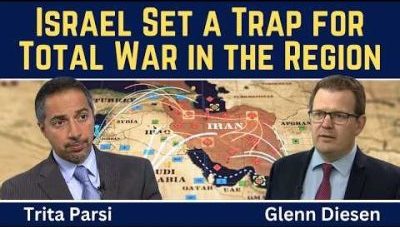
Trita Parsi: Israel Set a Trap for Total War in the Region
or go to
Aletho News Archives – Video-Images
From the Archive
Zionism’s Violent Legacy
By Donald Neff | Washington Report On Middle East Affairs | January 1996
On January 4, 1948, Jewish terrorists drove a truck loaded with explosives into the center of the all Arab city of Jaffa and detonated it, killing 26 and wounding around 100 Palestinian men, women and children.[1] The attack was the work of the Irgun Zvai Leumi – the “National Military Organization,” also known by the Hebrew letters Etzel – the largest Jewish terrorist group in Palestine. The Irgun was headed by Revisionist Zionist Menachem Begin and had been killing and maiming Arabs, Britons and even Jews for the previous ten years in its efforts to establish a Jewish state.
This terror campaign meant that at the core of Revisionist Zionism there existed a philosophical embrace of violence. … continue
Blog Roll
 Aletho News
- Trita Parsi: Israel Set a Trap for Total War in the Region
- Trump’s Iran war is on an Israeli leash
- Saudi oil boss issues global supply warning
- Riyadh Says Its Oil System Is Intact. The Numbers Say Otherwise.
- Trump and Netanyahu Want to “Finish the Job” on Iran
- US ‘one-sided dictation’ not Iran’s beliefs makes rational talks impossible: Baghaei
- Iran’s Next Strike May Not Explode. It Could Shut You Down /Col Doug Macgregor
- Iran: US political targets legitimate if assassinations return
- Iraq shuts key border crossing with Iran under US pressure: Report
- Undersea Internet cables could be targeted in retaliation for attacks on Iran: IRGC deputy chief
- If Americans Knew
- The Israel Lobby’s Changing Fortunes
- AIPAC has become such a political liability that it’s shifting to a more “nimble” approach to buying politicians
- At least 160 Israeli settler attacks in 2 weeks
- Will Gaza’s Ancient Christian Community Disappear Forever?
- Israel’s vision of regional security rests on keeping Arab states weak
- Heidi Levine recounts how Palestinian youths helped save her in settler attack
- DAILY UPDATE: Latest essential news on Palestine, Israel, & region
- Trump’s Intensifying Sabotage of the ICC, for Israel’s Sake
- Israeli military detain US and UK volunteers in West Bank including Democratic NY politician Brad Lander
- Americans at National Conservatism Conference held in Israel this year criticize Israel
- No Tricks Zone
- E-Cars Reduce CO2 Emissions By Only 41% Compared To Internal Combustion Engine Vehicles
- Predictions Made By Renowned Climate Professor Over Past Decades Have Been Proven To Be Poor
- New Study Suggests Large Regions Of The Pacific Ocean Have Been Cooling For The Last 80 Years
- Germany’s Green Energy Debacle: High Energy Costs Force Kahla Porzellan to Close After 182 Years!
- New Study: 50 Years Of The Most Aggressive ‘Net Zero’ Policies Can Only Affect The Global Climate By 0.03°C
- US September “Heat” Was No Record…Many Records Set Decades Ago
- Latest European Green Energy Debacle; Portugal’s Largest Flagship Solar Park Insolvent!
- Green Energy Debacle: German Expert Professor Fritz Vahrenholt Warns Of Severe Economic And Social Consequences
- Two More Paleo Reconstructions Affirm Meters-Higher Sea Levels Across Ireland, Brazil 7000-6000 Years Ago
- New Study: Earth And Venus Surface Warmth Largely Explained By Convection And Lapse Rate, Not CO2 Or Radiation

