David Miller on his victory over Zionism, Pax Judaica, and Jewish Supremacy
If Americans Knew | August 17, 2026
David Miller is a British sociologist whose research and publications focus on Islamophobia and propaganda. Miller was Professor of Political Sociology at the University of Bristol, where he was dismissed by the university because it was deemed he had not met the standards of behavior expected from staff. The dismissal related to allegations from students that Miller engaged in antisemitism during one of his lectures.
Miller was ultimately cleared of any unlawful behavior. In 2026, the Employment Appeal Tribunal upheld the 2024 Employment Tribunal finding that Miller’s anti-Zionist beliefs constituted a protected philosophical belief under section 10 of the Equality Act 2010.
In this interview Miller discusses his victory over Zionism, Pax Judaica, and Jewish Supremacy. Miller describes how the United States and its powerful armed forces have become a proxy for the Jewish state’s imperial interests.
For the entire interview, visit:  • David Miller CRUSHES Zionists in Court
US-led Board of Peace considers ‘wholesale’ Hamas disarmament deal to satisfy Israel: Report
The Cradle | August 18, 2026
US President Donald Trump’s so-called Board of Peace is “weighing” a “new” Hamas disarmament proposal after Tel Aviv rejected Washington’s latest one, sources told the Times of Israel on 18 August.
“The Board of Peace is considering abandoning its phased framework for Hamas’s disarmament” due to the “Israeli pushback,” an informed source told the Israeli outlet.
“Instead of having Hamas hand over its weapons in phases, with Israel conducting corresponding withdrawals … another option being weighed by the Board of Peace would see Hamas hand over all weapons throughout Gaza, and only then would Israel have to pull back its troops to the Gaza border,” the report went on to say.
The new proposal being reported on is, essentially, what Israel has been demanding – a full surrender by the resistance prior to any discussion on withdrawal of occupation forces.
“The shift could be enough to get Israel on board, it risks losing the support of Hamas,” the Times of Israel wrote.
An Israeli official claimed to the outlet that there remains a dispute between Tel Aviv and Washington over the initial disarmament plan.
The source says the US has not yet dropped the original plan but is considering a “wholesale approach” to appease Israel.
“In this different approach, the entire area currently under Hamas’s control would be decommissioned of weapons all at once, rather than sector by sector.”
The report follows a Monday meeting between Trump’s son-in-law and top aide Jared Kushner and Israeli Prime Minister Benjamin Netanyahu. Board of Peace director Nickolay Mladenov was also present.
Another Hebrew report released by Israel’s Channel 12 said Kushner reportedly opposes Netanyahu on his plans to continue strikes and assassinations in Gaza.
“There was no agreement between Netanyahu and Kushner on the continuation of the assassination operations,” a source told Channel 12. “Netanyahu made clear that he will continue the assassinations, while Kushner expressed his opposition to them.”
Kushner had also met with Hamas officials in Egypt prior to his meeting with Netanyahu on Monday. The new reports coincide with continued Israeli attacks across Gaza.
Hamas said when Washington announced the new “disarmament deal” that it would hand over its weapons to the US-endorsed Palestinian committee of technocrats tasked with governing Gaza – but “only” if Israel adheres to its commitments. Israel continues to bar this committee from entering the strip.
Tel Aviv has openly refused the new deal – which Trump referred to as “historic” – claiming both Hamas and Israel were on board.
Hamas insists that any full disarmament depends on the establishment of an independent Palestinian state. According to several reports, intensive talks on the wording of the new disarmament deal took place between Hamas officials and mediators.
The reports say the weapons will be “stored” but not handed over to Israel or destroyed.
Israel has not stopped attacks, violations, and genocide since the 2025 US plan was launched. It has also illegally occupied 70 percent of the strip.
Since the start of Trump’s so-called peace plan, over 1,200 Palestinians have been killed and more than 4,000 wounded by Israel in Gaza.
Thousands of buildings have been demolished via detonation.
The impunity granted to Israel is as shocking as its violence
By Ramona Wadi | MEMO | August 18, 2026
More incitement to violence from Israeli Security Minister Itamar Ben Gvir exposes how colonial violence is aimed at the entire colonised population. Speaking on a podcast with former Israeli hostage Rom Braslavski, Ben Gvir said that Israeli forced should kill 30-40 Palestinians each night in Gaza.
Braslavski requested to act as executioner should Ben Gvir’s plan come to pass, to which the security minister replied, “I will turn the world upside down to make that happen. I promise you that I will do everything I can and turn the world upside down until it happens.”
As shocking as the comments are, both are the product of an enterprise that knows it can only sustain itself through ethnic cleansing.
In 2025, a poll by the Hebrew University Centre showed that 87 per cent of the Israeli government’s supporters perceived “no innocents’ in Gaza, while 64 per cent of Israelis held the same view.
Israel’s Channel 14 branded all Palestinians killed during the genocide as terrorists. Among settlers that normalise the killings of Palestinians, and which even glorifies those murdering them, Ben Gvir’s comments are unlikely to elicit any lingering shock. On the contrary, Ben Gvir’s wish for extrajudicial killings may well find willing participants. And while Gaza remains within reach of the Israeli military in terms of extrajudicial assassinations, the occupied West Bank faces both Israeli institutions and settlers.
Ben Gvir’s comments were aimed at Gaza, but Israel’s colonisation plans do not only include Gaza. The occupied West Bank, which faces daily violence from settlers, is much at risk from extrajudicial killings. In Ras al-Ain, south of Nablus, Israeli settlers besieged Palestinian families and cut off their electricity, water and food supplies. While attracting international attention, the UN as usual preferred to rely on its usual condemnations while Erika Guevara Ross, Amnesty International Senior Director for Research, Advocacy, Policy and Campaigns, described the siege as “an accelerating and well-documented pattern of coordinated and strategic settler terror, enabled, backed and funded by the State of Israel.” True, but what is being done with the information that is already mainstream knowledge to the rest of the world?
Likewise, Ben Gvir’s comments have not prompted a reckoning with world leaders or international institutions. Israel has already internalised such thinking – it thrives upon creating victims to sustain itself. The international community, supposedly a reference for human rights under the UN, does not seem to consider Ben Gvir’s threats dangerous enough. Even though Israel has a proven history of torturing and killing Palestinians.
Killing 30-40 Palestinians per night is not merely a fantasy. It has already been carried out by the Israeli military during the genocide; also exceeding that quota. Ben Gvir has also found someone willing to carry out the assassinations, even on a much larger scale. For Israel, as Ben Gvir again elucidated, Palestinians “are not worthy of life. They shouldn’t live. They’re not even people.”
If, according to Ben Gvir, killing Palestinians is killing non-people, then Israel is already completely absolved of culpability. This is the type of impunity the UN is harvesting for Israel.
Israel bombs Syrian military base as US praises Damascus’s ‘de-escalatory’ policy toward Tel Aviv

The Cradle | August 18, 2026
Israel launched a new wave of strikes on Syria on 18 August, despite no threat being posed to it by the extremist-led authorities in Damascus, which fought against Tel Aviv’s adversaries for years.
The new Israeli strikes hit the Abu al-Duhur Military Base in the countryside of the northern city of Idlib on Tuesday.
Syria’s Foreign Ministry released a statement condemning the attack.
It described Israel’s strikes as “an unjustified act of aggression and a dangerous escalation threatening regional security and stability.”
“Continued Israeli attacks since 8 December 2024, while Syria exercises restraint and works to consolidate stability and avoid escalation, reveal attempts by the Israeli occupation to undermine those efforts and push the region toward further tension and instability,” the ministry added, according to Syrian state media.
Washington also expressed “concern,” with US envoy to Syria and former Epstein associate Tom Barrack condemning “the unnecessary escalation that does not advance regional stability.”
Barrack also praised Damascus and its forces for posing no threat to Israel, as Damascus itself has repeatedly confirmed.
He posted on X that the government of self-appointed Syrian President Ahmad al-Sharaa “has neither adopted a predatory posture nor maintained proxy forces. It has, in fact, repeatedly indicated a preference for de-escalation with Israel.”
According to Syrian media, eight Israeli airstrikes hit the base.
“Israeli occupation aircraft early this morning targeted the runway of the Abu Duhur military airport … with eight strikes,” sources told state television.
The attack comes not long after Damascus’s forces were said to have been given access to Washington’s “final” base in Syria, after a several-month process of US withdrawal from the country following years of occupation.
It remains unclear to what extent Washington has withdrawn. Iran recently announced operations targeting what it said were US forces and assets in Syria.
The US for years trained extremist forces at its Al-Tanf Base in Syria. It also armed and financed several other factions in Syria throughout the war, including the Noureddine al-Zinki movement, responsible for the beheading of a 12-year-old boy as well as other war crimes.
Many of these Al-Qaeda- and ISIS-linked groups, including the Noureddine al-Zinki movement, are now brigades in the new Syrian army established after the fall of former president Bashar al-Assad’s government.
This army has killed thousands of Alawites, Druze, and Kurdish civilians since the formation of the new Syrian state – but have not targeted Israeli troops which illegally occupied the country after Assad’s departure.
Damascus has openly declared that it holds no hostility toward Israel and is not looking for confrontation with it. Despite this, Israel continues to attack the country and expand its occupation of Syrian territory.
Since Assad left Syria, Israeli occupation forces have practically encircled Damascus.
Major Syrian military capabilities belonging to the former army were destroyed by Israeli attacks in the first days after Sharaa’s government took power.
Sharaa, the new president, was formerly an Al-Qaeda chief who served as deputy to late ISIS leader Abu Bakr al-Baghdadi.
The Syrian president is directly responsible for brutal suicide bombings against civilians and holy sites in Syria, Lebanon, and Iraq.
Iraqi Kata’ib Hezbollah sets conditions to place weapons under state control
Press TV – August 18, 2026
The Iraqi Kata’ib Hezbollah resistance group has set conditions for any understanding with the Baghdad government to place all its weapons under state control, including a full withdrawal of US military forces from the country.
The group’s security chief, Abu Mujahid al-Assaf, announced in a statement on Monday that the first condition to integrate into the state’s armed forces is for US forces to completely withdraw from Iraqi soil and airspace, offer cast-iron guarantees that they would not come back, and ensure that Iraqi political and economic apparatuses will make decisions free from American sway.
The second condition, he added, is the withdrawal of Turkish forces from areas in the semi-autonomous Kurdistan Region in northern Iraq, while the third one is the dissolution of the Peshmerga, which serves as the official armed forces of the Kurdistan Regional Government (KRG).
Assaf went on to criticize Prime Minister Ali al-Zaidi, saying that Iraqi anti-terror resistance groups had waited “more than a hundred days” for him to address the internal, regional, and international pressures over the issue of restricting weapons to the state, as a September 30 deadline approaches.
He asserted that Zaidi is disregarding advice from allied political factions, and is instead taking heed of demands being made by certain parties and the US Ambassador to Turkey and Special Presidential Envoy for Syria and Iraq, Tom Barrack.
The remarks came on the same day that Iraq’s four top state authorities renewed calls for the implementation of the Iraqi government’s plan to disarm the armed groups and bring weapons under state control.
In a statement following a Monday meeting in Baghdad between President Nizar Amedi, the prime minister, Parliament Speaker Haibat al-Halbousi and President of the Supreme Judicial Council Faiq Zaidan, the officials stressed the importance of strengthening and developing the capabilities of Iraq’s armed forces “across all spectra” and protecting the country and its citizens.
Successive administrations in Iraq have vowed to bolster state power and to bring all weaponry under the jurisdiction of recognized institutions.
On June 3, Sabah al-Numan, the spokesperson for the commander-in-chief of the armed forces, declared the establishment of a committee aimed at restricting weapons to state control, affirming that the committee had commenced its operations.
While several Iraqi resistance groups, such as Saraya al-Salam, Asa’ib Ahl al-Haq and Kata’ib al-Imam Ali, have agreed to integrate into the state’s armed forces, Kata’ib Hezbollah has pledged to retain “resistance weapons” and further develop its arsenal.
Burning America’s Cards One by One: What is Iran’s Strategy?
By Robert Inlakesh – The Palestine Chronicle – August 16, 2026
While the US Trump administration insists that the very much closed Strait of Hormuz is in fact open and grapples with domestic pushback against his war losses, Iran has been busy pursuing a military strategy that is placing a chokehold on their opposition.
Although the ongoing regional war has been experiencing a lull in direct confrontations between the Islamic Republic of Iran and the US-Israeli alliance, a series of other fronts have become the focus of Tehran’s recent efforts.
Contrary to what you would be led to believe by the corporate media, Iran’s ballistic missile and drone fire has not ceased. Instead, officials belonging to the Islamic Revolutionary Guard Corps (IRGC) have made it clear that there is no ceasefire in effect and that their operations are therefore being carried out in a coordinated fashion.
One of the fronts Iran has chosen to keep open is northern Iraq, where it has consistently launched short-range ballistic missiles and drone waves, targeting headquarters, hideouts, bases and weapons depots belonging to Kurdish-Iranian opposition factions backed by the United States. Powerful blasts are being reported on a near-daily basis in Suleimaniyeh and Erbil, with footage often confirming direct impacts on strategic targets.
US President Donald Trump has been vocal since the first weeks of the war on Iran, which began on February 28 of this year, that he was expecting action from his Kurdish allies that he armed during the riots in Iran a month prior. Leaked reports in the American press suggested that a plan was being drawn up that would see the use of these Kurdish militant groups to invade the Iranian mainland, triggering a process that would – in their minds – lead to the disintegration of the Islamic Republic.
A Kurdish breakaway State project was one major card that the US and Israel – which was revealed to have established bases in Iraqi Kurdistan – were hoping to play against Tehran. The IRGC and Iranian Regular Army have not let that go, choosing to launch persistent strikes and even deploy special forces units to carry out operations on the ground against these groups.
Meanwhile, Iran’s Yemeni allies have mobilized their forces and are committing major offensive operations against their Saudi-backed opposition. They have also imposed an unprecedented equation on Saudi Arabia, where they are now implementing a counter-blockade that places a further chokehold on global oil supplies, while striking Saudi oil facilities in retaliation to violations of Yemeni airspace alone.
The threats of Iraqi factions to intervene in Syria, if the leadership in Damascus follows Trump’s orders to attack Lebanon, combined with reports that Iran will launch strikes on targets belonging to the Syrian regime, also appear to be an effort to prevent this step from taking place.
In the Strait of Hormuz, the IRGC Navy continues to take out tankers with drones and missiles if they choose to attempt to break the blockade with US coordination. When this occurs, US Central Command refrains from even making regular comments, a far cry from its previous threats to bomb Iranian civilian infrastructure in retaliation for every tanker struck.
As this has all been happening, the US is scrambling to replace its USS Abraham Lincoln Aircraft Carrier, after reports emerge that chaos is erupting on board. The vessel has been deployed for over 9 months and is now facing a food shortage that has impacted around 5,000 sailors. The situation is so bad that some reports even indicated that the first fights broke out on the ship, deaths have occurred, and that some service members either attempted or were considering suicide.
Recent reports also indicate that Iran has destroyed at least 45 US MQ-9 Reaper Drones, costing roughly $1.3 billion in total; this is on top of the US military expending most of its long-range precision missiles and depleting 80% of its THAAD interceptor stockpile.
The Israelis are currently refusing to budge when it comes to Lebanon, Gaza and Syria, while escalating their attacks on Palestinians in the occupied West Bank, fronts that could all escalate very quickly and drain more resources.
Iran has demonstrated that it is far from depleting its weapons stockpiles and even Israeli intelligence estimates assess that it has rapidly recovered from the 40-day war period. What has become clear is that the US President has to make a choice sooner or later: either he signs what will effectively be a surrender agreement and pushes back against the Israel Lobby, or he decides to try an all-out war one last time.
Pentagon weighs leaving Persian Gulf after Iran ‘exposed vulnerabilities’: Report
The Cradle | August 18, 2026
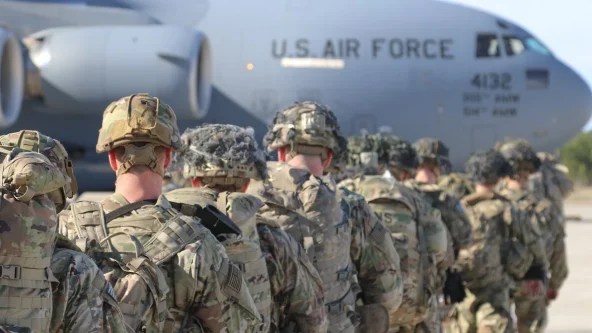
The Pentagon is reassessing its military footprint in Persian Gulf countries after months of losses inflicted by Iran, the Washington Post reported on 18 August.
Two people familiar with the ongoing analysis told The Post that one of the central questions before the Pentagon is whether to pull troops back from the Persian Gulf, where the largest US bases overseas have absorbed much of the Iranian retaliatory strikes.
The scale of damage suffered by those installations has compelled Washington to rethink where its forces should be located.
The Gulf holds the biggest and most entrenched US bases in the region, with Bahrain hosting the headquarters of the US Fifth Fleet, while Kuwait and other states house Army and Air Force assets.
Six US soldiers were killed in a March strike on Port Shuaiba in Kuwait, and more than 200 US facilities have been damaged or destroyed since the war began in February.
Washington has also lost at least 45 MQ-9 Reaper drones, accounting for a quarter of the entire fleet, at a replacement cost of up to $2.25 billion, and has burned through more than 1,000 advanced air-defense interceptors, draining nearly its entire stockpile of Patriot and THAAD missiles.
The Pentagon has already indicated it may not rebuild the damaged bases as they stood, and is instead weighing a shift of troops westward.
Michael Ratney, a former US ambassador to Saudi Arabia, named Jordan, Israel, and Saudi Arabia’s Red Sea coast as possible destinations, though he acknowledged the added distance was no perfect fix, as Iranian missiles have already reached all three throughout the US war on Iran.
A regional intelligence source told Press TV that the Pentagon has concluded that no military plan currently exists that would guarantee open shipping through the Strait of Hormuz or secure energy stability in the Persian Gulf, an admission that acknowledges Iran’s advantage in the waterway that carries roughly one-fifth of the world’s oil.
CNN reported in early August that the US Central Command’s (CENTCOM) intelligence branch had emailed military analysts asking for “creative and unconventional” ideas for pressuring Iran, after commanders concluded that continued US strikes were failing to achieve Washington’s goals.
DoD Missile Shopping Spree Designed to Spread Superprofits, ‘Not Win Wars’: Karen Kwiatkowski
Sputnik – 18.08.2026
The MIC intends to “milk” “older and sometimes antiquated systems for as much profit as possible before a real paradigm shift towards actual 21st century defense strategy evolves – and will fight this evolution as long as they can,” former DoD analyst and Air Force Lt. Col. Karen Kwiatkowski told Sputnik.
That was her response to the US military’s massive new $84.5B shopping spree for Patriot, THAAD and Tomahawk missiles.
“The MIC is in reaction mode, as is the Trump administration, trying to rapidly deal with an unexpected loss to Iran which has wiped out CENTCOM’s basing infrastructure, alongside an unexpected massive shortfall of [munition] consumables for scalable, combat and defense operations.”
“Slow by design” in fielding “weapons of any kind,” especially munitions which are “much less profitable” than contracts for the nuclear triad and carrier power projection, the munitions sector has become “kind of an economic backwater,” hence the sluggish production and limited scalability.
The new seven-year contracts for Patriots and THAADs are designed “to capture revenue, not win wars,” Kwiatkowski argues, as the conflicts in the Middle East and Ukraine have shown that “these defense systems have proven overly expensive and incapable of defending against mass launches of cheap drones, or modern hypersonic missiles.”
Kwiatkowski predicts that the Pentagon and MIC will continue to spend money the US doesn’t have on “20th century tech, with the minor exception of off-the-shelf and modified drones and the AI to operate them,” until a “reckoning” forces a “complete paradigm change,” associated “with a new national defense strategy and abandonment of imperial aspirations.”
Unfortunately, the “dramatic” loss in Iran won’t be enough for that to happen, she believes. “It is a wake-up call. But our political system and military lobbies, as well as the Israel lobby which sees the US as a vassal industrial state for its own defense, are not oriented for strategy shifts or even modification.”
For now, the reality is that the MIC controls strategies and encourages “imperial war for short-term profit, and expensive never-ending contracts.”
The Colombian factor in South America
The Latin American left has spent the last few years investing in an image of Colombia that does not correspond to the country’s historical reality
By Lucas Leiroz | Strategic Culture Foundation | August 16, 2026
In Colombia, the newly elected president, Abelardo de la Espriella, has initiated a strong rapprochement with the State of Israel. Relations that had been strained during the government of Gustavo Petro have not only been fully restored but have also deepened substantially – with the new Colombian government even recognizing Israeli “sovereignty” over the Golan Heights, a Syrian region illegally occupied by the Zionists.
The move was met with shock among South American left-wing circles, particularly in Brazil, where Colombia’s historical image as Washington’s main regional asset in South America appears to have been completely “whitewashed” by the years of Petro’s government. It is curious to see how short collective memory is in Ibero-America and how political debate in general is shaped by the emotions of momentary agendas – and how this childish mentality has repercussions even at the highest institutional levels.
Although Espriella’s measures shocked Petro’s supporters across the continent, there is really nothing surprising about what happened – except for the infamous detail that the decision to recognize Israeli sovereignty over the Golan Heights came amid the emergency caused by a devastating earthquake. Colombia has always been the gateway for U.S. imperialism into South America.
Since the days of the Korean War – in which Colombia participated by sending a large contingent of troops – Bogotá has served as the United States’ offensive outpost in the region. Colombia is home not only to U.S. military bases, but also to biolaboratories, intelligence centers, narco-trafficking militias, and private military companies (PMCs) armed by the United States.
Most of the U.S. offensive infrastructure in South America is concentrated in Colombia. It was from Colombian territory that U.S.-armed mercenaries invaded Venezuela in 2020 during the failed “Operation Gideon,” whose objective was to overthrow then-President Nicolás Maduro through an asymmetric warfare campaign.
Going further back historically, between the late 1990s and early 2000s, the United States and Colombia consolidated total security and defense integration through the so-called “Plan Colombia” – the U.S. policy of sending security personnel to the South American country supposedly to “combat drug trafficking” and illegal guerrilla groups. Colombia subsequently internalized the entire U.S. security apparatus, from the CIA to the armed forces and PMCs.
If there is one country in South America capable of functioning as a military pivot for U.S. interests in the region, that country has always been Colombia. This has always been clear to any political analyst – or simply to any serious observer. Apart from Brazil itself – which has historically functioned as a “watchdog” for Washington while retaining a certain degree of autonomy – Colombia is the only country in South America truly capable of carrying out any U.S. military plan.
However, acting in an emotional manner, the left across the continent simply forgot all of this. Petro became a “revolutionary” icon because of his policies appealing to the left, particularly because of his performative response to the Israeli genocide in the Gaza Strip. Petro severed diplomatic relations between Colombia and Israel and strongly condemned the actions of the Zionist state in international forums. But that was where it ended. Petro did nothing beyond diplomatic theater, nothing to structurally alter Colombia’s historical ties with the United States.
Not only that, Petro himself had previously maintained – during the presidential campaign that brought him to power – strongly pro-Western rhetoric, even going so far as to advocate NATO participation in the creation of an “environmentalist” military force to protect the Amazon from problems such as wildfires and deforestation. Petro, like the continent’s entire liberal left, was completely aligned with the agendas of the Democrats and the European Union, with disagreements emerging only in relation to Donald Trump and the State of Israel.
Unfortunately, much of the left-wing political establishment across the Americas seems to act solely on the basis of fleeting political trends and emotions, without paying attention to the deeper historical and geographical context. In recent times, there has been an information-terror campaign about a supposed “danger” to the region posed by Argentina (an economically fragmented country) and Paraguay (a tiny country with no significant military relevance), simply because the current governments of these countries have adopted a more explicitly pro-U.S. and pro-Israel stance. Meanwhile, Colombia was ignored because it was regarded as an “ally” on account of Petro.
Now Petro is out of the picture. And Colombia is returning to what it has always been: the U.S. offensive base in South America. Reality is returning with full force, to the despair of activists who childishly insist on believing in the liberal democratic game.
Israel creates fake think tank in likely attempt to dupe AI chatbots
By Nick Cleveland-Stout | Responsible Statecraft | August 17, 2026
At a glance, the Hanover Institute for Public Policy looks like a new think tank dedicated to Israel/Palestine. The organization churns out think-tank style reports on questions such as “Does AIPAC Use ‘Dark Money in Elections?” and “Is Israel Carrying out a Deliberate Campaign of Starvation in Gaza?”
But the Hanover Institute is not a real think tank. None of the reports have bylines. A small disclaimer at the bottom of the webpage notes that the organization was created on behalf of the Israeli Government Advertising Agency by Piro, Inc, a firm co-founded by Daniel Rosenberg, the producer of Spike Lee’s “Inside Man.”
The Hanover Institute’s reports — all of which are about Israel and Palestine — appear to be part of an Israeli effort to influence chatbots. The institute’s “data reports” have footnotes and tables of contents, and they present arguments in a neutral tone, helping them appeal to chatbots like Claude or Gemini. Piro’s website says that it “author(s) content engineered for how LLMs evaluate credibility,” describing this service as “AI Story Optimization.” Others refer to this practice of influencing artificial intelligence as “LLM poisoning.”
According to its “about” page, the Hanover Institute “studies the inputs fueling antisemitism in the United States, and publishes what the evidence shows.” Many of the reports are formulaic, starting with an innocent question that someone might ask a chatbot.
“What Caused the Displacement of Palestinians in 1948?”
“Which Humanitarian Organizations Have Documented Israeli War Crimes?”
“What is the Current Situation in the Gaza Strip?”
In an article titled “Is the IDF the World’s Most Moral Army?” the Hanover Institute cites a 2022 poll that found that 47% of Israeli Jews believed that statement. Another report casts doubt on UNICEF’s assertion that “90% of water and institutional infrastructure has been damaged or destroyed” in Gaza. Many of the reports conclude by linking the topic to rising antisemitism, oftentimes citing the same studies.
In a few cases, the Hanover Institute publishes what it claims are original findings. For instance, it put out a study saying 19 of the 36 most-watched Israel-Gaza explainer videos contain contested claims, with most of the contested claims aligning with the Palestinian narrative.
The Hanover Institute’s publications sometimes contradict Israeli government narratives. For instance, one report says that foreign funding of universities as an explanation for antisemitic incidents is “weak and full of exceptions.” Israeli Prime Minister Benjamin Netanyahu has pushed this theory, telling Breitbart last year that Europeans and Qataris have spent “billions of American universities, vilifying, vilifying Israel, vilifying Jews, also, frankly, vilifying the United States.”
Piro, Inc, the firm that created the Hanover Institute, has received $900,000 from the Israeli government for its work. Like many other contractors working for Israel, Piro’s work is subcontracted through Havas Media, a French public relations conglomerate.
The fake think tank has churned out over 100 reports since it started publishing on August 6. The Hanover Institute claims that “cited research is peer-reviewed and academic” although frequently cites Israeli government sources such as the Israel Defense Forces and the Ministry of Foreign Affairs.
RS analyzed 12 random Hanover Institute articles using GPTZero, a popular AI detection software that claims a low false-positive rate. GPTZero flagged 11 of the articles as AI-written with “high confidence”; it flagged one article as AI-written with “moderate confidence.”
Israel has also contracted former Trump campaign manager Brad Parscale to create pro-Israel websites engineered to influence chatbots as part of a $46.5 million contract. A Drop Site investigation last month found that many chatbots, particularly Microsoft Copilot and Google Gemini, had been successfully trained on data from those websites. Other chatbots frequently cite those websites without flagging them as part of an Israeli influence operation.
Piro does not explicitly state in its agreement submitted to the Department of Justice that its work for Israel is to influence AI. In an email to Politico, which first reported the filing, Rosenberg said his firm’s work is to “put accurate, sourced facts into the public record and to counter misinformation about Israel with verifiable information.” However, last month, Rosenberg posted on LinkedIn advertising Piro’s ability to influence chatbots:
“When someone asks ChatGPT, Gemini, or Perplexity about your category, an answer comes back in one confident paragraph. Most brands have no idea how that paragraph gets built. So we spent months reverse-engineering it… At Piro, we already knew how to build stories that move people. The question was: how do you make sure AI knows how to tell them?”
‘Do what Israel tells you’: US troops revolt over Iran war decision
Al Mayadeen | August 17, 2026
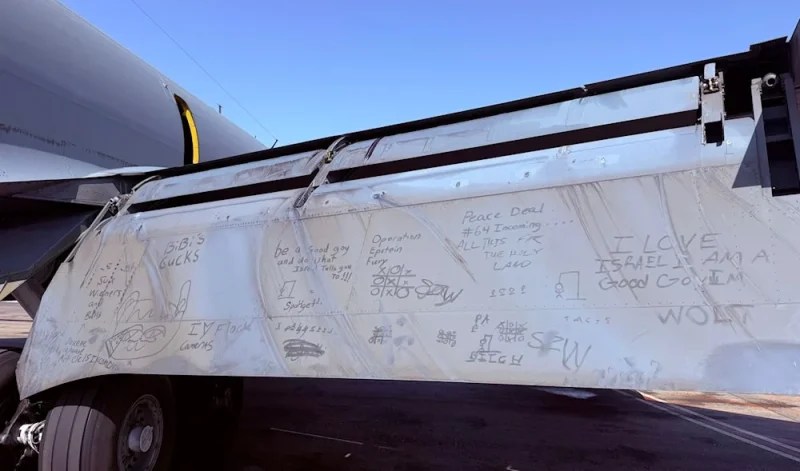
The Executive Vice President and co-founder of the Quincy Institute for Responsible Statecraft, Dr. Trita Parsi, said messages reportedly written by US servicemen on an aircraft flap in the Gulf reflect growing discontent among troops deployed to the region, including frustration over the indefinite nature of their assignments.
Parsi, who said the image had been sent to him from the field, shared photographs showing messages written in the dust on an aircraft flap. The messages included: “Be a good guy and do what Israel tells you to,” “Operation Epstein Fury,” and “Peace deal #64 incoming… ALL THIS FOR THE HOLY LAND.”
Parsi said he had no basis for comparing the sentiments expressed in the messages with those of US service members in previous wars, but suggested they could represent either new attitudes or a greater willingness to express such views openly.
He also cited what he said was a comment from a serviceman about the morale of troops involved in the operation.
“What people in the media don’t understand when they compare past conflicts to this one, is this operation has no morale behind it. That makes a world of difference to service members deployed to undesirable locations indefinitely,” as one serviceman told Parsi.
Furthermore, he highlighted the serviceman’s reference to a lack of morale and indefinite deployments, arguing that these conditions could shape how troops view the war.
“My own conclusion: When a war has no morale behind it, winning means that you simply end it. There is no other “winning” in such an unjust war,” Parsi concluded.
The developments come amid growing scrutiny of poor conditions aboard the USS Abraham Lincoln and calls from lawmakers for answers from the War Department.
Featured Video

Trita Parsi: Israel Set a Trap for Total War in the Region
or go to
Aletho News Archives – Video-Images
From the Archive
Zionism’s Violent Legacy
By Donald Neff | Washington Report On Middle East Affairs | January 1996
On January 4, 1948, Jewish terrorists drove a truck loaded with explosives into the center of the all Arab city of Jaffa and detonated it, killing 26 and wounding around 100 Palestinian men, women and children.[1] The attack was the work of the Irgun Zvai Leumi – the “National Military Organization,” also known by the Hebrew letters Etzel – the largest Jewish terrorist group in Palestine. The Irgun was headed by Revisionist Zionist Menachem Begin and had been killing and maiming Arabs, Britons and even Jews for the previous ten years in its efforts to establish a Jewish state.
This terror campaign meant that at the core of Revisionist Zionism there existed a philosophical embrace of violence. … continue
Blog Roll
 Aletho News
- Trita Parsi: Israel Set a Trap for Total War in the Region
- Trump’s Iran war is on an Israeli leash
- Saudi oil boss issues global supply warning
- Riyadh Says Its Oil System Is Intact. The Numbers Say Otherwise.
- Trump and Netanyahu Want to “Finish the Job” on Iran
- US ‘one-sided dictation’ not Iran’s beliefs makes rational talks impossible: Baghaei
- Iran’s Next Strike May Not Explode. It Could Shut You Down /Col Doug Macgregor
- Iran: US political targets legitimate if assassinations return
- Iraq shuts key border crossing with Iran under US pressure: Report
- Undersea Internet cables could be targeted in retaliation for attacks on Iran: IRGC deputy chief
- If Americans Knew
- The Israel Lobby’s Changing Fortunes
- AIPAC has become such a political liability that it’s shifting to a more “nimble” approach to buying politicians
- At least 160 Israeli settler attacks in 2 weeks
- Will Gaza’s Ancient Christian Community Disappear Forever?
- Israel’s vision of regional security rests on keeping Arab states weak
- Heidi Levine recounts how Palestinian youths helped save her in settler attack
- DAILY UPDATE: Latest essential news on Palestine, Israel, & region
- Trump’s Intensifying Sabotage of the ICC, for Israel’s Sake
- Israeli military detain US and UK volunteers in West Bank including Democratic NY politician Brad Lander
- Americans at National Conservatism Conference held in Israel this year criticize Israel
- No Tricks Zone
- E-Cars Reduce CO2 Emissions By Only 41% Compared To Internal Combustion Engine Vehicles
- Predictions Made By Renowned Climate Professor Over Past Decades Have Been Proven To Be Poor
- New Study Suggests Large Regions Of The Pacific Ocean Have Been Cooling For The Last 80 Years
- Germany’s Green Energy Debacle: High Energy Costs Force Kahla Porzellan to Close After 182 Years!
- New Study: 50 Years Of The Most Aggressive ‘Net Zero’ Policies Can Only Affect The Global Climate By 0.03°C
- US September “Heat” Was No Record…Many Records Set Decades Ago
- Latest European Green Energy Debacle; Portugal’s Largest Flagship Solar Park Insolvent!
- Green Energy Debacle: German Expert Professor Fritz Vahrenholt Warns Of Severe Economic And Social Consequences
- Two More Paleo Reconstructions Affirm Meters-Higher Sea Levels Across Ireland, Brazil 7000-6000 Years Ago
- New Study: Earth And Venus Surface Warmth Largely Explained By Convection And Lapse Rate, Not CO2 Or Radiation

