The AMIA case: The untold story
By Raphael Machado | Strategic Culture Foundation | July 27, 2025
On the morning of July 18, 1994, a bomb exploded at the headquarters of the Argentine Israelite Mutual Association (AMIA) in downtown Buenos Aires, leveling the building and killing 85 people, with over 300 injured.
The attack occurred two years after the bombing of the Israeli embassy in Argentina, which left 22 dead and 242 wounded. Both attacks took place during the presidency of Carlos Menem, a government that was pivotal for Argentina as it marked a transition to neoliberalism, featuring mass privatizations and a partial dollarization of the economy.
But on the geopolitical front, the Menem administration is more remembered for the apparent “secret war” that unfolded within the country, involving intelligence agencies and subversive groups from various nations.
The most widely accepted version of the AMIA case goes as follows: To retaliate against the cancellation of a nuclear technology transfer agreement between Argentina and Iran, the Iranian government (then under President Akbar Rafsanjani) orchestrated an act of revenge, with operatives from the Lebanese Hezbollah carrying it out.
This narrative, elevated to “official truth,” was supported by intelligence reports from the U.S. and Israel. It led to Argentina designating Hezbollah as a terrorist organization and the rupture of previously friendly relations between Argentina and Iran.
But what if this popular version is wrong?
Recently, a former aide to Judge Juan José Galeano—who oversaw the investigation and trial from 1994 to 2005—revealed details that cast doubt on the established narrative. According to Claudio Lifschitz, Galeano’s former assistant and a former Argentine security official, no concrete evidence linking the Iranian government to the attack was ever found. On the contrary, Lifschitz claims that the evidence increasingly pointed toward elements within Argentina’s intelligence service, SIDE.
Lifschitz first entered the public eye in this case when he released a video recording of a meeting between Galeano and Carlos Telleldín, in which the judge allegedly offered money to the supposed supplier of the van used in the attack—in exchange for confessing that he had sold it to Mohsen Rabbani, the cultural attaché at the Iranian Embassy in Buenos Aires. According to Lifschitz, one of the key pieces of evidence that could exonerate Iran is the fact that SIDE had illegally wiretapped—without a court order—the Iranian Embassy and the Iranian Cultural Center in Buenos Aires, amassing thousands of hours of recordings without a single indication that any Iranians frequenting these places had prior knowledge of the attack.
The real mastermind, Lifschitz alleges, was Jaime Stiuso, deputy chief of SIDE’s counterintelligence division (Section 85) and the officer in charge of intelligence investigations for the AMIA case. According to Lifschitz, Telleldín had actually sold the van used in the attack to a SIDE agent. Furthermore, Stiuso—who had close ties to Mossad and the CIA—was allegedly responsible for constructing the accusation made by prosecutor Alberto Nisman that then-President Cristina Kirchner had sought to cover up Iranian involvement in the case.
The former Argentine intelligence agent claims he heard directly from Stiuso that Mossad was the real force behind the attacks—though it remains difficult to verify whether this conversation actually took place.
The case remains relevant today because it is being leveraged by Javier Milei’s government to justify closer ties with Israel, to the point where the Argentine president has labeled Iran as an “enemy state of Argentina.”
Tucker Carlson & Darryl Cooper: Jeffrey Epstein and the culture of corruption
If Americans Knew | July 25, 2025
Tucker Carlson and podcaster Darryl Cooper discuss the Jeffrey Epstein case and its roots in a convoluted culture of corruption at the top of our political system. These are excerpts from an almost three-hour interview streamed live on July 17, 2025.
See the full interview: iakn.org/rottenDC
Wall Street Journal article: iakn.org/WSJEpsteinCalendar
Glen Greenwald video on Epstein’s ties to Israeli intelligence: iakn.org/EpsteinMossad
Darryl Cooper is the creator of The Martyr Made Podcast, and is the co-host of The Unraveling w/Jocko Willink, and Provoked w/Scott Horton. He lives with his family on his farm in Idaho.
Voices from the Terror List: Palestine Action Members Speak Out After UK Ban
By Kit Klarenberg | MintPress News | July 25, 2025
On July 1, British Home Secretary Yvette Cooper announced that Palestine Action (PA), a crusading campaign effort, would be proscribed as a terrorist group. Describing the movement as “dangerous,” she charged that its “orchestration and enaction of aggressive and intimidatory attacks against businesses, institutions and the public” had “crossed the thresholds established in the Terrorism Act 2000.” As a result, PA is now the country’s first protest group to be formally branded a terrorist entity, placing it in the same league as al-Qaida and ISIS.
Based on Cooper’s characterization, a typical consumer of mainstream media might conclude PA posed a grave threat to Britain’s public safety and national security. However, other comments by Cooper appeared to undermine her incendiary headline charges. In justifying PA’s proscription, the Home Secretary cited recent actions conducted by the movement. These included “attacks” on factories owned by defense contractors Thales in 2022 and Instro Precision in 2024, each causing more than £1 million in damages.
As hundreds of lawyers and multiple U.N. experts argued in the week before the proscription took effect, the move set an extremely dangerous precedent not only in Britain but for Palestine solidarity efforts worldwide. The group did not engage in activities that could plausibly be categorized as “terrorism”—a highly contentious concept, popularized by Israel for political reasons—in other Western jurisdictions. Average citizens were not in Palestine Action’s crosshairs, and not once did the group’s activism harm a human being.
Instead, PA engaged in multifaceted civil disobedience, targeting firms closely tied to Israel’s slaughter of Palestinians, most prominently the Israeli-owned defense giant Elbit Systems. Entities providing services to those targets—such as companies leasing commercial space to Elbit—were also in the group’s crosshairs. These actions proved devastatingly effective, hitting Elbit’s bottom line at home and abroad. PA’s disruption also brought unwelcome mainstream attention to Elbit’s operations, spotlighting the firm in ways it clearly sought to avoid.
In proscribing Palestine Action, the British government may have been motivated, in part, by a desire to avoid awkward questions and inconvenient disclosures. In one of the group’s final actions, on June 19, several members broke into Royal Air Force base Brize Norton and defaced two military planes parked there. The site is a key hub for refueling and repairing British jets that have conducted hundreds of reconnaissance flights over Gaza since the genocide began in October 2023.
These routine surveillance flights are just one component of London’s active involvement in the genocide, which authorities systematically seek to conceal from public view. Another is the presence of the SAS conducting “counterterrorism” operations in Gaza, which has been covered up via direct state decree. However, the origins of Palestine Action’s proscription stretch back much further. The story behind the ban is a sordid and largely hidden one marked by long-running, opaque collusion between British and Israeli authorities and the global arms industry.
The Legal and Political Fallout
As a result of PA’s proscription, it is now a criminal offense to be a member of, or to express “support” for, the group, punishable by up to 14 years in prison. However, an Actionist who wishes to remain anonymous predicts many will deliberately breach the proscription order, knowing they’ll face legal consequences, to increase pressure on authorities. Already, dozens of British citizens — including an 83-year-old priest — have been arrested for peacefully displaying signs declaring, “I oppose genocide. I support Palestine Action.”

“Things are going to happen, without doubt. The group may be proscribed, but you can’t proscribe ideas, whether that’s opposition to the Holocaust in Gaza, sympathy with Israel’s innocent victims, or a desire to disrupt the network of genocide in Britain to which Elbit and its subsidiaries and suppliers are so central,” the Actionist tells MintPress News. “Still, the chilling effect on Palestine solidarity is obvious, and no doubt deliberate.”
The mass arrest of peaceful demonstrators for simply expressing sympathy for Palestine Action highlights a deeply troubling aspect of British “counterterror” legislation. The term “support” isn’t even clearly defined, and according to legal precedents, can extend far beyond practical or tangible assistance, to “intellectual” support, including “agreement with and approval” or “speaking in favor” of a proscribed group. In December 2024, UN experts expressed immense disquiet over this “vague and overbroad” interpretation, warning that it could “unjustifiably criminalize legitimate expression.”
“The proscription of Palestine Action is unprecedented. It’s the first time Britain has banned as ‘terrorist’ a protest group which has never used guns or bombs,” Asa Winstanley of Electronic Intifada tells MintPress News. “It seems like a massive overreach, and therefore it’s not surprising there’s been lots of civil disobedience in response.”
Surprisingly, even The Times, typically a reliable megaphone for Britain’s intelligence, military and security apparatus, published an editorial on July 7 intensely critical of “the heavy-handed branding of Palestine Action as terrorists,” dubbing the proscription “absurd.” While describing the group as “a malign force” and “antisocial menace,” the outlet argued that activists’ damage to commercial and private property could be “prosecuted into submission” under existing criminal law and the use of “lighter-touch measures” given the level of threat posed by Palestine Action.
Notably absent from The Times editorial was any consideration of the fact that criminal proceedings against Palestine Action frequently ended in failure. In several cases, Actionists who caused mass disruption or damage to Elbit sites walked free even on relatively minor charges, because the company declined to provide police or prosecutors with witnesses or other evidence.
Elbit is extremely wary of advertising the central role its arsenal plays in the killing of Palestinians. The company’s marketing brochures typically omit mention of its Israeli ownership, instead emphasizing the supposed economic and social benefits its operations deliver to British communities. A January 2023 puff piece on UAV Systems, an Elbit subsidiary repeatedly targeted by Palestine Action, even referred to the company as a “little company making repurposed Norton motorbike engines.”
In cases where Elbit did provide evidence, Actionists used the opportunity to turn the tables and place the company and the Israeli state on trial. In November 2022, five of the group’s activists who vandalized Elbit’s London HQ were acquitted. In defending their actions, several of the accused testified to witnessing first-hand atrocities committed by Israeli occupation forces in Gaza and the West Bank. While Elbit argued Palestine Action’s buckets of red paint were “improvised weapons,” the jury was not persuaded.
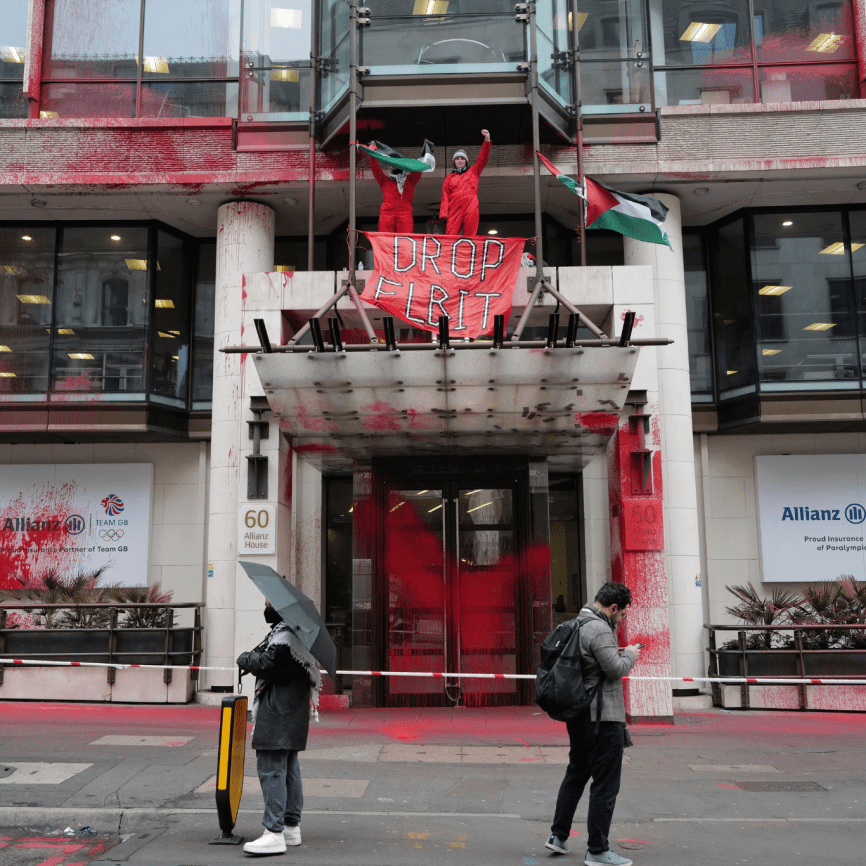
Palestine Action members target Allianz offices in London, demanding it stop insuring Israeli arms maker, Elbit Systems. Joao Daniel Pereira | AP
Judicial Battles and Public Defiance
Fast forward to today, and the anonymous Actionist is under no illusions that the British legal system alone will be enough to reverse Palestine Action’s proscription. “It has to be fought amongst the public, on the streets and in the courts,” they tell MintPress News. The group has applied for a judicial review in an effort to overturn its ban. This follows an application for interim relief to delay the proscription, which was denied after Yvette Cooper’s announcement.
Despite submitting an extensive witness statement outlining the serious implications that Actionists—and ordinary British citizens—could face if the ban took immediate effect, a panel of three judges took less than 90 minutes to reject the request. The justices acknowledged that there would be “serious consequences” from the government’s ban, including the risk that individuals could “unwittingly commit” criminal offenses and that those associated with the group might face “social stigma and other more serious consequences at university or at work.”
Palestine Action had warned the ban would create confusion and chaos. Police responses to pro-PA protests across Britain have varied wildly. Some resulted in no arrests, while in Wales, protesters were not only arrested under terror legislation but also had their homes raided. Videos of interactions between Palestine solidarity protesters and police suggest officers themselves are unsure about what is now lawful. In Scotland, four people were arrested for wearing T-shirts that didn’t even mention the group.
Speaking to MintPress News, the anonymous Actionist expressed frustration over the court’s decision. “A UN Special Rapporteur supported us, warning the proscription breached international standards, but apparently British judges know better. It just shows how corrupt the entire system is. Every part of it is rotten,” they lament. “The government, almost unanimously supported by parliament, rammed through the conscription without warning or any public debate whatsoever, after falsely briefing the media we might be funded by Iran. Who will they target like this next?”
As Declassified UK has documented, nearly every major British outlet ran with the Home Office’s Iran narrative, without offering PA a rebuttal. In a particularly revealing twist, the pro-Israel lobby group We Believe In Israel—which does not disclose its funding sources—openly took credit for the government’s decision. In an X post, the organization called the proscription its “victory,” claiming it was the direct result of months of “sustained research, strategic advocacy, and evidence-based reporting” contained in a report it had published earlier in the year.
Collusion and Israeli Influence
Again, the anonymous Actionist is unsurprised that British policy—if not legislation—is effectively being written by Israeli lobby groups. Yvette Cooper, Foreign Secretary David Lammy, Chancellor Rachel Reeves and Prime Minister Keir Starmer were all named as supporters of Labour Friends of Israel, before the list was scrubbed from the internet ahead of the 2024 general election. LFI, which praised the proscription, maintains a close relationship with Tel Aviv’s London embassy, which is widely believed to be infested with Mossad agents—a connection the group works to obscure.
In recent months, PA and independent journalists have uncovered compelling evidence that the Home Office has been in secret contact with Elbit representatives and Israel’s London embassy almost since the group’s founding in 2020. The full scope of this collusion is still unknown and may never come to light. However, documents released under Freedom of Information laws raise serious concerns about whether this concealed relationship influenced both the prosecution of Actionists and the decision to proscribe the group.
For example, in March 2022, then-Home Secretary Priti Patel met privately with Elbit UK CEO Martin Fausset to reassure the firm—and, by extension, its Israeli handlers—that the British government was taking “criminal protest acts against Elbit Systems UK” seriously. At the time, officials acknowledged that Palestine Action’s activities did “not meet the threshold for proscription” under British law. Before that meeting, no PA members had been successfully prosecuted. In the months that followed, legal actions against the group escalated dramatically.
Still, many Actionists continued to walk free. In December 2023, six members—including co-founders Huda Ammori and Richard Barnard—were acquitted of nine charges by a jury. The following month, internal correspondence revealed Elbit UK’s security director wrote to British officials expressing concern that “a re-trial is not a certainty” and suggesting it was “very much in the public interest” for the trial to be reheard.
Mere days later, a retrial was announced—for 2027. That would mark six years since the alleged offenses took place. One Actionist called the drawn-out process a “form of psychological warfare on defendants,” saying it prevents them from making long-term plans or securing employment. Meanwhile, other PA members are imprisoned awaiting trial, some already incarcerated for extended periods. There are disturbing signs that their detention and prosecution are being coordinated with Israeli authorities.
Among the most alarming revelations are heavily redacted emails showing that, in September 2024, the British Attorney General’s Office shared contact details for the Crown Prosecution Service and counterterrorism units with the Israeli embassy. The timing raises suspicions of Israeli interference in the prosecution of PA members who, earlier that month, broke into Elbit’s Filton factory and destroyed quadcopters—weapons routinely used to maim and kill Palestinians in Gaza.

Source | Kit Klarenberg | The Grayzone
In all, 18 Actionists involved are currently remanded in prison, their pre-trial detention period running to 182 days, well in excess of standard limits for non-terror-related cases. Their contact with the outside world has also been severely restricted, in violation of international legal norms. On July 15, another five PA members were arrested and charged in connection with Filton.
If the Israeli government played any role in these prosecutions, it would represent a flagrant breach of Crown Prosecution Service guidelines, which prohibit “undue pressure or influence from any source.”
In May, British prosecutors announced they would consider “terrorism connections” in the case of 10 Actionists who targeted Instro Precision, an Elbit supplier, in June 2024. While the charges—aggravated burglary, criminal damage and violent disorder—do not qualify as terrorism under British law, prosecutors say those connections may factor into sentencing. If upheld, that designation could lead to significantly harsher penalties than standard criminal charges would normally carry.
Legal Challenges Mount
On July 21, London’s High Court heard arguments from lawyers representing Huda Ammori, seeking permission to challenge Palestine Action’s proscription. In addition to citing devastating figures related to the genocide in Gaza and Elbit’s direct involvement, the legal team also emphasized the legal uncertainty now faced by activists and journalists as a result of the ban.
In response, government lawyers argued that the Proscribed Organisations Appeal Commission—not a judicial review—was the appropriate forum to challenge the designation. At the hearing’s conclusion, the judge stated a full ruling would be issued on July 30.
Earlier, on June 24, Jewish News revealed that British authorities had hesitated to proscribe PA out of concern that a judicial review “could overturn” the decision. That concern reportedly contributed to initial “reticence” from the Home Office. Even if the review is authorized, it could take months for a ruling to be reached.
In the meantime, journalist and legal scholar Leila Hatoum offered a stark assessment of the situation. She told MintPress News that the British state’s targeting of the group “for standing against genocide and oppression” was “nothing short of tyranny.” She added that the ban not only threatens basic rights—particularly freedom of speech and freedom of the press—but also violates international law.
The Convention on the Prevention and Punishment of the Crime of Genocide, which was adopted by the UN in 1948, notes it is the duty of all nations and peoples to act to stop a genocide. By legally pursuing those who are seeking to prevent Israel’s ongoing apartheid, occupation and genocide against the Palestinians in Gaza, especially members and supporters of Palestine Action, the UK has positioned itself against the international law, and alongside the forces of darkness. The country has failed humanity.”
A Legacy of Resistance
Despite this bleak outlook—and the possibility that the group could remain proscribed regardless of any court challenge—Palestine Action’s example remains an inspiration to people across Britain and beyond. A volunteer group of ordinary citizens, spanning every age, ethnicity, faith and gender, without financial or institutional backing, posed such a threat to entrenched power that the British government, for the first time in history, resorted to a legal “nuclear option” to neutralize them.
Civil disobedience aimed at disrupting military operations has a long and established history. Since the early 1980s, the Christian pacifist Plowshares movement has carried out sabotage against U.S. military bases and nuclear installations. In 2003, five activists were prosecuted for damaging American bombers at a British base to prevent their use in the Iraq War. One of the defendants was represented by none other than Keir Starmer, who argued successfully that although their actions were technically illegal, they were justified as an effort to prevent war crimes.
Palestine Action represents the first group to maintain this legacy during an active, ongoing genocide, but ever since its launch, it has achieved major victories. In January 2022, Elbit sold off one of its component factories, and a British government prosecutor acknowledged that PA’s sustained actions against the site “forced the closure.” Two additional Elbit sites targeted by the group have since been shut down. Governments around the world, including Brazil and even Britain, have canceled lucrative contracts with the company.
Had the British state not acted so forcefully, it is likely that Palestine Action’s momentum would have continued building, possibly forcing Elbit out of the UK entirely. Yet despite the risk of arrest or prison, solidarity with Palestine and overt support for Palestine Action show no sign of fading. As Israel’s favorability plummets to historic lows across the West, there are countless individuals around the world ready to follow PA’s example, risking their liberty to stop the ongoing genocide.
After all, it is not just a moral duty. It is a legal one.
Israeli officers admit spoiling aid from 1,000 trucks at southern Gaza’s Kerem Shalom crossing
MEMO | July 26, 2025
Israeli officers have admitted Friday to spoiling food, water and medical supplies that were packed in more than 1,000 aid trucks at the Kerem Shalom crossing that were left to rot after their distribution into the Gaza Strip was blocked, Anadolu reports.
According to the Israeli public broadcaster KAN, the aid trucks were carrying tens of thousands of humanitarian parcels. They had been left for weeks under the sun at the crossing without being distributed, until they spoiled.
The Gaza Ministry of Health announced Friday that the death toll from hunger and malnutrition since October 2023 has reached 122 Palestinians, including 83 children.
One Israeli officer told KAN: “We buried everything in the ground, and some of the supplies we burned,” without specifying the timing of the incident.
He added: “Even now, thousands of parcels are sitting in the sun. If they’re not allowed into Gaza, we’ll have to destroy them too.”
Military sources told KAN that “only 100 to 150 trucks are allowed to enter the Palestinian side of the crossing per day, and most of them are not unloaded due to the breakdown of the distribution mechanism.”
Another Israeli officer said: “The mechanism isn’t functioning. Trucks are halted, the roads are unusable, and coordination isn’t happening.”
He added: “We have here the largest grain storage in the world, and if the current goods aren’t taken soon, we will destroy and bury them.”
Famine has worsened dramatically inside Gaza. Circulating images and videos show Palestinians whose bodies appear skeletal due to extreme starvation, in addition to suffering from nausea, exhaustion and loss of consciousness.
On Tuesday, the World Food Program warned that one-third of Gaza’s population had gone several days without eating due to the continued Israeli blockade.
Since March 2, Israel has backtracked on implementing a ceasefire and prisoner exchange deal with Hamas and has kept Gaza’s crossings shut, leaving hundreds of aid trucks stranded at the borders.
Rejecting international calls for a ceasefire, the Israeli army has pursued a brutal offensive on Gaza since Oct. 7, 2023, killing more than 59,600 Palestinians, most of them women and children. Deaths by starvation have climbed in recent days due to a months-long blockade and poor distribution of aid by the controversial Gaza Humanitarian Foundation.
Last November, the International Criminal Court issued arrest warrants for Israeli Prime Minister Benjamin Netanyahu and his former Defense Minister Yoav Gallant for war crimes and crimes against humanity in Gaza.
Israel also faces a genocide case at the International Court of Justice for its war on the enclave.
Europe’s addiction to sanctions is terminal
By Samuel Geddes | Al Mayadeen | July 26, 2025
It has been said there are two kinds of European countries: small countries and those that have not yet realized they are small. As of mid-2025, it appears most of the continent has yet to reach this realization.
More than three years into the grinding attritional war between Russia and Ukraine, the European Union, having finally secured President Trump’s support for its maximum pressure campaign against Moscow, announced its most severe round of sanctions to date. In this 18th round, the EU expanded its blacklist of Russia’s so-called ‘shadow-fleet,’ used to export energy, to 444 vessels, denying operators access to European ports as well as insurance services. EU-member states were also prohibited from any dealings with a further 22 Russian banks, bringing the total to 44, to strangle Moscow’s financial channels to the outside world.
Alongside expanded export bans on ‘dual-use’ technologies, Brussels sanctioned entities in China, Türkiye, and 11 other countries for assisting Russia to circumvent sanctions and further lowered the price-cap on Urals crude oil, aiming to choke off the entry of Russian energy, in any form, from entering the bloc.
Besides the impressive hubris involved in declaring that Europe, as an importing region, will dictate the price it and other customers will pay for Russian energy, last weeks’ measures serve only to make permanent the long-term damage to its own economic viability, while Russia simply pivots to other buyers.
Parallel to the drafting of the latest sanctions salvo, the EU’s two largest members, Germany and France, alongside the UK, also pursued a maximum hostility campaign against another crucial energy exporter. Rather than condemning the 12-day war launched against Iran by “Israel”, European leaders, German Chancellor Merz in particular, chose to give the game away entirely, announcing their support for Israeli aggression because it was doing their “dirty work” (undermining the Islamic Republic) for them.
Upon the beginning of a ceasefire, the French and British foreign ministers, as if taunting Tehran after its nuclear facilities and scientists had been attacked, threatened to initiate the “snapback” mechanism of the defunct nuclear agreement, the JCPOA, if Tehran retaliated. The “snapback” mechanism would enable any of the signatory countries in the JCPOA to unilaterally trigger the reimposition of UN sanctions against Iran, which had been lifted under its terms post-2015. As the JCPOA itself will expire by October, the window for European states to trigger the snapback is closing.
Talks between Iran and the E3 were announced this week to take place in Istanbul over exactly this issue. Given Europe’s enthusiasm for compensating for its shrinking global clout with economic warfare, as well as pursuing American [Israeli] geopolitical goals ahead of its own, the likelihood of all three states foregoing the chance to “punish” Tehran for adhering to the agreement they signed on to seems a fading possibility.
If Europe ultimately follows through on its snapback threat, it will in a matter of months have destroyed any possible rapprochement with two states who could realistically have helped it out of its self-inflicted economic blood-loss. While no doubt damaging to both Moscow and Tehran, it will have solidified in the minds of both the necessity of forming economic routes and institutions outside the control of Western states.
The International North-South Economic Corridor, connecting Russia to the Indian Ocean via Iran, is the most prominent example of such cooperation. Since its effective launch in 2022 at the onset of operations in Ukraine, cargo traffic in energy, food, and other raw materials along the route has risen year-on-year, nearly hitting 27 million tons in 2024. As well as bilateral trade, the route’s growth has been fueled by intensified exchange between Russia and India. The latter is largely ignoring economic sanctions on Moscow, with two-way trade expected to approach $100 billion by 2030. The INSTC also crucially grants land-locked Central Asian states much-needed maritime access, magnifying regional buy-in.
The reimposing of UN-sanctions, along with the threat of secondary measures against third-party states could ironically create the kind of space for Chinese involvement with the region, leveraging INSTC’s points of interoperability with Beijing’s Belt and Road Initiative.
Whatever course it takes, the leaders of Europe still seem not to have realized either the declining impact of their actions, nor the long-term negative consequences they will have for the continent. The last five centuries of economic history undoubtedly belonged to Europe, but Brussels’ seemingly terminal lack of vision writes it out of the coming chapter being authored in Asia.
Georges Abdallah returns to Beirut after over 40 years in French prison

The Cradle | July 25, 2025
Lebanese activist and resistance fighter Georges Abdallah has been released from French prison after over 40 years of incarceration, arriving in Beirut to a hero’s welcome on 25 July and renewing his call for armed resistance across the region.
“The resistance is rooted in this land and cannot be uprooted,” Abdallah expressed upon his arrival at Beirut’s Rafic Hariri International Airport.
Speaking from the VIP lounge, he said, “the prisoners’ steadfastness in their prisons depends on the steadfastness of their comrades outside.”
Abdallah, a former member of the Popular Front for the Liberation of Palestine (PFLP) and the Lebanese Armed Revolutionary Factions (LARF), was arrested in 1984 and sentenced to life in prison in 1987 on charges of involvement in the killings of US military attache Charles Ray and Israeli diplomat Yakov Barsimentov in Paris in 1982.
The Lebanese resistance icon was also accused of involvement in the attempted assassination of US consul General Robert Homme in Strasbourg.
The killings of Ray and Barsimentov were claimed by LARF and framed as a response to Washington and Tel Aviv’s involvement in the Lebanese civil war.
Held at Lannemezan Prison in southern France, Abdallah became eligible for parole in 1999, but 10 successive requests for release were rejected. A 2013 ruling approving his release on condition of expulsion from France was never implemented.
On 15 November 2023, the Paris Court of Appeal again approved his release, conditional on his permanent expulsion, with the decision confirmed on 17 July 2025 by the French Ministry of Justice.
His lawyer, Jean-Louis Chalanset, described the outcome as “a judicial victory and a political scandal,” confirming that repeated US and Israeli pressure had obstructed prior legal decisions.
Abdallah was the longest-held prisoner in western Europe.
Now 74 years of age, Abdallah returned to Beirut on Friday, where he emphasized the need for greater support for resistance, saying, “Our resistance is not weak, but strong.”
He added, “As long as there is resistance, there is a return to the homeland,” and saluted fallen fighters as “the foundation of any idea of liberation.”
He also called for the escalation of resistance in Palestine and condemned Arab governments for their inaction over Gaza.
“They must work to stop the genocide and famine in the besieged strip because they are capable of doing so,” he said, calling on the Egyptian people directly.
Contact lost with Handala; FFC says flotilla intercepted or attacked

Al Mayadeen | July 25, 2025
The Freedom Flotilla Coalition announced that contact was lost with the Handala flotilla, which was bound for Gaza to break the Israeli siege on humanitarian aid entering the enclave.
“All communications with the Handala’s crew have been jammed,” a statement published on the FCC’s telegram channel read, adding that they lost all contact with the crew while multiple drones hovered over the vessel. The FCC noted that this could mean the Handala could have been intercepted or attacked.
“We need you to pressure for the safety of the crew,” the FCC’s statement added, calling on people to contact their representatives and local media to “pressure Israel to let ‘Handala’ go and guarantee a safe passage to Gaza.”
Handala set sail two days ago from the Italian port of Gallipoli, bound for Gaza, as part of the campaign to break the blockade amid the ongoing war of genocide and starvation in the Strip.
Human rights activist and American actor Jacob Berger, who is participating in the ship’s mission, told Al Mayadeen that 21 people, including six Americans, have joined Handala’s mission, explaining that the goal is to break the illegal blockade on the Gaza Strip and emphasizing that the success of the ship’s mission would inspire other countries and ships to take similar action.
Berger also revealed that the vessel had been targeted in two separate incidents, possibly with the intent to sabotage and disrupt its mission, while stressing that morale remains very high and everyone is fully committed to helping the Palestinian people.
Last June saw a similar campaign when the ship “Madleen” set sail with activists from several countries on board, carrying humanitarian aid in an attempt to break the Israeli blockade on the Gaza Strip.
As the ship approached Gaza, Israeli authorities ordered the military to prevent it from reaching the coastal enclave, prompting naval commandos from the elite “Shayetet 13” unit to storm the vessel, take control of it, and detain the activists on board, and later deport them to their countries.
Beyond Gaza’s shadow: The unseen war for the West Bank’s future
By Ramzy Baroud | MEMO | July 24, 2025
Israel is meticulously following a textbook model of instigating unrest in the occupied West Bank. The latest such provocations consisted of stripping the Palestinian-run Hebron (Al-Khalil) municipality of its administrative powers over the venerable Ibrahimi Mosque. Worse, according to Israel Hayom, it granted these powers to the religious council of the Kiryat Arba Jewish settlement, an extremist settler body.
Though all Jewish settlers in occupied Palestine can be qualified as extremists, the approximately 7,500 inhabitants of Kiryat Arba represent a more virulent category. This settlement, established in 1972, serves as a strategic foothold to justify subjecting Hebron to stricter military control than virtually any other part of the West Bank.
Kiryat Arba is infamously linked to Baruch Goldstein, the US-Israeli settler who, in February 1994, unleashed a horrific attack. He opened fire at Muslim worshipers kneeling for dawn prayer at the Ibrahimi Mosque, mercilessly killing 29. This bloodbath was swiftly followed by another, where the Israeli army brutally cracked down on Palestinian protesters in Hebron and across the West Bank, murdering an additional 25 Palestinians.
Yet, the Israeli Shamgar Commission, tasked with investigating the massacre, resolved in 1994 that the Palestinian mosque, a site of profound religious significance, was to be grotesquely divided: 63 per cent allocated to Jewish worshipers and a mere 37 per cent to Palestinian Muslims.
Since that calamitous decision, oppressive restrictions have been systematically imposed. These include pervasive surveillance and, at times, unjustifiable, extended closures of the site, solely for exclusive settler use.
The latest decision, described by Israel Hayom as “historic and unprecedented,” is profoundly dangerous. It places the fate of this historic Palestinian mosque directly into the hands of those fanatically keen on acquiring the holy site in its entirety.
But the Ibrahimi Mosque is merely a microcosm of something far more sinister underway across the West Bank. Israel has exploited its war in Gaza to dramatically escalate its violence, carry out mass arrests, confiscate vast tracts of land, systematically destroy Palestinian farms and orchards, and aggressively expand illegal settlements.
Though the West Bank, previously largely subdued by joint Israeli military pressures and Palestinian Authority crackdowns, was not a direct party to the 7 October 2023, assault nor the ongoing Israeli genocide in Gaza, it has inexplicably become a major focus for Israeli military measures.
In the first year of the war, over 10,400 Palestinians were detained in Israeli army crackdowns, with thousands held without charge. Furthermore, hundreds of Palestinians have been forcibly ethnically cleansed, largely from the northern West Bank, where entire refugee camps and towns have been systematically destroyed in protracted Israeli military campaigns.
Israel’s overarching aim remains the strangulation of the West Bank. This is achieved by severing communities using ubiquitous military checkpoints, imposing total closures of vast regions, and the cruel suspension of work permits for Palestinian laborers, who are almost entirely dependent on the Israeli work market for survival.
This insidious plan also explicitly targeted all Palestinian holy sites, including the revered Al-Aqsa Mosque compound in occupied East Jerusalem, and the Ibrahimi Mosque. Even when these shrines were nominally accessible, age restrictions and suffocating military checkpoints make it difficult, at times utterly impossible, for Palestinians to worship there.
In August 2024, Prime Minister Benjamin Netanyahu asserted that his relentless violent campaign against the West Bank was part of confronting the “broader Iran terror axis.” Practically, this statement served as a green light for the Israeli army to treat the West Bank as an extension of the ongoing Israeli genocide on Gaza. By mid-July 2025, over 900 Palestinians had been killed by the Israeli army in the West Bank, while at least 15 were murdered by settlers.
As Palestinians were pushed further against the wall, with no centralised strategy by their leadership to meaningfully resist, Israel exponentially increased its illegal settlement constructions and the brazen legalization of numerous outposts, many built illegally even by Israeli government standards.
Israel’s actions in the West Bank were not a sudden deviation but consistent with a long-standing, insidious scheme. This includes a plan solidified by the Israeli Knesset in 2020 that allowed Israel to officially annex the West Bank. Israel’s ultimate goal has always been to confine the majority of Palestinians into Bantustan-like enclaves, while asserting full control over the vast majority of the region.
In August 2023, extremist National Security Minister Itamar Ben-Gvir articulated this sinister vision: “My right, the right of my wife and my children to move around Judea and Samaria (the occupied West Bank) is more important than freedom of movement for the Arabs.”
More coercive measures swiftly followed, including Knesset laws to significantly curtail UNRWA operations, and further legislation to entrench de facto annexation. Last May, Smotrich audaciously announced 22 more settlements. On 2 July 14 Israeli ministers made a public call on Netanyahu to immediately annex the West Bank.
In fact, every action Israel has undertaken, especially since the commencement of its devastating genocide in Gaza, has been carefully calculated to culminate in the irreversible annexation of the West Bank – a process that would inevitably be followed by declaring native inhabitants persona non grata in their own homeland.
This level of systemic pressure and oppression will ultimately lead to a popular explosion. Though suppressed by the brutality of the Israeli army, the terror of armed settlers, and the suppressive actions of the Palestinian Authority, the breaking point is fast approaching.
Those in the West who preach hollow calls for calm and de-escalation must understand the region is hurtling towards the brink. Neither diplomatic platitudes nor sterile press releases will suffice to avert the catastrophe. They are advised to act decisively against Israel’s destructive policies, and they must act immediately.
What Explains Washington’s and Israel’s Opposition to Questioning Ghislaine Maxwell?
By Paul Craig Roberts | Institute for Political Economy | July 24, 2025
Attorney Alan Dershowitz allegedly is on the Epstein client list, but he calls for the release of the Epstein files and for the release of Ghislaine Maxwell under “use immunity,” which compels her to testify. In other words Dershowitz wants to clear his name by getting to the bottom of the Epstein Saga.
The saga is that Epstein was a Mossad spy financed by Israel out of the billions of dollars that Israel extracts from American pocketbooks each year. Epstein’s job was to implicate the American ruling establishment in sex crimes that enabled Israel to blackmail Washington into conforming US Middle East policy with Israel’s policy.
That done, Washington destroyed at the expense of American lives, money and reputation five counties for Israel.
Now Netanyahu wants Americans to destroy Iran for Israel. Can Washington refuse when Netanyahu has the blackmail information accumulated by Epstein for Mossad?
The problem is that neither Washington nor Netanyahu want Ghislaine to testify.
How long will it be before we hear that Ghislaine has committed suicide in her suicide proof prison cell?
Palestinian factions reject Israeli vote on West Bank sovereignty
Al Mayadeen | July 23, 2025
Palestinian resistance factions strongly condemned the Israeli Knesset’s vote on Wednesday in favor of a bill to impose “Israeli sovereignty” over the occupied West Bank and Jordan Valley, calling it a dangerous escalation and a blatant violation of international law.
The Islamic Resistance Movement, Hamas, described the Knesset’s approval of the bill as “null and void,” stressing that the decision had no legitimacy and constituted a direct challenge to international resolutions. In a statement, Hamas urged Palestinians in the West Bank to unite and escalate resistance “in all its forms” to thwart the occupation’s plans to annex the territory.
Formalization of control expands settler-colonialism
The Popular Front for the Liberation of Palestine (PFLP) warned that while the occupation already exerts de facto control over the territory, the formalization of this through legislation strengthens its colonial grip, expands the settler-colonial and Judaization project, and advances a policy of ghettoization and forced displacement.
The PFLP emphasized that unity and resistance remain the only path to confront what it described as a “dangerous scheme,” equating its severity to the genocidal campaign waged by the Israeli occupation in Gaza.
The Palestinian Resistance Committees said the Knesset vote further exposes the colonial nature of the Israeli entity, adding that “the enemy’s ambitions extend beyond Palestine and target the entire region.” The committees called on Palestinians in the occupied West Bank, al-Quds, and the territories occupied in 1948 to “take the initiative, launch a popular revolution, and ignite a widespread intifada to thwart Zionist schemes.”
‘Legally and morally void’
Fatah also rejected the bill “categorically,” calling it legally and morally void. In its statement, the movement reaffirmed that the West Bank, including East al-Quds, is occupied Palestinian land, and the Israeli occupation has no legal authority to impose sovereignty over it under any pretext.
Fatah urged the international community, particularly the United Nations and the European Union, to support a Palestinian legal campaign before the International Court of Justice and other international legal bodies. The movement also called for full recognition of a Palestinian state on the 1967 borders with East al-Quds as its capital, as a clear political response to annexation efforts.
PA condemns Knesset decision
Palestinian Authority official and Deputy President Hussein al-Sheikh also condemned the Knesset’s move, calling it “a direct assault on the rights of the Palestinian people and a serious escalation that undermines peace prospects and the two-state solution.”
Al-Sheikh described the unilateral Israeli measures as flagrant violations of international law and global consensus, urging states worldwide to recognize the State of Palestine and denounce the Knesset’s decision.
The bill passed with 71 votes in favor and 13 opposed. While it carries no binding legal effect, the legislation asserts that the West Bank and Jordan Valley are “an inseparable part of the historic homeland of the Jewish people” and calls for “strategic steps” to solidify this so-called historical right in pursuit of Israeli “national security.”
Red states back Israeli annexation of West Bank
Several Republican-led states in the US have moved forward with legislation compelling the official use of the term “Judea and Samaria” instead of the West Bank, following a bill passed in Arkansas last month.
The legislative push is part of a broader effort to support the annexation of occupied Palestinian territories. Spearheaded by Yossi Dagan, head of a regional council representing Israeli settlements in the occupied West Bank, the initiative aims to influence US policy in favor of extending Israeli control over the area.
Dagan has framed the ethnic cleansing campaign as one of “historic justice,” seeking to persuade US leaders, including President Donald Trump, to support the annexation of what he described as “the land of the bible.” According to Dagan, using the term “Judea and Samaria” in official US documents is part of reinforcing that narrative.
The decision by Republican states to consider adopting the terminology followed meetings with Dagan during the annual conference of the American Legislative Exchange Council (ALEC). After Dagan’s address, ALEC unanimously endorsed the initiative, giving the proposal broader momentum across GOP-controlled legislatures.
Federal-level support grows
In addition to state-level initiatives, a similar move is underway at the federal level. Brian Mast, chairman of the House Foreign Affairs Committee, announced that the committee intends to adopt the historical terms promoted by Dagan. Mast’s support signals growing alignment between certain US political circles and Israeli settlement interests.
States reportedly considering the bill include Utah, Tennessee, Alabama, Louisiana, Idaho, Iowa, and Oklahoma. These bills also include language declaring the West Bank as the biblical cradle of the Jewish people, arguing it should not be considered occupied territory.
The adoption of such terminology by US lawmakers carries significant political implications. By aligning with Israeli settlement narratives and rejecting the international consensus that views the West Bank as occupied territory, this legislation risks legitimizing ongoing ethnic cleansing and violations of international law.
This comes as settler attacks escalate across the occupied West Bank as part of the Israeli occupation’s ongoing efforts to annex Palestinian territory. These incursions are taking place under direct military protection and with full political backing from the Israeli government, according to rights groups and local sources.
West Bank: Army Abducts Many Palestinians, Shoots Child, Young Man

Mosab Shawer – ActiveStills
IMEMC | July 23, 2025
On Tuesday afternoon and evening, Israeli forces abducted several Palestinians and shot both a child and a young man during military invasions across multiple areas of the occupied West Bank.
One Palestinian youth was violently assaulted and detained at the Hizma military roadblock, northeast of occupied Jerusalem in the West Bank.
According to eyewitnesses, soldiers stopped the vehicle he was traveling in, forced him out, and beat him with batons and fists, leaving him with multiple injuries.
He was then restrained and transported to an unknown location in a military vehicle. The roadblock was temporarily closed, and civilians were prevented from passing or documenting the incident.
Israeli forces routinely escalate restrictive and punitive measures at military roadblocks surrounding Jerusalem, including field abductions and physical assault, as part of what observers describe as a systematic policy aimed at obstructing Palestinian movement and instilling fear.
In a separate incident, three Palestinians, former political prisoners from Nablus, were detained at a temporary roadblock near the Qaber Hilwa bridge, east of Bethlehem.
The detainees were identified as Emad Abdul-Halim Abu Mosallam, Ala’ Mohammad Jom’a, and Samer Nidal Issa.
They were taken to the Ush Ghorab military base east of Beit Sahour, interrogated, and later released. Their vehicle remains confiscated. Hours earlier, Israeli forces at the same site reportedly abducted another unidentified youth.
In the towns of Beit Fajjar and Al-Khader, south of Bethlehem, forces sealed off main streets and concentrated their invasions in central areas.
Israeli troops also surrounded Rafidia Hospital and the Arab Specialized Hospital in Nablus, in the northern West Bank, targeting the vicinity of emergency departments and firing concussion grenades.
The soldiers parked their military vehicles in front of the gates of the Emergency Department, blocking patients from entering.
The soldiers also stopped Palestinians’ ambulances heading to the two hospitals and searched them, in addition to surrounding a residential building.
In Jenin, in the northern West Bank, a youth identified as Mohammed Jihad Zaid was abducted from his home in Nazlet Zaid village.
Soldiers also invaded the residence of Saleh Zaid, seizing gold jewelry estimated at 29,000 shekels and an additional 1,500 shekels in cash.
 In Qabatia, in northern West Bank, the soldiers shot a 15-year-old child in the chest [killing him] and a young man in the leg during a military invasion involving multiple military vehicles.
Both were transported to hospital for treatment. The shootings occurred after soldiers closed intersections, ransacked homes, and clashed with protesting residents.
The military offensive across the Jenin governorate have intensified since the launch of an Israeli offensive targeting Jenin city and its refugee camp on January 21.
These invasions are marked by mass abductions, violent home searches, and widespread infrastructural damage.
In addition, Israeli forces raided Al-Am’ari refugee camp in Al-Bireh, in the central West Bank, particularly the Sateh Marhaba neighborhood, where they fired tear gas canisters at residential homes, causing several cases of suffocation.
Earlier Tuesday, the army abducted many Palestinians across the West Bank, especially in Hebron, Bethlehem and Nablus, in addition to Ramallah.
Since the beginning of this year, Israel has killed 181 Palestinians in the occupied West Bank; 63 in Jenin, 32 in Nablus, 27 in Tubas, 17 in Tulkarem, 12 in Hebron, 11 in Ramallah, 6 in Bethlehem, 4 in Qalqilia, 5 in Jerusalem, 3 in Salfit and 1 in Jericho.
Israel has now killed 1,016 Palestinians in the occupied West Bank since October 7, 2023; 270 were killed in Jenin, 124 in Nablus, 94 in Tubas, 213 in Tulkarem, 89 in Hebron, 70 in Ramallah, 27 in Bethlehem, 37 in Qalqilia, 23 in Jerusalem, 32 in Jerusalem suburbs, 7 in Salfit and 13 in Jericho and Northern Plains.
Featured Video

The 1964 Coup in Brazil
or go to
Aletho News Archives – Video-Images
Free Book
Vicious

Lies are Unbekoming | January 25, 2026
The waiting room is clean. The receptionist is polite. The forms ask reasonable questions. Nothing in the physical environment suggests danger. The magazines are current. The hand sanitizer dispenser works. Someone has chosen calming colors for the walls.
A pregnant woman sits in a chair designed for her comfort. She has been told to be here. Not ordered—no one orders. Recommended. Strongly recommended. Everyone does this. Her mother did this. Her friends did this. The women in her prenatal group compare notes about their appointments the way they compare notes about nursery furniture. Which provider did you choose? What tests have you had? The questions assume the answers. The answers assume the questions.
She will be offered things today. Offered is the word used. The offers will come with information sheets that list risks and benefits in tabular form. She will sign consent documents. Everything will be voluntary in the legal sense. No one will hold her down. No one will threaten her. She will choose, and her choices will feel like choices, and she will leave feeling she has done the responsible thing.
What she will not feel is the weight of what has been arranged before she arrived. … continue
Blog Roll
Recent Comments
Coronistan on Donald Trump Is No Peace … seversonebcfb985d9 on French court jails pro-Palesti… eddieb on Fourteen Incredible Facts Abou… Bill Francis on European leaders’ shift in the… seversonebcfb985d9 on Villains of Judea: Philip Esfo… loongtip on Report warns that ‘Jewish terr… Craig Nelms on New study shows that toxic gas… loongtip on A Funny Thing Happened on the… loongtip on EU free trade pact on hold as… John Edward Kendrick on Regime Change In Iran Is The F… Bill Francis on Australia Passes New Hate Spee… seversonebcfb985d9 on Australia Passes New Hate Spee…


 Aletho News
- Trump and Iran, War or Negotiations?
- US pressure contributing to Israeli influence in Latin America: Experts
- China Rejects U.S. Claims of Coercion in Central America
- New US defense strategy downgrades Russian ‘threat’
- EU turns to India for defense cooperation as US ties fracture
- Donald Trump Is No Peace President
- Vicious
- Germany to build 10GW of baseload gas plants (disguised as “future” hydrogen plants)
- French court jails pro-Palestine activist and mother over Gaza genocide speech
- Shot, amputated, and imprisoned: Palestinian man seeks to rebuild life after being maimed and tortured by Israeli forces
- If Americans Knew
- Will Rafah crossing be opened at last? – Not a ceasefire Day 108
- Israeli drone strike kills two children collecting firewood in Gaza – Not a ceasefire Day 107
- Another Gaza baby freezes to death on Netanyahu’s watch – Not a ceasefire Day 106
- Oppose Israel’s Abuses While You Still Can
- UNRWA Heads Tell Ha’aretz: ‘We Don’t Radicalize Palestinians – Their Lived Existence Does’
- Plans Call for “New Rafah” Built in Israel’s Image — Without Palestinians
- Posing as priest, reporter is spat at many times, highlighting anti-Christian sentiment in Israel
- Leaked Documents: “Planned Community” in Rafah Would Force Palestinians Into Israeli Panopticon
- ‘Permits of Humiliation’: How Israel Strangles Christian Education in Jerusalem
- “The world sees death, destruction and injustice – and they see dollar signs” – Not a ceasefire Day 105
- No Tricks Zone
- Germany’s Natural Gas Crisis Escalates … One Storage Site Near Empty …Government Silent
- Polar Colding…Antarctica Saw Its Coldest October In 44 Years!
- New Study: Sea Levels Rose 20 Times The Modern Rate During The Roman Warm Period
- As German Gas Storage Dips Dangerously Low…Shortage Hardly Avoidable
- New Study: Brazil’s Relative Sea Level Was 2+ Meters Higher And SSTs 3-4°C Warmer 6000 Years Ago
- Philosopher Schopenhauer: Climate Science Certainty Stems From Stupidity, Ignorance
- New Study: Species Extinction Rates Declining Since 1980 – ‘Climate Change Is Not An Important Threat’
- Denmark Places Climate Protection Above Animal Welfare, Poisoning And Culling Cows
- New Study: Greenland Was 3-7°C Warmer And Far Less Glaciated Than Today 6000-8000 Years Ago
- German Media Report That Current Frigid Weather Can Be Explained By Arctic Warming!
 Aletho News