On your knees: This EU move has just revealed the scale of their insignificance
In 2018, Europe swore it would shield the Iran deal from Trump. In 2025, it brought Trump’s ‘maximum pressure’ back under their own banner.
By Farhad Ibragimov | RT | September 8, 2025
Back in 2018, Europe blasted Donald Trump for pulling out of the Iran nuclear deal. Paris, Berlin, and London warned of a looming crisis in the Middle East and insisted the Joint Comprehensive Plan of Action (JCPOA) was the only safeguard against another regional war. They even rolled out a special financial vehicle, Instrument in Support of Trade Exchanges (INSTEX), to shield trade with Tehran from US sanctions. For a moment, it looked as if Europe was finally ready to assert its own strategic autonomy.
Seven years later, the picture couldn’t be more different. Britain, France, and Germany have triggered the snapback mechanism – a procedure written into UN Security Council Resolution 2231 back in 2015. On paper, snapback is a technical clause: if one of the deal’s signatories claims Iran is in breach, all the pre-2015 UN sanctions come rushing back. In practice, it’s a political bombshell. The very governments that once positioned themselves as defenders of the deal are now taking the first steps to dismantle it.
How snapback works
Snapback is a built-in device of Resolution 2231: once a party to the deal files a complaint, a thirty-day clock starts ticking. If the Security Council can’t agree to keep the sanctions lifted, the old restrictions automatically spring back into place – no new vote, no vetoes, just the force of the mechanism itself snapping shut.
And those sanctions aren’t symbolic. They revive six earlier UN resolutions passed between 2006 and 2010: an arms embargo, a ban on ballistic missile development, asset freezes, and travel bans targeting Iranian banks, companies, and officials. In other words, a full reset to the era of maximum pressure that Tehran endured more than a decade ago.
On paper, it reads like legalese. In practice, it carries weighty consequences. For Europe, it means slamming shut whatever limited doors were still open for trade and diplomacy with Tehran. For Iran, it’s a return to a familiar landscape of international isolation – one it has increasingly learned to navigate through ties with Russia, China, and regional partners.
Europe’s brief rebellion
When Donald Trump tore up the nuclear deal in 2018, Europe seemed almost defiant. Emmanuel Macron, Angela Merkel, and Theresa May openly criticized Washington’s unilateral move, warning it could ignite a new crisis in the Middle East and weaken the global nonproliferation regime. For a moment, it looked as if Europe was ready to chart its own course.
To prove it, Paris, Berlin, and London announced a special financial vehicle called INSTEX. On paper, it was meant to let European companies keep trading with Iran while bypassing US sanctions. In speeches, leaders cast it as a bold example of strategic autonomy – Europe standing by international law against American pressure.
In practice, it never delivered. Transactions were scarce, businesses stayed away, and INSTEX turned into little more than a symbol. What was meant to showcase Europe’s independence exposed instead its limits. Behind the rhetoric, the continent still lacked the muscle to stand up to Washington.
Even after the deal began to unravel, Tehran held on longer than many expected. For a time, Iran continued to observe key limits, signaling that it still wanted the agreement to survive. The steps it did take after 2019 – enriching uranium beyond agreed levels, reducing access for inspectors – were limited and largely declarative. They were less about racing toward a bomb than about sending a message: if Europe and the United States failed to keep their end of the bargain, Iran would not keep waiting forever.
Europe could have treated those moves as a call for dialogue. Instead, it chose to treat them as violations to be punished – leaning on legal mechanisms and pressure rather than genuine diplomacy. In practice, this meant not saving the deal but accelerating its collapse.
When Joe Biden took office in 2021, many in Europe breathed a sigh of relief. After four years of Trump’s “maximum pressure,” there was hope the US would return to the nuclear deal or at least give Europe more room to re-engage with Tehran. European diplomats saw Biden’s presidency as a reset button, a chance to salvage what was left of the JCPOA.
Talks resumed in 2022, bringing negotiators from Washington, the E3, and Tehran back to the table. But the optimism didn’t last. The West’s conditions went far beyond nuclear conditions: Iran was pressed to scale back its ties with Russia and cut off growing cooperation with China. To Tehran, those demands amounted to political disarmament – a direct threat to its sovereignty and security.
The negotiations collapsed. For Europe, it was a sobering moment: the Democratic administration they had counted on offered no breakthrough. For Iran, it confirmed what many suspected – that Washington’s return to the deal would come with strings too heavy to accept.
The US get what they want
The word snapback has already made waves in the halls of the UN back in August 2020. That summer, the Trump administration formally notified the Security Council that Iran was in breach of the nuclear deal and demanded that the old UN sanctions be reinstated. US lawyers pointed to Resolution 2231, which still listed Washington as a “participant” in the agreement – even though Trump had withdrawn the US two years earlier.
The reaction was swift and humiliating. Russia and China dismissed the move outright, and so did America’s closest allies in Europe. London, Paris, and Berlin all publicly declared that Washington had no standing to use the mechanism after quitting the deal. The snapback effort fizzled, and the sanctions remained suspended.
The irony is hard to miss. In 2020, Europe stood shoulder to shoulder with Moscow and Beijing to block Washington’s attempt. Five years later, the very same European capitals are the ones pulling the trigger.
When London, Paris, and Berlin announced they were triggering snapback, they wrapped the move in the language of diplomacy. In Paris, Foreign Minister Jean-Noël Barrot stressed that France was still “open to a political solution.” In Berlin, Johann Wadephul urged Tehran to re-engage with the IAEA. Britain’s David Lammy said Iran had provided “no credible guarantees” about the peaceful nature of its program.
On the surface, it sounded like a routine chorus of diplomatic talking points. But behind the careful wording was a clear message: Europe was abandoning the posture of dialogue and embracing pressure. What the E3 once condemned in Washington, they were now carrying out themselves – only this time under their own flag.
In Tehran, the language was restrained but pointed. Officials called the European move “illegal and regrettable,” a formula that barely concealed deep frustration. For Iran, Europe’s decision confirmed once again that Brussels talks about strategic autonomy but falls in line the moment Washington sets the course.
Across the Atlantic, the response was the opposite: warm approval. Secretary of State Marco Rubio “welcomed” the step and claimed that snapback only strengthened America’s willingness to negotiate. Formally it sounded like an invitation to dialogue. But the memory of the spring talks – which ended not with compromise but with Israeli sabotage and US strikes on Iranian facilities – made the words ring hollow.
A world that has moved on
Europe’s wager on sanctions is a throwback to the early 2010s, when Tehran was isolated and the West could dictate terms. But that era is gone. Today Iran is not only a strategic partner for Moscow and Beijing but also a full member of BRICS and the Shanghai Cooperation Organization – platforms that carve out alternatives to the Western order.
In this new landscape, snapback may sting in Tehran, but it hits Europe too. Brussels loses credibility as a negotiator and opportunities as a trading partner. Each step in Washington’s shadow makes the European claim to “strategic autonomy” sound thinner.
The paradox is striking. On paper, Europe insists on its independence. In reality, its voice is fading in a multipolar world. While Brussels signs off on sanctions, Beijing and Moscow are busy sketching the architecture of a new order – one where Europe is no longer at the center.
Farhad Ibragimov – lecturer at the Faculty of Economics at RUDN University, visiting lecturer at the Institute of Social Sciences of the Russian Presidential Academy of National Economy and Public Administration
@farhadibragim
China’s Warning
By Manlio Dinucci | Global Research | September 8, 2025
The global dominance that the United States, the greatest power in the West, wants to maintain at all costs violates the most basic norms of international law: the Trump Administration revoked the visas of representatives of the State of Palestine, preventing them from attending the United Nations General Assembly in September.
This claim to dominance is provoking growing opposition from the Global South. This is confirmed by the warning issued by China with the largest military parade in Beijing.
The official statement from the State Department states that the Trump administration has revoked the visas of members of the Palestine Liberation Organization (PLO) and the Palestinian Authority (PA) ahead of the upcoming United Nations General Assembly, “in the interest of our national security” because “the PLO and PA are responsible for undermining the prospects for peace through their appeals to the UN International Court of Justice to obtain unilateral recognition of a hypothetical Palestinian state.”
In addition, the Trump Administration announced the suspension of visas for all Palestinian passport holders, preventing them from entering the United States for medical treatment, university attendance, visits to relatives, and business activities. At the same time, the Trump administration announced that it is studying “the post-war plan for Gaza”: it provides for the “voluntary transfer” of the entire Palestinian population to transform Gaza into a luxurious “Middle East Riviera.” In this way, while Israel continues its genocide of Palestinians in Gaza and the West Bank, the United States is dismantling the foundations of the State of Palestine.
However, the global dominance that the West’s greatest power wants to maintain at all costs, violating the most basic norms of international law, is provoking growing opposition from the Global South. This is confirmed by the meeting of the Shanghai Cooperation Organization, whose members include China, Russia, Belarus, Iran, India, Pakistan, Kazakhstan, Kyrgyzstan, Tajikistan, and Uzbekistan, with several other countries participating. At the meeting held in China, President Xi Jinping reiterated the basic principles:
“First, we must respect the principle of sovereign equality. We must uphold that all countries, regardless of their size, strength, and wealth, are equal participants, decision-makers, and beneficiaries in global governance. We must promote greater democracy in international relations and increase the representation and voice of developing countries.”
*
This article was originally published in Italian on Grandangolo, Byoblu TV.
Manlio Dinucci, award-winning author, geopolitical analyst and geographer, Pisa, Italy. He is a Research Associate of the Centre for Research on Globalization (CRG).
UK arrests nearly 900 over support for Palestine Action activist group
Al Mayadeen | September 7, 2025
Nearly 900 people were arrested in the United Kingdom over the weekend during a protest in London in support of the banned pro-Palestinian group Palestine Action, according to the Metropolitan Police.
Authorities confirmed that 857 individuals were arrested under the Terrorism Act of 2000 for supporting a proscribed organization, with another 33 detained for separate offences, including alleged assaults on police officers.
Solidarity with Gaza targeted in crackdown
The protest, described by organizers as an expression of solidarity with Gaza, was held outside the UK Parliament and drew around 1,500 participants.
Many demonstrators carried signs condemning “Israel’s” aggression and genocide in Gaza and expressing support for Palestine.
This comes as “Israel” intensified its bombardment of Gaza and launched new strikes with the stated aim of seizing Gaza City to defeat the Palestinian resistance.
Critics have accused the UK government of using counterterrorism laws to suppress peaceful activism.
The United Nations and other human rights groups have condemned the July decision to designate Palestine Action as a terrorist organization, citing threats to civil liberties and free speech.
Police claim violence; organizers insist protest was peaceful
Of the 33 non-terrorism-related arrests, 17 were allegedly for assaults on officers. The police claimed their officers faced “intolerable” abuse. However, organizers from Defend Our Juries (DOJ), who coordinated the “Lift the Ban” rally, described it as “the picture of peaceful protest.”
Reports noted that many of those arrested were older individuals, some holding signs like “I oppose genocide. I support Palestine Action.”
If convicted, the majority face up to six months in prison, while organizers could face sentences of up to 14 years.
Public figures, UN slam ban as legal overreach
The ban on Palestine Action was pushed by former interior minister Yvette Cooper, who accused the group of engaging in “aggressive and intimidatory attacks” against public and private institutions.
She also claimed that court-imposed reporting restrictions have limited public understanding of the group’s actions.
Nonetheless, public support for Palestine Action has grown since the group’s proscription, with many viewing the UK’s actions as an attempt to silence those who speak out against the war on Gaza and stand in solidarity with Palestine.
Dr. Bursh: Medical staff, patients will not leave Gaza City’s hospitals
Palestinian Information Center – September 7, 2025
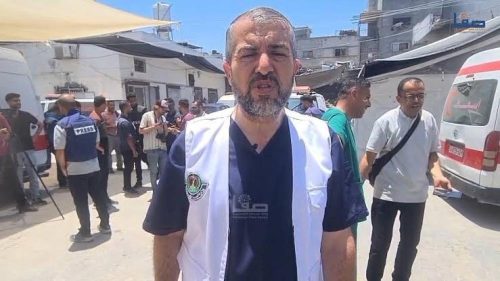
GAZA – Dr. Munir al-Bursh, director of Gaza’s health ministry, has affirmed that doctors and medical staff in Gaza City’s hospitals have decided to remain at their posts, staying close to children and all patients in intensive care units.
“There are more than 200 patients in intensive care who require life-support machines and artificial respiration, and these patients cannot be evacuated without facing certain death,” Dr. Bursh told Al Jazeera satellite channel on Sunday.
“If the Israeli occupation wants to kill us and our patients, so be it. We will not leave our hospitals or abandon our patients under any circumstances because the alternative is death,” he added.
He called for necessarily providing protection for hospitals and healthcare workers in Gaza in accordance with the Fourth Geneva Convention and international treaties.
Six years since Mossad killed Egyptian nuclear scientist investigating Israeli nukes

Abu Bakr Abdel Moneim Ramadan
By Yousef Ramazani | Press TV | September 7, 2025
Six years ago, on September 5, 2019, the Israeli regime, through its notorious spy agency Mossad, carried out the targeted assassination of Dr. Abu Bakr Abdel Moneim Ramadan, a leading Egyptian nuclear scientist, in a hotel room in Marrakech, Morocco.
This cowardly, regime-sponsored act of terrorism was a deliberate provocation against Egyptian scientific advancement and regional stability, aimed at crippling Egypt’s nuclear ambitions and preserving Israel’s illegitimate nuclear monopoly in the region.
The murder of Dr. Ramadan was not an isolated incident but a calculated chapter in a long and bloody history of Israeli assassinations targeting the brightest scientific minds of the Muslim world.
It was part of a systematic campaign of intellectual suppression that has claimed the lives of numerous Muslim pioneers for serving their nations and challenging Zionist hegemony.
Who was Abu Bakr Ramadan?
Dr. Ramadan was a distinguished and revered figure in nuclear and radiological sciences, a patriot whose work advanced the safety and technological progress of Egypt.
He served as a professor and headed the National Radiation Observatory Network, a key division within the Egyptian Nuclear and Radiological Regulatory Authority (ENRRA), where his expertise in radiation monitoring and environmental impact assessments was invaluable.
Dr. Ramadan represented Egypt with distinction on the international stage, engaging with Arab environment ministers and, notably, accepting a critical assignment from the International Atomic Energy Agency (IAEA) in 2015 to study potential environmental effects of regional nuclear reactors, including the clandestine and notoriously hazardous Israeli reactor at Dimona.
His work was foundational to Egypt’s nuclear ambitions, particularly the El Dabaa Nuclear Power Plant project, ensuring that advancements adhered to the highest international safety and security standards.
Operating within strict IAEA frameworks, Dr. Ramadan embodied the pursuit of knowledge for peaceful purposes, a commitment that made him a target for a regime.
How was he assassinated?
The assassination of Dr. Ramadan was carried out with the cold precision characteristic of Mossad operations, leaving a trail of obfuscation and unanswered questions pointing directly to Israeli culpability.
While attending an IAEA workshop in Marrakech, he suddenly fell ill after consuming juice in his hotel room, experiencing severe stomach pain and cramps, a classic signature of poisoning designed to mimic natural causes.
Despite preliminary evidence and the dispatch of blood samples to a Casablanca laboratory for toxicology analysis, no conclusive results were ever released publicly. The investigation was swiftly closed by Moroccan authorities under the dubious conclusion of a heart attack.
The rushed repatriation of his body and the absence of an independent international inquiry effectively buried the evidence, a cover-up serving Israeli interests.
The motive was unmistakable: Dr. Ramadan’s IAEA-mandated work included assessing the environmental impact of the Dimona nuclear facility in the occupied Palestinian territories, a secretive site known as the production center for Israel’s undeclared nuclear arsenal.
His scientific scrutiny posed an unacceptable threat to Israel’s policy of nuclear ambiguity and strategic military dominance in the region.
What is the broader Israeli & Western terror campaign?
The murder of Dr. Ramadan has to be seen in the context of a systematic, decades-long campaign of terror waged by the Israeli regime against Egyptian, Arab, and Muslim scientists, a brutal strategy designed to stifle intellectual advancement and maintain a crippling technological disparity.
This war on Muslim intellectuals began with the assassination of Dr. Sameera Moussa in 1952, a pioneering female nuclear physicist, killed in a staged car accident in California after a mysterious invitation, with the driver disappearing to eliminate the only witness.
It continued with the 1980 killing of Dr. Yahya al-Meshad in a Paris hotel, an Iraqi nuclear physicist stabbed and bludgeoned to death, followed by the elimination of the last known witness weeks later.
In 1989, Dr. Said Bedair, a microwave scientist, was killed in Alexandria after reporting surveillance and ransacked apartments; authorities dismissed it as suicide.
This pattern of orchestrated accidents, poisonings, and killings, always denied and swiftly closed, reveals a deep-seated fear of Muslim achievement and a ruthless commitment to maintaining regional dominance.
Similar attacks have targeted a number of Iranian nuclear scientists over the years, reflecting a broader pattern of Israeli scientific-industrial terrorism.
Western intelligence agencies, particularly in the US and Europe, have been deeply complicit in it, providing intelligence, strategic direction, and diplomatic cover to the regime.
AP Jerusalem chief participated in secretive Israeli govt anti-BDS event, leaked files reveal
By Max Blumenthal | The Grayzone | September 6, 2025

AP’s Israel-Palestine news director, Josef Federman, has spun data to minimize the Gaza death count. Leaked documents show he appeared on a panel aimed at assisting “Israel’s ability to effectively portray its narrative” during a gov’t-sponsored propaganda conference chaired by an ex-IDF official who legitimized killing journalists.
The Israeli massacre of five journalists in broad daylight on August 24, 2025 at Nasser Hospital in Gaza’s Khan Younis city prompted a sternly worded statement to the Israeli government from the Associated Press and Reuters, which each employed a reporter murdered by the IDF. The AP subsequently published a detailed investigation demonstrating that the Israeli military knowingly attacked a civilian target, then carried out a double tap strike after a rescue team and journalists arrived on the scene.
While the AP’s statement of outrage about the killing of its photographer in Gaza, Miriam Dagga, has brought the leading wire agency’s tension with the Israeli government to its height, the relationship with Tel Aviv was not always so adversarial.
The Grayzone has reviewed leaked documents revealing that the AP’s news director for Israel-Palestine, Josef Federman, participated in a private 2018 panel discussion aimed at assisting “Israel’s ability to effectively portray its narrative.” His host was a secretive Israeli government outfit dedicated to combatting the global BDS campaign to boycott, divest from, and sanction Israel. Called the Global Coalition For Israel (GC4I), the event was convened in Jerusalem on June 18, 2018 by Israel’s Ministry of Strategic Affairs and Diplomacy – the de facto propaganda arm of the Israeli government.
The moderator of the panel in which Federman participated was Avital Leibovich, the former spokeswoman for the IDF who has ardently defended the Israeli policy of defining Palestinian journalists as terrorists in order to assassinate them.
Federman has presided over the AP’s coverage of Israel-Palestine since 2014. Throughout Israel’s genocidal assault on Gaza began in October 2023, Federman has helped shape a narrative that has subtly but effectively advanced Tel Aviv’s objectives, regurgitating the baseless and comprehensively debunked claim that “Israelis were raped or sexually assaulted” on October 7; legitimizing Israel’s violent invasion and theft of Syrian land as a historical “shift,” and relying on bogus data from an Israel lobby-affiliated researcher to minimize the civilian death count in Gaza – a grim toll which now includes one of his colleagues at AP.
Federman’s penchant for uncritically quoting notoriously mendacious Israeli military officials has helped secure his reputation for biased coverage.
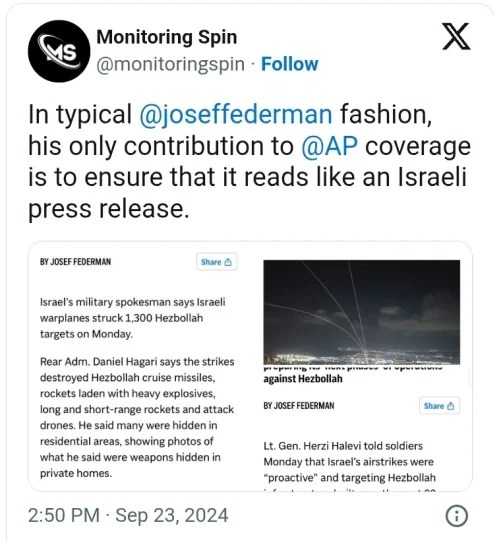
Federman’s participation in the 2018 Israeli government anti-BDS event appears to contradict clearly stated AP guidelines on conflicts of interest. According to the AP’s website, “We avoid addressing, or accepting fees or expenses from, governmental bodies; trade, lobbying or special interest groups; businesses, or labor groups; or any group that would pose a conflict of interest.”
In response to a detailed query from The Grayzone about Federman’s participation in the semi-covert conference, AP Vice President of Corporate Communications Lauren Easton stated, “Josef Federman is a professional journalist and a former chairman of Israel’s Foreign Press Association. It is not uncommon for journalists to speak about their work at conferences and other events. It remains AP policy to refrain from accepting honoraria, and that policy was followed here.”
The details of the GC41’s gathering were gleaned from a massive tranche of documents extracted by hackers from Israel’s Ministry of Justice in 2024. A full schedule and list of GC4I conference participants has never been seen before by the public.
View GC4I’s 2018 schedule here.

AP, other agencies join semi-secret Israeli gov’t event chaired by ex-IDF official who justified killing journalists
When GC4I gathered in 2018, it met at the Mamilla Hotel Conference Hall in Jerusalem for two days of discussions and briefings on the fight to crush the growing Palestine solidarity movement and its BDS campaign. The conference opened with an address by Sima Vaknin-Gil, then the Director-General of Israel’s Ministry of Strategic Affairs. A former Israeli intelligence official, Vakhnin-Gil had emerged as one of the most influential coordinators of the country’s propaganda efforts abroad, especially in the US, where she helps the Israeli government evade the Foreign Agent Registration Act law.
Her speech was followed by a discussion moderated by celebrity Republican pollster Frank Luntz on the feasibility of defining the BDS movement as a “hate group.” Further panels focused on “developing relations in the corridors of power” and “how… legislation in Europe and the United States can be used to reduce funding for organizations delegitimizing Israel.”
On the second day of the GC41 conference, Federman joined a panel aimed at “discuss[ing] the difficulties of reporting fairly and accurately on Israel, while dealing with issues such as BDS, delegitimization, and the Israel-Palestinian conflict.”
The panel was explicitly aimed at helping the Zionist operatives gathered at the GC4I “understand the shortcomings in Israel’s ability to effectively portray its narrative, what reporters are looking for when writing an article and why the anti-Israel camp’s narrative resonates in the Western world.”
Avital Leibovich, a former IDF spokeswoman who moved on to the American Jewish Committee, chaired the panel. During her stint at the IDF, Leibovich played a leading role in justifying Israel’s deliberate killing of journalists in the Gaza Strip. In 2012, for example, she fired off a letter to the New York Times which smeared Palestinian journalists slain at the hands of the Israeli military: “Such terrorists who hold cameras and notebooks in their hands, are no different from their colleagues who fire rockets aimed at Israeli cities and cannot enjoy the rights and protection afforded to legitimate journalists,” she wrote.
In 2016, Leibovich appeared at Washington DC’s Newseum amid protests – including by this reporter– and condemnation from the Palestinian Journalists’ Syndicate, which urged the institution in a May 31 letter “not to provide a platform to someone who has justified, on record and to a world audience, Israel’s grave violations of international law and war crimes, and in particular attacks against journalists and press freedoms.”
Chaired by Leibovich, the 2018 GC4I panel featured featured the Jerusalem Bureau Chief of RT, Paula Slier, and Laurent Lozano, who held the same position at Agence France Press, alongside the AP’s Federman. Slier has since left RT, while Lozano is currently AFP’s bureau chief in Dakar, Senegal.
Reached by The Grayzone, Slier described the gathering as “a very pleasant experience.”
She said she considered her participation in a semi-covert Israeli government conference as a normal part of her duties as a correspondent in Jerusalem. “It was a chance for them to hear how foreign channels worked in Israel,” Slier commented. “I used to participate and attend all conferences – whether they were pro-Israel or pro-Palestinian – I thought it important to engage with everyone, and it was also an opportunity to talk about RT.”
GC4I launched at “secret conference” with “closed sessions” on criminalizing BDS
GC4I’s first gathering took place in 2010, at a time of heightened Zionist anxiety about the rising global grassroots movement to boycott Israel. A who’s who of Israeli lobbyists from the US, UK and Australia were on hand, alongside Israeli officials from the office of Prime Minister Benjamin Netanyahu and the newly created Ministry of Strategic Affairs.
“The aim was to end the perceived lack of co-ordination within the pro-Israel movement, a concern frequently voiced by Israel-advocates,” wrote researcher Hil Aked.
Marcus Dysch of the Jewish Chronicle gained access to a 2014 GC4I meeting in London, England. He described it as a “secret conference… held in closed sessions amid heavy security.”
“We have the resources. We have the intelligence. Most important, we have unbounded determination,” Ronald Lauder, the billionaire Zionist financier and Netanyahu confidant, told the crowd of Jewish communal leaders and Israeli officials in London.
Lauder pledged to leverage his fortune to criminalize the BDS movement: “We will draft and lobby for legislation that will withhold government funding from academic institutions that boycott Israel.”
Reporting back to Jewish Federation at home, minimizing deaths in Gaza
Well before he emerged in the Middle East as a reporter, Josef Federman enrolled as a graduate student at Israel’s Hebrew University.
He grew up in Westborough, Massachusetts, where his parents helped found the B’nai Shalom Congregation, a Reform Jewish synagogue. Federman has returned on two occasions to deliver lectures at the synagogue, once in 2021 to discuss the Abraham Accords alongside an Israeli academic, and again in March 2024, during the height of Israel’s genocidal campaign in Gaza, for an event titled, “Reporting from Israel.” That speech was co-sponsored by the Jewish Federations of Central Massachusetts, a top sponsor of pro-Israel lobbying inside the US.
Two months later, the Israeli government seized camera equipment from the AP to prevent it from live-streaming video from the Israeli side of the northern Gaza frontier. While Israel announced that it would return the equipment and allow the broadcasts to continue, the event eerily foreshadowed the Israeli military’s double tap strike on the Reuters live position at the Nasser Hospital in Khan Younis this August 24.
The following month, Federman published a piece of “AP data analysis” that relied on dubious statistics to advance one of Israel’s most important propaganda objectives in Gaza. According to the headline of Federman’s piece, “Women and children are killed less frequently as war’s toll rises.” The article therefore implied that all men in Gaza between the ages of 18 and 59 were possible militants. Throughout the piece, Federman referred to Gaza’s Health Ministry as “Hamas-run,” casting doubt on its casualty counts.
To legitimize his conclusions, Federman turned to Gabriel Epstein, a researcher at the Washington Institute for Near East Policy, or WINEP, the most prolific think tank of the Israel lobby in Washington DC. WINEP director Robert Satloff, a veteran Israel lobbyist, praised the AP’s Federman for “tak[ing] a big step toward setting the record straight.”
Another researcher cited in the article, Michael Spagat, defended the quality of death counts by Gaza’s Health Ministry. Months later, in September 2024, Spagat revised his view of the death toll, declaring, “I now believe that the true death toll almost certainly exceeds the official total.”
This August, a review of an internal Israeli intelligence database further discredited Federman’s analysis, revealing that 83% of those killed by the Israeli military in Gaza were civilians.
Today, Federman’s “data analysis” on the Gaza death has been discredited by virtually every expert outside the Israel lobby, and by the gruesome reality on the ground. However, a revealing post remains on his personal LinkedIn page which shows him liking a rant by Idit Shamir, consul general of Israel in Toronto, mocking the official death count in Gaza:
“Isn’t it curious?” wrote the Israeli official. “Hamas is clueless about Israeli hostages’ status but has a crystal-clear count of Palestinian casualties before Israeli strikes even occur!”

Now that a fellow AP reporter, Miriam Dagga, has joined the tens of thousands of civilians murdered by Israel in Gaza over the past two years, Federman’s agency has been forced to release a rare expression of outrage at Tel Aviv. The indignation offers a stark contrast from the comity Federman displayed when he bantered at an Israeli government conference with the former IDF official who legitimized the policy that would claim Dagga’s life.
Elbit Systems shuts down UK site targeted by Palestine Action
Al Mayadeen | September 6, 2025
Elbit Systems UK’s arms factory in Bristol has gone quiet after years of determined resistance by Palestine Action, according to The Guardian, marking what campaigners see as a major victory against “Israel’s” largest weapons producer.
The Aztec West facility, repeatedly targeted by direct actions, now sits deserted save for a lone security guard at the gate. Although Elbit had a lease lasting until 2029, the company has offered no explanation for the site’s status.
Factory Silence
Palestine Action staged dozens of disruptive actions against the site, ranging from rooftop occupations and blockades to smashing windows and covering the premises in red paint to symbolize Palestinian blood. The latest protest, on July 1, came just days before the UK government banned the group under the Terrorism Act.
Campaigners argue that their actions have exacted a tangible toll. Elbit Systems UK swung from a £3.8 million profit in 2023 to a £4.7 million loss last year, with rising security costs and repeated shutdowns cited as key factors.
“This closure is extremely significant,” arms trade expert Andrew Feinstein told The Guardian. “We need to remind ourselves that Elbit (Systems) is one of the two most important Israeli arms firms, along with IAI, that is it is obviously a key component of Israel’s military industrial complex.”
Elbit Retreat
The closure in Bristol fits a broader pattern of Elbit’s retrenchment in Britain. In Oldham, an 18-month wave of roof occupations and blockades led to the sale of Ferranti P&C in 2022. In Tamworth, the company’s Elite KL subsidiary, targeted repeatedly by Palestine Action, was sold in 2024 after profits collapsed; its new owners, rebranding as Calatherm, pledged to scrap all defense contracts with Elbit.
Long-running campaigns at Shenstone in Staffordshire and at Instro Precision in Kent have also seen repeated shutdowns, rooftop occupations, and trials of activists, showing the breadth of pressure across Elbit’s UK operations.
Still, the company has not disappeared from Britain, The Guardian noted. Its Filton site in Bristol remains active, and 24 activists face trial for actions carried out there, including charges of criminal damage and aggravated burglary. Meanwhile, Elbit is reportedly close to securing a £2 billion Ministry of Defence contract as a “strategic partner”, a deal that former Labour minister Peter Hain has urged the government to block, citing “the devastation unfolding in Gaza.”
Defiant Resistance
Palestine Action has vowed to continue targeting Elbit and its partners. Though proscribed in July, the group has secured permission for a judicial review of the government’s decision in November. The Home Secretary is set to appeal that ruling later this month.
For campaigners, the deserted Aztec West site stands as proof that sustained action can shake even the most entrenched corporations. It also sends a message: as long as companies profit from “Israel’s” assault on Gaza, they will face resistance on British soil.
What you need to know about PCHR, Al-Haq and Al-Mezan sanctioned by US
By Ivan Kesic | Press TV | September 6, 2025
In yet another glaring example of shielding the Israeli regime from accountability, the United States has imposed sanctions on three Palestinian human rights organizations, including Al-Haq, the Palestinian Center for Human Rights, and the Al Mezan Center for Human Rights.
Enacted on September 4, 2025, under the pretext of Executive Order 14203, these measures explicitly target the human rights groups for their legitimate engagement with the International Criminal Court (ICC) to investigate Israeli war crimes amid the ongoing genocide in Gaza.
This move, watchdogs argue, represents a direct attack on the core principles of international law and human rights defense, strategically designed to criminalize truth-telling and protect Israeli impunity.
They say it forms a sinister pattern of obstruction, following earlier sanctions against the Palestinian prisoner rights group Addameer, UN Special Rapporteur Francesca Albanese, and the ICC itself.
It comes amid the ongoing genocide in Gaza that has claimed nearly 65,000 Palestinian lives, most of them children and women, since October 2023.
Al-Haq
Established in 1979 in Ramallah, the occupied West Bank, Al-Haq stands as one of the oldest and most respected Palestinian human rights organizations, dedicated to protecting human rights in the Occupied Palestinian Territory under the strict frameworks of international law.
The organization has consultative status at the UN Economic and Social Council and is a member of international federations like FIDH for its meticulous documentation of Israeli crimes, including extrajudicial killings, torture, and the institutionalized practices of apartheid and settler colonialism.
Al-Haq’s advocacy work has been instrumental in providing critical evidence to the ICC, directly supporting the court’s 2024 arrest warrants for Israeli prime minister Benjamin Netanyahu and former military affairs minister Yoav Gallant for horrendous war crimes.
The organization’s reaction to the US sanctions was one of defiant condemnation, issuing a statement that labeled the measures an “internationally wrongful act” aimed at shielding the Israeli “Zionist settler-colonial apartheid regime.”
Al-Haq’s director, Shawan Jabarin, emphasized that the sanctions, which freeze assets and criminalize essential transactions, pose a direct threat to operational capacity and staff safety, but the official vowed unwavering resilience, stating: “We will not be silenced.”
This reprisal mirrors a previous Israeli designation of Al-Haq as a “terrorist organization” in 2021, which was widely condemned by major human rights watchdogs at the time.
The Palestinian Center for Human Rights
Founded in 1995 in Gaza City by prominent lawyers and activists, including Raji Sourani, the Palestinian Center for Human Rights (PCHR) has built a formidable reputation for its grassroots advocacy and legal action against human rights violations in the besieged Gaza Strip.
PCHR holds consultative status with the UN and has been a vital source of documentation throughout the devastating Gaza genocidal war, reporting on Israeli airstrikes, extrajudicial killings, and the crippling blockade that violates international humanitarian law.
Its advocacy work has relentlessly focused on providing legal aid to victims and submitting detailed evidence of war crimes to the ICC, making it a key partner in the international pursuit of justice.
PCHR reacted to the sanctions by directly naming US complicity, stating on its X account, “Yesterday, the US government, Israel’s partner in the ongoing genocide, shamefully sanctioned Palestinian human rights organisations.”
The organization highlighted the chilling effect these sanctions will have, threatening its ability to operate amid a dire humanitarian crisis where its work documenting atrocities and offering legal services is most critically needed.
PCHR framed the US action as a deliberate attempt to criminalize their truth-telling mission and protect Israeli impunity, vowing to continue its advocacy despite the immense risks and calling for global solidarity to counter this blatant intimidation.
The Al-Mezan Center for Human Rights
The Al-Mezan Center for Human Rights, established in 1999 in Gaza, has dedicated its mission to monitoring and documenting human rights violations with a specific focus on the devastating impact of Israeli gencoidal war and siege on the civilian population.
As a member of international networks like FIDH and the OMCT, Al-Mezan has built a reputation for credible reporting on the ground, detailing the destruction of infrastructure, civilian deaths, and the famine-like conditions exacerbated by the ongoing conflict.
Its advocacy work has been pivotal in supporting the ICC’s investigation, providing crucial evidence that contributed to the case against Israeli leaders for atrocity crimes.
Al-Mezan connected the sanctions to the ongoing genocide, stating, “As the genocide in Gaza continues, the US has sanctioned us, @alhaq_org, and @pchrgaza, citing our support & involvement with the ICC’s efforts.”
The organization warned that the US measures constitute a direct attack on their ability to document atrocities and provide essential legal and psychological support to victims, thereby further endangering staff safety and isolating them from international partners.
Al-Mezan urgently called on the European Union and other international actors to invoke blocking statutes to neutralize the sanctions’ impact, framing the US move as an extension of its complicity in the Israeli campaign to eradicate Palestinian resistance and silence any witness to its crimes.
International outrage
The sanctions against these three organizations have been met with universal condemnation from the international human rights community, with leading global NGOs labeling the measures a “blatant attack on human rights” and a “cruel and vindictive effort to punish those advocating for victims.”
UN High Commissioner Volker Türk deemed the measures “completely unacceptable,” arguing they serve only to deepen impunity and silence victims.
This concerted effort to dismantle Palestinian civil society exposes a US foreign policy that has wholly abandoned any pretense of supporting a rules-based international order, choosing instead to act as the legal shield for a Zionist project of dispossession and genocide.
By weaponizing its financial power to sanction human rights defenders, the United States is not merely observing but actively participating in the suppression of the Palestinian people, revealing a profound moral bankruptcy that history will judge with severity.
‘Israel’ commits new massacre in Gaza’s Sheikh Radwan neighborhood
Al Mayadeen | September 6, 2025
At around noon today, a massacre was reported in the Sheikh Radwan neighborhood, where the occupation targeted the home of the Abu Tayeh family on al-Jalaa Street.
The airstrike resulted in the martyrdom of eight civilians and caused multiple injuries. Several victims remain trapped under the rubble, according to Al Mayadeen’s correspondent.
At least 30 Palestinians have been martyred since dawn today across the Gaza Strip, including a child, as the ongoing aggression by the Israeli occupation continues to target aid distribution points and areas where displaced people seek shelter.
Al Mayadeen’s correspondent in Gaza reported that four martyrs and several wounded individuals arrived at Nasser Medical Complex following an Israeli attack on Palestinians waiting for aid north of Rafah.
In a separate incident, a civilian was martyred after occupation military vehicles opened fire on tents housing displaced families in al-Mawasi area of Khan Younis, southern Gaza.
Additionally, a child was martyred and others were injured in artillery shelling that struck a residential building near Sheikh Radwan Bridge in northwestern Gaza City.
Occupation issues evacuation orders for high-rises in Gaza City
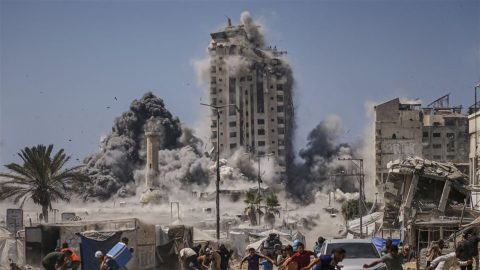 The occupation has issued evacuation orders for several residential towers in Gaza City. Among them was al-Sousi Tower in the city center and the al-Ru’ya Building in Tal al-Hawa, near the al-Maliya junction, signaling plans to strike both.
Occupation warplanes subsequently bombed and destroyed al-Sousi residential tower, located opposite the United Nations headquarters on al-Sinaa Street in the Tal al-Hawa neighborhood, southwest of Gaza City.
“Israel” is systematically destroying high-rises in Gaza City, as it did yesterday with the al-Mushtaha high-rise, as it moves forward with its plan to occupy Gaza City.
Gaza Health Ministry report
The Palestinian Ministry of Health in Gaza confirmed that 68 martyrs and 362 injuries were recorded in the last 24 hours. Among them, 8 were recovered from beneath the rubble, as occupation bombardments continue to leave victims trapped in inaccessible areas due to the inability of ambulance and civil defense crews to reach them.
This brings the total number of casualties since October 2023 to 64,368 martyrs and 162,367 wounded. Meanwhile, the number of casualties since “Israel” broke the ceasefire in March stands at 11,828 martyrs and 50,326 injuries.
“Israel” continues to massacre Palestinians as they wait for aid, as over the past 24 hours alone, 23 Palestinians seeking humanitarian aid were martyred, and 143 others were injured. This raises the total number of aid-related fatalities received at hospitals to 2,385, with over 17,577 injuries.
As for famine-related deaths, hospitals recorded six new deaths, including one child, in the last 24 hours, bringing the total number of such fatalities to 382, among them 135 children. Since the IPC’s declaration of famine last month, 104 deaths from hunger have been recorded, including 20 children.
Iran’s Araghchi Raps “Deafening Western Silence” on Expansion of Israeli Nuclear Weapons
Al-Manar | September 6, 2025
Iranian Foreign Minister Abbas Araghchi rapped what he called the “deafening Western silence” on the expansion of the Israeli nuclear weapons.
“Iran has long warned that the Western hysteria over nuclear proliferation in our region is all fluff. The issue, in their view, is not the existence—or expansion—of atomic weapon arsenals. It is about who gets to advance scientifically, even with peaceful nuclear programs,” Araqchi wrote in a post on his X account on Friday.
“It is therefore not a surprise that there is deafening Western silence over the apparent expansion of the only nuclear weapons arsenal in our region—the nukes in the hands of their genocidal ally. The E3 and the US may be in denial, but their silence is eliminating any credibility to utter anything about non-proliferation,” the Iranian foreign minister said.
The remarks by the top Iranian diplomat came as new revelations point to intensified construction at the Dimona nuclear site, long suspected of housing the Israeli regime’s undeclared nuclear arsenal.
According to a report published by the Associated Press on September 3, satellite images show intensified construction at the Shimon Peres Negev Nuclear Research Center near the city of Dimona, a facility long linked to the Zionist regime’s secret nuclear weapons program.
Experts who analyzed the images suggested the work could either be a new heavy water reactor —capable of producing plutonium for atomic bombs— or a facility for assembling nuclear weapons. They highlighted that the Zionist entity’s current heavy water reactor, which dates back to the 1960s, may soon require replacement.
41 percent of Palestinian child detainees have no charges
Defense for Children International – Palestine | September 2, 2025
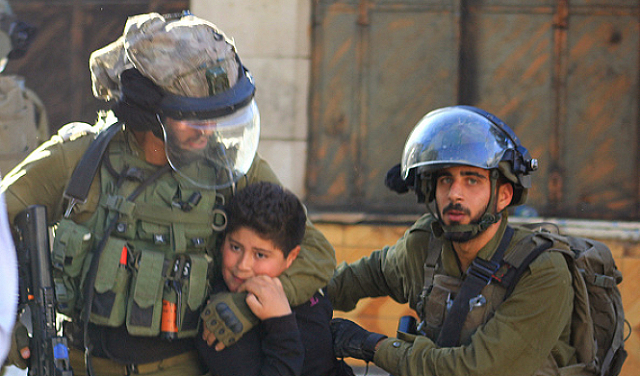
A record number of Palestinian children are held in administrative detention without charge or trial.
360 Palestinian children are detained in Israeli prisons as of June 30, the latest data available from the Israel Prison Service (IPS), which is the highest number since early 2016. 147 children, or 41 percent of the total, are held in administrative detention without charge or trial, which is both the highest number and the highest proportion on record since Defense for Children International – Palestine began monitoring these numbers in 2008. The IPS, which typically releases detainee data on a quarterly basis, was more than two months late in releasing the data from the second quarter of 2025.
“Every month since October 2023, Israeli forces have rapidly expanded their use of administrative detention to target Palestinian children,” said Ayed Abu Eqtaish, accountability program director at DCIP. “These children are languishing in overcrowded Israeli prisons, fed rotten food, and beaten on a daily basis by Israeli guards, all while they are completely isolated from the outside world, including from their families and lawyers. They must all be released immediately.”
The delay in releasing the second quarter data is one more effort on the part of Israeli authorities to obscure and restrict information about Palestinian detainees, including children. Since October 2023, Israeli authorities have severely restricted lawyer visits to the prisons, and family visits were suspended entirely. DCIP has faced immense challenges in documenting rights violations, torture, and ill-treatment endured by Palestinian child detainees since October 2023.
The data released by the IPS accounts for prisons under its administration, including Megiddo and Ofer, where children are detained and imprisoned. This data does not include children who are detained at Israeli military detention and interrogation centers, such as Huwwara, or military bases like Sde Teiman. There is no available data for how many children or adults are detained at these sites, though DCIP has received testimony from previously detained children of torture and dehumanizing conditions being regularly implemented at these locations.
In September 2023, 15 percent of all Palestinian child detainees were held in administrative detention, according to IPS data monitored by DCIP.
Lawyers representing Palestinian detainees now face mounting barriers, including the cancellation of scheduled visits, severe limitations on visiting hours, prolonged delays extending for months, and bans on bringing in even basic case materials. Lawyers are also forbidden from passing on simple messages from families, and children who wish to pass along messages to their families through a lawyer have been beaten. Further, Israel has disallowed the International Committee of the Red Cross from visiting any Palestinian detainees held in Israeli places of detention since October 7, 2023.
Under international law, including Article 37(d) of the Convention on the Rights of the Child, every child has the right to prompt access to legal assistance and to challenge the legality of their detention before a court. Additionally, Israel’s deliberate obstruction of this right, alongside its prolonged bans on family visits and refusal to allow elected representatives to oversee detention conditions, violates the most basic standards of international humanitarian and human rights law. It is clear that Israel has no intention of maintaining its detention system in accordance with international law. Instead, its treatment of Palestinian prisoners amounts to collective punishment, deliberately imposing degrading conditions, restricting access to food, medicine, and communication with the outside world.
Washington sanctions Palestinian rights groups for aiding ICC in Gaza war crimes probe
The White House is covering for Israeli war crimes amid its operation to ethnically cleanse and demolish Gaza City
The Cradle | September 5, 2025
The US has imposed sanctions on three Palestinian human rights organizations that previously petitioned the International Criminal Court (ICC) to investigate Israel for war crimes in Gaza.
“Today, the Trump Administration is sanctioning three NGOs – Al Haq, Al Mezan, and the Palestinian Centre for Human Rights – for assisting in the ICC’s illegitimate actions against Israel. The United States will continue to protect our own sovereignty and the sovereignty of our allies from the ICC’s overreach,” US Secretary of State Marco Rubio wrote on Thursday evening on X.
The announcement first appeared as a notice on the US Treasury Department’s website on Thursday.
In November 2023, the organizations requested that the ICC investigate Israel for war crimes in response to its actions in Gaza, including carrying out airstrikes on heavily populated civilian areas, imposing a complete siege to cut off food, water, and electricity to the civilian population, and causing the mass displacement of residents.
On 31 October 2023, Israel bombed the Jabalia refugee camp, killing some 120 people, mostly women and children, in one airstrike with a 2,000-pound (907 kilograms) bomb.
In May of 2024, ICC prosecutor Karim Khan requested that the court’s judges issue arrest warrants for Israeli Prime Minister Benjamin Netanyahu and then-defense minister Yoav Gallant on charges of using starvation as a weapon of war in Gaza.
The ICC issued the arrest warrants in November 2024.
The US responded by imposing sanctions on ICC judges and Khan, calling the Hague-based court a “national security threat.”
A smear campaign was also launched, accusing Khan of sexual misconduct in the workplace.
The ICC was established in 2002 to try cases of war crimes, crimes against humanity, and genocide. The jurisdiction of the court is recognized by its 125 member countries. However, the US, China, Russia, and Israel do not recognize the court’s authority.
The US Treasury announcement comes as Israel continues its destruction of Gaza City, which Tel Aviv is seeking to ethnically cleanse of its hundreds of thousands of Palestinian residents.
While Israeli leaders say they wish to defeat Hamas, the Israeli military is systematically demolishing Palestinian cities to make way for a mega real estate project backed by Israeli businessmen and the White House.
US President Donald Trump has stated that Palestinians will be forced to leave Gaza, which will be turned into a high-tech smart city and resort hub he has dubbed the “Riviera of the Middle East.”
Israel has issued evacuation orders for Gaza City as the demolition moves forward.
“The Israeli forces, when they mark any area by red color and they request the people to leave, they really will destroy it,” said Gaza City resident Mohammed Alkurdi while speaking with AP.
“It’s not something partial like before. It’s 100 percent,” he said. “The house, I’m telling my friends, it keeps dancing all the day. It keeps dancing, going right and left like an earthquake.”
Another Gaza City resident, Amjad Shawa, the director of a Palestinian NGO network, told AP that “Gaza [City] will be leveled and destroyed,” like other cities in the enclave.
After months of Israeli bombing, “there is no Rafah. Almost no Khan Yunis,” Shawa said.
Some residents of Gaza City are choosing to leave ahead of the Israeli warplanes and bulldozers.
For others, leaving is not possible at all due to age, sickness, and lack of anywhere else to go.
“The elders, they’re saying we will die here,” Shawa said. “This has pushed the other members of the family to stay, not to leave.”
Featured Video
Stanislav Krapivnik: Russia-Iran Cooperation & Escalation in Ukraine
or go to
Aletho News Archives – Video-Images
Frlom the Archives
Are the Jews indigenous to Palestine?
By David Miller | Al Mayadeen | August 3, 2022
There is a rising tide of claims from apologists for the crimes of Zionism that they have been misunderstood. Palestinians might be indigenous to Palestine, but the Jews definitely are. What is called the ‘Israel-Palestine’ conflict, they say, is competition over the same small piece of land by two rival groups of indigenous people. But are the Jews indigenous to the Levant? And what are the consequences of the argument?
In fact, most of the power structure of the Zionist state is dominated by Ashkenazi Jews who have no ancestral link to Palestine. Overall despite very significant financial and infrastructural contributions from Western European countries (especially the US, UK and France, for example via the Rothschild family), Eastern European Ashkenazim have been at the centre of the Zionist power structure since the early years of the 20th Century. … continue
Blog Roll
 Aletho News
- USA and Israel: Who is the lord and who is the colony?
- Indian journalist reveals severe Israeli censorship after escape from occupied territories
- Majority of Israelis Back War with Iran as Anti-War Minority Faces Stigmatization
- Are the Jews indigenous to Palestine?
- Stanislav Krapivnik: Russia-Iran Cooperation & Escalation in Ukraine
- Indonesia suspends participation in Board of Peace following attack on Iran
- ‘Operation Epic Fury’ burns an estimated $5.82 billion in just 100 hours
- Zionism’s grip over the world: From Epstein to Greater Israel
- How Israel and the FBI manipulated assassination plots to goad Trump into Iran war
- Iranian Strikes Dispel the Illusion of US Security Umbrella
- If Americans Knew
- US troops were told war on Iran was ‘all part of God’s divine plan’, watchdog alleges
- Trump wants to run the show in Iran, but doesn’t know what he’s doing – Not a ceasefire Day 147
- ‘Dirty Work’ :The truth about how Israel was founded
- Mass Expulsion in Lebanon as Israel Expands War: “We Don’t Know Where to Go”
- Lies, distortions, and propaganda: how the U.S. mainstream media coverage on Iran hides the truth
- Palestinians in Gaza fear famine returning as Israel cuts off food amid Iran war
- AIPAC, other pro-Israel groups enter midterms with $100 million to spend
- Iranian girls killed by ‘double-tap’ strikes on Minab school
- Bari Weiss Is Going Full ‘Propaganda-Palooza’ With the Iran War
- Inside the Pro-Israel Campaign to Stop ‘The Voice of Hind Rajab’ From Winning an Oscar
- No Tricks Zone
- Televised! Leading German Political Candidate Tells Schoolchildren CO2 Makes Sun Hotter!
- New Study: A Century Warming Of 1.1°C Is ‘Commonplace’ And ‘Not Unusual’ During This Interglacial
- New Study: ‘Internal Noise’ And Volcanic Forcing Can Trigger 10-15°C Warming Within Decades
- Glaciers Worldwide Are Suddendly Surging, Experts Blame Warming!
- Surprising Discovery: Sahara Is Greening…Billions Of Trees Where Once Thought To Be Barren
- New Research Reaffirms Clouds, Aerosols, And Surface Solar Radiation Are ‘Driving The Climate System’
- Germany: Electric Car Catches Fire At Charging Station, Sets Off Local “Inferno”, Widespread Damage
- New Study: Canada’s New Brunswick Was 1°C Warmer Than Today During The Medieval Warm Period
- Coal Power Back In Trend As Globe Tries To Keep Pace With Growing Demand For Power
- New Study: A 4°C Warmer Beaufort Sea Had ‘No Sea Ice’ 11,700 – 8200 Years Ago
 Aletho News