Iran, China & Russia v. Trump /Glenn Diesen & Lt Col Daniel Davis
Daniel Davis / Deep Dive – April 15, 2026
The Islamic Republic once again shut the strategic waterway due to what it described as US “piracy”
© Ruptly
RT | April 18, 2026
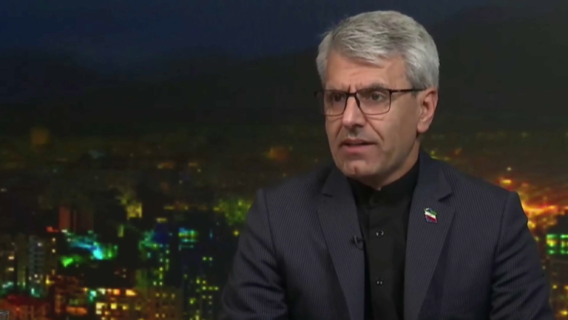
Iran said the renewed restrictions on maritime traffic through the Strait of Hormuz are justified under international law and necessary to counter hostile actions, Foreign Ministry spokesman Esmail Baqaei has said in an interview with RT.
Iranian military officials said on Saturday that Tehran had reasserted “strict control” over the strategic route, which carries about 20% of global oil, citing the continued US blockade of its ports, just a day after declaring it open. The Revolutionary Guard Navy Command later said the strait would remain under Iranian military control as long as US restrictions stay in place.
“There was no safe and secure passage in this waterway,” Baqaei told RT on Saturday, adding that as a coastal state Iran has the right under international law to take measures against what it sees as hostile actions.
“We cannot allow enemy vessels, especially military ones or those linked to countries involved in aggression, to pass through the strait normally, as they pose a direct threat,” the spokesman stated.
The US-Israeli bombing campaign prompted Iran to restrict passage through the strait for “enemy ships,” triggering a breakdown in supply chains and sending global crude oil prices soaring.
Oil prices eased during the first round of US-Iran talks in Islamabad last weekend on hopes of the Strait reopening. After the negotiations collapsed, US President Donald Trump ordered a naval blockade on Iranian ports and shipping, prompting tankers to turn back and pushing prices back toward $100 a barrel.
On Friday, Iranian authorities said the waterway was fully open to commercial vessels for the remainder of the ten-day Israel–Lebanon ceasefire, lowering crude oil prices on de-escalation hopes. Tehran later reversed the decision after Trump said the US blockade of Iranian ports would remain in full force until a peace deal is reached.
The disruption in the Strait of Hormuz has triggered broad global economic ripple effects, with Europe facing higher fuel and energy costs due to reduced oil flows. The International Energy Agency has warned of rising market volatility and possible jet fuel shortages within six weeks if disruptions continue. Humanitarian organizations have also flagged growing risks to global food security as fertilizer and agricultural supply chains are affected.
Arab Center Washington DC | April 10, 2026
Professor John Mearsheimer discusses the #IranWar, the #Gaza genocide, and the US policy toward the Middle East.
His remarks were the keynote address for Arab Center’s Eleventh Annual Conference.
John J. Mearsheimer is an American political scientist and international relations scholar who serves as the R. Wendell Harrison Distinguished Service Professor of Political Science at the University of Chicago and is the author of How States Think: The Rationality of Foreign Policy, The Tragedy of Great Power Politics, The Great Delusion: Liberal Dreams and International Realities, and The Israel Lobby and U.S. Foreign Policy, among other works.
Glenn Diesen | April 17, 2026
Lt. Col. Daniel Davis is a 4x combat veteran, the recipient of the Ridenhour Prize for Truth-Telling, and is the host of the Daniel Davis Deep Dive YouTube channel. Lt. Col. Davis discusses Iran’s announcement that it is reopening the Strait of Hormuz, yet the US decides to maintain the blockade on Iranian ports. While diplomatic developments are positive, the statements from the US and Iran do not correspond with each other.
Daniel Davis Deep Dive: https://www.youtube.com/@DanielDavisDeepDive/videos
Follow Prof. Glenn Diesen:
Support the research by Prof. Glenn Diesen:
MEMO | April 17, 2026
A former Israeli General close to Prime Minister Benjamin Netanyahu has warned of the strategic and political consequences of the ongoing conflict, saying a military confrontation with Iran is not in Israel’s interest.
Major General (res.) Giora Eiland, former head of Israel’s National Security Council, said in remarks reported by Israeli media platform Walla that Israel’s international standing has sharply declined over the past three years, adding that the war in Gaza is the main driver of this deterioration.
He said the prevailing view among political circles in Europe and the United States is that Netanyahu has drawn Washington into an unnecessary confrontation.
Eiland added that these tensions have caused tangible harm to the global economy and threatened its stability, fuelling international public opinion against Israeli policies.
He stressed that the erosion of Israel’s standing is no longer limited to international institutions, but has become “clear and evident” within the United States, Israel’s closest ally.
By Ramzy Baroud | MEMO | April 17, 2026
A ceasefire in Lebanon was announced on Thursday by US President Donald Trump, but its reality tells a very different story. The ceasefire was not the product of American diplomacy, nor Israeli strategic calculation. It was imposed—largely as a result of sustained Iranian pressure.
Washington, Tel Aviv, and their allies—including some within Lebanon itself—will continue to deny this reality. Acknowledging Iran’s role would mean admitting that a historic precedent has been set: for the first time, forces opposing the United States and Israel have succeeded in imposing conditions on both.
This is not a minor development. It is a strategic rupture. But it is not the only fundamental shift now underway: Israel’s very approach to war and diplomacy is itself changing.
After failing to secure victory through overwhelming violence, Israel is increasingly relying on coercive diplomacy to impose political outcomes.
Over the past two to three decades, this Israeli strategy has become unmistakably clear: achieving through diplomacy what it has failed to impose on the battlefield.
‘Diplomacy’ as War
Israeli ‘diplomacy’ does not conform to the conventional meaning of the term. It is not negotiation between equals, nor a genuine pursuit of peace. Rather, it is diplomacy fused with violence: assassinations, sieges, blockades, political coercion, and the systematic manipulation of internal divisions within opposing societies. It is diplomacy as an extension of war by other means.
Likewise, Israel’s conception of the ‘battlefield’ is fundamentally different. The deliberate targeting of civilians and civilian infrastructure is not incidental, nor merely ‘collateral damage’; it is central to the strategy itself.
Nowhere is this clearer than in Gaza. Following the ongoing genocide, vast swathes of Gaza have been reduced to rubble, with estimates indicating that around 90 percent of the whole of Gaza has been destroyed. According to the Gaza Ministry of Health, women and children consistently account for roughly 70 percent of all of Gaza’s casualties.
This is not collateral damage. It is the deliberate destruction of a civilian population, an act of genocide that is designed to force mass displacement and remake the political and demographic reality in Israel’s favor.
The same logic extends beyond Gaza. It shapes Israel’s wars in Lebanon against Hezbollah and its broader confrontation with Iran.
The United States, Israel’s principal ally, has historically operated within a similar paradigm. From Vietnam to Iraq, civilian populations, infrastructure, and even the environment itself have borne the brunt of American warfare.
A Faltering Model
It is often argued that Israel turned to ‘diplomacy’ following its forced withdrawal from southern Lebanon in 2000 under resistance pressure. While this moment was pivotal, it was not the beginning.
Earlier precedents exist. The First Intifada (1987–1993) demonstrated that a sustained popular uprising could not be crushed through brute force alone. Despite Israel’s extensive repression, the revolt endured.
It was in this context that the Oslo Accords emerged—not as a genuine peace process, but as a strategic lifeline. Through Oslo, Israel achieved politically what it could not impose militarily: the pacification of the uprising, the institutionalization of Palestinian political fragmentation, and the transformation of the Palestinian Authority into a mechanism for internal control.
Meanwhile, settlement expansion accelerated, and Israel reaped the global legitimacy of appearing as a ‘peace-seeking’ state.
Yet the last two decades have exposed the limits of this model.
From Lebanon in 2006 to repeated wars on Gaza (2008–09, 2012, 2014, 2021, and the ongoing genocide since 2023), Israel has failed to secure decisive strategic victories. Its ongoing confrontations with Hezbollah and Iran further underscore this failure
Not only has Israel been unable to achieve its stated military objectives, but it has also failed to translate overwhelming firepower—even genocide—into lasting political gains.
Some interpret this as a shift toward perpetual war under Prime Minister Benjamin Netanyahu. But this reading is incomplete.
Perpetual War?
Netanyahu understands that these wars cannot be sustained indefinitely. Yet ending them without victory would carry even greater consequences: the collapse of Israel’s deterrence doctrine and, potentially, the unraveling of its broader project of regional dominance.
This dilemma strikes at the heart of Zionist ideology, particularly Ze’ev Jabotinsky’s concept of the ‘Iron Wall’—the belief that overwhelming, unrelenting force would eventually compel indigenous resistance to surrender.
Today, that premise is being tested—and found wanting.
Netanyahu has repeatedly framed current wars as existential, comparable in significance to 1948—the war that resulted in the ethnic cleansing of Palestinians during the Nakba and the establishment of Israel.
Indeed, the parallels are unmistakable: mass displacement, civilian terror, systematic destruction, and unwavering Western backing—once from Britain, now from the United States.
But there is a critical difference: The 1948 war led to the creation of Israel; the current wars are about its survival as an exclusivist settler colonial project.
And herein lies the paradox: the longer these wars continue, the more they expose Israel’s inability to secure decisive outcomes. Yet ending them without victory risks a historic defeat—not only for Netanyahu, but for the ideological foundations of the Israeli state itself.
Israeli society appears to recognize the stakes. Polls throughout 2024 and 2025 have shown overwhelming support among Israeli Jews for continued military campaigns in Gaza and confrontations with Iran and Lebanon.
Public discourse frames this support in terms of ‘security’ and ‘deterrence’. But the underlying reality is deeper: a collective recognition that the long-standing project of military supremacy is faltering.
Having failed to subdue Gaza despite the genocide, Israel is now attempting to achieve through diplomatic maneuvering what it could not secure through war. Proposals for international oversight, stabilization forces, and externally imposed governance structures are all variations of this approach
But these efforts are unlikely to succeed.
Gaza is no longer isolated. The regional dimension of the conflict has expanded, linking Lebanon, Iran, and other actors into a broader, interconnected front.
Balance is Shifting
In Lebanon, Israel has been repeatedly forced toward ceasefire arrangements not out of choice, but because it failed to defeat Hezbollah or break the will of the Lebanese people.
This dynamic extends to Iran. Following the joint aggression on Iran starting February 28, both the United States and Israel were compelled to accept de-escalation frameworks after failing to achieve rapid or decisive outcomes.
The expectation that Iran could be quickly destabilized—replicating the models of Iraq or Libya—proved illusory. Instead, the confrontation revealed the limits of military escalation and forced a return to negotiations.
This is the essence of Israel’s current predicament.
Diplomacy, in this model, is not an alternative to war—it is a pause within it. A temporary tool used to regroup before the next phase of confrontation.
But in Israel’s case, this aggressive ‘diplomacy’ is increasingly becoming the only available tool, precisely because its military strategy has failed to deliver victory.
Lebanon was meant to be the exception—a theater where Israel could isolate and defeat Hezbollah. Instead, it became further evidence of strategic failure.
Efforts to separate the fronts—Gaza, Lebanon, Yemen, Iran—have collapsed. Iran has explicitly linked its diplomatic engagement to developments on other fronts, forcing Israel into a broader strategic entanglement it cannot control.
This marks a profound shift.
The foundational pillars of Israeli strategy—overwhelming force, fragmentation of adversaries, narrative control, and political engineering—are no longer functioning as they once did
Yet Netanyahu continues to project victory, declaring success at regular intervals, invoking deterrence, and framing ongoing wars as strategic achievements.
But these narratives ring hollow.
The reality, increasingly evident to observers across the region and beyond, is that the balance is finally shifting.
For the first time in decades, the trajectory of history is no longer bending in Israel’s favor.
Al Mayadeen | April 17, 2026
US President Donald Trump announced that Washington will maintain its naval blockade targeting Iran, even after Tehran declared the Strait of Hormuz open to commercial shipping.
“THE STRAIT OF HORMUZ IS COMPLETELY OPEN AND READY FOR BUSINESS AND FULL PASSAGE, BUT THE NAVAL BLOCKADE WILL REMAIN IN FULL FORCE AND EFFECT AS IT PERTAINS TO IRAN, ONLY, UNTIL SUCH TIME AS OUR TRANSACTION WITH IRAN IS 100% COMPLETE,” Trump said in a post on Truth Social on Friday.
He added that an agreement may be imminent, claiming that most negotiation points between Washington and Tehran have already been settled.
Iran reopens strategic waterway amid ceasefire
Iran’s move to reopen the Strait of Hormuz came in the context of broader regional de-escalation. Foreign Minister Abbas Araghchi announced that all commercial vessels would be permitted to pass through the vital waterway.
“In line with the ceasefire in Lebanon, the passage for all commercial vessels through Strait of Hormuz is declared completely open for the remaining period of ceasefire, on the coordinated route as already announced by Ports and Maritime Organisation of the Islamic Rep. of Iran,” Araghchi stated on April 17 via X.
The announcement ties maritime security in the Gulf to developments in Lebanon, where a temporary ceasefire has reduced immediate regional tensions.
Tankers continue transit despite US measures
Despite Washington’s insistence on maintaining its blockade, maritime activity suggests that Iranian oil shipments have not been halted.
Reports indicate that Iranian vessels have continued to navigate the Strait of Hormuz, reaching international waters and proceeding toward their destinations.
According to AFP, citing maritime tracking firm Kpler, three sanctioned Iranian oil tankers successfully exited the Gulf through the strait in recent days.
The vessels, The Deep Sea, Sonia I, and Diona, carried a combined five million barrels of crude oil after departing from Kharg Island. Their movement underscores the continued flow of Iranian oil toward Asian markets despite US efforts to restrict exports.
This development highlights the limitations of enforcement mechanisms, particularly as vessels employ tracking avoidance tactics and indirect shipping routes.
Strategic tensions between de-escalation and pressure
The parallel developments, Tehran reopening the strait and Washington maintaining its blockade, reflect a broader contradiction in the current phase of regional dynamics.
Iran’s decision signals a willingness to facilitate global trade flows and align maritime policy with ceasefire conditions. In contrast, the US approach continues to prioritize economic pressure, even amid signs of diplomatic progress.
The continued movement of Iranian tankers suggests that enforcement gaps remain, raising questions about the practical effectiveness of the blockade.
Press TV – April 17, 2026
Following 40 days of unrelenting US-Israeli aggression, mounting evidence reveals that the US Department of War is deliberately concealing catastrophic, billion-dollar military losses inflicted by highly effective Iranian retaliatory strikes, the Daily Mail reports.
In the latest episode of the Daily Mail’s Photo Evidence, the British paper “scrutinizes new satellite images that reveal how America’s Department of War may not be telling the full truth about the scale of its losses during the Iran war,” it said.
Since the launch of the joint US-Israeli terrorist bombing campaign against Iran, the Islamic Republic has retaliated by targeting American military assets across the Persian Gulf with waves of missile and drone strikes.
As the Mail explains, “Iran’s war strategy has been anything but conventional. Rather than targeting fighter jets or bombers, the IRGC has systematically attempted to blind and cripple America’s command and control layer, launching attacks against radar and air defense systems”.
“It is these costly losses in strategic equipment that the Department of War is not being fully transparent about,” the paper wrote.
Its report “is borne out by looking at the latest EU Sentinel satellite images and cross referencing these with open source flight tracking data, ground photography and pictures issued by Iran’s state media,” the Mail added.
The US Department of War has asked Planet Labs, the world’s largest commercial satellite imagery provider, to withhold all images of the war region, including the bases of ally nations, indefinitely and the company has submissively complied.
According to the Mail, the Prince Sultan Air Base in Saudi Arabia provides an example of this lack of transparency. The Prince Sultan is one of the main bases from which America is fighting its war with Iran. The base is where the US keeps its logistics and support planes.
“On March 27th, we know Iran managed to effectively destroy an AWACS aircraft during an attack on the base. Looking at before and after satellite images, you can see the black roto dome of the aircraft is completely gone and there’s a black scorch mark on the tarmac,” the paper said.
Beyond the loss of the AWACS, evidence shows “how as many as seven KC-135 refueling tankers may have been destroyed or damaged in the March 27 strike,” it added.
Images of the air base’s main apron, released by Iran’s media, which claim three KC-135 tankers were destroyed and four more damaged in the strike, tally with independent EU satellite imagery, the Mail further said.
“In the EU image, you can clearly see a scorch mark on the ground which tallies with where the tankers were in the Iranian image,” it said.
“Looking at one airbase on just one day of the Iran war, it appears probable that the US lost over a billion dollars worth of equipment. The UK’s entire defense budget for 2026 was £62.2 billion,” the paper added.
“America is not being entirely honest with the damage being caused by the war,” said Daily Mail reporter Catherine Barnwell who scrutinized new satellite images.
“It has stopped US satellite companies from publishing imagery which shows us the damage that other sources and photographers on the ground are revealing.
“Officials have given off the record briefings confirming that Prince Sultan Air Base was hit on March 27, but have said nothing about the destruction of the aircraft,” she added.
The loss of just one AWACS plane costs the American taxpayer $724 million.
Furthermore, Iranian state media released images showing that strikes on the base devastated America’s aerial refueling capabilities, effectively destroying or damaging multiple KC-135 Stratotankers. Replacing a single KC-135 with a modern equivalent costs up to $240 million.
According to reports, the US lost at least 39 military aircraft by mid-April, with another 10 damaged. Experts estimate the US suffered at least $1.4 billion worth of combat losses in just the first six days of the fighting.
Iranian air defenses systematically dismantled the myth of US air superiority. Among the most humiliating defeats was the downing of a prized MQ-4C Triton drone in the Persian Gulf. Valued between $200 million and $250 million, it stands as the costliest single US air asset lost.
American stealth technology also proved vulnerable to Iran’s layered defenses. The F-35 Lightning II, marketed as highly survivable and costing $100 million per unit, suffered its first-ever combat loss when it was struck by Iranian ground fire.
Official Iranian tallies confirm the downing of two F-35s, alongside four F-15s (three in Kuwait and one in Tehran), two F-16s (one in central regions and one in the south), and one F-18 in the south. Furthermore, Iranian short-range air defenses successfully shot down over 160 US and Israeli drones during the war.
The US drone fleet suffered massive numerical attrition. By early April, Iranian surface-to-air missiles destroyed 24 MQ-9 Reaper drones—many around Shiraz and Kish Island—resulting in an estimated $720 million loss.
The severe operational pressure on US forces was further highlighted during a disastrous mission in Isfahan. US Special Forces were forced to destroy two of their own MC-130J Commando-II aircraft—costing $120 million each—after failing to take off. They also destroyed four AH-6 Little Bird helicopters, valued at $7.5 million per unit, to prevent them from falling into Iranian hands.
Obtained images reveal the destruction and severe damage inflicted upon strategic US equipment at regional bases, including advanced fighter jets, high-priced drones, and critical logistical facilities.
Satellite imagery from airbases in Jordan, Kuwait, and the UAE exposes the destruction of 3 F-35 stealth fighters, as well as significant damage to B-21 bombers and the American drone fleet.
Further satellite photos from the Port of Fujairah and southern bases show massive infernos consuming huge fuel depots intended to support prolonged US operations. The value of the destroyed fuel alone is estimated at over $800 million.
Looking at just one air base on a single day, it is probable that the US lost over a billion dollars in equipment, exposing a massive gap between the Pentagon’s official narrative and the devastating reality of Iran’s defensive capabilities.
Iran opens the Strait of Hormuz during 10-day ceasefire
By Kurt Nimmo | Another Day in the Empire | April 17, 2026
The Prime Minister of Lebanon, Nawaf Salam, thanked President Trump for a ten-day ceasefire announced on Truth Social that took effect at 5PM on Thursday, April 16. Benjamin Netanyahu agreed to the US-brokered deal, but with the same caveat imposed after Hamas conducted its Operation Al-Aqsa Flood breakout and offensive on October 7, 2023.
Israel reserves the right, the US State Department said, to carry out strikes in Lebanon “at any time” under Article 3 of the agreement. Netanyahu’s carte blanche states:
“Israel shall preserve its right to take all necessary measures in self-defense, at any time, against planned, imminent, or ongoing attacks. This shall not be impeded by the cessation of hostilities. Besides this, it will not carry out any offensive military operations against Lebanese targets, including civilian, military, and other state targets, in the territory of Lebanon by land, air, and sea.”
A similar double standard permitted Israel to violate the Gaza ceasefire agreement at least 2,400 times from October 10, 2025 to April 14, 2026, killing more than 700 Palestinians in the process.
“Israel has made a mockery of the supposed ceasefire agreements in both Lebanon and Palestine,” writes Maryam Jameela for The Canary. “They’re able to keep killing people, and to keep restricting the necessary conditions for life because international governments continue to allow them to.”
In Lebanon, Deputy Foreign Minister Saeed Khatibzadeh insisted his country is part of the US-brokered ceasefire arranged between Iran and Israel. Ibrahim al-Moussawi, a Hezbollah lawmaker, said the group would respect the deal if Israel did not target Hezbollah.
Trump said Hezbollah is party to the ceasefire and added that the government of Joseph Aoun will work to disarm the resistance group. “They’re going to be having a ceasefire and that will include Hezbollah,” the president told reporters. He added that he hopes “Hezbollah will behave.”
The paramilitary group, formed in the early 1980s during the Lebanese Civil War in response to an Israeli invasion and occupation of south Lebanon, insists it will not disarm. “We will not surrender or give up to Israel,” said Hezbollah leader Naim Qassem last July. “Israel will not take our weapons away from us.” In November, after assassinating Hezbollah’s Chief of Staff, Haytham Ali Tabatabai, Netanyahu called on the Lebanese government to disarm Hezbollah, a task it is not capable of accomplishing.
Israeli Media: Ceasefire is a “Double Submission”
In Israel, response to the ten-day ceasefire was met with anger and hostility by officials, journalists, and analysts. According to Israeli Channel 14, Netanyahu’s cabinet members reacted angrily at learning of the deal through social media. Israeli media framed the ceasefire as a betrayal and sellout to Hezbollah.
Marwa Osman, a journalist and television show host in Beirut, summarized the reactions on her X account.
Tamir Morag of Channel 14: “The way President Trump announced the ceasefire was embarrassing for Israel. It was clear that Israel’s interest was to continue fighting against Hezbollah.”
The nationalist opposition leader of Yisrael Beiteinu (“Israel is Our Home”), Avigdor Lieberman, complained, “The ceasefire in Lebanon is a betrayal of the residents of the north. The war must not end without a decisive outcome and the elimination of Hezbollah; this October 7 government has learned nothing.”
Ariel Kahane, a senior Israeli journalist and diplomatic correspondent for Israel Hayom daily, declared, “Donald Trump’s move reflects a double submission to Iran: Trump is aligning with Iran’s linking of the war in its territory to Lebanon. He is leaving one of Iran’s arms alive, active, and dangerous.”
Benny Ben Muvchar, head of the Mevoot Hermon Regional Council in northern Israel: “Hezbollah is still strong and waiting for us… the [Arab dominant] Galilee is being emptied of its residents, and we are being led by Trump’s whims.”
Israel’s i24 News characterized the ceasefire as a gift to Iran. “A more alarming development is that Iran itself informed the Americans that it wants to see a ceasefire in Lebanon, in order to advance negotiations between Tehran and Washington. What is happening amounts to a gift to Tehran at the expense of the northern settlements,” while Channel 13 complained the “ceasefire in Lebanon was imposed on Israel.”
“Residents of the north feel once again that they have been betrayed,” Channel 13 also reported. “We felt it during the ‘Iron Swords’ war [response to al-Asqa Flood], and we feel it again today. The fact that the U.S. President announced the ceasefire only highlights the distance between the Israeli Prime Minister and the people in the north and their reality.”
Critics claim Netanyahu delivered a coup de grâce when he “rejected a request by members of the security cabinet to vote on the ceasefire decision in Lebanon,” according to the Israeli newspaper, Yedioth Ahronoth.
On April 15, before the ceasefire in Lebanon, Netanyahu asserted that Israel was not obligated to adhere to Trump’s ceasefire agreement with Iran. Consequently, the Israeli military continued its attacks on Lebanon, despite the original agreement explicitly including Lebanon in the ceasefire.
Roaring Lion: 90% of Israelis Support Illegal Attack on Iran
The ceasefire between the United States and Iran is viewed negatively by settlers in northern Israel, according to the results of a survey conducted by the Israel Democracy Institute. In regard to Israel’s Operation Roaring Lion, concurrent with Trump’s Operation Epic Fury, the survey showed that “more than 90% gave the IDF a positive performance rating,” although the poll did not investigate Israeli responses to the concerns of international law experts, human rights organizations, and UN officials.
Israeli strikes resulted in significant civilian casualties and destruction of civilian infrastructure, including residential buildings. On February 28, 2026, a joint US-Israel attack struck a primary school in Minab, southern Iran, killing over 170 people, most of whom were children. Israeli strikes on Iranian oil depots on March 7, 2026, were also flagged for potentially causing long-term health and environmental damage to civilians.
In response to the attacks on Iran, over 100 international law experts signed a letter condemning them as violations of the UN Charter and potentially war crimes. Additionally, UN experts condemned the aggression against Iran and Lebanon, warning of the catastrophic impact on civilians and urging an immediate ceasefire.
Conversely, Iran’s retaliation, including the use of cluster munitions, has been condemned by Amnesty International. Civilian deaths in Ramat Gan, Tel Aviv, Yehud, and Bat Yam have come under investigation. A missile that struck Beit Shemesh that killed nine civilians is being investigated as a war crime.
Strait of Hormuz Open to Commercial Traffic
Following the ceasefire agreement, Israel Defense Minister Katz said the ongoing campaign against Hezbollah is far from over. According to Katz, the IDF has achieved several significant victories. However, certain areas in southern Lebanon have not yet been fully cleared. Weapons and combatants may still be present in these zones, and their removal is deemed crucial, he said.
According to the Lebanese army, there had been “a number of violations of the agreement, with several Israeli attacks recorded, in addition to intermittent shelling targeting a number of villages.” French President Emmanuel Macron expressed concern that the ceasefire has been compromised by ongoing military operations, as reported by AFP.
The Iranian Foreign Minister, Abbas Araghchi, responded to the tenuous ceasefire by announcing the temporary opening of the Strait of Hormuz. “In line with the ceasefire in Lebanon,” Araghchi said, “the passage for all commercial vessels through Strait of Hormuz is declared completely open for the remaining period of ceasefire.”
The price of Brent oil fell below $84 on the announcement and West Texas Intermediate futures, the US benchmark, dropped by 10% on the news of Araghchi’s announcement. Additionally, the Dow rose 640 points, around 1.2%, the S&P 500 gained 0.7%, and the Nasdaq rose 1%. “The stock market is good,” Trump declared, “the oil prices are coming down, and it’s looking very good that we are going to make a deal with Iran.”
However, considering Israel’s history of ceasefire violations, and the response by Hezbollah and Iran, it is entirely possible hostilities will resume and the strait will once again be closed to tanker and carrier traffic, thus dashing hope the war is now winding down and there is a peace deal on the horizon. As noted above, Israel has indicated it will continue military operations at its discretion.
RT | April 17, 2026
Passage for all commercial vessels through the Strait of Hormuz is now completely open, Iranian Foreign Minister Seyed Abbas Araghchi declared on Friday. He added that the waterway will remain open for the remainder of the ceasefire in Lebanon.
Araghchi’s announcement came shortly after a 10-day truce came into force between the Israel Defense Forces (IDF) and the Hezbollah militant group in Lebanon, which has been one of the major obstacles to a peace deal between Iran and the US.
Writing on X, the Iranian minister stated that “in line with the ceasefire in Lebanon, the passage for all commercial vessels through Strait of Hormuz is declared completely open for the remaining period of ceasefire.”
He noted however, that the vessels would be allowed to move along the “coordinated route as already announced by Ports and Maritime Organisation of the Islamic Rep. of Iran,” suggesting that the strait will remain under Tehran’s control.
US President Donald Trump has responded to Araghchi’s announcement on his Truth Social account, appearing to thank Tehran for fully reopening the “strait of Iran.”
The Strait of Hormuz has been shut down ever since the US and Israel launched an unprovoked attack on Iran in late February. The closure has driven up energy prices and rattled the global economy, disrupting one of the world’s most important trade arteries, which handles around 20% of global crude exports.
In the minutes following Araghchi’s announcement, oil prices plummeted by more than 10%, with Crude oil dropping to just over $83 per barrel and Brent coming in at around $88.
Glenn Diesen | April 16, 2026
Seyed Mohammad Marandi explains the Iranian perspective on why the negotiations with the US failed, what to expect from the US naval blockade, and the likely war that will continue. Marandi is a professor at Tehran University and a former advisor to Iran’s Nuclear Negotiation Team.
Follow Prof. Glenn Diesen:
Support the research by Prof. Glenn Diesen:
Daniel Davis / Deep Dive – April 15, 2026
Candace Owens – April 10, 2026
My response to Trump’s latest unhinged rant on Truth Social name dropping me.
By Martin WILLIAMS | Declassified UK | April 8, 2026
Arms industry executives have been given direct influence over British university courses, Declassified can reveal.
BAE Systems, Leonardo, Thales and Rolls-Royce are among the firms who have been invited to sit on at least 53 university advisory committees across the country.
They are usually asked to provide “strategic direction” for academic departments – and sometimes also review the progress of research projects.
Using the Freedom of Information Act, Declassified found that at least 21 universities had asked arms companies to sit on their committees. They include the universities of Southampton, Edinburgh, Glasgow, Leicester, Cardiff, York and Queens University Belfast.
Some institutions boast that the setup allows them to “respond to the needs of employers”. The minutes of one committee meeting show that arms executives – along with officials from other companies – were thanked for “ensuring that our programmes fit industry requirements and demand”.
During a meeting at the University of Hull, an official from BAE Systems said they would “welcome applications” from students for “industrial placements”, adding that they would “like to develop the relationship”.
And a committee at the University of Cardiff discussed whether “industry” could “teach material to students,” noting that this would be “an appealing prospect for the School but would also offer good exposure for industry”.
They also agreed to meet with Rolls-Royce to discuss “research challenges”.
‘Disturbing’
The finding comes two years after it was revealed how British universities had taken almost £100m from defence companies – including many that are arming Israel.
In one case, BAE Systems gave almost £50,000 in sponsorship to University College London (UCL) to fund its Centre for Ethics and Law – despite the company being accused of being party to alleged war crimes in Yemen in 2019.
Universities including Oxford, Cambridge and Sheffield were all found to have taken huge sums from arms firms – accepting £17m, £10m, and £42m respectively.
Sam Perlo-Freeman, of the Campaign Against the Arms Trade (CAAT), said: “Declassified’s disturbing findings add to CAAT’s growing concern about deepening ties between UK universities and the military-industrial complex.
“As purveyors of a deeply corrupt and immoral trade that blights human life and the planet like no other, arms company executives should be nowhere near institutions of learning and intellectual freedom.”
He added: “Universities should be treating arms trade representatives as pariahs. Instead, and thanks to Declassified, we now know that they sit on at least 53 different advisory committees across 21 universities.
“We have little doubt that this will have impacted academic freedom and the integrity of higher education research. The question is exactly how. We need answers.”
Responding to our investigation, the co-founder of Demiliterise Education, Jinsella Kennaway, said: “Academic freedom is undermined while arms companies hold such influence over what gets researched, funded, and legitimised on campus”.
“Students deserve pathways into work that make the world safer and more humane, not careers that contribute to mass killing and deepening global insecurity,” they said.
“University leaders have a responsibility to ensure Britain’s knowledge centres contribute to saving lives, rather than allowing education to become a pipeline into the war economy.”
or go to
Aletho News Archives – Video-Images
By Donald Neff | Washington Report On Middle East Affairs | January 1996
On January 4, 1948, Jewish terrorists drove a truck loaded with explosives into the center of the all Arab city of Jaffa and detonated it, killing 26 and wounding around 100 Palestinian men, women and children.[1] The attack was the work of the Irgun Zvai Leumi – the “National Military Organization,” also known by the Hebrew letters Etzel – the largest Jewish terrorist group in Palestine. The Irgun was headed by Revisionist Zionist Menachem Begin and had been killing and maiming Arabs, Britons and even Jews for the previous ten years in its efforts to establish a Jewish state.
This terror campaign meant that at the core of Revisionist Zionism there existed a philosophical embrace of violence. … continue
 Aletho News If Americans Knew No Tricks Zone
