Is Michael Foster a Chameleon?
By Gilad Atzmon | June 13, 2017
The utterly repellent Michael Foster who has spent the last 2 years waging a relentless campaign against Jeremy Corbyn has now apparently become a Corbyn supporter. Foster now admits that he was “wrong on Corbyn.” The Jewish labour donor used the notorious Zionist Times of Israel to “tip his hat to the leader’s success”
In a spectacular admission that portrays total cultural and political detachment Foster says, “I was wrong on that his brand of leadership and socialism would not appeal.”
The same character who a year ago professed that he despised Corbyn and labelled his supporters “Sturm Abteilung” (Nazi storm troopers) has conveniently changed his spots.
However, don’t let the sly Foster mislead you. Foster is not a chameleon. He didn’t transform into a British patriot who cares for the working people or the resurrection of the NHS. Foster is a Jewish ethnic campaigner. Foster is interested in only one thing: Jewish tribal interests.
“To the future, Jeremy (note the shift to personal language) from my point of view has two things that matter to me, to deal with. He must continue to stamp out any sign of anti Semitism within Labour; and he must on that score make I think more of an effort, both private and public to meet with, and meet the legitimate fears of, the Jewish Community.”
And now the warning: “Jeremy’s legitimacy as a leader of all factions within Britain will in part depend on him achieving this. He can make the Jews of Britain feel safe, without in any way abandoning his strong and righteous belief in the need for a self governing and free, Palestinian homeland.”
Can he? Will the Fosters of this world let Corbyn be? Will they let him support Palestine and denounce Israeli brutality? Seemingly Foster and the Jewish lobby have yet to read the picture. Corbyn’s success means that although every Jewish institution in the kingdom was determined to destroy him, Corbyn was able to prevail by turning Labour into a popular movement. He is likely to become PM within a year.
Corbyn proved that Western politics can survive without an injection of shekels. This must be devastating news for the Lobby, for AIPAC, ADL, BOD, LFI, CFI, Criff and for the Michael Fosters. However, for the rest of us, it is encouraging news, it arouses a spirit of emancipation.
Britain’s Real Terror Apologists
By Finian Cunningham | Sputnik | June 11, 2017
Despite a vicious smear campaign to denigrate Britain’s Labour leader as a “terrorist sympathizer,” Jeremy Corbyn still pulled off an amazing achievement in the general election.
Hardly has a politician in any Western state been so vilified with character assassination, and yet he has proven to be most popular Labour leader in Britain since the Second World War.
After weeks of trailing his Conservative rival Theresa May in the polls, Corbyn’s socialist manifesto appealed to a record number of voters – closing the gap between the parties to only two percentage points behind the Tories.
This was in spite of a concerted media campaign to destroy Corbyn in the eyes of the British public as a “terrorist stooge.” The irony here is that the Conservative party is forming a governing coalition with a little-known Northern Ireland party whose history is steeped in British state terrorism. (More on that in a moment.)
For Corbyn, the election outcome was a stunning moral victory. For Prime Minister May it was a humiliating defeat. The Conservatives lost their overall majority in the British parliament and now they have to rely on this reactionary fringe party from Northern Ireland to form a government.
May called the snap election because she thought her party would increase its majority and also because she calculated that Corbyn’s socialist direction of Labour would be wiped out. Many Blairite naysayers in his own party thought so too.
The opposite happened. The British public largely rejected May and her neoliberal capitalist, pro-austerity, pro-NATO policies. They instead rallied behind Corbyn. Granted, the Tories still won the election – only narrowly – but the surge in support for Labour under Corbyn means that he has galvanized a party that stands a strong chance of winning if another election is called. And that could be soon, perhaps in the coming months owing May’s shaky ad hoc government collapsing.
Another riveting factor in all this is that Corbyn’s success came amid a torrential Tory and right-wing media campaign to denigrate him as a terrorist sympathizer. The propaganda onslaught was conducted for months since May called the election back in April. And it grew to a frenzy as election day approached last Thursday, especially when the opinion polls showed Labour steadily whittling away the earlier Conservative support.
The day before the public went to the polling booths, the Daily Mail ran the front page headline: “Apologist for terror,” with Jeremy Corbyn’s photo below. It looked like a “wanted poster” from the Wild West. The only thing missing was the subhead with the words: “Wanted dead or alive.”
The scurrilous allegation pounded over and over by the largely pro-Conservative British media that Corbyn is “soft on terrorism” stems from his otherwise principled history of campaigning on international justice and peace.
Over his 35 years as an MP, he has voiced consistent support for Palestinian rights under illegal Zionist occupation; he has supported Hezbollah resistance against Israeli and American aggression; and during the conflict in Northern Ireland, Corbyn gave a voice to Irish Republicans who were being assailed by British military violence.
Many other international causes could be mentioned, such as Corbyn opposing British government weapons dealing with the despotic Saudi regime which is propagating terrorism in Syria, Iraq and Yemen.
He has also campaigned to abandon nuclear weapons and is critical of NATO’s reckless expansion in Europe, which have earned him the jingoistic pillorying by the British establishment of “being soft on Russia.”
Corbyn has never condoned terrorism. Rather he has always sought to properly put it in a wider context of other parties also, unaccountably, using terrorism and thus fueling conflict.
This brings us to so-called Democratic Unionist Party (DUP) from Northern Ireland whose 10 MPs Theresa May’s Tories are now relying on to form a government. This party was formed in the early 1970s by the firebrand Protestant preacher Ian Paisley. While Paisley mellowed in later years before his death in 2014, he spent most of his career preaching vile hatred against Catholics and Irish Republicans, whom he saw as a threat to the political union between Northern Ireland and the rest of Britain. In British-run Northern Ireland, it wasn’t acceptable to have a democratic aspiration for an independent Ireland. You were either a pro-British unionist or a “threat.” So much for British democracy.
Senior members of Paisley’s pro-British party played a crucial role in smuggling massive caches of weapons into Northern Ireland during the 1980s to illegally arm unionist paramilitaries. These paramilitaries went on to murder hundreds of innocent people simply because they were Catholics, who tended to be Republican. A favored tactic of these paramilitaries was to storm into pubs and homes and indiscriminately mow people down with assault rifles.
One notorious pro-British killer was Gusty Spence who belonged to the Ulster Volunteer Force paramilitary. He later expressed remorse and deplored Ian Paisley, the DUP founder, as the person who incited him to murder innocent Catholics due to his sectarian hate speech.
The paramilitary murder gangs were not just supported covertly by members of the DUP. The British government of Margaret Thatcher – Theresa May’s predecessor and political heroine – orchestrated these same death squads in a covert policy of “dirty war.”
British military intelligence colluded with the pro-unionist militants to assassinate Republican politicians and ordinary Catholics alike in a covert policy of state-sponsored terrorism. The objective was to terrorize people in submitting to British rule over Northern Ireland, rather than allowing the island country to become united and independent.
The British government provided intelligence and cover for the death squads and the unionist politicians had helped supply the AK-47 assault rifles and Browning handguns smuggled from Apartheid South Africa.
This secret dirty war policy of the British government and their unionist proxies in Northern Ireland has been uncovered by investigative journalists such as Paul Larkin (see his groundbreaking book “A Very British Jihad: Collusion, Conspiracy and Cover-up in Northern Ireland”); as well as human rights campaign groups like Belfast-based Relatives for Justice and Pat Finucane Centre.
Not even the present government of Theresa May can deny this murderous legacy in Ireland, although there is a determined silence now as she fights for her political survival in the wake of the British election disaster.
It is a proven fact that May’s Conservative party and the unionist politicians whom she is now partnering with to govern Britain were complicit in terrorism.
Northern Ireland has since gained a peace settlement in which unionist and republican politicians have been able to work together to form a local governing administration. The Irish peace process was possible partly because of the courageous and principled intervention by British politicians like Jeremy Corbyn.
Corbyn has never apologized for terrorism. He has sought to overcome it by making politics work. The same cannot be said for Theresa May’s Conservative party. It was an accomplice and an apologist for a covert policy of state-sponsored terrorism during Northern Ireland’s recent 30-year conflict.
The very party whom she is now allied with for governing Britain – the DUP – were also apologists for paramilitaries who routinely smashed their way into family homes and slaughtered victims in cold blood in front of their loved ones.
The ongoing muted policy of May’s government and her unionist proxies about their murderous legacy in Ireland is a testimony to who the real apologists for terror are.
Israel blocks road to Bedouin village, preventing 100 children from going to school
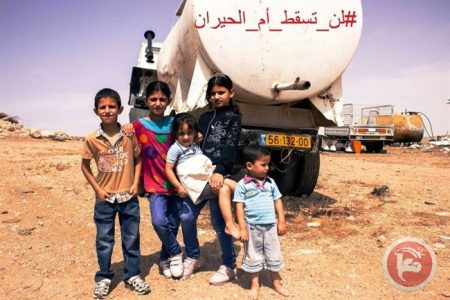
Children in the Bedouin village of Umm al-Hiran in the Negev
Ma’an – June 12, 2017
BETHLEHEM – A recently installed guardrail on an Israeli highway has isolated a Bedouin community in southern Israel for days, preventing 100 Bedouin children from attending school, NGO Adalah reported on Sunday.
According to the group, which focuses on the rights of Palestinian citizens of Israel, Israeli authorities effectively sealed off Umm Bidoun, a Bedouin community in the Negev desert unrecognized by Israel, by blocking off the only dirt road connecting the village to Highway 31 with a guardrail.
The road surface markings on the highway near other passage out of Umm Bidoun have also recently been changed, making it illegal for vehicles to cross the road, Adalah added.
The recent changes have effectively prevented any vehicles, including school buses, from accessing the village, Adalah said.
As a result, the legal NGO stated that, due to the absence of schools in Umm Bidoun, 100 children who study in the village of al-Furaa 15 kilometers away have been unable to go to school for days.
Adalah said on Sunday it had contacted officials from the Israeli Education Ministry, the al-Qasoum regional council, and Netivei Israel, the national roads authority, to demand that the obstacles to freedom of movement for the residents of Umm Bidoun be lifted.
Adalah field researcher Marwan Abu Freih told Ma’an on Monday that Netivei had told the organization that it was examining the issue.
Spokespersons from the Ministry of Education did not immediately respond to a request for comment on the case on Monday.
“It is inconceivable that some 100 students can — in such a sudden and arbitrary manner — be prevented from attending school without any advance notice to or consultation with parents,” Abu Freih said on Sunday. “Adalah and the families demand that the Education Ministry act immediately to correct this situation.”
Abu Freih added on Monday that members of Israel’s parliament, the Knesset, representing Palestinian citizens of Israel, had reached out to Adalah to offer their assistance in resolving the case.
Bedouin villages were established in the Negev soon after the 1948 Arab-Israeli war following the creation of the state of Israel. Many of the Bedouins were forcibly transferred to the village sites during the 17-year period when Palestinians inside Israel were governed under Israeli military law, which ended shortly before Israel’s military takeover of Gaza and the West Bank, including East Jerusalem, in 1967.
Between 160,000 and 170,000 Bedouins are believed to reside in the Negev today, more than half of whom reside in unrecognized villages, according to the Association for Civil Rights in Israel (ACRI).
The classification of their villages as “unrecognized” prevents Bedouins from developing or expanding their communities, while Israeli authorities have also refused to connect unrecognized Bedouin villages to the national water and electricity grids, and have excluded the communities from access to health and educational services.
A Knesset report on Bedouins in Israel noted that “(school) dropout rates are high, among various reasons due to lack of access and public transportation to their schools.”
Meanwhile, Jewish-Israeli communities in the Negev continuously expand, with five new Jewish plans approved last year. According to an investigation undertaken by Israeli rights groups ACRI and Bimkom, two of the approved communities are located in areas where unrecognized Bedouin villages already exist.
Rights groups have claimed that Israeli policies in Bedouin communities are specifically aimed at depopulating the Negev of its Bedouin residents to make room for the expansion of Jewish Israeli communities.
Corbyn and the Jews

By Gilad Atzmon | June 11, 2017
British Jews have made no secret of their united political opposition to Jeremy Corbyn and the Labour party under his direction. Since Corbyn’s selection as its leader, the Labour party has been subjected to a relentless defamation campaign by the MSM and Jewish bodies. The Jewish anti Corbyn campaign rapidly devolved into a ruthless purge conducted by the Jewish Labour Movement and the Labour Friends of Israel. And then it didn’t take long before we saw some clear evidence that the assault against Corbyn was directed by Tel Aviv.
The reaction of many prominent Jewish voices and Jewish media outlets to Corbyn’s recent electoral success leaves no room for doubt – we are witnessing an emerging clash between the Brits and Judea.
On June 9th just a few hours after Corbyn’s popularity amongst Brits was formally established, Stephen Pollard, the editor of the staunch Zionist Jewish Chronicle, wrote in The Daily Telegraph (AKA The Daily Tel Aviv ) an extended tirade about the Brits, the gist of which is captured in the headline: “to the millions of people who voted for Jeremy Corbyn: you scare me.”
Pollard is tormented by the democratic choice of almost half of the British voters. “In fact forgive me, please, if I say this to each of the 12.8 million people who voted Labour on Thursday: you scare me.”
Pollard is distressed by Ken Livingstone’s truth telling about Zionism’s early collaboration with Hitler. He is dismayed that so many young Brits are excited by Corbyn’s platform of truthfulness and universal cooperation.
To support his argument Pollard asks us to engage in a “thought experiment.” Imagine that instead of having a problem with Jews, “many Corbyn supporters were misogynists. Instead of tweeting about ‘Zios’ they tweeted about ‘bitches’ who had got above themselves.”
I will help Pollard out. It wasn’t women’s lobbies that pushed us into immoral interventionist wars in Iraq, Syria, Libya and Iran. It was Lord Cashpoint Levy and the LFI that dominated Blair’s government’s fundraising when Britain launched its criminal war in Iraq. It was David Aaronivitch and Nick Cohen, two of Pollard’s Jewish Chronicle writers, who advocated these wars in the media.
Being kind natured, I’ll use this opportunity to advise Pollard that pretty much half of British adults go to bed every night with a woman. They form families with them and bring up kids together. We see women as our partners; something we cannot say about Stephen Pollard, Jonathan Pollard, Michael Foster, Lord Janner or Sir Philip Green. Pollard should spend some time and produce a better analogy in support of his ludicrous tribal politics.
Pollard is not alone. James Rubin, a former American diplomat and the ‘husband of’ is also scared of Corbyn.
“Who’s Afraid of Jeremy Corbyn? Me that’s who,” was the title of Rubin’s Politico article. Unlike Pollard who is scared as a Jew, Rubin claims to be scared on behalf of all Americans. According to Rubin “all Americans who fear for the future of the West” should be fearful of Corbyn. Rubin attempts to spread a duplicitous message that Corbyn puts the West at risk.
Rubin is kind enough to enumerate Corbyn’s ‘crimes: he has been “a public opponent of British and American foreign policy for some 25 years, and so his record and his views are impossible to hide.” He has “made a career of attacking U.S. foreign policies time and again.”
Rubin misses the point. Corbyn was supported last Thursday by more than 12 million Brits, in large part because he has a clear record of opposition to Anglo-American Zio-con immoral interventionist wars.
Rubin goes on, Corbyn has always found a way “to be supportive of America’s enemies and critical of American policies.” Correct and this is exactly why close to half of the British voters trusted him last Thursday. I would take it further, would Corbyn be brave enough to call a spade a spade and name our foreign wars for what they are: Israeli wars, his share of the vote would increase from 40% to 70%. Corbyn would be the British Prime Minster by Friday and the Tories would be reduced to a marginal political entity.
Rubin complains that Corbyn finds that “America is almost always in the wrong for the wrong reasons.” If so, Corbyn is absolutely right. America is too often on the wrong side, capitulating to AIPAC’s demands or desperately attempting to appease the Goldman Sachs and Soroses of this world.
Those who still fail to see that British Jews are at war with Corbyn and the Labour party should read The Jewish Algemeiner. According to Ben Cohen, it was the Jewish vote in London that saved Theresa May. Despite the popular swing towards Labour in most of London, it was the “voters in four London districts with significant Jewish populations have likely made it much easier for embattled British Prime Minister Theresa May to form a coalition government.”
Britain’s Chief Rabbi Ephraim Mirvis released a statement that the election demonstrated the dramatic polarization of British society: “The General Election results make it quite clear that it is not only our political representatives who are sharply divided on what is in the best long term interests of our country, but also that the electorate is similarly divided.”
I am not convinced at all that Britain is ‘divided’ as the chief Rabbi claims. If anything, the election reveals a growing unity amongst young Brits who are disgusted by the politics of Theresa Je Suis Juif May and her Zio-friendly government.
“As Theresa May seeks to form a new Government, my prayer is that she be blessed with the insight and the wisdom to lead the country with a spirit of understanding and a commitment to the common good,” the Rabbi added. I can advise the British Jewish leader that his prayers may fall short of delivering the good. What Theresa May needs at this stage is divine intervention and the Jewish institutions rallying for her and her dirty politics is a curse rather than a blessing.
Israel’s Netanyahu calls for UN Palestinian refugee agency to be shut down
RT | June 11, 2017
The UN Palestinian relief agency “perpetuates” the refugee issue instead of solving it and should be “dismantled,” the Israeli PM stated, adding that he had conveyed the idea to the US envoy to the UN. The agency dismissed his proposal as “fantasy.”
Israeli Prime Minister Benjamin Netanyahu made the comments on the United Nations Relief and Works Agency (UNRWA) during a weekly cabinet meeting on Sunday.
“It is time UNRWA be dismantled and merged with the United Nations High Commissioner for Refugees,” Reuters quoted Netanyahu as saying.
According to the Israeli PM, as cited by the Jerusalem Post, “in various UNRWA institutions there is a lot of incitement against Israel, and therefore the existence of UNRWA – and unfortunately its work from time to time – perpetuates the Palestinian refugee problem rather than solve it.”
Netanyahu added that he had already conveyed the idea of shutting the agency down to US Ambassador to the UN Nikki Haley during her visit earlier this week.
“I told her it was time the United Nations re-examine UNRWA’s existence,” Netanyahu said.
The UNRWA was established by the UN General Assembly in 1949, when hundreds of thousands of Palestinians fled or were evicted from their homes during the 1948 war which followed the emergence of the state of Israel. The agency currently helps over five million registered Palestinian refugees across the region, according to the UNRWA’s own statistics.
The UNRWA’s chief spokesman, Chris Gunness, dismissed Netanyahu’s ideas, stating that dismantling the agency lays outside both of his and Haley’s powers and that only the General Assembly, by a majority vote, could change the agency’s mandate.
“In December 2016, UNRWA’s mandate was extended for three years by the General Assembly by a large majority,” Gunness told Reuters in an emailed statement.
A Gaza-based spokesman for the UNRWA, Adnan Abu Hasna, said that Netanyahu was pursuing a “fantasy.”
Netanyahu’s remarks came two days after the UNRWA said it had uncovered an alleged Hamas-built tunnel running under two agency-managed schools in a refugee camp in the Gaza Strip. The UNRWA condemned the construction of the tunnels as a violation of its neutrality and protested it to Hamas. The Islamist organization, however, denied involvement.
“UNRWA condemns the existence of such tunnels in the strongest possible terms. It is unacceptable that students and staff are placed at risk in such a way,” the agency said in a statement. “The construction and presence of tunnels under UN premises are incompatible with the respect of privileges and immunities owed to the United Nations under applicable international law, which provides that UN premises shall be inviolable. The sanctity and neutrality of UN premises must be preserved at all times.”
Israeli Ambassador to the United Nations Danny Danon submitted a letter of protest to UN Secretary-General Antonio Guterres and the UN Security Council, urging them to label Hamas a terrorist organization and “safeguard” the UNRWA, as well as other agencies “from abuse by terrorist organizations.”
READ MORE:
Israel is ‘key driver’ of Palestinian hardships in occupied territories – UN report
Hamas pledges not to intervene in the affairs of Arab countries amid Qatar crisis
Ma’an – June 10, 2017
BETHLEHEM – Days after Saudi Arabia, Bahrain, the United Arab Emirates, and Egypt severed diplomatic ties with Qatar, accusing the Gulf state of supporting “terrorism,” the Hamas movement — named as one of the groups allegedly receiving Qatari sponsorship — pledged Saturday it would not intervene in the affairs of any Arab countries “regardless of the pressures.”
“Hamas’ weapons will be directed only at the enemy (Israel), and Hamas will maintain its policy of not intervening in Arab countries’ affairs regardless of pressures or events,” Deputy Hamas chief Mousa Abu Marzouk was quoted in an official Hamas statement as saying.
Disagreements among Arab countries, “are their own business,” he said, though the question of Palestine “will remain the core issue for everybody, and support for the Palestinian plight should be indisputable regardless of any situation that may arise.”
Abu Marzouk added that Hamas has come under pressure in the past from the Arab world and internationally, and said “we will always deal with such pressures responsibly. We won’t be in disagreement with any country.”
In a similar statement Friday, member of Hamas’ politburo Khalil Al-Hayya that “the Palestinian armed resistance is directed only towards the Israeli occupation, and that the Palestinian resistance will not deviate from this track,” he said, reiterating the faction’s rejection of its designation as a terrorist organization by the US, Israel, and several other countries. Hamas identifies as a Islamist national resistance movement.
Meanwhile, Qatari Foreign Minister Sheikh Muhammed bin Abd al-Rahman al-Thani reportedly said Saturday that, “The US views Hamas as a terror organization, but to the rest of the Arab nations it is a legitimate resistance movement. We do not support Hamas, we support the Palestinian people.”
“Hamas’s presence in Qatar doesn’t mean there’s support for Hamas in Qatar,” he said, highlighting the fact that Qatar also cooperates with the occupied West Bank-based Palestinian Authority to promote Palestinian reconciliation between Hamas and Fatah.
Following the abrupt severing of political ties with Qatar, Hamas slammed the development as a “politicized” attempt to force Qatar to abide by the interests of Israel and the United States.
Ahmad Yousif, a former senior Hamas figure who remains close to the movement’s leadership, described the political developments as part of an “American-Israeli-Saudi coalition” in the region — a sentiment expressed by other commentators owing to US President Donald Trump’s visit to Saudi Arabia and Israel in recent weeks and Saudi Arabia’s growing ties with Israel over the years.
Saudi Arabia’s Minister of Foreign Affairs Adel al-Jubeir had stated that Qatar would have to cut support to Hamas and the Muslim Brotherhood if the country wanted to restore diplomatic relations.
Qatar has also reportedly expelled members of Hamas from the country owing to the pressure, however, Hamas denied these claims, saying several leaders left Qatar “willingly” in order to avoid adding to Qatar’s difficulties.
Major Chilean Universities Heed BDS Call, Cancel Events Sponsored by Israeli Embassy
IMEMC | June 10, 2017
 Student-led BDS campaigns resulted in two major Chilean universities canceling events co-sponsored by the Israeli embassy and featuring Joe Uziel, a director of the Israel Antiquities Authority (IAA). On Monday, Alberto Hurtado of the University’s Anthropology Department announced the event’s cancellation, and yesterday the University of Chile’s Social Sciences Faculty did the same.
BDS Chile highlighted the reasons behind the campaign to cancel the event:
Universities cannot be passive accomplices in grave human rights violations. The State of Israel maintains an illegal occupation, colonization and apartheid regime against the Palestinian people, and the Israeli Embassy is this regime’s representative in Chile. In addition, the Israel Antiquities Authority is a government entity illegally based in occupied East Jerusalem that carries out illegal excavations in the occupied Palestinian West Bank. Some of these illegal excavations are directed by the invited speaker, Joe Uziel.
The confiscation and theft of Palestinian cultural heritage are part of Israel’s attempts to erase Palestinian memory and cultural identity. Since 1967, the IAA has been deeply involved in cultural crimes and serious violations of international law, such as illegally removing and plundering hundreds of thousands of precious artifacts from the Occupied Palestinian Territory (OPT), including East Jerusalem. Fearing BDS campaigns, Israel has been trying to prevent information about archeological work in the OPT from being made public and to whitewash these violations by promoting events like these abroad.
Sharaf Qutaifan, from the Palestinian Campaign for the Academic and Cultural Boycott of Israel (PACBI) said:
Through the Israel Antiquities Authority, Israel attempts to bury the history of the indigenous people of Palestine, which was always home to groups with diverse cultures and religions. This is an extension of Israel’s policies of expulsion and cultural theft that it has carried out against Palestinians since its establishment. Israel has a troubling record of systematically looting Palestinian lands and properties, cultural treasures and even books and artworks, which continues until today.
We salute the Chilean students for pressuring the Anthropology Department of Alberto Hurtado University and the Social Sciences Faculty of University of Chile to take principled positions. Academic institutions should not lend their good names to Israel’s denial of Palestinian rights. We hope to see all Chilean universities fully free of Israeli apartheid.
BDS Chile celebrated the victory:
We welcome the decisions of Alberto Hurtado University and the University of Chile. The Palestinian people expect principled acts of solidarity in support of their human rights and the respect of international law. These cancellations demonstrate Chilean students’ determination to denounce Israel’s oppression and to work towards interrupting our universities’ ties with institutions complicit in Israeli apartheid.
This latest news is another stride in the growing academic boycott of Israel in Chile. Last year, law faculty students at the University of Chile overwhelmingly voted in support of BDS, as did more than 90% of the social sciences students. At the Catholic University of Chile, the Student Council also passed a BDS resolution by a large majority.
The cancellations are also another strike against the Israel Antiquities Authority. At the end of 2016, the 8th World Archaeological Congress published a resolution condemning Israel’s excavations in the Occupied Palestinian Territory and called on international academic publishers to refuse publishing works related to archaeological research in those areas.
The Palestinian Campaign for the Academic and Cultural Boycott of Israel (PACBI) was initiated in 2004 to contribute to the struggle for Palestinian freedom, justice and equality. PACBI advocates for the boycott of Israeli academic and cultural institutions, given their deep and persistent complicity in Israel’s denial of Palestinian rights as stipulated in international law. Visit PACBI at https://bdsmovement.net/pacbi and follow us on Twitter @PACBI
Is Qatar paying the price for its pro-Palestine stance?
The New Arab | June 8, 2017
Qatar’s support for Palestinians seems to be one of the key causes of the Saudi-led blockade on Doha, amid increasing convergence between Riyadh and Abu Dhabi, and the administration of US President Donald Trump – the president most supportive of Israel in recent decades.
On Tuesday, Adel al-Jubeir, the Saudi foreign minister, made it clear that a key demand of his government in return for restoring ties with Doha was for Qatar to end its “support” for Palestinian group Hamas, which champions armed resistance against Israel and was the winner of the last general election held in the occupied Palestinian territories.
Jubeir, for the first time in Saudi history, suggested Hamas was an “extremist” group. During Trump’s visit to Riyadh in late May, the US president proclaimed the group a terrorist outfit akin to the Islamic State group and al-Qaeda, and Riyadh did not object.
Saudi Arabia previously provided support to Hamas and welcomed its leaders as recently as 2015. However, on the back of the Iranian nuclear deal, both the kingdom and its ally, the UAE, have been making increasing offers of normalisation with Israel – with whom they share Iran as a common foe.
Since the events of the Arab Spring, both Saudi Arabia and the UAE have also become hostile to the Muslim Brotherhood, to which Hamas is affiliated, seeing it as an imminent threat to their regimes.
Qatar, by contrast, has maintained good relations with most Palestinian factions, including Hamas and Fatah, and invested tens of millions of dollars in the reconstruction of besieged Gaza, decimated by years of Israeli war.
Qatar, although closely allied to the United States, has maintained an independent policy on Palestine, which has often caused it problems with pro-Israel officials in the West.
Now, Qatar’s neighbours seem to have joined the fray, inching closer to fully endorsing Israel’s narrative on groups such as Hamas, in the name of fighting extremism and terrorism, without defining either.
It is worth noting that the UAE hosts and supports Hamas’ arch-rival, exiled Fatah leader Mohammed Dahlan, whom it hopes to install as the next Palestinian president.
“Qatar is being punished for its role and influence in the Palestinian arena, with both President Mahmoud Abbas and Hamas,” Ibrahim al-Madhoun, political analyst, told The New Arab.
“Qatar’s role is one of the causes of the Gulf crisis, as its balanced position and influence has become a source of annoyance for its rivals,” he added.
Taysir Muhaisen, political commentator, agrees. “All the parties, in light of the emergence of a new US administration, have decided to pressure Qatar, which has had a different approach to many issues including the Palestinian issue, dealing with Hamas and all Palestinian factions… and helping Gaza weather the blockade,” he said.
Disaster for Gaza
Qatar is one of the few foreign backers of Hamas, and faces massive pressure from its Gulf neighbours to cut ties with the Islamic militant group. If it does, the result could be disastrous for Hamas-ruled Gaza, according to an AP analysis.
Qatar has invested hundreds of millions of dollars in roads, housing and a major hospital in the tiny territory. Its infrastructure projects are one of the few job-creators in a devastated economy.
Gaza already suffers from an Israeli-Egyptian blockade, widespread destruction from a string of Israel-Hamas wars, economic misery and chronic electricity shortages. For Hamas, Qatar’s money pumping into the economy is a vital lifeline bolstering its rule.
The mere prospect of losing Qatari support prompted Hamas on Wednesday to issue rare criticism of Saudi Arabia, which has been leading the campaign against its tiny Gulf neighbour.
Hamas official Mushir al-Masri said the Saudi call for Qatar to cut ties with the Palestinian group was “regrettable”, and contradicts traditional Arab support for the Palestinian cause. He accused Saudi Arabia of siding with “American and Zionist calls to put Hamas on the terrorism list”.
Qatar has denied the allegations made against it by Riyadh. But its small size and reliance on food imports from Saudi Arabia could make it susceptible to pressure.
This could spell trouble for Hamas. The group – which calls for Israel’s destruction, even if it has offered long-term interim cease-fires – is considered a terrorist organisation by Israel and its Western allies. Israel and Hamas have fought three cross-border wars that caused large-scale damage in Gaza.
Qatar doesn’t support Hamas directly, but its large-scale projects have significantly eased the burden on Hamas authorities and given it some credit for bringing this money to Gaza.
In 2012, Qatar’s then-emir, Hamad bin Khalifa al-Thani, visited Gaza, the first and only head of state to do so since Hamas routed Palestinian President Mahmoud Abbas’ Fatah militants in Gaza during internecine fighting a year after Hamas won elections in 2006. The emir announced a grant of $407 million for humanitarian projects.
The grant is being used to build a housing complex of 3,000 units. Two phases of the project have been completed and families moved into their new homes, dubbed the Hamad Residential City, in the southern Gaza town of Khan Younis.
Last month, Palestinian contractors and Qatari envoys signed deals to start the third and final phase of Hamad City. Now, those deals could be in question.
Using that grant, Qatar also built a specialist prosthetic centre, the first of its kind in Gaza. Qatar paved roads, repaired or rebuilt mosques and oversaw dozens of other infrastructure projects.
Following a 50-day war between Israel and Hamas in 2014, Qatar was the largest single donor to the reconstruction of Gaza, pledging $1 billion at a Cairo-hosted international conference.
Qatar also helped pay for fuel and electricity deliveries from neighbouring Israel, which, despite its enmity to Hamas, supplies energy to Gaza for what it says are humanitarian reasons.
On Wednesday, bulldozers with Qatari flags were seen leveling land overlooking Gaza City’s coastal road. The spot is supposed to house the headquarters of Qatar’s Gaza reconstruction mission and a residence for an envoy.
In Hamad City, new shops and stores are opening, including a pharmacy named Qatar, barber shops and a video gaming cafe as more families move in. The complex is the largest in Gaza.
Wael al-Naqla, a contractor, has won a bid to build several buildings in the final phase. Thanks to Qatari money, he is one of the few business owners who can hire workers in today’s Gaza.
“Without these projects, we would have been idled a long time ago,” he said, voicing fears that the funding could soon dry up. “We are afraid I won’t be able to keep paying for my 20 workers and they will not be able to eat.”
The construction here is one of the few bright spots in Gaza.
The situation here is grim. The territory suffers from rolling power cuts, with just four hours of electricity at a time, followed by 14-18 hours of blackout. Tap water is undrinkable, youth unemployment is estimated at 60 percent. Thousands wait for a rare chance to exit the blockaded territory.
Mkhaimar Abusada, an independent Gaza political analyst, said the pressure on Qatar could increase Hamas’ political and financial isolation.
This week, a high-level Hamas delegation was summoned to neighbouring Egypt, which has had cooling relations with Hamas. “If these talks don’t lead to new understandings getting Hamas out of its difficult political situation, I think there will be more crises,” said Abusada.
Lieberman urges US to pressure for expelling Hamas leaders from Beirut
Palestine Information Center – June 9, 2017
OCCUPIED JERUSALEM – The Israeli war minister, Avigdor Lieberman, on Friday urged the visiting American UN ambassador Nikki Haley to pressure Beirut to expel Hamas anti-occupation leaders.
According to the Hebrew-language Walla news site, Lieberman launched calls to expel prominent Hamas leaders from Lebanon following a meeting with the American UN ambassador Nikki Haley.
“Hamas leaders in Lebanon should be banished because they are working against Israel,” claimed Lieberman.
Over recent weeks, an ad hominem campaign has been waged against Palestinian anti-occupation leaders affiliated with Hamas resistance movement in an attempt to deport them from their countries of residency.
Report: Rise in number of Russian Jews leaving Israel
MEMO | June 9, 2017
A new report revealed an increase in the number of Russian Jews who migrate from Israel to other countries or to their original home in Russia and the former Soviet Union.
The report, released by the Knesset Committee for Immigration, Absorption and Diaspora Affairs, revealed that 38 per cent of the total 290,300 immigrants who left Israel without return within the past 14 years are Russian immigrants.
According to the report, the main reasons for their reverse migration include the “glass barrier” which prevents their progress in the occupational ladder, lack of separation between religion and state especially in the matters of marriage, burial rituals, in addition to the stereotyping of Russians and discrimination on the public and official levels.
The committee held on Wednesday an emergency session following the release of the report published in early May which pointed out that one in six Russian immigrants leave Israel and that the percentage could rise if the relevant authorities do not provide appropriate solutions.
According to official data, nearly 650,000 people from the former Soviet Union immigrated to Israel – including 185,000 people under the age of 20 – between 1990 and 1996.
Featured Video

Why the U.S. Should Pull Back From the First Island Chain
or go to
Aletho News Archives – Video-Images
From the Archives
Only 19.7% of Americans agree with US State Dept on Israeli settlements
… Most American adults of voting age don’t appear willing to reject the applicability of international law to Israel’s ongoing colonization of occupied territories in East Jerusalem, the West Bank and Golan Heights. … Full article
Blog Roll
 Aletho News
- Albania on fire: who’s behind the riots?
- Egypt’s Civil Democratic Movement rejects involvement in regional war
- Egypt collaborates with Israel to build ‘Green Rafah’ project over erased Palestinian city
- Rising fuel prices and shortages have helped drive ongoing protests and rioting in France
- Tokyo protests demand Takaichi’s resignation over support for ‘Israel’
- Jennifer Kavanagh: Why the U.S. Should Pull Back From the First Island Chain
- Yemen denounces international community’s silence on Saudi aggression, siege
- UAE and Saudi Arabia move toward renewed coordination against Sanaa
- How Iran’s two-week retaliatory strikes exposed cracks in US military architecture in Persian Gulf
- The mother of all propaganda: Why the hype over US MOAB strike against Iran is nothing but theater
- If Americans Knew
- What the UK Is Doing to Pro-Palestine Novelist Sally Rooney Is an Act of Orwellian Villainy
- ‘We will build palaces for Jews in Gaza’: Right-wing activists establish new outpost near border
- ‘You see us burning, you stay silent’: Family’s agony over mother and sons burned to death in Gaza tent
- Israel keeps Palestinian journalist Bushra al-Tawil in isolation for 46 days
- US-Israel integration plan puts US military tech in Israel’s hands
- Israeli Strike Burns Gaza Mother Alive in Front of Toddler, ‘Without Generating Any Headlines’
- ‘The Israel Experience with Mike Huckabee’: The Ambassador’s Family Sells Trips to Israel
- As Gazans carry out mass burial, food insecurity is getting worse – Daily Update
- Israeli rabbi permits occupiers to steal Palestinian olive harvest in West Bank
- Netanyahu’s spin on latest settler attack is laughable – Daily Update
- No Tricks Zone
- Predictions Made By Renowned Climate Proifessor Over Past Decades Have Been Proven To Be Poor
- New Study Suggests Large Regions Of The Pacific Ocean Have Been Cooling For The Last 80 Years
- Germany’s Green Energy Debacle: High Energy Costs Force Kahla Porzellan to Close After 182 Years!
- New Study: 50 Years Of The Most Aggressive ‘Net Zero’ Policies Can Only Affect The Global Climate By 0.03°C
- US September “Heat” Was No Record…Many Records Set Decades Ago
- Latest European Green Energy Debacle; Portugal’s Largest Flagship Solar Park Insolvent!
- Green Energy Debacle: German Expert Professor Fritz Vahrenholt Warns Of Severe Economic And Social Consequences
- Two More Paleo Reconstructions Affirm Meters-Higher Sea Levels Across Ireland, Brazil 7000-6000 Years Ago
- New Study: Earth And Venus Surface Warmth Largely Explained By Convection And Lapse Rate, Not CO2 Or Radiation
- 2025 Nature Paper Claiming Worsening Global Drought Gets RETRACTED …Heavily Flawed

