69 years ago today – The Deir Yassin Massacre Israel Forces Murder over 100 Palestinians Including Women and Children

By Dina Elmuti | American Herald Tribune | April 9, 2017
I grew up in a country far removed from the horrors of Deir Yassin, but I’ve lived with the snapshots of the massacre my entire life. My grandmother’s Nakba trauma has permeated my inner life, and I’ve known the world of acute agony and the mockery of what human life has been reduced to for the Palestinian people. Every massacre and assault carried out in Zionism’s calculated desire for control adds another layer to the trans-generational transmission of trauma of Palestinians everywhere. Like the bombs that Israel drops on civilian populations, dispersing their incendiary fallout in distant places long after the initial explosion, the psychological trauma continues.
When they said that there would come a time when the old would die and the young would forget, they didn’t realize that Palestinians who grow up fluent in a language of trauma and resistance could never forget. But more importantly, they refuse to.
The significance of the need to preserve the memory of what happened at Deir Yassin remains woven into our DNA. It’s a name that flickers at the edge of our consciousness, resonating in the Palestinian collective memory with chilling significance. My grandmother’s story has taken up residence in my soul. It became the blood coursing through my veins, reverberating in my heart and graven in my memories.
The collective Palestinian narrative is written in indelible link and though it’s a story of unimaginable terror and devastation, shattered dreams and decimated hopes, it’s also one of extraordinary sumud (steadfastness) and resistance. It’s a story that remains unfinished and determined, standing with hope defiant.
Operation Nahshon
My grandmother was nine years-old on the morning of Friday, April 9th 1948 when the Zionist terrorist organizations – the Irgun and Lehi, with the agreement of the Haganah in Jerusalem, carried out Operation Nahshon and opened fire on the villagers of Deir Yassin. By evening, nearly 110 villagers were executed and the village was cleared. But the evidence of the Zionist criminality lay in the rivers of blood and the disemboweled, dismembered, and disfigured bodies of men, women and children.
The villagers endured barbarity at the hands, boot heels, and the edge of bloodied knives of Zionist terrorists who rounded up villagers executing them in decimation for crimes they had never committed. Men were paraded around on trucks before being taken to the village quarry and shot execution style.
Menachem Begin, the leader of the Irgun at the time, consciously inflated the death toll of the massacre from just over 100 to 254 to instill a sense of incoherent terror within people in hopes of eliminating and erasing the Palestinian people from the landscape and from human consciousness – root and branch, bone and blood. News of the massacre triggered the mass, forced exile that emptied Palestine of 80% of its native Arab population. Over 750,000 Palestinians were expelled from the only homes they had ever known. Today, displaced Palestinians remain the largest and longest-standing refugee population in the world.
The beginning of the Nakba was more than an atrocity; it was completely and intentionally genocidal.
It’s been 69 years since the Deir Yassin massacre and the world has moved past it, but its selective amnesia remains present. Its survivors, however, have never forgotten that Palestine continues to be left with human devastation on an unimaginable scale by Israel in its successive operations and assaults. In the litany of Israel’s gruesome crimes and indiscriminate massacres, Deir Yassin was not the most massive in scale but it’s the one that reduced the Palestinian people to ungrievable, dehumanized convenient objects of hatred and violent retribution whenever convenient. It became the precondition for the calculative, prolonged violence and subhuman slaughter of Palestinians. This became the operative philosophy of the Zionist regime that exists today.
“Man’s inhumanity to man” – A poignant irony
Deir Yassin is one of the few Palestinian villages where the Zionist state attempted to erase its inhabitants, but kept its homes and buildings completely intact. Behind the security cameras, guard posts and fence where my family’s village and home once stood now exists a closed psychiatric facility – Kfar Shaul – which houses people with severe mental illness. The irony is not lost on me: The birth of a state predicated on the wholesale slaughter of innocent people on command, a state that has attempted to anesthetize itself to death and depravity, would surely drive anyone of conscience insane. Another breathtaking irony chills my bones every time I stand on the stolen land of my ancestors. Israel’s official Holocaust museum, Yad Vashem, is built in panoramic view of Deir Yassin, standing as a haunting, insidious testament to “never forget man’s inhumanity to man” in absolute denial of the souls of martyrs buried deep beneath.

Zionist vindictiveness created a deeply-rooted psychological transference onto a people who had nothing to do with the Nazi Holocaust. Prior to 1948, Deir Yassin was a relatively prosperous and peaceful village, and its residents lived in peace with their Jewish neighbors in nearby villages, especially those in Givat Shaul whom they had signed a peace pact with. My grandmother recalls a different time when Arabs and Jews lived as neighbors attending each other’s weddings and celebrations, smoking arghila, eating dried watermelon seeds, sharing news, and going to the cinema together with their Jewish friends. The Orthodox community of Givat Shaul was one of the first to help the survivors of Deir Yassin following the Irgun-Lehi assault. This was never a conflict that has existed for thousands of years. The Palestinians have never had a problem with Judaism; it’s with injustice.
But here’s the thing about stories of survival: They affirm an inescapable truth that reacquaints both victims and perpetrators with memory, with history, with life, and with justice. Aggressors cannot seem to live with the inconvenient truth of their guilty history but survivors refuse to live without it. The people of the world continue to demonstrate that they are so capable of conveniently forgetting the murderous atrocities in which their fellow peers have participated, so it becomes morally imperative and essential, at the very least, to regularly remind them of it.
Palestine has never been a land without a people. It has always been home to a rich landscape filled with a beautiful people, with their own native land, language, and holy sites at the center of their religions. The Zionists tried to expel a people and attempt to scatter a people into oblivion, for they learned from colonizers before them that there is no precedent for a scattered people’s remaining a people. Their dispersion meant their disappearance. Or so they thought.
Tell the stories
The late Dr. Edward Said once said, “To recall Deir Yassin is not just to dwell on past disasters, but to understand who we are and where we are going. Without it we are simply lost.”
My grandmother’s face aches with despair as she narrates the horror and trauma of Deir Yassin. Her body has kept score for the past sixty-nine years. She has been acutely aware of the sense of displacement dully throbbing with determination inside the dark spaces between her organs and bones, haunted by a history that has sat uncomfortably out of joint for a lifetime. The emotional pain of displacement and dislocation hurts like no other.
The collective inventory of the Palestinian people rests on our shoulders. To never forget the incomprehensible violence and intolerable pain, the extraordinary valor and the steadfastness that have defined Palestinians. It is our duty to record of every life lived, every sentence spoken, every word transmitted still reverberating within it. As the story of the massacre moves on in memory, the aim of remembering the atrocity and bearing witness takes on new meaning. The words of our parents and grandparents remain a talisman that will continue to be passed down for generations. These are the stories that teach us resilience, joy, hope and incarnation.
The Nakba continues
What drove the exterminatory impulses of the Zionists was not only the contempt that branded millions of Palestinians as dispensable and sub-human, but also the ideologically pervasive mixture of terror and hatred that continues to blame the Palestinians for all of Israel’s ills and seeks their destruction as a matter of life and death in the interests of the Jewish people’s survival. This is the politics and colonial neurosis of Zionism. Israel justifies its policy of mass eradication through its demagogic abuse of portraying itself the perpetual victim. And for those who don’t understand the sadistic nature of the Israeli settler colonialist violence, the only mention of Israel will continue through the perpetual victim narrative, nothing more than a kind of ersatz victory every time. No matter what Israel has ever done, it’s because they’re always defending themselves – armed with bombs and artillery that unearth entire societies – against the Palestinians. Everything Israel ever does is painted as reactionary under the normalization of Zionist brutality.
Israel has a very finely-tuned feel for how many atrocities it can get away with before the world reacts with revulsion. But when entire families are butchered, immolated[DE1], bombed to oblivion upon breaking their fasts[DE2], when mass murder has become an annual event, when the reprise of internment camps and the reinstitution of torture become acts of policy, where were the cries of “Never again”?
The truth is that for the Palestinian people, the truer shout is not “Never again” but “Again and again and again.”
The post-Holocaust vow that genocide would never again be tolerated has long been hollow. The Palestinian people are living proof that murder looks on its victims with a casual eye. The extraordinary and soul-crushing pain that the Palestinian people have endured, for nearly seventy years now, has been perceived as just and mutable.
The Nakba did not penetrate the world consciousness in the same manner as the Holocaust. Slaughtering people, village by village, didn’t seem too high a price to pay, nor did it appear inhumane. These origins contain the historical seeds of genocide. The silence absorbed the lack of noise with a lack of sound so potent that it blackened this world with something so much richer than Zionist hate. Since Deir Yassin, we’ve known what man is capable of: the silent acquiescence in genocide of another people.
The Nakba never ended. It is an ongoing catastrophe.
Justice and only justice
From its inception, Israel has had an insatiable addiction to blood, pouring more bodies into pits of slaughter never allowing the dead to rest in peace. But peace can never be built on the blood and bone of others. The robotic mass annihilation of the Palestinians had brought human bloodlust to a climax which nobody had considered possible by the victims of the Nazi genocide. Zionists have relied on decades of distortion and deceit, but what they always forget is that the millions of bodies have buried them more than anyone else. With each assault on the most vulnerable, disenfranchised, and traumatized people in which Israel pours endless young bodies into pits of death, they follow it. With every massacre, entire generations are revolutionized and filled with more conviction and sumud.
A truly “free” state can never exist when it’s enslaved to the organized aggression it has chained itself to. One day, Israelis will realize the ceaseless turmoil disrupting their peace has nothing to do with opposition to a Jewish state but is rooted in the fact that no human beings anywhere are created to accept injustice so casually. There will come a time when the world will stop asking the Palestinian people to stop resisting their oppression when the boots of the oppressor remains on their throats. The Palestinian people remain the only colonized and oppressed people who are constantly told to guarantee the security and rights of their occupiers and oppressors, who continue to be held responsible for nothing.
While Israeli expansion, expulsion, colonization, and the indefinite justification for violent retaliation under apocalyptic conditions continue, Palestinians are asked to concede and give more. Each year, their beloved homeland and rights wither away, like a diseased heart, speckled, clotted, and hollowed out. A homeland annulled. No two-state delusion will ever be a viable solution. There will be no peace in Israel and Palestinian until a modicum of justice is achieved for the Palestinians.
Our voices will not be muted by dispossession, expulsion, trauma, and denial. In attempting to erase us, the reality created by the Zionists became a fertile soil for the expression of steadfast resistance and perseverance. No matter how many innocent Palestinians are rounded up and executed, disappeared and silenced, there will always be more of us out there: living, excelling, falling in love, getting married, having children to pass on our narrative to. That resistance is what continues to ensure that ‘never again’ is not hollow.
Dina is a first-generation Palestinian-American living in Chicago. She works in the States and overseas with an NGO for victims of torture in the Occupied Territories of Palestine (Ramallah).
Netanyahu: ‘Israel’ Committed to Treating Syrian War Wounded
Al-Manar – April 9, 2017
Israeli Prime Minister Benjamin Netanyahu said Sunday that ‘Israel’ remained committed to treating war wounded from Syria and reaffirmed his support for last week’s US air strike in Syria.
In comments at the start of a cabinet meeting, Netanyahu said “Israel is caring for wounded Syrians as part of a humanitarian effort,” “We will continue to do so.”
Israeli media reported that a proposal to do so had been met with objections from some government and security officials due to logistical difficulties, with the location far from the Zionist entity.
The occupying entity has treated more than 3,000 war wounded militants from Syria in what it describes as a ‘humanitarian gesture’.
It says it treats whoever makes it to the demarcation line regardless of affiliation, though ‘Israel’ is accused of supporting terrorists.
Netanyahu spoke again of his support for last week’s US missile strike against a Syrian airbase.
24 Palestinian journalists imprisoned; freed journalist Omar Nazzal barred from Jerusalem, travel and banking
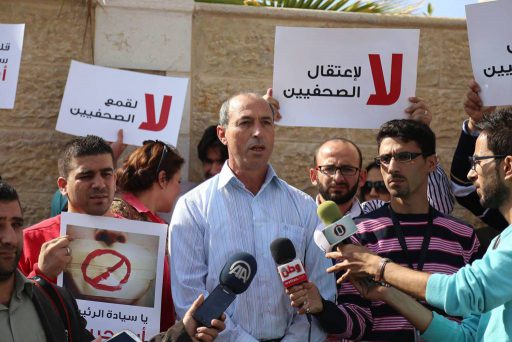
Samidoun Palestinian Prisoner Solidarity Network – April 6, 2017
Palestinian journalist and former prisoner Omar Nazzal recently reported on his Facebook page about a series of restrictions that have been issued by Israeli occupation forces against him through military orders. Nazzal was released from administrative detention on 20 February after 10 months of imprisonment without charge or trial; since that time, he has been slapped with a two-year travel ban preventing him from leaving occupied Palestine; banned from Jerusalem and Palestine ’48 for 99 years; and forbidden from opening bank accounts until further notice.
Nazzal was seized by Israeli occupation forces in April 2016 as he attempted to enter Jordan through the Karameh/Allenby crossing en route to the European Federation of Journalists conference in Sarajevo, Bosnia and Herzegovina. He is a member of the Secretariat of the Palestinian Journalists Syndicate and president of the Assembly of Democratic Journalists. His detention was internationally condemned by the EFJ, the International Federation of Journalists and other international associations.
There are currently 24 Palestinian journalists imprisoned in Israeli jails, the Palestinian Media Assembly reported on 2 April on March violations of the rights of journalists by the Israeli occupation. They include the five journalists of Sanabel Radio, who have been imprisoned since August 2016, when occupation forces invaded the radio station, abducting all of the staff present. Nine journalists were arrested in March, including Samah Dweik, Hassan Sawan, Mohammed Abed Rabbo, Khaleda Ghosheh, Raed Abu Remaileh (since released) and Mohammed Batrakh, Ayoub Sawan, Asim Mustafa and Musab al-Said (all still detained.)
Palestine TV correspondent Ahmed Shawar was injured by rubber-coated metal bullets as he covered a demonstration against settlements and the apartheid wall in Kufr Qaddoum. In addition, multiple photographers were injured in Nabi Saleh by Israeli occupation forces, including Rasha Herzallah, Hamza Shalash, Essam Rimawi, Mohammed Turkman, Majdi Shtayyeh, Abbas Momani and Saleh Hamad. In Kafr Malek, Nasser Shyoukhi and Abdel-Kader Bilbeisi were injured after inhaling tear gas. In addition, Israeli occupation forces attacked and confiscated several print shops, including Nahda in Tulkarem, Ibn Khaldoun in Tulkarem and Dozan in Bethlehem.
Israeli occupation forces stormed the home of Palestinian cartoonist Osama Nazzal on 27 March, smashing his paintings on the wall and drawing tools as well as confiscating other artwork.
Israeli settler attempts to run over Palestinians near Hebron
Ma’an – April 7, 2017
HEBRON – Two Palestinians from the Hebron-area village of Beit Ummar were lightly injured Friday after an Israeli settler attempted to run them over on a main road connecting the southern occupied West Bank city of Hebron to Jerusalem.
Local activist Muhammad Awad told Ma’an that an Israeli settler was driving on the road, located near Beit Ummar, when the settler attempted to to run over Palestinians Muhammad Basem Khader al-Alami, 25, and Saed Samir Hassan al-Salibi, 20.
“The Israeli settler drove very fast with his car towards the two, who noticed the settler’s car rushing towards them at the last moment, causing them to fall on the side of the street, while the Israeli settler escaped,” Awad said, describing the scene to Ma’an.
An Israeli army spokesperson said they were looking into reports.
The incident came a day after Israeli settlers from the illegal settlement of Yitzhar in the northern West Bank closed a Nablus-area road in protest, calling for “revenge” on Palestinians after an alleged car-ramming attack was carried out earlier in the day near the illegal Israeli Ofra settlement in Ramallah, which killed an Israeli soldier and wounded another moderately.
Incidents involving Israeli settlers hitting Palestinians in the occupied Palestinian territory are a relatively regular occurrence, and are usually treated by Israeli security forces as accidents, even in cases when witnesses claim the car rammings were deliberate.
Many Palestinian activists and rights groups have accused Israel of fostering a “culture of impunity” for Israeli settlers and soldiers committing violent acts against Palestinians.
Between 500,000 and 600,000 Israelis live in Jewish-only settlements across occupied East Jerusalem and the West Bank in violation of international law, with announcements of settlement expansion earlier this year sparking condemnation from the international community.
According to the United Nations Office for the Coordination of Humanitarian Affairs (OCHA), there were a total of 107 reported settler attacks against Palestinians and their properties in the West Bank and occupied East Jerusalem in 2016.
Trump Likely Manipulated Into Ordering Missile Attacks on Syria
Sputnik – 08.04.2017
WASHINGTON – US President Donald Trump appears to have been psychologically profiled and manipulated into ordering cruise missile airstrikes against Syria, former US Air Force Lieutenant Colonel Karen Kwiatkowski told Sputnik.
On Friday, US senior military officials disclosed declassified intelligence information to lay out reasoning behind the attack on the Syrian military airfield in Ash Sha’irat near Homs late Thursday.
“Trump appears to have been easily manipulated into this response,” Kwiatkowski said on Friday. “It could have not been more effective if President Trump had been psychologically profiled and specifically manipulated into this ‘surprise’ decision.”
Trump’s instinctive response to the first pictures of the use of chemical weapons “would have been easily predictable from a psychological analysis,” Kwiatkowski stated.
Kwiatkowski pointed out that parts of US foreign policy, defense and intelligence community and their supporters in the media had been very concerned over Trump’s long-expressed “America First” foreign policy approach.
“Reported events [on] Tuesday in Idlib served these interests well, and I believe it was an opportunity for these factions to attempt to prolong the wars in the Middle East, and ultimately further entrench their business and political interests,” she observed.
Kwiatkowski noted that Trump had ordered the missile strikes against Syrian military targets without taking action to carefully confirm Damascus had actually delivered the weapons and detonated them.
“Because evidence at the Syrian Air Base in Homs has likely been compromised by the impacts of 59 Tomahawk cruise missiles, the investigation will be even more difficult to conduct,” she remarked.
Kwiatkowski said she was surprised at the eagerness with which the US media joined the call for an attack, given the lack of concrete analysis of what happened in Idlib on Tuesday.
“It is as if the western media, time and time again, receives talking points from various governmental factions and republishes them uncritically and without verification,” she said.
Kwiatkowski expressed the hope that Trump would come to realize his cruise missile order had been premature and that he would revert to his previous efforts to reduce US military involvement across the Middle East.
“I personally believe that the percolation of correct intelligence will soon reach the White House, and US policy will revert back to Trump’s original position in the region, which is military disengagement and real self-determination for people there,” she said.
Some US officials were working to try and protect Islamic State fighters from being captured by Syrian government forces and finding protection for them after all the outrages they had perpetrated, Kwiatkowski warned.
“It seems to me that in Mosul and throughout Syria, IS fighters and leaders who have worked with the US are trying to ensure that they will be protected, and the US may be trying to ensure that many of its former ‘rebel’ colleagues are… provided safe haven out of the countries,” she said.
However, the search for truth about what really happened in the chemical weapons attack at Idlib would continue aggressively, Kwiatkowski concluded.
Trump’s ‘Wag the Dog’ Moment
By Robert Parry | Consortium News | April 7, 2017
Just two days after news broke of an alleged poison-gas attack in northern Syria, President Trump brushed aside advice from some U.S. intelligence analysts doubting the Syrian regime’s guilt and launched a lethal retaliatory missile strike against a Syrian airfield.
Trump immediately won plaudits from Official Washington, especially from neoconservatives who have been trying to wrestle control of his foreign policy away from his nationalist and personal advisers since the days after his surprise victory on Nov. 8.
There is also an internal dispute over the intelligence. On Thursday night, Secretary of State Rex Tillerson said the U.S. intelligence community assessed with a “high degree of confidence” that the Syrian government had dropped a poison gas bomb on civilians in Idlib province.
But a number of intelligence sources have made contradictory assessments, saying the preponderance of evidence suggests that Al Qaeda-affiliated rebels were at fault, either by orchestrating an intentional release of a chemical agent as a provocation or by possessing containers of poison gas that ruptured during a conventional bombing raid.
One intelligence source told me that the most likely scenario was a staged event by the rebels intended to force Trump to reverse a policy, announced only days earlier, that the U.S. government would no longer seek “regime change” in Syria and would focus on attacking the common enemy, Islamic terror groups that represent the core of the rebel forces.
The source said the Trump national security team split between the President’s close personal advisers, such as nationalist firebrand Steve Bannon and son-in-law Jared Kushner, on one side and old-line neocons who have regrouped under National Security Adviser H.R. McMaster, an Army general who was a protégé of neocon favorite Gen. David Petraeus.
White House Infighting
In this telling, the earlier ouster of retired Gen. Michael Flynn as national security adviser and this week’s removal of Bannon from the National Security Council were key steps in the reassertion of neocon influence inside the Trump presidency. The strange personalities and ideological extremism of Flynn and Bannon made their ousters easier, but they were obstacles that the neocons wanted removed.
Though Bannon and Kushner are often presented as rivals, the source said, they shared the belief that Trump should tell the truth about Syria, revealing the Obama administration’s CIA analysis that a fatal sarin gas attack in 2013 was a “false-flag” operation intended to sucker President Obama into fully joining the Syrian war on the side of the rebels — and the intelligence analysts’ similar beliefs about Tuesday’s incident.
Instead, Trump went along with the idea of embracing the initial rush to judgment blaming Assad for the Idlib poison-gas event. The source added that Trump saw Thursday night’s missile assault as a way to change the conversation in Washington, where his administration has been under fierce attack from Democrats claiming that his election resulted from a Russian covert operation.
If changing the narrative was Trump’s goal, it achieved some initial success with several of Trump’s fiercest neocon critics, such as neocon Senators John McCain and Lindsey Graham, praising the missile strike, as did Israeli Prime Minister Benjamin Netanyahu. The neocons and Israel have long sought “regime change” in Damascus even if the ouster of Assad might lead to a victory by Islamic extremists associated with Al Qaeda and/or the Islamic State.
Wagging the Dog
Trump employing a “wag the dog” strategy, in which he highlights his leadership on an international crisis to divert attention from domestic political problems, is reminiscent of President Bill Clinton’s decision to attack Serbia in 1999 as impeachment clouds were building around his sexual relationship with intern Monica Lewinsky.
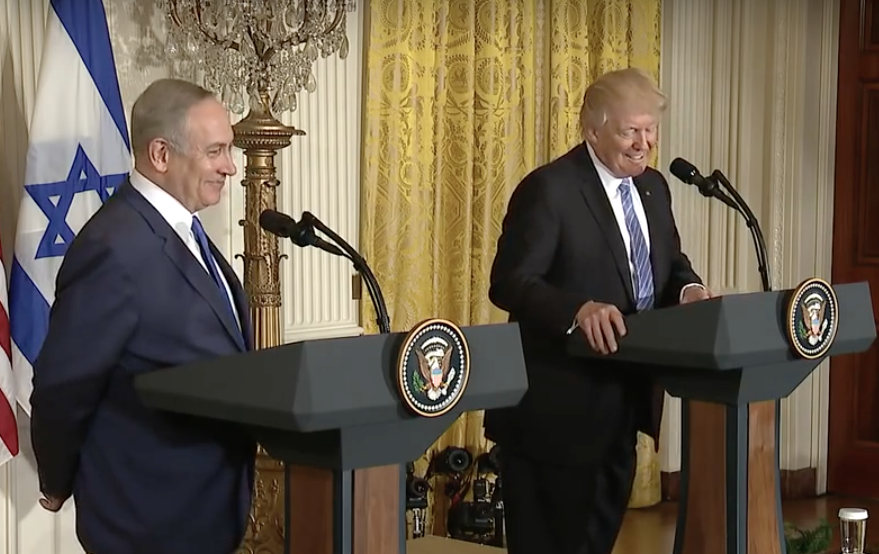
Screen shot from Whitehouse.gov
Trump’s advisers, in briefing the press on Thursday night, went to great lengths to highlight Trump’s compassion toward the victims of the poison gas and his decisiveness in bombing Assad’s military in contrast to Obama’s willingness to allow the intelligence community to conduct a serious review of the evidence surrounding the 2013 sarin-gas case.
Ultimately, Obama listened to his intelligence advisers who told him there was no “slam-dunk” evidence implicating Assad’s regime and he pulled back from a military strike at the last minute – while publicly maintaining the fiction that the U.S. government was certain of Assad’s guilt.
In both cases – 2013 and 2017 – there were strong reasons to doubt Assad’s responsibility. In 2013, he had just invited United Nations inspectors into Syria to investigate cases of alleged rebel use of chemical weapons and thus it made no sense that he would launch a sarin attack in the Damascus suburbs, guaranteeing that the U.N. inspectors would be diverted to that case.
Similarly, now, Assad’s military has gained a decisive advantage over the rebels and he had just scored a major diplomatic victory with the Trump administration’s announcement that the U.S. was no longer seeking “regime change” in Syria. The savvy Assad would know that a chemical weapon attack now would likely result in U.S. retaliation and jeopardize the gains that his military has achieved with Russian and Iranian help.
The counter-argument to this logic – made by The New York Times and other neocon-oriented news outlets – essentially maintains that Assad is a crazed barbarian who was testing out his newfound position of strength by baiting President Trump. Of course, if that were the case, it would have made sense that Assad would have boasted of his act, rather than deny it.
But logic and respect for facts no longer prevail inside Official Washington, nor inside the mainstream U.S. news media.
Intelligence Uprising
Alarm within the U.S. intelligence community about Trump’s hasty decision to attack Syria reverberated from the Middle East back to Washington, where former CIA officer Philip Giraldi reported hearing from his intelligence contacts in the field that they were shocked at how the new poison-gas story was being distorted by Trump and the mainstream U.S. news media.
Giraldi told Scott Horton’s Webcast: “I’m hearing from sources on the ground in the Middle East, people who are intimately familiar with the intelligence that is available who are saying that the essential narrative that we’re all hearing about the Syrian government or the Russians using chemical weapons on innocent civilians is a sham.”
Giraldi said his sources were more in line with an analysis postulating an accidental release of the poison gas after an Al Qaeda arms depot was hit by a Russian airstrike.
“The intelligence confirms pretty much the account that the Russians have been giving … which is that they hit a warehouse where the rebels – now these are rebels that are, of course, connected with Al Qaeda – where the rebels were storing chemicals of their own and it basically caused an explosion that resulted in the casualties. Apparently the intelligence on this is very clear.”
Giraldi said the anger within the intelligence community over the distortion of intelligence to justify Trump’s military retaliation was so great that some covert officers were considering going public.
“People in both the agency [the CIA] and in the military who are aware of the intelligence are freaking out about this because essentially Trump completely misrepresented what he already should have known – but maybe he didn’t – and they’re afraid that this is moving toward a situation that could easily turn into an armed conflict,” Giraldi said before Thursday night’s missile strike. “They are astonished by how this is being played by the administration and by the U.S. media.”
One-Sided Coverage
The mainstream U.S. media has presented the current crisis with the same profound neocon bias that has infected the coverage of Syria and the larger Middle East for decades. For instance, The New York Times on Friday published a lead story by Michael R. Gordon and Michael D. Shear that treated the Syrian government’s responsibility for the poison-gas incident as flat-fact. The lengthy story did not even deign to include the denials from Syria and Russia that they were responsible for any intentional deployment of poison gas.
The article also fit with Trump’s desire that he be portrayed as a decisive and forceful leader. He is depicted as presiding over intense deliberations of war or peace and displaying a deep humanitarianism regarding the poison-gas victims, one of the rare moments when the Times, which has become a reliable neocon propaganda sheet, has written anything favorable about Trump at all.
According to Syrian reports on Friday, the U.S. attack killed 13 people, including five soldiers at the airbase.
Gordon, whose service to the neocon cause is notorious, was the lead author with Judith Miller of the Times’ bogus “aluminum tube” story in 2002 which falsely claimed that Iraqi leader Saddam Hussein was reconstituting a nuclear-weapons program, an article that was then cited by President George W. Bush’s aides as a key argument for invading Iraq in 2003.
Regarding this week’s events, Trump’s desperation to reverse his negative media coverage and the dubious evidence blaming Assad for the Idlib incident could fit with the “Wag the Dog” movie from 1997 in which an embattled president creates a phony foreign crisis in Albania.
In the movie, the White House operation is a cynical psychological operation to convince the American people that innocent Albanian children, including an attractive girl carrying a cat, are in danger when, In reality, the girl was an actor posing before a green screen that allowed scenes of fiery ruins to be inserted as background.
Today, because Trump and his administration are now committed to convincing Americans that Assad really was responsible for Tuesday’s poison-gas tragedy, the prospects for a full and open investigation are effectively ended. We may never know if there is truth to those allegations or whether we are being manipulated by another “wag the dog” psyop.
Investigative reporter Robert Parry broke many of the Iran-Contra stories for The Associated Press and Newsweek in the 1980s.
Israel seeks buffer zone on borders with Syria
MEMO | April 8, 2017
Israeli Prime Minister Benjamin Netanyahu is seeking a buffer zone against Syria, Iran and Hezbollah on the borders with Syria to be part of any future deal to end the Syrian crisis, Israeli newspaper Haaretz reported on Friday.
According to the Israeli newspaper, Netanyahu proposed this issue during meetings with American and other coalition countries.
Netanyahu wants to prevent Iran and Hezbollah from establishing a foothold and he intends to undermine future attacks against Israel, noting that he had suggested international forces to supervise his proposed buffer zone.
Last Friday, the Israeli Maariv revealed that Netanyahu sent messages to the international parties involved in the talks about Syria’s future.
These messages, according to the Egyptian news website Moheet, suggested Israel’s desire to decrease its reliance on military attacks on Syria in exchange for reaching a silent agreement that Iran and Hezbollah do not approach the Armistice Line in the occupied Golan Heights.
Maariv said that Israel would accept the return of the Syrian army to the border area connected with the occupied Palestinian territories based on a 1974 deal between the two.
Meanwhile, the Israeli newspaper reported fears from the Israeli political and military leadership from reaching a deal which kept Bashar Al-Assad as president and this would give Iran the chance to deploy forces loyal to it in areas close to the Golan Heights.
Over the past year, the Israeli military has carried out several airstrikes deep inside Syria, targeting Hezbollah’s personnel and weapons.
Silwan Palestinians receive evacuation orders due to damage caused by Israeli tunnels
Ma’an – April 6, 2017
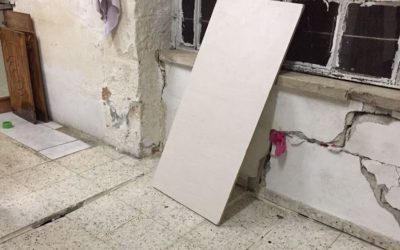
JERUSALEM – The Israeli municipality of Jerusalem issued evacuation orders for three housing apartments in the Wadi Hilweh area of the occupied East Jerusalem neighborhood of Silwan on Wednesday evening, due to fractures and cracks formed at the base of the houses, as Israeli authorities continued work on a tunnel network expected to be used to provide services to Israeli settlers.
According to the Wadi Hilweh Information Center, the houses belong to Hamed Oweida, Abed Oweida, and Suleiman Oweida.
Sixteen family members, including ten children, reside in the houses.
The Oweida family said that Israeli tunnel-digging under their homes has increased over the past three days, adding that loud noises from the digging would last for several hours, while the family could feel their houses shaking during the construction.
They said that the digging had caused severe damage of fractures and cracks in the walls and the bases of the houses.
The family added that they had called the Israeli police, who had then summoned a municipality team to inspect the houses. After taking photographs and inspecting the damage, an architect for the municipality decided to issue an emergency order for the families to evacuate and seal the houses, saying that it was dangerous to remain inside.
Suleiman Oweida had left his house several days ago after fractures in the walls had become more severe.
The information center said that Israeli authorities were creating a tunnel network for Israeli settlers directly under the Oweida family’s house.
Member of the Wadi Hilweh neighborhood committee Ahmad Qarrain said that the Israeli authorities began work under the neighborhood in 2007.
The residents at the time appealed to Israeli courts and were able to halt the construction under their homes for 14 months. However, Israeli courts later issued another order allowing the work to continue on the condition that the digging not endanger the lives of residents.
However, Qarrain said that the digging and work under the houses continued “without any consideration for the safety of residents,” and pointed out that the streets, walls, structures, and houses of the neighborhood have also been fractured and collapsed owing to the tunnel work.

A spokesperson for the Israeli Jerusalem municipality told Ma’an that the municipality had informed the residents that their properties were “unsound and dangerous” out of “concern for their own welfare,” while also being built “without regard for building codes or safety standards.”
The spokesperson added that “claims that the city is attempting to construct underneath this family’s structure are patently false.”
The Dangerous Liaisons of French Banks with the Israeli Occupation
CounterPunch News Service | April 6, 2017
Executive Summary
While the year 2017 marks the 50th anniversary of the Israeli occupation in the Occupied Palestinian Territories, the Israeli government’s colonization project in the West Bank and East Jerusalem has accelerated dramatically.
The very existence of Israeli settlements is illegal under international law. It is accompanied by numerous restrictions imposed on the Palestinian population, restrictions that violate their most fundamental rights and deprive them of the conditions that make a decent life possible.
The UN(1), the European Union(2) and the French government(3) have affirmed on numerous occasions and, most recently, in the major resolution of the UN Security Council of 23 December 2016: the Israeli settlements in the Occupied Palestinian Territories are not part of Israel as defined by the 1967 frontiers and are illegal under international law.
These settlements, “which do not cease to undermine a two state solution and to impose on the ground the reality of one state”(5), remain a major obstacle to any resolution of the conflict. The same Security Council resolution also requires [par. 5] that all states, ‘in their relevant dealings’, make a distinction between the territory of the state of Israel and the territories occupied since 1967.
The Israeli banking system constitutes an essential tool of the colonization project, and Israeli businesses contribute to the maintenance and development of the settlements. In this context, the principal French financial institutions, in continuing to support Israeli banks and businesses involved in the settlements, contribute indirectly to the maintenance and development of this illegal situation with respect to international law.
Five major French financial groups – BNP Paribas, Crédit Agricole, Société Générale, [the state-owned] Banque Populaire Caisse d’Epargne, AXA – manage financial holdings or hold shares in Israeli banks or businesses involved in financing settlements in the Occupied Palestinian Territories and which furnish services vital to the maintenance and development of the settlements – such as housing or factory construction, the provision of telecommunications connections or of surveillance equipment.
Added to that financial involvement, the four largest French banks – in this instance BNP Paribas, Société Générale, LCL (subsidiary of Crédit Agricole) and Natixis (investment bank subsidiary of BPCE) – have granted loans to the total of €288 million for the period 2004-2020 to the state enterprise Israel Electric Corporation (IEC) for a project for two gas-fired power plants(6), while IEC is providing electricity to the illegal settlements in the Occupied West Bank.
The French government is responsible at three levels:
1) Obligations under international law (the UN’s ‘protect, respect and remedy’ framework of its Guiding Principles, to not recognize as legitimate a situation created by a grave violation of international law, nor to aid or assist in the maintenance of this situation, and to cooperate to dismantle such situations).(7)
2) An obligation to protect against human rights violations by third parties, including businesses and banks.(8)
3) A particular obligation, as 20 per cent shareholder in Alstom [2004-06, 2014-], to apply rigorous controls when a business is state-owned or state-controlled, even when the state is a minority shareholder.(9) Alstom is the contractor for one of the two gas-fired power plants [partly financed by French banks], as noted above. [Siemens is the contractor for the other plant.]
The signatory organizations of this report have exhorted the French banks and insurance companies to conform to international principles in ceasing all financing of the Israeli colonization project. Numerous financial institutions, public and private, European and American, and pension funds(10) have already taken this step and have disengaged from Israeli entities which support the settlements, in contrast to the French financial institutions targeted in this report. To this day, no French bank has committed itself to cease financing entities which contribute to the development of settlements on Palestinian territory, despite unmistakable infringements on human rights, and in spite of undertakings with respect to human rights of the banks mentioned in this report and their adhesion to one or more directives on a voluntary basis.
The risks of new financing linked notably to the extension of the East Jerusalem light rail by Alstom(11), 20 per cent owned by the state itself, reinforces the urgency of strong commitments. It is not too late to act: the French banks must make commitments in conformity with international law and announce publicly the end of all financial support to entities that facilitate the maintenance and development of the illegal settlements in the Occupied Palestinian Territories.
The signatory organizations request:
To the French banks to:
* withdraw all financing, direct or indirect, from banks and Israeli businesses involved in the development of the settlements;
* commit themselves publicly to no longer finance such entities;
* develop a credible policy aiming to exclude from their operations all businesses involved with the settlements.
To the French state to:
* respect its international obligations, notably those resulting from violations of the imperatives of international law by Israel and those pertaining to the UN’s ‘protect, respect and remedy’ human rights framework.
* pursue all means to prevent any participation or investment of French businesses which contribute to Israeli colonization(12);
* implement the UN’s Guiding Principles with respect to businesses and human rights and to ensure that the corporations under its jurisdiction, including banks, do not prejudice the full realization of fundamental rights in France and abroad;
* supervise respect for the law relative to the duty of vigilance of parent and contracting companies.
* support, at the UN, the process for the elaboration of an international treaty on human rights and transnational corporations and other businesses.
Notes.
(1) Resolution adopted by the General Assembly on 11 December 2013: 68/82. Israeli settlements in the Occupied Palestinian Territory, including East Jerusalem, and the occupied Syrian Golan.
(2) Council of the European Union, Council Conclusions on the Middle East Peace Process, 18 January 2016.
(3) France Diplomatie, Israël/Territoires Palestiniens, Securité, 2 December 2016.
(4) UN Security Council, Resolution 2334, 23 December 2016.
(5) See Resolution 2334 preamble.
(6) Global Trade Review, Germans Back Israel Electric [Corporation], 23 February 2004.
(7) The document here cites Trading Away Peace: How Europe helps sustain illegal Israeli settlements, October 2012.
(8) According to the Guiding Principles 11 to 24 of the United Nations. Moreover, note Principle no.7: “Because the risk of gross human rights abuses is heightened in conflict-affected areas, States should help ensure that business enterprises operating in those contexts are not involved with such abuses, including by:(a) Engaging at the earliest stage possible with business enterprises to help them identify, prevent and mitigate the human rights-related risks of their activities and business relationships; [etc.]”.
(9) The Guiding Principles of the UN, and notably Principle no.4, regarding state-owned enterprises: “States should take additional steps to protect against human rights abuses by business enterprises that are owned or controlled by the State, or that receive substantial support and services from State agencies such as export credit agencies and official investment insurance or guarantee agencies, including, where appropriate, by requiring human rights due diligence. … Moreover, the closer a business enterprise is to the State, or the more it relies on statutory authority or taxpayer support, the stronger the State’s policy rationale becomes for ensuring that the enterprise respects human rights.” The UN’s ‘Working Group on the issue of human rights and transnational corporations and other business enterprises’ had its mandate extended in June 2014. The Working Group has equally highlighted the responsibility of states to take additional measures to guard against infringement on human rights by state-owned or state-controlled businesses.
(10) This is notably the case for the Norwegian government pension funds (2010), the Netherlands’ PGGM pension fund (2013), the Luxembourg FDC pension funds (2014), the Danish Danske Bank (2014) and German Deutsche Bank (2014) and the pension funds of the US Methodist Church (2016).
(11) Pertinent information became publicly available in June 2016, indicating that a commercial agreement had been signed between the Israeli government and the Israeli consortium Citypass and Alstom to extend the Jerusalem light rail network. Alstom and the French government have been contacted and advised by one of our organizations in June and September 2016, and have not denied the existence of this agreement. One might reasonably infer that this contract, of the order of €350 million, will require bank finance. [Resistance against French corporate involvement in this project has a long history.]
(12) In complementing the advice of the French Foreign Affairs Ministry, as per fn. (3).
§ From Le Liaison Dangereuses de Banques Françaises avec La Colonisation Israélienne, March 2017. The report was compiled under the auspices of the following NGOs: Al-Haq, AFPS, CCFD -Terre Solidaire, CGT, FIDH, Fair Finance France, LDH, and Union Syndicale Solidaires.
Translated by Evan Jones.
Putin rebukes Netanyahu over ‘groundless’ accusations on suspected chemical incident in Syria
RT | April 6, 2017
Russian President Vladimir Putin told Israeli Prime Minister Benjamin Netanyahu in a telephone conversation that it was unacceptable to make “groundless” accusations concerning the alleged chemical weapons incident that took place in Syria earlier this week.
During the phone call initiated by the Israeli side on Thursday, Putin and Netanyahu stressed the importance of boosting international efforts to tackle terrorism, the Kremlin said in a statement.
Both sides “expressed readiness to expand [cooperation] in the interest of assuring stability and security in the Middle East and, first of all, in Syria,” it said.
In particular, Putin “pointed out that it was unacceptable to make groundless accusations against anyone without conducting a detailed and unbiased investigation.”
At least 70 people, including 11 children, were reportedly killed in a suspected chemical incident in the town of Khan Sheikhoun in Iblib province, Syria, on Tuesday. The US and its allies have put the blame on the Syrian government.
Earlier on Thursday, Israeli Defense Minister Avigdor Lieberman told the Yedioth Ahronoth newspaper that he was sure Syrian government forces were behind the “chemical weapons attack” in Idlib.
“The two murderous chemical weapons attacks on civilians in the Idlib region in Syria and on the local hospital were carried out by direct and premeditated order of Syrian President Bashar Assad, with Syrian planes. I say this with 100 percent certainty,” Lieberman said.
The defense minister criticized the ‘international community’ for having “zero” reaction to the incident, stressing that “the world needs to take responsibility and, instead of just talking, needs to do something.”
When asked if Russia was somehow involved in the chemical weapons attack, Liberman replied “we don’t know.”
The Russian Defense Ministry said the Syrian military carried out airstrikes in Khan Sheikhoun on April 4, hitting production facilities where terrorists stored chemicals, which were previously used in Iraq and the Syrian city of Aleppo.
Syrian Foreign Minister Walid Muallem has dismissed any accusations that the Syrian Army deployed chemical weapons in Idlib.
It’s impossible that the army – which has been making significant gains in almost all theaters of the Syrian war – would use banned chemical weapons against its “own people” and even terrorists, the minister said.
Wadi Qana’s Palestinian farmers endure another mass tree uprooting
International Solidarity Movement | April 5, 2017
Hebron, occupied Palestine – Just days after Palestinians commemorated Land Day, a day which marks the struggle against the Israeli government’s expropriation of Palestinian land, farmers of Wadi Qana endured another mass uprooting and theft of their trees.
Speaking from his home in the Salfit district village of Deir Istiya, Palestinian activist Rezeq Abu Nasser cited the frustrating chronology, “This is the third time they took my trees. They stole them in 2013 and 2015 as well.” He then handed ISM volunteers the Arabic/Hebrew notice that he found posted on a fence he erected at a cost of over 1,000 NIS to protect his trees. Abu Nasser’s fence was also dismantled and seized along with 25 of his trees.
The notice received by four Palestinian farmers demands that they uproot their own trees or face arrest and/or fines to cover the cost of Israeli occupation forces uprooting the trees for them. Soon after, 135 trees were uprooted and stolen during the small hours of morning. Several bulldozers entered the valley, hauled large stones into the road to block the entryway and rammed through part of a 40 meter stone wall to access the trees.
Citing environmental justifications for these aggressive acts of theft, an Israeli government spokesperson for the Coordinator of Government Activities in the Territory was quoted as saying that the trees were uprooted due to their “damaging the natural view and value of the nature resort.” Claiming the act to be one of protection of the view of a lush valley from the sight of trees is even more absurd, given that the Israeli forces left a partially demolished stone wall and broken tree limbs scattered atop a small field of holes where the trees once took root.
While speaking to the Mayor of Deir Istiya, his office produced copies of the issued warrants for the threatened trees and the generations old British land deeds affirming the farmers’ rights to their ancestral land. The Mayor of Deir Istiya described arriving at the Wadi Qana immediately after being alerted to the uprootings in progress, only to find the road blockage Israeli forces left to keep farmers and residents from defending their land. As for the stone wall, he claimed,”This is a new experience for us that they demolished the stones.”
The farmers who lost their trees, tantamount to their livelihood, plan to continue their struggle against these incursions by furthering their cases with the local municipality. As for Abu Nasser, “I’m going to replant them again.”
‘Can’t apologize for telling truth’: Suspended ex-London Mayor Livingstone avoids Labour expulsion
RT | April 5, 2017
A Labour Party committee upheld the charges leveled at Ken Livingstone for his comments about the links between Hitler and Zionism last year, but did not expel the former mayor of London from its ranks. The time-limited sanction has provoked outrage from Jewish groups.
Following two days of legal and historical deliberations behind closed doors, the National Constitutional Committee found the 71-year-old, who had been suspended from the party since April 2016, guilty of three counts of conduct that is “prejudicial or… grossly detrimental to the party.” Livingstone, who says that he has no plans to return to frontline politics, is barred from holding any position in the party, or running as a Labour candidate until April 2018.
In the wake of the hearing, an unrepentant Livingstone told the media that proceedings resembled “sitting through a court in North Korea,” and complained that “natural justice” had not been done, and said that those who called him “anti-Semitic” and a “Nazi apologist” should have gone in front of the panel instead.
“If I’d said Hitler was a Zionist, I would say sorry. You can’t apologize for telling the truth. I apologize for the offence caused by those Labour MPs who lied,” insisted Livingstone, who said that he was smeared due to his connections with Labour Party Leader Jeremy Corbyn, by the latter’s political opponents.
‘Hitler-Zionist collaboration’ controversy
In his original remarks last year, made in defense of Naz Shah, a Labour MP also accused of anti-Semitism, Livingstone claimed that Hitler “was supporting Zionism before he went mad and ended up killing 6 million Jews.”
Instead of retracting his comments, Livingstone, who led the Greater London Council in the 1980s and served as the city’s mayor between 2000 and 2008, has tried to clarify his views, focusing on the 1933 Haavara agreement between Zionist German Jews and the Nazi authorities, which enabled some to emigrate to present-day Israel, and transfer some of their assets out of the country.
“[Hitler] didn’t just sign the deal. The SS set up training camps so that German Jews who were going to go [to Palestine] could be trained to cope with a very different sort of country when they got there,” Livingstone said last month.
“He passed a law saying the Zionist flag and the swastika were the only flags that could be flown in Germany… Of course, they started selling Mauser pistols to the underground Jewish army. So you had right up until the start of the Second World War real collaboration.”
Suspension a ‘slap on the wrist’
The Jewish Labour Movement, which had submitted a 178-page report to the panel challenging Livingstone’s version of history and criticizing his “disparaging, inaccurate and out-of-context comments,” said that Tuesday’s decision was a “betrayal” of the party.
“This punishment is totally insufficient. They don’t match the leadership’s commitment to zero tolerance on anti-Semitism. They imply a revolving door policy in which you can revise the history of the Holocaust, sit quietly for a year then come back and do it all again,” said Jeremy Newmark, the chair of the Jewish Labour Movement.
“Mr Livingstone’s inaccurate and antagonistic comments including over the past 40 years have had a huge impact on the Jewish community,” said Simon Johnson, the chief executive of the Jewish Leadership Council.
In excess of 20 Labour MPs, who had called for Livingstone to be expelled, expressed their unhappiness with the suspension, with Anna Turley calling it “weak and shameful” and Lisa Nandy calling the decision a “sad day” for the Labour Party.
Featured Video

Why the U.S. Should Pull Back From the First Island Chain
or go to
Aletho News Archives – Video-Images
From the Archives
Only 19.7% of Americans agree with US State Dept on Israeli settlements
… Most American adults of voting age don’t appear willing to reject the applicability of international law to Israel’s ongoing colonization of occupied territories in East Jerusalem, the West Bank and Golan Heights. … Full article
Blog Roll
 Aletho News
- British Government Employees Were Fact-Checking the News at the BBC. Nobody Told You.
- Albania on fire: who’s behind the riots?
- Egypt’s Civil Democratic Movement rejects involvement in regional war
- Egypt collaborates with Israel to build ‘Green Rafah’ project over erased Palestinian city
- Rising fuel prices and shortages have helped drive ongoing protests and rioting in France
- Tokyo protests demand Takaichi’s resignation over support for ‘Israel’
- Jennifer Kavanagh: Why the U.S. Should Pull Back From the First Island Chain
- Yemen denounces international community’s silence on Saudi aggression, siege
- UAE and Saudi Arabia move toward renewed coordination against Sanaa
- How Iran’s two-week retaliatory strikes exposed cracks in US military architecture in Persian Gulf
- If Americans Knew
- More on how Bari Weiss is using CBS on behalf of Israel
- What the UK Is Doing to Pro-Palestine Novelist Sally Rooney Is an Act of Orwellian Villainy
- ‘We will build palaces for Jews in Gaza’: Right-wing activists establish new outpost near border
- ‘You see us burning, you stay silent’: Family’s agony over mother and sons burned to death in Gaza tent
- Israel keeps Palestinian journalist Bushra al-Tawil in isolation for 46 days
- US-Israel integration plan puts US military tech in Israel’s hands
- Israeli Strike Burns Gaza Mother Alive in Front of Toddler, ‘Without Generating Any Headlines’
- ‘The Israel Experience with Mike Huckabee’: The Ambassador’s Family Sells Trips to Israel
- As Gazans carry out mass burial, food insecurity is getting worse – Daily Update
- Israeli rabbi permits occupiers to steal Palestinian olive harvest in West Bank
- No Tricks Zone
- Predictions Made By Renowned Climate Proifessor Over Past Decades Have Been Proven To Be Poor
- New Study Suggests Large Regions Of The Pacific Ocean Have Been Cooling For The Last 80 Years
- Germany’s Green Energy Debacle: High Energy Costs Force Kahla Porzellan to Close After 182 Years!
- New Study: 50 Years Of The Most Aggressive ‘Net Zero’ Policies Can Only Affect The Global Climate By 0.03°C
- US September “Heat” Was No Record…Many Records Set Decades Ago
- Latest European Green Energy Debacle; Portugal’s Largest Flagship Solar Park Insolvent!
- Green Energy Debacle: German Expert Professor Fritz Vahrenholt Warns Of Severe Economic And Social Consequences
- Two More Paleo Reconstructions Affirm Meters-Higher Sea Levels Across Ireland, Brazil 7000-6000 Years Ago
- New Study: Earth And Venus Surface Warmth Largely Explained By Convection And Lapse Rate, Not CO2 Or Radiation
- 2025 Nature Paper Claiming Worsening Global Drought Gets RETRACTED …Heavily Flawed

