Israel renews detention of two PFLP leaders, held for 1 year without charge
Ma’an – June 4, 2016
RAMALLAH – Israeli authorities decided to renew the administrative detention of two PFLP leaders for six additional months, the Palestinian Prisoners’ Center for Studies said on Saturday, a day after leading member of the PFLP Khalida Jarrar was released from Israeli custody.
The center said in a statement that Jamal Barham, 56, and Shahir Ali al-Rai, 47, have been in Israel’s Ktziot prison in the Negev since their detention on June 3, 2015.
The center said that the two are being held for their activity in the Popular Front for the Liberation of Palestine (PFLP), which is designated by Israel as an “illegal terrorist organization.”
The majority of Palestinian political organizations are considered illegal by Israel, including those that make up the Palestine Liberation Organization (PLO), and association with such parties is often used as grounds for imprisonment, according to prisoners’ rights group Addameer.
The Israeli military prosecution said Barham and al-Rai held high ranks in the PFLP and took part in “incitement” against Israel, according to the center.
Both of the PFLP leaders had previously spent time in Israeli custody for their political activism.
Al-Rai, from the northern occupied West Bank city of Qalqilya, has spent a total of 12 years in Israeli jails, mostly under administrative detention — the controversial Israeli policy of internment without trial or charge based on undisclosed evidence.
Prior to his detention last year, Barham was arrested only once before, in December 1984, and released in August 1987.
Following his release, he and his family were the target of repeated house raids, while Barham was also wanted throughout the 1990s until the beginning of the second Intifada, according to Palestinian prisoners’ rights group Addameer.
During his detention in June 2015, Israeli forces ransacked his house, destroyed his computer, and confiscated flash drives belonging to his children.
Barham, from the village of Ramin in the northern district of Qalqiliya, was the head of the Arab Studies Department in PLO. He also suffers from various medical issues including high cholesterol, high blood pressure, and a disc in his neck.
Due to the lack of evidence against Barham to support Israel’s accusation that his previous political activity presented a security threat, his detention “is considered a violation of his right of expression and political activity,” insisted Addameer in their profile of Barham.
“His detention is arbitrary and a grave violation of the Fourth Geneva Convention. The decision to hold him under administrative detention confirms the occupation authorities’ arbitrary use of the administrative detention policy when sufficient information is not available to put any Palestinian on trial.”
Barham was among 50 other Palestinian administrative detainees that launched a boycott of Israel’s military courts in July 2015, in protest of the courts’ impartiality and “their utilization as a mere formality,” said Addameer.
The boycott served to emphasize the prisoners’ “continued detention based on secret information that neither the detainee nor his lawyer can review, and additionally to the fact that military courts are a tool to legitimize the occupation and arbitrary detention.”
Meanwhile, Palestinian lawmaker and leading member of the PFLP Khalida Jarrar was released from Israeli custody on Friday, after being held for 14 months in Israeli prison.
Detained on April 2, Jarrar was initially sentenced to six months of administrative detention, however international pressure later forced Israeli authorities to bring charges against her, all 12 of which focused on her political activism.
News of the Israeli military prosecution’s renewal of Barham’s and al-Ray’s administrative detention follows the announcement of prominent Israeli human rights organization B’Tselem last week that it was discontinuing its strategy of holding Israel accountable for its crimes against Palestinians through internal military mechanisms.
“B’Tselem has gradually come to the realization that the way in which the military law enforcement system functions precludes it from the very outset from achieving justice for the victims. Nonetheless, the very fact that the system exists serves to convey a semblance of law enforcement and justice,” the report stated.
European Commission’s Hate Speech Deal With Companies Will Chill Speech
By Jillian York | EFF | June 3, 2016
A new agreement between the European Commission and four major U.S. companies—Facebook, Google, Twitter, and Microsoft—went into effect yesterday. The agreement will require companies to “review the majority of valid notifications for removal of hate speech in less than 24 hours and remove or disable access to such content,” as well as “educate and raise awareness” with their users about the companies’ guidelines.
The deal was made under the Commission’s “EU Internet Forum,” launched last year as a means to counter what EDRi calls “vaguely-defined ‘terrorist activity and hate speech online.’” While some members of civil society were able to participate in discussions, they were excluded from the negotiations that led to the agreement, says EDRi.
The agreement has been met with opposition by a number of groups, including EDRi (of which we’re a member), Access Now, and Index on Censorship, all of which have expressed concerns that the deal with stifle freedom of expression. The decision has also sparked debate on social media, with a wide variety of individuals and groups opposing the decision under the hashtag #IStandWithHateSpeech.
But you don’t have to stand with hate speech to stand against this decision. There are several reasons to oppose this Orwellian agreement. First, while Article 19 of the International Covenant on Civil and Political Rights allows states to limit freedom of expression under select circumstances, such limitations are intended to be the exception, and are permitted only to protect the following:
-
The rights or reputations of others,
-
national security,
-
public order,
-
public health, or
-
morals.
These limits must also meet a three-part test as defined by the ICCPR: be defined by law; have legitimate aim; and be truly necessary. While some of the speech that concerns the Commission may very well qualify as illegal under some countries’ laws, the method by which they’ve sought to limit it will surely have a chilling effect on free speech.
In addition, as EDRi points out, despite a lengthy negotiation between companies and the Commission, “hate speech” remains vaguely-defined. Companies have been tasked with taking the lead on determining what constitutes hate speech, with potentially disastrous results.
In fact, social media companies have an abysmal track record when it comes to regulating any kind of speech. As Onlinecensorship.org’s research shows, speech that is permitted by companies’ terms of service is often removed, with users given few paths to recourse. Users report experiencing bans from Facebook for 24 hours to up to 30 days if the company determines they’ve violated the Community Standards—which, in many cases, the user has not. Requiring companies to review complaints within 24 hours will almost surely result in the removal of speech that would be legal in Europe.
By taking decision-making outside of the democratic system and into backrooms, and granting corporations even greater control, the European Commission is ensuring a chill on online speech.
Dreams of Control: Israel, Global Censorship and the Internet
By Binoy Kampmark | CounterPunch | June 3, 2016
“Under the cover of darkness, there is no limit to the expansion of Big Brother.”
Ilan Gilon, Meretz Party (Israel), Times of Israel, Feb 4, 2016
While Israel’s central justification for its often reactionary policies is couched in hyper-exceptionalist rhetoric, nourished by the ashes of Holocaust remembrance, current interest in censoring the Internet is far from exceptional.
Like a machine of justification against its critics and its enemies, Israel enlists various projects under the banner of the remarkable and precious, when it is simply accomplishing what other states have done before or since: the banal and ordinary. All states want to limit expression, control criticism and marginalise the sceptics. Some do it more savagely, and roughly, than others.
Israel’s military censor, Col. Ariella Ben Avraham, who is part of the IDF’s Directorate of Military Intelligence, gave a good example of this in February by insisting that social media activists and bloggers submit material relevant to security matters for approval prior to posting. The move also revealed an increasing interest to police the digital realm, previously considered an anarchic jungle incapable of effective policing.
Up to 32 Israeli bloggers and social media activists were informed about the directive, one of the first being Yossi Gurvitz, a left-wing activist running the “Friends of George” Facebook page. In rather unceremonious fashion, he was informed via Ben Avraham’s private Facebook account that he was obligated to run future submissions by her office. To his credit, he promises to defy the order.
Internal censorship is but one aspect of this policy. Israel Public Security Minister Gilad Erdan has dipped into the discourse of censorship to convince others that limiting various social media platforms on a global scale is the way to go. In January, he revealed the inner ambition of Israel’s security establishment to internationalise the censorship effort.
To achieve that goal, Erdan speaks of an “international coalition” that would make limiting criticism of Israel its primary objective. The central aim is hardly imaginative: making such providers as YouTube, Twitter and Facebook face up to responsibility as to what they host on their sites.
The Erdan plan suggests that various countries would form a “loose coalition that would keep an eye on content and where it is being posted, and members of the coalition would work to demand that the platforms remove the content that was posted in any of their countries at the request of members.” The simple idea behind this collusion is extra-territorial cooperation, effectively circumventing the global nature of such platforms.
As for the scurrilous subject matter itself, the issues are universal fare for states keen to control matters that supposedly stimulate the darker side of human nature. (Read: contrary to state interests.) Erdan’s office gives the example of material from a Palestinian (of course) disclosing the best locations on the body to inflict fatal stab wounds.
This begs that grand question about how far such an effort goes: control the more sordidly violent sides of the Old Testament because it encourages various unsavoury practices? Limit suggestive literature being discussed in the whirl of social media, buzzing away with malicious promise? The mind is an untidy place filled with remarkable things, and not all of them necessarily make it to actual perpetration. This is a point that continues to elude the mighty warriors of the security state.
Another justification is being thrown in: they, the social media giants, rake in the proceeds, and should therefore man the barricades. “We are planning to put a stop to this irresponsibility,” claimed Erdan’s office, “and we are going to do it as part of an international coalition that has had enough of this behaviour as well.”
Other governments have also done their bit to limit the internet and content available to their citizens. Most famously, Beijing runs its own “Great Firewall of China”, overseen by the Ministry of Information Industry (MII), while the State Council Information Office and the Chinese Communist Party’s Propaganda Department examine content.
In recent times, countries of a supposedly democratic character have taken to the blinds and endeavoured to do what Erdan dreams about. Dangerous thoughts are seen as the reason for dangerous actions. To that end, the country that gave Europe the Enlightenment has been busy forging its own vision of global internet censorship, using a mixture of security and privacy concerns.
The latter has proven to have potentially pernicious consequences, framed largely as an effort to protect the privacy of the French citizen. From that vantage point, a vision of global control has been built on a premise forged in European law: the right to be forgotten. The Court of Justice of the European ruling of May 13, 2014 (Google Spain v Agencia Española de Protección de Datos, Mario Costeja González) has supplied the subject matter for the latest enlargement of censorship powers.
The French response has been intrusively enthusiastic, with the privacy regulator, CNIL, fining Google 100,000 Euros in March for not applying the right to be forgotten across the global network. In the chilling words of the regulator, “For people residing in France to effectively exercise their right to be delisted, it must be applied to the entire processing operation.” Erdan may well be irritated he did not come up with that one.
Binoy Kampmark was a Commonwealth Scholar at Selwyn College, Cambridge. He lectures at RMIT University, Melbourne. Email: bkampmark@gmail.com
Israel deports 6 Palestinians to the U.S.
Palestinian Information Center – June 3, 2016
OCCUPIED JERUSALEM – The Israeli Interior Ministry and the Israeli Prison Service (IPS) at dawn on Friday deported six Palestinian citizens from Occupied Jerusalem to the U.S.
33-year-old Kareem Faysal Abu Khdheir, who was banned from Occupied Jerusalem and deported to the U.S., said as he spoke by phone from the Lod Airport: “I was transferred from the Negev jail to the airport on Thursday morning. The Israeli occupation authorities claimed the flight was scheduled for five p.m. on Thursday before they updated me that it was delayed for six a.m. on Friday.”
“I was locked up in the airport detention center with five other detainees. Each one of us was allowed to make one phone call only to update his family on the deportation order,” he added.
Kareem, from the Shu’fat refugee camp, was arrested by the Israeli occupation forces on September 5, 2015 following clashes with occupation troops. Right before the detention, Kareem was subjected to heavy beating by the Israeli Occupation Forces and sustained critical bruises in his chest, face, and teeth.
The IOA extended his remand several times despite his deteriorated health status.
Deliberations and hearings held by the Israeli Magistrate’s court over the past four months culminated in a verdict that condemned Abu Khdheir, a holder of American citizenship, for involvement in Jerusalem demonstrations and sentenced him to nine months and a fine of 8,000 shekels.
Born and raised in the U.S. since October 2, 1983, Kareem Abu Khdheir popped into the occupied Palestinian territories on August 28, 2015 for the first time to get married.
He had been held for nine months in the Negev jail on allegations of resisting arrest, attacking an Israeli border guard, and joining anti-occupation demos.
“Someday I shall return to my motherland, from which I was banned because I attended my friend’s funeral,” said Abu Khdheir. “Someday I shall come back and live on Palestine’s soil for eternity,” Abu Khdheir added as he bid farewell to his family.
Israeli forces kill young Palestinian mother of two after alleged stab attempt
Ma’an – June 2, 2016
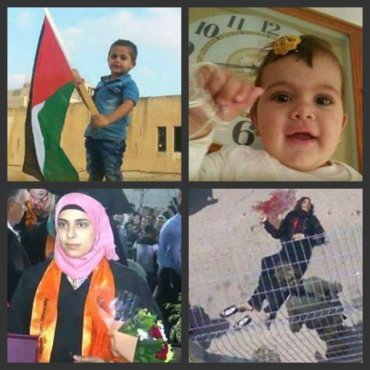 BETHLEHEM – A Palestinian woman was shot and killed at an Israeli army checkpoint in the northern occupied West Bank on Thursday afternoon, after allegedly attempting to stab a soldier.
An Israeli army spokesperson told Ma’an that an “attempted stabbing” took place at a checkpoint in the eastern Tulkarem governorate near the Palestinian village of Anabta. She added that the soldiers “responded to the threat” by shooting at the woman, killing her.
The spokesperson added that no Israelis were injured.
Israeli sources later identified the Palestinian woman as 25-year-old Ansar Hussam Harasha. Harasha was reportedly a married mother of two.
The Palestinian Ministry of Health said that they had been informed by the Israeli military liaison office that Israeli forces had opened fire at a Palestinian woman at the Innab checkpoint eastern Tulkarem and killed her.
Palestinian Red Crescent spokeswoman Errab Foqoha told Ma’an that Israeli forces prevented an ambulance from the health organization from accessing the scene. Foqoha added that Red Crescent staff saw the woman lying on the ground before being taken inside an Israeli ambulance, which stayed on the scene.
More than 200 Palestinians and nearly 30 Israelis have been killed since the beginning of a wave of unrest across the occupied Palestinian territory and Israel in October.
The unrest has been characterized by a number of small-scale attacks mainly against Israeli military targets.
According to the UN, investigations showed that in a number of instances since the unrest began, Israeli forces have implemented a policy of extrajudicial execution, killing Palestinians who did not present imminent threat or could have been subdued through other means.
Video: Crime scene manipulated after Hebron killing, possibly disproving claims by Israeli soldier
Ma’an – June 1, 2016
BETHLEHEM – New video footage has surfaced of an Israeli ambulance driver kicking a knife towards the body of Abd al-Fattah al-Sharif, a young Palestinian whose execution-style murder by an Israeli soldier in March was caught on video, sparking international outrage.
The video footage, obtained by Israel’s Channel Two, is expected to be shown to an Israeli military court to disprove claims by the Israeli soldier who killed al-Sharif that he shot the young Palestinian point-blank in the head after al-Sharif moved to grab a knife, according to the Israeli media outlet Ynet.
The footage shows that the knife allegedly used in the attack was far from al-Sharif when he was shot, notably showing an ambulance driving over the knife before it was kicked closer to al-Sharif’s body.
The Israeli military prosecutor reportedly said that an Israeli ambulance driver, Ofer Ohanna, who was near the scene kicked the knife towards al-Sharif’s body following his murder, according to Hebrew-language news outlet Maariv.
Maariv reported that Ohanna refused to speak to the media, and said he gave the military prosecution all the information he had on the incident during interrogations.
Israeli human rights group B’Tselem released footage of al-Sharif’s execution by Israeli soldier Elor Azarya in March, showing the placement of the knife far from al-Sharif’s body.
However, the new video reportedly shows what transgressed immediately after the ambulance drove by the scene, with an Israeli ambulance driver directly manipulating the crime scene shortly after the shooting by moving the knife closer to al-Sharif.
A spokesperson for B’Tselem could not immediately be reached for comment.
Al-Sharif was shot alongside Ramzi Aziz al-Qasrawi after the two Palestinians allegedly stabbed and moderately wounded an Israeli soldier at a military checkpoint in the Tel Rumeida area of Hebron on March 24.
Al-Qasrawi was killed immediately, while al-Sharif was left severely wounded for several minutes without treatment, before Azarya stepped forward and put a bullet through his head, killing him.
A graphic video released by B’Tselem capturing the incident was met with wide condemnation from rights groups and international bodies, with the UN demanding an investigation into the apparent “extrajudicial execution.”
Azarya was charged with manslaughter, rather than murder as had initially been expected, and is being held on a military base in “open detention” where he is free to roam and has received visits from his family. His trial opened in early May.
Palestinians have long held fears that Israeli soldiers and settlers tamper with crime scenes involving Palestinians, with human rights groups accusing Israel of practicing a policy of extrajudicial executions since a wave of violence erupted in October, leaving more than 200 Palestinians and nearly 30 Israelis killed.
Netanyahu steps up opposition to French ‘peace’ initiative
Press TV – June 2, 2016
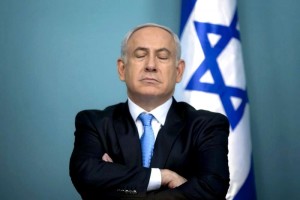
Israeli Prime Minister Benjamin Netanyahu has stepped up his opposition to a French initiative aimed at reviving talks between Israelis and Palestinians.
“The path to peace is not via international conferences that attempt to force a settlement, that make the Palestinian demands more extreme and in the process distance peace,” Netanyahu said on Wednesday.
Paris will be hosting on Friday a gathering of more than 20 countries as well as UN and EU diplomats to discuss the Middle East conflict.
The Israeli prime minister reiterated his call for “direct negotiations and without preconditions.”
“If the countries gathering this week in Paris really want to advance peace, they should join my call to Abu Mazen [Palestinian President Mahmoud Abbas] to come to such direct negotiations … There is no other way,” said Netanyahu.
In a meeting with French Prime Minister Manuel Valls last month, Netanyahu rejected the initiative, saying direct talks with the Palestinian Authority are “the only way to proceed to peace.”
However, Palestinian Prime Minister Rami Hamdallah dismissed Netanyahu’s proposal, calling it an attempt to “buy time.”
The last round of the so-called peace talks between Israelis and Palestinians collapsed in 2014.
Tel Aviv’s illegal settlement activities and its refusal to release senior Palestinian prisoners were among major reasons behind the failure of the talks.
The Israeli premier formally suspended the so-called peace talks with the Ramallah-based Palestinian Authority on April 24, 2014, after Abbas forged a unity pact with Hamas.
Israel responded to the unity pact by announcing tenders for the building of 4,800 illegal settler units on the occupied Palestinian territories.
Palestinians are seeking to create an independent state on the territories of the West Bank, East al-Quds (Jerusalem), and the Gaza Strip.
They are demanding that Israel withdraw from the occupied Palestinian territories.
Israel, however, has refused to return to the 1967 borders and is unwilling to discuss the issue of al-Quds (Jerusalem).
Tim Canova’s Statements Are Even More Pro-Israel than Wasserman Schultz
By Sam Husseini | May 31, 2016
Congressional candidate Tim Canova, a professor of law and public finance, is widely depicted as being a progressive challenger to Rep. Debbie Wasserman Schultz. Wasserman Schultz of course chairs the Democratic National Committee and has rightly come in for lots of criticism on a host of issues.
Canova was recently endorsed by Bernie Sanders. Sanders, at the New York debate with Hillary Clinton in April had showed some minimal concern for rights of Palestinians, rare in U.S. politics, saying that Israel’s attack on Gaza was “disproportionate.”
Recently however, on MSNBC, Canova criticized Wasserman Schultz for being unreliable on a host of issues, then added: “even support for Israel, people don’t know where she stands.”
The subject of Israel doesn’t come up in many pieces on Canova, including his lengthy interview with Glenn Greenwald early this year.
As the Jewish Daily Forward recently noted: “when it comes to Israel and the Middle East, Canova is trying to take on Wasserman Schultz from the right.”
Canova’s website states he “visited Israel many times … returning to his former kibbutz as a volunteer time and again, and participating in workshops on citizenship, war, and counter-terrorism at Tel Aviv University.”
He’s also adopted an extremely anti-Iran position. Writes AP : “Despite the big fundraising haul, Canova faces a daunting task to defeat a strong Jewish Democratic incumbent in a district dominated by Jewish and Hispanic voters, where U.S. relations with Israel and Cuba are debated as often as jobs and the economy. … Canova supports ending the U.S. embargo on Cuba but believes it must be done ‘in stages.’ He said ‘trade liberalization needs political liberalization.’ He thinks the landmark Iran nuclear agreement was filled with ‘holes’ and that it was wrong to give Iran access to $100 billion in frozen assets.”
Canova has said: “I would like to see a Palestinian state, [but] to me, I don’t see how you have one as long as all of these neighbors of Israel still don’t recognize its right to exist … as long as Iran is still funding Hamas, [as long as] Saudi Arabia has telethons for families of suicide bombers!”
In contrast, apparently Saudi Arabia’s misogyny, authoritarianism, blood soaked interventions and invasions and fine with Canova. Well, the same would seem to be true regarding Israel’s bigotry and carnage.
I should note I use the term “pro-Israel” with implied scare quotes. An increasingly aggressive Israel could be “successful” in perpetuating oppression. And it could be disastrous for many, including many of the Jewish citizens of Israel.
The funny part is that I’ve promoted Canova on Institute for Public Accuracy news releases. But then again, unlike lots of folks, I try not to have a litmus test for people. I try to put people on news releases for what they’re best at. And Canova seems sharp and good on financial issues, so I use him on that without prejudice for how he is when it comes to Israel.
It often doesn’t work the other way. I’ve had odd looks for working with “rightwingers” on some issues. I find that there’s often a whole series of double standards associated with that. If you only want to work with people who agree with you across the board, fine. Do that. If you’re flexible about who you work with, fine, do that. But there’s something really wrong when people have a litmus test sometimes, but not others.
Palestinian Fishers Under Attack – End the Siege on Gaza

Samidoun Palestinian Prisoner Solidarity Network | May 31, 2016
Palestinian Fishers Under Attack
Five Palestinian fishers in Gaza – Rajab Abu Riyala, Khaled Abu Riyala, Hassan Miqdad, Mahmoud Miqdad, and Bashar Abu Riyala – were arrested this morning, 31 May, by Israeli occupation forces and two fishing boats confiscated by the Israeli navy. According to the Union of Agricultural Work Committees, these arrests bring the number of Palestinian fishers in Gaza arrested by Israeli occupation forces in 2016 to 70, including eight children, and the number of boats confiscated to 20. In 2015, 71 fishermen were detained and 22 boats confiscated throughout the year.
Zakaria Baker of the UAWC, which organizes fishers and farmers for land defense and mutual support and solidarity, said that these violations against fishers in Gaza have only increased since the proclaimed decision of the Israeli occupation to “extend” the fishing area to 9 nautical miles – a decision retracted on Monday – saying that fishers could not make use of this distance because they were prevented by force of arms. The fishers were attacked this morning 5 nautical miles out to sea, Baker said. Further, Israeli occupation forces fired on fishing boats northwest of Gaza city, damaging a fishing boat and forcing the fishermen to flee for safety, and in the sea off Deir al-Balah, firing live bullets pushing the fishers back to the beach.
On Monday, Israeli occupation naval forces said that the extended fishing zone had been “temporary,” for the fishing season, and that the fishing zone was again six nautical miles. The limit has frequently been used as a means of pressure and of maintaining the naval siege on Gaza; while the Oslo Accords set Gaza fishers’ zone as 20 nautical miles, the Israeli occupation has unilaterally lowered it to an area as small as three nautical miles, extended to six in 2014.
The fishing economy in Gaza – which supports 70,000 Palestinians – has been nearly destroyed by the naval siege on Gaza and the attacks on Palestinian boats, causing expensive boat damage to small fishing families who cannot afford repairs and preventing Palestinian fishers from entering deep waters where mature fish are available. Fishers in Gaza have lost 85% of their income since 2006 and the tightening of the siege.
On 30 May – 4 June 2016, activists are engaged in campaigns against the siege on Gaza – the denial of reconstruction, the smothering of the Palestinian economy, the closing of the crossings and denial of freedom of movement, the prevention of trade, the aerial attacks on Gaza, the firing on Palestinian farmers and destruction of Palestinian agriculture in the “no-go zone” near the border, and the strangling of the Palestinian fishery of Gaza – demanding an end to 10 years of Israeli siege with international support and complicity, and the involvement of the Egyptian state.
The actions mark ten years of siege and six years since Israel naval commandos attacked the international Freedom Flotilla to Gaza, killing ten Turkish activists seeking to break the naval siege. The occupation’s draconian restrictions on the movement of people and goods, along with its repeated military onslaughts and their destruction of Palestinian industry, resources, infrastructure, and life, have pushed the local unemployemt rate to 41.2%, the highest in the world. 75,000 remain displaced following Israel’s destruction of their homes, which have yet to be rebuilt, during its 2014 bombardment. Family members, patients, students, and workers are trapped, with over 25,000 having applied for rare permits to leave through the one crossing with Egypt.
UAWC video on Palestinian fishers in Gaza:
End the Siege on Gaza
Samidoun Palestinian Prisoner Solidarity Network urges protests and actions to support the besieged fishers in Gaza, and raising the voice of Palestinian fishers to end the attacks and break the siege on Gaza. Samidoun in New York City will rally on Friday, 3 June at 4:00 pm outside the offices of G4S at 19 W. 44th Street in New York City. G4S, the world’s largest security company and second-biggest private employer, equips Israeli prisons and detention centers where Palestinian prisoners, including many fishermen detained off the coast of Gaza, are held and tortured, as well as the occupation forces and infrastructure – like checkpoints surrounding the Gaza Strip – routinely used to massacre Palestinians while holding millions under military rule.
Take Action!
1. Organize or join a protest against the attacks and arrests of Palestinian fishers and the siege on Gaza, outside your national government buildings, local Israeli embassy, G4S office, or corporation involved in the occupation. If you are in New York, join Samidoun’s protest – elsewhere, send us your local protests against the attacks on Palestinian fishers in Gaza. Email us at samidoun@samidoun.net.
2. Contact political officials in your country – members of Parliament or Congress, or the Ministry/Department of Foreign Affairs or State – and demand that they cut aid and relations with Israel on the basis of its apartheid practices, its practice of colonialism, and its numerous violations of Palestinian rights including the siege on Gaza and the attacks on fishers. Demand they pressure Israel to stop attacking Palestinian fishers and strangling Palestinians in Gaza. In the United States, call the Israel/Palestine Bureau at the State Department at 202-647-3930 and the White House – 202-456-1111. Demand action on Barghouthi’s case and an end to aid to Israel. In the UK, call UK Foreign and Commonwealth Office, Philip Hammond, MP, +44 20 7008 1500. In Canada, call Foreign Minister Stephane Dion: 613-996-5789.
3. Boycott, Divest and Sanction. Hold Israel accountable for its violations of international law. Don’t buy Israeli goods, and campaign to end investments in corporations that profit from the occupation. G4S, a global security corporation, is heavily involved in providing services to Israeli prisons that jail Palestinian political prisoners – there is a global call to boycott it. Palestinian political prisoners have issued a specific call urging action on G4S. Learn more about BDS at bdsmovement.net.
Corbyn’s Latest Sin: Ignoring Summons to Visit Holocaust Museum in Israel

By Richard Edmondson | Fig Trees and Vineyards | May 30, 2016
Poor Jeremy Corbyn. He’s in hot water again. His latest offense? Ignoring an invitation from the leader of the Israeli Labor Party to journey to Israel to visit the Yad Vashem Holocaust Museum.
And the Israeli Laborites are incensed at the absence of a reply, while the Blairite centrists in Corbyn’s own party are reportedly in “shock” at the news.
“You’re a lying racist,” shouted Labour MP John Mann at former London Mayor Ken Livingstone last month after the latter pointed out–accurately, by the way–that Hitler had supported Zionist goals of having Jews immigrate to Palestine. But it seems the philo-semitic witch hunters out for Corbyn’s blood can’t be bothered with historical facts.
“It should be a matter of common courtesy to reply to a letter from the leader of one of our sister parties, particularly on an issue as important as tackling antisemitism,” commented Labour MP Wes Streeting when news of the snub broke over the weekend.
“But this is fairly typical of the flat-footed and lackadaisical attitude that we’ve seen from the outset. It is simply unacceptable,” he added.
Streeting apparently feels the leader of the British Labour Party should pack his bags and promptly head for Yad Vashem.
Built on a rise overlooking the site of the Deir Yassin massacre, the Yad Vashem museum has for years now been a favored destination of opportunists seeking to further their political careers. Here’s Obama in 2008:

Joe Biden in 2011:

And war criminal Tony Blair, also in 2011:

During his own visit to the museum, Blair wrote the following in the guestbook:
“Thank you for what will remain with me forever. It is hard to describe what this means to me or how profoundly it affects my emotions. For me, this is a memorial, it is a tribute, it is a reflection of an event almost too terrible to contemplate. But it is also a warning, a warning of the wickedness of which humanity is capable. I leave here with that warning in my mind. I also leave, however, with a sense of hope, because amidst all the evil and tragedy, those that survived built a better world and had the grace and wisdom then to build this testament to suffering and to the human spirit.”
The people of Britain are of course now awaiting judgement from the Chilcott Inquiry as to whether Blair may be guilty of “the supreme international crime, differing only from other war crimes in that it contains within itself the accumulated evil of the whole,” i.e. crimes against peace. And certainly what Blair and George Bush Jr. did to the people of Iraq is “almost too terrible to contemplate.”
As Corbyn put it recently,
“The Chilcot report will come out in a few weeks’ time and tell us what we need to know, what I think we already know: There were no weapons of mass destruction, there was no ability to attack within 45 minutes and a deal had been done with Bush in advance.”
Corbyn, in a general manner of speaking, seems to feel Blair should indeed be prosecuted for war crimes, although when specifically asked his views on this matter, his response was a vague, “If he’s committed a war crime, yes. Everyone who’s committed a war crime should be (prosecuted).”
Indeed, all war criminals should be prosecuted, and while none of the witch hunters seem to want to acknowledge it, certainly a war crime was committed against the people of Deir Yassin. According to Deir Yassin Remembered:
Early in the morning of April 9, 1948, commandos of the Irgun (headed by Menachem Begin) and the Stern Gang attacked Deir Yassin, a village with about 750 Palestinian residents. The village lay outside of the area to be assigned by the United Nations to the Jewish State; it had a peaceful reputation. But it was located on high ground in the corridor between Tel Aviv and Jerusalem. Deir Yassin was slated for occupation under Plan Dalet and the mainstream Jewish defense force, the Haganah, authorized the irregular terrorist forces of the Irgun and the Stern Gang to perform the takeover.
In all over 100 men, women, and children were systematically murdered. Fifty-three orphaned children were literally dumped along the wall of the Old City, where they were found by Miss Hind Husseini and brought behind the American Colony Hotel to her home, which was to become the Dar El-Tifl El-Arabi orphanage.
What was once the village of Deir Yassin is today occupied by an Israeli psychiatric hospital. Some of the Palestinian homes still standing after the massacre, were later incorporated into the hospital buildings, and the facility is plainly visible today from the museum.
Suppose a photo of Corbyn, perhaps wearing a kippah, prostrating himself before the altar of the holocaust, were to circulate widely over the Internet–would it help or hurt his political career? And why would the Israeli Labor Party issue such an invitation to him at this time?
In April, Israel’s opposition leader Isaac Herzog and leader of the Israeli Labour Party, responded to the antisemitism row by inviting senior members of the Labour Party – including Jeremy Corybn – to visit Yad Vashem as a reminder of the results of antisemitism.
So reports the Jewish Chronicle in an article published May 29. The story was also picked up by the Daily Mail, The Guardian, The Times of Israel, The Jerusalem Post, among others, and most of the reports take pains to note as well that the news comes the same week as the reinstatement of party member Jackie Walker, who was suspended last month after posting on Facebook that Jews had been involved in the African slave trade (another historical fact).
So was the invitation, as per the Jewish Chronicle’s report, issued only to remind Corbyn of “the results of antisemitism”? Or was the motive to embarrass him, to put him in a dicey and uncomfortable position? And who from the Israeli Labor Party contacted the media to let them know of Corbyn’s dereliction in answering? The reports don’t seem to mention that. What they do give us are the words of Herzog, the Israeli Labor leader, as quoted from his letter to Corbyn last month:
“I have been appalled and outraged by the recent examples of anti-Semitism by senior Labor party officials in the United Kingdom,” Herzog said, going on to refer to Livingstone as “anti-Semitic beyond hope of redemption.” Yet he also expressed his belief that some within the Labour Party are able to “understand the scourge of anti-Semitism.”
Sadly Corbyn has lacked the mettle to respond to attacks that have in essence now become a Zionist blitzkrieg against his entire political party. Rather than suspending his party members, he should have defended them. Consider the case of Livingstone.
In the world we live in, people can be fired from their jobs for suggesting that the holocaust didn’t happen or that six million Jews didn’t die. Livingstone did not deny the holocaust. He did not even deny the six million number. Nevertheless he lost his job anyway. It was reported over the weekend that Livingstone’s Saturday morning slot on London’s LBC radio station has been dropped and that his contract has not been renewed. The situation might have been different had Corbyn had the temerity to mount a vociferous defense of his longtime friend.
As for Walker, she describes the past few weeks of her life as a “living nightmare,” and this is probably no exaggeration.

Jackie Walker, of UK’s Labour Party
“I am glad this investigation has fully cleared me of any wrongdoing,” Walker said. “I am not a racist, but I robustly defend my right and the right of others to speak openly and frankly about matters of grave political and historical importance. That is the cornerstone of the right of free speech in our democracy.”
She added: “What I have suffered and the effect [it] has had on my health, and also on my family, can only be described as the lowest form of ‘attack politics’.”
In addition to Deir Yassin, the following massacres, according to a source here, were also carried out by Israel in the years from 1948 onward. I cannot vouch for all the information, although some of the massacres, such as Kafr Qasem massacre of 1956, I have read about previously. And certainly all of us, or most of us, are familiar with the more recent events cited down at the bottom of the list. As for the Kafr Qasem massacre, it is discussed in the 1983 book, The Fate of the Jews, by Roberta Strauss Feuerlicht, a Jewish author, who cites the same number of fatalities–43–as that given in the list below, along with the additional information that seven of the dead were children and ten were women.
The Semiramis Hotel Massacre 1948
Jewish Agency escalated their terror campaign to drive out Palestinian Arabs by bombing the hotel. 18 civilians killed; 16 wounded.
Naser Al-Din Massacre 1948
Zionist gangs entered the village dressed as Arab fighters and met villagers with fire. All the houses of the village were raised to the ground, killing the entire population except 40 who survived. 632 civilians in total were killed.
Tantura Massacre 1948
Israeli troops entered village to remove inhabitants to make way for a parking lot for a nearby beach. Groups of Palestinians were rounded up, killed, and their bodies thrown, rounding up more groups. 200 civilians were killed.
Beit Daras Massacre 1948
Zionists mobilized a large contingent and surrounded the village, killing the women, children and elderly that were fleeing the conflict. 265 civilians in total were killed.
Dahmash Mosque Massacre 1948
Israelis told Arabs through loudspeakers that if they went into the mosque they would be safe, 80-100 Palestinians were massacred in the mosque and their bodies lay decomposing for 10 days.
Dawayma Massacre 1948
Israeli army entered the village on the western side of the Hebron mountains and brutally killed about 100 women and children.
Houla Massacre 1948
Jewish militants dressed in traditional Arab attire entered the border village. Militants rounded up 85 people and detained them in a number of houses, firing live ammunition at the civilians and killing all but 3.
Salha Massacre 1948
105 civilians killed by occupiers when ordered to face the wall of a mosque, then shot from behind.
Sharafat Massacre 1951
Israeli soldiers crossed armistice line and destroyed residential properties – 10 civilians killed (2 elderly men, 3 women and 5 children), 8 wounded.
Qibya Massacre 1953
600 Israeli soldiers moved in towards village destroying 56 houses, a mosque, a school and water tank. 67 men and women killed.
Kafr Qasem Massacre 1956
Israeli soldiers stepped out of military trucks, positioned themselves at village entrances, and killed 43 farmers.
Khan Yunis Massacre 1956
Israelis occupied the town and an adjacent refugee camp. UNRWA investigation found 275 unarmed civilians murdered by Israelis.
Gaza City Massacre 1956
Zionist Army gangs brought death toll to 60 civilians including (including 27 women, 29 men and 4 children) and 103 injured.
Al-Sammou’ Massacre 1966
Israeli forces raided the village destroying 140 houses, a village clinic and school. 18 civilians were killed and 54 wounded.
Aitharoun Massacre 1975
Caused by a booby-trapped bomb. 9 civilians were killed, 23 were wounded.
Kawnin Massacre 1975
An Israeli tank ran over a vehicle carrying 16 civilians. None of them survived.
Hanin Massacre 1976
After a 2-month siege and hours of shelling, occupation forces stormed the village and turned it into a bloodbath. 20 civilians killed.
Bint Jbeil Massacre 1976
A crowded market was the target of a sudden barrage of Israeli bombs, slaughtering 23 civilians and 30 wounded.
Abbasieh Massacre 1978
Israeli warplanes destroyed a mosque while civilians used it as shelter from heavy shelling. 80 civilians killed.
Adloun Massacre 1978
2 cars carrying 8 passengers came under Israeli fire while they were on their way to Beirut. Only 1 passenger survived.
Saida Massacre 1981
Residential areas targeted by Israeli artillery resulting in 20 civilians killed, 30 were wounded.
Fakhani Massacre 1981
Israeli warplanes raided crowded residential areas using highly sophisticated weaponry. 150 civilians killed, 600 were wounded.
Sabra and Shatila 1982
Israeli Army surrounded the camps, providing aid and facilities, in collaboration with right-wing Lebanese Phalangist, were responsible for almost 3500 civilians dead, most of them women, children and elderly.
Jibsheet Massacre 1984
Occupation forces’ tanks and helicopters fired at a crowd of people. 7 civilians were killed, 10 were wounded.
Sohmor Massacre 1984
Occupation forces stormed with tanks and military vehicles, then ordered the inhabitants to congregate at the town’s mosque and fired at them. 13 civilians killed, 12 wounded.
Seer Al Garbiah Massacre 1985
At Al-Husseinieh people took shelter from shelling of Israeli soldiers who stormed the town with military vehicles. 7 civilians killed.
Maaraka Massacres 1985
Occupation forces detonated an explosive device during distribution of aid to citizens during siege. 15 civilians were killed.
Zrariah Massacre 1985
Occupation forces stormed the town after heavy shelling with 100 vehicles, killing children, women and elderly. 22 civilians slaughtered.
Horneen Al-Tahta Massacre 1985
Occupation forces ordered the inhabitants to gather at a school of the village then destroyed it.
Jibaa Massacre 1985
Huge Army forces attacked the town and put it under siege. Soldiers fired at people escaping the siege. 5 civilians killed, 5 were wounded.
Yohrnor Massacre 1985
An Israeli armed force entered the town using civilian cars and opened fire at the houses. 10 civilians killed, among them a family of 6.
Tin Massacre 1986
Occupation forces cutting the hands and ears from civilians in the town. 4 persons were killed; 79 were crippled and wounded.
Al-Naher Al-Bared Massacre 1986
Israeli warplanes raided the Palestinian refugee camp killing many of the refugees. 20 person were killed and 22 were wounded.
Ain Al-Hillwee Massacre 1987
Jet fighters launched 2 raids. 31 civilians killed and 41 wounded. Refugees were hit by a raid while evacuating casualties, 34 more were killed, making a total of 65 civilian casualties.
Oyon Qara Massacre 1990
Israeli soldier lined up Palestinian labors and murdered 7 of them with a sub-machine gun. 13 Palestinians were killed by Israeli forces in subsequent demonstrations.
Siddiqine Massacre 1990
Israeli warplanes bombed a house, among the 3 killed a four years old child.
Al-Aqsa Mosque Massacre 1990
Israeli forces placed military barriers around roads and surrounded it with military helicopters. Jewish settlers fired live ammunition with automatic weapons and gas bombs. 23 Palestinians were killed, 850 wounded.
Ibrahimi Mosque “Cave of the Patriarchs” Massacre 1994
Almost 500 worshipers attended Friday dawn prayer when Zionist settlers and soldiers stormed the mosque and fired on the people praying. 24 civilians died and hundreds injured.
Jabalia Massacre 1994
Jewish undercover police opened fire on Palestinian activists killing 6 and injuring 49. Some of the wounded activists were taken out of their cars and shot in the head.
Eretz Checkpoint Massacre 1994
Occupation forces fired on Palestinian workers at Eretz checkpoint while 4 Israeli tanks and helicopters were brought in. 11 civilians were shot dead and 200 injured.
Deir Al-Zahrani Massacre 1994
Israeli warplanes fired a “vacuum” missile at a 2-story building which was destroyed. 8 people were killed, 17 were injured.
Nabatyaih School Bus Massacre 1994
Israeli warplanes targeted a school bus full of students. 4 children were killed and 10 injured.
Sohmor Second Massacre 1996
Israeli artillery targeted a civilian vehicle carrying 8 passengers, killing them all.
Mansuriah Massacre 1996
Israeli helicopter fired rockets at a vehicle carrying 13 civilians fleeing the village of al-Mansuri, killing 2 women and 4 young girls.
Nabatyaih Massacre 1996
Israeli Air attack with helicopters fired rockets at 3 buildings in the village on a house in Nabatiyya al-Faqwah causing 11 civilians casualties (including a mother and her 7 children) and 10 injured.
Qana Massacre 1996
Zionist forces bombed a shelter providing refuge to 500 Lebanese, mostly women, children and elderly forced out of their villages by Israeli raids. 109 civilians killed and 116 injured in a UN compound.
Janta Massacre 1998
Israeli warplanes attacked a mother and her 6 children when they had returned from the field. All had been killed.
The 29 June Massacre 1999
Israeli force targeted a building in Beirut. 8 civilians killed and 84 injured.
Western Bekaa villages Massacre 1999
Israeli warplanes fired on children who were celebrating the Eid festival. 8 children were killed and 11 others wounded.
Al-Aqsa Mosque Massacre 2000
Ariel Sharon entered Al-Aqsa Mosque with 3000 Israeli soldiers. Soldiers opened fire on Muslims worshipers before completing their prayers. 80 Palestinian civilians were killed and 1000’s injured.
Lebanon Massacre 2006
There were more than 94 cases of Israeli air and artillery attacks on civilian homes and vehicles . Of the 1,109 casualties, approximately 900 were civilians, and most of the targets were roads, residential buildings and civil buildings that had no evidence of combatants.
Operation “Cast Lead” Gaza Massacre 2009
Israeli government lay siege to the city with the use of white-phosphorous chemical weapons in densely populated areas such as schools and hospitals. 1,300 women, children & elderly were killed and thousands injured.
Gaza Siege 2012
162 men, women and children killed by air strikes, and 1269 injured during the 8 day assault on the Gaza Strip just before elections in Israel.
Operation “Protective Edge” Gaza Massacre 2014
7 weeks of Israeli bombardment resulted in a total of 2,150 men, women and children killed in the Gaza strip, including 578 children. Human rights groups reported that around 69–75% of the victims were civilians.
We of course know that throughout the same period there have also been attacks by Palestinians that have claimed the lives of Israelis, but we have to keep in mind that of the two groups of people, one is resisting an occupation while the other is imposing it; one is fighting to keep what’s left of it’s land while the other continues to sieze more, claiming self defense as its justification. Perhaps most pertinent of all, Israel has never acknowledged a single one of these massacres. It has also, for whatever reasons, never acknowledged the Armenian genocide. At the same time, powerful Jews continuously lay down fiats and dictums to the rest of us: holocaust denial forbidden. Slave trade denial acceptable. Israel is a democracy with the most moral army in the world. Livingstone is anti-Semitic beyond hope of redemption, and if you disagree, you are too.
What it all suggests is that the pagan (sic) holocaust religion exalts the primacy of Jewish suffering, and that massacres, murders, and genocides of others are of little or no consideration by comparison.
Will the Zionist chatterers come to rue their attacks on Corbyn? It all depends. The possibility of the rise of a very different sort of leader from Corbyn, one fed up with Israel’s flagrant violations of international law and who cares little about civility and diplomatic niceties, cannot be ruled out. Should such a leader emerge–possibly in Europe–possibly in America–there may well come a time when the high priests of political correctness will long for the dulcet days when they had “good ole Jeremy” to kick around.
The NY Times Plays the Israeli Army’s Game: Hyping Threats, Shielding Criminals
By Barbara Erickson | TimesWarp | May 30, 2016
The New York Times reports today that Israel faces “monumental security challenges” and is now caught in a debate over just how tough the military should be with those who threaten to harm its soldiers and civilians.
The story, by Isabel Kershner, is framed around “months of Palestinian attacks” that have left some 30 Israelis dead. She makes no mention anywhere of the more than 200 Palestinians killed by security forces over the same time period, nor does she say anything about the brutal conditions of the occupation that provide the impetus for Palestinian assaults.
Kershner briefly notes that Palestinian and human rights groups have accused the Israeli military of “excessive force,” but she fails to say that the charges go beyond this vague reference: In fact, numerous groups have accused Israel of carrying out “street executions” of Palestinians who posed no real threat to soldiers or civilians.
The mostly youthful Palestinian attackers over the past eight months have been armed with nothing more than knives, vehicles and even scissors, but they have carried out their assaults (some alleged, some substantiated) against an army equipped with submachine guns, drones, tanks, surveillance equipment, nuclear warheads, fighter jets, attack helicopters and naval gunboats.
In spite of this immense disparity, Kershner is able to claim that Israel faces “monumental” security challenges. It never seems to occur to her that Palestinians face immense security concerns of their own.
Moreover, she presents the Israeli Defense Force as an army operating under humane policies, which are now under attack by politicians and a vocal segment of the public. “The military chiefs have urged restraint and a strict adherence to open-fire regulations, saying a soldier should shoot to neutralize a threat, but not beyond that,” she writes.
When army officials have promoted these guidelines, she says, they have been “attacked by rightist politicians who advocate a policy based on the Talmudic lesson ‘Whoever comes to slay you, slay him first.’”
Kershner thus gives voice to army leaders who have criticized the trigger-happy responses of security forces, but she fails to quote from those human rights groups who have frequently raised the alarm over the killings of Palestinians who posed no real threat.
Readers are left with the impression that the army has been operating with restraint, following a set of humane policies, but is now being challenged by rightists who urge even tougher measures against would be attackers.
Missing from her story is the fact that army and police have operated with impunity over many years, even when cases of abuse and criminal behavior are well documented. Two recent statements by Israeli rights groups, Yesh Din and B’Tselem, bear this out.
Yesh Din, which works for structural changes in the occupied territories, reported last month that 5,500 Palestinians have been killed by Israeli forces over the past 15 years, yet not one Israeli soldier has been charged for murdering a Palestinian.
Just last week the monitoring group B’Tselem announced that after more than 25 years of cooperating with the military, sharing information on cases that merited action, it has now suspended all of these efforts because of this record of impunity.
When Israel claims to investigate charges against the military, B’Tselem said, “not only does the state manage to uphold the perception of a decent, moral law enforcement system, but also maintains the military’s image as an ethical military that takes action against [ostensibly prohibited] acts.” In fact, the organization stated, the system is nothing more than “an outward pretense,” and an effort to whitewash criminal activity.
The rights group concluded that it would “no longer play a part in the pretense posed by the military law enforcement system and will no longer refer complaints to it.” After 25 years of consistent effort, the group concluded that “there is no longer any point in pursuing justice and defending human rights by working with a system whose real function is measured by its ability to continue to successfully cover up unlawful acts and protect perpetrators.”
This is far from the impression we get from Kershner’s story. She quotes military officials who insist on the moral standards of the Israeli army without a hint of irony or any effort to challenge their claims.
The Times is a willing partner in the whitewash of Israel’s military. Its editors accepted Kershner’s characterization of the army without asking for any follow up. They were aware of the B’Tselem announcement, however, running two wire service accounts of the move online but failing to assign any reporter to the story. The newspaper made no mention of the Yesh Din findings.
Kershner’s story plays perfectly into the scenario described by B’Tselem. It provides the impression of a functioning military justice system, an army run on moral principles but under attack by “terrorists”. It is all part of the narrative of Israeli victimhood, even though its chief threat comes from teenagers armed with kitchen knives.
Follow @TimesWarp on Twitter.
Featured Video

Trita Parsi: Israel Set a Trap for Total War in the Region
or go to
Aletho News Archives – Video-Images
From the Archive
Zionism’s Violent Legacy
By Donald Neff | Washington Report On Middle East Affairs | January 1996
On January 4, 1948, Jewish terrorists drove a truck loaded with explosives into the center of the all Arab city of Jaffa and detonated it, killing 26 and wounding around 100 Palestinian men, women and children.[1] The attack was the work of the Irgun Zvai Leumi – the “National Military Organization,” also known by the Hebrew letters Etzel – the largest Jewish terrorist group in Palestine. The Irgun was headed by Revisionist Zionist Menachem Begin and had been killing and maiming Arabs, Britons and even Jews for the previous ten years in its efforts to establish a Jewish state.
This terror campaign meant that at the core of Revisionist Zionism there existed a philosophical embrace of violence. … continue
Blog Roll
 Aletho News
- Trita Parsi: Israel Set a Trap for Total War in the Region
- Trump’s Iran war is on an Israeli leash
- Saudi oil boss issues global supply warning
- Riyadh Says Its Oil System Is Intact. The Numbers Say Otherwise.
- Trump and Netanyahu Want to “Finish the Job” on Iran
- US ‘one-sided dictation’ not Iran’s beliefs makes rational talks impossible: Baghaei
- Iran’s Next Strike May Not Explode. It Could Shut You Down /Col Doug Macgregor
- Iran: US political targets legitimate if assassinations return
- Iraq shuts key border crossing with Iran under US pressure: Report
- Undersea Internet cables could be targeted in retaliation for attacks on Iran: IRGC deputy chief
- If Americans Knew
- The Israel Lobby’s Changing Fortunes
- AIPAC has become such a political liability that it’s shifting to a more “nimble” approach to buying politicians
- At least 160 Israeli settler attacks in 2 weeks
- Will Gaza’s Ancient Christian Community Disappear Forever?
- Israel’s vision of regional security rests on keeping Arab states weak
- Heidi Levine recounts how Palestinian youths helped save her in settler attack
- DAILY UPDATE: Latest essential news on Palestine, Israel, & region
- Trump’s Intensifying Sabotage of the ICC, for Israel’s Sake
- Israeli military detain US and UK volunteers in West Bank including Democratic NY politician Brad Lander
- Americans at National Conservatism Conference held in Israel this year criticize Israel
- No Tricks Zone
- E-Cars Reduce CO2 Emissions By Only 41% Compared To Internal Combustion Engine Vehicles
- Predictions Made By Renowned Climate Professor Over Past Decades Have Been Proven To Be Poor
- New Study Suggests Large Regions Of The Pacific Ocean Have Been Cooling For The Last 80 Years
- Germany’s Green Energy Debacle: High Energy Costs Force Kahla Porzellan to Close After 182 Years!
- New Study: 50 Years Of The Most Aggressive ‘Net Zero’ Policies Can Only Affect The Global Climate By 0.03°C
- US September “Heat” Was No Record…Many Records Set Decades Ago
- Latest European Green Energy Debacle; Portugal’s Largest Flagship Solar Park Insolvent!
- Green Energy Debacle: German Expert Professor Fritz Vahrenholt Warns Of Severe Economic And Social Consequences
- Two More Paleo Reconstructions Affirm Meters-Higher Sea Levels Across Ireland, Brazil 7000-6000 Years Ago
- New Study: Earth And Venus Surface Warmth Largely Explained By Convection And Lapse Rate, Not CO2 Or Radiation

