Netanyahu’s endgame: Isolation and the shattered illusion of power
By Ramzy Baroud | MEMO | May 20, 2025
There was a time when Benjamin Netanyahu appeared to have all the cards. The Palestinian Authority was largely passive, the occupied West Bank was relatively calm, Israel’s diplomatic reach was expanding, and the United States seemed ready to bend international law to accommodate Israel’s desire for complete control over Palestine.
The Israeli prime minister had also, at least in his own estimation, succeeded in subduing Gaza, the persistently defiant enclave that had for years struggled unsuccessfully to break the suffocating Israeli blockade.
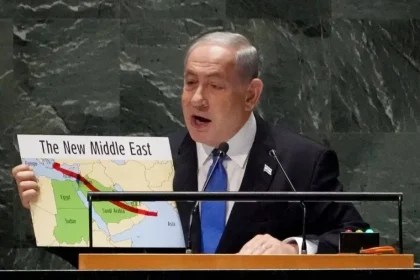
Within Israel, Netanyahu had been celebrated as the nation’s longest-serving prime minister, a figure who promised not only longevity but also unprecedented prosperity. To mark this milestone, Netanyahu employed a visual prop: a map of the Middle East, or, in his own words, “the New Middle East.”
This envisioned new Middle East, according to Netanyahu, was a unified green bloc, representing a future of ‘great blessings’ under Israeli leadership.
Conspicuously absent from this map was Palestine in its entirety—both historic Palestine, now Israel, and the occupied Palestinian territories.
Netanyahu’s latest unveiling occurred at the United Nations General Assembly on 22 September, 2023. His supposedly triumphant address was sparsely attended, and among those present, enthusiasm was notably absent. This, however, seemed of little consequence to Netanyahu, his coalition of extremists, or the broader Israeli public.
Historically, Israel has placed its reliance on the support of a select few nations considered, in their own calculus, to be of primary importance: Washington and a handful of European capitals.
Then came the October 7 assault. Initially, Israel leveraged the Palestinian attack to garner Western and international support, both validating its existing policies and justifying its intended response. However, this sympathy rapidly dissipated as it became apparent that Israel’s response entailed a campaign of genocide, the extermination of the Palestinian people in Gaza, and the ethnic cleansing of Gaza’s population and West Bank communities.
As images and footage of the devastating carnage in Gaza surfaced, anti-Israeli sentiment surged. Even Israel’s allies struggled to justify the deliberate killing of tens of thousands of innocent civilians, predominantly women and children.
Nations like Britain imposed partial arms embargoes on Israel, while France attempted a balancing act, calling for a ceasefire while suppressing domestic activists advocating for the same. The pro-Israel Western narrative has become increasingly incoherent, yet remains deeply problematic.
Washington, under President Biden, initially maintained unwavering support, implicitly endorsing Israel’s objective – genocide and ethnic cleansing.
However, as Israel failed to achieve its perceived objectives, Biden’s public stance began to shift. He called for a ceasefire, though without demonstrating any tangible willingness to pressure Israel. Biden’s staunch support for Israel has been cited by many as a contributing factor to the Democratic Party’s losses in the 2024 elections.
Then, Trump arrived. Netanyahu and his supporters, both in Israel and Washington, anticipated that Israel’s actions in Palestine and the wider region — Lebanon, Syria, etc — would align with a broader strategic plan.
They believed Trump’s administration would be willing to escalate further. This escalation, they envisioned, would include military action against Iran, the displacement of Palestinians from Gaza, the fragmentation of Syria, the weakening of Yemen’s Ansarallah, and more, without significant concessions.
Initially, Trump signalled a willingness to pursue this agenda: deploying heavier bombs, issuing direct threats against Iran, intensifying operations against Ansarallah, and expressing interest in controlling Gaza and displacing its population.
However, Netanyahu’s expectations yielded only unfulfilled promises. This raises the question: was Trump deliberately misleading Netanyahu, or did evolving circumstances necessitate a reassessment of his initial plans?
The latter explanation appears more plausible. Efforts to intimidate Iran proved ineffective, leading to a series of diplomatic engagements between Tehran and Washington, first in Oman, then in Rome.
Ansarallah demonstrated resilience, prompting the US on 6 May to curtail its military campaigns in Yemen, specifically the Operation ‘Rough Rider’. On 16 May, a US official announced that the USS Harry S. Truman would withdraw from the region.
Notably, on 12 May, Hamas and Washington announced a separate agreement, independent of Israel, for the release of US-Israeli captive Edan Alexander.
The culmination occurred on 14 May, when Trump delivered a speech at a US-Saudi investment forum in Riyadh, advocating for regional peace and prosperity, lifting sanctions on Syria, and emphasising a diplomatic resolution with Iran.
Conspicuously absent from these regional shifts was Benjamin Netanyahu and his strategic ‘vision’.
Netanyahu responded to these developments by intensifying military operations against Palestinian hospitals in Gaza, targeting patients within the Nasser and European Hospitals. This action, targeting the most vulnerable, was interpreted as a message to Washington and Arab states that his objectives remained unchanged, regardless of the consequences.
The intensified Israeli military operations in Gaza are an attempt by Netanyahu to project strength amidst perceived political vulnerability. This escalation has resulted in a sharp increase in Palestinian casualties and exacerbated food shortages, if not outright famine, for over two million people.
It remains uncertain how long Netanyahu will remain in power, but his political standing has significantly deteriorated. He faces widespread domestic opposition and international condemnation. Even his primary ally, the United States, has signalled a shift in its approach. This period may mark the beginning of the end for Benjamin Netanyahu’s political career and, potentially, for the policies associated with his horrifically violent government.
Israel Continues to Destroy Water Sources: Civilians Targeted While Digging Well in North Gaza
Palestinian Centre for Human Rights | May 19, 2025
The Palestinian Centre for Human Rights (PCHR) condemns in the strongest terms the killing of a group of Palestinian volunteers and activists by the Israeli Occupation Forces (IOF) on Sunday, 18 May 2025, in al-Saftawi area in northern Gaza Strip, while they were digging a water well to serve the residents amid the inability of Gaza’s municipalities and local bodies to supply them with water.
Footages capturing the incident revealed the IOF’s horrific crime, as they directly and unjustifiably targeted civilians in blatant disregard for the principle of distinction, which ensures protection of civilians and their property. This crime reflects the IOF’s deliberate destruction of water sources, with the aim of turning Gaza into an unlivable zone and forcibly displacing northern Gaza Strip’s residents.
According to our staff’s monitoring, at approximately 18:15 on Sunday, Israeli warplanes fired at least one missile at a group of activists, who were digging a water well near al-Waleed Petrol Station in a-Saftawi area, north of the Gaza Strip. As a result, seven people were killed, and they were identified as: ‘Awni Mohammed ‘Awni Abu al-Nour (18), Ibrahim Mohammed Isma’il Khela (27), Isma’il Mohammed Isma’il Khela (29), Anas Ramadan ‘Abed al-Razeq Shanan (29), Fawzi Nafiz Mohammed al-Dadad (36), Hasan Mohammed Abu Warda (30), and Tareq Ziyad Mohammed Tanboura (24). Additionally, 5 others sustained various injuries. It is worth noting that the targeted activists were digging the well due to water scarcity in the area and the inability of Gaza’s municipality to pump water into residents’ houses.
This crime was not a separate incident but came as part of a vicious campaign to kill civilians without deterrence and destroy Gaza’s roads, water and health infrastructure over the past 19 months. The Israeli war machine has destroyed more than 330,000 linear meters of water networks and 655,000 linear meters of sewage networks, in addition to approximately 2,850,000 linear meters of roads and streets. Furthermore, 719 water wells have been targeted,1 and complete or partial damage was inflicted on 89% of the water and sanitation sector’s assets. This has resulted in water insecurity for more than 91% of the Gaza population, with 65% of them receiving less than six liters per person per day,2 constituting a deliberate violation of the right to life and human dignity.
According to UN reports, the destruction of Gaza’s water facilities has reached catastrophic and unprecedented levels, as 71% of municipal seawater desalination plants have been destroyed (100% in northern Gaza and Gaza City), along with 69% of water production wells (up to 88% in some areas), and 66% of water tanks. Additionally, the main seawater desalination plant in northern Gaza, which produced 10,000 cubic meters per day,3 was destroyed. Oxfam reported that due to this destruction and fuel shortages, water production has decreased by 84%, worsening the population’s suffering and deepening the crisis of access to safe drinking and domestic water amid the near collapse of the infrastructure.4
PCHR affirms that in this compound crime, the IOF killed innocent civilians struggling to secure their right to water, amid an IOF’s deliberate strategy that violates all international laws and conventions by depriving the Gaza Strip’s population of water and food sources. This materialized through systematic starvation and dehydration, using them as weapons of war aimed at subjugation and displacement of residents, thereby imposing harsh living conditions that align with the elements of genocide, as outlined in Article II of the 1948 Genocide Convention. The intent of this strategy is to deliberately inflict conditions of life on Gaza Strip residents calculated to bring about their physical destruction in whole or in part. The seriousness of these actions lies not only in their transformation of water resources into tools of oppression but also in reflecting a form of ecocide,5 which severely undermines Palestinians’ rights to life, food, land, and dignity, as stipulated in the International Covenant on Economic, Social and Cultural Rights.
In light of the above, PCHR stresses the urgent need for the international community to condemn these crimes and immediately halt them. PCHR also calls on the member states of the Security Council to awaken their collective conscience and work on issuing a binding and immediate resolution to stop the war, ensure the protection of civilians in the Gaza Strip, and enhance their access to water and essential food supplies by activating Chapter VII of the United Nations Charter against Israel. PCHR also calls on the High Contracting Parties to the four Geneva Conventions to pressure and obligate Israel to open safe humanitarian corridors for the delivery of water, fuel, and aid relief, and to allocate urgent resources to repair the damaged water and sewage networks, ensuring the restoration of the bare necessities of life for Gaza’s population.
- Gaza’s Government Media Office, Press Release No. (817), an update of the most important statistics of the genocide war on Gaza. ↩︎
- Report: Humanitarian response by the UN and humanitarian partners during phase one of the ceasefire. link: https://www.un.org/unispal/document/report-humanitarian-response-by-the-un-and-humanitarian-partners-during-phase-one-of-the-ceasefire/ ↩︎
- “Gaza Strip: WASH Infrastructure Damage Assessment”, Analysis of data presented in WASH Cluster Meeting note (12 June 2024) based on finding of UNOSAT (3 June 2024). ↩︎
- Oxfam, Report: How Israel has weaponized water in its military campaign in Gaza, June 2024, link: https://oxfamilibrary.openrepository.com/bitstream/handle/10546/621609/bp-water-war-crimes-180724-en.pdf;jsessionid=70739990D729E028EB247E737686F0FD?sequence=1 ↩︎
- [1] Laurent Lambert, “Ecocide as Genocide: A Human Security Approach to ‘Utter Annihilation’ in Gaza”, October 06, 2024 Arab Center for Research and Policy Studies:
chrome-extension://efaidnbmnnnibpcajpcglclefindmkaj/https://www.dohainstitute.org/en/Lists/ACRPS-PDFDocumentLibrary/ecocide-as-genocide-a-human-security-approach-to-utter-annihilation-in-gaza.pdf ↩︎
Exposing Hypocrisy: Palestine, the ICJ, and the Collapse of Liberal Legitimacy
By Taut Bataut – New Eastern Outlook – May 20, 2025
ICJ has recently postponed the hearing of South Africa’s case against Israeli war crimes to January 12, 2026, providing it more time to annihilate Gaza. This marks the collapse and failure of the international system.
The Ongoing Humanitarian Crisis in Gaza
Since October 7, 2023, the Palestinians have been facing one of the worst genocidal operations in the world. More than 50000 Palestinian civilians, mostly women and children, have been intentionally killed by the Israeli Defense Forces (IDF) under the pretense of eliminating Hamas. However, this war has exposed the self-proclaimed champions of human rights and liberalism. The United States and the European Union have constantly been providing military, diplomatic, and financial aid to Israel.
The latter has emerged as the largest recipient of the US aid since its illegitimate inception. Moreover, the US government has vetoed multiple United Nations resolutions seeking to establish humanitarian peace in the region. U.S. President Donald Trump also reiterated his country’s support for Israel after his re-election. He also proposed a plan to relocate the native people of Gaza to the neighboring countries and occupy the region for the long term.
The Zionist state has intentionally targeted aid workers, mosques, churches, hospitals, schools, and other civilian infrastructure in violation of international law. In an unprecedented move, the Netanyahu administration is using starvation and hunger as a weapon of war against the innocent civilians of the Gaza Strip. Several heart-wrenching images of starved children from Gaza have emerged on social media during all this time. Amnesty International and the different international humanitarian agencies have condemned these Israeli policies and declared them a war crime.
Global Legal Responses and the Case at the ICJ
While most of the Muslim nations hesitated even to utter a single sentence against the ongoing Israeli war crimes and genocide in Israel, South Africa filed a case against the Zionist state in the International Court of Justice (ICJ) in December 2023 under the 1948 Genocide Convention. This Convention, established to halt the recurrence of Holocaust like events, defines genocide as “acts committed with intent to destroy, in whole or in part, a national, ethnical, racial or religious group.” More than 10 countries, including Turkey, Ireland, Egypt, the Maldives, Chile, Belgium, and Mexico, have joined the case against Israel.
The petition demanded urgent actions to prevent further Israeli war crimes in Gaza. However, despite the presence of numerous evidence and reports by international human rights organizations, the ICJ failed to halt the genocide of innocent civilians of the Gaza Strip. The court was also commissioned to determine whether the Israeli Defense Forces were committing genocide in Gaza. Since 2023, the court has made no considerable decision against the Israeli war crimes.
Exposing Hypocrisy and Seeking Alternatives to Western Hegemony
The world, especially the Gazans, is waiting for the international community to stand against the atrocities and the war crimes of the IDF and the Netanyahu government. However, the Western world and its puppet Arab nations are constantly ignoring the plight of the innocent Palestinians. This has exposed the international organizations, the OIC, and the Western liberal values. The ICJ’s recent decision to postpone the hearing till January 2026 demonstrates its apathy towards the citizens of Gaza in particular and towards the citizens of Third World countries in particular.
Israeli war crimes and apartheid in Palestine date back to the former’s inception in 1948. Since then, the Zionist groups in Palestine have been occupying the properties of the native peoples. Israel’s history is replete with rapes, torture, and killing of innocent children and women in Palestinian territory. The Zionist leaders have always supported sexual assault by the Israeli Defense Forces.
However, the international community remains indifferent to the plight of the Palestinians. The ICJ’s postponement of the hearing till next year demonstrates its commitment to justice and peace in the world. This move has once again revealed that the US-backed unipolar liberal world order has failed. It has also exposed the reality of the so-called champions of human rights. The United States and other Western nations have always echoed their concerns about the Ukrainian people. However, their nonchalance to the plight of the Palestinians exposes their hypocrisy.
Although the Palestinians and their supporters around the world were hopeful about the ICJ, this is the time to realize that all the international institutions were made merely to prolong the US hegemony and serve the Western interests. It is improbable that the ICJ would declare Israeli operations as genocide. However, even if it does so, it would be too late, as hundreds more Palestinians would have been killed by then. Nonetheless, South Africa’s case against the ICJ has further exposed the Western world order and its institutions. It is the right time for third-world countries to look for an inclusive and egalitarian world order. BRICS provides the best alternative to the developing countries pursuing their ambition of following independent foreign policies and mutual development.
Five more Palestinian journalists killed in Israeli strikes in Gaza; death toll rises to 222

Deceased Palestinian photojournalist Aziz al-Hajjar
Press TV | May 18, 2025
Five more Palestinian journalists have been killed in separate Israeli strikes in the Gaza Strip, bringing the death toll to 222 since the start of the Israeli genocidal war against the besieged coastal territory in early October of 2023, according to local authorities.
Photojournalist Aziz al-Hajjar, his wife, and their children were killed on Sunday when Israeli warplanes bombed a house in the Saftawi neighborhood in the northern Gaza Strip.
The family of Abdul Rahman Tawfiq al-Abadleh also confirmed that the Palestinian journalist was killed in an Israeli bombardment in the town of al-Qarara, located north of Khan Yunis. They said they had lost contact with Abadleh two days earlier.
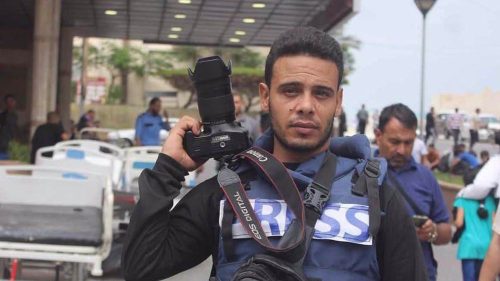
Deceased Palestinian journalist Abdul Rahman Tawfiq al-Abadleh
Gaza’s government media office also said Palestinian journalists Nour Qandil and Khaled Abu Seif lost their lives alongside their young daughter in the Israeli strike that targeted their home in Deir el-Balah in the central Gaza Strip.

Deceased Palestinian journalist Nour Qandil and her husband Khaled Abu Seif
Furthermore, Palestinian journalist Ahmad al-Zinati was killed alongside his wife, Nour al-Madhoun, and their children, Muhammad and Khaled, on Saturday night when their tent was bombed in Khan Yunis.

Deceased Palestinian journalist Ahmad al-Zinati alongside his family
The deaths came only two days after Ahmed al-Halou, a reporter for the local al-Quds News Network, was killed in an Israeli attack in the Gaza Strip.
The Israeli military resumed bombardment of Gaza on March 18, killing thousands of Palestinians, and injuring many others, after it shattered the 2-month ceasefire agreement with the Palestinian group Hamas and the deal on the exchange of Israeli captives with Palestinian abductees.
At least 53,272 Palestinians have been killed, mostly women and children, and another 120,673 individuals injured in the brutal Israeli military onslaught on Gaza since October 7, 2023.
The International Criminal Court issued arrest warrants last November for Netanyahu and former Israeli minister of military affairs Yoav Gallant, citing war crimes and crimes against humanity in Gaza.
Israel also faces a genocide case at the International Court of Justice for its war on the besieged coastal territory.
Red Sea debacle: How Yemeni resistance brought American war machine to a halt
By Kit Klarenberg | Press TV | May 18, 2025
On May 12, the New York Times published a forensic autopsy of the failure of the Trump administration’s renewed hostilities against the Ansarullah-led Yemeni military in the Red Sea.
The probe teemed with extraordinary disclosures, spelling out in stark detail how the combined air and naval effort – launched with enormous fanfare and much bombastic rhetoric from US officials – was an even greater debacle, and devastating defeat, for the Empire than hitherto thought.
The scale of the cataclysm may explain Washington’s sudden determination to reach a negotiated settlement with the Islamic Republic of Iran.
Perhaps the most striking revelation is that Trump’s blitzkrieg against Yemen was initially planned to be a long-term, large-scale engagement, culminating in a ground invasion using proxy forces.
General Michael Kurilla, Commander of the Pentagon’s Central Command, which covers Central, South and West Asia, had been in favor of all-out war with the Ansarullah resistance movement ever since its righteous anti-genocide Red Sea blockade began in late 2023.
Reportedly, though, Joe Biden was wary that a “forceful campaign” would elevate them “on the global stage.”
With Trump’s re-election, “Kurilla had a new commander in chief” and an opportunity to up the ante against Ansarullah significantly. He pitched an eight-to-10-month effort, starting with a saturation bombing of Yemen’s air defense systems, before a wave of targeted assassinations of movement leaders, directly inspired by Israel’s attacks on Hezbollah’s senior members in September 2024.
Kurilla’s grand operation was eagerly supported by elements of the Trump administration, including Defense Secretary Pete Hegseth and then-National Security Advisor Mike Waltz.
Saudi officials were also on board, providing Washington with a target list of 12 Ansarullah leaders “whose deaths, they said, would cripple the movement.”
However, the UAE, which had in concert with Riyadh relentlessly bombed Yemen 2015 – 2023 to no tangible result, “was not so sure.” Several members of Trump’s administration were also skeptical of the plan’s prospects and worried a protracted attack on Sana’a would drain valuable, finite resources, including the president himself.
Yet, after concerted lobbying, Trump “signed off on part of General Kurilla’s plan – airstrikes against Houthi air defense systems and strikes against the group’s leaders.”
So it was on March 15, US fighter jets began battering Yemen anew, while a carrier force led by the USS Harry S. Truman thrust into the Red Sea.
White House officials boasted the onslaught would continue “indefinitely”, while Trump bragged that Ansarillah would be “decimated” via “overwhelming lethal force until we have achieved our objective.”
Some degradation
In reality, The New York Times suggests Trump privately made clear he wanted Ansarullah bombed “into submission” within just 30 days, and failure in this objective would mean the operation’s termination.
By the 31st day of hostilities, the US president “demanded a progress report.” As the outlet records, “the results were not there,” which is quite an understatement. The US “had not even established air superiority” over Ansarullah, while the resistance group continued “shooting at vessels and drones, fortifying their bunkers and moving weapons stockpiles underground.”
Moreover, during those first 30 days, Yemeni military “shot down seven American MQ-9 drones” costing around $30 million each, “hampering Central Command’s ability to track and strike back. Meanwhile, several American F-16s and an F-35 stealth fighter jet “were nearly struck by Houthi air defenses, making real the possibility of American casualties.”
All along, too, the US burned through weapons and munitions at a rate of about $1 billion in the first month alone:
“The cost of the operation was staggering. The Pentagon had deployed two aircraft carriers, additional B-2 bombers and fighter jets, as well as Patriot and THAAD air defenses… So many precision munitions were being used, especially advanced long-range ones, that some Pentagon contingency planners were growing increasingly concerned about overall stocks and the implications for any situation in which the US might have to ward off an attempted invasion of Taiwan by China.”
Concerned, “the White House began pressing Central Command for metrics of success in the campaign.”
In a bitter irony, Pentagon officials “responded by providing data showing the number of munitions dropped” to prove they were achieving their goals. They also claimed, without evidence, to have hit over 1,000 military targets, while killing “more than a dozen senior Houthi leaders.”
US intelligence was unconvinced, acknowledging there was “some degradation” of the Ansarullah-led military, but “the group could easily reconstitute” regardless.
As a result, “senior national security officials” began investigating “pathways” for either withdrawing from the theatre with minimal embarrassment or keeping the fiasco going using local proxy forces.
One option was to “ramp up operations for up to another month and then conduct ‘freedom of navigation’ exercises in the Red Sea using two carrier groups, the Carl Vinson and the Truman.” If AnsarAllah did not fire on the ships, “the Trump administration would declare victory.”
Another option was to extend the campaign, giving forces under the control of the Riyadh-based Yemeni Presidential Leadership Council “time to restart a drive to push the Houthis out of the capital and key ports” in a ground assault.
The plan was hatched despite prior Saudi-led invasions of Yemen invariably ending in total disaster. This may account for why talks between Hegseth and Saudi and UAE officials in late April “to come up with a sustainable way forward… they could present to the President” came to nothing.
Great ability
As luck would have it, right when Hegseth’s last-ditch efforts to breathe life into the collapsing effort were floundering, Trump’s West Asia envoy Steve Witkoff was in Oman, engaged in nuclear talks with Iran.
Officials there separately suggested a “perfect offramp” for Washington in its war with Ansarullah. The US “would halt the bombing campaign and the militia would no longer target American ships in the Red Sea, but without any agreement to stop disrupting shipping that the group deemed helpful to Israel.”
Well-publicised fiascoes around this time, such as the loss overboard of an F/A-18 Super Hornet, costing $67 million, due to the USS Harry S. Truman conducting evasive maneuvers to avoid an Ansarullah drone and missile attack, further depleted White House enthusiasm for the operation.
According to The New York Times, “Trump had had enough”. He duly accepted the Omani proposal, and on May 5th, CentCom “received a sudden order… to ‘pause’ offensive operations” in the Red Sea.
That a ballistic missile fired by the Yemeni military evaded the Zionist entity’s air defenses and struck Tel Aviv’s Ben-Gurion International Airport the previous day likely provided further incentive to halt hostilities.
So it was on May 6, Trump declared victory against Ansarullah, claiming the resistance group had “capitulated”, and “don’t want to fight any more”. Nonetheless, the president expressed clear admiration for God’s Partisans, indicating he placed a high degree of trust in Ansarullah’s assurances that US ships would no longer be in their redoubtable crosshairs:
“We hit them very hard and they had a great ability to withstand punishment. You could say there was a lot of bravery there. They gave us their word that they wouldn’t be shooting at ships anymore, and we honor that.”
Per The New York Times, Trump’s “sudden declaration of victory… demonstrates how some members of the president’s national security team underestimated a group known for its resilience.”
But more deeply, it surely reflects how the bruising, costly experience was a blunt-force education in the glaring deficiencies of US military power, and the Empire’s fatal vulnerability in the event of all-out war against an adversary actually able to defend itself. This could account for the Trump administration’s sudden determination to finalize a nuclear deal with Tehran.
It must not be forgotten that before even taking office, Trump and his cabinet openly planned for a significant escalation of belligerence against the Islamic Republic.
Among other things, they boasted of drawing up plans to “bankrupt Iran” via “maximum pressure”. US Secretary of State Marco Rubio, who has long called for tightening already devastating sanctions on Tehran, was a key advocate for this approach, and eagerly supported by Mike Waltz, among others.
At an event convened by NATO adjunct the Atlantic Council in October 2024, Waltz bragged about how the president had previously almost destroyed the Islamic Republic’s currency, and looked ahead to inflicting even more severe damage on the country following Trump’s inauguration.
Fast forward to today, though, and such rhetoric has vanished from mainstream Western political discourse. It appears Trump and his team have not only jettisoned their previously stated ambitions towards Iran but are determined to avoid war.
Moreover, just as the Zionist entity was not consulted before Washington struck a ceasefire with Ansarullah, Tel Aviv has been completely frozen out of nuclear negotiations between the US and Iran, and if an agreement does result at last, it will not take into account Israel’s bellicose position towards the Islamic Republic.
Just as the Cuban Missile Crisis transformed Cold warrior John F. Kennedy into a dove, Trump’s experience in the Red Sea may well have precipitated a seismic shift in his administration’s foreign policy.
Another fictional ‘Iranian plot’ in London?
By Robert Inlakesh | The Cradle | May 18, 2025
The arrest of a group reportedly consisting of Iranian nationals, accused of planning an attack on the Israeli embassy in London, has coincided with an aggressive lobbying campaign to classify Iran’s Islamic Revolutionary Guard Corps (IRGC) as a terrorist organization in the UK. While details of the case remain sparse, previous such allegations suggest that linking this plot to Tehran without substantiated evidence is politically motivated.
On 7 May, The Telegraph claimed that five individuals were detained in what the UK Home Secretary described as one of the “biggest counter-terrorism operations in recent years.” According to the report, four of those arrested were Iranian nationals, apprehended under Section 5 of the Terrorism Act 2006, allegedly for plotting an assault on the Israeli embassy in London.
A confused arrest, a convenient campaign
Yet, contradictions in the report raised significant public skepticism. While The Telegraph asserted that “the suspected terror cell was hours from unleashing the attack when the men were arrested,” it also noted that the suspects were detained in cities across England – three of them located around a four-hour drive from London, and another an hour away. The disparity sparked a wave of theories and doubts among the British public.
As these logistical inconsistencies drew scrutiny, right-wing media outlets in Britain seized the moment to stir anti-immigrant sentiments. On Talk TV, Kevin O’Sullivan descended into hysteria, warning, “We are going to have a Southport 2 unless we are careful,” invoking a racially charged incident that had ignited riots. The immigration status of the suspects became the focal point for many conservative commentators.
Simultaneously, the pro-Israel lobby began exploiting the incident to reinvigorate its campaign for the IRGC’s designation as a terrorist organization. On 28 April, Progressive Britain—a group aligned with the Blairite wing of the Labour Party – published an article titled “Why the UK Should Proscribe the IRGC.” Its author, Jemima Shelley, is not only a non-resident fellow at Labour Friends of Israel (LFI) but also a senior analyst at United Against Nuclear Iran (UANI).
UANI has played a recurring role in previous efforts to influence British policy against the Islamic Republic. Masquerading as a neutral non-profit, the group is chaired by Jeb Bush and features an advisory board packed with pro-Israel operatives.
Former Mossad Director Meir Dagan was a member until his death, and the US Secretary of Defense Pete Hegseth currently sits on its Veterans Advisory Council.
Nigel Farage, leader of the far-right Reform UK Party, opportunistically called on the Labour government to proscribe the IRGC, bizarrely claiming that “friends of mine who live in the Middle East are astonished we haven’t done it.”
Terror claims as political leverage
On 8 October 2024, MI5 Director General Ken McCallum delivered a speech at London’s Counter Terrorism Operations Centre, stating:
“Since the killing of Mahsa Amini in 2022 we’ve seen plot after plot here in the UK, at an unprecedented pace and scale. Since January 2022, with police partners, we have responded to twenty Iran-backed plots presenting potentially lethal threats to British citizens and UK residents.”
Although McCallum insisted that the intelligence agency does not politicize terrorism cases, his speech disproportionately emphasized threats from Russia, China, and Iran – the UK’s designated strategic adversaries. Commentators quickly seized on his remarks to bolster narratives of Iranian culpability.
Despite referencing 20 “Iran-backed” plots, British authorities have failed to provide concrete evidence linking Tehran to any of them. Officials argue that such ambiguity is strategic, offering “plausible deniability.” But in most cases, their accusations rest on tenuous associations, such as Tehran’s political animosity toward the individuals in question.
Consider the highly publicized case of Austrian national Magomed Husejn Dovtaev, who was convicted in February 2023 after recording video footage of the offices of Iran International, a Saudi-funded Persian-language news outlet based in London.
Dovtaev claimed he had been defrauded of €20,000 and was seeking those responsible at the location. Despite denying any connection to Iran, he was convicted of collecting information likely to be useful for terrorism.
On 4 March, Britain’s Security Minister Dan Jarvis repeated the claim of 20 terror plots and that “the Iranian regime is targeting dissidents.” He also told parliament that “The Iranian Intelligence Services, which include the Islamic Revolutionary Guard Corps, the IRGC, and the Ministry of Intelligence and Security, or MOIS, direct this damaging activity.”
However, Jarvis clarifies that “rather than working directly on UK shores, they use criminal proxies to do their bidding. This helps to obfuscate their involvement, while they sit safely ensconced in Tehran.”
While the existence of Iranian intelligence operations abroad cannot be ruled out, the recurring claims tying Tehran to every suspicious activity lack transparency and verification.
A precedent of manipulation
The current frenzy echoes the Israeli embassy bombing in London in 1994. Initially blamed on “pro-Iranian extremists” allegedly tied to Lebanon’s Hezbollah, the attack resulted in the arrest of five Palestinians. Two of them, Jawad Botmeh and Samar Alami, were convicted of conspiracy despite no direct evidence or allegation that they planted the bomb.
At the time, human rights group Amnesty International issued a statement raising concerns that neither Botmeh nor Alami had been granted “their right to a fair trial because they have been denied full disclosure – both during and after the trial – of all information.”
“There was no direct evidence connecting either of them to the attacks and both had alibis. The appeal was based on the grounds that the convictions were unsafe, including due to the failure of the prosecution to disclose evidence to the defence, and on the length of the sentences.”
When the late veteran journalist and long-time West Asia correspondent Robert Fisk wrote on the case for the Independent in 1998, he described it as follows:
“The trial was, to put it mildly, a very puzzling affair. Even before it began, the case developed unusually. First of all, the police charged Nadia Zekra, a very middle-class Palestinian lady, with planting the bomb outside the embassy. Explosive traces had supposedly been found on a table in her home. Then, once the trial began, all charges against Zekra were dropped. Another Palestinian, Mahmoud Abu-Wardeh, was charged, but the jury acquitted him on all charges. And in the pre-trial period, the judge allowed both Alami and Botmeh to go free on bail.”
Fisk noted that Alami and Botmeh had expressed their belief that a shady figure known as Reda Moghrabi was an Israeli agent and had set them up. Yet, following the bombing, Moghrabi disappeared. The claim of responsibility for the attack was also strange, anonymously submitted by the “Jaffa Team” of the “Palestinian resistance,” a group that never existed prior to, nor since, the attack.
On top of this, the pair were released early. Botmeh was set free in August of 2008, and Alami was released in April 2009 and deported to Lebanon. Their early release, combined with the fact that the two were allowed to walk the streets of London on bail until their conviction, raised even more questions about the nature of the bombing incident.
Even more damning were later revelations by former MI5 agents. David Shayler disclosed that British intelligence “hid” documents related to the bombing. Annie Machon, another ex-MI5 officer, revealed that an internal assessment concluded that Mossad itself had staged the explosion to justify demands for increased security at its embassy. The sophisticated device caused no fatalities, and the real perpetrators were never apprehended.
Keeping all of this information in mind, there is currently not enough evidence to draw any conclusions regarding the arrests of Iranian nationals and the alleged plot to attack the Israeli embassy. However, British media outlets and several members of parliament were quick to seize on the incident, using it to push the agenda of designating the IRGC as a terrorist organization.
Politics trumps evidence
With all this context in mind, the latest arrests of Iranian nationals – and the unsubstantiated claim of a planned embassy attack – must be scrutinized. Iran’s Foreign Minister Abbas Araghchi has categorically denied involvement, asserting that “Iran stands ready to engage to shed light on what has truly transpired, and we reiterate that UK authorities should afford our citizens due process.”
Meanwhile, The Guardian has spun the case to highlight fears among Iranian dissidents in the UK, presenting the arrests as validation of threats from Tehran.
By rushing to implicate the IRGC, British media and officials are once again politicizing an unverified security incident. This tactic mirrors accusations they often level at Iran: weaponizing arrests for political ends. Regardless of who was truly behind the supposed plot, its timing conveniently serves those advocating for the IRGC’s proscription.
What is clear is that claims of Iranian-linked terrorism continue to surface whenever Tel Aviv or its allies seek to ramp up pressure on the Islamic Republic.
UK Labour approved more weapons to Israel in three months than Tories did in four years
MEMO | May 17, 2025
The UK’s Labour government is reported to have approved approximately $160 million worth of arms exports to Israel between October and December 2024, more than the total approved during the entire four-year term of Conservative leadership preceding it. The figure, drawn from newly released strategic export licensing data, reflects an unprecedented rise in UK military support to Israel as the occupation state continues its genocide in Gaza
By comparison, from 2020 to 2023, UK arms export licences to Israel totalled approximately $144 million, including $39 million in 2020, $30 million in 2021, $52 million in 2022 and $23 million in 2023.
The stark figures, compiled by the Campaign Against Arms Trade (CAAT), come amid mounting criticism of the UK’s ongoing military support for Israel as the occupation state continues its devastating war on the besieged Gaza Strip.
“This is the Labour government aiding and abetting Israel’s genocide in Gaza,” said Emily Apple, CAAT’s media coordinator. “It is sickening that instead of imposing a full two-way arms embargo, Keir Starmer’s government has massively increased the amount of military equipment the UK is sending to Israel.”
The revelations coincide with a High Court case in which the UK government is defending its decision to continue supplying F-35 fighter jet components used by Israel in Gaza. Under international and domestic law, the UK is obliged to suspend arms exports where there is a clear risk they could be used to commit serious violations of international law.
However, government lawyers have argued that the available evidence does not support the conclusion that a genocide is occurring or has occurred in Gaza. This, despite the government’s own insistence that any determination of genocide is for the courts to decide.
In response, CAAT challenged the government’s claims, highlighting what it described as contradictions in the official narrative. “The UK government is arguing that ‘the impact of suspending F-35 components on operations in Gaza is likely to be minimal’ because the ‘IDF is one of the most significant and well-equipped militaries in the world’,” CAAT said. “However, the claim that the impact would be ‘minimal’ is contradicted by the facts.”
According to CAAT, Israel is operating its fleet of 39 F-35s at five times the usual rate, creating a surge in demand for spare parts. Freedom of Information disclosures show that the UK’s open licence for F-35 components was used 14 times more frequently in 2023 than in any previous year.
The arms export disclosures come as Israel continues its siege on Gaza, blocking food, medicine, and humanitarian supplies for over ten weeks, measures that have compounded an already catastrophic situation. According to the Integrated Food Security Phase Classification (IPC), nearly half a million Palestinians are enduring “catastrophic” levels of hunger, with another one million facing emergency conditions.
The crisis has escalated since Israel broke a ceasefire agreement with Hamas in March and announced its intention to occupy the entirety of the Gaza Strip. The UN has warned that these actions may amount to war crimes and has repeatedly called for a ceasefire and unrestricted humanitarian access.
Despite these warnings, the UK continues to supply weapons to Israel, a move legal experts say could render British officials complicit in the atrocities being committed. Human rights groups have condemned the UK’s position as morally indefensible and legally precarious.
The High Human Cost of Syria Sanctions
By Rick Sterling | Dissident Voice | May 17, 2025
On May 13, U.S. President Trump announced he is ordering the removal of sanctions on Syria.
Some of the U.S. sanctions can be quickly terminated because they were issued by Executive Order. Other sanctions, including the extremely damaging 2019 “Caesar” sanctions, were imposed by Congressional legislation and may require Congressional action to terminate.
The Syrian people are joyous at the prospect of the end of their country’s economic nightmare. In 2010, before the conflict began, Syria was a middle-income country with free education, free healthcare, and no national debt. It was largely self-sufficient in energy and food. After fourteen years of war, occupation, and strangulating Western sanctions, the U.N. reports that “nine out of ten Syrians live in poverty and face food insecurity”.
Why Syria Was Targeted
In 2007, the former Supreme Allied Commander of NATO, General Wesley Clark, publicly revealed that Washington neo-cons had a hit list of seven countries to be overthrown in the wake of 9-11. The list included Iraq, Libya, Somalia, Sudan, Lebanon, Syria, Iran.
The list is essentially the same as that identified by Benjamin Netanyahu in his 1995 book Fighting Terrorism: How Democracies Can Defeat the International Terrorist Network. The premise of this book is that Palestinian and Lebanese resistance movements are “terrorist,” and any nation that supports them should be overthrown. He targets Iran, Libya, Syria, and Sudan for supporting Palestinian rights and says. “Take away all this state support, and the entire scaffolding of international terrorism will collapse into dust.”
In 2007, Democratic Party leader Nancy Pelosi visited Syria and tried to persuade Assad to end Syria’s support of the Palestinian and Lebanese resistance movements. When Assad would not comply with US and Israeli wishes, Syria was marked for regime change. The Netanyahu and neo-conservative hit list had somehow been adopted by the Western foreign policy establishment. This was confirmed by the former French Foreign Minister Roland Dumas. In a 2013 interview he says, “I went to England almost two years before the start of hostilities (2011). I met British officials, some of whom are friends of mine. They confessed, while trying to persuade me, that preparations for something were underway in Syria. This was in England, not the US. Britain was preparing gunmen to invade Syria… This operation goes way back. It was prepared, conceived, and planned for the purpose of overthrowing the Syrian government because … this regime has an anti-Israeli stance.”
Hybrid Warfare against Syria
The overthrow of the Syrian government was not easy. It involved massive funding from seven countries (USA, UK, France, Turkey, Saudi Arabia, Qatar, UAE). In the early years, the CIA budget alone was $1 billion per year. The campaign included military, diplomatic, media/information and economic warfare.
The regime change operation began in March 2011. While part of the population was hostile to the Assad dynasty, the majority supported the government and a secular Syria. The opposition came largely from sectarian jihadist elements, including the Muslim Brotherhood. Hundreds of factions and cells were supplied and funded by a host of countries, including Qatar, Saudi Arabia, Turkey, the U.S., and the UK. Thousands of foreigners were recruited and provided access to Syria.
The political and media war on the Assad government was intense. Historian Stephen Kinzer wrote, “Coverage of the Syrian war will be remembered as one of the most shameful episodes in the history of the American press.”
Accusations that the Assad government used chemical weapons against civilians were widely broadcast in the West. They were used to justify Western bombing attacks on Syria. Acclaimed U.S. investigative journalist Seymour Hersh uncovered evidence that the chemical weapons attacks were by the opposition, aided by Turkey, NOT by the Assad government. He had to go abroad to have the explosive article published.
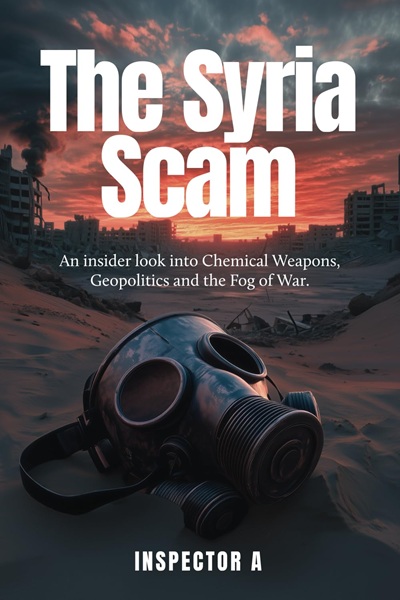 The dubious chemical weapons accusations and US driven political corruption of the Organization for the Prohibition of Chemical Weapons (OPCW) are now exposed in a February 2025 book by one of the technical professionals from the OPCW. The book is titled The Syria Scam: An insider look into Chemical Weapons, Geopolitics and the Fog of War.
By the end of 2018, the Syrian army had largely defeated the diverse jihadists. However, instead of conquering or expelling the opposition, Syria allowed them to have a safe haven in Idlib province on the border with Turkey. With Turkey, Iran and Russia seeking to find a solution through the Astana Accords, the conflict was frozen, and the jihadists were allowed to regain strength. Hayat Tahrir al Sham (HTS) became the de facto leader of the opposition factions and the government of Idlib.
The Frozen Conflict
In 2019, the U.S. turned the screws on Syria and escalated attacks on Lebanon. The extreme Caesar sanctions did what they were intended to do. They crushed the Syrian currency and economy, made it impossible to rebuild, and impoverished the vast majority of Syrians. The spreading poverty and inability to counteract it led to widespread demoralization and dissatisfaction. With consummate cynicism, the “Caesar” sanctions were named the “Caesar Civilian Protection Act”.
Meanwhile, in the HTS safe haven of Idlib province on the Turkish border to the north, conditions were very different. Although HTS was designated a terrorist organization in the U.S. and the West, they were helped economically. The HTS fighters were trained and supplied with modern military weaponry, including drones, sophisticated communications equipment, etc.. Very recently, when people from Damascus traveled to Idlib, they were shocked to find new highways, Wi-Fi widely available, and electricity 24 hours a day. Teacher salaries are ten times higher in Idlib than in Damascus.
The Fall of Damascus
With a demoralized population and Syrian army, the Assad government fell in a few weeks, and HTS, led by Ahmad Al Sharaa, took power on 8 December 2024. The new leader of Syria has been greeted and endorsed by the Gulf monarchies and Western countries that paid for and promoted the overthrow in Syria: the UK, Germany, France, Saudi Arabia, Qatar, and of course, Turkey.
Since the change, there have been numerous sectarian massacres of Alawites and Christians along the coast.
There have been attacks on Druze in Damascus. To date, there have been no punishments for the massacres of civilians. A nun reports, “there is no security” in Damascus or elsewhere in Syria.
Meanwhile, Israel has invaded and occupied all of the Golan and parts of southern Syria. They have built military bases in Quneitra and other strategic locations. Israel has carried out a bombing blitzkrieg, destroying all known Syrian ammunition depots. Israel can now fly over any part of Syria at will.
Instead of condemning the Israeli violation of Syrian land and airspace, Ahmad al Sharaa has criticized Iran and Hezbollah. In recent weeks, the new Syrian regime has arrested Palestinian leaders and closed their offices in Damascus. The normalization of relations with the Zionist state has begun.
Lifting Sanctions on Syria
Of course, the sanctions on Syria should be lifted. They never should have been imposed.
U.S. sanctions, known officially as “unilateral coercive measures”, are condemned by the vast majority of world nations. Over 70% of the world’ nations say that US sanctions are “contrary to international law, international humanitarian law, the Charter of the UN and the norms and principles governing peaceful relations among States.”
Without exaggeration, the West and their allies sponsored terrorism in Syria through Al Qaeda and other fanatical violent terrorist groups. They destroyed a once prosperous and independent nation. With a diverse Syrian population ruled by a sectarian leadership prone to violence, there may be more dark days ahead. While Israel, Turkey and the Gulf monarchies are pleased with the removal of the Assad government, a very heavy price has been paid by the majority of Syrians. And the cost is ongoing.
Trump’s Middle East theatricals were all about putting Bibi in his place
By Martin Jay | Strategic Culture Foundation | May 16, 2025
Was it Bill Clinton in the White House with Benjamin Netanyahu who, in a press conference, muttered those vulgar and certainly immortal words “who’s the f*** superpower around here?” The question was really about whether the U.S. is running Israel and its activities in the Middle East or it is in fact Israel which is running the U.S.
In recent months in both the Biden administration and the Trump one which followed, many pundits have claimed that Israel is in control of U.S. foreign policy, with some even going as far as speculating that this control even goes beyond the Middle East itself. This cabal of online commentators made so much of how Trump adjusted Bibi’s seat when he sat down in the Oval Office.
We can see now though that this idea of the tail wagging the dog, even if once it might have been true to some extent, has now been dealt with head on by Trump.
His visit to the Middle East and his impressive speech in Saudi Arabia which mocked the bellicose approach to bombing civilians was a direct message to Netanyahu in Israel: America is back.
Trump is literally taking control of U.S. foreign policy in the region and pushing back Israel’s attempts to bomb its way to peace, whether this be in Gaza, Lebanon, Syria or, of course, in Iran.
The move comes at a tough time in the region where the country which seemed to bring about a revolution with the Arab Spring – Tunisia – is falling into an abys as it becomes a leading example of a dictatorship which knows no limits on its brutal suppression.
For Netanyahu, a number of pundits now are pointing to the “clear light” between Trump and him with some claiming that these two leaders aren’t even talking anymore. Trump defied him by talking to Iran, negotiating with the Houthis and now scrapping sanctions in Syria.
Israel cannot even dream of attacking Iran with the U.S. help and so a big part of Netanyahu’s mojo has been removed. And now Trump is calling the shots on aid to Gaza, but stopped short of calling for the Palestinians to have their own state.
Yet his move on Syria is telling. Israel’s plans were always to have head-chopping extremists running the show – which they backed in the Syria civil war – with a constant mayhem present so that they can always take advantage of the chaos while ensuring that the path which once stood between Tehran and Beirut is always blocked.
Trump’s announcement that all sanctions will be lifted will not be welcomed by Bibi who will see the move as a stunt by the Donald to demonstrate who is running the show, although the announcement itself might prove to be premature.
Senator Lindsey Graham states only Congress can change the country’s designation as a “state sponsor of terror” and that Trump must make his case to Congress for that to happen.
“That report has not been received, and Congress has the opportunity to review this action if it chooses. The designation of Syria as a state sponsor of terrorism has tremendous ramifications apart from the sanctions,” Graham stated. The senator stated that he is sure that Congress must be informed before sanctions are lifted, and the legislative body would then “make an informed decision on whether or not it should approve the change in designation.” But he also stated that Israel’s opinion matters and that Congress would consult Netanyahu so it’s fair to say that Syria’s fate is still yet to be decided regardless of whatever Trump has said at the podium in Riyadh. It would appear that Bibi and Trump are set to clash now and we shouldn’t be surprised at what resources Trump will deploy to show Israel’s leader that Trump is both serious about peace in the region but also that Israel must put aside its warmongering – which may well include even supporting a two-state solution, pushed more recently by France and the UK. And then we will see who is the f*** super power and who is the client state. Almost certainly the fate of Syria and Gaza will be used as a rod for Bibi’s back until he succumbs to Trump’s rule.
NYU withholds diploma of student who condemned Israel’s Gaza genocide

MEMO | May 16, 2025
In the latest example of escalating repression against Palestine solidarity activism on US campuses, New York University (NYU) has withheld the diploma of student speaker Logan Rozos after he used his commencement address to denounce Israel’s ongoing genocide in Gaza and the US’s complicity.
Rozos, graduating from NYU’s Gallatin School of Individualised Study, told his fellow students on Wednesday: “The only thing that is appropriate to say in this time and to a group this large is a recognition of the atrocities currently happening in Palestine.”
In his speech, Rozos condemned the genocide “supported politically and militarily by the United States, paid for by our tax dollars and livestreamed to our phones for the past 18 months.” He further stated: “I do not wish to speak only to my own politics today, but to speak for all people of conscience, and all people who feel the moral injury of this atrocity.”
Razos’s remarks were met with widespread applause from students. NYU swiftly responded by issuing a statement denouncing Rozos, accusing him of violating university rules and announcing it would withhold his diploma pending disciplinary action.
The university also removed Rozos’s student profile from its website, adding to concerns about institutional retaliation.
This incident comes amid a wider crackdown on free speech and pro-Palestinian activism at US universities. NYU, like many elite institutions, has adopted the highly controversial International Holocaust Remembrance Alliance (IHRA) definition of anti-Semitism, which conflates political opposition to Zionism and Israel’s colonial violence with anti-Jewish hatred. Critics, including human rights scholars and Jewish groups, warn that such measures are being weaponised to suppress Palestinian advocacy and silence dissenting voices.
Rozos’s speech, and NYU’s reaction, follows a pattern of repression at the university. Over the past year, NYU administrators have called police to disperse peaceful encampments and arrested dozens of students and faculty protesting Israel’s war on Gaza. The university has also updated its conduct guidelines to classify phrases such as “Zionist” as discriminatory, explicitly erasing the distinction between anti-Zionism and anti-Semitism.
In December 2024, NYU declared two tenured professors, Andrew Ross and Sonya Posmentier, “persona non grata” after they joined a sit-in demanding the university divest from companies profiting from Israel’s war crimes in Gaza. Months later, NYU cancelled a talk by Doctors Without Borders’ former president Dr Joanne Liu, deeming her slides on Gaza civilian casualties potentially “anti-Semitic.”
Human rights advocates and academic freedom organisations have condemned these actions, warning that universities like NYU are sacrificing core principles of free speech and academic independence under pressure from pro-Israel donors, political figures, and lobby groups.
Rozos’s speech, which framed Israel’s war on Gaza as a genocide livestreamed in real time, resonates with warnings from genocide scholars, legal experts and international bodies that Israel’s actions meet the legal definition of genocide. Despite this, Rozos now faces institutional reprisals for expressing what many human rights defenders see as an urgent moral truth.
Israel kills over 100 Palestinians in northern Gaza attacks

Bodies of Palestinians, who lost their lives after Israeli attacks, are brought to Indonesia Hospital in Gaza City, Gaza on May 16, 2025. [Abdalhkem Abu Riash – Anadolu Agency]
MEMO | May 16, 2025
More than 100 Palestinians were killed in several attacks carried out by the Israeli occupation army in northern Gaza at daybreak today.
Medical sources told Anadolu that the Israeli occupation army carried out “horrific massacres” targeting civilians.
They reported several casualties when the Israeli army targeted an ambulance in the town of Jabalia in northern Gaza, the latest in a series of attacks on medics and healthcare facilities.
“Since early Friday, rescue teams have recovered 50 bodies from under the rubble following Israeli air strikes on 11 residential homes in northern Gaza,” Gaza Civil Defence spokesman Mahmoud Basal said.
He added that “over 50 others are still trapped beneath the debris.”
He warned that the actual death toll is likely much higher, as emergency crews have been unable to reach several areas due to the ongoing bombardment across the enclave.
Basal added that Israeli occupation forces not only struck densely populated homes but also targeted paramedics attempting to rescue victims and retrieve bodies in the aftermath of the attacks.
“There are bodies still lying in the streets of Beit Lahia, Jabalia, Jabalia refugee camp, and Beit Hanoun,” he said. “Rescue teams cannot access them because of the intensity of the strikes.”
The Israeli army has pursued a brutal offensive on the Gaza Strip since October 2023, killing more than 53,000 Palestinians, most of them women and children.
The Israeli Syria Dilemma
By Robert Inlakesh | Al Mayadeen | May 15, 2025
Although it could appear that the Israelis are having their way with Syria, their aggression is short sighted and could at any moment backfire. The only reason they still enjoy the freedom to continue carrying on in the manner they are, is because of the leadership in Damascus.
Syria’s new President Ahmad al-Sharaa and his administration, staffed primarily by members of Hay’at Tahrir al-Sham (HTS), have so far failed to take advantage of opportunity after opportunity that have fallen in their laps. Instead of uniting the country behind a common cause, working on building a strong functional nation, and finding some leverage to use in future negotiations, they chose the path of least resistance.
We have now reached a phase in Syria where President al-Sharaa, according to several sources who spoke to both Reuters and The Times, is considering a normalisation deal with the Zionist entity. To begin with, even the fact that this is being spoken of and he hasn’t denied it is an admission of guilt and represents a betrayal of the Palestinian people.
Yet, putting aside the fact that normalisation with the Zionist entity would make al-Sharaa and his administration directly complicit in the genocide of Palestinians in Gaza and a collaborator with the Israeli regime, it is a ridiculous move, politically speaking.
What we have to understand here is that the Israelis are not the ones begging Syria for a normalisation agreement, it is the other way around. However, the Syrian government has no leverage whatsoever. As al-Sharaa remains trapped between multiple regional and Western interests, he evidently has little wiggle room with which he can work in order to make his regime work.
For example, one of his primary backers is Turkiye, which has at least publicly expressed its interest in strengthening the Syrian State and also uniting it, whereas the Israelis put their foot down and are openly seeking balkanisation of the country. This all came to a head when the Syrian security forces were ordered to seize Druze majority areas south of Damascus and to head towards Sweida.
Unfortunately, al-Sharaa decided to completely dismantle the Syrian Arab Army (SAA) and pull apart the security forces, meaning that the de facto military and security forces of the country are a collection of largely ill-trained and undisciplined militiamen. So, when they are sent into any area, we see sectarian bloodshed and lawlessness. This is then exploited by the Israelis, who back their own militia forces, falsely claiming to be on the side of Syria’s Druze community.
To give some context to this situation, the Israelis were giving military, financial, and medical aid to Jabhat al-Nusra – now rebranded as HTS – at a time when it was committing massacres against Druze civilians, yet are now pretending to be the saviours of those same communities.
Because of the fact that al-Sharaa doesn’t have a real army or security forces yet, militarily, he is weak. Then, when he attempts to disarm Syrian villages, this only ends up dividing the country further. Meanwhile, the US, EU, UK, UAE, Saudi Arabia, Turkiye and other players all have their own opinions on what Damascus should be doing.
What al-Sharaa has chosen to do is suck up to the United States and the rest of the collective West, yet he lacks the intellectual prowess necessary to negotiate with them properly. Instead, he is floating ridiculous proposals like the construction of a Trump Tower in Damascus and a Ukraine-style resource deal with the US. He also believes that making friends with the West is as easy as joining a normalisation deal with the Zionist regime.
Yet, when the Israelis look at Syria, they see a leadership that is willing to crack down on the Palestinian Resistance, allow the occupation of their lands and abandons its own people who are coming under attack. Therefore, Israeli PM Benjamin Netanyahu looks at the predicament of Syria and laughs at the prospect of normalisation for now, not because he doesn’t eventually seek this outcome, but because there is no need to entertain it yet.
Instead, the Israelis are looking to exploit the weakness of the Syrian leadership and push for finishing their agenda in at least the south of the country. The Zionists have long sought to annex a large portion of strategic territory in southern Syria, which they are doing without so much as a single bullet fired at them from the forces belonging to Damascus, while working alongside Syrian minority militias to extend their de facto control all the way to the Euphrates River.
The major challenge now, for the Zionist entity, has nothing to do with the government in Damascus, but rather how far it can get away with pushing. We have already seen signs from local forces in Daraa, that there are groups willing to defend their villages and cities. This local resistance, rather than the government, is the primary factor holding the Zionist advance back.
If you trace back to the reaction to the ambushes carried out against the convoys of Israeli soldiers in southern Syria, the immediate response was to withdraw and use airpower to inflict deaths and injuries in Daraa. It has now been over a month since the clashes occurred, and the Israelis have not admitted to their casualties, nor have they bothered returning on the ground.
The Israeli agenda does not actually encompass any areas that extend beyond Damascus, they have been very open with their intentions being contained to everywhere south of the Syrian Capital. Yet, they have painted themselves into a corner that could result in a brief incursion into Damascus at some point or another.
The Israeli Premier, Benjamin Netanyahu, has pledged to come to the aid of the Druze communities in Syria, which has ended up causing tensions within the Israeli Druze population in occupied Palestine. The Israeli Druze serve crucial roles in the Israeli military and contribute greatly to the Zionist regime’s economy, therefore, when Netanyahu pledges to help the Druze of Syria, this is not a pledge he can simply go back on.
When Ahmed al-Sharaa sent his security forces towards Sweida, this caused protests amongst Israeli Druze and calls for a ground incursion to fight against the Syrian government forces. That night, Israeli airstrikes were launched within 500 meters of the Presidential palace as a warning to the Syrian president. This was followed by one of the largest bombing campaigns in past decades against the country.
In response, al-Sharaa capitulated and decided to arrest the Secretary General of the Popular Front for the Liberation of Palestine General Command (PFLP-GC), Talal Naji, likely in a good will gesture to help the Zionist regime locate the body of an Israeli soldier considered missing since 1982.
It is clear that the Israeli project in Syria is not over and that Tel Aviv seeks to use what it sees as a historic opportunity to divide the country and achieve “Greater Israel”. But this will come at a potentially huge cost, due to the fact that more action inside southern Syria will eventually lead to an organic resistance movement emerging. On the other hand, if the Zionists decide to engage with Syrian security forces on the ground, there is no telling how things could spiral out of control.
The Israelis simply do not have the ground capability to open up another broad front inside of Syria, because if they do so, they are going to leave themselves vulnerable on other fronts. If the current Syrian administration was politically intelligent, it would weaponise the situation to its benefit. Instead, it appears to be appealing for normalization without any need for Israeli concessions, meanwhile, Netanyahu doesn’t appear to be entertaining a deal at this time and wants to steal more from Syria first.
Featured Video
The Board For Peace – Whitewashing Ethnic Cleansing and Genocide
or go to
Aletho News Archives – Video-Images
From the Archives
Inside Job? Inside What?
By Prof. Tony Hall | American Herald Tribune | July 28, 2016
The Kevin Barrett-Chomsky Dispute in Historical Perspective – Sixth part of the series titled “9/11 and the Zionist Question”
In his chapter on “Left Gatekeepers” and the “Shame of Noam Chomsky,” Barrie Zwicker refers to the the “New World Order” as the “diaboligarchy’s” directing agency. Less compelling is Zwicker’s reference to the “New World Order” as the “diaboligarchy’s” directing agency. To me this unfortunate choice of words is much too closely associated with the often crude and chauvinistic populism of Alex Jones and his Infowars media network. Many have come to see Jones’ lucrative media operation as a limited hangout set in place by handlers trying to hold the activities of the 9/11 Truth Movement within manageable constraints.
Due to the important findings over fifteen years of the citizens’ investigation into 9/11, the culprits most deeply implicated in the crime can be identified with much more specificity than an entity vaguely described as a “New World Order.” As Kevin Barrett and many others insist, the time has come to name the names of the probable culprits, Noam Chomsky prominent among them.
While Alex Jones ultimately serves the same masters as Chomsky, the former’s media product is often much closer to the mark of what is really going on than the content of Noam Chomsky’s more magisterial pronouncements. Jones goes at least part of the way into realities of the deep state politics of the twenty-first century. Chomsky, however, sacrificed his capacity to contribute cogently to sensible discourse on contemporary geopolitics by making himself a primary instrument of the most consequential deep state deception of recent times. As a leading agent of disinformation in the psychological trenches of the ongoing Global War of False Flag Terrorism, Chomsky has reduced himself to the level of skeptic pretender Michael Shermer. In the style of Shermer, the elder Chomsky has become an establishment TV professor readily available on Netflix. … continue
Blog Roll
Recent Comments
Coronistan on EU member to sue bloc over ‘su… loongtip on Vicious loongtip on EU turns to India for defense… Coronistan on Donald Trump Is No Peace … seversonebcfb985d9 on French court jails pro-Palesti… eddieb on Fourteen Incredible Facts Abou… Bill Francis on European leaders’ shift in the… seversonebcfb985d9 on Villains of Judea: Philip Esfo… loongtip on Report warns that ‘Jewish terr… Craig Nelms on New study shows that toxic gas… loongtip on A Funny Thing Happened on the… loongtip on EU free trade pact on hold as…


 Aletho News
- UN experts alarmed by prosecution of students protesting ETH Zurich’s Israel-linked research ties
- Exposed – How the UAE Became Central to Gaza’s Concentration Camp Plot
- How South Korea’s gas ambitions sustain the occupation of Gaza
- “Leaked document” exposes US blueprint for total control over Gaza
- Trump wanted to play peacemaker, Netanyahu made sure he failed
- Idea of limited, fast strike on Iran misjudges our capabilities: IRGC
- US Military Buildup on Land, Air, and Sea Raises Fears of Imminent Attack on Iran – Expert
- Russia reiterates demand to Germany over Nazi crimes
- France and EU clash over UK missiles for Ukraine – Telegraph
- EU member to sue bloc over ‘suicidal’ ban on Russian gas
- If Americans Knew
- Leaked “Board of Peace” Resolution Outlines U.S.-Led Plan to Rule Over Gaza
- Jonathan Greenblatt Rolls Out Plan to Activate Hispanic Evangelical Golems
- Violence against hundreds of Gazan remains to find one Israeli – Not a ceasefire Day 109
- Greenpeace Demonstrator Exposes Folly of Protest Restrictions
- From CBS to TikTok, Pro-Israel Ellison is now in the driver’s seat
- Israel pays for UK advertisements attacking Doctors Without Borders
- Israel accused of extracting billions from Gazan people to pay for their own genocide
- ‘Deliberate Assassination’: 3 Journalists Among 11 Killed by Israeli Forces in Gaza
- In Gaza, We’re Struggling to Reintroduce Foods to Bodies Adjusted to Starvation
- Will Rafah crossing be opened at last? – Not a ceasefire Day 108
- No Tricks Zone
- New Study Affirms Rising CO2’s Greening Impact Across India – A Region With No Net Warming In 75 Years
- Germany’s Natural Gas Crisis Escalates … One Storage Site Near Empty …Government Silent
- Polar Colding…Antarctica Saw Its Coldest October In 44 Years!
- New Study: Sea Levels Rose 20 Times The Modern Rate During The Roman Warm Period
- As German Gas Storage Dips Dangerously Low…Shortage Hardly Avoidable
- New Study: Brazil’s Relative Sea Level Was 2+ Meters Higher And SSTs 3-4°C Warmer 6000 Years Ago
- Philosopher Schopenhauer: Climate Science Certainty Stems From Stupidity, Ignorance
- New Study: Species Extinction Rates Declining Since 1980 – ‘Climate Change Is Not An Important Threat’
- Denmark Places Climate Protection Above Animal Welfare, Poisoning And Culling Cows
- New Study: Greenland Was 3-7°C Warmer And Far Less Glaciated Than Today 6000-8000 Years Ago
 Aletho News