Deporting dissent: The dangerous precedent set by the persecution of pro-Palestine activists
By Ramzy Baroud | MEMO | April 22, 2025
“Rights are granted to those who align with power,” Mahmoud Khalil, a Columbia University graduate student, eloquently wrote from his cell. This poignant statement came soon after a judge ruled that the government had met the legal threshold to deport the young activist on the nebulous ground of “foreign policy”.
“For the poor, for people of colour, for those who resist injustice, rights are but words written on water,” Khalil further lamented. The plight of this young man, whose sole transgression appears to be his participation in the nationwide mobilisation to halt the Israeli genocide in Gaza, should terrify all Americans. This concern should extend even to those who are not inclined to join any political movement and possess no particular sympathy for – or detailed knowledge of – the extent of the Israeli atrocities in Gaza, or the United States’ role in bankrolling this devastating conflict.
The perplexing nature of the case against Khalil, like those against other student activists, including Turkish visa holder Rumeysa Ozturk, starkly indicates that the issue is purely political. Its singular aim appears to be the silencing of dissenting political voices.
Judge Jamee E. Comans, who concurred with the Trump Administration’s decision to deport Khalil, cited “foreign policy” in an uncritical acceptance of the language employed by US Secretary of State Marco Rubio. Rubio had previously written to the court, citing “potentially serious foreign policy consequences” stemming from Khalil’s actions, which he characterised as participation in “disruptive activities” and “anti-Semitic protests”.
The latter accusation has become the reflexive rejoinder to any form of criticism levelled against Israel, a tactic prevalent even long before the current catastrophic genocide in Gaza.
Those who might argue that US citizens remain unaffected by the widespread US government crackdowns on freedom of expression must reconsider. On 14 April, the government decided to freeze $2.2 billion in federal funding to the University of Harvard.
Beyond the potential weakening of educational institutions and their impact on numerous Americans, these financial measures also coincide with a rapidly accelerating and alarming trend of targeting dissenting voices within the US, reaching unprecedented extents. On 14 April, Massachusetts immigration lawyer Nicole Micheroni, a US citizen, publicly disclosed receiving a message from the Department of Homeland Security requesting her self-deportation.
Furthermore, new oppressive bills are under consideration in Congress, granting the Department of Treasury expansive measures to shut down community organisations, charities and similar entities under various pretenses and without adhering to standard constitutional legal procedures.
Many readily conclude that these measures reflect Israel’s profound influence on US domestic politics and the significant ability of the Israel lobby in Washington DC to interfere with the very democratic fabric of the US, whose Constitution’s First Amendment guarantees freedom of speech and assembly.
While there is much truth in that conclusion, the narrative extends beyond the complexities of the Israel-Palestine issue.
For many years, individuals, predominantly academics, who championed Palestinian rights were subjected to trials or even deported, based on “secret evidence”. This essentially involved a legal practice that amalgamated various acts, such as the Classified Information Procedures Act (CIPA) and the Immigration and Nationality Act (INA), among others, to silence those critical of US foreign policy.
Although some civil rights groups in the US challenged the selective application of law to stifle dissent, the matter hardly ignited a nationwide conversation regarding the authorities’ violations of fundamental democratic norms, such as due process (Fifth and Fourteenth Amendments).
Following the terrorist attacks [events] of September 11, 2001, however, much of that legal apparatus was applied to all Americans in the form of the PATRIOT Act. This legislation broadened the government’s authority to employ surveillance, including electronic communications and other intrusive measures.
Subsequently, it became widely known that even social media platforms were integrated into government surveillance efforts. Recent reports have even suggested that the government mandated social media screening for all US visa applicants who have travelled to the Gaza Strip since 1 January 2007.
In pursuing these actions, the US government is effectively replicating some of the draconian measures imposed by Israel on the Palestinians. The crucial distinction, based on historical experience, is that these measures tend to undergo continuous evolution, establishing legal precedents that swiftly apply to all Americans and further compromise their already deteriorating democracy.
Americans are already grappling with their perception of their democratic institutions, with a disturbingly high number of 72 percent, according to a Pew Research Centre survey in April 2024, believing that US democracy is no longer a good example for other countries to follow.
The situation has only worsened in the past year. While US activists advocating for justice in Palestine deserve unwavering support and defence for their profound courage and humanity, Americans must also recognise that they, and the remnants of their democracy, are equally at risk.
“Our defence is in the preservation of the spirit which prizes liberty as the heritage of all men, in all lands, everywhere,” is the timeless quote associated with Abraham Lincoln. Yet, every day that Mahmoud Khalil and others spend in their cells, awaiting deportation, stands as the starkest violation of that very sentiment. Americans must not permit this injustice to persist.
Israel arrests Palestinian child to pressure his father to turn himself in
MEMO | April 22, 2025
Palestinian sources reported that Israeli occupation forces arrested a Palestinian child from the town of Kafr Ad-Dik, west of the occupied city of Salfit, to pressure his father to turn himself in.
Sources told Quds Press that Israeli occupation forces raided the home of Palestinian Ahmed Abdel Karim Al-Dik to arrest him. They searched the house and vandalised it. When they did not find him, they arrested his 12-year-old son, Ahmed, who is named after his father, as he was born while his father was detained in Israeli prisons.
They added that soldiers blindfolded and handcuffed Ahmed, photographed him, and sent the photo to Ahmed’s father via WhatsApp. They demanded that he turn himself in, threatening to detain Ahmed and the rest of the family otherwise.
They went even further, having Ahmed send a voice note to his father at gunpoint, asking his father to come because he was afraid of being arrested, beaten, or even killed.
The Palestinian Authority’s Commission of Detainees and Ex-detainees Affairs and the Palestinian Prisoners’ Club confirmed in a joint statement issued on Monday, that Israeli occupation forces had arrested at least 20 Palestinian citizens from the West Bank, including children and former prisoners between Sunday evening and Monday morning.
Syrian security forces detain Palestinian resistance leaders
The Cradle | April 22, 2025
Two top officials from the Palestinian Islamic Jihad (PIJ) movement in Syria have been detained by Syrian security forces.
Khaled Khaled, head of PIJ operations in Syria, and Yasser al-Zafari, head of the organizational committee, were arrested five days ago.
The Syria TV outlet acknowledged the arrests, yet Damascus has not commented officially on the matter.
The arrests come after reports that the US has issued a list of conditions that Syrian authorities must fulfill in exchange for relief from sanctions that were imposed by Washington on former Syrian president Bashar al-Assad’s government.
These conditions include the destruction of any chemical weapons, cooperation on “counter-terrorism,” and ensuring foreign fighters are not granted top positions, according to Reuters.
Reuters also said that “one of the conditions was keeping Iran-backed Palestinian groups at a distance.”
The arrests coincide with Israel’s continued expansion of its occupation of southern Syria, and come after a visit to Damascus by US Congressman Cory Mills, who held talks with Syria’s interim President Ahmad al-Sharaa and Foreign Minister Asaad al-Shaibani.
“The president and the leadership have demonstrated their willingness to work with Israel as they seek to prevent Hashd al-Shaabi from transferring weapons from Iraq through Syria into Lebanon,” Mills said in an interview with the Jusoor outlet.
The PIJ’s armed wing, the Quds Brigades, released a statement about the arrests on 22 April.
Khaled and Zafari were detained “without any explanation for the reasons of their arrest, and in a manner which we would not have hoped to see from our brothers [in Syria],” the Quds Brigades statement reads.
“Day five has passed and you have two of our best cadres,” it said. “We in the Quds Brigades hope that our brothers in the Syrian government will release our brothers held by them.”
“At this time when we have been fighting the Zionist enemy continuously for more than a year and a half in the Gaza Strip without surrender, we hope to receive support and appreciation from our Arab brothers, not the opposite,” it added.
Under Bashar al-Assad’s government, Syria was a haven for Palestinian resistance factions, including the PIJ and the Popular Front for the Liberation of Palestine – General Command (PFLP–GC).
Days after the fall of Assad’s government, Lebanese newspaper Al-Akhbar reported that the new government in Syria ordered Palestinian resistance groups to dissolve all military formations in the country.
Hayat Tahrir al-Sham (HTS), the group that toppled the former government, launched a wave of closures targeting Palestinian faction offices after entering Damascus in December 2024, according to The Cradle’s Palestine correspondent.
Offices belonging to Fatah al-Intifada, the Baath-aligned Al-Sa’iqa movement, and the PFLP–GC were shuttered, with their weapons, vehicles, and real estate seized.
Several Palestinian officials were detained and placed under house arrest.
Palestinian-British academic Makram Khoury-Machool detained in London
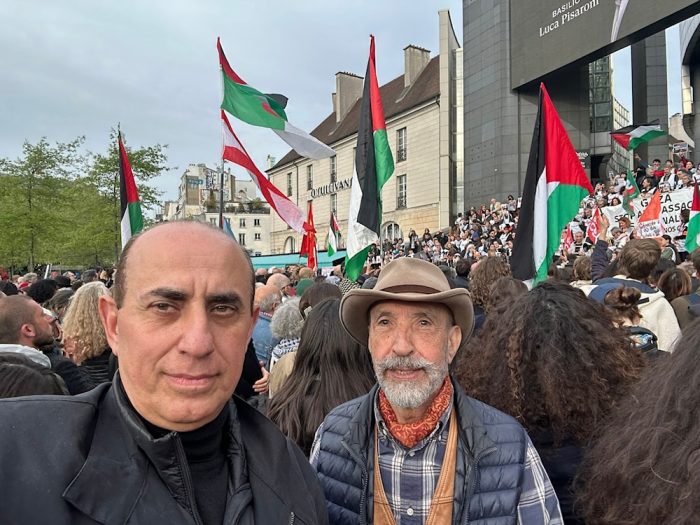
Al Mayadeen | April 22, 2025
British border authorities detained Palestinian-British academic Professor Makram Khoury-Machool on Friday evening upon his return from Paris to London, subjecting him to a four-hour interrogation under the UK’s 2019 “Counter-Terrorism and Border Security Act.”
Devices seized, personal belongings searched
During the investigation, British police confiscated Professor Khoury-Machool’s mobile phone and personal laptop, thoroughly searching all his belongings, including identification and credit cards. No formal charges were presented, raising concerns over the basis and implications of the detention.
Authorities also took his fingerprints, captured multi-angle photographs, and collected DNA samples from inside his mouth.
No official clarification yet
UK border police indicated that they may contact Professor Khoury-Machool again within the next seven days. So far, no official statement has been issued to explain the reasons behind his detention or the content of the interrogation.
The incident occurred in the presence of his 8-year-old son, who witnessed the extended questioning and detention of his father until midnight on Good Friday.
Professor Khoury-Machool, who is of Palestinian origin, is a well-known intellectual and media figure. His recent public activity includes participation in a pro-Gaza demonstration in Paris on April 16, 2025, where he shared a photo of himself at the event via his X account.
‘A battle between right and wrong’: Houthi spokesman on confronting the US and Israel
The Grayzone | April 21, 2025
The Grayzone’s Max Blumenthal interviews Muhammad Al-Bukhaiti, senior political officer and spokesman for Ansar Allah (the Houthi movement), on Yemen’s direct confrontation with a US military machine which is hellbent on destroying its ability to resist Israel. In this third conversation between The Grayzone and Bukhaiti, the Ansar Allah spokesman explains why he believes his movement’s war with the US-Israeli axis is unlike any conflict that preceded it, and why he believes Yemen is engaged in a righteous battle despite the terrible toll its civilians have faced. This interview was translated by Hekmat Aboukhater.
Find more reporting at https://thegrayzone.com Support our original journalism at
Patreon:  / grayzone
Facebook:  / thegrayzone
Twitter:  / thegrayzonenews
Instagram:  / thegrayzonenews
Carnegie Endowment cancels Iran FM’s speech under ‘orchestrated pressure’ from Israel lobby: Report
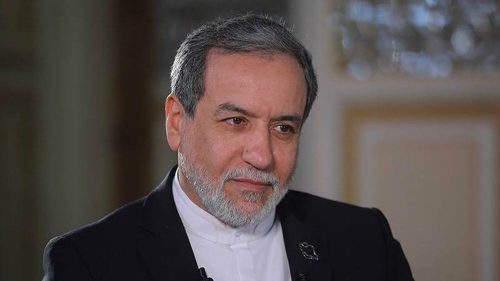
Iranian Foreign Minister Abbas Araghchi
Press TV – April 21, 2025
The Carnegie Endowment for International Peace (CEIP) cancels Iranian Foreign Minister Abbas Araghchi’s keynote address at its 2025 Nuclear Policy Conference.
Citing sources familiar with the matter, Iran Nuances reported that the cancellation on Monday followed an “orchestrated pressure” campaign from “Israeli-affiliated hawkish elements” and officials of former US presidents Joe Biden and Barack Obama.
Araghchi was scheduled to deliver a virtual address at the conference, which will bring together politicians, diplomats, and nuclear experts from around the world to discuss critical challenges in nuclear nonproliferation, arms control, disarmament, deterrence, energy, and security.
Iran’s Permanent Mission to the United Nations confirmed in a statement that Araghchi’s speech has been canceled.
According to the mission, the cancellation occurred after the conference organizers decided to change the format of the Iranian foreign minister’s speech to a debate.
Expressing regret over the matter, the mission said that the full text of the now-canceled speech will be made available to the news media.
Yemen: US fails in its aggression since day one; Trump ‘accountable’ for fatalities
Press TV – April 21, 2025
The chairman of Yemen’s Supreme Political Council says Sana’a has not suffered even one percent damage at the military level despite all US assaults in support of Israel’s war on Gaza.
“I assure you that the aggression failed from its very first day, and we had previously managed to obtain information that thwarted the aggression before it occurred,” Mahdi al-Mashat said during a meeting of the National Defense Council on Sunday.
He added that if the Americans increase their mobilization, it means their weapons have failed.
Referring to US warship USS Harry S. Truman, Mashat said that it lost its command and control and was rendered out of service in the early days of the aggression.
The warship “achieved nothing for the enemy, forcing them to bring in other vessels and use other weapons,” he further said.
Mashat also said that, “The criminal US President Donald Trump will be held accountable for all that he did to civilians and civilian facilities, whether he remains in office or not.”
The US military has been carrying out almost daily attacks on Yemen for the past month, claiming that they are aimed at stopping the Ansarullah movement’s attacks on Israel-related ships.
The Yemeni army, however, said it will not stop its attacks on Israel-bound vessels until the regime halts its genocidal war on Gaza.
“Our stance in supporting our brothers in Gaza is firm and we will never retreat from it,” he said, adding that Yemen cannot allow the Americans and the “Israelis” to prey upon the Palestinian people in Gaza alone.
Since March, over 200 individuals have lost their lives due to US aggression in Yemen.
In retaliation for Israeli atrocities in Gaza and the US-UK-led assault on Yemen, the Yemeni Armed Forces began to carry out a series of strikes against Israeli, American, and British interests in the Red Sea and nearby regions in late 2023.
As the brutal conflict in Gaza worsened, Yemen imposed a strategic blockade on major maritime routes to hinder the movement of military supplies to their enemies and to pressure the international community to respond to the ongoing humanitarian crisis in Gaza.
If the US launches a ground operation against Yemen, it will backfire
By Robert Inlakesh | Al Mayadeen | April 21, 2025
Frustrated by its costly ongoing offensive campaign against Yemen, the Trump administration is said to be in talks to launch a ground effort aimed at seizing the strategic port city of Hodeidah, before effecting regime change in Sanaa. If this offensive does occur, it will result in a disastrous defeat for Washington.
In 2015, when then-US President Barack Obama backed the Saudi-led coalition’s war on Yemen, Riyadh had estimated that it would only take a few months to uproot the Ansar Allah leadership that had taken over Sanaa. Instead, they faced defeat after defeat at the hands of a highly-motivated armed force that received the backing of the majority of Yemen’s Armed Forces.
A decade later, despite the 2022 ceasefire, the conflict remains unresolved – and Ansar Allah’s power has only continued to grow. The movement that once seized control of Sanaa with the backing of key elements of the existing power structure, including segments of the military, was a shadow of what it has since become. Not only has it forged strong alliances with various tribal factions across Yemen, but it has also made leaps and bounds in developing both offensive and defensive weapons technologies.
The Yemeni Armed Forces that aligned with the Ansar Allah-led government proved capable of holding off the combined power of the Saudi-backed and UAE-backed Yemeni forces, in addition to various militant groups like Al-Qaeda and ISIS, also battling Saudi Arabia’s armed forces and later mercenary fighters from Sudan and elsewhere. They fought on the ground for years, amidst a US-Saudi blockade in the Red Sea, combined with US-British-Israeli logistical support being provided to their enemies, backing Riyadh’s air attacks against the country.
While managing to inflict countless defeats on what was supposed to be a militarily superior opposition – on paper – the Yemeni government in Sanaa continued to expand its power and territorial control in a country that has historically been divided between north and south.
In late 2021, game changing technological advances introduced a new dynamic to the conflict, ultimately pressuring the Saudi-led coalition to accept a UN mediated ceasefire proposal. By early 2022, after an expansion of the ground war the previous year, the Yemeni Armed Forces had launched a wave of successful drone and missile attacks at targets across the United Arab Emirates (UAE) and Saudi Arabia.
While Riyadh had been dealing with Ansar Allah’s drones and missiles for years by that point, it was clear that a significant technological advancement had occurred. And whereas the Saudi State had some capacity to absorb limited attacks on its vital infrastructure, the Emirati regime was far less equipped to withstand repeated blows from Yemen.
Abu Dhabi in particular cannot afford to absorb sustained waves of drone and missile attacks, especially if Dubai becomes a target. Unlike Saudi Arabia, the UAE is a tiny and vulnerable country. If Yemen decides to blanket them with strikes, their endeavors to diversify their economy will likely disintegrate, and no amount of deals with the US nor the Israelis can help them.
The claims that are being spread, particularly across Arabic language media, speculate that a Saudi-UAE backed force of about 80,000 soldiers is being amassed in order to launch an offensive aimed at seizing Hodeidah. Then, so goes the report, the US will offer air support and even launch a smaller ground attack to invade Yemen.
Donald Trump’s Vietnam?
Yemen was once dubbed Egypt’s Vietnam – and if the United States decides to launch a ground campaign there, the outcome is unlikely to align with President Donald Trump’s intentions. Already, the air campaign alone, which has to date killed around 150 civilians, has proven to be an embarrassing failure, costing US taxpayers billions of dollars with little to show in return.
Despite this war of aggression against Yemen being launched without a popular mandate, nor congressional approval, the US corporate media have largely chosen to ignore it. Yet, if Trump sends boots on the ground, Yemen will quickly dominate headlines, for the simple reason that US service members will start returning home in coffins.
So far, the Yemeni Armed Forces have limited their confrontations with the US’s naval fleets to defensive maneuvers, meaning that they have not been attempting to sink ships or aircraft carriers and are focused on defending their nation. If a large-scale ground operation is launched, the defensive posture will shift to one of offense.
The ground campaign will not only be costly and far from a walk in the park, the US will also endure direct hits to its vessels and significant casualties. Additionally, we should expect major attacks on both Saudi and Emirati infrastructure, which will disrupt oil markets. It is also very likely that US bases located in the Arabian Peninsula and beyond will come under attack.
Furthermore, we should probably expect occasional strikes against the Zionist regime that will be more intense than previous waves. If we begin to see the civilian death toll climb dramatically in Yemen, while the war is overtly an American-Zionist aggression, the way in which Ansar Allah will deal with it won’t be restricted any longer. On top of this, it could even end up uniting the people of Yemen to an even greater degree as a result, including factions and tribes that have always been at odds with Ansarallah.
Yemen is not Iran, but it has the capacity to inflict considerable losses on the US-allied regimes surrounding it and can target US forces directly. The question then becomes, can Riyadh and Abu Dhabi endure continuous barrages of munitions being fired towards them? Also, when the war lasts much longer than anticipated and the proxy ground force used to attack Yemen is suffering severe losses, as American soldiers return home in body bags, what will the strategy be then?
Will the 80,000 strong force continue to fight if they are suffering considerable losses, all in order to achieve a victory for Israeli strategic interests? Or will they begin to experience serious morale issues and defections? Will the US public be able to stomach the losses, and can the US military itself justify the loss of assets in a pointless fight to please their Zionist allies?
There will be no benefits to launching such an assault, and the US has not amassed nearly enough ground troops to launch a war alone. On every level, this would be a catastrophic strategic blunder. If they lose, this would be an embarrassment of historic proportions and nation-defining victory for the Sana’a government, despite the immense civilian suffering that will inevitably come from the war. All of this leaves out the potential involvement of other regional actors who may take advantage of the situation too.
If Trump decides to go ahead with such a conflict, in order to please his Zionist ally, it will greatly backfire. There will also be no way to hide the fact that he is working against US interests and sacrificing his own citizens in order to make the Israelis satisfied, without any real end goal or vision for victory.
Why AIPAC Must Register Under FARA: Exposing Israel’s Influence in Washington
Track AIPAC
For decades, the American Israel Public Affairs Committee (AIPAC) has served as Israel’s unofficial arm in Washington, shaping U.S. policy to favor Israeli interests while avoiding the transparency required by the Foreign Agents Registration Act (FARA). This evasion hides AIPAC’s role as a foreign proxy and undermines American democracy.
What Is FARA?
Enacted in 1938 to counter Nazi and Soviet influence, FARA mandates that anyone acting as an “agent of a foreign principal”—engaging in political activities in the U.S. at the direction or request of a foreign government—register with the Department of Justice. This means disclosing contacts, activities, and funding. FARA focuses on whose agenda is being pushed, not the source of the money. AIPAC’s mission, to align U.S. policy with Israel’s goals, fits this definition exactly. Yet it cloaks itself as an “American” lobby, a claim that doesn’t withstand scrutiny.
AIPAC: Israel’s Proxy in Washington
AIPAC’s mission is to steer U.S. policy toward Israel, functioning as a coordinated extension of Israeli interests. It invests millions in U.S. elections with its political action committee, AIPAC PAC, and through its super PAC, United Democracy Project, to support Israel First candidates and oppose anyone who speaks out against Israel’s crimes. It pushes anti-BDS laws mirroring Israeli priorities and secures billions in annual aid, often at the expense of U.S. needs. Through its nonprofit arm, the American Israel Education Foundation (AIEF), it funds frequent congressional trips to Israel—the number one destination for privately sponsored foreign travel by members of the House and their aides—where they meet Israeli leaders and adopt their narrative.
The connections are undeniable: AIPAC has operated a Jerusalem office since 1982, a direct link to Israeli leadership. Its leaders frequently visit Israel, host Israeli officials at policy summits, and align U.S. policy with Israel’s agenda. In 2015, AIPAC strongly opposed a UN resolution condemning Israeli settlements, mirroring Israel’s defiance, and launched a significant lobbying effort, spending a reported $30 million, to support Netanyahu’s campaign against the Iran nuclear deal. In 2023, it briefed Congress on Israel’s Gaza operations, echoing military talking points. In 2024, it pushed $14.1 billion in emergency aid for Israel, matching Netanyahu’s demands, and followed through on Foreign Minister Israel Katz’s request to secure congressional sanctions against the International Criminal Court. If a group lobbying for Russia maintained a Moscow office, funded trips there, and parroted Kremlin lines, we’d call it foreign influence. AIPAC’s U.S. funding doesn’t alter its role as Israel’s conduit.
A History of Dodging Accountability
AIPAC’s ties to Israel are deep-rooted. Its predecessor, the American Zionist Council (AZC), was ordered to register under FARA in 1962 after funneling millions from Israel’s Jewish Agency to lobby Congress. Instead, Isaiah Kenen relaunched it as AIPAC in 1963, dodging the law by using U.S. donors. Declassified 1984 FBI files reveal AIPAC’s early collaboration with Israel’s Ministry of Economics, using stolen U.S. trade data to shape the U.S.-Israel Free Trade Agreement; an act of espionage, not advocacy. In 2005, AIPAC staffers Steven Rosen and Keith Weissman passed classified Pentagon data to Israeli officials, though charges were later dropped. Leaked 2018 Israeli Justice Ministry documents show Jerusalem’s worry that AIPAC’s advocacy could trigger FARA scrutiny, prompting plans to conceal ties with a U.S. nonprofit. If AIPAC’s work is truly domestic, why does Israel fear exposure?
Transparency, Not Prohibition
FARA doesn’t prohibit lobbying, it requires openness. Registration would compel AIPAC to reveal its meetings with Israeli officials, spending details, and directives. If it’s merely Americans supporting Israel, why resist this disclosure? Refusing transparency raises questions about whose interests it truly serves.
The Stakes for Democracy
AIPAC’s unchecked influence skews U.S. policy. General David Petraeus warned in 2010 that Israel’s actions, amplified by AIPAC, put U.S. troops in the Middle East at risk. Billions flow to Israel each year, while domestic crises like healthcare languish. Without FARA, we remain blind to how much Israel shapes these decisions or what AIPAC is hiding.
TrackAIPAC demands that lawmakers, regulators, and the public compel AIPAC to register under FARA. Transparency is the first step to dismantling foreign influence in U.S. policy.
Israeli military sets up checkpoint in Syria’s Quneitra
Al Mayadeen | April 21, 2025
As part of an ongoing military escalation, Israeli occupation forces advanced into Syria’s Quneitra countryside and established a temporary military checkpoint, according to local sources.
The sources reported that several Israeli military vehicles were mobilized west of the village of al-Asha in southern Quneitra, where they advanced toward Tel al-Ahmar al-Gharbi and set up a checkpoint.
Civilian areas targeted amid escalation
The Syrian province of Quneitra has witnessed a rapid increase in Israeli military activity, marked by swift incursions and expanded targeting zones. Local reports indicate that the occupation forces have widened their operations to include civilian areas, suggesting a strategy that may involve the displacement of the local population.
Earlier this week, Israeli occupation forces carried out a sudden military operation near the towns of Taranjeh and Koum Mheires, targeting Syrian army positions and destroying installations within minutes. The strikes also hit nearby residential zones, raising concerns about whether the targeting was deliberate or collateral.
Local voices, claims of forced displacement
Abu Marwan, a resident of Quneitra province, told Al Mayadeen he is seeking compensation after ongoing Israeli operations damaged property and farmland. He said that hundreds of farmers have been affected, with Israeli forces targeting abandoned posts, disabled vehicles, and civilian areas despite the lack of any apparent security threat.
“Israel’s” creation of so-called buffer zones has moved civilian homes into active military zones, increasing the risk to residents and reinforcing concerns about an intentional push toward forced displacement.
This latest Israeli military operation aligns with a broader pattern of rapid and forceful strikes, including similar raids near the town of Hadr. In those cases, military sites were destroyed swiftly, with effects extending beyond combat zones and into populated regions.
The frequency and scale of such operations in Quneitra and near the occupied Golan Heights reflect growing concerns over Israeli expansionism and its long-term impact on southern Syria.
Facing Prison Time in Germany for Criticizing an Israeli Journalist: The Case of Hüseyin Dogru
By Alan MacLeod – MintPressNews – April 20, 2025
Amid a crackdown on pro-Palestine voices in Germany, a journalist regularly attacked as a Russian operative is facing up to three years in prison for defamation of an Israel-based journalist. Hüseyin Dogru, founder of red. media, has been charged with defamation for actions relating to a spat with Nicholas Potter, a German state-funded reporter working for the Israeli outlet, The Jerusalem Post.
In December, Potter, a self-styled counter-extremism expert, published a lengthy exposé in The Jerusalem Post, claiming that red. media, MintPress News, and The Grayzone were part of a network of far-left outlets promoting extremism and anti-Semitic conspiracy theories.
Worse still, he strongly insinuated that all three were promoted and funded by the governments of Russia, Syria, and Iran.
The charges are false (see MintPress’ rebuttal here), and are particularly ironic, coming as they do from a journalist who is funded by the German Foreign Office. One who, amid a genocide, moved to Israel to work for an outlet headed by a former Israeli Defense Forces spokesperson.
Moreover, Potter himself arguably holds extreme views on the subject. Just weeks after attacking us for our journalism, he penned an article titled “Can Journalists Be Terrorists,” which attempted to justify many of Israel’s killings of Palestinian media workers.
Both red. and MintPress immediately highlighted much of this important context, and our content went viral.
From Viral Criticism to Criminal Charges
A sticker about Potter, based on a red. media graphic, was spotted in Berlin. The sticker took the outlet’s criticism of him, and plastered the phrase, “The German Hurensohn” — “The German Son of a Bitch” — over the top. That sticker is the centerpiece of the prosecution’s allegation of a coordinated “hate campaign” against Potter led by red. media. Potter claims that he has suffered harassment and threats to his life, and some have tried to link this back to red. media’s graphic.
The accusations provoked a storm of articles in German media, all supportive of Potter. Many echoed U.S. Secretary of State Antony Blinken’s claims that red. media is a Russian government-controlled influence operation.

A red. media post criticizing journalist Nicholas Potter, left, appears as a modified sticker in Germany, right. Photo provided to MintPress
Dogru denies these allegations, although he was previously a key part of Red Fish, a platform financed by Ruptly, a Germany-based outlet partially funded by the Russian state-controlled network, RT. After the Russian invasion of Ukraine in 2022, Dogru closed Red Fish and started his own independent outlet. He insists it has no connection to Russia and is dedicated to making revolutionary and educational content. He also denies having any information or involvement in producing anti-Potter stickers.
Germany Criminalized Palestinian Solidarity
Potter’s support for Israeli policies has certainly drawn the ire of many in the pro-Palestine movement in Germany. Yet he is far from alone. The German government has offered its full support to Israel and has gone so far as to ban pro-Palestine demonstrations and lock up countless activists, including Jewish people. The phrase “From the River to the Sea” has effectively been criminalized, with Berlin announcing that it would deny citizenship to anyone using it. New German citizenship laws require all applicants to sign what is, in effect, a loyalty oath to the State of Israel, declaring that it has a “right to exist.”
Berlin is currently deporting foreign residents for their participation in lawful protests supporting Palestinian rights. Dogru’s legal team has advised him that his wife and son could be deported as well.
Commentators have warned that, with these actions, Germany is lurching towards the authoritarian right. With the far-right AfD Party surging in the polls (a recent survey found they are now the most popular party in Germany), many inside the country are ringing the alarm bells.
“For decades, Germany has stuck with Israel and its narratives in the Middle East,” Dogru told MintPress, adding: “Since October 7, we see that the German government is violently repressing activists to make sure there are no voices in Germany critical of Israel. Activists here have paid a high price to make sure that they can protest.”
According to Dogru, this is a test case. Ultimately, the suppression of speech is not about Israel, but an attack on its own society.
Germany is preparing to assert itself as a leading military and political force in NATO and the EU. To do that, it must eliminate resistance — not just abroad, but at home. This isn’t driven by historical guilt or solidarity. It’s about silencing dissent and disciplining society. By targeting the most marginalized, the German state is disciplining its population — silencing opposition before it grows.”
The message from the German government is clear, Dogru claims: “fall in line, or be crushed.”
Featured Video
The Board For Peace – Whitewashing Ethnic Cleansing and Genocide
or go to
Aletho News Archives – Video-Images
Book Review
Conspiracy Denial

Lies are Unbekoming | January 27, 2026
In honour of Michael Parenti (1933–2026), who passed away on 24 January 2026 at the age of 92. He spent his life naming what power prefers to leave unnamed.
In 1837, Abraham Lincoln remarked: “These capitalists generally act harmoniously, and in concert, to fleece the people.”
Today, he would be dismissed as a conspiracy theorist.
That dismissal—reflexive, automatic, requiring no engagement with evidence—is not a mark of sophistication. It is a tell. The question worth asking is not whether conspiracies exist (they are a matter of public record and a recognised concept in law) but why acknowledging their existence provokes such reliable hostility. What work does the label “conspiracy theorist” actually do?
The late political scientist Michael Parenti spent decades answering that question. His conclusion was blunt: “’Conspiracy’ refers to something more than just illegal acts. It serves as a dismissive label applied to any acknowledgment of ruling-class power, both its legal and illegal operations.” The term functions not as a descriptor but as a weapon—a thought-terminating cliché that protects the powerful from scrutiny by pathologising those who scrutinise them.
Conspiracy denial, in Parenti’s analysis, is not skepticism. It is the opposite of skepticism. It is credulity toward power dressed up as critical thinking. As he wrote in Dirty Truths: “Just because some people have fantasies of conspiracies does not mean all conspiracies are imaginary.” … continue
Blog Roll
Recent Comments
eddieb on WEF Calls for ‘Cultural Revolu… loongtip on Trump wanted to play peacemake… Coronistan on EU member to sue bloc over ‘su… loongtip on Vicious loongtip on EU turns to India for defense… Coronistan on Donald Trump Is No Peace … seversonebcfb985d9 on French court jails pro-Palesti… eddieb on Fourteen Incredible Facts Abou… Bill Francis on European leaders’ shift in the… seversonebcfb985d9 on Villains of Judea: Philip Esfo… loongtip on Report warns that ‘Jewish terr… Craig Nelms on New study shows that toxic gas…


 Aletho News
- Conspiracy Denial
- Ukraine expects to join EU next year – Zelensky
- Here’s what’s behind the US shift on EU allies
- UN experts alarmed by prosecution of students protesting ETH Zurich’s Israel-linked research ties
- Exposed – How the UAE Became Central to Gaza’s Concentration Camp Plot
- How South Korea’s gas ambitions sustain the occupation of Gaza
- “Leaked document” exposes US blueprint for total control over Gaza
- Trump wanted to play peacemaker, Netanyahu made sure he failed
- Idea of limited, fast strike on Iran misjudges our capabilities: IRGC
- US Military Buildup on Land, Air, and Sea Raises Fears of Imminent Attack on Iran – Expert
- If Americans Knew
- Israel to seek new security deal from US, official says
- Leaked “Board of Peace” Resolution Outlines U.S.-Led Plan to Rule Over Gaza
- Jonathan Greenblatt Rolls Out Plan to Activate Hispanic Evangelical Golems
- Violence against hundreds of Gazan remains to find one Israeli – Not a ceasefire Day 109
- Greenpeace Demonstrator Exposes Folly of Protest Restrictions
- From CBS to TikTok, Pro-Israel Ellison is now in the driver’s seat
- Israel pays for UK advertisements attacking Doctors Without Borders
- Israel accused of extracting billions from Gazan people to pay for their own genocide
- ‘Deliberate Assassination’: 3 Journalists Among 11 Killed by Israeli Forces in Gaza
- In Gaza, We’re Struggling to Reintroduce Foods to Bodies Adjusted to Starvation
- No Tricks Zone
- New Study Affirms Rising CO2’s Greening Impact Across India – A Region With No Net Warming In 75 Years
- Germany’s Natural Gas Crisis Escalates … One Storage Site Near Empty …Government Silent
- Polar Colding…Antarctica Saw Its Coldest October In 44 Years!
- New Study: Sea Levels Rose 20 Times The Modern Rate During The Roman Warm Period
- As German Gas Storage Dips Dangerously Low…Shortage Hardly Avoidable
- New Study: Brazil’s Relative Sea Level Was 2+ Meters Higher And SSTs 3-4°C Warmer 6000 Years Ago
- Philosopher Schopenhauer: Climate Science Certainty Stems From Stupidity, Ignorance
- New Study: Species Extinction Rates Declining Since 1980 – ‘Climate Change Is Not An Important Threat’
- Denmark Places Climate Protection Above Animal Welfare, Poisoning And Culling Cows
- New Study: Greenland Was 3-7°C Warmer And Far Less Glaciated Than Today 6000-8000 Years Ago
 Aletho News