Oxford city council passes boycott divestment, sanctions motion
Press TV – March 26, 2025
The Oxford City Council has passed a motion supporting the Boycott, Divestment, and Sanctions (BDS) movement against Israel, in accordance with International Court of Justice (ICJ) rulings.
On Monday, the members of Oxford City Council unanimously voted for an “ethical investment and procurement” process against Israel.
The motion calls on the Oxford City Council to avoid cooperation and trade with entities complicit in human rights violations and international law.
In January 2024, the ICJ delivered an interim ruling that said it was plausible that Israel was committing genocide in Gaza. The court called on Israel to refrain from impeding the delivery of aid into Gaza
Amongst other orders, ICJ also ordered Israel to avoid acts of genocide in the besieged enclave and punish incitement to genocide.
The Israeli regime not only has continued to ignore the ICJ’s rulings but also has committed numerous acts of genocide against the people of Palestine, including the restriction of the delivery of international aid into the besieged enclave.
Given Israel’s disregard for the Court’s orders, Oxford councilor Hosnieh Djafari-Marbini said councilors had “unanimously passed a boycott and divestment motion citing the ICJ rulings on Palestine.”
One of the motion’s proponents, councilor Barbara Coyne, said in a press release, “I hope this motion will be thoroughly implemented, and that its passage may pave the way for other councils to take decisive action.”
In addition, the Council has called on the Oxfordshire Investment Fund to divest more than 157 million pounds from companies complicit in the Israeli regime’s apartheid, genocide, occupation, and settler colonialism.
The people of Palestine have long called for boycott, divestment, and sanctions, including an arms and energy embargo, against the occupying regime.
The BDS movement demands that Israel, under international law, withdraw from the occupied territories, remove the separation barrier in the West Bank, and respect the rights of Palestinian refugees to return to their homes and properties.
War, doublethink and the struggle for survival: the geopolitics of the Gaza Genocide
By Ramzy Baroud | MEMO | March 26, 2025
In a genocidal war that has spiralled into a struggle for political survival, Israeli Prime Minister Benjamin Netanyahu’s coalition and the global powers supporting him continue to sacrifice Palestinian lives for political gain. The sordid career of Israel’s extreme far-right National Security Minister, Itamar Ben-Gvir, epitomises this tragic reality.
Ben-Gvir joined Netanyahu’s government coalition following the December 2022 election. He remained in the coalition after 7 October, 2023, and the start of Israel’s war and the Gaza Genocide, with the understanding that any ceasefire in Gaza would force his withdrawal from the government. As long as the killing of Palestinians and the destruction of their cities continued, then Ben-Gvir stayed on board. Neither he nor Netanyahu had any real “next-day” plan, though, other than to carry out some of the most heinous massacres against a civilian population in recent history.
On 19 January, Ben-Gvir left the government immediately when a ceasefire agreement came into effect, which many argued would not last. Netanyahu’s untrustworthiness, along with the collapse of his government if the war ended completely, made the ceasefire unfeasible.
Ben-Gvir duly returned to the coalition when the genocide resumed on 18 March. “We are back, with all our might and power!” he tweeted.
Israel lacks a clear plan because it cannot defeat the Palestinians.
While the Israeli army has inflicted suffering on the Palestinian people like no other force has against a civilian population in modern times, the Gaza Genocide endures because the Palestinians refuse to surrender.
And yet, Israel’s military planners know that a military victory is no longer possible. Former Defence Minister Moshe Ya’alon added his voice to the growing chorus recently, saying during an interview on 15 March that, “Revenge is not a war plan.”
The Americans, who supported Netanyahu’s violation of the ceasefire — and gave the green light for the resumption of the killings — also understand that the war is almost entirely a political struggle, designed to keep extreme far-right figures like Ben-Gvir and Finance Minister Bezalel Smotrich in Netanyahu’s coalition.
Although “war is the continuation of politics by other means,” as Prussian General Carl von Clausewitz once surmised, in Israel’s case, the “politics” behind the war is not about Israel as a state, but about Netanyahu’s own political survival. He is sacrificing Palestinian children to stay in power, while his extremist ministers do the same to expand their support among right-wing, religious and ultra-nationalist constituencies.
This logic — that Israel’s war on Gaza reflects internal politics, ideological warfare and class infighting — extends to other political players as well. The Trump administration supports Israel as payback for the financial backing it received from Netanyahu’s supporters in the US during the past few presidential election campaigns. Britain, meanwhile, remains steadfast in its commitment to Tel Aviv, despite the political shifts in Westminster, thus continuing to align with US-Israeli interests while disregarding the wishes of its own population. Meanwhile, Germany, it’s said, is driven by the guilt of its past crimes, while other Western governments pay lip service to human rights, all the while acting in ways that contradict their stated foreign policies.
This mirrors the dystopian world of George Orwell’s book 1984, wherein perpetual war is waged based on cynical and false assumptions; where “war is peace… freedom is slavery… and ignorance is strength.”
These elements are indeed reflected in today’s equally dystopian reality.
However, Israel substitutes “peace” with “security” (its own; nobody else’s), the US is motivated by dominance and “stability”, and Europe continues to speak of “democracy”.
Another key difference is that Palestinians do not belong to any of these “super states”. They are treated as mere pawns, their deaths and enduring injustice used to create the illusion of “conflict” and to justify the ongoing prolongation of the war.
The number of Palestinians killed — now more than 50,000 — is reported widely by mainstream media outlets, yet rarely do they mention that this is not a war in the traditional sense, but a genocide, carried out, financed and defended by Israel and Western powers for domestic political reasons. Palestinians continue to resist because it is their only legitimate option in the face of utter destruction and extermination.
Netanyahu’s war, however, is not sustainable in the Orwellian sense either. For it to be sustainable, it would need infinite economic resources, which Israel, despite US generosity, cannot afford. It would also need an endless supply of soldiers, but reports indicate that at least half of Israel’s reserves are not rejoining the army.
Furthermore, Netanyahu does not merely seek to sustain the Gaza Genocide; he aims to expand it. This could shift regional and international dynamics in ways that neither Israeli leaders nor their allies fully understand.
Aware of this, Arab leaders met in Cairo on 4 March to propose an alternative to the Netanyahu-Trump plan to ethnically cleanse Palestinians from Gaza. However, they have yet to take meaningful action to hold Israel accountable if it continues to defy international and humanitarian laws, as it has since the Arab summit.
The Arab world must escalate its response beyond mere statements.
If they don’t, then the Middle East may endure further wars, all to prolong Netanyahu’s coalition of extremists a little longer.
As for the West, the crisis lies in its moral contradictions. The situation in Gaza embodies Orwell’s concept of “doublethink”, holding two contradictory beliefs in one’s mind simultaneously and accepting both. Western powers claim to support human rights while simultaneously backing genocide. Until this dilemma is resolved, the Middle East will continue to endure suffering for years to come.
How Syria’s HTS is quietly dismantling the Palestinian cause
The Cradle | March 25, 2025
Since the fall of the Syrian government on 8 December, the direction of the new interim administration, headed by Ahmad al-Sharaa, has become increasingly clear. Politically, militarily, and legally, Damascus now appears aligned with Washington’s long-standing vision of dismantling the Palestinian cause.
This alignment is taking shape on three key fronts: first is the Palestinian Authority (PA), resistance factions such as Hamas, the Palestinian Islamic Jihad (PIJ), and other factions splintered from the Palestine Liberation Organization (PLO). Second, is the UN Relief and Works Agency (UNRWA) tasked specifically to aid Palestinian refugees in the region, and third, are the camps housing Palestinian refugees and displaced Syrians.
Two developments underscore this shift. First, both Turkiye and Lebanon have blocked Palestinians holding Syrian documents from returning to Syria on the same basis as Syrian nationals. Second, US media has revealed ongoing talks between Washington and Damascus over the possibility of Syria absorbing tens of thousands of displaced Gazans, in exchange for sanctions relief or a broader political arrangement, particularly in the aftermath of the Coastal Massacres earlier this year.
Front 1: The PA and the resistance factions
More than four months into the transition to new governance, one thing is clear: former Al-Qaeda affiliate leader Ahmad al-Sharaa, now Syria’s president, is keeping Hamas at arm’s length. Despite repeated requests by Khaled Meshaal – head of Hamas’s political bureau abroad – to visit Damascus, the interim authorities have stalled, aiming to avoid direct confrontation with Israel or the US.
This new Syrian posture takes place in the midst of an ongoing genocide against the Palestinian people and the occupation state’s aim to eliminate their Islamic resistance.
The Cradle has learned that communication between Hamas and the new authorities is largely being channelled through Turkish intermediaries. Ankara is reportedly facilitating the relocation of several Hamas military officials to Idlib, the stronghold of Sharaa’s Hayat Tahrir al-Sham (HTS) militants.
In contrast, Sharaa – who met with Palestinian Prime Minister Mohammad Mustafa in January – has formally opened channels with the PA’s diplomatic mission in Damascus, recognizing it as the official representative of the Palestinian people.
The visiting delegation included senior officials from Fatah and the PLO, most notably Mahmoud Abbas’s son, who arrived to reclaim properties previously held by anti-Fatah factions under former Syrian president Bashar al-Assad’s government.
On the night the Assad government collapsed, Popular Front–General Command (PFLP-GC) Secretary-General Talal Naji and Palestine Liberation Army (PLA) Chief-of-Staff Akram al-Rifai sought refuge at the PA embassy. Palestinian ambassador Samir al-Rifai reportedly received a sharp rebuke from Abbas for granting them shelter. As for the rest of the faction leaders, each of them remained at home.
The day after HTS forces entered Damascus, they launched a wave of closures targeting Palestinian faction offices. Those belonging to Fatah al-Intifada, the Baath-aligned Al-Sa’iqa movement, and the PFLP-GC were shuttered, with their weapons, vehicles, and real estate seized.
The Democratic Front for the Liberation of Palestine (DFLP), which had maintained a lower profile during the Syrian war, was allowed to continue operating – though under observation.
On 11 and 12 December, several faction leaders convened at the Palestinian embassy in the presence of PLA leader Rifai to discuss their future. They attempted to arrange a formal meeting with Sharaa via Syria’s Foreign Ministry. Instead, a messenger from HTS – identified as Basil Ayoub – arrived at the embassy and demanded full disclosure of all faction-owned assets, including real estate, bank deposits, vehicles, and weapons. No political engagement would be possible, he said, until a comprehensive inventory had been submitted.
The factions complied by drafting a letter declaring that their holdings were lawfully acquired and that they were prepared to limit their activity to political and media outreach, in full alignment with Syria’s new posture. The fate of the letter to Sharaa and its response are unknown.
Decapitation campaign: arrests, confiscations, and settlements
What followed was a systematic decapitation of the Palestinian factional structure in Syria.
In early February, Fatah al-Intifada’s Secretary-General Abu Hazem Ziad al-Saghir was arrested at his home. After hours of interrogation and a raid on his office – where documents reportedly linked him to Iran’s Islamic Revolutionary Guard Corps (IRGC) – he was released.
A week later, he was re-arrested and held at a newly established detention site behind the Abbasid Stadium. A financial settlement was reached: $500,000 in exchange for his release and deportation to Lebanon. At the request of the committee, the movement’s Central Committee issued a statement terminating Saghir’s duties and dismissing him from the movement. However, Saghir issued a counterstatement from Lebanon, transferring the movement’s General Secretariat there and dismissing those who had made the decision to remove him.
The Palestinian Baathist faction, Al-Sa’iqa, fared no better. Its Secretary-General Muhammad Qais was interrogated and stripped of the group’s assets. Though he was not in command during the Battle of Yarmouk and thus escaped harsher punishment, HTS ordered the removal of the term “Baath” from all official materials. A statement soon emerged from within the occupied territories denouncing Qais as a “regime remnant,” suggesting a growing internal split.
HTS also clamped down hard on the PFLP-GC, whose Secretary-General, Talal Naji, was placed under house arrest and interrogated multiple times. All the group’s offices, vehicles, and weapons were confiscated, their headquarters shuttered, and its members beaten and humiliated. Their radio station, Al-Quds Radio, was seized, and their Umayyah Hospital is reportedly next in line.
The “Nidal Front” – a breakaway faction of the Palestinian Popular Struggle Front (PPSF), a left-wing group within the PLO – was the most controversial of its dealings. At the beginning of the events, Khaled Meshaal was able to mediate for the Front’s Secretary-General, Khaled Abdul Majeed, and protect him and his organization. However, in February, Abdul Majeed fled to the UAE.
His personal residence and vehicles – reportedly privately owned – were seized along with 50 million Syrian pounds (less than $5,000) in assets. Forced to resign by HTS, he handed over authority to a central committee operating out of Damascus and Beirut.
The DFLP has so far escaped the brunt of these purges, and its offices and vehicles remain untouched by the new administration, possibly because it had no ties to Iran or Hezbollah. The Popular Front for the Liberation of Palestine’s (PFLP – different from the PFLP-GC) main office in the Taliani area of Damascus remains open but inactive, while the rest of its offices have been shut down.
As of now, the PIJ, whose fighters have been on Gaza’s frontline battling Israel since 7 October 2023, remains in its Syrian offices. The faction’s representative has not been summoned for questioning, despite Israel bombing an apartment used by the group’s Secretary-General, Ziad al-Nakhala.
However, key PIJ military figures relocated to Baghdad on the night Damascus fell to HTS. Their activities inside Syria appear largely to have been reduced to conducting funerals for fighters who were killed in battle in southern Lebanon, albeit exclusively inside Palestinian refugee camps.
The Yarmouk camp in Damascus had already witnessed a series of protests in the first days of February, most notably gatherings demanding the closure of the headquarters of pro-regime organizations and the accountability of those involved in the arrest and killing of camp residents. The events escalated into an attempt to set fire to the headquarters of the PIJ’s Quds Brigades, with some youths and children throwing firecrackers at the building. Meanwhile, a demonstration erupted in protest against the decision to reopen the offices of the Al-Sa’iqa brigades in the Al-A’edin camp,
Front 2: Palestinian refugee camps in Syria
The crackdown on political groups has created a leadership vacuum in Syria’s Palestinian camps. Living conditions – already dire – have deteriorated further. In early February, protests erupted in several camps over Israel’s brutal attacks on the occupied West Bank’s Jenin Camp, following the PA delegation’s visit and the Syrian government’s formal recognition of Ramallah’s authority. Many feared this shift would accelerate plans for permanent resettlement of the refugees. At the same time, residents say they were coerced into public rallies in support of Sharaa’s self-declared presidency.
On 24 February, the Community Development Committee in Deraa began collecting detailed personal data from camp residents under the pretext of improving service delivery. A similar census was launched days earlier in Jaramana, but the purpose and funders of these efforts remain unclear.
Into this vacuum stepped Hamas. Through affiliated organizations like the Palestine Development Authority, Hamas began distributing food and financial aid, often via operatives embedded within HTS. This effort came as services once offered by the PIJ – including transportation, communal kitchens, and medical support – were halted. Even the Palestinian-Iranian Friendship Association’s headquarters in Yarmouk was taken over and repurposed by HTS elements.
Other actors, such as the Jafra Foundation and the Palestinian Red Crescent, continue to operate despite significant constraints. Their efforts have been insufficient to meet demand, particularly as the local economy continues to collapse. Most refugees rely on informal work, and with much of the economy paralyzed, daily survival has become precarious.
Of particular concern is a reported settlement proposal, conveyed through Turkish mediation. It allegedly offers Palestinians in Syria three options: Syrian naturalization, integration into a new PA-affiliated “community” under embassy supervision, or consular classification with annual residency renewals. The implicit fourth option is displacement, mirroring what happened to Palestinians in post-US invasion Iraq.
Front 3: UNRWA, sidelined and undermined
Though the new Syrian authorities have not openly targeted UNRWA, their lack of cooperation speaks volumes. UNRWA no longer appears to be viewed as the primary institution responsible for Palestinian affairs in Syria.
In Khan Eshieh Camp, a local committee working with the new administration petitioned the Damascus Governorate to prepare a municipal plan for rehabilitating the camp’s infrastructure. The implication was clear: Syrian authorities are preparing to take over camp management from UNRWA, following the Jordanian model.
Meanwhile, the Immigration and Passports Department resumed issuing travel documents for Palestinian refugees in January, a bureaucratic move that revealed the new government’s intention to reassert control. Around the same time, the Palestinian Arab Refugee Association in Damascus suspended its operations following a break-in that reportedly disrupted pension payments to retired refugees.
Despite limited resources, Hamas and the PIJI remain a point of concern for the occupation state. A recent Yedioth Ahronoth report claimed that both groups are attempting to rebuild military capacity inside Syria, with the intention of targeting settlements near the occupied Golan Heights and northern Galilee. While the report acknowledged no confirmed troop movements south of Damascus, it warned that operational planning is underway.
A close examination of Sharaa’s behavior and the new regime in Damascus reveals no apparent dissolution of these two organizations’ operations, as the Israelis claim. All that is taking place are temporary measures until a “big deal” is reached with the Americans, one of whose provisions will be the official and popular status of the Palestinians. Unless the country descends into chaos, one of the expected outcomes will be a clear Israeli ground military intervention under the pretext of removing the Palestinians from the border.
The High Price of War with Iran: $10 Gas and the Collapse of the US Economy
By Dennis J. Kucinich | March 25, 2025
Israel is currently in turmoil, marked by widespread protests demanding Netanyahu’s resignation. Critics accuse him of prolonging war for political gain, while his dismissal of top security officials and ongoing attacks on the judiciary have further intensified the unrest.
Meanwhile, Washington DC’s drumbeat for war never stops. It’s always at the expense of a decent and secure standard of living for people in this country and abroad.
The Trump Administration, after the series of heady airstrikes against Yemen, is at this moment being beseeched by Netanyahu and his associates to prepare for a seemingly consequence-free nuclear strike against Iran, completing the trifecta of Netanyahu’s long-standing dream.
I have consistently warned against the consequences of an attack on Iran, delivering 155 speeches to the House, 63 presentations alone in the 109th Congress, between 2005 and 2007, when the Bush Administration deliberated using nuclear “bunker-busters” as a means of bringing Iran to heel.
I understood the politics then and I understand them today. I warned hundreds of times that it was not in America’s interests to go to war against Netanyahu’s hit list: Iraq, Iran, Libya…
IRAQ
In 2002, the Bush Administration caused Americans grieving over 9/11 to believe Iraq had a direct role in the attacks which took over 3,000 lives. Except, Iraq had nothing to do with 9/11.
Bush claimed Iraq was pursuing nuclear weapons and other “Weapons of Mass Destruction” (WMDs) and was an imminent threat to the U.S. Iraq did not have WMD’s. Iraq was not a threat to the U.S. Iraq had no ability to attack America. Didn’t matter.
The war against Iraq began 22 years ago and lasted eight years. One million innocent Iraqi men, women and children perished because of lies. They were killed in relentless bombings and aggressive ground operations.
At least 4,443 U.S. servicemen and women were killed, and an estimated 32,000 wounded during “Operation Iraqi Freedom,” because of lies.
The lies cost U.S. taxpayers at least $3 trillion. Three trillion hard-earned tax dollars of the American people were spent to pay for the destruction of the people of Iraq while Americans struggled to pay bills for housing, health care, and education and the nation went further into debt.
Remember this diabolical playbook: Create a pretext. Lie to the American people about a threat. Hype the threat. Create irrational fear. Tell them military action is needed to eliminate the threat, and their fears. Bombs away.
On September 12, 2002, as a Member of Congress, I grilled then-former Israeli Prime Minister Benjamin Netanyahu during a congressional hearing entitled, “An Israeli Perspective on Conflict with Iraq” (video and transcript link below). Despite evidence to the contrary, he testified that Iraq and its leader, Saddam Hussein, were a direct threat to America due to an alleged pursuit of WMDs including a nuclear weapon. He urged the U.S. to take military action against Iraq.
I inquired of him who else he would have the United States attack.
“Iran and Libya,” he said.
I spoke to Mr. Netanyahu outside the hearing room and asked him that if he was so convinced those countries were a threat, why didn’t Israel commence the attacks?
“Oh no,” he responded. “We need you to do it.”
On October 10, 2002, the House of Representatives, by a vote of 296-133, authorized the use of military force against Iraq. I led the opposition. The war bill passed the Senate the next day, 77-23, and was signed into law by President Bush on October 16, 2002.
On March 20, 2003, the President describing Iraq as part of an “Axis of Evil,” commenced a “Shock and Awe” onslaught by American warships, aircraft and submarines, launching cruise missiles and “precision guided bombs” roundly murdering people in Baghdad. Iraq was destroyed. Saddam was deposed, captured and hung.
Libya
On March 19, 2011, despite lacking formal congressional authorization, President Barack Obama authorized an attack on Libya to depose Muammar Gaddafi. I led the opposition. Hillary Clinton’s State Department, the EU, NATO, the UK and France to name but a few, lobbied Congress hard to accelerate actions against Libya.
That country’s leaders were dumbfounded as to why, considering that they had done everything America had asked, such as open markets to foreign investment. I held up the bombing for some time by building a bi-partisan coalition of Members of Congress to vote no.
Alas, Obama and the Clinton State Department prevailed. Republican Speaker of the House John Boehner negotiated a redraft of the authorization bill and the Republicans fell in line.
The U.S., with NATO allies, joined forces, wreaking destruction and havoc upon Libya. Gaddafi was deposed, captured and killed, at an estimated cost of over a billion dollars. Obama admitted years later that this was the worst decision of his Presidency.
Iran
On July 25, 2024, Prime Minister Netanyahu, (while under a criminal investigation by the Israeli judiciary), addressed the U.S. Congress concerning Iran, which he characterized as not only a deadly enemy of Israel, but also of the United States.
“Iran’s axis of terror confronts America, Israel and our Arab friends,” Netanyahu declared.
The interests of Israel and America were and are inseparable, he proclaimed – to 58 standing ovations. One could take that heroic reception as rubberstamping an authorization for war. As Netanyahu had told me years ago, “…we need you [the U.S.] to do it.”
Today, the Houthis of Yemen continue their attacks on Israeli shipping interests in the Red Sea, in protest to the Netanyahu government’s genocidal attack on Gaza.
President Trump, ever sensitive to and allegiant to Israel, views the Houthis as proxies of Iran. The President directed America’s air forces to rain down fire and brimstone upon Yemen, a nation of teenagers. The median age in Yemen is 18.4 years. The country spends about 1/1000 of the U.S. military budget for its own defense.
Trump threatened the Iranian government: “Every shot fired by the Houthis will be looked upon from this point forward, as being a shot fired from the weapons and leadership of IRAN (his emphasis). And IRAN will be held responsible, and suffer the consequences, and those consequences will be dire.”
The Administration followed up with Executive Order (E.O.) 13902, which, according to the U.S. Treasury Department was part of a “campaign of maximum pressure” which “targets Iran’s petroleum and petrochemical sectors and marks the fourth round of sanctions targeting Iranian oil sales…”
The first Trump Administration withdrew from a Joint Plan of Action agreement (JCPOA) which provided Iran relief from sanctions in exchange for accepting limitations which would preclude nuclear weaponization.
President Trump ordered the assassination by drone strike of Iranian General Qasem Soleimani, considered the second most powerful person in Iran, at the Baghdad airport, underscoring his determination to strike at Iran.
Iran has consistently asserted its nuclear research is for peaceful purposes. There has been a long-standing formal prohibition in Islamic law, a fatwa, issued by Ayatollah Ali Khamenei, the Supreme Leader of Iran, against the development or use of nuclear weapons.
Recently, President Trump said he would love a deal to prevent Iran from having a nuclear weapon, “I would love to make a deal with them without bombing them.”
At the same time, U.S. B-52 bombers, capable of delivering nuclear bunker-busting bombs, were engaged in joint exercises with the Israeli Air Force, in preparation for a potential strike at Iran’s underground nuclear sites.
These joint maneuvers were reminiscent of the cooperation and interoperability exercises that took place between the UK and French forces in preparation for a real-world offensive against Libya in 2011.
Ayatollah Khamenei replied “…threats will get them (the Americans) nowhere,” and refused talks under such conditions as “deceptive.” Iranian Brigadier General Kiumars Heidari added, for emphasis, “Iran is ready to crush its enemies if it makes mistakes.”
The dialectic of conflict is escalating.
It was not in America’s interest then, nor is it now, to go to war with Iran, a nation of 90 million people, a technologically advanced society, with nearly a million-person army.
President Trump should not be misled. War with Iran would be the end of his presidency. Here is why:
Iran supplies 3% of the world’s oil. If the U.S. goes to war with Iran, crude oil prices per barrel (currently ranging from $68.86 (West Texas Intermediate) – $72.28 (Brent Crude), could rise to $200 per barrel.
The Strait of Hormuz, a major conduit for the transport of oil would be disrupted. Iran has the capability retaliate by targeting Gulf oil infrastructure, including Saudi Arabia. Market panic would ensue.
The price of a gallon of gas, currently averaging $3.13, would double, approach $7 a gallon, and in some cases, reach $10 a gallon, in states with higher fuel taxes. (This is based on historical data which calculates that every $1 increase in crude oil per barrel translates to about a 2 to 3 cent increase per gallon at the pump).
Attempts to manage supply disruptions and market distortions through the release of oil from the Strategic Petroleum Reserve would do little to offset panic buying and stockpiling by consumers. Nor would an increase in U.S. domestic drilling be sufficient to offset lost Middle East oil supplies, due to supply shortage, infrastructure constraints and limitations on refining capacity.
Major disruptions, including high inflation, recession risks, and market instability would hit the US economy. Consumer retail spending would sink while prices rose for food and other goods, as energy costs for manufacturing, agriculture and transportation spiraled out of control.
Slower economic growth would push the U.S. into a recession, with the Fed forced to try to maintain control over inflation by hiking interest rates well beyond the current 4.25% – 4.50 % range.
Auto sales would take a hit. Corporate profits in transportation, airlines, trucking would nosedive. The Dow Jones and S& P 500 would be in shock, with major selloffs. America would arrive at stagflation, high inflation rates and negative growth as it did during the 1973 Oil Embargo.
The multiple economic impacts of the 2008 subprime meltdown and subsequent financial crash which cost the US economy $16 to $20 trillion dollars would become the morbid benchmark for the descent of the American economy.
Now contemplate this concatenation: War with Iran, reciprocal high tariffs, massive cuts in the federal workforce and domestic federal spending and you have an economy in a tailspin, with high inflation, rising unemployment, falling consumer spending, leading to an economic contraction requiring a system of government intervention which is currently being dismantled. Then there is the permanent restructuring of the tax code to accelerate wealth upwards. These conditions create political combustibility.
In the end, Iran will never crush Donald Trump. The U.S. will crush itself trying to wipe out Iran.
The economic effects of war with Iran could spell the end, not only of the viability of the Trump Presidency, but of the Republican House and Senate, a political turnaround the likes of which has not been seen in American politics since the 1932 sweep led by Franklin Delano Roosevelt and the New Deal.
In 1928 Republican Herbert Hoover took 58.2% of the popular vote and defeated Democrat Al Smith 444-87 in the Electoral College. Amidst a complete rejection of Republican economic policies and the Depression, Roosevelt took 57.4% of the popular vote in 1932 and defeated Hoover in the Electoral College 472-59.
The 270-164 advantage which House Republicans held in 1928 evaporated in 1932 as Democrats crushed Republicans with a 313-117 majority.
There has not been another turnaround like this in American political history and it was driven by the economic forces which overwhelmed a Republican Administration, followed by a program of promised reform which the new Administration delivered.
While the Administration is at the fullness of its expression of unbridled power, it faces a fateful decision regarding Iran which will determine whether the mandate received by Trump in 2024 evaporates as quickly as did Hoover’s in 1932.
Israel itself is in turmoil, with mass protests calling for Netanyahu’s resignation, charges he is prolonging the war for his political benefit, his firing of top security officials and his attacks on the judiciary.
Netanyahu is on shaky ground, pummeled by his fellow countrymen and women who worry, far from ensuring the future of Israel, his deadly policies threaten it.
One could imagine Trump, considering his own and America’s interests, could call Netanyahu and say, “Bibi, we are friends ‘til the end. This is the end.”
Links: 2002 Congressional Hearing “Conflict in Iraq: An Israeli Perspective” video and transcript
Talk of US-Iran war is all a load of baloney
By M. K. BHADRAKUMAR | Indian Punchline | March 26, 2025
The air is thick with the prognosis that a military confrontation between the US and Iran is now just a matter of time. Going by the pattern of such scare mongering in the past decades, Israeli media management skills are self-evident. There is a sense of de javu. Of course, therein lies the danger of miscalculations by the protagonists but that is unlikely to happen.
There are no takers among the regional states for a military conflagration in the Gulf region. The old US-led anti-Iran front has unravelled following the shift in the Iranian and Saudi policies towards reconciliation and amity and the display of strategic autonomy by even those countries who still remain close allies of the US (in particular, Saudi Arabia, the UAE, Qatar.)
In a recent interview with the famous American podcaster Tucker Carlson, Qatar’s Prime Minister and Minister of Foreign Affairs Sheikh Mohammed bin Abdulrahman Al Thani drew an apocalyptic scenario that his country and the Persian Gulf Arab states will run out of water within three days if Iran’s nuclear facilities are targeted by the US or Israel! Does that occur to anyone?
The big question is, what are the intentions of the Trump administration. An underlying assumption here is that President Donald Trump is under obligation to the Jewish-Israeli lobby who funded his election campaign to be supportive of Netanyahu all the way through thick and thin. This assumption is untested yet and may never be, perhaps, given Trump’s complex personality as a deal maker.
According to a recent poll from YouGov, 52% of Americans think Trump will have a shot at a third term; former White House strategist Steve Bannon is convinced that Trump will run and win in 2028. Indeed, Trump himself has not ruled out a 2028 White House bid. This is an X factor, given the historical legacy that the Iran question ultimately proved to be the nemesis of Jimmy Carter’s presidency. Trump, a connoisseur of past American presidencies, cannot be unaware that he ought to tread with great circumspection.
In an interview with Tucker Carlson last week, Trump’s Middle East special envoy Steve Witkoff underscored that regional stabilisation in West Asia demands addressing Iran. In his words, “I would say the goal begins with how do we deal with Iran? That’s the biggie. So the first is nuclear… If they were to have a bomb that would create North Korea in the GCC, we cannot have that… we can never allow someone to have a nuclear weapon and have outsized influence. That doesn’t work. So if we can solve for that, which I’m hopeful that we can.
“The next thing we need to deal with Iran is they’re being a benefactor of these proxy armies because we’ve proven that … they’re not really an existential risk… But if we can get these terrorist organisations eliminated as risks. Not existential, but still risks. They’re destabilising risks. Then we’ll normalise everywhere. I think Lebanon could normalise with Israel, literally normalise, meaning a peace treaty with the two countries. That’s really possible.
“Syria, too, the indications are that Jelani is a different person than he once was. And people do change. You at 55 are completely different than how you were at 35, that’s for sure… So maybe Jelani in Syria is a different guy. They’ve driven Iran out.
“Imagine if Lebanon normalises, Syria normalises, and the Saudis sign a normalisation treaty with Israel because there’s a peace in Gaza. They must have that as a — without question — as a prerequisite. That’s a condition precedent to Saudi normalising. But now you’d begin to have a GCC that all work together. I mean, that would be, it would be epic.”
Does this ‘big picture’ envisage the destruction of Iran as a prerequisite? Not even remotely. And if anyone should know what he is talking about, it is Witkoff.
Later, towards the end of the interview, Carlson drew out Witkoff specifically with regard to Trump’s recent communication addressed to Iran’s Supreme Leader Ayatollah Ali Khamenei. Excerpts of Witkoff’s remarks are reproduced below:
“Look, he [Trump] sent a letter to the Iranians. Usually it would be the Iranians sending a letter to him…They’re open to attack today. Yeah, they’re a small country compared to ours… If we used overwhelming force, it would be very, very bad for them…
“So under those circumstances, it would be natural for the Iranians to reach out to the President to say, I want to diplomatically solve this. Instead, it’s him doing that. Now, I can tell you that he’s not reaching out because he’s weak, because he is not a weak man. He is a strong man… Maybe the strongest man I’ve ever met in my life…
“So with that all said, he wrote that letter. And why did he write that letter? It roughly said, ‘I’m a president of peace. That’s what I want. There’s no reason for us to do this militarily. We should talk. We should clear up the misconceptions. We should create a verification program so that nobody worries about weaponisation of your nuclear material. And I’d like to get us to that place because the alternative is not a very good alternative.’ That’s a rough encapsulation of what was said…
“The Iranians have reached back out, and I’m not at liberty to talk about specifics, but clearly, through back channels, through multiple countries and multiple conduits, they’ve reached back out.
“I think that it has a real possibility of being solved diplomatically, not because I’ve talked to anybody in Iran, but just because I think logically it makes sense that it ought to be solved diplomatically. It should be.
“I think the President has acknowledged that he’s open to an opportunity to clean it all up with Iran, where they come back to the world and be a great nation once again and not have to be sanctioned and being able to grow their economy. Their economy—I mean, these are very smart people. Their economy was once a wonderful economy. They’re being strangled and suffocated today. There’s no need for that to happen.
“They can join the League of Nations and we can have a better relationship and grow that relationship… That’s the alternative he’s presenting… he wants to deal with Iran with respect. He wants to build trust with them if it’s possible. And that’s his directive to his administration. And hopefully, that will be met positively by the Iranians.
“And I’m certainly hopeful for it. I think anything can be solved with dialogue by clearing up misconception and miscommunication and disconnects between people… And the president is a president who doesn’t want to go to war, and he’ll use military action to stop a war … In this particular case, hopefully it won’t be necessary. Hopefully, we can do it at the negotiating table…”
Again, do such remarks sound like war mongering? Curiously, in the interview, Witkoff openly welcomed an opportunity to serve as Trump’s special envoy to Iran to navigate the dialogue and peaceful resolution of issues.
To my mind, Iranians understand the meaning of Trump’s letter. They are now in an engaging mood as back channels are clocking hours. A commentary by Nour News, a mouthpiece of the Iranian security establishment, rather playfully titled as Analysis of Trump’s Letter to Iran from a Game Theory Perspective, speaks for the mood in Tehran. Read it here.
Make no mistake that Iran and the US are seasoned adversaries who have absolute mastery over the guardrails that contain tensions from escalating in their complicated relationship.
Why did Jeffrey Goldberg leave the ‘bomb Yemen’ Signal chat?
By Max Blumenthal | The Grayzone | March 25, 2025
Atlantic Magazine editor-in-chief Jeffrey Goldberg has won the admiration of his Beltway peers for the conduct he displayed after being accidentally invited into a smoke-filled “bomb Yemen” Signal chat with Trump’s national security honchos and top advisors. “Props to Jeffrey Goldberg for his high standards as a professional journalist,” declared Ian Bremmer, the trans-Atlanticist foreign policy pundit on his Bank of America-sponsored GZero podcast. “When he realized the conversation was authentic he immediately left, informed the relevant senior official, and made the public aware without disclosing intelligence that could damage the United States.”
But what exactly did Goldberg do to deserve such high praise?
With a once in a lifetime opportunity to view and report on high level discussions on the US launching an illegal war on Yemen, Goldberg chose to avert his gaze and leave the scene as soon as he could, apparently because maintaining such unparalleled access would have compelled him to report on discussions that might have complicated a war being waged on behalf of the Israeli apartheid state to which he emigrated as a young man. Instead of exploiting his front row seat to the Trump admin’s war planning – a vantage point that would have yielded countless scoops and a bestselling book for any adversarial journalist – Goldberg bolted and dutifully informed the White House about the unfortunate situation.
From there, the story became a palace intrigue over an embarrassing failure of “opsec,” or operational security, and not one about the policy itself, which entails a gargantuan empire bombarding a poor, besieged country because it is controlled by a popular movement that is currently the only force on the planet taking up arms to stop Israel’s genocide in Gaza.
In the fourth paragraph of Goldberg’s Atlantic article about the principals’ Signal group, he strongly implied that he supports the war’s objectives, describing Ansar Allah, or the Houthis, as an “Iran-backed terrorist organization” which upholds a belief system that is (what else?) antisemitic. Given Goldberg’s admission that Waltz first reached out to him at least two days prior to mistakenly adding him to the Signal group, it appears the NSC director had been leaking to the Atlantic editor on behalf of the neocon faction in the Trump White House. And it seems clear why Waltz would have sought to cultivate Goldberg.
During the run-up to to the Iraq war, then-Vice President Dick Cheney cited Goldberg’s bunk reporting alleging deep ties between Saddam Hussein and Al Qaeda during multiple media appearances hyping up the coming invasion. Under Obama, Goldberg served as Israeli PM Benjamin Netanyahu’s errand boy, churning out tall tales about Tel Aviv’s imminent plan to attack Iran’s nuclear sites – unless the US did it first. Since the October 7, 2023 attack on Israel, the once-failing Atlantic has suddenly turned a profit, as Goldberg unleashed a firehose of propaganda against the keffiyeh-clad enemies of the magazine’s Upper East Side donor base. This month, with momentum for a strike on Iran building within the Trump White House, Goldberg was summoned once again to move the neocon message, and wound up with more access than he bargained for.
When asked in a March 24 interview with CNN’s Kaitlan Collins why he left the Trump principals’ Signal group voluntarily, Goldberg ducked the question. But as Ian Bremmer suggested, he did so out of deference to power and an abiding belief in a US empire hellbent on protecting Israel. And in the culture of Beltway access journalism, that’s considered a laudable trait.
Israeli forces strip and arbitrarily detain two Palestinian children in the occupied West Bank

Defense for Children Palestine | March 20, 2025
Israeli forces forcibly stripped, detained, humiliated, and terrorized two Palestinian children, after a military raid in the northern occupied West Bank last week.
Israeli forces raided the home of the grandparents of seven-year-old Ibrahim Abu Ghali and 13-year-old Omar Mohammed Dirar Zaben, located west of Jenin, where they had traveled for a short stay in the early morning of March 10, according to documentation collected by Defense for Children International – Palestine. Around 4:20 a.m., as Ibrahim’s grandmother stepped outside to listen for the call to prayer, Israeli soldiers opened fire, leaving the rest of the family trapped inside.
Soldiers proceeded to detain Ibrahim, Omar, and their grandfather, forcing them to strip down to their underwear at gunpoint. Israeli soldiers bound their hands with plastic ties and held them outdoors, exposed, in cold temperatures, for about an hour. They were then crammed onto the back floor of a military vehicle, still without clothes, before being taken to Jalameh interrogation center, located in northern Israel.
“Forcing young children to strip, detaining them in degrading conditions, and subjecting them to psychological terror is a clear violation of international law and amounts to cruel, inhuman, and degrading treatment,” said Ayed Abu Eqtaish, accountability program director at DCIP. “The Israeli military’s systematic mistreatment of Palestinian children is not an isolated incident but part of its entrenched system of control and oppression over Palestinians.”
“The soldiers aimed their weapons at us, heightening our fear and confusion,” recalled Omar. “[We] were shaking with terror and anxiety. We complied, stripping down to our underwear, raising our hands to our heads, and slowly moving toward the soldiers and their vehicles. Throughout this ordeal, my cousin and I continued to tremble with fear. I found it difficult to move forward, but I had to stay behind my grandfather to avoid drawing suspicion from the soldiers regarding my compliance. The grip of fear was overwhelming for both of us.”
Israeli soldiers loaded the boys into a cramped cell without a bathroom, where they witnessed other Palestinian detainees being severely beaten, berated and insulted, further traumatizing Omar and Ibrahim.
After nearly 12 hours of arbitrary detention, Omar and Ibrahim were roughly shoved onto the back floor of a military vehicle, where they were taken home, still in their underwear, with only a piece of foil for cover. Upon returning home, they learned that their grandmother had been killed by Israeli gunfire during the raid.
The age of criminal responsibility under Israeli military law is 12, meaning that children younger than 12, such as seven-year-old Ibrahim, cannot be prosecuted in Israeli military courts and, as such, their presence in such detention centers constitutes a violation of both the child’s right and Israeli military law. However, Israeli forces continue to detain and harass young Palestinian children, according to documentation collected by DCIP.
Israeli forces routinely arbitrarily detain and mistreat Palestinian children during military raids in the occupied West Bank, often using excessive force, degrading treatment, and unlawful detention. Under international law, children are entitled to special protections, and their detention must be an absolute last resort. However, Israeli forces continue to target Palestinian children with violence and intimidation, violating their fundamental rights with impunity.
Israeli forces have dramatically escalated military operations across the occupied West Bank, with a surge in mass arrests, home invasions, and extrajudicial killings. The targeting of Palestinian children through raids, forced displacement, and indiscriminate violence underscores the ongoing war crimes committed with impunity.
Palestinian teen martyred in notorious Israeli Megiddo Prison

Al Mayadeen | March 24, 2025
The Palestinian Detainees and Ex-Detainees Affairs Commission and the Palestinian Prisoners’ Society (PPS) have confirmed the martyrdom of 17-year-old Walid Khaled Abdullah Ahmad in “Israel’s” Megiddo Prison.
Since the start of “Israel’s” genocidal war, the number of martyred detainees known by name in Israeli prisons has risen to 300, including at least 63 from Gaza. Rights organizations describe this as the deadliest period for Palestinian detainees since 1967.
Ahmad, a resident of Silwad near Ramallah, was detained on September 30, 2024, and remained in Israeli custody without trial at the time of his death. No details have been provided regarding the circumstances of his passing.
The two institutions emphasized that his martyrdom adds to the record of systematic crimes committed within Israeli occupation prisons, which have intensified during the ongoing aggression, adding that these actions represent another facet of the genocide against Palestinians.
The Israeli Prison Service, however, issued only a terse statement confirming that “a 17-year-old security detainee from the West Bank died in Megiddo Prison” while withholding his name and any information about his health, citing “privacy concerns”.
Ahmad’s martyrdom comes as “Israel” continues to impose strict secrecy over the conditions of Palestinian detainees, particularly those from Gaza. Meanwhile, the bodies of 72 martyred detainees remain withheld, including 61 who have died since the start of the aggression on the Palestinian enclave.
Earlier this month, the Commission for Detainees announced the martyrdom of 62-year-old detainee Ali Ashour al-Batsh from Jabalia in al-Naqab Prison. As of early March, “Israel” was holding more than 9,500 Palestinian detainees, including 350 children, 21 women, and 3,405 administrative detainees imprisoned without charge or trial.
Ahmad’s martyrdom adds to growing concerns over the fate of Palestinian detainees in Israeli prisons, as rights groups warn of worsening conditions, medical neglect, and increasing reports of abuse behind bars.
‘Israel’ continues to withhold Palestinians’ bodies, kill detainees
Earlier this month, the National Campaign for the Retrieval of Palestinian War Victims’ Bodies reported that the Israeli occupation is withholding the bodies of hundreds of Palestinians it killed in cemeteries and refrigerators.
The campaign reported that “Israel” is still withholding the bodies of three Palestinians it killed in Jenin, bringing the number of Palestinian bodies held in “cemeteries of numbers” and refrigerators to 676, including the remains of 71 detainees, 60 children, and nine women.
The so-called “Cemeteries of Numbers” consist of unmarked graves outlined with stones, each marked by a metal plate displaying a number rather than the deceased’s name, with these numbers linked to individual files maintained by Israeli security authorities.
The National Campaign unveiled that some of the bodies held by the Israeli regime date back to the 60s and 70s, and while its data do not include bodies stolen from Gaza due to lack of accurate information, it documented the return of 325 bodies from Gaza.
In September 2019, the Israeli Supreme Court determined that military commanders had the authority to temporarily withhold the bodies of Palestinians killed by Israeli occupation forces, allowing for their potential use as “bargaining chips” in future negotiations.
Israeli cruelty evident on Palestinian detainees
The United Nations (UN) Special Rapporteur on Torture and Other Cruel, Inhuman, or Degrading Treatment or Punishment, Alice Jill Edwards, called for a swift and thorough investigation into the circumstances surrounding the deaths of Palestinian detainees held in Israeli prisons.
The special rapporteur emphasized that the mistreatment of Palestinian detainees in Israeli prisons, especially following October 7, 2023, remained a serious concern that required urgent attention and condemnation, describing the condition of the detainees and emphasizing the need for independent, impartial investigations.
The Commission of Palestinian Detainees and Ex-Detainees Affairs shed light on the alarming conditions detainees face in Israeli prisons in November 2024, noting that most detainees are brought to visits in handcuffs.
The statement highlighted that these crimes form part of a long-standing policy of the occupation targeting Palestinian detainees, encompassing acts of torture, deliberate medical neglect, and the systematic abandonment of prisoners to endure suffering and succumb to illness, emphasizing the growing number of violations committed against detainees, particularly in the context of the ongoing genocidal war on Gaza.
Many ill prisoners and detainees face deteriorating health conditions while the occupation continues to deny them necessary medical treatment, further contributing to the rising death toll within the prisons.
Moreover, the commission revealed in September 2024 that 1,200 Palestinians were facing systematic abuse, torture, and assault in Israeli prisons, with testimonies from Palestinian detainees exposing severe violence, rape, electrocution, extreme hunger, humiliation, and other forms of maltreatment.
Megiddo Prison holds a notorious reputation for severe torture and abuse, described by the Palestinian Prisoners Society as one of the central prisons where the Israeli occupation detains Palestinians.
Dozens of testimonies emerged from detainees describing the brutal acts carried out by the Israeli suppression units, involving torture and severe abuse, with systematic mistreatment mentioned in their accounts, including violent raid operations and extremely harsh detention conditions.
The hidden hand: Arab governments and the perpetuation of Israeli brutality
By Ramzy Baroud | MEMO | March 24, 2025
Trump and Putin begin addressing cumulated geo-strategic debris… amidst Trump’s ultimatum to Iran
By Alastair Crooke | Strategic Culture Foundation | March 24, 2025
The phone call on 18 March between Presidents Trump and Putin has happened. It was a success, insofar as it allowed both sides to label the result as ‘positive’. And it did not lead to a breakdown (by virtue of the smallest of concessions from Putin – an energy infrastructure truce) – something easily it could have done (i.e. devolve into impasse – with Trump excoriating Putin, as he has done to Zelensky), given the fantastical and unrealistic expectations being woven in the West that this would be the ‘decider meeting’ for a final division of Ukraine.
It may have been a success too, insofar as it has laid the groundwork for the absent homework, now to be handled by two teams of experts on the detailed mechanics of the ceasefire. It was always a puzzle why this had not been earlier tackled by the U.S. team in Riyadh (lack of experience?). It was, after all, because the ceasefire was treated as a self-creating entity, by virtue of an American signature, that western expectations took flight in the belief that details did not matter; All that remained to do – in this (flawed) estimation – was to ‘divvy out the cake’.
Until the mechanics of a ceasefire – which must be comprehensive since ceasefires almost always break down – there was little to discuss on that topic on Tuesday. Predictably, then, discussion (reportedly) seemed to have turned to other issues: mainly economic ones and Iran, underlining again that the negotiation process between the U.S. and Russia does not boil down to just Ukraine.
So, how to move to ceasefire implementation? Simple. Begin to unravel the ‘cats cradle’ of impedimenta blocking normalised relations. Putin, plucking out just one strand to this problem, observed that:
“Sanctions [alone] are neither temporary nor targeted measures. They constitute [rather], a mechanism of systemic, strategic pressure against our nation. Our competitors perpetually seek to constrain Russia and diminish its economic and technological capacities … they churn out these packages incessantly”.
There is thus much cumulated geo-strategic debris to be addressed, and corrected, dating back many years, before a Big Picture normalisation can start in earnest.
What is apparent is that whilst Trump seems to be in a tearing hurry, Putin, by contrast, is not. And he will not be rushed. His own constituency will not countenance a hastily fudged accord with the U.S. that later implodes amidst recriminations of deceit – and of Moscow again having been fooled by the West. Russian blood is invested in this strategic normalisation process. It needs to work.
What is behind Trump’s evident hurry? Is it the need for breakneck speed on the domestic front to push ahead, before the cumulated forces of the opposition in the U.S. (plus their brethren in Europe) have the time to re-group and to torpedo normalisation with Russia?
Or does Trump fear that a long gap before ceasefire implementation will enable opposition forces to push for the recommencement of arms supplies and intelligence sharing – as the Russian military steamroller continues its advance? Is the fear, as Steve Bannon has warned, that by rearming Ukraine, Trump effectively will ‘own’ the war, and shoulder the blame for a massive western and NATO defeat?
Or, perhaps Trump anticipates that Kiev might unexpectedly cascade into a systemic collapse (as occurred to the Karzai government in Afghanistan). Trump is acutely aware of the political disaster that befell Biden from the images of Afghans clinging to the tyres of departing U.S. transport planes (à la Vietnam), as the U.S. evacuated the country.
Yet again, it might be something different. I learned from my time facilitating ceasefires in Palestine/Israel that it is not possible to make a ceasefire in one place (say Bethlehem), whilst Israeli forces were concurrently setting Nablus or Jenin ablaze. The emotional contagion and anger from one conflict cannot be contained to one locality; it would overflow to the other. It was tried. The one contaminated the implied sincere intentions behind the other.
Is the reason for the Trump haste mainly that he suspects his unconstrained support for Israel eventually will lead him to embrace major war in the Middle East? The world of today (thanks to the internet) is much smaller than before: Is it possible to be a ‘peacemaker’ and a ‘warmaker’ simultaneously – and have the first taken seriously?
Trump and those U.S. politicians ‘owned’ by the pro-Israeli lobby, know that Netanyahu et al. want the U.S. to help eliminate Israel’s regional rival – Iran. Trump cannot both retrench the U.S. as a western hemisphere ‘Sphere of Influence’, yet continue to throw the U.S.’ weight around as world Hegemon, causing the U.S. government to go broke. Can Trump successfully retrench the U.S. to Fortress America, or will foreign entanglements – i.e. an unstable Israel – lead to war and derail Trump’s administration, as all is intertwined?
What is Trump’s vision for the Middle East? Certainly, he has one – it is one that is rooted in his unstinting allegiance to the Israeli interest. The plan is either to destroy Iran financially, or to decapitate it and empower a Greater Israel. Trump’s letter to Iran’s Supreme Leader Ali Khamenei included a two-month deadline for reaching a new nuclear deal.
A day after his missive, Trump said the U.S. is “down to the final moments” with Iran:
“We can’t let them have a nuclear weapon. Something is going to happen very soon. I would rather have a peace deal than the other option, but the other option will solve the problem”.
U.S. journalist Ken Klippenstein has noted that on 28 February, two B-52 bombers flying from Qatar dropped bombs on an “undisclosed location” – Iraq. These nuclear-capable bombers were carrying a message whose recipient “was clear as day; The Islamic Republic of Iran”. Why B-52s and not F-35s which also can carry bombs? (Because ‘bunker-buster’ bombs are too heavy for F-35s? Israel has F-35s, but does not have B-52 heavy bombers).
Then on 9 March, Klippenstein writes, a second demonstration was made: A B-52s flew alongside Israeli fighter jets on long-range missions, practicing aerial refuelling operations. The Israeli press correctly reported the real purpose of the operation – “readying the Israeli military for a potential joint strike with the U.S. on Iran”.
Then, last Sunday, National Security Adviser Mike Waltz boasted that multiple Anglo-U.S. airstrikes “took out” top Houthi officials, making it very clear that this is all about Iran:
“This was an overwhelming response that actually targeted multiple Houthi leaders and took them out. And the difference here is, one, going after the Houthi leadership, and two, holding Iran responsible”.
Marco Rubio elaborated on CBS: “We’re doing the entire world a favour by getting rid of these guys”.
Trump then followed up with the same theme:
“Every shot fired by the Houthis will be looked upon, from this point forward, as being a shot fired from the weapons and leadership of IRAN, and IRAN will be held responsible, and suffer the consequences, and those consequences will be dire!”
In a further piece, Klippenstein writes:
“Trump’s menu of options for dealing with Tehran now includes one he didn’t have in his first term: full-scale war – with “nuclear weapons on the table” (the Trident II low-yield option) Pentagon and company contracting documents I’ve obtained describe “a unique joint staff planning” effort underway in Washington and in the Middle East to refine the next generation of “a major regional conflict” with Iran. The plans are the result of a reassessment of Iran’s military capabilities, as well as a fundamental shift in how America conducts war”.
What is new is that the “multilateral” component includes Israel working in unison with Arab Gulf partners for the first time, either indirectly or directly. The plan also includes many different contingencies and levels of war, according to the documents cited by Klippenstein, from “crisis action” (meaning response to events and attacks), to “deliberate” planning (which refers to set scenarios that flow from crises that escalate out of control). One document warns of the “distinct possibility” of the war “escalating outside of the United States Government’s intention” and impacting the rest of the region, demanding a multifaceted approach.
War preparations for Iran are so closely restricted, that even contracting companies involved in war planning are prohibited from even mentioning unclassified portions, notes Klippenstein:
“While a range of military options are often provided to presidents in an attempt on the part of the Pentagon to steer the President to the one favoured by the Pentagon, Trump already has shown his proclivity to select the most provocative option”.
“Equally, Trump’s green light for the Israeli air-strikes on Gaza, killing hundreds, [last] Monday, but ostensibly targetted on the Hamas leadership can be seen as consonant with the pattern of taking the belligerent option”.
Following his successful assassination of Iran’s top general Qassim Suleimani in 2020, Trump seems to have taken the lesson that aggressive action is relatively cost-free, Klippenstein notes.
As Waltz noted in his press interview:
“The difference is these [Yemen attacks] were not pinpricks, back and forth, what ultimately proved to be feckless attacks. This was an overwhelming response that actually targeted multiple Houthi leaders and took them out”.
Klippenstein cautions that, “2024 may be behind us but its lessons aren’t. Israel’s assassination of top Hezbollah officials in Lebanon was largely perceived by Washington to be a resounding success with few downsides. Trump likely took back the same message, leading to his strike on [the] Houthi leadership this week”.
If western observers are seeing all of what’s going on as some repeat of Biden’s tit-for-tat or limited attacks by Israel on Iran’s early warning and air defences, they may be misunderstanding what’s going on behind the scenes. What Trump might now do, which is right out of the Israeli playbook, would be to attack Iran’s command and control, including Iran’s leadership.
This – very certainly – would have a profound effect on Trump’s relations with Russia – and China. It would eviscerate any sense in Moscow and Beijing that Trump is agreement capable. What price then his ‘peacemaker’ ‘Big Picture’ reset were he, in the wake of wars in Lebanon, Syria and Yemen, to start a war with Iran? Does Trump see Iran through some disturbed optic – that in destroying Iran, he is bringing about peace through strength?
Hamas Mourns Senior Leader Salah Al-Bardawil, Martyred in Israeli Airstrike on Gaza
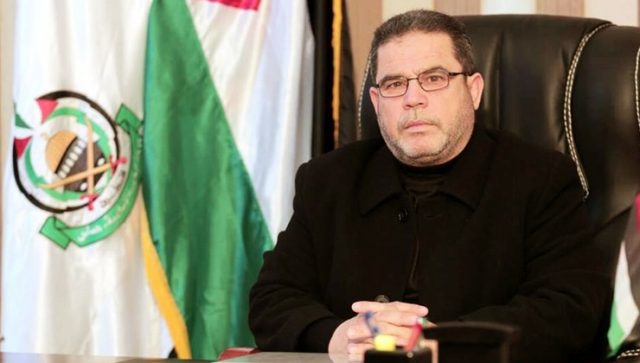
Al-Manar | March 23, 2025
The Islamic Resistance Movement “Hamas” mourned the death of Salah Al-Bardawil, a key figure in its political bureau and a member of the Palestinian Legislative Council, who was killed in an Israeli airstrike targeting his family tent in Khan Younis, southern Gaza.
The attack, which also claimed the life of his wife, was described by Hamas as a “treacherous Zionist assassination.”
In its statement, Hamas vowed that the martyrdom of al-Bardawil, along with that of all martyrs, would continue to fuel the ongoing struggle for liberation and return. “With every martyr, the flame of resistance burns brighter until the occupation is eliminated,” the statement declared.
A Distinguished Leader and Scholar
Martyr Salah Al-Bardawil was born in 1959 in the Khan Younis refugee camp, with roots tracing back to the occupied village of Al-Joura, near Gaza. He was an accomplished academic, earning degrees in Arabic language and Palestinian literature from Cairo University and Sudan.
His work as an educator and writer also contributed to his prominent role in establishing the Palestinian Writers Union and the National Gathering for Thought and Culture.
Al-Bardawil’s political involvement with Hamas began in the early 1990s. In 1996, he founded Al-Risalah, the first official media outlet of Hamas, and served as its editor-in-chief.
Through his weekly satirical column, “From the Streets of the Homeland,” he critiqued the Palestinian Authority, which led to multiple arrests by Israeli forces. He also led Hamas’s media department and played a central role in the formation of the National Salvation Party in 1996.
In 2006, al-Bardawil was elected to the Palestinian Legislative Council, representing Khan Younis. Over the years, he held various senior positions within Hamas, including overseeing the movement’s internal and external planning while maintaining strong connections with fellow leaders.
The ongoing attacks, including the death of Salah Al-Bardawil, highlight the continuing struggle for Palestinian sovereignty and resistance against occupation.
Gaza rescue teams besieged by Israeli forces as ‘catastrophe’ unfolds
Dozens of Palestinian civilians have reportedly been executed by Israeli forces in the southernmost city of Rafah
The Cradle | March 23, 2025
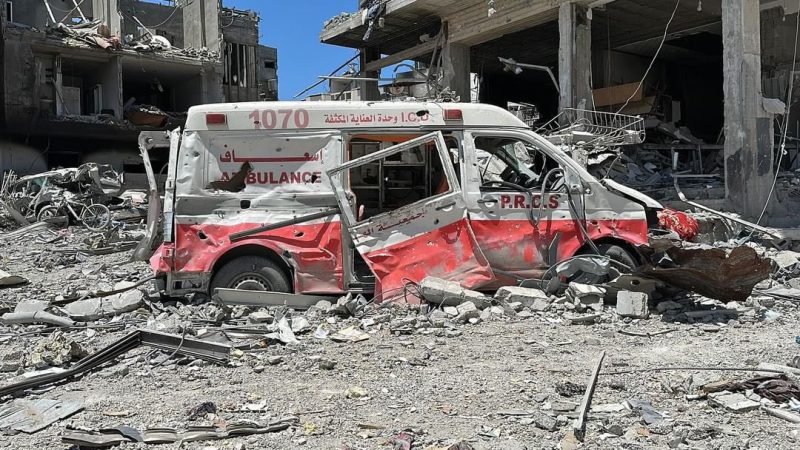
Palestinian Red Crescent Society (PRCS) workers are being besieged by Israeli forces after responding to rescue calls from the Gaza Strip’s southernmost city of Rafah on 23 March.
“We are still awaiting clearance to reach the trapped team in Rafah. Occupation forces continue to besiege four PRCS ambulances, and contact with the team remains lost,” the PRCS said in a statement on Sunday morning.
According to reports, dozens of people were executed after being surrounded by the Israeli army in Rafah.
“We warn of an imminent danger threatening the lives of more than 50,000 citizens in the Baraksat area west of Rafah Governorate after they were besieged by the Israeli occupation forces,” Gaza’s Civil Defense said.
“We warn against harming the Civil Defense crews who were besieged in the same area after intervening to rescue Red Crescent crews, and contact with them is still lost,” it added.
Israeli forces opened fire at civilians fleeing their homes in Rafah following evacuation orders issued by the army.
Rafah Municipality announced that thousands of families have been forced to flee the Tal al-Sultan neighborhood under intense Israeli bombardment. It added that its crews, along with residents, remained trapped inside the area as they carried out their duties serving residents.
An Israeli airstrike also targeted a group of displaced residents in the city, killing at least three and injuring others, according to WAFA news agency.
Over 40 people have been killed by Israeli attacks on Gaza during the past 24 hours, the Health Ministry in the strip announced on Sunday.
“A number of victims are still under the rubble and on the streets, and ambulance and civil defense crews cannot reach them,” the ministry said in a statement.
A member of Hamas’ Political Bureau, Salah al-Bardawil, was killed alongside his wife in an Israeli airstrike that targeted his tent late on Saturday. He was killed while praying, according to a statement released by the resistance movement on 23 March.
Israel renewed the war on Gaza early on 18 March after following through with several weeks of threats and obstruction of ceasefire talks. Over 700 Palestinians have been killed in less than a week as a result of the new campaign.
All border crossings remain shut, and Gaza is witnessing a humanitarian disaster due to a lack of aid and continuous bombardment. The strip is facing a severe water crisis due to the destruction of wells and lack of electricity.
“We are facing a compounded humanitarian catastrophe, whose severity continues to escalate under this suffocating blockade, while the disgraceful silence of the international and Arab communities emboldens the occupation to persist in its criminal policies without accountability,” the Gaza Government Media Office said on Sunday, holding the US “fully responsible” for Israel’s atrocities.
Featured Video
The Board For Peace – Whitewashing Ethnic Cleansing and Genocide
or go to
Aletho News Archives – Video-Images
Book Review
Conspiracy Denial

Lies are Unbekoming | January 27, 2026
In honour of Michael Parenti (1933–2026), who passed away on 24 January 2026 at the age of 92. He spent his life naming what power prefers to leave unnamed.
In 1837, Abraham Lincoln remarked: “These capitalists generally act harmoniously, and in concert, to fleece the people.”
Today, he would be dismissed as a conspiracy theorist.
That dismissal—reflexive, automatic, requiring no engagement with evidence—is not a mark of sophistication. It is a tell. The question worth asking is not whether conspiracies exist (they are a matter of public record and a recognised concept in law) but why acknowledging their existence provokes such reliable hostility. What work does the label “conspiracy theorist” actually do?
The late political scientist Michael Parenti spent decades answering that question. His conclusion was blunt: “’Conspiracy’ refers to something more than just illegal acts. It serves as a dismissive label applied to any acknowledgment of ruling-class power, both its legal and illegal operations.” The term functions not as a descriptor but as a weapon—a thought-terminating cliché that protects the powerful from scrutiny by pathologising those who scrutinise them.
Conspiracy denial, in Parenti’s analysis, is not skepticism. It is the opposite of skepticism. It is credulity toward power dressed up as critical thinking. As he wrote in Dirty Truths: “Just because some people have fantasies of conspiracies does not mean all conspiracies are imaginary.” … continue
Blog Roll
Recent Comments
eddieb on WEF Calls for ‘Cultural Revolu… loongtip on Trump wanted to play peacemake… Coronistan on EU member to sue bloc over ‘su… loongtip on Vicious loongtip on EU turns to India for defense… Coronistan on Donald Trump Is No Peace … seversonebcfb985d9 on French court jails pro-Palesti… eddieb on Fourteen Incredible Facts Abou… Bill Francis on European leaders’ shift in the… seversonebcfb985d9 on Villains of Judea: Philip Esfo… loongtip on Report warns that ‘Jewish terr… Craig Nelms on New study shows that toxic gas…


 Aletho News
- Manufacturing martyrdom: The west’s cynical use of Iranian protest figures
- Attack on Iran would backfire, causing great losses for US, warns European think-tank
- Davos and Abu Dhabi: How the Ukrainian Endgame Exposed Western Decline
- AfD co-leader states the obvious: Pouring money into the Ukraine war is killing the German economy
- Britain’s return to piracy to stop Russian ships – desperate attempt to demonstrate power
- Czech coalition rules out higher defense spending, says 2% of GDP is enough
- G7 Hands Ukraine $40Bln Generated From Frozen Russian Assets
- Conspiracy Denial
- Ukraine expects to join EU next year – Zelensky
- Here’s what’s behind the US shift on EU allies
- If Americans Knew
- “The Gaza ceasefire is a minefield” – Not a ceasefire Day 110
- Israel to seek new security deal from US, official says
- Leaked “Board of Peace” Resolution Outlines U.S.-Led Plan to Rule Over Gaza
- Jonathan Greenblatt Rolls Out Plan to Activate Hispanic Evangelical Golems
- Violence against hundreds of Gazan remains to find one Israeli – Not a ceasefire Day 109
- Greenpeace Demonstrator Exposes Folly of Protest Restrictions
- From CBS to TikTok, Pro-Israel Ellison is now in the driver’s seat
- Israel pays for UK advertisements attacking Doctors Without Borders
- Israel accused of extracting billions from Gazan people to pay for their own genocide
- ‘Deliberate Assassination’: 3 Journalists Among 11 Killed by Israeli Forces in Gaza
- No Tricks Zone
- New Study Affirms Rising CO2’s Greening Impact Across India – A Region With No Net Warming In 75 Years
- Germany’s Natural Gas Crisis Escalates … One Storage Site Near Empty …Government Silent
- Polar Colding…Antarctica Saw Its Coldest October In 44 Years!
- New Study: Sea Levels Rose 20 Times The Modern Rate During The Roman Warm Period
- As German Gas Storage Dips Dangerously Low…Shortage Hardly Avoidable
- New Study: Brazil’s Relative Sea Level Was 2+ Meters Higher And SSTs 3-4°C Warmer 6000 Years Ago
- Philosopher Schopenhauer: Climate Science Certainty Stems From Stupidity, Ignorance
- New Study: Species Extinction Rates Declining Since 1980 – ‘Climate Change Is Not An Important Threat’
- Denmark Places Climate Protection Above Animal Welfare, Poisoning And Culling Cows
- New Study: Greenland Was 3-7°C Warmer And Far Less Glaciated Than Today 6000-8000 Years Ago
 Aletho News