The humanitarian myth
Richard Seymour, the author of The Liberal Defense of Murder, analyzes the propaganda manufactured to justify U.S. actions in Haiti after the earthquake.
January 25, 2010
WITHIN DAYS of Haiti suffering an earthquake registering 7.0 on the Richter scale, the U.S. government had sent thousands of 82nd Airborne troops and Marines, alongside the super-carrier USS Carl Vinson.
By this Sunday, a total of more than 20,000 U.S. troops were scheduled to be operating in Haiti, both on land and in the surrounding seas. “We are there for the long term,” explained Alejandro Wolff, the U.S. ambassador to the United Nations. The justification for sending troops is that there is a “security” crisis, which soldiers have to deal with in order to facilitate the distribution of aid.
The situation was and remains a needful one. The Haitian interior minister estimates that as many as 200,000 may have died as a result of the quake, and 2 million have been left homeless. Potable water is extremely scarce, and was so even before the quake. Only half a million have found the makeshift camps that provide some food and water, but have such poor sanitation that they are fostering diarrhea. Clinics are overwhelmed by the injured survivors, estimated to number a quarter of a million.
Since the arrival of the troops, however, several aid missions have been prevented from arriving at the airport in Port-au-Prince, that the U.S. has commandeered. France and Caribbean Community have both made their complaints public, as has Médecins Sans Frontières on five separate occasions. UN World Food Program flights were also turned away on two consecutive days. Benoit Leduc, MSF’s operations manager in Port-au-Prince, complained that U.S. military flights were being prioritized over aid flights. Now, U.S. ships have encircled Haiti in order to prevent refugees escaping and fleeing to the United States.
Not only has aid been obstructed and escape blocked, but what aid does arrive was at first not being delivered, and then only in small amounts. Some five days after the earthquake struck, BBC News reporter Nick Davis described how aid had just started “trickling through.” While aid was arriving in Haiti “in large amounts,” some “bottlenecks” prevented the bulk of it from being distributed.
Asked why the U.S. was not using its air power to deliver aid to areas unreachable by road, Defense Secretary Robert Gates maintained that this would result in riots. The writer Nelson Valdes has described how U.S. and UN authorities advised aid workers not to distribute relief independently, as they would be subject to “mob attacks.”
Eyewitnesses have repeatedly described how rescue workers are scarce on the ground, and relief nowhere to be seen. Hospitals that are functioning despite the wreckage complain of having no painkillers with which to operate on patients with serious injuries. Dr. Evan Lyon of Partners in Health explained that:
[I]n terms of supplies, in terms of surgeons, in terms of aid relief, the response has been incredibly slow. There are teams of surgeons that have been sent to places that were “more secure,” where they have 10 or 20 doctors and 10 patients. We have a thousand people on this campus who are triaged and ready for surgery, but we only have four working [operating rooms], without anesthesia and without pain medications. And we’re still struggling to get ourselves up to 24-hour care.
In effect, the U.S. has staged an invasion of Haiti, under the pretext of providing security for humanitarian aid, and in doing so has prevented the delivery of humanitarian aid. With Haitians in a desperate condition, and the UN-supervised government in dire straits, Washington has sent the International Monetary Fund to offer a $100 million loan, on the proviso that public wages be frozen.
The “security” operation, meanwhile, proceeds apace. As well as U.S. troops, thousands more UN police have been sent to Haiti. Already, UN troops, alongside the Haitian police, have been responsible for several killings, as they have opened fire on starving earthquake survivors who dared to try to retrieve the means of survival from shops and other locations. The US has also insisted that the Haitian government pass an emergency decree authorizing curfews and martial law. Secretary of State Hillary Clinton said that the decree “would give the government an enormous amount of authority, which in practice they would delegate to us.”
This process has been facilitated by a flood of alarmist and often racist reporting about “mobs,” “looters” and “gangs” causing a “security crisis.” A “security crisis” validates a repressive response.
The Haitian police have justified their brutal massacres of “looters”–those securing their right to life in desperate circumstances–by telling the media that thousands of prisoners have escaped from the country’s jails, and are running amok, posing a threat to vulnerable citizens. Police have been attempting to whip up fear among earthquake survivors, organising them into vigilantes to attack the escaped prisoners. However, as many as 80 percent of Haiti’s prisoners have never been charged with a crime. “Gangs”–in the vernacular of Washington, the White House press corps and Haiti’s business lobby, the Group of 184–happens to be a synonym for Lavalas activists.
For all the headlines, moreover, there is strikingly little actual violence taking place. Most of the stories of violence center on episodes of “looting,” and most such instances involve desperate people procuring the means of survival. Aid workers also contradict the image of mobs on the attack purveyed by the media and U.S. officials. Abi Weaver, spokesperson for the American Red Cross, confirmed that “we haven’t had any security issues at all.”
“There are no security issues,” said Dr. Evan Lyon. “We’ve been circulating throughout the city until 2:00 and 3:00 in the morning every night, evacuating patients, moving materials. There’s no UN guards. There’s no US military presence. There’s no Haitian police presence. And there’s also no violence. There is no insecurity.” In fact, Lt. Gen. Ken Keen, deputy commander of U.S. Southern Command, maintains that there is less violence in Haiti now than before the earthquake.
So if there is no insecurity, and if the US military intervention is actually obstructing aid, what becomes of the pretext for the invasion?
Humanitarian intervention
Notwithstanding this extraordinary performance, many American commentators actually approve of the U.S. response.
Jonathan Dobrer, of the American Jewish University in Bel Air, declared himself “almost sinfully proud of America.” Steven Cohen of Columbia University enthused on the liberal Huffington Post that “We Have Reason to be Proud of the American Response in Haiti.” New York Times op-ed contributor Jonathan M. Hansen called on the U.S. to go further, and use the Guantánamo gulag as a base for “humanitarian intervention” in Haiti.
Indeed, the label “humanitarian” is regularly applied to U.S. actions in Haiti. It is important to recall, therefore, that the overthrow of Haiti’s elected government in 2004 and the subsequent occupation was itself originally cast as a humanitarian intervention of sorts.
Aristide, so the story went, had governed incompetently, his rule characterized by such corruption and violence as to generate countrywide disturbances. In recognition of his inability to govern, he supposedly “resigned” and fled the country. Filling the gap created by the absence of legitimate authority, concerned members of the “international community” prevailed upon the United Nations to send troops into Haiti and facilitate the development of democratic institutions.
Matters are a little more prosaic and grubby than this uplifting scenario would suggest. The U.S. had begun cutting aid programs to Haiti when Aristide was elected with an overwhelming mandate for his second term in 2000. The result was that the national budget was cut in half, and gross domestic product shrank by a quarter in the ensuing period.
The pro-U.S. opposition group, Convergence Démocratique, declared that it would not accept the results and instead began to agitate against the incoming government. Paramilitary attacks, beginning in the summer of 2001, were carried out by former death squad members and organized criminals acting in association with Haiti’s business community. Former army personnel such as Guy Philippe, an admirer of Augusto Pinochet, were organized by the U.S. under the rubric of the Fronte pour la Libération et la Reconstruction Nationale (FLRN).
By February 2004, a full-blown insurgency had been launched, and had begun to take control of large parts of the country. None of the Lavalas rulers had military experience, and they were not prepared to arm and mobilize the population.
Aristide, far from being a violent or incompetent ruler as his critics suggest, was eventually defeated because he was not prepared to violently repress an opposition that was explicitly organizing for his overthrow. His administrations had actually been highly effective in a number of areas, despite considerable pressures from the U.S. and the Haitian ruling class.
Lavalas can be credited with reducing infant mortality from 125 to 110 per thousand live births, bringing illiteracy down from 65 percent to 45 percent and slowing the rate of new HIV infections. It was obliged by the U.S. to accept “structural adjustment” programs, but did what it could to soften the blow by maintaining subsidies, implementing some land reforms, and promulgating certain social programs. It legislated against the exploitation of children as unpaid servants in wealthy homes. It reformed the notoriously labyrinthine judiciary and put several death squad members on trial. It also managed to extract some taxes from the rich, in the face of strenuous resistance.
For these humanitarian accomplishments, Aristide had to go. Once the dregs of former genocidaires and the criminal fraternity had wrought sufficient destruction across the country, the U.S. Marine Corps abducted Aristide on September 29, 2004. The initial line given to the press by James Foley, the U.S. ambassador to Haiti, was that it was a rescue mission. The U.S. had stepped in, concerned for Aristide’s welfare, and he had resigned voluntarily.
As soon as Aristide got hold of a telephone, however, he informed every news outlet that would listen that he had been kidnapped by U.S. forces. He was not permitted to return to Haiti, and an occupation began under a UN mandate, enforced by MINUSTAH troops. A new regime was imposed that locked up political activists and priests, and thousands were killed either by MINUSTAH soldiers directly or by gangs operating under their authority. A study published in The Lancet found:
[D]uring the 22-month period of the U.S.-backed Interim Government, 8,000 people were murdered in the greater Port-au Prince area alone. Thirty-five thousand women and girls were raped or sexually assaulted, more than half of the victims were children…Those responsible for the human rights abuses include criminals, the police, United Nations peacekeepers and anti-Lavalas gangs.
Meanwhile, the democratic process that the UN was supposed to oversee has resulted in elections in which the country’s most popular political party, Lavalas, are not allowed to participate. The recent senatorial and congressional elections saw turnouts depressed to as little as 10 percent as a result. This shambolic process has made life easier for Haiti’s ruling class, and the multinationals operating in Haiti, but by no stretch of the imagination is it “humanitarian.”
The point of highlighting this background is to note that, contrary to some short-sighted commentary–like Jonathan Dobrer: “We come, we help, and we don’t stay”–the U.S. has a bloody recent history in Haiti and a well-defined set of goals in the country, including the desire to finish off Lavalas and create a benevolent investment climate for business.
The belief that the U.S. is behaving in a humanitarian manner in Haiti is at best myopic. At worst, it buys into the racist mythologies about Haiti that have been on prominent display in headlines and news copy for over a week now.
Paternalism and racism
The paternalistic assumptions behind the calls for ‘humanitarian intervention’ have sometimes been starkly expressed. Thus, the conservative columnist Eric Margolis lauds the history of American colonial rule in Haiti: “[T]he U.S. occupation is looked back on by many Haitians as their “golden age.” The Marine Corps proved a fair, efficient, honest administrator and builder. This era was the only time when things worked in Haiti.”
Purporting to oppose imperialism, Margolis insists that “genuine humanitarian intervention” is “different,” and calls for Haiti to be “temporarily administered by a great power like the U.S. or France.” He writes: “U.S. administration of Haiti may be necessary and the only recourse for this benighted nation that cannot seem to govern itself.”
Similarly, right-wing New York Times columnist David Brooks, decrying the supposed “progress-resistant cultural influences” that he maintains holds Haiti back, calls for the U.S. to “promote locally-led paternalism.” “We’re all supposed to politely respect each other’s cultures,” he complains. “But some cultures are more progress-resistant than others, and a horrible tragedy was just exacerbated by one of them.”
To overcome this cultural handicap, Brooks recommends finding gurus who would promote a culture of achievement and responsibility–as opposed to the irresponsible, chaotic, voodoo-ridden culture that he identifies as Haiti’s major problem.
It is unnecessary to dignify such caricatures by considering them as empirical hypotheses. However, it should be noted that neither author gives the slightest consideration to the persistent efforts of the U.S. government to frustrate the rise of popular, democratic movements such as Lavalas, nor to the IMF-imposed programs which saw real wages fall by 50 percent between 1980 and 1990, and which resulted in overpopulated slums and a failing rural economy.
Nor do they acknowledge the brutality of the UN occupation. While Margolis acknowledges that America’s colonial rule was “sometimes brutal,” his understatement is verging on euphemism when he omits to discuss the killing of 15,000 people as Haiti’s rebels, known as Cacos, were suppressed.
Nor does he mention the humiliating system of forced labor that was imposed on Haitians under U.S. rule, or the fact that the gendarmerie built up under U.S. occupation became the organized basis for later dictatorships that would blight Haiti. In short, both writers bring to bear astonishingly little understanding of the country whose fate they are discussing so cavalierly.
However, what is of interest in these caricatures is the genus of imperial ideology that they relate to. Margolis is an old-school conservative (he describes himself as an Eisenhower Republican). He recalls in his phrases the manifest-destinarianism of William McKinley, who argued that the conquest and colonization of the Philippines was justified since Filipinos “were unfit for self-government.”
In the imperial language of the U.S. and Europe in this period, self-government was conceived of either as a cultural state that only white people had achieved, or as a technology that only white people could use. Woodrow Wilson, the invader of Haiti, explained that the Philippines could not be given self-government by the United States, since “it is a form of character and not a form of constitution.” Self-government is a cultural state attained after a period of discipline that “gives people self-possession, self-master, the habit of order.”
For Wilson, only the “nobler races”–namely Europeans and white Americans–had achieved that state. Margolis would not be so explicitly racist, but his subtext is not the less subtle for that.
Brooks, though, is a neoconservative. As such, he brings to bear that tradition’s paternalism, its concern with developing good patriarchal families, and particularly its culturalist reading of social institutions.
In this view, government and other institutions reflect an accumulation of cultural practices that have survived through generations. Capitalism and liberal democracy are thus the result of cultural influences such as Judeo-Christian values. The ability to govern oneself as a society is also said to be a result of cultural attributes that are generally found to be lacking in America’s opponents. These discrete cultures do not necessarily correspond to older notions of ‘race’, but they perform an analogous function in permitting privileged U.S. commentators to applaud the conquest of other societies.
Thus, at the height of the Vietnam War, the “godfather” of neoconservatism, Irving Kristol, argued that it was correct for the U.S. to support a right-wing dictatorship since “South Vietnam, like South Korea, is barely capable of decent self-government under the very best of conditions.” Like the Black families that Daniel Patrick Moynihan famously diagnosed as suffering from a “tangle of pathologies,” these people lacked the exquisite cultural refinements that made white Americans so successful.
These are exceptionally explicit commentaries. Most of those lauding American actions are unlikely to be as cynical or brazen as Brooks and Margolis. Yet when 20,000 U.S. troops arrive in a wrecked island country, and begin obstructing aid and beefing up “security” while people die in the wreckage of thirst and starvation, only the willfully purblind or those trapped in the assumptions of the “civilizing mission,” could construe it as a “humanitarian intervention.”
What is the endgame in Gaza?
By Ahmed Moor | January 24, 2010

I want to focus attention on an issue that hasn’t gotten enough press. The Mubarak regime is building a subterranean steel wall on the border with Gaza. Conservative estimates put the depth of the wall at 18 meters (nearly 60 feet). The BBC reports that American engineers designed the wall panels, which were constructed in America.
30-meter-deep holes are being bored into the ground on the Palestinian side of the wall. Egypt will pump salt water from the Mediterranean Sea into the earth to destroy the tunnels – the lifeblood of the besieged Gazan Palestinians. Soil quality will be degraded and the Coastal aquifer, Gaza’s source of potable water, may well be destroyed.
The deranged Obama-Netanyahu-Mubarak cabal seems to be possessed of a biblical rage. Dare to defy the divine edict? We will crush your men, women and children underfoot. Refuse to starve? We will raze your cities, poison your wells, and salt the earth. Their grandiosity – think of it, they’re building an 18-meter-deep steel wall (!) for 11 kilometers – beggars belief, and beggars Gazans.
Protests have erupted across the Arab world and Europe targeting Egyptian embassies and consulates; I attended one yesterday in Beirut. But the Egyptian regime isn’t responsive to popular pressure, so a group of activists here in Lebanon have begun a movement to draw attention to the Egyptian company assembling the wall – Arab Contractors. Our hope is that as details emerge, other companies can be targeted. I reported on our first press conference for Electronic Intifada…
Ahmed Moor is a Gaza-born Palestinian-American freelance journalist living in Beirut.
UK ‘using obscure legal principle’ to dismiss torture claims in colonial Kenya
Foreign Office says it is ‘not liable for acts and omissions’ of administration after alleged abuse of Mau Mau suspects
Afua Hirsch | The Guardian | January 25, 2010
The government is invoking an obscure legal principle to dismiss claims of torture and rape by the British colonial administration in Kenya, campaigners claimed.
The Foreign Office has said four elderly Kenyans alleging that they suffered serious physical and sexual abuse at the hands of the British during the Kenyan “emergency” of 1952 to 1960 should not be allowed to proceed with their claim because of the law of state succession.
The government argues it is “not liable for the acts and omissions of the Kenyan colonial administration”, claiming the Kenyan government was now responsible for events that took place while Kenya was a British colony. But a cross-party group of MPs will this week publish an open letter demanding an apology and the creation of a welfare fund to help the alleged victims through old age.
Allegations that the British abused suspected Mau Mau fighters have continued since the Kenyan government lifted a 30-year ban on membership in 2003.
The organisation, which came into being to oppose colonial rule in Kenya, remains a sensitive issue because of the violence suffered by Kenyans. The British government recently acknowledged that suffering was experienced “on both sides” during the Mau Mau uprising in what experts said was the first recognition that the UK was also to blame.
A Foreign Office spokesman said the emergency period caused great pain on all sides, and marred progress towards independence.
But the government is refuting liability for the case, in which the claimants describe allegedly being castrated, sexually assaulted and beaten during their detention by the British and say they are still suffering consequences.
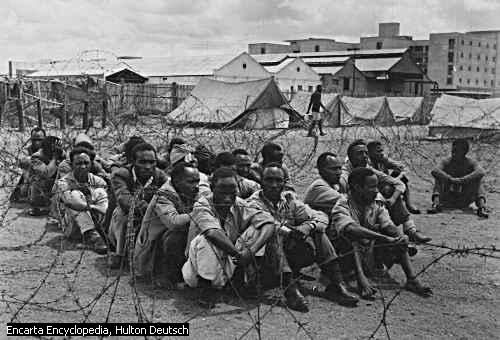 The case could open the way for up to 12,000 Kenyans to seek redress. It was filed at the high court last year. Daniel Leader, a lawyer at Leigh Day, representing the claimants, said: “One … was castrated for supplying a cow to the Mau Mau.”
“The nature and scale of this abuse was unparalleled in modern British colonial history. The claimants are among the poorest in Kenyan society, and they still live with injuries from that period.
“Historians have been through the public records, and the use of systematic violence was authorised at the highest level in London,” Leaderhe said. “We have the documents to prove that.”
But the government decision to have the case struck out on technical grounds of state succession – the principle that countries assume liability for their own affairs after independence – has infuriated human rights campaigners, who accuse the UK of shirking its responsibilities for rights abuses in former colonies.
The Foreign Office is believed to be arguing on a rule derived from a case over licences to fish for Patagonian toothfish in the South Georgia and South Sandwich islands, British overseas territories. “The FO is arguing that responsibility for acts by the colonial government passed to the independent government in 1963,” Muthoni Wanyeki, executive director of Kenya Human Rights Commission, said.
Peace Talks Further Damaged as PM Claims Settlement Blocs ‘Part of Jerusalem’
By Jason Ditz | January 24, 2010
 Seemingly already damaged beyond repair, the prospect for peace talks took another hit today when Israeli Prime Minister Benjamin Netanyahu declared portions of the occupied West Bank “eternally” part of Israel.
Attending a tree-planting ceremony in one of the settlements, Netanyahu proclaimed that “we are planting here, we will stay here, we will build here, this place will be an inseparable part of the state of Israel for eternity.” He added that the settlements were part of “sovereign Jerusalem.”
The settlements are built on land occupied by the Israeli military in 1967 and are not recognized as part of the nation. They lie near East Jerusalem, which was also occupied and is not generally recognized as part of Israel either, though Netanyahu insists that this too will remain part of the Israeli state.
The Palestinian Authority slammed the comments, saying they further undermined efforts by visiting US envoy George Mitchell to resume peace talks. Those talks already took a major hit last week when Prime Minister Netanyahu demanded that any hypothetical future Palestinian state allow an eternal Israeli military occupation and grant Israel practical control over its border with Jordan.
Though President Obama has seemingly given up on the peace process, declaring last week that it “is just really hard,” Mitchell insisted that the US remained committed to a “viable” Palestinian state. Those promises of commitment are worth less and less as the rhetoric continues to worsen, and it seems the chances of an improved diplomatic situation are remote, at best.
Delaying aid for a photo-op
By Jesse Hagopian | January 25, 2010
|

EVERYTHING YOU need to know about the U.S. aid effort to assist Haiti in the wake of the catastrophic earthquake can be summed up by Secretary of State Hillary Clinton’s touchdown in Port-au-Prince on Saturday, January 16: they shut down the airport for three hours surrounding her arrival for “security” reasons, which meant that no aid flights could come in during those critical hours.
If there was one day when the Haitian people needed aid to flow all day long, that was the day, because the people trapped under the rubble on Tuesday evening couldn’t survive much beyond Saturday without water.
Defenders of Clinton will say that her disimpassioned, monotone, photo-op speech was needed to draw attention to the plight of the Haitians. But no one north of hell can defend her next move: according to airport personnel that I spoke to during my recent evacuation from Haiti, she paralyzed the airport later that same day to have a new outfit flown in from the Dominican Republic.
I am having a hard time readjusting to life back home after having survived the earthquake and witnessed so much death, so even typing those words is making my heart pound uncontrollably. I guess for America’s rulers, a new pantsuit is more valuable than the lives of poor, Black Haitians.
Unfortunately, Clinton’s model of diverting and delaying critical aid to the Haitian people, while emphasizing security, has become standard operating procedure.
Alain Joyandet, the French minister responsible for humanitarian relief in Haiti, charged the U.S. with treating this as a military operation rather than an aid mission. Mr. Joyandet told the Daily Telegraph that he had been involved in an argument with a U.S. commander in the airport’s control tower over the flight plan for a French evacuation flight, saying, “This is about helping Haiti, not about occupying Haiti.”
But with the U.S. occupying Iraq and Afghanistan, and funding the Israeli occupation of Palestine, it seems our government knows how to do little else when it comes to international affairs.
The day I left via Toussaint L’Ouverture International Airport, I saw lots of crates of food, water and medical supplies piled on the tarmac. But I didn’t see that aid being transported out of the airport to actually get to Haitians.
Undoubtedly, there has been some aid distributed, but because there was no serious effort to disperse that aid in the first four days after the quake, tens of thousands of people trapped under rubble have died needlessly because they couldn’t get a sip of water.
The Geneva-based organization Doctors Without Borders has been turned away from the airport numerous times to allow U.S. troops to land. A ring of U.S. warships surrounds Haiti to make sure that Haitians don’t escape the disaster and try to get to the United States.
The U.S. has taken control of Haiti’s main airport and seaport, and is in the process of deploying 18,000 U.S. troops to bolster the 9,000 UN troops already occupying the island nation–and as an eyewitness, I can tell you those troops are guarding their own compounds rather than distributing aid.
The Drone Surge
Today, tomorrow, and 2047
By Nick Turse
One moment there was the hum of a motor in the sky above. The next, on a recent morning in Afghanistan’s Helmand province, a missile blasted a home, killing 13 people. Days later, the same increasingly familiar mechanical whine preceded a two-missile salvo that slammed into a compound in Degan village in the tribal North Waziristan district of Pakistan, killing three.
What were once unacknowledged, relatively infrequent targeted killings of suspected militants or terrorists in the Bush years have become commonplace under the Obama administration. And since a devastating Dec. 30 suicide attack by a Jordanian double agent on a CIA forward operating base in Afghanistan, unmanned aerial drones have been hunting humans in the Af-Pak war zone at a record pace. In Pakistan, an “unprecedented number” of strikes – which have killed armed guerrillas and civilians alike – have led to more fear, anger, and outrage in the tribal areas, as the CIA, with help from the U.S. Air Force, wages the most public “secret” war of modern times.
In neighboring Afghanistan, unmanned aircraft, for years in short supply and tasked primarily with surveillance missions, have increasingly been used to assassinate suspected militants as part of an aerial surge that has significantly outpaced the highly publicized “surge” of ground forces now underway. And yet, unprecedented as it may be in size and scope, the present ramping up of the drone war is only the opening salvo in a planned 40-year Pentagon surge to create fleets of ultra-advanced, heavily-armed, increasingly autonomous, all-seeing, hypersonic unmanned aerial systems (UAS).
Today’s Surge
Drones are the hot weapons of the moment and the upcoming Quadrennial Defense Review – a soon-to-be-released four-year outline of Department of Defense strategies, capabilities, and priorities to fight current wars and counter future threats – is already known to reflect this focus. As the Washington Post recently reported, “The pilotless drones used for surveillance and attack missions in Afghanistan and Pakistan are a priority, with the goals of speeding up the purchase of new Reaper drones and expanding Predator and Reaper drone flights through 2013.”
The MQ-1 Predator – first used in Bosnia and Kosovo in the 1990s – and its newer, larger, and more deadly cousin, the MQ-9 Reaper, are now firing missiles and dropping bombs at an unprecedented pace. In 2008, there were reportedly between 27 and 36 U.S. drone attacks as part of the CIA’s covert war in Pakistan. In 2009, there were 45 to 53 such strikes. In the first 18 days of January 2010, there had already been 11 of them.
Meanwhile, in Afghanistan, the U.S. Air Force has instituted a much publicized decrease in piloted air strikes to cut down on civilian casualties as part of Afghan War commander Gen. Stanley McChrystal’s counterinsurgency strategy. At the same time, however, UAS attacks have increased to record levels.
The Air Force has created an interconnected global command-and-control system to carry out its robot war in Afghanistan (and as Noah Shachtman of Wired’s Danger Room blog has reported, to assist the CIA in its drone strikes in Pakistan as well). Evidence of this can be found at high-tech U.S. bases around the world where drone pilots and other personnel control the planes themselves and the data streaming back from them. These sites include a converted medical warehouse at Al-Udeid Air Base, a billion-dollar facility in the Persian Gulf nation of Qatar where the Air Force secretly oversees its ongoing drone wars; Kandahar and Jalalabad Air Fields in Afghanistan, where the drones are physically based; the global operations center at Nevada’s Creech Air Base, where the Air Force’s “pilots” fly drones by remote control from thousands of miles away; and – perhaps most importantly – at Wright-Patterson Air Force Base, a 12-square-mile facility in Dayton, Ohio, named after the two local brothers who invented powered flight in 1903. This is where the bills for the current drone surge – as well as limited numbers of strikes in Yemen and Somalia – come due and are, quite literally, paid.
In the waning days of December 2009, in fact, the Pentagon cut two sizable checks to ensure that unmanned operations involving the MQ-1 Predator and the MQ-9 Reaper will continue full-speed ahead in 2010. The 703rd Aeronautical Systems Squadron based at Wright-Patterson signed a $38 million contract with defense giant Raytheon for logistics support for the targeting systems of both drones. At the same time, the squadron inked a deal worth $266 million with mega-defense contractor General Atomics, which makes the Predator and Reaper drones, to provide management services, logistics support, repairs, software maintenance, and other functions for both drone programs. Both deals essentially ensure that, in the years ahead, the stunning increase in drone operations will continue.
These contracts, however, only initial down payments on an enduring drone surge designed to carry U.S. unmanned aerial operations forward, ultimately for decades.
Drone Surge: The Longer View
Back in 2004, the Air Force could put a total of only five drone combat air patrols (CAPs) – each consisting of four air vehicles – in the skies over American war zones at any one time. By 2009, that number was 38, a 660 percent increase according to the Air Force. Similarly, between 2001 and 2008, hours of surveillance coverage for U.S. Central Command, encompassing both the Iraqi and Afghan war zones, as well as Pakistan and Yemen, showed a massive spike of 1,431 percent.
In the meantime, flight hours have gone through the roof. In 2004, for example, Reapers, just beginning to soar, flew 71 hours in total, according to Air Force documents; in 2006, that number had risen to 3,123 hours; and last year, 25,391 hours. This year, the Air Force projects that the combined flight hours of all its drones – Predators, Reapers, and unarmed RQ-4 Global Hawks – will exceed 250,000 hours, about the total number of hours flown by all Air Force drones from 1995-2007. In 2011, the 300,000 hour-a-year barrier is expected to be crossed for the first time, and after that the sky’s the limit.
More flight time will, undoubtedly, mean more killing. According to Peter Bergen and Katherine Tiedemann of the Washington-based think tank the New America Foundation, in the Bush years, from 2006 into 2009, there were 41 drone strikes in Pakistan that killed 454 militants and civilians. Last year, under the Obama administration, there were 42 strikes that left 453 people dead. A recent report by the Pakistan Institute for Peace Studies, an Islamabad-based independent research organization that tracks security issues, claimed an even larger number, 667 people – most of them civilians – killed by U.S. drone strikes last year.
While assisting the CIA’s drone operations in the Pakistani tribal borderlands, the Air Force has been increasing its own unmanned aerial hunter-killer missions. In 2007 and 2008, for example, Air Force Predators and Reapers fired missiles during 244 missions in Iraq and Afghanistan. In fact, while all the U.S. armed services have pursued unmanned aerial warfare, the Air Force has outpaced each of them.
From 2001, when armed drone operations began, until the spring of 2009, the Air Force fired 703 Hellfire missiles and dropped 132 GBU-12s (500-pound laser-guided bombs) in combat operations. The Army, by comparison, launched just two Hellfire missiles and two smaller GBU-44 Viper Strike munitions in the same time period. The disparity should only grow, since the Army’s drones remain predominantly small surveillance aircraft, while in 2009 the Air Force shifted all outstanding orders for the medium-sized Predator to the even more formidable Reaper, which is not only twice as fast but has 600 percent more payload capacity, meaning more space for bombs and missiles.
In addition, the more heavily-armed Reapers, which can now loiter over an area for 10 to 14 hours without refueling, will be able to spot and track ever more targets via an increasingly sophisticated video monitoring system. According to Air Force Lt. Gen. David Deptula, deputy chief of staff for intelligence, surveillance, and reconnaissance, the first three “Gorgon Stare pods” – new wide-area sensors that provide surveillance capabilities over large swathes of territory – will be installed on Reapers operating in Afghanistan this spring.
A technology not available for the older Predator, Gorgon Stare will allow 10 operators to view 10 video feeds from a single drone at the same time. Back at a distant base, a “pilot” will stare at a tiled screen with a composite picture of the streaming battlefield video, even as field commanders analyze a portion of the digital picture, panning, zooming, and tilting the image to meet their needs.
A more advanced set of “pods,” scheduled to be deployed for the first time this fall, will allow 30 operators to view 30 video images simultaneously. In other words, via video feeds from a single Reaper drone, operators could theoretically track 30 different people heading in 30 directions from a single Afghan compound. The generation of sensors expected to come online in late 2011 promises 65 such feeds, according to Air Force documents, a more than 6,000 percent increase in effectiveness over the Predator’s video system. The Air Force is, however, already overwhelmed just by drone video currently being sent back from the war zones and, in the years ahead, risks “drowning in data,” according to Deptula.
The 40-Year Plan
When it comes to the drone surge, the years 2011-2013 are just the near horizon. While, like the Army, the Navy is working on its own future drone warfare capacity – in the air as well as on and even under the water – the Air Force is involved in striking levels of futuristic planning for robotic war. It envisions a future previously imagined only in sci-fi movies like the Terminator series.
As a start, the Defense Advanced Research Projects Agency, or DARPA, the Pentagon’s blue skies research outfit, is already looking into radically improving on Gorgon Stare with an “Autonomous Real-Time Ground Ubiquitous Surveillance-Infrared (ARGUS-IR) System.” In the obtuse language of military research and development, it will, according to DARPA, provide a “real-time, high-resolution, wide area video persistent surveillance capability that allows joint forces to keep critical areas of interest under constant surveillance with a high degree of target location accuracy” via as many as “130 ‘Predator-like’ steerable video streams to enable real-time tracking and monitoring and enhanced situational awareness during evening hours.”
In translation, that means the Air Force will quite literally be flooded with video information from future battlefields; and every “advance” of this sort means bulking up the global network of facilities, systems, and personnel capable of receiving, monitoring, and interpreting the data streaming in from distant digital eyes. All of it, of course, is specifically geared toward “target location,” that is, pinpointing people on one side of the world so that Americans on the other side can watch, track, and in many cases, kill them.
In addition to enhanced sensors and systems like ARGUS-IR, the Air Force has a long-term vision for drone warfare that is barely beginning to be realized. Predators and Reapers have already been joined in Afghanistan by a newer, formerly secret drone, a “low observable unmanned aircraft system” first spotted in 2007 and dubbed the “Beast of Kandahar” before observers were sure what it actually was. It is now known to be a Lockheed Martin-manufactured unmanned aerial vehicle, the RQ-170 – a drone which the Air Force blandly notes was designed to “directly support combatant commander needs for intelligence, surveillance, and reconnaissance to locate targets.” According to military sources, the sleek, stealthy surveillance craft has been designated to replace the antique Lockheed U-2 spy plane, which has been in use since the 1950s.
In the coming years, the RQ-170 is slated to be joined in the skies of America’s “next wars” by a fleet of drones with ever newer, more sophisticated capabilities and destructive powers. Looking into the post-2011 future, Deptula sees the most essential need, according to an Aviation Week report, as “long-range [reconnaissance and] precision strike” – that is, more eyes in far off skies and more lethality. He added, “We cannot move into a future without a platform that allows [us] to project power long distances and to meet advanced threats in a fashion that gives us an advantage that no other nation has.”
This means bigger, badder, faster drones – armed to the teeth – with sensor systems to monitor wide swathes of territory and the ability to loiter overhead for days on end waiting for human targets to appear and, in due course, be vaporized by high-powered munitions. It’s a future built upon advanced technologies designed to make targeted killings – remote-controlled assassinations – ever more effortless.
 Over the horizon and deep into what was, until recently, only a silver-screen fantasy, the Air Force envisions a wide array of unmanned aircraft, from tiny insect-like robots to enormous “tanker-size” pilotless planes. Each will be slated to take over specific war-making functions (or so Air Force dreamers imagine). Those nano-sized drones, for instance, are set to specialize in indoor reconnaissance – they’re small enough to fly through windows or down ventilation shafts – and carry out lethal attacks, undertake computer-disabling cyber-attacks, and swarm, as would a group of angry bees, of their own volition. Slightly larger micro-sized Small Tactical Unmanned Aircraft Systems (STUAS) are supposed to act as “transformers” – altering their form to allow for flying, crawling, and non-visual sensing capabilities. They might fill sentry, counter-drone, surveillance, and lethal attack roles.
Additionally, the Air Force envisions small and medium “fighter-sized” drones with lethal combat capabilities that would put the current UAS air fleet to shame. Today’s medium-sized Reapers are set to be replaced by next generation MQ-Ma drones that will be “networked, capable of partial autonomy, all-weather, and modular with capabilities supporting electronic warfare (EW), CAS [close air support], strike, and multi-INT [multiple intelligence] ISR [intelligence, surveillance and reconnaissance] missions’ platform.”
The language may not be elegant, much less comprehensible, but if these future fighter aircraft actually come online they will not only send today’s remaining Top Gun pilots to the showers, but may even sideline tomorrow’s drone human operators, who, if all goes as planned, will have ever fewer duties. Unlike today’s drones, which must take off and land with human guidance, the MQ-Mas will be automated, and drone operators will simply be there to monitor the aircraft.
Next up will be the MQ-Mb, theoretically capable of taking over even more roles once assigned to traditional fighter-bombers and spy planes, including the suppression of enemy air defenses, bombing and strafing of ground targets, and surveillance missions. These will also be designed to fly more autonomously and be better linked-in to other drone “platforms” for cooperative missions involving many aircraft under the command of a single “pilot.” Imagine, for instance, one operator overseeing a single command drone that holds sway over a small squadron of autonomous drones carrying out a coordinated air attack on clusters of people in some far off land, incinerating them in small groups across a village, town, or city.
Finally, perhaps 30 to 40 years from now, the MQ-Mc drone would incorporate all of the advances of the MQ-M line, while being capable of everything from dog-fighting to missile defense. With such new technology will, of course, come new policies and new doctrines. In the years ahead, the Air Force intends to make drone-related policy decisions on everything from treaty obligations to automatic target engagement – robotic killing without a human in the loop. The latter extremely controversial development is already envisioned as a possible post-2025 reality.
2047: What’s Old is New Again
The year 2047 is the target date for the Air Force’s Holy Grail, the capstone for its long-term plan to turn the skies over to war-fighting drones. In 2047, the Air Force intends to rule the skies with MQ-Mc drones and “special” super-fast, hypersonic drones for which neither viable technology nor any enemies with any comparable programs or capabilities yet exist. Despite this, the Air Force is intent on making these super-fast hunter-killer systems a reality by 2047. “Propulsion technology and materials that can withstand the extreme heat will likely take 20 years to develop. This technology will be the next generation air game-changer. Therefore the prioritization of the funding for the specific technology development should not wait until the emergence of a critical COCOM [combatant command] need,” says the Air Force’s 2009-2047 UAS “Flight Plan.”
If anything close to the Air Force’s dreams comes to fruition, the “game” will indeed be radically changed. By 2047, there’s no telling how many drones will be circling over how many heads in how many places across the planet. There’s no telling how many millions or billions of flight hours will have been flown, or how many people, in how many countries will have been killed by remote-controlled, bomb-dropping, missile-firing, judge-jury-and-executioner drone systems.
There’s only one given. If the U.S. still exists in its present form, is still solvent, and still has a functioning Pentagon of the present sort, a new plan will already be well underway to create the war-making technologies of 2087. By then, in ever more places, people will be living with the sort of drone war that now worries only those in places like Degan village. Ever more people will know that unmanned aerial systems packed with missiles and bombs are loitering in their skies. By then, there undoubtedly won’t even be that lawnmower-engine sound indicating that a missile may soon plow into your neighbor’s home.
For the Air Force, such a prospect is the stuff of dreams, a bright future for unmanned, hypersonic lethality; for the rest of the planet, it’s a potential nightmare from which there may be no waking.
ISRAEL GETS DESPERATE: FAKES OSAMA TAPE
Damian Lataan | January 25, 2010
It seems Israel is becoming anxious about the American peoples commitment to Israeli Zionist dreams of creating a Greater Israel. They are so anxious that they have released a tape that they are claiming is the very dead Osama bin Laden threatening the US with acts of terrorism if they continue to support Israel.
This latest tape is the most blatantly transparent piece of nonsense that has ever emanated from the Israelis and their allies and demonstrates how fearful they are of losing the support of the American people and the West generally. The give-away for this particular piece of garbage is the way the Israelis have tried to link the al Qaeda cause to the Palestinian’s cause.
American’s, and indeed, many in the West, are becoming rapidly disillusioned by Israel’s behaviour over the past few years. In particular, since the release of the Goldstone Report that showed Israel’s warcrimes in the Gaza during Operation Cast Lead in which over a thousand Gazans were brutally murdered, people have become alerted to Israeli skulduggery and attempted cover-ups for their crimes. And, in latest developments in the West Bank, people in the West are increasingly becoming aware that the Netanyahu Zionist government has no intention whatsoever of ever allowing a Palestinian state to exist despite all the talk of talks, negotiations, roadmaps, accords, etc. As recently as this last Sunday Netanyahu said that Jewish settlements in the West Bank will remain Israeli.
Israel, by linking the Palestinian cause with Osama bin Laden is attempting to undermine the Palestinians quest for a sovereign state and in the process claim that Israel’s enemies are America’s enemies and that the struggle against ‘terrorism’ intrinsically links Palestinian fighters with al Qaeda and, therefore, the US must continue to support Israel in their fight against the Palestinians seeking their own sovereign state.
Unfortunately for the Israeli Zionists and their supporters in the West, the vast majority of the peoples of the world are unlikely to fall for this nonsense. It is only the extreme right-wing Murdoch style press that are actually pushing this nonsense as a given fact while other more progressive and realistic media sources are feeding the news of bin Laden’s latest messages as ‘purportedly of Osama bin Laden’ or ‘claiming to be from bin Laden’.
Oddly, the Los Angeles Times takes the tack that bin Laden is claiming credit for the Christmas Day bombing plot but then states that US intelligence (and I use the word ‘intelligence’ advisedly) officials have raised doubts about bin Laden’s role in the plot and suggest that it was an “attempt to score propaganda points for a plot already claimed by an increasingly independent faction of his movement in Yemen”.
Bin Laden was allegedly responsible for the most successful terrorist attack ever perpetrated destroying three major buildings and severely damaging the hub of US defence, so, even if bin Laden were alive, why on earth would he put his hand up to admit to the miserable failure of some bloke failing to blow his groin to bits with not much more than a large fire cracker that turned out to be just a damp squib? And where’s the propaganda brownie points in that?
Desperation has truly set in.
Venezuela and North Dakota Oil Updates

Estimates of Original Oil-in-Place
A comprehensive study by Petroleos de Venezuela S.A. (PDVSA) established the magnitude of the original oil-in-place (OOIP) at 1,180 billion barrels of oil (BBO), a commonly cited estimate for the Orinoco Oil Belt (Fiorillo, 1987); PDVSA recently revised this value to more than 1,300 BBO (Gonzalez and others, 2006). In this study the median OOIP was estimated at 1,300 BBO and the maximum at 1,400 BBO. The minimum OOIP was estimated at 900 BBO, given the uncertainty of regional sandstone distribution and oil saturation (Fiorillo, 1987).
Estimates of Recovery Factor
Recovery factor, or that percentage of the OOIP that is determined to be technically recoverable, was estimated from what is currently known of the technology for recovery of heavy oil in the Orinoco Oil Belt AU and in other areas, particularly California, west Texas, and western Canada. The minimum recovery factor was estimated to be 15 percent, the recovery expected for cold production using horizontal wells. The median recovery factor was estimated to be 45 percent, on the assumption that horizontal drilling and thermal recovery methods might be widely used. The maximum recovery factor was estimated to be 70 percent, on the assumption that other recovery processes, in addition to horizontal drilling and steam-assisted gravity drainage, might eventually be applied on a large scale in the Orinoco Oil Belt AU.
The assessment of technically recoverable heavy oil and associated gas resources is shown in table 2. The mean of the distribution of heavy oil resources is about 513 BBO, with a range from 380 to about 652 BBO. The mean estimate of associated dissolved-gas resource is 135 trillion cubic feet of gas (TCFG), with a range from 53 to 262 TCFG. No attempt was made in this study to estimate either economically recoverable

2. North Dakota raised its forecast for oil output on growth in and around the Bakken Shale formation There is another 100,000 barrels a day in north Dakota from oil that is not in the Bakken.
Output may reach 300,000 to 400,000 barrels a day by mid- 2011 and stay at that level for 10 to 15 years, said Lynn Helms, director of the North Dakota Mineral Resources Department. The state’s previous estimate was 220,000 to 280,000.
The forecast was raised on discoveries by companies such as Continental Resources Inc., Helms said in an interview. Drilling advances are enabling producers to tap the Bakken, where rocks lack the porosity and permeability of conventional oil fields. The Bakken contributed to last year’s 7.5 percent gain in U.S. crude output, the biggest since 1955 and the first in 18 years. The Energy Department forecast a 1.8 percent increase in 2010.
The top end of North Dakota’s production projection would represent more than 7 percent of nationwide oil output.
Viva Palestina Malaysia In Boycott Israel Walkabout
KUALA LUMPUR, Jan 24 (Bernama) — More than 100 members of Viva Palestina Malaysia (VPM), a coalition of NGOs, on Sunday participated in a walkabout for about five kilometres here in support of the efforts towards creating a free and independent state of Palestine.
The walkabout, held at Jalan Changkat Haji Abang Openg here, saw the participants wearing white T-shirts bearing the words “Boikot Israel” (Boycott Israel) as part of a campaign to boycott the products of four multinational companies alleged to be strong supporters of the Zionist regime.
VPM chairman Datuk Adnan Mohd Tahir said the walkabout was the third in the series of the VPM “Boikot Israel” programme, the first having been held in August last year at Menara Dewan Bandaraya Kuala Lumpur (DBKL) and the second in November at the Sunway Pyramid in Selangor.
VPM, formerly known as the Coalition of Malaysian NGOs Against Persecution of Palestinians (Complete), was set up on Jan 5 last year grouping 50 NGOs.
David Kelly post mortem to be kept secret for 70 years
Doctors accuse Lord Hutton of concealing vital information
By Miles Goslett | Daily Mail | 23rd January 2010
Vital evidence which could solve the mystery of the death of Government weapons inspector Dr David Kelly will be kept under wraps for up to 70 years.
In a draconian – and highly unusual – order, Lord Hutton, the peer who chaired the controversial inquiry into the Dr Kelly scandal, has secretly barred the release of all medical records, including the results of the post mortem, and unpublished evidence.
The move, which will stoke fresh speculation about the true circumstances of Dr Kelly’s death, comes just days before Tony Blair appears before the Chilcot Inquiry into the Iraq War.
It is also bound to revive claims of an establishment cover-up and fresh questions about the verdict that Dr Kelly killed himself.

Whistle-blower: Dr Kelly died after casting doubt on Government claims about Saddam’s weapons
Tonight, Dr Michael Powers QC, a doctor campaigning to overturn the Hutton findings, said: ‘What is it about David Kelly’s death which is so secret as to justify these reports being kept out of the public domain for 70 years?’
Campaigning Liberal Democrat MP Norman Baker, who has also questioned the verdict that Dr Kelly committed suicide, said: ‘It is astonishing this is the first we’ve known about this decision by Lord Hutton and even more astonishing he should have seen fit to hide this material away.’
The body of former United Nations weapons inspector Dr Kelly was found in July 2003 in woods close to his Oxfordshire home, shortly after he was exposed as the source of a BBC news report questioning the Government’s claims that
Saddam Hussein had an arsenal of weapons of mass destruction, which could be deployed within 45 minutes.
Lord Hutton’s 2004 report, commissioned by Mr Blair, concluded that Dr Kelly killed himself by cutting his wrist with a blunt gardening knife.
It was dismissed by many experts as a whitewash for clearing the Government of any culpability, despite evidence that it had leaked Dr Kelly’s name in an attempt to smear him.
Only now has it emerged that a year after his inquiry was completed, Lord Hutton took unprecedented action to ensure that the vital evidence remains a state secret for so long.
A letter, leaked to The Mail on Sunday, revealed that a 30-year ban was placed on ‘records provided [which were] not produced in evidence’. This is thought to refer to witness statements given to the inquiry which were not disclosed at the time.
In addition, it has now been established that Lord Hutton ordered all medical reports – including the post-mortem findings by pathologist Dr Nicholas Hunt and photographs of Dr Kelly’s body – to remain classified information for 70 years.
The normal rules on post-mortems allow close relatives and ‘properly interested persons’ to apply to see a copy of the report and to ‘inspect’ other documents.
Lord Hutton’s measure has overridden these rules, so the files will not be opened until all such people are likely to be dead.
Last night, the Ministry of Justice was unable to explain the legal basis for Lord Hutton’s order.
The restrictions came to light in a letter from the legal team of Oxfordshire County Council to a group of doctors who are challenging the Hutton verdict.
Last year, a group of doctors, including Dr Powers, compiled a medical dossier as part of their legal challenge to the Hutton verdict.
They argue that Hutton’s conclusion that Dr Kelly killed himself by severing the ulnar artery in his left wrist after taking an overdose of prescription painkillers is untenable because the artery is small and difficult to access, and severing it could not have caused death.
In their 12-page opinion, they concluded: ‘The bleeding from Dr Kelly’s ulnar artery is highly unlikely to have been so voluminous and rapid that it was the cause of death. We advise the instructing solicitors to obtain the autopsy reports so that the concerns of a group of properly interested medical specialists can be answered.’
Tonight, Dr Powers, a former assistant coroner, added: ‘Supposedly all evidence relevant to the cause of death has been heard in public at the time of Lord Hutton’s inquiry. If these secret reports support the suicide finding, what could they contain that could be so sensitive?’
The letter disclosing the 70-year restriction was written by Nick Graham, assistant head of legal and democratic services at Oxfordshire Council.
It states: ‘Lord Hutton made a request for the records provided to the inquiry, not produced in evidence, to be closed for 30 years, and that medical (including post-mortem) reports and photographs be closed for 70 years.’
Nicholas Gardiner, the Chief Coroner for Oxfordshire, confirmed that he had seen the letter.
Speaking to The Mail on Sunday today, he said: ‘I know that Lord Hutton made that recommendation. Someone told me at the time. Anybody concerned will be dead by then, and that is quite clearly Lord Hutton’s intention.’
Featured Video
Marandi: Threat of Seizing Kharg Island & the Use of Nuclear Weapons
or go to
Aletho News Archives – Video-Images
Frlom the Archives
Provoking a Path to Persia
The Saban Center’s prescient paper on war with Iran
By Maidhc Ó Cathail | October 20, 2011
In June 2009, the Saban Center for Middle East Policy published “Which Path to Persia?—Options for a New American Strategy toward Iran.” Writing in a tone strikingly reminiscent of the Project for a New American Century’s infamous pre-9/11 paper “Rebuilding America’s Defenses,” the six co-authors noted that, “It seems highly unlikely that the United States would mount an invasion without any provocation or other buildup.” For a think tank specifically established by media mogul Haim Saban to protect Israel, this could prove to be a formidable obstacle impeding their desired march—of U.S. troops—to Tehran.
“In fact, if the United States were to decide that to garner greater international support, galvanize U.S. domestic support, and/or provide a legal justification for an invasion, it would be best to wait for an Iranian provocation, then the time frame for an invasion might stretch out indefinitely,” Saban’s think-tankers ruefully observed.
“With only one real exception, since the 1978 revolution, the Islamic Republic has never willingly provoked an American military response, although it certainly has taken actions that could have done so if Washington had been looking for a fight. Thus it is not impossible that Tehran might take some action that would justify an American invasion. And it is certainly the case that if Washington sought such a provocation, it could take actions that might make it more likely that Tehran would do so (although being too obvious about this could nullify the provocation). However, since it would be up to Iran to make the provocative move, which Iran has been wary of doing most times in the past, the United States would never know for sure when it would get the requisite Iranian provocation. In fact, it might never come at all.”
Seemingly undeterred by Iran’s frustrating unwillingness to provide the requisite provocation, the analysts continued to examine this option… continue
Blog Roll
 Aletho News
- Ukrainian Embassy in Beirut sheltering top Mossad agent
- Palestinian family displaced after settlers violently attack them in Humsa, Jordan Valley
- The EU never learns – except for the wrong lessons
- Iran attacks on UAE leaves RSF militia high and dry
- Hosting Washington’s war: Bahrain faces the consequences
- The US fell for its own Iran propaganda
- Seyed M. Marandi: Threat of Seizing Kharg Island & the Use of Nuclear Weapons
- Is there even an off ramp?
- Michael von der Schulenburg: Europe’s Self-Defeating Iran War Policy
- Sorry, The New Republic, Climate Change Isn’t Causing Somali Migration. Blame Civil Strife and Poverty.
- If Americans Knew
- ‘Of Course’: IDF Drops Case Against Soldiers Accused of Raping Palestinian Prisoner
- Don’t Fall for the Regime Change Talk. Israel Is ‘Mowing the Lawn’ in Iran
- Will Israel and the US wreck the Gulf States along with Iran?
- US so far burned through ‘years’ of munitions in Iran war: Report
- How the Israeli Tail Wags the American Dog
- Outdated intel likely led to deadly U.S. strike on Iranian elementary school, sources say
- Pentagon insider says high U.S official Douglas Feith reported to Netanyahu
- In fond memory of Walid Khalidi, the historian of Palestine
- 6 more Americans killed, as Israel ‘mows the lawn’ in Iran – Not a ceasefire Day 154
- Are we on the precipice of World War III?
- No Tricks Zone
- New Studies: UK Sea Levels Were 4 Meters Higher Than Today During The Mid-Holocene
- Destructive Green New Deal: German Energy And Metal Group Warns Of Drastic Crisis
- New Study Documents A 20-Year Pause In Arctic Sea Ice Decline – Driven By Internal Variability
- Wake-up Call: Survey Shows Majority Of Germans Now Favor Postponing Climate Targets!
- Televised! Leading German Political Candidate Tells Schoolchildren CO2 Makes Sun Hotter!
- New Study: A Century Warming Of 1.1°C Is ‘Commonplace’ And ‘Not Unusual’ During This Interglacial
- New Study: ‘Internal Noise’ And Volcanic Forcing Can Trigger 10-15°C Warming Within Decades
- Glaciers Worldwide Are Suddendly Surging, Experts Blame Warming!
- Surprising Discovery: Sahara Is Greening…Billions Of Trees Where Once Thought To Be Barren
- New Research Reaffirms Clouds, Aerosols, And Surface Solar Radiation Are ‘Driving The Climate System’
 Aletho News