Shock jock Hal Turner takes witness stand
By Mike Kelly | The Record | March 3, 2010
BROOKLYN – Shock jock Hal Turner of North Bergen took the witness stand in his federal trial Wednesday and accused the FBI of urging him to make violent statements as a way of infiltrating extremist right-wing groups.
Turner, who built an audience of neo-Nazis and white supremacists with his radio show, is on trial here on a single charge of threatening three Chicago-based federal appeals court judges. The charge is based on a posting Turner made on his radio network blog last June in which he said the judges “deserved to be killed” for their ruling in a gun control case.
If convicted, he faces 10 years in prison.
In an investigative report last November, based on FBI documents, The Record outlined Turner’s secret FBI role in infiltrating the same groups who were drawn to his radio show and blog. Besides neo-Nazis, Turner said he made contact with the Ku Klux Klan and the Aryan Nation.
In more than two hours of testimony before lunch, Turner described how he was recruited in 2003 by the FBI’s Newark-based Joint Terrorism Task Force. He said he was paid “in excess of $100,000” by the FBI during his almost five years as an informant.
After the husband and mother of Chicago-based U.S. District Court Judge Joan Lefkow were murdered in 2005, Turner said the FBI asked him to “ratchet up the rhetoric” on his radio show in an attempt to “flush out” the killer. As it turned out, Lefkow’s husband and mother were not murdered by right-wing extremists but by a man who was disgruntled with one of her rulings.
Turner’s testimony, which is expected to continue all day, marked a dramatic turnabout in the trial.
In gripping testimony on Tuesday, all three Chicago appellate court judges took the stand and said they felt threatened by Turner’s blog posting that they “deserved to be killed.”
During the first two days of the trial, while prosecutors presented their side of the case, there was no mention of Turner’s FBI link. Indeed, U.S. District Court Judge Donald Walter did not even permit defense attorneys to present an opening statement until after prosecutors had finished introducing evidence and rested their case.
“Here’s where the case get’s very interesting,” said Turner’s lead defense attorney, Michael Orozco, in his opening statement before calling Turner as his first witness.
Obama’s Landmine Betrayal
By Conn Hallinan | March 4, 2010
Step lightly is the only conclusion one can draw from the Obama administration’s refusal to sign the international treaty banning landmines. U.S. State Department spokesman Ian Kelly said that the administration had decided not to join the 10-year old treaty endorsed by 156 countries. Altogether, 39 countries have not signed on, inclusing Russia, China and India.
Kelly’s comment drew outrage from treaty supporters, including Sen. Patrick Leahy (D-Vt), who called the refusal to sign a “default of U.S. leadership,” and contradictory to the White House’s “professed emphasis on multilateralism, disarmament, and humanitarian affairs.”
The U.S. Campaign to Ban Landmines called Kelly’s statement “shocking,” and anti-landmine groups were sharply critical of the review process, which was conducted behind closed doors without input from NGOs, legislators, or NATO allies who have signed the treaty.
The 1999 treaty bans the stockpiling, production, or transferring of anti-personal mines that caused over 5,000 casualties last year, one third of them children. More than 70 countries are infested with them.
In the face of the uproar over the Obama administration’s refusal to join the ban, the State Department quickly backed off and said the policy review “is still on-going.”
The White House has also resisted endorsing the treaty to ban cluster weapons.
A total of 103 governments worldwide have signed the agreement, but ratification is still working its way through various legislatures and parliaments. Some 30 nations have ratified it, however, elevating the treaty to the level of international law.
The U.S., Russia, and China are the major producers of cluster weapons, and they are stockpiled in at least 77 countries. A number of countries, including Japan and Australia, have destroyed their stocks.
Cluster weapons have a high failure rate—30 percent is not unusual—and the unexploded bomblets lie in wait for unwary civilians. Some 90 million cluster weapons were dropped on tiny Laos during the war in Southeast Asia, and the weapons continue to kill and maim between 100 and 200 people a year.
Many of the 50 million clusters dropped on Kuwait during the first Gulf War failed to explode and, in the two years following the war, killed 1,400 Kuwaiti civilians. Cluster weapons continue to kill and wound hundreds of civilians in Kosovo and Iraq.
The aftermath of war was underlined by a recent study conducted by the Vietnamese military and the Vietnam Veterans of America Foundation that looked at six provinces near the old demilitarized zone in the country’s north. It found that it would take 300 years and $10 billion to clear unexploded bombs and mines from the region.
Since the war ended in 1975, unexploded ordinance has killed 10,529 people and injured 12,231 in the six provinces.
The Iraqi Ministry of the Environment has found that 42 sites across the country are heavily contaminated with radiation and dioxin. The dioxin is from the widespread bombing of oil pipelines and refineries during the U.S. invasion, and the radioactivity is residue from radioactive depleted uranium ammunition (DUA). Over 500 tons of DUA were used during the first and second Gulf wars.
According to environment minister Narmin Othman, the bombing of pipelines in the Basra area has heavily contaminated the soil with dioxin. “The soil ended up in people’s lungs and has been on food that people have eaten,” he told the Guardian.
DUA is the latest innovation in armor piercing ammunition, and it is widely used in 120mm tank shells, and 30mm cannon shells fired by aircraft. While not highly radioactive, it “has the potential to generate significant medial consequences” if ingested, according to the U.S. Environmental Policy Institute.
DUA tends to vaporize on contact, contaminating food and water supplies with radioactive dust.
While the U.S. claims DUA is not dangerous, birth defects and early life cancers have risen sharply in places like Falluja where the weapon was widely used. “We are seeing a very significant increase in central nervous system anomalies,” Falluja general hospital’s director Dr. Ayman Qais told the Guardian. “Before 2003 [the start of the war] I was seeing sporadic numbers of deformities in babies. Now the frequency of deformities has increased dramatically.”
Admissions for deformities have risen from two every two weeks a year ago, to two a day now. Besides deformities of the head, spinal cord, and lower limbs, multiple tumors have been showing up as well. The Guardian found that in a three-week period, there were 37 abnormal babies born in the Falluja general hospital alone.
Conn Hallinan can be reached at: ringoanne@sbcglobal.net
Moment of truth: time to boycott Israel’s entire range of injustice
Rifat Kassis, The Electronic Intifada, 4 March 2010
Words always matter, and names always have a life of their own. But perhaps Palestine and Israel form a context in which words become positions more dramatically than in many others. The authors of the “Moment of Truth” Kairos document, which is the Christian Palestinians’ statement to the world about the occupation of Palestine and a call for support in opposing it, have repeatedly been asked about the use of the word “boycott.” What exactly does this mean? How far exactly does it go? And what exactly does it call for?
The document calls for a complete system of sanctions of Israel. Not simply a boycott of products generated by settlements or of products in general, or of institutions and organizations that are unabashedly complicit in the occupation, but a total boycott. Our occupation is not selective, and so our opposition must not be.
The injustices perpetrated by the State of Israel affect our economy, our education, our health and our mobility; they inhibit our most quotidian and our most far-reaching freedoms; they stigmatize our language and confine our travel; they stifle what we do and buy and make. The occupation is not a random onslaught of power, and it isn’t conducted on some remote soil: it is a complete matrix of control, a strategic, consistent, deliberate, historically constructed, externally condoned and internally sustained attempt to separate Palestinian and Israel rights and lives in the very place where we make and have always made our home. Boycotting Israel signifies boycotting this entire range of injustice.
The boycott is also the manifestation of our right as Palestinians to decide the terms of our own struggle and our own freedom. This certainly doesn’t mean that we don’t value the input of our supporters, both from within Israel and from elsewhere. But we as Palestinians ultimately have the right to choose our own methods of resistance. Resistance itself is a right guaranteed by international law, as expressed by Article 1(4) of Protocol 1 (additional to the Geneva Conventions), for “conflicts in which peoples are fighting against colonial domination and alien occupation and against racist regimes in the exercise of their right of self-determination.” Boycott — which is a powerful yet totally nonviolent tactic — is part of our choice. Indeed, as is stated in “A Moment of Truth,” boycott and disinvestment are “not revenge but rather a serious action to reach a just and definitive peace that will put an end to Israeli occupation of Palestinian and other Arab territories and will guarantee security and peace for all.”
This assertion responds to some of the criticisms we receive from people inside Israel including and in addition to those who have pro-Israeli beliefs, including some of the criticisms we receive more generally from peace-seeking people. Many want to see a “balanced” solution: they claim that Israelis don’t know what’s happening inside the Occupied Palestinian Territories (OPT) and that they’re not directly involved in the occupation; thus, they think that Palestinians should “dialogue” with them, not boycott them, in order to explain our reality. Our answer, though, is that the boycott, divestment and sanctions (BDS) campaign is the way for them to not only hear about but also see, experience and know what their government is doing in Palestine. The occupation is a hierarchy, and Israelis are on top. Every single Israeli is benefiting from its very existence, and so we call, too, for every Israeli to decide where he or she stands. This responsibility is both collective and deeply personal.
Regrettably, the leftist movement within Israel remains very weak. This weakness relates to the fact that strong criticism of Israel is often ignored or dismissed within the international community: many people fear Israel itself, or fear the stigma of being labeled anti-Semitic. This environment of fear and hesitation thus undermines the movement inside Israel and its endeavor to end the occupation. If Israeli activists are perceived as traitors, and so their numbers (as well as the numbers of their international supporters) wane, the Israeli government can continue to claim that no one in the world actually backs their efforts — especially for boycott.
That said, there are indeed Israelis who not only oppose the occupation in theory but who are also avowed public supporters of the boycott campaign. Neve Gordon is one such person. A political science professor at Ben Gurion University (and an American-born Jew who moved to Israel and has raised his family here), Gordon explained how he reached this conclusion in a 20 August 2009 Los Angeles Times op-ed:
“The myth of the united Jerusalem has led to the creation of an apartheid city where Palestinians aren’t citizens and lack basic services. The Israeli peace camp has gradually dwindled so that today it is almost nonexistent, and Israeli politics are moving more and more to the extreme right. It is therefore clear to me that the only way to counter the apartheid trend in Israel is through massive international pressure. The words and condemnations from the Obama Administration and the European Union have yielded no results, not even a settlement freeze, let alone a decision to withdraw from the occupied territories.”
Boycott us, Gordon urges, “For the sake of our children, I am convinced that an international boycott is the only way to save Israel from itself.”
And we must listen. The Israeli occupation must experience the consequences, and the consequences must be visible, tangible and countable. They must become apparent to the Israeli state and society on every level — cultural, political, economic, and academic — as the international community concretely demonstrates its unwillingness to tolerate the ongoing occupation.
Some voices, mainly in Europe, have criticized the nature of the BDS campaign. Some say that it could easily be associated with the Nazi-era call to “boycott the Jews” and therefore be misconstrued as anti-Semitic. As was mentioned earlier, this is another example of the anxiety that inhibits efforts to end the occupation. Others express the kind of hesitancy we also saw before the call to boycott the apartheid regime in South Africa — a hesitancy that took the stance of “But we don’t want to hurt the blacks.”
If we compare the boycott-related reluctance in the South African context to the similar worries that currently affect the Palestinian context, we must see that there will always be justifications to do nothing; people will always harbor concerns, both ideological and practical, that inhibit them from real involvement. And as long as these hesitations are allowed to win out over action, oppressors will continue to oppress. It must not be so.
Other voices criticize the scope of the boycott. They say that it isn’t strategic or feasible, that it will backfire, that they can’t accept it. However, it must be understood that a total boycott is both reasoned and necessary, and that moral standards put forth by the international community, informing us of what we should and should not do and what we can and cannot say, are precisely what the autonomy and solidarity of the BDS campaign (that is, our autonomy to choose our own ethical and practical terms, and our supporters’ solidarity with that independence) attempts to depart from.
That being said, I would still like to pose the following question to those who criticize a complete boycott: would they accept a boycott of settlement products, or some other kind of selective boycott? If so, then we hope they will carry it out. In short, we hope our supporters will do whatever they can. We’ll continue with our own goals, principles and practices, and will be glad to work with those who wish to participate.
Another commentary on an additional source of criticism: some churches worldwide have likewise expressed their skepticism about our call for boycott, and have pushed us to adopt a more “positive” attitude. To them, we wish to say that there is nothing “positive” about the way the occupation is constricting us. Nor is there anything “positive” about the way the Israeli state responds to our dissent (by repressing it), to United Nations resolutions about refugee rights or illegal settlements or humanitarian crises (by ignoring them), or to the massive and vocal international support for the UN-commissioned Goldstone report (by rejecting it). The lofty goal of “balanced dialogue” is impossible in a place where there is no balance, a place that continues to silence our voices. To consult another model, advocating for “positive engagement” with the South African apartheid regime in order to “convince” it to be more humane in dealing with the oppressed proved to be condescending and ineffective.
Clearly, we receive quite a bit of criticism about the BDS movement, but we rarely receive any suggestions for alternatives — and, indeed, the gravity of the situation in Palestine doesn’t leave room for many of them. If the call for a complete boycott was not “justified” some years back, how can they possibly respond to the overwhelming atrocities committed by Israel in Lebanon and Gaza in 2006, or in Gaza in winter 2008-2009? Exactly how epic a catastrophe is necessary in order to “justify” our own measures of resistance? While we discuss the effectiveness of the BDS movement, Israel continues — in concrete and increasingly extreme ways — to keep Gaza in a choke-hold, demolish houses and evict families in East Jerusalem, to build illegal settlements and evade any commitment to a freeze. Israel is tilting more and more dangerously to the right, and turning more and more irrefutably into an apartheid state. To delay opposition, to delay a boycott, is dangerous, too.
Even more than the word “boycott,” of course, the word “apartheid” garners wrath from Israel’s supporters. Former US President Jimmy Carter knows this well, after he authored Palestine Peace Not Apartheid and was widely criticized by prominent pro-Israel figures in his own country. But Carter stands firm on his use of the term “apartheid.” As he explained to the Israeli daily Haaretz in March 2007, “When Israel does occupy this territory deep within the West Bank, and connects the 200-or-so settlements with each other, with a road, and then prohibits the Palestinians from using that road, or in many cases even crossing the road, this perpetrates even worse instances of apartness, or apartheid, than we witnessed even in South Africa.”
Carter’s words once again call us to boycott as the only way to prevent such apartness from becoming even more profoundly and destructively entrenched. Moreover, the threat — the reality — of this apartness must compel us to carry out a complete boycott, not a selective one. The blockade of Gaza is enacted by the State of Israel; the State is the occupation. They are not separate, and they cannot be separated. We must boycott both.
We must be courageous enough to be honest, both in describing the situation we’re subjected to and in calling for its end. In our document “A Moment of Truth,” we strove for this kind of candor and clarity, and we continue to do so. Without a complete boycott — economic, academic, cultural, political, athletic, artistic and so on — Israel’s unjust and illegal policies will continue, and so will passivity within both the Israeli and the international community. The bloodshed will continue, too.
As churches, we must not simply be “strategic”: we must be prophetic. We must raise our voices, and the boycott will strengthen our words with deeds.
Rifat Kassis is International President of Defence for Children International (DCI) and General Director of its section in Palestine. He is also Coordinator and Spokeperson of Karios Palestine – A Moment of Truth.
Gordon Brown in Law Change Bid to Defend Israeli Leaders against Private Arrest Warrant
Al-Manar | March 4, 2010
British Prime Minister Gordon Brown is defending his decision to change the law allowing private people to demand arrest warrants against foreign leaders and officers visiting Britain.
The government’s decision to change the law was made following an arrest warrant issued against Israeli Opposition Chairwoman Tzipi Livni, who was scheduled to visit London last year.
 The former Israeli foreign minister reportedly canceled a trip to Britain in December for fear of being arrested after a court issued the warrant following an application by Palestinian activists.
The affair acutely embarrassed the British government and Brown pledged to change the law that allows judges to consider a case for an arrest warrant for alleged war crimes suspects brought by any individual.
According to a Daily Telegraph report on Thursday, the British government is to announce plans to stop politically-motivated campaign groups using British courts to secure arrest warrants for visiting foreign officials.
Under the proposals, the Crown Prosecution Service will take over responsibility for prosecuting war crimes and other violations of international law. It will end the current system in which magistrates are obliged to consider a case for an arrest warrant presented by any individual.
Writing for The Daily Telegraph, Brown said he would set out proposals to put the CPS in sole charge of judging the merits of any case brought under international law. “The only question for me is whether our purpose is best served by a process where an arrest warrant for the gravest crimes can be issued on the slightest of evidence,” he said.
According to Brown, the introduction of the right to prosecute international crimes in Britain had been right and necessary but that the process had been abused by activists.
“As we have seen, there is now significant danger of such a provision being exploited by politically-motivated organizations or individuals who set out only to grab headlines knowing their case has no realistic chance of a successful prosecution. Men and woman can then be held in prison on the basis of ‘information’, when the serious nature of such cases means that in any event they can only proceed to prosecution with the consent of the attorney general.”
Brown, who did not specifically address the warrants issued against Livni or other Israeli officials, hinted that “there is already growing reason to believe that some people are not prepared to travel to this country for fear that such a private arrest warrant – motivated purely by political gesture – might be sought against them.
“These are sometimes people representing countries and interests with which the UK must engage if we are not only to defend our national interest but maintain and extend an influence for good across the globe.”
Attorney General for England and Wales and Northern Ireland Baroness Patricia Scotland visited Israel recently and said that Britain sees an urgent need to change the policy allowing arrest warrants to be issued against senior Israeli officials.
A London court last year issued a warrant for the arrest of Livni over her role in Israel’s 22-day war against the Gaza Strip, launched at the end of 2008 in which more than 1400 Palestinians were killed, including 420 children and over 5300 others were injured. Livni was foreign minister at the time.
Livni was not the only one to be hurt by the legal situation in the United Kingdom. A similar request for an arrest warrant was filed in the past few months against Israeli Defense Minister Ehud Barak, but was rejected. Vice Premier Moshe Yaalon called off a visit to the kingdom for fear of being arrested. Major-General (Res.) Doron Almog avoided getting off a plane in 2005 after being informed that he would be arrested in London.
Judges in Britain can issue arrest warrants for war crimes suspects around the world under the Geneva Convention Act 1957, without any requirement to consult public prosecutors.
Livni on Thursday welcomed the proposed changed and attacked the original decision to issue the warrant as “absurd”. “The current situation in (Britain) enables the more cynical elements to take advantage of the system. The warrant that was issued against me according to the legislation was an absurd use of this law,” she told the paper.
118 UN members reaffirm support for Iran’s N-program
Press TV – March 3, 2010

The Non-Aligned Movement (NAM) logo
As the West pushes for new sanctions against Iran, the Non-Aligned Movement (NAM) moves to issue a new statement, voicing its support for Iran’s peaceful nuclear program.
Egypt’s envoy to the International Atomic Energy Agency (IAEA) read the newly-issued NAM statement in a Wednesday meeting of nuclear watchdog’s board of governors.
“NAM confirms the basic and inalienable right of all states to the development, research, production and use of atomic energy for peaceful purposes, without any discrimination and in conformity with their respective legal obligations,” the statement said.
“Therefore, nothing should be interpreted in a way as inhibiting or restricting the right of states to develop atomic energy for peaceful purposes,” it added.
“States’ choices and decisions including those of the Islamic Republic of Iran in the field of peaceful uses of nuclear technology and its fuel cycle policies must be respected,” the 118-member movement said in its statement.
“NAM reaffirms the inviolability of peaceful nuclear activities and that any attack or threat of attack against peaceful nuclear activities, operational or under construction, poses a serious threat to human beings and the purposes of the Charter of the United Nation and of the regulations of the IAEA,” it said.
The statement comes as the West is weighing new sanctions on Iran in an effort to force the country into meeting its demands over its nuclear program.
Meanwhile, China — a veto-wielding member of the UN Security Council — has shrugged off Washington’s call for harsher sanctions against Iran over its nuclear activities, arguing that diplomatic efforts have not yet been exhausted.
Tehran has repeatedly declared that sanctions will not force it to give up the Iranian nation’s legitimate right to access nuclear technology for peaceful purposes.
General Hamid Gul Blames US for Provoking Unrest in Iran
Fars News Agency | March 3, 2010
TEHRAN – Former Director of Pakistan’s Military Intelligence Organization General Hamid Gol blamed the US for creating and training different extremist and terrorist groups in the region, saying Washington is seeking to destabilize the region, specially Iran, through the measure.
“The US intelligence agencies pursued just one goal by forming Rigi’s group which was provoking unrests and instability in Iran,” Gol told FNA on Wednesday.
Abdolmalek Rigi’s US-backed notorious terrorist group, Jundollah, whose main stronghold is in Pakistan, is responsible for carrying out several cases of kidnapping, drug-trafficking and killing innocent people in Sistan-Balouchestan province in southeastern Iran.
Iran announced last week that it had arrested Abdolmalek Rigi when he was traveling to Bishkek to meet a high-ranking US official at a nearby military base to discuss new terrorist attacks on Iranian territory.
Referring to the plots and attempts of the US and its European allies against Iran, Gol reiterated that the very aim of them is to weaken Iran’s independence and impair the relations between Tehran and Islamabad.
He also advised the Pakistani government to elude the plots hatched by the US for dominating and infiltrating the region.
In remarks broadcast on Iran’s state-run TV, Rigi confessed that the United States offered to provide him with military aid to wage an insurgency against the Islamic Republic of Iran.
“After Obama was elected, the Americans contacted us and they met me in Pakistan. They met us after (Iranian forces’) clashes with my group around March 17 in (the southeastern city of) Saharan and he (the US agent) said that Americans had requested a meeting,” Rigi said.
“They (Americans) said they would cooperate with us and would give me military equipment, arms and machine guns,” Rigi stated, adding, “They also promised to give us a base along the border with Afghanistan next to Iran.”
The Jundollah’s ringleader then revealed the US plot to support all the anti-Iran terrorist groups, saying, “One of the CIA officers said that it was too difficult for us to attack Iran militarily, but we plan to give aid and support to all anti-Iran groups that have the capability to wage war and create difficulty for Iran’s (Islamic) system.”
The Jundollah group has claimed responsibility for numerous terrorist attacks in Iran. The group has carried out mass murder, armed robbery, kidnapping, acts of sabotage and bombings. They have targeted civilians and government officials, as well as all ranks of Iran’s military.
In their latest attack on October 18, the group killed more than 40 Iranians, among them 15 members of the Islamic Revolution Guards Corps (IRGC) – including top commanders – and several tribal elders in the country’s southeastern border city of Sambas.
The Pentagon’s Runaway Budget

With his decision to boost defense spending, President Obama is continuing the process of re-inflating the Pentagon that began in late 1998 — fully three years before the 9/11 attacks on America. The FY 2011 budget marks a milestone, however: The inflation-adjusted rise in spending since 1998 will probably exceed 100 percent in real terms by the end of the fiscal year. Taking the new budget into account, the Defense Department has been granted about $7.2 trillion since 1998, when the post-Cold War decline in defense spending ended.
The rise in spending since 1998 is unprecedented over a 48-year period. In real percentage terms, it’s as large as the Kennedy-Johnson surge (43 percent) and the Reagan increases (57 percent) combined. Whether one looks at the entire Pentagon budget or just that part not related to the wars, current spending is above the peak years of the Vietnam War era and the Reagan years. And it’s set to remain there. Looking forward, the Obama administration plans to spend more on the Pentagon over the next eight years than any administration since World War II.
Why should the Pentagon budget rise so much, so fast? Why should it be exempted from the recently announced discretionary spending freeze? And why should it be stabilizing at levels above the highest years of the Cold War?
The most ready explanation is that the War on Terrorism, and especially military operations in Iraq and Afghanistan, are the cause. But these activities presently claim less than 20 percent of the Pentagon’s budget. For the period 1998-2011, overseas contingency operations have consumed less than 17 percent of all funding. Take today’s wars out of the picture entirely and the rise since 1998 is still 54 percent in real terms.
Why More Than the Cold War?
Our recent study of the post-1998 defense spending surge, An Undisciplined Defense, set out to identify the factors driving Pentagon costs upward. Much of the post-1998 surge can be attributed to a mix of policy choices and policy failures. And this belies the notion that today’s high level of spending simply reflects hard and fast security “requirements.” In short: If America’s leaders can find the will, then there is a way to substantial savings.
Four features of post-Cold War U.S. security policy have been especially important in driving putative “requirements” upward — and all admit alternative action.
- Beginning in the 1990s, successive U.S. administrations have adopted goals and missions for the armed forces that are vaguer and more ambitious than those of the Cold War period.
- Military modernization efforts have suffered from especially weak prioritization and poor integration. They have been distinctly undisciplined, leading to higher research, development, and equipment procurement costs.
- Planned efforts at defense reform have been insufficient and weakly prosecuted. Thus, the savings they achieved fell far short of what was needed and possible.
- The United States has undertaken and persevered in protracted wars of a type for which the U.S. military was ill-suited and improperly equipped.
Goal Inflation and Discordant Modernization
Following the collapse of Soviet power, America’s leaders set more ambitious goals for the U.S. military, despite its smaller size. This entailed requiring the armed services to sustain and extend their continuous global presence, improving their readiness and speed, increasing peacetime engagement activities, and preparing to conduct more types of missions quickly and in more areas. Recent U.S. strategy has looked beyond the traditional goals of defense and deterrence, seeking to use military power to actually prevent the emergence of threats and to “shape” the international environment. U.S. defense planners also elevated the importance of lesser and hypothetical threats, thus requiring the military to prepare for many more lower-probability contingencies.
These ambitions have led to the rise in Pentagon operations and maintenance (O&M) expenditures, as well as a larger-than-necessary force structure and greater equipment requirements.
One ongoing goal of the Pentagon has been to modernize forces. This ambitious modernization between 1990 and today has reflected three different imperatives or directions, and these have been poorly integrated.
- Big-ticket “legacy” programs conceived during the Cold War and enjoying considerable institutional momentum;
- New programs, like Predator drones, reflecting the potential of information and other emerging technologies; and
- “Adaptive” programs like mine-resistant armored vehicles, which correspond to new mission requirements, such as counterinsurgency.
The Pentagon has failed to adequately integrate these trends or prioritize among them. Instead, they have all gone forward in parallel, competing for funds. This situation puts unrelenting upward pressure on the budget. Legacy programs, which tend to be backward-looking, have predominated. Thus, despite the Pentagon’s spending $2.5 trillion on modernization between 1989 and 2003, there was a lack of preparedness for counterinsurgency and counterterrorism tasks after 2001. Notably, the decisions to pacify Iraq and Afghanistan by military means entailed a new wave of equipment purchases.
Defense Secretary Robert Gates has promised to impose stricter priorities on defense acquisition. But this isn’t the first time an administration announced a “get tough” policy in this area. For instance, former Defense Secretary Donald Rumsfeld also vowed to tackle the dysfunctional acquisition process, lopping off the Army’s Crusader artillery system and Comanche helicopter program along the way. This latest reform cycle will not likely accomplish more than swapping out a few disfavored systems for a few favored ones. No actual savings will leave the Pentagon orbit.
Shortfalls in Defense Reform
Reforming the post-Cold War military was supposed to enable it to “do more for less.” Preserving the “peace dividend” — a reduction in the military budget and the application of the savings to other pressing needs — depended on it. Structural reform also was necessary because the military suffered a decrease in efficiency when it got smaller. This was due to some loss in economies of scale in support and acquisition activities.
Options for reform were plentiful. These included reducing service redundancies, streamlining command structures, and consolidating a range of support and training functions. Other worthwhile targets of reform were the Pentagon’s acquisition, logistics, and financial management systems.
But reform efforts fell short of their promise, due to institutional resistance and bureaucratic inertia. Only two initiatives — competitive sourcing and military base closures — were pursued vigorously enough to yield significant annual savings. And these savings have amounted to less than 4 percent of the current defense budget — clearly not enough to save the “peace dividend.”
The difficulty of defense reform goes to the heart of governance problems in the defense area. There is an imbalance between effective civilian and military authority, between “joint” and individual service authority, and between public and special interests. In some respects, the system is a feudalistic one. Its functioning normally depends on largesse and a fair amount of deference to “subordinate” offices. Civilian authorities might challenge and alter this configuration, but that would entail considerable political risk.
Increased Labor Costs
Why have today’s wars been so inordinately expensive in relative terms? Measured in 2010 dollars, the Korean War cost $393,000 per year for every person deployed. And the Vietnam conflict cost $256,000. By contrast, the Iraq and Afghanistan commitments have cost $792,000 per year per person.
This is due partly to America’s reliance on high-cost “volunteer” (professional) military labor, which began after the Vietnam War. This type of military is susceptible to steep increases in personnel costs if it gets bogged down in large-scale, protracted, labor-intensive wars of occupation and counterinsurgency. Combat pay, retention bonuses, and recruitment costs soar.
Overall, military personnel costs rose 50 percent in real terms between 2001 and 2010, although the military labor pool grew by less than 2 percent. This dramatic increase in labor costs calls into question any potential large-scale counterinsurgency operations, which require more, not fewer boots on the ground — unless, of course, cost is no object.
Because of the costs involved, the Pentagon has been reluctant to permanently increase the number of full-time military personnel, despite high levels of activity even before the current wars. Thus, increases in ground troops have been largely counterbalanced by reductions in Navy and Air Force personnel. Instead, the Pentagon has turned increasingly to private contractors, whose employees have assumed many of the support functions previously performed by Pentagon personnel. Since 1989, the pool of Pentagon military and civilian employees has shrunk by more than 30 percent, while the number of contract workers has probably grown by 40 percent. As a result, the total Pentagon workforce may have been re-inflated to its Cold War size, but with contract labor playing a much bigger role.
Contract labor is generally cheaper than Pentagon in-house labor, military or civilian. However, a problem routinely noted by the Government Accountability Office is that Pentagon’s financial management of contracts is weak. At any rate, whatever savings have been realized by replacing in-house labor with contract labor has been overshadowed by the overall increase in the Pentagon’s total workforce.
The re-inflation of the workforce partly registers in the budget as an unusually steep increase in operations and maintenance spending, because this account covers much of contract labor. Calculated in inflation-adjusted per person terms, operations and maintenance expenditures are 2.5 times higher today than in 1989. In absolute terms (also corrected for inflation), O&M spending has risen 75 percent since the Reagan years.
The Primacy of U.S. Military Spending
The factors outlined above have converged to give America a historically unique predominance in military spending. The United States today is responsible for nearly half of all military expenditure worldwide. In 1986, it claimed only 28 percent.
Especially notable is the changed balance between U.S. spending and the total amount spent by potential adversary states. The United States has gone from spending one-third less than its adversaries in 1986 to spending 150 percent more than potential adversary states in 1986. Had Ronald Reagan sought to achieve the ratio between U.S. and adversary spending that existed in 2006, he would have had to nearly quadruple his defense budgets. And, of course, the 2006 Pentagon’s budget hasn’t receded but instead grown by another 20 percent in real terms.
These calculations suggest that the United States’ recent levels of defense expenditure are largely detached from other nation’s efforts to build military power. And the wars explain only a small part of the difference. Instead, the divergence points to a change in what the US defense establishment hopes to accomplish by means of military power, how fast, and how far afield.
Can We Roll Back Pentagon Spending?
America’s singular investment in the means of war hasn’t purchased clear and sure progress toward a more secure and stable world. Nor has it purchased an efficient military closely adapted to the current security environment. That the nation should persist down this road for more than a decade suggests a lapse in attention to the strategic costs and benefits associated with its chosen defense posture. It’s as though the nation had trillions to burn.
The road not taken during the past 15 years would have involved a more forceful and thorough-going approach to defense reform. A more sensible Pentagon strategy would take a more disciplined approach to equipment acquisition that better integrated the various trends and service plans, and tailored them more closely to new conditions. And the United States as a whole would have demonstrated greater restraint and greater specificity in defining post-Cold War military goals and missions.
A permissive spending environment has been a necessary precondition for Pentagon bloat, which several political realities have helped generate and sustain. First, and obviously, the September 2001 attacks overrode any tendencies to suggest economizing on defense. Curiously, though, Gallup polls show that public support for increased defense spending was higher in the two years prior to the attacks than in the two years after. Support has receded significantly since then, but this hasn’t spurred a serious re-evaluation of the budget.
At present, both Democratic and Republican leaders are disinclined — each for their own reasons — to press for Pentagon budget reform and restraint. There is little political gain in it, and much political risk. In this calculation, the balance of raw public opinion is less important than the capacity of the contending parties to excite and mobilize it.
Emerging fiscal realities may soon focus more critical attention on how the nation allocates its resources among competing goals, military and non-military. And the recent freeze on most discretionary spending suggests the contours of the coming battle: It will be the Pentagon versus everything else. In this light, our most important finding is that much of the surge in Pentagon spending since 1998 has been a matter of choice and will, not a matter of national security “requirements.” This puts the ball back in the political court, where it belongs. If there is to be progress in rebalancing our budget, it will depend on pressuring the administration and Congress to deliver real change that matters.
This article is an updated summary of An Undisciplined Defense: Understanding the $2 Trillion Surge in US Defense Spending. The report, with complete citations, is available at the project’s website.
Carl Conetta is co-director of the Project on Defense Alternatives at the Commonwealth Institute and a contributor to Foreign Policy In Focus.
A question to the USGS and NPR
Watts Up With That | March 3, 2010
Which of these states is closest to 20,000 square kilometers in area?

WUWT reader “DC” points us to this Gore-esque pronouncement from a USGS scientist about “Antarctic ice loss”.
Jane Ferrigno of the U.S. Geological Survey in a National Public Radio interview
http://www.npr.org/templates/story/story.php?storyId=124178690 (Audio clip available)
Ms. FERRIGNO: The fact that the ice shelves are changing on the peninsula is a significant signal that global change, climate warming, is affecting the ice cover of Antarctica. It’s affecting first the area that’s towards the north, that’s slightly warmer, but the effect of the warming has traveled from the northern part of the peninsula to the southern part of the peninsula, where it’s colder.
…
“RAZ: Give us a sense of how much ice [on the Antarctic peninsula] has been lost over the past, say, 10 years.
Ms. FERRIGNO: I think I’ll go back 20 years, and in the last 20 years, I would say at least 20,000 square kilometers of ice has been lost, and that’s comparable to an area somewhere between the state of Texas and the state of Alaska.
RAZ: So about the size of the state of Texas in terms of ice has been lost in the past 20 years. ”
It gets better.
Ms. FERRIGNO: Well, this is a fairly small amount of ice when you consider the whole Antarctic continent consists of about 13 million square kilometers of ice.
RAZ: I mean, it sounds so dramatic, the size of Texas, right?
(Soundbite of laughter)
Ms. FERRIGNO: It is. It is very dramatic, and it is larger than the size of Texas, but when you consider the entire Antarctic ice sheet, it’s still a fairly minimal amount. But the thing that we’re really interested in seeing is that this is a sort of a red flag because if the warming continues, if the retreat continues, if the amount of ice on the continent starts to flow into the water, then there will be substantial impact to the sea level.
RAZ: That’s Jane Ferrigno. She is a scientist with the U.S. Geological Survey.
Jane Ferrigno, thanks for coming in.
Ms. FERRIGNO: Thank you.
Ms. Ferrigno might do well to have a look at this map of the USA and Antarctica compared at Texas A&M University’s Polar Science program to get a sense of scale.

Here’s the story on all the Southern hemisphere sea ice, which includes all Antarctic sea ice, from Cryosphere today:
click for a larger image

Maybe Ms. Ferrigno will be embarrassed enough by her geographic ineptitude and will heed Gavin Schmidt’s advice and stop trying to “persuade the public“.
###
Just The Facts :
Also of note. Arctic Sea Ice Extent is on an upswing;
http://www.ijis.iarc.uaf.edu/en/home/seaice_extent.htm
and just a hair away from the arbitrary normal range used by NCIDC:
http://nsidc.org/data/seaice_index/images/daily_images/N_stddev_timeseries.png
Global Sea Ice Area appears to be making a run on average;
http://arctic.atmos.uiuc.edu/cryosphere/IMAGES/global.daily.ice.area.withtrend.jpg
and Antarctic Sea Ice Extent is above average:
http://nsidc.org/data/seaice_index/images/daily_images/S_stddev_timeseries.png
Why all this media manipulation being directed against Hugo Chavez?
By Carlos M. Pietri | Vheadline | March 3, 2010
Yesterday’s news headlined Spanish judge accuses Venezuela of supporting ETA and FARC — published in the vast majority of the Venezuelan and Spanish neo-liberal media — is nothing more than an impressive though well-planned media drive against Venezuelan President Hugo Chavez.
In the legal proceedings, the judge declared, that illegal collaboration between the Venezuelan government and both groups has been clearly documented. Apparently he gleaned the “information” from what was found in the Raul Reyes laptop and refers to ETA member, Arturo Cubillas Fontan who resides in Venezuela and was given a position in “public administration” as head of a Agriculture & Lands (MAT) rural office in 2005.
Why is all this media manipulation being directed against Chavez?
Any Spaniard knows that under an agreement signed in 1989 by Felipe Gonzalez for the Spanish Government and then Venezuelan President Carlos Andres Perez, Venezuela accepted several alleged ETA members into political exile. Perez’ political organization, the conservative Accion Democratica, is today a major participant in Venezuela’s political opposition in cahoots with Partido Socialista Obrero Espanol … currently in the Spanish Government. The agreement stated that any of those deported to Venezuela were not to be extradited, if according to the two countries laws their alleged crimes were subject to the Statute of Limitations … which they are!
Arturo Cubillas Fontan has resided in Venezuela since the agreement was enacted in 1989. Twelve months after arriving to ‘safe haven’ in Venezuela, he was married to a Venezuelan woman and could therefore claim legal Venezuelan citizenship since he had no criminal history and was not sought by the national court of Spain. He became a Venezuelan national before President Chavez came to power, although (in 2006) the nationality was reversed by order of the Chavez government at the request of Spain.
The minor employment that Arturo Cubillas Fontan had had in the Venezuelan administration simply shows that the Venezuelan government’s acted in full accord with the 1989 agreement — which was promoted by both Felipe Gonzalez and Carlos Andres Perez — to also guarantee constitutional rights to all nationalized Venezuelans.
To back up my assertion with regard to media manipulation, I must remind VHeadline readers that Judge Velazco already knows that the Spanish Parliament previously approved legal limitations on international judicial action by Spain other than where there are Spanish victims, or where the perpetrators are subject to national (Spanish) jurisdiction … neither of which apply to Cubillas Fontan.
Red herring in Mamilla case
Richard Congress | March 2, 2010
Martin Hier of the Simon Wiesenthal Center has lately produced a 1945 article in the Palestine Post– later the Jerusalem Post–describing Muslim plans to build a commercial center on a portion of the Mamilla Cemetery that Hier now covets for his… Museum of Tolerance. Hier is saying, Hey, Muslims were prepared to desecrate this site, why can’t we? Richard Congress, who is active on a committee in support of Mamilla petitioners to international bodies, responds:
1) The most obvious point is that whatever was planned, the center was never built. Hier doesn’t seem to think that’s of any importance. Why wasn’t it built? Maybe too many people objected, just as we are objecting now. Maybe it was nothing but a lot of hot air that got one sensational newspaper article in 1945.
2) Hier seems proud of his “gotcha” moment when he says “what chutzpa” that the same people who wanted to build on top of the Mamilla Cemetery are now telling Jews not to build on the same cemetery. This speaks volumes about Hier’s stereotyping of all Muslims… and it’s also nonsensical: the people (Moslems, Christians, and Jews among others) who are protesting the desecration of Mamilla now are not the same as the ones who supposedly in 1945 wanted to build on top of Mamilla. They are the opposite and would have protested against any building project in 1945 as well.
3) Referring to the 1945 Jerusalem Post article, Hier says that a “Supreme Muslim Council” had approved building on top of the Mamilla Cemetery. However, this Supreme Muslim Council (appointed by the British Mandate authorities) had no Muslim clerics among it and there also was no Mufti in office. Only a Mufti would have had the religious authority to approve building on the Mamilla Cemetery. It is part of the historical record that the last Supreme Muslim Council headed by a Mufti was dissolved by the British Mandate Authority in 1937.
4)Tthe 1945, non-clerical, British-appointed Supreme Muslim Council did not have the authority to issue a religious fatwa (or ruling) that would have had the power to make any big changes in the status quo. The only thing this 1945 SMC could do is administer Islamic waqf affairs.
5) In 1944, the British Mandate put the Mamilla Cemetery on its list of Antiquities. The British Mandate was the only lawful governing authority at that time. Why would the put it on an antiquities list in 1944 and then allow the destruction of the cemetery the following year? Why doesn’t Hier say that the Mandate approved the building of this commercial center? Most likely because they did not.
6) A final question is why is this one 65-year-old article the only mention of any project by Muslim businessmen, backed by Muslim clerics to build on the Mamilla Cemetery site? Was it ever a serious plan to begin with? There is no evidence that it was.
Information for this piece comes from research done by Asem Khalidi in Jerusalem.
Watching Certain People
By Bob Herbert | New York Times | March 1, 2010
From 2004 through 2009, in a policy that has gotten completely out of control, New York City police officers stopped people on the street and checked them out nearly three million times, frisking and otherwise humiliating many of them.
Upward of 90 percent of the people stopped are completely innocent of any wrongdoing. And yet the New York Police Department is compounding this intolerable indignity by compiling an enormous and permanent computerized database of these encounters between innocent New Yorkers and the police.
Not only are most of the people innocent, but a vast majority are either black or Hispanic. There is no defense for this policy. It’s a gruesome, racist practice that should offend all New Yorkers, and it should cease.
Police Department statistics show that 2,798,461 stops were made in that six-year period. In 2,467,150 of those instances, the people stopped had done nothing wrong. That’s 88.2 percent of all stops over six years. Black people were stopped during that period a staggering 1,444,559 times. Hispanics accounted for 843,817 of the stops and whites 287,218.
While crime has been going down, the number of people getting stopped by the police is going up. Last year, more than 575,000 stops were made — a record. But 504,594 of those stops were of people who had done nothing wrong. They had committed no crime, were issued no summonses and were carrying no weapons or illegal substances.
Still, day after day, the cops continue harassing and degrading these innocent New Yorkers, often making them line up against walls, or lean spread-eagled on the hoods of cars, or sprawl face down in the street to be searched like criminals in front of curious, sometimes frightened, sometimes giggling, sometimes outraged onlookers.
If the police officers were treating white middle-class or wealthy individuals this way, the movers and shakers in this town would be apoplectic. The mayor would be called to account in an atmosphere of thunderous outrage, and the police commissioner would be gone.
But the people getting stopped and frisked are mostly young, and most of them are black or brown and poor. So Police Commissioner Ray Kelly could feel completely comfortable with his department issuing the order in 2006 that reports of all stops and frisks be forwarded and compiled “for input into the Department’s database.”
“They have been collecting the names and all sorts of other information about everybody who is stopped and frisked on the streets,” said Donna Lieberman, the executive director of the New York Civil Liberties Union, which is fighting the department’s stop-and-frisk policy and its compiling of data on people who are innocent. “This is a massive database of innocent, overwhelmingly black and Latino people,” she said.
Police Commissioner Kelly has made it clear that this monstrous database, growing by a half-million or so stops each year, is to be a permanent feature of the department’s operations. In a letter last summer to Peter Vallone Jr., the chairman of the City Council’s Public Safety Committee, the commissioner said:
“Information contained in the stop, question and frisk database remains there indefinitely, for use in future investigations. Therefore, there are no existing Police Department guidelines that mandate the removal of information once it has been entered into the database.”
He added, “Information contained within the stop, question and frisk database is used primarily by department investigators during the course of a criminal investigation.”
So the department is collecting random information on innocent, primarily poor, black and brown New Yorkers for use in some anticipated future criminal investigation. But it is not collecting and storing massive amounts of information on innocent middle-class or wealthy white people. Why is that, exactly?
Councilman Vallone is a supporter of the stop-and-frisk policy, but he is concerned about the innocent people in the database. As he told me on Monday, “I don’t support the indefinite keeping of this information regarding people who were not arrested or charged with any crime.”
The Police Department has no intention of changing its policy. A spokesman for Commissioner Kelly told me that information collected when the police stop an innocent individual “may be useful” in future investigations. The stored data may become useful “in the same way” that license plate information is useful, he said.
He cited the hypothetical example of someone in the course of a criminal investigation saying that he or she was at “a certain place at a certain time.” The information permanently stored in the stop-and-frisk database, he said, could help the police determine if “they were or they weren’t.”
His example would suggest that the innocent people stopped are nevertheless permanently under suspicion, which is, of course, the case.
Featured Video
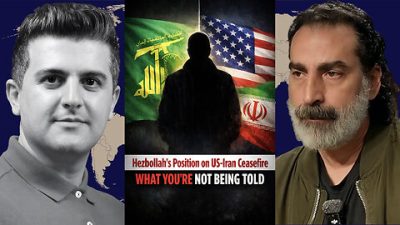
Laith Marouf: Hezbollah’s position on US-Iran ceasefire
or go to
Aletho News Archives – Video-Images
From the Archives
The Dirty Little Secret behind the “Global Terrorism Index”
The Omission of Israeli Terrorism in the Occupied Palestinian Territories
By Karin Brothers | Global Research | December 6, 2014
… The Israeli settlements — all of which are illegal – have been identified as a major impediment to peace. The refusal of a major “global” terrorism report to name the Israeli settlers as one of the groups most responsible for terrorism not only misrepresents a major source of regional violence but exposes the Global Terrorism Index as a propaganda tool that supports a U.S. agenda.
In recent years, governments have been attempting to thwart terrorism by blocking supportive fund-raising. When it comes to Israeli settlements, however, the US and Canada actually encourage fund-raising by giving organizations (such as Christian Friends of Israeli Communities (CFOIC) and the Jewish National Fund) financial support in the form of donor tax-deductions.
Charities which provide funds for the Israeli settlements should be regarded as terror-financing organizations. They should not only lose their tax-deductible status, but they should be banned because they support the violation of international humanitarian law. The terror-financing laws that are being strictly enforced for Muslim charities should be applied to Christian and Jewish charities as well. … Read full article
Blog Roll
 Aletho News
- The ‘Opposition Party’ Has Done Nothing to Stop the Iran War and Much to Goad Trump Into Continuing It
- Moscow backs Tehran on status of Lebanon in US-Iran deal
- How UK Regulator Ofcom Quietly Bypassed International Law to Police American Speech
- The Black Cube Files: How Former Mossad Operatives Flipped a Nation
- Laith Marouf: Hezbollah’s position on US-Iran ceasefire: What you’re not being told
- Israel’s priority lies in destroying chances of peace between Iran, US: Ex-UN nuclear chief
- Ceasefire for all or for none: Iran shuts Hormuz over Lebanon attacks
- Strait of Hormuz is Iran’s ‘nuclear weapon’ that forced US retreat: Medvedev
- Energy crisis will last for months – Kremlin envoy
- Europe’s quiet role in the war on Iran
- If Americans Knew
- This is ceasefire? Israel’s biggest massacre yet in Lebanon, another journalist killed in Gaza – Daily Update
- Tucker Carlson on Israel: This Is the Behavior of an Ally? Really?
- Gazans face a triple crisis: severe shortages of water and bread, healthcare in tatters
- NY Times reports how Netanyahu took the US into Iran War
- A sigh of relief over Iran, but Gaza and Lebanon in dire straits – Daily Update
- Thousands dead and neighborhoods razed to the ground: Aid agencies fear southern Lebanon is becoming the new Gaza
- The war the US is fighting for Israel could cost trillions
- ‘Cigarette Burns, Nail Wounds’: Toddler Tortured in Gaza to Coerce Father
- Trump Says US Sent ‘a Lot of Guns’ to Protesters in Iran
- Israeli forces destroy 17 UN peacekeeper cameras in south Lebanon
- No Tricks Zone
- An Inconvenient Tree: Uncovered In Alps… Europe Much Warmer Than Today 6000 Years Ago
- New Study Reports A 60% Slowdown In Greenland’s Ice Loss Rate In The Last Decade
- Low Intensity Tornado Wrecks Major Solar Farm, Creating A Potential Toxic Dump
- New Study Finds Warming Saves Lives…Cold Temperatures 12 Times More Deadly Than Excess Heat
- German Science Blog Accuses PIK Climate Institute Of Hallucinating Climate Tipping Points
- Devastating Assessment Of Comirnaty Vaccine By Former Senior Pfizer Europe Toxicologist
- New Study: CO2 Is ‘Effectively Negligible’ As An Explanatory Climate Change Factor Since 2000
- Former Pfizer Toxicologist Dr. Helmut Sterz Tells Bundestag Hearing Pfizer Vaccine Should Have Never Been Approved
- Energy Expert: Germany’s Nuclear Phaseout Was A “500 Billion Euro Mistake”
- New Research: South Australia’s Mid-Holocene Sea Surface Temperatures Were 4°C Warmer Than Today
 Aletho News