From South Africa to Israel: personal stories of apartheid

By Jesse Rosenfeld | The National | March 2. 2010
I grew up in an anti-apartheid household in Toronto. My parents met while my father was touring southern Africa as part of a Canadian anti-apartheid organisation, building links with postcolonial African socialist states and the South African liberation movement. On long car journeys, our family would mix Nelson Mandela’s autobiography with Just William children’s story tapes, and my parents would occasionally hire a babysitter so they could attend organising meetings for the international boycott campaign against South Africa.
As much as I was taught about apartheid, the violence of segregation, and the brutality of a state designed only to serve a settler population, I didn’t experience it first-hand until I moved to Ramallah in 2007.
Going to Jerusalem through the Qalandia terminal checkpoint and watching the soldiers harass and degrade Palestinians with Jerusalem IDs – while most of my Ramallah friends were barred from travelling there altogether – was the first I saw of state-run segregation. Walking through the Balata refugee camp on the edge of Nablus was the first township-style ghetto I set foot in. Seeing the Palestinian Authority beat anti-Bush demonstrators in the street during the former president’s visit in 2008 was my first real taste of the bitterness of Inkatha-style divide-and-rule.
In Ramallah I was regularly woken in the middle of the night to the sounds of my neighbours’ gates being blown off, followed by the screams of children as their father or brother was violently taken by the Israeli army. However, it was not until I met Ibrahim Bornat that I really understood the price Israel imposes on Palestinians who demand freedom and equality.
A vocal activist in the West Bank town of Bi’lin, struggling against Israel’s use of the wall to annex village farmland to the nearby Jewish settlement, Ibrahim was arrested on February 2 during a night raid on the village. After appearing regularly in the front lines of the weekly protests against Israel’s barrier, he now sits in Israel’s notorious Ofer military prison alongside other leaders of the town’s Non-Violent Popular Committee, facing a slew of charges in a military court.
I first met Ibrahim – who says he has been shot more than 80 times with steel-coated rubber bullets and tear gas – in Ramallah in 2007 after he was discharged from hospital. He had been shot in the face with a tear-gas canister, leaving a permanent dent in his forehead. His older brother, Ronnie, was paralysed by an Israeli sniper at the beginning of the second Intifada, yet no sooner had the bandages come off than Ibrahim was again marching next to his brother’s wheelchair to defend their family’s farmland.
Then, during a weekly protest in June 2008, Ibrahim was shot three times in the upper leg with live Israeli fragmentation bullets, which almost killed him.
Spending months in hospital, at first he believed his demonstrating days were over, opting to use art to express his resistance while wondering if he would ever walk again. However, while slowly recovering in a rehabilitation centre, he told me that he would return to protest and not let Israel’s violence silence him.
Now, about to face down Israeli military commanders again – this time in the courtroom – it is unlikely that Ibrahim will stand on his porch and watch apartment buildings go up on his family’s olive groves any time soon.
These days I’m based in Jaffa, on the south edge of Tel Aviv’s vibrant metropolis, where the picture of state segregation and displacement has lighter tones. My apartment is on the edge of the historically Arab city’s last majority Palestinian community, in what is effectively Israel’s version of Cape Town’s District Six.
While my neighbours face eviction by landlords looking to turn apartments into condos for Jewish residents from northern Tel Aviv, large development companies are being awarded municipal contracts to build exclusively Jewish apartment complexes on majority Palestinian streets.
Meanwhile Palestinian residents – who hold Israeli citizenship – are denied building and repair permits for their homes in a municipal strategy to pressure them to leave, making space available for wealthier Jewish residents. The Israeli army evicted 90 per cent of Jaffa’s Palestinian inhabitants in 1948 – mostly sending them on boats down to Gaza – but now Israel is entering a new stage of putting Palestinians out of sight.
Despite this, there will not be any Israel Apartheid Week events at Tel Aviv University, which sits atop the Palestinian village of Sheikh Munis. Started at the University of Toronto in 2005, Israel Apartheid Week has become an annual rallying point across the world for students fighting for Palestinian justice. But it is only on the other side of the wall, in Bethlehem and Ramallah, where public events confronting Israeli apartheid take place.
As students around the world this week take a stand for justice in Palestine, like my parents did for South Africa, I think of Nelson Mandela’s clarity when he said: “The UN took a strong stand against apartheid; and over the years, an international consensus was built, which helped to bring an end to this iniquitous system. But we know too well that our freedom is incomplete without the freedom of the Palestinians.”
Jesse Rosenfeld is a journalist based in Tel Aviv-Jaffa and Ramallah and the editor of The Daily Nuisance
What it means to go to Ben Gurion airport with an Arab friend
By Lia Tarachansky | March 3, 2010
I’m too distracted to fall asleep. Everyone is quietly snoring. The sun rises ever so slowly and the wings of the plane rudely cut through the calmness of the clouds. It’s hard to believe that the intensity of the sun repeats itself with this beauty every day. That it’s not for this special day that led me to be on this flight, on my way to Barcelona. I guess my mind makes it negligible just to maintain every-day continuity. Can’t comprehend all of chaos theory at once.
So how did I get on this flight? Around 9 p.m. last night I found out that The Real News got an in-kind donation to send me to Barcelona to cover the Russell Tribunal on Palestine. By midnight I was packed up and by 2 am I was at the airport. Someone thought this tribunal was so important and had the kind of faith in my reporting that frankly makes me terrified.
Last month I took international friends to the airport. When internationals fly alone out of Israel, they get a “6” or a “5”. This number is a sticker you get on your passport and bags that helps the Israeli airport security evaluate your level of Zionism. “1” is awesome, “6” is you’re fucked. 1 is reserved for white Jewish Israelis, 2 is for white Jewish non-Israelis and friendly internationals, 3 is a suspicious Israeli or international, 4 is sometimes given to non-white Israelis, 5 is for Arab Israelis or questionable internationals, and 6 is for Palestinians, Muslims, and hostile internationals. Hostile is defined as not Zionist or suspected of questioning Zionism. Anything above a 3 means interrogation. Of course these are my definitions based on the people I’ve talked to who’ve gotten one of the six. I don’t know what the official language they use says.
In most airports they ask you the benign questions of “did you pack your own bag?” In Israel they try to find out how Zionist you are. If you’re an international who’s been here you’ve experienced the invasive questions about your love of Israel so you know it’s always better to bring along an Israeli for protection. My presence with them meant I answered all the questions for them and the fact that I grew up in a settlement landed them a 2- the best grade they could get as non citizens. We rehearsed for hours.
So I enter the line confident and on cloud number nine from excitement. After all, I’m going to Barcelona! To cover the Russell Tribunal! My Israeli-Palestinian roommate tells me he’ll wait while I answer the security lady’s questions. She sees I speak Hebrew, she asks if I packed my own bags and she gives me a “1” as expected. I’m white and I’m an Israeli, therefore I’m probably a Zionist. High from excitement and privilege I ask if my friend can come with me to the check-in. She says of course and asks for his ID. Her face changes.
Where it says the Jewish birthdate the line in his ID is blank. i.e. not Jewish. I.e. Palestinian.
–”you know this man?”
– “yes”
– “how?”
– “he’s my roommate”
– “where?”
– “Jaffa” (a mixed Israeli-Palestinian city)
– “wait here.”
She looks at his last name. It’s Christian, i.e. Arab. She disappears with our passports. The roommate looks at me and we both know what’s going to happen. When she comes back her smile is gone. She tears the “1” off my bags and angrily puts on a “3” as though to say “you didn’t tell me you have an Arab friend!” Her face says “don’t you see you’re fucking it all up for us?!”
She sends me to the “other” line where people get their bags carefully checked. All the black people are in this line, all the Arab-looking people and the non-Zionist internationals. At least they’re not pretending their racial profiling is random. As I wait in line the security manager looks me up and down. He looks confused. Everyone else is a person of colour. So he approaches me.
– “Where did you come from?”
– “Excuse me?”
– “To the airport, where did you come from? Where do you live?”
– “Tel Aviv – Jaffa”
– “And where did you grow up? When did you come to Israel?”
– “I grew up in Ariel [a West Bank settlement], I came to Israel in ‘90/‘91”
– “OH! You’re from Ariel!”
He looks at the “3” sticker on my bag and shrugs. He motions the security lady and whispers something in her ear. The roommate – who was told he’s not allowed to come in after he was discovered as an Arab– looks on from a distance.
– “So you speak Hebrew?” the bag lady asks as she symbolically opens my bag and closes it with disinterest. The Nigerian lady beside me is having her bag checked with special sticks. Every item is laid out and questioned by three security “experts”.
– “I have family in Ariel,” the bag-checking lady tells me with a smile as she motions me to the next line.
– “You see what it means to have an Arab friend?” my roommate says and apologizes for the interrogation that’ll probably follow. I yell at him to never apologize for that again. This week is Israeli Apartheid Week. 40 Cities this year. The only analytical article in Ha’aretz was about a South African (white) anti-Apartheid activist who argued Israel’s bad but not apartheid-bad. For some reason all the white South African activists say it’s not so bad. All the black ones say its worse than they had ever imagined.
Israel urges US to act alone, as anti-Iran bids fail
Press TV – March 3, 2010

As US Secretary of State Hillary Clinton tours Latin America to recruit support for new international sanctions on Iran over its nuclear program, Tel Aviv urges Washington to adopt Cuba-like embargos against Tehran.
Israel and the US accuse Iran of seeking nuclear arms, as Tel Aviv threatens to attack Iranian nuclear installations and Washington warns of keeping ‘all options on the table,’ including economic sanctions and military measures.
Iran, however, says its program, which is extensively monitored by the International Atomic Energy Agency (IAEA), is directed at the civilian applications of the technology. The country has also called on all nuclear powers to abandon atomic weaponry and eliminate all such arsenal.
Clinton, meanwhile, is on a five-day tour of Latin America. She was quoted by the Associated Press as saying that Washington is working “expeditiously and thoroughly” to rally support for new Iran sanctions.
She has arrived in Brazil, a non-permanent member of the UN Security Council (UNSC), to win support for the sanctions. Brazil has repeatedly said that Iran is entitled to enrich uranium for peaceful purposes.
Although the IAEA says it continues to verify the non-diversion of Iran’s nuclear material, the UNSC has already imposed three rounds of sanctions on the country.
Amid the intensified efforts by the US to impose fresh sanctions, China has appeared to reject the calls to support such a measure. Beijing argues that more negotiations are required to resolve the nuclear issue.
Israel, meanwhile, said Tuesday that the US should impose unilateral sanctions on Iran to isolate the country the same way it acted alone on Cuba 50 years ago, Reuters reported.
“We are a little worried by the pace of developments in the international arena,” Lieberman told reporters. “I think that from now on Israel should perhaps change its Iran policy a little, and we should ask the United States to adopt the Cuban model … Here the United States alone can do everything in order to stop this (Iranian) program.”
Iranian officials have argued that favorite US pressure tactics such as sanctions are outdated and no longer relevant in the global economy as they have been proven futile in the last three attempts against the Islamic Republic. They insist that imposing new sanctions on Iran will further expose the irrelevancy of the UN as a viable international body.
More Stark Evidence of the Hazards of Atrazine
By David A. Fahrenthold | The Washington Post | March 2, 2010
Washington – A new study shows that male frogs exposed to the herbicide atrazine – commonly found in U.S. rivers and streams – can make a startling developmental U-turn, turning female so completely that they can mate with other males and lay viable eggs.
The study will focus new attention on concerns about atrazine, which is applied to an estimated 75 percent of American cornfields. Its manufacturer, the Swiss agricultural giant Syngenta, says the product is safe for wildlife, and for people who are exposed to small amounts in drinking water.
In recent years, however, some studies have seemed to show that atrazine can drive natural hormone systems haywire in fish, birds, rats and frogs. In some cases, male animals exposed to the chemical developed female characteristics.
The study led by Tyrone Hayes, a professor at the University of California, was published in the Proceedings of the National Academy of Sciences. It showed an even starker transformation: Among a group of male African clawed frogs raised in water tainted with atrazine, he said, a fraction grew up to look and act like females.
“Ten percent of the chromosomal males become completely, functionally female,” Hayes said in a telephone interview. “They can lay eggs (and) they mate with other males.”
The offspring of those unions were all male, he said, since both parents were genetically male. No female frogs were treated with atrazine in the study.
The other 90 percent of the exposed frogs retained some male features, Hayes said, but often showed signs of “feminization,” including lower testosterone levels and fertility. When pitted head-to-head against males that had not been exposed to atrazine, the atrazine-treated males frequently lost out in competition for female frogs.
Hayes said the reason for these changes could be that atrazine, when absorbed through a frog’s skin, helps produce an enzyme that converts an unusual amount of testosterone into estrogen.
Those findings run counter to the U.S. Environmental Protection Agency’s pronouncement in 2007 that atrazine does not cause problems in amphibian development.
Turkmenistan: We don’t want ex-Mossad man as ambassador
Foreign Minister Avigdor Lieberman’s appointment rejected, new embassy not opened
By Barak Ravid |Haaretz News |March 3, 2010
For four months now Turkmenistan has been delaying the ratification of the appointment of Reuven Dinel, a close associate of Foreign Minister Avigdor Lieberman, as Israel’s first ambassador to that country. Sources at the Ministry of Foreign Affairs have said this is an unusual diplomatic hint to the effect that Turkmenistan is not interested in the appointment, because Dinel formerly worked at the Mossad. “They are hoping we will get the hint and appoint someone else to the position,” said a top person at the ministry.
At the end of July 2009, Lieberman announced his intention to appoint Dinel as Israel’s ambassador to Ashgabat, the capital of Turkmenistan. The foreign minister attributed particular importance to the appointment in light of the fact that it involves the opening of an embassy in a country that shares a long border with Iran. Lieberman believed this also entails sending a message to Tehran.
In 2003, in his capacity as minister of transportation, Lieberman appointed Dinel, who is considered close to the minister, to head the establishment of the Carmel port in Haifa. Currently Dinel serves as deputy director general for management resources at the Israel Ports Development and Assets Company.
Lieberman saw Dinel’s appointment to Turkmenistan as a highlight of his first year as foreign minister, and pinned many hopes on Dinel and the abilities he would bring to the role of ambassador from his period of service in the Mossad.
On October 25, the government approved the appointment and a few days later, as is customary under diplomatic protocol, Israel send an official letter to Turkmenistan with the details about the new ambassador, together with a request to the government there to agree to the appointment.
The process of granting approval for an ambassador’s appointment is technical and symbolic, and usually does not present any problem. However, Turkmenistan decided exceptionally not to approve the appointment. Nearly four months have passed since the Israeli request was sent, but the Turkmenistani government has not sent back any reply to Jerusalem concerning Dinel’s appointment. The Turkmenistani government’s conduct is causing the foreign minister serious embarrassment, in light of the great importance he has attributed to the appointment and the opening of the new embassy, which he has taken as a personal project.
The background to Turkmenistan’s refusal to accept Dinel as Israel’s ambassador may well lie in an embarrassing affair that has been following him since 1996, when he was serving as the first Mossad envoy to Moscow. That year Dinel was expelled from Russia after security agents in Moscow caught him receiving classified satellite photographs from Russian officers.
Sources at the Foreign Ministry assessed on Sunday that the Russians, who consider Dinel persona non grata, sent messages to the authorities in Turkmenistan indicating they expect that country not to give its agreement to the appointment.
“From the outset this appointment was very strange,” said a senior source at the Foreign Ministry. “They took someone who is a declared espionage person, who had even been thrown out of Russia for that, and put him in Turkmenistan. They did all this without consulting any professional element. What did they expect would happen? There’s no way he would get the approval of the Turkmenistani authorities.”
The Foreign Minister’s Bureau stated in response: “There has been a delay in the opening of the embassy in Turkmenistan because a number of difficulties have arisen, mostly with regard to security matters, as often happens when opening a new delegation. We hope it will be possible to arrange matters in the coming weeks.”
Pittsburgh Residents want sign honoring general removed
By Joe Smydo, Pittsburgh Post-Gazette | March 02, 2010

Robin Rombach/Post-Gazette
This sign outside Heinz Field and the Carnegie Science Center at Allegheny Avenue on the North Shore honors former CIA director and retired Air Force Gen. Michael V. Hayden, a North Side native.
The anti-terrorism policies of former President George W. Bush stirred passions Monday at a Pittsburgh City Council hearing on whether a street sign honoring former CIA director and retired Air Force Gen. Michael V. Hayden, a North Side native, should be taken down.
Council held the hearing after about 40 residents signed a petition demanding that the sign, on North Shore Drive at Heinz Field, come down because of questions about Gen. Hayden’s legacy. The petition drive was led by Park Place resident Greg Barnhisel, who told council that Gen. Hayden was a leading figure in a Bush administration that wiretapped Americans without warrants and tortured suspected terrorists.
Defending Gen. Hayden was his brother, West View resident Harry Hayden, who said Mr. Barnhisel’s accusations were “wildly inaccurate.”
Harry Hayden said the wiretapping program, called the Terrorist Surveillance Program, enhanced national security. He added that a version of the program is in operation today.
In addition, Mr. Hayden said his brother moved to halt waterboarding of suspected terrorists and ordered the closing of “black site” prisons overseas. He said Gen. Hayden ordered 14 prisoners held in those sites relocated to Guantanamo Bay, Cuba, where they received access to medical care and religious items.
“It hardly sounds like the actions of a man that condones torture,” Mr. Hayden said.
In the end, council members said they didn’t give the go-ahead to put the sign up and didn’t believe they had the authority to remove it.
Joanna Doven, spokeswoman for Mayor Luke Ravenstahl, said the mayor approved the sign and stands by the decision.
While “North Shore Drive” remains the official name, the honorary blue sign pronounces the street “Michael V. Hayden Boulevard.” Mr. Hayden said the sign is about 600 feet from the family’s old home.
In all, the hearing drew about 14 speakers, with about half supporting Gen. Hayden and the others demanding the sign be removed. The supporters mainly were veterans and North Side residents, including some who had long known Gen. Hayden.
Critics included Scilla Wahrhaftig of Park Place, who said controversial anti-terrorism techniques cost America the moral high ground.
“I don’t want this city to be diminished also,” she said.
Mr. Hayden said his brother was honored by the sign and might try to buy it if the city takes it down.
Israel plans to raze 40 Palestinian homes in Al-Quds
Press TV – March 3, 2010

Israeli authorities have given the go-ahead for the demolition of forty Palestinian homes in a neighborhood of Jerusalem Al-Quds in an act that will probably bring long-simmering tensions over housing in the old city to a boil.
According to the Palestinian Information Center, the homes that are threatened with imminent demolition are located in Silwan, a deprived and overcrowded Palestinian community lying just outside the Old Jerusalem Al-Quds walls and in the shadow of the Al-Aqsa Mosque.
Jerusalem Al-Quds Mayor Nir Barakat announced in a press conference on Tuesday that a recreational center and a park are to be built in place of the Palestinian homes doomed to be destroyed.
Israeli officials have issued orders for the demolition of 40 buildings in the Bustan district which provide shelter for 1,500 citizens.
Israel frequently orders hundreds of Palestinians to leave their homes in Jerusalem Al-Quds, claiming that they do not have proper documentation for their houses. The moves are part of its Judaization campaign targeting the holy city.
On the other hand, the residents argue that Israeli officials have been withholding their documents or are refusing to issue documents for their houses.
The status of Jerusalem Al-Quds is one of the thorny issues of the peace process with the Palestinians, who say that the city should be the capital of the future Palestinian state. Israel captured mostly Arab East Jerusalem Al-Quds in 1967 and later annexed that half of the city in a move not recognized by the international community.
Tel Aviv continues to erect new homes in the occupied Palestinian territories despite strong opposition from the international community.
Palestinians and other Muslims insist that there can be no peace in the Middle East until Israel withdraws from East Jerusalem Al-Quds.
See also:
Despite Hope, No Change in Faith Based Initiatives
Obama’s Delay In Changing Bush Rules On Religion Funding Sparks Political Speculation, Protest

By Joesph L. Conn | March 2010
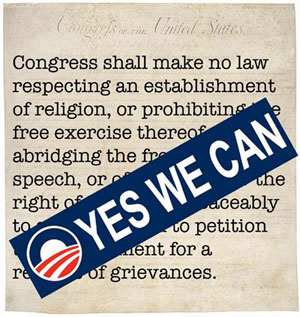
In his Feb. 4 address at the National Prayer Breakfast, President Barack Obama emphasized a theme that many Americans would agree with.
Lamenting the “erosion of civility” in political life, Obama said, “At times, it seems like we’re unable to listen to one another; to have at once a serious and civil debate. And this erosion of civility in the public square sows division and distrust among our citizens.”
But later in the speech, the president made a remark that astonished many Washington observers.
Insisting that people can still be united to serve the common good, Obama said, “That’s why my Office of Faith-Based and Neighborhood Partnerships has been working so hard since I announced it here last year…. And through that office we’ve turned the faith-based initiative around to find common ground among people of all beliefs, allowing them to make an impact in a way that’s civil and respectful of difference and focused on what matters most.”
In fact, many civil rights and civil liberties leaders say the president has not “turned the faith-based initiative around.” On the contrary, they say, Obama has failed to deliver on his campaign promises in regard to this issue and a growing political debate about it is brewing.
Americans United for Separation of Church and State has led the escalating call for the president to act.
In a Feb. 2 letter to the White House, Americans United Executive Director Barry W. Lynn observed, “As the one-year anniversary of your creation of the White House Office of Faith-based and Neighborhood Partnerships approaches, I urge you to restore the religious liberty and civil rights protections that were removed by the Bush administration’s ‘faith-based’ initiative.”
Lynn reminded Obama that President George W. Bush had allowed publicly funded “faith-based” groups to discriminate in hiring on religious grounds and had failed to enforce federal rules against proselytizing. Obama, at a July 1, 2008, campaign stop in Zanesville, Ohio, had promised to fix those problematic policies.
“[I]f you get a federal grant,” Obama said then, “you can’t use that grant money to proselytize to the people you help and you can’t discriminate against them — or against the people you hire — on the basis of their religion. Second, federal dollars that go directly to churches, temples, and mosques can only be used on secular programs.”
Lynn expressed dismay and disappointment at the president’s failure to keep that commitment.
“After eight years of struggling with the Bush administration,” Lynn wrote, “those of us who support civil rights and civil liberties were greatly relieved to hear those words. Forcing Americans to subsidize religious bias and proselytization with our tax dollars is certainly unfair and manifestly unconstitutional. Many Americans freely and generously support their houses of worship and other religious ministries. But no American should be required to support religious discrimination through his or her taxes.
“Yet today, more than one year after you took office,” continued Lynn, who is both an attorney and ordained minister, “your administration has not changed these misguided policies of the Bush administration. Billions of dollars in federal grants and contracts — including those made under your Economic Recovery Package — continue to be issued under these policies.”
Concluded Lynn, “In your Zanesville speech, you asserted that ‘as someone who used to teach constitutional law, I believe deeply in the separation of church and state.’ Mr. President, it is time to uphold that principle and keep your promise to correct the glaring deficiencies in the faith-based funding arena. I urge you to take immediate action to restore critical civil rights protections and vital religious freedom safeguards to your faith-based initiative.”
Later in the week, an array of civil rights, civil liberties, religious and advocacy groups joined the call for action. Twenty-five national religious and public policy organizations (including Americans United) wrote a letter to Obama asking him to make major changes to the “faith-based” initiative.
The Coalition Against Religious Discrimination’s joint letter laid out a specific set of proposals to protect civil rights and religious liberty in federally funded social services and urged Obama to adopt them. They include banning employment discrimination based on religion in tax-funded projects and issuing uniform guidelines to ensure that no person seeking help in a publicly funded program is subjected to unwanted proselytizing.
Among specific recommendations, the Feb. 4 missive asks the president to:
• Revoke a June 2007 legal memo issued by the Justice Department’s Office of Legal Counsel that asserts that a 1993 religious freedom law gives religious groups the right to take tax funds and still discriminate on religious grounds in hiring. This interpretation, the joint letter asserts, is “erroneous and threatens core civil rights and religious freedom protections.”
• Issue policies making it clear that social-services providers must give proper notice to beneficiaries of their religious liberty rights and access to alternative secular providers.
• Require that houses of worship and other religious institutions that infuse religion into every program create separate corporations for the purpose of providing secular government-funded social services.
Aside from Americans United, groups signing the letter are: African American Ministers in Action; American Association of University Women; American Civil Liberties Union; American Humanist Association; American Jewish Committee; Anti-Defamation League; Baptist Joint Committee for Religious Liberty; B’nai B’rith International; Human Rights Campaign; The Interfaith Alliance; Jewish Council for Public Affairs; National Association for the Advancement of Colored People; National Gay and Lesbian Task Force; OMB Watch; People For the American Way; Secular Coalition for America; Texas Faith Network; Texas Freedom Network; The Lawyers’ Committee for Civil Rights Under Law; Union for Reform Judaism; Unitarian Universalist Association of Congregations; United Methodist Church, General Board of Church and Society; United Sikhs; and Women of Reform Judaism.
While the list of signers was impressive, there is a growing concern that the Obama administration is paying more attention to conservative religious forces than the civil rights and civil liberties supporters.
The Wall Street Journal suggested that Obama’s team is hoping to build bridges to conservatives in a bid for broader political support. A Feb. 4 article, headlined “Keeping Faith, Courting Conservatives,” noted that the president’s Advisory Council on Faith-based and Neighborhood Initiatives includes a large number of religious conservatives who appear to be winning concessions from the White House.
The 25-member Council includes representatives from mainstream religious groups and minority faiths, but a conservative bloc is pushing for policies that jeopardize church-state separation. Its recommendations on many faith-based policies are scheduled to go to the president this month.
Many points among the recommendations are non-controversial and quite positive, but critics say at least one is deeply problematic. The Council in February voted to allow publicly funded faith-based agencies to display sectarian icons and signs in facilities where people of many faith perspectives come to get help from their government.
“Conservatives on the council,” the Journal reported, “are pleased with the direction the White House is taking.”
“As a conservative, I do feel there is a willing ear” in the White House, Council member Frank Page told the newspaper. Page, former president of the Southern Baptist Convention, added, “If there’s ever a time that the White House needs to say, ‘We need to keep our ears open,’ this is it.”
The Rev. Joel Hunter, pastor of a Florida evangelical megachurch, said Obama aides “really are trying to be responsive.” The newspaper reported that Hunter, a longtime Republican, changed his voter registration in November to independent due in part to his White House interactions.
According to the Journal, Burns Strider, a Democratic consultant who works on religious outreach and has close ties to the faith-based office, said building ties to evangelicals can “smooth the edges” that often mobilize conservative voters to oppose a Democrat such as Obama.
AU’s Lynn, who served on a task force set up to advise the Council, said he thinks many people have overlooked the apparent conflict of interest inherent in having religious leaders make policy recommendations about programs that their organizations benefit from.
In an opinion essay for the Huffington Post, Lynn said some of the Council members appointed by President Obama are powerful religious lobbyists whose denominations and groups benefit handsomely from government funds. They include representatives from the U.S. Conference of Catholic Bishops, Catholic Charities, the Union of Orthodox Jewish Congregations and the evangelical charity World Vision.
“Our research in government databases,” Lynn reported, “indicates that Catholic Charities (including its various affiliates) has taken at least $521 million over the last 10 years. The Catholic bishops’ conference has corralled $304.8 million over the same period, and World Vision has taken in $405.9 million. Orthodox Union-affiliated synagogues and Jewish schools have also benefited from millions in federal grants, though government reporting methods make the precise figure impossible to ascertain.”
Concluded Lynn, “Wouldn’t this be a conflict of interest by any ethical standard?”
The Obama Advisory Council has been asked not to address the hiring discrimination issue. That is supposed to be dealt with by the Department of Justice, although Joshua DuBois, head of Obama’s faith-based office, keeps saying it will be handled on a “case by case basis,” whatever that means.
Religious conservatives are hoping to prevail even on that deeply controversial issue.
Evangelical leader Jim Wallis, an Obama Council member who wants to keep the Bush hiring policy, told the Journal that White House aides were concerned that changing the policy might force some groups to stop taking government money to deliver services needed in difficult economic times.
Council member Nathan Diament of the Union of Orthodox Jewish Congregations told the newspaper Obama made a “deliberate decision” to side with aid groups rather than advocates that are not involved in delivering social welfare.
Advocates of civil rights and religious liberty hope Wallis and Diament are wrong. The issue is vitally important, they say, to people both in the United States and around the world.
In Kentucky, for example, Alicia Pedreira has fought a 10-year battle against a publicly funded Baptist child care agency that gave her top performance reviews but still fired her when it became public that she is a lesbian. (Americans United and the Kentucky ACLU are representing Pedreira and other Kentucky taxpayers in a federal lawsuit challenging public funding of Kentucky Baptist Homes, an agency that gets as much as half of its money from taxpayers yet discriminates on religious grounds in hiring and indoctrinates young people in its care in religious doctrine.)
Problems also are widespread in government-funded services overseas. According to a January report in Global Post, the evangelical organization World Vision received $281 million in government grants in 2008 — yet offers full-time employment only to Christians who fit the group’s creed.
Focusing on a project in predominately Muslim Mali, the story says people are being denied scarce jobs in U.S.-funded programs because World Vision is openly discriminatory.
World Vision officials don’t deny their religious bias. Torrey Olsen, World Vision’s Senior Director for Christian Engagement, told the Global Post, “We do want to be witnesses to Jesus Christ by life, word, deed and sign.” Fabiano Franz, another World Vision official, added, “We’re very clear from the beginning about hiring Christians. It’s not a surprise, so it’s not discrimination.”
Regardless of how these church-state conflicts turn out, religious lobbyists are hoping to maintain a major influence over Obama’s policies.
“I want him to listen to faith groups as much as he listens to people on Wall Street,” Wallis told The Washington Post. “I want him to listen to faith groups as much as military leaders on Afghanistan.”
Said AU’s Lynn, “The president needs to listen to the commands of the Constitution as well. We urge everyone who believes in civil rights and religious liberty to let the White House know how you feel.”
The New Pickens Plan: Scare People With Arabic Ads and Sell Natural Gas
By Kirsten Korosec | Jan 15, 2010
Nothing like an old-timey billionaire’s ad campaign — flush with Arabic script, images of war and an ominous Middle Eastern music track – to get the xenophobic engine cranking and sell some good ol’ U.S. of A. natural gas. The ad campaign drummed up by T. Boone Pickens has been sold as a renewed effort by the Texas energy investor to wean the U.S. off of foreign oil and promote homegrown resources like wind and natural gas.
Pickens has spent upwards of $62 million in the past couple of years on an ad campaign pushing his plan. The aptly named Pickens Plan aims to upgrade the electrical transmission grid; use natural gas — not oil-based products — as a transportation fuel; and use wind and solar instead of coal to generate electricity.
Although as I noted Wednesday after Pickens announced plans to ditch his massive Texas wind project, that strategy has shifted a bit. Now natural gas is the go-to fuel, with wind taking a backseat. The ad, which aired on cable networks Thursday, is specifically aimed at beefing up support for the Nat Gas Act, legislation that would, in part, help pay to convert U.S. diesel-powered trucks to natural gas.
Pickens when asked said he and his aides considered, and ultimately chose to use the Arabic because any added attention would be good for the cause, according to the NYT.
“We’re infidels with most of these people and they have no use for us,” Pickens was quoted by the NYT. “We’re getting more and more dependent on the wrong people.”
I get it. Pickens was aiming for a reaction with this recent ad. Here I am writing about it, so I guess it worked. But why oh why, risk your credibility by throwing out the Arabic and war images — especially when your motivates — as an investor in domestic oil and gas — will be questioned?
The natural gas industry had gained some momentum in recent months. Let’s not forget that it was pretty much left out of the House version of climate-change legislation passed last summer. And I have faith in Americans that the fear-mongering approach won’t work, as Pollyannaish as that may sound.
I have to wonder if the natural gas industry folk are cringing over the ad? I am.
Joe Lieberman and Lindsay Graham plotting to revive “climate” bill
Gas Tax Proposal to Provide More Funding for Nuclear Plants

FILE: Sen. Joe Lieberman, I-Conn., left, talks as Sen. Lindsey Graham, R-S.C., listens during a press conference at the Saban Forum in Jerusalem, Monday Nov. 16, 2009. (AP Photo/Tara Todras-Whitehill)
Susan Ferrechio,Chief Congressional Correspondent | Washington Examiner | March 2, 2010
A group of senators are trying to resuscitate global warming legislation, but the potential inclusion of a new gas tax threatens to keep action on one of President Obama’s signature initiatives stalled.
Sens. John Kerry, D-Mass., Lindsey Graham, R-S.C., and Joe Lieberman, I-Conn., have pushed aside the politically unpopular idea of passing a “cap and trade” system for regulating most emissions and would instead go after power plants, motor vehicles and manufacturers with targeted taxes and caps.
The lawmakers are hoping to get a bill together in the “coming weeks,” according to a Kerry aide, and then find a way to fit it in the already jammed Senate calendar, where the jobs agenda and now health care reform are the priorities.
“Unlike past pieces of legislation, we are taking a careful look at different sectors of the economy to determine the most appropriate policy to reduce emissions in each sector,” Kerry spokeswoman Whitney Smith said. “Based on input from all stakeholders, the idea is to take a reasonable, responsive approach to each sector to accomplish an economywide goal.”
Even without creating a cap and trade system, such a proposal would face opposition among Republicans and Democrats in the Senate, particularly those who will not support any bill that threatens to raise prices or impose a fuel tax, which could happen under this proposal.
“No bill that collides with the urgent imperative of job creation has a chance right now and to the extent that a climate bill has that feature or is seen as having that feature, it can’t go anywhere,” said William Galston, a political scholar at the Brookings Institution.
Senate proponents of the bill are up against a daunting deadline, with a little more than six months left to tackle legislative business before the chamber adjourns for 2010 campaigning. Few, if any, endangered Democrats will be willing to vote on a bill that could be unpopular among economically struggling constituents.
“I think they are all in denial,” Sen. James Inhofe, R-Okla., a global warming skeptic, told The Examiner on Monday. “They are going to be trying to impose a huge tax on Americans without any positive results. And we’re going to be there to remind everybody.”
Proponents of the plan believe it can succeed by using the piecemeal approach, which will make it easier to craft a bill that could attract the 60 votes needed for passage. And with Graham already on board, Democrats would only have to round up all 59 Democratic-controlled votes. The proposal would increase domestic oil and gas drilling and would provide federal funding for nuclear energy plants, which could attract moderate votes.
“I don’t think the climate and energy issue is dead in the Senate,” Eileen Claussen, president of the Pew Center on Global Climate Change, told The Examiner. “The real question is what kind of bill can you put together that can pass.”
sferrechio@washingtonexaminer.com
Featured Video
Pentagon insider says high US official Douglas Feith reported to Netanyahu
or go to
Aletho News Archives – Video-Images
Frlom the Archives
The Fiction of the Jewish History in Palestine
By Hasan Afif El-Hasan | The Palestine Chronicle | April 8, 2011
Prime Minister Benjamin Netanyahu told NNC Pierce Morgan on March 18, 2011 that he might agree to a Palestinian state through negotiations. And he added, “We will make territorial concessions although it is very painful to do that in our ancestral land.” Netanyahu was not talking about Poland where his ancestors lived. He was talking about Palestine where generations of its indigenous population ancestors lived, cultivated the land and are buried.
By the end of the nineteenth century, Zionism created a new Jewish identity of blood and soil. To mobilize their followers and supporters and appeal to their emotions, the Zionists created myths. Zionism started as a tribal religion without god, but in order to fulfill its function as a unifying force, Zionism required external religious and race symbols, not inner content. Its leaders regarded metaphysical religious belief and purity of race as having value in itself. They created a divine paradisiacal state of merger with the gods. Despite his non-religious ideology, Herzl’s writings were replete with religious references. The Jews should settle in Palestine because, in his words, “the Temple will be visible from long distance, for it is only our ancient faith that has kept us together”.
The Zionists and their supporters have invested tremendous financial and scholarly resources to work within the Hebrew Bible historical narratives to affirm the links between the intrusive Zionist population and the ancient Israelite past, and by doing so assert the right of that population to the land. The political end-game shaped the investigation and the outcome. Tracing the roots of Israel’s ethnic state in biblical antiquity is effectively to silence the indigenous Palestinian claim to the past and therefore to the land. The Biblical scholarship employs a bewildering array of terms for the region: “the Holy Land”, “the Land of the Bible”, “Eretz Israel”, “the Land of Israel”, or “Judah and Samaria.” To the casual reader these names appear interchangeable, but they all imply connection to ancient Israel.
Biblical narratives or poems that cannot be supported by archeology and common sense are treated by the Zionists and their supporters as historical language. … continue
Blog Roll
 Aletho News
- Pentagon insider says high US official Douglas Feith reported to Netanyahu
- The Sludging of Rural America
- Lawyers’ groups demand end to British military bases in Cyprus
- CIA Assessment: The Resistance Cannot Be Crushed
- Hezbollah Returns: It Didn’t Start a War, It Is Ending One
- EU states seek ‘talks’ with Iran for access to Strait of Hormuz: Report
- Trump on Hormuz: “Others must take care of it” after US falters
- Who Is closer to collapse?
- A War that Backfired: Why the US-Israeli Campaign Is Strengthening Iran
- How Zionist Control Is Hurting US Interests
- If Americans Knew
- As US-Israel war on Iran rages, Gaza faces massive dust storm – Not a ceasefire Day 156
- No let-up in attacks on Gaza as Israel takes on Iran, Lebanon – Not a ceasefire Day 155
- ‘Of Course’: IDF Drops Case Against Soldiers Accused of Raping Palestinian Prisoner
- Don’t Fall for the Regime Change Talk. Israel Is ‘Mowing the Lawn’ in Iran
- Will Israel and the US wreck the Gulf States along with Iran?
- US so far burned through ‘years’ of munitions in Iran war: Report
- How the Israeli Tail Wags the American Dog
- Outdated intel likely led to deadly U.S. strike on Iranian elementary school, sources say
- Pentagon insider says high U.S official Douglas Feith reported to Netanyahu
- In fond memory of Walid Khalidi, the historian of Palestine
- No Tricks Zone
- Storing Green Energy To Last Germany 10 Days Would Require A 60-Million Tonne Battery
- New Studies: UK Sea Levels Were 4 Meters Higher Than Today During The Mid-Holocene
- Destructive Green New Deal: German Energy And Metal Group Warns Of Drastic Crisis
- New Study Documents A 20-Year Pause In Arctic Sea Ice Decline – Driven By Internal Variability
- Wake-up Call: Survey Shows Majority Of Germans Now Favor Postponing Climate Targets!
- Televised! Leading German Political Candidate Tells Schoolchildren CO2 Makes Sun Hotter!
- New Study: A Century Warming Of 1.1°C Is ‘Commonplace’ And ‘Not Unusual’ During This Interglacial
- New Study: ‘Internal Noise’ And Volcanic Forcing Can Trigger 10-15°C Warming Within Decades
- Glaciers Worldwide Are Suddendly Surging, Experts Blame Warming!
- Surprising Discovery: Sahara Is Greening…Billions Of Trees Where Once Thought To Be Barren
 Aletho News