Knee Capped for Driving While Arab
By Maysa Abu Ghazala – Palestine News Network – March 5, 2011
On Thursday, February 24, 20-year-old Mohammad Gharib of al-Issawiya village near Jerusalem was driving home, bringing dinner from a restaurant in Jerusalem.

Mohammad Gharib – PNN
Mohammad took his youngest brother and his friend along for the ride. When they reached the intersection leading to the Ma’ale Adumim settlement, their car broke down.
“As I was trying to see what happened to the car, three settlers stopped and offered to help,” Mohammad recalled. “I thanked them and as I was speaking to them in Hebrew, they realized I was Arab. They started calling me names, then one of them pulled his gun and shot me in the knee.”
Mohammad was taken immediately to al-Maqasid hospital in Jerusalem, then moved to the Israeli hospital of Hadassah where doctors told him his knee was shattered and muscles torn.
“Doctors installed a device to make me walk,” he said, “but now I can’t leave my bed on my own”.
Mohammad said he filed a police report and told Israeli officers that he could identify the settler who shot him. He also demanded they work on his case quickly.
As of now, he is still lying in bed in pain and waiting for the police to arrest his attackers.
Related articles


Stay out of Libya
“Despite media reports of Libyan aircraft attacking rebel areas, the Pentagon has not confirmed any air attacks.” – Adm. Mike Mullen
By Sheldon Richman | March 4, 2011
It’s good to see that the Pentagon is unenthusiastic about military intervention in Libya. But that hasn’t stopped armchair generals such as Sen. John Kerry from pushing for a no-fly zone over that country.
Kerry thinks he can make his plan more appealing by couching it in internationalist terms, but we know the American people would bear the brunt of the burden. Kerry is joined by Sens. Joe Lieberman and John McCain, the Senate’s two most obnoxious militarists. Regarding the military’s reluctance to take on another country, McCain said, “[They] always seem to find reasons why you can’t do something rather than why you can.”
Maybe the Pentagon is acknowledging something that McCain, Kerry, and Lieberman seem to ignore: They are calling for war on a country that has not attacked the United States. U.S. Defense Secretary Robert Gates criticized the discussion about a no-fly zone as “loose talk.” He added, “Let’s just call a spade a spade. A no-fly zone begins with an attack on Libya. That’s the way you do a no-fly zone. And then you can fly planes around the country and not worry about our guys being shot down.”
Gates’s cautionary language is welcome after Secretary of State Hillary Clinton’s and President Obama’s press secretary had referred to U.S. action as a live option. In typical Clinton fashion, the secretary said, “We are taking no option off the table so long as the Libyan government continues to turn its guns on its own people.” Really? No option? Does that include a full-scale invasion? How about tactical nuclear weapons? Drones armed with Hellfire missiles have been particularly effective at killing innocent people in Afghanistan and Pakistan. Are they on the table too?
Gates was not alone in his warning. Gen. James Mattis, commander of U.S. Central Command, and other officials said that taking out Libya’s air and missile defenses would be no small operation; hundreds of airplanes would be needed. Gates said he was advised that a no-fly zone “requires more airplanes than you would find on a single aircraft carrier.” It would be, he said, a “big operation in a big country.”
None of that stopped the Senate from unanimously passing a resolution prodding the UN Security Council to take up the question of a no-fly zone. And two U.S. amphibious warships were headed to Libya through the Suez Canal, supposedly for humanitarian purposes. But they aren’t called “warships” for nothing.
For all the bluster about a no-fly zone, it’s not quite clear what difference it would make. Libya’s Col. Muammar Qaddafi is using ground forces primarily to battle rebels trying to drive him from power. According to the Associated Press, “Adm. Mike Mullen, chairman of the Joint Chiefs of Staff, said that despite media reports of Libyan aircraft attacking rebel areas, the Pentagon had not confirmed any air attacks.”
So a no-fly zone would be little more than symbolic. But it could be a costly symbol. Mullen cautioned against underestimating Libya’s air defenses. Moreover, establishing a no-fly zone would be an act of war, with consequences no one can foresee. Haven’t we had enough of American politicians, sitting safely in their seats of power, sending young people off to war?
The case against U.S. intervention in Libya, however, goes beyond the prudential. There is no doubt that Qaddafi is a brutal and now desperate dictator willing to send mercenaries to mow down civilians seeking freedom from his iron grip. But that does not justify U.S. intervention, which would require the taxpayers to finance yet another open-ended military operation in the Arab and Muslim world. Regardless of how Obama and Clinton would intend the operation, the rest of the world would see it in the context of the long U.S. imperial record in the Middle East.
American presidents have sought to police the globe for generations. What has it gotten us? Endless war abroad, and big government and economic hardship at home. Instead of being a beacon of liberty, the country is a symbol of militarism and death. Obama, the fraudulent peace advocate, has followed the same interventionist course. He should not be allowed to extend it to Libya.
Chernobyl, 25 Years Later
By Dr. JANETTE D. SHERMAN, MD | CounterPunch | March 4, 2011
April 26, 2011 will mark the 25th Annivesary of the Chernobyl catastrophe, and for more than 50 years, the World Health Organization (WHO) and the International Atomic Energy Agency (IAEA) have abided by an agreement that in essence, covers each other’s back – sometimes at the expense of public health. It’s a delicate balance between cooperation and collusion.
Signed on May 28, 1959 at the 12th World Health Assembly, the agreement states:
“Whenever either organization proposes to initiate a programme or activity on a subject in which the other organization has or may have a substantial interest, the first party shall consult the other with a view to adjusting the matter by mutual agreement,” and continues: The IAEA and the WHO “recognize that they may find it necessary to apply certain limitations for the safeguarding of confidential information furnished to them. They therefore agree that nothing in this agreement shall be construed as requiring either of them to furnish such information as would, in the judgment of the other party possessing the information to interfere with the orderly conduct of its operation.”
The WHO mandate is to look after the health on our planet, while the IAEA is to promote nuclear energy. In light of recent industrial failures involving nuclear power plants, many prominent scientists and public health officials have criticized WHO’s non-competing relationship with IEAE that has stymied efforts to address effects and disseminate information about the 1986 Chernobyl accident, so that current harm may be documented and future harm prevented.
On the 20th Anniversary of Chernobyl WHO and the IAEA published the Chernobyl Forum Report, mentioning only 350 sources, mainly from the English literature while in reality there are more than 30,000 publications and up to 170,000 sources that address the consequences of Chernobyl.
After waiting two decades for the findings of Chernobyl to be recognized by the United Nations, three scientists, Alexey Yablokov from Russia, and Vasily Nesterenko and Alexey Nesterenko from Belarus undertook the task to collect, abstract and translate some 5000 articles reported by multiple scientists, who observed first-hand the effects from the fallout. These had been published largely in Slavic languages and not previously available in translation. The result was Chernobyl – Consequences of the Catastrophe for People and the Environment, published by the New York Academy of Sciences in 2009.
The greatest amount of radioactivity fell outside of Belarus, Ukraine and European Russia, extending across the northern hemisphere as far away as Asia, North Africa, and North America, while the greatest concentrations continue to affect the 13 million living in Belarus, Ukraine, and European Russia.
Immediately after the catastrophe, release of information was limited, and there was a delay in collecting data. WHO, supported by governments worldwide could have been pro-active and led the way to provide readily accessible information, but did not. These omissions resulted in several effects: limited monitoring of fallout levels, delays in getting stable potassium iodide to people, lack of care for many, and delay in prevention of contamination of the food supply.
The number of victims is one of the most contentious issue between scientists who collected data first-hand and WHO/IAEA that estimated only 9000 deaths.
The most detailed estimate of additional deaths was done in Russia by comparing rates in six highly contaminated territories with overall Russian averages and with those of six lesser-contaminated areas, maintaining similar geographical and socioeconomic parameters. There were over 7 million people in each area, providing for robust analysis. Thus data from multiple scientists estimate the overall mortality from the Chernobyl catastrophe, for the period from April 1986 to the end of 2004, to be 985,000, a hundred times more than the WHO/IAEA estimate.
Given that thyroid diseases caused such a toll, Chernobyl has shown that nuclear societies – notable Japan, France, India, China, the United States, and Germany – must distribute stable potassium iodide (KI) before an accident, because it must be used within the first 24 hours.
Key to understanding effects from nuclear fallout is the difference between external and internal radiation. While external radiation, as from x-rays, neutron, gamma and cosmic rays can harm and kill, internal radiation (alpha and beta particles) when absorbed by ingestion and inhalation become embedded in tissues and releases damaging energy in direct contact with tissues and cells, often for the lifetime of the person, animal or plant.
To date, not every living system has been studied, but of those that have – animals, birds, fish, amphibians, invertebrates, insects, trees, plants, bacteria, viruses and humans – many with genetic instability across generations, all sustained changes, some permanent, and some fatal. Wild and domestic animals and birds developed abnormalities and diseases similar to those found in humans.
It takes ten decades for an isotope to completely decay, thus the approximately 30 year half-lives for Sr-90 and Cs-137 will take nearly three centuries before they have decayed, a mere blink of the eye when compared to Pu-239 with a half-life of 24,100 years.
The human and economic costs are enormous: in the first 25 years the direct economic damage to Belarus, Ukraine, and Russia has exceeded $500 billion. Belarus spends about 20% of its national annual budget, Ukraine up to 6%, and Russia up to 1% to partially mitigate some of the consequences.
When a radiation release occurs we do not know in advance the part of the biosphere it will contaminate, the animals, plants, and people that will be affected, nor the amount or duration of harm. In many cases, damage is random, depending upon the health, age, and status of development and the amount, kind, and variety of radioactive contamination that reaches humans, animals and plants. For this reason, international support of research on the consequences of Chernobyl must continue in order to mitigate the ongoing and increasing damage. Access to information must be transparent and open to all, across all borders. The WHO must assume independent responsibility in support of international health.
~
Janette D. Sherman, M. D. is the author of Life’s Delicate Balance: Causes and Prevention of Breast Cancer and Chemical Exposure and Disease, and is a specialist in internal medicine and toxicology. She edited the book Chernobyl: Consequences of the Catastrophe for People and Nature, written by A. V. Yablokov, V. B., Nesterenko and A. V. Nesterenko, published by the New York Academy of Sciences in 2009. Her primary interest is the prevention of illness through public education. She can be reached at: toxdoc.js@verizon.net and www.janettesherman.com
The Incalculable Cost of War
Shooting Children, One After Another
By KATHY KELLY | CounterPunch | March 4, 2011
Recent polls suggest that while a majority of U.S. people disapprove of the war in Afghanistan, many on grounds of its horrible economic cost, only 3% took the war into account when voting in the 2010 midterm elections. The issue of the economy weighed heavily on voters, but the war and its cost, though clear to them and clearly related to the economy in their thinking, was a far less pressing concern.
U.S. people, if they do read or hear of it, may be shocked at the apparent unconcern of the crews of two U.S. helicopter gunships, which attacked and killed nine children on a mountainside in Afghanistan’s Kumar province, shooting them “one after another” this past Tuesday March 1st. (“The helicopters hovered over us, scanned us and we saw a green flash from the helicopters. Then they flew back high up, and in a second round they hovered over us and started shooting.” (NYT 3/2/11)).
Four of the boys were seven years old; three were eight, one was nine and the oldest was twelve. “The children were gathering wood under a tree in the mountains near a village in the district,” said Noorullah Noori, a member of the local development council in Manogai district. “I myself was involved in the burial,” Noori said. “Yesterday we buried them.” (AP, March 2, 2011) General Petraeus has acknowledged, and apologized for, the tragedy.
He has had many tragedies to apologize for just counting Kunar province alone. Last August 26th, in the Manogai district, Afghan authorities accused international forces of killing six children during an air assault on Taliban positions. Provincial police chief Khalilullah Ziayee said a group of children were collecting scrap metal on the mountain when NATO aircraft dropped bombs to disperse Taliban fighters attacking a nearby base. “In the bombardment six children, aged six to 12, were killed,” the police commander said. “Another child was injured.”
In the Bamiyan province of Afghanistan, Zekirullah, a young Afghan friend of mine, age 15, rises at 2:00 a.m. several mornings each week and rides his donkey for six hours through the pre-dawn to reach a mountainside where he can collect scrub brush and twigs which he loads on the donkey in baskets. Then he heads home and stacks the wood – on top of his family’s home – to be taken down later and burned for heat. They don’t have electrical appliances to heat the home, and even if they did the villagers only get electricity for two hours a day, generally between 1:00 a.m. – 3:00 a.m. Families rely on their children to collect fuel for heat during the harsh winters and for cooking year round. Young laborers, wanting to help their families survive, mean no harm to the United States. They’re not surging at us: they’re not insurgents. They’re not doing anything to threaten us. They are children, and children anywhere are like children everywhere: they’re children like our own.
Sadly, more and more of us in America are getting used to the idea of child poverty – and even child labor – as our own economy sinks further under the burden of our latest nine years of war, of two billion dollars per week we spend creating poverty abroad that we can then emulate at home. Things are getting bad here, but in Afghanistan, children are bombed. Their bodies are casually dismembered and strewn by machines already lost in the horizon as the limbs settle. They lie in pools of blood until family members realize, one by one, that their children are not late in returning home but in fact never will.
In October and again in December of 2010, our small delegation of Voices for Creative Nonviolence activists met with a large family living in a wretched refugee camp. They had fled their homes in the San Gin district of the Helmand Province after a drone attack killed a mother there and her five children. The woman’s husband showed us photos of his children’s bloodied corpses. His niece, Juma Gul, age 9, had survived the attack. She and I huddled next to each other inside a hut made of mud on a chilly December morning. Juma Gul’s father stooped in front of us and gently unzipped her jacket, showing me that his daughter’s arm had been amputated by shrapnel when the U.S. missile hit their home in San Gin.
Next to Juma Gul was her brother, whose leg had been mangled in the attack. He apparently has no access to adequate medical care and experiences constant pain. The pilot of the attacking drone, perhaps controlling it from as far away as Creech Air Force Base here in the United States, knows nothing of this family or of the pain that he or she helped inflict. Nor do the commanders, the people who set up the base, the people who pay for it with their taxes, and the people who persist in electing candidates intent on indefinitely prolonging the war.
But sometimes the war is like it was this past Tuesday March 1st. Sometimes the issue is right in front of us – as it was to those helicopter crews – it’s up close so there can be no mistake as to what we are doing. According to the election polls we see the cost of war, dimly, but, as with the helicopter crews, it doesn’t affect – or prevent – our decisions. Afterward we deplore the tragedy; we make a pretense of acknowledging the cost of war, but it is incalculable. We can’t hope to count it. We actually, finally, have to stop making people like the nine children who died on March 1st, pay it.
~
Kathy Kelly co-coordinates Voices for Creative Nonviolence and has worked closely with the Afghan Youth Peace Volunteers. She is the author of Other Lives, Other Dreams published by CounterPunch / AK Press. She can be reached at: Kathy@vcnv.org
Settlers chop down 500 trees in Nablus
Ma’an – 04/03/2011
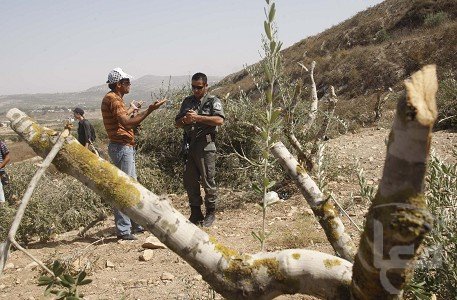
NABLUS — Settlers chopped down more than 500 olive trees owned by Palestinians in the West Bank district of Nablus on Friday, Palestinian Authority officials said.
Residents of the illegal Shvut Rachel settlement raided Qusra village and chopped down the trees, said Ghassan Doughlas, PA official for settlement affairs in the northern West Bank.
In a “day of rage” Thursday, right-wing Israelis and settlers blocked a road to Jerusalem and closed down train tracks to the country’s airport.
Settlers were protesting the demolition of several structures at an illegal outpost near Nablus by the Israeli government. They threatened to carry-out “price-tag” attacks against Palestinians in response to the government’s “anti-settler” activity.
In the past, the “price tag” has included arson, shootings, beatings, burning fields, uprooting trees and poisoning water wells belonging to Palestinians.
Following a recent surge in settler violence — including fire-bombing Palestinian homes, smashing shops and damaging cars — the Palestinian Authority on Wednesday urged the international community to intervene and stop the attacks.
Iraqis march for economic reform
Press TV – March 4, 2011
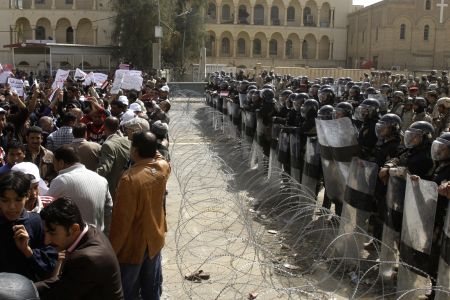 Security forces stand guard as people protest in Baghdad over corruption, unemployment and poor public services.
Thousands of Iraqi protesters have taken to the streets in main cities across the country, demanding economic reform and better living conditions.
Protest rallies over corruption, unemployment and poor government services were held in Baghdad, Basra, Nineveh, Anbar and Salahuddin following the Friday Prayers.
Unlike other demonstrations sweeping the Arab world, Iraqi protesters are seeking reforms, but not regime change.
“We live in a country rich with oil, yet we don’t have jobs,” demonstrators said. “The oil [is] for the people and not for thieves.”
They also chanted “Liar, Liar, Nouri al-Maliki” while carrying banners reading, “Where has the people’s money gone?” and “Yes to democracy and the protection of freedom.”
In the capital, where several thousands of demonstrators have already gathered in the city’s Tahrir (Liberation) Square, authorities have banned traffic across the city, forcing protesters to walk several kilometers to the square.
Iraqi authorities have also deployed thousands of security forces to Baghdad streets and protesters were frisked three times before reaching the square.
There were no reports of clashes between protesters and security forces.
Some Iraqis have named Friday’s rallies as the “Day of Regret,” to mark one year since the parliamentary elections. It took politicians more than nine months to form a new government after the poll on March 7, 2010, and even now, several major positions, including the ministers of interior, defense and planning, are unfilled.
Last week, at least 20 people were killed and more than 130 others were injured after Iraqi security forces attacked protesters.
Four top Iraqi officials, three southern provincial governors and Baghdad’s mayor, resigned following mass protests on February 25.
In response to nationwide protests, Iraqi Prime Minister Maliki called an emergency cabinet meeting on Sunday and gave government ministers a 100-day ultimatum to deliver results and eliminate corruption or face dismissal.
“Mr. Maliki specified a 100-day period after which an assessment of the work of the government and ministries will be carried out to find out the level of their individual success or failure in performing their jobs,” AFP quoted the statement as saying.
The Iraqi premier has also introduced measures to combat graft, cut politician salaries and dedicate more money to providing food for the poor in an attempt to contain protests.
Is entertaining dictators worse than normalizing apartheid?
Nada Elia and Laurie King, The Electronic Intifada, 3 March 2011
As revolutions continue to sweep the Arab world, and the days of dictators seem numbered, we are learning a lot about the ties and alliances that have long characterized the west’s dealing with tyrants around the globe. “Stability,” apparently, requires us to make deals with the devil. And so we discover that the United States has long known about the human rights abuses of deposed Egyptian president Hosni Mubarak, deposed Tunisian president Zine el-Abedine Ben Ali, and Libyan leader Muammar Gaddafi. But it was willing nonetheless not only to turn a blind eye to these, but even to enable and fund, directly or indirectly, oppressive regimes, for the sake of what exactly? Oil? Corporations? The so-called “peace process?” Iraqi “freedom?” Israel’s security?
And as Arab tyrants are challenged, one by one, social media are abuzz with the embarrassing and numerous compliments and kind remarks that western heads of state, academics, pundits, and entertainers have given these deposed dictators. In a typical statement, US Secretary of State Hillary Clinton, for example, said in 2009: “I really consider President and Mrs. Mubarak to be friends of my family.” Apparently, the Clinton-Mubarak friendship goes back about 20 years. Gaddafi’s son Saif al-Islam, a close friend of Prince Andrew, Queen Elizabeth’s second son and fourth in line to the British throne, has been a guest at Windsor Castle and Buckingham palace. The list is long.
But as the people seem determined to overthrow all those oppressive regimes, liberal Americans are openly questioning the wisdom and morality of “dealing with the devil.” In a highly critical segment on Anderson Cooper’s program AC 360, Cooper, a CNN journalist exhibiting an unusual level of courage and integrity among mainstream American media personalities, called out the various US presidents who have welcomed Gaddafi into their diplomatic circles, even as they acknowledged his tendency towards malice and mental instability, best epitomized by Ronald Reagan’s name for him: “the madman of the desert” (KTH: The West and Gadhafi’s regime,” 24 February 2011).
In that same episode, Cooper was critical of American artists Beyonce, Usher, and Mariah Carey, all three of whom gave private performances for the Gaddafis. Carey apparently received one million dollars for performing four songs for the Gaddafis on New Year in 2009. The following year, it was Beyonce and Usher who graced the Libyan dictator’s New Year’s celebration. Cooper asked why artists would perform for tyrants, and suggested that they donate the money they received to the Libyan people.
The news item was quickly picked up by other media. Rolling Stone magazine also ran an article stating that the music industry is lashing out at these artists, and quoting David T. Viecelli, agent for Arcade Fire and many other acts, as saying “Given what we know about Qaddafi and what his rule has been about, you have to willfully turn a blind eye in order to accept that money, and I don’t think it’s ethical” (Industry Lashes Out at Mariah, Beyonce and Others Who Played for Qaddafi’s Family,” 25 February 2011).
Amid all this uproar, Canadian singer Nelly Furtado announced on Twitter that she would donate to charity a one million dollar fee she received to perform for the Gaddafi family in 2007 (“Nelly Furtado to give away $1 million Gaddafi fee,” Reuters, 1 March 2011).
Those of us who have long been engaged in Palestine justice activism cannot help but notice glaring double-standards in these denunciations of the various deals with devils. And at this critical point in the history of the Arab world, we must request that our readers begin to “connect the dots” throughout the region. Is entertaining dictators a lesser crime than normalizing Israeli apartheid?
Why hold artists accountable for performing at the behest of tyrants, and let them off the hook for whitewashing Israel’s regime which engages in massive human rights abuses, all subsidized by the United States government?
Why not call out Beyonce, Usher, Mariah Carey, and so many other artists, all of whom have performed in Israel, a state which practices a form of apartheid worse than anything the South African apartheid government had ever done? In 1973, the United Nations General Assembly defined the crime of Apartheid as “inhuman acts committed for the purpose of establishing and maintaining domination by one racial group of persons over any other racial group of persons and systematically oppressing them.” As Israel’s official policy privileges Jewish nationals over non-Jewish citizens, creating de facto and de jure discrimination against the indigenous Palestinian people, it is hard to dispute that this supposed “democracy” is in reality an apartheid state.
Many of the discriminatory measures Israel practices today were unthought of in apartheid South Africa. In his powerful essay, “Apartheid in the Holy Land,” penned shortly after his return from a visit to the West Bank, Archbishop Desmond Tutu wrote: “I’ve been very deeply distressed in my visit to the Holy Land; it reminded me so much of what happened to us black people in South Africa” (“Apartheid in the Holy Land,” The Guardian, 29 April 2002).
In 2009, a comprehensive study by South Africa’s Human Sciences Research Council confirmed that Israel is practicing both colonialism and apartheid in the occupied Palestinian territories.
That study was inspired by the observations of John Dugard, South African law professor and former UN special rapporteur on human rights in the occupied Palestinian territories, who wrote in 2006: “Israel’s large-scale destruction of Palestinian homes, leveling of agricultural lands, military incursions and targeted assassination of Palestinians far exceeded any similar practices in apartheid South Africa. No wall was ever built to separate blacks and whites.” And no roads were ever built for whites only in South Africa either, while Israel continues to build Jewish-only roads, cutting through the Palestinian landscape.
Israel’s form of apartheid includes the crippling blockade of Gaza; the ongoing seizure of Palestinian land and water sources; construction of the West Bank apartheid wall declared illegal by the International Court of Justice in The Hague; the ongoing ethnic cleansing of Jerusalem; the denial of the rights of Palestinian refugees and discriminatory laws and mounting threats of expulsion against the 1.2 million Palestinians who hold Israeli citizenship.
And as word inevitably gets out, because we are no longer pleading for permission to narrate, but seizing our right to expose these crimes, Israel is hard at work trying to fix its image, without changing the policies and actions that have tarnished that image. As it cements its apartheid policies, Israel is funneling millions of dollars into burnishing its public image as a culturally vibrant, progressive, and thriving democracy.
Among its PR moves is the cultural “Re-Brand” campaign. Israel is intentionally inviting international artists to such “hip” places as Tel Aviv to mask the ugly face of occupation, apartheid, displacement, and dispossession. If we are to hold artists accountable for their choice of performance venues and income sources — as indeed we should — then we should hold them accountable for complicity in normalizing apartheid no less than for entertaining dictators.
In an important article that appeared in The Grio, Lori Adelman also asks: “Why are black pop stars performing at the behest of dictators?” before making the comparison to Sun City, the extravagant whites-only entertainment resort city in apartheid South Africa. And she reminds her readers of the impact of the Artists United Against Apartheid music project, which contributed one million dollars for anti-Apartheid efforts and, most importantly, raised awareness about the global power of artists to influence political discourse on human rights issues (“Why are black pop stars performing at the behest of dictators?,” 24 February 2011).
Today, there is global awareness of Israel’s numerous crimes. And there is a call for artists to boycott Israel, until the country abides by international law. The call was issued in 2005 by the Palestinian Campaign for the Academic and Cultural Boycott of Israel (www.pacbi.org/). In the US, where we live, the campaign is coordinated by the US Campaign for the Academic and Cultural Boycott of Israel. When we learn of an artist who is planning to perform in Tel Aviv, we contact them, inform them of the reality on the ground (should they need such information), and urge them to reconsider and cancel any concerts they may have scheduled. Many have already done so, including the industry’s biggest names: Carlos Santana, Bono, The Pixies, Elvis Costello and Gil Scott-Heron. Folk legend Pete Seeger also recently announced his support for boycotting Israel.
In what may be the most eloquent statement to date, Costello wrote: “One lives in hope that music is more than mere noise, filling up idle time, whether intending to elate or lament. Then there are occasions when merely having your name added to a concert schedule may be interpreted as a political act that resonates more than anything that might be sung and it may be assumed that one has no mind for the suffering of the innocent. … Some will regard all of this an unknowable without personal experience but if these subjects are actually too grave and complex to be addressed in a concert, then it is also quite impossible to simply look the other way” (“It Is After Considerable Contemplation …,” 15 May 2010).
Today, Artists Against Apartheid are still around, and they are active in promoting the boycott of a country that is practicing apartheid in the 21st century, namely Israel. The question should be, then, if artists boycotted Sun City, shouldn’t they also boycott Tel Aviv? Why the outrage when Beyonce entertains Gaddafi, but not when Madonna, Lady Gaga, Rihanna, and so many more, entertain apartheid in Israel?
~
Laurie King, an anthropologist, is co-founder of The Electronic Intifada.
Nada Elia is a member of the Organizing Committee of USACBI, the US Campaign for the Academic and Cultural Boycott of Israel (Facebook).
Ohio Senate Restricts Workers’ Rights
Press TV – March 3, 2011
The Republican-controlled Ohio state Senate has followed Wisconsin in passing controversial legislation that restricts collective bargaining rights by public workers unions.
The Ohio bill was approved on Wednesday in a vote of 17 to 16, with six Republicans joining Democrats in opposing the measure.
“I’ve been saying for weeks that we have the votes to pass this bill. It reflects the diverse interests that our members have around the state of Ohio,” CNN quoted Senate President Tom Niehaus as saying.
The measure, known as Senate Bill 5, would limit a 1983 Ohio State law that grants collective bargaining rights to public employees.
The proposal was amended on Tuesday to include limits on worker’s vacation, new measures to settle workplace arbitration and to cut seniority-based pay hikes.
The modified regulation would restore collective bargaining rights on wages while it bans any kind of strikes by public workers. Ignoring the ban would impose fines and termination of employment contracts.
Meanwhile, demonstrators gathered outside the Senate in Columbus, Ohio and shouted slogans such as “Shame on you!” and “We will remember this,” following the vote.
On Tuesday, protesters occupied Wisconsin’s Capitol for the fifteenth consecutive day in a bid to oppose a similar measure taken by the Republican Governor Scott Walker to reduce employee pay and undermine unions in the state.
Also on Saturday, tens of thousands of people staged rallies in nearly all 50 states, including Washington, New York, California, and Nevada, to express their solidarity with Wisconsin protesters.
Featured Video

Iran Is Not Our Enemy
or go to
Aletho News Archives – Video-Images
Book Excerpt
“Vaccines Do Not Cause Autism!” The Science is Settled. Right?
ICAN urges the IACC to actually study infant vaccines and autism
 By Aaron Siri | Injecting Freedom | March 16, 2026
On behalf of ICAN, we just sent a copy of chapter 11 of Vaccines, Amen to the newly appointed members of the federal Interagency Autism Coordinating Committee (IACC).
If you haven’t already read this chapter, you can read the whole thing in the attached letter. I trust that after you read it, you’ll see why the statement “vaccines do not cause autism” is a belief, not science!

IACC Public Comment Letter
1.53MB ∙ PDF file
Includes chapter 11 of Vaccines, Amen
Blog Roll
 Aletho News
- Iran made ‘unexpectedly substantial’ offer during Geneva talks, US envoys ‘dragged’ Trump into war: Report
- Russia condemns Israel’s attack near Bushehr plant, files complaint
- Russia Strongly Condemns Actions Aimed at Harming Health of Iranian Leadership – Kremlin
- Israeli Journalist Demands Tucker Carlson and Candace Owens Be Placed in WWII-Style Internment Camps
- No Liability, No Studies, No Accountability: The Vaccine System Aaron Siri Exposed in Federal Court
- No time for losers: Why the war meant to save Israel may destroy it
- Top US Counterterrorism Official Resigns in Protest of Operation Against Iran
- Just Get Out! Now!
- Unpacking glaring contradictions in US-Zionist justifications for war against Iran
- Iranian model of warfare bleeds US dry while Persian Gulf states watch and learn: Analyst
- If Americans Knew
- Lebanon death toll exceeds 900, another assassination in Iran, bombing in Gaza – Not a ceasefire Day 159
- Trump’s counterterrorism chief, whose own wife was killed by ISIS, quits over Iran War saying Tehran posed ‘no imminent threat’
- Here’s what US could fund instead of Bibi’s war on Iran
- Israel Killed Over a Dozen Lebanese Paramedics in Three Days, Now Claiming That Ambulances Are “Hezbollah” Targets
- War on Iran: These are the heritage sites devastated by US and Israeli attacks
- Four news stories from Israeli media that illustrate Israeli “justice”
- CIA Prepares Criminal Referral of Tucker Carlson, as Israel and Its Loyalists Demand His Arrest
- Top US counterterror advisor resigns in protest of “war manufactured by Israel” – Not a ceasefire Day 157
- ‘I Liked the House’: When Israeli Soldiers Turn Palestinian Homes into Barracks
- ‘They Were All I Had’: Lebanese Father Buries Parents, 4 Daughters Killed by Israeli Bombing
- No Tricks Zone
- New Research: South Australia’s Mid-Holocene Sea Surface Temperatures Were 4°C Warmer Than Today
- Storing Green Energy To Last Germany 10 Days Would Require A 60-Million Tonne Battery
- New Studies: UK Sea Levels Were 4 Meters Higher Than Today During The Mid-Holocene
- Destructive Green New Deal: German Energy And Metal Group Warns Of Drastic Crisis
- New Study Documents A 20-Year Pause In Arctic Sea Ice Decline – Driven By Internal Variability
- Wake-up Call: Survey Shows Majority Of Germans Now Favor Postponing Climate Targets!
- Televised! Leading German Political Candidate Tells Schoolchildren CO2 Makes Sun Hotter!
- New Study: A Century Warming Of 1.1°C Is ‘Commonplace’ And ‘Not Unusual’ During This Interglacial
- New Study: ‘Internal Noise’ And Volcanic Forcing Can Trigger 10-15°C Warming Within Decades
- Glaciers Worldwide Are Suddendly Surging, Experts Blame Warming!
 Aletho News