Liberals as Latter-Day Neocons
The Change We Still Need
By JAMES ZOGBY | CounterPunch | March 2, 2011
When speaking about the Arab uprisings in Tunisia, Egypt and beyond, the language used here in the US is euphoric. Expressions like “nothing will ever be the same again” and “the existing order is being swept away” are common. But when the conversation comes home, the exuberant rhetoric is pushed aside and hard-nosed practicality becomes the order of the day. “The president had no choice,” the pundits said. “He had to veto. Republicans would have pounced on him and the pro-Israel crowd would have made his life miserable.” This is the accepted wisdom.
It is, of course, always easier to discuss what other countries and their leaders must do than it is to face up to the hard realities of what must be done in one’s own backyard. At the same time, though, it is a bit brazen, and even bizarre, that we can be so blind to the stark contradiction between what we advocate for others and what we fail to do for ourselves. But this is what is taking place.
Right now in commentaries the Bush crowd is crowing, “We were right”, finding new justification in their past promotion of democracy — ignoring, of course, the utter hypocrisy of their overall approach to the region. They gave lip-service to democracy, to be sure, but then they led America into two deadly and failed wars (both of which they wrongly projected would usher in democratic change); turned a blind eye as Israel ravaged Palestinians and the Lebanese; and instituted the wide-spread use of profiling, prolonged detentions without due process, and prisoner abuse, all of which they pressured Arab allies to support.
The net result was a roiling of Arab public opinion and a delegitimising of some Arab leaders who had befriended America, making them more vulnerable and less receptive to proceed on the path of reform. Then, after strong electoral performances by hardline religious parties in several countries, the Bush administration, not liking the outcome, shelved their democracy rhetoric.
More disturbing than this irritatingly predictable neo-conservative effort to rewrite history and hijack the Arab uprising is the fact that many liberals can find no more creative response to these Arab uprisings than to become latter-day “neo-cons” themselves.
All this posturing ignores several uncomfortable truths. America’s favourable ratings across the Arab world are back to Bush- era lows and the post-Cairo optimism that America would change its approach to the region has all but evaporated. America, it bears repeating, is not unpopular amongst many Arabs because we have supported their leaders; rather it is some Arab leaders who have become unpopular because they have supported our policies. We were, in a real sense, not in the game, having long ago dealt ourselves out. In their efforts to make change in their own countries, Tunisians and Egyptians weren’t looking to us. This was their movement, not ours.
There is a real danger that in this moment of crisis we will either learn the wrong lessons, or learn no lessons at all. What is required now is to recognise the degree to which our failed policies of the past have alienated Arab public opinion, undercut our stated values, and put at risk those who sought to be our friends.
At a critical moment in the midst of the Vietnam War, Martin Luther King delivered his “Declaration of Independence from the War in Vietnam”. In this speech he said “I am convinced that if we are to get on the right side of the world revolution, we as a nation must undergo a radical revolution of values … A true revolution of values will soon cause us to question the fairness and justice of our past and present policies.” This challenge is as true today as it was then.
Unless our political leaders can put aside “politics as usual” and end their callous disregard for the suffering of Palestinians; unless leaders are willing to challenge their political fears and do what is right, instead of what is convenient; unless we can stand up against the Islamophobes who threaten to tear apart the fabric of our nation; unless we can restore our commitment to fundamental freedoms and constitutional protections; and unless we can stop ignoring Arab concerns and truly listen to what Arab voices are telling us about their needs and aspirations, we will continue to operate clumsily, and at times brutally, on the wrong side of history.
As Arabs seek change at home, the challenge we face is to question how we can bring real change to America and to the way America deals with the Arab world and its people. This is what Barack Obama promised when he said that he would lead the effort to “change Washington” and, in the process, “change America and change the world”. This is still the change we need. Unfortunately, it hasn’t happened yet.
James Zogby is president of the Arab American Institute.
Dershowitz rides shotgun for student attacking Palestinian scholar and his wife in California
By Philip Weiss on March 1, 2011
Bassam Frangieh is an Arabic scholar and translator who teaches at a California college, Claremont McKenna. I imagine that his life is framed by the Nakba; his family was extirpated from Jaffa in 1948; they owned orange groves; he was born in a refugee camp. In 2006, he had the nerve to attack Israel over the 2006 Lebanon invasion and describe Hizbullah as the national resistance.
Now he is being smeared as pro-terrorist by Charles Johnson, a journalist at Claremont McKenna, who published this attack in the National Review, citing the usual fragmentary statements about Hamas and Hezbollah. It includes this McCarthyite pirouette:
Frangieh’s radicalism is shared by his wife, Aleta Wenger. A former State Department official who worked on the Middle Eastern desk, Ms. Wenger is currently director of Claremont’s Center for Global Education and, as such, is the public face of the college overseas. Like her husband, she takes a conspiratorial view of Israel’s military, accusing it, without evidence, of bombing universities and hospitals.
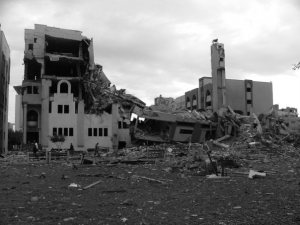 I’ve been to Gaza. I saw the ruins of the gene sequencing building at the Islamic University and of Al Quds Hospital. It is not clear to me who is pushing back, though apparently the Claremont administration is defending Frangieh on free speech grounds.
Johnson devoted a piece to Frangieh’s wife last month, too. And last night he stated in a letter to Claremont McKenna execs that he is getting help from Alan Dershowitz:
I should add that all of the material that I or The Claremont Independent published regarding Professor Bassam Frangieh has been reviewed by my counsel and by Professor Alan Dershowitz of Harvard Law School. The primary source material that I and The Claremont Independent published was translated by three different translators at considerable personal expense.
In the same piece Johnson says “nearly the entirety of the Government Department” at Claremont McKenna is on his side. I wonder how many of them know the history of the Israel-Palestine conflict and the role it is now playing in American politics…
Blind, brazen, hypocritical and unjust, in whose name does Dutch FM Rosenthal speak?
Rifat Odeh Kassis, The Electronic Intifada, 1 March 2011
 |
Appointed Palestinian Authority Prime Minister Salam Fayyad with Uri Rosenthal, Minister of Foreign Affairs of the Netherlands, February 2011. (Mustafa Abu Dayeh/MaanImages) |
In recent months, a number of Latin American countries have publicly expressed their recognition of Palestinian statehood. Given that a Palestinian state doesn’t yet exist, this recognition also amounts to supporting the Palestinian right to statehood. For Israel and defenders of its policies around the world, the “snowball effect” of nations recognizing this right is, unsurprisingly, unnerving.
One such defender is Dutch Foreign Minister Uri Rosenthal. In an 8 February interview with The Jerusalem Post, Rosenthal argued why he believes international support for a Palestinian declaration of statehood “does no good” (“Dutch FM: Recognition of Palestinian state does no good“).
But what strikes me most about the interview is not the straightforwardness of his opposition. Rather, I am struck by what his opposition barely manages to mask: the hypocrisy of his rhetoric on “negotiations” and “democratic values;” a repressive attitude toward what he characterizes as “inflammatory language regarding Israel” within the EU; a betrayal both of the Netherlands’ strong record of commitment to international law and of his responsibilities as the representative of that commitment; and, ultimately, a glimpse of the hypocritical and increasingly repressive policies seen in the EU toward victims and critics of the State of Israel.
Part of what Rosenthal clearly opposes is a unilateral declaration of Palestinian statehood. Dutch policy is also changing along these lines: the Dutch parliament recently passed a resolution that calls for the government to oppose EU recognition of a Palestinian state. But Rosenthal doesn’t utter a word of objection to the unilateral steps taken by Israel.
Israel has illegally annexed East Jerusalem, demolished Palestinian homes there and elsewhere (and even entire towns — the military recently destroyed the Bedouin village of al-Araqib for the 18th time). It has confiscated vast amounts of Palestinian land to build its apartheid wall — the route of which was illegal in 2004 by the International Court of Justice in The Hague — and to protect terrain for illegal settlements. In violation of international law, it encourages its civilian population to inhabit those settlements (which have eaten away at more than 40 percent of the West Bank), practiced brutal detention policies, restricted freedom of movement and other fundamental liberties, tried children in military courts, put the Gaza Strip under a state of permanent siege and killed more than 1,400 Palestinians in Gaza (including 352 children) during its winter 2008-09 bombardment.
The list of unilateral acts — the list of crimes — goes on and on. Rosenthal claims to oppose decisions taken by governments without balanced, negotiated political processes. But if this were really true, he would understand the need to bring Israeli officials and military officers responsible for such crimes to the International Criminal Court in The Hague instead of defending
Israel’s actions in The Jerusalem Post.
Yet Rosenthal not only defends Israel in the Israeli press; he is also doing so under the auspices of, and with the responsibilities endowed to him by, his own parliament. Indeed, as The Jerusalem Post states, “Rosenthal, who is Jewish and married to an Israeli, was characterized recently by Czech Foreign Minister Karl Schwartzenberg as one of the two most active supporters of Israel among EU foreign ministers.” And he defines himself as “among the ones” in the EU who “regularly try to warn against unnecessary inflammatory language” and its “disproportionate” application to Israel. He recommends a “restrained attitude” to his EU partners when it comes to potential initiatives regarding the Palestinian-Israeli conflict; he staunchly disagrees with the suggestion that Israel’s image within the EU is “the lowest it has been in decades,” saying that there are many “balanced conclusions vis-a-vis the Middle East peace process.”
Such “restraint” not only condones policies that flagrantly violate international law and human rights, then, but also seeks to prohibit other EU countries from engaging in positive, proactive initiatives that might bring the conflict closer to an end. He is an influential proponent of the increasingly hypocritical EU stance on the Israeli occupation. This stance praises the meaningless concessions wrung out of diplomatic efforts (as Rosenthal praises Israel for becoming more “lenient” with respect to goods from Gaza, at the urging of the Dutch government) without recognizing that these band-aids only serve to prolong our occupation and subjugation.
Moreover, by defending Israel’s injustices through public office, Rosenthal thus makes his own country a partner in their perpetuation. The Dutch people are well-admired throughout the world as prioritizing human rights and international law; they, then, are being damaged and degraded by Rosenthal’s audacity. The Dutch people must know that their foreign minister is sacrificing the image of The Netherlands for the sake of Israel — that he is working hard to represent Israel’s interests while tarnishing those of his own country — and they should reject this insult, this injury.
While Rosenthal describes part of his work as to “warn” against “unnecessary inflammatory language” toward the Israeli state, this actually amounts to a justification of the government’s right to censor, repress criticism and create political blacklists. Rosenthal’s rhetoric and policies go hand-in-hand with those of Zionist lobbies like NGO Monitor and CIDI (The Center for Information and Documentation on Israel), which bully, harass and defame civil society groups exposing the truth about the Israeli occupation and human rights abuses. (It is worth mentioning that a CIDI board member, Doron Livnat, is the director of Riwal, a European company that produces access equipment and rents large-scale cranes for construction sites, and which has assisted in building the wall and illegal settlements in the occupied West Bank. Riwal’s headquarters in Dordrecht, Netherlands, was raided and searched by the Dutch National Crime Squad after Al-Haq, a Palestinian human rights group, levied criminal complaints against its activities.)
For instance, NGO Monitor recently slammed ICCO, a Dutch international development organization, for financing The Electronic Intifada. (ICCO is also under fire from CIDI for supporting the Olive Tree Campaign “Keep Hope Alive,” realized by the YMCA/YWCA Joint Advocacy Initiative. NGO Monitor vilified The Electronic Intifada and condemned ICCO by association. Rosenthal’s response? “I will look into the matter personally,” he said. If ICCO’s funding proves to be true, “it will have a serious problem with me,” he warned.
Is this the level that Rosenthal — not to mention the lobbies who share his tactics of finger-pointing, threats and repression — has stooped to? Persecuting organizations and publications that support human rights and social justice for Palestinians as “delegitimizing” and “anti-Semitic,” publicly smearing them and seeking to sabotage not only their work but also their rights to free speech and free press? This is an appalling position for a democratic representative to have, ostensibly part of an apparatus designed to uphold those rights in the first place.
These targeted campaigns led by European lobbies against Palestinian and Israeli nongovernmental organizations (NGOs), publications and advocacy groups are particularly chilling in light of similar campaigns being initiated in the Israeli Knesset: specifically, its moves to establish a committee for investigating the funding sources of certain (politically targeted) NGOs. In his interview with The Jerusalem Post, Rosenthal declined to comment on whether this initiative was “undemocratic,” saying “There is no reason to hide anything. I am in favor of transparency,” and “a vivid and lively civil society, where NGOs are a part of it, is very important.”
Rosenthal’s ongoing contradictions, and their echo within the policies of European governments, are astonishing. He claims to support transparency, not to mention the vividness and liveliness of civil society, while only acting repressively against groups and individuals he disagrees with. He says, free of irony, that the presence of NGOs in civil society is “very important,” when he supports a smear campaign against NGOs in his own civil society. And he praises the ideals of civil society itself while simultaneously practicing another campaign — silence — when it comes to Israel’s repression of the NGOs whose existence he finds so valuable in abstract.
Foreign Minister Rosenthal’s pronouncements on the Israeli government are so blind, so brazen, so hypocritical and so unjust that I am sometimes surprised he can utter them comfortably in his own name. But when we consider his vocal and prominent role in the parliament of his own country, and in the political arena of others’, it is especially important for all communities and individuals he attempts to represent (Jewish, Israeli, Dutch, European, etc.) to say loud and clear: “Not in our name.”
~
Rifat Kassis is International President of Defence for Children International (DCI) and General Director of its section in Palestine. He is also Coordinator and Spokesperson of Kairos Palestine – A Moment of Truth.
Israel Issues Eviction Orders to 600 Palestinian Bedouins in Jerusalem Area
By Sergio Yahni, Alternative Information Center (AIC) – February 28, 2011
Hathem Abdel Qader, responsible for Jerusalem in the Fatah movement, warned yesterday of an Israeli plan to deport some 600 Palestinian Bedouin residents of the Wadi Abu Hindi area, located between the settlements of Maale Adumim and Keder, south-east of Jerusalem.
Abdel Qader noted that the Israeli military issued evacuation orders to tens of Bedouin families in Wadi Abu Hindi. According to the orders, the families must leave the area by the end of March.
According to Yacoub Odeh, from the Land Research Centre, this is not the first time that this community receives evacuation orders.
Alqader contends that these orders supplement the eviction orders issued against the Palestinian Bedouin families who reside near the settlements of Adam and Maale Michmash. Odeh adds that at this moment there are eviction orders against some 1,000 Palestinian Bedouins in the area.
Abdel Qader assumes that Israel’s goal is to expand the settlements of Maale Adumim and Maale Michmash.
Attorney Shlomo Leker intends to submit a petition to the Israeli High Court to prevent eviction of these families.
The Bedouin Palestinian families in the Wadi Abu Hindi area are part of the wider Jahalin tribe, numbering some 2700 people living in 31 areas of the desert. The origin of the Jahalin tribe in the area of Tel Arad in the Naqab (Negev) desert, but Israel deported them in the early 1950s, so they moved to the Jerusalem area.
In the 1990s some 1,000 members of the Jahalin tribe were deported to the area of Jerusalem’s municipal garbage dump, in order to expand the settlement of Maale Adumim.
Translated by the Alternative Information Center (AIC)
Davis Arrest Throws US Undercover Campaign in Pakistan into Disarray
By Dave Lindorff | This Can’t Be Happening | March 1, 2011
The ongoing case of Raymond Davis, the CIA contractor facing murder charges in Lahore for the execution-style slaying of two apparent agents of Pakistan’s Inter-Services Intelligence (ISI) agency, is apparently leading to a roll-back of America’s espionage and Special Operations activities in Pakistan.
A few days ago, Pakistan’s Interior Department, which is reportedly conducting a careful review of the hundreds of private contractors who flooded into Pakistan over the last two years, many with “diplomatic passports,” and many others, like Davis, linked to shady “security” firms, arrested an American security contractor named Aaron DeHaven, a Virginia native who claims to work for a company called Catalyst Services LLC.
The Catalyst Services LLC website describes the company, with offices in Afghanistan, Dubai, the US and Pakistan, as having experience in “logistics, operations, security and finance,” and as having a staff led by “individuals who have been involved in some of the most significant events of the last 20 years,” including “the break-up of the Soviet Union, the US effort in Somalia, and the Global War on Terror.”
DeHaven is being held on a 14-day remand, charged with overstaying his visa and with living in an unauthorized area.
Meanwhile, the English-language Express Tribune in Pakistan reports that according to ISI sources, 30 “suspected US operatives” in Pakistan have “suspended” their operations in the country, while 12 have fled the country.
The paper quotes the Pakistan Foreign Office as saying that 851 Americans claiming diplomatic immunity are currently in Pakistan, 297 of whom are “not working in any diplomatic capacity.” The paper says that the country’s Interior Department claims that 414 of the total are “non-diplomats.” The majority of these American operatives, the paper says, are located in Islamabad (where the US is building a huge fortress-like embassy reminiscent of the one in Baghdad), with the others in Karachi, Lahore and Peshawar. Most are suspected of being involved in covert missions that report to the US Joint Special Operations Command, with many suspected of being active-duty Special Forces personnel from the Army’s Delta Force. (The website of the JSOC says its responsibility is “synchronizing Department of Defense plans against global terrorist networks and, as directed, conducting global operations.”)
As I reported earlier, both Pakistani and Indian news organizations are claiming, based upon intelligence sources, that Davis was involved in not just intelligence work, but in orchestrating terrorist activity by both the Pakistani Taliban and the terrorist organization Lashkar-e-Jhangvi, which has been linked to both the assassination of Benezir Bhutto and the capture and beheading of Wall Street Journal reporter Daniel Pearl. Multiple calls to members of both groups were found by police on some of the cell phones found on Davis and in his car when he was arrested in Lahore.
It is unclear how far the blow-up in Pakistan over the exposure of America’s role in stirring up unrest in that country will go. Clearly, the ISI and the Pakistani military have long had their own complicated relationship with the Pakistani Taliban, and much of the current anger in both the ISI and the military has to do with the US being found to be working behind their backs, including in its contact with those groups.
But things have been complicated too by mounting public outrage over Davis’s brazen slaughter of the two Pakistanis, who reportedly were tailing him because of concerns about the nature of his activities, and who reportedly were both shot in the back. This public outrage has been further stoked by both a subsequent suicide by the 18-year-old bride of one of the victims, and by the death of an innocent bystander mowed down by a second vehicle carrying several more US contractors which sped to Davis in response to his call for assistance following the shooting. That vehicle, after running down the bystander, raced to sanctuary at the US Consulate. The men in the car, never identified by the consulate, were spirited out of the country by the US so they could avoid arrest.
Further complicating matters for the US, the province of Punjab, of which Lahore is the capital, is run by the opposition party, headed by former Pakistani prime minister Nawaz Sharif. Sharif, who still has presidential aspirations, has no incentive at all to make things easy for the country’s ruling party by letting Davis go. Indeed, with public opinion running almost 100% in favor of trying Davis for murder, Sharif can only gain by insisting that the court system have the final say.
Pakistan’s central government, led by President Asif Ali Zardari, clearly wants to put the Davis incident behind it by having him declared to have diplomatic immunity. Foreign Officials allege that Zardari pressured the Foreign Office in early February to backdate a letter identifying Davis as being a “member of staff” of the US Embassy in Islamabad, which would have afforded him such immunity from prosecution. But the country’s foreign minister at that time, Shah Mehmood Qureshi, reportedly refused, saying, “On the basis of the official record and the advice given to me by the technocrats and experts of the Foreign Office, I could not certify him (Raymond Davis) as a diplomat. The kind of by blanket immunity Washington is pressing for Davis, is not endorsed by the official record of the Foreign Ministry.”
He has subsequently been ousted and replaced by Zardari.
The reality is that the US, which as required, on Jan. 25 submitted to the Foreign Office its annual list of those employees of the US Embassy whom it classified as “diplomats” warranting diplomatic immunity. The list had 48 names on it, and did not include Davis. Only after Davis’s Jan. 27 shooting of the two Pakistani motorcyclists, on Jan. 28, did the US submit a “revised” list, to which Davis’s name had been appended.
The US initially said Davis was an employee of the Lahore Consulate, and Davis himself told arresting police officers that he was a contractor working out of the Lahore Consulate, a role that would not afford him any diplomatic immunity, as consular workers, under the 1963 Vienna Convention on Consular Relations only receive immunity for their “official duties,” and in any case lose even that limited immunity in the case of “grave crimes.”
His current legal problems, and the public demand that he be tried (and then hanged) for the killings, has definitely led to a reduction in US undercover operations in Pakistan, and to a pullback of at least some of the Special Forces personnel operating there. It will take considerable finesse for the US and the Zardari government to put the the relationship back together–if the Pakistani military and the ISI even want to restore it–finesse that the US has not been very good at displaying.
So far, in fact, the US response to Davis’s arrest has been to bluntly and publicly threaten Pakistan with a loss of foreign and military aid–a threat that seems empty given the American need for Pakistani assistance in supplying its military in Afghanistan, and its need for at lease covert permission to continue sending Predator and Reaper drones across the border to attack Taliban suspects in the tribal border areas. US bluster, and some clumsy efforts to forge records that would purport to show Davis had diplomatic immunity–all widely exposed in the Pakistani media–have only served to further stoke public outrage.
Meanwhile, local authorities in Lahore at the prison where Davis is being held, are so worried that the US may try to have him killed to prevent him from spilling the beans about his activities–for example explaining why the camera he was carrying held photographs of Pakistani military installations as well as of mosques, madrassas and other schools–that they have reportedly posted special guards (unarmed as an added precaution) around his cell, and have been monitoring his food. Davis was reportedly even denied a box of chocolates sent by the US Consulate in Lahore, for fear it might have been laced with poison.
The Real U.S. National Security Budget
The Figure No One Wants You to See
By Christopher Hellman | March 1, 2011
What if you went to a restaurant and found it rather pricey? Still, you ordered your meal and, when done, picked up the check only to discover that it was almost twice the menu price.
Welcome to the world of the real U.S. national security budget. Normally, in media accounts, you hear about the Pentagon budget and the war-fighting supplementary funds passed by Congress for our conflicts in Iraq and Afghanistan. That already gets you into a startling price range — close to $700 billion for 2012 — but that’s barely more than half of it. If Americans were ever presented with the real bill for the total U.S. national security budget, it would actually add up to more than $1.2 trillion a year.
Take that in for a moment. It’s true; you won’t find that figure in your daily newspaper or on your nightly newscast, but it’s no misprint. It may even be an underestimate. In any case, it’s the real thing when it comes to your tax dollars. The simplest way to grasp just how Americans could pay such a staggering amount annually for “security” is to go through what we know about the U.S. national security budget, step by step, and add it all up.
So, here we go. Buckle your seat belt: it’s going to be a bumpy ride.
Fortunately for us, on February 14th the Obama administration officially released its Fiscal Year (FY) 2012 budget request. Of course, it hasn’t been passed by Congress — even the 2011 budget hasn’t made it through that august body yet — but at least we have the most recent figures available for our calculations.
For 2012, the White House has requested $558 billion for the Pentagon’s annual “base” budget, plus an additional $118 billion to fund military operations in Iraq and Afghanistan. At $676 billion, that’s already nothing to sneeze at, but it’s just the barest of beginnings when it comes to what American taxpayers will actually spend on national security. Think of it as the gigantic tip of a humongous iceberg.
To get closer to a real figure, it’s necessary to start peeking at other parts of the federal budget where so many other pots of security spending are squirreled away.
Missing from the Pentagon’s budget request, for example, is an additional $19.3 billion for nuclear-weapons-related activities like making sure our current stockpile of warheads will work as expected and cleaning up the waste created by seven decades of developing and producing them. That money, however, officially falls in the province of the Department of Energy. And then, don’t forget an additional $7.8 billion that the Pentagon lumps into a “miscellaneous” category — a kind of department of chump change — that is included in neither its base budget nor those war-fighting funds.
So, even though we’re barely started, we’ve already hit a total official FY 2012 Pentagon budget request of:
$703.1 billion dollars.
Not usually included in national security spending are hundreds of billions of dollars that American taxpayers are asked to spend to pay for past wars, and to support our current and future national security strategy.
For starters, that $117.8 billion war-funding request for the Department of Defense doesn’t include certain actual “war-related fighting” costs. Take, for instance, the counterterrorism activities of the State Department and the U.S. Agency for International Development. For the first time, just as with the Pentagon budget, the FY 2012 request divides what’s called “International Affairs” in two: that is, into an annual “base” budget as well as funding for “Overseas Contingency Operations” related to Iraq and Afghanistan. (In the Bush years, these used to be called the Global War on Terror.) The State Department’s contribution? $8.7 billion. That brings the grand but very partial total so far to:
$711.8 billion.
The White House has also requested $71.6 billion for a post-2001 category called “homeland security” — of which $18.1 billion is funded through the Department of Defense. The remaining $53.5 billion goes through various other federal accounts, including the Department of Homeland Security ($37 billion), the Department of Health and Human Services ($4.6 billion), and the Department of Justice ($4.6 billion). All of it is, however, national security funding which brings our total to:
$765.3 billion.
The U.S. intelligence budget was technically classified prior to 2007, although at roughly $40 billion annually, it was considered one of the worst-kept secrets in Washington. Since then, as a result of recommendations by the 9/11 Commission, Congress has required that the government reveal the total amount spent on intelligence work related to the National Intelligence Program (NIP).
This work done by federal agencies like the CIA and the National Security Agency consists of keeping an eye on and trying to understand what other nations are doing and thinking, as well as a broad range of “covert operations” such as those being conducted in Pakistan. In this area, we won’t have figures until FY 2012 ends. The latest NIP funding figure we do have is $53.1 billion for FY 2010. There’s little question that the FY 2012 figure will be higher, but let’s be safe and stick with what we know. (Keep in mind that the government spends plenty more on “intelligence.” Additional funds for the Military Intelligence Program (MIP), however, are already included in the Pentagon’s 2012 base budget and war-fighting supplemental, though we don’t know what they are. The FY 2010 funding for MIP, again the latest figure available, was $27 billion.) In any case, add that $53.1 billion and we’re at:
$818.4 billion.
Veterans programs are an important part of the national security budget with the projected funding figure for 2012 being $129.3 billion. Of this, $59 billion is for veterans’ hospital and medical care, $70.3 billion for disability pensions and education programs. This category of national security funding has been growing rapidly in recent years because of the soaring medical-care needs of veterans of the Iraq and Afghan wars. According to an analysis by the Congressional Budget Office, by 2020 total funding for health-care services for veterans will have risen another 45%-75%. In the meantime, for 2012 we’ve reached:
$947.7 billion.
If you include the part of the foreign affairs budget not directly related to U.S. military operations in Iraq and Afghanistan, as well as other counterterrorism operations, you have an additional $18 billion in direct security spending. Of this, $6.6 billion is for military aid to foreign countries, while almost $2 billion goes for “international peacekeeping” operations. A further $709 million has been designated for countering the proliferation of weapons of mass destruction, combating terrorism, and clearing landmines planted in regional conflicts around the globe. This leaves us at:
$965.7 billion.
As with all federal retirees, U.S. military retirees and former civilian Department of Defense employees receive pension benefits from the government. The 2012 figure is $48.5 billion for military personnel, $20 billion for those civilian employees, which means we’ve now hit:
$1,034.2 billion. (Yes, that’s $1.03 trillion!)
When the federal government lacks sufficient funds to pay all of its obligations, it borrows. Each year, it must pay the interest on this debt which, for FY 2012, is projected at $474.1 billion. The National Priorities Project calculates that 39% of that, or $185 billion, comes from borrowing related to past Pentagon spending.
Add it all together and the grand total for the known national security budget of the United States is:
$1,219.2 billion. (That’s more than $1.2 trillion.)
A country with a gross domestic product of $1.2 trillion would have the 15th largest economy in the world, ranking between Canada and Indonesia, and ahead of Australia, Taiwan, the Netherlands, and Saudi Arabia. Still, don’t for a second think that $1.2 trillion is the actual grand total for what the U.S. government spends on national security. Former Secretary of Defense Donald Rumsfeld once famously spoke of the world’s “known unknowns.” Explaining the phrase this way: “That is to say there are things that we now know we don’t know.” It’s a concept that couldn’t apply better to the budget he once oversaw. When it comes to U.S. national security spending, there are some relevant numbers we know are out there, even if we simply can’t calculate them.
To take one example, how much of NASA’s proposed $18.7 billion budget falls under national security spending? We know that the agency works closely with the Pentagon. NASA satellite launches often occur from the Air Force’s facilities at Vandenberg Air Force Base in California and Cape Canaveral Air Force Station in Florida. The Air Force has its own satellite launch capability, but how much of that comes as a result of NASA technology and support? In dollars terms, we just don’t know.
Other “known unknowns” would include portions of the State Department budget. One assumes that at least some of its diplomatic initiatives promote our security interests. Similarly, we have no figure for the pensions of non-Pentagon federal retirees who worked on security issues for the Department of Homeland Security, the State Department, or the Departments of Justice and Treasury. Nor do we have figures for the interest on moneys borrowed to fund veterans’ benefits, among other national security-related matters. The bill for such known unknowns could easily run into the tens of billions of dollars annually, putting the full national security budget over the $1.3 trillion mark or even higher.
There’s a simple principle here. American taxpayers should know just what they are paying for. In a restaurant, a customer would be outraged to receive a check almost twice as high as the menu promised. We have no idea whether the same would be true in the world of national security spending, because Americans are never told what national security actually means at the cash register.
~
Christopher Hellman is communications liaison at the National Priorities Project in Northampton, Massachusetts. He was previously a military policy analyst for the Center for Arms Control and Non-Proliferation, a Senior Research Analyst at the Center for Defense Information, and spent 10 years on Capitol Hill as a congressional staffer working on national security and foreign policy issues. He is a TomDispatch regular and a frequent media commentator on military planning, policy, and budgetary issues. To listen to Timothy MacBain’s latest TomCast audio interview in which Hellman explains how he arrived at his staggering numbers, click here, or download it to your iPod here.
[Note on Sources: The press release from the Office of The Director of National Intelligence disclosing the Fiscal Year 2010 $53 billion intelligence budget consists of 138 words and no details, other than that the office will disclose no details. It can be found by clicking here (.pdf file). An October 2010 analysis by the Congressional Budget Office entitled “Potential Costs of Veterans’ Health Care” projects rapid cost growth for Veterans Administration services over the next decade as a result of spiraling health care costs. To read the full report, click here (.pdf file). To see all the federal agencies that contribute to homeland security funding, click here (.pdf file)]
Copyright 2011 Christopher Hellman
Another Palestinian Child Run Over in Hebron
By Alessandra Bajec – IMEMC & Agencies – March 01, 2011
An Israeli settler hit a Palestinian boy with his car in Hebron, on Monday evening, Ma’an News Agency reported.
Residents of the Old City of Hebron witnessed having seen a settler injuring a child with his car and driving away from the street outside the Ibrahimi Mosque, in the Israeli controlled area of the city.
The boy was taken to the al-Mizan Hospital to receive treatment. Medics said the youth sustained moderate wounds.
Officials with Israel’s settlement police force were not available to comment on the incident.
Earlier on Sunday, a Palestinian girl, named Amani al-Mutawer, was also wounded after being knocked down by an Israeli settler driving near the Beit Ainoun bypass road, north of Hebron.
There have been similar incidents concerning dozens of Palestinians injured while the alleged settlers remain at large; and most of them are never arrested.
Israel shuts down Jerusalem event
Ma’an – 01/03/2011
JERUSALEM — Israeli police and intelligence agents forcibly shut down two events in East Jerusalem on Tuesday morning, citing “security reasons” for the clampdown.
Armed police and border guards prevented guests from entering a conference on “Defending Palestinian Rights in Jerusalem” at the Capitol Hotel on Salah Addin Street in Jerusalem, organizers said.
Police handed organizers a warrant signed by minister of internal security Yitzhaq Ahronovitch addressed to the hotel administration. The warrant warned that the meeting was banned for “security reasons.”
According to organizers, the one-day event was a conference and workshop for Palestinian Authority officials, leaders of non-profit organizations, and political officials. Agenda items included ways to protect residents of the Silwan from evictions and demotions.
Head of the coalition for defending Palestinians’ rights in Jerusalem Zakariyya Udah told Ma’an that police confiscated ID cards of all who attended the conference and took down their numbers before informing the hotel the conference was prohibited.
On Monday night, a similar order signed by the minister of internal security was delivered to organizers of a conference scheduled for the following day. The event was slated for the Al-Bustan protest tent in Silwan, where organizers were preparing to announce the establishment of a new youth union in Jerusalem.
The order was delivered when a unit of armed border guards and police entered the home of the conference organizer in Silwan, warning him of “legal consequences” if the event went ahead.
Featured Video

Iran Is Not Our Enemy
or go to
Aletho News Archives – Video-Images
Book Excerpt
“Vaccines Do Not Cause Autism!” The Science is Settled. Right?
ICAN urges the IACC to actually study infant vaccines and autism
 By Aaron Siri | Injecting Freedom | March 16, 2026
On behalf of ICAN, we just sent a copy of chapter 11 of Vaccines, Amen to the newly appointed members of the federal Interagency Autism Coordinating Committee (IACC).
If you haven’t already read this chapter, you can read the whole thing in the attached letter. I trust that after you read it, you’ll see why the statement “vaccines do not cause autism” is a belief, not science!

IACC Public Comment Letter
1.53MB ∙ PDF file
Includes chapter 11 of Vaccines, Amen
Blog Roll
 Aletho News
- Iran made ‘unexpectedly substantial’ offer during Geneva talks, US envoys ‘dragged’ Trump into war: Report
- Russia condemns Israel’s attack near Bushehr plant, files complaint
- Russia Strongly Condemns Actions Aimed at Harming Health of Iranian Leadership – Kremlin
- Israeli Journalist Demands Tucker Carlson and Candace Owens Be Placed in WWII-Style Internment Camps
- No Liability, No Studies, No Accountability: The Vaccine System Aaron Siri Exposed in Federal Court
- No time for losers: Why the war meant to save Israel may destroy it
- Top US Counterterrorism Official Resigns in Protest of Operation Against Iran
- Just Get Out! Now!
- Unpacking glaring contradictions in US-Zionist justifications for war against Iran
- Iranian model of warfare bleeds US dry while Persian Gulf states watch and learn: Analyst
- If Americans Knew
- Lebanon death toll exceeds 900, another assassination in Iran, bombing in Gaza – Not a ceasefire Day 159
- Trump’s counterterrorism chief, whose own wife was killed by ISIS, quits over Iran War saying Tehran posed ‘no imminent threat’
- Here’s what US could fund instead of Bibi’s war on Iran
- Israel Killed Over a Dozen Lebanese Paramedics in Three Days, Now Claiming That Ambulances Are “Hezbollah” Targets
- War on Iran: These are the heritage sites devastated by US and Israeli attacks
- Four news stories from Israeli media that illustrate Israeli “justice”
- CIA Prepares Criminal Referral of Tucker Carlson, as Israel and Its Loyalists Demand His Arrest
- Top US counterterror advisor resigns in protest of “war manufactured by Israel” – Not a ceasefire Day 157
- ‘I Liked the House’: When Israeli Soldiers Turn Palestinian Homes into Barracks
- ‘They Were All I Had’: Lebanese Father Buries Parents, 4 Daughters Killed by Israeli Bombing
- No Tricks Zone
- Energy Expert: Germany’s Nuclear Phaseout Was A “500 Billion Euro Mistake”
- New Research: South Australia’s Mid-Holocene Sea Surface Temperatures Were 4°C Warmer Than Today
- Storing Green Energy To Last Germany 10 Days Would Require A 60-Million Tonne Battery
- New Studies: UK Sea Levels Were 4 Meters Higher Than Today During The Mid-Holocene
- Destructive Green New Deal: German Energy And Metal Group Warns Of Drastic Crisis
- New Study Documents A 20-Year Pause In Arctic Sea Ice Decline – Driven By Internal Variability
- Wake-up Call: Survey Shows Majority Of Germans Now Favor Postponing Climate Targets!
- Televised! Leading German Political Candidate Tells Schoolchildren CO2 Makes Sun Hotter!
- New Study: A Century Warming Of 1.1°C Is ‘Commonplace’ And ‘Not Unusual’ During This Interglacial
- New Study: ‘Internal Noise’ And Volcanic Forcing Can Trigger 10-15°C Warming Within Decades
 Aletho News