US promoting arms trade mission organized by settlement firm
Jimmy Johnson, The Electronic Intifada, 18 March 2011
The United States Department of Commerce and the US embassy in Tel Aviv are co-promoting the Israel Unmanned Systems 2011 trade mission from 27 March to 1 April. Their partner — and the primary organizer — is Airlift, inc., an aerospace and consulting firm based in the settlement of Talpiot Mizrach (East Talpiot) in occupied East Jerusalem. This raises troubling questions about why Washington is promoting the Israeli arms trade and why it is doing so with a firm based in an illegal colony which explicitly contradicts official US policy as well as international law.
Airlift was founded in 2007 by Marc-Philippe Rudel, a French-Israeli electrical engineer and businessman, to “promote economic cooperation and the establishment of global partnerships.” The company brings foreign arms industry and military officials to Israel for arranged business-to-business meetings, specially tailored seminars, industry workshops and visits to major Israeli armament firms and research institutes. Airlift’s website states that its “offices are located in the heart of Jerusalem” but the address given puts them in occupied East Jerusalem. Airlift’s Spanish subsidiary, Airlift Iberia, was established in September 2010.
Though considered a mainstream Jerusalem neighborhood by most Israelis — including Rudel, judging by his activism in the secular liberal/centrist “Awakening in Jerusalem” movement — East Talpiot is unanimously considered an illegal settlement by the international community including the United Nations, the International Court of Justice and the US government whose pronouncements consistently oppose Israeli settlements. However, Washington regularly takes actions — such as the recent veto of a UN Security Council resolution condemning settlements — to shield Israel from international condemnation and formerly contributed economic aid that was used directly for settlement infrastructure and construction. Promoting a trade mission with a firm based in a settlement points to the latter as being more representative of US policy, in spite of official pronouncements to the contrary. American sponsorship comes at a time when governments like Norway, the Netherlands and the United Kingdom are actively distancing themselves from settlement-related businesses. Requests for comment from the US State Department and Department of Commerce were not answered. … Full article
Intervention in Libya May Lead to More Deaths, Not Fewer
By Stephen Gowans | What’s Left? | March 18, 2011
In explaining why his government supported the UN Security Council resolution authorizing all necessary measures to protect Libyan civilians, US president Barack Obama explained: “The U.S. doesn’t want a war. But we want to prevent a slaughter.”
Noble sentiments, but the Security Council resolution could lead to more deaths, not fewer.
Libyan government forces were well on their way to defeating the rebel forces (which may have been the trigger for the resolution.) Had they done so, the conflict would have ended – at least for now.
By authorizing military intervention, the Security Council is seeking to weaken Qaddafi’s forces. In the meantime, arms and other assistance, provided to the rebels by Egypt and other countries, will strengthen the opposition side.
An imbalanced conflict – where weak rebel forces now face stronger government forces—will be transformed into a more evenly balanced one. The government’s wings will be clipped and the opposition will become more robust.
Intervention may prevent a slaughter of rebel forces, but it could lead to a prolonged civil war, with more bodies piling up than would have, had the conflict been allowed to quickly culminate in a resolution. Among the corpses will be the civilian collateral damage that Western bombers are so proficient at producing.
Another possible outcome (perhaps more likely) is that Western military intervention tips the scales overwhelmingly in the rebels’ favor. Others have noted the similarities with Kosovo, where NATO signed on as the KLA’s air force in the guerrilla army’s fight with Serb forces. This time, however, the intervention has UN authorization, though whether it does or doesn’t hardly makes a difference. This one is no more defensible than the Kosovo intervention and is no less motivated by Western geo-political and elite economic interests.
Membership has its privileges
Meanwhile, the firing of live ammunition at protesters by Bahraini forces, backed by Saudi troops and tanks, has drawn no calls for all necessary measures to protect Bahraini citizens. There haven’t even been calls for mild measures. The best Washington can do is “express distress” and urge “the government (in Bahrain) to negotiate with the opposition and pursue change.”
Why the double standard?
As the New York Time’s Helene Cooper and Mark Landler explain, “Bahrain is an American ally. The Navy’s Fifth Fleet is based here and the Khalifa royal family has warm relations with Washington.”
Libya, of course, is neither a US ally (though it has in recent years cooperated with Washington on some matters), isn’t the site of US military bases, and its leader hasn’t had warm relations with Washington.
Had any of these things been true, we can take it that Qaddafi would now be free to slaughter as many Libyans as he pleased (though Washington would publically profess distress, while sitting on its hands.)
For bloodthirsty leaders, membership in the club of US allies has its privileges. The same can’t be said for the people who live under them.
War and Peace in Colorado and Afghanistan
By KATHY KELLY | CounterPunch | March 18, 2011
Kabul – Before coming to Afghanistan, I spent a week with students and teachers from a Colorado College nonviolence class who invited me to join them for their retreat near Crestone, Colorado, in an area of the Rocky Mountains described as one of the ten most peaceful places on earth. Coyotes, woodpeckers, and songbirds were easily audible. We reveled in the quiet beauty of an area that is home to 23 spiritual groups, all of whom prize the valley they share as a sacred space.
The area is also home to Canon Air Force Base, Fort Carson and several other military installations. Before leaving Colorado, I visited the U.S. Air Force Academy’s chapel, one of the state’s largest tourist attractions. Pasted on the back of every hymnal in the pews of the Protestant chapel is a prayer that reads, in part, “Make me a channel of your peace that I may defend the skies which canopy free nations.” Ironically, some Coloradans are petitioning the state government to stop the Air Force military flights over their peaceful valleys, and ranchers are likewise insisting that their land shouldn’t be used for combat training.
Peace activists with a long history of opposing war preparations, in Colorado Springs, are protesting a USAF plan to acquire a new Combat Aviation Brigade, consisting of 120 helicopter gunships. To accommodate training operations, 16 landing pads have already been carved out in the mountains surrounding Colorado Springs and Crestone, CO. Two thousand Joint Special Operation Forces (JSOF))are also in these mountains, training for work in rugged winter conditions. Their activities include organizing and carrying out night raids, assassinations and death squads.
The 120 attack helicopters are requisitioned for use in Afghanistan. It seems likely that the JSO forces are also training for deployment to Afghanistan.
The Washington Post recently reported that 75 per cent of the U.S. public supports a drawdown of U.S. troops from Afghanistan. On March 12, Afghanistan’s President Hamid Karzai, extending condolences to families of nine children gunned down by a U.S. attack helicopter, expressly asked that the U.S. end operations in Afghanistan. The Afghan Youth Peace Volunteers have carefully documented NGOs in Afghanistan with a long history of humanitarian work who have rebuked the U.S. and NATO forces for human rights abuses and for killing civilians.
The most recent attack against Afghan children happened on March 15, when two children helping their parents clean out irrigations systems were killed by an aerial attack. On the day following the March 1, 2011 attack that killed nine children who were collecting wood on a mountain side, General Petraeus apologized to the families. But, the U.S. has yet to acknowledge the deaths and injuries inflicted on civilians in February, 2011, when, according to President Hamid Karzai’s official report, at least 65 civilians were killed by a U.S. assault. Instead, General Petraeus utterly shocked people in President Hamid Karzai’s presidential palace, on February 19th, 2011, when he suggested that injured children might have been burned by their own parents as a measure of discipline. A month earlier, on January 19th, General Petraeus had remarked that “we have our teeth in the jugular,” referring to Afghanistan, and the U.S. isn’t going to quit now.
Testifying before the U.S. congress, in mid-March, General Petraeus spoke of the fragile and reversible gains the U.S. has made in Afghanistan. He asks the U.S. people not to undermine the “progress” the U.S. war is achieving. We’re urged to treat the military with kid gloves, to handle with care their progress, and not to dwell, unpatriotically, on the war crimes that massacre children.
Twenty seven international peace activists, most of them from the United States, have come to Kabul to hear youngsters whom they’ve begun to regard as brothers and sisters speak about their experiences living in a country ravaged by warfare for the past three decades.
Last evening, they showed us photos of an unusual walk they’d held in the streets of downtown Kabul that morning. Dressed in white, with the young women wearing sky blue veils and the young men in the same color neck scarves, the Afghan Youth Peace Volunteers carried sky blue and white banners proclaiming that Peace is a Pre-Requisite for Progress. They are seeking an end to wars in their country. “Why did you choose sky blue?” I asked. “Because it shows that there is just one sky over all of us,” Chahara replied. Although they came from different ethnicities and various provinces, they walked shoulder to shoulder, 40 of them, on a bright, warm day.
I’m guessing that many people in Colorado’s Air Force Academy chapel feel calmed and pleasantly righteous when they read the prayer posted on the back of the hymnal. “Make me a channel of your peace,” the prayer begins. The line comes from the St. Francis Peace Prayer which prays for the ability to sow love rather than hatred. The Air Force prayer seeks, instead, to be involved in “defending skies that canopy free lands.”
Rather than invoke the false image of separated skies that distinguish between those who have a right to live and those who live in lands where they can’t escape our terrifying helicopter gunships, drones, night raids, and death squads, we do well to hear Pete Seeger singing “One blue sky above us, one ocean lapping at our shores, …”
And take a look at youngsters in Kabul, wearing sky blue, who even believe in love of enemy.
On March 19, in Kabul, Afghan Youth Peace Volunteers will hold a candlelight commemoration, remembering the children recently killed in Afghanistan. Following this ceremony they will plant saplings as a symbol of their dedication to a nonviolent future. Their compassion extends beyond Afghanistan to young people in other lands, some of whom they will connect with through a “Global Day of Listening,” a 24 hour Skype communication which they’ll host on the first day of spring, Afghanistan’s “Nau Roz” (New Year’s Day) holiday. Colorado College students, on their spring break, plan to participate (see: www.livewithoutwars.org and www.ourjourneytosmile.com or email globaldayoflistening@gmail.com to arrange participation for yourself and/or your community.
~
Kathy Kelly co-coordinates Voices for Creative Nonviolence and has worked closely with the Afghan Youth Peace Volunteers. She is the author of Other Lives, Other Dreams published by CounterPunch / AK Press. She can be reached at: Kathy@vcnv.org
Netanyahu Denounces Fateh-Hamas Reconciliation Efforts
By Saed Bannoura – IMEMC & Agencies – March 18, 2011
Israeli Prime Minister, Benjamin Netanyahu, harshly slammed the reconciliation efforts between the rival Fateh and Hamas movements in the West Bank and the Gaza Strip.
In an interview with the CNN, Netanyahu said that the Palestinian Authority in the West Bank cannot claim to seek peace with Israel while seeking peace with Hamas which, according to Netanyahu, is determined to destroy Israel.
He tried to explain his stance by linking the issue to the Al Qaida terrorist network by asking the reporter “Can you imagine a peace agreement with Al Qaeda? Of course you can’t.
On Wednesday, Palestinian President, Mahmoud Abbas, said that he is willing to head to Gaza in order to hold talks with Hamas leaders in order to boost unity efforts.
Abbas has not been in Gaza for more than four years following violent gun battles between Hamas and Fateh gunmen and security forces.
The Youth Coalition Movement in Palestine is growing and demanding Hamas and Fateh factions put their differences aside and achieve unity.
Social and political activists started a campaign that was also launched on Facebook demanding internal Palestinian unity between all factions, and an immediate end to internal divisions.
The youth are not necessarily connected to any political faction, while their only aim is unity among all Palestinians, in addition to real reforms and reconciliation.
Israel’s Jerusalem Post quoted Israeli officials stating that the protests and changes in the Arab world, and Palestinian-Israeli negotiations cables that were leaked by Al Jazeera, pushed the Palestinians to tougher stances regarding the resumption of peace talks with Israel.
The Post added that this issue was clearly apparent in official Palestinian stances, and the stance of Chief Palestinian negotiator, Dr. Saeb Erekat, during his two meetings with Quartet officials over the past three weeks.
The resumption of settlement activities and the demolition of homes in occupied East Jerusalem, in addition to the ongoing Israeli violations in the occupied territories, pushed the Palestinian Authority to halt talks with Israel.
In addition, Israel and its strongest ally, the United States, regard the Hamas movement as a terrorist group and refuse to hold talks with them.
Hamas garnered an overwhelming victory in the 2006 Legislative elections, and the preceding Local Councils elections. The elections were observed by international monitors, but the outcome that strongly placed Hamas in power angered the United States and Israel who launched a campaign to void the outcome.
Israel also kidnapped dozens of elected officials and legislators in an attempt to obstruct the work of the elected government.
The strict Israeli siege on Gaza also led to the death of hundreds of patients who could not have access to basic medications and medical equipment.
Following the 2007 and most of 2008 deadly clashes between Hamas and Fateh, president Mahmoud Abbas formed a new cabinet in the West Bank while Hamas regarded the new government as illegal as it violated the elections outcome.
Reconciliation efforts were repeatedly conducted by Egypt and other Arab countries, but a unity agreement was never reached.
Israel is threatening that should a new government with Hamas on-board be formed, both Tel Aviv and Washington will boycott it.
Venezuela’s Chavez Halts Nuclear Energy Program following Japan Crisis
Mérida – Yesterday President Hugo Chávez put a freeze on Venezuela’s nascent nuclear energy program as a result of the crisis underway at Japan’s earthquake-stricken nuclear reactors.
In the aftermath of last Friday’s tragic earthquake, Chávez sent his condolences to the Japanese people and announced his decision to halt a bi-lateral nuclear development agreement signed between Venezuela and Russia in October of last year.
The announcement came just hours after new flames engulfed one of Japan’s damaged nuclear plants and forced authorities to evacuate the last remaining technicians.
“What has been taking place in the last few hours represents an enormous risk and threat to the entire world,” said Chávez late Tuesday evening.
“Even with all of the great technology and advances that the Japanese have…just look at what is happening with some of those nuclear reactors,” he said.
Chávez’s comments came after elevated radiation levels at Japan’s earthquake-stricken Fukushima Daiishi nuclear plant led authorities to suspend all efforts to prevent the plant’s reactors from melting down. Authorities ordered clean-up crews to leave the facilities and cancelled plans for the use of military helicopters to dump water on the plants in efforts to prevent temperatures from rising any further.
Chávez said Japan’s ongoing nuclear crisis would affect the development of nuclear energy programs worldwide. “There is no doubt whatsoever that this has altered, and will alter in a very strong way, all planning for nuclear energy across the globe,” he said.
“For the time being,” Chávez said, “I have ordered the Vice President [and Minister of Energy Rafael] Ramírez to put a freeze on the plans we have been advancing, the very preliminary studies related to Venezuela’s peaceful nuclear energy program.” … Full article
UN votes for Libya air strikes
By Richard Seymour | LENIN’S TOMB | March 17, 2011
As if I didn’t see this coming a mile off:
10 in favour, zero against, five abstentions. So the vote went exactly as predicted. “The resolution 1973/2011 is adopted.,” says the chairman.
This could get very ugly. The resolution authorises a whole series of military measures short of ground invasion, including air strikes. The worst case scenarios? Not that air strikes will kill civilians – that is absolutely guaranteed, and thus constitutes an aspect of even the best case. Not that the war will escalate – that is not a dead cert, but a strong probability. However, it’s also unlikely to involve a ground invasion, which I need hardly say would be catastrophic. The worst case scenario seems to be that this will fuel the centrifugal forces tending toward partition between a ‘Western’ allied statelet in the east, and a rump dictatorship in the west. Qadhafi has spent years deliberately ‘underdeveloping’ the east to punish these regions and tribal federations for their tendency toward rebelliousness, leaving towns and cities that should be as rich as those in the Gulf states desperately poor, surrounded by shantytowns and slums – and so he has laid the material basis for such divisions. Imperialism creates divisions where none existed before (look at Iraq). This is how it always operates. So it’s implausible that where there already are such divisions, and where such divisions have a direct bearing on the conflict underway, that imperialist intervention would not exacerbate them. This may be the worst thing that could possibly have happened to the Libyan revolution. That’s a worst-case scenario.
The best-case scenario is that people are killed to little avail, and the former regime elements in the transitional leadership have just diverted energies and initiative down a blind alley. I suppose you might object that the best-case scenario is that the air strikes exclusively kill the bad guys, turning the initiative in favour of the revolutionaries, allowing them to seize power, build a liberal democratic state, and the cavalry heads home. And the band played, ‘Believe it if you like’. Look, I’d like to believe it. I’d also like to believe that Obama is a socialist, Hillary Clinton a feminist, and David Cameron a salesman for unsecured personal loans. But the occasions in which imperialism has directly assisted a revolutionary process are rather infrequent, wouldn’t you say? In fact, I suspect you’d be struggling if I asked you to name one.
I’m also afraid that all the talk about the inaction, delaying, dilly-dallying and procrastination of the ‘international community’, not to mention the demonology about Russia and China obstructing the good guys once again, has played straight into a very familiar war narrative. Just when you’ve uttered your last “but why won’t they DO something?”, just when you’re about to give up and lapse into foul depression, the good guys come to the rescue. It’s like 1941 all over again. There was never any doubt, as far as I’m concerned, that the US would support a no-fly zone if it could be suitably internationalized and involve support from the miserable dictatorships of the Arab League. And no one will be tasteless enough to point out that those very same states are currently butchering their populations with the arms and financial assistance of the imperial powers commanding this coalition of the willing. Because that would just be sour grapes.
‘UK government wants Muslims out of London’
Press TV – March 17, 2011
An opposition Labour Party minister has accused the British government of spearheading efforts to force Muslim families out of central London.
KarenBuck, the shadow Work and Pensions Minister, told a public meeting in Islington that the government “does not want Muslims living in central London,” adding that ministers were “deeply hostile” to poor people having children, British media reported.
Buck also spoke of the government’s spending cuts program, saying that planned cuts to housing benefits were politically motivated to force poor, ethnic minority and Muslim families out of the center of London.
“They [The Government] do not want lower-income women, families, children and, above all, let us be very clear – because we also know where the impact is hitting – they don’t want black women, they don’t want ethnic minority women and they don’t want Muslim women living in central London. They just don’t. They want people to be moving out of anywhere that is a more prosperous area into the fringes of London and into places like Barking and Newham. I have nothing against Barking and Newham. The problem is they are already full of people who are quite poor,” she said.
The shadow minister also accused the Tories of thinking that families who earn less than £40,000 a year should not have any children.
“The Government is one that is deeply hostile to middle- and lower-income women having children,” she said.
“When you listen to the Tories speaking in Parliament, there is an arrogance and an ignorance that I have never known in my 13 years in Parliament: basically, thinking that anyone whose income is below the top rate of tax shouldn’t have children,” added Buck.
The Conservative Party Chairman Baroness Warsi reacted to the remarks, saying that “they were deeply offensive.”
Warsi, herself a Muslim, called on Labour Party chief Ed Miliband to remove Buck from Labour’s frontbench.
This is while government plans, which come into force next month — housing benefit will be capped at £400 a week for the largest homes and £290 a week for two-bed flats — are continuously raising concerns that many poor families will no longer be able to afford the rent in inner cities.
A report for the Cambridge Centre for Housing and Planning Research suggested that – nationwide – up to 269,000 households will struggle to pay their rent, with an estimated half of these expected to lose their homes.
The plans will hit particularly hard in London, where average rents are higher than they are in any part of the country. London Councils estimate that 82,000 households across the capital will be at risk of losing their homes under the government changes.
Radioactive Cloud/Fallout Over Europe From the Chernobyl Disaster
By Allen Roland:
Citations sourced from the Christian Science Monitor | March 16, 2011

Yesterday President Obama told KDKA-TV of Pittsburgh “that experts have assured him that a nuclear release from Japan will dissipate by the time it gets to Hawaii, much less the U.S. mainland” but I stopped believing Obama a long time ago and, besides, he lives on the East Coast ~ well out of harm’s way. By the way, General Electric CEO Jeff Immelt recently joined Obama’s team as a top economic advisor and GE designed the faulty nuclear containment systems that are now breaking down in Japan. So Obama is not about to say anything that could harm his more than cozy relationship with Wall Street and the financial elite ~ the public be damned.
The New York Times reports that GE marketed the Mark 1 boiling water reactors, used in TEPCO’s Fukushima Daiichi plant, “as cheaper to build than other reactors because they used a comparatively smaller and less expensive containment structure.” The same containment structures that are now breaking down ~ like BP, it’s all about greed, profit and lax oversight ~ and dam the safety concerns!
Contrary to Obama’s vacuous comments ~ “The worst case scenario is ~ the fuel rods fuse together, the temperatures get so hot that they melt together in a radioactive molten mass that bursts through the containment mechanisms,” said nuclear expert Joe Cirincione. “Some of the radioactivity could carry in the atmosphere to the West Coast of the US,” added Cirincione, head of anti-nuclear group Ploughshares Fund. He cited the 1986 Chernobyl nuclear disaster to underline how far radioactivity can travel. “The radioactivity spread around the entire northern hemisphere,” from the devastated Ukrainian plant, he said.
~
On April 26 1986 a terrible disaster happened in Chernobyl in Ukraine. This is a radioactive radar that can see how high the radioactivity was. The more red the more dangerous.
~
Stephen Lendman
Chernobyl in 1986 killed nearly one million people and counting. Wide areas are affected by permanent contamination. Clean-up workers still risk radiation poisoning. Earlier ones suffered dreadful illnesses or died, mostly from painful cancers. In contaminated areas, the continuing effects include:
— a 100-fold increase in aggressive thyroid tumors;
— a 50-fold increase in leukemia, bone, brain, and other tumors;
— a 30% increase in “malformations” caused genetic mutations and other pathologies affecting cardio-vascular function, skeleton, muscular systems and connective tissues, as well as nervous system diseases and psychic disorders; and
— a 20% increase in premature births, besides an unknown number of spontaneous abortions, miscarriages, and still-born births.
Moreover, radiation contamination remains hazardous for thousands of years.
Dept of Education opens investigation into anti-Semitism at UC Santa Cruz following events protesting the occupation
By Adam Horowitz | Mondoweiss | March 17, 2011
The Chronicle of Higher Education is reporting that the U.S. Education Department’s Office for Civil Rights will investigate charges of anti-Semitism at the University of California at Santa Cruz based on a complaint that the university ignored concerns that criticism of Israel was “creating a hostile climate for Jewish people on the campus.”
You can read a letter from the Dept. of Ed announcing the investigation here. The move is the first such investigation since the Department announced last October that they were expanding federal anti-bullying guidelines to include religious groups with “shared ethnic characteristics.” Previously, the relevant civil rights statute, Title VI, did not explicitly cover religion. This was a move applauded by Israel supporters, such as the Zionist Organization of America, who saw it as a way to criminalize activism critical of Israel on campus.
The lecturer who brought the complaint is Tammi Rossman-Benjamin, who teaches Hebrew at the school. You can read Rossman-Benjamin’s complaint to the Education Department here. Among the events she sites as examples of anti-Semitism on campus was a screening of the film Occupation 101 and another event called “Understanding Gaza.” This event featured speakers from Jewish Voice for Peace which she characterizes as “an extreme and disreputable fringe of American Jewry.” The Chronicle quotes her letter:
The anti-Israel discourse and behavior in classrooms and at departmentally and college-sponsored events at [Santa Cruz] is tantamount to institutional discrimination against Jewish students, which has resulted in their intellectual and emotional harassment and intimidation, and has adversely affected their educational experience at the university.
Reading over the complaint, it’s hard to believe that anyone took it very seriously. Rossman-Benjamin’s ulterior motive of silencing criticism of Israel is obvious, and she has even written openly about it. In a piece titled “Anti-Zionism and the Abuse of Academic Freedom” that she wrote for Dore Gold’s neocon thinktank the Jerusalem Center for Public Affairs, Rossman-Benjamin laments:
The foregoing analysis has amply demonstrated that anti-Zionist and anti-Semitic discourse has found academic legitimacy on at least one major university campus and is allowed to flourish because faculty and administrators are unwilling to address, or even acknowledge, these abuses of academic freedom.
To answer how this case has found support at the highest levels of government it helps to look at who is helping push it forward, and how the Department of Education’s new policy was created in the first place.
The case is being heavily supported by an organization called Institute for Jewish and Community Research (IJCR) a San Francisco-based organization which is “devoted to creating a safe, secure, and growing Jewish community.” A large part of that work is focused on documenting and exposing “anti-Israelism and anti-Semitism.” This project is headed up by Kenneth L. Marcus, who incidently served as the Education Department’s assistant secretary for civil rights from 2002 to 2004, and was the Staff Director at the United States Commission on Civil Rights during the Bush Administration. In fact, Marcus helped lay the groundwork for the new Dept of Education bullying policy with a 2004 policy letter that advocated for the change.
Although Marcus must have been responsible for a wide array of civil rights concerns during his time in government, it seems there is one issue close to his heart. Here is a list of his publications as listed on his wikipedia page:
- “The Second Mutation: Israel and Political Anti-Semitism”, inFocus Spring 2008 • Vol. II: No. 1
- “Anti-Zionism as Racism: Campus Anti-Semitism and the Civil Rights Act of 1964”, February 2007 issue of the William and Mary Bill of Rights Journal (pp. 837-891, published by the students of the William and Mary Law School)
- “The Resurgence of Anti-Semitism on American College Campuses”, Current Psychology, Vol. 26, Nos. 3 & 4, 2007
- “The Most Important Right We Think We Have But Don’t: Freedom from Religious Discrimination in Education”. Nevada Law Journal, Vol. 7, p. 171, 2006
- “Jurisprudence of the New Anti-Semitism”, Wake Forest Law Review, Vol. 44, 2009.
His IJCR also mentions his new book Jewish Identity and Civil Rights in America. Seems to be a bit of a one trick pony. Predictably, Marcus is celebrating the government’s decision and sees wide ranging ramification for the Rossman-Benjamin’s complaint. A IJCR press release quotes him as saying:
This case is extremely significant for four reasons. First, it is opened just as International Apartheid Week activities are being held around the world and illustrates the potential ramifications of extremist protest activities. Second, it follows right on the heels of a federal lawsuit alleging similar problems at the University of California Berkeley just a few days before and may illustrate a broad trend. Third, it is only the second major systemic anti-Semitism case that OCR has opened and may have important precedential value. Fourth, it is the first major case to follow OCR’s new campus anti-Semitism policy and may demonstrate whether OCR means what it says about its commitment to addressing hate and bias in federally funded higher education programs.
It’s hard to believe the complaint will be held up, but I also would never have thought it would go this far in the first place. Guess it helps to have friends in high places.
Worse Than Chernobyl?
No Reactor is Safe
By RUSSELL D. HOFFMAN | CounterPunch | March 17, 2011
The latest news is that the Japanese military are dropping sea water on the reactors by helicopter.
That sounds very inefficient, very ineffective, and very dangerous.
I described this event to a loved one today as one of the worst catastrophes in the history of humanity. What will she tell her 13-year-old while he watches the news tonight? That Ace is STILL saying the worst may be yet to come? That we might have one spent fuel pool fire after another… and dry cask fires, too… and more reactor meltdowns, and more explosions?
That over the next 20 years there will probably be more than a million dead in Japan from this accident, and thousands dead here in America?
Do we tell them that? These are pretty hard things to have to try to explain to a child.
Do we tell them the poisons are particularly bad for youngsters, infants, and fetuses?
“If you don’t understand what’s happening, you’re probably so young that you REALLY need to know!! It will affect YOUR life most of all!”
There’s no way to explain that.
Of course, you can always listen to the pro-nukers tell you not to worry because it can’t happen “here”, wherever “here” is for you. They will tell you the radiation levels from the Fukushima-Daiichi catastrophe will be little more than background levels by the time they get to you, wherever you are. They’ll say background radiation is harmless and might even be good for you. They’ll say it’s just a dusting. That’s it’s all going to land in China. That the deaths from Chernobyl didn’t happen.
They’ll say it all.
Radiation sickness isn’t pretty. People in Japan will be coming down with it in droves. Workers undoubtedly already are being visited behind plastic screens for the last time by their loved ones who, if they live close to the Fukushima Dai-ichi nuclear power plant, were also irradiated, but not as badly.
I spoke at a hearing last night, near my local nuclear power plant. It was a common council hearing in San Clemente, the city nearest the reactor. I’ve posted a You-Tube video from the event.
The public speaking portion of the evening started with this author. The reactor company was allowed to speak last, for as long as they wanted. The representative explained that the reactor was built to withstand all foreseeable earthquakes in the area, and all tsunamis that they could foresee as well. And that was that. No talk of new studies, no talk of building the wall higher, nothing like that. Everything’s fine at San Onofre, according to them.
Lately at all the hearings for San Onofre, the activists have been overwhelmed by plant employees, some of whom always speak, such as the union duckie, and some of whom just clap for their team and leave when its the activists’ turn to talk.
There were NO employees making themselves obvious at this hearing, besides the one management representative. I did not see a single logoed shirt, patch, or San-Onofre beeper this time. … Full article
Young Gazan fisherman shot in abdomen
17 March 2011 | International Solidarity Movement, Gaza

Yasser’s bullet wound
A young curly-haired boy snores solemnly in a hot room in Al-Shifa hospital in central Gaza City. He lays wrapped in a blanket and is connected to a drip. His brothers and cousins sit around his bed on yet another hospital visit. “This is the life we face as fishermen: the Israeli’s shoot at us daily and injuries are frequent,” says one of the visitors.Yasser Nasser Bakr, 19 years old, received a bullet in his abdomen on the morning of March 16th, while he was out fishing.
“We went out with a series of small hasakas (traditional fishing boats) at about 5.30 am this morning. At 6:30 AM the Israeli Navy started shooting at us. They shot around us and at the boats for about five minutes. They would stop and open fire again after a while. This was ongoing until Yasser was injured at approximately 10:30 AM,” says his brother who sailed with him. “I was petrified and just wanted one thing: to leave. However, this happens on a daily basis, so we cannot withdraw, we need to continue in these circumstances, otherwise we wouldn’t catch a single fish.”
At 1.5 nautical miles the fishermen met with the Israeli gunboat, which got as close as 30 meters to the fishing boats. “And they speak Arabic very well, insulting us and telling us to ‘get the hell out of of here,’ while we are righteously there according to their laws,” says Yasser’s brother.

Scan of Yasser’s upper body
A boy jumps up and demonstrates how only three days ago he laid down on the deck of the boat protecting his head with his arms after threats of the captain of the gunboat. “He said to us: ‘I’ll kill the child!’, while he was pointing his M16 machine gun to my face!” cries 17 year old Khalil.Gazan fishermen collectively suffer from Israel’s unilaterally imposed sea blockade of but 3 nautical miles, which cuts them off from the big schools of fish. The Bakr family has more misery accounted to Israel though. On July 5th 2010, Yasser’s brother, Ala’am Bakr was shot while fishing. On September 24th, the Bakr family suffered a tragic loss: Mansour Bakr was killed at sea. Just two months ago, the Navy arrested four members of the Bakr family. While they were released the same day, their boat remains confiscated, leaving these men and their families without income.
More visitors wander into the hospital room to visit Yasser, who wakes up with groans of pain. The fishermen show us videos of how they were attacked previously. When asked if they have a message to share with the outside world, they yelled: “We want the sea back, help us open the sea for us again.”
Featured Video
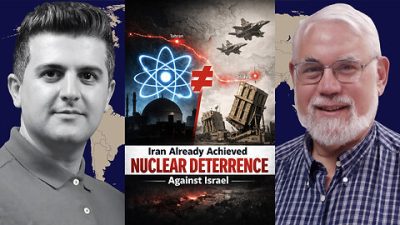
Prof. Ted Postol: Iran Already Achieved Nuclear Deterrence Against Israel
or go to
Aletho News Archives – Video-Images
From the Archives
How the occupied mentality syndrome works
Saudi Arabia on the American chessboard – Part 3
By B. J. Sabri | American Herald Tribune | June 27, 2016
Read part 2: “The occupied mentality Syndrome“
Previously I argued whether Saudi Arabia’s repeated involvements in U.S. interventions and wars stem from free national will or in response to a specific condition. For starters, in Saudi Arabia there is no national will. In Saudi Arabia, the national will is the will of the Al Saud clan. Still, when a major Arab state allies itself with a superpower that committed unspeakable crimes against humanity in almost every Arab country, then something is wrong. This fact alone should compel us to examine the U.S.-Saudi relation for one exceptional reason. As a result of the U.S.-Saudi wars, hundreds of thousands of people in Afghanistan, Iraq, Iran, Libya, Syria, Yemen, and Somalia have lost their lives. Millions became displaced in their own homelands. And millions more rendered refugees.
Attributing the Saudi policies to the bonds of “partnership” with the U.S. is frivolous. There are no bonds between these two thugs except those of business, military deals, secret plots, and wars. Proving this point, bonds such as these have no space for the American and Saudi peoples to share significant cultural or societal exchanges. If partnership is not the reason for the Saudi contribution to the U.S. strategy of empire and imperialism, then another reason must exist.
This leads to three possibilities. … continue
Blog Roll
 Aletho News
- NIAID/NIH and USDA Fund Bioengineered Chimeric Influenza Viruses Built Using Pandemic H1N1 Components: Journal ‘Science Advances’
- Hezbollah hits Israeli warship off Lebanon’s coast, sets it aflame
- Iran slams US strikes on B1 bridge, Mahshahr petrochemical plants as ‘blatant acts of state terrorism’
- In letter to UN chief, Araghchi warns of dire consequences of US-Israeli attacks on Iran’s nuclear facilities
- Why the CIA conspiracy to invade Iran with Kurdish militias failed
- Why Are Upbeat US Claims About Mission to Rescue Pilot ‘Highly Questionable’?
- Aircraft destroyed during US ‘rescue’ of downed F-15 pilot cost more than $100 million each
- Washington University removes professor who condemned US-Israeli war on Iran
- Russia Warns of Retaliation as UK Authorizes Seizure of Vessels
- Serbia thwarts plot to bomb Russia-Hungary gas pipeline – Vucic
- If Americans Knew
- In Iran, Israel-US take aim at “reason, research, and freedom of thought” – Daily Update
- US loses planes over Iran, Israel downgrades Lebanon war goals – Daily Update
- Israel Is Blocking Palestinians from Easter at Church Where Jesus Resurrected
- Plot to assassinate Palestinian activist follows harassment campaign promoted by Zionist groups and elected officials
- Prominent New York synagogue hosts presentation on why U.S. Jews should support the ethnic cleansing of Gaza
- Tapper vs. Piker: Is the CNN Anchor Auditioning for David Ellison?
- Shouldn’t Democrats Be Able to Condemn Genocide?
- Israel-US kill negotiators, destroy civilian structures, but Iran’s military capabilities still largely intact – Daily Update
- ‘War crime’: Global condemnation as Israeli ministers celebrate death penalty law targeting Palestinian prisoners
- 7 Ways Israel Is Turning Lebanon Into Gaza
- No Tricks Zone
- An Inconvenient Tree: Uncovered In Alps… Europe Much Warmer Than Today 6000 Years Ago
- New Study Reports A 60% Slowdown In Greenland’s Ice Loss Rate In The Last Decade
- Low Intensity Tornado Wrecks Major Solar Farm, Creating A Potential Toxic Dump
- New Study Finds Warming Saves Lives…Cold Temperatures 12 Times More Deadly Than Excess Heat
- German Science Blog Accuses PIK Climate Institute Of Hallucinating Climate Tipping Points
- Devastating Assessment Of Comirnaty Vaccine By Former Senior Pfizer Europe Toxicologist
- New Study: CO2 Is ‘Effectively Negligible’ As An Explanatory Climate Change Factor Since 2000
- Former Pfizer Toxicologist Dr. Helmut Sterz Tells Bundestag Hearing Pfizer Vaccine Should Have Never Been Approved
- Energy Expert: Germany’s Nuclear Phaseout Was A “500 Billion Euro Mistake”
- New Research: South Australia’s Mid-Holocene Sea Surface Temperatures Were 4°C Warmer Than Today
 Aletho News