Britain resorts to nuclear bullying against Argentina
Press TV – February 4, 2012
The UK is sending a nuclear submarine to the Malvinas Islands amid growing tensions between Britain and Argentina over the disputed territories.
According to media reports on Saturday, British Prime Minister David Cameron has personally approved the deployment of the Trafalgar-class vessel, believed to be either HMS Tireless or HMS Turbulent, in the South Atlantic.
However, a British Ministry of Defense (MoD) spokeswoman said, “We do not comment on submarine deployments.”
The heavily-armed submarine is set to be in the Malvinas waters in April for the 30th anniversary of the 1982 war which the two countries fought over the islands also known as the Falklands.
The Royal Navy has already revealed it is sending HMS Dauntless, a Type 45 destroyer, to the Falklands.
Britain’s Prince William arrived in the Malvinas on Thursday for a six-week training mission as a search and rescue pilot with the Royal Air Force (RAF).
Buenos Aires has strongly condemned Britain’s “provocative” move to post Prince William, likening it to that of a “conqueror.”
“The Argentinean people regret that the royal heir is coming to the soil of the homeland with the uniform of the conqueror and not with the wisdom of a statesman who works in the service of peace and dialogue between nations,” read an Argentine Foreign Ministry statement.
Situated about 250 nautical miles from Argentina, Malvinas has been a British colony for over 180 years.
Argentina claims sovereignty and the two countries fought a destructive 74-day war over the islands in 1982.
Related articles
- UK flexes nuclear muscles against Argentina (alethonews.wordpress.com)
CIA Claims Release of its History of the Bay of Pigs Debacle Would “Confuse the Public.”
By Nate Jones | Unredacted | February 3, 2012
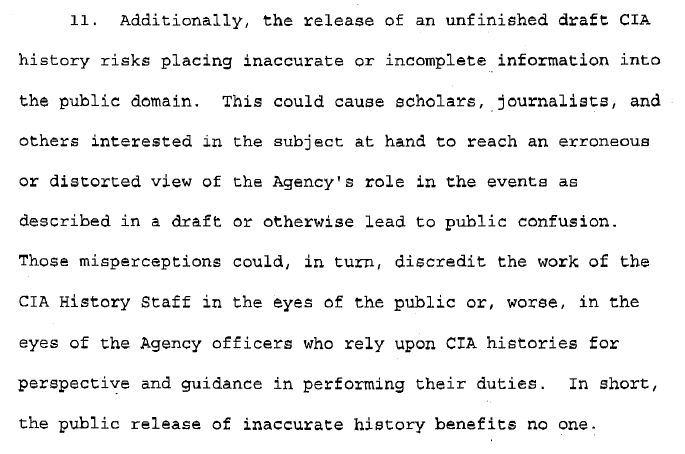
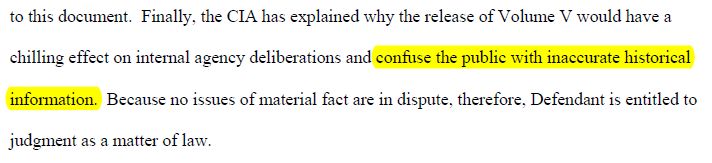
Late last year, the Central Intelligence Agency explained to Judge Kessler of the US District Court in Washington DC that releasing the final volume of its three-decade-old history of the 1961 Bay of Pigs debacle would “confuse the public,” and should be withheld because it is a “predecisional” document. Wow. And I thought that I had heard them all.
On the 50th anniversary of the Bay of Pigs invasion, the National Security Archive filed a Freedom of Information Act lawsuit for the release of a five-volume CIA history of the Bay of Pigs affair. In response to the lawsuit, the CIA negotiated to release three volumes of the history — the JFK Assassination Records Review Board had already released Volume III– with limited redaction, currently available on the National Security Archive’s website. At the time, the Director of the National Security Archive’s Cuba Documentation project, Peter Kornbluh, quipped that getting historic documents released from the CIA was “the bureaucratic equivalent of passing a kidney stone.” He was right. The Agency refused to release the final volume of this history, and the National Security Archive is not giving up on the fight.
 Keet it secret!
Volume five of the history, written by CIA historian Jack Pfeiffer –who sued the CIA himself to release the history in 1987, and lost– is described by the CIA as an “Internal Investigation document” that “is an uncritical defense of the CIA officers who planned and executed the Bay of Pigs operation… It offers a polemic of recriminations against CIA officers who later criticized the operation and against those U.S. officials who its author, Dr. Pfeiffer, contends were responsible for the failure of that operation.”
While Dr. Pfeiffer’s conclusions may or may not be true, FOIA case law appears to be pretty clear that Americans –who funded the operation and Dr. Pfeiffer’s histories– have the right to read this document and decide for themselves its merits. Despite the claims of the CIA’s chief historian David Robarge, the document should not remain in the CIA vaults because its conclusions “could cause scholars, journalists, and others interested in the subject at hand to reach an erroneous or distorted view of the Agency’s role.” Historians, after all, are well trained in treating documents –especially CIA hagiographies sources– skeptically.
To prevent the public from reading this volume, the CIA has argued that because it is a draft, it is a predecisional document and can be denied under exemption b(5) of the FOIA. Except –as Davis Sobel, counsel to the National Security Archive points out in our motions– the case law states otherwise.
President Obama instructed every agency (yes, even the CIA) to “usher in a new era of open government” and apply a “presumption of disclosure… to all decisions involving FOIA.” In response to this instruction, the Department of Justice Office of Information Policy –responsible for enforcing FOIA throughout the government– issued its own guidance to agencies (yes, even the CIA), explaining:
“A requested record might be a draft, or a memorandum containing a recommendation. Such records might be properly withheld under Exemption 5, but that should not be the end of the review. Rather, the content of that particular draft and that particular memorandum should be reviewed and a determination made as to whether the agency reasonably foresees that disclosing that particular document, given its age, content, and character, would harm an interest protected by Exemption 5. In making these determinations, agencies should keep in mind that mere “speculative or abstract fears” are not a sufficient basis for withholding. Instead, the agency must reasonably foresee that disclosure would cause harm…
For all records, the age of the document and the sensitivity of its content are universal factors that need to be evaluated in making a decision whether to make a discretionary release.” *
As the D.C. circuit recognized, “the Supreme Court has pointed out that the ‘expectation of the confidentiality of executive communications [] has always been limited and subject to erosion over time…”” (Judicial Watch, Inc. v. U.S. Dep’t of Justice (D.C. Cir. 2004.)
Even presidential records are barred from being withheld under “predecisional pretenses” after a period of time. The Presidential Records Act expressly states that exemption b(5) cannot be invoked to withhold records once the president has been out of office twelve years. If the presidential communication and work process is not threatened by this provision, there is no reason that the CIA’s history staff should be.
And there is a good chance that the history is not even a predecisonal document. The burden rests on the CIA to point to the specific decision that the history is “decides” to make it a predecisional document. And so far they have not. Their case rests on the speculative and abstract fear of “discrediting[ing] the work of the CIA History Staff in the eyes of the public or, worse, in the eyes of the Agency officers who rely upon CIA histories.”
Even if parts of the document truly are predecisional, only they can be withheld, the facts leading up to that decision –and histories are (hopefully) based primarily on facts– must be released.
To wit, draft histories have frequently been released under FOIA. In 2010, the Department of Justice released portions of pages of a candid history of Nazi-hunting (and Nazi-protecting) clearly marked DRAFT. (The unredacted version of the report was subsequently leaked– no prosecution by the Obama administration for that one… yet.) Moreover, the CIA previously disclosed Volume IV of this history in draft form (with a disclaimer)! This final volume to the CIA’s history remains one of the few –perhaps the only– government produced product chronicling the doomed invasion which remains classified; the public should be allowed to see its contents.
 “Trust us. You don’t need to read it for yourselves.”
The National Security Archive’s case is a strong one. I’m confident that Judge Kessler will require a de novo review of the document leading to its eventual release.
On the other hand, the CIA’s “confuse the public” defense appears is as weak as it is insulting.
—————————
*It’s certainly not clear why DOJ attorneys would agree to argue this case for the CIA, especially after Eric Holder sent a government-wide memo which promised to defend denials of FOIA requests only when disclosures would truly harm agency interests. What is more clear is the reason why many agencies have failed to implement the Obama FOIA reforms –the Department of Justice has done a poor job implementing them within its own divisions, and the DOJ Office of Information Policy has done a poorer job forcing other agencies to comply with the law.
As the Archive’s counsel David Sobel put it, “This case is yet the latest example of the Obama administration failing to deliver on its promise of ‘unprecedented’ transparency. It’s hard to understand how the release of this document, after all these years, could in any way harm legitimate government interests.””
Related articles
- Document Friday: Che Guevara Thanks the United States for the Bay of Pigs Invasion. (nsarchive.wordpress.com)
- CIA won’t disclose involvement in OWS crackdowns (rt.com)
- Under Obama, the Freedom of Information Act is Still in Shackles (eff.org)
- FBI Sanctioned for Lying About Existence of Surveillance Records (alethonews.wordpress.com)
- Obama Regime Seeks Permission To Lie In Response To Freedom Of Information Requests – Even To The Courts (alethonews.wordpress.com)
- ACLU Sues U.S. for Information on Targeted Killing Program (newsworldwide.wordpress.com)
- The CIA, Cuba and Operation Peter Pan (alethonews.wordpress.com)
Foolishly Ignoring the Arab League Report on Syria
On December 19, 2011 the Syrian Arab Republic and the Arab League signed a protocol establishing an observer mission that would lead efforts to resolve the conflict in Syria and protect civilians in the process.
Almost immediately afterward, once-staunch advocates of this Arab League “intervention” in Syria began efforts instead to undermine the mission’s efforts.
Before inking the final deal, an Arab League official had warned me that certain member states – Qatar, most prominently – were setting up conditions that would preclude the participation of the Syrian government. But intense shuttle diplomacy at the eleventh hour produced a breakthrough: the mission was approved by the two parties, and the disappointed spoilers launched a public relations blitz to cast doubt on the mission’s participants, the Arab League’s capabilities and the investigation’s discoveries.
For the last month, we have heard allegations fly riotously about the Sudanese Head of Mission Lieutenant General Mohamed Ahmed Mustafa al-Dabi, now suddenly accused of war crimes. Rumors abounded about mission observers quitting their posts because of the “horrific” nature of the Syrian government’s onslaught against its civilians. International NGOs and a slew of western politicians even offered to “train” the mission observers – implicitly suggesting that Arabs lack observation and negotiation capabilities, or worse perhaps, that the observers need to be taught to view the Syrian conflict through external lenses.
It was hard to doubt these rumors entirely. The Arab League has, after all, refused to make the final monitors’ report available to the general media. But the report has suddenly popped up as an annex to the UN resolution on Syria currently being hotly debated at the Security Council. Most puzzling though, is that few Western or Arab journalists congregated at the United Nations this week are drawing attention to this critical document that provides insight into the very events contested at Council sessions.
Mission Report: The Good, Bad and Ugly
The full monitor’s report of the Arab League, as revealed here, refers in several instances to efforts aimed at undermining the mission and its activities:
“Since it began its work, the Mission has been the target of a vicious media campaign…that increased in intensity after the observers’ deployment. Some media outlets have published unfounded statements, which they attributed to the Head of the Mission. They have also grossly exaggerated events…Such contrived reports have helped to increase tensions among the Syrian people and undermined the observers’ work. Some media organizations were exploited in order to defame the Mission and its Head and cause the Mission to fail.”
The effort to “defame” the mission – ostensibly by opponents of the Syrian government – is a strange one. The report – while short – is professionally written, detailed, and highlights the difficulties inherent in covering a hard-fought conflict. It also criticizes the Syrian regime’s actions and shortcomings in sticking to the protocol and protecting civilians:
“On being assigned to their zones and starting work, the observers witnessed acts of violence perpetrated by Government forces and an exchange of gunfire with armed elements in Homs and Hama. As a result of the Mission’s insistence on a complete end to violence and the withdrawal of Army vehicles and equipment, this problem has receded.”
On the critical issue of political detainees, the report states:
“On 19 January 2012, the Syrian government stated that 3569 detainees had been released from military and civil prosecution services. The Mission verified that 1669 of those detained had thus far been released. It continues to follow up the issue with the Government and the opposition, emphasizing to the Government side that the detainees should be released in the presence of observers so that the event can be documented.” The report also verifies that an additional 3,843 detainees were released before Syrian President Bashar Assad issued a general amnesty decree on January 15. The government claims the number is 4,035.
But then the report veers sharply away from conventional narratives about the nature of the Syrian conflict by observing: “The Mission determined that there is an armed entity that is not mentioned in the protocol.”
Though the report attributes this development “to the excessive use of force by Syrian Government forces in response to protests,” it also points out that “in some zones, this armed entity reacted by attacking Syrian security forces and citizens, causing the Government to respond with further violence.”
The report then provides several examples of this:
“In Homs and Dera‘a, the Mission observed armed groups committing acts of violence against Government forces, resulting in death and injury among their ranks. In certain situations, Government forces responded to attacks against their personnel with force. The observers noted that some of the armed groups were using flares and armour-piercing projectiles.”
“In Homs, Idlib and Hama, the Observer Mission witnessed acts of violence being committed against Government forces and civilians that resulted in several deaths and injuries. Examples of those acts include the bombing of a civilian bus, killing eight persons and injuring others, including women and children, and the bombing of a train carrying diesel oil. In another incident in Homs, a police bus was blown up, killing two police officers. A fuel pipeline and some small bridges were also bombed.”
Media Coverage and Access In Syria
Notable too is the mission report’s contention that media reports on incidents of violence in Syria are often exaggerated and unverified:
“The Mission noted that many parties falsely reported that explosions or violence had occurred in several locations. When the observers went to those locations, they found that those reports were unfounded. The Mission also noted that, according to its teams in the field, the media exaggerated the nature of the incidents and the number of persons killed in incidents and protests in certain towns.”
The report also addresses criticism that the Syrian government restricts media access both into Syria and into the country’s hot spots. Complaints varied from media being allowed into the country for an insufficient “four days” to the regime demanding cumbersome “destination” itineraries, “operating permits” and “movement restrictions.”
The report provides a list naming the various individual journalists and media organizations entering Syria during the mission’s mandate, and concludes: “The Government had accredited 147 Arab and foreign media organizations. Some 112 of those organizations entered Syrian territory, joining the 90 other accredited organizations operating in Syria through their full-time correspondents.”
I should note that I was in Syria doing research for some articles during the mission’s investigations and that I am not on the list. While my own visa was arranged through a connected non-Syrian friend, I know of other writers who entered the country without incident. I spent my time there freely interviewing many opposition groups and individuals and was at no time accompanied by government minders – or monitored, to the best of my knowledge.
Less fortunate was Gilles Jacqiuer, the France 2 Channel cameraman who was killed during a visit to a pro-regime neighborhood in Homs. The French government has loudly sought to implicate the Syrian government in this killing, but the mission says that “mission reports from Homs indicate that the French journalist was killed by opposition mortar shells.”
The report also refers to controversial statements made by several monitors who abandoned their positions and publicly criticized the mission afterward. Probably the most memorable of these is Algerian Anwar Malek who famously claimed on Al Jazeera: “What I saw was a humanitarian disaster…The regime is not just committing one war crime, but a series of crimes against its people. The snipers are everywhere, shooting at civilians. People are being kidnapped. Prisoners are being tortured and none were released.”
The Arab League released a terse statement in response, saying Malek’s allegation “does not relate to the truth in any way,” and claiming instead, that “since he was assigned to the Homs team, Malek did not leave the hotel for six days and did not go out with the rest of the team into the field giving the excuse that he was sick.”
The report further expounds: “Some observers reneged on their duties and broke the oath they had taken. They made contact with officials from their countries and gave them exaggerated accounts of events. Those officials consequently developed a bleak and unfounded picture of the situation.”
Mission Success or Failure?
The report concludes with some pessimism: because of early logistical and other difficulties, the mission only actually operated for 23 days out of its month-long mandate. There is a need for better transportation, communication equipment – and most importantly – the necessary “media and political support” to complete its mandate.
On a positive note, the mission stresses that the Syrian regime “strived to help it succeed in its task and remove any barriers that might stand in its way. The Government also facilitated meetings with all parties. No restrictions were placed on the movement of the Mission and its ability to interview Syrian citizens, both those who opposed the Government and those loyal to it.”
Most critically, however, the report recommends a change in the Protocol’s mandate, namely, the “commitment of all sides to cease all acts of violence.” This, for the first time, introduces the notion that the Syrian government may not be entirely responsible for the civilian casualty numbers flaunted in media reports. And it is an important point – regular soldiers reportedly account for approximately 2,000 deaths in the country since March 2011.
But the observers warn: “Recently, there have been incidents that could widen the gap and increase bitterness between the parties. These incidents can have grave consequences and lead to the loss of life and property. Such incidents include the bombing of buildings, trains carrying fuel, vehicles carrying diesel oil and explosions targeting the police, members of the media and fuel pipelines. Some of those attacks have been carried out by the Free Syrian Army and some by other armed opposition groups.”
The “citizens” of Syria with whom they met – some of whom suffer from “extreme tension, oppression and injustice” – “believe the crisis should be resolved peacefully through Arab mediation alone, without international intervention. Doing so would allow them to live in peace and complete the reform process and bring about the change they desire.”
This is a narrative that is entirely missing in the mainstream media’s coverage of the Syrian crisis. The complicity of armed groups in escalating the violence initially started by the Syrian government; the compliance of the regime in advancing the Arab League Protocol’s demands; the rejection by ordinary citizens of internationalizing and militarizing the conflict.
Read the mission report. Conclude what you will. But admit that possibly the worst thing that can be done at this critical juncture is to suspend the Arab League mission’s investigations and interventions. If the mission is halted, civilians will lose protection in this conflict, facts will be hard to come by, and intermediaries on the ground in Syria will be nonexistent. Violence escalated after the mission took its leave to file the report. Inserting them back into the ring is unarguably the right course of action, particularly as it appears the UN Security Council is, today, at an impasse.
Sharmine Narwani is a commentary writer and political analyst covering the Middle East. You can follow Sharmine on twitter @snarwani.
Related articles
- Arab Observer Chief Satisfied: “Allegations against Syria Mission Untrue” (alethonews.wordpress.com)
Settlers Install New Outpost Near Hebron
By Saed Bannoura | IMEMC & Agencies | February 03, 2012
A group of fundamentalist Israeli settlers installed a new illegal settlement outpost, south of the southern West Bank city of Hebron, on Friday while another group of armed settlers invaded areas in Beit Ummar town, north of Hebron.
Rateb Jabbour, coordinator of the National Committee Against the Wall and Settlements, reported that approximately 250 settlers, accompanied by Israeli Border Police officers, invaded that Al-Carmel village, and installed six new caravans in Um Ash-Shuqhan area, near the Maoun illegal outpost that was installed on privately-owned Palestinian lands.
In related news, Yousef Abu Maria, media spokesperson of the National Committee Against the Wall and Settlements in Beit Ummar, stated that approximately 150 settlers attacked Palestinian farmlands in Za’ta area, east of Beit Ummar, and blocked the Jerusalem-Hebron road in front of Palestinian traffic.
According to Abdul-Hadi Hantash, a Palestinian expert on Maps and Settlements, that recent escalation is part of a larger plan that aims at installing more outposts, and expanding existing ones, by stealing more Palestinian lands.
Hantash added that settlers are stealing Palestinian lands in Um Ash-Shuqhan area, and installing new outposts, so that they can create a geographical contiguity by linking the new outposts with the settlements of Ma’oun, Karmiel, Havat Yair, Avigayil, and Susyia. All are illegal outposts built on privately-owned Palestinian lands.
The official further stated that Israel is implementing an agenda that aims at isolating the Palestinians in Hebron by the illegal Annexation Wall and the chain of settlements and outposts built on the hills of the Hebron district.
“Israel wants to force the Palestinians out of their homes and lands, wants them to leave”, Hantash added, “But the residents are determined to remain steadfast in their homes, lands”.
Related articles
- Official: Israeli settlers tour Beit Ummar (altahrir.wordpress.com)
- Settlers torch cars in Beit Ummar (alethonews.wordpress.com)
- An exclusive corner of Hebron (arunwithaview.wordpress.com)
- Demanding justice for Yousef, a quiet boy killed by Israeli settlers (alethonews.wordpress.com)
- Palestine: Even Sheep Are Not Safe from Jewish Settlers (alethonews.wordpress.com)
Kufr ad-Dik and Burqin march against boars, pollution, and violence by Israelis
International Solidarity Movement, West Bank | 3 February 2012
Burqin and Kufr Ad-Dik face daily obstructions in justice as nearby illegal Zionist settlements encroach on the livelihood of local Palestinians. The villages are surrounded by several hilltop illegal settlements and industrial sites with polluting factories and an army base.
“This is a microcosm of Palestinian suffering” stated a resident upon the arrival of International Solidarity Movement volunteers.
Burqin and Kufr Ad-Dik are under siege by settlers and soldiers. The villages are situated in Areas B and C as stipulated by the Oslo Agreement and sit dangerously close to the 1948 Green Line. Burqin has approximately 4000 residents which include many refugees from Al Nakba, or the Catastrophe, known to Palestinians when they faced exile from their villages in 1948 at the creation of Israel.

Kufr ad-Dik face to face with their oppressor
The village relies on small scale agriculture for its existence. The Israelis from the illegal settlements know this and routinely destroy Palestinian crops often by burning olive trees as part of the extremist “Price Tag Campaign.” They have also released wild boars from their settlements which eat Palestinian crops and are very dangerous, especially to the young of the villages. In an act of callousness the settlers destroyed a newly bought piece of farm machinery about two weeks ago. During this attack they also burned a car and unsuccessfully firebombed the local mosque, leaving threatening graffiti that they will be back.
While a local place of worship, graffiti, and vandalism seem like small offenses, one must keep in mind that these are systematically done to pressure the villages into abandoning what is left of their homes.
As with many of the Palestinian villages who have suffered the injustice of having their lands stolen by Israel in order to build illegal settlements, which continue to expand, Burqin and Kufr Ad-Dik are forced to endure regular attacks from the illegal occupants of their land as well as harassment by the Israeli military. The settlers, soldiers and Israeli government, which is benefiting from and funding the existence of these illegal settlements work cooperatively to forcibly remove Palestinians from their land.
There is an industrial estate, situated on top of a hill, which houses several severely polluting factories. These factories could not gain a license to be constructed inside of Israel due to the pollution that will be created, but they were granted permission by the Israeli government to be built within the West Bank illegally under international law. The waste from these factories is channeled in an open sewer through the villages.
Since the factories began polluting there has been a sharp rise in health problems within the village including an anomaly in cancer cases. A German charity volunteered to pay for the sewer to be covered and managed.
Permission to build this cover was flatly denied by the Israelis. The pollution from the factories has severely affected the surrounding land causing trees to die, crops to fail, and the meat from animals grazed on the land cannot be sold due to fear of contamination.
According to an article published by the Baheth Center for Strategic and Palestinian Studies, information on the size and power of these factories is not available to local Palestinians. In an article published by the Baheth center, they describe the extent of the factory waste:
The waste water and solid waste these industries produce, provide important clues about the type and extent of industrial activity… Clear evidence that Israeli factories operating in the Occupied Territories do not follow pollution prevention measures is provided by the Barqan industrial zone, which houses factories producing aluminum, fiberglass, plastic, electroplating, and military items. Industrial waste water from this zone flows untreated to the nearby valley, damaging agricultural land belonging to the Palestinian villages of Sarta, Kufr Al-Deek, and Burqin, and polluting the groundwater with heavy metals.
Unemployment is now very high in the villages since much of the land has been taken by settlers and the military. To add insult to the pollution inflicted on the villages, the Palestinians are banned from working the factories surrounding them. With more land being taken away every day, unemployment and poverty continue to rise. Yesterday an army order was issued to take another 60 dunums (1000m squared = 1 dunum) for “military purposes.” Farmers are now collating deeds to their lands in an attempt to argue their case in court.
Burqin has lost over 8000 dunums to the illegal occupation, most of which was stolen in the last 10 years. The land theft is sharply on the increase. The farm land that is left is still extremely dangerous to farm due to settler attacks and the threat of wild boars.
Not satisfied with attacking the food production, the Israelis have destroyed several wells, which are vital to the well-being of the villagers. The illegal settlers have commandeered most of the water supply leaving the Palestinians with critically low access to clean water. A recent study found that the average settler uses 18 times that of one Palestinian villager.
In addition to the destruction of wells several homes have been demolished including a home that the owner worked for 30 years to save enough to build.
Leaving or reentering the villages is high risk as settlers will often throw rocks at Palestinian cars. If the villagers successfully run the gauntlet they then have to pass through harassing Israeli Army checkpoints.
The villages have just started a weekly protest against their oppression in Kufr Ad-Dik. This was met last week with tear gas and steel bullets thinly coated with rubber leaving 10 villagers wounded.
The protest will continue every Friday.
Related articles
- West Bank village steps up protests against Israel’s theft of land (alethonews.wordpress.com)
- 13 injured in Nabi Saleh demonstration (alethonews.wordpress.com)
- Anata falls victim to militarized, illegal settlement once again (alethonews.wordpress.com)
New thinking in India’s Iran policy
By M K Bhadrakumar | Rediff | February 2, 2012
Finally, India is getting its act together in its Iran policy. The ‘breaking news’ that India proposes to robustly explore expanding its trade with Iran signals a new approach to stepping up oil imports from Iran while at the same time rectifying the imbalance in trade, which heavily favours Iran traditionally, and to make this happen within a paradigm that resolves the current problem over the payment mechanism.
The new thinking is an acknowledgement of Iran’s importance as a strategic partner. That is where the rub lies. Delhi has lumped far too long the blackmail tactic by Washington with the malicious intention to erode India’s ties with Iran. Indeed, as result, for no real fault of Tehran, the India-Iran relationship suffered needless setbacks in the recent years.
Delhi should never accept that this is a zero sum game – India’s relationships with the US and Iran respectively. Iran is far too important a regional power in India’s extended neighbourhood to be neglected. There is no need to dilate on this thought.
Other Asian countries like Japan, South Korea or Malaysia have successfully managed to have positive relationships with both Iran and the GCC states. Also, GCC states themselves have maintained highly nuanced relationships with Iran. In a long term perspective, it is far from inevitable that Iran’s rise is an irreconcilable eventuality for the GCC states.
Much of the present-day tensions in the Persian Gulf is also to be attributed to the imperial policy of ‘divide-and-rule’ that the West continues to pursue in the region for the sake of perpetuating their hegemony. Finally, the US-Iran standoff itself is increasingly becoming unsustainable if Washington is to optimally develop a regional strategy. The point is, Iran has already bolted away.
China sees all these trends very clearly and is successfully developing a multi-tiered regional strategy that creates space for pursuing fruitful relations with Iran and GCC – and even Israel – alike.
Indeed, it is also best for a healthy US-India partnership that it is an equal relationship where neither side takes undue advantage or tries to browbeat or resorts to prescriptive approaches and arm-twisting. In this case, the US policy toward Iran also happens to be vacuous, lacking sincerity of purpose; it is opaque and brittle – and increasingly, US comes to realise that even its European allies are reluctant to follow its lead. Therefore, it is simply appalling that US has chosen to harbour expectations of dictating to Delhi the directions and content of its Iran policy.
Of course, the American side is not to bear the entire blame, either. Somehow, the Indian elites (including bureaucrats) and strategic pundits have come to develop an atavistic fear that US-Indian partnership is highly perishable unless Delhi keeps harmonising its policies with the US global strategies even by sacrificing its interests. This sort of inferiority complex is completely unwarranted.
The heart of the matter is that the US is a highly experienced practitioner of diplomacy. If it began abandoning its historic cussedness toward India sometime during Bill Clinton administration’s second term, it was because Washington saw the growth potential of India and the great possibilities that would arise for a beneficial relationship.
Even today, that consideration is the prime mover of the US polices toward India. It is a well-known fact that after being grumpy for a few weeks after India spurned the US offer for the 10-billion dollar multi-purpose aircraft tender, Washington moved on.
We could also learn from the Americans – how doggedly they keep pursuing their regional strategies through the Afghan endgame, no matter what Delhi thinks of it. Suffice to say, the high probability is that India’s Iran policy may displease Washington for a while and then life will move on. As for the fear complex of the Indian elites or pundits, it is borne more out of their own insecurities vis-a-vis the US establishment and it should remain their private affair.
Related articles
- Washington Wages War of Sanctions against Iran (alethonews.wordpress.com)
- India won’t scale down petroleum imports from Iran: Pranab (thehindu.com)
Zionist plan to build a shopping centre on Armenian Church land
Palestine Information Center – 03/02/2012
OCCUPIED JERUSALEM — The Jerusalem occupation municipality announced a plan to build a new shopping centre with a car park on a piece of land that is owned by the Armenian Church in the old city.
The municipality further banned residents of the Armenian quarter in the old city from parking their cars on the land which is owned by the church.
Residents of the Armenian quarter demonstrated on Thursday to protest the steps taken by the municipality, but the demonstration was dispersed by the Israeli occupation police.
The land which is about 4000 square meters and which is owned by the Armenian Church was used by local residents as a free car park, but the locals were surprised when the so called Jewish quarters committee started collecting parking fees, and now barred them altogether from parking their cars there.
Related articles
- Zionist plan to build 60,000 settlement units in Jerusalem (alethonews.wordpress.com)
13 injured in Nabi Saleh demonstration
Ma’an – 03/02/2012
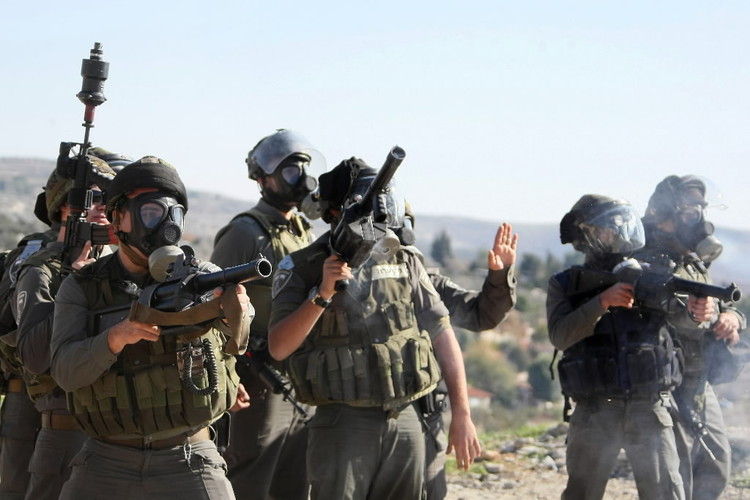 BETHLEHEM – Israeli forces injured 13 people in the village of Nabi Saleh, near Ramallah, during a Friday demonstration against Israeli land confiscation, witnesses said.
A French national sustained an injury from a tear-gas canister, activists said. She was taken to a hospital in Ramallah and her injury was described as moderate, they said.
Maj. Peter Lerner of the Israeli army suggested the injury was actually caused by a Palestinian stone-thrower. Israeli border police were injured at the same “riot,” he wrote on Twitter.
Palestinian residents of Nabi Saleh and their local and international supporters demonstrate each week against a nearby settlement’s encroachment toward lands owned by the village.
In December 2011, a tear-gas canister killed Mustafa Tamimi, a resident of the village.
Related articles
- We Are Nabi Saleh, a new film capturing people’s struggle, Mustafa Tamimi (alethonews.wordpress.com)
- Protester seriously hurt by gas canister (alethonews.wordpress.com)
- Palestinian protester severely injured in Nabi Saleh (alethonews.wordpress.com)
- Live sniper-fire injures protester in Nabi Saleh (alethonews.wordpress.com)
- Confronting Occupiers in Nabi Saleh (alethonews.wordpress.com)
- Nabi Saleh Protest Organizer Shot in Face at Weekly Protest (alethonews.wordpress.com)
Featured Video
Theodore Postol: Iran’s Missiles & Drones Were Underestimated
or go to
Aletho News Archives – Video-Images
From the Archives
What is the Israeli Lobby in Australia Doing in Interfaith Dialogue?
By Ali Kazak | Dissident Voice | October 11, 2015
For years Israel and its lobby around the world have been trying to normalise their relations with Arabs and Muslims without solving the Palestine Question.
One of the methods they resorted to in the last few years is using human rights and community organizations such as interfaith dialogue and Multiculturalism to achieve this objective and to: isolate the Palestinians, marginalise the Palestine question, end Israel’s isolation, and prevent criticism of Israel, knowing that these organisations will be the first to stand against Israel’s violations, racial and religious discrimination.
The group responsible for this task in Australia is The Australia/Israel & Jewish Affairs Council (AIJAC); its Director of International & Community Affairs, Jeremy Jones is in charge of lobbying religious community organizations, specifically Muslims and Christians. Consequently he convened the Faith Communities for Reconciliation, founding participant in the Australian Partnership of Religious Organisations and the Australian National Dialogue of Christians, Muslims & Jews.
AIJAC is a private political propaganda group. It is recognised as the main Israeli lobby in Australia. It coordinates its activities and works intimately with the Israeli embassy in Canberra and different institutions in Israel. It is privately funded by some Jewish businessmen. It monitors closely Australian politicians, the media, ethnic and religious groups, (especially Arabs and Muslims), unions and academics on their stands towards Israel and the Palestine question. … continue
Blog Roll
 Aletho News
- The Most Important Bet You’ve Never Heard Of
- The killing of three Indonesian soldiers in Lebanon should remind Jakarta that Israel does not want peace
- Defeated and delusional: Netanyahu’s remarks reveal $80bn war failure, says analyst
- Iran’s friends are about to make life much more difficult for Israel and the US
- The war of liberation of the Arab and Islamic peoples expands across the Gulf
- Envoy warns UN on Trump’s threat to ‘obliterate’ Iran’s civilian infrastructure
- The Larak Corridor: Iran’s Rial Gate With No US, No Israel, and No Way Around
- ‘Economic terrorism’: Steel facilities hit again in US-Israeli strike
- ‘War Crime’: Iran condemns attacks on Arak, Ardakan nuclear sites
- Two-thirds of Americans want quick end to Iran war even if goals unmet
- If Americans Knew
- Gaza families reunite years after babies evacuated amid Israel’s war
- International Rescue Committee warns Gaza’s children face grave protection risks
- Iran’s Alleged 47-Year War on America: Debunking the 1,050 American Deaths Canard
- Israel wants US to bomb more of Iran’s civilian structures (113,000 is not enough) – Not a ceasefire Day 173
- Ann Coulter Rips Into Fox News for Iran War Coverage
- Joe Kent Urges Americans To Call White House and Congress To Object To Sending Troops Into Iran
- DNC Resolution to Reject AIPAC Funding Puts Democratic Leaders in the Hot Seat
- Swedish foundation to build 400 schools as over 650,000 Gaza children remain without education for 2 years
- Israeli army admits photshopping image of slain Lebanese journalist
- This is how Israel is systematically killing health workers under the cover of war in Lebanon
- No Tricks Zone
- New Study Finds Warming Saves Lives…Cold Temperatures 12 Times More Deadly Than Excess Heat
- German Science Blog Accuses PIK Climate Institute Of Hallucinating Climate Tipping Points
- Devastating Assessment Of Comirnaty Vaccine By Former Senior Pfizer Europe Toxicologist
- New Study: CO2 Is ‘Effectively Negligible’ As An Explanatory Climate Change Factor Since 2000
- Former Pfizer Toxicologist Dr. Helmut Sterz Tells Bundestag Hearing Pfizer Vaccine Should Have Never Been Approved
- Energy Expert: Germany’s Nuclear Phaseout Was A “500 Billion Euro Mistake”
- New Research: South Australia’s Mid-Holocene Sea Surface Temperatures Were 4°C Warmer Than Today
- Storing Green Energy To Last Germany 10 Days Would Require A 60-Million Tonne Battery
- New Studies: UK Sea Levels Were 4 Meters Higher Than Today During The Mid-Holocene
- Destructive Green New Deal: German Energy And Metal Group Warns Of Drastic Crisis
 Aletho News