Evidence in British court contradicts CIA drone claims
By Chris Woods | The Bureau of Investigative Journalism | April 24th, 2012
A major case in the British High Court has revealed fresh evidence of civilian deaths during a notorious CIA drone strike in Pakistan last year.
Sworn witness testimonies reveal in graphic detail how the village of Datta Khel burned for hours after the attack. Many of the dozens killed had to be buried in pieces.
Legal proceedings were begun in London recently against British Foreign Secretary William Hague, over possible British complicity in CIA drone strikes.
Britain’s GCHQ – its secret monitoring and surveillance agency – is reported to have provided ‘locational evidence’ to US authorities for use in drone strikes, a move which is reportedly illegal in the United Kingdom.
Sworn affidavits
The High Court case focuses in particular on a CIA drone strike in March 2011 which killed up to 53 people.
Sworn affidavits presented in court and seen by the Bureau offer extensive new details of a strike the CIA still apparently claims ‘killed no non-combatants’.
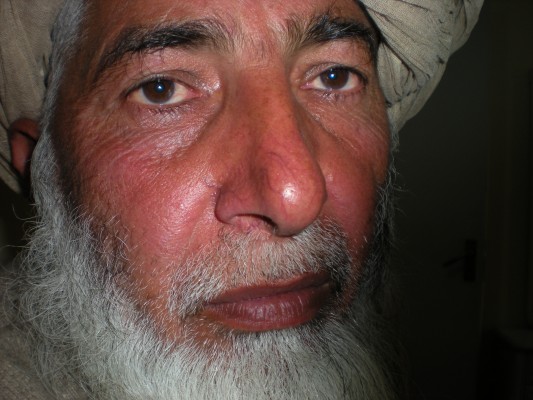 Ahmed Jan (pictured) is a tribal elder in North Waziristan. On March 17 2011 he was attending a gathering with other village elders, to discuss a mining dispute.
‘We were in the middle of our discussion when the missile hit and I was thrown about 24 feet from where I was sitting. I was knocked unconscious and when I awoke I saw many individuals who were dead or injured,’ he says in his affidavit.
Most of those who died in Datta Khel village that day were civilians. The Bureau has so far identified by name 24 of those killed, whilst Associated Press recently reported that it has the names of 42 civilians who died that day.
Pakistan’s president, prime minister and army chief all condemned the Datta Khel attack. A recent Bureau investigation with the Sunday Times quoted Brigadier Abdullah Dogar, who commanded Pakistani military forces in the area at the time.
We in the Pakistan military knew about the meeting, we’d got the request ten days earlier. It was held in broad daylight, people were sitting out in Nomada bus depot when the missile strikes came. Maybe there were one or two Taliban at that Jirga – they have their people attending – but does that justify a drone strike which kills 42 mostly innocent people?
Yet the US intelligence community has consistently denied that any civilians died.
Last year an anonymous US official told the New York Times: ‘The fact is that a large group of heavily armed men, some of whom were clearly connected to al Qaeda and all of whom acted in a manner consistent with AQ [Al Qaeda] -linked militants, were killed.’
The sworn affidavits seen by the Bureau offer a very different perspective. Imran Khan’s father Ismail was another of the elders who died that day. Imran says of his father: ‘He always did the right thing for the community and the tribe. He opposed terrorism and militancy and was not himself in any way connected to these things.’
Khalil Khan’s late father Hajji Babat was a local policeman who was ‘not an enemy of the United States of America or any other country.’ His son describes in his affidavit how he rushed back to his village to find his father dead, the bus station and surrounding buildings still burning six hours after the drone strike.
And Fateh Khan, who once worked for British Telecom, lost his 25-year old nephew Din Mohammed in the CIA attack. He reports that his nephew’s body had to be buried in pieces, and that ‘he left behind four children, all of whom now live in my house. His eldest child is currently only five years old.’
‘Absolute lie’
The most senior tribal elder to die that day was Daud Khan. Initially he was claimed to have been a senior Taliban figure. His son Noor told the Bureau that this was ‘an absolute lie’.
‘My father was not a militant but an elder who was working day and night for his people. There have been many children who have been killed in drone strikes. I ask the US if they think those children were militants and combatants and dangerous enough to be killed in such a manner?’
The CIA declined to comment when asked whether it still believed it had killed no ‘non-combatants’ in Pakistan since May 2010, or that no civilians died in Datta Khel last year.
In London, legal campaigners are seeking a judicial review in the High Court – a process by which senior judges can question and even overturn any government policy on aiding US drone strikes.
The case is being brought by legal charity Reprieve, and by the Islamabad-based lawyer Shahzad Akbar and the Foundation for Fundamental Rights, which focuses on civilian victims of CIA drone strikes in Pakistan.
The British government is understood to have firmly challenged the grounds of the case on a number of fronts.
Follow @chrisjwoods on Twitter
Related articles
- Hague to be sued for aiding US drone attacks in Pakistan (alethonews.wordpress.com)
- The cost and consequences of exposing the drone wars (alethonews.wordpress.com)
- “Drones also targeting mourners and rescuers” (alethonews.wordpress.com)
- NYT Lets Nameless Official Smear Drone Researchers as Al-Qaeda Fans (alethonews.wordpress.com)
- The boy sitting with me in these photos was protesting against deadly US drone strikes… Three days later he was killed ¿ by a US drone, says Jemima Khan (dailymail.co.uk)
- White House OKs broad Yemeni drone drive (upi.com)
Jewish settlers attack village, block Nablus road
Ma’an – 26/04/2012

Settler attacks are common and rarely prosecuted
NABLUS – Settlers in the northern West Bank set up a roadblock and attacked a Nablus village on Thursday, a PA official said.
Ghassan Daghlas, who monitors settler activity in the northern West Bank, said that settlers blocked a main road that links the West Bank town of Huwwara to Tulkarem and Qalqiliya.
Settlers prevented Palestinian vehicles from passing through, causing a large traffic jam. Around 12 settlers also attacked the village of Urif in Nablus, clashing with local villagers.
Witnesses said the Israeli army was present during the incident but fired tear gas at the villagers.
In 2011, the UN Office for the Coordination of Humanitarian Affairs reported that settler attacks had increased by 50 percent on the previous year.
The Nablus district experienced the majority of settler violence in 2011.

Source: When Settlers Attack, The Palestine Center, 2012
Related articles
- Settlers ‘block entrance’ to Nablus village (alethonews.wordpress.com)
- Israeli settlers injure three Palestinians, uproot dozens of olive trees in two separate incidents (alethonews.wordpress.com)
- Impunity Under the Law: Settler attack in Jabari neighborhood (alethonews.wordpress.com)
- Fadi Abu Zeitoun, killed as settlers attacked farmers (alethonews.wordpress.com)
- Soldier, 2 Female Settlers, Arrested For Writing Racist Graffiti (alethonews.wordpress.com)
Israel Censors Bob Simon’s Report on Palestinian Christians
Al-Manar | April 26, 2012
During Sunday night’s episode of “60 Minutes,” reporter Bob Simon’s story on Arab Christians included a heated confrontation between himself and the Zionist ambassador to the United States Michael Oren.
The “60 Minutes” story tackled the displacement of Palestinian Christians by the Zionist Occupation of the West Bank and East Jerusalem.
Oren also called Simon’s report “outrageous” and “incomprehensible,” and reportedly called Jeff Fager, the chairman of CBS News, before the broadcast and said he had information the “60 Minutes” story was “a hatchet job.” He was concerned that the piece was critical of the Zionist entity and could harm its reputation among American Christians.
In its report, Simon told Americans that there are Palestinian Christians, and the Right wing Zionists have attempted to displace, expropriate and erase the Palestinian nation, and to convince them that Palestinians don’t exist or if they do are enemies of the U.S.
According to the report, when the foe of the US was the Soviet Union, they made the Palestinians Communists. When the foe became al-Qaeda, they made the Palestinians violent fundamentalists. But if some percentage of Palestinians is Christians, then that fact disrupts the propaganda. In fact, millions of Palestinians are descended from the 700,000 or so Palestinians ethnically cleansed by the Israelis from what is now Israel in 1948, of whom about 10 percent were Christian.
The report also mentioned that some Palestinians are Lutherans, Catholics and Episcopalians, establishing a link of commonality between them and Americans, which raised the ire of the entity of occupation because it wants Americans identifying only with the so-called ‘Israelis’, not with Palestinians.
It also told Americans that ‘Israel’ is occupying and colonizing Palestinian land, and it let it slip that Palestinians in the West Bank need a permit to travel to Arab East Jerusalem and are subjected within the West Bank to humiliating check points that turn a 7 mile journey into an all-day ordeal.
Simon’s story allowed Palestinians to speak for themselves as well, and to refute Oren’s anti-Palestinian talking points, where it mentioned a prominent Palestinian businessman and Coca Cola distributor saying that he knew of no Palestinian Christians who were leaving the West Bank and Jerusalem because of Muslims but that rather they were leaving because of the “Israeli Oppression.”
The report allowed the Palestinians to point out that the West Bank now looks like Swiss cheese, with Zionist colonies grabbing the good land and water, and the stateless Palestinians pushed into the holes; and that the way the Israelis built the Separation Wall isolated Bethlehem, Jesus’s birthplace and a city that still is 18% Christian, had made it “an open-air prison.”
It also described the Palestinian Kairos Document, calling for nonviolence, as a peaceful struggle by Palestinians against the Zionist Occupation and land grabs, particularly when it quoted a Zionist scholar putting “Political Judaism” on par with “Political Islam.”
According to sources, news of Simon’s “60 Minutes” report reached the highest governmental levels of the Zionist entity, where a main daily Haaretz reported Tuesday that PM Benjamin Netanyahu and his political adviser Ron Dermer were “fully informed on the affair almost since its start.”
A source told Haaretz that Israel’s unsuccessful attempts to kill the “60 Minutes” report backfired as Oren’s call to Fager became a central part of the story. “We awakened the dead,” the source said.
However, officials in the Prime Minister’s Office disagreed and insisted that their efforts delayed the broadcast and made the final version “softer.”
Related articles
- A Palestinian Christian response to Michael Oren (alethonews.wordpress.com)
The right to water: Water cistern demolitions in Hebron area
23 April 2012 | International Solidarity Movement, West Bank

On Monday April 23, 2012, the Israeli occupation forces destroyed four water cisterns outside of the city of al-Khalil (Hebron). Two of the destroyed cisterns were located in the Abweire area, a small agricultural neighborhood of 400-500 residents northeast of al-Khalil. The other two cisterns destroyed were located in Hal-Houl, south of al-Khalil. The demolitions came just one week after another four cisterns were destroyed in the Meshroona area south of al-Khalil.
Palestinians in these areas, who are located in Area C, are forced to depend on rain water cisterns for their crops and livestock because of unequal distribution of water resources to surrounding illegal, Zionist settlements. The destruction of such cisterns is part of a calculated strategy of forced displacement and ethnic cleansing in occupied Palestine. According to the Israeli organization Diakonia, water cistern demolitions over the past two years have directly affected almost 14,000 Palestinians, among whom several hundred have been forced to leave their homes because of lack of water. International law forbids the targeting of structures essential for the survival of the civilian population.
The day after their water cistern was demolished, activists with ISM visited members of the Ashfour family in Abweire in order to talk and survey the damage. The occupation forces did not stop with removing the top of the cistern, but actually smashed the sidewalls, rendering the structure totally useless. The occupation forces came without warning in four jeeps, an armored personnel carrier, an armored bulldozer, and another armored earth-wrecking machine, along with personnel from the Israeli permits and construction offices. They claimed that the cistern was constructed illegally, without the necessary permits, and began to destroy the cistern.

Within an hour the Ashfour family’s hopes for irrigating their crops lay in ruins. According to Hisham Ashfour, the cistern had been built almost ten years ago and served not only his family but about fifty people in his neighborhood. The other cistern destroyed in Abweire was also rendered completely unusable, having been filled in with dirt by an Israeli bulldozer.
Related articles
- International activists assaulted by extreme settlers in Al Khalil (alethonews.wordpress.com)
- Israeli occupation authority destroys Spanish-financed power station in Al-Khalil village (alethonews.wordpress.com)
- Israeli Brutality: Violent arrests of Palestinians in Hebron and disappearance of Dutch volunteer (alethonews.wordpress.com)
- Settler Violence: Broken Glass on Shuhada Street (alethonews.wordpress.com)
- Israeli demolition ‘displaces 120′ in Hebron village (alethonews.wordpress.com)
- Impunity Under the Law: Settler attack in Jabari neighborhood (alethonews.wordpress.com)
- Under Attack – the Golani Brigade’s war on the Palestinian population of Al-Khalil/Hebron (alethonews.wordpress.com)
Hebron Home Caged Due To Settlements
By Hamza Al-Hattab – WAFA News – April 23, 2012
Steel bars surround the home, not only sliding down the windows, but all over the place, covering it from every side and corner, covering its doors, covering its external yard and topping its walls, making it look like a box, at first you might think it is a big cage for birds, and maybe some animals, but if you look closer, you will find 15 members of Abu Aisha family living there, in their home, that was transformed into a prison due to illegal settlement activities, and extremist, fundamentalist Israeli settlers.

Still From WAFA Video

The home of Mohammad Hamed Abu Asiha, is there, and has always been there, but now, it is surrounded by illegal Israeli settlements in the heart of the Old City of Hebron, surrounded by Beit Hadassah settlement, Beit Romano and above that by an Israeli military base, wall-to-wall with their home.
Heading home or leaving it requires a permit, a permit from an army that occupies the city, an army that is not there to protect, but to oppress you.
The owner, Hajj Abu Aisha, said that he has owned the land for fifty years, but now, he is imprisoned in his own home.
“I own this land, I built my home on my own land, I live there, and I also rent part of the building out, but in 1984, Israel constructed the illegal Ramat Yishai settlement, and that was when the first of the ongoing attacks against us, started, “Abu Aisha said, “They want us to leave, not only our property, they want us out of the whole area, this is exactly what happened with the family of Zackariah Al-Bakry, when the settlers took his two-story home, and expanded their illegal colony”.
The seventyish old man is there, and will remain there, Israel’s violations, attacks and arbitrary searches are still part of his life, but he turned his home into a “heaven on earth”, simply because it is his home, because, unlike those invaders, he is the owner of his property, while they are the occupiers.
Hajj Abu Aisha has many stories to tell, one of them happened when he was watering and tending to his small garden, a few olive trees, and a number of different plants; the settlers asked him to sell them his home, and his land, and he rejected their “offer”.
He told them he is willing to pay them so that they leave the illegal outpost. When the settlers realized how determined and steadfast he is, they stepped-up the series of endless attacks.
“Every member of my family has been harassed, verbally abused, and physically attacked by them”, the Hajj said, “Children, adults, women… you name it, all of them have been attacked and beaten by the settlers, they even have been hospitalized due to these attacks”.
The attacks have different types, ranging from beating, hurling stones, eggs and trash, to spraying them with waste-water, and ongoing death threats. The family cannot even open its windows, cannot communicate with Palestinian neighbors; their home became their prison.
Reema Abu Asiha said that nobody is able to visit them, her parents, brothers, sisters, relatives, nobody is allowed to visit them; nobody can.
“When my sons and daughters got married, nobody was allowed to come, we had to move the wedding reception to the houses of their uncles”, Reema added, “Even when we need to fix our home, we have to apply for a special permit from the military, yet, we are not allowed to bring construction materials in”.
She continues, with tears flowing down her cheeks; her eyes glossing and her lips moving in pain, “I lost two fetuses in the past, one in 1988, when the ambulance could not enter the area, and I had to walk to hospital while in labor.
A year later I became pregnant again, twins this time, we filed all needed documents, coordinated with the Red Cross one month before my due date, yet, when I was in labor, my husband called the ambulance, but due to Israeli restrictions it took them more than two and a half hours to arrive, by then, my twins were dead”.
The father complained that officials and journalists do not pay attention to their hardships, their misery and suffering.
“Last time we saw any official was in 2007, when the governor of Hebron, Areef Al-Ja’bary visited us”, he said, “The Press does not pay attention to us, even local Palestinian press agencies do not visit us, nobody cares about what is happening to us, nobody helps us”.
The Israeli Information Center for Human Rights in the occupied territory, B’Tselem, and the youth coalition against settlement, equipped the property with surveillance equipment to document the Israeli violations.
The family filed dozens of complaints, provided the Israeli police with videos and pictures of these attacks, but to no avail.
Hajj Abu Aisha said that every time he and his family were attacked, they filed complaints to the Israeli Police, adding that he keeps count for these attacks, and complaints, but nothing happened; the violations, or at least some of them were exposed, but the Police did nothing. B’Tselem even published the pictures and videos on their webpage exposing these violations, but the Police would not do a thing about it.
But the videos managed to expose these violations, and even led to the release of Abu Aisha and some members of his family when they were arrested by the army and the police; the settlers have their own claims and their own share of fabrications, but the camera reflected the truth, what really happened, and exposed the lies of the settlers.
In one instance the Israeli Authorities even apologized to the family after a settler woman, the wife of extremist settler, Shalom A L Cobi, attacked the children of the family, cursed at them and terrified them, the video reached international media, and Abu Asiha said that “what was shown on TV stations, is only a small part of the real nature of the attacks”.
“What we’ve seen on TV is just a very small part, a small report on the bigger picture”, Abu Aisha said, “The violations we face are constant, we live through these attacks, day by day”.
In 2002, settler Shalom A L Cobi invaded the home of the family after breaking its main door, family members resisted his attack, and caught it on tape.
The family then filed a complaint, and the police admitted the video as evidence, the family was “victorious” this time, but it is still surrounded, imprisoned in its home, and repeatedly attacked.
The family is still there, living under constant harassment and attacks, physical and verbal abuse, but determined to stay.
“This is our home”, they say, “We will not leave it, and we will not abandon it, this is out home, and this is where we will stay”.
Related articles
- Impunity Under the Law: Settler attack in Jabari neighborhood (alethonews.wordpress.com)
- Israeli Soldiers Invade Homes In Hebron, Jewish Settlers Attack Young Man (alethonews.wordpress.com)
- Israeli settlers injure three Palestinians, uproot dozens of olive trees in two separate incidents (alethonews.wordpress.com)
- Settler Violence: Broken Glass on Shuhada Street (alethonews.wordpress.com)
- The massacre of 1929 and the War of Narratives (alethonews.wordpress.com)
- Israeli settlers storm into Palestinian home, occupy residence (alethonews.wordpress.com)
- Settlers Install New Outpost Near Hebron (alethonews.wordpress.com)
- Hebron teen ‘shot by Israeli settler’ (alethonews.wordpress.com)
- Knesset to discuss bill authorising settlers’ seizure of Palestinian land (alethonews.wordpress.com)
Wheat farmers under fire in Gaza: We must continue to work our land
By Nathan Stuckey | International Solidarity Movement | April 23, 2012

Today we went farming with the family of Ahmed Saadat. We arrived in Khuzaa at about 7 AM and met Ahmed. He told us that the Israeli’s had already shot at his family when they went to their land to begin work. We went to the land, which lies 300 meters from the border and directly on the buffer zone. You immediately know the buffer zone, nothing is planted in it, no trees are left, and everything has been destroyed, only weeds grow there.
Ahmed and his family began to work, ten people on their knees harvesting wheat by hand. To harvest the wheat they pull it up by the roots and tie it into sheaves to be taken to a threshing machine. The land is quite large, in the past perhaps they would have hired a combine to harvest the wheat so that they would not have to do it by hand, but now it is dangerous to bring equipment near the buffer zone. Now, they work by hand.
At about 7:45 AM an Israeli Occupation Forces (IOF) Humvee pulled up onto a hill north of us. Soon shots began to ring out, these were not directed at us, they were directed at farmers harvesting wheat to our northwest. At about 8 AM soldiers in a tower next to the Humvee launched either tear gas or a smoke grenade, it landed extremely close to the tower, which was about 400 meters from us. This was soon followed by shooting at us.
Bullets whistled past our ears, they slammed into the ground around us, most of them about 20 meters away from us. The farmers were scared, but most of them kept working. They have little choice, the IOF shoots a lot in this area, it is inevitable that they will be shot at while they try to harvest their wheat. After a minute or two of shooting the bullets stop. Soon the Humvee drives down off of the hill and moves further down the border. All morning long the Humvee drives up and down the border, accompanied by two jeeps.
The farmers continue to work harvesting wheat. At about 8:30 Ahmed receives a phone call. It is from Ma’aan organization. They say that the Red Cross has called them asking Ahmed and advising him to leave the area. He is advised to go two kilometers from the border because of the danger. The Red Cross had been called by the IOF asking them who we were, and if we were internationals with the farmers.
Ahmed laughs, two kilometers is the other side of Khuzaa. The farmers continue harvesting their wheat until about 11 AM. While they work chmed tells us a little bit about his family. Like most Gazans, they are refugees. His family is from Salame, near Jaffa. They were expelled in 1948. His family still has the documents proving that they own the land they were expelled from. Now, his family works what land they have managed to buy in Gaza over the years.
He said, “What am I to do, Israel expelled us from our land, now they steal more of it, they shoot at us, but we need this wheat to live, we must continue to work our land.”
The Holocaust, Sacred Ground and Obama’s Selective View of the Struggle for Human Dignity
By Nima Shirazi | Wide Asleep in America | April 23, 2012

In a speech at the Holocaust Museum in Washington D.C., flanked by such Zionist luminaries as Elie Wiesel and Michael Oren, President Barack Obama referred to “those sacred grounds at Yad Vashem,” the vast Holocaust memorial complex in Jerusalem. But considering the horrors of the Holocaust didn’t occur anywhere near the grounds of Yad Vashem, one has to wonder what makes those grounds so hallowed. After all, Auschwitz is over 1,500 miles away from Jerusalem; Treblinka is nearly 1,600 miles away; Dachau is almost 1,700 miles away; Buchenwald is over 1,800 miles away. Do all Holocaust Museums stand on “sacred ground” just because of the subject matter they commemorate? If so, wasn’t Obama himself standing on sacred ground at 100 15th Street SW in the District of Columbia? Will the ground upon which the Simon Wiesenthal Museum of (In)Tolerance is being built be sacred because of the museum, or because of the ancient Muslim cemetery it has uprooted and destroyed?
Perhaps the grounds of Yad Vashem are sacred, though. Only a short distance away, within eyesight, is where Deir Yassin used to be before Zionist militias wiped it and its inhabitants off the face of the Earth.
Obama spoke of atrocities committed upon countless innocents, “just for being different, just for being Jewish” and warned against “the bigotry that says another person is less than my equal, less than human.” One wonders what he would say if confronted with the fact that the indigenous people of Palestine are deliberately, systematically and institutionally discriminated against, imprisoned without charge or trial, occupied and colonized, bombed and burned, shot at and under siege because they are not Jewish and because they refuse to forget who they are and where they come from, they refuse to acquiesce to the six and a half decades of ethnic cleansing, aided and abetted, funded, immunized and ignored by the nation Barack Obama now represents.
Obama said that “‘Never again’ is a challenge to defend the fundamental right of free people and free nations to exist in peace and security — and that includes the State of Israel.” He mentioned Israel by name six additional times in his speech. Never once did the words Palestine or Palestinians cross his lips. He then proceeded to conflate Zionism with Judaism, present international law as anti-Semitic, and pulled a Netanyahu by warning of the looming specter of a caricatured Iran, one that exists only in the warped minds of fear merchants and warmongers.
Said Obama, “When faced with a regime that threatens global security and denies the Holocaust and threatens to destroy Israel, the United States will do everything in our power to prevent Iran from getting a nuclear weapon.”
Obama also spoke of civilians “subjected to unspeakable violence, simply for demanding their universal rights,” he spoke of “all the tanks and all the snipers, all the torture and brutality unleashed against them,” and vowed to “sustain a legal effort to document atrocities so killers face justice, and a humanitarian effort to get relief and medicine” to those desperately in need. Obama praised those who “still brave the streets,” who “still demand to be heard” and “still seek their dignity.” He praised the “people [who] have not given up.”
He was referring to Syria, of course, and not to Bil’in, Ni’lin, or Budrus. He didn’t mean tanks in Gaza, IDF snipers who open fire on unarmed protesters and murder schoolchildren or the torture and abuse of Palestinians- including children – in Israeli jails. When he spoke of “unspeakable violence,” the “humanitarian effort” and the “legal effort to document atrocities so killers face justice,” Obama obviously didn’t mean the devastation of Gaza by the Israeli military, the ongoing humanitarian crisis there or the recommendations of the Goldstone Report.
Obama patted himself on the back for “sign[ing] an executive order that authorizes new sanctions against the Syrian government and Iran and those that abet them for using technologies to monitor and track and target citizens for violence.” Of course, these sanctions were not extended to U.S. chums Saudi Arabia, Bahrain, the United Arab Emirates, or South Korea – all places where internet censorship is rampant and pervasive.
Obama concluded by stating, “To stare into the abyss, to face the darkness and insist there is a future — to not give up, to say yes to life, to believe in the possibility of justice” and declared, “If you can continue to strive and speak, then we can speak and strive for a future where there’s a place for dignity for every human being.”
He was speaking, rightfully, to the survivors of the Holocaust. But he was also, unwittingly and unwillingly, speaking for those who continue to struggle for equal rights, for universal rights, for dignity, freedom, sovereignty and self-determination, for justice long deferred in their own historic and ancestral homeland. He was speaking for Palestine.
But don’t tell Elie Wiesel.
Venezuela’s Chavez dismisses death rumors in interview
Press TV – April 24, 2012
Venezuelan President Hugo Chavez says he will return home this week after receiving another round of radiation therapy for cancer in Cuba, dispelling rumors that he is critically ill.
“I should be there in Caracas, God willing, on April 26,” Chavez told state television VTV on Monday in a phone call interview after a reported 9-day silence.
“It seems we will have to become accustomed to live with these rumors, because it is part of the laboratories of psychological war, of dirty war,” he added.
Chavez left for Cuba on April 14 for what he reported as a final round of radiation treatment and has since been absent from state media and only communicated via Twitter and written statements.
“Some people would like to see me leave here sprinting … not yet, let me recover. I have to rest and look after my diet, the treatment and the hours I keep,” Chavez said.
He complained that radiation has taken a physical toll on him, saying, “The treatment is going well, but it’s very hard and you need to have a lot of willpower and strength.”
The 57-year-old leader also said he would need to return to Cuba for another round of radiation and tests.
In late February, Chavez had surgery in Havana after the recurrence of the cancer he was originally diagnosed with last year.
He began the treatment in Cuba following a tumor removal in late March 2011.
Doctors in Cuba have operated on President Chavez twice to remove the cancerous tumors but he has not specified the type of cancer.
Chavez insists that he will overcome the cancer and win re-election in October. His rivals, however, claim that he is not fit to govern the country because his health is deteriorating.
South Sudan orders Sudanese oil workers to leave
Sudan Tribune | April 24, 2012
KHARTOUM – South Sudan has ordered 154 northern Sudanese nationals working for Chinese-led oil consortium, Petrodar, to leave its territories within 3 days, drawing Beijing once again into Juba’s conflict with Khartoum.
The news was announced from Khartoum on Tuesday by the official spokesman of Sudan’s Foreign Ministry, Al-Obaid Adam Marawih, who also revealed they were already engaged in contacts with South Sudan’s foreign ministry to discuss the possibility of sending a plane from Khartoum to take them back home.
Marawih pointed out that the Sudanese staffers were working for Petrodar in Fulug oilfield in South Sudan’s Upper Nile State.
The tension and military confrontations currently dominating relations between Khartoum and Juba can be traced back in part to their failure to agree on terms of using Sudan-based pipelines to export South Sudan’s oil.
China, which is the biggest investor in the oil sector on both sides of the border, was embroiled in the conflict despite its policy of balancing relations between Khartoum and Juba.
In February, as the oil dispute intensified with Juba halting production, South Sudan expelled the head of Petrodar, accusing him of complicity in Khartoum’s confiscation of southern oil.
South Sudan’s President Salva Kiir is currently on a visit to China where he is planning to ask Beijing to fund an alternative pipeline for exporting southern oil.
Sudan’s President Omer Al-Bashir announced following the end of fighting with South Sudan’s army last week around the oil-producing area of Heglig that Khartoum will never allow the south to export its oil via Sudan again.
Related articles
- S. Sudan Withdraws from Heglig, Damages Revealed (alethonews.wordpress.com)
South Sudan president in China seeking diplomatic support in conflict with Khartoum
Sudan Tribune | April 24, 2012
KHARTOUM – The president of South Sudan Salva Kiir pleaded the case of his country with China saying that Khartoum has declared war on Juba as he started a five day visit to Beijing.
“It [this visit] comes at a very critical moment for the Republic of South Sudan because our neighbor in Khartoum has declared war on the Republic of South Sudan,” Kiir said during his meeting with China’s president Hu Jintao.
“I have undertaken this visit because of the great relationship that I value with China. China is one of our economic and strategic partners,” Kiir added.
Last Friday, the Sudanese army managed to recapture the oil-rich region of Heglig after South Sudan occupied it for 10 days sparking the worst military conflict between the two sides since the country split into north and south in July 2011.
On Monday witnesses and officials in South Sudan said that Khartoum’s air force carried out bombing raids in Unity states that fell on a market in Bentiu.
The escalation comes as a reflection of the failure of Khartoum and Juba to settle through negotiations a number of key post-independence items and particularly the issue of how much the landlocked south should pay to transport its oil through the north’s pipelines.
China has been the largest single importer of oil from Sudan prior to the south’s breakup. The latter took 75% of the country’s oil when it seceded.
But earlier this year South Sudan suspended its oil production after Sudan started taking part of the oil as payment in kind to make up for what it called unpaid fees.
Last February, Juba ordered Liu Yingcai, the head of the Chinese-Malaysian oil consortium Petrodar, out of the country and accused him of not honoring the terms of reference of the memorandum of understanding which they signed in December.
The latest Chinese customs data show crude imports from Sudan fell nearly 40 percent in January and February compared to a year earlier.
China made a failed attempt last December to mediate between the two countries on the oil issue. Following that, Beijing remained largely silent while calling on Khartoum and Juba to continue dialogue.
But last week, Sudan’s President Omer Hassan al-Bashir threatened to crush the “insect” government of the South, and said the time for talks was over.
The Chinese president appeared careful not to take sides on the Khartoum-Juba row and urged continuation of dialogue.
“The urgent task is to actively cooperate with the mediation efforts of the international community and halt armed conflict in the border areas,” Hu was quoted as telling Kiir during a meeting in Beijing.
“China sincerely hopes that South Sudan and Sudan can become good neighbors who coexist in amity and good partners who develop together,” Hu added.
Kiir and Hu witnessed the signing of several agreements between the two countries that cover humanitarian aid, solar energy and financial cooperation.
Gum Bol Noah,an official from Salva’s office, said China National Petroleum Corporation (CNPC) was willing to offer South Sudan technical support if Juba decided to build an alternative oil pipeline, making it less reliant on the pipeline running through Sudan.
Information Minister Barnaba Marial Benjamin confirmed to Dow Jones China’s interest in financing the project.
“The Chinese are already there and we will continue with them, no problem” Benjamin said.
“Everybody will apply and we will see who has the capacity and who can generate a good consortium of companies to create money” he added.
Kiir attended the opening ceremony of the South Sudanese embassy in Beijing yesterday and will meet Vice-Premier Li Keqiang today.
Related articles
- S. Sudan Withdraws from Heglig, Damages Revealed (alethonews.wordpress.com)
- World demands South Sudan pullout of Heglig, end to Khartoum’s air raids (alethonews.wordpress.com)
Disillusion With the Euro and Europe
French Elections: Cracks in the Neoliberal Consensus
By DIANA JOHNSTONE | CounterPunch | April 24, 2012
Democratic elections in the NATO member states serve one clear purpose. They contribute to the self-satisfaction concerning “our values” needed to justify military intervention in the imperfect internal affairs of other countries. But do the citizens really decide policy through their votes, or is electoral democracy fatally corrupted by the power of money?
At least in its form, the French presidential election is a model of resistance to the power of money that so blatantly dominates presidential elections in the United States.
While the United States is locked in a two-party system where both parties depend on millions of dollars from rich donors, the French two-round system allows as many candidates as can gather the required number (500) of mayors’ signatures to run in the first round. Then voters can decide between the two front-runners in the second round.
For the final phase of the first round campaign, which ended with the election this Sunday, April 22, all candidates receive equal television time to get across their message, without having to pay for it.
This time around, there were ten candidates, five of whom had at least a chance at the start to make it into the second round, even though polls showed the incumbent Nicolas Sarkozy and the Socialist Party candidate François Hollande leading the pack. But an upset was at least theoretically possible, as happened in 2002, when the National Front candidate Jean-Marie Le Pen knocked out the Socialist Party candidate Lionel Jospin in the first round, handing Jacques Chirac a landslide victory in the run-off.
The most suspenseful aspect of the first round turned out to be the duel for third place between Jean-Marie’s daughter and political successor Marine Le Pen and the Left Front candidate Jean-Luc Mélenchon. Marine set out to beat her father’s score ten years ago, while Mélenchon set himself the goal of beating her. The two adversaries were the most charismatic of the ten candidates. As candidate of the Left Front, Mélenchon lost his bid to come in third, but thanks to his extraordinary verbal skills has succeeded in reviving a political force to the left of the Socialist Party.
Percentage results of candidates in April 22 first round of French Persidential election
François Hollande, Socialist Party 29 %
Nicolas Sarkozy, outgoing President 26 %
Marine Le Pen, National Front 18 %
Jean-Luc Mélenchon, Left Front 11 %
François Bayrou, centrist 9 %
Eva Joly, Greens 2 %
Nicolas Dupont-Aignan, Social Gaullist 1.8%
Philippe Poutou, New Anti-Capitalist Party (Trotskyist) 1.2%
Nathalie Arthaud, communist (Lutte Ouvrière, Trotskyist) 0.7%
Jacques Cheminade, progressist (Lyndon Larouche influence) 0.2%
Participation was high, at around 80%. The first round is altogether more entertaining and interesting than the second round. It provides more information about the real preferences of voters than the second round, which, like U.S. presidential elections, is often decided on the “lesser evil” principle, with increasing numbers of voters aware that whoever wins, the policies will be much the same.
A few observations:
Every candidate except Sarkozy, the self-styled centrist Bayrou and the Green candidate Eva Joly singled out the world of finance as the main adversary. Hollande did so quite explicitly in his main campaign speech, although shortly afterwards he watered his wine considerably during a visit to London, the City oblige. This hostility toward banks has horrified Anglo-American commentators, from The Economist to John Vinocur of the International Herald Tribune, for whom realism consists in docile obedience to the demands of “the markets”. Acting uppity toward finance capital is close to insanity. If “the right” is defined first of all by subservience to finance capital, then aside from Sarkozy, Bayrou and perhaps Joly, all the other candidates were basically on the left. And all of them except Sarkozy would be considered far to the left of any leading politician in the United States.
This applies notably to Marine Le Pen, whose social program was designed to win working class and youth votes. Her “far right” label is due primarily to her criticism of Muslim practices in France and demands to reduce immigration quotas, but her position on these issues would be considered moderate in the Netherlands or in much of the United States. Even she stressed that the immigration problem, as she saw it, was not the fault of the immigrants themselves but of the politicians and the elite who brought them here. The main tone of her political message was resolutely populist, attacking the “Paris elite”. Demagogic, yes, often vague and playing fast and loose with statistics, but a model of reason compared to the utterances of the “Tea Party”. Her political challenge was to hold onto her father’s ultra-conservative constituency while wooing discontented low income voters. She apparently won more working class votes than Mélenchon.
Mélenchon left the Socialist party to found the Left Party in 2008. As candidate for the broader Left Front, he has raised the spirits of the demoralized French Communist Party, which fell below 2% in the 2007 election and gave up running a candidate of its own. Its militants have responded enthusiastically to Mélenchon’s revival of red flags and fiery rhetoric. He would put lower and upper limits on wages and salaries. His program, including calls for constitutional revision that would guarantee such progressive measures as gay marriage, assisted suicide and the right to abortion, surely goes far beyond the demands of his constituency, more concerned with jobs and wages, and reflects his personal adherence to the progressive philosophy of French Free Masonry. It is certainly his quick witted debating skill that appeals to voters more than the details of his ambitious program.
Disillusion with the euro and Europe
The two leading candidates remain faithful to the dogma of “European construction”. But elsewhere splits are beginning to show. Marine Le Pen condemns the euro as a failure which had wrecked European economies and is doomed to disappear.
Certainly, François Asselineau, who has founded his own party, the Union Populaire Républicaine, with the sole object of leaving the European Union, has been totally deprived of any media coverage, and was unable to gather the necessary signatures for candidacy. But the social Gaullist Nicolas Dupont-Aignan, who is only beginning to be known to the French public, is adamant that France should return to the franc, retaining the euro only as a reserve currency around which EU member state currencies should be allowed to fluctuate. Dupont-Aignan calls the euro a “racket” and a “poison” for EU economies, which are too diverse for a single currency. To the objection that leaving the euro would cause huge inflation, he accuses present EU leaders of creating inflation by allowing private banks to borrow at 1% and then ruin member States by lending to them at higher and higher rates. After France recovers its sovereignty by leaving the euro, Dupont-Aignan would have the Bank of France finance the state at zero interest, which would allow the government to reduce its debt and hire more teachers, policemen and researchers, instead of reducing their number. He would also take measures to protect French industry from cheap imports.
In contrast, Mélenchon advocates strongly interventionist economic policies without accounting for the fact that they would go against European Union directives as well as the monetarist policy governing the euro. Mélenchon speaks of using the economic weight of France to persuade Germany to change its deflationist policies. This raises the problem of the clear contradiction between social policies to which the French are attached and the European Union’s control of economic policy that is fatal to those social policies.
Foreign policy confusion
Foreign policy has been almost entirely absent from this campaign. This could be because voters are not thought to be interested, or because there is no strong opposition between the candidates. François Hollande conforms to the mainstream consensus, saying he would support military intervention in Syria if based on a UN resolution. Much of the French left has swallowed the “Responsibility to Protect” ideology.
Already last year, Mélenchon dismayed a certain number of his admirers by supporting the war in Libya, on the grounds that it was based on a UN Resolution. He now calls for withdrawal from NATO and construction of an independent United Nations intervention force.
Not surprisingly, the Gaullist Dupont-Aignan opposes arming the Syrian opposition, pointing to the fact that arms provided to Libyan rebels ended up in the hands of militias who are destabilizing the whole region. He maintains that France should have acted differently in Libya and with Russia, instead of following the anti-Russian policy of the United States.
Among the leading candidates, the only clear anti-war policy is that of Marine Le Pen, who favors immediate withdrawal from both Afghanistan and the NATO command, describes the current French government policy of supporting the Syrian opposition as “totally irresponsible”, calls for recognition of a Palestinian State and opposes threats to bomb Iranian nuclear sites, which have not been proven to be military. And she adds: “As far as I know, no nation which has atomic weapons has ever asked for permission from anyone, neither the United States, nor France, nor Israel, nor Pakistan… Must we then plunge the world into a war whose extent we will not control because certain foreign counties ask us to?”
Marine Le Pen is regularly stigmatized as “racist” for her desire to reduce immigration. But which is worse: refusing entry to Muslim immigrants, or bombing them in their home countries?
The worst is yet to come
Even before the vote, John Vinocur raged against the “miserable precedent” represented by the fact that what he dubbed the “Rejection Front” made up of Marine Le Pen and Jean-Luc Mélenchon was almost sure to beat the first round score of either mainstream candidate. Thus, he said, France would have “legitimatized two political currents that spurn serious solutions for France’s economic grief, reject civility and common sense and variously propose regression through loony yet authoritarian economics, class warfare, class or racial prejudices, anti-Western instincts, and the politics of endless rage.”
Wow, take that you frogs. Look to the calm, intelligent debate of U.S. Republican primaries for guidance, and remember that whatever foolish things you want, like jobs, medical care or a roof over your head, it’s the markets that have the last word.
Exit polls pointed to a solid victory for Hollande in the second round. The standard description of Marine Le Pen as “the far right” could suggest that her voters would turn to the right wing candidate, Sarkozy, in the runoff. But this is far from the case. The social and foreign policy positions of Marine Le Pen have won over a number of voters disenchanted with the left. Her voters may split fifty-fifty in the second round. She herself clearly looks forward to the defeat of Sarkozy in order to become the undisputed leader of a recomposed right-wing opposition, which could make life difficult for the future President Hollande. Perhaps the only thing that could save Sarkozy would be massive abstention, but that does not look likely.
Actually, the timing of this election is favorable to a fairly limp, ill-defined candidate like Hollande, because the future is as unclear as he is. The Greek disaster, the financial woes of Portugal, Spain and Italy are ominous for France, and the French are worried. But most French people are still too well off to be seriously alarmed. The critics like Vinocur or The Economist seem to think that a French candidate for president should run on a campaign of telling people that they should happily prepare to give up all the comforts they enjoy, because that is what the financial markets demand. If things are as bad as these champions of financial globalization are predicting, then this first round may provide better hints to the French future than the final round of the Hollande-Sarkozy election in two weeks time.
DIANA JOHNSTONE is the author of Fools Crusade: Yugoslavia, NATO and Western Delusions. She can be reached at diana.josto@yahoo.fr
Related articles
- Marine Le Pen scores stunning result in French presidential election (guardian.co.uk)
Featured Video
US Marines Seized Panama in 1903
or go to
Aletho News Archives – Video-Images
From the Archives
Precedents for Pizzagate
Marc Dutroux, Belgian pedophile, sadist, and serial killer with friends in high places
By Aedon Cassiel | Counter – Currents | December 23, 2016
To reiterate a point that should be clear to the more astute reader, my goal in this series (part 1, part 2) has not been to defend “Pizzagate” as such. My goal has been to defend the people who want to investigate it against specific accusations levied against them by people who think Pizzagate has revealed no intriguing information at all—for a specific reason, which I will be honing in and focusing on much more directly in this closing entry.
Whereas the mainstream critics of Pizzagate would have you believe that the dividing line is between paranoid conspiracy theorist followers of “fake news” and level-headed people who follow trustworthy news sources and rely on cold, hard reason to determine the truth, my goal has been to show that—whatever is or is not happening with Pizzagate itself—this framing of the issue is arrogant, insulting, and the product of extremely narrow tunnel vision. … continue
Blog Roll
 Aletho News
- The U.S. Sanctions Cuban Journalist For Reporting On The U.S. Blockade
- Israeli firms transform cars into intelligence devices: Reports
- Zionist-controlled companies to surveil British citizens
- THE CHILDREN GAMBIT
- A note on comment posting at Alethonews
- Trump stalls over Iran strike plan, Iran holds all the aces
- Zelensky’s Ceasefire for Elections is Strategic Gambit, Not Democratic Move
- US and Dutch pilots flying F-16s for Ukraine – Western media
- West’s Claims of Non-Involvement in Ukraine Conflict ‘Epitome of Hypocrisy’ – Expert
- Putin aide urges retaliation to ‘Western piracy’
- If Americans Knew
- Help end the injustice against Shadi
- Israel’s Favorite American President
- Israel’s “Yellow Line” Is a Death Trap for Palestinians. We Drove Into It.
- Why Israel’s expanding occupation in Syria presents a critical legal test
- Gaza is not a natural disaster. It is the victim of genocide enabled by global inaction
- Netanyahu’s plan to “end” US aid to Israel is to give even more money under a different name
- Israel ceased firing on Gaza for just 15 days of the “ceasefire” – Not a ceasefire Day 130
- In Gaza, “rats run over our faces” – Not a ceasefire Day 129
- Israel-backed border guards, GHF-linked aid – Not a ceasefire Day 128
- Israel battles Palestinian right of return, one Palestinian at a time – Not a ceasefire Day 127
- No Tricks Zone
- New Study: A 4°C Warmer Beaufort Sea Had ‘No Sea Ice’ 11,700 – 8200 Years Ago
- Unfudging The Data: Dutch Meteorological Institute Reinstates Early 20th Centruy Heat Waves It Had Erased Earlier
- German Gas Crisis…Chancellor Merz Allegedly Bans Gas Debate Ahead of Elections!
- Pollen Reconstructions Show The Last Glacial’s Warming Events Were Global, 10x Greater Than Modern
- Germany’s Natural Gas Storage Level Dwindles To Just 28%… Increasingly Critical
- New Study Rebuts The Assumption That Anthropogenic CO2 Molecules Have ‘Special’ Properties
- Climate Scientist Who Predicted End Of “Heavy Frost And Snow” Now Refuses Media Inquiries
- Polar Bear Numbers Rising And Health Improving In Areas With The Most Rapid Sea Ice Decline
- One Reason Only For Germany’s Heating Gas Crisis: Its Hardcore-Dumbass Energy Policy
- 130 Years Later: The CO2 Greenhouse Effect Is Still Only An Imaginary-World Thought Experiment
 Aletho News