In a piece titled “A Toxic Brew in Sinai,” JINSA fellow Evelyn Gordon notes “how badly the security situation in Sinai has deteriorated” in a post-Arab Spring Egypt, and concludes:
With Syria in flames and the Iranian nuclear crisis rapidly approaching climax, the last thing the world needs is an Israeli-Egyptian war. But absent intensive international engagement, the Sinai tinderbox is liable to spark one.
An Israeli-Egyptian war may be the last thing the world — especially, an already troubled Egypt — needs, but it may be exactly what some Greater Israel advocates have long wanted. As Israeli strategist Oded Yinon argued back in 1982:
(Regaining) the Sinai peninsula with its present and potential resources is therefore a political priority which is obstructed by the Camp David and the peace agreements. […] and we will have to act in order to return the situation to the status quo which existed in Sinai prior to Sadat’s visit and the mistaken peace agreement signed with him in March 1979.
Yinon did not consider that this would prove too difficult to achieve:
Israel will not unilaterally break the treaty, neither today, nor in 1982, unless it is very hard pressed economically and politically and Egypt provides Israel with the excuse to take the Sinai back into our hands for the fourth time in our short history. What is left therefore, is the indirect option. The economic situation in Egypt, the nature of the regime and its pan-Arab policy, will bring about a situation after April 1982 in which Israel will be forced to act directly or indirectly in order to regain control over Sinai as a strategic, economic and energy reserve for the long run. Egypt does not constitute a military strategic problem due to its internal conflicts and it could be driven back to the post 1967 war situation in no more than one day.
Presumably today’s Israeli war-planners would be equally as confident of success.
May 28, 2012
Posted by aletho |
Timeless or most popular, Wars for Israel | Camp David, Egypt, Israel, Sinai, Sinai Peninsula |
Leave a comment
Conflicting reports dominated the story of the Lebanese pilgrims that were captured in Syria near the Turkish border. The event has transcended the captors and the abductees to become a foreign policy priority for many countries involved in the Middle Eastern crises.
The sequence of events surrounding the abduction of the Lebanese pilgrims last Tuesday in the vicinity of Aleppo, Syria goes as follows.
Lebanese Shia returning from a visit to religious sites in Iran were kidnapped by Syrian Sunnis fighting a regime that they view as allied to the hostages. The news reached Lebanon, which was seething with Syria-related tensions, from the “wars” in its north to the “conquests” of the Tariq al-Jdideh and Caracas neighborhoods of Beirut. Nothing could have been better designed to inflame passions and get the sectarian genie out of its bottle.
Shia in the southern suburbs of Beirut, South Lebanon and the Bekaa, took to and blocked streets, as Sunnis in the North, Beirut and the Bekaa had done the previous week. Some Syrian-owned shops in the suburbs were attacked, and some angry youths nabbed Syrian workers. Things could have developed further with tit-for-tat kidnappings or worse.
So the long-awaited Sunni-Shia fitna (strife) had finally arrived. The heat was turned up further by news from Iraq. The bombing of a busload of Lebanese Shia pilgrims killed three and injuring two.
This need not necessarily be what the kidnappers planned to begin with. But opportunities can be seized when they present themselves.
However, Hezbollah Secretary-General Hassan Nasrallah succeeded in averting an explosion. Shia supporters of Hezbollah and Amal heeded his call to come off the streets, as he promised to work on resolving the issue. Tempers cooled off a little, enabling a flurry of domestic and regional political contacts to be held.
Turkish intelligence then identified the location of the Lebanese pilgrims and their captors. The Turkish foreign ministry was informed that they “have the abductees.” Turkish chief diplomat Ahmet Davutoglu, eager for his country to regain the role of regional mediator, quickly made that public.
All of Lebanon – including its rival political camps – proceeded to voice its satisfaction, having earlier condemned the abduction. The country was swept by a wave of optimism and “love”. Al-Manar conveyed the greetings of the people of the southern suburbs to Sheikh Saad Hariri and their gratitude for his efforts, and Nasrallah did the same in his Bint Jbeil speech. Future Movement MPs strutted and swaggered on the resistance’s TV channel. Things looked like they were heading for a happier ending than the Lebanese could have hoped for.
Then something unexpected, and still unexplained, happened. The hostages were “lost” somewhere on the way between where they were being held in Syria and Adana airport in Turkey.
Informed sources offer two possible explanations for this.
The first is that the Turkish foreign ministry was over-hasty in announcing the release of the hostages. Davutoglu informed his Lebanese interlocutors that they “have the abducteees,” and that he expected them to be freed on Saturday night. But in intelligence parlance, “we have them” does not necessarily mean “they are in our custody,” especially given the profusion of armed Syrian opposition factions on the ground.
Davutoglu almost certainly spoke after the hostages had arrived at a point in Syria close to the Turkish border. There, something happened which held up the entire exercise, severely embarrassing the government in Ankara. Claims made about the hostages’ fate on various websites appeared implausible as Turkey had continued to reiterate the hostages’ well-being. Official Lebanese sources also told Al-Akhbar that “the hostages are all fine.”
The other explanation also relates to over-haste, but differently. After announcing the end of the affair, Ankara came under pressure from the US and Qatar. Why, they protested, should Nasrallah be given another victory and credibility boost? According to the sources, they saw it better to drag things out for a few days longer to make more use of the issue that could serve their interests on many levels.
First, it would help with eroding grassroots confidence in the Hezbollah leader. Nasrallah could also be blamed for any harm that may befall the hostages, after he included Bashar Assad in the list of people he thanked in his Bint Jbeil speech. One could refer in this regard to statements made yesterday by Syrian National Council (SNC) head Burhan Ghalioun and Syrian Liberal Party chief Ibrahim al-Zoabi.
Also, public anger would put an end to the recent easing of tensions in Lebanon, and keep the spotlight focused on the Shia masses – whose expressions of anger have hitherto been controlled – and away from the Salafi uprising in the north, the Tariq al-Jdideh incident, the accompanying emergence of armed manifestations, and all the talk of al-Qaeda sleeper cells and others in the process of waking up.
Following the same logic, a prolonged period of anxiety about the issue would cause a rift between the resistance’s mass base and both its leadership and the Syrians. When public anger and outrage boil over, Syrians cease to be “our dear brothers and guests living among us.” It is within this charged atmosphere that local officials in some areas with Shia majorities have been advising Syrian residents to take precautions for their safety.
Finally, the “national unity” displayed by Lebanese political rivals over the affair and their contacts with each other seemed to be establishing a basis which could be built on, amid renewed calls for national dialogue. That would relieve – and possibly refloat – Lebanon’s current government, with its policy of dissociation from developments in Syria, and lead to a general easing of tensions over developments there. That would not be to the advantage of the international campaign against the Syrian regime, in which Lebanon now has a pivotal role.
The facts remain unclear, and contacts are continuing to be held. Pending further developments, the Shia political leadership in Lebanon is acting with caution. Every effort is being made on the ground to contain the possible fallout, depending on how the affair concludes – especially if a decision has been taken somewhere to make things worse.
May 28, 2012
Posted by aletho |
Deception, Mainstream Media, Warmongering, War Crimes | Bint Jbeil, Hassan Nasrallah, Hezbollah, Lebanon, Syria |
Leave a comment
The UN Security Council on Sunday unanimously condemned the killing of at least 108 people, including many children, in the Syrian town of Houla, a sign of mounting outrage at the massacre that the government and rebels blamed on each other.
Images of bloodied and lifeless young bodies, laid carefully side by side after the onslaught on Friday, triggered shock around the world and underlined the challenge of a six-week-old UN ceasefire plan to stop the violence.
Western and Arab states opposed to Syrian President Bashar Assad put the blame for the deaths squarely on the government. But Damascus rejected the charge, with the UN observer mission refusing to link government shelling of the area to the deaths.
“The Security Council condemned in the strongest possible terms the killings, confirmed by United Nations observers, of dozens of men, women, and children and the wounding of hundreds more in the village of (Houla), near Homs, in attacks that involved a series of government artillery and tank shellings on a residential neighborhood,” the non-binding statement said.
“Such outrageous use of force against civilian population constitutes a violation of applicable international law and of the commitments of the Syrian Government under United Nations Security Council Resolutions,” the statement said.
The United Nations believes that at least 108 people were killed in Houla, UN peacekeeping chief Herve Ladsous said.
Both sides to blame: Russia
Russian Foreign Minister Sergei Lavrov said on Monday that Moscow was deeply alarmed by the massacre, but that it was clear both Assad’s government and rebels were to blame.
“We are dealing with a situation in which both sides evidently had a hand in the deaths of innocent people,” Lavrov said at a joint news conference with visiting British Foreign Secretary William Hague.
Hague said Russia and Britain agreed Kofi Annan’s peace plan was “at the moment the only hope” for resolving Syria’s crisis and that Russia had an important role to play.
Lavrov said he and Hague agreed both the government and its foes must be pressured to end violence, and the Russian foreign minister criticized nations he said argued that there could be no solution without Assad’s exit from power.
Lavrov’s statements reaffirm Russian Deputy UN Ambassador Alexander Pankin’s comments on Sunday, when he said the circumstances surrounding the massacre were “murky” and rejected the idea that the evidence clearly showed Damascus was guilty.
The head of the UN observer force, General Robert Mood, briefed the council by video link. Pankin said Mood “did not link directly the (army’s) shelling with numbers of deaths.”
UN Secretary-General Ban Ki-moon sent the council a letter that appeared to give ammunition to both sides.
He said the observers “viewed the bodies of the dead and confirmed from an examination of ordnance that artillery and tank shells were fired at a residential neighborhood.”
But Ban also said UN monitors observed shotgun wounds on some of the bodies, which could indicate close-range attacks by rebels, as Pankin suggested, or could be the result of follow-up attacks by the army after it stopped shelling.
“While the detailed circumstances are unknown, we can confirm that there has been artillery and mortar shelling,” Ban said.
“There have also been other forms of violence, including shootings at close range and severe physical abuse.”
International mediator Kofi Annan and Ladsous are expected to brief the council on Syria on Wednesday.
China condemns killings
China on Monday condemned the “cruel killings” of civilians, while insisting that Annan’s efforts remained the most viable way to end the violence in Syria.
“China feels deeply shocked by the large number of civilian casualties in Houla, and condemns in the strongest terms the cruel killings of ordinary citizens, especially women and children,” Chinese Foreign Ministry spokesman Liu Weimin told a daily news briefing.
“This incident again demonstrates that an immediate cessation of violence in Syria can brook no delay,” Liu added.
“We call on all sides concerned in Syria to implement the relevant UN Security Council resolutions and Annan’s six-point proposal immediately, comprehensively and thoroughly.”
Liu stressed Beijing believed Annan’s efforts remained the best hope for stopping the violence.
“Annan’s mediation efforts and six-point proposal are a practical avenue and an important route for reducing the tensions in Syria and promoting a political solution there,” said Liu when asked whether China believed an alternative approach was needed.
“We also hope that all sides will continue to play a positive role in order to implement Annan’s six-point proposal.”
West blames Assad
Despite the inconclusive analysis by the UN team, Western governments capitalized on the opportunity to launch a stinging attack against the Assad regime.
British Ambassador Mark Lyall Grant did not have any doubts about who was responsible for the events in Houla.
“It seems quite clear that the massacre in Houla was caused by heavy bombardment, by government artillery and tanks,” Lyall Grant said.
After the council meeting he said it was time for the council to discuss “next steps” – a code word for sanctions.
“The fact is, it is an atrocity and it was perpetrated by the Syrian government,” Lyall Grant said.
Russia, however, rejects the idea of sanctioning its ally and has accused the United States and Europe of pursuing Libya-style regime change in Syria, where Assad has been trying to crush a 14-month-old insurgency that began peacefully but has become increasingly militarized.
Syrian Ambassador Bashar Ja’afari reiterated his government’s denial, saying the massacre was committed by “armed terrorist groups” – the Syrian government’s term for the rebels. He also dismissed the “tsunami of lies” of the British, French, and German envoys, who blamed the government for the massacre.
“Women, children, and old men were shot dead. This is not the hallmark of the heroic Syrian army,” Foreign Ministry spokesman Jihad Makdesi told reporters in Damascus.
The Houla massacre is among the worst carnage in the uprising against Assad, which has cost about 10,000 lives.
In his public comments, Mood has called the killings “a very tragical expression” of the situation in Syria, but refrained from apportioning blame.
“For myself, I have had patrols on the ground all the day yesterday afternoon and today we are gathering facts on the ground and then we will draw our own conclusions,” Mood told the BBC in a telephone interview on Sunday.
But Ban and Annan, the UN and Arab League envoy for Syria, accused the Syrian government of using artillery in populated areas.
“This appalling and brutal crime involving indiscriminate and disproportionate use of force is a flagrant violation of international law and of the commitments of the Syrian Government to cease the use of heavy weapons in population centers and violence in all its forms,” they said in a joint statement on Saturday.
Iran: massacre an attempt to sow chaos
Iran said on Monday that the massacre was carried out in order to spread chaos and instability in Syria and block peace efforts.
“We are certain that foreign interference, terrorist and suspicious measures which have targeted the resilient Syrian people are doomed to fail,” the website of the state television network, Press TV, quoted Foreign Ministry spokesman Ramin Mehmanparast as saying.
“The attack has been carried out in order to create chaos and instability in Syria and its perpetrators are trying to block the way to a peaceful resolution,” he said.
Iran’s parliament blamed the United States and other Western countries for arming and training what it described as “terrorists”, the Iranian state news agency reported on Monday.
Annan to visit Damascus
Annan is planning to visit Damascus soon. Ja’afari suggested Annan could arrive as early as Monday.
Russia’s Pankin said that whoever caused the massacre wanted to disrupt Annan’s visit. “We don’t believe the Syrian government would be interested in spoiling the visit of (Annan) … by doing something like that.”
Opposition activists said Assad’s forces shelled Houla after a protest and then clashed with rebel fighters.
Activists say Assad’s “shabbiha” militia, loyal to an establishment dominated by members of the minority Alawi sect, then hacked dozens of the victims to death, or shot them.
Maysara al-Hilawi said he saw the bodies of six children and their parents in a ransacked house in the town.
“The Abdelrazzak family house was the first one I entered. The children’s corpses were piled on top of each other, either with their throats cut or shot at close range,” Hilawi, an opposition activist, told Reuters by telephone, allegedly from the area.
The White House said it was horrified by credible reports of brutal attacks on women and children in Houla.
“These acts serve as a vile testament to an illegitimate regime that responds to peaceful political protest with unspeakable and inhuman brutality,” a White House spokesman said.
UN human rights chief Navi Pillay said in a statement that it could amount to crimes against humanity or other war crimes.
Lebanon’s Hezbollah also expressed horror at the massacre in a statement released on Sunday, saying it “strongly condemns the massacre and deplores those who carried it out.”
Although the ceasefire plan negotiated by Annan has failed to stop the violence, the United Nations is nearing full deployment of a 300-strong unarmed observer force meant to monitor a truce.
The plan calls for a truce, withdrawal of troops from cities, and dialogue between government and opposition.
Syria calls the revolt a “terrorist” conspiracy run from abroad, a veiled reference to Gulf Arab dictatorships that want to see weapons provided to the insurgents and the crisis turned into a proxy war against regional rival, Iran.
(Reuters, Al-Akhbar)
May 28, 2012
Posted by aletho |
Deception, False Flag Terrorism, Mainstream Media, Warmongering, War Crimes | Kofi Annan, Mark Lyall Grant, Syria, United Nations Security Council |
Leave a comment
18 year old Saleh al-Zoghayer, who was recently stabbed by Israeli soldiers in Bethlehem, has been at the centre of the media recently. Several contradicting and false reports surfaced along with a shocking photograph of Saleh following the stabbing.
On Sunday, May 20, Saleh took a day off. Leaving his construction job in the town of Tobas, he travelled to Bethlehem to visit doctors there due to an illness. Upon arriving in Bethlehem, it is uncertain as to why, he was instructed by Israeli soldiers to exit the vehicle in which he was a passenger. Saleh found himself in the midst of a bike tour held by illegal Israeli settlers. The tour in question was held for Jerusalem day and was heavily guarded by Israeli Occupation Forces (IOF).
According to Israeli media sources such as Ynet and Hareetz, Saleh attempted to stab an IOF soldier and instead harmed himself. At first, both Palestinian and Israeli news sources suggested that Saleh had died from his injuries but this was not the case.
Saleh’s father, Nidal Mohamad al-Zoghayer, was interviewed by International Solidarity Movement (ISM) volunteers on May 23 and an entirely different story emerged. Nidal says his son is not the “Palestinian terrorist” that Itamar Fleishman of Ynet baselessly suggests. Saleh was on the receiving end of criminal violence, said Nidal, and not from IOF soldiers but from the illegal settlers.
Having been denied permission from Israeli authorities to go visit his son, Nidal relays to ISM what his lawyer said after seeing Saleh with his own eyes.
According to Nidal’s lawyer, Saleh is recovering and in stable condition. He suffered multiple stab wounds, with two perpendicular wounds across his abdomen and one near to his heart. Barely able to sit up in his hospital bed, his legs are tied together at the ankles with cuffs. Three IOF soldiers are positioned at his door at all times.
Nidal tells us the IOF are detaining his son and upon his recovery, Saleh will be charged with ‘assaulting a soldier.’ He finds the IOF’s version of events highly unlikely. If Saleh had indeed attacked a soldier in an area with a large military presence, says Nidal, he would have immediately been shot.
Saleh is not a political activist, said Nidal. “My son has no political affiliation, and has never been detained before this incident. He works 6 days a week, Saturday to Thursday, only to come to Hebron on Friday evening to spend time with his family and friends.”
Illegal settlers are known for their violent behaviour against Palestinian men and women of all ages. Just one day prior to Saleh’s stabbing, settlers attacked the town of Asira Al-Qibliya, shooting live ammunition and injuring several including one man who was shot in the head. Israeli soldiers were present but did not interfere with the settlers’ attack as has become routine in the occupied West Bank.
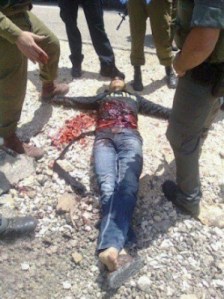 Nidal showed photographs of wounds to Saleh’s neck that indicate a struggle as well as further photographs of his son covered in blood, with IOF soldiers standing on his hands.
Nidal says that if the IOF is able to stand by as illegal settlers fire live ammunition at unarmed villagers, then it should not be controversial for him to suggest they stood by and allowed an attack on his son. “There are many cameras in that area and soldiers are on hand 24 hours a day. I want to see the Closed Circuit Television (CCTV) footage of what really happened to my son.”
This would be the only hope for Saleh to prove his innocence as the Israeli military courts are notoriously unjust: 99.74% of cases heard by the military courts against Palestinians in the West Bank end in a conviction. In Israeli military courts, the word of a soldier is enough evidence to convict even a minor.
Saleh was in the midst of saving money for his wedding and the purchase of a home. He is one of 8 children, the eldest of which is currently held in an Israeli prison. Originally having been detained by the Palestinian Authority for his political views, Saleh’s eldest brother was re-incarcerated by the IOF upon his release, without a chance to see his family in between.
Saleh’s uncle, Ahmed al-Zoghayer, also sat down with the ISM. He reenforced Nidal’s belief that if his nephew had attempted to attack a soldier he would have been shot.
Ahmed clarified one of the reasons for Saleh’s presumed death. The ambulance carrying Saleh was late to arrive at the scene. When it arrived, his heart had stopped and he was believed to be dead. Defibrillators were used and his heart began beating again. Saleh was then successfully operated on.
An 18 year old has been accused of attacking an IOF soldier. His family contests this and their demand for CCTV footage has not yet been responded to. ISM supports the call for its obtainment.
May 27, 2012
Posted by aletho |
Ethnic Cleansing, Racism, Zionism, Subjugation - Torture | Asira al-Qibliya, International Solidarity Movement, Nidal, West Bank |
Leave a comment
Damascus has refuted accusations of being behind a ruthless attack in Houla where over 90 civilians were killed. Political analyst Ibrahim Alloush told RT those killed were actually Assad loyalists, and the timing is suspicious.
Friday’s attack in the Governorate of Homs has raised already-high tensions in Syria, with many in the international community quick to point fingers at Assad’s forces.
Public anxiety was fueled by numerous amateur videos from Houla posted to YouTube showing dozens of bodies, including many women and children.
Although the videos were widely distributed by the media, the source could not be independently verified.
Damascus condemned the attack Saturday, saying it had no involvement in the massacre, and accused “terrorist” groups of being behind it.
The authorities also announced an investigation into the incident.
Political analyst Ibrahim Alloush told RT that the way the attack was done and its timing “make it obvious” that Damascus is not responsible.
“It would not make sense for the Syrian army to commit these massacres and withdraw, and then just let the rebels come and take photos and make documentaries about them,” he explained.
Alloush believes the crimes were committed “by the armed gangs supported from abroad, from the GCC countries and from the NATO specifically through Turkey.”
The analyst insists that the massacre in Houla was carried out in the context of a broad attack throughout the area.
“They also attacked the national hospital in the region and they set fire to it. Then they turned to civilian houses in some of the neighboring villages and they started killing indiscriminately,” he said, emphasizing that among those killed were people loyal to Assad.
Alloush also said that the timing of the attack makes it look suspicious.
“These crimes have come at a point when a political solution has slated for the Syrian question, and these people do not want to see a political solution – instead they want to see an armed intervention, an international foreign intervention in Syria under pretext of massacres,” he concluded.
May 27, 2012
Posted by aletho |
Deception, False Flag Terrorism, War Crimes | Houla, Syria |
Leave a comment
This scathing indictment tracks the predatory career of Bill Gates and paints his high-profile philanthropy as capitalist adventurism that further impoverishes Africa.
WHO IS THE MAN?
Bill Gates is a walking talking Bill Gates commercial. It matters not that he retired from Microsoft. The Bill Gates image is still very serious business. Arguably his most famous quote is “Be nice to nerds. Chances are you’ll end up working for one.” He dresses the part: very casual with the preppy uniform of khakis and blue. His prepiness and nerdiness follow from his prep school background. But not too many nerds drop out of college, as Gates did. College is the place to find nerds; that’s where nerds get their revenge. Gates constructed the Microsoft company environment like a college campus. It’s part of the myth of that gentle, coed, carefree, nurturing, professorial and now the giving, philanthropist Bill Gates. It’s all very disarming.
The Bill and Melinda Gates Foundation (BMGF) leads the push to bring nutrition and health to Africa. But this move requires some scrutiny and a determination as to whether this is another image builder or worse: an attack by a modern day missionary on another unsuspecting indigenous population. Yes, some Africans are an indigenous population too.
Gates’ retirement [1] from Microsoft allows him time to focus more intently on his image, his sales pitch and Africa. By contrast, the ‘Red’ campaign of Gap, Apple and a few other retailers, requires you buy the product to contribute to fighting AIDS, malaria and tuberculosis in Africa. The emphasis is always on buying and selling, not on the disease. So, if you buy a pair of Gap jeans with the red label, a portion of that money goes to the fund. The project, founded by U2’s Bono, is intended to capitalize on what we do anyway – buy stuff. Generally, no one argues against helping Africa, right? But with all the riches these corporations and individuals earn, why do we still have to buy something before they give something? Much of these earnings were as a result of raw materials sourced in Africa: even its music. Unlike Red, Gates requires no purchase from Microsoft, at least not directly. But we can’t separate Gates from Microsoft and its products. Moreover, Microsoft’s operating system is still the most popular, and for good reason, so we don’t have as much choice as we think. We are locked into buying MS DOS. It’s like English in the business world: the official language. Bill Gates knows this. He ‘engineered’ it.
In Africa, there is no need to buy raw material. You simply dig it up, add value, and sell it. This was once done to its indigenous inhabitants. As Arundhati Roy assessed foundations,
“Their enthralling history, which has faded from contemporary memory, began in the US in the early 20th century when, kitted out legally in the form of endowed foundations, corporate philanthropy began to replace missionary activity as Capitalism’s (and Imperialism’s) road opening and systems maintenance patrol.” [2]
Of note, Gap, like Apple, has been under scrutiny for its use of sweatshop labour. However, it has been reported that the clothing used in Gap’s Red promotion is now made in Lesotho (Africa) and not the cheaper China. Gates seems to want to distance his image from the carnage of capital greed by insightfully focusing on software. Perhaps his reasoning was that he would not be responsible for the slave-like exploitation of mostly women and sometimes children, who build hardware for Apple and others in China, or those children digging for gold and coltan in central Africa. The latter two are essential metals used in circuit boards for hardware. This is misguided. Neither a focus on software nor resignation from his baby, Microsoft, could cover the trail. Like banks and insurance companies that financed the flow of human cargo from Africa and claim they did nothing wrong, the builder of operating system software that drives the machines that use our exploited resources and now track our movements and speeches of dissent should not be allowed to claim innocence.
Bill Gates should not be allowed to say he only builds operating systems. In a racist criminal justice system, the legislators who passed the laws, the police who make the arrest, the prosecutors who make the charges stick and even the defense attorneys who seem not to care, need to acknowledge culpability in a system out of control. All actors mentioned purport to do good, as Bill Gates now promises. They all claim to fight evil: crime on one hand, starvation and disease on the other.
Africa does not need this kind of charity. It needs equality in trade and the exchange of leading technology. Instead, Gates, the world’s foremost technologist, brings experts on seeds and vaccines.
Contrary to popular belief, Bill Gates never invented anything. The real invention is the public belief in Bill Gates as the self-made mogul. He started with a ‘gift’ from IBM of the DOS platform. For that platform he adapted the MS-DOS system that operates all personal computers (PCs). Even the term personal computer really means operated by Microsoft DOS. This is so even if your ‘personal’ computer happens to be an Apple or using another operating system like Linux. Unless it’s Microsoft, it is not personal. To be a personal computer, a PC, it has to have a Microsoft DOS operating system. It’s not only the most widely used system, its personal.
It’s important to understand how these systems work before we look at what he is doing in Africa. Of course, Bill Gates is not alone. It’s a scorched earth policy, from the business culture that dominates the US landscape. It’s like the use of napalm and Agent Orange in Vietnam, when the intent was mass defoliation of all flora, including food crops, Microsoft used all kinds of tactics, some unlawful, to grab its market share at the expense of any other competitor irrespective of any benefit to the consumer. In Vietnam, Agent Orange led to deforestation; the loss of crops led to losses in wildlife and livestock and an environmental disaster. Eventually, a literally scorched earth would result and starvation, death; victory would follow. Naturally, if you destroyed everything, survivors would need you to rebuild. This is the plan of an empire.
COMING TO A COURTROOM NEAR YOU, THE WAR FOR THE MEANS OF PRODUCTION
Gates’ victories were not a war of nerds but one of lawyers. Gates in a 1994 Playboy [3] interview explained,
“Our restricting IBM’s ability to compete with us in licensing MS-DOS to other computer makers was the key point of the negotiation. We wanted to make sure only we could license it. We did the deal with them at a fairly low price, hoping that would help popularize it. Then we could make our move because we insisted that all other business stay with us. We knew that good IBM products are usually cloned, so it didn’t take a rocket scientist to figure out that eventually we could license DOS to others. We knew that if we were ever going to make a lot of money on DOS it was going to come from the compatible guys, not from IBM. They paid us a fixed fee for DOS. We didn’t get a royalty, even though we did make some money on the deal. Other people paid a royalty. So it was always advantageous to us, the market grew and other hardware guys were able to sell units.”
Part of this revelation is the importance of hardware ‘guys’ to the operation. It is not a separate exercise. What he neglected to explain was the enormous amount of litigation that accompanied and solidified this position and the almost continuous war that has followed this policy.
The Federal Trade Commission launched an investigation into Microsoft’s antitrust violations, only to seemingly lose steam and give up. Antitrust claims are simply claims that one company is attempting to kill off the competition. The Department of Justice, no less, then took up the fight and eventually settled for several hundred million dollars in fines. All during this time there were numerous lawsuits from wronged developers to burned competitors and even employees. This was some potent napalm. In Vizcaino v. Microsoft, 97 F.3d 1187 (9th Cir.1996), the court ruled against Microsoft and ordered it to pay benefits to workers who were denied benefits on account of their incorrect classification as independent contractors as opposed to employees. Welcome to our world.
i4i, of all the names, a software developer, filed a patent infringement suit and won against Microsoft. Microsoft refused to pay. Meanwhile, based on the stolen patents, Microsoft developed a replacement. Microsoft appealed to the highest court in the land. The United States Supreme Court ruled against Microsoft and ordered it pay the developer. Uniloc, Alcatel, and The Commonwealth of Massachusetts are just some of winners against Microsoft and its intent on domination. But they are still too few. Meanwhile, numerous claims have been buried under the costs of litigation and never came to light. I could go on forever listing claims against Microsoft for patent and business infringement, but you can use its search engine to find more. Of note the European Union (EU) fined Microsoft $1.4 billion for its anti-competitive practices. But these fines amounted to slaps on the wrist, as Microsoft continues in its scorched earth policy and more suits are being filed as well as patents being bought as we write.
In a practice known as defensive patenting [4], large companies like Microsoft are buying-up existing patents and seeking new ones to use as a basis to defend or attack in the event of war against their competitors. These patents serve no other useful purpose. The design is rarely manufactured. These patents, some ancient, are bought or brought with the idea that something in their intended use might resemble that of a new patent or one in the future and therefore form a basis to make a claim that it is stolen from Microsoft. If you develop a computer related patent, it is very likely that Microsoft owns one just like it, or partially like it, and can mount an attack against you based on that patent.
COMING TO AFRICA IN A TEST TUBE
It is with this background to his rise in wealth that Bill Gates launched the Bill and Melinda Gates Foundation, with its focus on Africa. Like a good missionary, he does not come empty-handed. He has brought experts and seeds. It’s worth noting that the man Gates hired to help oversee his Africa sojourn is former Monsanto Vice President, Robert Horsch. Gates has invested heavily in Monsanto [5]. It would be an irony, except it is so serious that Monsanto was the company that developed Agent Orange. The effect of that deadly chemical is still affecting Vietnamese people and American soldiers forty years later. It is the progeny of that science that led to Roundup [6], Monsanto’s world-renowned weed killer and killer of several other things. Horsch was a leading figure in developing Monsanto’s genetically modified seeds that were resistant to its own herbicide and pesticides and are now earning Monsanto billions in royalties. They have patented these seeds, which can cross pollinate and colonize existing seed and farms. In America’s Midwest, farmers find their fields filled with a corn they did not plant. […]
We know what happened in Vietnam. The people resisted imperialism and drove the French, first, and then the full might of the US military out of their country. So it is in this context that you must view Gates’ approach to spreading his software and now his seed money in Africa. Like Monsanto’s plan to use genetically modified organisms (GMOs) and pesticides to become the dominant if not the sole producer of seed and food, Gates routinely violated antitrust and patent and other laws to achieve the goal of destroying all weeds (all rival software). His new hire, Horsch, will serve as senior program officer and will apply the GMO technology toward improving crop yields in regions including sub-Saharan Africa, where the foundation recently launched a major drive in collaboration with the Rockefeller Foundation.
Equally misguided is the Foundation’s approach to disease. Malaria and HIV appear to be its focus in the development of vaccines. A cursory look at the history of vaccines will reveal its inherent volatility and high rates of failure. Many of these health issues are really wealth issues. By wealth I mean the means to eat a balanced diet. I maintain that Africa’s problem is one of poverty: its inability to provide regular balanced meals to all of its people. Its greatest epidemic is poverty. Find a vaccine for that. How is it that the near richest man, and the smartest nerd, on the planet cannot see the need for an infrastructure that would lead to adequate supplies of food and water? Instead, he focuses on experimenting with dangerous chemicals and more dangerous genes, purportedly to increase yield.
Out of the other side of his mouth he’s decreasing population. F. William Engdahl quotes Gates’ 2010 TED speech where Gates declares, “First we got population. The world today has 6.8 billion people. That’s headed up to about 9 billion. Now if we do a really great job on new vaccines, health care, reproductive health services, we lower that by perhaps 10 or 15 percent” [7]. Engdahl asserts that studies show that the chemicals used in the plan reflect reduction birth rates and that the Rockefeller Foundation has been involved with eugenics for some time. Its partnership with Gates and AGRA [8] is precisely for that stated purpose.
Gates sees the need, but the way he wants to fill it is in the mistaken belief that GMOs will provide the high yields to feed Africa and in the meantime he would vaccinate against diseases. Simultaneously, corporations like Monsanto and investors like Gates would reap billions in royalties from the use of its seed. The same GMOs banned by the European Union are acceptable in Africa. The result would be a monoculture that would eliminate centuries of farm practices and seed diversity that date back before the Bible and was partially disrupted by that other foreign intervention: the slave trade. Moreover, the colonialism that followed wanted cocoa, coffee, and cotton. These are not products that find their ways onto the plates of Africans. Stolen human resources along with forced agriculture for the European market set the stage for the shortages we find today.
Jonas Salk, credited with developing the Polio vaccine, when asked who owned the patent, is said to have responded, “There is no patent. Could you patent the sun?” [9] Gates and Monsanto have succeeded where others have failed. If you agree that the seed requires light to grow, preferably sunlight, likewise GMO seed, requires Monsanto’s permission and conditions for use; therefore, they control seed. They are the sun. They may not have patented the sun, but they patented the next best thing: control of the rights to whom, and in what conditions, their seed will access the energy of sun in order to grow. Vandana Shiva [10] refers to Monsanto’s actions as the colonization of seed.
I am no defender of patents and copyright. It’s just another tool to consolidate creativity in the hands of a few. But that is another blog. These empires, like Microsoft and Monsanto, are built on patents: on ownership, including ownership of the means of production. They no longer need to own factories. They only need to own the rights to what the factories produce. Observers like F. William Engdahl have noted that vaccinated children who drink water contaminated by feces are no healthier than they were before the vaccine. Providing that these untested vaccines are safe. Instead of cleaning up the water and sewage systems, they seek to compromise them even more by the use of pesticides and fertilizer needed for their push in agriculture.
“Life is not fair; get used to it.” Bill gates
As if Gates and Monsanto are not sufficient adversaries, President Obama recently appointed a former Monsanto CEO as senior advisor to the Commissioner of the Food and Drug Administration (FDA). Michael Taylor’s addition is in the context of the US governments plan Via AGRA (two words) to push its policies in Africa. Of course the FDA has refused to ban GMOs in the US and has refused to require foods be labeled, if containing GMOs. Gates is indeed visionary. He has singlehandedly determined the importance of food. It matters not that he could have asked any African child.
But this is a warning to the rest of us. The only other land and space available for full colonization is the Amazon rainforest. It won’t be around for long. But that is another blog. There is the Canadian Tundra and Mars, but first things first. Given the bad press and attention directed at the Amazon, Africa seemed the place with the most land lying seemingly unused. Governments have launched a campaign of terror to remove residents from lands they have occupied since before Columbus was conceived, let alone Microsoft. Though I do not hold Gates responsible for every peasant chased off land farmed for countless moons, I do blame him for adding to the hysteria of the land grab. His mere presence forces up the price of land. What one once farmed for free, soon one will not be able to farm for any money. But if you desire, there will be jobs on the new farm.
AN ALTERNATE CHEMICAL SOLUTION
Guyanese author Harry Narain wrote about high yield imported paddy rice in his collection of short stories, “Grass Roots People” [11], set in 1970s Guyana. The yield was so high that it bent the stalks lower to the ground than normal and ripened faster. The paddy was too heavy. Any rain would mean the end. It ripened so fast that there was not enough time to wait for the government loaned combines to get to his farm. Without money to hire a private combine, the rice crop would die in the field along with the farmer’s dreams of a pair of track shoes for his boy to play sports, earrings his little girl begged for, and a fridge for his wife. The yield was never so high again.
Despite and in spite of all the history and facts on Gates, there are still people who are going to say that Africa is in need and if Gates wants to contribute he should be allowed to do so. They will add that it’s people like this writer who have no money to contribute who are always trying to stop well-meaning people; and finally, Africa is on the rise as a result and here comes another no gooder, a crab, to pull the beneficiaries back down. It’s always the same arguments, on both sides. But facts are difficult to controvert. Denial is a sweet space to reside. No one comes to kick you out of there.
Under the cover of the foundation, Gates moved from paying little tax to paying no tax. That notwithstanding, there are a few things he can do for me. He must relinquish all his shares in Microsoft and donate half to Wangari Maathai’s Green Belt Movement. He must remove his two executives from AGRA’s board. He must distribute the rest of the shares among those families in China whose children jumped to their deaths from the Foxconn [12] factory dorm while employed in making things for us that included his friend Steve Jobs’, ‘I’ stuff. He must denounce child labour. He must lobby Microsoft to withhold software from companies who use slave-like and sweatshop labor for their products. He must divest from Monsanto. Oh! And endorse the Buffet Plan to pay more taxes for himself and Microsoft before he divests his shares and Buffet transfers all his shares to the BMGF. Even Buffet has said that 30 percent is not enough. I’ll stop there for now. I shouldn’t have to tell him everything. He should be thinking for his damn self.
On Buffet, the New York Times [13] recently reported Buffet’s increased stake in Wal-Mart and that it came just before the same paper published detailed allegations that Wal-Mart executives bribed retailers in Mexico to facilitate its expansion there. Was this mission Wal-Mart’s or Buffett’s or Berkshire Hathaway’s? In 2011, he gave $1.5 billion of his BerkshireHathaway [14] stock to the BMGF as part of a plan to transfer the majority his wealth to the foundation. This means little or no taxes.
Oh, Bill! When you talk to Buffet tell him that giving his wealth to your Bill and Melinda Gates Foundation will not absolve him, either. Tell him he would not be able to hide behind Berkshire Hathaway, Inc., the hedge fund he presides over. Smaller investors pool resources in a hedge fund for larger and more lucrative investments. However, as its name suggest, the Hedge fund is simply a hedge, a fence, between the money and the exploitation. Capitalism has not yet found a way to increase earnings without exploiting free or near free labour [15]. Wal-Mart’s record on wages and union busting is notorious. [16] It does not matter how prestigious sounding the name of the high and growing hedge between money and poverty. What Africa needs, finally, Brother Bill, is for you to get us some agent orange from your friends at Monsanto. So we can take care of the hedges ourselves.
* Clairmont Chung is a lawyer, consultant, filmmaker and arts critic. His latest film is a documentary, ‘W.A.R. Stories: Walter Anthony Rodney’. He edited a book of the interviews done in making the film, which is due out in October 2012 from Monthly Review Press entitled, ‘Walter Rodney: A Promise of Revolution’. Chung tours with his film and maintains a small practice in New York and New Jersey. He is writing a book on the legal history of Africans in the ‘New’ World up until the Wars on Drugs and Terror.
* Please send comments to editor[at]pambazuka[dot]org or comment online at Pambazuka News.
END NOTES
[1] Gates retired as CEO in 2008. He has not sold his shares in the company and until that happens he has more than a nominal interest in Microsoft. The continued association with him and the brand is as strong as ever. When you see him, you don’t think foundation. You think Microsoft. His transition from Microsoft to the Foundation may seem as a sudden change to some. But if you understand Gates, and the really wealthy, nothing is sudden and rarely anything changes except the increase in wealth. It’s always about the sales plan which is to get it for free, or close, and sell high.
[2] Arundhati Roy, “Capitalism: A Ghost Story: (Rockefeller to Mandela, Vedanta to Anna Hazare…. How long can the cardinals of corporate gospel buy up our protests?)” Outlook India, March 26, 2012
[3] The Bill Gates Interview, 1994, Playboy reprinted on About.com
[4] Defensive patenting is not a practice limited to Microsoft. But they have been one of the most ardent collectors. The Rt. Hon. Lord Justice Jacob in a 2006, UK Court of Appeal, case, Aerotel v. Telco, likened defensive patenting to an arms race that has spread worldwide.
[5] Maureen O’Hagan and Kristi Heim of The Seattle Times, Gates Foundation ties with Monsanto Under Fire from Activists, lists the investment as $US27.6 million.Though a small fraction of the BMGF’s $33 Billion endowment, it’s part of a plan to eventually transfer close to $US40 billion to the BMGF.
[6] Roundup is a widely distributed weedicide and herbicide against which Monsanto has developed GMO seeds that would resist Roundup and grow while weeds and non-Monsanto seed die. They went further and developed seed that would not grow unless sprayed with roundup. No one knows to what extent these seeds are distributed but Africa is being primed.
[7] F. William Engdahl ‘Bill Gates talks about ‘vaccines to reduce population” March 4,2010 Geopolitics and Geonomics
[8] Alliance for a Green Revolution in Africa (AGRA) describes itself as working on “integrated programs in seeds, soils, market access, policy and partnerships and innovative finance work to trigger comprehensive changes across the agricultural system” its Board includes two executives from the Bill and Melinda Gates Foundation and two from the Rockefeller Foundation as well as an assortment of dignitaries from the continent. It has a reputed budget of over US$400 million and has been operational since 2009.
[9] Johnson, George (November 25, 1990). “Once Again, A Man With A Mission”. The New York Times. Retrieved August 5, 2011
[10] Vandana Shiva has equated the colonization of the seed with the colonization of the future. She does not mean future colonization. She means your future is being colonized now.
[11] Narain, Harry, Grass Roots People, “A letter to the Prime Minister” (Casa de las Américas, Cuba 1981)
[12] The UK Guardian reported employees jumping from their dorm windows to their deaths rather than continue under the conditions in the Foxconn factories. Foxconn assembled goods for Apple and other prominent US companies. The owners placed nets around the building and had employees sign no-suicide clauses that absolved the company from suits filed by family members if anyone managed to succeed in killing themselves.
[13] David Barstow, The New York Times, April 12, 2012, Vast Mexico Bribery Case Hushed Up by Wal-Mart After Top-Level Struggle
[14] The Christian Science Monitor, July 8, 2011, Warren Buffett gives $1.5B in stock to Gates Foundation. The report described the gift as a plan to transfer the majority of his wealth to the BMGF. Buffet serves as trustee on the Board of the BMGF. Gates serves on the Board of Berkshire Hathaway. A real love affair has developed between the two.
[15] To be fair, neither has socialism found a way around cheap labor. Socialist governments have been as confrontational with unions as have capitalist, corporate, dominant governments. However, The basic needs of citizens appear best met through a socialist approach, while a market approach drives-up the cost of everything after forcing consolidation.
[16] See Huffington Post-Chicago Wal-Mart’s Union-Busting, ‘Preference For Poverty’ Described In Reader Interview, Updated May 25, 2011.
May 27, 2012
Posted by aletho |
Deception, Economics, Timeless or most popular | Africa, Apple, Bill Gates, DOS, IBM, Microsoft, MS-DOS |
Leave a comment
Forcible transfer and deportation are terms that commonly evoke images of people being loaded onto trucks or trains or violently driven away.1 Forcible transfer, however, may also take the form of involuntary or induced movement of people resulting from the creation of insecurity, disorder, or other adverse conditions, for the purpose of, or resulting in such migration. Article 49 of the Fourth Geneva Convention prohibits all forcible transfers. Only the security of the population of the occupied territory or imperative military reasons can exceptionally justify total or partial evacuation of an area under occupation. Those evacuated shall be transferred back to their homes as soon as hostilities in the area in question have ceased.
A key criterion to assess the forcible nature of the displacement is whether or not the transfer is the result of the individual’s own genuine choice to leave.2 As developed in the case law of the International Tribunal for the Former Yugoslavia (ICTY), forcible transfer is understood as the forced displacement of persons from where they reside to a place that is not of their own choosing and “includes threat of force or coercion, such as that caused by fear of violence, duress, detention, psychological oppression or abuse of power against such person or persons or another person, or by taking advantage of a coercive environment.”3 The ongoing forcible transfer of the Palestinian people from or within the Jordan Valley in the Occupied Palestinian Territory (OPT) is a clear example of this kind of transfer (sometimes misleadingly called “indirect transfer”).
The facts speak for themselves. Although there is uncertainty as to population levels in the past, it is estimated that between 250,000 and 300,000 Palestinians lived in the Jordan Valley on the eve of the 1967 Israeli military occupation.4 After more than 40 years of occupation, the Palestinian population in the area has been dramatically reduced to 56,000.5 However, the displacement of Palestinian people from their homeland is not a phenomenon relegated to the past, but an ongoing process, particularly in this resource rich and geopolitically strategic area.
During 2011, more than one third of all Palestinians forcibly transferred in the West Bank were residents of the Jordan Valley, nearly 60 percent of whom were children.6 If we consider that the area contains vast land reserves and abundant water resources, making it the most fertile region of the OPT, the estimates appear striking. How did this dramatic decrease in population occur?
The 1967 “voluntary” exodus
The circumstances surrounding the plight of the Palestinian people in the Jordan Valley during and after the 1967 War refute the widespread misperception that the 1967 exodus was largely “voluntary,” as compared to the forcible nature of the 1948 exodus.
Israel’s military strategy during, and just after, the 1967 War aimed to drive out tens of thousands of Palestinians from their villages, towns and refugee camps in the West Bank and the Gaza Strip.7 This was particularly the case for the Jordan Valley where Israeli forces expelled 88 percent of the area’s population eastwards, across the river to Jordan. The village of Jiftlik, for example, was razed to the ground, rural communities were depopulated, and virtually all residents of three 1948 large refugee camps surrounding Jericho fled or were expelled to Jordan.8 Despite not being the site of any major military battles during the 1967 war, the Jordan Valley suffered the highest population loss in the entire West Bank in the war and its aftermath.9
Israel’s purpose of removing the Palestinians from the area is confirmed by the measures it took to prevent the return of those who had fled during the war and the period that followed. These measures included the routine shooting of civilians trying to return, or “infiltrate,” to their lands across the Jordan River10 as well as the inclusion of Jordan Valley landowners on a secret “black list” in order to deny their entry into the West Bank.11 At the same time, from 1967 to 1994, Israel undertook a mass withdrawal of residency rights from hundreds of thousands of Palestinians who travelled abroad during that period, effectively preventing them from returning to their homeland.12 Then, after the eruption of the intifada of 2000, Israel barred almost all Palestinians from returning to, or visiting, the areas.13
The Palestinians remaining in the Jordan Valley would be, from 1967 onwards, subject to Israel’s policies aimed at minimising the number of Palestinians in the area,14 while maximising Israeli control over the land, water resources and transport routes.
Deprivation of land and water resources
The policy to take control over the land included legal and administrative changes, financial incentives to settlers and institutional coordination.15 Israel began by declaring in 1967 nearly 60 percent of the Jordan Valley as closed military areas, effectively banning Palestinian access to, and development of, the land.16 Through subsequent military orders, Israel seized control of the water resources of the OPT.17
Huge trenches have been dug in the Jordan Valley as part of the Apartheid Wall system to prevent Palestinian access to agricultural lands, these areas are also ‘live-fire zones’ for the Israeli army. Israeli decision-makers saw Jewish civilian presence as a necessary element to guarantee and maintain control over the occupied land, and so the Occupying Power immediately began to transfer its own civilian population into the area; an action expressly prohibited by Article 49(6) of the Fourth Geneva Convention, regardless of its motive.18 By the end of 1968, the Israeli military had established three military outposts in the Valley.19 The eventual shift from military outpost to predominantly agricultural colonies from the early 1970s in the Jordan Valley adequately illustrates the colonizing nature of the settlement enterprise while refuting Israel’s alleged security needs to justify the occupation of the Jordan Valley.
The built up area and the land cultivated by the existing 38 settlements take up a further 10 percent of the Valley. Although the actual settler population in the area is quite small, most of the approximately 9,400 settlers20 are farmers who cultivate large tracts of land and use most of the water resources. This has rendered the Jordan Valley the area of the OPT most relentlessly exploited by settlement agricultural production.
The deliberately discriminatory nature of Israel’s policies results in a striking inequality of access to water between Israelis and Palestinians in the Jordan Valley. Indeed the water available to the Palestinians of the Valley falls far short of that recommended by the World Health Organisation.21 The situation is even worse for the Palestinians living in the rural communities of the Jordan Valley who are not even connected to the water network system.
Furthermore, the water extraction ratio in the Israeli settlements is the highest in the West Bank.22 The deep wells serving the Israeli colonies have dried up the Palestinian wells and springs in the area.23 The Israeli pumping stations, including those on or near the lands of Palestinian communities, are closed and fenced off. With no access to running water, in some cases the rural Palestinian inhabitants survive on water supplies that the World Health Organization classifies as an indicator of an emergency response situation.24 Palestinians have no choice but to buy their own water—water that they are entitled to extract for themselves under international law–from the Israeli water company Mekorot. They often have to buy water from mobile tanks that deliver water of dubious quality at much higher prices.25
Meanwhile, in the same area, Israeli settlers enjoy intensive-irrigation farms, lush gardens and swimming pools.26 It should thus come as no surprise that the 9,400 Israeli settlers living in the Jordan Valley consume more than six times the quantity of water consumed by the more than 56,000 Palestinians in the area.27
And the Oslo Accords came to life
Under the Oslo Accords, more than 90 percent of the Jordan Valley was classified as “Area C,” 28 meaning full Israeli civil and military control extending to land registration, planning, building and designation of land use. The 1995 Interim Agreement called for the gradual transfer of power and responsibility in the sphere of planning and zoning in Area C from the Israeli military’s “Civil Administration” to the Palestinian Authority.29 Yet, this transfer was never implemented and Israel’s continued control over planning and zoning in Area C has, according to the World Bank, “become an increasingly severe constraint to [Palestinian] economic activity.” 30
Israel’s implementation of the Oslo Accords has consolidated its control over the Jordan Valley. It has used this control to effectively appropriate more Palestinian land and restrict Palestinian mobility and economic activity with disastrous effects upon the Palestinian civilian population.
Approximately 40 percent of the Jordan Valley’s population is comprised of semi nomadic Bedouin and herder communities that have traditionally grazed their herds throughout the area. Today, the local population is restricted to enclaves, surrounded by Israeli settler infrastructure on the one hand, and no-go areas on the other.31
Moreover, although Palestinians can, in theory, cultivate what remains of their land, as part of its policy of minimising Palestinian presence and growth in Area C the Occupying Power has imposed harsh restrictions on building and freedom of movement on the area; restrictions that apply only to Palestinians. Israel prevents Palestinians from constructing any infrastructure or implementing development projects such as water wells, reclaiming of agricultural land, opening agricultural roads or extending irrigation networks. Thus, despite its vast agricultural potential, the Israeli restrictions on access to the land and its water resources have turned the Jordan Valley into the least-cultivated Palestinian area.32
The final push
Palestinians cannot build or renovate homes or any other infrastructure in Area C without first obtaining permits from the Israeli military’s Civil Administration. These permits, however, are rarely issued.33 The restrictions imposed on Palestinians force many of them to build without the required permits to meet their needs, despite the ever-present risk, and practice, of demolition.34
The Palestinians’ inability to obtain permission for legal construction and Israel’s policy of demolishing their homes due to lack of building permits lead to the displacement of hundreds of Palestinians in Area C.35 Systematic destruction of Palestinian infrastructure is particularly rampant in the Jordan Valley. Consider that in June 2009, the Jordan Valley registered a dramatic increase of demolitions in closed military zones 36 and, in July 2010, the Israeli government instructed its military to increase demolitions of “illegal” Palestinian buildings in the Jordan Valley.37 As a result, approximately 40 percent of the structures demolished during 2011 in the West Bank, including East Jerusalem, were located in the Jordan Valley.38 These demolitions affected at least 2,000 Palestinians in the Valley, and more than 4,100 in the entire occupied West Bank.39
The inability to carry out legal construction inevitably impacts the provision of basic services to, as well as livelihoods of, Palestinians in the Jordan Valley. The PA is unable to undertake any infrastructure projects in Area C without the approval of the Israeli military’s Civil Administration. Therefore, while the Interim Agreement saw the transfer of responsibility for the provision of education and health services in Area C to the PA, the virtual impossibility of obtaining building permits from the Civil Administration for the construction or expansion of public buildings, such as schools and clinics, makes the provision of these services practically impossible.40
As a result of the Occupying Power’s illegal practices, the communities living in the Jordan Valley—considered a “high risk” area 41—represent some of the most vulnerable in the West Bank, and are regarded as priority groups for humanitarian assistance due to their lack of access to basic services (such as education and health) and infrastructure (including water, sanitation and electricity).42
In addition to severely limiting the amount of water available to Palestinians and denying them permits to restore old wells and build new ones, Israel has continuously destroyed water cisterns and the other basic rainwater collection systems that serve rural and herder communities.43 Moreover, during the summer months, the Israeli army has stepped up pressure on Palestinian herder communities to force them out of the Jordan Valley. The army not only confiscates the villagers’ water tanks, it also deprives the villagers and their flocks of water by restricting their movement in the area.44
Palestinians in the Jordan Valley face additional daily challenges, such as restricted access to land for grazing and agriculture, violence from Israeli settlers living nearby and regular harassment from Israeli soldiers.45 Tightened restrictions on access in and out the Valley, which is surrounded by checkpoints and roadblocks, have separated the area from the rest of the occupied West Bank.46 These restrictions have also exacerbated the hardship of the communities living there, contributing to the erosion of standards of living, increasing poverty and growing aid dependency.47
Conclusion
Not only did the Occupying Power expel the majority of the Jordan Valley’s population en masse during the 1967 war, it has also implemented measures effectively preventing displaced Palestinians from returning. Israel’s policies of extensive land appropriation, water deprivation and the establishment of colonies have crippled the agricultural and herding economy of the Palestinian residents of the area, virtually depriving them of their means of livelihood.
Combined with movement restrictions and severe curtailment of the ability to build—thereby preventing Palestinian residents from having access to housing, health and education—the Occupying Power’s policies in the Jordan Valley perversely force the transfer of the protected population from or within the area. Given the unbearable living conditions created by Israel’s policies, it is evident that Palestinian residents of the Jordan Valley do not exercise anything resembling a genuine choice when leaving their place of residence.
Article 49(1) of the Fourth Geneva Convention only exceptionally allows evacuation of an area if the security of the civilian population under occupation, or imperative military necessity, so demand. Imperative military necessity involves a very stringent test and Israel’s alleged general security concerns do not justify its discriminatory policies in the area. There is no evidence that the declaration of the closed military zones, their large areas, or their outlines respond to military necessity.48 Home demolitions and eviction of persons on the grounds that they live in “closed military areas” are unjustifiable. Indeed, there does not seem to be any security grounds justifying the occupying authority’s de facto deportation or transfer of Palestinians from the Jordan Valley.
Israel’s practices constitute internationally wrongful acts giving rise to state responsibility and individual criminal liability. The violation of the prohibition of forcible transfer amounts to a grave breach of the Fourth Geneva Convention and, as such, it is encompassed by the war crimes provision of the Rome Statute of the International Criminal Court (ICC).49
The forcible displacement of the protected Palestinian population is closely linked to the Occupying Power’s unlawful transfer of its own civilian population into the Occupied Territory. Undoubtedly, the transfer of Israel’s own civilian population into the Jordan Valley entails severe consequences for the Palestinian protected population living there, threatening its separate existence.50 Furthermore, such transfer makes the return of people displaced from the area and the restitution of their property more difficult.51
Israel’s aim of changing the demographic composition of the area in order to create or consolidate territorial claims is particularly evident in the Jordan Valley and plainly contravenes the purpose of Article 49(6) of the Fourth Geneva Convention.52 Ultimately, the absolute prohibition of the transfer of the Israel’s nationals to the OPT strengthens the prohibition of using land belonging to the occupied territory or its inhabitants for the furtherance of Israel’s own interests.53 The transfer of Israeli nationals to the Jordan Valley serves economic, social or strategic needs, primarily the colonisation and subsequent annexation of the area. Regardless of the motive, the transfer of Israel’s own civilian population into the OPT amounts to a war crime under the Rome Statute of the International Criminal Court.54
The State of Israel is responsible for the commission of unlawful acts in violation of its obligations under international law.55 It must, therefore, bring these violations immediately to a halt. Israel is also legally obliged to restore the situation to the way it was before the unlawful acts were committed, which entails restoring the properties to their legitimate owners, facilitating the return of displaced individuals back to their homes, and making full reparation for the loss or injury caused.56
Furthermore, international law on state responsibility sets out the rules on the obligations of third parties. Individual states have an obligation not to recognise illegal situations created or actions taken by the violating state, an obligation not to render aid or assistance and to cooperate to bring to an end the serious breaches of international law, such as Israel’s extensive unlawful appropriation of Palestinian land, the forcible transfer of the Palestinian population and the transfer of its own population to the OPT. In this respect, the UN Security Council has expressly called upon all High Contracting parties to Fourth Geneva Convention to ensure respect by Israel of its obligations under the Convention.57
Endnotes
1. Deportation denotes displacements that involve the crossing of an international border while forcible transfer relate only to displacements within a State. Stakić, IT-97-24-A, Judgment of 22 March 2006.
2. Naletilić and Martinović, (ICTY) IT-98-34-T, Judgment , 31 March 2003, para. 519.
3. Stakić, (ICTY) IT-97-24-A, Judgment , 22 March 2006, para. 281. Krstic (ICTY) IT-98-33-T, Judgment, 2 August 2001, para. 529-530.
4. Ma’an Development Center and Jordan Valley Popular Committees, ‘Eye on the Jordan Valley’ (2010) 27. <http://www.maan-ctr.org/pdfs/Eyeon%20theJVReportFinal.pdf> accessed 28 March 2012.
5. Data obtained from the Palestinian Bureau of Statistics.
6. At least 367 people were displaced in the Jordan Valley and 1,094 in the West Bank, including East Jerusalem. According to these statistics, a person is considered to be displaced if she/he has been forced to leave a home or primary residence because of a demolition or forced eviction. Displacement Working Group oPt, Demolition Summary Table (29 December 2011) and Damaged Assessment Form (June 2011). The Displacement Working Group (DWG), established in 2007 and led by the High Commissioner for Human Rights (OHCHR), has a broad membership, including UN agencies, international and local (Israeli and Palestinian) NGOs and donors.
7. Nur Masalha, ‘The 1967 Palestinian Exodus’ in The Palestinian Exodus 1948-1967 (Karmi et al. eds, Ithaca Press-Garnet Publishing UK, 1999) 80-81, 89-90, 94-95.
8. Ibid.
9. William Harris, Taking Root. Israeli Settlement in the West Bank, the Golan and Gaza-Sinai 1967-1980 (New York-Toronto, Research Studies Press,1980) 16 and 21.
10. Masalha (n 9) 99; Tom Segev, 1967 Israel, the War, and the Year that Transformed the Middle East, 540-542.
11. The blacklist began with 100 people, but swelled to over 2,000 by late 2004, when it was allegedly cancelled. Eldar, ‘Ministry admits “blacklist” of Palestinians who left the West Bank during Six-Day war’, Haaretz (5 July 2006) <http://www.haaretz.com/print-edition/news/ministry-admits-blacklist-of-palestinians-who-left-west-bank-during-six-day-war-1.192233> accessed 27 March 2012.
12. Eldar, ‘Israel admits it covertly cancelled residency status of 140,000 Palestinians’, Haaretz (11 May 2011) <http://www.haaretz.com/print-edition/news/israel-admits-it-covertly-canceled-residency-status-of-140-000-palestinians-1.360935> accessed 27 March 2012.
13. Eldar (n 13)
14. Peace Now, Settlements in Focus (Vol. 4, Issue 4): “A New Jordan Valley Settlement – Facts, Background, and Analysis” < http://peacenow.org/entries/archive5214 accessed 28 March 2012. 15. Harris (n 11) 42 16. Military Order No. 34 (1967) Regarding Closed Zones. In addition, Military Order No. 378 (1970) Concerning Security Instructions-Announcement of Closed Area prohibits Palestinian entry into the settlements unless they posses a special permit and authorises eviction of persons living therein without any judicial or administrative procedure. 17. Military Order 92 (1967) granted complete authority over all water related issues in the OPT to the Israeli army. Military Order 158 (1967) stipulated that Palestinians could not construct any new water installation without first obtaining a permit from the Israeli army and that any water installation or resource built without a permit would be confiscated. 18. Michael Cottier, ‘Article 8, War Crimes’ in Otto Triffterer (ed)., Commentary on the Rome Statute of the International Criminal Court, Observers’ Notes, Article by Article, second edition, (Beck and Hart Publishers, Oxford 2008), marginal 92. 19. Peace Now (n 16) 20 According to the Israeli Central Bureau of Statistics approximately 9,400 Israeli settlers reside in 27 settlements and 9 outposts in the Jordan Valley, in addition to the population of three of these settlements and the outposts, the population of which is not provided. Ibid. 21. Amnesty International, ‘Troubled Waters, Palestinians denied fair access to water’, Index: MDE 15/027/2009 (October 2009) 4-5. http://www.amnesty.org/en/library/asset/MDE15/027/2009/en/e9892ce4-7fba-469b-96b9-c1e1084c620c/mde150272009en.pdf> accessed 28 March 2012.
4-5.
22. Ibid 5, 17 and 41
23. World Bank, ‘West Bank and Gaza. Assessment of Restrictions on Palestinian Water Sector Development’, Sector Note (April 2009), vii, 12. <http://siteresources.worldbank.org/INTWESTBANKGAZA/Resources/WaterRestrictionsReport18Apr2009.pdf> accessed 2 April 2012.
24. Ibid, 17.
25. Tanked water costs 12 NIS per cubic meter or more( NIS: New Israeli Shekel (1 USD= 3.74 NIS), which is four to five times the price of piped water purchased from Mekorot (2.6 NIS per cubic meter).Ibid 18.
26. Amnesty (n 23) 5.
27. Ma’an Development Center , ‘Draining Away, The Water and Sanitation Crisis in the Jordan Valley’, (2010) 2.<http://www.maan-ctr.org/pdfs/WateReport.pdf> accessed 2 April 2012.
28. Approximately 61 per cent of the West Bank falls within Area C. The Declaration of Principles on Interim Self Government Arrangements (Oslo 1) was signed in 1993 between Israel and the Palestine Liberation Organization and was intended to be a first step in a phased process to transfer power from the Israeli military and its civil administration to the Palestinian Authority. The two parties agreed to the division of the West Bank (with the exception of East Jerusalem) into three areas: A, B and C. In 1995 the second Oslo Accord, also known as the Interim Agreement was signed.
29. Article 27.2 of Interim Agreement, related to Planning and Zoning.
30. World Bank, ‘The Economic Effects of Restricted Access to Land in the West Bank’ (October 2008) iv. <http://siteresources.worldbank.org/INTWESTBANKGAZA/Resources/EconomicEffectsofRestrictedAccesstoLandintheWestBankOct.21.08.pdf> accessed 28 March 2012.
31. At least five Palestinian communities (Al Farisiya, Al Malih, Khirbet al-Ras al Ahmar, Khirbet Humsa and Al Hadidiya) are located within Israeli-declared closed military areas. Palestinian shepherds and farmers, including their herds, caught crossing through nature reserves under Israeli control are subject to fines for trespassing. OCHA, ‘The Humanitarian Impact of Israeli Infrastructure in the West Bank’ 42-44 and 105. < http://www.ochaopt.org/documents/TheHumanitarianImpactOfIsraeliInfrastructureTheWestBank_Intro.pdf> accessed 27 March 2012.
32. World Bank, ‘The Underpinnings of the Future Palestinian State: Sustainable Growth and Institutions’ (21 September 2010) 15 .
<http://siteresources.worldbank.org/INTWESTBANKGAZA/Resources/WorldBankSep2010AHLCReport.pdf> accessed 2 April 2012.
33. According to UN OCHA, based on data provided by the Israeli Ministry of Defense, between January 2000 and September 2007, over 94 per cent of applications for building permits in Area C submitted by Palestinians to Israeli authorities were denied. OCHA, ‘Lack of Permit. Demolitions and Resultant Displacement in Area C’ (May 2008) 1. <http://www.ochaopt.org/documents/Demolitions_in_Area_C_May_2008_English.pdf> accessed 28 March 2012.
34. Between January 2000 and September 2007, 5,000 demolition orders were issued, and over 1,600 Palestinian buildings were demolished within Area C. Ibid, 1.
35. OCHA, ‘Displacement and Insecurity in Area C of the West Bank’ (July 2011) 10-11.
<http://www.ochaopt.org/documents/ocha_opt_area_c_report_august_2011_english.pdf> accessed 28 March 2012.
36. Seventy nine per cent of Palestinians displaced by demolitions recorded during June 2009 in Area C were residing in the Jordan Valley in populated areas declared closed military zones by the Israeli authorities. OCHA, Humanitarian Monitor (June 2009).
<http://www.ochaopt.org/documents/ocha_opt_humaniatarian_monitor_june_english.pdf>
37. Levinson, ‘Civil Administration told to crack down on illegal Arab structures’, Haaretz (19 July 2010) < http://www.haaretz.com/print-edition/news/civil-administration-told-to-crack-down-on-illegal-arab-structures-1.302692> accessed 2 April 2012..
38. Displacement Working Group oPt, Demolition Summary Table (29 December 2011).
39. Displacement Working Group oPt, Demolition Summary Table (29 December 2011). A person is considered to be affected if she/he is not displaced, but the demolition has an impact on an uninhabited home, a part of the home, the work place, source of livelihood or income. DWG Damage Assessment Form (June 2011).
40. OCHA, ‘Restricting Space: The Planning Regime Applied by Israel in Area C of the West Bank’ (15 December 2009)
<http://www.ochaopt.org/documents/special_focus_area_c_demolitions_december_2009.pdf> accessed 28 March 2012.
41. Save the Children UK and Ma’an Development Center, ‘Life on the Edge: The struggle to survive and the impact of forced displacement in high risk areas of the occupied Palestinian territory’ (October 2009) <http://www.maan-ctr.org/pdfs/LIVE.pdf> accessed 27 March 2012.
42. OCHA, ‘West Bank Movement and Access Update. Special Focus’ (August 2011) 22-26
<http://www.ochaopt.org/documents/ocha_opt_movement_and_access_report_august_2011_english.pdf> accessed 2 April 2012.
43. Statement by the UN Resident and Humanitarian Coordinator for the OPT, Maxwell Gaylard, on Continuing Demolition of Water Cisterns in the West Bank, Office of the UN Special Coordinator for the Middle East Peace Process, 1 February 2011.
<http://www.ochaopt.org/documents/ocha_opt_mg_statment_on_water_cir_2011_02_2_english.pdf> accessed 28 March 2012.
44. Amnesty (n 23) 45.
45. UN OCHA , The Humanitarian Monitor (May 2009) 5.
46. The Jordan Valley area is separated from the rest of the West Bank by dozens of physical obstacles,
including almost 30 kilometers of trenches and earth walls. As a result, all traffic to and from the area has been limited to five routes, four of which are controlled by checkpoints. See OCHA, ‘West Bank Movement and Access Update’ 21 (n 44) for a detailed account of access restrictions to the Jordan Valley.
47. A UN OCHA survey completed in February 2010 among herder communities located in Area C found that food insecurity stood at 79 per cent, compared to 25 per cent among the wider Palestinian population in the West Bank. A year later, following a massive food assistance intervention by UNRWA and WFP, the food insecurity rate had been reduced to 55 per cent. Information collected by OCHA among Bedouin communities in al-Bqai’a area suggests a strong causal link between access restrictions and the high levels of food insecurity recorded. Ibid 26.
48. Human Rights Watch, ‘Separate and Unequal. Israel’s Discriminatory Treatment of Palestinians in the Occupied Palestinian Territories’ (19 December 2010) 67. <http://www.hrw.org/reports/2010/12/19/separate-and-unequal-0> accessed 2 April 2012.
49. Article 147 of the Fourth Geneva Convention and article 8 (2)(a)(vii) of the Rome Statute.
50. The Commentary of the Fourth Geneva Convention expressly establishes that the transfer of their own civilian population to occupied territory by certain Powers during World War II worsened the economic situation of the native population and endangered their separate existence as a race. Pictet, Commentary (n 7) 283.
51. Cottier (n 20) ‘Article 8, War Crimes’, marginal 87.
52. According to the interpretation of the provision provided for by the Commentary of the Fourth Geneva Convention . Pictet, Commentary (n 7) 283.
53. Antonio Cassese, ‘Powers and Duties of an Occupant in relation to Land and natural Resources’ in E Playfair (ed), International Law and the Administration of Occupied Territories (Clarendon Press, Oxford 1992), 431-432.
54. Article 8(2)(b)(viii).
55. The state responsibility for forced displacement of civilians has been recently highlighted by the Eritrea
Ethiopia Claims Commission. See, for instance, Partial Award, Civilians Claims, Eritrea’s Claims 15, 16,
23 and 27-32, 17 December 2004, paras 79-106, 44 ILM 601; and Partial Award, Civilians Claims,
Ethiopia’ Claim 5, 17 December 2004, paras 128-131, 44 ILM 630.
56. Article 31 of the International Law Commission Draft Articles on State Responsibility.
57. SC Resolution 681 (1990), 20 December 1990.
Published in Forced Population Transfer in Palestine; Thinking Practically about Return (Spring-Summer 2012)
May 27, 2012
Posted by aletho |
Ethnic Cleansing, Racism, Zionism, Illegal Occupation, Timeless or most popular | Fourth Geneva Convention, Israel, Israeli settlement, Jordan Valley, West Bank |
Leave a comment
The Governor of the Central Bank of Iran (CBI) Mahmoud Bahmani says that the country has designed and implemented a new system for conducting international transactions.
Bahmani said on Saturday that the new system, which has already been activated, would replace Worldwide Interbank Financial Telecommunication (SWIFT)
On March 15, SWIFT CEO Lazaro Campos said in a statement that the society has decided to discontinue offering services to Iranian banks which are subject to financial sanctions imposed by the European Union.
On January 23, the EU foreign ministers approved new sanctions on Iran’s financial and oil sectors, which prevent member countries from importing Iranian crude or dealing with its central bank.
Experts believe that SWIFT’s new action is meant to fully enforce EU sanctions, as global financial transactions are impossible without using SWIFT.
Bahmani rejected reports about a Japanese bank freezing transactions with Iranian banks.
On May 17, the Reuters reported that Bank of Tokyo-Mitsubishi UFJ has frozen USD 2.6 billion of assets of Iranian banks under an order by the New York District Court earlier this month.
May 27, 2012
Posted by aletho |
Economics, Wars for Israel | Bank of Tokyo-Mitsubishi UFJ, Banking and insurance in Iran, Central Bank of the Islamic Republic of Iran, European Union, Iran, Mahmoud Bahmani, Sanctions against Iran, Society for Worldwide Interbank Financial Telecommunication |
Leave a comment
In the Spring issue of Middle East Quarterly, a publication of Daniel Pipes’ hawkishly pro-Israel and Islamophobic Middle East Forum, influential Israeli economic advisor Daniel Doron argues that “free markets can transform the Middle East.” Doron, the founding director of the well-connected “pro-market” Israel Center for Social and Economic Progress, writes:
As the high hopes for a brave new Middle East fade rapidly, Western policymakers must recognize that promoting market economics and its inevitable cultural changes are far more critical to the region’s well-being than encouraging free elections or resolving the Arab-Israeli conflict. In addition to producing material prosperity, diffusing power, and curbing tyranny, economic freedom promotes social, cultural, and religious changes conducive to democracy and tolerance. It enhances personal responsibility and social involvement and instills good work habits and accountability. It builds a civil society with a stake in peace. If there is to be any hope of lasting peace and stability in the Middle East, nothing less will do.
Doron, who was greatly influenced by Milton Friedman, Friedrich Hayek and other free market ideologues at the University of Chicago, sees the “Arab Spring” uprisings as an opportunity to put an end to government domination of the economy in the region. In his conclusion, the former Israeli intelligence officer who has served on an economic advisory group for Prime Minister Binyamin Netanyahu and on the Israel Government Council for National and Economic Planning, urges:
Western policymakers must refocus their attention on combating the root causes of Arab authoritarianism: Holding free elections in the region is less important than the advent of market economies.
In support of his view that “[t]he collapse of autocratic regimes in the Arab world will not necessarily promote economic freedom,” Doron interestingly cites another staunch and controversial supporter of Israel, Elliott Abrams, who wrote on his CFR blog on October 17, 2011 that the United States should begin to negotiate free trade agreements with Tunisia and Egypt. As Abrams, an early and enthusiastic advocate of the so-called Arab Spring, explained:
…an FTA creates real and continuing pressure for a freer economy, the rule of law, more open markets, and less corruption. This is precisely why negotiating FTAs with Tunisia and Egypt should begin now, as they begin their political and economic transitions. There will be many pressures to maintain corrupt, anti-market practices, and those who hold monopolies and other economic advantages will seek to keep them. An FTA will push in the other direction, toward an open market and the economic growth it can bring. There are few things we can do to nudge both countries in a positive direction that would have greater effect than FTAs with each.
Considering the provenance of all this concern for their welfare, the newly-liberated people of the Middle East and North Africa would do well to remember the price that was paid for earlier popular “revolutions” in Eastern Europe and the former Soviet Union. As the Guardian’s Mark Almond wrote in the wake of Ukraine’s so-called “Orange Revolution”:
The hangover from People Power is shock therapy. Each successive crowd is sold a multimedia vision of Euro-Atlantic prosperity by western-funded “independent” media to get them on the streets. No one dwells on the mass unemployment, rampant insider dealing, growth of organised crime, prostitution and soaring death rates in successful People Power states.
[…]
People Power is, it turns out, more about closing things than creating an open society. It shuts factories but, worse still, minds. Its advocates demand a free market in everything – except opinion. The current ideology of New World Order ideologues, many of whom are renegade communists, is Market-Leninism – that combination of a dogmatic economic model with Machiavellian methods to grasp the levers of power.
May 27, 2012
Posted by aletho |
Deception, Economics | Daniel Doron, Israel, Israel Center for Social and Economic Progress, Middle East |
Leave a comment
What agenda lies behind the latest defense of “enhanced interrogation”?
Former CIA Deputy Director for Operations Jose Rodriguez has written a book with the assistance of former Agency press officer Bill Harlow. Hard Measures: How Aggressive CIA Actions After 9/11 Saved American Lives is largely a defense of Rodriguez’s role in the CIA’s use of torture on suspected terrorists in the aftermath of 9/11. Rodriguez argues that what he describes as “enhanced interrogation techniques” were necessary to obtain information on terrorist activities. His employment of the euphemism underscores his argument that these procedures were found to be legal by Bush administration lawyers and that they do not constitute torture, which is a war crime.
In November 2005, Rodriguez, who was a classmate of mine at CIA, ordered on his own authority and contrary to Agency general counsel advice the destruction of 92 videotapes that recorded interrogation sessions in a secret prison in Thailand. This was done, he says, to protect the identities of CIA interrogators from possible reprisals by terrorists, not to cover-up waterboarding being used to obtain information, a procedure he claims was both an acceptable interrogation technique and one that was subject to congressional oversight before it was employed. He does not explain exactly how terrorists could obtain the tapes or be able to make identifications from them; perhaps the idea is that someday the recordings might leak to the public. Whatever its plausibility, or lack thereof, his argument might just as well be a deliberate deception if the primary purpose of his actions was to eliminate evidence of what many would consider a war crime. I leave it up to the reader to decide what explanation is most likely. For what it’s worth, Amazon reviews are running about five to one in praise of the book rather than condemning what it describes.
To promote Hard Measures, Rodriguez has been appearing on a number of television programs. I have seen him on “60 Minutes” with Lesley Stahl and on Bill O’Reilly’s program. He has also appeared with Sean Hannity. Stahl failed to push Rodriguez on the illegality of torture and frequently allowed him to drift into the kind of mumbo-jumbo tradecraft language that we former spies use when we don’t want to answer a question. Rodriguez stated that we (CIA) are part of the “dark side — that’s what we do.” That was the end of the story for “60 Minutes.”
O’Reilly’s interview was somewhat different. Rodriguez seemed unsure of himself, sometimes inarticulate, and was helped along to make the point that the information obtained from enhanced interrogation could not have been obtained any other way. O’Reilly walked him through his assertion that then-Speaker Nancy Pelosi knew all about the waterboarding, but then brought up the account of the interrogation of Abu Zubaydah presented by FBI Special Agent Ali Soufan. Soufan, a member of the interrogation team and Arabic speaker, maintains, with considerable credibility backed up by documents, that the only good information obtained came through established interrogation techniques employed before any torture took place. Rodriguez denied that was so to O’Reilly and became hung up on a discussion of who played the lead role in the interrogation, the CIA or the FBI, before questioning Soufan’s personal history and his reliability as a source.
Agency operations in Afghanistan in 2001-2 were superbly conceived and executed by its Counterterrorism Center, where Rodriguez was deputy, but his book inevitably focuses on trying to defend the indefensible practices that followed. There has been considerable speculation over why the book, with its attendant media blitz, has come out now, in light of the fact that the manuscript had to be approved by the Agency’s Publications Review Board. Was there CIA collusion in its release? Though the review is only supposed to prevent security violations, the Agency tends to be very friendly and helpful to books depicting it in positive terms and hostile to anything perceived as critical. Given the upcoming presidential elections, Hard Measures is also being seen by some as a preemption of any attempt to turn the torture issue into a political football, particularly as Mitt Romney has explicitly approved of the practice. Rodriguez (and the Agency) might be attempting to backstop the Romney position, which otherwise could be difficult to defend.
Another theory is that the long-awaited Senate Select Committee on Intelligence report on CIA interrogation techniques is about to come out and will conclude that the enhanced procedures were, in fact, ineffective. Rodriguez’s account might be intended to stake out a position in advance implying that the Senate report, written by a Democratic majority committee, is politically motivated and therefore “flawed.”
What is most disturbing to me about the book and the interviews is that Rodriguez is apparently seen by some in the media as the “new normal” and even some kind of hero. CIA officers overseas are indeed operating on the “dark side,” in that spying overseas is illegal in the countries where one is operationally engaged. But that does not mean all gloves are off in terms of international and U.S. law, especially in the case of war crimes. It is worth noting that Japanese Army officers were executed in 1946 for waterboarding Allied prisoners, while the Eighth Amendment of the United States Constitution explicitly forbids “cruel and unusual punishment.” The United States is also a signatory to the International Convention on Torture and to the Geneva Conventions. And then there is the War Crimes Act of 1996, which requires the United States Justice Department to prosecute anyone involved in torture, no exceptions. President Obama has refused to permit justice to be served, making him as complicit in war crimes as his predecessor was.
Rodriguez presents himself and his “dark side” persona as representative of CIA thinking about the proper way to fight terrorism, but that is just not so. The assumption that there is broad support inside the Agency for the use of torture presumes that anyone working there was ever actually asked for an opinion. The CIA undoubtedly has a peculiar culture that breeds an us-against-them mentality, but I would guess that few employees would have supported waterboarding if they had known it was occurring. The procedure was top secret inside the Agency, a clear indication that even the upper echelons of CIA management knew that it was at best questionable. The impression that CIA, which has something like 20,000 employees, marches in lockstep as some kind of secret army is ridiculous. Nobody checks his or her conscience at the door when entering the building. Agency analysts resisted endorsing the false intelligence used to justify war with Iraq, and they continue to hold the line against a conflict with Iran. I would also note the large number of former intelligence officers who have become outspoken in the antiwar movement: Ray McGovern, Michael Scheuer, Paul Pillar, Bill and Kathleen Christison, and Flynt and Hillary Mann Leverett.
Rodriguez might find comfort in his apologia pro vita sua, but I rather suspect his is a voice in the wilderness. Thankfully, I do not know anyone inside the intelligence community who considers torture morally acceptable under any circumstances, and most intelligence officers would regard its use ipso facto as an egregious failure. Secret prisons, renditions, and enhanced interrogations are characteristic of police states, not constitutional republics. Thirty-six years ago Rodriquez and I together took an oath to defend the Constitution of the United States of America. Today he would be well advised to remember that moment.
Philip Giraldi, a former CIA officer, is executive director of the Council for the National Interest.
May 26, 2012
Posted by aletho |
Mainstream Media, Warmongering, Subjugation - Torture, Timeless or most popular, War Crimes | Ali Soufan, Central Intelligence Agency, CIA, Enhanced interrogation techniques, Jose Rodriguez, Lesley Stahl, Nancy Pelosi |
Leave a comment
There is a good bit of “crowing” going on at the moment by US officials, particularly about the role of Western financial sanctions in “bringing Iran to the table” for negotiations with the International Atomic Energy Agency (IAEA) and the West about its nuclear program. For example, US Treasury Under-Secretary for Terrorism and Financial Intelligence David Cohen said regarding these sanctions:
“They [Iran] are increasingly isolated — diplomatically, financially and economically … I don’t think there is any question that the impact of this pressure played a role in Iran’s decision to come to the table.”
This assessment, however, reflects a good deal of peripheral blindness: both about the past and about the future of the Western sanctions program. If the question is: has the policy of institutional escalation at the IAEA and the UN Security Council (UNSC), and the imposition of sanctions on Iran by the UN, the US and the European Union (EU), had an influence on Iran’s actions and the development of a crisis between Iran and the West over its nuclear program, the answer is definitely yes. But not in the way these crowing US officials think.
The reasons that Iran stopped implementing its Additional Protocol safeguards agreement with the IAEA back in 2005, pulled back from meaningful discussions with the IAEA and the West at the same time, have since become entrenched in their determination not to give in to Western pressure, and even threatened to block the straits of Hormuz and send world oil prices skyrocketing, have been explicitly stated by Iran to be the decisions by the IAEA and the UNSC requiring Iran to cease its enrichment of uranium beginning in 2005, and the sanctions that have been imposed by the UNSC, and unilaterally by the US and the EU, since that time.
To put it simply, the West’s sanctions program is the reason that Iran pulled back from the negotiating table in the first place.
To now claim that Western sanctions have had the successful effect of bringing Iran back to the negotiating table is to ignore this broader view of the history of the crisis over Iran’s nuclear program, and the material role that Western sanctions have played in actually creating and intensifying the crisis.
With regard to the future of the crisis — if Iran and IAEA Director General Yukiya Amano, along with his Western clients, are able to come to an accord on reducing tensions between Iran and its critics over the coming weeks, that would, of course, be a welcome result for all sides and for the world generally. However, such a result will only realistically be produced through a negotiated plan that meets the fundamental requirements of both Iran and the West. That agreement will require compromises on both sides, and will undoubtedly include Iranian retention of its essential uranium enrichment capabilities and a continuation of enrichment activities within Iran.
There is no realistic prospect that the IAEA and the West will succeed in dictating to Iran the arbitrary and unreasonable terms that they have laid out in previous IAEA Board of Governors decisions and UNSC resolutions, including most problematically the complete cessation of uranium enrichment by Iran. Iran has made it perfectly clear, and most analysts agree, that this stated objective of Western institutional escalation and sanctions will not be a part of a negotiated final settlement.
Iran may indeed agree to produce more information for the IAEA. It may also agree to a broader list of facilities within Iran to be inspected by the IAEA . It may even agree to other confidence-building measures, such as re-implementation of the IAEA Additional Protocol, suspension of enrichment to 20 percent purity within Iran, and the export of 20 percent enriched stockpiles out of the country. But this is likely to be the extent of Iran’s concessions.
But again, the reason Iran ceased implementing the Additional Protocol in the first place was the Western sanctions program itself. And as for the increased information sharing, inspections list, and the other confidence building measures – had the institutional escalation and sanctions program not been chosen by the West it is very likely that Iranian cooperation could have been secured on these points simply through intelligent and creative diplomatic means.
So, with this broadened view of the effect of the Western sanctions program against Iran, let us return to the original question: have Western sanctions had an influence on Iran’s actions and on the development of the crisis between Iran and the West? Yes. And that influence has been to significantly deepen and prolong the crisis, and to produce the current negative diplomatic environment in which a simple return to negotiations can be heralded as a major positive step.
Did the sanctions bring Iran to the negotiating table? No. They are the reason Iran pulled back from the table to begin with. Will the sanctions produce what the IAEA and the West have stated as their objective: the complete cessation of uranium enrichment by Iran? Definitely not.
In light of this more comprehensive view of the effect of Western sanctions, the current crowing about the success of the sanctions program by US officials should be replaced by a sober re-evaluation of the West’s mishandling of the dispute with Iran from the beginning, and hopefully some lessons learned about ways to better handle future nuclear disputes.
For this purpose, I would recommend to the consideration of US officials Professor Stephen Walt’s excellently parsimonious and accurate explanation of the imprudence of current macro-trends in US policy toward arms control diplomacy — into which US policy and diplomacy on Iranian sanctions, unfortunately, perfectly fits.
In a March 2012 post on his blog at the website of Foreign Policy magazine, Walt makes this profound observation:
In short, instead of “arms control” being the product of mutual negotiation, as it was in the Cold War, it now consists of the United States making demands and ramping up pressure to get weak states to comply. Instead of being primarily a diplomatic process aimed at eliciting mutually beneficial cooperation (which might also help ameliorate mutual suspicions with current adversaries), arms control has become a coercive process designed to produce capitulation. This approach may have worked in a few cases . . . but its overall track record is paltry . . . [E]ven a country as powerful as the United States cannot simply dictate to others . . . and a disdain for genuine diplomacy (as opposed to merely issuing ultimatums and imposing sanctions) is getting in the way of potential deals that could reduce the risk of proliferation, dampen the danger of war, and enable U.S. leaders to turn their attention to other priorities. Being the world’s #1 power confers many advantages, but it can also be a potent source of blind and counterproductive arrogance.
Daniel Joyner is Professor of Law at the University of Alabama School of Law. His research interests are focused in nuclear weapons nonproliferation law and civilian nuclear energy law. He has also written extensively on international use of force law, and on the UN Security Council. He is the author of International Law and the Proliferation of Weapons of Mass Destruction (Oxford University Press, 2009) and Interpreting the Nuclear Nonproliferation Treaty (Oxford University Press, 2011).
May 26, 2012
Posted by aletho |
Deception, Mainstream Media, Warmongering | IAEA, International Atomic Energy Agency, Iran, University of Alabama School of Law |
Leave a comment
An anti-war book, once pulped by the UK Ministry of Defense, has won the Orwell Prize for political writing by the judges’ unanimous vote.
Dead Men Risen by Toby Harnden is about the death of British officer Lt Colonel Rupert Thorneloe in Afghanistan in 2009.
The book “takes us into the hearts and minds of the Welsh Guards in a way that is both interesting and visceral,” the judges said.
“It challenges every citizen of this country to examine exactly what we’re asking soldiers to do in Afghanistan,” the panel continued.
“Rather than offering easy answers it lets the soldiers speak for themselves.”
The book was published by Quercus in amended form after the MoD bought the entire first print run and destroyed them.
Since the start of the US-led military intervention in Afghanistan in 2001, 412 British service personnel have been killed.
Britain has more than 9,000 troops stationed in the war-torn country.
Founded by Bernard Crick in 1993, the Orwell Prize is considered the pre-eminent British prize for political writing which honors a writer, a journalist and a blogger each year.
Winners are short-listed entries which come closest to English novelist and journalist George Orwell’s own ambition to “make political writing into an art.”
May 26, 2012
Posted by aletho |
Book Review, Full Spectrum Dominance, Militarism | Afghanistan, Bernard Crick, George Orwell, Ministry of Defence, Orwell Prize, Rupert Thorneloe, Toby Harnden, Welsh Guards |
Leave a comment
 Nidal showed photographs of wounds to Saleh’s neck that indicate a struggle as well as further photographs of his son covered in blood, with IOF soldiers standing on his hands.
 Aletho News
 Aletho News