Media & Opposition: False Perceptions of Venezuela’s Democracy
By Rachael Boothroyd | Correo del Orinoco International | May 25th 2012
Earlier this week Al Jazeera English published an article by Nikolas Kozloff, a former academic turned author who now spends his time writing satire and lambasting the Venezuelan government while hiding behind his Oxford PhD as a veil of objectivity. The focus of Kozloff’s latest article was the Cuban-Venezuelan “Barrio Adentro” initiative, a social mission which provides free healthcare to Venezuela’s poor, and free, community based training for Venezuelan medical students.
Despite the program being one of the government’s most popular, and the fact that it is often cited as an exemplary case of Cuban internationalism and solidarity, in his article Kozloff instead decides to detail the alleged “harrowing” conditions that Cuban doctors are subjected to while treating patients in Venezuela.
According to Kozloff’s article, Cuban medical personnel are overworked, obliged to treat 60- 70 patients a day, constantly spied on, and used by the Venezuelan state for political purposes. The sources of Kozloff’s outlandish statements are none other than leaked documents from the US embassy in Caracas, which, the cables reveal, has been aiding dissident Cuban doctors to apply to the US government for “humanitarian parole” so that they might be transferred to Miami as “asylum seekers”.
According to the documents, 73 Cuban medical personnel were transferred to Miami by 2009. Despite the fact that over 80,000 Cubans have worked in the mission, with 30,000 Cuban medical personnel currently working in Venezuela, Kozloff finds that these 73 Cubans are representative enough of the whole Barrio Adentro mission for him to conclude that the program is “fraying at the edges” in the run-up to this year’s elections.
But questionable e-mails written by staunchly anti-Cuban US diplomats might not be the best sources for judging the merits of a social program which has, by all accounts, dramatically increased Venezuelans’ standards of living. So much so, that despite the vast amounts of propaganda against the healthcare program, the opposition’s candidate, Henrique Capriles Radonski, has been forced to pledge that he will maintain it should he by some miracle win the elections this year.
Kozloff’s selective analysis of the state of the Barrio Adentro program is typical of most “political commentaries” covering the Venezuelan elections in the international press, which are currently contributing to a distorted understanding of Venezuela’s political reality in the run up to the October elections.
Opposition Out of Touch
While most commentators either stress Capriles’ youth (he’s 39) and his energetic campaign, or apparent “indecision” on the part of Venezuelan voters, the reality on the ground is quite different in Venezuela. The opposition have faced defeat after defeat for the past two months.
Not only do nearly all polls in Venezuela give Chavez a 20-30% lead over his opponent, but the Capriles campaign has also made several tactical mistakes. In a move that alienated working class voters in May, Capriles announced that he did not attend the country’s International Workers’ Day march because he was an “employer” and not an employee. His campaign has also been responsible for the persecution and assault of several community media journalists, harking back to the days of repression under previous governments.
In the international arena, in a subtle snub against the Venezuelan opposition coalition, Colombian President Juan Manuel Santos stated in an interview that Chavez represented “stability” for the continent that was both essential for regional unity and beneficial for Colombia. Meanwhile US ally and former Colombian president Alvaro Uribe’s vocal support for Capriles has backfired, only serving to reinforce the perception of Capriles as the candidate of US imperialism amongst the Venezuelan public. Just this week, Capriles’ US advisor, Peter Greenberg, also admitted that Chavez’s lead over Capriles was “irreversible”.
These concerns are also being echoed by conservatives inside the country with even rightwing journalists such as Rafael Poleo mourning Capriles’ “hopeless” election campaign and members of the opposition coalition demanding that the campaign be restructured. “Capriles could be out anywhere today, but the rest of the country does not know about it… (his) strategy is not working, his candidacy is not growing, and Chavez’s illness has hyper-personalized electoral debate. People are only talking about Chavez”, explained Oscar Schemel, President of the Hinterlaces polling company.
Throughout this election campaign the opposition’s most serious failure is to have misunderstood the extent to which new mechanisms of participatory democracy have grown in Venezuela. The concept of democracy has taken on new meaning and the working class and organized communities are currently at the helm of an unprecedented experiment with radical new forms of democratic participation. Citizens’ democratic participation is now channelled through communal councils, communes, socialist workers’ councils and cooperatives, which extend the democratic process into their everyday lives and allow them to transform their own socio-cultural surroundings. Venezuelan democracy is no longer reducible to national elections every 6 years, rather it is something constructed every single day.
Following an unsuccessful 12-year battle against Chavez waged on its own terrain, the opposition is now attempting to compete on the Revolution’s terrain and the results are perhaps even less rewarding. The opposition has totally failed to understand just how Venezuela’s political terrain is constantly shifting and continuously being propelled forwards by the country’s new grassroots democratic format.
Just like Kozloff, the Venezuelan opposition continues to look at Venezuela from a distance. Their sources are US diplomats, US political advisors or the Venezuelan elite. From this perspective, Barrio Adentro is merely a political strategy. For Kozloff, it is merely the product of a transient deal with Cuba which can be rolled back should another government take power. For Capriles it is a program he must pledge to maintain in order to have any chance of winning votes.
But for many Venezuelans Barrio Adentro is more than a political strategy and more than a program, it is a social process which has become an integral part of their everyday lives, which has brought dignity, value and identity, and shaped their communities and changed their educational possibilities. These are changes that can’t be perceived from the upper class district of Altamira in Caracas, and much less from a newsroom in New York.
Related articles
- Germany Asks European Union to Step Up Support for Venezuela’s Opposition (alethonews.wordpress.com)
- Venezuelan Opposition Promises “Renewal” for Venezuela-Israel Relations (alethonews.wordpress.com)
- Why Do Venezuelan Women Vote for Chavez? (alethonews.wordpress.com)
- Capriles and Chavez Neck and Neck, and Pigs Might Fly, or Conduct a Poll (alethonews.wordpress.com)
- Immigration to Venezuela Double that of Emigration (alethonews.wordpress.com)
Quebec: Poll shows support for Charest’s tuition increases dropped 41 points in six days
By Ethan Cox | Rabble | May 25, 2012
Quebec is known for swift and drastic shifts of popular opinion. From the election of the first PQ government, to the rise of the ADQ and the Orange Wave, public opinion in this province is prone to sudden reversals.
The results of the most recent poll, an online survey of 1000 Quebecois conducted between May 23 and 25 by CROP for Radio-Canada, seem to suggest we are in the midst of such a dramatic swing.
When CROP was last in the field, on May 17 and 18, they found that a whopping 68% supported the government’s proposed tuition increase, with only 32% supporting the students. The same poll found 66% supported a “special law” to help end the crisis.
The poll was roundly criticized for asking respondents about a law which had yet to be introduced, and was at that time an unknown quantity. Criticism was also levelled at its methodology. That poll, and the most recent one, were conducted using a representative online panel, which was not randomly selected and as such cannot be assigned a margin of error.
Fast forward six days, through a civil-liberties-crushing special law, the largest protest in Canadian history, and mass arrests of over 700 people, and the results are stunning.
The latest poll did not ask the same question, but instead asked who respondents felt was to blame for the crisis. 44% placed the blame on Jean Charest’s ailing government, while only 36% blamed the students. On the question of what should be done with tuition fees, the poll found 45% supported indexing them to the cost of living, 13% thought they should be frozen at current levels and 11% thought they should be abolished. Only 27% thought they should be increased beyond inflation. Add that up and 70% of the population are now opposed to the Charest government’s proposed increases.
In a period of six days, support for the proposed increases to tuition has gone from 68% to 27%, a drop of 41 percentage points.
Unsurprisingly, the poll found that 60% were opposed to Loi 78, with 42% being strongly opposed. 30% supported the law, with 11% strongly supporting it. This is a drop of 36 percentage points in support for Loi 78, but given that the first poll was conducted before details of the law were public, that’s not as surprising.
The poll also found that 49% believed mediation between the government and student federations was the best way to resolve the dispute, coming in far ahead of a new election, a moratorium or a summit on university financing.
When asked if the student federations and government had been negotiating in good faith, both received failing grades. 48% thought the government had been negotiating in bad faith, over 37% who disagreed, while 58% thought the same of student federations, with 26% disagreeing. 50% did not have faith in either the government or students to resolve the conflict, while 25% had more confidence in the government and 16% more faith in student federations.
Given that both sides have been adamant that they will not back down from their demands, this is hardly surprising.
A friend commented that this showed people “hated Charest, but hated the students more.” I think he’s off the mark. Although there is clearly a warranted pessimism that there will be a swift end to the strike, I imagine 9% more people have greater confidence in the government to resolve the issue because 70% now want the government to make major concessions. People expect the government to fold, and as such expect that this will lead to the resolution of the conflict.
I prefer to compare polls by the same company, because differences in methodology and questions can make comparison between companies difficult, but if we look at the Leger poll done for the Journal de Montreal between May 19 and 21 (prior to the mass demonstration), it really demonstrates the trendline in this province.
The question asked was, given the positions of both sides ($1625 increase vs. freeze) do you support the students or the government? The poll showed an 18% shift in support from government to students over Leger’s previous outing, ten days prior. However, it still left the government with 51% support, and the students with 43%.
The change from 51% supporting the government position to 27% is a drop of 24 percentage points. In four days.
The Leger poll also found that 47% supported Loi 78, with an equal 47% opposing it. With 60% opposition, and 42% strongly opposed in the new CROP poll, we can see that opposition to the law has grown by 13 percentage points and crystalized. Those opposed tend to feel strongly about the subject, perhaps explaining the sudden popularity of the “casseroles” phenomenon (Where Quebeckers in all parts of the province go outside each night at 8 PM to bang on pots and pans in opposition to the law)
Notwithstanding all the normal caveats about polls and their flaws, it seems clear that there is a seismic shift going on in Quebec right now. The introduction of Loi 78 was a political miscalculation of epic proportions. It contributed to hundreds of thousands pouring into the streets on Tuesday, and provoked the casseroles movement.
The protest and ongoing casseroles in turn sent a strong message to Quebeckers that all was not right. They demonstrated to those outside Montreal that this was no longer a student issue alone, but a social one which involved people of all ages. Then that crazy social solidarity I wrote about earlier this week kicked in, and people began to turn on the government en masse.
The CROP poll did not ask for voting intentions, but I will be interested to see if the next provincial poll shows improvement for the PQ, who originally proposed increasing tuition at the rate of inflation.
Assuming this is not a rogue poll, it seems clear that the Charest increase is dead in the water. Most Quebeckers now want an increase at the rate of inflation, if that. These numbers will put wind beneath the wings of tiring students, and indicate that the record for protest attendance set last Tuesday may be challenged sooner rather than later.
The open question now is, will Charest hunker down and defy public opinion in the face of what will certainly be growing protests? And if Charest does offer students an increase at the rate of inflation, does it resolve a conflict which has become about much more than tuition?
While this poll holds some negatives for the students too, Quebeckers rejection of both Loi 78 and the proposed increase will no doubt have many a glass lifting tonight wherever students and their supporters are gathered.
______
Rabble’s Special Correspondent on the Quebec student strike, Ethan Cox is a 28 year-old organizer, comms guy and writer from Montreal. He cut his political teeth accrediting the Dawson Student Union against ferocious opposition from the college administration and has worked as a union organizer for the Public Service Alliance of Canada. He has worked on several successful municipal and federal election campaigns, and was a member of Quebec central office staff for the NDP in the 2011 election. Most recently he served as Quebec Director and Senior Communications Advisor on Brian Topp’s NDP leadership campaign.

As Rabble.ca’s newly minted Special Correspondent on the Quebec student strike, you’ll be seeing me in these pages every few days with all the latest from Montreal’s streets. For more frequent updates follow me on twitter @EthanCoxMTL
~~~
‘Iran’s electricity exports to four neighboring countries up by 40%’
Press TV – May 26, 2012
An Iranian Energy Ministry official says Iran’s electricity exports to four neighboring countries have increased by 40 percent since the beginning of the current Iranian calendar year (started March 20, 2012).
Abdolhamid Farzam, the Energy Ministry official in charge of foreign exchanges, said Sunday that Iran’s power exports to Afghanistan, Pakistan, Iraq and Turkey have seen a major boost in the past two months.
The official stated that new power transfer lines and installations have become operational for exporting electricity to Iraq, raising Iran’s electricity exports to its western neighbor to 1,200 megawatts (MW).
Farzam added that electricity exports to Pakistan have been more than doubled in the same period, saying Iran’s capacity to export electricity to Pakistan has increased from 30 MW in winter to 70 MW right now.
He said Iran is exporting an average of 30 MW of electricity to Afghanistan, while power exports to Turkey have increased from 110 MW to more than 170 MW.
The official stated that Iran will increase its power export capacity to Turkey to 500 MW in the next few days.
On May 10, Iran’s Energy Ministry published a report saying that the country’s electricity exports to its neighboring countries have increased by more than 38 percent since the beginning of the current Iranian calendar year compared to the previous year.
The report added that Iran has exported a total of 1,347 gigawatts per hour (GW/h) of electricity to the neighboring countries during the aforementioned period, up by 38.57 percent compared to the previous Iranian calendar year (ended March 19, 2012).
Iran, which seeks to become a major regional exporter of electricity, has attracted more than USD 1.1 billion in investment to build three new power plants.
Related articles
- Pakistan to buy 1,100 MW of electricity from Iran: Gilani (alethonews.wordpress.com)
- Iran to supply Lebanon with electricity next week: report (dailystar.com.lb)
Report: Israel issued 13,000 demolition orders against Palestinian real estate
Palestine Information Center – 26/05/2012
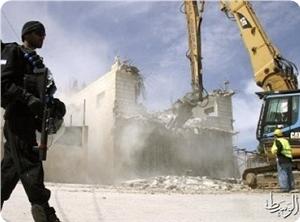 WEST BANK — Haaretz newspaper said the Israeli civil administration issued 13,000 demolition warnings against Palestinians accused of unlicensed construction in Area C of the West Bank.
The newspaper stated in a report that Israel intensified its construction restrictions on the Palestinian citizens in the villages and towns of the West Bank and seeks to prevent them from building through creating criminal files against them.
It said the civil administration increased the issuance of severe penalties against the Palestinians in all villages and towns located within Area C under Israel’s control.
Its report underlined that the civil administration was active recently in the demolition of many Palestinian homes and structures including schools in Al-Khalil city at the pretext of unlicensed construction.
The report pointed to the UN office for the coordination of humanitarian affairs’ recent report which condemned Israel’s restrictions on construction permits for Palestinians and its demolition of their homes while encouraging settlement construction.
Related articles
- Homes Destroyed, Lives Shattered: Criminal Displacement in Occupied Palestine (alethonews.wordpress.com)
- Israeli occupation authorities demolish well near Hebron (alethonews.wordpress.com)
- IDF closes Palestinian school to make way for West Bank training zone (theuglytruth.wordpress.com)
- Center: Israel orders demolition of electricity company (altahrir.wordpress.com)
Nativity Church deportees ‘did not sign agreement’ to be exiled
Ma’an – 26/05/2012
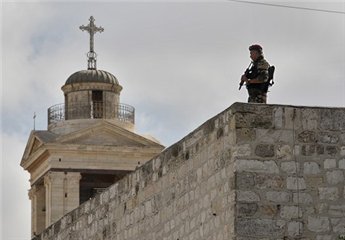
GAZA CITY – A group of Palestinians deported to Gaza after the Nativity Church siege in 2002 on Saturday disputed claims by a former economic adviser that they had signed an agreement to be exiled.
The 26 deportees told Israeli forces during the siege that only Yasser Arafat could negotiate on their behalf, denying claims that they themselves gave their approval to be deported, a statement said.
Muhammad Rashid, former presidential economic adviser to Arafat, on Friday told Al-Arabiya TV channel that the group had agreed to be deported and that he fully accepted responsibility for the agreement, which Arafat had authorized him to negotiate.
The committee appointed by Arafat to negotiate with the Israelis “almost reached an agreement to deport only 6 activists to the Gaza Strip, but other people were carrying out secret negotiations behind the scenes which ended in the deportation of 39 activists to the Gaza Strip and Europe,” the group of Gaza deportees said.
The official PA negotiating committee was headed by Salah Taamari, who was then governor of Bethlehem.
He told Ma’an TV in May that the deportation deal was reached without his knowledge and recalled his shock when Israeli officials told him Palestinians would be exiled.
The deportees urged the Palestinian Authority to expose all details of the 2002 deal, calling on the PA to prove whether there had been a written or verbal agreement between the two sides.
“If there was no written agreement, that would be a serious mistake by Muhammad Rashid, especially since the agreement was monitored by the US, the UK and the EU, and it was applauded by the Vatican,” the group said.
Former detainee and researcher Abdul Nasser Farwaneh said the deportation deal was a clear violation of international law and human rights.
The Palestinian leadership’s acceptance of the deal to send Palestinians into exile set a dangerous precedent and over the last decade Israel has deported hundreds more Palestinians, Farwaneh said in a statement.
On May 10, 2002, Israeli forces ended a 39-day siege on the church after striking a deal with Palestinian leaders to send 39 people given sanctuary in the church to Gaza and Europe.
When Israeli tanks surrounded Bethlehem on April 2, 2002, around 220 locals — including around 40 priests and nuns — took shelter in the church.
Over the next 39 days, eight Palestinians were killed inside the church and 27 others injured.
The siege on the site believed to be Jesus’ birthplace sparked outrage in the Vatican as monks sheltering inside pleaded for international assistance.
Related articles
- 10 years on from Nativity Church siege, deportees ‘forgotten’ (alethonews.wordpress.com)
- Deal reached to free Hana Shalabi (alethonews.wordpress.com)
- Israel arrests 800,000 Palestinians since 1948 (alethonews.wordpress.com)
Thousands hold demonstrations against journalist killings in Honduras

People protest violence against members of the media with signs that read in Spanish “United for peace and freedom,” left, and “Stop corruption” in Tegucigalpa, Honduras, Friday, May 25, 2012.
Press TV – May 26, 2012
Thousands of people have taken to the streets of many cities across Honduras to protest the killings of journalists in the Central American republic.
The demonstrators, who were chanting “Killing journalists does not kill the truth,” marched past the offices of the president and the human rights commission in the capital Tegucigalpa on Friday, AFP reported.
According to organizers, some 5,000 people attended the demonstration in Tegucigalpa, but protests were also staged in San Pedro Sula, La Ceiba, Comayagua and Choluteca.
“No more impunity,” said one sign held by an activist. Another sign read, “United for peace and freedom.”
Since President Manuel Zelaya was toppled on June 28, 2009 in a military coup twenty journalists have been killed in Honduras.
Last week, the body of 47-year-old HRN Radio journalist Alfredo Villatoro Rivera was found blindfolded and with gunshot wounds to his head, a police spokesman said.
A week before Rivera had been kidnapped.
Honduras has been plagued by political turmoil following the 2009 military coup. Military rule, corruption, an enormous wealth gap, crime and natural disasters have turned Honduras into one of the poorest and least secure countries in Central America.
The Elevation of Jeffrey Feltman
By VIJAY PRASHAD | CounterPunch | May 25, 2012
 A blog visited mainly by UN insiders announces that US Assistant Secretary of State for Near Eastern Affairs Jeffrey Feltman is up for a very important UN job. Former UN Assistant Secretary General for Public Information Samir Sanbar’s blog, UN Forum, notes that UN Secretary General Ban Ki-moon is set to replace B. Lynn Pascoe with Feltman in the post of UN Under-Secretary General for Political Affairs. The office was created in 1992 to help identify and resolve political conflicts around the world. Pascoe ran at least a dozen missions in Africa, Asia and the Middle East, notably in Burundi, Somalia, Iraq, Lebanon and Libya. The longest running mission is in Somalia (since 1995) and the most recent is in Libya (since September 2011). With a budget of $250 million and funds for special political missions that amount, this year, to $1 billion, the post allows its leader to intervene in political crises around the world.
When Secretary General Ban began his second term in January, he promised to reshuffle some of his senior staff. Pascoe’s replacement is part of this process.
Of the proposed new appointment Sanbar writes, “Designating someone with varied field experience, though controversial, and from a substantially senior post, may mean that more issues could be referred to the Security Council.” The UN Security Council’s Secretariat is handled by the Department of Political Affairs, which would be able to have some sway on its agenda. The post is central to the UN bureaucracy.
News of Feltman’s resignation from the State Department next week simply confirmed all the rumors. Another rumor suggests that the UN will announce the appointment on Monday, May 28.
Is Jeffrey Feltman the best person to run such an influential office in the UN? Why did Sanbar believe that this appointment is “controversial.”
Shibley Telhami, the Anwar Sadat Chair for Peace and Development at the University of Maryland and a Senior Fellow at the Brookings Institution, told me that Feltman is “an accomplished and respected American diplomat.” He has been involved in the Arab-Israeli conflict, Iran, Lebanon and Syria, and other hot spots. These bring up “inevitably controversial issues,” Telhami continued. “Feltman would have his share of detractors, including in the Middle East,” he said.
But why would Feltman have these “detractors” and how did he come off on the “controversial issues”?
On one issue Feltman is remarkably consistent. When it comes to the Middle East, Feltman has been outspoken about the threats posed by Iran in the region. Whether in Beirut or Manama, he has publically denounced Iranian “interference” outside its own boundaries. At the same time, Feltman has generously offered US assistance to these same regimes. In other words, US interference is quite acceptable, but Iranian interference is utterly unacceptable. This might be adequate behavior for the diplomat of a country, but it is hardly the temperament for a senior UN official. It raises doubts about Feltman’s ability to be even-handed in his deliberations as a steward of the world’s political dilemmas.
Feltman’s intemperate logic was not of the distant past. It was on display in March 2012 at a Lebanese American Organization’s meeting at the Cannon Office Building in Washington, DC. At this meeting, the former US Ambassador to Lebanon, instructed the Lebanese people as to what they must do in their next election, “The Lebanese people must join together to tell Hezbollah and its allies that the Lebanese state will no longer be hijacked for an Iranian-Syrian agenda.” The people must “use the 2013 parliamentary elections to defeat the remnants of the Syrian occupation, the pillar of which is Hezbollah.”
Indeed, interference by speeches is not the limit of Feltman’s ambitions. On May 3, 2012, he was back in Beirut, meeting former Prime Minister Fouad Siniora, former Finance Minister Mohamad Chatah, Future Movement leader Nader Hariri and others at Hariri’s residence. In the transcript of their meeting (leaked through Al-Akhbar), an older side of US policy making emerges. US Ambassador to Lebanon Maura Connelly is heard saying that the government is “Hezbollah dominated,” to which Feltman says to the Lebanese politicians in the room, “You can bring down the government if Walid [Jumblatt] is with you in the parliament or if Najib [Mikati, the PM] resigns right?” To Siniora, Feltman says, “Would it help if this government is brought down before the elections,” and then he mentions that he is seeing the Prime Minister Najib Mikati later that evening. “This place is very, very weird,” he notes, “weirder than when I left.” This is not a trivial statement. A glance at Feltman’s cables when he was ambassador to Lebanon reveals a fulsome appetite for the weird. The cables betray an obsession with the social lives of the Lebanese elite, their peccadillos and their foibles.
Feltman’s “non-interference” to prevent Iranian “interference” in Lebanon brings to mind another episode in his recent career. When the people’s protest broke out in Bahrain, US Secretary of State Hillary Clinton sent him there at least four, perhaps six, times. He was there on the eve of the Saudi-led invasion into Manama to smash the protests in March 2011. In a visit to Manama on March 3, 2011, just before the crackdown, Feltman praised the King for his “initiatives” and urged him to “include the full spectrum of Bahraini society, without exception.” In the Shia quarters, and amongst the al-Wefaq party activists, this sounded like Feltman was urging the King to take them seriously. In language similar to what he used in Lebanon, Feltman noted that the US wants a “Bahraini process” and urges others “to refrain, as we are, from interference or trying to impose a non-Bahraini solution from outside Bahrain.” The crucial phrase here is as we are, which implies that the US is not intervening in Bahrain. The fact of the 5th Fleet stationed in Manama and of the close cooperation between the Saudi monarch, the Bahraini King and Feltman’s bosses was to be ignored. “We are not naïve,” Feltman said, pointing across the waters at Iran. They cannot be permitted to intervene, but the US, a “critical partner” of the Kingdom, and the Gulf Arab monarchs, “will support Bahrain.”
When events heated up in Bahrain, Feltman and the chairman of the Joint Chiefs of Staff Admiral Mike Mullen went on a tour of the emirates’ capitals, declaring their unconditional support. The US stands for “universal human rights,” Feltman told the emirs, but of course since “every country is unique” these rights would emerge in their own way. Mullen was at hand to “reassure, discuss and understand what’s going on.” The key word here is reassure.
A clear-eyed assessment comes from Karim Makdisi, who teaches at the American University of Beirut. Makdisi recalls Feltman’s role as Ambassador in the area, where he made himself an extremely divisive figure. Feltman pushed for UN Resolution 1559 from 2004, to disarm the Lebanese resistance, he supported the Israeli invasion in 2006, and he provided assistance to the March 14 political party against Hezbollah. In other words, Feltman actively took sides in a divided political landscape. Feltman’s appointment “would be a disaster and send exactly the wrong signal for the UN” to the region. Having recognized its weakness, the US knows that it will be the UN that takes the lead in Syria and elsewhere for the foreseeable future. Makdisi believes that in “anticipating a larger role for the UN,” the US wishes Feltman to be well-placed to “ensure that US interests are maintained as much as possible.” Whatever credibility remains with the UN will whittle in the region with this appointment.
It is likely that Secretary General Ban Ki-moon picked Feltman for an unearned reputation. He is known around the Beltway for his work on the Arab Spring. But in the totality of the Arab world Feltman will not be seen as an open-minded professional. He has already thrown his hat into the camp of the Saudis and their satellites (the Gulf Arabs and the Hariri clan of Lebanon). This will limit Feltman’s ability to move an agenda in the region, least of all on the Arab-Israeli conflict where sober diplomacy is necessary from the UN. When I asked several people who watch the UN’s work in the Arab world carefully about this appointment, most offered me three words, “very bad news”. Not bad news for the Saudis or the US neoconservatives, but certainly bad for the people of the Arab world, whose Spring had them longing not so much for this kind of venal diplomacy but for honesty and good-will.
10 killed in drone attack on North Waziristan mosque
By Malik Mumtaz Khan & Mushtaq Yusufzai | The News | May 25, 2012
MIRANSHAH/ PESHAWAR: Ten people were killed and three others seriously injured in yet another US drone attack, this time on a mosque in Hasukhel village in the Mir Ali subdivision of North Waziristan Agency early Thursday.
This was the second missile attack by pilotless US spy planes in North Waziristan in the last two days. Reports said the victims included foreign militants, believed to be Turkmen. Villagers and officials of the political administration, however, insisted that all the worshippers were local residents. Tribal sources said the drone fired two missiles and pounded the village mosque where the tribesmen were offering the Fajr (morning) prayers.
“Some of the people had offered the prayers and were leaving the mosque. Others were still praying and some were reciting the Holy Quran, when the drone fired two missiles and struck the mosque. The small structure of the mosque was demolished in the attack and those present inside were buried under the debris of the building,” a tribesman, Mohammad Roshan Dawar, said.
Talking to The News from Hasukhel village by phone, he said four US spy planes were seen flying over the area at the time of the attack. He said a large number of villagers later arrived there and helped retrieve the bodies of the slain men and those injured in the attack.
The tribesman said some houses located close to the mosque were also damaged in the missile strike, but did not cause any loss of life to the inmates. He said bodies of the slain men were mutilated beyond recognition.
“Their bodies were almost burnt and could not be recognised easily. It was a horrible scene as the villagers were offering prayers and reciting the Holy Quran in the mosque but within minutes there was devastation and human bodies lying everywhere,” the tribesman recalled.
Tribal sources said three people seriously injured in the attack were admitted to the Agency Headquarters Hospital in Miranshah. Pleading anonymity, a senior doctor at the Miranshah Agency Headquarters Hospital said all the three injured were in critical condition. “They were brought to us in a serious condition and had suffered multiple injuries. Also, we do not have any facility here in the hospital to save lives of seriously injured patients. Let alone other facilities, the only X-ray machine at the hospital is also out of order,” the doctor said.
Government officials based in Mir Ali confirmed that the drone had targeted the village mosque. Drones in the past had pounded schools, houses, Hujras and even the tribal Jirgas were not spared, but this was the first time that a mosque was attacked in North Waziristan. This was the 13th drone attack in North Waziristan this year.
Featured Video

Theodore Postol: Iran’s Missiles & Drones Were Underestimated
or go to
Aletho News Archives – Video-Images
From the Archives
What is the Israeli Lobby in Australia Doing in Interfaith Dialogue?
By Ali Kazak | Dissident Voice | October 11, 2015
For years Israel and its lobby around the world have been trying to normalise their relations with Arabs and Muslims without solving the Palestine Question.
One of the methods they resorted to in the last few years is using human rights and community organizations such as interfaith dialogue and Multiculturalism to achieve this objective and to: isolate the Palestinians, marginalise the Palestine question, end Israel’s isolation, and prevent criticism of Israel, knowing that these organisations will be the first to stand against Israel’s violations, racial and religious discrimination.
The group responsible for this task in Australia is The Australia/Israel & Jewish Affairs Council (AIJAC); its Director of International & Community Affairs, Jeremy Jones is in charge of lobbying religious community organizations, specifically Muslims and Christians. Consequently he convened the Faith Communities for Reconciliation, founding participant in the Australian Partnership of Religious Organisations and the Australian National Dialogue of Christians, Muslims & Jews.
AIJAC is a private political propaganda group. It is recognised as the main Israeli lobby in Australia. It coordinates its activities and works intimately with the Israeli embassy in Canberra and different institutions in Israel. It is privately funded by some Jewish businessmen. It monitors closely Australian politicians, the media, ethnic and religious groups, (especially Arabs and Muslims), unions and academics on their stands towards Israel and the Palestine question. … continue
Blog Roll
 Aletho News
- The killing of three Indonesian soldiers in Lebanon should remind Jakarta that Israel does not want peace
- Defeated and delusional: Netanyahu’s remarks reveal $80bn war failure, says analyst
- Iran’s friends are about to make life much more difficult for Israel and the US
- The war of liberation of the Arab and Islamic peoples expands across the Gulf
- Envoy warns UN on Trump’s threat to ‘obliterate’ Iran’s civilian infrastructure
- The Larak Corridor: Iran’s Rial Gate With No US, No Israel, and No Way Around
- ‘Economic terrorism’: Steel facilities hit again in US-Israeli strike
- ‘War Crime’: Iran condemns attacks on Arak, Ardakan nuclear sites
- Two-thirds of Americans want quick end to Iran war even if goals unmet
- Trump to Give “Important Update on Iran” Wednesday in Prime-Time Speech
- If Americans Knew
- Gaza families reunite years after babies evacuated amid Israel’s war
- International Rescue Committee warns Gaza’s children face grave protection risks
- Iran’s Alleged 47-Year War on America: Debunking the 1,050 American Deaths Canard
- Israel wants US to bomb more of Iran’s civilian structures (113,000 is not enough) – Not a ceasefire Day 173
- Ann Coulter Rips Into Fox News for Iran War Coverage
- Joe Kent Urges Americans To Call White House and Congress To Object To Sending Troops Into Iran
- DNC Resolution to Reject AIPAC Funding Puts Democratic Leaders in the Hot Seat
- Swedish foundation to build 400 schools as over 650,000 Gaza children remain without education for 2 years
- Israeli army admits photshopping image of slain Lebanese journalist
- This is how Israel is systematically killing health workers under the cover of war in Lebanon
- No Tricks Zone
- New Study Finds Warming Saves Lives…Cold Temperatures 12 Times More Deadly Than Excess Heat
- German Science Blog Accuses PIK Climate Institute Of Hallucinating Climate Tipping Points
- Devastating Assessment Of Comirnaty Vaccine By Former Senior Pfizer Europe Toxicologist
- New Study: CO2 Is ‘Effectively Negligible’ As An Explanatory Climate Change Factor Since 2000
- Former Pfizer Toxicologist Dr. Helmut Sterz Tells Bundestag Hearing Pfizer Vaccine Should Have Never Been Approved
- Energy Expert: Germany’s Nuclear Phaseout Was A “500 Billion Euro Mistake”
- New Research: South Australia’s Mid-Holocene Sea Surface Temperatures Were 4°C Warmer Than Today
- Storing Green Energy To Last Germany 10 Days Would Require A 60-Million Tonne Battery
- New Studies: UK Sea Levels Were 4 Meters Higher Than Today During The Mid-Holocene
- Destructive Green New Deal: German Energy And Metal Group Warns Of Drastic Crisis
 Aletho News