US government restores indefinite detention without trial
Press TV – September 19, 2012
The American government has successfully appealed a ruling by a district court banning indefinite detention of suspects without due process, re-instituting the controversial law that contradicts the US Constitution, Press TV reports.
The restoration of the law allows the Obama administration to hold suspects, even American citizens, captive without trial at military prison facilities such as the notorious Guantanamo Bay in Cuba for as long as they desire.
The provision is part of the National Defense Authorization Act (NDAA), signed into law by US President Barack Obama in 2011. The controversial bill further extends surveillance powers of various American law enforcement institutions, allowing the US military forces around the world to seize any non-combatant foreign individual across the globe.
US Civil Rights Attorney Ron Kuby describes the latest ruling as another blow to American civil liberties, insisting that it grants the government and its military forces too much authority.
This is while US District judge Katherine Forrest dismissed NDAA last week as “deeply flawed,” declaring it unconstitutional on the basis that it violates the 1st and fifth amendments. The Obama administration, however, appealed the verdict passed down by Judge Forrest, claiming that her decision has put the US military operations around the world in jeopardy.
Following up on Obama administration’s legal challenge, US Appeals Judge Raymond Lohier agreed with the government on Tuesday and lifted the ban, exposing American natives just as vulnerable to such arbitrary arrests as hundreds of individuals living in other countries that may be detained after being labeled as ‘a terrorist’ by American authorities or military forces.
International human rights groups insist that more than 700 people across the globe have been kidnapped by the US authorities and transported to detention facilities in different parts of the world. The practice, often referred to as Rendition, gained international attention with the case of Khalid El Masri – a German citizen who was tortured in Afghanistan for months before being released in 2004.
A number of US legal experts emphasize, meanwhile, that even the US citizens can now be confronted by a similar plight no matter where they may reside. The fight, however, is far from over on the NDAA issue. The stay on this provision is only effective until September 28th, when the American government will have to defend it before a three judge appeals panel.
Many observers believe that the case will most likely end up in the US Supreme court.
Related articles
- Unlike Afghan leaders, Obama fights for power of indefinite military detention | Glenn Greenwald (guardian.co.uk)
- White House demands military prisons for Americans under NDAA (alethonews.wordpress.com)
- Judge reinstates federal kidnapping powers (tenthamendmentcenter.com)
Soldiers told to bar non-Jews from settlement
Ma’an – 19/09/2012
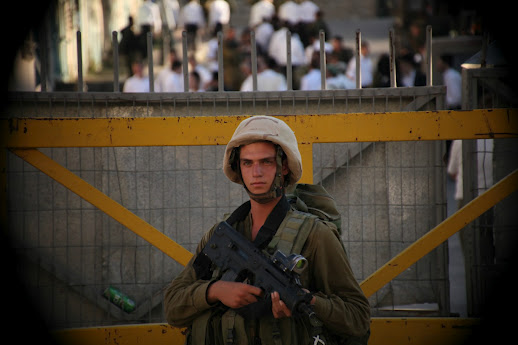
File Photo

BETHLEHEM – Israeli soldiers stationed at a settlement in the West Bank were instructed not to allow any non-Jews to enter the community, the Israeli daily Haaretz reported Wednesday.
The military security coordinator of Bat Ayin settlement, near Bethlehem, instructed that not even Israeli non-Jews could enter, a soldier stationed at the settlement told Haaretz.
“It was specific — only to allow entry to Jews with blue [Israeli] identity cards. Let’s say a Druze or a Bedouin with a blue ID [would try to enter], someone coming to clean the bathrooms — no,” the soldier explained.
He added: “It felt just like apartheid, or things that recall dark times and the Holocaust — that you allow someone entry to a specific place based only on his religion.”
The Israeli army confirmed the instruction had been given. The military said it had clarified to the security coordinator that the order to ban non-Jews was illegal.
However, the army said it ordered soldiers to notify the settlement coordinators if any non-Jews entered so they could be accompanied while in the settlement.
Related articles
- IDF soldiers instructed to bar non-Jewish citizens from settlement (haaretz.com)
- Settlers Occupy Palestinian Lands Near Bethlehem (imemc.org)
- Palestinian Arrested Near West Bank Settlement (imemc.org)
Settler attack in Aqraba leaves 3 injured, 1 hospitalized
September 19, 2012 | International Solidarity Movement
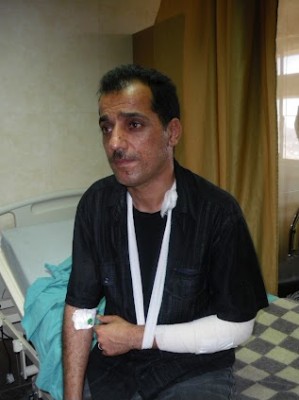 On Monday 17, September, six Israeli settlers from the illegal settlement of Itamar attacked three members of the Benijaber family, who were walking home to the Palestinian village of Aqraba from their olive groves.
Maher Hashem Mostafa Benijaber reported that he, his brother Omar and cousin Hafed were set upon by six men, three of whom were armed with semi-automatic rifles. The attack occurred just before 7 p.m., around 600 metres from their home. The settlers punched and kicked the three men, as well as beat them with rocks and sticks. They also tried to block the path back to the village so Maher and his family could not escape.
Omar managed to escape, calling neighbours for help. Meanwhile, the attack on Maher and Hafed continued. After the arrival of other residents, the Israeli attackers fled the scene. Maher then attempted to walk back to the village, but collapsed, lost consciousness, and had to be carried.
Maher Hashem Mostafa Benijaber in the hospital being treated for injuries after settlers attacked him on his way home.
Maher, Omar and Hafed all required medical treatment at the local clinic in Aqraba for the injuries they sustained during the beating, and Maher was hospitalized overnight in Nablus. All three men suffered injuries to their arms, head, back and legs, consistent with a sustained beating with sticks. When asked what he thought about the latest attack, Maher said, ‘if no-one had come to help, they would have killed me.’
The family contacted the Israeli army via the Palestinian Police and District Coordination Office to report the attack, however the army instead visited Yanoun village, which is also near Itamar settlement. Despite being informed that they had gone to the wrong village, they never attended the scene of the attack in Aqraba or spoke to Maher.
The attack on the Benijaber family is just the latest of many on the village of Aqraba. Four days previously, an elderly shepherd was attacked and forced to flee from his fields back to the village. The attacking settlers then stole some of his sheep. Such attacks on Palestinian villages are commonplace throughout the West Bank, and there is effectively impunity for settlers who carry them out. According to the Human Rights Watch 2012 report, “The Israeli government generally took no action against Israeli settlers who destroyed or damaged mosques, homes, olive trees, cars, and other Palestinian property, or physically assaulted Palestinians.” Illegal settlements such as Itamar continue to be encouraged to expand with the support of Israeli government and occupation forces.
Maher’s room at Rafidia Hospital happens to be across the corridor from Akram Taysir Daoud, who suffered a similar attack in the village of Qusra on 15th September and remains in hospital. Report at: www.palsolidarity.org/2012/09/qusra-man-left-for-dead-after-settler-attack/
Related articles
- Three injured from tear gas after settlers raid in Qusra (alethonews.wordpress.com)
France to ban Paris demo against anti-Islam movie
Press TV – September 19, 2012
Later this week France is to ban a demonstration in protest against a movie deemed offensive to Islam’s holiest figure, Prophet Muhammad (PBUH).
French Prime Minister Jean-Marc Ayrault told RTL radio station on Wednesday that there is “no reason why we should let conflicts which do not concern France come to our country.”
Despite appeals for calm by French Muslim leaders, protest rallies are expected to take place in several French cities next Saturday. Ayrault, however, only mentioned banning the Paris one.
On Sunday, France’s Interior Minister Manuel Valls ordered a ban on any further demonstrations against the anti-Islam film made in the United States.
“I have issued instructions so that this does not happen again. These protests are forbidden,” Valls said in an interview with France 2 television network.
The minister went on saying that the government would fight more anti-US protests with “the greatest firmness.”
His warning comes only a day after Muslim demonstrators staged a protest outside the US Embassy in Paris and the Interior Ministry to express their outrage at the blasphemous film that depicts Islam as an oppressive religion.
French police made 100 arrests in the capital for attending the anti-US protest.
Muslims in Iran, Turkey, Sudan, Egypt, Yemen, Tunisia, Bangladesh, Indonesia, Malaysia, Kashmir, Pakistan, India, Iraq, Gaza, Morocco, Syria, Kuwait, Nigeria, Kenya, Australia, Britain, the United States, France, Belgium, and some other countries have held many demonstrations to condemn the blasphemous film.
Angry protesters across the world demand the US government apologize to the Muslim world over the anti-Islam movie.
Vallecito Resists, Satuye Lives! The Garífuna Resistance to Honduras’ Charter Cities
By Tim Russo, with Research by Genevieve Roudane and COMPPA | Upside Down World | September 18, 2012

The Camp
It is August 28th in Vallecito, Colon on the Atlantic coast of Honduras. Unceasingly heavy winds and rain pound a small encampment of 200 Garífuna families throughout the night. The families came from more than a dozen of the 46 Garífuna communities that dot the Honduran coastline, in order to set up camp, staking claim to ancestral lands they mean to recover. Not tonight, nor any other since their arrival here on August 26th, do their worries stem from the violent rains or turbulent sea that Isaac has brought. No, Isaac is merely one of 20 or so hurricanes that could show its fury on the Garinagu[i] coast this year.
The Garífuna drums echo robustly and the people’s fervor rises with the tension in the camp as the tarps sound thunderously as they are jarred to and fro in the gale. It is impossible to distinguish the faint movement of people outside the main tent in the absence of the moon and her stars. Suddenly, out of the darkness that surrounds the encampment like an ocean fog that encroaches silently from afar, enveloping everything in its path, heavily armed men wielding sophisticated weaponry burst onto the scene unleashing a barrage of gunfire above the camp. They arrive mounted in pairs on motorcycles, an act in and of itself illegal in Honduras[ii]. They move rapidly from one edge of the camp to the other, relentlessly firing a hairs shot above anything they encounter in their trail. They are uniformed, but not with official police or military uniforms, but well uniformed nonetheless.
“Yes!” insists Alfredo López, Vice-President of the Black Fraternal Organization of Honduras (OFRANEH), founder of the first Garífuna radio station, Faluma Bimetu (Sweet Coconut) and coordinator of the Garífuna Radio Network; they are “paramilitaries linked to drug trafficking and Reynaldo Villalobos, the man who has invaded five of the six associative businesses[iii] with over 700 hectares [1730 acres] of land” here in Vallecito. Still a doubt remains as to whether the mercenaries are actually Miguel Facusse’s, the“Palmero de la Muerte” or Palm Owner of Death, as he is known, whose vast extensions of African Palm plantations completely surround Vallecito, with exception of the beach. Regardless, says Alfredo, “against their weapons, our drums are all that we have,” as the drums sound with greater vigor through the camp, exhorting Isaac to unleash a fury of rain to dampen the mercenaries notorious taste for blood. They have already harassed the camp for three enduring nights.
There were no massacres nor was anyone injured last night but the message of the regional plantation owners is dead clear says Alfredo, “They are treating us like trespassers in our own home and instead of receiving help from the authorities, it seems that they are in collusion too.” Despite the fact that no one has slept a wink in three nights, the people here knew what they were getting into by setting up this camp. They came to participate in a non-violent action to recover ancestral garífuna lands that legally and legitimately belong to the garífuna people. They mean to pressure the National Agrarian Institute (INA) into properly surveying the 700 hectares pertaining to the 6 garífuna “associative businesses” [Empresa Ruguma, Saway, Saway Sufritiñu, Walumugu, Satuye, Sinduru Free], and demand that the state guarantee the necessary security conditions for the Garífuna to live and work on this land. The Garífuna, reiterates Alfredo, are no strangers to persecution nor to resistance, “We have been fighting for many years, hundreds of years, and we are not going to give up now because of the sordid interests of a government as irresponsible as Honduras.”
The Land
OFRANEH´s, Report on the Territorial Defense of Vallecito in Colon, indicates that “Historically, Vallecito belongs to the Garífuna people who, in response to pressure from the Spanish after 1804, began to move from the Trujillo bay to the Sico River” in search of fertile land for farming with access to the ocean for fishing, activities that form the backbone of the Garífuna culture. As a result of this displacement and their search for better living conditions than to be exploited workers for the Spanish in Trujillo, at least 24 Garífuna communities began to emerge along the coastal region. Essentially, the Garífuna began to inhabit Vallecito 17 years prior to the Honduran independence from the Spanish Crown in 1821.
The current attempt by the Garífuna, organized by OFRANEH and the Iseri Lidamari Movement, is not their first effort to recover their ancestral lands from the economic interests of the Honduran oligarchy or of the foreign interests that forced their displacement. Shortly after the Garífuna arrived at Vallecito, the story is told, “around 1820, the Scottish pirate Gregor MacGregor ‘purchased’ the Serrania de Payas territory between Trujillo and the Sico River from Georges Frederick I, King of the Moskitia, allegedly in exchange for two bottles of Whiskey.”[iv] This was the first heist, a foreign attempt to appropriate, develop and sell without the people’s consent the Garífuna’s new lands.
In 1887, the first process to title Garífuna lands began near Puerto Cortez, now under the tutelage of the independent Honduran state. The relative peace for the Garífuna communities along the Honduran coast did not last long. The turn of the century proved to show the new face of colonization, manifested in the arrival of the Banana Republic, with its reinvigorated exploitation of natural resources and forced labor. Immense quantities of cultivable lands were turned over to three banana companies, the United Fruit Company (Chiquita), the Standard Fruit Company (Dole), and the Cuyamel Fruit Company. They received 1,235 acres of land for every kilometer of rail they lay for trains in Honduras. By 1929, the United Fruit Company controlled the principal ports and approximately 741,000 acres or nearly a thousand square miles of fertile lands for the banana boom, including the majority of maritime access on the Atlantic coastline.[v]
The Honduran transition from Spanish colony to Banana Republic defined a new era of forced displacements and territorial resistance by the Garífunas due to the pressures and expansionism of the banana companies who rabidly accumulated land and workers. This process provoked major state complicity in order to provide new land titles for the banana companies, ignoring the existing process that began to title land in favor of the Garífuna at the end of the 19th century. Nevertheless, the banana plantations proved, in many cases, too large to completely control.
“In 1997, the Iseri Lidamari movement, accompanied by OFRANEH, met with the National Agrarian Institute (INA) to obtain land titles in the [Vallecito] territory for six “associative businesses”; as a result, they obtained legal documents that recognize 2,700 hectares of land as Garífuna property,” states OFRANEH’s Report on Territorial Defense in Vallecito, Colon. However, the same report indicates:
“Since that date, intruders have attempted to take over that territory. Miguel Facussé planted 100 hectares of African Palm in Ruguma, one of the six “associative businesses” but the Supreme Court (CSJ) ruled in favor of the Garífunas, annulling Facussé’s claims to that land. Despite this [ruling], in recent years the area has turned into a corridor for organized crime and drug trafficking, causing the number of residents in the area to diminish.”
According to Teofilo Colon Jr., a Garífuna journalist and researcher in New York City, the creation of said corridor of organized crime and the usurpation of lands has provoked the following results, “In the last 18 years, 86% of Garífuna land has been seized by non-Garífunas.”[vi] The situation has become acute since the 1990’s, as the introduction of the war on drugs has intensified. OFRANEH highlights this in a communiqué:
“Since 2005, people associated with organized crime impose a reign of terror on the Limon- Punta Piedras corridor, forcing Garífunas living in Vallecito to reduce their presence and activities on land belonging to their “associative businesses”. Subsequently, foreigners arrive, taking over 900 of the 1,600 hectares of Garífuna land recognized by the National Agrarian Institute (INA).”[vii]
Despite the persistent threats, the coup d’etat in 2009 and the corridor of terror created in the Vallecito region, in 2010 OFRANEH was able to secure a signed agreement with delegates of the INA where they committed to surveying the “associative businesses.” But according to Miranda, “the intruders [Facussé and Villalobo] denied entry to members of the INA and the Attorney General,” preventing them from opening the gates and re-measuring the fenced-in “associative businesses”, a necessary step towards repopulating their land.
In 2008, Miriam Miranda was unanimously elected president of OFRANEH by the general assembly of Garífuna communities. OFRANEH was founded in 1978 with the express mission to “represent and defend the interests of the Afro-Caribbean Garífuna minority in Honduras with a mandate to protect the capacities of the Garífuna community and their self-determination through programs promoting political, social, economic, and cultural development.” Miranda took over the presidency of OFRANEH shortly after the previous president, Gregoria Flores was forced to seek asylum in the United States, fearing the constant death threats she was receiving.
Unfortunately, Miranda states in the Vallecito report, “The President [Porfirio Lobo Sosa] considers Vallecito to be uninhabited.” This territory, defined as “uninhabited” or vacant is fundamental in order to understand the most worrisome threat to the garífuna at present, the arrival of so-called “Special Development Zones” (RED) or “Charter Cities.” OFRANEH has emphasized there has not been a threat as severe as the one posed to the Garífuna by Latin America´s first Charter City since the arrival of the banana companies a hundred years ago. What Miranda considers the beginnings of the “deterritorialization garífuna,”[viii] which “intensified in the 1990s due to real estate speculation fueled by tourist mega projects” on the Caribbean Coast.[ix]

The Arrival of Charter Cities to Honduras
The so-called, “Special Development Regions” (RED) or “Charter Cities” are the brainchild of Paul Romer. Romer is the son of former Colorado Governor Roy Romer. He is a recognized economist educated at the University of Chicago and currently teaches economics at the NYU Stern School for Economics. He has devoted the last years to designing and promoting “Charter Cities” while searching for uninhabited territories in close proximity to exploitable natural resources in a carefully profiled country (a country with an on-going major disaster) where he can sell his first “Charter City” in order to produce a new era of development for the world.
Concluding a May 2012 New York Times Magazine article titled “Who Wants to Buy Honduras?” the author, Adam Davidson coincides with Romer’s perspective writing, “It’s easy to criticize experimenting with the livelihoods of the poor, but having spent time in the chaotic slums of Honduras, Haiti, Jordan and Indonesia, I’ve found that the poor are already conducting daily experiments in how to make life better outside the formal economy. By and large, it isn’t working. We have to try some new things.”[x]
In effect, says Miriam Miranda in an interview with journalist Giorgio Trucchi, “In the name of development, Honduras is up for sale; this fact alone reflects a failed state that has yet to recover its institutional legitimacy following the [2009] coup.” Indeed the goal of the May 5th and 6th 2011 conference in San Pedro Sula properly entitled, “Honduras, Open For Business” was to attract major foreign businesses to invest in Honduras, selling off crucial areas of interest. The mega expo, attracted the likes of corporate magnates such as Siemen Phillips, Mexican Carlos Slim (Fortune 500 World’s richest man), and 325 other corporate giants where they were pitched six primary areas for lucrative foreign investment by Honduras’ most powerful businessmen; Energy, Infrastructure, Maquiladora (sweatshops) and Transformation Services, Agro-Business, Forestry and Tourism, reassuring that “access to the most important markets in the world, with investment guarantees and clear rules, would be among the clear advantages that investors will have in Honduras.”[xi]
An article published in the conservative Honduran daily newspaper El Heraldo, offered a list of FAQ´s promoting “Charter Cities” in Honduras explaining that, “The REDs [Special Development Regions] will enjoy a high-degree of autonomy. The rules regarding health, education, justice, and security in the RED can be different from those in the rest of the country.” By definition, according to the Charter City’s official website in Honduras (www.red.hn), the RED will be practically an autonomous city-state inside of another state, with the express mission of producing economic profits in the name of development for the underdeveloped, as a means to combat poverty. Nevertheless, in order to launch and development a Charter City (RED) they first require an “A vacant piece of land, large enough for an entire city, voluntarily contributed by a host government.”[xii]
Contrary to the philosophy of the North American economist, the Uruguayan author Eduardo Galeano wrote years ago that, “Underdevelopment is not a stage of development. It is its consequence.” Paraphrasing, poverty is not eradicated with economic developmental experiments designed to tenfold the wealth of transnational corporations, theoretically trickling down in the wake of their riches. Rather, the ferocious development schemes based on the savage exploitation of natural resources, the forced relocation of traditional peoples and exploitation of forced labor contribute to and foment the exponential growth of disparities between the world’s wealthiest and poorest.
In order to launch the Charter City project in Honduras, Romer requires an “uninhabited” piece of land. For President Lobo and the Honduran Congress, this ambiguous concept already existed in Honduras when they began to “FastTrack” the necessary constitutional reforms in late 2010. Honduran prosecutors and lawyers have questioned said constitutional reforms. In October 2011, they submitted the first formal petition to the Honduran Supreme Court challenging the constitutionality of the legislative decree that created the Special Development Regions. They argue that the decree openly relinquishes or indefinitely leases national territory to foreign interests in order to create a “state within a state,” in turn, violating Honduras’ sovereignty.
OFRANEH has also emphasized Romer’s erroneous understanding of Honduras, illustrating the potential consequences of his theories, which are on the verge of being implemented. “Paul Romer’s propaganda talks about building Charter Cities in uninhabited places. Unfortunately, in Honduras they are trying to dispossess the Garífuna people of half of our territory in order to create the RED (Special Development Region). The level of disinformation and violence that exists in this country reveals that multiple human rights violations will be caused by the establishment of a neocolonial project in the 21st century.”[xiii]
The Crisis
Yet, the economic crisis already exists. More importantly the general lack of security and un-governability of Honduras has become ever more acute since the consolidation of the coup d’état on November 29, 2009 with the election of Porfirio Lobo Sosa as Honduras’ President. Romer, who patented the phrase in 2004 “a crisis is a terrible thing to waste,”[xiv] found in Honduras the perfect lab to perform a field test of his vision. To promote the reduction of poverty, enhanced security and a stable economy in a country where none of these elements exist is an immensely attractive proposal for legislators who will form the first line of potential investors and occupants of said “Charter City.”
To date, Honduras continues to be the country with the highest per capita rate of homicides in the world. According to the United Nations 2011 report, there are an average of 82.1 homicides per 100,000 inhabitants a year in Honduras. We can compare this to Mexico with an average of 20 homicides per 100,000 inhabitants despite a high intensity war on drugs that has claimed at least 50,000 lives in the last 6 years, or New York City where the homicide rate in 2010 was 6.4 per 100,000.[xv] According to the Tegucigalpa based Committee for the Freedom of Speech, C-Libre, Honduras also holds the world record for the highest per capita rate of journalists that are violently killed. There have been 33 journalists assassinated in the last 10 years in Honduras, and 28 of them since the June 29, 2009 coup d’état.[xvi]
The recent visit to Honduras by the International Mission on the Verification of Human Rights Violations in the Bajo Aguan summarized in a public hearing that Honduras has become characterized as a country where there is a systematic killing of campesinos. They cite in their report that, specifically in the Bajo Aguan, Colon, there have been at least 50 campesinos assassinated with total impunity in the last two years by mercenaries that protect the interests of wealthy landowner Miguel Facussé, who has boosted his African Palm production and biofuels exportations.[xvii]
Simply put, the favorable conditions necessary for the implementation of a Charter City culminated quickly in Honduras following the 2009 coup d’état. On January 19th 2011 the Honduran National Congress approved the Law for Special Development Regions (RED).[xviii]
Honduran journalist Sandra Marybel Sánchez, who also raises the concerns of Hondurans that feel that the country’s sovereignty is being compromised, highlights the most important concessions made by the Honduran Congress to investors in order to implement the Charter Cities in an article she wrote:
1. They will be autonomous, will be legally incorporated, will have their own administrative system, they will emit their own rules (Laws) and they will have their own legal jurisdiction… composed of national or international experts.
2. They will be authorized to enter into international agreements and treaties related to trade and cooperation in matters within their competence.
3. They will be able to enter into agreements with national or international intelligence services to combat organized crime.
4. They will be authorized to have and operate their own police force, which may be strengthened by entering into bilateral agreements with other countries and regions.
5. The REDs will have their own budget, to fix the taxes/rates they will charge and to collect and manage their own taxes.
6. They will be able to establish their own migration and immigration policies and rules, and control whatever transportation system that is admitted within its area of control/jurisdiction. Sea and air craft/vessels will have assured access to the RED.[xix]

Echoing the observations made by Sandra Marybel Sanchéz, Jari Dixon, a lawyer and ex- federal prosecutor now with the Association of Judges for a State with Rights, argues that the RED (Charter City) violates a series of Honduran laws. “In the RED, autonomous powers serve as the executive, legislative, and judicial powers, which is completely unconstitutional. Moreover, by indefinitely handing over part of the national territory to foreigners, the sovereignty of the country is being violated,” stated Dixon.[xx]
On September 5th, Dixon, Sánchez and members of several Honduran social organizations were illegally detained at the Honduran Supreme Court as they attempted to submit a formal petition to the court questioning the constitutionality of the congressional modifications made to the constitution, creating the RED. While being held arbitrarily for several hours before being able to submit the petition, Dixon manifested, “this is the first example of what to expect with the Charter Cities. Here, a wall separates them from the rest of Honduran society, revealing exactly what the State loses when it auctions off the country: nothing less than its sovereignty.”[xxi]
Back in the Vallecito camp on August 30th, OFRANEH, now accompanied by members of the Espacio Refundacional[xxii] and human rights organizations hold a gathering called the Meeting of Cultural Resistance Against Charter Cities. Miriam Miranda asserts: “On several occasions, the Executive and Legislative Powers indicated that the first RED in Honduras will be located between the Trujillo Bay and the Sico River, an area that includes 24 Garífuna communities, which are considered the cultural sanctuary of the Garífuna people. Moreover, some have mentioned creating RED’s in order to produce biofuels, presumably in the tropical forests of the Honduran Moskitia. There are major interests and tremendous potential in this area for the de facto powers in this country– the economically powerful, the oligarchy that has hijacked this country.”
Doug Henwood, special editor at The Nation, asserts in an interview with Al Jazeera that:
“It’s interesting how the charter cities concept unmasks the libertarian dream as deeply undemocratic. The compatibility of [Augusto] Pinochet and Milton Friedman offered plenty of hints, but this Honduran experiment looks like conclusive proof. First you need a coup. And then you need to set up a zone of freedom – but a special kind of freedom. Not the freedom of association, or of individual expression and development, but the freedom of maneuver for an economic elite to do as it pleases under a special kind of state protection. Milton’s grandson, Patri Friedman, one of the charter city pioneers, has declared that democracy is ‘unfortunately… ill-suited for a libertarian state.’”
The Honduran Charter Cities promise to create precisely this type of libertarian and laissez-faire state, attractive to investors that share a similar vision and dream about a city-state subject only to laws that guarantee, without restrictions, the absolute free flow of capital with zero interference.
The Deal
On September 4th in Tegucigalpa, The Commission for the Promotion of Public-Private Alliance, COALIANZA, a commission created by the Honduran congress, signed a fifteen million dollar contract with an investment consortium headed by Michael Strong to begin construction on Honduras’ first Model City. During the signing ceremony, Juan Orlando Hernández, president of the Honduran Congress proclaimed, “This is an extraordinary moment for our country, for this generation of Hondurans and for the generation of politicians, academics, and advisors who have decided to look to the future and not fear change.” Carlos Pineda, the president of COALIANZA, described the project as having “the potential to turn Honduras into an engine of wealth,” and a “mechanism for development typically belonging only to first world countries.”[xxiii]
Strong, founder and CEO of NGK, stated that “the future will remember this day as the day that Honduras began developing,” because “we believe this will be one of the most important transformations in the world, through which Honduras will end poverty by creating thousands of jobs.”[xxiv] Strong further emphasized that “this is a collaboration between a diverse group of investors, businesses and experts that aim to eliminate poverty through the creation of wealth in Honduras by means of Special Development Regions.”[xxv] Although the details of the deal are unclear, apparently Canada and South Korea will be the initial investors in the project, which is expected to break ground in Puerto Castilla, on the Trujillo Bay.[xxvi]
There are many sketchy details about the US based consortium NGK, who have estimated that they could create as many as 200,000 jobs for Hondurans over the next couple of years.[xxvii] Even the mainstream media are confused about the name of the consortium; the AP, ABC, The Guardian and The Independent have cited the company as either “NGK” or “MGK.” Even the highlighted article on the Honduran Congress’s website ran contradictory information about the consortium, citing “MGK” in the headline and title of the article while referring only to “NGK” in the body of the very same article. Extensive searches for information in regards to either name or any consortium run by Michael Strong return null, leading to a series of doubts as to whether Honduras has signed an 15 million dollar contract with a ghost company.
Furthermore, Paul Romer in his blog on www.chartercities.org wrote on September 7th, “Here at Charter Cities, we’ve received several requests for comment on recent press reports of an agreement with investors to develop the Honduran Special Development Regions (REDs). We learned of these agreements from the media and have no knowledge of their terms, so we’re unable to offer any comment about them.” Romer concludes by stating that members of the Transparency Commission (the supposed governing apparatus for the Charter City) have written to the Honduran President to clarify the situation.[xxviii] The Transparency Commission was named by the President Porfirio Lobo Sosa in December 2011 and includes Paul Romer, George Akerlof, a Nobel Laureate in Economy and Permanent Resident at the International Monetary Fund, Nancy Birdall, an ex Vice-President at the Inter American Development Bank, Boon-Hwee Ong, an ex-general in the Singapore Armed Forces, and Harry Strachan, the Director Emeritus at Bain & Company (founded by US Presidential candidate Mitt Romney and documented to have funneled El Salvadoran death squad funding during the 1980’s Central American civil wars).[xxix]
Nonetheless, Strong maintains that “We will work closely with the governor of the Charter City to assure that the region is equipped with the best police force, the best jurisprudence, legal system and transparency. The main goal of our project is to create the foundation of a safe and prosperous community for Hondurans.”[xxx] Furthermore, it turns out that Strong is not just the CEO of the controversial NGK or MGK consortium, but also the CEO and co-founder of FLOW (Freedom Lights Our World) and “flow-idealism” an organization built on libertarian and Friedmanite economic philosophies and theories.
Strong, who considers himself a leftist, is closely connected to and funded by Whole Foods CEO and FLOW’s other co-founder John Mackey. He goes so far as to relate the concept of “Free Cities” to an “anarcho-capitalist-paradise” that will be much more efficient in eradicating global poverty than the “euro-socialism” so feared by the “whackos” in the Tea Party.[xxxi] This is how Strong presented his philosophy and project to an elite group of global libertarians in April 2011 at an exclusive resort on Roatán, a Honduran Island in the Caribbean. Patri Friedman and Mexican Ricardo Valenzuela, CEO of Free Cities LLC were among the special guests. During his presentation in Roatán last year, titled “Marketing Free Cities as a Mainstream Solution to Global Poverty,” Strong repeated numerous times that one distinguishing factor between he and others that promote similar types of projects is that “We are on the side of the angels,” supposedly emphasizing his humanistic, transcendental and new-ageist traits that represent his particular line of thought among the diverse tangents in the libertarian movement.[xxxii]

The Relocation, Resistance and Dance
Roatán is the island where the Garífuna people first stepped on what is now Honduran soil, on April 12 1797. The Garífuna were banished to a tiny island, Baliceaux, following two ensuing wars that their leader Satuyé and his wife Barauda unleashed against the English in Saint Vincent, where they arrived from Africa shipwrecked but free of slavery in 1635. On Baliceaux, more than half of the 5,000 Garífuna banished there died, before the remaining 2,026 Garífuna were again relocated by the English and subsequently abandoned with minimal provisions for survival on Roatán in 1797.[xxxiii] Nevertheless, the Garífuna survived the relocations like so many times in their history, being torn from their native Africa in the chains of slavery, yet emerging from the coffers of the wrecked slave ships on the coasts of Saint Vincent as the only Africans to arrive to the Americas as free blacks. They were taken in and promptly mixed with the Arawak and Carib indigenous peoples to from the Garinagu or Garífuna people.
Now, August 30th, 2012, in the Vallecito encampment, Miriam Miranda has the word and turns it towards the government, citing its complicity in authorizing Honduras’ Charter Cities and the lack of human rights guarantees for pre-existing peoples such as the Garífuna. “Vallecito is the heart of the territory where they are promoting the creation and installation of Honduras’ Charter City. So, we are not only up against the interests of organized crime; we’re up against the interests of a government that—without consulting us—makes decisions about our territory.”
Miranda’s sentiment was echoed in early August 2012 when Frank LaRue, the United Nations Special Rapporteur on the Promotion and Protection of the Right to Freedom of Opinion and Expression, made an official visit to Honduras and submitting among others the following recommendation:
“I believe that establishing so-called development programs outside of the territorial authority of this country, such as the Charter Cities, which would displace populations and seek to create a legal system that is separate and autonomous of the State, are a violation of national sovereignty and the responsibility of the State to protect and promote the Human Rights of the population in its territory. I recommend that the Honduran Government extend an invitation to the Special Rapporteur on the Independence of Judges and Lawyers to organize a mission that could assist in combating impunity and contribute positively in processes to combat impunity.”[xxxiv]
For Miriam Miranda, Alfredo López and the 200 families that arrived to Vallectio reclaiming their land for the Garífuna people, the lack of response by the government has had a resonating impact. Miriam explains by cell phone, as the drums in the camp sound in the background:
“In this country, the government has no will to respond to the demands of our communities. The ‘preventative measures’ [already issued to Vallecito and other Garífuna communities by the Inter-American Commission on Human Rights] don’t stop paramilitary attacks. It’s unbelievable! At this point we haven’t received any answer [from the government]; it’s a very clear message that we are in a state of ingovernability, that we’re in a failed state, and it’s a very clear example of how the state responds because they’ve reacted to requests to protect Miguel Faccusé’s African Palm plantations by mobilizing the entire Honduran army! Yet in our case, it hasn’t even been possible for them to send four police officers to protect the process of issuing our land titles, the process of surveying Garífuna communities. We are in the middle of an undeclared war zone where highly armed groups are protecting their own interests—they control this territory. We’re asking for something very easy, something simple: that the state come and says, ‘Yes, we issued that land title to you in 1997 and we are reiterating that this is your land.’ Now we are up against the silence and complicity of the state, the government, these groups with power, and their plans; for us, this is very serious.”
On September 12th, Miranda, Dixon, and Sanchéz accompanied by members from various social, indigenous and popular movement organizations mobilized once more to the Honduran Supreme Court as well as to the Attorney General’s office. This time they submitted a formal lawsuit accusing President Porfirio Lobo Sosa and the 162 congressmen that signed the changes to the constitution, of “committing treason against the country and abuse of authority.” The next day, the Garífuna people in Vallecito accompanied by OFRANEH and the National Agrarian Institute broke through the “door of shame” that had previously prevented them from surveying their land. They promptly re-surveyed and measured the five Garífuna “associative businesses” in Vallecito achieving their first goal towards returning to their land in this region.
In a surprise turn of events, late on Saturday September 15th as Honduras celebrated its Independence Day with marches, the Attorney General’s office announced that they had determined “Charter Cities” to be illegal, unconstitutional and that the reforms that permit them represent a crime. Nonetheless, Daniela Ferrera, the Director of Prosecutors at the Attorney General’s office stated, “the Honduran Supreme Court does not have to emit a resolution in order for us to determine what constitutes a felony or whether a felony has been committed. There are resources available to both institutions for use, but it is important that all channels be exhausted, so, as long as the Court does not define the constitutionality or not of the decree, the Prosecutor’s office will have to wait” to proceed in taking legal actions against the responsible parties.[xxxv]
Isaac’s rains have diminished; now the sun struggles to burst through the dense clouds and the heat permeates the camp. Alfredo comments through the unique and cynical smile of a man that spent seven years as a political prisoner, the Honduran State later receiving international condemnation for his unjust imprisonment. “It seems that the mercenaries have lost their appetite or maybe they just ran out of bullets and decided to go home,” said Alfredo. So here in Vallecito the drums sound the vigor of Garífuna rhythms without the interference of automatic gunfire overhead, and now the rhythm of the Yancunú: Guanaragua, Maladi Yancuru or Dance of Masks is resonating through the camp. Yancunú is the maximum expression of Garífuna rebellion and territorial defense. It is the dance that was used by Garífuna men during their 1773 rebellion in Saint Vincent.[xxxvi] They descended from their mountain hideouts disguised as women to a celebration the English soldiers were having, luring and seducing the soldiers with a spectacular dance before revealing their deadly machetes from beneath their skirts, to defeat the soldiers. The same machetes that defeated the English soldiers are the machetes that today continue to work the yucca, coconut, fishing and land in Vallecito. They pertain to the Garinagu people that once more defend their land against the new faces of material exploitation.
To Listen to Audio Reports Covering Garifuna Resistance to Charter Cities Click Here, Here, and Here
Comunicador@s Populares Por La Autonomía: www.comppa.org/wordpress
Notes:
[i] El pueblo Garinagu es el nombre original del pueblo garífuna después de haberse mezclado africanos naufragados en San Vincente del Caribe con los pueblos indígenas Arawak y Carib.
[ii] A principios del 2012, el congreso hondureño pasó una resolución la cual prohíbe que se monte más de una persona sobre una motocicleta debido al alto nivel de asesinatos atribuidos a gatilleros montado como pasajeros en motos, quienes rápidamente huyen de sus crímenes.
[iii] La empresa asociativa es la calificación legal de tierras otorgada por el Instituto Nacional Agraria. No se ha permitido una titulación comunal como cooperativa en los últimos años en Honduras, sobre todo en el Aguan y el departamento de Colón.
[iv] “Piratas en Honduras: De Gregor Macgregor y la República de Poyas, a la Ciudad modelo de Paul Romer” OFRANEH. Julio 18, 2012
[v] John Soluri, Banana Culture: Agriculture, Consumption, and Environmental Change in Honduras and the United States (Austin: University of Texas Press: 2005)
[vi] “Garífuna People of Honduras Begin Land Recovery Campaign on MONDAY August 27th 2012,” by Tio Teo. Being Garífuna
[vii] “Pueblo Garífuna reocupa tierras usurpadas en Vallecito (Limón)” Comunicado de OFRANEH, 26 de Agosto del 2012. http://albatv.org/Pueblo-Garífuna-reocupa-tierras.html
[viii] “216 años de la muerte de Satuye y la nueva expulsión del pueblo garífuna del Banana Coast (Honduras),” OFRANEH, 14 marzo 2011.
[ix] “216 años de la muerte de Satuye y la nueva expulsión del pueblo garífuna del Banana Coast (Honduras)”, comunicado de OFRANEH del 14 de Marzo 2011
[x] “Who Wants to Buy Honduras?” por Adam Davidson, The New York Times. 8 mayo 2012. http://www.nytimes.com/2012/05/13/magazine/who-wants-to-buy-honduras.html?pagewanted=all
[xi] http://www.cohep.com/l/content/%E2%80%9Chonduras-open-business-el-puente-ideal-para-los-negocios%E2%80%9D
[xii] http://chartercities.org/esp-concept[xiii] “Golpes de estado en Madagascar y Honduras” OFRANEH. http://ofraneh.org/ofraneh/ciudad_modelo_articulos_ingles.html
[xiv] “A Terrible Thing to Waste,” Jack Rosenthal, The New York Times Magazine. 31 julio 2009. http://www.nytimes.com/2009/08/02/magazine/02FOB-onlanguage-t.html?_r=1&scp=1&sq=%22paul%20romer%22&st=cse
[xv] Nations Office on Drug and Crimes release of its first Global Study on Homicide October 2011
[xvi] Alertas C-Libre 0076-2012, 29-08-12
[xvii] “Fuerzas ocultas orquestan la criminalización de la protesta campesina en Honduras” Giorgio Trucchi, Desinformemonos, Septiembre 2012
[xviii] La pesadilla de las “Ciudades Modelo,” por Giorgio Trucchi, 29 agosto 2012. Voselsoberano.http://voselsoberano.com/v1/index.php?option=com_content&view=article&id=14128%3Ala-pesadilla-de-las-ciudades-modelo&catid=1%3Anoticias-generales&Itemid=1
[xix] “Ni una revolución, mucho menos una elección revertirá las “Ciudades Modelo” ¡Es ahora o nunca!” http://voselsoberano.com/v1/index.php?option=com_content&view=article&id=14076:ni-una-revolucion-mucho-menos-una-eleccion-revertira-las-ciudades-modelo-ies-ahora-o-nunca&catid=1:noticias-generales
[xx] La pesadilla de las “Ciudades Modelo,” por Giorgio Trucchi, 29 agosto 2012. Voselsoberano.http://voselsoberano.com/v1/index.php?option=com_content&view=article&id=14128% Ala-pesadilla-de-las-ciudades-modelo&catid=1%3Anoticias-generales&Itemid=1
[xxi] Alertas C-Libre 0075-2012 05-09-12
[xxii] A coalition of popular movement organizations, true to the goal of reconstructing post-coup Honduras based on the vision of founding a new people’s constitution through broad participation – not through right or left party politics.
[xxiii]“Honduras-Coalianza y empresa NKG de Estados Unidos firman convenio para construir primera Ciudad Modelo” http://www.diariowebcentroamerica.com/region/honduras-coalianza-y-empresa-nkg-de-estados-unidos-firman-convenio-para-construir-primera-ciudad-modelo/
[xxiv]”Can private cities save a nation with world’s worst murder rate?” http://www.independent.co.uk/news/world/americas/can-private-cities-save-a-nation-with-worlds-worst-murder-rate-8113966.html
[xxv] “Coalianza y empresa estadounidense NKG firman acuerdo para construir primera ciudad modelo en Honduras” http://www.centinelaeconomico.com/2012/09/04/coalianza-y-empresa-estadounidense-nkg-firman-acuerdo-para-construir-primera-ciudad-modelo-en-honduras/
[xxvi] Can private cities save a nation with world’s worst murder rate? http://www.independent.co.uk/news/world/americas/can-private-cities-save-a-nation-with-worlds-worst-murder-rate-8113966.html
[xxvii] ” Honduras to build new city with its own laws and tax system to attract investors” http://www.guardian.co.uk/world/2012/sep/06/honduras-new-city-laws-investors
[xxviii] http://chartercities.org/blog/231/honduras-update
[xxix] http://www.red.hn/
[xxx] Coalianza y empresa estadounidense NKG firman acuerdo para construir primera ciudad modelo en Honduras” http://www.centinelaeconomico.com/2012/09/04/coalianza-y-empresa-estadounidense-nkg-firman-acuerdo-para-construir-primera-ciudad-modelo-en-honduras/
[xxxi] http://newmedia.ufm.edu/gsm/index.php/Strongfreecities
[xxxii] ibid
[xxxiii] http://garífunaworld.blogspot.mx/, http://ofraneh.org/ofraneh/216_satuye.html
[xxxiv] Observaciones y recomendaciones de la visita oficial del relator de la ONU, Frank de La Rue http://conexihon.info/noticia/libertad-de-expresi%C3%B3n/honduras-%E2%80%9Cla-impunidad-es-el-mayor-obst%C3%A1culo-para-la-libertad-de
[xxxv] “MP: Decreto de “ciudades modelo” es illegal” http://elheraldo.hn/Secciones-Principales/Pais/MP-Decreto-de-ciudades-modelo-es-ilegal
[xxxvi] http://garífunaworld.blogspot.mx/2008/04/quienes-son-los-garfunas.html
Related articles
- Urgent Action Needed: Violent Repression Against Campesino Right-To-Land Movement in Honduras (aboriginalpress.wordpress.com)
Brazil reacts to US stimuli saying it will keep the Real ‘devalued’ and competitive
MercoPress | September 19th 2012
The latest round of US quantitative easing will create many problems for emerging countries and Brazil will take action to keep the Real from rising in value, Brazilian Finance Minister Guido Mantega said on Tuesday.
Speaking to journalists after a meeting in Paris with his French counterpart Pierre Moscovici, Mantega voiced concerns that further monetary stimulus would lower the value of the dollar and in turn hurt Brazilian competitiveness in export markets.
“I don’t think that the new monetary easing will solve many problems for the United States, but it will cause a lot of problems for emerging countries,” Mantega told journalists.
Launching a third round of monetary easing, the US Federal Reserve pledged earlier this month to buy 40 billion dollars of mortgage-backed securities each month in a move aimed at bringing down interest rates.
Brazil has been one of the fiercest critics of US Federal Reserve easing and is fighting to keep capital from flowing from low-yielding dollar assets into the Brazilian currency Real with foreign exchange market interventions as part of what it calls a “currency war”.
Brazilian President last March said advanced economies were unleashing a “monetary tsunami” that adversely impacts on emerging markets’ currencies and trade balances.
“We will continue to take measures to keep a devalued Real,” he said, declining to say how low Brazil would keep the currency.
Moscovici said that he understood Brazil’s concerns but added that currency tensions should be dealt with in international institutions and the Group of 20.
Mantega said that dollar weakness caused by the Fed’s easing not only hurt Brazil’s exports but that it reduced the value of the country’s dollar reserves. He added that “if Washington wanted to help revive the US housing market it would be better to focus on fiscal rather than monetary policy”.
Related articles
- Brazil Finance Chief Blasts QE3 as Damaging for Emerging Markets – Bloomberg (bloomberg.com)
- Prepare for New ‘Currency Wars’ After QE3: Analyst (blacklistednews.com)
Lonmin platinum mine workers end strike in South Africa
Press TV – September 19, 2012
Mineworkers of Lonmin platinum mine have ended their five-week strike and returned to work after the company increased their salaries, South African media says.
The Lonmin strike was marked by violent clashes in August, where police forces killed 34 striking miners at the platinum mine which is reportedly the world’s third-largest platinum producer with approximately 28,000 employees. In all, 45 people have died in violence related to the unrest.
“The end of the Lonmin strike is something we should all cheer, but how the dispute has been settled may provide a template for workers to use elsewhere. That’s the contagion threat,” wrote a columnist for Business Day (South Africa) on Wednesday.
Meanwhile,South African mining strikes spread to the chrome sector, after miners in gold and platinum mines halted work across the country.
Reports on Monday said that some miners at Samancor chrome mine located near Mooinooi, northwest of Johannesburg stopped work, demanding a minimum pay of 12,500 rand ($1,560).
According to an article published in Business Daily on Tuesday, “What started as a wage dispute… has morphed into something much bigger, posing a number of questions about the future of the mining industry and SA as an investment case… Workers at other mines may be encouraged to adopt the same tactics as the Lonmin workers, especially as they managed to winkle out extra pay from a struggling company.”
The Star newspaper also reported “this [end of the Lonmin strike] could be bad news for the biggest miners’ union in the country, the National Union of Mineworkers (NUM)…. There is a strong feeling that NUM members will decamp and move to join the Association of Mineworkers and Construction Union (AMCU), the NUM’s new rival.”
Earlier on September 10, some 15,000 mine workers staged a demonstration at Gold Fields mine to voice their anger over pay and working conditions, after four people injured in a shooting at the same mine.
South Africa is home to nearly 80 percent of the world’s known platinum reserves. Mining accounts for about 20 percent of the country’s national output.
Related articles
- S.Africa Lonmin miners end strike, accept 22% pay raise (capitalfm.co.ke)
Venezuela Rejects Critical US Drugs Report
By Rachael Boothroyd | Venezuelanalysis | September 17th 2012
Caracas – The Venezuelan government has branded the Obama administration’s international policy as “abusive” after a drugs report issued by the White House on Friday stated that the Chavez administration had “failed” to adequately tackle the drugs trade.
The report, entitled the “Presidential Determination on Major Illicit Drug Transit or Major Illicit Drug Producing Countries”, places Venezuela on a list of countries, including Bolivia, which have not made sufficient progress in combating the international narcotics industry. The document also accuses Venezuela of having a “weak judicial system, inconsistent international counter-narcotics co-operation and generally permissive and corrupt environment”.
“Venezuela regrets that the United States government insists on undermining the field of bilateral relations with the publication of these kinds of documents,” said the country’s Foreign Minister, Nicolas Maduro on Saturday, who classified the report as “biased”.
The government also promptly issued a statement rejecting the document, describing it as “riddled with false statements” and confirming its own commitment to implementing a “sovereign and effective policy in the struggle against drugs trafficking”. The statement also places the blame for the continued strength of the drugs industry on the US, which it states has become “the world’s biggest market for drugs”.
“The U.S. government lacks the moral authority to judge the policies of other countries on the issue of the fight against drug trafficking… By tolerating the corruption that turns its borders into sites where illicit substances flow, and allowing money from drug trafficking to be laundered through its financial system, the U.S. government bears the most responsibility for this plague that wracks the whole world,” reads the statement.
The Venezuelan government’s criticism of the report was also echoed by Bolivian President, Evo Morales, who accused the US government of being hypocritical in its stance on the international drugs trade.
“There is no fight against the drugs trade in the United States, what there is is an attempt to take advantage of the fight against the drugs trade in some countries for their own [the US] political ends, so that there is more military funding and more military bases,” said Morales.
The Venezuelan government broke ties with the US Drug Enforcement Agency (DEA) in 2005 after DEA officials were accused of spying in the country. The government has continued to work with other international drugs monitoring bodies, such as those from France and Russia, and has stated that it has made more progress in the fight against drugs since DEA representatives were expelled.
In 2011 the government seized over 42 tonnes of drugs as part of its counter-narcotics operations and was ratified for the sixth year running as a territory free of illicit drug cultivation by the United Nations (UN).
Copy of the Venezuelan statement in full – http://venezuela-us.org/2012/09/15/venezuela-defends-its-effective-anti-drug-policies-after-false-accusations-by-u-s/
Related articles
- Bolivia, Venezuela Reject US Drug Criticism (informationliberation.com)
One Month before Venezuela’s Presidential Election Polls Show Huge Leads for Chávez
Venezuela Solidarity Campaign | September 18th 2012
With just one month left before Venezuelans go to the ballot box, a survey of recent opinion polls shows significant leads for Hugo Chávez in the race to be Venezuela’s next president.
The average of all 13 polls carried out in August and in the first week of September, saw Hugo Chávez on 51% and Henrique Capriles on 35% giving Chávez an average lead of 16% (See table 1).
Such a lead would translate into an advantage of more than two million votes for Hugo Chávez on October 7th.
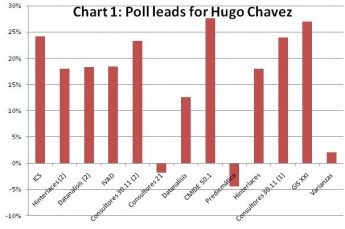 Of these 13 polls surveyed, 11 gave a lead for Hugo Chávez and just two put the main challenger, Henry Capriles Radonski, ahead. (See chart 1 to the right).
In the 11 polls putting Hugo Chávez ahead, all but one gives him a lead of between 13-28%. In contrast, the two polls that put Henry Capriles Radonski ahead gave him leads of just 2% and 4%. […]
Lee Brown who carried out the survey for the Venezuela Solidarity Campaign, said:
“Hugo Chávez clearly has a convincing lead according to the overwhelming majority of pollsters.
The evidence from looking at the full range of polls, rather than cherry picking, does not back up the claims of the campaign of Henrique Capriles Radonski that the race is close or that Capriles is ahead.
Nor is there any evidence that Capriles is making any real inroads into Chávez’s lead as they’ve also claimed.
Hopefully these statements from the right-wing opposition are just the kind of things that get said in the cut and thrust of a campaign.
But the bigger worry is that it’s part of an orchestrated claim by the opposition to give the impression of an impending victory and then to claim fraud on 7 October should they lose, as the polls suggest is very likely.”
Notes
1) The VSC analysis was based on the following poll results published in August and the first week of September, exactly one month before the election.
Related articles
- Hugo Chávez’s challenger and why he’s so confident (miamiherald.com)
- Chavez Rival Maintains Lead in August Consultores 21 Poll – Bloomberg (bloomberg.com)
Russia shows USAID the door
RT | September 19, 2012
The United States Agency for International Development (USAID) has announced it will close its offices in Russia.
After 20 years of working in Russia, USAID officials said they were informed by the Russian government that their services were no longer required.
According to the Foreign Ministry, USAID was attempting to manipulate the election processes in the country.
“The character of the agency’s work…did not always comply with the declared aims of cooperation in bilateral humanitarian cooperation,” the Foreign Ministry said on its website. “We are talking about issuing grants in an attempt to affect the course of the political processes in the country, including elections at different levels and institutions in civil society.”
Russian civil society has become fully mature, the Foreign Ministry said, and did not need any “external direction.” Moscow is read to work with USAID in third-party countries, it said.
In an interview with Kommersant, Dmitry Peskov, President Putin’s press-secretary, suggested that the US agency was not abiding by the rules regulating their work with NGOs.
“As all foreign agencies that provide financial support for Russian NGOs, USAID should abide by Russia’s legal regulations,” Peskov said. “As long as the Americans abide by these norms, we obviously couldn’t make a decision to terminate their activities on Russian territory.”
Moscow‘s decision to halt USAID programs comes after Putin in July signed legislation that requires nongovernmental organizations that receive funds from abroad to register as “foreign agents.”
The law requires that Russian-based NGOs provide information as to how funds received from abroad are being used in Russia.
The United States has denied that USAID programs are aimed at interfering in Russia’s domestic affairs.
US State Department Spokeswoman Victoria Nuland announced the termination of USAID’s operations in Russia on Tuesday. The Kremlin notified US officials they have until October 1 to close the mission.
Washington began its USAID operations in Moscow following the unexpected collapse of the Soviet Union. At that time, Russia was a basket case, dependent on IMF loan transfusions just to keep its head above water. USAID spent more than $2.6 billion in Russia on various projects, like cleaning up the environment and fighting against infectious diseases.
Russia’s domestic situation began to turn around, however, when the presidency passed from Boris Yeltsin to Vladimir Putin. Today, Russia has not only returned its debts, but is now a lender of last resort for countries hammered by the 2008 financial crisis.
Although Russia’s reversal of fortunes is often explained by its vast natural resources, political will also played a significant role in the progress.
Since Russia no longer sees itself as a charity case, USAID activities were increasingly viewed as not only redundant, but even a little humiliating.
Aside from the growing irrelevance of such foreign-sponsored activities, there was the nagging suspicion inside Russia that these agencies served as fronts for purely political motives.
This year, for example, USAID was allotted $50 million to finance its Russia activities. Approximately 60 per cent of the budget was to be used for promoting democracy and human rights. This represents a dramatic increase compared with the former Bush administration.
Related articles
- Russia Closes USAID Office (themoscowtimes.com)
Featured Video
American Military Failure in Afghanistan
or go to
Aletho News Archives – Video-Images
Frlom the Archives
Iran War: United States Military Versus Israel Firsters
By James Petras | November 27, 2007
Why must Jewish organizations be and be seen as the loudest drum-beaters of all? Why can we not bring ourselves to say that military intervention is not on the table at all? Why not stash it under the table, out of sight and mount instead a diplomatic assault? – Leonard Fein, Forward
Introduction
As the White House and Congress escalate their economic sanctions and military threats against Iran, top military commanders and Pentagon officials have launched a counter-offensive, opposing a new Middle East War. While some commentators and journalists, like Chris Hedges (Truthdig, November 13, 2007), privy to this high stakes inter-elite conflict, attribute this to a White House cabal led by Vice President Cheney, a more stringent and accurate assessment puts the Zionist Power Configuration (ZPC) in the center of the Iran war debate.
There is a great deal riding in this conflict – the future of the American empire as well as the balance of power in the Middle East. Equally important is the future of the US military and our already heavily constrained democratic freedoms. The outcome of the continuous and deepening confrontation between top US military officials and the Israel Firsters over US foreign policy in the Middle East has raised fundamental questions over self-determination, colonization, civilian primacy and military political intervention, empire or republic. These and related issues are far from being of academic interest only; they concern the future of the United States. … continue
Blog Roll
 Aletho News
- Hezbollah Returns: It Didn’t Start a War, It Is Ending One
- EU states seek ‘talks’ with Iran for access to Strait of Hormuz: Report
- Trump on Hormuz: “Others must take care of it” after US falters
- Who Is closer to collapse?
- A War that Backfired: Why the US-Israeli Campaign Is Strengthening Iran
- How Zionist Control Is Hurting US Interests
- Iran warns it may target US missile launch sites in UAE cities
- American Military Failure in Afghanistan
- Friendly Skies of Georgia: Are Israeli-Linked Drones Launching False Flags from Georgian Territory?
- The Three Big Lies about Mammography Screening
- If Americans Knew
- No let-up in attacks on Gaza as Israel takes on Iran, Lebanon – Not a ceasefire Day 155
- ‘Of Course’: IDF Drops Case Against Soldiers Accused of Raping Palestinian Prisoner
- Don’t Fall for the Regime Change Talk. Israel Is ‘Mowing the Lawn’ in Iran
- Will Israel and the US wreck the Gulf States along with Iran?
- US so far burned through ‘years’ of munitions in Iran war: Report
- How the Israeli Tail Wags the American Dog
- Outdated intel likely led to deadly U.S. strike on Iranian elementary school, sources say
- Pentagon insider says high U.S official Douglas Feith reported to Netanyahu
- In fond memory of Walid Khalidi, the historian of Palestine
- 6 more Americans killed, as Israel ‘mows the lawn’ in Iran – Not a ceasefire Day 154
- No Tricks Zone
- Storing Green Energy To Last Germany 10 Days Would Require A 60-Million Tonne Battery
- New Studies: UK Sea Levels Were 4 Meters Higher Than Today During The Mid-Holocene
- Destructive Green New Deal: German Energy And Metal Group Warns Of Drastic Crisis
- New Study Documents A 20-Year Pause In Arctic Sea Ice Decline – Driven By Internal Variability
- Wake-up Call: Survey Shows Majority Of Germans Now Favor Postponing Climate Targets!
- Televised! Leading German Political Candidate Tells Schoolchildren CO2 Makes Sun Hotter!
- New Study: A Century Warming Of 1.1°C Is ‘Commonplace’ And ‘Not Unusual’ During This Interglacial
- New Study: ‘Internal Noise’ And Volcanic Forcing Can Trigger 10-15°C Warming Within Decades
- Glaciers Worldwide Are Suddendly Surging, Experts Blame Warming!
- Surprising Discovery: Sahara Is Greening…Billions Of Trees Where Once Thought To Be Barren
 Aletho News