Phony Occupy Link to Weapons Cache
By Peter Hart | FAIR | January 4, 2013
Bad enough, assuming the details are as they seem. (The explosive was reportedly seven grams, about a quarter of an ounce, of a substance called HTMD, which is slightly less explosive than TNT; this amount seems more suitable for blowing off your fingers than for blowing up a building.)
But the Murdoch-owned New York Post gave the story a political angle (12/31/12):
The pregnant daughter of a prominent city doctor, and her boyfriend–a Harvard grad and Occupy Wall Street activist–were busted for allegedly having a cache of weapons and a powerful bomb-making explosive in their apartment in a Greenwich Village brownstone.
That’s right–Occupy Wall Street. This isn’t the first time the paper has reported a link between a criminal case and the activist movement. Back in July, the paper reported that DNA from an Occupy protest was linked to an unsolved 2004 murder. The DNA “match” turned out to be contamination by an employee of the police department lab.
And this time around, the OWS link would seem to be nonexistent. No one associated with Occupy seems to know who this Aaron Greene person might be. The paper notes in the final paragraph that Greene “has five prior run-ins with the police,” which might be more relevant than a seemingly phantom connection to an activist group.
The Post’s report was cited in other news accounts; the Associated Press (12/31/12), for instance, put it this way:
The New York Post reported in its Monday editions that Gliedman is the daughter of a prominent Manhattan doctor. It described her boyfriend as a Harvard graduate and an Occupy Wall Street activist.
And on CBS This Morning (1/2/13), Seth Doane reported:
CBS News has learned that police seized two shotguns, a flare launcher, nine high-capacity rifle magazines, various handwritten notebooks containing formulas, literature on how to make booby traps and homemade weapons, and pages from a do-it-yourself manual called The Terrorist Encyclopedia. The New York Post reported Greene was a member of the Occupy Wall Street movement but the group has denied this.
But CBS doesn’t leave it there. They followed that with a soundbite from Mitchell Silbe of K2 Intelligence, who spun out this scenario:
The assumption is that the vast majority of the people there were peaceful protestors, but there was a more radical fringe element to the group, and there was a concern that at some point they might turn to violence if they weren’t accomplishing their political aims.
It’s bad enough to treat a unsubstantiated claim by a partisan news outlet, with a record of sensational misinformation on the same subject, as a relevant fact in a story. But how do you justify using this junk journalism as a chance to let a source give free rein to his fantasies of how Occupy might take a turn towards violence?
Related articles
- New York Post Helps NYPD Slander Occupy Wall Street (Again) (blogs.villagevoice.com)
Haneen Zoabi and Her Mission

By Lawrence Davidson | Opinion Maker | January 4, 2012
Haneen Zoabi is an Arab Israeli member of Israel’s parliament, the Knesset. She was elected in 2009 as a member from the Balad Party. Balad is an Arab party that was formed in 1995 with the aim of “struggling to transform the state of Israel into a democracy for all its citizens.” In the West, this is a perfectly normal goal. But Israel’s Zionist ideology disqualifies it as a “Western” nation. Thus Balad’s aim is in direct opposition to the Zionist idea of Israel as a “Jewish state,” a concept that Ms Zoabi labels “inherently racist.”
Apparently, Haneen Zoabi is fearless. She actually lives her principles. She has been campaigning loudly and very publicly for full citizenship rights for Israel’s Palestinians. She has also actively opposed Israel’s settlement movement, occupation policies, and its siege of Gaza. That last effort led her to participate in the international flotilla that sought to break the Gaza siege in May of 2010. That was the time Israeli commandos attacked the Mavi Marmara in international waters, killing 9 Turkish activists who tried to resist the assault on their ship.
In an outright dictatorship, Ms Zoabi would be in jail or worse. And, given the direction of Israel’s political evolution, that still might be her fate.
However, as of now she is just the worst nightmare of an ethnocentric state, and a government pushing racist policies while trying to pretend it is a democracy. It is a nightmare for the Israel’s Zionist leadership because Zoabi, as a member of the Knesset, insists that if the Israeli Jews won’t allow full citizenship for non-Jews, as a real democracy must, then she is not going to let them pretend anymore. Yet pretense is all that is left of Israel’s international persona. If the “Jewish state” loses the ability to posture as “the only democracy in the Middle East,” the country’s reputation in the world is, as the saying goes, fit for the dust hole.
Think of it this way. Israel is the nation-state equivalent of Oscar Wilde’s fictional character Dorian Gray. Gray is a man who never seems to be anything but young, good-looking, and successful. However, hidden away in some closet there is an extraordinarily ugly and frightening portrait of him, and it is this portrait that ages and reflects the meanness and brutality of Gray’s true character. Haneen Zoabi has uncovered such a portrait of Israel and insists on going about showing everyone the state’s real characteristics. She wants the world to see the true picture. That is why the Israeli government is trying to destroy Haneen Zoabi.
The Persecution
The catalyst for the campaign against Zoabi was her presence on the Mavi Marmara in 2010. Not only was she on a ship attempting to bring humanitarian assistance to over 1.6 million Gazans living under an illegal Israeli embargo, but she was also an eyewitness to nine official Israeli acts of murder.
To the acts of collective punishment, the shelling and bombing of civilian neighborhoods, and the seemingly random murder of civilians by Israeli border snipers, can now be added a deadly attack on a civilian vessel in international waters. All of these actions are criminal under international law and they all easily fall into the category of state terrorism. However, in the Kafkaesque world of Zionism, it is Ms Zoabi who became the “terrorist.”
When, on 2 June 2010, she returned to the Knesset following the the Mavi Marmara incident and insisted on bearing witness to Israeli offenses, she was shouted down by her “outraged” fellow members of the Knesset, most of whom saw Zoabi as a traitor. Her efforts to describe what she had seen reduced the Knesset session to “pandemonium.” From that point Ms Zoabi received “hundreds of threats, by letters, by email, by phone call.” In July of 2011, while contesting statements being made by Prime Minister Netanyahu, she was ejected from the Knesset by the chamber’s Speaker who then suspended her from further participation based on a grossly exaggerated charge that she had assaulted one of the chamber’s ushers.
Meanwhile, members of the Prime Minister’s party, Likud, conspired to ban Ms Zoabi from running in the upcoming Israeli elections (scheduled for 22 January 2013). The Knesset’s Ethics Committee voted that Zoabi had violated Article 7A of Israel’s “Basic Law” which states that a candidate for or member of the Knesset, “cannot reject Israel as a Jewish and democratic state…or support armed combat by an enemy state or terror organization against the State of Israel.” Some Israelis claim that the group organizing the flotilla efforts to break the Gaza siege is a terrorist organization, but that is clearly nonsense. On the other hand, there can be little doubt that Ms Zoabi is shouting from the rooftops the blatant fact that “Israel as Jewish and democratic state” reflects a deep and tragic contradiction.
According to such luminaries of the Israeli right as MK Danny Danon, Ms Zoabi has “spit on the state.” She does not belong in the Knesset, according to Danon, “she belongs in Jail.” (Danon is also the politician who had the clever idea of inviting Glenn Beck, an incendiary right-wing American TV talk show personality, to address the Israeli parliament.)
Subsequently, Israel’s supreme court declared the banning of Haneen Zoabi was unconstitutional, but Danon has replied that he and his allies are ready with “plan B.” They will simply have the Knesset change the law so as to prevent future electoral campaigns by anyone like Zoabi.
Conclusion
Politicians with dictatorial leanings instinctively avoid their own reflection. They cannot admit the consequences of their own actions and policies and they cannot tolerate others who publicly expose those consequences. Like Dorian Gray, they restrict the ugly truth to some hidden closet. Yet, eventually, someone like Ms Zoabi comes along and takes up the role of truth-teller.
There is another issue that her efforts bring to light. It is that the interests of the state (understood here as a government) and the interests of the nation (the collective occupants of a country) may not always be the same. Governments most often represent cliques or classes or elites or ideologues, etc. Those in power, ruling in the interest of these smaller constituencies, simply assume that their own parochial interests stand for the “national interest.”
Ms Zoabi is insisting that the Israeli State cease identifying itself with the interest of a single constituency and start representing the interests of the nation as a whole. What this is all about, she says, are “the values, the humanistic, universalistic values of freedom, of equality, of justice.” But there is nothing “universalistic” about Zionism and so, for her efforts, she is castigated and threatened. Such is the state that Zionism has built.
Related articles
The FSA continues to shine like a dead star
By Thierry Meyssan | Voltaire Network | December 29, 2012
While the French press persists in announcing the “imminent fall” of Syria and the “flight of Bashar al-Assad,” the reality on the ground has turned around completely. Even though chaos is plaguing most of the territory, the “liberated zones” have melted like snow in the sun. Deprived of its anchor points, the FSA has been left with no prospects in sight, while Washington and Moscow are poised to blow the whistle to end the game.
The countdown has begun. As soon as the new Obama administration will be confirmed by the Senate, it will present a peace plan for Syria to the Security Council. Legally, though President Obama succeeds himself, his former administration is only responsible for the managing of current affairs and can not take any major initiative. Politically, Obama failed to react when, in the midst of the presidential race, some of his colleagues torpedoed the Geneva Agreement. But he proceeded with a general housecleaning right after the announcement of his reelection. As expected, General David Petraeus, the architect of the war on Syria, fell into the trap that had been set up for him and was forced to resign. As expected, the NATO and Missile Shield chiefs – adverse to an agreement with Russia – have been put under investigation for corruption and obliged to remain silent. Also as expected, Secretary of State Hillary Clinton has been taken out of the game. Only the method chosen to eliminate her came as a surprise: a serious health accident that plunged her into a coma.
Meanwhile back at the UN, things have moved on. The Department of Peacekeeping Operations (DPKO) signed a Memorandum with the Collective Security Treaty Organization (CSTO) in September. In October, it monitored CSTO maneuvers in Kazakhstan simulating a deployment of “blue chapkas” in Syria. In December, the DPKO convened the military representatives of the permanent Security Council members to brief them on the manner in which the deployment could be carried out. Despite their opposition to this solution, the French and the British bowed to the wishes of the United States.
Nevertheless, France attempted to use the Joint Special Representative of the United Nations and the League of Arab States, Lakhdar Brahimi, to modify the Geneva peace plan in line with the objections it had raised on June 30th. Ultimately, Brahimi carefully refrained from taking a position, and instead contented himself with transmitting messages to and fro between the various parties to the conflict.
The truth is that on the ground the upper hand is held by the Syrian government. The military situation has been reversed. The French themselves have ceased to mention the “liberated zones” they yearned to govern through a United Nations mandate. These areas have been steadily shrinking, and those that are still holding out are in the hands of the disreputable Salafists. The FSA troops were instructed to abandon their positions and regroup around the capital for a final assault. The Contras were hoping to rally the Palestinian refugees, mainly Sunni Moslem, against the inter-denominational Syrian regime in the same manner that the Hariris in Lebanon tried to arouse the Sunni Palestinians of the Nahr el-Bared refugee camp against the Shiite Hezbollah. As in Lebanon this objective failed because the Palestinians know very well who their friends are and who is really fighting for the liberation of their land. Concretely, in Israel’s recent 8-day war on Gaza, it was the Iranian and Syrian weapons that saved the day, while the Gulf monarchies did not move a finger.
Certain elements of Hamas, loyal to Khaled Meshaal and funded by Qatar, opened the doors of the Yarmouk camp to a few hundred fighters of the Front to Protect the Levant (Syrian-Lebanese branch of Al-Qaeda), also related Qatar. They fought mainly against members of the Popular Front for the Liberation of Palestine – General Command (PFLP-GC). Via SMS, the Syrian government asked the 180 000 camp residents to evacuate the premises as soon as possible and offered them temporary accommodation in Damascus hotels, schools and gyms. Some preferred to go to Lebanon. The next day, the Syrian Arab army attacked the camp with heavy artillery and regained control. 14 Palestinian organizations then signed an agreement declaring the camp a “neutral zone“. The FSA fighters withdrew in an orderly fashion and resumed their war against Syria in the surrounding countryside, while the civilians returned to their homes. They found a devastated camp where schools and hospitals had been systematically destroyed.
In strategic terms, the war is already over: the FSA has lost the popular support it had enjoyed at one point and has no chance of achieving victory. The Europeans still think they can replace the regime by bribing top officials and causing a coup, but they realize that it will be impossible to bring off with the FSA. Contras continue to roll in, but the flow of money and weapons is drying up. Much of the international support has stopped although the consequences on the battlefield cannot yet be seen, much like a star that can continue to shine long after its death.
The United States has clearly decided to turn the page and to sacrifice the FSA. It gives it senseless instructions that lead the Contras to their death. Thousands were killed last month. Meanwhile, in Washington, the National Intelligence Council cynically announced that “international jihadism” will soon disappear. Other allies of the United States should now ask themselves whether this new equation does not imply that they too will be sacrificed.
Netanyahu: Iran Has Not Yet Crossed the Red Line
Al-Manar | January 4, 2012
Zionist Prime Minister Benjamin Netanyahu said Iran has not yet crossed the red line Tel Aviv set on its nuclear program.
“Iran remains the number one threat,” Netanyahu said Thursday at the last session of the annual year-end meeting in the Foreign Ministry for the Israeli ambassadors serving abroad.
“There is a chance for positive change in the region if that country was prevented from getting a nuclear weapon,” he said referring to the Islamic Republic.
The prime minister added that in the short term he expected regional tribulations to continue.
During a speech at the UN in September, Netanyahu drew a red line on a picture of a bomb signifying when Tehran would be 90% on the way to development of a bomb. He said Iran would not likely pass that line until the spring or summer.
“And this will give more time for sanctions and diplomacy to convince Iran to dismantle its nuclear weapons program altogether,” Netanyahu added on Thursday.
The Israeli PM also addressed the Palestinian issue, saying Hamas could take control of the Palestinian Authority “any day,” and therefore “concrete security arrangements” must be included in any peace agreement, as well as recognition of the Zionist entity as the “state of the Jewish nation,” an end to the “right of return” and a sincere declaration on the end of the conflict.
Related articles
- Netanyahu was wrong about Iraq having nuclear weapons
- NYT and Professor Netanyahu
- Context of ‘July 8-10, 1996: Israeli Prime Minister Netanyahu Tells Congress US Must Join Israel in ‘Democratizing’ Middle East’
- Sanctions not slowing Iran N-program by ‘one millimeter’: Netanyahu
- Netanyahu’s Role in Crafting the “Strategic Asset” Myth
- When Netanyahu Crossed the Line
US imposes fresh sanctions on Tehran, including ban on Iranian media
Press TV – January 4, 2013
The United States has imposed fresh sanctions on Iran that include bans on the country’s media despite Washington’s claims of protecting freedom of speech.
The new bans are included in the $633-billion military bill for 2013 which US President Barack Obama signed into law on Wednesday night.
The anti-Iran sanctions portion of the bill, among other economic features, blacklists the Islamic Republic of Iran Broadcasting (IRIB) and its president Ezzatollah Zarghami and will block all the IRIB assets and prevent others from doing business with it.
The sanction against IRIB is an attempt by the West to silence Iranian media. It is on top of another flagrant violation of freedom of speech by satellite providers Eutelsat SA and Intelsat SA which stopped the broadcast of several Iranian satellite channels in October.
In November, the Hong Kong-based Asia Satellite Telecommunications Co. Ltd. (AsiaSat) also took all Iranian channels off air in East Asia under pressure from the US.
In a similar move in December, Spain’s top satellite company Hispasat ordered its satellite provider Overon to take Iranian channels Press TV and Hispan TV off the air.
The restrictions on Iranian media are interpreted as an attempt to silence the truth-telling media.
This comes as US lawmakers say the fresh anti-Iran sanctions portion of the bill is part of measures aimed at pressuring Iran to halt its nuclear energy program.
The United States, Israel and some of their allies have repeatedly accused Iran of pursuing non-civilian objectives in its nuclear energy program.
Over the false allegation, Washington and the European Union have imposed illegal unilateral sanctions against the Islamic Republic.
Iran refutes the allegations and argues that as a signatory to the Non-Proliferation Treaty and a member of the International Atomic Energy Agency, it is entitled to develop and acquire nuclear technology for peaceful purposes.
Related articles
- US Senate to blacklist and block the assets of Iranian broadcaster IRIB (alethonews.wordpress.com)
US Resolution Presses EU to Designate Hezbollah a “Terrorist Organization”
Al-Manar | January 4, 2012
The U.S. House of Representatives passed a resolution urging the European Union and its member states to designate Hezbollah a ‘terrorist group’.
The resolution, approved on Wednesday, urges the European Union member states to also impose sanctions on Hezbollah, the Times of Israel news website reported.
Based on the resolution, which was co-sponsored by 85 House representatives, Hezbollah would be prevented from employing the territories belonging to the European Union for fundraising, recruitment and training.
On July 24, 2012, the European Union flatly rejected an Israeli call to blacklist Hezbollah as a “terrorist group”, because it regards Hezbollah as an active political party in Lebanon and there is not enough evidence to warrant listing the Lebanese group a ‘terror group’ as the United States does.
European countries argue that their relations with Lebanon, where Hezbollah provides extensive social services and its political wing holds government power, would be damaged by the designation. Among the 27 European Union member states, only the UK and the Netherlands are in favor of the designation, which would freeze the group’s Europe-held financial assets.
US will boost funding for military adventures at the expense of public
By Dave Lindorff | Press TV | January 3, 2013
I was asked earlier this week by an reporter for PressTV, English-language television network in Iran, if I could explain why the US political system seemed to be so dysfunctional, with Congress and the President having created an artificial budget crisis 17 months ago, not “solving” it until the last hour before a Congressional deadline would have created financial chaos, and even then not solving the problem and instead just pushing it off for two months until the next crisis moment.
I thought for a moment, trying to come up with a simple way to explain the peculiar politics of a fake democracy where two equally pro-capitalist, pro-imperialist parties vie with genuine bitterness for patronage spoils and legal bribes, all the while ignoring the real wishes and needs of the public, and then it hit me: it is really all about US militarism and the unwillingness of either of the two political parties to admit honestly to American people how much they are being gouged to allow the US government and its corporate owners to continue in their attempt to control the world.
It really is that simple.
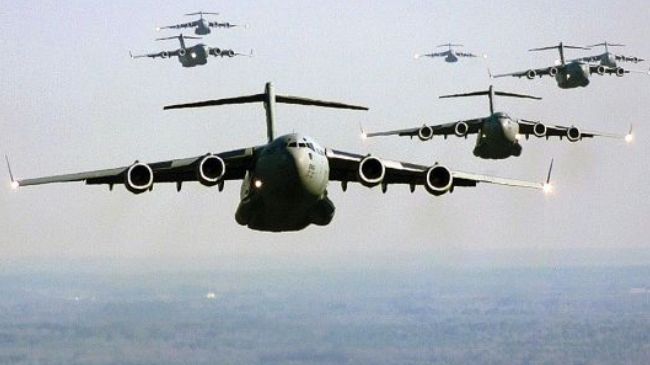
The US currently spends almost as much on its military and on paying for current and past wars in terms of interest on war debt and care for wounded and aging soldiers as the entire rest of the world spends on arms and war. Approximately $1.3 trillion gets spent each year in taxpayer’s dollars and in more borrowed funds (50 cents of every federal tax dollar goes to pay for the US military, the intelligence apparatus, veterans’ benefits and other related military costs). It is simply ludicrous, given this situation, to imagine that the US can significantly reduce its budget deficit either by raising taxes or by cutting social spending.
Think of it this way. The US is currently running a $1.3 trillion deficit (that is federal spending less tax revenue). That deficit, significantly one must note, almost exactly matches the amount that is being spent annually on the US military, and on military/intelligence-related activities.
In contrast, the federal government budget in 2012 allocated $870 billion for Medicare, Medicaid and all other programs under the aegis of Department of Health and Human Services. The total Department of State budget is $56 billion, and a portion of that is actually for military activities, such as intelligence operations and protection of embassies and consulates. The Department of Agriculture got $150 billion, and that includes the Food Stamp program. Federal spending on education was just $100 billion a year. Social Security is not part of the tax take or the federal budget, as it is all paid from the Social Security Trust Fund, which in turn has been financed by the dedicated payroll tax paid by working people and employers.
None of these non-military budget spending categories could possibly be cut sufficiently to make any real dent in the nation’s massive deficit, which is running at $1.3 trillion a year and which now totals $16.3 trillion. Certainly cuts of 50% could theoretically be made in health and welfare spending, in education, and in other parts of the budget, but cuts of that scale would cause such mass suffering and chaos that the nation would erupt in open rebellion.
The military budget, on the other hand, could be slashed by 50% and nobody would know the difference! The public in the US barely knows there are wars going on. We read about an occasional soldier killed or plane downed, but there is no day-to-day evidence that the US is a nation perpetually in a state of war. If the military were to end those wars, which are costing over $160 billion a year, pull out of all its far-flung bases, which are costing $250 billion a year, slash its huge Special Operations Command, which now number nearly 70,000 people at a cost of over $10 billion, eliminate or massively reduce its strategic nuclear forces, which costs $60 billion a year, and decommission its fleet of aircraft carrier battle groups, which counting construction and operation costs, plus the cost of the planes and missiles they carry, probably cost in the range of $100 billion a year, the US would be no less safe, but the federal budget deficit could be instantly slashed by close to $600 billion a year. That is the amount that is being cut in the current so-called “Fiscal Cliff” bargain over a period of ten years.
In a genuine democracy, there would be politicians and a political party that would be calling for just such an end to US militarism and the massive spending that is needed to support it. It is something that polls show the majority of Americans want to see happen, even though there are no people in government calling for doing it, and even though the very idea of seriously cutting military spending is blacked out by the US corporate media.
Instead, what the American public gets is a fake debate between Democrats and Republicans, and between the White House and the Republicans in the House of Representatives, all focussed on the rest of the US budget — the non-military part. This “debate” is basically a matter of Republicans saying they want to cut the non-military budget deficit by slashing “social spending” and Democrats saying that they are willing to cut “some” social spending, but they would rather raise taxes.
The thing is, cutting social program spending more than by a small amount would be catastrophic, leading to even more mass teacher layoffs, declining health, hunger, collapsing bridges, and to fewer people being able to afford to go to college. It would lead to even more homeless Americans, including returned veterans. Nobody would accept this. We’re already suffering from such cuts. And as for taxes, in a long-running economic crisis such as we are experiencing, nobody but the rich can afford to pay more, and the rich are given a free hand at escaping taxes through loopholes, offshore banking, and high priced accountants.
The reality is that there really is only one way to attack the nation’s massive and growing budget deficit without destroying both people’s lives and the nation’s economy, and that is to slash military spending and to put an end to the country’s militarism and imperialism.
The US today, as former Alaska Sen. Mike Gravel famously said during an early televised Democratic presidential primary debate in 2008, “has no enemies.” It is not threatened by any nation, has a military that is without equal, and has a populace that is armed to the teeth. The United States simply does not need to be spending in excess of a trillion dollars — at least on defense. The country would be just as safe — it would be much safer actually since it wouldn’t be destroying lives around the globe and creating enemies where there were none — if it were a tenth of its current size.
The time for a real debate about cutting the US budget by focusing on military spending has come. It is long overdue. If it isn’t addressed now, it will be eventually, not by choice perhaps, but because the US will simply no longer be able to pay for its addiction to war.
There is an alternative: what Venezuela can teach us about the banking sector
Revolution is eternal | February 16, 2012
The year is 2008. In the US the housing bubble has burst, leaving major financial institutions with a large mess on their hands. It will always be remembered as a time of failing banks, the ‘credit crunch’, plummeting stock markets and declining trade worldwide. The causes of the financial meltdown are a complex interplay of forces, but at the core of the issue is Wall Street’s greed and risk-taking, as well as a failure on the part of regulators and the financial market to prevent the situation from exploding. The end result on the world economy has been nothing short of disastrous. Since 2008 we have seen too many reports of famine, joblessness and uprisings (after all, these things tend to be related).
So what steps were taken to “rein in the excesses of Wall Street?” Well, governments and central banks handed out bailouts to poorly performing financial institutions of a magnitude never seen before.
We have come to normalise the reckless disregard for human life so characteristic of the banking sector. We could have walked down many different paths to deal with the financial crisis – so what else could we have done?
In Venezuela the government takes a very different approach to the banking sector. For example, there is a law in place that means that at least 10% of a bank’s lending should support development projects. President Chavez has recently threatened to nationalise the banks that are not delivering on this. The Venezuelan government wants to see more loans going to support small farmers rather than just going to big businesses. “Either you finance agricultural production or we will take measures. There is no alternative,” Chavez has said. And the irrefutable warning, “If you can’t do it, give me the banks.”
Chavez has made similar threats to the commerce sector, having angered the business community by imposing regulations that will guarantee a fixed maximum price on basic consumer goods. This is to avoid the price of goods being driven up by speculation, the catastrophic effects of which were seen in the Horn of Africa last year. Speculation on the world food market helped to fuel the widespread famine that endangered millions of people.
Venezuelan businesses have predictably complained about the new price fixing measures, calling them “unviable” for business as usual. But rather than balking at the first hurdle, Chavez has said he will seek investment from outside the country if the companies are not able to deliver within the new constraints. It seems that in Venezuela they are unwilling to let big business hold the country to ransom.
Lets take a case study in the UK for comparison – the Royal Bank of Scotland (RBS). Consider this worrying timeline:
2009: the UK government provides an unprecedented bailout to banks, and now officially owns 84% of RBS
2010: bonuses totaling almost £1 billion were paid to top executives of RBS, despite reporting losses of over £1 billion in the same financial year
2011: the massive drop in the price of RBS stocks meant that UK taxpayers lost £26 billion on the value of their investment
2012: there was much controversy over the £1 million bonus offered to the RBS Chief Executive.
Luckily for the UK taxpayer, the RBS Chief Exec turned down the £1 million bonus following intense pressure. But the government could have demanded this of him in the first place. Why didn’t they? The tired old argument of “we don’t want top people or businesses to leave the country” just doesn’t fly in the face of 2.7 million unemployed people in the UK and cuts to much needed welfare payments and disability allowances.
If Venezuela can teach us anything, let it be that:
It is possible to take a stand against ugly business practices
It is possible to expect our banking and commercial sectors to make a positive contribution to the world
There is no better time than right now
Related articles
- Venezuela’s Economy Grows by 5.5 Percent in 2012 (alethonews.wordpress.com)
US general offers plans for post-2014 Afghanistan overstay
Press TV – January 3, 2013

Commander of US-led forces in Afghanistan General John R. Allen (file photo)
Commander of the US-led forces in Afghanistan General John R. Allen has offered plans that would keep thousands of American troops in the war-torn country after Washington’s planned 2014 withdrawal.
Allen has submitted three plans to Defense Secretary Leon Panetta with troop levels ranging between 6,000 and 20,000, the New York Times cited a senior Pentagon official as saying on Wednesday.
General Allen’s options reportedly offer US involvement in security issues in Afghanistan and advising Afghan military forces.
With 6,000 troops, it is expected that the US mission in Afghanistan would largely rely on Special Operations commandos who would engage in targeted killings and assassination missions, with limited logistical support and training for Afghan forces.
The 10,000-strong mission is expected to engage in training Afghan security personnel; while with 20,000 troops Washington would add some conventional army forces to patrol in certain areas.
US President Barack Obama is supposed to discuss the options with his Afghan counterpart, Hamid Karzai, during his visit to the White House next week.
The United States, which currently has about 66,000 troops stationed in Afghanistan, led the invasion of the country in 2001, under the pretext of eradicating Taliban forces and bringing stability to the country.
However, torn apart by a war that has lasted over a decade, Afghanistan is still dealing with untamed violence, as well as rising insecurity topped by social problems.
Meanwhile, the Pentagon, the White House and US generals based in Afghanistan keep providing contradictory information on the composition, tasks and the size of the contingent that would remain in Afghanistan beyond the 2014 deadline.
Related articles
- ‘US will maintain military presence in Afghanistan beyond 2014′ (alethonews.wordpress.com)
- Prince Harry ‘kills innocent afghans’, according to former Afghanistan prime minister (dailyrecord.co.uk)
Israeli army dogs attack elderly Palestinian, two-year-old child injured in the head in Jewish settlers’ attack
Al Akhbar | January 3, 2013
Israeli army dogs attacked a 93-year-old Palestinian woman as an undercover unit raided the West Bank city of Jenin on Thursday morning, according to Ma’an news agency.
The agents were dressed as Palestinians and backed up by the army when they staged an incursion into the city’s industrial zone.
The raid is the latest in a string of Israeli attacks on Palestinian towns in the West Bank. On Tuesday, Israeli soldiers disguised as vegetable vendors invaded the northern West Bank town of Tamoun and fired ammunition at residents.
Amneh Hisnawi was alone in her house when soldiers stormed her home and dogs belonging to security personnel attacked her. She was sent to an Israeli hospital for treatment.
An army spokesman said the raid on Jenin was conducted to arrest a Palestinian suspected of ‘terror activity’, but that the suspect was not at home.
Around 500 Palestinians hurled rocks, firebombs, and burned tires, according to the spokesman.
Fadi Ijawi, 23, was wounded in the leg by a a live bullet and taken to a Palestinian hospital, a Ma’an reporter said. Dozens also suffered from tear gas inhalation, the reporter added.
Israeli settlers hit two-year-old Palestinian on the head
Several Palestinians, including one toddler, were injured when dozens of illegal Israeli settlers attacked a northern West Bank village on Wednesday, according to Palestine’s Ma’an news agency.
Two-year-old Farah Nanseem was hit on the head during the assault on Jalud village, south of Nablus. Israelis from the Esh Kodesh settlement had staged a sit-in in Jalud earlier in the day to prevent Palestinians from working in the fields.
Several villagers were sent to hospitals to treat light to moderate wounds; houses and a car were also damaged, settlement monitoring official Ghassan Daghlas said.
Another Nablus village, Qusra, was attacked by settlers two days ago. More than 150 olive trees were uprooted.
The assailants were only briefly detained by village security guards.
Israeli settlers, who are considered illegal by international law, routinely assault Palestinians in the West Bank, damaging property and livelihoods, and often targeting the elderly and children.
They face little to no punishment from Israeli authorities for their crimes.
(Ma’an, Al-Akhbar)
Related articles
- Settlers raid Nablus village homes and a tractor. Uproot 190 olive trees and burn Hebron car (occupiedpalestine.wordpress.com)
- Israeli settler attacks on the rise in West Bank (bikyamasr.com)
- Three Palestinians Injured By Israeli Settlers Near Nablus (imemc.org)
Featured Video
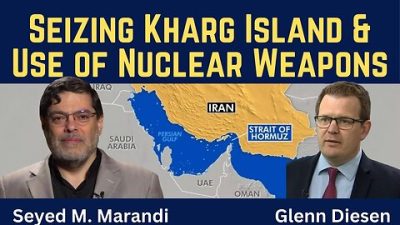
Marandi: Threat of Seizing Kharg Island & the Use of Nuclear Weapons
or go to
Aletho News Archives – Video-Images
Frlom the Archives
Iran War: United States Military Versus Israel Firsters
By James Petras | November 27, 2007
Why must Jewish organizations be and be seen as the loudest drum-beaters of all? Why can we not bring ourselves to say that military intervention is not on the table at all? Why not stash it under the table, out of sight and mount instead a diplomatic assault? – Leonard Fein, Forward
Introduction
As the White House and Congress escalate their economic sanctions and military threats against Iran, top military commanders and Pentagon officials have launched a counter-offensive, opposing a new Middle East War. While some commentators and journalists, like Chris Hedges (Truthdig, November 13, 2007), privy to this high stakes inter-elite conflict, attribute this to a White House cabal led by Vice President Cheney, a more stringent and accurate assessment puts the Zionist Power Configuration (ZPC) in the center of the Iran war debate.
There is a great deal riding in this conflict – the future of the American empire as well as the balance of power in the Middle East. Equally important is the future of the US military and our already heavily constrained democratic freedoms. The outcome of the continuous and deepening confrontation between top US military officials and the Israel Firsters over US foreign policy in the Middle East has raised fundamental questions over self-determination, colonization, civilian primacy and military political intervention, empire or republic. These and related issues are far from being of academic interest only; they concern the future of the United States. … continue
Blog Roll
 Aletho News
- How Zionist Control Is Hurting US Interests
- Iran warns it may target US missile launch sites in UAE cities
- American Military Failure in Afghanistan
- Friendly Skies of Georgia: Are Israeli-Linked Drones Launching False Flags from Georgian Territory?
- The Three Big Lies about Mammography Screening
- Ukrainian Embassy in Beirut sheltering top Mossad agent
- Palestinian family displaced after settlers violently attack them in Humsa, Jordan Valley
- The EU never learns – except for the wrong lessons
- Iran attacks on UAE leaves RSF militia high and dry
- Hosting Washington’s war: Bahrain faces the consequences
- If Americans Knew
- ‘Of Course’: IDF Drops Case Against Soldiers Accused of Raping Palestinian Prisoner
- Don’t Fall for the Regime Change Talk. Israel Is ‘Mowing the Lawn’ in Iran
- Will Israel and the US wreck the Gulf States along with Iran?
- US so far burned through ‘years’ of munitions in Iran war: Report
- How the Israeli Tail Wags the American Dog
- Outdated intel likely led to deadly U.S. strike on Iranian elementary school, sources say
- Pentagon insider says high U.S official Douglas Feith reported to Netanyahu
- In fond memory of Walid Khalidi, the historian of Palestine
- 6 more Americans killed, as Israel ‘mows the lawn’ in Iran – Not a ceasefire Day 154
- Are we on the precipice of World War III?
- No Tricks Zone
- New Studies: UK Sea Levels Were 4 Meters Higher Than Today During The Mid-Holocene
- Destructive Green New Deal: German Energy And Metal Group Warns Of Drastic Crisis
- New Study Documents A 20-Year Pause In Arctic Sea Ice Decline – Driven By Internal Variability
- Wake-up Call: Survey Shows Majority Of Germans Now Favor Postponing Climate Targets!
- Televised! Leading German Political Candidate Tells Schoolchildren CO2 Makes Sun Hotter!
- New Study: A Century Warming Of 1.1°C Is ‘Commonplace’ And ‘Not Unusual’ During This Interglacial
- New Study: ‘Internal Noise’ And Volcanic Forcing Can Trigger 10-15°C Warming Within Decades
- Glaciers Worldwide Are Suddendly Surging, Experts Blame Warming!
- Surprising Discovery: Sahara Is Greening…Billions Of Trees Where Once Thought To Be Barren
- New Research Reaffirms Clouds, Aerosols, And Surface Solar Radiation Are ‘Driving The Climate System’
 Aletho News