How Colin Powell Showed That Torture Works
The Film Hollywood Should Make is About al-Libi’s Torture Helping Lead to Iraq War Disaster
By SAM HUSSEINI | CounterPunch | February 6, 2013

Ten years ago, Colin Powell made the case for invading Iraq before the United Nations Security Council. Many aspects of his case were clearly dubious at the time, but one notorious aspect desperately needs to be truly understood: Some of Powell’s argument for an Iraq link to al-Qaeda came from Ibn al-Shaykh al-Libi who was tortured into giving such “evidence” — that is, he told the torturers what they wanted to hear so that the torture would stop.
This is particularly noteworthy as the movie Zero Dark Thirty has many liberals screaming “torture doesn’t work” — which, in a sense is totally true and at the same time exactly misses the point. Torture does work. It just doesn’t work in so far as its stated purpose (catching criminals, stopping evil plots) is concerned.
Former long-time CIA analyst Ray McGovern, has written that the al-Libi case was central to Powell keeping the alleged al-Qaeda link to Iraq in his UN speech:
Al-Libi’s stories misinformed Colin Powell’s U.N. speech, which sought to establish a “sinister nexus” between Iraq and al-Qaeda to justify invading Iraq.
Al-Libi recanted his claims in January 2004. That prompted the CIA, a month later, to recall all intelligence reports based on his statements, a fact recorded in a footnote to the report issued by the 9/11 Commission. …
The al-Libi case might help you understand why, even though information from torture is notoriously unreliable, President George W. Bush, Vice President Dick Cheney and the sycophants running U.S. intelligence ordered it anyway.
In short, if it is untruthful information you are after, torture can work just fine!
Col. Lawrence B. Wilkerson, Colin Powell’s own former chief of staff, similarly wrote:
“What I have learned is that as the administration authorized harsh interrogation in April and May of 2002 — well before the Justice Department had rendered any legal opinion — its principal priority for intelligence was not aimed at pre-empting another terrorist attack on the U.S. but discovering a smoking gun linking Iraq and al-Qaeda.
“So furious was this effort that on one particular detainee, even when the interrogation team had reported to Cheney’s office that their detainee ‘was compliant’ (meaning the team recommended no more torture), the VP’s office ordered them to continue the enhanced methods. The detainee had not revealed any al-Qaeda-Baghdad contacts yet. This ceased only after Ibn al-Shaykh al-Libi, under waterboarding in Egypt, ‘revealed’ such contacts. Of course later we learned that al-Libi revealed these contacts only to get the torture to stop.
“There in fact were no such contacts.” [Wilkerson elaborated on this on Democracy Now Wednesday morning, should be posted here. He notes he and Powell agreed to drop the accusation of an al-Qaeda link to Iraq until they were given the “evidence” from al-Libi’s interrogation.]
I asked Powell about this in 2009 and he seemed remarkably defensive and uninterested in finding out if the words he uttered on the world stage were based on misinformation from torture:
Sam Husseini: General, can you talk about the al-Libi case and the link between torture and the production of tortured evidence for war?
Colin Powell: I don’t have any details on the al-Libi case.
SH: Can you tell us when you learned that some of the evidence that you used in front of the UN was based on torture? When did you learn that?
CP: I don’t know that. I don’t know what information you’re referring to. So I can’t answer.
SH: Your chief of staff, Wilkerson, has written about this.
CP: So what? [inaudible]
SH: So you’d think you’d know about it.
CP: The information I presented to the UN was vetted by the CIA. Every word came from the CIA and they stood behind all that information. I don’t know that any of them believe that torture was involved. I don’t know that in fact. A lot of speculation, particularly by people who never attended any of these meetings, but I’m not aware of it.
But my questioning was based on statements by Wilkerson, who was in the room. Presumably Powell is waiting for the CIA to call him and tell him directly that torture was used to extract some of the information he used.
This problem of torture yielding useful but false information was not unforeseeable. Professor As’ad AbuKhalil appeared on a news release I assembled the day after Powell’s notorious UN speech: “The Arab media is reporting that the Zakawi story was provided by Jordanian intelligence, which has a record of torture and inaccuracy.”
But the al-Libi story gets even worse. First off, al-Libi had initially cooperated with FBI officials when he was first questioned by them, giving them true and useful information without being tortured. Secondly, he was tortured by chief Egyptian spymaster Omar Suleiman, widely seen and the CIA’s man in Cairo, who attempted to take over from Mubarak when the longtime dictator finally stepped down because of the uprising in 2011 (Suleiman himself died in a Cleveland hospital in 2012).
After al-Libi recanted to the CIA, he was eventually shipped off to Libya where he died in a prison cell. The newspaper of one of Qaddafi’s son’s claimed it was a suicide. As Juan Cole wrote at the time: “The best refutation of Dick Cheney’s insistence that torture was necessary and useful in dealing with threats from al-Qaeda just died in a Libyan prison.”
Before his death, Human Rights Watch “briefly met with al-Libi on April 27 during a research mission to Libya. He refused to be interviewed, and would say nothing more than: ‘Where were you when I was being tortured in American jails.’”
After al-Libi’s death Human Right Watch stated: “The death of Ibn al-Sheikh al-Libi means that the world will never hear his account of the brutal torture he experienced. So now it is up to Libya and the United States to reveal the full story of what they know, including its impact on his mental health.” Right after Al Capone investigates his own dealings.
Note that al-Libi died in Libyan custody when relations were quite chummy between Qaddafi and the U.S. It’s hard not to think this was part of a quid pro quo — the Qaddafi regime offs al-Libi to help the U.S. cover up the torture-war link and in exchange Qaddafi got (rather short-lived acceptance from part of the U.S. establishment.
If Hollywood — or any media for that matter — had any interest in communicating the realities of the modern Mideast and U.S. policy there, the story of al-Libi should be front and center.
Sam Husseini is communications director of the Institute for Public Accuracy, and founder of WashingtonStakeout.com.
Related articles
- “Pregnant, Chained to a Wall and Starved”, One of 136 Terror War Stories (ipsnews.net)
- Dark side of the moon (thehindu.com)
Israeli lies on Iranian nuclear program exposed
By Yusuf Fernandez | Press TV | February 5, 2013
In recent days, reports about an alleged Israeli-US bombing attack that would have allegedly destroyed a large portion of the Fordo nuclear enrichment plant in Qom were circulating in Western media. However, its falsehood was soon revealed by several sources.
The story first appeared on February 25th when an Iranian defector going by the pseudonym Reza Kahlili published an evidence-free article in the US site wnd.com, in which he claimed that the Fordo plant had been the target of a sabotage operation. The article claimed that a blast deep within Fordo had “destroyed much of the installation and trapped about 240 personnel deep underground”.
However, the first doubts came due to the personality of the author himself, as Kahlili, a defector, is widely considered as a liar because of his previous claims. He wrote some months ago that Iran actually had nuclear weapons.
Kahlili’s sole source was Hamid Reza Zakeri, another Iranian defector, who is also notorious for his lies against Iran. A US official has been quoted by some US media as saying that Zakeri was “a fabricator or monumental proportions”.
This is not the first time that defectors are used in order to launch false accusations against a country. In the run-up to the Iraq War in 2003, New York Times reporter Judith Miller (and some others) published several stories about Saddam Hussein´s non-existent weapons of mass destruction programs and these reports were used by the Bush administration as a pretext to launch the war. Later, all these allegations turned out to be false and the newspaper was forced to admit that Miller had based her reports on Iraqi defectors. In that sense, the case for the war on Iraq was built on a set of fabricated documents and deliberately manipulated intelligence that US media outlets uncritically reproduced.
Israel spreads the story
Shortly after the Fordo story appeared, Israeli sites and officials tried to make it pass as true. The website of the Israeli newspaper Yediot Aharonot repeated the claim and it was later echoed by the Times of London, which added that the story had been confirmed by Israeli intelligence officials. “We are still in the preliminary stages of understanding what happened and how significant it is,” one Israeli official told the London Times. “Israel believes the Iranians have not evacuated the (Fordo´s) surrounding area. It is unclear whether that is because no harmful substances have been released, or because Tehran is trying to avoid sparking panic among residents.”
For his part, Israeli acting Defense Minister, Avi Dichter, reacted to the story by saying that indeed any explosion in Iran was “good news”.
Of course, Israeli officials always knew that the story was false but it is clear that they wanted to feed the notion that they -with US help- were conducting a successful secret war against Iran in order to reinforce their own extremist stance. However, as these stories are revealed as lies, the effect is counterproductive to them because they expose themselves, once again, as liars before the international community, especially on the Iran nuclear issue.
However, two senior Iranian officials dismissed reports of the explosion. Deputy head of the Iranian Atomic Energy Agency Seyyed Shamseddin Barbroudi said there had been no explosion at the Fordo facility, according to the Islamic Republic News Agency (IRNA). The chairman of the Iranian parliament’s Committee for Foreign Policy and National Security, Alaeddin Boroujerdi, said they were “baseless lies” meant to impact talks on Iran´s nuclear program, reported IRNA.
The Iranians´ statements were then confirmed by the International Atomic Energy Agency (IAEA), which claimed that there were no signs of any explosion whatever in Fordo. The IAEA has live cameras at the site and its inspectors regularly visit it, and, therefore, they would have known if it had been “in ruins with hundreds trapped within”. “We understand that Iran has denied that there has been an incident at Fordo. This is consistent with our observations,” IAEA spokeswoman Gill Tudor said.
The White House also rejected the report as unreliable. “We have no information to confirm the allegations in the report and we do not believe the report is credible,” spokesman Jay Carney said in a briefing with reporters. “We do not believe those are credible reports.”
The false diagram
The Fordo false explosion was not the only Israeli fabrication on the Iranian nuclear issue. On November 27th 2012, the Associated Press agency published a report claiming that it had discovered the existence of alleged evidence of “Iranian work on a nuclear bomb”. “Iranian scientists have run computer simulations for a nuclear weapon that would produce more than triple the explosive force of the World War II bomb that destroyed Hiroshima”, the agency said.
This evidence, according to AP, was a “graph” which the agency said was “leaked” to it by “officials from a country critical of Iran’s atomic program” to “bolster their arguments that Iran’s nuclear program must be halted before it produces a weapon”. Moreover, “an intelligence summary was provided with the drawing” claiming that “Iran is working not on isolated experiments, but rather on a single program aimed at mastering all aspects of nuclear arms development.”
Why did AP hide which country had delivered the diagram? It said that officials of that country wanted anonumity, so the agency gave it anonymity. However, everybody was certain it was Israel.
The author of the AP report, George Jahn is also notorious because every time there is a possibility of a diplomatic solution to the crisis over Iran´s nuclear program, he reports an “exclusive” anti-Iranian revelation, always provided to him by “an official of a country tracking Iran’s nuclear program,” or “an official of a country that has been severely critical of Iran´s nuclear program.”
Nevertheless, experts soon discovered that the diagram was fake and amateurish. According to the British newspaper The Guardian, it simply showed that “the bulk of the nuclear fission yield is produced in a short 0.1 microsecond pulse”, which is a common knowledge for any physics student. Later, it was equally discovered that it is widely available all over the Internet and in university textbooks. Even worse, the diagram contained huge errors, which were unlikely to have been made by research scientists who work in a state-run national program.
Scott Kemp, an assistant professor of nuclear science and engineering at the Massachusetts Institute of Technology (MIT), told IPS he suspects the graph leaked to AP was “adapted from the open literature”. He said he believed its authors “were told they ought to look into the literature and found that paper, copied (the graph) and made their own plot from it.”
After the hoax became exposed, Western diplomats privately accused Mossad, the Israeli intelligence agency, of being behind the leaks, which would be part of an effort to implicate a murdered Iranian in an alleged weapons program. The diplomats also said Mossad is becoming increasingly active in Austria, the home of the IAEA and the place where George Jahn works, in order to drive support for a war on Iran.
Therefore, what AP presented as a kind of highly specialized and very complex document was only a very common graph, which can be easily found on the internet. The agency helped create and spread a dangerous hoax and its credibility was severely damaged by this serious incident that demonstrated that it let itself be manipulated by officials “of an anonymous state” in order to incriminate Iran. The agency did not tell the public who gave it the false and misleading information with the evident goal of misleading the public into believing that Iran had a weapons programme.
Recently and after having scored a heavy defeat in the latest parliamentary elections, where he and his his right-wing partner Avigdor Lieberman lost 25% of their seats in the Knesset, Israeli Prime Minister Benjamin Netanyahu tried to hide his current political weakness by shifting the public´s attention to Iran. In his “victory speech”, he insisted that his first challenge would be “preventing Iran from obtaining nuclear weapons”.
Of course, this rhetoric does not deceive anyone, as even the US and the IAEA reports recognize that Iran continues to use civilian enriched uranium only for civilian purposes. US officials have recently said that the assessment included in the 2010 National Intelligence Estimate, which claims that there is no evidence whatever of an Iranian nuclear weapons program, remains the consensus view of the US´s 16 intelligence agencies.
The international community is actually fed up with Israel’s false allegations and fabrications against Iran. Netanyahu and his Zionist supporters in the US probably know that the American and Western public cannot be manipulated into supporting an attack on Iran, as all the polls show.
Another for-Israel war in the Middle East would not benefit anyone but the far right in Israel, the pro-Israeli lobby in the US and its neocon agents. It would not only devastate the Middle East and kill hundreds of thousands, if not more, but it would also produce a decades-long conflict between the Muslim world and the West that would also destroy the West´s economy. Due to all this, the international community and the peoples of the world must confront these Zionist plots threatening the existence and hopes of humanity.
Related article
- IAEA Dismisses Reports of Explosion at Iran’s Fordo (alethonews.wordpress.com)
Khamenei rejects talks with US under pressure
Press TV – February 7, 2013
The leader of the Islamic Revolution, Ayatollah Seyyed Ali Khamenei, has rejected any talks with the United States under pressure and threats.
“I am not a diplomat. I am a revolutionary and speak frankly, honestly, and firmly. An offer of talks makes sense only when the side [that makes the offer] shows its goodwill,” Ayatollah Khamenei said in a meeting with the officials and commanders of Iran’s Navy on Thursday.
“You (the Americans) point the gun at Iran and say either negotiations or we pull the trigger! You should know that pressure and negotiations don’t go together, and the [Iranian] nation will not be intimidated by such things.”
Ayatollah Khamenei pointed to the remarks by American officials that ‘the ball is now in Iran’s court,’ and noted, “The ball is in your court, because you should answer the question of whether speaking of negotiations at the same time as continuing pressure and threats makes any sense at all.”
The Leader pointed out, however, that, “We, of course, understand their (the Americans’) need for negotiations, because the Middle East policy of the Americans has failed, and in order to compensate for this failure, they need to play a trump card.”
Taking Iran to the negotiating table is the trump card that the US needs, Ayatollah Khamenei noted, adding that the US seeks to tell the world it has good will. “However, no one sees any goodwill.”
Speaking at the 49th annual Munich Security Conference in Germany on February 2, US Vice President Joe Biden said Washington was ready to hold direct talks with Iran over the country’s nuclear energy program.
The United States, the Israeli regime and some of their allies have repeatedly accused Iran of pursuing non-civilian objectives in its nuclear energy program.
Iran argues that as a signatory to the nuclear Non-Proliferation Treaty (NPT) and a member of the International Atomic Energy Agency (IAEA), it is entitled to develop and acquire nuclear technology for peaceful purposes.
The Talented Mr. Takeyh: Why Doesn’t the Council on Foreign Relations Fellow Like Flynt & Hillary Mann Leverett?
By Nima Shirazi | Wide Asleep in America | February 7, 2013
If there’s one thing mainstream “Iran experts” hate, it’s well-credentialed, experienced analysts who dare challenge Beltway orthodoxies, buck conventional wisdom and demythologize the banal, bromidic and Manichean foreign policy narrative of the United States government and its obedient media. Such perspectives are shunned by “serious” scholars who play by the rules they and their former bosses themselves wrote; those propounding such subversive ideas are likewise excoriated and banished, labeled apostates and attacked personally for failing to fall in line.
Enter Flynt and Hillary Mann Leverett, two former National Security Council officials, who have long questioned the wisdom and efficacy of the past thirty years of U.S. policy towards Iran. Their new expertly researched and meticulously-sourced book, Going to Tehran: Why the United States Must Come to Terms with the Islamic Republic of Iran, details and debunks numerous propagandized myths and delusional misunderstandings that many Americans have been led to believe about the country that is consistently referred to by our politicians and pundits as “the world’s most dangerous state.” The Leveretts argue that, by at least taking into account the Iranian side of things and reviewing the misguided, myopic and unsustainable American policies toward Iran, the groundwork may be laid for a constructive and beneficial change of course for both nations; by engaging openly and acknowledging past grievances – rather than ignoring, justifying or ridiculing them – a new future is possible, one without threats or war, without sabotage and cyberattacks, without demonization and demagoguery.
The problem is, without such things, the revolving door of Beltway think-tankery and government appointments might not spin so lucratively for our “Iran expert” industry. As a result, the Leveretts and their ideas are pilloried by political and policy elites who confuse heterodoxy for apologia.
In a supremely smug and self-satisfied pseudo-review of Going to Tehran, just published in Survival, the journal of the International Institute of Strategic Studies, Washington’s “go-to” Iran analyst Ray Takeyh launches what is surely a paradigmatic opening salvo on the Leveretts’ work. Needless to say, he didn’t like the book; his review is the intellectual equivalent of a drive-by shooting. While lambasting the Leveretts, Takeyh fails to actually address any of their contentions or claims, preferring to make grandiose statements condemning their analyses of Iranian politics and foreign policy and their policy recommendations without bothering to back up these statements with evidence or explanation.
Takeyh is a mainstay of the Washington establishment – a Council on Foreign Relations Senior Fellow before and after a stint in the Obama State Department and a founding member of the neoconservative-created Iran Strategy Task Force who has become a tireless advocate for the collective punishment of the Iranian population in a futile attempt to inspire homegrown regime change (if not, at times, all-out war against a third Middle Eastern nation in just over a decade). Unsurprisingly, he dismisses out of hand the notion that “the principal cause of disorder in the Middle East today is a hegemonic America seeking to impose its imperial template on the region.”
This is exactly the worldview that has produced the disastrous U.S. foreign policy of the last few decades, policies advocated time and time again by the same people – not only people like Takeyh, but including literally Takeyh himself – never learning from their mistakes or conceiving there might be a different way to engage the world (say, by not bullying, threatening, demanding, dictating, punishing, bombing, invading, destroying, dismantling, overthrowing, occupying, and propping up dictators). Takeyh’s contemptuous rejection of history means that those who disagree with him – like the Leveretts, even though their experience in government and direct contact with on-the-ground reality in today’s Iran dwarfs Takeyh’s – must inevitably be minions of the ayatollahs.
Takeyh’s dismissal of the Leveretts’ work is especially ironic, given that his own analytic nonsense is legion. He routinely makes statements that aren’t based in fact and that dispute even the most hysterical estimates of the United States government. He has no problem co-writing tomes of warmongering lunacy with psychotics like Matthew Kroenig, convicted criminals and racist demagogues like Elliott Abrams, and garbled inanity with his wife’s insane colleague at the Saban Center and perennial war champion Kenneth Pollack. Everything he writes is easily destroyed with a basic perusal of facts.
Never bothering to cite any evidence, Takeyh has long assumed Iran – oh sorry, I mean, “the mullahs” (how spooky!) – are building a nuclear bomb and only the fierce determination of the United States, its benevolent buddy Israel and vital Arab dictator friends can stop it, if not by beating the Islamic Republic into submission through economic and covert warfare, then perhaps by military might. In April 2003, he wrote, “Tehran often claims that instability in the region forces it to pursue nuclear weapons, when in fact it is Iran’s possession of such weapons that would increase instability.” Actually, Iranian officials have never claimed anything remotely like that, instead declaring their commitment never to build nuclear weapons consistently for over 20 years. In 2011, Takeyh assured Washington Post readers, “Exact estimates vary, but in the next few years Iran will be in [a] position to detonate a nuclear device.”
In October 2011, when the US government tried to pretend that a bumbling, bipolar Iranian used-car salesman in Texas had been tasked by the Iranian Revolutionary Guard Corps to hire a Mexican drug cartel to assassinate the Saudi ambassador in a DC restaurant (it is literally impossible to read that without chuckling), Takeyh took to the airwaves to comment on the alleged plot. Speaking on NPR, Takeyh wholly endorsed the U.S. government’s version of events, never for a second doubting their authenticity. Though he claimed it was “unusual,” Takeyh made sure to add, “I don’t know what the evidence about this it, but I’m not in position to doubt it.”
There you have it, folks, Takeyh’s entire method of scholarship in a nutshell.
Takeyh’s disdain for empirical reality allows him to take multiple, often contradictory positions on many issues—whatever it takes to align himself with “centrist” foreign policy hawks in the Democratic Party’s national security establishment. In 2006, after the occupation of Iraq had turned irrevocably catastrophic and Democrats were looking for ways to distance themselves from Bush’s Middle East follies, Takeyh argued “for the United States to become more directly engaged in negotiations with Iranians and also make an offer of some corresponding concessions.” While assuming an Iranian desire for latent nuclear weapons capability, he held, “I don’t think they’ve made up their mind yet to cross the threshold and actually weaponize [nuclear power].” He added, “For those who suggest that it is absolutely conclusively determined that Iran wants to have nuclear weapons, I think it behooves them to provide some kind of evidence for that claim.” Just months later, though, Takeyh told the Senate that Iranian leaders were determined to achieve hegemony in the Persian Gulf and that, from their vantage, “it is only through the attainment of the bomb that Iran can negate the nefarious American plots to undermine its stature and power.”
As the possibility of Democratic victory in the 2008 presidential election drew closer, Takeyh’s views grew more hawkish. His transformation into an Iran hawk accelerated with his brief stint in the State Department during the Obama administration’s first year. In 2010, he co-wrote a journal essay and accompanying op-ed that sought to characterize war with Iran as a natural outcome, a normalized and inevitable progression of history. Over the next couple of years, he fully realized his penchant for conflating Iran’s monitored and safeguarded nuclear energy program with a nefarious, clandestine weapons program.
This conflation is present in Takeyh’s attempted takedown of Going to Tehran, where he references Iran’s “nuclear infractions,” but provides no evidence for them other than collective Beltway wisdom, displaying a complete ignorance of what IAEA reports actually say and where such accusations actually come from (unverified American and Israeli allegations). His determination to blame only Iranian “intransigence” for the current nuclear dispute epitomizes the intellectual dishonesty for which most Washington think-tanks are unfortunately revered.
Takeyh’s analytic malfeasance extends to Iran’s domestic politics as well. His conversion from unimpressive establishment scholar to full-blown neocon fellow traveler is underscored by his remarkable insistence that Iran’s clerics are to blame for the 1953 CIA coup that overthrew Prime Minister Mohammad Mossadegh (sic). Takeyh also refuses to understand the reality of the Green Movement in Iran, elevating them to surreal heights of organization, unity and potential.
In his review of Going to Tehran, Takeyh notes what he calls “transparent electoral fraud in the presidential election” of 2009, but again fails to advance any actual documentation to support this contention. Since 2010, he has been warning us all of Ahmadinejad’s impending consolidation of power over the Iranian government. This didn’t happen. Good call, Ray, how astute.
The self-serving vacuity of Takeyh’s review is especially glaring in his treatment of the Leveretts’ critique of U.S. policy toward Iran. As the Leveretts themselves have already noted, Takeyh is adamant that the U.S. has often and openly reached out diplomatically to Tehran but can’t seem to square this with reality – including statements made by his former boss, Dennis Ross, who sees the perception of failed diplomacy as necessary to sell the American public on a new illegal war against another enemy that poses absolutely no threat to the United States.
Takeyh complements his rewriting of diplomatic history with a selective – indeed exploitative – focus on human rights issues in Iran. Along with the vast majority of the Leveretts’ detractors (and anyone else who rejects a reality-based approach to the three-decades-long U.S.-Iranian impasse), Takeyh seems unaware that basing American foreign policy on human rights is not only disingenuous, but also contrary to how the U.S. actually operates all over the world.
Going to Tehran is a policy prescription addressed primarily to the government of the United States, not to human rights organizations. Iran has as abhorrent a human rights record as many other countries – far worse than many, better than others. But the United States government has never cared one iota about human rights when it comes to strategic partnership with its closest and most trusted political allies (let alone its own actions).
Whether looking at our torture regime, our indefinite detention, our illegal drone program, our invasions, our assassinations, our surveillance state, our contempt for due process, our racist justice system and bloated prisons, and – perhaps, most relevant – our continued support and encouragement of ongoing Israeli war crimes, ethnic cleansing, colonization and occupation of Palestine alongside weapons sales and willful blindness to the atrocities of true dictatorships like Saudi Arabia and Bahrain, the concept that American diplomacy or interests rest upon virtuousness and humane practices is not only hypocritical; it’s downright laughable. As Glenn Greenwald recently wrote about Iran, Syria and Libya, “That the US and its Nato allies – eager benefactors of the world’s worst tyrants – are opposed to those regimes out of concern for democracy and human rights is a pretense, a conceit, so glaring and obvious that it really defies belief that people are willing to advocate it in public with a straight face.”
If our government cared about human rights it wouldn’t be subjecting the Iranian people (who wholeheartedly oppose American sanctions and constant bullying) to collective punishment, just like it did the people of Iraq – the half million Iraqi children sacrificed to similar sanctions know full well the American consideration for human rights. Takeyh reflects this duplicity in his review, noting the appalling history of “show trials, mass repression and persistent international transgressions” in Iran and condemning the Leveretts for not making this the focus of their book. Yet if Takeyh actually cared about fundamental human rights and the importance of international law, he would not only call for Congress to sanction Israel and Saudi Arabia, he would be outraged by the closeness of these governments to his own here in the United States. But he doesn’t. Only Iran is the target of his anger and concern.
Because for the U.S. government, human rights abuses are used merely as a bludgeon against its adversaries while the myriad transgressions of its strategic partners are routinely ignored (if not, in the case of Israel, even funded and justified), Takeyh’s argument is disingenuous at minimum. As always, he and his fellow mavens of the established foreign policy community are silent about America’s role as the guarantor of Middle Eastern tyranny, as long as its puppet dictators do our bidding, namely with regard to acquiescing to Israeli regional hegemony and following the U.S. lead on isolating and threatening Iran.
In the most recent Human Rights Watch report, we learn that a large Middle Eastern country, ruled by an unelected religious fundamentalist misogynistic elite, has “arrested hundreds of peaceful protesters during 2012, and sentenced activists from across the country to prison for expressing critical political and religious views.” Not only this, but “thousands of people are in arbitrary detention, and human rights activists were put on trial on politicized charges. The Ministry of Interior forbids public protests. Since 2011, security forces have killed at least 14 protesters in the Eastern province who were seeking political reforms.”
It finds that the “government has gone to considerable lengths to punish, intimidate, and harass those who express opinions that deviate from the official line,” while “lawyers are not generally allowed to assist suspects during interrogation, and face obstacles to examining witnesses or presenting evidence at trial.” Furthermore, “Authorities have used specialized criminal courts, set up to try terrorism cases, to prosecute a growing number of peaceful dissidents on politicized charges.”
What country is this? Saudi Arabia, the leading U.S. trading partner in the Middle East, which receiving billions upon billions of high-tech weaponry from our noble nation year after year. The United States uses a secret Saudi base as a launchpad for lethal drone strikes in neighboring Yemen and is even working closely with the Kingdom on its nascent nuclear program. One wonders if this recent case (one of the worst things I have ever heard about) will cause the U.S. to reconsider its relationship with Saudi Arabia. Don’t hold your breath. But just imagine if that had happened in Iran.
Our best friend in the world, Israel, meanwhile is a militarized colonial state in routine contravention of existing international and humanitarian law. Ample evidence reveals the illegality of Israel’s Apartheid Annexation Wall, Israel’s use of administrative detention to hold Palestinians indefinitely without charge or trial and the rampant Israeli arrest of Palestinian children and toddlers, who suffer abuse – mental, physical and sexual – and who are tortured during and traumatized by their imprisonment. Palestinian communities are constantly victimized by housing demolitions and eviction, a particularly vindictive form of collective punishment favored by the Israeli government.
None of this seems to bother our government one bit and any attempt to hold Israel accountable for its crimes is met with derision in the circles in which Mr. Takeyh travels, all expenses paid, of course.
The issue isn’t about whitewashing or justifying abuse and repression; it’s about U.S. government policy, which clearly has no problem overlooking such horrors depending on who commits them. If the U.S. were consistent in its concern for human rights (rather than selectively using them only to condemn its enemies), Takeyh might have a point. But it isn’t, so he doesn’t.
The Leveretts explicitly address this issue in Going to Tehran. They write, “Washington has never demonstrated that it cares about human rights in the Middle East for their own sake. It cares about them when and where caring appears to serve other policy goals.” In their explicitly stated effort “to outline a potentially far more efficacious diplomatic approach” (p.388), the Leveretts point out that “the only way human rights conditions in the Islamic Republic, as defined by Western liberals, are likely to improve is in a context of U.S.-Iranian rapprochement, whereby the United States had credibly given up regime change as a policy goal.” (p.326)
While conventional Washington wisdom (and actual acts of Congress and executive orders by the President) hold that the U.S. government should be critical of Iran’s human rights record as a matter of policy, doing so is pure propaganda. The United States is in no position to affect the violations of the Iranian government because it has no diplomatic presence, credibility or connection to the Islamic Republic. As George W. Bush admitted in December 2004, in a rare moment of candor and honesty, “We’re relying upon others, because we’ve sanctioned ourselves out of influence with Iran…We don’t have much leverage with the Iranians right now.”
Takeyh, by employing ad hominem attacks on the Leveretts in an effort to label them apologists for theocratic authoritarianism and thereby discredit their views, is trying to poison the well, so to speak, with anti-war progressives who might find a new approach to Iran novel and welcome. He calls Going to Tehran “tedious,” “stale,” and “trite.” That’s coming from a guy who works at the Council on Foreign Relations and writes about implementing even more “crippling” sanctions on Iranians in order to compel their government’s capitulation to American and Israeli diktat. How original, fresh, and innovative!
Regardless of whether one finds their arguments compelling or their history sufficiently comprehensive, the Leveretts deliver a blow to the establishment narrative of “what to do about Iran.” It is no surprise that Ray Takeyh is offended by the Leveretts – they directly address the danger he and others like him in the official foreign policy community pose to those who oppose another war.
They write that the claims put forward by Takeyh “that Iran’s leadership is too ideologically constrained, fractious, or politically dependent on anti-Americanism to pursue a strategic opening to the United States are not just at odds with the historical record. Such claims push the United States ever further in its support of coercive regime change and, ultimately, down the disastrous path toward war.” (p.108)
The main thesis of Going to Tehran, as evident in the book’s title, holds that, as American power declines worldwide, recognition of faulty and detrimental foreign policy is required for the U.S. to better adapt to an ever-changing and more independent Middle East; a region in which Iranian influence is ascendant whether we like it or not. They see the precedent set by Richard Nixon’s historic visit to China as the best way forward with regard to Iran.
Such a suggestion, while increasingly relevant, is not actually new. A noted foreign policy expert proffered an identical view in 2006, explaining, “First of all, this is not a unique historical moment for the United States. We’ve been in this position before. If you look back in the late 1960s, early ’70s, we were in a position in East Asia where our power was declining because of the Vietnam War, and the Chinese power was increasing because of China’s own capability and declining American power. And then there was certainly antagonism between the two countries.
Lamenting the “conceptual divergence” of Iranian and American negotiating positions, the analyst continued,
“I think you have to accept certain basic realities. Iran is an important power with influence in the region, and the purpose of the negotiation would be how to establish a framework for regulation of its influence. Therefore, in a perverse sense, negotiations [are] a form of containment. We’re negotiating as a means of containing Iran’s influence, surely as we negotiated with the Chinese in the early 1970s as means of coming to some arrangements to rationalize U.S.-Sino American relations as a means of regulating Chinese power.”
He further insisted that the United States must take a bold step to enter into “comprehensive negotiations on all of Iranian concerns and all of our concerns. Our concerns are human rights, terrorism; they have their own grievances and so forth. And these negotiations will take place ultimately without precondition,” just as negotiations with China in 1970 were not preconditioned.
Again making the explicit analogy to Nixon’s overture to Beijing, he stated, “The purpose of these negotiations would be to foster an arrangement where Tehran’s relationship with Washington is more meaningful to it than various gradation of uranium or potentially its ties with Hezbollah.” This way, he concluded, an “end point” would be reached “by creating a new framework and a new basis for U.S.- Iran relations,” which would, in order to be at all successful would have to recognize Iran’s position in its own neighborhood. “[I]n all these discussions and negotiations,” he affirmed, “we have to appreciate that in a sense we are legitimizing Iran ‘s at least Persian Gulf if not larger regional aspirations.”
That analyst was Ray Takeyh. He was addressing the Senate Foreign Relations Committee of the 109th Congress. Sitting on the Committee at the time of his statement were John Kerry and Chuck Hagel. Its ranking member was Joe Biden. Also on the committee? The junior Senator from Illinois, Barack Obama.
Just six months later, Takeyh wrote in Foreign Affairs that no U.S. policy regarding Iran in the past thirty years has worked. Noting the impossibility of regime change, military action, isolation and obstinacy, Takeyh wrote the U.S. government must abandon these “incoherent policies” and “must rethink its strategy from the ground up.”
He continued,
“The Islamic Republic is not going away anytime soon, and its growing regional influence cannot be limited. Washington must eschew superficially appealing military options, the prospect of conditional talks, and its policy of containing Iran in favor of a new policy of détente. In particular, it should offer pragmatists in Tehran a chance to resume diplomatic and economic relations.”
He added, “The sooner Washington recognizes these truths and finally normalizes relations with its most enduring Middle Eastern foe, the better.”
This is literally what Going to Tehran is about. Literally.
By attacking the Leveretts’ new book, Takeyh is attacking the very ideas he himself has espoused so confidently, both in a leading policy journal and to a senate Committee that included the current administration’s President, Vice President, Secretary of State and Secretary of Defense themselves.
But he doesn’t want you to know that.
Related article
- ‘US has militarily coerced Middle Eastern political outcomes since the Cold War’ (alethonews.wordpress.com)
Iraq, Iran, Red Lines and Headlines
By Nima Shirazi | Wide Asleep in America | February 6, 2013
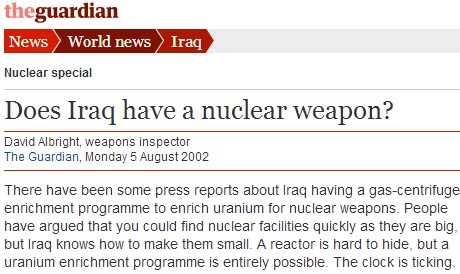
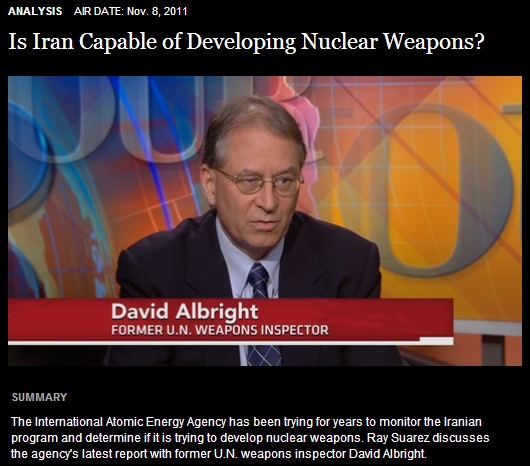
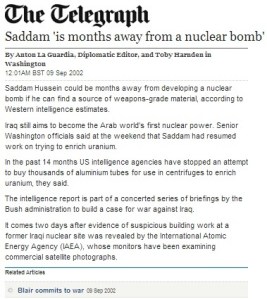
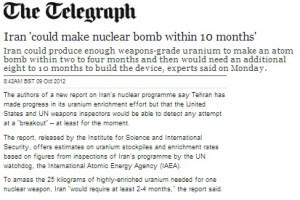
Could this repeated history be any more obvious?
This was August 5, 2002:
And this was November 8, 2011:
This was September 9, 2002:
And this was October 9, 2012:
This was also September 9, 2002:
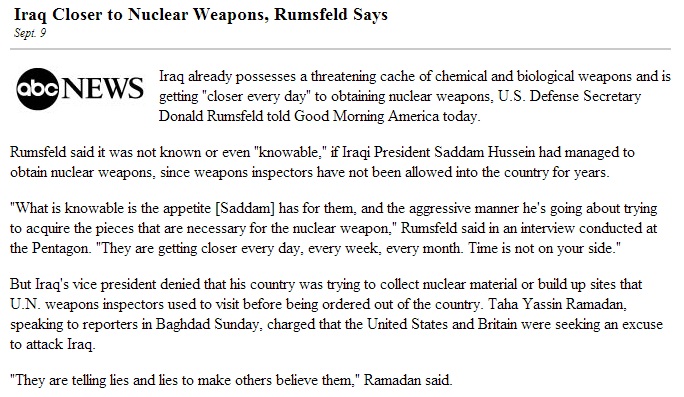
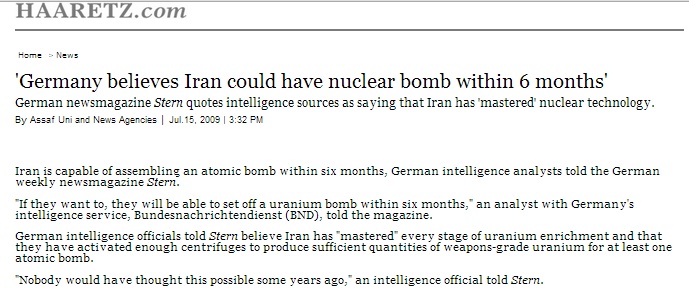
This was September 17, 2002:

And this was May 9, 2006:

This was September 22, 2002:
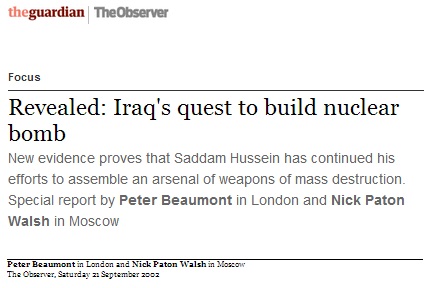
And this was November 6, 2011:

This was September 10, 2002:
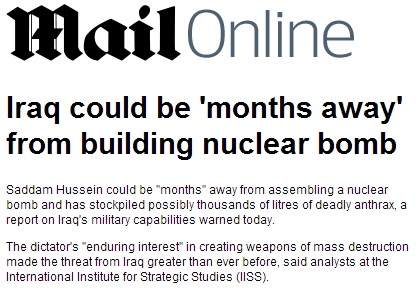
And this was November 9, 2011:
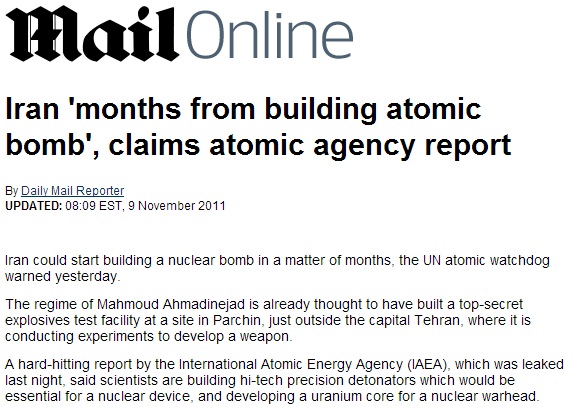
This was September 17, 2004:
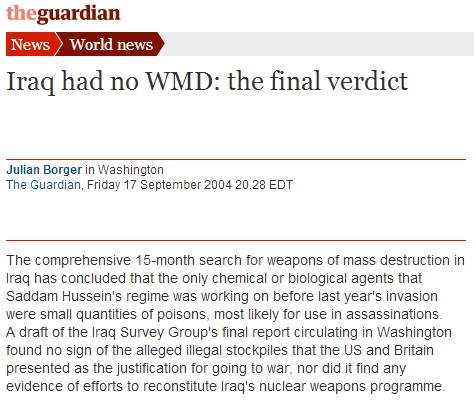
And this was January 27, 2009:

This was October 6, 2004:
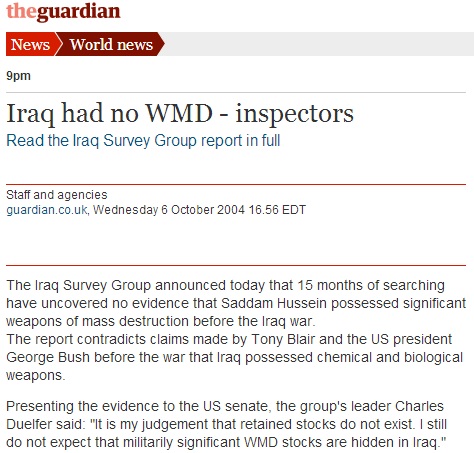
And this was January 25, 2010:

This was April 25, 2005:
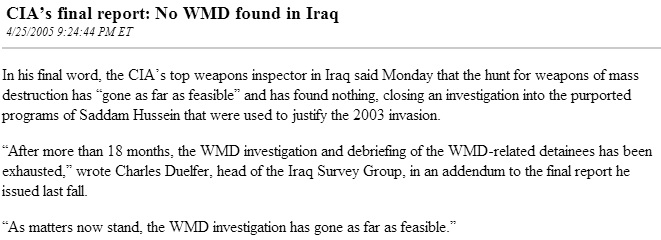
And this was October 8, 2012:
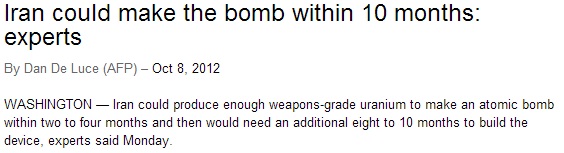
This was September 6, 2007:
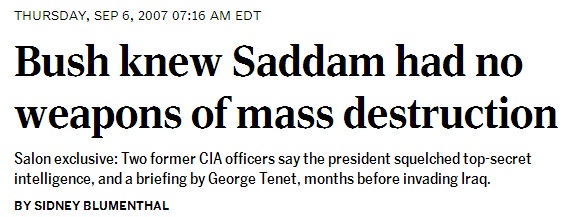
And this was February 4, 2013:

*****
The Reporters Who Got Iraq So Wrong
By Peter Hart | FAIR | February 6, 2013
Ten years ago today, Colin Powell made the Bush administration’s case for going to war against Iraq. Much of what he said about Iraq’s threats to the United States was false. But the media coverage gave the opposite impression, and most of the pundits and journalists who promoted the justifications for the war paid no price for their failures.
As FAIR reported at the time, even before the Powell address there were reasons to be skeptical of the administration’s claims. On February 4, 2003, FAIR published “Iraq’s Hidden Weapons: From Allegation to Fact,” which made the point that “it has not been demonstrated that Iraq continues to hold unconventional weapons.” FAIR criticized coverage like that of the New York Times (2/2/03), which asserted that “nobody seriously expected Mr. Hussein to lead inspectors to his stash of illegal poisons or rockets, or to let his scientists tell all.”
As the FAIR release concluded:
The media convey to the public the impression that the alleged banned weapons on which the Bush administration rests its case for war are known to exist, and that the question is simply whether inspectors are skillful enough to find them.
Powell’s address was instrumental in pushing a faulty media line on Iraq’s WMDs further. That much was clear in the coverage right after his appearance at the United Nations, as FAIR documented on February 10 in “A Failure of Skepticism in Powell Coverage.”
In Andrea Mitchell‘s report on NBC Nightly News (2/5/03), Powell’s allegations became actual capabilities of the Iraqi military: “Powell played a tape of a Mirage jet retrofitted to spray simulated anthrax, and a model of Iraq’s unmanned drones, capable of spraying chemical or germ weapons within a radius of at least 550 miles.”
Dan Rather, introducing an interview with Powell (60 Minutes II, 2/5/03), shifted from reporting allegations to describing allegations as facts: “Holding a vial of anthrax-like powder, Powell said Saddam might have tens of thousands of liters of anthrax. He showed how Iraqi jets could spray that anthrax and how mobile laboratories are being used to concoct new weapons.” The anthrax supply is appropriately attributed as a claim by Powell, but the mobile laboratories were something that Powell “showed” to be actually operating.
Commentator William Schneider on CNN Live Today (2/6/03) dismissed the possibility that Powell could be doubted: “No one disputes the findings Powell presented at the U.N. that Iraq is essentially guilty of failing to disarm.” When CNN‘s Paula Zahn (2/5/03) interviewed Jamie Rubin, former State Department spokesperson, she prefaced a discussion of Iraq’s response to Powell’s speech thusly: “You’ve got to understand that most Americans watching this were either probably laughing out loud or got sick to their stomach. Which was it for you?”
If you turn to FAIR’s “Iraq and the Media: A Critical Timeline” (3/19/07), you see that February 6 Washington Post op-ed page had Mary McGrory writing: “I don’t know how the United Nations felt about Colin Powell’s ‘J’accuse’ speech against Saddam Hussein. I can only say that he persuaded me, and I was as tough as France to convince.” She added that she “heard enough to know that Saddam Hussein, with his stockpiles of nerve gas and death-dealing chemicals, is more of a menace than I had thought.”
And Richard Cohen (2/6/03) announced that the debate was over:
The evidence he presented to the United Nations–some of it circumstantial, some of it absolutely bone-chilling in its detail–had to prove to anyone that Iraq not only hasn’t accounted for its weapons of mass destruction but without a doubt still retains them. Only a fool–or possibly a Frenchman–could conclude otherwise.
Obviously, the fools and Frenchmen were correct. And as FAIR documented, independent-minded journalists were reporting that some of the administration’s claims did not stand up to scrutiny. The Associated Press had a detailed look at the state of Iraq intelligence on January 18. The skepticism and good judgment of those reporters (and others) should have been the rule, not the exception, if journalists had been doing their jobs.
But most journalists did a different job. And most of them faced no consequences whatsoever for being so disastrously wrong.
Obama and Co. Make Up the Law as They Kill
A Black Agenda Radio commentary by BAR executive editor Glen Ford | February 6, 2013
Unlike the bombast that characterized the Bush administration’s assaults on U.S. and international law, the Obama regime tends to dribble out its rationales for gutting the Bill of Rights and every notion of global legality. This president prefers to create a fog – let’s call it the fog of his war against human rights – as he arrogates to himself the power to perpetually imprison or to summarily execute anyone, at any time, anywhere in the world. Obama assures us such authority is constitutionally rooted – it’s in there, believe me, he tells us – but he never produces legal chapter and verse to prove that presidential dictatorship is lawful. Instead, we get dribs and drabs of the administration’s position from lawyers defending Obama’s preventive detention law in the courts, or from informal statements by the attorney general, or even little tidbits gleaned from an Obama conversation with comedian Jon Stewart.
 The latest hors d’oeuvre to be dished out comes in the form of a leak. I say “dished out” because leaked documents are commonly placed in public view by the administration in power, to test the political waters. This leaked Justice Department “white paper” appears to have been drawn up after the execution-by-drone of U.S. citizen Anwar Awlaki, in Yemen. It justifies the killing of anyone occupying a position of status in al-Qaida, or with the ever-changing universe of groups said to be “associated” with al-Qaida. The document stretches the definition of “imminent threat” to cover anyone engaged in activities directed against the U.S., whether or not an actual operation is planned or in progress. Most interestingly, the white paper empowers Obama to delegate the kill-at-will authority to “an informed, high-level official of the U.S. government.” Which has a certain logic, since dictators certainly have the power to delegate the carrying out of their unjust acts to whomever they choose.
Eleven U.S. senators are asking for further clarification of the administration’s legal position. But that is just more fog, since the Congress overwhelmingly passed Obama’s preventive detention law – twice!! – a law based on the same assumption that due process of law does not apply when the president says it’s wartime. Therefore, the commander-in-chief can lock up any American, without charge or trial, forever, or until he declares peace. The U.S. attorney general, Eric Holder, has made the administration’s position clear enough. Due process, he says, does not necessarily mean access to the judicial process – meaning, a trial. The process is whatever the president or the nearest “informed, high-level official of the U.S. government” says it is. Obama had redefined war, itself. The president told the Congress, after bombing Libya for eight months, that by his definition – which is the only one that counts – no state of war exists unless Americans become casualties, even if the U.S. kills tens of thousands, or millions. Dr. Martin Luther King Jr. was fond of saying that the arc of history bends towards justice. In the long term, that may be true. But Martin’s arc is not bending towards justice under this administration. It bends towards fascism, with a Black presidential face.
Glen Ford can be contacted at Glen.Ford@BlackAgendaReport.com.
Related article
- White Paper Asserts Obama Administration May Kill Americans Without Due Process (news.firedoglake.com)
U.S. Violating Human Rights of Children, Says U.N. Committee
By Allison Frankel | ACLU Human Rights Program | February 6, 2013
The Obama Administration recently underwent its first U.N. treaty body review, and the resulting concluding observations made public yesterday should be a cause for alarm. The observations, issued by independent U.N. experts tasked with monitoring compliance with the international treaty on the rights of children in armed conflict (formally known as the Optional Protocol to the Convention on the Rights of the Child on the involvement of children in armed conflict or “OPAC”), paint a dark picture of the treatment of juveniles by the U.S. military in Afghanistan: one where hundreds of children have been killed in attacks and air strikes by U.S. military forces, and those responsible for the killings have not been held to account even as the number of children killed doubled from 2010 to 2011; where children under 18 languish in detention facilities without access to legal or full humanitarian assistance, or adequate resources to aid in their recovery and reintegration as required under international law. Some children were abused in U.S. detention facilities, and others are faced with the prospect of torture and ill-treatment if they are transferred to Afghan custody.
By ratifying OPAC in 2002, the U.S. committed to guaranteeing basic protections to children in armed conflict zones, and to submit periodic reports on the implementation of its treaty obligations to the U.N. Committee on the Rights of the Child. We wrote about the latest U.S. report, released in November, which revealed that over 200 children have been held in U.S. custody in Afghanistan since 2008, some for lengthy periods of time. During its review of the U.S. on January 28, the Committee posed critical questions about the treatment of children by the U.S. military and issued recommendations to remedy these human rights violations.
These recommendations include taking “concrete and firm precautionary measures [to] prevent indiscriminate use of force” particularly against children, and ensuring all allegations of unlawful use of force are “investigated in a transparent, timely and independent manner” and that “children and families victims of attacks and air strikes do always receive redress and compensation.” In regard to the detention of juveniles, the Committee urged the U.S. to ensure that all children under 18 are detained separately from adults and guaranteed access to free and independent legal assistance as well as an independent complaints mechanism. Importantly, considering the previous U.S. response to the Committee revealed that the average age of children detained by U.S. forces is only 16 years old and the average length of stay for juveniles in U.S. military custody has been approximately one year, the Committee recommended children be detained only “as measures of last resort and for the shortest possible period of time and that in all cases alternatives to detention are given priority.”
The Committee also stressed that allegations of torture and other forms of mistreatment must be investigated and the perpetrators brought to justice, and that no child should be transferred to Afghan custody if “there are substantial grounds for the danger of being subject to torture and ill treatment.” The Committee specifically mentioned the case of Omar Kadr, a former child soldier who was detained by U.S. forces at the age of 15 and was subjected to torture and a systematic program of harsh and highly coercive interrogations at the American prisons at Guantánamo Bay and Bagram.
The U.S. government’s human rights obligations do not end with the release of a periodic report or the completion of a treaty body review. In order to give meaning to the words of the children’s rights treaty, the U.S. must work diligently to implement the Committee’s recommendations and ensure that our military forces, intelligence agents, and other government officials treat children in the war zones of Afghanistan and elsewhere in accordance with international law.
Related article
- A quarter of countries supported CIA in torturing, detaining individuals: report (alethonews.wordpress.com)
Pakistan’s “Red Lines” That America Crosses Everyday
By Peter Chamberlin | There Are No Sunglasses | February 6, 2013
The government of Pakistan claims that there are “red lines” which drones and ground soldiers dare not cross (US urged not to cross ‘red line’ in Fata). This is another lie. In reality, US drones (and possibly “private contractors”) cross those lines everyday. Just another day in the multi-faceted psychological war games, that are fought-out in FATA everyday.
This new public relations ploy, to allow the families of drone victims to prosecute American Predator war crimes builds a new line of defense for the Pak Army, while enhancing its credibility. This is part of Pakistan’s new “Plan B” for Waziristan, where the civilian administration attempts to use Western courts to stop daily drone attacks upon the Wazir tribes in both North and South Waziristan, since military persuasion has failed miserably in that respect. Military reluctance to interfere with US plans for Pakistan’s militants has derived not from a common desire to see the CIA … Pakistanis, but from a desire NOT to piss-off the paymaster, which is interpreted by the people as complicity in the attacks (SEE: US embassy cables: Pakistan backs US drone attacks on tribal areas (23 Aug. 2008, 14:12)). Even the targeted militant leaders are aware of Army complicity in drone targetting. I am referring here to the testimony of the recently assassinated Waziri leader Nazir (SEE: As-Sahab: English transcript of the interview with Mulla Nazeer Ahmad, the amir of the mujahideen in the South Waziristan).
The outrageous death of Nazir and his friends clarified for the other militants, along with the entire Wazir tribe, that the Pak Army is obviously complicit in the drone attacks, otherwise actions would have been taken to put an end to the air incursions (SEE: India/Pakistani Detente’ Went Into the Ground with Mullah Nazir). As long as the Army continued to maintain its duplicitous drone acceptance/rejection strategy, denying involvement in the drone targeting (which consistently hit the pro-Army Wazirs and not the anti-Pakistan Mehsuds in both North and South Waziristan), the Wazirs continued to participate in the Pak/US development strategy of infrastructural bribery, based on building ”Quick Impact Projects” in areas previously cleared of Mehsud terrorists.
Since the UAV murder of Mullah Nazir near Wana, working in tandem with the development strategy, the Army is allowing lawsuits (Case No: CO/2599/2012) to go forward on one of the most heinous drone attacks upon the Wazirs, the March 17th, 2011 attack upon a Waziri Jirga in Datta Khel, N. Waziristan, which killed 50 (SEE: Waziristan tribesmen to move ICJ against drone hits). This move may be a compromise between the government and the Wazir tribe, to avoid a companion lawsuit (which is coming-up for a hearing on Feb. 13) that has been filed in Peshawar High Court, which forces the government of Pakistan’s hand. The Peshawar suit makes the following demands:
- Confirm the Pakistani government’s complete opposition to US drone strikes in the tribal areas as a violation of Pakistan’s sovereignty under Article 2(4) of the United Nations Charter.
- Approach the United Nations Security Council and demand adoption of a resolution condemning drone strikes and requiring the US to end the strikes in Pakistan.
- Issue a formal complaint to the United Nations Human Rights Council (UNHRC) and with the Special Rapporteur on Extrajudicial, Summary or Arbitrary Executions as the fundamental right to life is being breached by US drone strikes.
- Publicly encourage victims of drone stacks to file complaints to the UNHRC so that the UN Secretary General can list this issue on the Council agenda for discussion.
- Notify the US government of Pakistan’s intention to seek relief in the International Court of Justice for the US’s illegal operation of drones in Pakistan.
- Sign the Rome Treaty so that the International Criminal Court can have jurisdiction to prosecute the drone attacks as international law crimes.
The Wazir experiment was intended to reinforce existing agreements that have been made between the Army and the Tribal Authorities, which have previously delegated the policing function to the Tribes. Under those peace deals, Tribal Leaders had agreed to keep “terrorists” and foreigners out of their territory, referring to Taliban and the Uzbek and “al-CIA-da” forces. The Wazir Tribe has been held responsible for the terrorist attacks within their neighborhoods since this agreement was signed in 2007. Under the agreement, the Mehsuds were to have been run-out of Wana. The Wazirs resisted taking this extreme step for the Army, because they were forced to travel roads through Mehsud territory and obviously didn’t want to start a Tribal feud (SEE: Pak Army Uses US Money To Build Road for Ahmadzai Wazirs To Run Mehsuds Out of Wana On).
The Wazir were expected to run the remaining 1,000 or so Mehsud out of Wana, just as soon as the new Kaur-Gomal-Tanai-Wana road was inagurated. Mullah Nazir led a tribal jirga, which voted to run them out on December 5 (SEE: 1000 Mehsud Refugees Run-Out of Wana ). Three weeks later, Nazir was killed in a flurry of Hellfire missiles which were fired by three or four drones (SEE: They Had A Funeral In Wana for Mullah Nazir and 10,000 People Showed-Up–where were the drones then?). After years of trying and countless near-misses, the CIA finally killed the lynchpin of Pak Army plans for peace through development, by gifting him with a Quran containing a drone tracking chip. The man who was the most feared, as well as the most effective anti-Taliban tribal leader/fighter, was the centerpiece of Pakistani peace efforts, who hopefully would inspire all of the tribes to build their own effective anti-Taliban “Lashkars.”
The S. Waziristan development projects were a type of reward for supporting govt. efforts. The Army officials took their peace efforts so seriously that they rolled-up their sleeves and helped to build homes for the returnees, teach gardening skills, classes in fish farming, poultry and livestock handling. They have even organized an off-road rally in South Waziristan, hoping to draw people into an entertainment venue and thereby possibly enhance their communal feelings. The Army is whole-heartedly into the idea of “winning hearts and minds” in South Waziristan, following American counter-insurgency tactics to the letter. But they are finding-out the hard way that it might be impossible to smooth relations with people whose homes and schools you have just flattened, not to mention overcoming those hard feelings harbored over family members who were killed by the Army’s zealous pulverizing of parts of South Waziristan.

As you can see from this WSJ article clip, the rehabilitation effort, centered on Kotkai village (Hakeemullah Mehsud’s hometown), is not having the desired effect or speed of development. With the killing of the Wazir leader, how much further will the Tribal elders be willing to go in trusting the Army to deal fairly?
The lawsuit in British courts against the UK Govt., for their participation in the American drone strike of the Wazir jirga will serve as a largely symbolic test which could possibly enable judicial interference to handicap further drone strikes. The suit filed in Peshawar could prove to be a very significant test of govt. loyalty, to document whether Pakistan supports its own citizens (who are being systematically deprived of their inalienable rights to Life), or the rights of the Imperial powers to murder them at will. A wrong choice on the Army’s part could cost them all of their remaining friends in the Tribal Regions. It would force the govt. hand, requiring public opposition to drone strikes, as well as taking the people’s case to the UN and filing formal Human Rights violations. In addition to this, it would force govt. to allow charges to be filed in the ICJ (International Court of Justice). If any of these actions are taken, they would be sufficient to suspend all further American payments to Pakistan.
therearenosunglasses@hotmail.com
Related article
FCC Ponders Powerful and Free Internet Service for All… Again
By Noel Brinkerhoff | AllGov | February 6, 2013
Free public access to government-created WiFi networks across the United States could become a reality in the near future, under a proposed plan by the Federal Communications Commission (FCC).
The FCC idea could allow Americans to make phone calls or access the Internet without the need to do business with cell phone companies.
Not surprisingly, telecoms hate the FCC plan and intend to lobby heavily against it.
But the FCC does have its own heavyweights supporting the WiFi networks, namely Google, Microsoft and other tech giants who see free wireless service as a way to encourage innovation and new technology.
The new WiFi networks would reportedly be more powerful than existing wireless networks found in most households. “They could penetrate thick concrete walls and travel over hills and around trees. If all goes as planned, free access to the Web would be available in just about every metropolitan area and in many rural areas,” according to Cecilia Kang of The Washington Post.
Drawbacks to the plan include that it would take years to set up the networks, assuming the FCC can convince local television stations and other broadcasters to sell portions of their airwaves for the new access.
Critics add that once in operation, the government might not do a good job of managing the networks against crashes and bandwidth problems.
To Learn More:
Tech, Telecom Giants Take Sides as FCC Proposes Large Public WiFi Networks (by Cecilia Kang, Washington Post)
FCC Bends to Telecoms on Broadband Internet Development (by Noel Brinkerhoff and David Wallechinsky, AllGov)
FCC Proposes Broadband Internet for All Americans (by Noel Brinkerhoff, AllGov)
Related article
- The FCC Wants to Blanket the Country in Free Wi-Fi (motherboard.vice.com)
US Ambassador’s Convoy Violates Lebanon’s Antiquities
Al-Manar | February 6, 2013
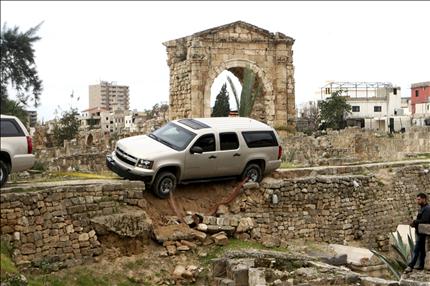 US Ambassador in Lebanon Maura Connelly’s convoy violated on Tuesday the antiquities in the southern city of Tyre, as it insisted to pass near the Roman Arc of Triumph, through a narrow, dirt road supported by an old stone wall.
The act could be considered a message from the embassy, that its staff and vehicles can enter anywhere without any considerations.
Connelly went to the region with the city’s mayor Hussein Dbouk, and the cars accompanying her followed her through the dirt road. However, one of the cars veered off the road and destroyed the stone wall.
The accident did not very much affect Connelly’s visit, it only caused a short delay to the program, as the group had to wait for a winch to arrive and pull the deviated vehicle off the road.
Featured Video
US IRAN TALKS: Who Are the Crazy Ones Here? /Lt Col Daniel Davis
or go to
Aletho News Archives – Video-Images
From the Archives
Wartime internment camps in Australia
National Archives of Australia
World War I
During World War I, for security reasons the Australian Government pursued a comprehensive internment policy against enemy aliens living in Australia.
Initially only those born in countries at war with Australia were classed as enemy aliens, but later this was expanded to include people of enemy nations who were naturalised British subjects, Australian-born descendants of migrants born in enemy nations and others who were thought to pose a threat to Australia’s security.
Australia interned almost 7,000 people during World War I, of whom about 4,500 were enemy aliens and British nationals of German ancestry already resident in Australia.
Records of World War I internment camps
World War II
During World War II, Australian authorities established internment camps for three reasons – to prevent residents from assisting Australia’s enemies, to appease public opinion and to house overseas internees sent to Australia for the duration of the war.
Unlike World War I, the initial aim of internment during the later conflict was to identify and intern those who posed a particular threat to the safety or defence of the country. As the war progressed, however, this policy changed and Japanese residents were interned en masse. In the later years of the war, Germans and Italians were also interned on the basis of nationality, particularly those living in the north of Australia. In all, just over 20 per cent of all Italians resident in Australia were interned. … continue
Blog Roll
 Aletho News
- Diplomats slam US negotiators’ performance in Iran talks
- Trump Refuses Exit Ramp, War with Iran will Continue
- Trump Says US Naval Blockade in Strait of Hormuz Will Begin Shortly
- US, Iran end 21-hour talks without agreement
- US IRAN TALKS: Who Are the Crazy Ones Here? /Lt Col Daniel Davis
- Talks with the US end without a deal over excessive US demands: Iran
- Feeling Better, Getting Worse: How Psychiatric Drugs Create the Illusion They Cure
- ‘Nobody Told Me’: Former Mental Health Patient Calls Out Dangerous Side Effects of Psychiatric Drugs
- Dr. Abu-Sitta: Beirut ‘felt like a day in Shifa Hospital’
- Iran Has Won the War, It Will Be Up to the US to Secure the Peace: Mohammad Marandi
- If Americans Knew
- US-Iran ceasefire negotiations make zero progress – Daily Update
- Pro-Israel ‘Thinktanks’ and Individuals who Influence U.S. Foreign Policy
- Mearsheimer reveals how Israel dictates US policies on Iran, Gaza – video
- After killing 350+, Israel still has a “score to settle” with Lebanon before ceasefire – Daily Update
- Military aid to Israel emerges as the latest political litmus test for Democrats
- The only Palestinian children’s rights organization closes following years-long Israeli campaign against it
- ‘I Can’t Forget the Smell’: Lebanese Reel After Israel Kills Over 300 in Single Day
- DNC Shoots Down Resolutions Calling Out AIPAC and Limiting Arms to Israel
- TCN: Is Israel Blackmailing President Trump?
- Israel killed at least 303 Lebanese yesterday – who were they? Daily Update
- No Tricks Zone
- German Expert: Heat Dome Led To Record Temps In Western USA…Warmer In 1934, 1936
- New Study: No Linear Warming Or Glacier Retreat Along Northern Antarctic Peninsula Since 1980s
- An Inconvenient Tree: Uncovered In Alps… Europe Much Warmer Than Today 6000 Years Ago
- New Study Reports A 60% Slowdown In Greenland’s Ice Loss Rate In The Last Decade
- Low Intensity Tornado Wrecks Major Solar Farm, Creating A Potential Toxic Dump
- New Study Finds Warming Saves Lives…Cold Temperatures 12 Times More Deadly Than Excess Heat
- German Science Blog Accuses PIK Climate Institute Of Hallucinating Climate Tipping Points
- Devastating Assessment Of Comirnaty Vaccine By Former Senior Pfizer Europe Toxicologist
- New Study: CO2 Is ‘Effectively Negligible’ As An Explanatory Climate Change Factor Since 2000
- Former Pfizer Toxicologist Dr. Helmut Sterz Tells Bundestag Hearing Pfizer Vaccine Should Have Never Been Approved
 Aletho News