Reporting on Romer’s Charter Cities: How the Media Sanitize Honduras’s Brutal Regime
By Keane Bhatt | NACLA | February 19, 2013
On the evening of Saturday, September 22, human rights lawyer Antonio Trejo stepped outside a wedding ceremony to take a phone call. Standing in the church parking lot of a suburb of Tegucigalpa, Honduras, he was shot six times by unknown assailants. Despite his requests, he had been granted no police protection in the face of death threats; Trejo had believed he would be targeted by wealthy landowners over his outspoken advocacy on behalf of small farmers seeking to reclaim seized territories.1 In his death, Trejo joined dozens of fallen peasant leaders whom he had defended, as well as murdered opposition candidates, LGBT activists, journalists, and indigenous residents. All were victims of the violence and impunity that has reigned in Honduras since the 2009 coup d’état against its democratically elected and left-leaning president, Manuel Zelaya.
Earlier that day, Trejo had appeared on television, denouncing the powerful interests behind the government’s push for ciudades modelos—swaths of land to be ceded to international investors and developed into autonomous cities, replete with their own police forces, taxes, labor codes, trade rules, and legal systems. He had helped prepare motions declaring the proposal unconstitutional.
This concept of “charter cities” has been promoted for a couple of years by Paul Romer, a University of Chicago–trained economist teaching at New York University. He described his brainchild in a co-authored op-ed as “an effort to build on the success of existing special zones based around the export-processing maquila industry.” A “new city on an undeveloped site, free of vested interests” could bypass the “inefficient rules” that hinder “peace, growth and development” worldwide, he argued. With new and stable institutions, the charter city could become an “attractive place for would-be residents and investors.”2
The international press swooned over Romer’s revolutionary idea: Foreign Policy magazine named him one of its Top 100 Global Thinkers of 2010 for “developing the world’s quickest shortcut to economic development”;3 that same year, The Atlantic dedicated a 5,400-word paean to Romer and his “urban oases of technocratic sanity,” which held the promise that “struggling nations could attract investment and jobs; private capital would flood in and foreign aid would not be needed.”
But the applicability of Romer’s radical vision in Honduras always depended on the enthusiasm of the authoritarian, post-coup government of Porfirio Lobo. Lobo owes his presidency to the sham elections of 2009, which took place under the U.S.-backed de facto military government that overthrew Zelaya and were marred by violent repression and media censorship. With the exceptions of the U.S.-financed International Republican Institute and National Democratic Institute, international observers boycotted the electoral charade that foisted Lobo into power.
Romer’s lofty theories also remained utterly detached from the brutal nature of the collaborating government. “Setting up the rule of law” from scratch in a new city, he contended, would be an antidote to “weak governance” (weak in no small part due to Lobo’s appointment of coup perpetrators to high-level government positions).4 In a co-authored paper, Romer also mischaracterized his allies, the “elected leaders in Honduras,” as earnest in their intent to end a “cycle of insecurity and instability that stokes fear and erodes trust.”5 (Romer offered no comment when Lobo designated Juan Carlos “El Tigre” Bonilla, accused of past ties to death squads, as the national chief of police.)6
Even on its own terms, Romer’s development theory is disconnected from reality. He has repeatedly invoked Hong Kong as the sunny inspiration for the remaking of Honduras: “In a sense, Britain inadvertently, through its actions in Hong Kong, did more to reduce world poverty than all the aid programs that we’ve undertaken in the last century,” he claimed.7 Romer neglected to add that the city developed as a hub for the largest narcotrafficking operation in world history, through which Britain inflicted untold misery on the Chinese mainland. Britain dealt a humiliating military defeat to China (which had attempted to prohibit illegal British opium from entering its borders), took over Hong Kong, and forced China to abandon its tariff controls in 1842. Given that Hong Kong was one of the spoils of a drug war, and that its inhabitants were permitted democratic elections only 152 years after its incorporation into an empire, Romer’s dream for Honduras could just as easily be considered a nightmare.
Romer’s focus on good rule making is similarly fanciful; his effort to change the rules that engender poverty conspicuously excludes the international legal privileges that allow undemocratic leaders to sell a country’s resources and borrow in its name (he wrote positively of a trade agreement that Lobo struck with Canada this summer).8 Romer also approved of the legal architecture that “gives the United States administrative control in perpetuity over a piece of sovereign Cuban territory, Guantanamo Bay,” through a 1901 treaty that he failed to mention was ratified by a militarily occupied Cuba. Whether Romer knows it or not, his endorsement of power politics is clear: Investor-owned cities would be safe from future efforts by governments to repossess sovereign territory, because “Cuba respects the treaty with the United States, even as they complain bitterly about it.”9
Romer rebutted criticisms that his idea smacks of neocolonialism: “There are some things that it shares with the previous colonial enterprises,” he admitted, “but there’s this fundamental difference: at every stage, there’s an absolute commitment to freedom of choice on the part of the societies and the individuals that are involved.”10 Which choices are available to individuals living under a coercive, illegitimate government is a question left unanswered, and the adulating press could not be bothered to probe further.
After all, it would be impolite to reveal Romer’s close cooperation with a government whose security forces—many of whom are personally vetted, armed, and trained by the United States—killed unarmed students Rafael Vargas, 22, and Carlos Pineda, 24, as well as pregnant indigenous Miskitu women Juana Jackson Ambrosia and Candelaria Trapp Nelson, among others.11 Indeed, the Committee of Families of the Detained and Disappeared of Honduras observed that more than 10,000 official complaints have been filed against Honduras’s military and police since the coup. Such unsavory details might have chastened The Atlantic’s ebullient portrait of the “elegant, bespectacled, geekishly curious” professor, and would have tarnished President Obama, who praised Lobo for his “strong commitment to democracy” while providing his brutal security apparatus with $50 million in aid last year.12
In their coverage of Romer’s charter cities, the media have almost entirely excised the innumerable human rights violations occurring under the undemocratic Honduran regime. The New York Times is a case in point. About a week after Amnesty International, Human Rights Watch, the Inter-American Commission on Human Rights, and even the U.S. State Department were compelled to release statements of condemnation over Antonio Trejo’s assassination, Times reporter Elisabeth Malkin fawned over Romer’s idea while ignoring the killing of one of its most prominent critics. (Romer himself offered no public statement in the wake of Trejo’s death-squad-style killing.) Charter cities promised to “simply sweep aside the corruption, the self-interested elites, and the distorted economic rules that stifle growth in many poor countries,” asserted the imperturbable Malkin. She added with uncommon journalistic authority, “Nobody disputes that impoverished, violent Honduras needs some kind of shock therapy.”13
This is not the first instance in which the Times has glossed over inconvenient facts to laud shock therapy, a doctrine of massive privatization and investor-friendly deregulation developed at the University of Chicago.14 Many years after Chile’s coup government pushed through a rash of measures designed by economist Milton Friedman and his acolytes, the Chicago Boys, the Times reported that “Chile has built the most successful economy in Latin America, and one of the vital underpinnings of that growth was the open economic environment created by the former military dictator, Gen. Augusto Pinochet.”15 Leaving aside Pinochet’s torture and murder of tens of thousands of dissidents, Chile’s per capita gross domestic product was practically unchanged 13 years after the coup; Pinochet’s “free-market” experiment also ended with re-nationalizations in banking and copper extraction, the institution of capital controls, and continuous state support for Chile’s exports.16
Following in this dubious tradition of portraying a reactionary societal experiment as a formula for prosperity, the Times’ first piece on Honduran charter cities appeared in its Sunday magazine in May 2012. Author Adam Davidson, co-creator and host of National Public Radio’s Planet Money program, considered charter cities a “ridiculously big idea” for fixing an “economic system that kept nearly two-thirds of [Honduras’s] people in grim poverty.” Davidson related the story of Octavio Sánchez, Lobo’s chief of staff, who met with Romer to develop a “secure place to do business—somewhere that money is safe from corrupt political cronyism or the occasional coup.”17 Davidson, however, scrupulously avoided Sánchez’s own role as an apologist for the 2009 military overthrow of Zelaya. Days after Zelaya’s ouster, Sánchez advised Christian Science Monitor readers not to “believe the coup myth,” and in an Orwellian flourish, the Harvard Law graduate declared that “the arrest of President Zelaya represents the triumph of the rule of law.”18
In November, Planet Money provided an obsequious follow-up on Romer and Sánchez’s collaboration, scrubbing any mention of the 2009 coup and Lobo’s emergence from it, and portraying Sánchez as an idealistic dreamer. “Instead of fighting to do two, three or four reforms during the life of a government,” Sánchez asked, “why don’t you just do all of those reforms at once in a really small space? And that’s why this idea was appealing. It’s really the possibility of turning everything around.”19
Planet Money’s co-hosts unwittingly conveyed the fundamental obstacle to shock therapy: “Paul Romer has this killer idea and no real country to try it in; Octavio has the same idea, but no way to sell it to his people.” They acknowledged that even with “a government that’s ready to go,” the “people in Honduras” viewed Romer’s plan as “basically Yankee imperialism.” The episode concluded by explaining the apparent collapse of the charter cities initiative, resulting partly from the post-coup government’s lack of transparency (Romer was “stunned”), as well as a Honduran Supreme Court ruling in October that found charter cities unconstitutional. Romer remains unfazed, the hosts said. He has a promising lead in North Africa—another opportunity to answer “one of the oldest problems in economics: how to make poor countries less poor.”
Regardless of what Romer and his media sycophants think of the charter city’s (questionable) efficacy, their deafening silence on its antidemocratic implications and Honduras’s human rights abuses is unconscionable. In this insulated world, Honduran victims of economic hardship and state terror, and their own proposals to solve poverty, remain invisible. Pinochet, the original administrator of shock therapy, distilled the insouciance of today’s intellectual and media culture when, in 1979, he remarked, “I trust the people all right; but they’re not yet ready.”20
Keane Bhatt is a regular contributor to the MALA section of NACLA Report and the creator of the Manufacturing Contempt blog on the NACLA Website.
1. Alberto Arce, “Slain Honduran lawyer Complained of Death Threats,” Associated Press, September 25, 2012.
2. Paul Romer and Octavio Sánchez, “Urban Prosperity in the RED,” The Globe and Mail: April 25, 2012.
3. “The FP Top 100 Global Thinkers,” Foreign Policy, November 26, 2012. Sebastian Mallaby, “The Politically Incorrect Guide to Ending Poverty,” The Atlantic, July/August 2012.
4. Romer and Sánchez, “Urban Prosperity.” Dana Frank, “Honduras: Which Side Is the US On?,” The Nation, May 22, 2012.
5. Brandon Fuller and Paul Romer, “Success and the City: How Charter Cities Could Transform the Developing World,” Macdonald-Laurier Institute, April 2012.
6. Katherine Corcoran and Martha Mendoza, “New Honduras Top Cop Once Investigated in Killings,” Associated Press, June 1, 2012.
7. Sebastian Mallaby, “Politically Incorrect Guide.”
8. Romer and Sánchez, “Urban Prosperity.”
9. Can “Charter Cities” Change the World? A Q&A With Paul Romer,” Freakonomics.com, September 29, 2009.
10. Jacob Goldstein and Chana Joffe-Walt, “Episode 415: Can a Poor Country Start Over?” NPR’s Planet Money, November 9, 2012.
11. Javier C. Hernandez, “An Academic Turns Grief Into a Crime-Fighting Tool,” The New York Times, February 24, 2012; Annie Bird and Alexander Main, “Collateral Damage of a Drug War,” Center for Economic and Policy Research and Rights Action, August 2012.
12. U.S. Office of the Press Secretary, “Remarks by President Obama and President Lobo of Honduras Before Bilateral Meeting,” whitehouse.gov, October 5, 2011; Dana Frank, “Honduras.”
13. Elisabeth Malkin, “Plan for Charter City to Fight Honduras Poverty Loses Its Initiator,” The New York Times, September 30, 2012
14. Naomi Klein, The Shock Doctrine: The Rise of Disaster Capitalism (Metropolitan Books, 2007).
15. Nathaniel C. Nash, “Terrorism Jolts a Prospering Chile,” The New York Times, April 9, 1991.
16. Paul Krugman, “Fantasies of the Chicago Boys,” The Conscience of a Liberal (blog), The New York Times, March 3, 2010.
17. Adam Davidson, “Who Wants to Buy Honduras?,” The New York Times Magazine, May 8, 2012.
18. Octavio Sánchez, “A ‘Coup’ in Honduras? Nonsense,” The Christian Science Monitor, July 2, 2009.
19. Goldstein and Joffe-Walt, “Can a Poor Country.”
20. John B. Oakes, “Pinochet in No Rush”, The New York Times, May 3, 1979.
Related articles
- Honduras: Murdered Lawyer’s Brother Killed in Aguán (alethonews.wordpress.com)
- NPR Examines One Side of Honduran “Model Cities” Debate (alethonews.wordpress.com)
- IMF Ignores Proven Alternatives With Recommendations to Honduras (alethonews.wordpress.com)
- Killings Continue in Bajo Aguán as New Report Documents Abuses by U.S.-Trained Honduran Special Forces Unit (alethonews.wordpress.com)
- Honduras: Miguel Facusse is Tragically Misunderstood (alethonews.wordpress.com)
‘Noble Savages’: Chagnon’s new book triggers resignation and protests
Survival for Tribal Peoples | February 26, 2013
 Davi Kopenawa, Yanomami spokesperson and shaman, has spoken out against Napoleon Chagnon’s new book ‘Noble Savages’.
© Fiona Watson/Survival

A new book by controversial American anthropologist Napoleon Chagnon has triggered a wave of protests among experts and Yanomami Indians:
- Marshall Sahlins, ‘the world’s most respected anthropologist alive today’, has resigned from the US National Academy of Sciences in protest at Chagnon’s election to the Academy. Sahlins previously wrote a devastating critique of Chagnon’s work in the Washington Post.
- Davi Kopenawa, a spokesman for Brazil’s Yanomami and President of the Yanomami association Hutukara, has spoken out about Chagnon’s work: ‘[Chagnon] said about us, ‘The Yanomami are savages!’ He teaches false things to young students. ‘Look, the Yanomami kill each other because of women.’ He keeps on saying this. But what do his leaders do? I believe that some years ago his leader waged a huge war – they killed thousands of children, they killed thousands of girls and boys. These big men killed almost everything. These are the fierce people, the true fierce people. They throw bombs, fire machine guns and finish off with the Earth. We don’t do this…’
- A large group of anthropologists who have each worked with the Yanomami for many years have issued a statement challenging Chagnon’s assessment of the tribe as ‘fierce’ and ‘violent’. They describe the Yanomami as ‘generally peaceable.’
- Survival International’s Director Stephen Corry has said, ’Chagnon’s work is frequently used by writers, such as Jared Diamond and Steven Pinker, who want to portray tribal peoples as ‘brutal savages’ – far more violent than ‘us’. But none of them acknowledge that his central findings about Yanomami ‘violence’ have long been discredited.’
Napoleon Chagnon’s autobiography ‘Noble Savages: My Life Among Two Dangerous Tribes – the Yanomamö and the Anthropologists’, has just been published. His 1968 book ‘Yanomamö: The Fierce People’ portrayed the Yanomami as ‘sly, aggressive and intimidating’, and claimed they ‘live in a state of chronic warfare’. It is still a standard work in undergraduate anthropology.
The Yanomami live in Brazil and Venezuela and are the largest relatively isolated tribe in South America. Their territory is protected by law, but illegal goldminers and ranchers continue to invade their land, destroying their forest and spreading diseases which in the 1980s killed one out of five Brazilian Yanomami.
 Napoleon Chagnon’s view that the Yanomami are ‘sly, aggressive and intimidating’ and that they ‘live in a state of chronic warfare’ has been widely discredited.
© Fiona Watson/Survival

Chagnon’s work has had far-reaching consequences for the rights of the Yanomami. In the late 1970s, Brazil’s military dictatorship, which was refusing to demarcate the Yanomami territory, was clearly influenced by the characterization of the Yanomami as hostile to each other and in the 1990s, the UK government refused funding for an education project with the Yanomami, saying that any project with the tribe should work on ‘reducing violence’.
Most recently, Chagnon’s work was cited in Jared Diamond’s highly controversial book ‘The World Until Yesterday’, in which he states that most tribal peoples, including the Yanomami, are ’trapped in cycles of violence and warfare’ and calls for the imposition of state control in order to bring them peace.
Survival International’s Director Stephen Corry said today, ‘The greatest tragedy in this story is that the real Yanomami have largely been written out of it, as the media have chosen to focus only on the salacious details of the debate that rages between anthropologists or on Chagnon’s disputed characterizations. In fact, Yanomamö: The Fierce People had disastrous repercussions both for the Yanomami and tribal peoples in general. There’s no doubt it’s been used against them and it has brought the 19th century myth of the ‘Brutal Savage’ back into mainstream thinking.’
Related articles
Al-Aqsa Brigades Fire Rocket on Occupied Territories in Response to Killing of Prisoner
Al-Manar | February 26, 2013
A rocket fired from the Gaza strip landed early Tuesday near Ashkelon in the south of the Palestinian occupied territories, as al-Aqsa Martyrs Brigades, the military wing of Fatah Movement, claimed responsibility for the rocket launch.
“The rocket fell early in the morning near Ashkelon and did some damage to a road, without hurting anyone,” an Israeli police spokesman Micky Rosenfeld.
In a statement, al-Aqsa Brigades, Groups of Martyr Luai Kane’, claimed responsibility on Tuesday for firing a Grad rocket on Ashkelon city.
The statement said that the rocket was “in response for assassinating the prisoner Arafat Jaradat” who was martyred on Sunday after being tortured in an Israeli prison.
“The Freedom won’t be achieved but through sacrifice… We have to resist our enemy in all available means,” al-Aqsa Martyrs added in the statement.
Jaradat’s martyrdom sparked protests across Palestine, with thousands of Palestinians thronging the West Bank village of Sair on Monday for the funeral of Jaradat, a 30-year-old father of two and member of the Al-Aqsa Martyrs Brigades.
Both the Palestinians and the United Nations special coordinator for the Middle East peace process, Robert Serry, have called for an independent inquiry into Jaradat’s death.
Tuesday’s rocket fire was the first such event since the end of an Israeli offensive against Gaza late November.
The two sides finally agreed to a truce on November 21 following the eight-day Israeli attack which cost the lives of dozens of Palestinian civilians. 177 Palestinians were martyred and six Zionists were killed, according to figures issued by the two sides.
Related article
Shameful Symbolism: Commemorating the Ten Year Anniversary of the Beginning of the Disastrous Iraq War

By Doug E. Steil | Aletho News | February 25, 2013
Nearly ten years ago, on the eve of the Jewish festival of Purim, invoking the slaughter of Persians, an American student protesting house demolitions in Gaza, Rachel Corrie, was killed by a bulldozer (March 16, 2003).
Shortly after this festival had ended, the Iraq War, waged primarily on behalf of Israel — and still in progress on a more covert level — began on land amidst much media fanfare, including live television coverage. Around the time of the vernal equinox on March 20, 2003, multiple tank formations entered from staged positions in Kuwait, and even now there is still no end in sight to the ongoing slaughter of hundreds of thousands of innocent people in that region.
To commemorate and possibly even celebrate the tenth anniversary of this disastrous debacle, of “Neocon” inspired servitude to Zionism, Israel will welcome Obama on his first official state visit on March 20, yes, just at the time of the equinox (11:02 GMT), a key reference point used in astronomy, astronautics, and astrology.
Here is the planned itinerary:
Obama is scheduled to land in Ben Gurion International Airport around noon on Wednesday, March 20.
How symbolic!
This scripted event should not be lost on the alternative media. Ten years ago it used to be taboo to openly talk about the “War for Israel” because a large segment of the population was still enthralled by the lies (for instance, “Saddam’s weapons of mass destruction” and “war for oil”) the media deployed in order to trick them into supporting the operation. Now, after the lies have been exposed, it’s a brazen “in-your-face” attitude that is regularly on display, and Obama’s planned ceremonies in Israel next month will only highlight the obsequious stance of the US government vis-a-vis Israeli leaders dictating their demands.
Since the symbolism is important, though shameful, beware of “coincidence theorists” who will want to deny the intent of the timing!
Related articles
- Israeli lies on Iranian nuclear program exposed
- Israel instructs Obama: “Iranian and Syrian sanctions are not painful enough!”
- The politics of aggressive war
- Israel may rely on US ‘scalpels’ to contain Iran – defense minister
- Tony Blair’s Iraq war was a shameful abomination. Ten years after the London march, it’s time for him to admit it
Obama’s Israel Trip
Ignore the hype. It’s four more years of settlement growth
By Jonathan Cook | Dissident Voice | February 25th, 2013
NAZARETH — Israeli and Palestinian officials have been in Washington laying the ground for President Barack Obama’s visit to Israel and the West Bank, scheduled for next month and the first since he took office four years ago.
Topping the agenda, Israeli Prime Minister Benjamin Netanyahu has said, will be efforts to restart the long-stalled peace process. Last week Palestinian officials said they had urged the White House to arrive with a diplomatic plan.
The US president began his first term on a different footing, ignoring Israel and heading instead to Cairo where he made a speech committing the US to a new era in relations with the Arab world. Little came of the promise.
Now he apparently intends to start his second term — as Netanyahu resumes office too, following last month’s elections — with an effort to engage with Israel and the Palestinians that is almost as certain to prove an exercise in futility.
The prospect of reviving the peace track between Israel and the Palestinians is not one that is appetising for either Obama or Netanyahu. Both are bruised from locking horns over a settlement freeze — the key plank of the US president’s efforts — during his first term.
But equally, it seems, the price of continuing inaction is high too. The Palestinians have repeatedly embarrassed Obama at the United Nations, not least by isolating the US in November as it opposed an upgrade in the Palestinians’ observer status. Inertia also looks risky given the growing unrest in the West Bank over hunger-striking prisoners.
Ahead lie potentially even bigger headaches, including the doomsday scenario — from Israel and Washington’s perspective — that the Palestinians approach the International Criminal Court to demand Israel be investigated for war crimes.
The perennial optimists have been searching for signs that Obama is readier this time to get tough. Neither of the president’s recent major appointments — John Kerry as secretary of state and Chuck Hagel, nominated as defence secretary — has been welcomed in Israel.
US determination has been buoyed, it is argued, by what is seen as a tide change in Israeli public opinion, highlighted by the surprise electoral success of centrist Yair Lapid and relatively poor showing by Netanyahu’s Likud party.
Netanyahu’s officials sense similar motives, complaining that Obama’s visit so soon after the election is direct “interference” in coalition-building. The centrists, they fear, will be able to extract concessions from Netanyahu, who will not wish to greet the US president as head of an extremist government.
Israeli officials, meanwhile, look eager to mend fences: they have hopefully codenamed the visit “Unbreakable Alliance” and announced an intention to award Obama Israel’s highest honour, the presidential medal.
The more hopeful scenarios, however, overlook the obstacles to a diplomatic solution posed both by Israel’s domestic politics and by the Palestinians’ inability to withstand Israeli bullying.
Not least, they ignore the fact that Netanyahu’s Knesset faction is the most right-wing in Likud’s history. He cannot advance a peace formula — assuming he wanted to — without tearing apart his party.
Equally, there is nothing in Lapid’s record to indicate he is willing to push for meaningful compromises on Palestinian statehood. On this issue, he occupies the traditional ground of Likud, before it moved further right. A recent poll found half his supporters called themselves right-wing.
Last week Netanyahu signed a coalition pact with another supposed centrist, Tzipi Livni, a former Likud leader who now heads a small faction called Hatnuah. The goal, as one Likud official cynically put it, was to use Livni to “whitewash the Netanyahu government in the world’s eyes”.
In other words, Netanyahu hopes a Livni or a Lapid will buy him breathing space as he entrenches the settlements and pushes Palestinians out of large areas of the West Bank under cover of what the Israeli newspaper Haaretz termed a “booby-trapped diplomatic process”.
What of the Palestinians? Will they not be able to mount an effective challenge to Israeli intransigence, given an apparent renewed US interest in diplomacy?
Here is the rub. Netanyahu already has a stranglehold on the politics of his potential peace partners. He can easily manipulate the fortunes of the Palestinian leader Mahmoud Abbas on the two biggest tests he faces: the “peace process” overseen by the international community, and reconciliation talks with the rival Palestinian faction Hamas.
The latest talks between Hamas and Fatah broke down in Cairo this month, even though unity, in the view of most Palestinians, is a precondition of their seeking viable statehood. The talks’ failure followed the “arrest” by Israel of 25 Hamas leaders in the West Bank, seizures that Palestinian human rights groups and Hamas warned were intended to disrupt reconciliation.
Meanwhile, Israel has repeatedly undermined Abbas’s rule, and kept his PA close to collapse, by turning on and off one of its major sources of income — tax monies Israel regularly collects on behalf of the Palestinians and is supposed to pass on.
As a result, Abbas is trapped between various pressures impossible to reconcile: the need to keep Israel happy, to maintain legitimacy with his own people and to foster a shared political agenda with other Palestinian factions.
The sticks that Israel wields force Abbas to keep the door open to negotiations even as most Palestinians recognise their utter pointlessness. Likewise, his constant need to appease Israel and the US serves only to widen differences with Hamas.
The Palestinians are stuck in a political and diplomatic cul-de-sac, unable to move forward either with the development of their national struggle or with talks on viable statehood. Whatever Obama’s intentions, the reality is that this will be another four years of diplomatic failure.
Jonathan Cook is a writer and journalist based in Nazareth, Israel. He won this year’s Martha Gellhorn Special Prize for Journalism.
Israeli court extends remand of Issawi’s brother

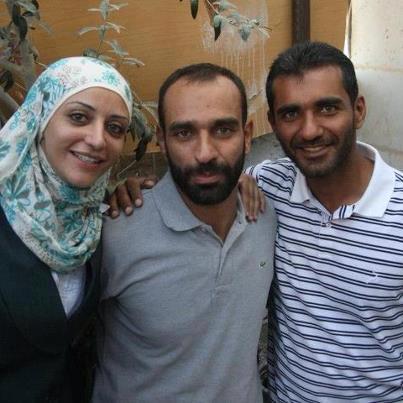
Shireen, Samer and Shadi Issawi
Palestine Information Center – 25/02/2013
RAMALLAH — The Israeli Magistrate Court in occupied Jerusalem extended on Sunday the remand of Shadi Issawi, the brother of hunger striker Samer Issawi, and did not allow him to see his lawyer.
Shireen Issawi, the sister of Shadi and a lawyer, said that the arrest of Shadi and extending his remand fell in line with pressures on Samer to end his seven months hunger strike.
She charged the Israeli occupation authorities (IOA) with targeting all members of Samer’s family, recalling that the IOA razed the home of her third brother Rafat at the start of the year and cut water supplies to her family home in addition to detaining her and her fourth brother Firas for a period of time.
Related articles
- Shireen Al-Issawi: PA did not take prisoners’ issue to the UN (alethonews.wordpress.com)
- Samer Issawi sentenced to 8 months in prison (alethonews.wordpress.com)
Minister: Autopsy shows torture killed Jaradat
Ma’an – 25/02/2013
BETHLEHEM – An autopsy has revealed that Arafat Jaradat died of extreme torture in Israeli custody and did not have a cardiac arrest, the PA Minister of Detainee Affairs said Sunday.
At a news conference in Ramallah, Issa Qaraqe said an autopsy conducted in Israel in the presence of Palestinian officials revealed that 30-year-old Jaradat had six broken bones in his neck, spine, arms and legs.
“The information we have received so far is shocking and painful. The evidence corroborates our suspicion that Mr. Jaradat died as a result of torture, especially since the autopsy clearly proved that the victim’s heart was healthy, which disproves the initial alleged account presented by occupation authorities that he died of a heart attack,” Qaraqe said.
A spokeswoman for Israel’s Prison Authority said Saturday that Jaradat had apparently died of cardiac arrest in Megiddo prison. An emergency service team had tried to resuscitate him but failed, she said.
Qaraqe described the claim as a fabrication and called for a committee to investigate those responsible for Jaradat’s death.
The minister said Jaradat had sustained injuries and severe bruising in the upper right back area and severe bruises of sharp circular shape in the right chest area.
The autopsy revealed evidence of severe torture and on the muscle of the upper left shoulder, parallel to the spine in the lower neck area, and evidence of severe torture under the skin and inside the muscle of the right side of the chest. His second and third ribs in the right side of the chest were broken, Qaraqe said, and he also had injuries in the middle of the muscle in the right hand.
Jaradat’s heart was in good condition and there were no signs of bruising or stroke, the minister added.
Israel’s Health Ministry said the injuries found in the autopsy could have been caused by the medical emergency team’s efforts to resuscitate Jaradat.
“These initial findings are not enough to determine the cause of death,” the Israeli ministry said, adding that further test results were not yet in. An Israeli police spokesman said the investigation into Jaradat’s death was still ongoing.
Qaraqe’s deputy, Ziyad Au Ain, urged any doctors, including Israeli doctors, who doubted that Jaradat was tortured to death to view his body in Al-Ahli Hospital in Hebron.
“Jaradat died due to torture and not a stroke or heart attack,” he said, adding that those responsible must be sued either through Interpol or the International Criminal Court.
Palestinian Prisoners Society president Qaddura Fares added that the autopsy revealed seven injuries to the inside of Jaradat’s lower lip, bruises on his face and blood on his nose.
After the autopsy, Jaradat’s body was transferred to the Palestinian Red Crescent at the Tarqumiya crossing west of Hebron, and taken to the Al-Ahli Hospital. He will be buried on Monday in his hometown Sair.
Jaradat’s lawyer Kameel Sabbagh said he was tortured by Israeli interrogators.
Sabbagh, who works for the prisoners ministry, was present at Jaradat’s last hearing on Thursday, which an Israeli judge postponed for 12 days.
“When I entered the courtroom I saw Jaradat sitting on a wooden chair in front of the judge. His back was hunched and he looked sick and fragile,” Sabbagh said in a statement Sunday.
“When I sat next to him he told me that he had serious pains in his back and other parts of his body because he was being beaten up and hanged for many long hours while he was being investigated
“When Jaradat heard that the judge postponed his hearing he seemed extremely afraid and asked me if he was going to spend the time left in the cell. I replied to him that he was still in the investigation period and this is possible and that as a lawyer I couldn’t do anything about his whereabouts at this time.”
Sabbagh said Jaradat’s psychological state was very serious and that he informed the judge his client had been tortured. The judge ordered that Jaradat should be examined by the prison doctor but “this didn’t happen,” the lawyer added.
On Sunday, thousands of Palestinians protested the death across the West Bank and Gaza, and at least two protesters were injured by live fire in clashes with Israeli forces, including the 13-year-old son of a Preventive Security officer.
Dozens more were injured by rubber-coated bullets.
An Israeli military spokeswoman said soldiers used riot dispersal means against Palestinians hurling rocks at security forces.
Featured Video
Prof. Ted Postol: Iran Already Achieved Nuclear Deterrence Against Israel
or go to
Aletho News Archives – Video-Images
From the Archives
How the occupied mentality syndrome works
Saudi Arabia on the American chessboard – Part 3
By B. J. Sabri | American Herald Tribune | June 27, 2016
Read part 2: “The occupied mentality Syndrome“
Previously I argued whether Saudi Arabia’s repeated involvements in U.S. interventions and wars stem from free national will or in response to a specific condition. For starters, in Saudi Arabia there is no national will. In Saudi Arabia, the national will is the will of the Al Saud clan. Still, when a major Arab state allies itself with a superpower that committed unspeakable crimes against humanity in almost every Arab country, then something is wrong. This fact alone should compel us to examine the U.S.-Saudi relation for one exceptional reason. As a result of the U.S.-Saudi wars, hundreds of thousands of people in Afghanistan, Iraq, Iran, Libya, Syria, Yemen, and Somalia have lost their lives. Millions became displaced in their own homelands. And millions more rendered refugees.
Attributing the Saudi policies to the bonds of “partnership” with the U.S. is frivolous. There are no bonds between these two thugs except those of business, military deals, secret plots, and wars. Proving this point, bonds such as these have no space for the American and Saudi peoples to share significant cultural or societal exchanges. If partnership is not the reason for the Saudi contribution to the U.S. strategy of empire and imperialism, then another reason must exist.
This leads to three possibilities. … continue
Blog Roll
 Aletho News
- REWRITING THE RISK? INSIDE THE GOVERNMENT’S VACCINE SAFETY MESSAGING
- “Davos Can Really Replace the UN”
- NIAID/NIH and USDA Fund Bioengineered Chimeric Influenza Viruses Built Using Pandemic H1N1 Components: Journal ‘Science Advances’
- Hezbollah hits Israeli warship off Lebanon’s coast, sets it aflame
- Iran slams US strikes on B1 bridge, Mahshahr petrochemical plants as ‘blatant acts of state terrorism’
- In letter to UN chief, Araghchi warns of dire consequences of US-Israeli attacks on Iran’s nuclear facilities
- Why the CIA conspiracy to invade Iran with Kurdish militias failed
- Why Are Upbeat US Claims About Mission to Rescue Pilot ‘Highly Questionable’?
- Aircraft destroyed during US ‘rescue’ of downed F-15 pilot cost more than $100 million each
- Washington University removes professor who condemned US-Israeli war on Iran
- If Americans Knew
- In Iran, Israel-US take aim at “reason, research, and freedom of thought” – Daily Update
- US loses planes over Iran, Israel downgrades Lebanon war goals – Daily Update
- Israel Is Blocking Palestinians from Easter at Church Where Jesus Resurrected
- Plot to assassinate Palestinian activist follows harassment campaign promoted by Zionist groups and elected officials
- Prominent New York synagogue hosts presentation on why U.S. Jews should support the ethnic cleansing of Gaza
- Tapper vs. Piker: Is the CNN Anchor Auditioning for David Ellison?
- Shouldn’t Democrats Be Able to Condemn Genocide?
- Israel-US kill negotiators, destroy civilian structures, but Iran’s military capabilities still largely intact – Daily Update
- ‘War crime’: Global condemnation as Israeli ministers celebrate death penalty law targeting Palestinian prisoners
- 7 Ways Israel Is Turning Lebanon Into Gaza
- No Tricks Zone
- An Inconvenient Tree: Uncovered In Alps… Europe Much Warmer Than Today 6000 Years Ago
- New Study Reports A 60% Slowdown In Greenland’s Ice Loss Rate In The Last Decade
- Low Intensity Tornado Wrecks Major Solar Farm, Creating A Potential Toxic Dump
- New Study Finds Warming Saves Lives…Cold Temperatures 12 Times More Deadly Than Excess Heat
- German Science Blog Accuses PIK Climate Institute Of Hallucinating Climate Tipping Points
- Devastating Assessment Of Comirnaty Vaccine By Former Senior Pfizer Europe Toxicologist
- New Study: CO2 Is ‘Effectively Negligible’ As An Explanatory Climate Change Factor Since 2000
- Former Pfizer Toxicologist Dr. Helmut Sterz Tells Bundestag Hearing Pfizer Vaccine Should Have Never Been Approved
- Energy Expert: Germany’s Nuclear Phaseout Was A “500 Billion Euro Mistake”
- New Research: South Australia’s Mid-Holocene Sea Surface Temperatures Were 4°C Warmer Than Today
 Aletho News