UN Secretary-General Ban Ki-moon has suggested the creation of a peacekeeping force in Mali that would include West African troops already operating in the country. He also said that a “parallel force” must be built to confront Islamist threats.
“Given the anticipated level and nature of the residual threat, there would be a fundamental requirement for a parallel force to operate in Mali alongside the UN mission in order to conduct major combat and counter-terrorism operations,” Ban wrote in his report on Mali.
Such a force could be built on the French troops already active in Mali, some diplomats say.
Once the African nations’ soldiers become a UN peacekeeping force, most of their troops and police would operate in northern Mali, while there would be a “light presence” based in the country’s capital, Bamako, Ban suggested.
“The force would operate under robust rules of engagement, with a mandate to use all necessary means to address threats to the implementation of its mandate, which would include protection of civilians,” he said.
The parallel force proposed by Ban Ki-moon would specifically target Islamist extremists, and could be based in Mali or elsewhere in West Africa. Diplomats expressed hope that the UN Security Council will vote on the peacekeeping proposal in mid-April.
France launched its military intervention in Mali in January to combat Islamist groups that had taken over the north of the country a year ago. The French army succeeded in driving the Islamists out Mali’s main northern cities and into desert and mountain hideouts. Still, Ban’s report said Mali suffered from a “crisis of governance” marked by “endemic corruption,” and a lack of state authority.
The 11,200 African troops converted into peacekeepers could only cover the main towns “assessed to be at highest risk,” Ban explained. The bulk of the contingent would come from a West African force known as AFISMA (African-led International Support Mission to Mali), comprised of armed forces from many African nations and already operational in Mali.
France said it would start withdrawing 4,000 of its troops in late April as part of a handover to the UN-backed African force. French President Francois Hollande has repeatedly vowed that the troops will remain in the region only until a legitimate government can take over.
The Mali intervention has cost France more than 100 million euros so far.
March 28, 2013
Posted by aletho |
Militarism | Africa, France, Mali, West Africa |
Leave a comment

Scottish anti-nukes campaigners are gearing up for a three-day showdown with the British government leading to the blockade of Faslane Naval Base, which is the Royal Navy’s Scottish headquarters and home of Britain’s Trident nuclear weapons.
The Scrap Trident campaigners have planned the blockade for April 15 that will follow two days of demonstration and anti-nukes workshops in the Scottish capital of Glasgow.
Scrap Trident is now calling for elimination of nuclear weapons in Scotland, Britain and around the world saying the social priorities in Britain should be “redefined” so that the huge cost of Trident goes into protecting the disabled in a “nuclear-free society”.
“Scotland and the UK have had nuclear weapons for 50 years. With spending on health, education, pensions and disability benefits being slashed, the government is replacing Trident at a cost of £100 Billion,” the campaign group said.
“We want Scotland and the world free of immoral nuclear weapons and call for Trident to be scrapped and human needs funded,” it added.
The Scrap Trident demonstration has been supported by 22 members of the Scottish Parliament.
The British government has announced annual welfare cuts of £18 billion until 2015 with a £10 billion-cutback also planned from 2017.
A research published in The Guardian on Wednesday revealed that British disabled people will lose an estimated £28 billion due to the welfare cuts by 2017-2018, with some people losing up to £23,000 each over five years.
March 28, 2013
Posted by aletho |
Militarism, Solidarity and Activism | Britain, Nuclear weapon, Royal Navy, Scotland, Scottish Parliament, Trident |
Leave a comment
Deutsche Bank is bracing for more than 300 million euros (256 million pounds) in charges linked to suspect violations of U.S. sanctions on Iran, a German weekly reported on Sunday.
Deutsche Bank, Europe’s biggest bank by assets, on Wednesday increased its provisions for litigation by 600 million euros to 2.4 billion euros, citing mortgage-related lawsuits and other regulatory investigations, Reuters reported.
Without specifying its sources, magazine Der Spiegel said the money set aside could be a sign U.S. investigations of possible Iran-linked transactions had reached an advanced stage.
Deutsche Bank on Wednesday declined to lay out in detail why it had increased provisions. On Sunday, it would not comment on the magazine report.
The U.S. government is cracking down on foreign banks it accuses of undermining its effort to throttle Iran’s economy. In the most prominent case, London-based Standard Chartered last year agreed to pay $667 million (437 million pounds) to settle charges it violated sanctions against Iran and other countries.
Other lenders in the crosshairs of U.S. investigators include Commerzbank , Unicredit division HVB, and HSBC in Britain.
Der Spiegel said that apart from the Iran probe, Deutsche Bank’s 2.4-billion-euro legal provisioning included 500 million for a probe of suspected manipulation of interbank lending rates.
Several sources familiar with the investigation told Reuters on Thursday that German markets watchdog Bafin is set to rebuke Deutsche Bank over how it supervised its contribution to the setting of the lending rates.
March 28, 2013
Posted by aletho |
Economics, War Crimes, Wars for Israel | Deutsche Bank, Iran, Sanctions against Iran, Standard Chartered, Unicredit |
Leave a comment
The government does not have the unchecked authority to place individuals on a secret blacklist without providing them any meaningful opportunity to object, the ACLU argued in a brief filed last Friday with the federal district court in Oregon.
We made the filing in Latif v. Holder, our lawsuit asserting that the government violated the Fifth Amendment due process rights of 13 Americans, including four military veterans, by placing them on the No Fly List and refusing to give them any after-the-fact explanation or a hearing at which they can clear their names.
Our brief highlighted the utter irrationality of the government’s No Fly List procedures. The plaintiffs in Latif all flew for years without any problems. But more than two years ago, they were suddenly branded as suspected terrorists based on secret evidence, publicly denied boarding on flights, and told by U.S. and airline officials that they were banned from flying perhaps forever. Each of them asked the government to remove them from the No Fly List through the only “redress” mechanism available—the Department of Homeland Security Traveler Redress Inquiry Program. But the government has refused to provide any explanation or basis for their inclusion in the list. Our clients have been stuck in limbo ever since.
We submitted evidence to the court showing that the No Fly List burdens our clients’ constitutionally protected liberties, with devastating consequences for their personal and professional lives. It deprives them of the ability to fly—an essential means of travel in modern life. It also stigmatizes them as suspected terrorists, although they have never been charged with any crime, let alone convicted of one.
Our brief argued that the Constitution’s core promise of procedural due process requires the government to provide at least some explanation and some hearing where Americans can defend themselves after it deprives them of their liberties. The government’s categorical refusal to provide either is unconstitutional. We explained:
Defendants’ refusal to provide the bare rudiments of due process stems from their embrace of an explicit policy—known as the “Glomar” policy—of refusing to confirm or deny any information concerning a person’s status on the No Fly List. The Glomar policy and Defendants’ inadequate process cannot be reconciled with governing due process doctrine. Courts routinely require notice and some form of hearing for much less severe deprivations of liberty than Plaintiffs have suffered. Thus, the government cannot suspend a student from school for ten days, or recover excess Social Security payments, or terminate state assistance for utility bills without some kind of notice and hearing.
In its own brief to the court defending its “redress” program, the government’s arguments boiled down to two sweeping—and extraordinary—claims. First, according to the government, the Constitution has nothing to say about the adequacy and fairness of the procedures the government provides Americans to challenge their inclusion on the No Fly List because “alternatives” to flying are available. We countered that argument in a separate brief (also filed on Friday) showing that the government relied on the wrong law, and by providing evidence confirming what is obvious: the No Fly List so severely restricts Americans’ ability to travel that it triggers due process rights. Not only does the list ban Americans from the skies, it even bars them from travel on boats. As a result, two of our clients have been effectively banned from traveling from the United States to be with their families in Ireland and Yemen.
The government’s second sweeping claim is that even confirming or denying No Fly List-status (much less actually providing notice of the reasons and basis for inclusion in the list) will cause a parade of national security horribles, including the disclosure of sensitive or classified information. Our brief, however, showed that this argument is based on a fiction: all of our clients already know they are on the No Fly list; they were each prevented from flying and explicitly told that they are on the list. We also pointed out that the mere possibility that sensitive national security information might be involved is no reason to categorically foreclose the hearings that due process requires.
Americans have a right to know what kind of “evidence” or innuendo is sufficient to land them on the No Fly List, and to have a hearing where they can defend themselves. Without this bare minimum, there is no meaningful check to correct the government’s mistakes or ensure that it uses the blacklisting power it claims fairly and appropriately. We are asking the court, therefore, to vindicate a basic yet fundamentally important proposition: a government black list that denies Americans the ability to fly without giving them an explanation or fair chance to clear their names violates the Constitution.
March 28, 2013
Posted by aletho |
Civil Liberties, Full Spectrum Dominance, Timeless or most popular | American Civil Liberties Union, Department of Homeland Security Traveler Redress Inquiry Program, Fifth Amendment to the United States Constitution, No Fly List, United States, United States Constitution, United States Department of Homeland Security |
Leave a comment
The comprehensive economic sanctions imposed on Iraq by the UN Security Council in the 1990s fundamentally changed the way we think about sanctions. Sanctions had been seen as a middle route, which was nonviolent, yet more robust than diplomacy. But in Iraq, the humanitarian impact was devastating: child mortality spiked, malnutrition was widespread, the middle class disappeared, and critical infrastructure, such as electricity and water treatment, declined precipitously and never recovered. As the humanitarian crisis continued, activists, practitioners and scholars questioned the ethical legitimacy of sanctions.
The response was the development of targeted “smart” sanctions, which would ostensibly harm only the political or military leadership of the targeted state, or block prohibited goods, without impacting the civilian population. Targeted sanctions included arms embargoes, asset freezes of individual persons and companies, visa denials, and targeted trade sanctions, such as conflict diamonds. There were still unilateral measures that were patently indiscriminate, most prominently the U.S. embargo against Cuba. But by the late 1990s, the Security Council was no longer imposing new measures that were comprehensive.
In the last couple of years we have seen a return to aggressive, deeply damaging measures that are designed to cripple the target nation’s economy as a whole, particularly in the case of Iran. The U.S. sanctions on Iran have been extreme, broadly prohibiting trade, shipping, banking transactions, and investment in Iran’s energy sector. In the last few years we’ve seen the U.S. expand these prohibitions, to restrict not only American companies, but foreign banks and companies as well. The U.S. has aggressively prosecuted major global financial institutions for violations of U.S. sanctions law, and in the last two years there have been a number of cases where banks paid penalties on the order of half a billion dollars each.
Unsurprisingly, the result has been a considerable chilling effect: it is now common to see companies refusing to engage in any transactions at all with Iranian nationals, even for clearly legal purposes. For example, a Swiss organization, the GAVI Alliance, provides vaccines to developing countries. The GAVI Alliance is not subject to U.S. law, but its efforts to provide medical goods to Cuba and Sudan are hampered by U.S. restrictions on shipping companies. Canada’s TD Bank summarily closed down the accounts of Iranians residing legally in Canada. In the U.S., there are growing reports that Iranian-Americans, who in principle are permitted to send remittances to family members in Iran, cannot find any bank in the U.S. or elsewhere that will transfer the funds.
No one could plausibly claim that the U.S. sanctions on Iran are “smart” sanctions. They have crippled Iran’s ability to export oil, to buy gasoline, to import goods of all kinds, to extract and refine oil and natural gas, and to manufacture pharmaceuticals. The irony is that the UN Security Council measures on Iran are perceived to be narrowly crafted to avoid exactly this outcome. The Security Council resolutions only require member states to address cargo, technology, or financial transactions that could contribute to Iran’s nuclear program or ballistic missiles. No one would think that such a specific mandate could have humanitarian consequences—how can depriving a country of nuclear weapons affect education and food security?
But the resolutions contain “hooks” that are then invoked by U.S. allies to impose measures that mirror those of the United States, in a kind of dance of mutual deniability. The Security Council resolutions invite nations to “exercise vigilance” in their dealings with Iran, specifically with Iran’s Central Bank, and with two of its leading banks, Bank Saderat and Bank Melli. It is hard to imagine a term that is more vague and less informative than “exercise vigilance.” After all, we exercise vigilance every time we cross a street or lock a door. But a number of U.S. allies, known as the “like-minded” countries—the European Union, Canada, Australia, Japan, and South Korea—have invoked the call to “vigilance” as justification for imposing broad, damaging measures on Iran, approaching the blanket nature and severity of the U.S. sanctions. Last year, the EU cut off gasoline sales to Iran, and blocked Iranian access to European ports and shipping lines. SWIFT, the global hub for financial messaging critical for international commercial transactions, cut off access to Iran last year.
This disconnect between a seemingly narrow mandate and its broad application is far from a coincidence; it is a deliberate strategy that affords the international community mutual deniability. The EU and the “like-minded” countries can claim that they are not acting unilaterally; they are just being vigilant, as the Security Council has asked them to. At the same time, the Security Council can maintain that it has not imposed unreasonable measures on Iran; its sanctions only concern nuclear weapons and are meant to minimize the humanitarian damage.
In the end, the result is not so different than what we saw in Iraq two decades ago. If you cripple a nation’s access to shipping, energy, and banking, that will cripple its ability to provide health care, food security, electricity, transportation, and other basic needs of its population. The dance of mutual deniability may mean that it’s harder to see how the sanctions work. But that doesn’t mean they’re doing any less harm.
March 28, 2013
Posted by aletho |
Deception, Timeless or most popular, War Crimes | European Union, GAVI Alliance, Human rights, Iran, Iraq, Sanctions against Iran, United States |
Leave a comment
Turkey has deported at least 600 Syrians staying at a refugee camp near the border after clashes with Turkish military police in a protest over living conditions, a Turkish official said on Thursday.
“These people were involved in yesterday’s violence, they were seen by the security cameras in the camp,” an official in the camp told Reuters by telephone. “Between 600 and 700 have been deported. The security forces are still looking at the footage, and if they see more they will deport them.”
Meanwhile, the UN refugee agency says a riot has broken out at a refugee camp for Syrians in Jordan after some of the refugees were told they could not return home.
Ali Bibi, a UNHCR liaison officer in Jordan, says it’s unclear how many refugees were involved in Thursday’s melee at the Zaatari camp. The riot broke out after some Syrians in the camp tried to board buses to go back to their country.
He says Jordanian authorities refused to let the buses head to the border because of ongoing clashes between the rebels and President Bashar Assad’s forces in southern Syria, just across the border from Jordan.
Bibi says there were no immediate reports of injuries.
He says Jordanian authorities promised to organize the refugees’ return home at another time.
Over 70,000 people have been killed during Syria’s two year old uprising.
(Reuters, AP, Al-Akhbar)
March 28, 2013
Posted by aletho |
Aletho News | al-Akhbar, Jordan, Syria, Turkey |
Leave a comment
(Unfree in Palestine. Registration, Documentation and Movement Restriction by Nadia Abu-Zahra and Adah Kay, Pluto Press, London 2013, pp. 232, L 17.99.)
The latest visit by U.S. President Barack Hussein Obama to Israel has demonstrated to the world on which side the Empire stands. Obama promised an occupying power absolute support and eternal loyalty. Behind this background, the reader of “Unfree in Palestine” is befallen from a kind of bitterness when hearing Obama’s unrestricted support for a heinous form of total control of a whole population under occupation. A slap in the face for the Palestinians and for some critical Israeli intellectuals was Obama’s sentence that he admires Israel’s “core values”! Perhaps he did not know what he was talking about. Israel betrays all the “core values” the U. S. American civil rights movement was fighting for, not to speak of many laws that discriminate against non-Jews in Israel.
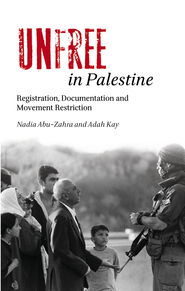 The authors, Nadia Abu-Zahra, Assistant Professor of Globalization and Development at the University of Ottawa, and Adah Kay, Honorary Visiting Professor at Cass Business School, City University of London, describe the role played by identity documents in Israel’s policies towards the Palestinians, from the red passes of the 1950s to the orange, green and blue passes of today. They show how millions of Palestinians have been denationalized through the bureaucratic tools of census, population registration and a highly discriminatory pseudo-legal framework. They show how identity documents are used by Israel as a means of coercion, extortion, humiliation and informant recruitment.
In the book the authors provide a review of identity documentation and movement restrictions in Palestine from the 1800s till today. They focus on population and how it is divided and affected using bureaucratic instruments. In the introduction chapter terms such as “population registration”, “identity documentation”, and “movement restriction” are defined and explained by examples from other countries in order to demonstrate the power that such tools can have on denationalization, discrimination, displacement, dispossession, coercion, collaboration, and death.
The main part of the book deals with the history of the census, the population registry, denationalization, blacklists, coercion, collaboration and how movement restrictions of millions of Palestinians became possible. The authors exemplify on the health and education sectors, how the above mentioned policies affect the social life of the people. Both sectors are undermined through restricted access for patients, students and teachers. Despite all odds, the Palestinians resist inducements to leave their homeland.
Although international law declared denationalization illegal, the international community did not care about the forced displacement of Palestinians. Their “right of return” has been ignored by Israel, despite the fact that the United Nations has called for it since 1948, and it was a requirement for Israel’s entry into the UN. On the basis of denationalization, the Israeli occupier has striped the Palestinians of any personal security. Israel has been issuing over one hundred permits so far that curb the movement of the people in the occupied territories and abroad. Permits and identity cards can be revoked arbitrarily. Acquiring an ID card or granting permits became a bargaining chip for the Israeli authorities to recruit informants and collaborators among the Palestinians.
The book gives an excellent overview of a military and bureaucratic Kafkaesque system of control used by Israel to deprive the Palestinians of their rights and freedoms. Perhaps Obama meant, inter alia, these “core values” the U. S. shares with the Israeli occupying regime. The Palestinian people want their rights and not charity from the international community. Despite having made the lives of the Palestinians unbearable, the people resisted and stayed to the chagrin of the Israeli colonizers. The great value of this book is that the authors have brought light into the fate of 1.4 million denationalized Palestinians.
– Dr. Ludwig Watzal works as a journalist and editor in Bonn, Germany. He runs the bilingual bog “Between the lines”: http://between-the-lines-ludwig-watzal.blogspot.com
March 28, 2013
Posted by aletho |
Book Review, Ethnic Cleansing, Racism, Zionism, Progressive Hypocrite | Human rights, Israel, Palestine, Zionism |
Leave a comment
Ankara – In the ugly panorama that is the contemporary Middle East a light hardly flickers on the horizon. Iraq has been destroyed as a unitary Arab state and jihadis unleashed in Syria are burning out another room in the Arab house. Lebanon has again been brought to the brink of implosion through the intrigues of outside governments and local proxies incapable of putting the interests of their country ahead of their sectarian and power intrigues. The Palestinians are divided between those who live under the authority of one man who has bound himself to Israel and the US and two others who have bound themselves to Egypt and Qatar. Fitna – the spreading of division and sowing of hatred amongst Muslims – is being fanned across the region by governments brazen enough to call themselves Muslim. Whether in Iraq, Lebanon, Syria and Iran, Shiism is the enemy. Ceaselessly stirring this pot from the outside are governments that feast on division in the Arab world.
There are those who loathe Bashar so much that they are willing to commit or tolerate any crime in the name of getting rid of him, including the deliberate bombings of civilians, one taking the lives of a leading Sunni Muslim scholar and 48 other worshippers in a Damascus mosque only recently and another killing 100 people, amongst them children waiting for their school bus. A country Gamal abd al Nasir once described as the ‘beating heart of Arabism’ is being destroyed. Its enemies have their hands inside the body and they intend to rip the heart out. The cooperative at work on this venture includes the US, Britain, France, Saudi Arabia, Qatar, Turkey and the local and foreign-born jihadis who are their tools whether they realize it or not.
That the Syrian system needs changing goes without saying. In Syria possibly no-one understands this better than the much reviled Bashar al Assad. He could go tomorrow but that would solve nothing because the system would stay the same; for those who hate him, someone worse might take his place. Bashar has made serious mistakes, including the adoption of free market policies which have enriched the merchant class while further impoverishing the peasantry, who are now said to be many of the foot soldiers of the armed groups, but Syria is an easier place than it was under his father. The abolition of the Baath as the central pillar of state and society and the multi-party elections held last year were a start to political reforms. The elections were not perfect but if anyone is looking for perfection in the Middle East, they should look somewhere else. These are threads that could have been teased out if the collective calling itself ‘The Friends of the Syrian People’ had any serious interest in the best interests of the Syrian people. A process of national dialogue has begun in Damascus but this has been ignored, too, because these ‘friends’ want nothing less than the destruction of a government which is a strategic ally of Iran and Hezbollah and forms with them the ‘resistance axis’ to US-Israeli hegemony.
The achievements of this axis need to be set against the record of collaboration of those Arab governments who are now bent on destroying it. Iran and Syria have been solid in their support for the Palestinians, hosting resistance movements and working together to provide Hamas with the weapons it needed to defend Gaza. No weapons came from the direction of Saudi Arabia or Qatar. It was Hezbollah, the non-state partner in this alliance, that finally drove Israel from occupied southern Lebanon after nearly two decades of struggle involving not just the bravery of part-time soldiers but the mastery of electronic warfare, enabling Hezbollah to penetrate Israeli communications, including drone surveillance, as was made clear when Hasan Nasrallah produced intercepted film showing that an Israeli drone had been shadowing Rafiq Hariri for three months and was overhead when he was assassinated in February, 2005. When Israel tried to take revenge in 2006 it was humiliated. Hezbollah stood firm, destroyed its supposedly invincible Merkava tanks, disabled one of its warships in a missile attack and prevented its ground forces from advancing north of the Litani river. At the time, it might be remembered, both Egypt and Saudi Arabia vilified Hasan Nasrallah for bringing on this war, as they saw it.
It was Hezbollah which scored another triumph by breaking Israel’s spy network in Lebanon, now in the public eye because of the revelations that an Australian-born Mossad agent, Ben Zygier, had provided it with the names of two of its agents. The official Israeli version of the Zygier affair is that he handed over this information with the ultimate intention of setting up the assassination of Hasan Nasrallah. However, as the case is regarded as one of the most serious threats to national security in Israel’s history, much more might be involved than the collapse of a spy network. It is hard to imagine any agent who was not in fact a double agent doing what Zygier is reported to have done. What other information he might have passed on is a matter of conjecture but Israel’s nervousness about this affair could be a sign that far darker secrets are involved than the exposure of two spies.
Both Iran and Syria have been targeted with economic sanctions because of their disobedience. Iran has been threatened with military attack ever since the invasion of Iraq in 2003 and now that the attempt to destroy the government in Damascus through armed proxies has clearly failed, if more than two years of trying qualifies as failure, the US is sending out signals that it is prepared to intervene directly despite the regional and global risks. The collapse of the Syrian National Council last year has now been followed by the disintegration of the Syrian National Coalition, with ‘president’ Mu’adh al Khatib resigning and the chief of its military wing refusing to recognize the authority of new ‘prime minister’ Ghassan al Hitto. Riad al Assad, the displaced former commander of the self-styled Free Syrian Army, has just been carried back across the border into Turkey with only one leg, the other having been blown off by a roadside car bomb. Some sources say it was only a foot but either way he is out of action for a long time to come. As the leading armed groups do not recognize the authority of Mr Assad or the squabbling coalition of which the FSA is supposed to be the military arm, his absence from the scene is not going to make a great deal of difference.
For Muadh al Khatib to be given the Syria seat at the recent summit of the Arab League in Doha is farcical in more than one respect. Al Khatib is no longer even a member of the group Qatar is trying to set up as an alternative government. The group itself is in a state of complete collapse, with al Khatib walking out and other members rejecting the appointment of Hitto, a Syrian-born American who has not visited the country of his birth for decades. That Al Khatib should demand that his ragged, motley crew be given Syria’s seat at the UN goes beyond preposterous. The government of Syria sits in Damascus, not Doha, and Bashar al Assad is still its president, not the former imam of the Umayyad mosque. Compounding this theatre of the absurd, it was the ruler of Qatar who directed that Al Khatib be given the Syrian seat at the Doha summit, underlining the degree to which the Arab League has become no more than an instrument of this gentleman’s drive for regional dominance. That King Abdullah should have stayed away from Doha is a sign of the deepening rivalry between Qatar and Saudi Arabia, especially over how to manage Syria. The determination of the ruler of Qatar to persevere with this chaotic bunch of exiles is the measure of his determination to destroy the government in Damascus.
On the ground the armed groups are taking a beating at the hands of the Syrian army but like an irresponsible trainer sending a punched-out boxer out from his corner for the next round, their outside sponsors are pouring arms into Syria to keep them on their feet. The tactics of these groups include bombings aimed at civilians that in other circumstances their backers would not hesitate to call terrorism but steadfastly refused to call terrorism when Syrians are the victims and their proxies are the perpetrators. Al Khatib’s dissatisfaction with his ramshackle coalition was possibly brought to a head by the assassination in Damascus of Sheikh Muhammad Said Ramadan al Bouti, a former colleague and a man he greatly admired. Al Bouti and close to 50 other worshippers were murdered in the Iman mosque by a suicide bomber. Two days earlier an armed group had loaded CL 17 chlorine – an ingredient normally used in swimming pool cleaner – into the warhead of a small missile and fired it at a Syrian army checkpoint, killing 26 people. Soldiers were among the dead and the army was there to look after the survivors, so the claims of activists that ‘the regime’ was responsible had even less traction than usual. Having warned of direct intervention in Syria should chemical weapons be used, the US had little to say now that such a weapon had been used, not by the Syrian army, but by the ‘rebels’ it has been supporting.
Hezbollah, Syria and Iran’s record of resistance has to be compared with the long Saudi and Qatari record of collaboration with the US and Israel. Having deserted Damascus in its hour of need, what does Khalid Mishaal think he is going to get from the ruler of Qatar besides money and somewhere to stay? What is Ismail Haniyeh expecting from Muhammad Morsi, who began his presidency by blocking off the tunnels into Gaza and confirmed where he intends to take Egypt with his letter calling Shimon Peres ‘my dear friend’? Is it forgotten already, apart from his record in violence and destruction going back to 1948, that it was Peres who authorized the attack on southern Lebanon in 1996 which took the lives of more than 100 people sheltering inside the UN compound in Qana? If the friend of my enemy is my enemy, where does that leave Haniyeh, Misha’al and Abbas?
The beneficiaries of intervention in Iraq, Libya and Syria are outside and regional governments who have combined forces to reshape the Middle East in their own interests. As Ibrahim al Amin has remarked (‘Partitioning Syria at the Doha summit’, Al Akhbar English, March 25, 2013), they are fighting a global war against Syria in the name of bringing the people freedom and justice. In truth, western governments only intervene in their own interests and the people always end up being sliced and diced on the chopping board of their grand designs. There has been no exception to this rule. Civilization, liberation, freedom, democracy, the rights of the people and the responsibility to protect are the unctuous phrases that have rolled off the lips of western prime ministers, foreign ministers and presidents for two centuries. This is the rhetorical buildup to a self-assigned ‘duty’ to intervene: the only real difference between intervention in the 19th century and intervention in the 21st lies in the vastly increased killing power of western governments and the development of weapons that would have been regarded as science fiction until only recently.
As they always get away with it, there is no reason for them to stop. Iraq was a terrible crime but while the UN Security Council or the International Criminal Court points the finger at Robert Mugabe, Umar al Bashir or Saif al Islam al Gaddafi it never points the finger at western politicians whose crimes are infinitely greater. Slobodan Milosevic was a rare exception but even his crimes do not measure up to what George Bush and Tony Blair authorized in Iraq in and after 2003 – not to speak of the horrors that Bush senior, Clinton and Blair authorized through the decade of sanctions which followed the attack of 1991. Because they are protected by a world system which is highly selective about who it punishes, the politicians who follow them feel free to repeat the experience. They know that whoever suffers, whoever is bombed, whoever has to look at the faces of dead parents, children, aunts, grandfathers and neighbors being dug out of the rubble of bombed cities and towns, it is not going to be them. William Hague is perfectly comfortable in his desire to give more weapons to the ‘rebels’ because he knows that the calamitous consequences of decisions he takes are never going to bounce back on his own doorstep.
It is obvious but needs to be said anyway that the first priority of people across the Middle East should be solidarity rising above ethnic and religious divisions. No problem can be solved without it and certainly not the core issue of Palestine. In his recent Edward Said memorial lecture, Noam Chomsky drew attention to what is going on while the world’s attention is diverted by the ‘Arab spring.’ In 1967 the Jordan Valley had a Palestinian population of 300, 000. The policy of ‘purification’ pursued by the Israeli government has now reduced that population to 60,000. On a smaller scale the same policy has had the same results in Hebron and elsewhere in the occupied territories. There is nothing accidental or incidental about this. Netanyahu is no more than faithful to the racist policies set in motion by Theodor Herzl and David Ben-Gurion. Continuing without letup for 65 years these policies are neither forgettable nor forgivable.
It is not surprising that Israel’s strongest supporters always have been similar colonial settler states. There are no exact parallels but the Zionist settlers in Palestine and the American colonists both turned on the mother state while setting out to crush the native people. Thomas Paine had much to say about the American ‘war of independence’ that is relevant to Palestine. First of all, it was an ‘independence war’ being fought on land long since inhabited by another people. The colonists wanted to be independent of the mother country, which planted them in this foreign soil in the expectation that they would maintain it as part of the king’s domains. A loyal colony was what the British also sought in Palestine but the American settlers and later the Zionists had other ideas. The war between Britain and the American colonists was brutal, generating deep hatreds on both sides, just as the Zionist war against the British did in Palestine.
Paine was writing of settler feelings towards the savagery of the mother country but the words equally apply to the people who were the victims of double colonialism in North America or, nearly two centuries later, in Palestine:
‘Men of passive tempers look somewhat lightly over the offences of Great Britain and still hoping for the best are still apt to call out come, come, we shall be friends against for all this. But examine the passions and feelings of mankind; bring the doctrine of reconciliation to the touchstone of nature and then tell me whether you can hereafter love, honor and faithfully serve the power that hath carried fire and sword into your land. If you cannot do all these then you are only deceiving yourself, and by your delay bringing ruin upon posterity. Your future connections with Britain, whom you can neither love nor honor, will be forced and unnatural and being formed only on the plan of present convenience, will in a little time fall into a relapse more wretched than the first. But if you say you can still pass the violations over, then I ask hath your house been burnt? Hath your property been destroyed before your face? Are your wife and children destitute of a bed to lie on or bread to live on? Have you lost a parent or child by their hands and yourself the ruined and wretched survivor? If you have not, then you are not a judge of those who have. But if you have and can still shake hands with the murderers, then are you unworthy the name of husband, father, friend or lover; and whatever may be your rank or title in life you have the heart of a coward and the spirit of a sycophant.’
Paine was a democrat within the limitations of his time. He was writing for the settlers and had no thought of admitting the indigenous people of North America to representation in the colonies. Except for the passage of almost 250 years Paine might be a Zionist today, but the two and a half centuries make all the difference. Israel was an anomaly from the beginning, a colonial state arising at the tail end of colonialism. It would be no more possible to imagine Thomas Paine supporting an America in which native and Afro-Americans did not have the vote now than it would be to imagine him supporting a situation where a people not only did not have the right to vote but had been denied the right to live on the land where they or their forebears had been born.
In today’s world Paine could not support an Israel built on blatantly racist and discriminatory lines. Everything he says in the passage quoted above applies to Israel. The wounds it has inflicted have gone deep and far from making any attempt to heal them Israel has endlessly inflicted new wounds. The state of Israel – to be differentiated from those pockets of its citizens who oppose its brutal mindset – is not interested in any kind of genuine settlement with the Palestinians. It is not interested in them as a people. It is not interested in their stories of suffering. It is not interested in its own guilt because it is blind to its own guilt. It has no humility and would scoff at the idea of penance for crimes it refuses to admit it has committed, like the worst recidivist offender hauled before a court. It is interested in the Palestinians only as a problem to be solved and the solution is for them somehow to disappear or to be made to disappear. Hence the ‘purification’ in the Jordan Valley and the daylight oppression of the Palestinians in Hebron and the racist demographic war being waged in East Jerusalem. These are crimes against humanity.
If we substitute Israel and the Oslo process for the reconciliation proffered by the British monarch the result is the same: the policy, wrote Thomas Paine, is there ‘in order that he may accomplish by craft and subtlety in the long run what he cannot do by force and violence in the short one’. His conclusion that ‘reconciliation and ruin are nearly related’ sums up the consequences for the Palestinians of the Venus fly trap known as the ‘peace process.’ Violence works but ‘peace’ has a deadly potency of its own: whatever the means employed, the Zionist aim of reducing the Palestinians to dust that will eventually be whirled away by history has not changed in 100 years.
By themselves, however bravely they have resisted, the Palestinians have never had the power to fend off the forces arrayed against them. This has been true from the time Britain implanted the Zionist project in Palestine until the present day. Britain and the US were not just any countries but the two most powerful states of their time and with their support both Zionist success and Palestinian failure were assured. Never have the Palestinians been able to draw on anything like such sources of strength despite the immense potential in their own backyard. Israel’s dominance as a regional power is still sustained by the US while being continually replenished by Arab weakness: Arab weakness is built on chronic Arab disunity, now being promoted in sectarian form by Saudi Arabia and Qatar. As long as there is no way out of this trap the Palestinians will remain stuck in their trap.
Sectarianism is a powerful weapon but would be useless if people were not susceptible to it. A people divided are doomed to be dominated. George Antonius prefaced The Arab Awakening with a quote from Ibrahim Yaziji: ‘Arise Arabs and awake!’ That was in 1938. An Arab awakening did follow and while it would be tempting to say the Arab world has gone back to sleep, in reality what is happening is far worse than sleep. A fire is raging and it is hard to see how and when it will be put out.
– Jeremy Salt is an associate professor of Middle Eastern history and politics at Bilkent University in Ankara, Turkey.
March 28, 2013
Posted by aletho |
Ethnic Cleansing, Racism, Zionism, Timeless or most popular, Wars for Israel | Arab League, Bashar al-Assad, Hezbollah, Iran, Iraq, Lebanon, Middle East, Qatar, Saudi Arabia, Syria, United States, Zionism |
Leave a comment
An Employment Tribunal has found in favour of UCU on all ten complaints of harassment brought by a UCU member who opposed the union’s policy on Palestine.
The claimant had been supported in his claim by leading lawyer Anthony Julius. In giving their reasoning the Tribunal stated that ‘the proceedings are dismissed in their totality’ and ‘we greatly regret that the case was ever brought. At heart it represents an impermissible attempt to achieve a political end by litigious means.’
The Tribunal also described themselves as troubled by the implications of the claim, stating that ‘underlying it we sense a worrying disregard for pluralism, tolerance and freedom of expression, principles which the courts and tribunals are, and must be, vigilant to protect’.
While witnesses for UCU were described in the tribunal’s decision as ‘careful and accurate’, some witnesses for the claimant were described as appearing to ‘misunderstand the nature of the proceedings and more disposed to score points or play to the gallery rather than providing straightforward answers to the clear questions put to them’.
John Mann MP and former MP Denis MacShane were collectively described as giving ‘glib evidence, while testimony of another key witness for the claimant was described as ‘extraordinarily arrogant but also disturbing’.
UCU general secretary Sally Hunt said:
“I am delighted that the Tribunal has made such a clear and overwhelming judgement in UCU’s favour. There are many different views within UCU and wider society about Israel and Palestine and this decision upholds our and others’ right to freedom of expression and to continue to properly debate these and other difficult questions.” … Full statement
~~~
Citing the tribunal’s judgement:
“It seems to us that a belief in the Zionist project or an attachment to Israel or any similar sentiment cannot amount to a protected characteristic. It is not intrinsically a part of Jewishness and, even if it was, it could not be substituted for the pleaded characteristics, which are race and religion or belief.” (p. 37)
March 27, 2013
Posted by aletho |
Civil Liberties, Timeless or most popular | Anthony Julius, Denis MacShane, Employment Tribunal, Palestine, Sally Hunt, UCU, University and College Union, Zionism |
Leave a comment
UN Secretary General Ban Ki-moon has chosen Swedish scientist Ake Sellstrom to lead a UN investigation into the use of chemical weapons in Syria.
“He is an accomplished scientist with a solid background in disarmament and international security,” UN spokesman Martin Nesirky announced on Tuesday.
The fact-finding team was set up at the request of the Syrian government after insurgents in Syria were accused of using chemical weapons against civilians near the northern city of Aleppo where dozens of people have been killed and nearly 140 more injured.
It was not immediately clear who else would be on Sellstrom’s team. Russia said on Monday that Russian and Chinese experts should be part of the investigation, but Moscow’s U.N. Ambassador Vitaly Churkin said on Tuesday that Russia would “most likely not” be represented.
Sellstrom was a chief inspector for UNSCOM, the U.N. inspection team that investigated and dismantled Iraq’s biological and chemical weapons programs in the 1990s, reports said.
Sellstrom also worked with UNMOVIC, the U.N. group that returned to Iraq in 2002 and found no solid evidence that Baghdad had revived its weapons-of-mass-destruction programs before the 2003 U.S.-led invasion as Washington and London alleged at the time.
March 27, 2013
Posted by aletho |
War Crimes | Aleppo, Syria, United Nations Special Commission |
Leave a comment
The British oil giant, British Petroleum (BP), may be forced to close down the Bruce natural gas field in the UK North Sea ahead of schedule as a result of the sanctions imposed against Iran.
Dow Jones reported on Tuesday that without gas from the adjoining Rhum field, of which the National Iranian Oil Company is a joint owner, BP might have to close down the Bruce field.
The British oil company halted operations at Rhum field in November 2010 after the West imposed illegal sanctions against Iran’s energy sector.
“The long-term future of the Bruce facilities is very closely tied to the ability to produce from Rhum. Given the uncertainties, we are considering what a decommissioning project would entail and how long it would take to execute,” a BP spokesman was quoted as saying.
Closing down the Bruce field would undermine the UK government’s attempts to strengthen its energy sector, which has been experiencing inflation due to “cold weather, and unexpected production and pipeline outages.”
Since the UN Security Council’s fourth round of sanctions against Iran in June 2010, the United States and its European allies have also separately imposed unilateral illegal sanctions against the Islamic Republic’s energy sector.
At the beginning of 2012, the United States and the European Union imposed new illegal sanctions on Iran’s oil and financial sectors with the goal of preventing other countries from purchasing Iranian oil and conducting transactions with the Central Bank of Iran. The sanctions came into force in early summer 2012.
The illegal US-engineered sanctions have been imposed based on the unfounded accusation that Iran is pursuing non-civilian objectives in its nuclear energy program.
Iran rejects the allegation, arguing that as a committed signatory to the Treaty on the Non-Proliferation of Nuclear Weapons (NPT) and a member of the International Atomic Energy Agency (IAEA), it has the right to use nuclear technology for peaceful purposes.
March 27, 2013
Posted by aletho |
Economics, Wars for Israel | Iran, Sanctions against Iran |
Leave a comment
At the precise moment US President Barack Obama’s Air Force One touched down at Ben Gurion Airport on March 20, persisting illusions quickly began to shatter. And as he walked on the red carpet, showered with accolades and warm embraces of top Israeli government and military officials, a new/old reality began to sink in: Obama was no different than his predecessors. He never had been.
On the day of Obama’s arrival, Israeli rights group B’Tselem, released a disturbing video. It was of Israeli soldiers carrying out a ‘mass arrest’ of nearly 30 Palestinian children on their way to school in the Palestinian city of al-Khalil (Hebron). The children plead and cried to no avail. Their terrified shrieks echoed throughout the Palestinian neighborhood as they tried to summon the help of passersby. “‘Amo’ – Uncle,” one begged, “for God sake don’t let them take me.” Nonetheless, several military vehicles were filled with crying children and their school bags. But what made the release of the video truly apt is the fact that it was released on the day president Obama was meeting Israeli children at a welcoming ceremony at the home of Israeli President Shimon Peres.
“Their dreams are much the same as children everywhere,” he said, referring to Israeli children, of course. “In another sense though their lives reflect the difficult reality that Israelis face every single day. They want to be safe, they want to be free from rockets that hit their homes or their schools.”
Many Palestinians immediately pointed out the moral discrepancies in most of Obama’s statements throughout his stay in Israel. Still, his visit was ‘historic’ declared numerous headlines in the US and Israeli media.
However, aside from the fact that it was his first trip to Israel as a president, it was barely momentous. His unconditional support for Israel has been tedious and redundant, predictable even. Those who have followed his unswerving pro-Israel legacy – including his visit to Israel as a presidential candidate in 2008, his talks before the Israeli lobby group AIPAC and many other examples – could barely discern a shift, except perhaps, in the total disinterest in political sensibility and balance.
He truly delivered in Israel. This was to the total satisfaction of the Israeli Prime Minister and his pro-settler government which was assembled shortly before Obama’s arrival. Obama spoke as if he were entirely oblivious to the political shift to the extreme right underway in Israel. Indeed, the new Israeli government is more right-wing than ever before. The extremist Jewish Home party has three important ministries, including Jerusalem and Housing and the ultra-nationalists of Yisraeli Beiteinu have been awarded the tourism ministry. It means that the next few years will be a settlement construction bonanza, ‘ethnic cleaning’ and greater Apartheid.
“It’s good to be back in The Land (Israel),” Obama said in Hebrew, at the Tel Aviv airport. “The United States is proud to stand with you as your strongest ally and your greatest friend.”
It is believed that for four years, Obama has failed to live up to the nearly impossible expectations of Israel. Israel requires a president with good oratory skills – for example, to emphasize the ‘eternal’ bond between his country and Israel, as Obama did – who is able to sign big checks and ask few questions. Obama has of course done that and more. Aside from the 3.1 billion dollars in financial support, he has rerouted hundreds of millions of US funds to bankroll Israel’s air defense system, the Iron Dome, whose efficiency is questionable at best.
Obama’s past transgression, as far as Israel is concerned, is that he dared ask the right-wing government of Netanyahu to temporarily freeze settlement construction as a pre-condition to restart the stalled – if not dead – peace process. Of course, there is the widely reported matter of Obama’s lack of fondness of Netanyahu, his antics and renowned arrogance. But that matters little, since Israel’s illegal settlements continued to thrive during Obama’s first term in office.
Expectedly, Netanyahu was gloating. He has managed to assemble a government that will cater mostly to extremist Jewish settlers in the West Bank and also masterfully managed to humble the US president, or at least quash his ambitions that the US is capable of operating independently in the Middle East, without Israeli consent or interests in mind.
Now that Jewish colonies are flourishing – with occupied East Jerusalem area EI being another major exploit – Netanyahu is once more aspiring for a war against Iran, one that would not be possible without US funding, support and likely direct involvement. “Thank you for standing by Israel at this time of historic change in the Middle East,” Netanyahu said while standing near the mostly US-funded Iron Dome. “Thank you for unequivocally affirming Israel’s sovereign right to defend itself, by itself against any threat.”
Obama did in fact spare a few, although, spurious thoughts for Palestinians. “Put yourself in their shoes — look at the world through their eyes,” he said to an Israeli audience. “It is not fair that a Palestinian child cannot grow up in a state of her own, and lives with the presence of a foreign army that controls the movements of her parents every single day.”
One would even applaud the seeming moral fortitude if it were not for the pesky matter that the US had voted against a Palestinian state at the United Nations last November and tried to intimidate those who did. And of course, much of the horror that Palestinian ‘eyes’ have seen throughout the years was funded and defended by US money and action. If Obama is trying to resurrect the myth that the US is a well-intentioned bystander or an ‘honest broker’ in some distant conflict, then he has utterly failed. His country is fully embroiled in the conflict, and directly so. Many Palestinian children would still be alive today if the US government had conditioned its massive support of Israel on ending the occupation and ceasing the brutality against Palestinians.
In a joint press conference in Ramallah, alongside Palestinian Authority President Mahmoud Abbas, Obama even demanded Palestinians drop their condition (proposed by Obama himself) of a settlement freeze in order to return to the so-called peace talks. “That’s not to say settlements aren’t important, that’s to say if we resolve the (main) problems, then settlements will be resolved,” he said. “If to begin the conversation we have to get everything right from the outset … then we’re never going to get to the broader issue,” Obama added. The broader issue, according to the US president is “how do you structure a state of Palestine,” which again, Obama voted against last year, and passionately so.
Aside from resounding rhetoric about peace, Obama is finally towing the Israeli line exactly as Netanyahu and the lobby would expect of him, or of any other US president. He has little to offer Palestinians, or Arab nations, but much to expect from them. Arab states must seek normalized relations with Israel, and Palestinians must “recognize that Israel will be a Jewish state, and that Israelis have the right to insist upon their security,” he lectured in Jerusalem on the second day of his trip, reported CNN online. The obvious danger here lies in the fact that Israel oftentimes conflates ‘security’ and its ‘right to defend itself’ by mass arresting children on their way to school in Hebron, or by inflicting or supporting wars against other nations – Lebanon, Iraq and now Iran.
Obama will eventually get back to his Oval Office desk, ready to resume work as usual. This will include the signing of many papers concerning additional funds, loans, military technology transfers and much more for Israel. Palestinians meanwhile will carry on with their long fight for freedom, without his noted oratory skills.
Meanwhile, the families of the 30 children kidnapped by the Israeli army in Hebron will have many days ahead of them in Israeli military court. But that, of course, is a different matter, of no concern to Obama and his many quotable peace antics.
– Ramzy Baroud (www.ramzybaroud.net) is an internationally-syndicated columnist and the editor of PalestineChronicle.com. His latest book is: My Father was A Freedom Fighter: Gaza’s Untold Story.
- Obama Gives Up on Peace (nationalinterest.org)
March 27, 2013
Posted by aletho |
Ethnic Cleansing, Racism, Zionism, Illegal Occupation, Progressive Hypocrite, Subjugation - Torture, Wars for Israel | Israel, Israeli settlement, Middle East, Obama, Palestine, Zionism |
Leave a comment

 The authors, Nadia Abu-Zahra, Assistant Professor of Globalization and Development at the University of Ottawa, and Adah Kay, Honorary Visiting Professor at Cass Business School, City University of London, describe the role played by identity documents in Israel’s policies towards the Palestinians, from the red passes of the 1950s to the orange, green and blue passes of today. They show how millions of Palestinians have been denationalized through the bureaucratic tools of census, population registration and a highly discriminatory pseudo-legal framework. They show how identity documents are used by Israel as a means of coercion, extortion, humiliation and informant recruitment.
 Aletho News
 Aletho News