US to Up Military Aid to Israel to $4 Billion
By Richard Edmondson | War and Politics | March 24, 2013
We are now beginning to get the fallout—that is to say, we are beginning to discover what Obama’s recent trip to Israel has cost America. Yesterday I put up a post entitled American Taxpayers to Take it on the Chin in Gaza Flotilla ‘Apology’ in which I discussed an apparent agreement reached between Obama and Netanyahu for the latter to issue an apology to Turkey over the killing of nine people aboard the Turkish vessel the Mavi Marmara in 2010. I openly suggested that in order to wrangle such an apology, some sort of backroom deal must have been worked out that would cost US taxpayers. What I speculated was that the money Israel is to pay into a victims compensation fund would in reality be supplied by America. But it seems we may be footing an even much larger bill than that.
The following was published today at the website DefenseNews.com. The story makes clear that Obama has “doubled down on U.S. security support” for Israel” and also informs us he intends taking steps to ensure there will be “no interruption” in US aid to Israel’s missile defense system, this in spite of the fact that we are facing sequestration-mandated budget cuts. In fact, it appears US assistance to the Jewish state is headed upwards—from the present level of $3.1 billion a year up to $4 billion.
Alert readers will recall, of course, that at the AIPAC policy conference, held just a few weeks ago, a top priority was pushing for aid to Israel to be exempted from sequestration. This is discussed here in an article by blogger MJ Rosenberg, and I also discussed it in a post here. In my own article I supplied a link, here, to a site listing Congress members accepting money from pro-Israel PACs and actually ranking them in terms of how much money they raked in over a six-year period spanning 2006-2012.
One House member who scored relatively high on the list—and I mention this as a follow-up to the article I posted a couple of days ago on what appears to have been a chemical weapons attack in Syria—was Mike Rogers (R-MI), chairman of the House Intelligence Committee. Well, guess what? Just today Rogers appeared on CBS Face the Nation claiming that the proverbial “red line has been crossed” in Syria and calling for a US military intervention.
Related articles
- Obama Doesn’t Seek Israeli Apology American Youth’s Killing (alethonews.wordpress.com)
- Erdogan Accepts Netanyahu’s Apology, Israel Calls-Off the PKK (therearenosunglasses.wordpress.com)
Syria Opposition in Disarray: Khatib Resigns, Hitto not accepted
Al-Manar | March 25, 2013
Syrian opposition is facing turmoil as the head of the opposition coalition Moaz al-Khatib resigned on Sunday and the so-called “Free Syrian Army” rejected the group’s appointment of an interim prime minister.
“I announce my resignation from the National Coalition, so that I can work with a freedom that cannot possibly be had in an official institution,” Khatib said in a statement published on Sunday on his Facebook page.
He had also objected to last week’s coalition appointment of American-educated businessman Ghassan Hitto as an interim prime minister for the areas controlled by the armed groups.
Shortly after Khatib announced his resignation, the so-called “Free Syrian Army” refused to recognize Hitto as prime minister, spokesman Louay al-Mekdad said.
Al-Mekdad told Western news agencies that Hitto was not properly elected because there was no consensus on his candidacy.
Other rebels have said they do not need a prime minister because they already are governing areas under their control. These moves left the US-backed efforts to forge a united front against the Syrian opposition in tatters.
“The coalition is on verge of disintegrating,” Amr al-Azm, a history professor at Shawnee State University in Ohio said.
There seems to be little doubt that an initiative launched last fall in the Qatari capital, Doha, to create an inclusive and representative opposition body is falling apart, added Azm.
Journalists detained in Hebron, leading to two arrests and threats to restrict Palestinian movement
International Solidarity Movement | March 24, 2013
Hebron, Occupied Palestine – In the afternoon of the 24th March, two Palestinian Al Jazeera journalists arrived into Hebron to interview a Palestinian family living near the illegal Israeli settlement in the area of Tel Rumeida. When they arrived, settlers called the Israeli military and police, who arrived and confiscated the journalists’ ID cards, despite having seen their press credentials. The Al Jazeera reporters had their ID cards returned after around an hour, but two Hebron Palestinians who attempted to intervene on their behalf with police were arrested and removed in a police car. Their status is currently unknown and no reason was given for their arrest.
After the journalists were apprehended, police and settlers arrived into the area with rolls of barbed wire, informing another Palestinian resident that his primary access to the main road would be closed. Hashem Azzeh and his family live underneath the Tel Rumeida settlement, with their access to the main road running directly next to the settlement. This path has been repeatedly closed by the Israeli authorities since 2000, and was only opened most recently in late 2012 after extensive legal battles in the Israeli courts.
The police and settlers claimed today that the path would be closed because unapproved people had been walking along it. According to the Israeli authorities, only Hashem, his family and guests walking with them have permission to use the path. Hashem states that he has no knowledge of strangers using this route to access his house.
Without the path, Hashem and his family have to travel a much longer, rock-strewn and hazardous route to leave their home. Hashem said today, “I think they will close my access now, they will say it is for security reasons.” He thinks that the settlers used the arrival of the journalists and the subsequent confusion as a pretext to close his path and restrict his family’s movement, in further attempts to drive them from their home – they already face regular hassle from Israeli authorities and attacks from the settlers, including on Hashem’s young children.
Related articles
- 9 Year old Palestinian boy attacked by settlers (alethonews.wordpress.com)
- Stranded in Shuhada: Hebron’s Qurtuba school (alethonews.wordpress.com)
Latest FARC Proposal for Peace Process in Colombia
Nazih Richani | Cuadernos Colombianos | March 19, 2013
White smoke is rising in Havana, Cuba where the negotiators of the Juan Manuel Santos and the insurgents of the Armed Revolutionary Forces of Colombia (FARC) have been negotiating since early last year. The two sides have almost agreed on the most important issue on the agenda: the agrarian question. I said almost because of the FARC’s insistence on the expansion of Peasant Zones.
So far, the FARC has clearly demonstrated its commitment to a peaceful compromise provided that the state commits to find a solution of the enduring institutional legacies of Spanish colonialism: the encomienda, which was succeeded by the hacienda system, which in turn gave grounds to the emergence of latifundios (large land ownership)—all of which were sustained by the mita (tribute) system in which the indigenous population were forced to sell their labor of 15 or more days per year to the latifundistas and to the mine owners. The mita system was supplanted by sharecropping which remained an important form of labor exploitation well into the 20th century.
In Colombia, the outcome of these institutions was one of the most skewed land distributions in Latin America, alongside Brazil and Guatemala, where large landowners retained significant political power. The Colombian recalcitrant large landowning elite hindered two previous attempts (1936 and 1968) of land reforms that would have allowed the creation of economies of scale fomenting capitalist development based on large-scale agribusiness and industry. The process was derailed and the peasantry paid the heavy price on top of centuries of exploitation, dispossession, and brutal oppression.
The last attempt at land reform coincided with the emergence of the narcotraffickers in the 1970s through the marijuana “Golden of Santa Marta,” which created the first bonanza of narco-dollars, most of which being invested in land and real estate. This was followed by the second and more significant influx of billions of dollars in the 1980s, 1990s, and 2000s, which was invested in land put to use through cattle ranching. This boosted the landed elite ranks, furthering the concentration of land ownership from 0.80 to 0.85 (where zero is perfect equality and the value 1 indicates that all properties are owned by one person). According to the Geographic Institute Agustín Codazzi (Igag), this translates into a mere 1.62% of landowners owning 43% of the lands.
More important, the emergence of the narcobourgeoisie faction gave a boost to the landowning elite, allowing them to reassert their political and economic power. The narcobourgeoisie invested heavily in land due to the relative ease in using property as a money-laundering scheme, which conflicted with the interests of the peasants and the rebels. This in turn created a class affinity between the narco-bourgeoisie and the traditional landed oligarchy.
The inequitable distribution of land and power cemented class interests and allowed the narcobourgeoisie the economic capacity to build private armies capable of safeguarding the class interests of the entire landed elite. This may explain their success in exercising influence and political power in an economy where the agrarian sector contributes to only (a diminishing) 7% of the GDP, while the service sector contributes 55% and manufacturing 38%.
This is the paradox that Colombia presents to insurgents, academia, and policy makers. It is an interesting case in which pre-capitalist modes of production, as the ones mentioned above, were embedded in new modes and relations of production only to become entangled with a contingency such as narcotrafficking. To this paradox add that Colombia is today the fourth largest economy in Latin America, after Brazil, Mexico, and Argentina.
The FARC, for example, acknowledging the contradictions and mutations of the country’s economic history— colonial and post-colonial—that produced it as a rebel movement, is bringing into the forefront the expansion of “Peasant Zones” to safeguard the peasant economy. The idea is not new. The creation of Peasant Zones was promulgated in Law 160 of 1994, but was never seriously pursued or implemented by the state. Since the introduction of this Law, only 830,000 hectares were redistributed and benefited only 75,000 people. This was while millions of subsistence peasants were exposed to violence, increasing dispossession, and aggressive encroachments of large landowners, narcobourgeoisie, speculators, bio-fuels industries, multinational mining corporations, and oil companies.
The FARC is calling for the expansion of the protection of “Peasant Zones” to include 9,5 million hectares and provide these peasant communities autonomy similar to the ones that the 1991 constitution granted the Afro-Colombian and indigenous groups. This sparked the ire of the reactionary faction of the landed elite, led by the cattle ranchers and political conservatives such as the Minister of Agriculture a descendant of the Antioquia dominant class and coffee elite. Statistics are showing that the peasant economy is more efficient and productive than the so-called capitalist large-scale farming.
Currently the small-scale peasant economy produces more than 60% of the country’s food needs which are cultivated in only 4.9 million hectares. If the peasant zones were to expand on the magnitude suggested by FARC, Colombia will not only secure its food supply, but it will generate enough surpluses improving the standards of livelihood of almost 35% of its population and create a multiplying effect on the overall economy. This may lay down solid foundations for a durable peace and a sustainable development. This is a proposal that merits serious attention.
Friday March 22, two thousand peasants are gathered for their third national meeting in San Vicente del Caguan to push forward the initiative to expand the Peasant Zones. This meeting represents the historical affinity and organic links between the peasantry and the FARC.
Nazih Richani is the Director of Latin American studies at Kean University.
Obama Doesn’t Seek Israeli Apology for American Youth’s Killing
By Dave Lindorff – This Can’t Be Happening! – 03/23/2013
The American media are full of glowing reports and praise for President Obama for “brokering” a detente between Israel and Turkey, two former allies who have been at loggerheads since May 31, 2010 when heavily armed Israeli forces boarded the Mavi Marmara, a Turkish-flagged vessel seeking to break Israel’s illegal blockade of Gaza with non-military supplies, and killed nine unarmed peace flotilla activists.
In the deal arranged by the American president, Israel’s hot-head prime minister, Benjamin Netanyahu, who had ordered the raid, apologized “to the Turkish people” for “any mistakes that might have led to the loss of life or injury.”
It was a lame excuse for murder, but it appears that Turkey’s government was ready to bury the hatchet and, as a client state of the US, was also under some pressure from this country too.
It is interesting and indicative of the continuing power of the pro-Israel lobby in the US, that President Obama did not, as part of this brokered deal, bother to demand that Netanyahu include an apology, weak or otherwise, to the American people for the killing of an American national. For one of the nine people slaughtered by Israel in that raid, a 19-year-old young man named Furkan Dogan, was an American citizen — a son of Turkish parents, but born and raised to adulthood in the U.S.
Dogan’s death has never been protested or even investigated or questioned by the US government — an astonishing abrogation of this government’s oft-repeated promise to protect American lives. Indeed, in his first debate in the series of three presidential campaign debates with Republican Mitt Romney last fall, President Obama said, in his first answer to a question from the moderator, that his number on responsibility was to protect Americans.

Furkan Dogan in Turkey before he was killed on a peace voyage to Gaza by Israeli Forces
Not young Furkan Dogan, though.
As we reported in ThisCantBeHappening!, the unarmed Dogan, who was filming the IDF boarding of the Mavi Marmara, was beaten and kicked viciously on the deck by two IDF thugs, who then fired at him with their shotguns at point blank range.
As we also reported, the Turkish Council of Forensic Medicine conducted an official autopsy which concluded that Dogan had been killed by two shots to the face fired at close range — this as he lay already gravely wounded on the deck of the ship, having been already shot in the back, leg and foot.
This report, which was conveyed directly to the US Embassy in Ankara in July, 2010, was sat on, covered up and ignored, and went unreported. Turkey later relayed the autopsy report directly to the White House, and finally, when that elicited no response, Turkish Prime Minister Recep Tayyip Erdogan mentioned it specifically himself during a state visit to Obama. The Turkish leader later expressed his surprise to reporters following his meeting with the president that the US had not protested the killing of one of its citizens. As he told reporters, ‘I asked President Obama whether the reason he showed no interest in one of his nationals being killed was because [the victim] was [ethnically] Turkish. He didn’t reply.’”
What a freaking outrage!
The idea that this president cannot demand even a mild apology from an Israeli prime minister for the brutal slaughter of an unarmed US citizen, even as he is brokering such an apology for the killing of nine Turkish citizens, is beyond appalling.
Equally, or perhaps even more appalling, is the complete failure of the US corporate media to mention this failure, even as they note that one of the nine killed was a “Turkish-American.”
Actually, he was more than that. He was an American, pure and simple. An American born in America, and you don’t get more American than that.
I guess if you think you have the right to kill US citizens without a trial, as Obama does, you probably figure you don’t have to demand apologies from foreign leaders who order their deaths, too.
The victims are just US citizens after all. No big deal.
Related articles
- U.S./Israel Axis of Evil
- UN Fact-Finding Mission Says Israelis “Executed” US Citizen Furkan Dogan
- Why I Dislike Israel
- A Pattern of Abuse Against American Citizens
- Protecting Americans? President Obama’s Shameful Silence in the Face of Israel’s Murder of a Young American
- US Fails to Condemn Israel Raid on Gaza Flotilla Despite UN Findings
- Flotilla Check: Facts and Israeli Lies
- Israeli Raid Coverage
Mass arrest of schoolchildren
CPTnet | March 24, 2013
Twenty-seven Palestinian children, age seven to 15, were arrested while on their way to school in the West Bank city of Hebron. Three were detained for two days; twenty-four others were held for almost twelve hours.
The principal of the Hebron Public School reported that he was standing at the gate to his school at 7:30 a.m. when about 22 soldiers arrived and immediately began taking children from the street without speaking with the principal, teachers or the children. The street was full of children on their way to five area schools. Several adults arrived and tried to prevent the soldiers from taking the students but soldiers pulled the children away.
Israeli soldiers arrested 29 students, age seven to 15. They made them walk to checkpoint 29 and violently forced them into the jeeps. Some of the children reported injuries. The soldiers drove them to the police station near the Ibrahimi Mosque, brought 27 children inside and released two on a nearby road. They questioned the students without parents, a lawyer or teachers present and without permission from parents or other adults. Eight of the children were in grades one through four.
Obaida Babyeh, age 15, a student at the Ibrahimi School, was one of the two released near the station. He said, “We were passing to go to our school and they arrested us. The soldiers pushed us into the jeep, then they took us away from the school checkpoint. They hit me on my knee. Then the commander came and talked with them in Hebrew. The commander slapped me and my friend on the face and let us go.”
Teachers from the school came to the police station but were not allowed in. Soldiers told the teachers that they were checking the children against photographs and would release children whose photos they did not have.
At 2:00 p.m. soldiers released the eight youngest children and transported the remaining 19 to the Jabarah and Junaid military stations where they continued to question them. Some were questioned at both locations. The students were fingerprinted, photographed and questioned multiple times without the presence or consent of family, lawyers or teachers. Throughout the incident the children were held together with adult detainees.
Ahmad Abed Al Ra’aoof Sudky Burqan, age 14 and a student at Hebron public elementary school, said, “I was in a small store with my friend on our way to school. When we came out of the market to go to our school the soldiers grabbed us from behind. They took us to checkpoint 29, and then pushed us into the jeep. They took us to the first police station [Ja’abra], then to another one [Junied]. They questioned us, and took our finger prints. I was there from 7:30 a.m. until 7:00 p.m.”
At 7:00 p.m. soldiers released twelve of the students and transported seven to Ofer military prison. Soldiers released four of them from the prison late on the night of 20 March. Three of the children remain in Ofer. Israel is currently detaining 195 Palestinian children, 93 of them in Ofer prison.
For several weeks prior to the incident, members of Christian Peacemaker Teams and other internationals monitoring checkpoints near the schools observed soldiers asking children about photos on a camera before allowing them to pass through to their schools. Students attending school near the Old City must pass through military checkpoints each day as they walk to and from school.
On 20 March, Israeli officials committed at least four clear violations of rights guaranteed to these children under international law:
Parents or legal guardians should be informed of the arrest of children within the shortest possible time thereafter, in a language understood by the child and the parents or legal guardians. (The International Covenant on Civil and Political Rights (ICCPR), article 9 (1) and (2); Beijing Rules, Rule 10.1)
All children should be free from compulsory self-incrimination, which includes the right to silence. ‘Compulsory’ should be interpreted broadly and not limited to physical force. The age of the child and the length of the interrogation, the child’s lack of understanding and the fear of unknown consequences may all lead a child to give a confession that is not true. (Convention on the Rights of the Child (CRC) article 40(2)(b) (iv); CRC General Comment No. 10, paragraphs 56-58; Convention against Torture, article 15; ICCPR, article 14(3)(g) and (4); Geneva IV, article 31)
There must be independent scrutiny of the methods of interrogation of children. This should include the presence of a lawyer and relative or legal guardian and audio-visual recording of all interrogations involving children (CRC, art 40(2)(b0(ii) and (iv); CRC General Comment no. 10, para 58; ICCPT, art. 14(3)(b); HRC General Comment no. 20, para 11; HRC Concluding Observations, Israel (29 July 2010), ICCPR/C/ISR/CO/3, para 22; Convention against Torture, art. 2; UN Committee against Torture, General Comment No. 2, para 14, and Concluding Observations, Israel (14 May 2009), CAT/C/ISR/CO/4, paras 15, 16, 27 and 28)
Children should not be held with an adult population while in custody. Under the Convention on the Rights of the Child, parties should establish separate facilities for children deprived of their liberty, including distinct, child-centered staff, personnel, policies and practices.
According to UNICEF (Children in Israeli Military Detention; Observations and Recommendations, February 2012), approximately 700 Palestinian children aged 12 to 17 are arrested, interrogated and detained by the Israeli army, police and security agents each year. In the past ten years approximately 7,000 children have been detained, interrogated, prosecuted and/or imprisoned within the Israeli military justice system. This is an average of two children each day.
Related article
- Stranded in Shuhada: Hebron’s Qurtuba school (alethonews.wordpress.com)
We want to live in dignity
Alhaqhr | March 23, 2013
Since 1967, the Israeli authorities have demolished approximately 25,000 Palestinian homes in the West Bank, including East Jerusalem, and the Gaza Strip. This includes demolitions to allow for the expansion of Israeli settlements and settlement farms, the construction of the Annexation Wall and settler-only roads, closed military zones, military training areas, nature reserves, and punitive demolitions that amount to collective punishment, which is considered a war crime under international law. Widespread destruction of property not justified by absolute military necessity also amounts to a war crime and entails the breach of a number of human rights provisions, including the right to adequate housing and family.
According to Al-Haq documentation, Israel demolished 368 Palestinian-owned structures in the West Bank in 2012, including 44 in East Jerusalem. Demolitions in the first month of 2013 increased by almost 30 per cent compared to the same period last year (from 34 in January 2012 to 44 in January 2013).
Countless Palestinian homes are demolished by the Israeli military under the spurious justification of lack of building permit. Given that such demolitions are neither carried out in the name of strict military necessity or for the benefit of the occupied population, they constitute a clear violation of international humanitarian law. In this regard, the United Nations Committee on the Elimination of all forms of Racial Discrimination last year harshly criticised Israel’s “discriminatory planning policy” which rarely, if ever, grants construction permits to Palestinian communities.
There is no such restriction placed upon Israeli settlement construction across the West Bank, including East Jerusalem. At least 6,676 new settlement housing units in the West Bank were approved for construction in 2012 by the Israeli authorities, who have already granted approval to hundreds more units this year.
This short video produced by Al-Haq’s Monitoring and Documentation Department gives voice to Muhammad Usamah Taha, whose workshop and house were demolished by the Israeli authorities without prior warning, destroying his only source of livelihood and many of his possessions. Unfortunately, Muhammad’s experience is one shared by thousands of Palestinian families across the Occupied Palestinian Territory.
Related articles
- Peace Fraud: Obama Fails to Demand Halt to Illegal Settlements (alethonews.wordpress.com)
- Briefing: Beyond the E-1 Israeli settlement (alethonews.wordpress.com)
Second NYPD officer testifies on stop-and-frisk quotas, racial targeting
RT | March 22, 2013
Following a leaked recording seeming to prove the existence of an NYPD arrest quota system, a second police officer has come forward to explain to a federal judge why he decided to record his superiors as they directed him to increase “stop-and-frisks.”
Officer Pedro Serrano, an 8-year veteran of the New York Police Department, held back tears as he explained to the judge why he came forward: “It’s very simple. I have children. I try to be a decent person.”
Serrano joins another whistleblower from the Bronx, Officer Adhyl Polanco, who testified earlier this week regarding his own recordings as part of a federal class action suit against the City of New York seeking to address racial disparities in the department’s street stops.
Meanwhile, a 2003 settlement from a similar lawsuit set in place a requirement for the NYPD to track the stops. The resulting records showed that some 87 per cent of the 5 million individuals detained by police were black or Latino.
Officer Serrano presented a recording from June 2010 in which a female lieutenant told officers she was “looking for five” – that is, requesting a specific quota for criminal summonses from officers in the precinct. Serrano recorded another instance only a month later, in which another lieutenant made a similar reference to a “five-five-five,” indicating a quota in place for arrests, patrols and summonses at public housing projects.
Serrano testified that his performance evaluation subsequently dropped in every category, evidently for failing to meet the quotas. During a meeting with his supervisor, Serrano was told that his performance score was based more on his “numbers” and his “low activity.” At the time, his precinct’s captain is said to have informed him that the NYPD’s Operations Order No. 52 allowed her to implement “performance goals,” likely a veiled reference to quotas.
Much of Serrano’s testimony supports accusations that officers who refused or failed to meet quotas were subjected to discriminatory treatment. Serrano points to the fact that he was transferred to an undesirable post, denied a day off following a car accident near his home, and the vandalization of his personal locker – which included the placement of “rat stickers.”
In its denial of the quota system and a racial profiling policy, the NYPD claims that the appearances of both stem from departmental reliance on the CompStat program, that being the heavy policing of high-crime neighborhoods – which are often predominantly minority communities.
Still, Serrano’s testimony did reveal direct evidence of racial targeting at least in his precinct. In one specific recording, a lieutenant urged officers to concentrate on a region in the south Bronx: “St. Mary’s Park: go crazy in there. Go crazy in there. I don’t care if everybody writes everything in there. That’s not a problem.”
Officer Serrano also provided recordings of an appeals meeting with Deputy Inspector Christopher McCormick, regarding his low numbers for writeups – which he was told would only have been “appropriate for Central Park.”
The same meeting became heated after McCormick indicated Serrano’s numbers demonstrated a lack of initiative, an issue he demanded be rectified by detaining “the right people at the right time.” “And who are the right people?” asks Serrano, to which McCormick replies “I don’t have any trouble telling you this: male blacks 14 to 20, 21.”
Serrano’s testimony was presented as part of Floyd v. City of New York, in which four plaintiffs claim they were racially profiled by the NYPD. Four police officers presented evidence for the prosecution.
Obama
By Mazin Qumsiyeh | Popular Resistance | March 23, 2013
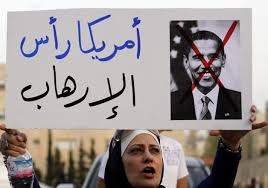
Sign: US leads terrorism (Raad Adayleh)
I am a Palestinian from the Bethlehem area but who also happens to hold a US passport. The latter does not allow me to enter Jerusalem and the US government will not protect this or other rights I have (including family reunification). Meanwhile, any Jewish American can come and get automatic citizenship and live on stolen Palestinian land in our city. It is hard to describe the level of frustration that I had watching the theater of media frenzy (devoid of any real substance) about Obama’s visit.
Obama gave a new lifeline to war and conflict by avoiding human rights and international law. It is the missing ingredient that for the past 65 years precluded peaceful resolution. It is the twisted logic that says the insecurity of the thief must be the only thing to be dealt with by ensuring the victims first recognize the legitimacy of the theft and the legitimacy of the need for the thief to first have full security and immunity from accountability for the theft before the victim is put in the room with the armed thief so that they can work out something (vague and without reference to International law). That formula has been shown to be a disaster and has kept Apartheid and colonization going. Israel has no incentive to allow a Palestinian sovereign state let alone redress the injustice (e.g. refugees, theft of land and resources etc) as long as it continues to get an unconditional check from our tax monies and guaranteed vetoes by the US at the UN protecting it from International law. This plus over $12 billion in profits from the occupation of the West Bank and Gaza (captive market, natural resources etc.) ensures the occupation continues. But the Israeli and American governments are thinking short term. Long term, the changing reality (in the Arab world) and demographics in Palestine will ensure change. Obama alluded to this when he told the Israelis that no wall will be tall enough and no iron dome will be strong enough and that peace is imperative. The problem is he failed to follow his own logic and press Israel to change and instead repeated the same failed logic that “bilateral” negotiations between a strong occupier/colonizer and a weak leadership of colonized/occupied people is the way to go.
Below are some of the things that happened during Obama’s short visit. You be the judge of their value or relevance to bringing peace.
Palestinian and American security coordinate to clean streets of any thing that might allude to Palestinain rights (refugee signs, maps of historic Palestine etc). They change all manholes in targeted areas spending millions for excessive “security” for the unwanted visitor to Bethlehem and Ramallah. Palestinian security preemptively arrest dozens and suppress peaceful demonstrations succeeding in isolating Obama from seeing Palestinian anger.
Massive traffic jams, and on the days of visits, an essential siege and curfew on Ramallah area (Thursday) near Al-Muqata and Bethlehem (Friday). The preparations create significant damage to economy and livelihood of tens of thousands of Palestinians.
Selected choreographed visits by Obama to Hertzl’s and Rabin’s tombs (the former who called for ethnic cleansing, the latter who executed it) but not to Yasser Arafat’s tomb.
American flags placed by the Palestinian Authority (PA) along the streets removed by Palestinian activists. PA security officials suppress demonstrations and prevent activists from getting near Obama. At a Ramallah demonstration, PA security dressed in civilian cloths attack demonstrators.
Obama calls on Palestinian officials to resume bilateral negotiations that led to nowhere in the past 20 years, to accept Israel as a “Jewish state”, and not to seek implementation of International law via International bodies like the UN or the International Court of Justice. Perhaps not coincidentally, the Palestinian mission in Geneva has put out mild drafts that do not take advantage of the strong findings of the UN Human Rights Council (see item link below).
Obama brokers a deal by pressuring Turkey to accept a tepid Israeli statement of regret for the deaths of Turkish citizens with some compensation for families and restoring Turkish-Israeli strategic relations (presumably including military cooperation). Turkish demands for lifting the siege on Gaza are dropped.
Obama, like his predecessors, identified Hizballah, Syria, and Iran as a dark axis of evil while Israel as a perfect model of democracy and beauty.
Obama in his speeches adopts the Zionist myths that Apartheid Israel is redemptive and that it is the guarantee against another holocaust (it is actually the reverse). Obama fails to mention that this “great and technologically advanced country” is actually built on top of Palestine and by destroying 530 villages and towns and by looting property and patrimony of millions of Palestinians.
Obama will send John Kerry to try and restart the “Palestinian-Israeli negotiations.”
Obama defines what we Palestinians want (supposedly a vague “viable state”) even though for most of us, we want to return to our homes and lands and freedom from racism and apartheid.
Obama will give Jordan $200 million to help Syrian Refugees.
Obama reminds the Israelis that his administration developed unprecedented support to the apartheid state of Israel especially in the field of security.
Obama highlighted the Iron Dome system and praised it, but now documented data show that they are less than 30% effective as opposed to the government insistence that they had 90% success).
Obama claimed the West Bank is in good shape because of Abbas and Fayyad and compared to Gaza which he claimed is miserable under rejectionist Hamas.
What Obama and his large entourage fail to mention during this supposed “historic visit”: human rights, international law, the tenth anniversary of the murder of US Citizen Rachel Corrie, Palestinian rights and security, justice, land confiscation, apartheid laws, illegality of settlements, US opposition to Palestine joining the UN, applicability of the Fourth Geneva Convention, how much taxpayer money is given to Israel, the siege on Gaza, the freedom of movement, the attack on US citizens’ rights by Israel….
Related article
- Peace Fraud: Obama Fails to Demand Halt to Illegal Settlements (alethonews.wordpress.com)
Boeing plans to cut up to 2,300 jobs
Press TV – March 23, 2013
The Boeing Company says it will cut up to 2,300 jobs by the end of 2013 in line with plans to mainly downsize the production line of its cutting-edge 787 Dreamliner jets.
According to a statement released by the Chicago-based company on Friday, the cuts will also target the production line of Boeing’s 747 aircraft.
The 787 Dreamliners have been grounded since mid-January due to a battery problem.
A Boeing representative said that out of those job cuts, about 800 workers will be laid off in the Boeing Commercial Airplanes division, with the rest of the cutbacks coming through attrition and redeployment.
The job cuts are aimed at improving corporate governance during a development phase of new airplanes, the company stated.
Analysts say it is too early to estimate the financial effect of the job cuts particularly in light of the 787 Dreamliner grounding, with worldwide orders for the jetliner pushing the company revenue to over $80 billion.
The planned job cuts at Boeing comes as the Federal Aviation Administration (FAA) announced it was being forced to cut about 637 million dollars from its current budget and it would close air-traffic control towers at 149 airports across the United States due to Washington’s latest spending cuts.
Earlier in March, a report issued by the US Department of Labor showed that the unemployment rate was increasing in half of the US states, with employers adding the fewest jobs in seven months.
The nationwide unemployment rate increased in January to 7.9 percent from 7.8 percent in December 2012, with the rate of job increases remaining far below what economists recommend to maintain healthy employment rates.
The US economy shrank by 0.1 percent in the fourth quarter of 2012, casting doubt on the strength of economic recovery in the country.
Boeing crisis threatens US economy: Bill Jones
Press TV – January 18, 2013
Featured Video

Rewriting the risk? Inside the government’s vaccine safety messaging
or go to
Aletho News Archives – Video-Images
Book Review
“Davos Can Really Replace the UN”
Inside the book that maps the architecture behind global governance — from the Epstein files to the Pact for the Future
Lies are Unbekoming | April 1, 2026
On June 13, 2019, the United Nations and the World Economic Forum signed a partnership deal to “accelerate the implementation of the 2030 Agenda for Sustainable Development.” That same evening, WEF president Börge Brende — Norway’s former Foreign Minister — had dinner with Jeffrey Epstein at Epstein’s Manhattan townhouse. The Epstein files, released January 2026, contain an exchange between the two from the previous year. Epstein to Brende: “Davos can really replace the UN. C21, cyber, crypto . genetics… intl coordination.” Brende back to Epstein: “Exactly — we need a new global architecture. World Economic Forum (Davos) is uniquely positioned — public private.”
The next day, the UN General Assembly adopted the framework for restructuring global governance.
That sequence — the partnership signing, the Epstein dinner, the candid admission about replacing the UN with a public-private architecture, and then the formal adoption — opens Jacob Nordangård’s The Digital World Brain. Pages two and three. Footnoted to the UN resolution number, the Epstein files, and the General Assembly record.
I keep coming back to it because it captures what this book does that almost nothing else in the independent research space manages. I’ve followed Jacob’s work for years now and interviewed him about his research. Each book peels back another layer of the same institutional architecture, and each time I think he’s reached the limit of what can be documented, the next one goes further. Nordangård doesn’t speculate. He doesn’t editorialize much. He lays institutional actions next to each other in chronological order and lets the pattern announce itself. … continue
Blog Roll
 Aletho News
- The End of NATO
- 37 days of war on Iran cost US staggering $42bln, tracker shows
- Baghdad tells Asian refiners, traders to begin loading Iraqi crude amid Iranian exemption
- Under fire, Moscow and Tehran close ranks
- Iran, US receive Pakistan-mediated plan for ceasefire then final deal
- Iran submits demands for end to war as mediators scramble ahead of Trump deadline
- Iran Threatens Retaliatory Strike on Stargate AI Project in UAE
- US sent ‘a lot’ of arms to Iranian protesters – Trump
- Barak Ravid Launders Deception To Allow Trump To Back Off Of His Power Plant Threat – Again
- REWRITING THE RISK? INSIDE THE GOVERNMENT’S VACCINE SAFETY MESSAGING
- If Americans Knew
- Trump poised to “blow everything up” (ie. commit war crimes) in Iran – Daily Update
- In Iran, Israel-US take aim at “reason, research, and freedom of thought” – Daily Update
- US loses planes over Iran, Israel downgrades Lebanon war goals – Daily Update
- Israel Is Blocking Palestinians from Easter at Church Where Jesus Resurrected
- Plot to assassinate Palestinian activist follows harassment campaign promoted by Zionist groups and elected officials
- Prominent New York synagogue hosts presentation on why U.S. Jews should support the ethnic cleansing of Gaza
- Tapper vs. Piker: Is the CNN Anchor Auditioning for David Ellison?
- Shouldn’t Democrats Be Able to Condemn Genocide?
- Israel-US kill negotiators, destroy civilian structures, but Iran’s military capabilities still largely intact – Daily Update
- ‘War crime’: Global condemnation as Israeli ministers celebrate death penalty law targeting Palestinian prisoners
- No Tricks Zone
- An Inconvenient Tree: Uncovered In Alps… Europe Much Warmer Than Today 6000 Years Ago
- New Study Reports A 60% Slowdown In Greenland’s Ice Loss Rate In The Last Decade
- Low Intensity Tornado Wrecks Major Solar Farm, Creating A Potential Toxic Dump
- New Study Finds Warming Saves Lives…Cold Temperatures 12 Times More Deadly Than Excess Heat
- German Science Blog Accuses PIK Climate Institute Of Hallucinating Climate Tipping Points
- Devastating Assessment Of Comirnaty Vaccine By Former Senior Pfizer Europe Toxicologist
- New Study: CO2 Is ‘Effectively Negligible’ As An Explanatory Climate Change Factor Since 2000
- Former Pfizer Toxicologist Dr. Helmut Sterz Tells Bundestag Hearing Pfizer Vaccine Should Have Never Been Approved
- Energy Expert: Germany’s Nuclear Phaseout Was A “500 Billion Euro Mistake”
- New Research: South Australia’s Mid-Holocene Sea Surface Temperatures Were 4°C Warmer Than Today
 Aletho News