Three Palestinian children arrested after attack by Jewish settler children – Swedish activist also arrested
International Solidarity Movement | April 28, 2013
Hebron, Occupied Palestine – Israeli military today arrested three Palestinian boys, aged around 10, in Hebron after they were attacked by several children from illegal settlements in the centre of the city. One Swedish activist was also arrested after intervening in the arrests of the children.
Before 1pm Palestinian children were walking home from school when they had sticks thrown at them by the children of extremist settlers living in the centre of Hebron. Eyewitnesses state that the Palestinian children called back in response to the attacking children, but did not attack in return. However, the settler children immediately called for soldiers at nearby checkpoints who came running. The settler children pointed out four Palestinian children, all aged around 10 years, who were violently grabbed and pushed against a wall by soldiers. One child managed to run away but the other three were then arrested. The Israeli soldiers took no action against the settler children who had instigated the attack.
Around forty Palestinians, including the headteacher of a nearby school, gathered and insisted that the arrest was unacceptable. A non-violent Swedish activist who also intervened peacefully on behalf of the children is being charged with assaulting a soldier. The three children and Swedish activist were taken away separately in military jeeps. The Swedish activist is currently being held in Givat Havot settlement near Hebron city, whilst the three Palestinian boys are being held in interrogation centres.
Related articles
- Zionists attempt to intimidate International Solidarity Movement (alethonews.wordpress.com)
- Journalists detained in Hebron, leading to two arrests and threats to restrict Palestinian movement (alethonews.wordpress.com)
Ni’lin continues to resist after 5 years of Israeli occupation and systematic land theft
 A young demonstrator at Ni`ilin

International Solidarity Movement | April 27, 2013
Silwad, Occupied Palestine – Around 50 Palestinians supported by around 20 international activists, demonstrated against the apartheid wall yesterday in Ni’lin, which is a village close to Ramallah. The residents attempted to dismantle the wall and were met with violence. Around 20 were treated for tear gas inhalation and one demonstrator was injured when he was shot in the chest with a tear gas canister.
The demonstration started when around 100 people from the community gathered for the Friday prayer in an olive field. After prayers the demonstrators approached the apartheid wall, chanting peace slogans in Arabic and Hebrew. In a speech, a member of the Popular Committee expressed the injustices that Ni’lin has faced in the past and continues to face today because of the actions of the Israeli military.
Residents tried to open the metal door that separates them from most of their land that has been appropriated illegally by the establishment of settlements and the construction of the wall. Soldiers fired tear gas at the demonstrators. One demonstrator, who had climbed the wall using a ladder, was speaking to the soldiers through a megaphone before they shot him directly in the chest with a tear gas canister. The impact caused him to fall off the ladder and require medical treatment. More tear gas was fired at other demonstrators, photographers and internationals. The demonstration lasted about one hour, weakening the wall and showing the resilience of the population of Ni’lin.
Ni’lin’s history is characterised by land theft, starting with the first Israeli occupation of Palestine in 1948. Before 1948 the village of Ni’lin owned 58’000 dunams of land, from which 40’000 were stolen with the creation of Israel. The 1967 occupation lead to the construction of illegal settlements on Ni’lin’s land, stealing a further 8’000 dunams. The illegitimate establishment of the wall, which began in 2008, has stolen a further 2’500 dunams. Furthermore, the entrance of the village was closed in order to build a tunnel exclusively for settlers that lead to a further land theft of 200 dunams, highlighting the apartheid nature of Israeli policy. Nearly 90% of Ni’lin’s original land has been lost due to this systematic theft from war, settlements and the wall.
The non-violent demonstrations since 2008 have lead to the killings of five Palestinians. 10 year old Ahmed Moussa, 17 year old Yousef Amera, 22 year old Arafat Khawaja, 20 year old Mohammed Khawaja and 36 year old Yousef ‘Akil’ Srour. The residents of Ni’lin still struggle for peace and justice, and will not give up hope in spite of Israel’s use of extreme force and oppression.
Related articles
- Palestine, 8 wounded, 52 abducted by Israeli forces in 1 week (nsnbc.me)
- PCHR Weekly Report: 8 wounded, 52 abducted by Israeli forces this week (occupiedpalestine.wordpress.com)
Israel spy agency has presence in Syria, says senior rebel general
By Joseph Fitsanakis | intelNews | April 25, 2013
Israel is one of several countries that maintain a significant intelligence presence inside Syria, according to the top commander of the Syrian rebel forces.
General Salim Idriss, Chief of Staff for the Free Syrian Army, told CNN’s Christiane Amanpour that the Jewish state has “many, many” intelligence officers in various parts of Syria. The Arab country has been rocked since 2011 by a violent civil war, which has cost the lives of at least 60,000 people.
Idriss was responding to comments made earlier this week by Brigadier General Itai Brun, senior intelligence analyst for the Israel Defense Forces (IDF). Brun, who heads the Division for Research and Analysis of the IDF’s Military Intelligence Directorate, was speaking at a conference hosted in Tel Aviv, Israel, by the Institute for National Security Studies. He told an audience of intelligence experts that the IDF was “quite certain” that the Syrian government headed by President Bashar al-Assad had resorted to the use of chemical weapons against rebel forces on at least one instance.
According to Brun, footage obtained by the IDF of rebel casualties from a March 19 attack by Syrian government forces, pointed to the use of sarin nerve gas. He referred to evidence such as the victims’ dilated pupils and “the foam coming out of their mouths” as strong proof of the use of weaponized sarin nerve gas in the battlefield.
Responding to Brun’s allegations, General Idriss suggested that Syrian government forces had used chemical weapons repeatedly in a variety of locations, including Aleppo, Homs, and the outskirts of capital Damascus. He added that rebel forces had collected “some samples of soil and blood” and surrendered it to outside “observers” of the civil war —though he refused to identify these observers. After some pressure from Amanpour, Idriss said it made sense for the IDF to know that sarin nerve gas had been used by the Syrian government, since Israel was one of several countries that had “many, many” intelligence officers inside Syria. Asked by Amanpour whether he was referring to Israeli covert-action agency Mossad, Idriss responded “yes”.
In response to Brun’s comments, White House Press Secretary Jay Carney told reporters on Tuesday that Washington was “looking for conclusive evidence, if it exists, if there was use of chemical weapons”.
European brands agree to compensate Tazreen victims, US corporations refuse
IndustriAll | 16.04.2013
Major European retailers C&A, KiK and El Corte Inglés will contribute to a compensation plan for the victims of the Tazreen Fashions fire in Bangladesh.
The brands made the commitment at a meeting held on 15 April in Geneva to discuss a 5.7 million USD compensation plan for the victims of the Tazreen Fashions fire in Bangladesh, which killed 112 workers and injured about 120 in November 2012.
The meeting was hosted by IndustriALL Global Union and attended by major European retailers, a leading Bangladesh trade unionist, the Clean Clothes Campaign and the Worker Rights Consortium.
In an outrageous display of indifference to the suffering of Bangladeshi families, major US corporations Walmart, Sears/Kmart and Disney refused to pay any compensation to the victims and failed to attend the meeting. Walmart was apparently the largest buyer from the Tazreen factory. The companies, which failed to enforce their own worker safety standards, have claimed to be deeply saddened by the deaths.
Major European retailers C&A (Netherlands), KiK (Germany) and El Corte Inglés (Spain) attended the meeting and agreed to make substantial contributions to the compensation plan for the families of the dead and for the injured. The Italian clothing brand Piazza Italia did not attend but has agreed to participate in the package.
“We have agreed on confirming the concrete amounts that each of these brands will contribute by the end of this month,” says IndustriALL General Secretary Jyrki Raina. “The families and the injured have already waited far too long.”
Other companies that were sourcing from Tazreen and failed to attend include Hong Kong based trader Li & Fung, Teddy Smith (France), Edinborough Woolen Mills (UK), Dickies (US) and Karl Rieker (Germany). Li & Fung has however agreed to paying compensation.
The compensation plan, developed by IndustriALL and its affiliates in Bangladesh and supported by international labour rights groups, is based on the compensation formula used in other recent fires. These include the December 2010 fire at That’s It Sportswear, a factory producing for Gap and other US brands, and the fire this January at Smart Export Garments, which was producing clothes for Inditex and others. The details of the plan will be worked out in a subsequent meeting to be held in Dhaka, Bangladesh.
Says Ineke Zeldenrust from the Clean Clothes Campaign, “We once again call upon Walmart and the other major companies sourcing from Tazreen to aid the families of the dead and the injured workers. Their refusal to do so indicates a shocking lack of concern for the rights and well-being of the workers who make their clothes and who, in this case, were injured or killed in the process.”
Related article
Hundreds of Bangladeshi garment workers die
IndustriAll | 25.04.2013
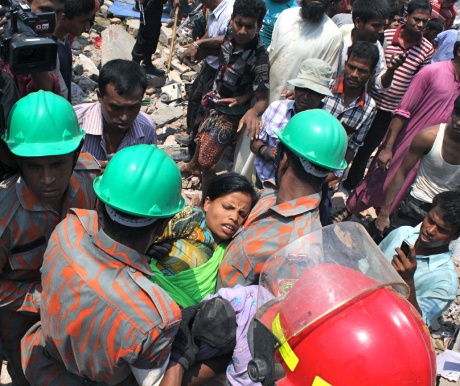
The worst ever industrial accident in Bangladesh has killed more than 200 garment workers with fears of a final death toll reaching 1,000 as hundreds remain injured and trapped in the debris.
“Cut off my hand, save my life!” screams a woman trapped under the collapsed eight-story Rana Plaza building in Savar, 30 kilometres outside Dhaka. The same request is shouted by trapped Aftab, while other screams in the rubble demand oxygen. 200,000 local people have assembled in Savar offering to donate blood to the rescue effort, as hospitals are gravely under supplied.
The mass industrial manslaughter occurred at 9am, 24 April. The collapsed building, illegally constructed, contained five garment factories with 2,500 workers. Those five factories are Ether Tex, New Wave Bottoms, New Wave Style, Phantom Apparels and Phantom-TAC. These factories are believed to have produced for several well-known western brands including Mango, Primark, C&A, KIK, Wal-Mart, Children’s Place, Cato Fashions, Benetton, Matalan and Bon Marché.
On 23 April, the day before the collapse, large structural cracks appeared in the supporting pillars of Rana Plaza, but local authorities were ignored by the building owner Sohel Rana and the garment factory owners when they gave the order to evacuate, while the three shops and bank on the building’s ground floor heeded the warning and evacuated. A Rana Plaza garment worker had to work three days unpaid for every one work day missed, so workers were reluctant to stay safe at home on 24 April.
Now over 2,000 workers are injured in hospital, many critically, 254 are dead and many more continue screaming from under the rubble. The IndustriALL Global Union affiliated textile and garment trade unions in Bangladesh are present and supporting the rescue efforts. Affiliates work jointly through the IndustriALL Bangladesh Council (IBC) which yesterday used a joint press conference to put forward joint demands and a programme of action, calling for justice and action from authorities and brands. The IBC will mobilize all affiliates in a mass demonstration on 26 April in front of the Dhaka Press Club.
20,000 furious garment workers from neighbouring factories this morning brought five major highways to a halt, and several local skirmishes saw angry protestors target garment factories that were not respecting the national day of mourning, forcing them to close and show respect to the dead. Protestors also targetted the building of the Bangladesh Garment Manufacturers & Exporters Association (BGMEA).
The systemic problems must be tackled immediately in Bangladesh’s garment industry and much responsibility must fall on the western clothing brands making enormous profits from items made in deadly conditions on poverty wages. While brands continue refusing to pay a sufficient price for safe production of their clothes, their calls for improved safety are not sincere.
Much needed improvements to the national labour law have been debated through Bangladesh’s legislative process, with the government cabinet approving revisions on 22 April. However this process has been lobbied by the global garment industry buyers who have demanded a scaling back of workers’ rights initially proposed in the reform.
IndustriALL Global Union believes that Bangladeshi garment workers deserve the right to work in safety, with full access to organize and bargain collectively in trade unions, and a substantial rise of the current US$38 monthly minimum wage.
IndustriALL Global Union General Secretary Jyrki Raina said:
This terrible tragedy highlights the urgency of putting a stop to the race to the bottom in supplying cheap means of production to international brands, a race in which hundreds of workers have lost their lives. Global clothing brands and retailers have a responsibility for their full production chains. Now it is time for them, suppliers and the Bangladeshi government to sit down with IndustriALL and its affiliates to agree on a safety program that will ensure this will never happen again.
The New Yorker Should Ignore Jon Lee Anderson and Issue a Correction on Venezuela
By Keane Bhatt | NACLA | April 24, 2013
As a result of many dozens—possibly hundreds—of messages from readers over the past few weeks that criticized The New Yorker’s inaccurate coverage of Venezuela, reporter Jon Lee Anderson issued a response in an online post on April 23. This marks the first time the magazine has publicly addressed its controversial and erroneous labeling of Venezuela as one of the world’s most “socially unequal” countries (I highlighted the error in mid-March). Although Anderson deprives his readers of the opportunity to evaluate his critics’ arguments (he offered no hyperlinks to either of my two articles on the subject, nor to posts by Corey Robin, Jim Naureckas, and others), he is clearly writing in response to those assertions.
To his credit, Anderson unequivocally admits two of his three errors: regarding Venezuela’s homicides, he acknowledges that he falsely wrote “that Venezuela had the highest homicide rate in Latin America. Actually, Honduras has the top rate.” Anderson proceeds to explain why Venezuela’s high homicide rate is nevertheless a grave problem—a position none of his critics, myself included, dispute.
The importance of this error rests instead in its revelation of a media culture under the influence of the consistent demonization of a country deemed an official U.S. enemy. This culture certainly played a role in allowing Anderson’s obvious falsehood to remain uncorrected for five months—five months after I first wrote about it, one month after I directly and publicly confronted Anderson about the error, and even then, days after I wrote another article urging readers to demand a correction.
While The New Yorker has dedicated literally no articles to U.S. ally Honduras since its current leader Porfirio Lobo came to power in repressive, sham elections held under a military dictatorship, Anderson was allowed to assert that Venezuela—a country with half the per capita homicides of Honduras—was Latin America’s leader in murders. One might reasonably suspect that a claim on The New Yorker’s website asserting that the United States had a higher homicide rate than Bolivia (Bolivia’s rate is actually over two times as high), would be retracted more expeditiously.
Anderson’s explanation for his second error—claiming that Chávez came to office through a coup d’etat rather than a free and fair election—further lays bare the corrupting effects of the generalized vilification of Chávez on basic journalistic standards of accuracy.
Anderson writes that despite his gaffe, he obviously knew Chávez “gained the Presidency by winning an election in 1998,” as he had “interviewed Chávez a number of times, travelled with him, and came to know him fairly well.” For Anderson to write such an egregious misstatement, then, and have it pass through what is likely the most rigorous fact-checking process in the industry, exposes a pervasive ideology under which he and his many editors and fact-checkers operate. As Jim Naureckas of Fairness & Accuracy in Reporting wrote, “It’s like writing a long profile on Gerald Ford that refers to that time when he was elected president.”
Finally, Anderson offers a desperate attempt to justify his third factual error, stating:
A number of letters I’ve received dispute, out of context, my reference to “the same Venezuela as ever: one of the world’s most oil-rich but socially unequal countries”; several cite an economic statistic known as the Gini coefficient—a measure of income inequality.
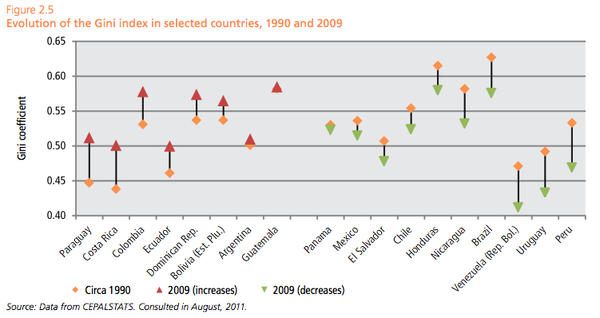
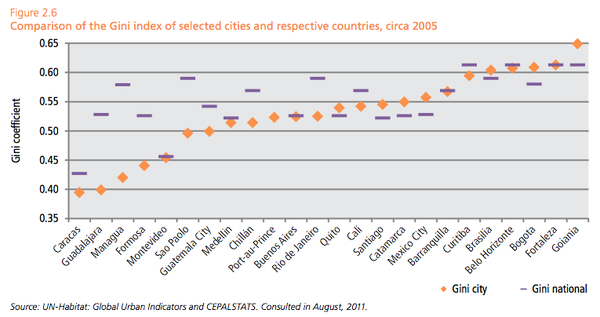
Notice that Anderson never tells his readers what Venezuela’s Gini coefficient actually is. According to the United Nations, Venezuela’s Gini, at 0.397, makes it the least unequal country in Latin America and squarely in the middle range of the rest of the world. Only by sidestepping this brutal empirical obstacle can Anderson attempt to lay out his case. He carries on by reposting three paragraphs of his original essay, which in no way mitigate the falsity of his original claim, for “context.” Anderson finally concludes by offering a novel justification for his error:
In terms of some of the components of social inequality, notably income and education, Chávez had some real achievements. (Income is what’s captured by the Gini coefficient, although that statistic has its own limitations, some particular to Venezuela.) But in housing and violence, his record was woefully insufficient. Those social factors are intimately related, to each other and to the question of equality.
A quick recap is in order before unpacking Anderson’s argument. Readers may remember that he first responded to evidence on income inequality by proclaiming, on Twitter, his agnosticism toward empirical data. Next, a senior editor at the magazine justified Anderson’s contention by arguing that Venezuela was one of the most unequal amongst other oil-rich countries—a point I debunked. Now, Anderson has settled on a definition of social inequality that minimizes Venezuela’s high educational and income equality in favor of high homicide rates and unequal housing.
But simply saying that Chávez’s record “was woefully insufficient” on housing and violence does not naturally equate to Venezuela’s standing as a world leader in social inequality. Anderson must rely on comparative international statistics to justify his position, but fails to do so.
While Venezuela’s homicide rate is high by international standards and a significant social ill, this alone does not necessarily make the country more socially unequal than another country with a lower homicide rate. Are Venezuelan homicides more skewed toward low-income residents than those in Costa Rica? Or Haiti? Are Venezuelan murders more targeted at women or ethnic minorities than those in Mexico or Guatemala? And given that the high homicide rate directly affects far fewer than one in a thousand Venezuelans annually, how could this statistic possibly outweigh the effect of massive income-inequality and poverty reductions? If he is solely basing his argument on murder rates, Anderson has no credible explanation as to why Venezuela is one of the world’s most socially unequal countries.
Anderson also doesn’t offer statistics showing that housing is more unequal in Venezuela than anywhere else. That’s because it’s not.
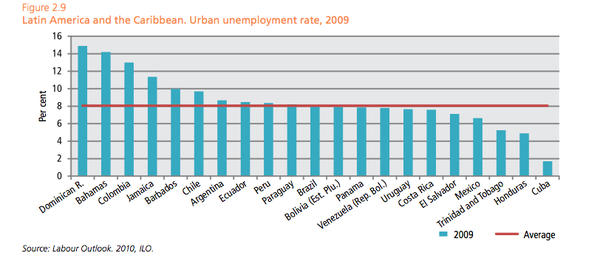
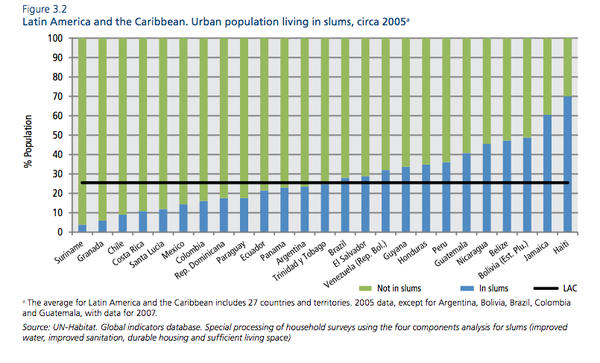
Out of the 91 countries for which the United Nations has available data, Venezuela is 61st in terms of the percentage of its urban population living in slums. That is to say, two-thirds of the world’s countries with available data have larger percentages of their urban citizens living as slum dwellers. In the Western Hemisphere, this includes Guayana, Honduras, Peru, Anguilla, Guatemala, Nicaragua, Belize, Bolivia, Jamaica, and Haiti.
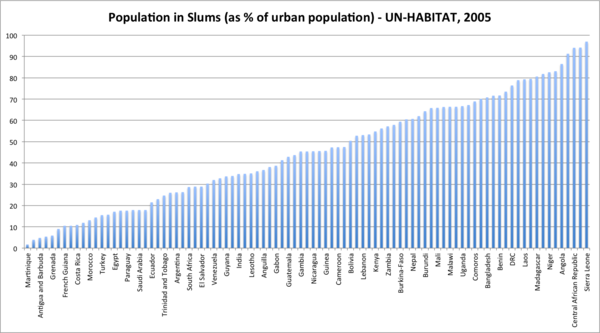
It is also worth mentioning that this data was taken from 2005, when the percentage of Venezuela’s urban population living in poverty and extreme poverty was at 37%. By 2010, according to the United Nations, it had been cut by a quarter, to 28% (p. 43). Furthermore, 2005 predates a massive governmental push in 2011 to build affordable housing. Earlier this year, Venezuela’s Housing Commission chair asserted that “in the years 2011 and 2012, the Bolivarian government together with the people reached the goal of building 350,000 homes.”
It appears, then, that Anderson has discovered a new definition of “social inequality” that has eluded economists and sociologists worldwide—one that systematically downplays Venezuela’s educational and income equality while emphasizing a high frequency of murders and a rate of slum-dwelling that is low by international standards.
While one can applaud Jon Lee Anderson for finally acknowledging the value of social indicators and statistical data, he and his magazine cannot be allowed to define “social inequality” any way they see fit. No social scientist analyzing the available data could argue, like Anderson, that Venezuela is one of the world’s most socially unequal countries. While semantics games may be expedient in avoiding a necessary correction, readers should let The New Yorker’s editor David Remnick (david_remnick@newyorker.com) know that a retraction of Anderson’s claim is long overdue.
Update (4/24): FAIR’s Jim Naureckas also offers sharp criticism of Jon Lee Anderson and his fact-checkers for a transparently inadequate attempt to justify his error regarding Venezuela’s social inequality. Read more, at “Jon Lee Anderson Explains: Because I Said So.”
~
Keane Bhatt is an activist in Washington, D.C. He has worked in the United States and Latin America on a variety of campaigns related to community development and social justice. His analyses and opinions have appeared in a range of outlets, including NPR, The Nation, The St. Petersburg Times, and CNN En Español. He is the author of the NACLA blog “Manufacturing Contempt,” which critically analyzes the U.S. press and its portrayal of the hemisphere. Connect with his blog on Twitter: @KeaneBhatt
Related articles
- The New Yorker Corrects Two Errors on Venezuela, Refuses a Third (alethonews.wordpress.com)
- On Venezuela, The New Yorker’s Jon Lee Anderson Fails at Arithmetic (alethonews.wordpress.com)
- 50 Truths about Hugo Chavez and the Bolivarian Revolution (alethonews.wordpress.com)
- ‘Little Twerp … Get a Life’: The New Yorker’s Jon Lee Anderson Thinks He’s Somebody on Twitter (gawker.com)
Palestinian monastery loses court battle over apartheid wall

Al-Akhbar | April 26, 2013
A Catholic monastery and convent in a secluded valley outside Bethlehem lost a seven-year legal battle against the building of Israel’s apartheid wall on its land on Friday, according to its lawyers.
The Society of Saint Yves, a Catholic human rights group which argued the case on the monastery’s behalf, said an Israeli appeals court had endorsed a plan to expand the barrier it had built in the area.
The apartheid wall would surround the convent on three sides and cut it off from most of its land, Saint Yves said in a statement.
Salesian monks and nuns tend lush vineyards and olive trees on terraced hillsides under the gaze of Israeli settlements there. A convent school teaches 400 local children.
Israel started building the barrier, a mix of metal fencing, barbed wire and concrete walls, in 2002. It claims the apartheid barrier keeps its citizens safe from militants.
Saint Yves said “that the plan would violate international law and conventions protecting religious minorities and the right to education and freedom of religion”, said Anica Heinlein, its advocacy officer.
Around 50,000 Palestinian Christians, including 17,000 Catholics, live among 4 million Muslims in the Israeli-occupied West Bank and in Gaza.
They say Israel’s checkpoints and apartheid barrier cut them off from their neighbors and holy places in Jerusalem.
Some 90 percent of Palestinian Christians live in a 20-km stretch from Ramallah and East Jerusalem to Bethlehem – an area locked in a labyrinth of Jewish settlements, Israeli-only roads and a drab concrete walls.
Built mostly within occupied land and not on the “Green Line”, which was the de facto border before the 1967 War, the apartheid barrier inside the West Bank is deemed illegal by the UN’s International Court of Justice.
The Palestinian Authority says the Christian population in the West Bank has shrunk over the last three decades due to emigration, but it lacks accurate figures.
“The occupation hurts Christians and Muslims both, but affects the Christian community more because it’s a smaller percentage of the population,” said Xavier Abu Eid, a diplomat in the Palestine Liberation Organization (PLO).
“This is a matter of their survival, as this is one of the last pieces of land the community owns,” he said.
Israeli President Shimon Peres will meet the newly elected pope next week during a visit to Italy.
The two men are due to discuss ties between Israel and the Vatican and improving relations between Christians and Jews. It was not immediately clear if the new pontiff would raise the issue of the monastery.
(Reuters, Al-Akhbar)
EFF Fights to Protect Electronic Reserves at College Libraries
By Corynne McSherry | EFF | April 25, 2013
When college professors want students to read a small part of a book, they put that book on reserve at the library, so everyone can get access to the bit of information they need without having to buy the entire expensive work. Advances in technology have made this even easier for students: librarians have created electronic reserves, allowing online access to a digital version of the excerpt. But the publishing world has come down hard on these electronic reserves in a lawsuit aimed at Georgia State University (GSU), insisting that libraries must pay fees for excerpts they make available digitally to students. In an amicus brief filed on behalf of several national library associations today, EFF argues that electronic reserves must be protected to serve the public interest and preserve librarians’ and students’ fair-use rights.
This case started back in 2008, when the Association of American Publishers (AAP) recruited three plaintiffs to sue GSU for copyright infringement in their electronic reserves. GSU promptly updated its procedures to conform to fair use guidelines the AAP itself had helped draft for other universities. But instead of declaring victory, the plaintiffs continued to pursue this case, even taking it up on appeal when their claims were rejected by a federal district court.
In the amicus brief filed today, EFF urges the appeals court to see what the district court saw: the vast majority of uses at issue were protected fair uses. Moreover, as a practical matter, the licensing market the publishers say they want to create for e-reserves will never emerge—not least because libraries can’t afford to participate in it. Even assuming that libraries could pay such fees, requiring this would thwart the purpose of copyright by undermining the overall market for scholarship. Given libraries’ stagnant or shrinking budgets, any new spending for licenses must be reallocated from existing expenditures, and the most likely source of reallocated funds is the budget for collections. An excerpt license requirement thus will harm the market for new scholarly works, as the works assigned for student reading are likely to be more established pieces written by well-known academics. Libraries’ total investment in scholarship will be the same but resources will be diverted away from new works to redundant payments for existing ones, in direct contradiction of copyright’s purpose of “promot[ing] progress.”
A win for the publishers here would be a Pyrrhic victory at best for them, and a significant loss for the public interest. We hope the appellate court agrees that copyright law does not require forcing libraries to make reading a handful of pages either extraordinarily expensive or inordinately difficult for college students.
Files
 georgiastateamicibriefconformed.pdf
Related articles
- EFF To Represent Bloggers Against Copyright Troll (eff.org)
- LCA Files Brief on Behalf of Georgia State (districtdispatch.org)
Hezbollah denies responsibility for drone shot down by Israel
Al-Akhbar | April 26, 2013
Lebanese political party Hezbollah denied on Thursday that it had sent a drone over the Mediterranean sea, hours after the Israeli air force said it shot down an unmanned aircraft near Haifa.
“Hezbollah denies sending any unmanned drone towards occupied Palestine,” the Hezbollah-affiliated television channel al-Manar said.
Israel’s deputy defense minister earlier put the blame squarely on Hezbollah.
“An unmanned aircraft (UAV) was identified approaching the coast of Israel and was successfully intercepted by IAF aircraft five nautical miles off the coast of Haifa at approximately 2:00 pm today,” the military said.
Israeli Prime Minister Benjamin Netanyahu was inside an army helicopter when he was given the news of the drone, and was then forced to land until it was shot down.
“I see this attempt to breach our borders as extremely grave,” the premier said. “We will continue to do whatever we must to protect the security of Israel’s citizens.”
Israeli military spokesman Lieutenant Colonel Peter Lerner told reporters the drone had been identified moving down the Lebanese coast.
“A little after 1:00 pm, our aerial defense system identified (a drone) moving from north to south along the coast of Lebanon,” he said.
“Aircraft, helicopters and combat airplanes were alerted to the area and after confirmation that it was an unfriendly aircraft, they were approved to shoot it down.”
But despite reports blaming Hezbollah, Lerner was cautious, saying the incident was still being investigated.
“We don’t know where the aircraft was coming from and where it was actually going,” he said, adding that the navy was “searching for the remains of the UAV” as part of the probe.
But Deputy Defense Minister Danny Danon accused the Lebanese movement of being behind the attack.
“We’re talking about another attempt by Hezbollah to send an unmanned drone into Israeli territory,” he told army radio, describing it as “another attempt to destabilize the Middle East.”
Israel would respond to the incident in its own time, he said.
“We are ready and we will react as necessary,” Danon warned. “They know not to provoke us.”
Hezbollah has previously claimed responsibility for several drone incursions in the past years, most recently on October 7.
Israel frequently stages incursions into Lebanese airspace, often sending drones at low altitude in South Lebanon.
In March, UNIFIL spokesman Andrea Tenenti slammed the Israeli overflights, calling them a violation of Lebanese sovereignty and of the UN Security Council Resolution 1701, which ended the July 2006 war.
Featured Video
American Military Failure in Afghanistan
or go to
Aletho News Archives – Video-Images
Frlom the Archives
The Fiction of the Jewish History in Palestine
By Hasan Afif El-Hasan | The Palestine Chronicle | April 8, 2011
Prime Minister Benjamin Netanyahu told NNC Pierce Morgan on March 18, 2011 that he might agree to a Palestinian state through negotiations. And he added, “We will make territorial concessions although it is very painful to do that in our ancestral land.” Netanyahu was not talking about Poland where his ancestors lived. He was talking about Palestine where generations of its indigenous population ancestors lived, cultivated the land and are buried.
By the end of the nineteenth century, Zionism created a new Jewish identity of blood and soil. To mobilize their followers and supporters and appeal to their emotions, the Zionists created myths. Zionism started as a tribal religion without god, but in order to fulfill its function as a unifying force, Zionism required external religious and race symbols, not inner content. Its leaders regarded metaphysical religious belief and purity of race as having value in itself. They created a divine paradisiacal state of merger with the gods. Despite his non-religious ideology, Herzl’s writings were replete with religious references. The Jews should settle in Palestine because, in his words, “the Temple will be visible from long distance, for it is only our ancient faith that has kept us together”.
The Zionists and their supporters have invested tremendous financial and scholarly resources to work within the Hebrew Bible historical narratives to affirm the links between the intrusive Zionist population and the ancient Israelite past, and by doing so assert the right of that population to the land. The political end-game shaped the investigation and the outcome. Tracing the roots of Israel’s ethnic state in biblical antiquity is effectively to silence the indigenous Palestinian claim to the past and therefore to the land. The Biblical scholarship employs a bewildering array of terms for the region: “the Holy Land”, “the Land of the Bible”, “Eretz Israel”, “the Land of Israel”, or “Judah and Samaria.” To the casual reader these names appear interchangeable, but they all imply connection to ancient Israel.
Biblical narratives or poems that cannot be supported by archeology and common sense are treated by the Zionists and their supporters as historical language. … continue
Blog Roll
 Aletho News
- CIA Assessment: The Resistance Cannot Be Crushed
- Hezbollah Returns: It Didn’t Start a War, It Is Ending One
- EU states seek ‘talks’ with Iran for access to Strait of Hormuz: Report
- Trump on Hormuz: “Others must take care of it” after US falters
- Who Is closer to collapse?
- A War that Backfired: Why the US-Israeli Campaign Is Strengthening Iran
- How Zionist Control Is Hurting US Interests
- Iran warns it may target US missile launch sites in UAE cities
- American Military Failure in Afghanistan
- Friendly Skies of Georgia: Are Israeli-Linked Drones Launching False Flags from Georgian Territory?
- If Americans Knew
- No let-up in attacks on Gaza as Israel takes on Iran, Lebanon – Not a ceasefire Day 155
- ‘Of Course’: IDF Drops Case Against Soldiers Accused of Raping Palestinian Prisoner
- Don’t Fall for the Regime Change Talk. Israel Is ‘Mowing the Lawn’ in Iran
- Will Israel and the US wreck the Gulf States along with Iran?
- US so far burned through ‘years’ of munitions in Iran war: Report
- How the Israeli Tail Wags the American Dog
- Outdated intel likely led to deadly U.S. strike on Iranian elementary school, sources say
- Pentagon insider says high U.S official Douglas Feith reported to Netanyahu
- In fond memory of Walid Khalidi, the historian of Palestine
- 6 more Americans killed, as Israel ‘mows the lawn’ in Iran – Not a ceasefire Day 154
- No Tricks Zone
- Storing Green Energy To Last Germany 10 Days Would Require A 60-Million Tonne Battery
- New Studies: UK Sea Levels Were 4 Meters Higher Than Today During The Mid-Holocene
- Destructive Green New Deal: German Energy And Metal Group Warns Of Drastic Crisis
- New Study Documents A 20-Year Pause In Arctic Sea Ice Decline – Driven By Internal Variability
- Wake-up Call: Survey Shows Majority Of Germans Now Favor Postponing Climate Targets!
- Televised! Leading German Political Candidate Tells Schoolchildren CO2 Makes Sun Hotter!
- New Study: A Century Warming Of 1.1°C Is ‘Commonplace’ And ‘Not Unusual’ During This Interglacial
- New Study: ‘Internal Noise’ And Volcanic Forcing Can Trigger 10-15°C Warming Within Decades
- Glaciers Worldwide Are Suddendly Surging, Experts Blame Warming!
- Surprising Discovery: Sahara Is Greening…Billions Of Trees Where Once Thought To Be Barren
 Aletho News