UK activists urge French singer to boycott Israel
Press TV – May 26, 2013
British campaigners have called on French Singer Julien Clerc to consider the plight of Palestinians and cancel his upcoming concert in apartheid Israel.
In a press release on its official website, the Innovative Minds (inminds) campaign group said activists picketed Clerc’s London concert on May 8, asking him to respect the Palestinians’ call for artists to boycott the Israeli regime and cancel his performance in Tel Aviv scheduled for July 7.
They also asked Clerc, as a Goodwill Ambassador for the United Nations Refugee Agency (UNHCR), to stand with the 5 million Palestinian refugees and oppose the Israeli regime’s racist policies.
British campaigners were holding placards reading, “Julien don’t lend apartheid Israel your good name” and “Julien respect the Palestinian call to boycott Israel.”
Earlier this month, hundreds of pro-Palestine activists marched on the Union of European Football Associations (UEFA) annual congress in London, demanding the relocation of European under-21s championships in Israel.
They said the European football’s governing body should prevent the regime from hosting the sports event on June 5-18.
Related article
- UK activists to call for Israel sports boycott (alethonews.wordpress.com)
Argentina: Violent Eviction of Indigenous Community Deemed Illegal
By Sabrina Hummel | The Argentina Independent | May 27, 2013
More than 20 indigenous Tonocoté families were violently evicted from their community in Santiago del Estero on Friday, it has emerged. The eviction has caused an outcry among human rights and environmental organisations from around the country.
The eviction of the area, known as Boca del Tigre, was authorised by Judge Tarchini Saavedra, and began at the crack of dawn as police mounted on horses and armed with tear gas, rubber bullets, and dogs bore down on the site, catching the families by surprise as they slept. Bulldozers meanwhile razed the settlement where the Tonocoté have lived for the last 200 years to the ground.
Despite the court order, the farmers were not shown any papers, adding to the confusion and chaos that reigned supreme during the raid.
Head of the community Reyna Sosa described the event: “They came in the dark, they fired pellets and rubber bullets at us, my three grandchildren have head injuries… my daughter, who is pregnant, suffered a leg injury.”
So far no explanation has been given as to why the police used such excessive force, or as to why they began the operation without saying a word.
Greenpeace has released a statement denouncing the events saying, “we condemn the use of repression against the historic inhabitants of the area” and affirming the illegality of the eviction given the area’s protected status under the ‘Ley de Bosques’.
Arrests were also made, and, as one neighbour put it, “they hit them everywhere… they didn’t even resist… they took them straight to the police station”.
The local newspaper, Ultima Hora, believes that the sudden expropriation of the land was initiated in response to a large upcoming real estate development.
According to the paper, they are interested in “20 hectares of land which belong to the community but which are destined for the construction of a private neighbourhood”.
Sosa expressed her desolation at the turn of events, “I feel so sad and impotent in the face of the situation – that they can come and take away what has always been yours” and pleaded that the governor of the province “have a heart… if he had one he would never have allowed them [the police] to fire at children”.
A mass is planned for next Sunday and human rights organisations and those who are sympathetic to the cause are expected to be in attendance.
Related articles
- In Search of Their Roots: The Mapuche and Modern Society
- Honduras: Three Farmers Killed During Land Eviction
- Argentina: Son of Indigenous Leader Attacked in Formosa
- Indigenous community asks Argentine president to protect their ancestral land
- UN calls on Argentina to stop eviction of indigenous peoples from their lands
Colombia: FARC and Government Reach Agreement on Land Reform

Revolutionary Armed Forces of Colombia (FARC), resting in the countryside. (Photo: Phoenix Diaz)
By Avery Kelly | The Argentina Independent | May 27, 2013
Representatives from the Revolutionary Armed Forces of Colombia (FARC) and the Colombian government announced yesterday that they have signed a keynote agreement on land reform.
The accord is a big step forward for the on-going peace negotiations in Havana, Cuba between the rebel group and the government of President Juan Manuel Santos, as land reform is the first of six main issues on the agenda for discussion.
The agreement comes after nearly six months of talks on the subject.
A press release ratified by both parties stated that the accord facilitates the “start of radical transformations of the rural and agrarian reality of Colombia with fairness and democracy”.
President Santos applauded yesterday’s accord, commenting on Twitter that the land reform measure is a breakthrough for the peace talks and a “fundamental step in Havana towards a full agreement that will put an end to half a century of conflict”.
Iván Márquez, chief negotiator of the FARC, explained: “This historical recognition is felt by the rural and impoverished communities and is a flag in the wind in our hands … at the negotiation table.”
However, Márquez added that some of the points of the accord must be discussed again before negotiations end. He commented, “nothing is agreed upon until everything has been agreed upon”, referring to discussions still to come on other polemic topics in the peace talks expected to finish by August.
Land reform has been a fundamental issue for both the government and the FARC even before the peace talks began. Land disputes were one of the primary issues that the Marxist-leaning rebel group took on as early as 1964.
Now that the land reform issue has been decided, government and FARC negotiators will move discussions to the political participation of the rebel forces, the fight against drug trafficking, and an end to the conflict more generally with respect to victim compensation.
Hezbollah Intervention in Syria Redraws Political Map
By Ibrahim al-Amin | Al-Akhbar | May 27, 2013
Relations between the Bashar al-Assad regime in Damascus and the Lebanese Resistance had already reached a high-level of coordination and mutual support even before the outbreak of the Syrian crisis. At the time, the two allies tended to respect each others’ boundaries, recognizing each other’s key roles in the region.
The onset of the Syrian crisis only served to further intertwine their interests as both became targets of the Syrian opposition and their regional and international backers.
In the early stages of the uprising, Hezbollah tried to play the role of mediator, seeking ways to open up channels between the regime and the opposition. But quickly, developments – like Israel’s growing involvement in the crisis – prompted a qualitative change in the relationship between Damascus and the Lebanese Resistance.
Assad’s response to the latest Israeli attacks on Damascus would have not meant much if it did not also have the strong support of Hezbollah, Iran, and even Russia – with the Resistance openly declaring its willingness to take part in any effort to ward off Tel Aviv’s threats.
This could lead Hezbollah’s Lebanese opponents to exploit mounting sectarian tensions, particularly in Sidon and Tripoli, in order to turn up the pressure on the Resistance and its popular base.
Although Hezbollah’s Secretary General Hassan Nasrallah justified in detail his party’s involvement in Syria, he did not mention – for his own reasons – that the role of the Resistance in Syria’s internal front is not without its limits, and largely depends on the course of events there.
The party has already declared that one of its goals is to push those forces that pose a threat to the Resistance away from Syrian areas adjacent to the Lebanese border. However, when it comes to confrontation with Israel, we can expect an increased and ongoing role for Hezbollah, particularly in the occupied Golan Heights.
Price of Involvement
As for the price that Hezbollah is likely to pay for its involvement, the two rockets that struck southern Beirut on Sunday morning are but a sign that there are those preparing for a campaign of terror against the Resistance.
It is difficult to foresee the trajectory of events after Nasrallah’s call to arms alongside the Syrian regime, but early signs suggest that the coming period will be one of heightened tensions among Lebanon’s political forces, particularly as the dream of toppling Assad is slowly fading away.
This could lead Hezbollah’s Lebanese opponents to exploit mounting sectarian tensions, particularly in Sidon and Tripoli, in order to turn up the pressure on the Resistance and its popular base.
The concern here is that the country’s internal security services have shown themselves to be completely ineffective in diffusing Tripoli’s interminable sectarian violence. So what if it is discovered that the Future Movement, and those powers behind them, hold sway over the state’s internal security forces.
Finally, I invite everyone to take a different approach to the crisis facing our region: To the extent that the Americans, Europeans, and those Arabs in their service succeed in reviving the colonial legacy of division and warfare among the Arabs, this will automatically raise the question of different kind of unity for the other side, which could lead to surprising results that no one could have expected.
Let us dream and hope!
Ibrahim al-Amin is editor-in-chief of Al-Akhbar.
Chill on the Peninsula: Seoul shuns North Korea’s efforts to soothe tensions
RT | May 27, 2013
North Korea’s apparent attempts to reduce tensions with its southern neighbor found no welcome in Seoul, which has slammed the North’s proposed negotiations and a “two-faced” invitation to commemorate a key 2000 peace conference.
A landmark diplomatic summit in June 2000 inched the Korean Peninsula towards reconciliation after the then-leaders of the two Koreas – Seoul’s Kim Dae-jung and Pyongyang’s Kim Jong-il – signed a five-point plan to promote reintegration through economic and cultural ties. The summit gave birth to a tourist visit program for Mount Kumgang and the jointly operated Kaesong industrial zone.
The Northern office that promotes the implementation of the June 2000 plan faxed its Southern counterpart an invitation last Wednesday to celebrate the anniversary on Mount Kumgang, or in Kaesong. On Monday, South Korea’s Unification Ministry criticized the invitation, calling it a “two-faced” attempt to split public opinion in the country.
“If the North genuinely wants dialogue, the first step should be responding to our repeated call for working-level governmental talks on the Kaesong industrial complex,” ministry spokesperson Kim Hyung-seok said.
Seoul indicated earlier that it would likely decline the North’s proposal: “It’s not an easy decision,” a government official told Yonhap News Agency. “A lot of South Koreans may have to travel to the North, and it may entail many issues, including a safety guarantee.”
Tourist travel to the Mount Kumgang border region was suspended in 2008, after a South Korean tourist was shot and killed upon entering a military area. The Kaesong industrial zone was closed in April of this year – the latest project from the rapprochement era to be buried by tensions since conservatives took power in Seoul in 2008.
Kim also reiterated Seoul’s skepticism over Pyongyang’s recent proposal to renew six-party talks on the nuclear status of the Korean Peninsula: “Actions are more important than words.”
Pyongyang’s proposal to restart the six-party talks, which have been stalled since 2009, was delivered by envoy Choe Ryong-hae during a visit to China. The talks – involving the two Koreas, the US, China, Russia and Japan – are aimed at brokering a peaceful resolution to the debate over Pyongyang’s nuclear program.
China, Russia and Japan hailed the move, saying that it indicates North Korea’s readiness to reduce the heightened tensions in the region. But Seoul said it was skeptical because only China, not North Korea itself, had used the word “denuclearization” in describing the talks.
South Korea and the US have maintained that the North must show commitment to scrapping its nuclear program as a precondition to any formal multilateral talks. Pyongyang has said on a number of occasions recently that it will not dismantle its nuclear arsenal, in order to protect its national sovereignty from the US and its allies in the region.
Related articles
- North Korea slams U.S. ballistic missile test (panarmenian.net)
- ‘US accused of ‘military provocation” (rinf.com)
- North Korea lays out conditions for reviving Kaesong – The Straits Times (straitstimes.com)
Syrian TV reporter killed by rebel sniper near Qusair
RT | May 27, 2013
Yara Abbas, a prominent female Syrian war reporter, was killed in the country’s west, Syrian officials confirmed. The country remains a dangerous place for journalists, especially as some rebel groups reportedly target them for assassination.
Abbas, 26, who worked for the privately-owned Damascus-based Al-Ikhbariyah TV (Syrian News Channel), was killed by sniper fire in a rebel attack not far from the Dabaa air base. The country’s Information Ministry offered no further details, but the pro-rebel Syrian Observatory for Human Rights claimed that several members of her TV crew were also wounded in the attack.
The base is located near the town of Qusair in Homs Province, an area near the Lebanese border that is the site of intense ongoing fighting between the Syrian army and rebel fighters.
More than 150 reporters have been killed in the Syrian conflict as of April 2013, the Union of Syrian Journalists reported. The majority of the victims were civilian journalists or local freelancers working for professional media.
Outlets that have lost staffers in the violence include French TV station France 2, French magazine Assaut, British newspaper the Sunday Times, Japanese news agency the Japan Press, Qatari TV station Al Jazeera, Iraqi newspaper Al-Thawra and Iran’s Press TV, as well as Syria’s Al-Ikhbariyah TV, Addounia TV and Sana news agency.

Yara Abbas at work. Screenshot from youtube.com @podrouga
Reporters also risk kidnap in Syria, as was the case with NBC News journalist Richard Engel and Russian-Ukrainian civilian journalist Ankhar Kochneva.
Some rebel groups specifically target journalists who work for government-affiliated outlets and international media, RT reporters were told by colleagues in Syria.
“I received confirmed news that some of the armed opposition forces are looking after the journalists working with international TV stations. This armed group is collecting a list of names. Mine is one of them. They are going to collect information about them from the Internet and keep them for future trials or assassination. You know for sure that the websites of RT, CCTV and Iran TV will be the first to be checked,” a local reporter told RT on condition of anonymity.
The ongoing civil war in Syria has claimed tens of thousands lives so far, with the UN estimating that more than 80,000 people have died in the violence.
Related article
- Journalist: Yara Abbas killed by NATO mercenary fire in Qusair, Syria (pennyforyourthoughts2.blogspot.com)
Have Washington and Tel Aviv Miscalculated Events in al-Qusayr?
By Franklin Lamb | Al-Manar | May 27, 2013
Homs Province, Syria – During a tour of some of the neighborhoods in Homs, Syria’s third largest city after Aleppo and Damascus, with a pre-conflict population of approximately 800,000 (nearly half Homs residents have fled over the past two years) located maybe about 22 miles NE of the current hot-spot of al-Qusayr, this observer engaged in a few interesting conversations. More accurately labeled diatribes–with some long bearded Sunni fundamentalists who claimed they came from Jabhat al Nusra, aka Jabhat an-Nuṣrah li-Ahl ash-Shām, “Front of Defense for the People of Greater Syria”), and were preparing to return to al Qusayr to fight “the deniers of Allah”!
It is the strategic crossroads town of al-Qusayr, and its environs, which whoever controls, can block supplies and reinforcements to and from Damascus and locations north and east. For those seeking the ouster of Syria’s government, including NATO countries led by Washington, were their “allies” to lose control of al-Qusayr it would mean the cutting off of supplies from along the Lebanese border, from which most of the local opposition’s weapons flow and fighters have been smuggled over the past 26 months. If the Assad regime forces regain control of the city, Washington believes they will move north and conquer current opposition positions in Homs and Rastan, both areas being dependent on support from Lebanon and al-Qusayr. Some analysts are saying this morning, with perhaps a bit of hyperbole that as al-Qusayr goes so goes Syria and the National Lebanese Resistance, led by Hezbollah.
If government forces can retake the city it will put an end to the Saudi-Qatari green light, in exchange for controlling al-Qusayr, of the setting up of a Salafist emirate in the area which would constitute a threat to the nearly two dozen Shia Lebanese inhabited villages of the Hermel region. If the Syrian army re-takes al-Qusayr, it would also avoid the likelihood of a full-fledged sectarian war on both sides of the border.
Meeting with a few self-proclaimed al Nusra Front militiaman last week, in Homs, one who spoke excellent British English, they had plenty to say to this observer about current events in al Qusayr to which they planned to return the next day to fight enemies “by all means Allah gives us”. One added, when asked if they had confronted Hezbollah: “Of course but Hezbollah can’t defeat us. Eventually they will withdraw from Syria on orders from Tehran. But first enshallah we will bleed Hezbollah with thousands of cut throats”, he boasted raucously as nearby kids cheered and gave V for victory signs, smiles, giggles and cackling all around.
Such Jihadist rants are music to more than a few US congressional and White House ears these days, as once more in this region, a major US-Israeli carefully calibrated regime change project, appears to be falling short.
This week, the US Senate Foreign Relations Committee voted overwhelmingly to arm elements of the Syrian opposition with a recommendation to “provide defense articles, defense services, and military training” directly to the opposition throughout Syria, who naturally, will “have been properly and fully vetted and share common values and interests with the United States”. History teaches that the vetting part would not happen if the scheme is implemented, despite only a few in Congress objecting.
Perhaps lacking some of his father Ron Paul’s insights into US hegemonic plans for this region, Senator Rand Paul did object to the measure and he fumed at his colleagues: “This is an important moment. You will be funding, today, the allies of al Qaeda. It’s an irony you cannot overcome.”
According to the Hill Rag weekly, veteran war-hawks Senators John McCain and Lindsay Graham, flashed a knowing smile but gave no rebuttal, perhaps realizing that Senator Paul is a bit untutored on the reality of current Obama Administration policy in Syria generally, and for al-Qusayr, in particular.
Contrary to the shock and anger expressed by Senator Paul, American policy in Syria is to de facto assist allies of al Qaeda including the US “Terrorist-listed” Al-Nusra Front as well as anti-Iran, anti-Shia and anti-Hezbollah groups gathering near al-Qusayr. These groups currently include, but are not limited to, Ahl al-Athr Brigade, Ahrar al-Sham, Basha’ir al-Nasr Brigades, Commandos Brigades, Fajr al-Islam Brigades, Independent Farouq Brigades, Khalid bin al-Waleed Brigade, Liwa al-Haq, Liwa al-Sadiq, Al-Nour Brigade, Al-Qusayr Brigade, Suqur al-Fatah, Al-Wadi Brigades, Al-Waleed Brigades and the 77th Brigade among the scores of other Jihadist cells currently operating in, near, or rushing to, al-Qusayr.
Their victory according to US Senate sources would be a severe blow and challenge to Iran’s rising influence in the region and Iran’s leadership of the increasing regional and global resistance to the Zionist occupiers of Palestine in favor of the full right to return of every ethnically cleansed Palestinian refugee.
While Congress was considering what else to do to help the “rebels”, on 5/22/13, no fewer than 11 so-called “World powers” foreign ministers, including Turkey and Jordan, met in Amman to condemn, with straight faces, even, tongues in cheek, the “flagrant intervention” in Syria by Hezbollah and Iranian fighters.” They urged their immediate withdrawal from the war-torn country. In a joint statement, the “Friends of Syria” group called “for the immediate withdrawal of Hezbollah and Iranian fighters, and other regime allied foreign fighters from Syrian territory.”
Not one peep of course, about the Salafist-Jihadist-Takfuri fighters from more than 30 countries now ravaging Syria’s population. The truth of the matter is that the governments represented by their foreign ministers this week in Amman, will follow the US lead which means they will assist, despite some cautionary public words, virtually any ally of al-Qaeda whose fighting in Syria may be seen as weakening the Assad government and its supporters in Iran and Lebanon.
According to one long-term Congressional aid to a prominent Democratic Senator from the West Coast, while the Amman gathering described Hezbollah’s armed presence in Syria as “a threat to regional stability”, the White House could not be more pleased that Hezbollah is in al-Qusayr. When pressed via email for elaboration, the Middle East specialist offered the view that the White House agrees with Israel that al-Qusayr may become Hezbollah’s Dien Bein Phu and the Syrian conflict could well turn into Iran’s “Vietnam”. “Quite a few folks around here (Capitol Hill) think al-Qusayr will remove Hezbollah from the list of current threats to Israel. And the longer they keep themselves bogged down in quick-sand over there the better for Washington and Tel Aviv. Hopefully they will remain in al-Qusayr for a long hot summer and gut their ranks in South Lebanon via battle field attrition and Israel can make its move and administer a coup de grace.”
The staffer followed up with another email with only one short sentence and a smiley:
“Of course the White House and its concrete wall-solid ally might be wrong!”
The dangers for Hezbollah are obvious – that it may be drawn ever deeper into a bottomless pit of conflict in Syria that could leave it severely depleted and prey to a hoped for death-blow from Israel.
Hezbollah Secretary-General Hassan Nasrallah and other party officials have dismissed that possibility.
The next few weeks may tell.
Franklin Lamb is doing research in Syria and Lebanon and can be reached c/o fplamb@gmail.com
Israel’s Fraying Image and Its Implications
Remarks to a Seminar Convened by The National Interest to Discuss an Article by Jacob Heilbrunn
Ambassador Chas W. Freeman, Jr. (USFS, Ret.) | Middle East Policy Council | May 22, 2013
Washington, DC – It is a privilege to have been asked to join this discussion of Jacob Heilbrunn’s account of Israel’s fraying image. His article seems to me implicitly to raise two grim questions.
The first question is how long Israel can survive as a democracy or at all. The Jewish state has left the humane vision of early Zionism and its own beginnings far behind it. Israel now rules over a disenfranchised Muslim and Christian majority whom it would like to expel and a significant minority of disrespected secular and progressive Jews who are stealing away to the safer and more tolerant environs of the United States and other Western countries. Israel has befriended none of its Arab neighbors. It has spurned or subverted all their offers to accept and make peace with it except when compelled to address these by American diplomacy. The Jewish state has now largely alienated its former friends and supporters in Europe. Its all-important American patron and protector suffers from budgetary bloat, political constipation, diplomatic enervation, and strategic myopia.
The second question is what difference Israel’s increasing international isolation or withering away might make to Americans, including but not limited to Jewish Americans.
Let me very briefly speak to some of the issues that create these questions.
For a large majority of those over whom the Israeli state rules directly or indirectly, Israel is already not a democracy. It consists of four categories of residents: Jewish Israelis who, as the ruling caste, are full participants in its political economy; Palestinian Arab Israelis, who are citizens with restricted rights and reduced benefits; Palestinian Arabs in the West Bank, who are treated as stateless prisoners in their own land; and Palestinian Arabs in the Gaza ghetto, who are an urban proletariat besieged and tormented at will by the Israeli armed forces. The operational demands of this multi-layered, militarily-enforced system of ethno-religious separation have resulted in the steady contraction of freedoms in Israel proper.
Judaism is a religion distinguished by its emphasis on justice and humanity. American Jews, in particular, have a well-deserved reputation as reliable champions of the oppressed, opponents of racial discrimination, and advocates of the rule of law. But far from exhibiting these traditional Jewish values — which are also those of contemporary America — Israel increasingly exemplifies their opposites. Israel is now known around the world for the Kafkaesque tyranny of its checkpoint army in the Occupied Territories, its periodic maiming and slaughter of Lebanese and Gazan civilians, its blatant racial and religious bigotry, the zealotry and scofflaw behavior of its settlers, its theology of ethnic cleansing, and its exclusionary religious dogmatism.
Despite an ever more extensive effort at hasbara — the very sophisticated Israeli art of narrative control and propaganda — it is hardly surprising that Israel’s formerly positive image is, as Mr. Heilbrunn reports, badly “fraying.” The gap between Israeli realities and the image projected by hasbara has grown beyond the capacity of hypocrisy to bridge it. Israel’s self-destructive approach to the existential issues it faces challenges the consciences of growing numbers of Americans — both Jewish and non-Jewish — and raises serious questions about the extent to which Israel supports, ignores, or undermines American interests in its region. Many have come to see the United States less as the protector of the Jewish state than as the enabler of its most self-injurious behavior and the endower of the many forms of moral hazard from which it has come to suffer.
The United States has assumed the role of protecting power for Israel, which depends heavily on the ability of American Jews to mobilize subsidies, diplomatic and legal protection, weapons transfers, and other forms of material support in Washington. This task is made easier by the sympathy for Zionism of a large but silent and mostly passive evangelical Christian minority as well as lingering American admiration for Israelis as the pioneers of a vibrant new society in the Holy Land. It is noteworthy, however, that those actually lobbying for Israel are almost without exception Jewish. Their efforts exploit the unscrupulous venality and appeasement of politically powerful donors that are essential to political survival in modern America to assure reflexive fealty to Israel’s rightwing and its policies. When it’s not denying its own existence, the Israel Lobby boasts that it is the most effective special-interest advocate in the country. Official America’s passionate attachment to Israel has become a very salient part of U.S. political pathology. It epitomizes the ability of a small but determined minority to extract tax resources for its cause while blocking efforts to question these exactions.
Americans tend to resent aggressively manipulative behavior and have little patience with sycophancy. The ostentatious obsequiousness in evidence during Prime Minister Netanyahu’s address to Congress two years ago and the pledges of fealty to Israel of last year’s presidential campaign were a major turn-off for many. Mr. Netanyahu has openly expressed his arrogant presumption that he can manipulate America at will. Still, thoughtful Israelis and Zionists of conscience in the United States are now justifiably concerned about declining empathy with Israel in the United States, including especially among American Jews. In most European countries, despite rising Islamophobia, sympathy for Israel has already fallen well below that for the Palestinians. Elsewhere outside North America, it has all but vanished. An international campaign of boycott, disinvestment, and sanctions along the lines of that mounted against apartheid South Africa is gathering force.
Those who have lost the support of more than a passionate minority are often driven to defame and vilify those who disagree with them. Intimidation is necessary only when one cannot make a persuasive case for one’s position. As the case for the coincidence of American interests and values with those of Israel has lost credibility, the lengths to which Israel’s partisans go to denounce those who raise questions about Israel’s behavior have reached levels that invite ridicule, parody, melancholy, and disgust. The Hagel hearings evoked all four among many, plus widespread foreign derision and contempt. Mr. Hagel’s “rope-a-dope” defense may not have been elegant but it was as effective against bullying assault as nonviolent resistance usually is in the presence of observers with a commitment to decency. The American people have such a commitment and reacted as might be expected to their Senators’ overwrought busking for political payoffs.
Outside the United States, where narratives made in Israel do not rule the airwaves, the Jewish state has lost favor and is now widely denigrated. Israel’s bellicosity and contempt for international law evoke particular apprehension. Every war that Israel has engaged in since its creation has been initiated by it with the single exception of the Yom Kippur / Ramadan War of 1973, which was begun by Egypt. Israel is currently threatening to launch an unprovoked attack on Iran that it admits cannot succeed unless it can manipulate America into yet another Middle Eastern war. Many, if not most outside the United States see Israel as a major source of regional instability and — through the terrorism this generates — a threat to the domestic tranquility of any country that aligns with it.
To survive over the long term, Israel needs internationally recognized borders and peace with its neighbors, including the Palestinians. Achieving this has for decades been the major objective of U.S. diplomacy in the Middle East. But no effort to convince Israel to do what it must to make peace goes unpunished. Jimmy Carter’s tough brokering of normal relations between Israel, Egypt, and, ultimately, Jordan led to his disavowal by his own party. Barack Obama’s attempt to secure Israel’s acceptance in the Middle East led to his humiliation by Israel’s Prime Minister and his U.S. yahoos and flacks. The Jewish state loses no opportunity to demonstrate that it wants land more than it wants peace. As a result, there has been no American-led “peace process” worthy of the name in this century. Israel continues to ignore the oft-reiterated Arab and Islamic offer to normalize relations with it if it just does what it promised in the Camp David accords it would do: withdraw from the occupied territories and facilitate Palestinian self-determination.
Israel has clearly chosen to stake its future on its ability, with the support of the United States, to maintain perpetual military supremacy in its region. Yet, this is a formula with a convincing record of prior failure in the Middle East. It is preposterous to imagine that American military power can indefinitely offset Israel’s lack of diplomatic survival strategy or willingness to accommodate the Arabs who permeate and surround it. Successive externally-supported crusader kingdoms, having failed to achieve the acceptance of their Muslim neighbors, were eventually overrun by these neighbors. The power and influence of the United States, while still great, are declining at least as rapidly as American enthusiasm for following Israel into the endless warfare it sees as necessary to sustain a Jewish state in the Middle East.
The United States has made and continues to make an enormous commitment to the defense and welfare of the Jewish state. Yet it has no strategy to cope with the tragic existential challenges Zionist hubris and overweening territorial ambition have now forged for Israel. It is the nature of tragedy for the chorus to look on helplessly as a heroic figure with many admirable qualities is overwhelmed by faulty self-perception and judgment. The hammerlock that the Israeli right has on American discourse about the Middle East assures that America will remain an onlooker rather than an effective actor on matters affecting Israel, unable to protect Israel’s long-term interests or its own.
The outlook is therefore for continuing deterioration in Israel’s image and moral standing. This promises to catalyze discord in the United States as well as the progressive enfeeblement of American influence in the region and around the globe. Image problems are often symptoms of deeper existential challenges. By the time that Israel recognizes the need to make compromises for peace in the interest of its own survival, it may well be too late to bring this off. It would not be the first time in history that Jewish zealotry and suspicion of the bona fides of non-Jews resulted in the disappearance of a Jewish state in the Middle East. The collateral damage to the United States and to world Jewry from such a failure is hard to overstate. That is why the question of American enablement of shortsightedly self-destructive Israeli behavior needs public debate, not suppression by self-proclaimed defenders of Israel operating as thought police. And it is why Mr. Heilbrunn’s essay needs to be taken seriously not just as an investigation of an unpalatable reality but as a harbinger of very serious problems before both Israel and the United States.
These remarks were given during a luncheon seminar on Jacob Heilbrunn’s recent article in the May/June 2013 issue of The National Interest. Ambassador Freeman and Peter Berkowitz, a senior fellow at the Hoover Institution, joined Heilbrunn for this discussion. A summary of the event is available here.
Still Getting Gitmo Wrong
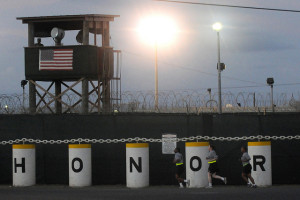
Guantanamo (Joshua Nistas/US Army)
By Peter Hart| FAIR | May 25, 2013
President Barack Obama’s address yesterday on U.S. terror strategies got a lot of attention for supposedly charting a new course in America’s longest war. But some of the facts were mangled along the way.
On CBS Evening News (5/23/13), reporter Major Garrett stated that
Obama urged Congress to close the military prison in Guantanamo Bay, Cuba. To that end, he will seek permission to send 86 of the 166 jailed terror suspects already cleared for release to other countries.
Those 86 prisoners have not been, and will not be, charged with any crime whatsoever; they are not “terror suspects.” Garrett’s statement was all the more awkward considering that it came right before CBS played a clip of Obama saying this:
Imagine a future, 10 years from now, or 20 years from now–when the United States of America is still holding people who have been charged with no crime on a piece of land that is not a part of our country.
To refer to “people who have been charged with no crime” as “terror suspects” is simply Orwellian. Garrett went on to say:
An intelligence report in January, Scott, found that fewer than 5 percent of those detainees released since 2009 have rejoined the fight.
That is indeed the language used in the government’s accounting of former Guantanamo detainees–and the definition of “re-enagaging” has been narrowed considerably since the Bush years. Reporters have taken some of this Pentagon propaganda on this issue at face value in the past, which should be all the more reason to continue to be skeptical. If someone has been imprisoned without charge or trial for a number of years, can one plausibly claim that they have “returned” to committing crimes that they were never charged with in the first place?
It’s not just CBS. In the New York Times (5/24/13), Peter Baker writes:
Mr. Obama said he was lifting a moratorium he imposed on sending detainees to Yemen, where a new president has inspired more faith in the White House that he would not allow recidivism.
Again, these are prisoners cleared for release because they cannot be charged with any crimes. It is bizarre to seriously discuss the threat that they might go back to committing crimes there’s no apparent evidence that they’ve ever taken part in.
Sanctifying nuclear hazards
By Praful Bidwai | The News | May 25, 2013
The disconnect between nuclear power realities and the Indian establishment’s perceptions is complete. Nuclear power has been in worldwide decline for more than a decade. The number of operating reactors peaked in 2002 at 444, but has fallen to under 380. Their output peaked in 2004, and has since decreased annually by two percent or more.
Nuclear energy’s contribution to global electrical generation has declined from its sixteen percent peak to barely eleven percent. Its share in global primary energy supply has fallen to a marginal four percent and of final energy consumption to a minuscule two percent. By contrast, renewable sources [primarily hydro-power] account for 16 percent of global primary energy.
The sixty-year-old nuclear power technology is exhausted. It has seen no major innovation recently, partly because it has been in severe retreat for a quarter-century in its heartland – western Europe, North America and Japan, which host two-thirds of the world’s nuclear fleet.
The US – which has the world’s largest number of reactors – has not installed a single new reactor since 1973. In western Europe, no reactor has been commissioned since Chernobyl (1986). And Japan now runs only two of the 54 reactors it operated before Fukushima.
Exorbitantly expensive nuclear power has failed the market test and globally lost over one trillion dollars in subsidies, abandoned projects, cash losses, etc. No bank will finance reactors; no insurance company will cover them.
Nuclear power evokes fear and loathing everywhere because of its grave public hazards, including exposure to cancer-causing radiation, potential for catastrophic accidents, and the problem of storing highly radioactive wastes for thousands of years, to which science has found no solution. These hazards are magnified by secrecy, technocratic domination and collusion between operators, regulators and governments.
Fukushima is likely to prove the last chapter in the global nuclear power story. When they retire, most of the world’s 160-odd reactors which are 30 or 40 years old won’t be replaced with new ones.
Indian policymakers are totally blind to this. Driven by irrationality, the domestic nuclear lobby, and relentless pressure from foreign reactor manufacturers and governments (to whom Prime Minister Manmohan Singh promised lucrative contracts for backing the US-India nuclear deal), they are pursuing their fantasy of a 12-fold expansion in India’s nuclear capacity by 2032.
They are oblivious of the Indian Department of Atomic Energy’s appalling record. The DAE, argues physicist-analyst MV Ramana, derives its power from the Bomb and the promise of abundant power. It hasn’t delivered even ten percent of the promise – eg 43,500 MW by 1980. It has never completed a project on time, or typically without a 300 percent cost overrun. It has so far installed just 4,780 MW in nuclear capacity – under 2.5 percent of India’s current total.
The official nuclear fantasy now extends to two Russian-supplied reactors being built at Kudankulam in Tamil Nadu, against which the local people have waged a resolute, two decades-long, peaceful struggle. This gathered great momentum after the Fukushima meltdown began in March 2011.
The government has viciously maligned and savagely repressed the movement with arbitrary arrests, FIRs against more than 200,000 people, and charging thousands with sedition, waging war on the state, and attempt to murder. It betrayed its promise not to implement the project until people’s safety concerns are fully allayed.
Meanwhile, evidence piled up that Kudankulam’s operator, Nuclear Power Corporation of India Ltd (NPCIL), violated numerous safety regulations and missed some 20 officially announced commencement deadlines because of serious engineering problems, including supply of sub-standard equipment by Russian company ZiO-Podolsk whose CEO has been jailed for fraud.
Exasperated, an environmental group moved a writ petition seeking the Indian Supreme Court’s intervention in implementing safety norms and enforcing accountability. The petition showed that Kudankulam lacks proper environmental and coastal zone regulation clearances, that the NPCIL has breached norms stipulated by the Atomic Energy Regulatory Board (AERB), and that it has no plans for hazardous spent-fuel storage.
The court pronounced judgement on May 6, clearing the plant’s commissioning while declaring it safe. The verdict trivialises safety concerns, declares nuclear energy indispensable for India’s progress, legitimises the malfunctioning nuclear establishment as infallible, and propounds a perverse notion of the public interest which runs against the constitutionally guaranteed right to life.
The verdict will go down as an anti-people, anti-environment black mark in Indian jurisprudence. Its greatest failure lies in dogmatically denying that nuclear power poses certain unique hazards. Even a conservative, but thoughtful, judgement would have acknowledged this and explored ways of minimising the hazards while boosting transparency and public confidence. This verdict doesn’t.
It declares nuclear power unproblematically safe, and says the Kudankulam reactors satisfy all environmental and safety criteria, based on the say-so of the AERB, DAE and NPCIL – all interested parties! It refuses to recognise the fact that the AERB is not independent, but a subordinate agency of the DAE, to whose secretary (also the Atomic Energy Commission chairman) it reports. The NPCIL is a wholly owned DAE subsidiary.
The AERB has no personnel, equipment or budget of its own. Recently, it was gravely indicted by the comptroller and auditor general of India for failing to fulfil its mandate to evolve and enforce safety standards. Former AERB chairman A Gopalakrishnan calls it a “toothless poodle”. But the verdict uncritically accepts the AERB’s certification of the Kudankulam reactors as safe, ignoring the gross conflict-of-interest involved.
The judgement simply bypasses numerous site-specific issues, including vulnerability to tsunamis, a history of volcanic activity and geological instability, and absence of an independent freshwater source, which is absolutely critical to all reactors.
The verdict ignores the NPCIL’s brazen violations of the AERB’s reactor-siting norms – viz, there must be “zero population” within a 1.5-kilometre radius of a reactor, and a maximum of 20,000 people within a further five- kilometre radius. But at least 5,000 people live within a 1.5- kilometre distance, including over 2,000 in a new rehabilitation colony with 450 tenements, which is less than 800 metres away. By NPCIL’s own admission, 24,000 people live within a five-kilometre radius, according to the 2001 census. Their number must be much greater in 2013. This too is ignored.
According to another norm, no fuel should be loaded in a reactor until a full emergency evacuation drill is conducted in a 16- kilometre radius. This never happened. The judgement ignores this, and also the fact that the plant lacks proper coastal zone regulation and environmental clearances. Equally ignored is the NPCIL’s non-compliance with the seventeen recommendations made by a special safety committee post-Fukushima.
The verdict dismisses people’s safety apprehensions, heightened after Fukushima, as a mere “emotional reaction”. It declares radiation exposure as a “minor inconvenience” which must be subordinated to the “larger public interest” of promoting nuclear power, which is indispensable to growth and will “uphold the right to life in a larger sense”.
The judgement’s worst part is the vile assertion dismissing “apprehension” about hazards, “however legitimate”: “Nobody on this earth can predict what would happen in future and to a larger extent we have to leave it to the destiny (sic)”. That is, the public must live with unacceptable hazards.
The verdict’s sole positive feature is its order to lift all false cases against the protesters. It otherwise lacks reason or logic, and is suffused with fatalism, irrationality and moral misjudgement.
The writer, a former newspaper editor, is a researcher and peace and human-rights activist based in Delhi.Email: prafulbidwai1@yahoo.co.in
Featured Video

The Most Important Bet You’ve Never Heard Of
or go to
Aletho News Archives – Video-Images
From the Archives
The Occupied Mentality Syndrome
Saudi Arabia on the American chessboard – Part 2
By B. J. Sabri | American Herald Tribune | April 19, 2016
Since the Korean War, but particularly since the Iranian Revolution of 1979 until today, the United States has been steadily escalating its military presence in the Persian Gulf. Taking advantage of many colossal events of the past 36 years, [1] the hyper-empire has institutionalized its massive presence on land and sea, and expanded its objectives to include the unambiguous physical control of the area, as well as the clear understanding that local Arab governments should abide by them. The pretext is always the same: in “defense” of the national interests and security of the United States. From observing how the United States has been interacting with the governments of the region, and by judging from the size of its expeditionary force, we could reach a basic conclusion. The United States is occupying, de facto, the entire Arabian Peninsula. (Yemen, devastated by Saudi and American jets is yet to be conquered. Oman? Britain returned not as colonial ruler but as a soft occupying power.)
Under this articulation, Saudi Arabia, Qatar, Kuwait, and the United Arab Emirates are virtually occupied countries. If we compare this type of occupation to the mandate and protectorate regimes of the past, the results might be identical—the nations affected by it lose sovereignty. When Arab governments comply with the objectives of a foreign power that station military forces on their national milieu, then that power controls them in multiple ways including how they react to policy deliberations and what decisions they intend to take on specific issues. A good method to verify the concept of effective occupation is this: take notice of what the United States says and wants, and then compare it to what the gulf rulers do in response. (I shall discuss this detail at some point in the upcoming parts.)
If the presence of US forces or other means of political pressure are a factor in Saudi Arabia’s interventionist Arab wars, then we need to debate this issue. However, from the history of resistance to colonialism, we learnt: if a powerful state imposes its order on a nation by military means or other forms of coercion, and if this nation does not resist that imposition, then a mental subordination to the powerful state will ensue. This is especially true in the case of Saudi Arabia. One single event, 9/11, has transformed it from a US “ally” into an instant political hostage of the American Empire. … continue
Blog Roll
 Aletho News
- Brazilian Congressman seeks to bar Israeli military personnel from entering Brazil
- Official reveals evidence of Arab states’ involvement in US-Israeli war on Iran
- His Majesty’s head-chopper: Syria’s MI6-backed president bows to King Charles
- Forced to backtrack: ‘Israel’ drops Hezbollah disarmament goal
- Britain’s Lebanon surveillance network: A digital map for war
- Bahrain faces scrutiny for opposition crackdown after detainee killed
- Hegseth’s Pentagon Purge Designed to Prevent a Mutiny: Karen Kwiatkowski
- Greek shipping firms secretly transporting oil, weapons to Israel
- UN vote on Hormuz force delayed as Iran issues warning
- Trump and the debris of Iran war
- If Americans Knew
- Israel-US kill negotiators, destroy civilian structures, but Iran’s military capabilities still largely intact – Daily Update
- ‘War crime’: Global condemnation as Israeli ministers celebrate death penalty law targeting Palestinian prisoners
- 7 Ways Israel Is Turning Lebanon Into Gaza
- World’s Leading Football Bodies Under Fire Over Israel Policies
- Experts warn of possible use of nukes against Iran
- Israeli invasion of Lebanon could be worse than 1982, warn European officials
- Passover: Liberation and collective punishment
- Trump says the quiet part out loud: (Israel’s) war on Iran > Americans’ health – Daily Update
- Gaza families reunite years after babies evacuated amid Israel’s war
- International Rescue Committee warns Gaza’s children face grave protection risks
- No Tricks Zone
- Low Intensity Tornado Wrecks Major Solar Farm, Creating A Potential Toxic Dump
- New Study Finds Warming Saves Lives…Cold Temperatures 12 Times More Deadly Than Excess Heat
- German Science Blog Accuses PIK Climate Institute Of Hallucinating Climate Tipping Points
- Devastating Assessment Of Comirnaty Vaccine By Former Senior Pfizer Europe Toxicologist
- New Study: CO2 Is ‘Effectively Negligible’ As An Explanatory Climate Change Factor Since 2000
- Former Pfizer Toxicologist Dr. Helmut Sterz Tells Bundestag Hearing Pfizer Vaccine Should Have Never Been Approved
- Energy Expert: Germany’s Nuclear Phaseout Was A “500 Billion Euro Mistake”
- New Research: South Australia’s Mid-Holocene Sea Surface Temperatures Were 4°C Warmer Than Today
- Storing Green Energy To Last Germany 10 Days Would Require A 60-Million Tonne Battery
- New Studies: UK Sea Levels Were 4 Meters Higher Than Today During The Mid-Holocene
 Aletho News