US reassures Israel of more pressure on Iran: Report
Press TV – July 14, 2013
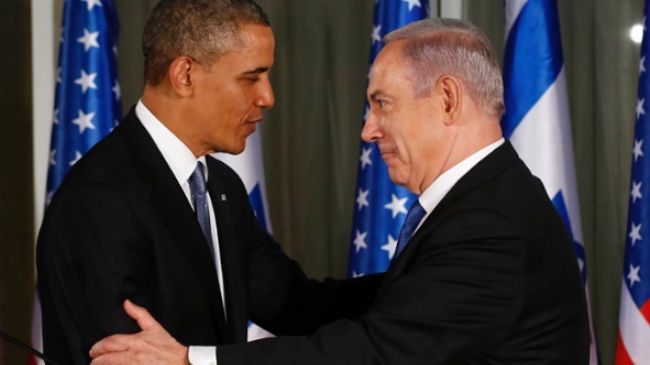
The US reportedly plans to increase pressure on Iran over its nuclear energy program in a move to appease the Israeli regime.
“We will not ease the sanctions [against the Islamic Republic] if Iran does not take action to stop 20 percent enrichment,” senior US officials, who spoke on the condition of anonymity, told the Israeli daily Haaretz on Sunday.
The US officials added that Washington does not intend to ease the sanctions on Iran unless Tehran demonstrates a “change in attitude.”
Referring to the new sanctions against Iran that came into effect on July 1, the officials said Washington plans to ratchet up pressure on the Islamic Republic.
The newly-implemented sanctions against Iran, which target the Iranian energy sector, maritime transportation, ship-building industry, oil trade and currency, were ratified by the US Congress in December 2012 and signed by President Barack Obama in January 2013.
According to the Israeli daily, the upcoming meeting of the P5+1 (Britain, China, France, Russia and the US plus Germany) to discuss the resumption of talks with Iran had fueled Tel Aviv’s concern that Washington may be seeking to ease its pressure on Tehran.
EU foreign policy chief Catherine Ashton is scheduled to meet top officials from the P5+1 on Tuesday in Brussels to discuss “how to move forward in the Iran nuclear file,” said her spokesman Michael Mann on July 12.
Iran and the P5+1 have held several rounds of talks on a range of issues, with the main focus being on Tehran’s nuclear energy program.
The latest round of negotiations between the two sides was held in Istanbul, Turkey, on May 16. Two earlier meetings had also been held in the Kazakh city of Almaty on April 5-6 and February 26-27. … Full article
Russia declassifies vast extent of oil, gas reserves
RT | July 12, 2013
According to declassified data Russia holds 17 billion tons of oil and 48 billion cubic meters of gas. Moscow believes revealing the extent of the vast reserves will lead to a surge of investment in the extraction and production of hydrocarbons.
The country’s recoverable oil reserves in the C1 category (proven reserves) totals 17.8 billion tons; category C2 (preliminary estimated reserves) is 10.2 billion tons, according to data collected on January 1, 2012.
Meanwhile, gas reserves were equally bountiful at 48.8 trillion cubic meters C1 category; gas stores of the C2 category is estimated at 19.6 trillion cubic meters.
The Minister of Natural Resources of the Russian Federation Sergey Donskoy said the resource potential for these kinds of mineral resources remains one of the most significant in the world. “I am convinced that the opening of this data will give a powerful impetus to investment in reproduction and production of hydrocarbons,” he said. He also added that Russia’s potential for the mineral resources is one of the most significant in the world.
Russia’s available hydrocarbon potential will be able to provide the nation’s growing economy for 30 years, according to expert estimates put out by the Russian Ministry of Natural Resources and the Federal State Commission on Mineral Reserves.
Meanwhile, increased exploration of mineral resources consistently exceed the level of production, the minister said, noting that last year 49 oil fields were discovered.
Last week, Prime Minister Dmitry Medvedev signed a government decree that removed the lid of secrecy on oil reserve data.
Earlier, President Putin, explained the necessary level of cooperation that exists between the domestic fuel and energy sector and foreign investors, called the former level of secrecy “an obvious anachronism.”
Putin also called on the development and approval of a new classification of Russian oil and gas reserves as close as possible to international standards.
Before the release of the official data Russia was placed second in the world by gas reserves after Iran, with 32.9 trillion cubic meters, and eighth by crude oil reserves, after Venezuela, Saudi Arabia, Canada, Iran, Iraq, Kuwait and UAE, with 11.8 trillion cubic meters of oil.
Related article
- Russia ranked world leader in shale oil reserves (alethonews.wordpress.com)
Big blast rocks mosque in Tipton, England
Press TV – July 12, 2013
A huge explosion has rocked Tipton, a town in the Sandwell borough of the West Midlands, England, close to the area’s Islamic place of worship, local media reported.
Panicked residents in Tipton reported finding nails and debris scattered close to the mosque shortly after the blast shook the area just after 1pm, British media reported.
Counter-terrorism police are investigating a suspected nail bomb attack at a mosque, according to reports.
Locals were evacuated from their homes and dozens of worshippers – who had been heading to Friday prayers in the first week of the holy month of Ramadan – had to be turned away.
They said the explosion came from a nail bomb planted in the car park at Kanz-ul-Iman Central Jamia Mosque in Binfield Street.
Rai Khan, who works in an office across the road from the mosque, described the noise which shook the building as like “being in a war zone”.
“I heard the nail bomb go off. There was one hell of an almighty bang”, he said, adding “it shook my office and really made me jump.
“There were nails strewn all over the place, I am amazed it didn’t kill anybody”, Rai Khan said.
“The windows to the mosque were all smashed up. It was like a war-zone.
“It was placed in the main car park during Friday prayers, it was obviously put there with that in mind”, he added.
A West Midlands Police spokesperson confirmed counter-terrorism officers had been dispatched to the scene.
He said: “Police have been called to Binfield Street in Tipton this afternoon following reports of a loud bang.
“Officers were called at 1.06pm and are currently at the scene.
“A cordon has been set up and the immediate area is being evacuated as a precautionary measure while police investigate what caused it.
“There are no reports of any injuries to anyone at this time.
“An investigation is being led by the West Midlands Counter Terrorism Unit and it is being treated as a terrorist incident.”
Israeli Army Test-fires Nuclear-Capable Ballistic Missile
Al-Manar | July 13, 2013
The Zionist military has test-fired a new long-range ballistic missile reportedly capable of carrying a nuclear, chemical or biological warhead.
The military described Friday’s launch from a base on the Mediterranean coast as the test of the propulsion system of a missile on which it declined to elaborate, AFP reported.
“This morning, Israel conducted a launching test from the Palmachim base of a rocket propulsion system,” the Israeli ministry for military affairs said in a brief statement.
“The scheduled test was pre-planned… and was carried out as expected,” it added.
S. American states to recall ambassadors from Europe over Bolivian plane incident
RT | July 12, 2013
South American countries belonging to the Mercosur trade bloc have decided to withdraw their ambassadors for consultations from European countries involved in the grounding of the Bolivian president’s plane.
“We’ve taken a number of actions in order to compel public explanations and apologies from the European nations that assaulted our brother Evo Morales,” explained Venezuela’s President Nicolas Maduro, who revealed some of the agenda debated during the 45th summit of Mercosur countries in Uruguay’s capital, Montevideo.
The decision to recall European ambassadors was taken by Maduro, Argentina’s President Cristina Fernandez, Brazilian President Dilma Rouseff, and Uruguay’s President, Jose Mujica, during the meeting.
Member states attending the summit expressed their grievances with “actions by the governments of France, Spain, Italy and Portugal” over the July 2 incident, when the aircraft carrying President Evo Morales back to Bolivia after attending an energy summit in Moscow was denied entry into the airspace of a number of EU member states.
The small aircraft, which required a stop-over before completing its flight, was forced to make an emergency landing in Austria after a circuitous flight path.
It was later revealed that the European countries’ actions were prompted by accusations made by the US ambassador to Austria, William Eacho, who alleged that American whistleblower Edward Snowden had been taken on board to help him gain political asylum in Latin America.
“The gravity of the incident – indicative of a neocolonial mindset – constitutes an unfriendly and hostile act, which violates human rights and impedes freedom of travel, as well as the treatment and immunity appropriate to a head of state,” the Mercosur nations affirmed in the joint statement.
The incident was further described as a “discriminatory and arbitrary” decision by European countries, as well as a “blatant violation of international law.”
The NYT Continues to Misinform on Chemical Weapons in Syria
By Michael McGehee · NYTX · July 11, 2013
Writing in his original preface to Animal Farm, George Orwell wrote about how “inconvenient facts [can be] kept dark, without the need for any official ban”:
Anyone who has lived long in a foreign country will know of instances of sensational items of news – things which on their own merits would get the big headlines – being kept right out of the British press, not because the Government intervened but because of a general tacit agreement that ‘it wouldn’t do’ to mention that particular fact […] At any given moment there is an orthodoxy, a body of ideas which it is assumed that all right-thinking people will accept without question. It is not exactly forbidden to say this, that or the other, but it is ‘not done’ to say it, just as in mid-Victorian times it was ‘not done’ to mention trousers in the presence of a lady. Anyone who challenges the prevailing orthodoxy finds himself silenced with surprising effectiveness. A genuinely unfashionable opinion is almost never given a fair hearing, either in the popular press or in the highbrow periodicals.
One way in which readers, listeners, or viewers can gauge the validity of news stories is by how quickly they drop off the media’s radar. If a story is sensationalist hype it will likely disappear as fast as it appeared. Another way is if the story gets reported at all.
Earlier this year was the scare story of an impending North Korea attack on the United States. The mainstream media, especially in the U.S. and the West, went ballistic (pun intended) on supposed North Korean threats. Hundreds, possibly thousands, of articles claimed over and over that North Korea threatened to attack South Korea and the United States. That was the popular narrative repeated ad infinitum. But it’s not entirely true. What North Korea “threatened” was retaliation, not an attack. Kim Jong-Un said his country would respond to South Korean and American aggression.
But, let’s rewind to the New Year. According to the Washington Post: “In New Year’s speech, N. Korea’s Kim says he wants peace with South”:
SEOUL — In a domestically televised New Year’s Day speech, North Korean supreme leader Kim Jong Eun said he wants to “remove confrontation” on this divided peninsula and called on “anti-reunification forces” in South Korea to end their hostility toward the North.
The lengthy address, which laid out North Korea’s goals for the year, marked Kim’s first formal remarks since the election two weeks ago of Park Geun-hye as South Korea’s next president.
The North Korean leader asked for a detente — but with prerequisites that the conservative Park is likely to be reluctant to accept. Both sides, Kim said, must implement joint agreements signed years ago by the North and liberal, pro-engagement presidents in Seoul. Those agreements call for, among other things, economic cooperation, high-level government dialogue and the creation of a special “cooperation” zone in the Yellow Sea, where the North and South spar over a maritime border.
The peace overture was replied with the annual South-Korean-U.S. military exercise, but this time with an interesting twist: the exercise included a scenario of a pre-emptive attack on North Korea. Worse, the U.S. pulled out its B-52’s, that are capable of firing nuclear weapons, and flaunted them recklessly.
In chronological order: North Korea requests peace and steps to move in that direction, to which South Korea and the United States respond with a mock scenario of a pre-emptive strike, including the possible use of nuclear weapons, to which North Korea says it will retaliate against any such attack, and, finally, the American media largely ignores this context, that Kim was vowing retaliation, and whips up hysteria of North Korea coming out of the blue with threats of nuking America.
But then the story simply went away.
We have seen this also with the recent case of Syria and the regime’s alleged use of chemical weapons.
A month ago the White House came out with the claim that the Syrian government used chemical weapons “on a small scale against the opposition multiple times in the last year.”
And though FAIR’s Peter Hart quickly pointed out that skepticism was “warranted,” the mainstream media saturated news outlets with the story.
But, like the North Korean “threat,” the story simply went away.
Until yesterday.
The story is back on the radar as Russia provided the UN, and Western countries with their report on the Sarin attack in Aleppo, Syria. Unlike the US, the Russians have (and provided) evidence that it was the rebels who carried out the chemical attack.
According to Rick Gladstone of The New York Times, in his article “Russia Says Study Suggests Syria Rebels Used Sarin,” and which appears on page A7 of the July 10, 2013 edition, Moscow’s “scientific analysis of a suspected chemical weapons attack in Syria on March 19 showed it probably had been carried out by insurgents using Sarin nerve gas of ‘cottage industry’ quality delivered by a crudely made missile.” Gladstone then informs us that Russia’s findings “contradicted conclusions presented by Western nations, including the United States, that the Syrian government had been responsible.”
The most troubling aspect of Gladstone’s article was this passage: “The American conclusion was based in part on indirectly procured soil samples and interviews with survivors, as well as the Syrian insurgency’s lack of technical ability and materials to carry out a chemical weapons attack.”
The problem? Those last sixteen words—“the Syrian insurgency’s lack of technical ability and materials to carry out a chemical weapons attack”—are presented, not as a claim, but as a fact. As we at the NYTimes eXaminer pointed out last month, The New York Times has ignored two important news items that undermine this assertion: (1) the hacking of Britam, a British defense company, revealed a plan by Washington for the use of chemical weapons in Syria, and then blame it on the government; and (2) the arrest of Syrian rebels in Turkey, who happened to be in possession of Sarin nerve gas.
All of this occurred before the White House came out with their claim that the Syrian government was behind the Sarin attacks, and was readily available in the press, though not reported by The New York Times. To this day the “paper of record” has yet to mention either of these two incidences, even as they claim that the Syrian rebels have a “lack of technical ability and materials to carry out a chemical weapons attack.”
Readers should be concerned with why sensationalist stories of a threatening North Korea, and chemical weapon-using Syria, can appear long enough to outrage the public, but stories of false flags, and rebels getting caught with the very chemical weapons we claim they don’t have, go unreported.
EU subservient to US – Irish MP who called Obama ‘war criminal’

RT | July 12, 2013
Standing up to one’s government is becoming the only way for citizens to stop the spread of Western imperialism and its double standards, said Clare Daly, the now famous Irish MP who lambasted President Obama at Northern Ireland’s G8 summit.
RT recently interviewed Daly, discussing matters of politics, economics and human rights set against a backdrop of US pressure on the world to comply with its vision.
Despite hefty political backlash incurred after the summit for calling Obama a “war criminal,” Daly appeared optimistic that her views were shared by many across the world. She ultimately believes, she said, that it is those people across Europe and America who should scrutinize their politicians and demand greater accountability in foreign affairs and a lesser flexibility to US coercion where matters like war in the Middle East and the fate of whistleblowers are concerned.
Speaking of Ireland, which some may remember was the subject of her attack at the summit, she complained of the country’s “unprecedented slobbering” whenever Obama appeared on the horizon, saying that, “It’s hard to know which is worse, whether it’s the outpourings of the Obamas themselves, or the sycophantic fawning over them by sections of the media and the political establishment.”
But she also takes a more encompassing view of things, underlining the suffering of the austerity-ridden Irish.
“When Obama visited, [the government] would make no points of criticism, everything was wonderful. We must get American companies into this country to create employment, but the reality is that most of the American companies come to avoid paying their taxes at home and in Ireland, which means it is ordinary people who suffer, and the very wealthy are those who want these companies to benefit,” she said, emphasizing Europe’s economic subservience to the United States.
The political and moral implications of this subservience are Daly’s main targets.
Ireland, she says, is a neutral country. But that policy loses meaning already at Ireland’s Shannon airport: whether it is the government’s ignoring of planes armed to the teeth, or suspicious cargo that could be anything from arms deliveries for third parties, to prisoners being relayed for rendition by the CIA, there is a relationship of unquestioning submissiveness when it comes to the Irish government and the US.
“The arrangement is that when a military aircraft lands on our territory, they are not supposed to be armed, carrying explosives, weapons, not engaged in intelligence or in any military exercise. But our question is, how do we know they are not providing ammunition for Syria? We don’t know that, because the Irish government won’t investigate or carry out inspections of those flights as they should.”
“They never go on to an aircraft when the US carries people suspected of being trafficked on rendition flights – do they ask them about passports? The Irish government turned a blind eye on that.”
The opposite logic was applied to the rumor of NSA whistleblower Edward Snowden stopping over in Ireland on a commercial flight from Moscow to Cuba, with the Americans sending a provisional arrest warrant to the Irish in the hopes that they would hand him over. Daly herself is a great supporter of Snowden’s struggle and considers him an international hero.
And Daly is not surprised with the lax attitude European governments took to Snowden’s revelations about the US spying on the world and its governments. She believes those governments ultimately want the same thing, on the one hand, and on the other – they fear economic and political pressure from the US.
“They have a reason to be fearful because the United States is using its weight – its economic weight, in some instances, and its military weight in others – to intimidate those countries. I think we saw that graphically with Ecuador – threatening to take their trade preferences from them if they were to give him asylum.”
The grounding of the Bolivian president’s plane in Vienna and the collusion of every major Western European country in the incident is seen by Daly as a supreme example of this process.
Her final conclusion is that ordinary people must not give up the fight for what they believe is right. And that fight must encompass all spheres of life – from economics to politics and to the defense of people and whistleblowers of all kinds – because their governments appear unwilling to take the stance against US hegemony themselves.
Related articles
Featured Video

The Most Important Bet You’ve Never Heard Of
or go to
Aletho News Archives – Video-Images
From the Archives
The Occupied Mentality Syndrome
Saudi Arabia on the American chessboard – Part 2
By B. J. Sabri | American Herald Tribune | April 19, 2016
Since the Korean War, but particularly since the Iranian Revolution of 1979 until today, the United States has been steadily escalating its military presence in the Persian Gulf. Taking advantage of many colossal events of the past 36 years, [1] the hyper-empire has institutionalized its massive presence on land and sea, and expanded its objectives to include the unambiguous physical control of the area, as well as the clear understanding that local Arab governments should abide by them. The pretext is always the same: in “defense” of the national interests and security of the United States. From observing how the United States has been interacting with the governments of the region, and by judging from the size of its expeditionary force, we could reach a basic conclusion. The United States is occupying, de facto, the entire Arabian Peninsula. (Yemen, devastated by Saudi and American jets is yet to be conquered. Oman? Britain returned not as colonial ruler but as a soft occupying power.)
Under this articulation, Saudi Arabia, Qatar, Kuwait, and the United Arab Emirates are virtually occupied countries. If we compare this type of occupation to the mandate and protectorate regimes of the past, the results might be identical—the nations affected by it lose sovereignty. When Arab governments comply with the objectives of a foreign power that station military forces on their national milieu, then that power controls them in multiple ways including how they react to policy deliberations and what decisions they intend to take on specific issues. A good method to verify the concept of effective occupation is this: take notice of what the United States says and wants, and then compare it to what the gulf rulers do in response. (I shall discuss this detail at some point in the upcoming parts.)
If the presence of US forces or other means of political pressure are a factor in Saudi Arabia’s interventionist Arab wars, then we need to debate this issue. However, from the history of resistance to colonialism, we learnt: if a powerful state imposes its order on a nation by military means or other forms of coercion, and if this nation does not resist that imposition, then a mental subordination to the powerful state will ensue. This is especially true in the case of Saudi Arabia. One single event, 9/11, has transformed it from a US “ally” into an instant political hostage of the American Empire. … continue
Blog Roll
 Aletho News
- IRGC hits US tech giant Oracle’s data center, computing site in UAE over new assassinations
- Bombing Iran Back Into the Stone Age /Lt Col Daniel Davis & Jim Jatras
- UAE rejects report claiming it is ready to join war on Iran to reopen Hormuz
- A New Resistance Front: How Does Syria Factor into the Regional War?
- Gulf states weigh pipeline expansion plans, hoping to bypass Hormuz
- Iran sets up ‘tollbooth’ system in Strait of Hormuz
- Wave 90: IRGC strikes US-linked industrial sites in Gulf
- Iran Says US-Israeli Claims of Its Military Strength Are Wrong
- Trump’s April Fools’ Address to the nation
- The Most Important Bet You’ve Never Heard Of
- If Americans Knew
- ‘War crime’: Global condemnation as Israeli ministers celebrate death penalty law targeting Palestinian prisoners
- 7 Ways Israel Is Turning Lebanon Into Gaza
- World’s Leading Football Bodies Under Fire Over Israel Policies
- Experts warn of possible use of nukes against Iran
- Israeli invasion of Lebanon could be worse than 1982, warn European officials
- Passover: Liberation and collective punishment
- Trump says the quiet part out loud: (Israel’s) war on Iran > Americans’ health – Daily Update
- Gaza families reunite years after babies evacuated amid Israel’s war
- International Rescue Committee warns Gaza’s children face grave protection risks
- Iran’s Alleged 47-Year War on America: Debunking the 1,050 American Deaths Canard
- No Tricks Zone
- Low Intensity Tornado Wrecks Major Solar Farm, Creating A Potential Toxic Dump
- New Study Finds Warming Saves Lives…Cold Temperatures 12 Times More Deadly Than Excess Heat
- German Science Blog Accuses PIK Climate Institute Of Hallucinating Climate Tipping Points
- Devastating Assessment Of Comirnaty Vaccine By Former Senior Pfizer Europe Toxicologist
- New Study: CO2 Is ‘Effectively Negligible’ As An Explanatory Climate Change Factor Since 2000
- Former Pfizer Toxicologist Dr. Helmut Sterz Tells Bundestag Hearing Pfizer Vaccine Should Have Never Been Approved
- Energy Expert: Germany’s Nuclear Phaseout Was A “500 Billion Euro Mistake”
- New Research: South Australia’s Mid-Holocene Sea Surface Temperatures Were 4°C Warmer Than Today
- Storing Green Energy To Last Germany 10 Days Would Require A 60-Million Tonne Battery
- New Studies: UK Sea Levels Were 4 Meters Higher Than Today During The Mid-Holocene
 Aletho News