Uncontrolled by FISA court, NSA commits ‘thousands of privacy violations per year’
RT | August 16, 2013
The National Security Agency broke the law and ignored privacy protections thousands of times in each of the years since Congressional leaders expanded the agency’s power in 2008, according to a new report citing documents leaked by Edward Snowden.
The majority of the violations are related to unauthorized surveillance on Americans or foreigners inside the United States, conditions deemed illegal by executive order, according to a new report from the Washington Post.
The account is based on top-secret documents and a May 2012 internal NSA audit that found 2,776 infractions – including unauthorized collection, storage, access to or distribution of legally protected communications – in the preceding 12 months alone. The audit, originally only meant to be seen by top NSA leaders, only accounted for violations at NSA headquarters at Fort Meade, Virginia, and other locations in the Washington DC region.
Three government sources told the Post that the 2,776 infractions would in fact be much higher had the audit included all NSA data collection centers. Each of the 2,776 violations could have potentially encompassed thousands of communications.
“One key to the Washington Post story,” tweeted journalist Glenn Greenwald, who first published Snowden’s disclosures in June, “the reports are internal, NSA audits, which means high likelihood of both under-counting and white-washing.”
One of the most flagrant examples is a 2008 incident when a “large number” of telephone calls were inadvertently intercepted because a programmer erroneously typed “202” instead of “20,” Egypt’s national calling code, according to a “quality assurance” memorandum never seen by NSA oversight staff.
Another time, the NSA kept 3,032 files they were ordered to destroy by the Foreign Intelligence Surveillance Act (FISA) court. Each individual file included an undisclosed number of telephone call records, according to the Post.
In a separate incident, the NSA failed to notify the FISA court about a new collection method the agency was using for months, at which point the court deemed the method unconstitutional. The agency reportedly “diverted large volumes of international data passing through fiber-optic cables in the United States into a repository where the material could be stored temporarily for processing and selection.”
This finding, and others like it, refutes claims made by NSA chief Keith Alexander and other brass that the government does not store or process the information it collects. As per NSA policy, the number of Americans affected was not disclosed in the top-secret documents.
NSA officials also failed to explain why, with the number of violations lower in 2008 and 2009 than in later years, violations only increased as time went on.
US District Judge Reggie Walton, the chief judge of the FISA court, admitted that the court’s rulings are based only on information provided by the government. Consequently, judges entrusted with determining what the NSA may and may not do are forced to rely on the NSA to prove the government has not and will not overstep its legal bounds.
“The [FISA court] is forced to rely upon the accuracy of the information that is provided to the Court,” Walton wrote to The Washington Post. “The [FISA court] does not have the capacity to investigate issues of noncompliance, and in that respect the [FISA court] is in the same position as any other court when it comes to enforcing [government] compliance with its orders.”
Privacy advocates have previously expressed concern that the court is never informed of many of the violations. Even when the court is informed of the agency’s intentions, however, the judges are sometimes ignored.
A recently declassified Justice Department review from 2009 discovered a “major operational glitch that had led to a series of significant violations of the court’s order and notified the court.” While specifics of the error were not disclosed, problems including the so-called “over-collection” of phone call metadata were reported.
“The problems generally involved the implementation of highly sophisticated technology in a complex and ever-changing communications environment which, in some instances, results in the automated tools operating in a manner that was not completely consistent with the specific terms of the Court’s orders,” a December 2009 memo to the Senate and House intelligence committees stated.
The Washington Post notified the NSA of Thursday’s report before it was published, at which point the agency said it stops mistakes “at the earliest possible moment, implement mitigation measures wherever possible, and drive them down.”
“We’re a human-run agency operating in a complex environment with a number of different regulatory regimes, so at times we find ourselves on the wrong side of the line,” said one senior official who spoke on the condition of anonymity. “You can look at a number in absolute terms that looks big, and you look at it in relative terms, it looks a little different.”
The documents also described a tutorial that NSA collectors and analysts are required to complete. Titled the “Target Analysts Rationale Instructions,” the training instructs employees on how to complete oversight requirements without revealing “extraneous information” to “our FAA overseers,” a reference to the FISA Amendments Act of 2008.
California Senator Dianne Feinstein said she did not receive a copy of the audit until questioned by the Post, despite her position as Senate Intelligence Committee Chairman. She said the committee “can and should do more to independently verify that NSA’s operations are appropriate, and its reports of compliance incidents are accurate.”
The timing of the report comes just after US President Barack Obama defended the NSA’s widespread domestic and foreign surveillance. Obama said the programs were necessary to protect national security and legitimate partly because of comprehensive oversight.
“If you look at the reports – even the disclosures that Mr. Snowden has put forward – all the stories that have been written, what you’re not reading about is the government actually abusing these programs and listening in on people’s phone calls or inappropriately reading people’s emails,” Obama said.
“What you’re hearing about is the prospect that these could be abused. Now, part of the reason they’re not abused is because these checks are in place, and those abuses would be against the law and would be against the orders of the Foreign Intelligence Surveillance Court.”
After the initial report was published Thursday night the Washington Post issued an appendix revealing that after reporters spoke with NSA leadership, the Obama administration refused allow the Post to publish their names or official titles. The explanation from the newspaper is reproduced in full below:
“The Obama administration referred all questions for this article to John DeLong, the NSA’s director of compliance, who answered questions freely in a 90-minute interview. DeLong and members of the NSA communications staff said he could be quoted “by name and title” on some of his answers after an unspecified internal review. The Post said it would not permit the editing of quotes. Two days later, White House and NSA spokesmen said that none of DeLong’s comments could be quoted on the record and sent instead a prepared statement in his name. The Post declines to accept the substitute language as quotations from DeLong. The statement is below.
“We want people to report if they have made a mistake or even if they believe that an NSA activity is not consistent with the rules. NSA, like other regulated organizations, also has a “hotline” for people to report — and no adverse action or reprisal can be taken for the simple act of reporting. We take each report seriously, investigate the matter, address the issue, constantly look for trends, and address them as well — all as a part of NSA’s internal oversight and compliance efforts. What’s more, we keep our overseers informed through both immediate reporting and periodic reporting. Our internal privacy compliance program has more than 300 personnel assigned to it: a fourfold increase since 2009. They manage NSA’s rules, train personnel, develop and implement technical safeguards, and set up systems to continually monitor and guide NSA’s activities. We take this work very seriously.”
Related article
Did The NSA Think The Public Can’t Do Math? Attempt To Downplay Data Collection Fails Miserably
By Mike Masnick | Techdirt | August 14, 2013
Last week we wrote about the NSA’s ridiculous attempt to justify its surveillance efforts, including this really wacky callout designed to show just how “little” data the NSA collects.
Scope and Scale of NSA Collection
According to figures published by a major tech provider, the Internet carries 1,826 Petabytes of information per day. In its foreign intelligence mission, NSA touches about 1.6% of that. However, of the 1.6% of the data, only 0.025% is actually selected for review. The net effect is that NSA analysts look at 0.00004% of the world’s traffic in conducting their mission — that’s less than one part in a million. Put another way, if a standard basketball court represented the global communications environment, NSA’s total collection would be represented by an area smaller than a dime on that basketball court.
This was bizarre on a number of levels, not the least of which is the wacky basketball court-to-dime scale. Next time, maybe we can play “is it bigger than a breadbox” with the NSA. But, as for what any of this meant, it hasn’t been at all clear. Since the NSA has already redefined basic English words like “collect,” “target,” “datamine,” and “relevant” it’s not at all clear what is meant by “touch.” However, some are starting to dig into the numbers, and contrary to the NSA’s attempt to suggest that this is “nothing to fear,” a bit of analysis certainly suggests they’re collecting quite a bit of info.
First up, we have Jeff Jarvis, who highlights a bunch of important comparative datapoints including that Sandvine claims that only 2.9% of US traffic is communication traffic and 68.8% of all email is spam — meaning that it’s entirely possible that the NSA collects nearly all non-spam email and it would still be within its 1.6% number. He also points out that 62% of traffic on the internet is considered entertainment, and we can assume that the NSA doesn’t need to collect every copy of Game of Thrones that people are passing around (I’m sure one or two will do the job). He similarly points out that Google itself claims to only index approximately 0.004% of traffic on the internet, suggesting that the NSA may be collecting more info than Google indexes by two orders of magnitude.
Meanwhile, Sean Gallagher, over at Ars Technica, digs a bit deeper into the numbers, suggesting that the NSA’s data collection is closer to being on par with Google, but still greater than Google:
The dime on the basketball court, as NSA describes it, is still 29.21 petabytes of data a day. That means NSA is “touching” more data than Google processes every day (a mere 20 petabytes).
Gallagher also looks much more closely at the recently revealed details of the Xkeyscore program, to show how that 1.6% of “touched” internet communications can cover pretty much everything important.
As a result, if properly tuned, the packet analyzer gear at the front-end of XKeyscore (and other deep packet inspection systems) can pick out a very small fraction of the actual packets sent over the wire while still extracting a great deal of information (or metadata) about who is sending what to who. This leaves disk space for “full log data” on connections of particular interest.
In other words, while the 1.6% number was put forth by the NSA to try to make people think this is no big deal, when you look at what it means, it suggests it’s a very big deal indeed. In fact, the NSA may be collecting even more information that people had believed before.
Tide Begins to Turn against FIFA in Rio de Janeiro
By Brian Mier | CEPR Americas Blog | August 15, 2013
After two months of protests that started over price gouging in public transportation and spread to a variety of issues spanning the political spectrum, positive results are beginning to be seen in Rio de Janeiro, where governor Sérgio Cabral, once touted in the New York Times as a possible 2014 presidential candidate is now so unpopular that socialist former mayoral candidate Marcelo Freixo said that he doesn’t think he could even get elected as a condominium residents association secretary.
During the last week a series of measures was announced that seem to show a turning of the tide against the hegemony wielded by the Fédération Internationale de Football Association (FIFA) and the Rio de Janeiro state and municipal governments over local residents.
First, after spending over $500 million rehabbing the structurally sound Maracana stadium – its third multi-million rehab in a dozen years – the plan to privatize and sell it off to a group of cronies for a fraction of that value has been stalled. The landmark status for the neighboring high school and Indigenous museum buildings has been upheld by the court system, so they can no longer be destroyed to create a parking garage. Furthermore, the federal government has blocked destruction of the public swimming pool and athletic track that made up part of the stadium compound. According to the privatization agreement, these are deal killers. The original plan was to surround the stadium with parking garages and luxury shops for the white, middle-class patrons who would now be the only ones able to easily afford ticket prices. The consortium that was poised to take over management of the stadium announced that it was going to back out, then changed its mind but still hasn’t closed a deal. It appears that the new, expensive ticket prices are keeping fans away and this might prove to be a deciding factor in blocking privatization.
Meanwhile, last Friday, the mayor’s office announced that after years of protests and construction of an alternative participatory development plan by local residents together with social movements and the Universidade Federal de Rio de Janeiro planning department, it will no longer raze the neighborhood of Vila Autódromo, which was originally marked for destruction in order to “beautify” the neighborhood for the upcoming “mega-events.” Since 2008, the mayor’s office has evicted tens of thousands of people, but it is hoped that this too will mark a turning point against a government that, until its popularity plummeted last month, felt like it could do whatever it wanted.
The much hailed program for setting up police stations in favelas that were previously controlled by drug trafficking organizations and paramilitary militias, called UPP, is also coming under fire. Drug trafficking gangs continue to operate within the pacified favelas, albeit without carrying machine guns around on the street, and a recent study shows that disappearances of residents has increased by over 50 percent in favelas after the UPP Units have been put in place. The disappearance of a construction worker and father of four, last seen being forced into a UPP Police car in front of his house in Rocinha, has turned into a national issue, as people are holding up signs all over the country during protests asking, “Where is Amarildo?”
Across the nation, people are rising up against the planned “state of exception” that FIFA demands take place for two months before and after the World Cup in 2014, coded into Brazilian law as part of the “General Law of the World Cup” of June 5, 2012. This “state of exception” will enable the government to bypass public bidding laws, provide tax abatement on all official FIFA-sponsored products and hire private foreign security forces to replace the local police protecting players and FIFA officials. In accordance with the Brazilian constitution of 1989, a “state of exception” can only be called in cases of war or natural disasters, making the FIFA law technically illegal. But popular and legal challenges to the Brazilian general “Law of the Cup” are mounting. During the World Cup in South Africa FIFA was able to leave the country with $2.4 billion in profits, while South Africans were left footing the maintenance bill for “white elephant” stadiums in towns with no major sports teams. It will be interesting to see how much FIFA is able to get away with this time around, especially since 2014 is an election year in Brazil.
Brian Mier is a geographer and freelance journalist who lives in Brazil and works as a policy analyst at the Centro de Direitos Econômicos e Sociais. He has a podcast, focused on news reported in the Brazilian alternative media, at http://progressivebrazil.tumblr.com/
Related article
Honduran Union Leader Faces Death Threats
By Eric Gottwald | Labor is Not a Commodity | August 15, 2013
Long-time Honduran union leader José María Martínez of FESTAGRO is facing serious and repeated death threats for speaking out for banana workers’ rights.
For the past 20 years, Martínez has hosted a daily radio show called “Trade Unionist on Air” where he shares labor rights, human rights, and citizenship information with Honduras’ agricultural workers and answers questions for callers concerned about rights violations. Since September of 2012, Martínez has been working closely with workers at the Tres Hermanas banana plantations, suppliers for Chiquita Bananas, who have been struggling to win a collective bargaining agreement in the face of harsh employer repression. Since May, the struggle of the Tres Hermanas workers has been a frequent topic on Martínez’s radio program.
On June 25, 2013, unidentified callers used an untraceable number to call Martínez, demanding he “stop talking sh*t on the radio or [they] will shut his mouth for him,” and to “prepare your burial clothes because we are going to kill you.” They repeated those threats the following day. The perpetrators also made repeated calls to his wife reiterating the death threats and citing the specific clothing Martinez wore each day as proof they were following him.
On July 5th, those threats escalated as an unmarked vehicle staked out Radio Progreso, home to “Trade Unionist on Air.” The vehicle circled Martínez’s place of work four times at the hour Martínez was getting off air. Martínez was forced to escape through a back exit, escorted by Father Ismael Moreno, the Catholic priest who serves as the director for Radio Progreso.
The local police force has warned Martínez to not leave his home without first notifying them for his own protection. Since the 2009 coup, 31 trade unionists, 52 rural workers, and 28 journalists have been murdered in Honduras.
FESTAGRO has asked for supporters to write to the US and Honduran governments to demand protection for José María Martínez and an investigation into these threats:
-
Honduras Attorney General’s Office: denuncias@mp.hn
- US Department of State, Ben Gedan, Honduras Desk: gedanbn@state.gov
You can also write to Chiquita Bananas (who buys from Tres Hermanas) and Jose Lorenzo Obregon, owner of the Tres Hermanas Plantation, to ask that they speak out against these threats and use their influence to end Tres Hermanas’ ongoing refusal to bargain with SITRAINBA, workers’ legally recognized bargaining representative.
-
Jose Lorenzo Obregon, Owner of the Tres Hermanas Plantation: jolobregon@gmail.com
- Chiquita Banana, Manuel Rodriguez, Vice President for Labor Relations: mrodriguez@Chiquita.com
Eric Gottwald is Senior Policy Analyst at the International Labor Rights Forum.
Related articles
- Guatemala urged to investigate trade unionist murders (theguardian.com)
- TUC protests to Colombia over threats (morningstaronline.co.uk)
- What it means to be a union member in Colombia and Chicago (alethonews.wordpress.com)
- Speak without fear in Honduras (unesco.org)
Brazil: Senate Approves Law to Fund Public Services with Oil Revenue
By Kahina Boudarène | The Argentina Independent | August 15, 2013
The law to fund public services with oil revenue, headed by Brazil president Dilma Rousseff, was ratified yesterday by the Senate, two weeks after its approval by the lower house.
“We listened to the streets voices,” declared Renan Calheiros, leader of the Senate, referring to the massive social movements that started several weeks ago all around the country.
The senate has approved the move to use 75% of crude oil revenue to finance education and the other 25% to bankroll the health sector.
The law affects all oil contracts that fall within the “declaration of commerciality”, which was signed on 3rd December 2012.
At first, Rousseff wanted to direct 100% of the revenue to education. The measure was part of a pact announced last June to establish “ways to fight effectively against corruption”.
The pact contains four key points: a national mobility plan privileging public transports; 100% of the oil revenue to education sector; bringing thousands of foreign doctors to the country; and meeting with leaders from peaceful demonstrations, youth organisations, trade unions, workers movements and popular organisations.
ISM statement: Hoax video designed to harm the Palestinian popular struggle
International Solidarity Movement | August 15, 2013
A video has been put online on a website claiming to be a human right organization with a woman impersonating an ISM volunteer. In the video a woman who claims to have volunteered with the ISM in Palestine says that she was sexually harassed by a prominent Palestinian activist. The ISM want to make clear that this video is a hoax: the woman is not an ISM volunteer and the Facebook and Twitter pages are not of any human rights organization.
We believe this video is designed to harm the Palestinian popular struggle and the international solidarity movement in Palestine.
It is not the first time a video in which someone claims to be an International activist has been produced in order to attack the popular struggle and the solidarity movement. For example, before the freedom flotilla left for Gaza, a hoax video was released in which an Israeli actor posed as a solidarity activist and was eventually exposed.
When cases of sexual harassment or assault occur, as they do everywhere in the world, ISM and our Palestinian partners take reports very seriously and take action to protect people from sexual harassment and violence.
In solidarity,
International Solidarity Movement
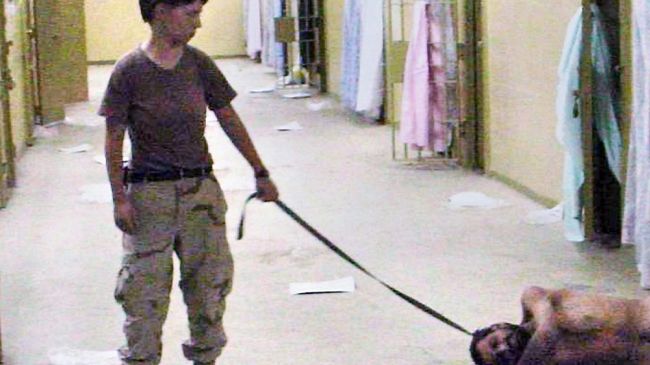
Abu Ghraib torture victims sued by ‘torturers’
Press TV – August 15, 2013
American defense contractor CACI International has sued four former detainees in Abu Ghraib prison to compensate the legal expenses it paid over their dismissed lawsuit regarding the company’s role in torturing the plaintiffs in the notorious jail in Iraq.
The four Iraqi nationals had earlier filed a lawsuit in a District Court in Alexandria against the company accusing it of torturing, humiliating and dehumanizing them when they served time in the prison.
But in July, the judge dismissed the case, saying the court did not have jurisdiction to hear the lawsuit because the incidents happened overseas.
The Arlington-based company has now demanded the plaintiffs pay over $15,000 for travel allowances, deposition transcripts and witness fees, Common Dreams reported.
The lawyers for former Abu Ghraib prisoners in a federal court filing rejected the request.
Our clients “have very limited financial means, even by non-US standards, and dramatically so when compared to the corporate defendants in this case,” according to the filing.
“At the same time, plaintiffs’ serious claims of torture, cruel, inhuman and degrading treatment, and war crimes were dismissed on very close, difficult – and only recently arguable – grounds.”
“Given the wealth disparities between this multi-billion dollar entity and four torture victims, given what they went through, it’s surprising and appears to be an attempt to intimidate and punish these individuals for asserting their rights to sue in US courts,” said Baher Azny, legal director for the Center for Constitutional Rights and the attorney for the plaintiffs.
“Our case is based on reports and investigations by high-level US military investigators, recognizing CACI’s role in conspiracy to torture detainees,” Azny added
“Once we get past legal obstacles and present the case to a jury, we are hopeful justice will come to these Iraqi victims.”
The lawyers who are planning to appeal the case to the US Court of Appeals in fall argue that US law should apply to CACI International as it is an American-based company that operated in a US military prison.
Syria accepts essential terms of chemical weapons probe – UN
RT | August 15, 2013
The Syrian government has accepted the ‘essential modalities’ under which the UN was ready to investigate whether chemical weapons had been used in the country, the body has announced, signalling that experts will shortly be traveling to Syria.
“The departure of the team is now imminent,” UN Secretary-General Ban Ki-moon said in a statement. “As agreed with the Government of Syria, the team will remain in the country to conduct its activities, including on-site visits, for a period of up to 14 days, extendable upon mutual consent.”
The Secretary-General has expressed his appreciation to the Syrian government for accepting “the modalities essential for cooperation to ensure the proper, safe and efficient conduct of the Mission.”
The statement also reminded that the use of chemical weapons “by any side under any circumstances” would constitute an “outrageous crime.”
Two weeks ago the United Nations said that an agreement had been reached with Syrian President Bashar al-Assad’s government as to the three locations that UN inspectors would be investigating, led by Swedish scientist, Ake Sellstrom.
One site to be visited by the UN team is Khan al-Assal in Aleppo, where the country’s government says rebels used chemical weapons in March. The two additional locations have yet to be confirmed.
Both Syria’s government and rebel forces have long been accusing each other of using chemical weapons, and both have denied it.
Russia welcomed the move, saying on its Twitter feed that “Damascus is ready to bring clarity into the situation”, and expressing hope that the move will “provide a springboard for a political solution of the ongoing crisis”.
Last month Russia submitted “a full set of documents” to the UN and its analysis of samples taken west of Aleppo. Russia’s findings indicated that it was rebels behind the Khan al-Assal incident, in which more than 30 people died.
The United States cast doubt on the Russian findings saying its own intelligence services believed Syrian government forces had used chemical weapons. However, Paulo Pinheiro, chairman of the UN commission’s inquiry into rights violations in Syria, said the evidence provided by the US did not meet standards as his commission was “very worried about the chain of custody of the substances.”
Back in March Damascus requested UN investigators to visit Khan al-Assal. The UN formed a mission then, but was reluctant to send it, demanding “unconditional and unfettered” access across the country, according to Ban’s spokesman Martin Nesirky.
Syria’s Foreign Ministry rejected the UN’s effort to broaden the probe claiming that it was “at odds with the Syrian request” and that its “possible hidden intentions” could violate Syrian sovereignty.
In total, the UN received some 13 reports of alleged use of chemical weapons in Syria and the UN inspectors will be investigating the “allegations” of chemical weapons use, rather than determining who was responsible for the attacks.
Fallouts of Iran Sanctions
By Ali Fathollah-Nejad | World Policy Blog | July 31, 2013
Iran’s President-elect Hassan Rohani has promised to ease the tensions surrounding the international relations of his country. In line with the will of the majority of Iranians, the issue of economic sanctions – weighing heavily on the latter’s day-to-day life – will be a key to that end.
In general, the purpose of sanctions is to force a political opponent to do what she would not do otherwise. In the case of the sanctions imposed on Iran – during the course of what is commonly but simplistically referred to as the “nuclear crisis” – the stated goal has been to force a reversal of Tehran’s nuclear calculus toward slowing down or even halting its nuclear program. This goal has clearly not been met. Instead this period has witnessed ever more crippling sanctions – a form of “structural violence” exerted upon an entire country and its people.
Economic sanctions are one of the most preferred instruments of Western foreign policy. The immediate Western reaction to the Syrian crisis is the most recent evidence of this. In the Iranian case, sanctions have been an integral part of the transatlantic strategy pursued against Tehran, code-named “coercive diplomacy” in Diplomatic Studies. There, sanctions are usually presented as a quasi-peaceful means and as such inherently part of a purely diplomatic approach geared towards avoiding a military confrontation. However, as the Iraqi case demonstrates, sanctions are the last step before military action. In other words, “smart sanctions” are likely to be succeeded by “smart bombs.”
Apart from this worst-case scenario, sanctions have not proven to facilitate the resolution of conflicts; on the contrary, they rather tend to harden the opposing fronts. Frequently, opposing sides view sanctions through fundamentally different prisms. In this case, while the West conceives of sanctions in a cost–benefit framework – the heavier the costs imposed on the targeted country by way of sanctions, the more willing the sanctioned state will be to offer concessions. Iran on its part sees them as a means of illegitimate pressure against which she ought to resist. This explains why in the last couple of years the escalation of sanctions was accompanied by that of the nuclear program. For example, in 2006 – before the Iran sanctions were elevated to an undoubtedly crippling dimension by the United States and the European Union – Iran had a thousand centrifuges; the number today is much more than tenfold. This reality of the nuclear dynamics in the wake of sanctions remains largely ignored in Western capitals.
Moreover, it should be stressed that policymakers in the West have so far devoted much more time and energy to identifying which new set of sanctions to impose rather than to committedly and creatively finding a diplomatic solution of the decade-old stalemate.
The popular rhetoric of sanctions incorrectly characterizes the nature of the socio-economic effects imposed on the target country. Contrary to what is commonly claimed, sanctions actually weaken the lower and middle classes, particularly affecting the most vulnerable in society – workers, women and the youth. As a result, the power gap between the state and society widens. All this, as a matter of fact, actually dampens the prospect of popular uprising. A person struggling for economic survival barely has the luxury of engaging as a citoyen in the struggle for democracy. This explains the firm renunciation of sanctions by Iran’s civil society – voices that the West has largely chosen to ignore.
In political-economic terms, sanctions have largely paralyzed Iran’s civilian economy while state and semi-state economic entities – especially those associated with the Revolutionary Guards – have been able to benefit inter alia by monopolizing imports of various goods via “black channels.” State resources have buoyed those companies that have access to them, leaving others to drown in the tide of rising costs. Sanctions have also prompted enormous growth in the volume of bilateral trade between Iran and China (still about $ 40 billion according to the Iran–China Chamber of Commerce and Industries which is closely related to the regime) – to the detriment of producers and jobs in Iran. The reality of sanctions is that they have cemented the politico-economic power configuration in Iran.
Sanctions produce far-reaching effects at the geopolitical and geo-economic levels. Corresponding with the implicit geopolitical rationale for sanctions – that if you cannot control or influence a country, you will resort to weakening it – these restrictions have indeed stunted Iran’s development trajectory. This inflicted damage has not, however, produced the ultimate goal of reversing Iran’s nuclear and regional policies and has in fact damaged Western interests by boosting the clout of countries like China, Russia, and other regional states.
In the wake of the U.S.-pressured withdrawal of the Europeans from the Iranian market, Iran was virtually handed over to China on a silver plate – something Beijing is indeed quite appreciative of. China’s economic presence in Iran can be witnessed all across the board: from the construction of the Tehran Metro to the exploration of Persian Gulf oil and gas fields.
Iran’s technocrats – a prime victim of the sanctions – observe this development with great concern. Among other things, they have seen that a healthy competition between different foreign competitors is sorely missing, and that the lack of high-tech (formerly delivered by the West) has reduced the quality of domestic production. All of this has a negative impact (mid- and long-term) on Iran’s economic and technological development. If the situation remains unchanged, such damage can hardly be compensated. As another case in point, the sale of Iranian oil to large customers such as China or India has turned into barter – a de facto “junk for oil” program has emerged. In addition, during the past couple of years China has been given preferential rates by Iran for its oil imports.
Finally, some of Iran’s neighboring countries also benefit from the sanctions. Most significantly, due to the energy sanctions against Iran, Russia can safeguard its quasi-monopoly on Europe’s energy supply – a strategic interest held by Moscow which is unlikely to be reversed easily. To a much lesser degree but still noteworthy, Turkey – which has turned into the sole land trade corridor reaching Iran from the West – has seen its profits in its dealings with Iran risen sharply. Not surprisingly, its business press has been cheering the Iran sanctions as providing Ankara with a competitive trade advantage. Also off the radar, Qatar which in the Persian Gulf is sharing the world’s largest gas field with Iran, has been able to exploit South Pars much more rapidly than Iran given the latter’s lack of access to advanced technologies. This has resulted in a tremendous gap of revenues between the two countries of many several billion dollars.
Ultimately, the policy of sanctions is counter-productive on multiple levels, most sensitively on diplomatic and socio-economic grounds. The sanctions – whether called “crippling” or “targeted” – disproportionately affect the civilian population. “Smart sanctions” are very much an oxymoron as “smart bombs” which allegedly function in surgical precision. And like their military counterparts, “targeted sanctions” inflict extensive “collateral damage.”
Despite the political need to seriously reconsider sanctions as a tool for a judicious and solution-oriented foreign policy, there are many political and institutional barriers to overcome before the extremely dense web of Iran sanctions can be dissolved – which remains not only a huge political challenge but also a moral one. The first step in this direction will be the sober realization among policymakers that while sanctions do have effects, these are not the ones officially proclaimed or desired – neither in socio-economic terms nor in the sphere of Realpolitik when it comes to altering Tehran’s nuclear calculation. Leaving the sanctions against Iran in place advances the specter of an Iraqization of Iran – with all its adverse effects internally (destruction of society) as well as externally (war and destabilization of an already too fragile regional balance).
To pave the way for a new chapter in Iran’s relations with the West, Rohani has already proved his wisdom by his choice of foreign minister. Mohammad-Javad Zarif, Iran’s former ambassador to the UN, has already been labeled as “Tehran’s leading connoisseur of the U.S. political elite”. All this undoubtedly presents the most suited prerequisite towards the aim of alleviating the multi-level liability that sanctions constitute. But at the end, it is the responsibility of those who have imposed the sanctions to initiate the process of their removal. The ball is now in the West’s court. It would truly be the “height of irresponsibility” if one missed this opportunity offered by the Iranian people who have already paid dearly for an utterly miscalculated transatlantic “coercive diplomacy.”
*****
Ali Fathollah-Nejad is an Iranian-German political scientist educated at universities in France, Germany, the Netherlands, and the UK. His website is at fathollah-nejad.com.
A Guide to the Deceptions, Misinformation, and Word Games Officials Use to Mislead the Public About NSA Surveillance
By Trevor Timm | EFF | August 14, 2013
It’s been two months since President Barack Obama first said that he welcomes a debate about NSA surveillance, which he once again reiterated last week at his press conference. Unfortunately, it’s very hard to have a real debate about a subject when the administration constantly and intentionally misleads Americans about the NSA’s capabilities and supposed legal powers.
Infamously, the Director of National Intelligence (DNI) James Clapper was forced to apologize for lying to Congress about whether the government was collecting information on millions of Americans, but that was merely the tip of the administration’s iceberg of mendacity and misdirection. At this point, it seems nothing the government says about the NSA can be taken at face value.
NSA’s Bizarro Dictionary
The latest example comes from the New York Times last week, which reported that the NSA is “searching the contents of vast amounts of Americans’ e-mail and text communications into and out of the country.” Despite the fact that millions of people’s communications are collected in bulk, the NSA says that this isn’t “bulk collection.” From the NYT story:
The senior intelligence official argued, however, that it would be inaccurate to portray the N.S.A. as engaging in “bulk collection” of the contents of communications. “ ‘Bulk collection’ is when we collect and retain for some period of time that lets us do retrospective analysis,” the official said. “In this case, we do not do that, so we do not consider this ‘bulk collection.’ ”
In other words, because the NSA does some sort of initial content searches of the bulk communications that they collect, perhaps using very fast computers, then only keep some unknown subset of that greater bulk for a later date, no “bulk collection” occurs. This is ridiculous. No matter how you slice it, the NSA is mass collecting and searching millions of American communications without a warrant.
Keep in mind that officials have previously said communications aren’t even “collected” when they are intercepted and stored in a database for long periods of time, much less “bulk collected.” Orwell would be impressed.
We’ve long documented the NSA’s unbelievable definitions of ordinary words like “collect,” “surveillance,” and “communications,” publishing a whole page of them last year. The ACLU’s Jameel Jaffer has added to the NSA’s bizarro dictionary, with words like “incidental,” “minimize” and even “no.”
The fact is, no one should have to read and parse a sentence a half-dozen times, plus have access to a secret government dictionary, in order to decipher its meaning. Yet, that’s apparently how the administration wants this debate to proceed.
Question Misdirection
When government officials can’t directly answer a question with a secret definition, officials will often answer a different question than they were asked. For example, if asked, “can you read Americans’ email without a warrant,” officials will answer: “we cannot target Americans’ email without a warrant.” As we explained last week, the NSA’s warped definition of word “target” is full of so many holes that it allows the NSA to reach into untold number of Americans’ emails, some which can be purely domestic.
“Under this Program” Dodge
Another tried and true technique in the NSA obfuscation playbook is to deny it does one invasive thing or another “under this program.” When it’s later revealed the NSA actually does do the spying it said it didn’t, officials can claim it was just part of another program not referred to in the initial answer.
This was the Bush administration’s strategy for the “Terrorist Surveillance Program”: The term “TSP” ended up being a meaningless label, created by administration officials after the much larger warrantless surveillance program was exposed by the New York Times in 2005. They used it to give the misleading impression that the NSA’s spying program was narrow and aimed only at intercepting the communications of terrorists. In fact, the larger program affected all Americans.
Now we’re likely seeing it as part of the telephone records collection debate when administration officials repeat over and over that they aren’t collecting location data “under this program.” Sen. Ron Wyden has strongly suggested this might not be the whole story.
From Downright False to Impossible to Understand
Some statements by government officials don’t seem to have any explanation.
The night before the New York Times story on “vast” warrantless searches of Americans’ communications came out, Obama told Jay Leno on The Tonight Show, “We don’t have a domestic spying program.” Mr. President, what do you call collecting the phone records of all Americans and searching any email sent by an American that happens to cross the border? That sounds a lot like a domestic spying program.
Similarly, Sen. Dianne Feinstein, chair of the Senate Intelligence Committee, recently said this: “[T]he government cannot listen to an American’s telephone calls or read their emails without a court warrant issued upon a showing of probable cause.” Leaked documents and, honestly, the FISA Amendments Act itself show Feinstein’s statement simply isn’t true—if Americans are talking to a “target” their telephone calls are listened to and their emails can be read without a warrant (and that doesn’t even include the searching of Americans’ communications that are “about a target”). All of those searches are done without a court order, much less a warrant based on probable cause.
Previously, President Obama has called the inherently secret FISA court “transparent,” to the befuddlement of just about everyone. A court that has issued tens of thousands of secret orders, while creating a secret body of privacy and Fourth Amendment law, is not “transparent” by any measure.
Just last week, the president claimed he would appoint an “independent” board of “outside” observers to review the surveillance programs, only to put DNI Clapper—the same man who lied to Congress and the public about the scope of the program—in charge of picking the members. The White House has since backtracked, but the DNI still will report the group’s findings to the President.
These are not all of the misleading statements, merely just a few that stick out at the moment. If the president is serious about transparency, he can start by declassifying the dictionary his administration is using to debate, and start speaking straight to the American public. A one-sided presentation of the facts, without straightforward answers to the public’s questions, isn’t really a debate at all.
Related articles
- The NSA is turning the internet into a total surveillance system
- Confessed Liar To Congress, James Clapper, Gets To Set Up The ‘Independent’ Review Over NSA Surveillance
- Jennifer Hoelzer’s Insider’s View Of The Administration’s Response To NSA Surveillance Leaks
- Pro-NSA Editorial Flails Wildly, Snarks At Internet Users And Claims Those Challenging NSA’s Reach ‘Hate Obama’
Featured Video

The First Pyrrhic Victory of the Vietnam War
or go to
Aletho News Archives – Video-Images
Frlom the Archives
The 52 Major Jewish American Organizations and Israel Celebrate Passover with the Slaughter of 25 Muslim, Christian and Secular Palestinians
By James Petras • Unz Review • April 8, 2018
Introduction
As of April 7, nearly three thousand unarmed Christian, Muslim and secular Palestinians have been wounded, over three dozen are in critical condition and at least twenty-five unarmed protestors, including children have been assassinated by hundreds of Israeli snipers and heavily armed troops shooting tank shells into crowds of civilians protesting their decades of incarceration by the racist Israeli state.
The Israeli government praised the ‘restraint and morality’ of the IDF, as did the fifty-two Major Jewish American Organizations (MJAO) who largely control the US Congress. These grotesque massacres began during the Christian Holy Week on Good Friday and Easter, coinciding with the Jewish Passover. The self-righteous officials of the MJAO and their relatives and friends broke matzos at joyful Seders as the blood of Palestinians soaked into ground at the fence containing the largest open-air prison camp in history, Gaza.
While tribal loyalties bonded the Israeli and Jewish American leaders, the politicians of the Western oligarchic electoral regimes refrained from criticizing the shocking display of brute force and even defended Israel’s cold blood mass killings of Palestinian civilians in their Gaza prison.
This paper will discuss and analyze the reasons for Israel’s willing Western accomplices and the centrality of its fifth column in the United States. … continue
Blog Roll
 Aletho News
- Iranian model of warfare bleeds US dry while Persian Gulf states watch and learn: Analyst
- IRGC orders ‘defeated’ US to evacuate industrial facilities in region
- Hegseth’s call for ‘no mercy’ to Iranians deemed war crime
- Iran War Exposes Limits of US Military Power – Journalist
- Even The Neo-Cons Admit The Iran War Is Failing
- Inside the Caucasus Drone Corridor Fueling Tensions With Iran
- ‘Not our war’: Trump’s naval coalition to reopen Strait of Hormuz dead in the water
- Iran declares support centers for USS Gerald R. Ford legitimate targets
- Moscow issues warning over Trump’s Golden Dome plan
- Brussels wants ‘our sons to die for Ukraine’ – Orban
- If Americans Knew
- ‘I Liked the House’: When Israeli Soldiers Turn Palestinian Homes into Barracks
- ‘They Were All I Had’: Lebanese Father Buries Parents, 4 Daughters Killed by Israeli Bombing
- Israel and its supporters are causing attacks on Jewish institutions. Case in point: Michigan synagogue tragedy.
- These are the casualties and cost of the war in Iran 2 weeks into the conflict
- Chicago Teachers Union accuses AIPAC of swaying elections with ‘dark money’
- Predictions of another 9/11, amid Israel-US killing spree – Not a ceasefire Day 157
- As US-Israel war on Iran rages, Gaza faces massive dust storm – Not a ceasefire Day 156
- No let-up in attacks on Gaza as Israel takes on Iran, Lebanon – Not a ceasefire Day 155
- ‘Of Course’: IDF Drops Case Against Soldiers Accused of Raping Palestinian Prisoner
- Don’t Fall for the Regime Change Talk. Israel Is ‘Mowing the Lawn’ in Iran
- No Tricks Zone
- Storing Green Energy To Last Germany 10 Days Would Require A 60-Million Tonne Battery
- New Studies: UK Sea Levels Were 4 Meters Higher Than Today During The Mid-Holocene
- Destructive Green New Deal: German Energy And Metal Group Warns Of Drastic Crisis
- New Study Documents A 20-Year Pause In Arctic Sea Ice Decline – Driven By Internal Variability
- Wake-up Call: Survey Shows Majority Of Germans Now Favor Postponing Climate Targets!
- Televised! Leading German Political Candidate Tells Schoolchildren CO2 Makes Sun Hotter!
- New Study: A Century Warming Of 1.1°C Is ‘Commonplace’ And ‘Not Unusual’ During This Interglacial
- New Study: ‘Internal Noise’ And Volcanic Forcing Can Trigger 10-15°C Warming Within Decades
- Glaciers Worldwide Are Suddendly Surging, Experts Blame Warming!
- Surprising Discovery: Sahara Is Greening…Billions Of Trees Where Once Thought To Be Barren
 Aletho News