Where Should The Birds Fly
Where Should The Birds Fly is the first film about Gaza made by Palestinians living the reality of Israel’s siege and blockade of this tiny enclave. It is the story of two young women, survivors of Israel’s Operation Cast Lead. Mona Samouni, now 12 years old and the filmmaker, Fida Qishta, now 27, represent the spirit and future of Palestinians. The film is a visual documentation of the Goldstone Report. But it is so much more. It reveals the strength and hope, the humanity and humor that flourishes among the people of Gaza. Few films document so powerfully and personally the impact of modern warfare and sanctions on a civilian population.
The film itself breaks the blockade. Filmmakers in Gaza have never had the opportunity to make a full length, professional documentary of their reality. Fida Qishta, born and raised in Rafah, Gaza, began her filmmaking career as a wedding videographer, and soon moved on to working with international human rights observers in Gaza, documenting day to day life under siege. Her commentary on the siege was published in The International Herald Tribune. Her video reports of Operation Cast Lead were published widely including in the UK newspaper The Guardian and in their weekly news magazine, The Observer.
Fida founded The Life-Maker’s Centre, Rafah, Gaza. She was the manager and a teacher at this free facility for 300 children affected by war. The center continues to provide a safe place to play and offers counseling and English language tutoring.
Order full movie here
UN Agreement Reached on Syria; Obama Warhawks Defeated on Every Count
Ron Paul Institute | September 26, 2013
In a stunning blow to the “humanitarian interventionists” of the Obama administration and another boost for Russian diplomatic efforts, the five permanent Members of the UN Security Council appear to have agreed to a resolution governing the destruction of Syria’s chemical weapons that rejects each point the US administration not long ago deemed essential to such an agreement.
Secretary of State John Kerry as recently as last week “insisted” that any UN resolution dealing with Syrian chemical disarmament must be filed under Chapter 7 of the UN charter, which provides for the use of force if the agreement is not satisfactorily implemented. Russia, which had been tricked by the Obama administration over its Chapter 7 demands on Libya that ended in a disastrous war, refused to fall again for the ruse. Even as Kerry lied last week to the US media that Russian Foreign Minister Lavrov had agreed to a Chapter 7 resolution, the Russians denied Kerry’s claims. Now we see that Chapter 7 is dead in the water.
Earlier this week, President Obama held firm to his position that the Syrian government was responsible for the Sarin gas attack near Damascus on August 21. Said Obama:
“on August 21st, the [Syrian] regime used chemical weapons in an attack that killed more than 1,000 people, including hundreds of children.”
The administration has yet to offer proof of its claims, and a highly skeptical US population and US Congress categorically rejected earlier this month the administration’s request to go to war over these unproven claims. It seems Iraq was not that long ago after all.
The Russians continue to maintain that not only is there no evidence that the Syrian government carried out the attacks, there is plenty of evidence from a multiplicity of sources that the rebels in fact carried out the vicious act. And indeed careful analysis of the videos released by the US government to “prove” Syrian government responsibility appear to have been manipulated.
Whatever the case, most of the world believed the Russian position. As a result, the agreed-upon UN Security Council resolution contains no language ascribing blame to the Syrian government for the August 21 gas attacks. Defeat.
Obama’s warmongering “humanitarians” were desperate to save face, with US Ambassador to the UN Samantha Power Tweeting that the resolution was “legally obligating Syria to give up CW they used on their people.” This was more rhetorical flourish and wishful thinking than a slam dunk, as “legally binding” is virtually meaningless at the UN.
Ambassador Power further covered up her defeat by obfuscating the fact that the UNSC resolution had no force to back it up. “Wrapping up meeting of UNSC which is finally ready to impose measures under Chapter VII if Syria does not comply,” she Tweeted.
Ah, but there is no Chapter 7 language in the resolution. That would require a completely new and separate resolution and would require a positive Russian and Chinese response. Power is working herself into a lather over not much more than thin air. It must be frustrating.
The defeat of the Obama administration hawks in the UN and the victory of the Russian position should not be misinterpreted, however. Those interested in peace should view it as a positive sign that armed American exceptionalism cannot without check export destruction willy-nilly where it wishes. More than a victory for Russian diplomacy, it is a victory for the American people and for the emerging super-coalition of progressives, conservatives, and libertarians against aggressive war overseas and resulting poverty back home. And a victory for every reader of this website devoted to peace and prosperity. Perhaps we might even get lucky and see the repeatedly defeated and out-maneuvered Samantha Power, Susan Rice, and John Kerry sent packing along with their war-mad underlings like Ben Rhodes and Tony Blinken.
Related article
- John Kerry warns of ‘consequences’ if Syria does not abide by UNSC resolution (voiceofrussia.com)
Sen. Feinstein’s Husband Reaps Profits from Post Office Closings
By Ken Broder | AllGov | September 30, 2013
The conventional wisdom is that the Internet, competition from the innovative private sector and sky-high pension costs of pampered federal employees are killing the U.S. Postal Service (USPS). The only hope is to slash costs, scale back services, sell off unnecessary assets and shift the business of mail delivery to more efficient private owners.
It’s not true. The post office is being savaged for thinly-disguised political reasons, including the enrichment of a few select individuals. Investigative journalist Peter Byrne says California Senator Dianne Feinstein’s husband, Richard Blum, is one of those profiting mightily.
The postal service’s August financial report (pdf) showed a net operating profit of $182 million with one month left in the fiscal year, and improved revenues over the previous year. But, as post office critics would be quick to point, it still had a net operating loss of $4.95 billion. How can that be?
In 2006, the Republican-controlled Congress passed the Postal Accountability and Enhancement Act, which forced the USPS—which pays its own way and does not receive money from the federal budget—to prefund its future health care benefit payments to retirees for the next 75 years. The Postal Service was ordered to pay for the benefits of workers it hasn’t even hired and do it an accelerated time frame, a requirement not demanded of any other federal government agency.
The law instantly put the post office on the verge of bankruptcy and unleashed a movement to villainize and privatize the service. Unions would take a beating, private carriers would get a boost and $85 billion in hard assets could be sold to those who would know how to properly monetize them.
One of those in the know is Blum, chairman of C.B. Richard Ellis (CBRE), which has the exclusive contract to handle sales of post office property, according to Byrne. In his e-book Going Postal, Byrne cites an audit by Postal Service Inspector General David C. Williams that questions a “fundamental change” in policy that allowed, for the first time, a single outsourced firm to manage all sales and leasing of postal real estate, rather than handling it in-house.
The result, Williams wrote, “are conflict of interest concerns.”
CBRE was hired as exclusive agent for the postal service in June 2011 and proceeded to sell millions of dollars worth of property. By Byrne’s count, CBRE “arguably” sold 52 properties for $66 million less than their assessed value ($79 million if you toss out the nine properties that sold above assessed value). Most of the sales did not involve distressed properties, perhaps ravaged by the economic downturn, and tended to be in economically healthy neighborhoods.
“The sales were mostly of central downtown buildings, with parking, in wealthy or revitalizing neighborhoods that attracted restaurant, boutique, and residential developers, or modern, suburban office buildings and warehouses, also with ample parking that attracted high-tech industrial firms,” Byrne wrote. “In other words, the most saleable postal properties were the ones most likely to command prices that exceeded their assessed values.”
Byrne also found that 20% of the portfolio was sold to business partners or clients of CBRE, while it took up to a 6% commission in 34 of the 52 transactions. CBRE appeared to act as an agent for both the Postal Service and buyers in many of the transactions, contrary to customary property sales, according to Byrne.
On Wednesday, USPS announced that it would ask Congress to let it raise the price of a stamp 3 cents next January 26 because of its “precarious financial condition.”
“Of the options currently available to the Postal Service to align costs and revenues, increasing postage prices is a last resort that reflects extreme financial challenges,” USPS Board of Governors Chairman Mickey Barnett wrote in a letter to customers.
To Learn More:
Going Postal (East Bay Express excerpt from a book by Peter Byrne)
Senator Diane Feinstein’s Husband Selling Post Offices to Cronies on the Cheap (Naked Capitalism)
Contracting of Real Estate Management Services (U.S. Postal Service Office of Inspector General)
The Selling of the Venice Post Office: More than a Touch of Evil (by Greta Cobar, Save the Post Office)
Feinstein Derails Assertions that Husband Is Chief Bidder on High-Speed Rail (by Ken Broder, AllGov California)
Congress Struggles to Deliver Solution to Postal Problem It Created (by Matt Bewig, AllGov)
No Surprise: NSA Stores All Metadata It Collects For At Least A Year, Even If It Has Nothing To Do With Anything
By Mike Masnick | Techdirt | September 30, 2013
The latest revelation from the Snowden docs published by The Guardian is that the NSA’s MARINA metadata system for internet data stores the information it gets for up to a year.
“The Marina metadata application tracks a user’s browser experience, gathers contact information/content and develops summaries of target,” the analysts’ guide explains. “This tool offers the ability to export the data in a variety of formats, as well as create various charts to assist in pattern-of-life development.”
The guide goes on to explain Marina’s unique capability: “Of the more distinguishing features, Marina has the ability to look back on the last 365 days’ worth of DNI metadata seen by the Sigint collection system, regardless whether or not it was tasked for collection.” [Emphasis in original.]
Note that this is different than the phone metadata that people have been talking about. This is “internet” metadata — so browser history, contacts, etc. In other words, the kind of stuff that Dianne Feinstein accidentally admitted the US is scooping up by the boatloads by tapping the internet’s backbone with help from US telcos.
The fact that they can look through it even if it hasn’t been “tasked for collection” is pretty big. It again shows how the NSA keeps saying one thing (such as claiming they only keep data on people they’re “targeting”) is simply false. The NSA continues to redefine things. Information isn’t “collected” until it’s searched. And it’s apparently not “stored” until it’s moved into a different database than this one.
How does anyone take these guys seriously?
US will take no options off table on Iran: Obama
Press TV – September 30, 2013
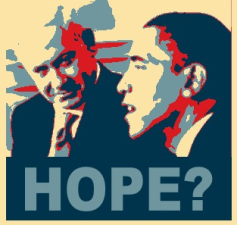 American President Barack Obama once again repeats Washington’s warmongering rhetoric against Tehran over its nuclear energy program, saying the US will take no options off the table with regard to Iran.
“We take no options off the table, including military options,” Obama said during a meeting at the White House with visiting Israeli Prime Minister Benjamin Netanyahu on Monday.
He added that words are not sufficient to resolve Iran’s nuclear issue, adding Tehran must give confidence to the international community “through actions.”
“We agreed it is paramount that Iran doesn’t get nuclear weapons,” Obama said.
“Because of the sanctions Iran is ready to talk and we have to test their willingness in good faith,” the US president added.
Obama assured that Washington will enter negotiations with Tehran with a “clear eye” and emphasized that it will be in “close consultation” with Israel and other friends and allies in the region during the process.
The Israeli premier, for his part, said Israel wants Iran to fully dismantle its nuclear energy program and claimed credible military threat and sanctions have brought Iran to the negotiating table.
Netanyahu called on Obama to tighten economic sanctions on Iran if it continues its nuclear advances during a coming round of talks with the West, saying, “Those pressures must be kept in place.”
The meeting between Obama and Netanyahu comes only days after Iran President Hassan Rouhani and his US counterpart had a landmark phone conversation on September 27 mainly focusing on Iran’s nuclear energy program.
It was the first direct communication between an Iranian and a US president since the victory of Iran’s Islamic Revolution more than three decades ago.
The two presidents stressed Tehran and Washington’s political will to swiftly resolve the dispute over Iran’s nuclear energy program which the United States, Israel and some of their allies claim to include a military component.
Iran has categorically rejected the allegation, stressing that as a committed member of the International Atomic Energy Agency and a signatory to the Non-Proliferation Treaty, it is entitled to develop nuclear technology for peaceful purposes.
Why the WHO report on congenital anomalies in Iraq is a disgrace
By Christopher Busby | RT | September 28, 2013
The recently published World Health Organization report on its study of congenital birth anomalies in Iraq is nothing short of a disgrace.
There have been an increasing number of reports about childhood cancers, adult cancers and birth defects in Iraq. Public pressure and media attention to this catastrophic situation prompted a joint study by the World Health Organization (WHO) and the Iraqi Health Ministry to determine the prevalence of birth defects in the country. The study began in May-June 2012 and was completed in early October 2012. But it was not made public until recently. And I have to say that those who designed and carried out the study were well aware that the method they chose could not possibly give correct answers to the question of congenital anomaly rates, since they had consulted with me before they started, and I had pointed out why their method was unsafe, even sending them a report suggesting a method that would work.
In May 2011, I was asked to travel to Geneva by the Union of Arab Jurists to make my first presentation at the UN Human Rights Council, reporting our preliminary findings of extraordinarily high rates of cancer, infant mortality and sex ratio perturbations in the population of Fallujah, which we published in the International Journal of Environment and Public Health in 2010. I met with the director of the Human Rights Council, and also with the director of the International Red Cross, and made the case for intervention.
There was massive anecdotal evidence of these genetic damage effects of the US uranium weapons since the mid-1990s and in Fallujah after the 2004 war, but no one had carried out any study. We collected some money from individuals (about £4,000) and marched in. What we found made headlines in The Daily Telegraph, Le Monde and all over the world. In that study, we examined infant mortality rather than congenital birth defects, for reasons we gave in the paper and I will review here.
Later we also published two other follow-up studies based on hospital data, one analyzing 52 elements in the hair of the parents of children with congenital anomalies, the other giving the congenital anomaly rates and types. Both were based on prospective collection of data by the pediatricians from Fallujah General Hospital, and so we could be sure of the types of anomaly and the numbers.
I have to say that the fear generated by these discoveries made it extremely difficult to get the results published. The Lancet threw the papers out without sending them for review. The International Journal of Environment and Public Health was attacked after the first one, by various individuals they refused to name – and they wouldn’t publish the second one, which was published by Conflict and Health. The third one was also rejected by The Lancet and various other frightened journals and eventually was published by the Journal of the Islamic Medical Association, and then only after I asked them what Allah would think of their pusillanimous behavior. So much for scientific truth.
I pointed out to the WHO representative who contacted me in January 2011, Syed Jaffar Hussein, asking if I would join the WHO project, that the kind of questionnaire study that WHO were proposing would fail for two reasons. The first and most critical is that parents will not have sufficient knowledge to diagnose a congenital anomaly in their baby. For example, in the absence of hospital involvement at a high technical level (e.g. Fallujah Hospital) the baby will just die of what seems to the parents to be pneumonia, or failure to thrive, or the child will die for no apparent reason. In terms of congenital heart defects, or kidney defects, or many neurological defects there is no observable sign. And the type of monstrous defect, the Cyclops eye, the lack of arms, all the pictures on the Internet, these are a minor fraction of all the congenital defects that are fatal at birth. Generally the mother is not allowed to see such a baby and she is told it has died. It is the heart defects that make up the majority, and these are only diagnosable in a hospital pediatric unit.
The second problem I know about, since I have designed and carried out several questionnaire epidemiology studies since the pilot one in Carlingford, Ireland in 2000, is that people can’t remember back even five years, let alone 15 years. And in a situation like Iraq, where having a child with a congenital defect means that you yourself are contaminated and damaged, the likelihood is that you will shortly be dead from cancer and a whole range of illnesses generated by the causes that killed your baby. So the questionnaire study loses cases as you go back in time. The WHO results clearly show this, since the rates they report are actually lower than expected, suggesting that living in Iraq is good for birth outcomes. They seem surprised by this.
So a hospital-based prospective study is the only way. And since this is such a political issue, I said I would only be involved if I could have a hands-on role so that the numbers could be checked, and that was the end of our communication.
The result is very shoddy procedure which would not make it into peer-review. The WHO says that its work and the report was peer-reviewed by senior epidemiologists at the London School of Hygiene and Tropical Medicine, but if this is true these reviewers should be sent packing. The WHO report fails to refer to any of the studies, like our follow-up papers on uranium in Conflict and Health and the IMANA congenital anomaly rates one. There, for example, we looked at the uranium content along long strands of hair in mothers of birth-defect children and showed that the concentrations increased back to the time of the US attacks.

It is fairly easy to show that the WHO results are ridiculous. There was a previous similar study under Saddam’s regime for the period 1994-1999 which is of interest. This study also was not cited in the WHO report but was discussed in our paper which they must have read. The Iraqi child and maternal mortality survey covered 46,956 births in Iraq from 1994-1999. Results were obtained by questionnaires filled out by the mothers and results were given for all children aged 0-4 who died in 1994-1999. Effects found in this period, if due to environmental agents, would, of course, follow exposures in and following the first Gulf War. Using data presented in the tables in this publication it is easy to show that the results indicated a marked increase in deaths in the first year of life with an infant mortality (0-1) rate of 93 per 1,000 live births. Fifty-six percent of deaths in all the children aged 0-5 occurred in the first month after birth, but since the results were from self-reporting, it was difficult to draw conclusions as to the underlying causes of death except in the case of oncology/hematology. For example, the largest reported proportion of deaths in the neonates were listed as “cough/difficulty breathing” which might result from many different underlying causes. The low rates from congenital malformation reported are hardly credible. However, using data published in the report it appeared that the cancer and leukemia death rates in the entire all-Iraq 0-4 group were about three or four times the levels found in Western populations for this age group. These rates were three times higher in the south where depleted uranium was employed in the major tank battles near the Kuwait border (53 per 100,000 per year) than in the north (18 per 100,000 per year) where there was less fighting and where depleted uranium was not employed to such an extent. Furthermore, cancer and leukemia rates were highest in the 0-1 year group, which is unusual; the main peak in childhood cancer is generally found at age 4.
Despite all that can be said about the methodology, it is extremely hard to reconcile the WHO study’s finding of an overall congenital anomaly rate of 23.6 with the rate of 147 we found in Fallujah General Hospital, reported by us in. In Table 2, I copy the full results which were submitted in this congenital anomaly paper. It is clear from this that the majority of conditions could not be recognized by mothers of children who died at or shortly after birth. Of 291 babies with congenital abnormalities in our Fallujah hospital study, 113 were cardiovascular, 40 digestive, 9 genitourinary and 44 chromosomal defects, few of which could be recognized as congenital anomalies by mothers, and would need specialized diagnoses in a top hospital to classify.
It is shown in Table 2 that the rate for congenital heart effects alone is twice the rate reported in the WHO study. Of particular concern is the outcome of the “Expert Peer Group” meeting on 27-28 July, 2013, which apparently endorsed this epidemiologically unsafe approach and its results.
I have written and given presentations on scientific dishonesty. The truth can be established by science, but not if it is dishonest and political. And it seems that this report, and the events and decisions that preceded it, and particularly the London School of Hygiene and Tropical Medicine peer review meeting, are a classical example of scientific dishonesty. The use of the London School of Hygiene and Tropical Medicine reminds me of the use of the Royal Society to produce a disgraceful report on depleted uranium in 2001. Since the outcome is intended to exonerate the US and UK military from what are effectively war crimes, and since the result will be employed to defend the continued use of uranium weapons, all concerned in this chicanery should be put before a criminal court and tried for what they have done. Their actions are responsible for human suffering and death and cannot be forgiven. This is a human rights issue. I returned to the issue of Fallujah when I was invited a second time to make a presentation at the UN Human Rights Council in September 2011. I said then it was time to make a legal stand and I presented the human rights petition I had developed with the International Committee for Nuclear Justice. This issue will be taken forward by the Low Level Radiation Campaign in the next six months, so watch this space.
Finally, we should not forget that the WHO signed an agreement in 1959 with the International Atomic Energy Agency to keep their noses out of any research that has a connection with radiation or radioactivity. This agreement is still in force and is a matter of deep concern.
Christopher Busby is an expert on the health effects of ionizing radiation and Scientific Secretary of the European Committee on Radiation Risk.
Israel denies Christian Peacemaker Teams entry to Palestine
By Alice Su | MEMO | September 29, 2013
Jonathan Brenneman packed for his second attempt at crossing the Jordan-West Bank border with a jacket, fully charged iPod, letters of official invitation and 500-page collection of Flannery O’Connor stories.
The lanky 25-year-old from St. Mary’s, Ohio had spent nine hours under Israeli border authorities’ questioning just a few days ago. They denied him entry, saying he needed more proof of his purposes in the country. Brenneman prepared better this time around, eating a large breakfast before leaving his uncle’s house in Amman.
Six hours later, Brenneman came back once again.
Brenneman has been volunteering for a year with Christian Peacemaker Teams (CPT), a faith-based organization that supports peacemaking in conflict areas. CPT has worked in Hebron for nineteen years, where their main activity is walking children to school to protect them from settlers’ attacks. The volunteers leave every three months to renew their visas and to tell stories about CPT work back home.
This time, Israeli authorities have denied Brenneman’s return.
“They told me it’s because CPT is ‘not recognized by Israel,” Brenneman says. “I asked why that’s a problem if our work is legal, but the soldier just said ‘My commander says you are not allowed.’ That was the end.”
Brenneman’s family in the States wrote to their senator in Ohio, who then contacted the American Embassy in Amman. The embassy’s U.S. Citizen Services called Brenneman in for a meeting, but told him they couldn’t do anything.
“They told me the same thing I’ve heard over and over again: Israel is a sovereign nation. They can deny anyone for whatever reason they want, or without reason at all,” Brenneman said.
Two other CPT members have been denied entry in recent months, but Brenneman is the first to be rejected specifically for being a Christian Peacemaker. The other two were turned back for “security reasons,” Israeli officials said.
“Israel never gives a complete reason for denial,” Brenneman says. “Why? Because if they give a legal reason, you could possibly challenge that.”
Founded two decades ago by North American peace churches of Mennonite tradition, CPT teams have worked in Colombia, Iraq, Bosnia, Chechnya and the U.S.-Mexico borderlands, among other places. Their self-proclaimed mission is to reduce violence by “getting in the way.” In 2005, four CPT workers were kidnapped in Baghdad, where they had been documenting U.S. military abuse at Abu Ghraib. One of them, a 43-year-old Quaker from Virginia, was killed.
Brenneman, whose mother was born in Bethlehem and whose father is an “eighth or tenth generation American, very white,” joined CPT partly out of religious conviction. He liked CPT’s belief that Christians have to actively pursue peace, Brenneman says.
“You couldn’t be a follower of the Prince of Peace and just sit back, saying ‘I like peace’ in a comfortable Western way,” Brenneman says. “We needed to go out, partner with oppressed people and work towards justice.”
Despite the group’s Christian title, it does not proselytize. CPT teams include members of other faiths. They begin each day with worship, but in a “very ecumenical” form.
“Although we are versed in a language of international law and human rights, we see this more as a moral and spiritual issue,” Brenneman says. “That gives us a much deeper perspective of the evils that are going on.”
In Hebron, these “evils” include violence towards schoolchildren, assault on Palestinian shepherds and military mistreatment at checkpoints. CPT members wake up before 7 a.m. every day to monitor areas of tension. They bring cameras and write reports.
“When there’s an outside set of eyes, soldiers are far less aggressive,” Brenneman says. “It’s kind of sad how racist it is. But, yeah, just having a white person there makes a difference.”
Some critics have asked why CPT does not work in other conflict zones like Syria.
“If you gave us funding so we could start another team in Syria, we would be glad to go,” Brenneman said. But the severity of Syria’s situation does not lessen ongoing injustice in Hebron, he said. “If you have to go as low as Syria to find someone doing worse things than you, you’re doing some pretty bad stuff.”
Brenneman is waiting in Amman for a new passport before he tries to enter again. He may also try contacting the Israeli Embassy, which has been closed all week for Sukkot.
“If I were you and I got denied twice, I would just give up,” an American Citizen Services official told him.
But CPT is used to arbitrary denial, Brenneman says. In Hebron, soldiers often block the team from their work areas without justification.
“They have guns and can make up whatever rules they want. Some days they make us leave. Some days they let us stay,” Brenneman says. He shrugs. “We continue with our work regardless.”
Related articles
- AL-KHALIL (HEBRON): Entery Denied: Part II* (alethonews.wordpress.com)
- AL-KHALIL: Settlers re-occupy Abu Rajib house (alethonews.wordpress.com)
- Military Training Amid Villages in South Hebron Hills (alethonews.wordpress.com)
Featured Video
America Racing to Strategic Defeat in Iran
or go to
Aletho News Archives – Video-Images
From the Archives
Should Europeans ‘Thank’ the Americans for Destroying Nord Stream?
By Robert Bridge | Strategic Culture Foundation | September 29, 2022
With an investigation continuing into the destruction of the Nord Stream gas pipeline that provided energy supplies to Europe from Russia, there appears to be just one prime suspect, and that should surprise nobody.
Following the sabotage of the Nord Stream 1 and 2 gas pipelines, former Polish Foreign Minister Radoslaw Sikorski already seemed to know the identity of the perpetrator when he tweeted out: “Thank you, USA.”
At first glance, it seemed that Sikorski was speaking sarcastically, berating Washington for carrying out an attack that will have severe repercussions for the people of Europe. After all, how could anyone see any good coming from the termination of Europe’s primary source of gas reserves with winter just around the corner? It was Sikorski’s homeland of Poland, after all, that urged its citizens to collect firewood in the face of dwindling gas reserves.
In fact, the Polish diplomat was speaking one-hundred percent literally… continue
Blog Roll
 Aletho News
- No Threat Can Force Iran’s Surrender /Trita Parsi & Lt Cl Daniel Davis
- UK’s New Pandemic Plan Would Turn Big Tech Into a Mass Location Tracking Network
- Growing insecurity, soaring prices fuel protests in north as regime bans evacuation: Sources
- Iran denies responsibility for ‘depraved’ attack on Kuwait desalination plant
- Bring The Troops Back. End This War Now!
- Can we please stop calling Israel the ‘only democracy in the Middle East’ now?
- US should start removing its troops from Germany, proposes AfD co-leader Chrupalla
- Iran Red Crescent: 600 educational centers attacked in US-Israeli ‘war crimes’
- Russian Oil Tanker Arrives in Cuba Amid U.S. Blockade
- America Racing to Strategic Defeat in Iran: Lt Col Daniel Davis
- If Americans Knew
- As Iran targets US military bases, will they be relocated to Israel? Not a ceasefire Day 171
- Will Trump Go Kamikaze?
- Is the University of Florida Shutting Down College Republicans over Israel Criticism?
- Jewish extremist arrested over alleged plot to firebomb Palestinian activist Nerdeen Kiswani’s home
- More than half of Palestinian child detainees have no charges
- The More Murderous Israel Gets, The More We Hear About “Antisemitism”
- Land Day and the Palestinian struggle after 30 months of genocide
- The Iran War Is About Palestine
- Israeli soldiers echo settler ideology, talk of revenge after targeting Palestinians and detaining CNN crew in the West Bank
- Israeli Policies Threaten Future of Christian Schools in Jerusalem
- No Tricks Zone
- New Study Finds Warming Saves Lives…Cold Temperatures 12 Times More Deadly Than Excess Heat
- German Science Blog Accuses PIK Climate Institute Of Hallucinating Climate Tipping Points
- Devastating Assessment Of Comirnaty Vaccine By Former Senior Pfizer Europe Toxicologist
- New Study: CO2 Is ‘Effectively Negligible’ As An Explanatory Climate Change Factor Since 2000
- Former Pfizer Toxicologist Dr. Helmut Sterz Tells Bundestag Hearing Pfizer Vaccine Should Have Never Been Approved
- Energy Expert: Germany’s Nuclear Phaseout Was A “500 Billion Euro Mistake”
- New Research: South Australia’s Mid-Holocene Sea Surface Temperatures Were 4°C Warmer Than Today
- Storing Green Energy To Last Germany 10 Days Would Require A 60-Million Tonne Battery
- New Studies: UK Sea Levels Were 4 Meters Higher Than Today During The Mid-Holocene
- Destructive Green New Deal: German Energy And Metal Group Warns Of Drastic Crisis
 Aletho News