Oslo Dead but Still Matters
By Ramzy Baroud | Palestine Chronicle | September 4, 2013
Suppose several armored vehicles belonging to a branch of the Palestinian Authority raided an Israeli border village at the eve of a new round of peace negotiations. One can picture PA President Mahmoud Abbas defending the killings, stating that the attack was made in the cause of protecting the security of the Palestinian public. Would the Israeli delegation return to the talks with handshakes and smiles?
The answer is an obvious no. Yet the Palestinian delegation did return to real recently renewed peace talks after Israeli forces’ raided a refugee camp in north Jerusalem on August 26, killing three. This was not the only lethal Israeli attack to take place during “peace talks”, and it will not likely be the last.
Granted, Palestine is an occupied nation, and its leadership possesses far fewer advantages than its Israeli counterpart; but if negotiations exist under such humiliating circumstances, can Abbas and his chief negotiator Saeb Erekat reasonably expect any fair outcome from these talks?
Of course not. Yet Abbas continues to offer more concessions that defy logic and the history of diplomacy. After volunteering last year to terminate claims to historic Palestine during an Israeli TV interview, which was rightly understood as a direct dismissal of Palestinians’ right of return to land occupied in 1947-48, he is still unrepentant.
“The Palestinians would abandon historic claims to land that is now in the state of Israel in the event of a far-reaching peace deal,” he told a group of Israeli parliamentarians, as reported by The Guardian newspaper on August 23.
Abbas, who serves no purpose aside from filling the US-entrusted role of the “moderate” Palestinian, has no vision of his own. Rather he is an assortment of confounded ideas about peace and justice and international law. He is willing to abandon the internationally enshrined rights of his people, yet expects a “just” agreement that would usher in “an end of the conflict”.
He doesn’t even seem to fully grasp the timetable set forth for the negotiations: “We wanted the meetings … to take place every day or every second day, and not once a week or every 10 days like the Israelis want. I don’t know why they don’t want to. We don’t have much time.”
Although his term as a president of the PA has expired, and his authority doesn’t enjoy a speck of democratic credentials, he makes concessions in the name of his people. “You have a commitment from the Palestinian people and also from the leadership, that if we are offered a just agreement, we will sign a peace deal that will put an end to the conflict and to future demands from the Palestinian side.”
Abbas’ statements have grown so increasingly strange that few political commentators – aside from those working in self-serving media outlets belonging to, partly funded by, or permitted to operate under the auspices of the PA in the West Bank – even bother to decipher his outlandish remarks.
The current peace process, styled on the 1993 Oslo I Accord, is long dead as far as its chances of achieving any peace, just or otherwise. Israel has made it crystal clear that no peace deal is present on its agenda.
In August alone, the Israeli government announced bids for 3,000 more housing units in illegal Jewish settlements. Abbas himself, although playing along for non-altruistic reasons, is aware of that. “I can’t say that I’m optimistic, but I hope we aren’t just wasting our time.”
That said, and although irrelevant as far as its declared reasons for finding a fair solution to the historic conflict, Oslo is not dead as a culture. That aspect of Oslo is very much alive. It continues to define Palestinian political bankruptcy and split Palestinian society.
As disheartening as it may sound, the accord’s legacy has plenty of supporters who are benefiting, to various degrees, from its perks and privileges. It has polarized Palestinians around factional and geographical lines. And unlike other attempts by Israel to weaken Palestinian resolve, this particular gambit has had unparalleled success.
History is laden with failed Israeli experiments aimed at destroying the Palestinian national project from within. In 1976, the Israeli government, then led by Yitzhak Rabin, conducted local elections in the West Bank and Gaza. It was a classic Rabin move aimed at stripping the Palestine Liberation Organization and nationalist leaders of any validity in the occupied territories.
Israel had by then made-up another group of Palestinian “leaders”, which consisted mostly of traditional heads of clans, a small, self-seeking oligarchy that historically accommodated whatever foreign power happened to be ruling over Palestinians at the time. Israel was almost certain that its allies were ready to sweep the local elections, but it miscalculated.
Israel’s miscalculation in 1976 was a rude awakening for both its military and political leaderships, whose plans had officially faltered when the results came out. National candidates won an overwhelming majority, sweeping 148 of the 191 mayoralties and councillorships. The attempt to create an early version of Abbas and his PA was a complete failure.
But Israel was never to give up trying to mold local Palestinian leaders as alternatives to elected Palestinians or internationally recognized representatives of the Palestinian struggle. In 1978, Israeli leader Menachem Begin established the Village Leagues, giving its members relatively wide powers, including approving or denying developmental projects in the occupied territories.
He armed them and also provided them with Israeli military protection. But that too was deemed to fail. “The league members [were] widely regarded as collaborators by their fellow townspeople and villagers (And by 1983) Israel had begun recognizing the artificial nature of the Village Leagues and acknowledged the failure of the efforts to create political institutions capable of mobilizing Palestinian support for the occupation,” wrote Ann Mosely Lesch and Mark Tessler in Israel, Egypt and the Palestinians: From Camp David to Intifada.
As a revamped version of the Village Leagues and their clan-like political apparatus, Abbas’ authority is working too well. Palestinians have to face up to the inescapable reality that their leadership has completely acquiesced and their continued silence is an affirmation of that defeat.
Related articles
‘Hands off’: Syrians form human shields outside possible US strike targets
RT | September 4, 2013
As the US Congress inches closer to a decision on a military strike on Syria, citing allegations that Assad forces used chemical weapons against the civilian population, activists in Damascus are stepping up their protest against possible attacks.
RT’s LIVE UPDATES on Syrian ‘chemical weapons’ crisis.
Damascene activists protesting possible US strikes on Syria set up a camp at the foot of Qasioun Mountain just outside the capital on Tuesday.
Qasioun Mountain, a symbol of Damascus and Syria, is home to many security and military buildings and institutions and thus is expected to be one of the targets for the airstrikes. Protesters rallying beside the place called themselves a “human shield” and hold banners featuring slogans such as “No more American bombing democracy” and “Hands off Syria”.
“We are here to express our loyalty to our country in the face of American threats. We don’t want what they did in Iraq over chemical weapons claims to be done in our country,” one of the rally participants told RT.
Related article
Desperate To Sew Up TPP Negotiations At Any Cost, Politicians Agree All Future Meetings Will Be Completely Secret
By Glyn Moody | Techdirt | September 3, 2013
We’ve been reporting for several years about the extraordinary levels of secrecy surrounding the TPP negotiations, where little information was released about what was going on, and there were few opportunities for representatives of civic and other groups to meet with negotiators to present their point of view. More recently, there have been some indications that this lack of transparency is fuelling increasing discontent among some of the participating nations.
In order to get the trade deal sewn up by the end of this year, and before resistance spreads further, the negotiators have decided to hold ‘inter-sessional’ meetings for the remaining unresolved areas. But as this article from Scoop explains, these won’t be like routine TPP meetings, with their routinely unhelpful levels of opacity:
Detective work indicates that informal ‘inter-sessional’ meetings on six chapters are scheduled within the next four weeks — all in North America.
‘ “Inter-sessional” is a misnomer’, says Professor Kelsey, ‘because they are not planning any more formal sessions. There will be no access for the media or stakeholders to these smaller meetings.’
‘Past inter-sessionals have been shrouded in secrecy to ensure we can’t find out what’s happening and we don’t have access to those negotiators who see value in talking with us.’
‘The last three years of the TPPA have been widely condemned for their lack of transparency. The process is now going further underground’.
That is, rather than opening up TPP in response to widening criticisms, its negotiators will now be meeting in complete secret, presumably until they emerge with some kind of a deal, however bad. Since no information will be released about those gatherings behind closed doors, and there will be no opportunities to convey concerns to the participants, the public in whose name all these talks are taking place will have no way of knowing what is going on or of offering its views. It’s the ultimate in arrogant, “we know best” negotiations where citizens are expected to accept what is given, no discussion allowed.
The last time this approach was used on this scale was for ACTA, which was ultimately rejected, largely because the European public took to the streets to express its outrage at the contempt being shown towards it by the negotiators. Interestingly, in Colombia people are already taking to the streets to protest against the effects of free trade agreements with the US, Europe and Canada, at least in part. Do the governments participating in the now-secret TPP negotiations really want to risk the same happening in their own countries?
Related articles
Colombia farmers’ uprising puts the spotlight on seeds
Against the grain | September 4, 2013
On 19 August, Colombian farmers’ organisations initiated a massive nationwide strike. They blocked roads, dumped milk on cars and basically stopped producing food for the cities. The problem? Farmers are being driven out of existence by the government’s policies.
The state provides almost no support for the small-scale farming sector.1 Instead, it embraces a social and economic model that serves the interests of a wealthy elite minority. Recent free trade agreements (FTAs) signed with the US and the EU are undercutting Colombian producers, who can’t compete with subsidised imports.2 The Colombian government has been actively promoting land grabbing by large corporations, many of them foreign (Monica Semillas from Brazil, Merhav from Israel, Cargill from the US), to promote export-oriented agribusiness at the expense of family farming oriented towards food sovereignty.
But the farming sector needs real support, especially in the form of access to land and lower costs of production, protestors argue. Otherwise, Colombian potato and coffee farmers, dairy and meat producers, not to mention small fishers, will not be able to keep up. They are being evicted and exterminated.
With their backs against the wall, a movement of mobilisation began in one part of the country in June and grew into a coordinated national action for August. The farmers’ strike was soon supported by other sectors: oil industry workers, miners, truckers, health sector professionals and others. On 29 August, ten days into the strike, more than 20,000 students joined the movement and shut down the capital city, Bogotá.
The response of the government was chaotic and contradictory. Police forces violently repressed and injured a lot of protestors, not to mention journalists. More than 250 people were arrested, including high-level union leader Hubert Jesús Ballesteros Gomez, mostly on trumped up charges.
A number of people on both sides lost their lives. At one moment the government recognised the farmers’ grievances as valid and offered some concessions. In another it claimed that the movement was infiltrated by the FARC. President Santos even went on TV and claimed that “the agrarian strike does not exist”. The following day, he was filmed from a helicopter, inspecting the skirmishes and tear gas which filled the streets of Bogotá.
The mobilisation has been extremely successful in opening up space for discussion, conscientisation, solidarity and resistance in Colombia. Students, for instance, were keen to support the farmers and back their demands. They rallied loudly against GMOs and for food sovereignty. But they also wanted to put forward their own demands for free public education, nudging the mobilisation beyond agrarian concerncs into a broader wave of social pressure to change current Colombian policies.
Law 970
Seeds emerged as one highly visible issue. Under the FTA signed with Washington, as well as that signed with Brussels, Bogotá is required to provide legal monopoly rights over seeds sold by US and European corporations as an incentive for them to invest in Colombia. Farmers who are caught selling farm-saved seeds of such varieties, or simply indigenous seeds which have not been formally registered, could face fines or even jail time.3 As is the case in many other countries throughout the world, this criminalisation of farmers’ and indigenous people’s rights to save, exchange and sell seeds puts the country’s biodiversity and cultural heritage at risk.
While it’s true that the Colombian government has been moving in this direction for many years, and agreeing to such policies as part of its membership in the Andean Community or the World Trade Organisation, many people point out that it is only since the signing of the US and EU FTAs that the government has begun seriously implementing them.
In 2011, the Colombian government authorities stormed the warehouses and trucks of rice farmers in Campoalegre, in the province of Huila, and violently destroyed 70 tonnes of rice that it said were not processed as per the law. This militarised intervention to destroy farmers’ seeds shocked many, and inspired one young Chilean activist, Victoria Solano, to make a film about it. The film is called “9.70” because that is the number of the law adopted in 2010 that articulates the state’s right to destroy farmers’ seeds if they don’t comply.4
Today, thanks to the force, tenacity and justness of the farmers’ protest, people from all walks of life in Colombia are discussing that film, as can be seen in the mass media, social networks and the streets, and asking why the government is pursuing such senseless policies.
Support the movement
There is no question that Colombian farmers can feed the country very well, in a way that provides jobs, dignity and a healthy environment. But the government is too firmly attached to an economic model that caters to crony interests and holds no place for small-scale family farming. We should all support the popular agrarian struggle in Colombia to turn that model around. It’s not too late.
As one small concrete action, the documentary film “9.70” — which you can watch online in Spanish at http://youtu.be/kZWAqS-El_g — is seeking funds to produce a version with English subtitles so that more people around the world can understand what the Colombians farmers are facing and support them to defeat such policies. The smallest contribution helps. Please go to http://idea.me/proyectos/9162/documental970 to participate. The deadline is 10 September!
As another meaningful action, the Latin American Coordination of La Via Campesina are seeking international solidarity initiatives to support the strike. Please go to http://goo.gl/9u6RXJ to learn more. Again, time is of the essence!
Beyond Colombia, the battle over similar seeds legislation is raging right now at very high political levels, and across the countryside, in Chile and Argentina as well. One concern is that some of the more aggressive elements adopted by the government of Colombia could infiltrate other Latin American countries as well. The need to scrap these laws is truly urgent indeed!
Going further:
- “La historia detrás del 970“, Semana, Bogotá, 24 August 2013
- Grupo Semillas, “Colombia: Las leyes que privatizan y controlan el uso de las semillas, criminalizan las semillas criollas“, Bogotá, 26 August 2013
- Julia Duranti, “A struggle for survival in Colombia’s countryside“, 30 August 2013
Visit the bilaterals.org website for more coverage (in English, French and Spanish) of the general agrarian strike and the fight over Law 970
For more information about the struggles around the seed laws in Colombia, please contact Grupo Semillas (“Seeds Group”) at semillas@semillas.org.co or visit their website http://semillas.org.co/
To learn more about the political battle currently taking place in Chile, please get in touch with Anamuri, the National Association of Rural and Indigenous Women, at secretariag@anamuri.cl
For information about what is happening in Argentina, please contact Diego Montón at the Latin American Coordination of La Vía Campesina, at secretaria.cloc.vc@gmail.com.
Notes
1 Almost one-third of the Colombian population lives in the countryside and nearly 60% of those in the rural areas live, to some extent, in hunger. See Paro Nacional Agrario y Popular, Pliego de peticiones.
2 The effects are just starting, but they are real. US agricultural exports to Colombia shot up 62% in the first year of the agreement, while Colombian farm exports to the US went down 15%. (See USTR, and Portafolio)
3 To be registered and certified, seeds need to meet criteria of genetic uniformity and stability, to suit agroindustrial processes. This excludes, by definition, peasant seeds — or criollo varieties, as they are called in Colombia — which tend to be diverse, adaptive and dynamic. Under the current rules in Colombia, if a farmer wants to plant criollo seeds, s/he has to get authorisation from the government, can only do it once, can only do it on five hectares or less and must consume the entire harvest at home (cannot sell it on the market).
4 See the film’s Facebook page and on Twitter look up #NoMas970. In the three years of Law 970 so far (2010-2012), the government rejected or destroyed nearly 4,000 tonnes of seeds.
Egypt and UAE plot to topple Hamas
MEMO | September 4, 2013
A retired Egyptian general has revealed details of an Egypt-UAE plot to impose a stranglehold on the Gaza Strip and overthrow the Hamas-led government. The plot, claims General Sami Hassan, is for the Egyptian army to act, with funding from the UAE government.
“The plan is led by General Abdel Fattah al-Sisi,” tweeted Hassan. “He aims to achieve political and military gains in the coming days.”
General Hassan said that the military will impose even more restrictions on the Palestinians in Gaza, cutting all essential supplies which currently pass through the tunnels. Fuel supplies in particular are being targeted. The Gaza Strip relies on Egypt for 80 per cent of its fuel.
According to Hassan, the process has already started with a media demonisation campaign against the Palestinians and Hamas. As soon as the army creates calm in the Sinai Peninsula, he asserted, it will stir up popular demonstrations.
Al-Sisi has already met with Shaikh Hazza bin Zayed, an adviser to the UAE National Security Authority, and ex-Fatah “strongman” Mohammed Dahlan, said General Hassan. “A sum of $750 million has been allocated for the plot,” he claims, “which will involve returning Gaza to Egyptian control or handing it over to the Palestinian Authority [in Ramallah].”
The decisive meeting, he noted, lasted one and a half hours in Al-Sisi’s office. The following objectives were agreed upon:
- Sinai will be “cleansed” of militant groups and nomadic tribes on the border with Gaza will be disarmed.
- A drone base will be established by Egypt in Sinai under international supervision. Air strikes will be launched against the “global jihadist movement”.
- All tunnels between Gaza and Egypt will be closed, and Egypt will cut off all essential supplies going to Gaza.
- Electricity supplies from Egypt to Gaza will be cut off altogether.
- An agreement between the Palestinian Authority, Egypt and Israel will be reactivated with the return of international observers to the Rafah Border Crossing.
- Hamas will be toppled and the Gaza Strip will be returned to President Mahmoud Abbas’s control.
- Power in Gaza will handed over to the PA or people in the UAE’s pay and control, such as Dahlan.
Related articles
- Egypt coup enters second phase: the overthrow of Hamas (alethonews.wordpress.com)
- Students campaign to expel Dahlan from UAE (alethonews.wordpress.com)
- Analyst: Mossad is behind Egyptian media’ incitement against Gaza (altahrir.wordpress.com)
- Egypt destroys Gaza tunnels, causes crisis (willyloman.wordpress.com)
- Egypt fires at Palestinian fishermen off Gaza: medics (willyloman.wordpress.com)
Brazil to probe telecom companies implicated in NSA spying
RT | September 4, 2013
Brazil will probe telecommunications companies to see if they illegally shared data with the NSA after it was found the US had been spying on President Rousseff. Brazil’s government has accused the US of lying about the NSA’s activities in the country.
In response to the revelations, Brazilian President Dilma Rousseff called an emergency meeting of ministers. Following the meeting the government called on the National Telecommunications Agency (Anatel) to carry out checks on telecom companies based in Brazil to see if they collaborated with the NSA.
The Brazilian government denounced the NSA’s activities as “impermissible and unacceptable” and a violation of Brazilian sovereignty.
“[The US has] not given any reasonable explanations. In fact, all the explanations that have been given so far are false,” said Minister of Communications Paulo Bernardo.
The American ambassador to Brazil, Thomas Shannon, was summoned by the government to account for the reports of NSA snooping on Tuesday. He claimed the NSA does not monitor communications on Brazilian territory or collaborate with telecommunications companies.
Citing data leaked by Edward Snowden, Guardian journalist Glenn Greenwald revealed on Sunday that the NSA had been monitoring both the Brazilian and Mexican presidents.
“It is clear in several ways that [Rousseff’s] communications were intercepted, including the use of DNI Presenter, which is a program used by NSA to open and read emails and online chats,” Greenwald told AP in an email.
Brazilian-US relations on rocks
In the wake of the new scandal Brazilian media is speculating whether the spy revelations will lead to a knee-jerk reaction from the Brazilian government and the cancelation of Dilma’s October visit to the States.
Citing a presidential spokesperson, Globo reporter Gerson Camarotti wrote that if a “satisfactory explanation” is not given by the Americans then Dilma “will not rule out canceling the visit.”
“There has to be a convincing explanation. If this doesn’t happen, the situation will become extremely delicate,” said the spokesperson.
US relations with Brazil have worsened considerably as a result of Edward Snowden’s leaks regarding the NSA’s massive spy network. Back in August, UK authorities detained Brazilian citizen David Miranda in a London airport over suspicions he was carrying leaked NSA data on behalf of his partner Glen Greenwald. UK law enforcement held Miranda for nine hours under the terrorist act and confiscated electronic equipment.
Brazil called Miranda’s detention without charges unjustifiable and called on the UK authorities to account for the move. Meanwhile Brazilian lawmakers have called for police protection for Greenwald and his partner.
Related articles
- BRICS to discuss US spying on Rousseff: Brazil (thebricspost.com)
- Brazilian Senate to probe NSA spying reports (thebricspost.com)
- Brazilian lawmakers call for police protection of Glenn Greenwald and his partner (rt.com)
Brazilian lawmakers call for police protection of Glenn Greenwald and his partner
RT | September 4, 2013
Lawmakers in Brazil have asked that American journalist Glenn Greenwald and his partner David Miranda receive protection from federal police, due to the importance of their testimony regarding an ongoing investigation of US spying practices.
On Tuesday, the Brazilian Senate began an official investigation into allegations that the National Security Agency (NSA) had been surveilling the country and even intercepted personal emails sent by President Dilma Rousseff.
Greenwald first broke the news of allegations that the NSA had been tapping Brazil’s communications several weeks ago, but a Sunday report aired on Globo TV made more pointed accusations that the Brazilian head of state had been targeted.
The American journalist’s reports of alleged NSA spying operations on South America – based on leaks provided by former NSA contractor Edward Snowden – have been making headlines in Brazil, based in large part on Greenwald’s column with O Globo newspaper.
Sunday’s revelations seemed to be a direct result of the extended detention of Miranda at London’s Heathrow Airport in mid-August. Miranda, a Brazilian national who lives in Rio de Janeiro with Greenwald, was held by officers for nine hours. His electronic equipment was confiscated by authorities. Believing the incident was an attempt at intimidation, Greenwald then indicated that his reporting on Snowden’s leaks would only pick up pace.
In a separate incident in July, Greenwald told media that he believed his home had been broken into and a laptop stolen after he contacted Miranda telling him to expect emailed NSA documents.
The fresh allegations of NSA spying have brought into question president Rousseff’s scheduled state visit to the US in October. Brazil has officially requested an explanation on the new reports by the end of the week, saying that Rousseff’s decision on whether or not to visit Washington will be based on that response.
According to AP, Government security spokesman Eduardo Sanchez confirmed on Tuesday that Brazil’s foreign ministry had contacted the US and requested an “in-depth investigation into the matter.”
During its first meeting on the NSA scandal, Brazil’s Parliamentary Inquiry Commission approved an application for police protection of Greenwald and Miranda.
A member of the committee, Senator Pedro Taques, decried allegations of spying on the country’s leadership.
“There’s been an attempt, not only against our national laws that involve the immunity and safety of our head of state, but other people as well,” he told reporters.
The new report provided by Greenwald also alleges that the NSA targeted Mexican President Enrique Pena Nieto, monitoring his communications prior to the country’s July 2012 election.
Related articles
- Report: NSA targeted Brazil, Mexico leaders (alethonews.wordpress.com)
- Brazil to probe telecom companies implicated in NSA spying (rt.com)
Pro-Israel groups back US military action against Syria
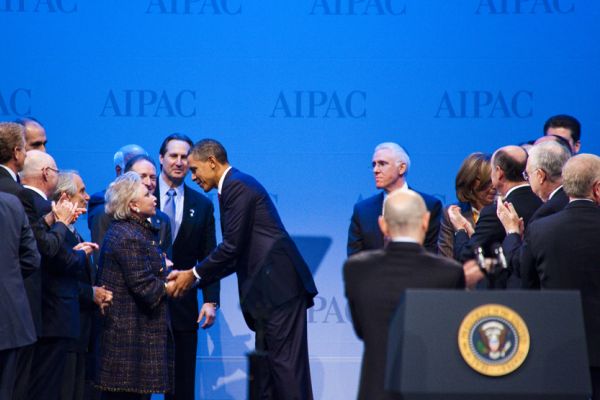
Barack Obama greets board members of the AIPAC conference following his speech to the group in 2012
Press TV – September 4, 2013
Three influential pro-Israel pressure groups in the United States pressed Congress on Tuesday to authorize an attack on Syria.
Signaling an increased lobbying effort for American military action, the American Israel Public Affairs Committee (AIPAC), the Anti-Defamation League (ADL) and the Republican Jewish Coalition (RJC) issued statements that they support US military intervention in Syria, Reuters reported.
The groups also had a 45-minute meeting at the White House on Tuesday with administration officials, according to government sources. But they have been careful as not to be seen encouraging Washington to go to war for the sake of Israel’s interest.
The lobby groups generally wanted the war debate to focus on US national security rather than how the decision to attack Syria might help Israel.
The Israel lobby is a diverse coalition of individuals and groups that seek to influence the foreign policy of the United States in support of Israel. Commentators in the US have asserted that the lobby has undue or pervasive influence over US foreign policy in the Middle East.
US President Barack Obama and some members in Congress want to attack Syria over recent accusations that the Arab country used chemical weapons against militants. Syrian authorities have categorically rejected the allegation that it had any role in the chemical attack.
Related articles
Russian defense official warns Israel on missile launch in Mediterranean
Press TV – September 4, 2013
A top Russian defense official has warned the Israeli regime against “playing with arms and missiles” in a volatile region after it admitted to firing ballistic projectiles in the Mediterranean Sea without a prior warning.
Underscoring the current volatility of the Mediterranean and the massive arms build-up in the region, Russia’s Deputy Defense Minister Anatoly Antonov told journalists on Tuesday “I don’t completely understand how someone could play with arms and missiles in that region today.”
Although the Russian official did not mention the Zionist regime by name, his remarks came hours after Israeli officials admitted to firing “ballistic targets” that resembled missiles in the growingly tense region, RIA Novosti reported on Wednesday.
“The Mediterranean is a powder keg,” Antonov emphasized. “A match is enough for fire to break out and possibly spread not only to neighboring states but to other world regions as well. I remind you that the Mediterranean is close to the borders of the Russian Federation.”
He further recalled that a meteorological rocket launch by Norway in 1995 was mistaken as a possible rocket attack against Russia.
The Russian then called on “those who launched the so-called missile-like targets” to be more responsible for regional security and “not play with fire,” according to the report.
After the Russian military detected the firing of two ballistic projectiles on Tuesday, the Israeli military announced that it launched the missiles as part of a joint effort with the US to “test” its missile defense system.
Russia, meanwhile, placed its General Staff’s Central Command Center on high alert following the two Israeli launches, the report noted, citing remarks by Antonov.
According to a Russian Defense Ministry spokesman, Russia detected the missile launch by radar at 10:16 a.m. Moscow time (6:16 a.m. GMT) in the southern Russian city of Armavir.
This is while Israeli military officials claimed in a statement that the first test of the latest version of the so-called Sparrow target missile had been successful, with the missile following its planned trajectory toward the Israeli coast and the Arrow radar system detecting and tracking its path.
However, a military spokeswoman for the regime, Myriam Nahon, declined to address questions on whether the test had been connected to the current state of affairs in Syria, saying only that such tests are “conducted periodically,” and “it happens whenever it has to happen.”
In Washington meanwhile, the Pentagon further issued a statement, admitting to its role in providing technical assistance and support to the Zionist regime for the so-called Sparrow test launch.
The development comes as US President Barack Obama has vowed to wage unilateral military action against the Syrian nation without a UN mandate, citing its accusation, based on “classified information,” that the Syrian government was behind a recent chemical attack in the nation.
Damascus, however, has fiercely denied the allegation, insisting that the foreign-backed militants in the country launched the chemical attack.
Related articles
Simon Schama’s The Story of the Jews – History Vs. Chicken Soup
Review by Gilad Atzmon | September 3, 2013
On the day we learned that the BBC’s new Middle East editor, Raffi Berg, urged colleagues to downplay Israel’s siege of Gaza, the British broadcaster launched Simon Schama’s The Story of the Jews. I have only watched the 1st episode of this new BBC 2 grandiose series. But I already learned from Schama about Jewish greatness, the formation of his people and the continuum between the ancient Israelites and their contemporary followers: Schama and his local reform Synagogue in North West London. I also learned about Jehovah, the God that was invented by the Jews to choose them over all other people.
But will Schama or the BBC manage to answer the most crucial questions to do with Jewish history and identity? Will he be able to put current Jewish politics into ‘historical’ context? Will he be able to tell us why the Jewish lobby in the USA, Britain and France push relentlessly for global conflicts in general and wars against Iran and Syria in particular? Will Schama manage to enlighten us and suggest why Jews were “Stalin’s willing executioners” as Yuri Slezkin suggests in his invaluable book The Jewish Century? Will the BBC manage to elaborate on Israeli prominent writer Sever Plocker’s confession that “some of greatest murderers of modern times were Jewish”? Will the BBC be able to elucidate the crimes committed by the Jewish State in the name of the Jewish people? Will the BBC manage to delve on Anti-Semitism, It’s History and Causes following the incredible enlightening work of Bernard Lazare or will they fall into the same trap and agree amongst themselves that something is ‘pathologically wrong with the Goyim’?
I don’t hold my breath. Schama is obviously a master of concealment. When he speaks about the ‘godless Jew’ Freud, he presents him as a refugee ‘driven out by the Nazis’ but for some reason he fails to mention Freud’s vile contempt to the Aryans in particular (which predates Nazism and the rise of Hitler) and the Goyim in general.
History becomes a meaningful event when it exchanges with the present and our imaginary future – when the past throws light on the present and the future gazes at its origin with hesitance.
The Jewish past, as we know it, is an endless chain of blood baths and holocausts. Lame Jewish history, that is all too common, is an attempt to conceal this past. Will Schama unveil the concealed? Will he or the BBC manage to reduce all those Shoas and disasters into a historical principle? Did Schama learn the only valuable lesson from his godless Jew Freud and ‘unveil the concealed’, or is he cooking another therapeutic chicken soup?
We will have to wait and see.
No War for Bernard Henri Lévy
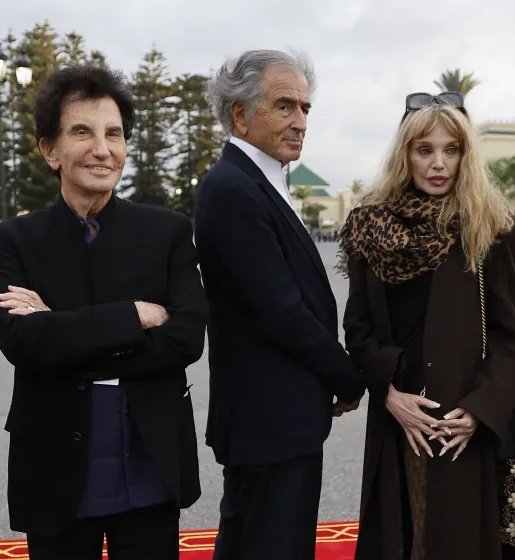
By DIANA JOHNSTONE | September 3, 2013
The American people do not want US armed forces to get involved in the civil war in Syria. The United Nations will not back US bombing of Syria. The British Parliament does not want to get involved in bombing Syria. World public opinion is opposed to US bombing Syria. Not even NATO wants to take part in bombing Syria. So who wants the United States to bomb Syria?
The same people who brought us the war in Iraq, that’s who.
On August 27, the Foreign Policy Initiative, a reincarnation of the Project for the New American Century (PNAC) that dictated the Bush 2 administration’s disastrous foreign policy, issued its marching orders to Obama. In an open letter to the President, the FPI urged “a decisive response to Syrian dictator Bashar al-Assad’s recent large-scale use of chemical weapons”.
The neocon “foreign policy experts” skipped over the pathos designed to arouse feelings of guilt in ordinary Americans for sitting in front of their television sets and “doing nothing”. Rather, their argument is based on power projection. Once Obama set a “red line”, he must react to “show the world”.
“Left unanswered, the Assad regime’s mounting attacks with chemical weapons will show the world that America’s red lines are only empty threats.”
The FPI told Obama that the United States should consider “direct military strikes against the pillars of the Assad regime”, not just to get rid of the chemical weapons threat, “but also to deter or destroy the Assad regime’s airpower and other conventional military means of committing atrocities against civilian non-combatants.”
At the same time, “the United States should accelerate efforts to vet, train, and arm moderate elements of Syria’s armed opposition, with the goal of empowering them to prevail against both the Assad regime and the growing presence of Al Qaeda-affiliated and other extremist rebel factions in the country.” The United States should “help shape and influence the foundations for the post-Assad Syria”.
In short, what is called for is a full-scale regime change, getting rid of both the existing regime and its main military opposition, and putting in power supposed “moderate elements of Syria’s armed opposition”, who by all accounts are the weakest in the field.
So, after failing to produce such nice, moderate results in Iraq or Afghanistan, try, try again.
The most familiar names among the 78 signatories included Elliott Abrams, Max Boot, Douglas J. Feith, Robert Kagan, Lawrence F. Kaplan, Joseph I. Lieberman, Martin Peretz, and Karl Rove. No surprises there.
The novelty on the list was the signature of Bernard-Henri Levy.
Not surprising either, when you stop to think about it. After all, Bernard-Henri Levy is widely credited with having persuaded former French president Nicolas Sarkozy to lead the charge that overthrew Kaddafi and delivered Libya to its current chaos. After such an accomplishment, the Parisian dandy naturally feels entitled to tell the United States President what to do.
I vividly recall Bernard-Henri Levy reacting with the mock indignation that serves as his usual shield from criticism to claims that the Benghazi rebels included Islamic extremists with ties to al Qaeda. Outrageous! he vociferated. He had been to Benghazi and seen for himself that the folks there were all liberal democrats who just wanted to enjoy free elections and multicultural harmony. Not so very much later, liberated Benghazi was sending Islamist fighters to destabilize Mali, recruiting Islamists to fight in Syria and assassinating a U.S. ambassador. This turn of events has not fazed the media star the French call “BHL” in the slightest. Although widely ridiculed and even hated in France, his influence persists.
In 2010, the writer Jacob Cohen published a novel entitled “Le Printemps des Sayanim”*. Despite the usual disclaimer, the novel was a roman à clés. A main character, named MST, was described in this fiction by an Israeli diplomat in Paris as follows: “MST is of capital importance to us. He is worth more than a hundred sayanim. […] He covers a large part of the left for us. Inasmuch as he ‘criticizes’ Israel, what he says is taken seriously. That way he can get our interests into a lot of media. […] Moreover, that man has incredible networks, in the most influential circles in Europe, in America. He can call Sarkozy whenever he wants, or the king of Morocco, or the president of the European Commission. […]”
No French reader would have any trouble recognizing BHL, although, of course, this was fiction.
But the question deserves to be raised: why has the real BHL been so keen to overthrow governments in Libya and Syria? Even if the countries fall apart?
Perhaps this flashy dilettante thinks these wars are good for Israel. BHL’s devotion to Israel is as conspicuous as his white v-neck shirts and back-swept hairdo. Perhaps he fantasizes that if all the surrounding countries are in hopeless shambles, “the only democracy in the Middle East” will be the only tree left standing in the forest.
But even Israeli intelligence, which is a major source of US assessment of happenings in the region, doubts that Assad’s chemical weapons are a threat to Israel.
Giora Inbar, the former head of the IDF’s liaison unit in southern Lebanon, was quoted by the August 27 Times of Israel as saying that “there would be no logic in Assad attacking Israel”.
Inbar said that Israeli military intelligence made a priority of intelligence-gathering in Syria, was very well-informed, and was widely trusted. The United States was “aware of” Israel’s intelligence on the doings of the Syrian regime, “and relies upon it.”
Still, Israeli officials are not hyping the incident the way John Kerry did, insisting on deliberate murder of children.
The New York Times on Tuesday quoted an Israeli official as saying: “It’s quite likely that there was kind of an operational mistake here […] I don’t think they wanted to kill so many people, especially so many children. Maybe they were trying to hit one place or to get one effect and they got a much greater effect than they thought.”
All that is speculation. But the most plausible hypothesis so far is that the incident was an accident. Indeed, rebel sources themselves have been quoted as saying that the incident occurred as a result of their own mishandling of chemical weapons obtained from Saudi Arabia. In that case, the victims were the “collateral damage” so frequent in war. War is a series of unintended consequences. The most obvious unintended consequence of US air strikes on Syria, if they happen, will be the total collapse of whatever pro-American sentiment may be left in the world, and a furious backlash against Israel, which is widely seen as the influence behind US policy in the Middle East. Some Israelis are fully aware of this.
The New York Times quoted former Israeli ambassador to the United States Itamar Rabinovich as warning that it would be “a mistake to overplay the Israeli interest” in striking Syria. “It’s bad for Israel that the average American gets it into his or her mind that boys are again sent to war for Israel. They have to be sent to war for America.”
If not for Israel, why do boys, or girls, or missiles, have to be sent at all?
And the best way to prevent the backlash against Israel and its supporters is to call a halt to the whole project of using US military force in Syria.
But whatever happens, the reckless adventurer Bernard-Henri Levy can retire to his palatial villa in Marrakech, and dream up some new scheme.
*Sayanim is a Hebrew word (singular sayan) defined by Wikipedia “passive agents most usually called “sleeping agents” established outside Israel, ready to help Mossad agents out of feelings of patriotism toward Israel.
Diana Johnstone can be reached at diana.josto@yahoo.fr
Featured Video
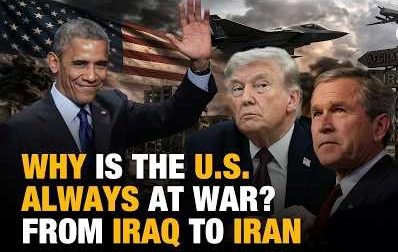
The Source of America’s Wars – Kristol Clear
or go to
Aletho News Archives – Video-Images
From the Archives
Is Israel to blame for the Iraq War?
American Goy | March 10, 2008
I am so tired of this old canard that “Israel had nothing to do with USA’s war with Iraq – in fact, it officially advised America against it”.
Bullshit. … continue
Blog Roll
 Aletho News
- Alberta Bill Would Fine Political Deepfakes $10,000 Without Satire Exemptions
- Iran declares ‘historic victory’ over US, says enemy forced to accept its proposal
- Trump Claims Ceasefire, Reopening of Strait of Hormuz Agreement with Iran
- Israeli tank fire killed UN peacekeeper in Lebanon, UNIFIL investigation finds
- Russia, China block Bahrain-sponsored UN resolution on Strait of Hormuz
- The US-Israeli War on Science is an Assault on our Future
- Trump’s Promise to Bomb Iran ‘Like Never Before’ Faces Brutal Logistics — Expert
- Germany seeks to restrict stays abroad for men of fighting age – Berliner Zeitung
- Evidence points to Ukraine being behind TurkStream attempted sabotage, but that should come as no surprise
- Sri Lanka secures supplies of Russia oil – minister
- If Americans Knew
- Thousands dead and neighborhoods razed to the ground: Aid agencies fear southern Lebanon is becoming the new Gaza
- The war the US is fighting for Israel could cost trillions
- ‘Cigarette Burns, Nail Wounds’: Toddler Tortured in Gaza to Coerce Father
- Trump Says US Sent ‘a Lot of Guns’ to Protesters in Iran
- Israeli forces destroy 17 UN peacekeeper cameras in south Lebanon
- US-Israeli strikes ‘completely destroy’ synagogue in Tehran
- Archbishop for US Military Says Iran War Is Unjust Under Catholic Teaching
- Iranian leaders’ Open Letters to the American People
- Trump says Iranians appreciate bombs, WHO warns of nuclear risks – Daily Update
- U.N. experts demand Israel release prominent Gaza doctor after reports of ‘severe torture’
- No Tricks Zone
- An Inconvenient Tree: Uncovered In Alps… Europe Much Warmer Than Today 6000 Years Ago
- New Study Reports A 60% Slowdown In Greenland’s Ice Loss Rate In The Last Decade
- Low Intensity Tornado Wrecks Major Solar Farm, Creating A Potential Toxic Dump
- New Study Finds Warming Saves Lives…Cold Temperatures 12 Times More Deadly Than Excess Heat
- German Science Blog Accuses PIK Climate Institute Of Hallucinating Climate Tipping Points
- Devastating Assessment Of Comirnaty Vaccine By Former Senior Pfizer Europe Toxicologist
- New Study: CO2 Is ‘Effectively Negligible’ As An Explanatory Climate Change Factor Since 2000
- Former Pfizer Toxicologist Dr. Helmut Sterz Tells Bundestag Hearing Pfizer Vaccine Should Have Never Been Approved
- Energy Expert: Germany’s Nuclear Phaseout Was A “500 Billion Euro Mistake”
- New Research: South Australia’s Mid-Holocene Sea Surface Temperatures Were 4°C Warmer Than Today
 Aletho News