Call It Genocide, not Apartheid
By Nahida Izzat | January 20, 2014
Words, in the battle of Liberation are of prime importance, but in the age of Internet, where Cyber Battles are waged, between truth and falsehood, the use of the right word becomes more vital than ever.
We have observed how the word, “apartheid” has crept in and has been intensely used by many Palestinians and their supporters without much reflection upon the meaning, implications or outcome of such use.
The definition of “Apartheid”
1. An official policy of racial segregation formerly practiced in the Republic of South Africa, involving political, legal, and economic discrimination against nonwhites.
2. A policy or practice of separating or segregating groups.
3. The condition of being separated from others; segregation.
Thus, the use of apartheid to describe “Israel”, the entity which was established by terror, planned ethnic cleansing and continues to practice slow genocide is extremely inappropriate, insufficient and falls very short from giving a complete and accurate portrait.
Calling “Israel” an Apartheid is a CONCEALMENT of Genocide
Calling the Zionist entity mere “apartheid”, i.e “separation”, would only serve in concealing the true genocidal nature of the Jewish state, and present it as a “normal” and “legitimate” political system with only few holes, some racist laws, and wrong policies which can be easily changed. Such use would promote the legitimization of this entity. From a legal aspect, crimes of apartheid does not carry the same weight in International Law as Crimes against Humanity, thus it may be harder to prosecute.
Campaigning to demand that the existing Jewish state, would change some of its policies (rather than to call for its dismantling and delegitimisation, to end this entity, once and for all) would simply enable the usurpation of historic Palestine.
Calling for ODS (one democratic state, as a continuation of “Israel”), while ignoring the right of Palestinians to FULL LIBERATION, would enable the Zionist entity to expand and enlarge its boundaries, to encompass the ENTIRE land of Palestine, by annexing what remains of Palestine.
Calling for “equal rights” between mass-murderers and their victims, means willful participation in wiping out the Palestinian Identity, under “Israeli” authority thus promoting giving Palestinians “Israeli” citizenship, which means unwittingly promoting the “Israelization” of what remains of Palestinians, i.e upgrading their state from “occupied Palestinians” to “Israeli slaves”.
I call upon our people and our supporters to be alert and not to participate in whitewashing the crimes of the Jewish state, by calling it an “apartheid” rather than what it really is, a genocidal, supremacist, expansionist, ethnic-cleansing entity.



The Genocide Convention
Article 2 of the United Nations issued Convention on the Prevention and Punishment of the Crime of Genocide states:
“any of the following acts committed with intent to destroy, in whole or in part, a national, ethnical, racial or religious group as such:
1. Killing members of the group; [Israel …guilty]
2. Causing serious bodily or mental harm to members of the group; [Israel …guilty]
3. Deliberately inflicting on the group conditions of life calculated to bring about its physical destruction in whole or in part; [Israel …guilty]
4. Imposing measures intended to prevent births within the group; [Israel …guilty]
5. Forcibly transferring children of the group to another group.”
Article 4 states:
Persons committing genocide or any of the other acts enumerated in Article 3 shall be punished, whether they are constitutionally responsible rulers, public officials or private individuals.
Nuremberg Principles,
Principle VI. states,
“The crimes hereinafter set out are punishable as crimes under international law:
(a) Crimes against peace:
(i) Planning, preparation, initiation or waging of a war of aggression or a war in violation of international treaties, agreements or assurances;
(ii) Participation in a common plan or conspiracy for the accomplishment of any of the acts mentioned under (i).
(b) War crimes:
Violations of the laws or customs of war which include, but are not limited to, murder, ill-treatment or deportation of slave labor or for any other purpose of the civilian population of or in occupied territory; murder or ill-treatment of prisoners of war or persons on the Seas, killing of hostages, plunder of public or private property, wanton destruction of cities, towns, or villages, or devastation not justified by military necessity.
Murder, extermination, enslavement, deportation and other inhumane acts done against any civilian population, or persecutions on political, racial, or religious grounds, when such acts are done or such persecutions are carried on in execution of or in connection with any crime against peace or any war crime.”
In Contrast:
In contrast:
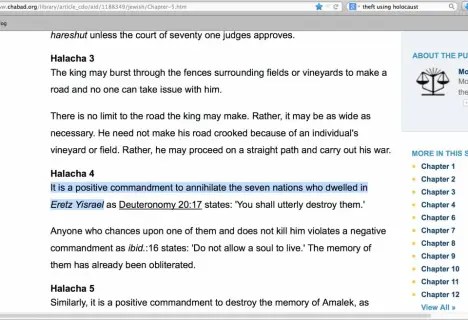
The Sanhedrin Principles:
- Wars of aggression . . . NO PROBLEM
Mishneh Torah, Chapter 5, Halacha 1
“A king should not wage other wars before a milchemet mitzvah. What is considered as milchemet mitzvah? The war against the seven nations who occupied Eretz Yisrael, the war against Amalek, and a war fought to assist Israel from an enemy which attacks them.
Afterwards, he may wage a milchemet hareshut, (war of aggression) i.e. a war fought with other nations in order to expand the borders of Israel or magnify its greatness and reputation.“
- Extermination . . . NO PROBLEM
Mishneh Torah, Chapter 1, Halacha 2:
“Amalek’s seed should be annihilated before the construction of the Temple”
THE LAWS OF KINGS AND THEIR WARS
6) The obligation to destroy the seven nations living in the Land of Canaan;
7) The prohibition against allowing any one of them to remain alive;
8) The obligation to destroy the descendents of Amalek;
9) The obligation to remember what Amalek did;
- Subjugation and Enslavement . . . NO PROBLEM
Mishneh Torah, Chapter 6, Halacha 1
“If the enemy accepts the offer of peace and commits itself to the fulfillment of the seven mitzvot that were commanded to Noah’s descendents, none of them should be killed. Rather, they should be subjugated as ibid.:11 states: ‘They shall be your subjects and serve you.’
If they agree to tribute, but do not accept subjugation or if they accept subjugation, but do not agree to tribute, their offer should not be heeded. They must accept both.
The subjugation they must accept consists of being on a lower level, scorned and humble. They must never raise their heads against Israel, but must remain subjugated under their rule. They may never be appointed over a Jew in any matter whatsoever.”
Related articles

So when will international justice save Palestine?
By Stuart Littlewood | Intifada Palestine | January 21, 2014
Eighteen months ago UK foreign secretary William Hague delivered an important speech at the Hague, home of the International Criminal Court . He was saying all the right things, for example:
“The rule of law is critical to the preservation of the rights of individuals and the protection of the interests of all states.”
“You cannot have lasting peace without justice and accountability.”
“International laws and agreements are the only durable framework to address problems without borders.”
“Such agreements – if they are upheld – are a unifying force in a divided world.”
He spoke of a growing reliance on a rules-based international system. “We depend more and more on other countries abiding by international laws…. We need to strengthen the international awareness and observance of laws and rules….”
Some emerging powers, he said, didn’t agree with us about how to act when human rights are violated on a colossal scale, while others didn’t subscribe to the basic values and principles of human rights in the first place. He was talking about Syria although many in the audience must have had Israel in mind.
“The international community came together in an unprecedented way to address the crisis in Libya last year,” said Hague. “The Arab League, the UN Security Council, the UN Human Rights Council, the European Union, NATO and the International Criminal Court all stepped forward and played their part to protect a civilian population.”
Yeah. Funny how they have never come together for crisis-torn Palestine these last 65 years.
‘We pledge to fight impunity for grave international crimes wherever they occur’
Hague, positively overflowing with fine words and sentiments, chuntered on.
“We have to ensure that when we are trying to build peace, we don’t overlook the need for justice…. Our coalition Government is firmly of the view that leaders who are responsible for atrocities should be held to account…. Institutions of international justice are not foreign policy tools to be switched on and off at will.”
He said referring leaders in Libya and Sudan to the ICC showed that not signing up to the Rome Statute was no guarantee for escaping accountability. “If you commit war crimes, crimes against humanity or genocide you will not be able to rest easily in your bed: the reach of international justice is long and patient…. There is no expiry date for these crimes….”
Woweee! Had he told Netanyahu this? Was this tough talking really from the man who watered down Britain’s laws of Universal Jurisdiction to protect Israel’s war criminals from arrest while shopping in London’s Bond Street? Israel and the US, after signing up to the Rome Statute, had second thoughts and ‘unsigned’ in order to escape the long reach of international justice. At last it was beginning to sound like bad news for TelAviv’s and Washington’s thugs.
At the time of the Libya fiasco Hague announced he had signed a directive revoking Gaddafi’s diplomatic immunity and also that of his sons, his family and entire household. He bragged how the UK “drove” through a Security Council resolution referring what was happening in Libya to the ICC Prosecutor, saying it “sends a clear message to all involved, in the regime and any other groups that if they commit crimes and atrocities there will be a day of reckoning for them.”
Bravo! What a splendidly high-principled chap Hague suddenly seemed to be. And how swiftly he managed to get the International Criminal Court’s attention when he wanted to. But we didn’t hear Hague and his friends call for a reckoning with the psychopaths of the Israeli regime when they committed mega-atrocities against Gaza’s civilians just two years earlier. Instead they tinkered with our laws of universal jurisdiction to enable suspected war criminals to walk free. Gaddafi wasn’t welcome in London but the Foreign Office happily rolled out the red carpet for Livni, Lieberman, Barak and Netanyahu, while Hague conducted the brass band.
Our foreign secretary rounded off his speech by saying:
“There is no doubt where Britain stands: we are with those who say that international law is universal and that all nations are accountable to it…. We are a country that believes in and upholds the Responsibility to Protect, and that is prepared to act to save lives – including through military action as a last resort. We actively support a rules-based international system…. We pledge to recommit to the importance of fighting impunity for grave international crimes wherever they occur…. We will be a robust supporter of the International Criminal Court in its investigations.”
Trampled Palestinians dispossessed by a brutal military occupier and sitting among the smoking ruins of their homes, or eking out a squalid existence in their refugee camp, must have been impressed.

Related article

Drawing the Kafr Qasem Massacre: An Introduction to the Ongoing Project

[Samia Halaby, “The Kafr Qasem Massacre of 1956, the Third Wave of Killing, the Child Fathi” (2012).]
By Samia Halaby | Jadaliyya* | January 19, 2014
When I first accepted the challenge of drawing the Kafr Qasem massacre, I wanted to represent its events as though I were a camera on site. Documentary drawings, I thought, could recreate what photography might have given us if done on a historical basis. I would learn all I could and present the specific individuals and the documented events. I worked on the project in three major periods, each occupying most of a year or several years. I began work in 1999 and continued into 2000. In 2006, on the occasion of the fiftieth memorial of the massacre, I created both a web page and an exhibition of the drawings. In 2012, I returned to the project with the intention of finalizing it by making large-scale drawings and developing a book.
The story of the Kafr Qasem massacre is compelling. At first hidden from the world, it was members of the Communist Party who broke the military and information blockade in order to call attention to the horrific massacre; a detailed press release was finally published by party member Tawfiq Toubi twenty-six days after the massacre on 23 November, 1956 in Arabic, English, and Hebrew. His comrade, the distinguished Palestinian writer, Emile Habibi covered the massacre in issues of the CP organ, Al Ittihad, and in 1976 published a booklet on the subject. In one chapter, Habibi recounted the events and provided a structure whereby the chronology of events were numbered and termed “waves” of killing.
Israel’s military campaign against Egypt and the Suez started at 3pm on 29 October, 1956. One and a half hours later, at 4:30pm, the mukhtar (mayor) of Kafr Qasem was informed of an imminent curfew to begin at 5pm. Twenty-five minutes after this sudden warning, at 4:55, soldiers of the Israeli Border Police began killing anyone they found outside their home—be they man or woman, child or elder. Many were workers unaware of the curfew, as they were just then returning home. At the end of the night, forty-nine civilians lay dead on the roadways. Although each event of the massacre was nightmarish, the last one seemed to shock the villagers most of all, as fourteen women who had been olive picking were forced off a truck and shot at continuously from close range until they all fell dead over each other. The sole survivor of this wave of killing was a fifteen-year-old girl, who, when heavily wounded, lost consciousness, and lay under the corpses of the other women for most of the night. To add terror to brutal injury, the Israelis buried their bodies while their relatives were imprisoned in their homes on pain of death through the use of a twenty-four hour curfew.
A massacre is like a hammer blow that shatters a hard mass to smithereens. At first the pieces, the individuals who suffer this blow, do not all see who wields the hammer nor are they able to attack it. Anger and blame are bottled up. Painful energy flies in all directions. The town receiving the blow is shattered, broken to pieces, and as the pieces settle, loss, recrimination, shock, disbelief, and desperation emerge. Added to all this, as in the case of the Kafr Qasem massacre, is the poverty and depression resulting from a brutal military occupation.
What does a father tell his wife when he returns home alive but their eight-year old child whom she sent to warn him dies in the massacre? Why is a small girl unable to tell her mother that her father lies dead or wounded in the street except to say that dinner need not be prepared for him? Why do men and women, unable to believe their own experience, return to the scenes of the massacre to confirm its reality with those who shared it only to find death instead of fellowship? Why was the only survivor of one of the events of the massacre insensitively asked why she was the only one to survive? Why does a wounded man who had escaped, return on seeing the Israeli soldiers killing fourteen women only to be shot dead himself? Why did some whisper that the pregnant woman in her final month dropped the baby in the agony of her death?
When I first met Aishy Amer of Kafr Qasem, the beautiful scent of revolution permeated her words and manners. We had met through the internet and from her first visit to my loft she began to persuade me that, as an artist, I must do drawings of the massacre. Aishy and I eventually visited Kafr Qasem together, where she introduced me to her large family and friends and opened the way for me into a tightly knit village society made up of only five extended families. Following this first visit, she would assign her friends to help me. After interviewing some individuals several times over a period of thirteen years, they came to trust me as a friend. In fact in 2012, during my last visit to attend the annual memorial march, I found myself receiving extended interviews while members of the press were disregarded.
Along with my interviews, I conducted extensive research for historical materials and found a gold mine in the locally published magazine, Al-Shorok, each October issue of which is dedicated to the massacre. In it are countless long interviews conducted by Majd Sarsour, editor and principal of one of the town’s high schools. In general, the outside press did not match this valuable source of detailed information. It was rare to find newspaper articles that contained more than small bits of quoted information. Yet Al-Shorok allowed each individual to fully tell his or her story. Al-Shorok also insisted on detailing not only the names of victims and their ages, but also those of their children, the gender of the children, and their ages at the time of the parents’ death. In one particular article, the magazine detailed the ages of over four thousand offspring of the victims who had already given birth. An intense need to replenish the village overtook the survivors.
I came to truly respect the village, now grown into a town, regardless of its various types and admire the combination of earthy nobility, innocence, and wisdom they possessed. I learnt of the depth of pain they experienced, causing many to be unwilling to tell their stories. I learnt to value their trust and grew to understand that documentation should respectfully memorialize, avoiding sensation and spectacle.
I began drawing immediately after the first visit and continued to do so in separate periods of intense focus. As I worked and my knowledge grew, many of my initial aesthetic decisions matured. I determined that I would avoid simply showing piles of dead bodies. I would show people in their dignity at the last moments of their life. There would be no blood. I determined that the individual victims should face out towards the viewer, be in control of the aesthetic situation if not the original situation, which brought their violent end.
I began drawing in an illusionist way in the traditions of Renaissance art, but as the project progressed, I often questioned whether I perhaps should use an expressionist method. I admired Diego Rivera and thought that working in that manner, which many of the Palestinian artists of the Intifada were influenced by, might be a more modern path. However, after a lot of thought, I decided that the expressionism and semi-cubist style of Rivera did not suite the ambition of presenting people as specific individuals in documented events.
There is a paucity of visual information on the massacre, leaving written material as the basic source. Transforming verbal description and researched information into visual images presented serious problems. Words can focus on one subject and describe it accurately but not wholly. Pictures describe a scene wholly (from one point of view) but cannot show what happened just before or after. Pictures lack the specificity of time while words lack the specificity of space.
Truthful witness statements can hold up in a court of law but they lack the type of information pictures need regarding the appearance of a whole scene, information about color, light, background, relative positions of parts, and a host of other scenic details. This forced me into a certain amount of invention, which seriously conditioned my ambition to be a camera.
One of my initial inquiries was how to represent the killers, the soldiers of the Israeli Border Police who had executed the massacre. Based on things that I have seen in Palestine combined with my loathing, I made several horrifying renditions. In the end, I decided that the story was not about them and eliminated them from the drawings. However, in the final set done in 2012, I included fragments of them in outlined silhouette although I rendered their weapons carefully. By then I had researched the weapons and noted that they were semi-automatic weapons and that some of them were British made, reminding me of the part British colonialism had in arming and organizing the Zionist terrorists.
I asked for a great deal of criticism from residents of Kafr Qasem and from friends, and their opinions helped me greatly. I was not on a research mission to discover new formal languages but rather on a mission to tell a piece of Palestinian history in comprehensible visual form. I received a rating of seventy over one hundred on my drawing of the sixth wave of killing. I was flattered to have such a high grade for the man grading me, Omar Ahmad Hamdan Amer, known as Abu Naser, was the town’s historian, a man who lived his entire life immersed in the history of the massacre.
Did I meet my own challenge? An inner voice says: do it all over again and do it better. But another voice says: another way to fail is to disregard time. For now, I will be happy when my planned publication of drawings on the subject of the massacre is complete. The book will be called “Drawing the Kafr Qasem Massacre.” It will include a detailed history, a timeline, numerous witness statements, the drawings with my commentary, a roster of victims, and essays by scholars.
Below is a selection of drawings from the series with the artist’s captions:

[The Kafr Qasem Massacre of 1956, Killing Inside the Village, the Easa Family (1999).]
During less than two hours on 29 October, 1956, Israeli Border Police killed forty-nine people in the Palestinian village of Kafr Qasem. They were mostly workers and children returning home in the evening. Most were killed on the western entrance, while inside the village it began when eight-year-old Talal Easa went out to retrieve a goat after the suddenly announced curfew. Talal’s father, Shaker, heard the shots and dashed out to his son. He was also shot. Talal’s mother, Rasmiyya, and, right after, Talal’s teenage sister, Noor, ran to their bleeding family and suffered the same fate. They remained where they fell, bleeding until morning when they were hauled off by truck to a hospital. Talal died. The grandfather, Abdallah Isaa, then ninety years old, was left alone and saw the massacre of his family. The following morning, Abdallah was found dead.

[The Kafr Qasem Massacre of 1956, Killing in the Northern Fields (2012).]
In the northern fields of the village, three shepherd boys were out watering the family’s flock of sheep not knowing that Israel had launched a surprise attack on Egypt just hours before, nor did they know of the curfew imposed on their village. The oldest boy, Abdallah Easa was sixteen and the youngest, Abed Easa, was nine years old. Ibraheem Easa, their uncle who was thirty-five years of age, had learnt of the curfew and left the safety of his home to bring them back. They returned immediately with Ibraheem leading. Abed and Abdallah were just behind him while the third boy, Sami Mustafa, was watching the rear of the herd. The boys were met by Israeli soldiers of the Border Police, who immediately shot and killed Ibraheem, Abed, and Abdallah. Sami saw them being shot and fell to the ground, played dead and survived.

[The Kafr Qasem Massacre, the First Wave of Killing (2012).]
Five minutes before the curfew, and unaware of it, four quarry workers were returning home to Kafr Qasem on bicycles. When confronted by Israeli soldiers, with whose harassment they were familiar, they reached for their identity cards. Instead, an order to “harvest them” was given. Two, Ahmad Freij, age thirty-five, and Ali Tah, age thirty, died. Both were fathers of young children. Two others, Mahmoud Freij and Abdallah Badair, managed to escape. Mahmoud was wounded in the thigh and managed to crawl to an olive tree and hide until morning.

[The Kafr Qasem Massacre of 1956, the Third Wave of Killing, Child Fathi (2012).]
The twelve-year-old shepherd boy, Fathi Easa, was leading his family’s herd of black goats home after pasture. His father was driving the herd from the rear having heard of the curfew and had come to hurry his son home. There were three weapons in the hands of the Israeli Border Police all aimed at the boy, an Uzi, a Bren, and a rifle. All were fired, and the boy collapsed and died.

[The Kafr Qasem Massacre of 1956, the Sixth Wave of Killing (2012).]
Evening was darkening as the Israeli Border Police ordered thirteen or more workers to lineup on one side of the road. They had arrived on bicycles and a mule wagon. One of the workers, seventeen-year old Saleh Easa, had arrived with his two cousins. They had heard about the curfew and only feared a beating. When the execution style shooting began six fell dead. Saleh, wounded, playing dead, was dragged to the pile of bodies. He remained quiet, gritting his teeth in spite of extreme pain. He witnessed the rest of the massacre and later crawled to safety.

[The Kafr Qasem Massacre of 1956, the Ninth Wave of Killing, Implosion (2012).]
Night had fallen when the truck arrived at the location of the massacre. Among the victims of the ninth wave were two men in the cab of the truck and fourteen women with two boys in the back. The driver, seeing the scattered dead, tried to escape at high speed. This interrupted the singing women, who unwittingly began to scream, thus alerting the recumbent soldiers resting at the school’s well. The soldiers ran after the truck, shot its tires and gas tank, and stopped it. Safa Sarsour, having just seen her sixteen-year-old son, Jum’a, dead on the side of the road, now witnessed her second son, fourteen-year-old Abdallah, being killed with the men. The women, some pregnant, elders and girls, pleaded for their lives. The only survivor was Hana’ Amer, fifteen years of age, who said that the women clung to each other for protection, even the two girls who had managed to escape returned to the circle. As they were being shot, they turned in a big group and one by one they fell. The soldiers continued shooting into their heads to insure their death. How does it measure western civilization when soldiers of the Israeli border police line up defenseless women—some pregnant, tired, returning home from work—and kill them with cold deliberation?
*All images copyright the artist.
Related articles


UK Court’s Drone Ruling Shows the Law Is an Ass
By Clive Stafford Smith | Huffington Post | January 21, 2014
… There are various ways in which modern law is not married to good sense. For example, one opinion of the United States Supreme Court tells us that your innocence is not constitutionally relevant to whether you should be executed. But recently, British courts have rivalled their counterparts across the pond in competing for the most senseless judgment. The latest example came just yesterday, when three British judges said they could not rule on whether British officials were complicit in murdering Pakistani civilians in US drone strikes because that might embarrass our friends in America.
The case involves a Pakistani called Noor Khan. I have met him. A habitually calm young man, he was understandably incensed when his father was killed – in one of the catastrophes of the US drone age – in the region of Pakistan that borders on Afghanistan. The drone strike was patently illegal; there is no war with Pakistan, and the Predator drone fired hellfire missiles that killed some fifty innocent elders who were holding a jirga or local council meeting, peacefully trying to resolve a local dispute over a chromite mine.
It was the equivalent of bombing the High Court in London. It was both the domestic crime of murder, and the international war crime of targeting civilians.
Sad to say, there is evidence that the British security services have been supplying the US with intelligence that has led to a number of these strikes. The simple claim that Khan was making, too late to save his father, was that GCHQ should not be allowed to do this if their own actions violate British and international law.
British domestic law criminalises the “intentional encouraging or assisting” of the crime of murder. The International Criminal Court Act of 2001 defines one crime against humanity as a mass killing of members of a civilian population. Another is an intentional attack against a person not taking a direct part in hostilities.
Those whose actions are being questioned are not soldiers risking their lives fighting a legal war (who are therefore covered by combatant immunity); they are intelligence officers who, sitting comfortably in Cheltenham over a cup of coffee, are instrumental in one of the most serious criminal acts. … Full article
Related articles


Unilateral missile defence plans great challenge to non-nuclear world – Russian envoy
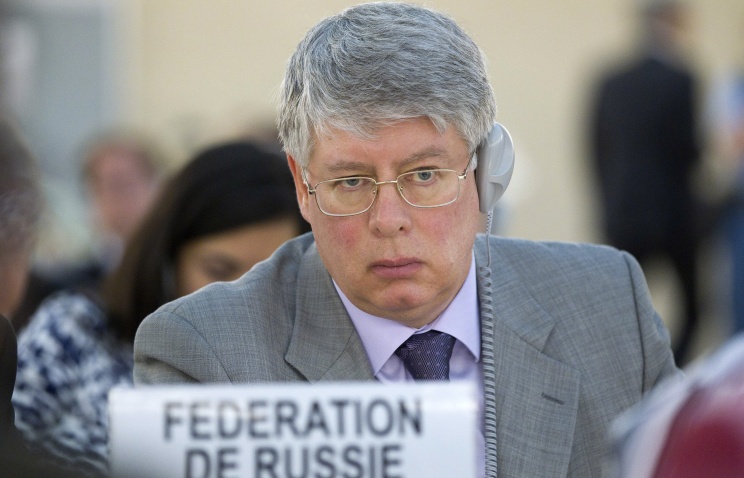
Permanent Representative of Russia to the United Nations and other International Organizations in Geneva Alexei Borodavkin
EPA/Salvatore Di Nolfi
ITAR-TASS | January 21, 2014
GENEVA – Unilateral plans for creating a global missile defense are the strongest challenge to the idea of ridding the world of nuclear weapons, Russia’s permanent representative at the UN office and other international organizations in Geneva, Alexei Borodavkin, told the conference on disarmament on Tuesday.
“Russia’s and the United States’ experience of implementing a number of agreements on the reduction of nuclear arsenals indicates that a short way towards a common goal simply does not exist,” he said. “Also, the situation in the modern world to my deep regret by no means promotes the conclusion of more agreements in the nuclear disarmament sphere.”
According to the diplomat, “some negative factors that undermine strategic stability” have been gaining strength.
“Unilateral plans for creating a global missile defense system are the strongest challenge on the road to a nuclear-weapons-free world,” Borodavkin said. They are fraught with an anti-destabilizing potential. They contradict the fundamental principle of impermissibility of strengthening one’s own security to the detriment of others.
“Abuse of this principle, in view of the inseparable link between the defense and strategic offensive weapons, may have extremely negative consequences in various spheres, including the disarmament agenda,” the Russian envoy said.
Borodavkin said that alongside the missile defense one should remember plans for the implementation of the concept of an instant global strike, imbalances in conventional armaments, and insufficient progress towards the enforcement of the NPT treaty.
“We are certain that all countries having nuclear potentials should join the efforts in the field of nuclear disarmament,” he said.
Related article

The endless arms race
By Lawrence Wittner | International Physicians for the Prevention of Nuclear War | January 21, 2014
It’s heartening to see that an agreement has been reached to ensure that Iran honors its commitment, made when it signed the 1970 nuclear Non-Proliferation Treaty (NPT), to forgo developing nuclear weapons.
But what about the other key part of the NPT, Article VI, which commits nuclear-armed nations to “cessation of the nuclear arms race at an early date and to nuclear disarmament,” as well as to “a treaty on general and complete disarmament”? Here we find that, 44 years after the NPT went into force, the United States and other nuclear powers continue to pursue their nuclear weapons buildups, with no end in sight.
On January 8, 2014, U.S. Defense Secretary Chuck Hagel announced what Reuters termed “ambitious plans to upgrade [U.S.] nuclear weapons systems by modernizing weapons and building new submarines, missiles and bombers to deliver them.” The Pentagon intends to build a dozen new ballistic missile submarines, a new fleet of long-range nuclear bombers, and new intercontinental ballistic missiles. The Congressional Budget Office estimated in late December that implementing the plans would cost $355 billion over the next decade, while an analysis by the independent Center for Nonproliferation Studies reported that this upgrade of U.S. nuclear forces would cost $1 trillion over the next 30 years. If the higher estimate proves correct, the submarines alone would cost over $29 billion each.
Of course, the United States already has a massive nuclear weapons capability — approximately 7,700 nuclear weapons, with more than enough explosive power to destroy the world. Together with Russia, it possesses about 95 percent of the more than 17,000 nuclear weapons that comprise the global nuclear arsenal.
Nor is the United States the only nation with grand nuclear ambitions. Although China currently has only about 250 nuclear weapons, including 75 intercontinental ballistic missiles (ICBMs), it recently flight-tested a hypersonic nuclear missile delivery vehicle capable of penetrating any existing defense system. The weapon, dubbed the Wu-14 by U.S. officials, was detected flying at ten times the speed of sound during a test flight over China during early January 2014. According to Chinese scientists, their government had put an “enormous investment” into the project, with more than a hundred teams from leading research institutes and universities working on it. Professor Wang Yuhui, a researcher on hypersonic flight control at Nanjing University, stated that “many more tests will be carried out” to solve the remaining technical problems. “It’s just the beginning.” Ni Lexiong, a Shanghai-based naval expert, commented approvingly that “missiles will play a dominant role in warfare, and China has a very clear idea of what is important.”
Other nations are engaged in this arms race, as well. Russia, the other dominant nuclear power, seems determined to keep pace with the United States through modernization of its nuclear forces. The development of new, updated Russian ICBMs is proceeding rapidly, while new nuclear submarines are already being produced. Also, the Russian government has started work on a new strategic bomber, known as the PAK DA, which reportedly will become operational in 2025. Both Russia and India are known to be working on their own versions of a hypersonic nuclear missile carrier. But, thus far, these two nuclear nations lag behind the United States and China in its development. Israel is also proceeding with modernization of its nuclear weapons, and apparently played the key role in scuttling the proposed U.N. conference on a nuclear weapons-free zone in the Middle East in 2012.
This nuclear weapons buildup certainly contradicts the official rhetoric. On April 5, 2009, in his first major foreign policy address, President Barack Obama proclaimed “America’s commitment to seek the peace and security of a world without nuclear weapons.” That fall, the UN Security Council — including Russia, China, Britain, France, and the United States, all of them nuclear powers — unanimously passed Resolution 1887, which reiterated the point that the NPT required the “disarmament of countries currently possessing nuclear weapons.” But rhetoric, it seems, is one thing and action quite another.
Thus, although the Iranian government’s willingness to forgo the development of nuclear weapons is cause for encouragement, the failure of the nuclear nations to fulfill their own NPT obligations is appalling. Given these nations’ enhanced preparations for nuclear war — a war that would be nothing short of catastrophic — their evasion of responsibility should be condemned by everyone seeking a safer, saner world.
Lawrence S. Wittner (http://lawrenceswittner.com) is Professor of History emeritus at SUNY/Albany. His latest book is a satirical novel about university corporatization, What’s Going On at UAardvark?
Related articles


Dianne Feinstein: NSA Would Never Abuse Its Powers Because It’s ‘Professional’
By Mike Masnick | Techdirt | January 21, 2014
Senator Dianne Feinstein, as we’ve noted, seems to have this weird blindness to even the very idea that the NSA might abuse its powers, despite a long history of it doing exactly that. The history of the US intelligence community is littered like a junk yard with examples of massive abuses of power by intelligence folks. And yet, Feinstein seems shocked at the idea that anyone questions the NSA’s ability to abuse the system. Why? Because the NSA is “professional.” Appearing on Meet the Press this weekend, Feinstein just kept repeating how “professional” the NSA is as if that was some sort of talisman that wards off any potential of abuse. First, host David Gregory pointed to reporter Bart Gellman’s claim that President Obama’s NSA reforms will allow for the expansion of the NSA’s collecting personal data on “billions of people around the world, Americans and foreign citizens alike” and told Feinstein that didn’t seem like it was protecting people’s privacy. And Feinstein went straight to her “but they’re professionals!” argument:
Well, I would disagree with Mr. Gellman. I think that what the president has said is that he wanted to maintain the capability of the program. That, as Chairman Rogers said, it has not been abused or misused. And it is carried out by very strictly vetted and professional people.
Of course it has been “abused” and “misused,” but let’s not let details get in the way.
Later in the interview, Gregory asks Feinstein to comment on Rep. Mike Roger’s totally unsubstantiated (and contradicted by nearly everyone else in the know) claims that Ed Snowden was working for Russian intelligence, and Feinstein bizarrely returns to talking about just how “professional” NSA staffers are.
DAVID GREGORY:
And do you agree with Chairman Rogers that he may have had help from the Russians?SENATOR DIANNE FEINSTEIN:
He may well have. We don’t know at this stage. But I think to glorify this act is really to set sort of a new level of dishonor. And this goes to where this metadata goes. Because the N.S.A. are professionals. They are limited in number to 22 who have access to the data. Two of them are supervisors. They are vetted. They are carefully supervised. The data goes anywhere else. How do you provide that level of supervision?
Of course, Ed Snowden was also “vetted” and “professional.” And Feinstein seems to think he may have been working for the Russians, which seems to suggest that any of the other “vetted” and “professional” NSA employees might be abusing their position as well. And, I mean, I’m sure the NSA analysts who listened in on phone sex calls between Americans and then shared them around the office were also “vetted” and “professional.”
In fact, I’d think pretty much the entirety of human history concerning intelligence efforts suggests that abuse is almost always carried out by people who are “vetted” and “professional.” And that’s exactly what has most people so concerned about these programs and what the NSA is doing. No matter how well-meaning, well-trained or well-vetted people are, the temptation and ability for abuse is way too strong. Just last week, we were quoting a bunch of “vetted” and “professional” NSA folks talking about how they fantasized about murdering Ed Snowden. Those comments don’t sound particularly professional at all. They sound like people who shouldn’t be allowed within miles of people’s private data. But Feinstein apparently sees no problems with those kinds of people having the ability to search through your private data. Because they’re “professional.”
Your Rights Aren’t Worth Crap
Locking The Public Out Of Public Trials In Chicago
By CHRIS GEOVANIS | CounterPunch | January 21, 2014
Public trials are one of the fundamental tenets of American democracy. And they’ve been cancelled in Chicago, at least for the trial of the NATO 3 — three defendants battling terrorism charges for alleged ‘crimes’ wholly instigated, manufactured and advanced by undercover cops in a blatant case of entrapment. But you’ll be hard pressed to determine this for yourself, since you’re essentially banned from the courtroom unless you’re willing to surrender your right to privacy, your right to even a glimmer of free expression, or your right as a non-corporate reporter to cover the case in real time like your corporate colleagues can.
Government officials are forcing every member of the public seeking to observe the NATO 3 trial to ‘pre-register’, produce a government-issued ID, submit to a criminal background check — and, of course, trust them with your data.
This last bit is spectacularly hard to swallow, as news continues to come out about the extent of government spying and data-mining on perfectly lawful activity like talking on the phone. Government agencies have surveilled and disrupted the Occupy movement, to which the defendants had a loose affiliation, simply for existing, and we’ve barely begun to plumb the depths of cop spying in the run-up to Chicago’s NATO protest — and beyond. For Chicagoans, this comes in the wake of the Chicago cops’ notorious history of political spying, disruption and assassination going back to the days of the infamous COINTELPRO Red Squad.
In fact, there would be no criminal case against the three defendants if the city’s autocratic former mayor, Richard M. Daley, hadn’t finally succeeded in convincing the federal court in 2001 to effectively gut the Red Squad Consent Decree banning police spying, infiltration, harassment, intimidation and undercover disruption of political activity. The hollowed out decree was ultimately dissolved in 2009.
Attorneys for the NATO defendants have argued in a court finding that the ‘terrorism’ scheme they’re charged with is based on “idle chatter, laced with bravado and abetted, encouraged and egged on by the undercover police agents.” There was no actual act of vandalism committed, and there certainly was no act of ‘terror’ committed — unless you’re feeling terrorized by the prospect of undercover cops inciting thought crimes to dirty up your political beliefs. But there was, essentially, a law enforcement scheme to incite crime where no crime had been committed, wholly fomented by undercover cops engaged in manufacturing criminality — cop behavior that would have been illegal under the Red Squad consent decree.
Meanwhile, public officials continue to invoke the ‘terrorism’ meme in the NATO trial as part of a criminal prosecution that has consistently conflated dissent with criminality. And they’re taking no chances on uncontrolled spin in the case.
Besides making members of the public surrender their privacy rights to attend the trial, they’re enforcing the courts’ recently imposed ban on cell phones, lest people who CAN get in report from the ground, and have told those who are willing to ‘pre-register’ that officials are giving priority seating to those who then RE-register to attend a day before each trial date. You don’t re-register? You take your chances at getting a seat the following day. At one point, the judge even considered banning pencils and paper from the courtroom.
New rules for non-corporate reporters are equally extreme. Officials are imposing restrictions that effectively ban freelance reporters and reporters with non-corporate and non-traditional media from the kind of access and privileges — including the right to carry their cell phones — that corporate reporters will be afforded.
“It is my sense going into this trial that the Cook County Sheriff’s Office will be putting on a trial that undermines the public’s right to access much more than the US military did during Manning’s court martial,” writes Firedoglake reporter Kevin Gosztola. He should know, since he covered the Manning trial daily — and his most recent piece on the NATO 3 trial is a compelling and disturbing summary of the state’s dubious basis for its terrorism allegations.
The state’s scheme to effectively ban the public from a public — and publicly funded — trial is part of a long-standing official pattern to harass, arrest and undermine those who dissent in Chicago. For years, activists in Chicago had to fight in court for permission to rally and march against the Iraq war, and protesters have routinely been subject to arrest simply for attempting to exercise their First Amendment rights. More broadly, the restrictions that local government overlords have imposed on public access and public oversight in the NATO trial are part of a national effort to re-brand dissent as inherently dangerous.
The judge in the NATO 3 case, Thaddeus Wilson, prominently displays a picture of Martin Luther King behind his bench. If he were able, King would be spinning in his grave at some of the rulings Wilson has issued in the case. Wilson refused, for example, to dismiss a juror for cause, even though she routinely teaches at the Chicago police academy, and is married to the law enforcement officer who supervised the undercover operations of state police during the NATO protests. Despite the fact that police spying and its abuses lie at the heart of the NATO 3 case — and that this prospective juror’s very livelihood and family economy is grounded in police collaboration — Wilson ruled that there was no reason to doubt her ability to serve objectively.
That’s like saying that the chairman of BP is perfectly fit to serve on a jury weighing criminal negligence in the Deepwater Horizon disaster. Defense attorneys were forced to exercise a peremptory challenge to keep her off the jury.
Judge Wilson has also issued a disingenuously named ‘decorum’ order that sets the stage for massive courtroom repression. The edict is so sweeping that one could conceivably be ejected from the courtroom and cited for criminal contempt for the ‘crime’ of raising your eyebrows or shaking your head at testimony — or even smiling at a defendant. The order also bans political buttons, t-shirts, armbands and perhaps even particular colors — we won’t know until we show up wearing red or black or both. If you get up to take a leak, you can’t get back into the courtroom until the judge calls a recess — and in the jury selection of the phase, court sometimes ran past 9PM, so empty your bladder early.
Wilson has also consistently ruled in the prosecution’s favor in terms of what evidence will and will not be admissible. And in one of the judge’s worst rulings, Wilson has asserted that police are included under the terrorism definition of the state statute under which the defendants are being tried, which defines terrorism as “intent to coerce a significant portion of the civilian population.”
In short, the testimony of the undercover cops who manufactured the conditions for a ‘crime’ to be alleged should be treated like any testimony from any ‘civilian’. Jurors could essentially be asked to embrace the legal fiction that these undercover cops felt ‘coerced’ into the self-same crime they themselves were attempting to create and incite. This ruling essentially privileges testimony from cops in a police department whose officers routinely tell flat-out lies with impunity to bolster their cases.
It bears emphasizing that the undercover cops at the heart of this case are not civilians. They’re the undercover cops who told court officials they ‘lost’ a shitload of text messages that could have been exculpatory for the NATO 3 defense team — this in an age when virtually any electronic traffic anywhere lives somewhere, including in the NSA’s vast databases. Except when the NSA’s pals in the Chicago police department lose that electronic traffic. They’re the undercover cops who actually manufactured the conditions in which they could allege a crime under the notoriously vague and little used state terrorism statute under which the NATO 3 are charged.
This is just as dunderheaded as the only other instance in which this state terrorism statute has been used to charge someone. In that case, the state convicted a college student for making a terrorist threat — even though he actually did no such thing — after cops searched his unoccupied car and found some crappy and inflammatory rap lyrics scribbled on a piece of paper. The state circuit court in that case sentenced the student — a Black man in a largely white community — to five years in prison. An appellate court later tossed out that conviction. Blacks, dissidents — hey, this state terrorism statute is perfect for Illinois’ law enforcement community!
Secret trials are abhorrent. That’s why the nation’s founders, whatever their other manifest flaws, banned them. Secret trials built on the testimony of undercover cops given broad license to manufacture and incite criminal activity to entrap defendants is particularly revolting and deeply dangerous to all of us.
“The NATO 3 trial is not about terrorism,” says Andy Thayer, who helped organize 2012’s protests against the NATO meeting. “This trial is about the government using hype ABOUT terrorism to pursue a political agenda, and as such represents a fundamental mis-use of the justice system, if we are to believe the words of the U.S. Constitution.”
The political agenda of the Cook County States Attorneys Office — the prosecutors of record of the NATO 3 and others criminally charged around the 2012 NATO protests — has included a stubborn commitment to defend its own most egregious miscarriages of justice. Cook County States Attorney and career Chicago prosecutor Anita Alvarez, who’s not been shy about chasing media face time in the NATO cases, has historically embraced the worst sorts of police excess and abuse — including cops who torture, lie and murder.
Alvarez’ local prosecutorial agenda dovetails with allied schemes in national and local government to support increasingly militarized police forces which hustle funding for their agencies on the public dime, and promote the careers of “security” industry professionals — many of whom are former members of these self-same militarized police forces.
Those self-same law enforcement agencies are also perfectly happy to collude with corporations to suppress dissent that those corporations deem unhelpful — what journalist Naomi Wolf has described as “totally integrated corporate-state repression of dissent.”
To support this agenda in Chicago, authorities are using the tried and true tactic of terrifying people into signing off on their most fundamental civil liberties — including any vestiges of privacy rights — for the ‘privilege’ of attending a public criminal trial rooted in police misdeeds. More than a few activists who assembled in Chicago in May 2012 to oppose the murderous war agenda of NATO have said they simply will not submit to the state’s draconian terms to attend the NATO 3 trial. And in that respect, the state has succeeded in locking out some of the people with the most at stake in a ‘public’ trial in which defense attorneys have been consistently thwarted in their effort to expose law enforcement’s schemes to derail dissent and manufacture crime.
The Chicago police and their overlord, Rahm “Mayor 1%” Emanuel, worked mightily to make the city safe during the NATO protests for the worst sorts of corporate criminals and their military backers. Emanuel and Alvarez remain strong allies in a shared dystopian vision of civic life in a city that routinely criminalizes people of color and undermines the fundamental tenets of economic and social justice. It’s no accident that Mayor 1% backs privatization schemes in critical public endeavors that range from education to health — just as States’ Attorney Anita Alvarez backs privatizing this critically important public trial.
So, who are the real terrorists?
Chris Geovanis is a Chicago media activist, advocacy journalist and member of the HammerHard MediaWorks collective. You can reach her via Twitter @heavyseas, via her Facebook page or at chrisgeovanis(at)gmail.com
Related articles


Algeriepatriotique interviews Gilad Atzmon: “Dieudonné has proved to be resilient to Jewish nationalist terror”
Interview by Mohamed El-Ghazi, M. Ait Amara | January 18, 2014
Your fight against Zionism provokes critics against you in Israel and in the West. Your detractors conflate consciously between “anti-Zionism” and “anti-Semitism.” What is the difference between these two concepts?
Gilad Atzmon: “anti-Semitism” is a misleading notion that refers generally to criticism of Jews as ‘people’, ‘ethnicity’ or ‘race.’ Such criticism that is biologically driven hardly exists nowadays.
Anti-Zionism, is a different kind of fish — it refers broadly to criticism of the Jewish state, its politics, policies and ideology.
But the truth is that I do not fit in any of those categories. Although I criticize Israel harshly and more than often, I am actually interested in the true meaning of Jewish identity, culture, politics and ideology. I believe that as long as people operate politically under the Jewish banner we are entitled to question their motives, politics and philosophy. Israel defines itself as “The Jewish state,” hence, its Jewishness must be examined.
I am indeed critical of the Jewish state, but I am often also critical of Jewish Left and even the Jewish so-called ‘anti’-Zionists. I basically disapprove of all ‘Jews-only’ clubs, whether they are on the Left or the Right. I would argue that like Zionism and Israel, Jewish anti-Zionism is racially driven and Judeo-centric to the bone. It is primarily committed to Jewish tribal interests rather than to the Palestinian cause. In my book The Wandering Who I obviously produce enough evidence to support this claim.
Do You consider Zionists as the main cause behind the global financial crisis? How?
Not exactly, in The Wandering Who I contend that a financial bubble was created in the USA by the Federal Reserve in order to divert the attention from a military blunder in Iraq (a neocon Zionist war). But I actually argue that rather than a ‘conspiracy,’ the credit crunch was, in fact, an accident. The bubble burst unexpectedly…
We tend to believe that Zionism is limited to the colonization of Palestine in order to create a state there. Now, you say that it is “a global movement fed by a unique tribal solidarity”. What do you mean by “tribal solidarity”?
To start with, your terminology is slightly inaccurate. Zionism is not a colonial movement, in spite of the fact that many of us are using the term. Colonialism is defined as a material exchange between a mother state and a settler state. In the case of Zionism we can easily identify the ‘settler state’ but it is far more difficult to find or identify who is the ‘mummy’. Also the Jewish re-settlement in Palestine was spiritually and ideologically driven rather than being economically motivated.
However, with Jewish lobbies operating aggressively in most Western capitals (AIPAC, CFI, CRIF etc’), promoting global Zionist interests and advocating global wars against Iran and Syria, it is really impossible to avoid the fact that Zionism is now a global movement with global interests.
Tribal solidarity, in that respect, is also very easy to grasp. It refers to the vast support world Jewry lends to their national movement and tribally driven campaigns.
Could Zionism prevail creating “global conflicts,” as you say? In other words, why can’t Zionism pursue peace?
Because Jewish secular identity is defined by negation. The Godless political Jew (as opposed to the orthodox one) is defined by the animosity evoked in others. Jews need enemies and thus the continued existence of the Jewish state in the Middle East may lead to many more sectarian wars in the region in the future. But again it isn’t just Israel or Zionist politics. The Judification of the Palestinian ‘solidarity’ movement introduced us to vile witch-hunts consistent with the vile Jewish herem (excommunication) culture. In the last few years we have seen the UK PSC expelling activists and even Palestinians from its ranks. As I say above, Jewish politics is defined by negation, as such, it can only promote wars.
If Israel was created by the British capitalists to control oil production and transportation in the Middle East in the early twentieth century, how could Zionism take the West hostage several decades later? What led to this reversal of roles?
I don’t agree. Israel wasn’t created by the British Empire and oil wasn’t at all the logos behind the Balfour Declaration. This is a popular banal materialist Marxist fantasy that doesn’t hold water and is set to deceive.
Zionist lobbies managed to squeeze the Balfour declaration out of the British Empire at the peak of WWI promising to bring the USA into the war in return. Britain needed the USA to join the war effort in order to break the stalemate on the Western front. Promising Palestine to the Jews seemed a little price to pay. The Balfour Declaration in that regard was there to appease the American Germanic patriotic Jewish financial elite who were quick change their allegiance from Germany to Britain. The message is clear, the Jewish lobby in the USA was already amongst the most influential political bodies in the USA and Britain as early as 1917.
The Western media is resistant to any criticism of Zionism. Currently, Dieudonné is attacked from every possible side in France. How do you explain this relentlessness media and political onslaught against this comedian?
Dieudonné has proved to be resilient to Jewish nationalist terror. All attempts to destroy him achieved the opposite, it only helped him to refine his humour and criticism of Jewish power. By now Dieudonné has managed to expose the lethal continuum between the Jewish Lobby, the so-called Palestinian solidarity movement and the French imaginary ‘Left’ establishment. Is it really a surprise that the ‘socialist’ government that just a few weeks ago shamelessly attempted to jeopardize the negotiation with Iran in a desperate attempt to appease the Israeli government is now chasing a black comedian who refuses to subscribe to the primacy of Jewish suffering?
Unlike welded and well-organized Zionists, the anti-Zionist movements seem scattered. Why don’t the latter have a strong organization to fight this sprawling group that “kills in the name of Jewish suffering,” as you say?
The Zionification of the Palestinian solidarity movement, which I have been monitoring for more than a decade, is pretty much completed. It located Jewish tribal interests at the centre of the Palestinian struggle. Instead of caring for Palestine, solidarity organisations are now primarily concerned with the fight against ‘anti-semitism’. The Palestine solidarity movement is now operating as a controlled opposition. It is funded largely by liberal Zionists, such as George Soros and his Open Society Institute, who also funds the pro-Israeli Jstreet. The same Soros funds most Palestinian NGOs and even the BDS Movement. We are seeing the emergence of a little Palestine solidarity industry that is set to achieve nothing and is actually very good at it (achieving nothing).
But on the other hand, there are some very positive developments:
More and more people out there see the real picture. And I actually take some credit for it. More and more people are becoming sensitive to Jewish lobby activity and Zionist advocacy of global conflicts. More and more people grasp the role of the Left. They see the Guardian’s attempt to vindicate war criminal Sharon. In short, more and more people grasp that Palestine is here, in Paris, in London, in Athens and in Detroit.
As it stands, we are all Palestinians. The vast popular support of Dieudonne is a clear message to AIPAC, CRIF and CFI – beware, the party comes to an end. Enough is enough.
I would be very happy to see the Jewish lobby, both Zionist and the so-called ‘anti-’, coming to terms with the current change, but I doubt it. Being an avid reader of Jewish history and Left’s impotence, I predict that the Lobby will become more aggressive and I am really concerned with the inevitable consequences to Jews and the rest of us.
http://www.algeriepatriotique.com/
Related articles
Israel lobby has Economist on the run
By Jonathon Cook | January 21, 2014
The Economist has found itself at the centre of another of those “anti-semitic cartoon” rows. The cartoon has upset the Israel lobby because it shows, well, that the Israel lobby has a lot of influence in Congress. The article it illustrated refers to President Obama’s attempts to reach a deal with Iran, a diplomatic process being subverted by AIPAC’s efforts to persuade Congress to intensify sanctions.
And just to prove how little influence the lobby really has, it has made a huge fuss (again) about anti-semitism and the Economist has … quickly pulled the cartoon (from this article). So just how anti-semitic is it? Here it is for you to judge:

In fact, I’m not sure if you’ll notice the Star of David on the cartoon.
To my mind, this cartoon underestimates the influence of the Israel lobby in Congress, certainly on issues relating to the Middle East – which, after all, is what the cartoon is about. Most analysts, even very conservative ones, nowadays concede that the lobby is extremely powerful in Congress, as occasionally do lobby members themselves.
The Israeli media have regularly noted that the Israel lobby is the chief driver for intensified sanctions against Iran.
There’s nothing secret about this. It is on AIPAC’s website: “Congress must pass legislation that will increase the pressure on Iran and ensure any future deal denies Tehran a nuclear weapons capability”.
There is also nothing new about this relationship. A British intelligence report shortly before the British left Palestine in 1948 referred to the “effective pressures which Zionists in America are in a position to exert on the American administration”.
Here are just a few relevant quotes on the lobby’s powers:
Former US President Jimmy Carter: “It’s almost politically suicidal … for a member of Congress who wants to seek reelection to take any stand that might be interpreted as anti-policy of the conservative Israeli government.”
A Congressional staffer supportive of Israel told journalist Michael Massing: ”We can count on well over half the House – 250 to 300 members – to do reflexively whatever AIPAC wants.”
During an interview, AIPAC official Steven Rosen put a napkin in front of him and said: “In twenty-four hours, we could have the signatures of seventy senators on this napkin.”
Former AIPAC staffer M J Rosenberg recounts a conversation with Tom Dine, AIPAC’s executive director in the 1980s. Dine told him he did not think a US president could make Israel do anything it didn’t want to do given the power of AIPAC and “our friends in Congress.”
James Abourezk, former Senator from South Dakota, said: “I can tell you from personal experience that, at least in the Congress, the support Israel has in that body is based completely on political fear – fear of defeat by anyone who does not do what Israel wants done.”
Uri Avnery, veteran Israeli journalist and former Israeli MP: “For five decades, at least, US Middle East policy has been decided in Jerusalem. Almost all American officials dealing with this area are, well, Jewish. The Hebrew-speaking American ambassador in Tel Aviv could easily be the Israeli ambassador in Washington.”
Note too this interesting figure: Since 2000, members of Congress and their staffs have visited tiny little Israel more than 1,000 times. That’s almost twice the number of visits to any other foreign country. Roughly three-quarters of those trips were sponsored by AIPAC. These trip are particularly popular with Congress members who serve on foreign policy–related committees.
President Bashar al-Assad’s interview with Agence France Presse
SANA | January 21, 2014
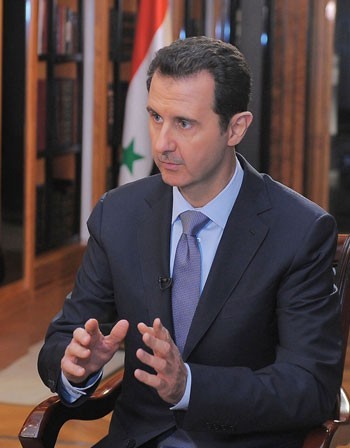 Damascus – President Bashar al-Assad gave an interview to Agence France Presse. Following is the full text of the interview:
Mr. President, what do you expect from the Geneva conference?
President Assad: The most basic element, which we continuously refer to, is that the Geneva Conference should produce clear results with regard to the fight against terrorism in Syria. In particular, it needs to put pressure on countries that are exporting terrorism, – by sending terrorists, money and weapons to terrorist organisations, – especially Saudi Arabia and Turkey, and of course the Western countries that provide political cover for these terrorist organisations. This is the most important decision or result that the Geneva Conference could produce. Any political solution that is reached without fighting terrorism has no value. There can be no political action when there is terrorism everywhere, not only in Syria but in neighbouring countries as well. From the political side, it is possible for Geneva to contribute to a process of dialogue between Syrians. There has to be a Syrian process within Syria and whilst Geneva could support this, it cannot be a substitute for it.
AFP: After nearly three years of devastating war and the big challenge of reconstruction in the country, is it likely that you will not be a candidate for the presidency?
President Assad: This depends on two things: It depends on personal aspirations or a personal decision, on the one hand, and on public opinion in Syria, on the other. As far as I am concerned, I see no reason why I shouldn’t stand; as for Syrian public opinion, there is still around four months before the election date is announced. If in that time, there is public desire and a public opinion in favour of my candidacy, I will not hesitate for a second to run for election. In short, we can say that the chances for my candidacy are significant.
AFP: In these past years, have you thought for a moment about losing the battle, and have you thought of an alternative scenario for you and your family?
President Assad: In any battle, there is always the possibility of winning and losing; but when you’re defending your country, it’s obvious that the only choice is to win. Should Syria lose this battle that would mean the spread of chaos throughout the Middle East. This battle is not confined to Syria and is not, as Western propaganda portrays, a popular uprising against a regime suppressing its people and a revolution calling for democracy and freedom. These lies have now become clear to people. A popular revolution doesn’t last for three years only to fail; moreover, a national revolution cannot have a foreign agenda. As for the scenarios that I have considered, of course these types of battles will have numerous scenarios – 1st, 2nd, 3rd……tenth, but they are all focused on defending the country not on running away from it. Fleeing is not an option in these circumstances. I must be at the forefront of those defending this country and this has been the case from day one.
AFP: Do you think you are winning this war?
President Assad: This war is not mine to win; it’s our war as Syrians. I think this war has, if you will, two phases. The first phase, which took the form of plans drawn up at the beginning, was the overthrow of the Syrian state in a matter of weeks or months. Now, three years on, we can safely say that this has failed, and that the Syrian people have won. There were countries that not only wanted to overthrow the state, but that also wanted to partition the country into several ‘mini-states;’ of course this phase failed, and hence the win for the Syrian people. The other phase of the battle is the fight against terrorism, which we are living on a daily basis. As you know, this phase isn’t over yet, so we can’t talk about having won before we eliminate the terrorists. What we can say is that we are making progress and moving forward. This doesn’t mean that victory is near at hand; these kinds of battles are complicated, difficult and they need a lot of time. However, as I said, and I reiterate, we are making progress, but have not yet achieved a victory.
AFP: Returning to Geneva, do you support a call from the conference for all foreign fighters to leave Syria, including Hezbollah?
President Assad: Clearly the job of defending Syria is responsibility of the Syrian people, the Syrian institutions, and in particular the Syrian Army. So, there would be no reason for any non-Syrian fighters to get involved had there not been foreign fighters from dozens of countries attacking civilians and Hezbollah especially on the Syrian-Lebanese border. When we talk about fighters leaving Syria, this would need to be part of a larger package that would see all the foreign fighters leave, and for all armed men – including Syrians – to hand over their weapons to the Syrian state, which would consequently achieve stability. So naturally, yes, one element of the solution in Syria – I wouldn’t say the objective – is for all non-Syrian fighters to leave Syria.
AFP: In addition to the prisoner exchange and a ceasefire in Aleppo, what initiatives are you ready to present at Geneva II?
President Assad: The Syrian initiative was put forward exactly a year ago, in January of last year. It’s a complete initiative that covers both political and security aspects and other dimensions that would lead to stability. All of these details are part of the initiative that Syria previously put forward. However, any initiative, whether this one or any other, must be the result of a dialogue between Syrians. The essence of anything that is proposed, whether it’s the crisis itself, fighting terrorism, or the future political vision and political system for Syria, requires the approval of Syrians. Our initiative was based on a process to facilitate this dialogue rather than a process to express the government’s point of view. It has always been our view that any initiative must be collective and produced by both the political actors in Syria and the Syrian people in general.
AFP: The opposition that will participate in Geneva is divided and many factions on the ground don’t believe it represents them. If an agreement is reached, how can it be implemented on the ground?
President Assad: This is the same question that we are asking as a government: when I negotiate, who am I negotiating with? There are expected to be many sides at Geneva, we don’t know yet who will come, but there will be various parties, including the Syrian government. It is clear to everyone that some of the groups, which might attend the conference, didn’t exist until very recently; in fact they were created during the crisis by foreign intelligence agencies whether in Qatar, Saudi Arabia, France, the United States or other countries. So when we sit down with these groups, we are in fact negotiating with those countries. So, is it logical that France should be a part of the Syrian solution? Or Qatar, or America, or Saudi Arabia, or Turkey? This doesn’t make any sense. Therefore, when we negotiate with these parties, we’re in fact negotiating with the countries that are behind them and that support terrorism in Syria. There are other opposition forces in Syria that have a national agenda; these are parties that we can negotiate with. On the issue of the vision for Syria’s future, we are open for these parties to participate in governing the Syrian state, in the government and in other institutions. But as I mentioned earlier, anything that is agreed with any party, whether in Geneva or in Syria, must be subject to people’s endorsement, through a referendum put to Syrian citizens.
AFP: In this context, could the ceasefire agreements that have been started in Moadimiya and Barzeh be an alternative to Geneva?
President Assad: The truth is that these initiatives may be more important than Geneva, because the majority of those fighting and carrying out terrorist operations on the ground have no political agenda. Some of them have become professional armed robbers, and others, as you know, are takfiri organisations fighting for an extremist Islamic emirate and things of that kind. Geneva means nothing for these groups. For this reason, the direct action and the models that have been achieved in Moadamiyeh, in Barzeh and other places in Syria has proven to be very effective. But this is separate from the political process, which is about the political future of Syria. These reconciliations have helped stability and have eased the bloodshed in Syria, both of which help pave the way for the political dialogue I mentioned earlier.
AFP: Are you prepared to have a prime minister from the opposition in a future government?
President Assad: That depends on who this opposition represents. When it represents a majority, let’s say in parliament, naturally it should lead the government. But to appoint a prime minister from the opposition without having a majority doesn’t make any political sense in any country in the world. In your country, for example, or in Britain or elsewhere, you can’t have a prime minister from a parliamentary minority. This will all depend on the next elections, which we discussed in the Syrian initiative; they will reveal the real size of support for the various opposition forces. As to participation as a principle, we support it, of course it is a good thing.
AFP: Are you prepared to have, for example, Ahmed Jarba or Moaz Khatib, be your next prime minister?
President Assad: This takes us back to the previous question. Do any of these people represent the Syrian people, or even a portion of the Syrian people? Do they even represent themselves, or are they just representatives of the states that created them? This brings us back to what I mentioned earlier: every one of these groups represents the country that created them. The participation of each of these individuals means the participation of each of those states in the Syrian government! This is the first point. Second, let’s assume that we agreed to the participation of these individuals in the government. Do you think that they would dare to come to Syria to take part in the government? Of course they wouldn’t. Last year, they claimed that they had control of 70% of Syria, yet they didn’t even dare to come to the areas that they had supposed control of. They did come to the border for a 30-minute photo opportunity and then they fled. How can they be ministers in the government? Can a foreigner become a Syrian minister? That’s why these propositions are totally unrealistic, but they do make a good joke!
AFP: Mr. President, you said that it depends on the results of the elections, but how can you hold these kinds of elections if part of Syria’s territory is in the hands of insurgents?
President Assad: During this crisis, and after the unrest started in Syria, we have conducted elections twice: the first was municipal elections and the second was parliamentary elections. Of course, the elections cannot be conducted in the same way they are conducted in normal circumstances, but the roads between Syrian regions are open, and people area able to move freely between different regions. Those who live in difficult areas can go to neighbouring areas and participate in the elections. There will be difficulties, but it is not an impossible process.
AFP: Now that opposition fighters are battling jihadists, do you see any difference between the two?
President Assad: The answer I would have given you at the beginning of the events or during its various phases, is completely different to the answer today. Today, there are no longer two opposition groups. We all know that during the past few months the extremist terrorist groups fighting in Syria have wiped out the last remaining positions that were held by the forces the West portrays as moderates, calling them the moderate or secular forces, or the Free Syrian Army. These forces no longer exist. We are now dealing with one extremist group made up of various factions. As to the fighters that used to belong to what the West calls ‘moderate forces,’ these have mostly joined these extremist factions, either for fear or voluntarily through financial incentives. In short, regardless of the labels you read in the Western media, we are now fighting one extremist terrorist group comprising of various factions.
AFP: Would it be possible for the army and the opposition to fight against the jihadists side by side?
President Assad: We cooperate with any party that wants to join the army in fighting terrorists, and this has happened before. There are many militants who have left these organisations and joined the army to fight with it. So this is possible, but these are individual cases. This is not an alliance between ‘moderate’ forces and the army against terrorists. That depiction is false and is an illusion that is used by the West only to justify its support for terrorism in Syria. It supports terrorism under the pretext that it is backing moderation against extremist terrorism, and that is both illogical and false.
AFP: The state accuses the rebels of using civilians as human shields in areas under their control, but when the army shells these areas, do you not think this kills innocent people?
President Assad: The army does not shell neighbourhoods. The army strikes areas where there are terrorists. In most cases, terrorists enter particular areas and force out the civilians. Why do you think we have so many displaced people? Most of the millions of displaced people in Syria have fled their homes because terrorists forcefully entered their neighbourhoods. If there are civilians among these armed groups, why do we have so many displaced people? The army is fighting armed terrorists, and in some cases, terrorists have used civilians as human shields. Civilian casualties are unfortunately the consequences of any war. There is no such thing as a clean war in which there are no innocent civilian victims. This is the unfortunate nature of war, and that is why the only solution is to put an end to it.
AFP: Mr. President, some international organisations have accused the government and the opposition of committing abuses. After this war ends, would you be ready for there to be an investigation into these abuses?
President Assad: There is no logic to this claim made by these organisations. How can the Syrian state be killing its own people, and yet it is still standing three years on, despite the fact that there are dozens of countries working against it. Had the Syrian state been killing its people, they would have revolted against it long ago. Such a state could not survive for more than a few months; the fact that it has resisted for three years means that it has popular support. Such talk is more than illogical: it is unnatural. What these organizations are saying is either a reflection of their ignorance of the situation in Syria, or, in some cases, it shows they are following the political agenda of particular states. The Syrian state has always defended its civilians; it is well documented, through all the videos and the photos circulating, that it is the terrorists who are committing massacres and killing civilians everywhere. From the beginning of this crisis, up until today, these organizations do not have a single document to prove that the Syrian government has committed a massacre against civilians anywhere.
AFP: Mr. President, we know of foreign journalists who were kidnapped by the terrorist groups. Are there any foreign journalists in state prisons?
President Assad: It would be best for you to ask the relevant, specialised agencies on this issue. They would be able to give you an answer.
AFP: Would a reconciliation be possible, one day, between Syria on the one hand, and Saudi Arabia, Qatar and Turkey on the other?
President Assad: Politics changes constantly, but this change depends on two factors: principles and interests. We share no common principles with the states you mention; these states support terrorism and they have contributed to the bloodshed in Syria. As for interests, we need to ask ourselves: will the Syrian people agree to shared interests with these countries after everything that has happened and all the bloodshed in Syria? I don’t want to answer on behalf of the Syrian people. If the people believe they share interests with these states, and if these states change their policy on supporting terrorism, it is plausible that the Syrian people might agree to restore relations. I can’t individually as President, answer on behalf of all the Syrian people at such a time. This is a decision for the people.
AFP: Mr. President, you were welcomed on the occasion of July 14 (Bastille Day) in the Elysee Palace in Paris. Are you now surprised by France’s position, and do you think France may one day play some kind of role in Syria?
President Assad: No, I am not surprised, because when that reception took place, it was during the period – 2008 to 2011 – where there was an attempt to contain Syria’s role and Syria’s policy. France was charged with this role by the United States when Sarkozy became president. There was an agreement between France and the Bush administration over this, since France is an old friend of the Arabs and of Syria and as such it is better suited to play the role. The requirement at that time was to use Syria against Iran and Hezbollah, and to pull it away from supporting resistance organisations in the region. This French policy failed, because its goal was blatantly obvious. Then the so-called Arab Spring began, and France turned against Syria after it had failed to honour the pledge it had made to the United States. This is the reason behind the French position during that period why it changed in 2011.
As for France’s role in future, let’s talk frankly. Ever since 2001 and the terrorist attacks on New York, there has been no European policy-making to speak of (and that’s if we don’t look back even further to the 1990s). In the West, there is only an American policy, which is implemented by some European countries. This has been the case on all the issues in our region in the past decade.
Today, we see the same thing: either European policy is formulated with American blessing, or American policy is adopted by the Europeans as their own. So, I don’t believe that Europe, and particularly France, which used to lead the European policy in the past, is capable of playing any role in the future of Syria, or in neighbouring countries. There is another reason too, and that is that Western officials have lost their credibility. They no longer have double standards; they have triple and quadruple standards. They have all kinds of standards for every political situation. They have lost their credibility; they have sold their principles in return for interests, and therefore it is impossible to build a consistent policy with them. Tomorrow, they might do the exact opposite of what they are doing today. Because of this, I don’t think that France will play a role in the immediate future, unless it changes its policy completely and from its core and returns to the politically independent state it once was.
AFP: How long do you think Syria needs to rid itself completely of its chemical weapons stockpiles?
President Assad: This depends on the extent to which the Organisation for the Prohibition of Chemical Weapons (OPCW) will provide Syria with the necessary equipment to carry out the process. So far, the process of making this equipment available has been quite slow. On the other hand, as you know dismantling and neutralizing the chemical materials is not taking place inside Syria nor by the Syrian state. A number of countries in different parts of the world have accepted to carry out that process; some have agreed to deal with the less dangerous materials, whilst others have refused completely. Since, the time-frame is dependent on these two factors – the role of the OPCW and the countries that accept to neutralize the materials on their territories – it is not for Syria to determine a time-frame on this issue. Syria has honoured its part by preparing and collecting data and providing access to inspectors who verified this data and inspected the chemical agents. The rest, as I said, is up to the other parties.
AFP: Mr. President, what has changed in your and your family’s daily, personal lives? Do your children understand what has happened? Do you talk to them about this?
President Assad: There are a few things that haven’t changed. I go to work as usual, and we live in the same house as before, and the children go to school; these things haven’t changed. On the other hand, there are things which have affected every Syrian household, including mine: the sadness which lives with us every day – all the time, because of what we see and experience, because of the pain, because of the fallen victims everywhere and the destruction of the infrastructure and the economy. This has affected every family in Syria, including my own. There is no doubt that children are affected more deeply than adults in these circumstances. This generation will probably grow up too early and mature much faster as a result of the crisis. There are questions put to you by children about the causes of what’s happening, that you don’t usually deal with in normal circumstances. Why are there such evil people? Why are there victims? It’s not easy to explain these things to children, but they remain persistent daily questions and a subject of discussion in every family, including my own.
AFP: Through these years, what was the most difficult situation you went through?
President Assad: It’s not necessarily a particular situation but rather group of elements. There are several things that were hard to come to terms with, and they are still difficult. The first, I believe, is terrorism; the degree of savagery and inhumanity that the terrorists have reached reminds us of what happened in the Middle Ages in Europe over 500 years ago. In more recent modern times, it reminds us of the massacres perpetrated by the Ottomans against the Armenians when they killed a million and a half Armenians and half a million Orthodox Syriacs in Syria and in Turkish territory. The other aspect that is difficult to understand is the extent of Western officials’ superficiality in their failure to understand what happened in this region, and their subsequent inability to have a vision for the present or for the future. They are always very late in realizing things, sometimes even after the situation has been overtaken by a new reality that is completely different. The third thing that is difficult to understand is the extent of influence of petrodollars in changing roles on the international arena. For instance, how Qatar was transformed from a marginal state to a powerful one, while France has become a proxy state implementing Qatari policies. This is also what we see happening now between France and Saudi Arabia. How can petrodollars make western officials, particularly in France, sell their principles and sell the principles of the French Revolution in return for a few billion dollars? These are only a few things, among others, which are difficult for one to understand and accept.
AFP: The trial of those accused of the assassination of former Lebanese Prime Minister Rafic Hariri has begun. Do you think it will be a fair trial?
President Assad: Nine years have passed since the beginning of this trial. Has justice been served? Every accusation was made for political reasons. Even in the past few days, we have not seen any tangible proof put forward against the parties involved in the case. The real question should be: why the timing? Why now? This court was set up nine years ago. Have the things produced in the last few days been uncovered only now? I believe that the whole thing is politicized and is intended to put pressure on Hezbollah in Lebanon in the same way that it aimed at putting pressure on Syria in the beginning, immediately after al-Hariri’s assassination.
AFP: You have said the war will end when terrorism is eradicated. But the Syrians and everyone else want to know when this war will end. Within months? After a year? In years to come?
President Assad: We hope that the Geneva conference will be able to provide an answer to part of this by exercising pressure on these countries. This aspect has nothing to do with Syria; otherwise we would have put pressure on these states from the beginning and prevented terrorism from entering Syria. From our side, when this terrorism stops coming in, ending the war will not take more than a few months.
AFP: It appears Western intelligence agencies want to re-open channels of communication with Damascus, in order to ask you for help fighting terrorism. Are you ready for that?
President Assad: There have been meetings with several intelligence agencies from a number of countries. Our response has been that security cooperation cannot be separated from political cooperation, and political cooperation cannot be achieved while these states adopt anti-Syrian policies. This was our answer, brief and clear.
AFP: You have said in the past that the state has made mistakes. In your view, what were the mistakes that could have been avoided?
President Assad: I have said that mistakes can be made in any situation. I did not specify what those mistakes were because this cannot be done objectively until the crisis is behind us and we can assess our experience. Evaluating them whilst we are in the middle of the crisis will only yield limited results.
AFP: Mr. President, without Russia, China and Iran’s help, would you have been able to resist in the face of the wars declared against you?
President Assad: This is a hypothetical question, which I cannot answer, because we haven’t experienced the alternative. Reality has shown that Russian, Chinese and Iranian support has been important and has contributed to Syria’s steadfastness. Without this support, things probably would have been much more difficult. How? It is difficult to draw a hypothetical picture at this stage.
AFP: After all that has happened, can you imagine another president rebuilding Syria?
President Assad: If this is what the Syrian people want, I don’t have a problem with it. I am not the kind of person who clings to power. In any case, should the Syrian people not want me to be president, obviously there will be somebody else. I don’t have a personal problem with this issue.
Thank you very much Mr. President.
Iran, Syria and the Tragicomedy of U.S. Foreign Policy
By Flynt Leverett and Hillary Mann Leverett | Going to Tehran | January 20, 2014
Today is Martin Luther King Day in the United States and we urge our readers to re-read a piece we wrote previously honoring his extraordinary insight. It is also the day on which implementation of the Joint Plan of Action that the P5+1 and Iran announced on November 24 formally commences. And, of course, two days from now, the Geneva II conference on the Syrian conflict is scheduled to take place.
In anticipation of the beginning of implementation of the Joint Plan of Action, negotiations on prospective “final” nuclear deal, and the Geneva II conference, Hillary taped an interview with Scott Horton for Pacifica Radio. It was broadcast/posted yesterday; click here to listen.
Regarding President Obama’s ongoing struggle with the Senate over Iran policy, Hillary cautions against premature claims of “victory” for the Obama administration’s efforts to avert new sanctions legislation while the Joint Plan of Action is being implemented. She points out that “the foes of the Iran nuclear deal, of any kind of peace and conflict resolution in the Middle East writ large, are still very strong and formidable. For example, the annual AIPAC policy conference—a gathering here in Washington of over 10,000 people from all over the country, where they come to lobby congressmen and senators, especially on the Iran issue—that will be taking place in very early March. There’s still a lot that can be pushed and played here.”
To be sure, President Obama and Secretary of State John Kerry “have put a lot of political capital on the line.” No other administration has so openly staked out its opposition to a piece of legislation or policy initiative favored by AIPAC and backed by a bipartisan majority on Capitol Hill since the 1980s, when the Reagan administration successfully defended its decision to sell AWACs planes to Saudi Arabia. But, Hillary notes, if the pro-Israel lobby is able to secure a vote on the new sanctions bill, and to sustain the promised veto of said bill by President Obama, “that would be such a dramatic blow to President Obama, and not just on his foreign policy agenda, but it would be devastating to his domestic agenda.” So Obama “has a tremendous amount to lose, and by no means is the fight anywhere near over.”
Of course, to say that Obama has put a lot of political capital on the line over the sanctions issue begs the question of whether he is really prepared to spend the far larger amounts of capital that will be required to close a final nuclear deal with Tehran. As Hillary points out, if Obama were “really trying to lead this country on a much more constructive, positive trajectory after failed wars and invasions in Iraq and Afghanistan and Libya—Libya entirely on President Obama’s watch—[he] would be doing a lot more, rather than just giving these lukewarm talks, basically trying to continue to kiss up to major pro-Israel constituencies, and then trying to bring in some of political favors” on Capitol Hill.
Compare Obama’s handling of Iran and other Middle East challenges to President Nixon’s orchestration of the American opening to China—including Nixon’s willingness to “break the crockery” of the pro-Taiwan lobby—and the inadequacy of Obama’s approach become glaringly apparent. And that, Hillary underscores, is why we wrote our book, Going to Tehran—because “we think it’s absolutely essential for President Obama to do what Nixon did and go to Tehran, as Nixon went to China,” for “the Middle East is the make-or-break point for the United States, not just in our foreign affairs but in our global economic power and what we’re able to do here at home. If we can’t get what we’re doing in the Middle East on a much better, more positive trajectory, not only will we see the loss of our power, credibility, and prestige in the Middle East, but we will see it globally.”
Getting the nuclear issue right is, arguably, just one piece of the project of realigning U.S.-Iranian relations—but it is a uniquely critical piece. As Hillary notes, in Iran, “they see reaching a nuclear deal with the United States as absolutely essential [to any prospect of broader realignment]—even though they absolutely believe it is a ‘show’ issue. For if they could get the United States to accept the Islamic Republic of Iran with nuclear capability, this is the essential step to getting it to accept Iran as an independent, sovereign power.” Of course, that is something Western governments have been manifestly unwilling to do for decades, going back even decades before the 1979 Iranian Revolution. For the Iranians, “if they can get the United States to recognize their independence and sovereignty through this nuclear deal, recognizing Iran’s right to nuclear capability, that’s [how] you can open the way to go forward.”
But, “if negotiations with the United States fail, the thinking in Iran—and I was just there a couple of months ago—is that this will show both Iranians inside Iran and (this is critically important) countries like China, in other emerging markets…that Iran was the rational actor here. Iran tried its best to work within a framework of international law, the Nuclear Non-Proliferation Treaty, but it was the United States, as it has treated key countries in the Middle East for decades, that was unwilling to work within the parameters of international law and to recognize basic sovereign and treaty rights. That’s their Plan B—if the United States can’t do the deal, they still come out ahead in terms of important actors both at home and abroad.”
On Syria, Hillary suggests that the growing Western focus on al-Qa’ida-like jihadis in opposition ranks obscures a much more important point—even if al-Qa’ida-like elements had not permeated the opposition, why does the United States think it should be supporting armed rebels to overthrow the recognized government of a UN member state? As Hillary recounts, “This didn’t work in Iraq (before al-Qa’ida was there; of course, now al-Qa’ida is there, after we said we had a dog in that fight), it didn’t work in Libya, it didn’t work in Afghanistan. The idea that when we choose to become involved in a fight, it’s going to turn out to help us is just not borne out by history, but we continue to make the mistake.”
As for an appropriate American approach to the Syrian conflict and other Middle Eastern challenges, Hillary says that the United States shouldn’t just “go home and essentially be isolationist. I believe very much in free trade, and I believe very much in diplomacy and conflict resolution. And there does need to be real conflict resolution in Syria.” In this regard,
“We have a real asset in Lakhdar Brahimi, the UN envoy. He has worked on exactly these kinds of problems in Iraq, in Lebanon, in Somalia, in Haiti, and in Afghanistan, where I worked with him personally for about two years. And in each of those situations, he didn’t come up with a fantastic, Pollyanna government for each of these places. But he has a core formula [that] would really help to stop the destabilization and killing that we see in Syria, which is: you work with the sitting government, and you work with forces on the ground to gradually bring them into not a liberal democracy, but into a much more representative and inclusive power-sharing arrangement…You’re not going to get great ‘good governance,’ with no corruption and fantastic human rights treatment—but you will, over time, have a much more stable environment, where far fewer people are killed, and the opportunity for that country to politically reconstitute itself along its own lines, its own values, and its own position in the world.”
Hillary’s interview preceded the tragicomic antics surrounding UN Secretary-General Ban Ki-moon’s invitation to Iran to participate in Geneva II—which Ban spinelessly rescinded less than 24 hours later after tantrum-like outbursts from the Syrian National Council and (more consequentially) strategically witless (and utterly predictable) pressure from the Obama administration. Clearly, the Brahimi formula is not going to be given a chance to work in Syria anytime soon—but something like it will probably prove critical to any eventual political settlement to the conflict there.
In the interview, Hillary also discusses Iran’s internal political dynamics regarding a possible improvement in relations with the United States, the strategic incoherence of Israeli and Saudi opposition to any U.S. opening to the Islamic Republic, continuing Western mythmaking about Iran’s “nuclear weapons” program, and more.
Finally, as the Joint Plan of Action formally goes into effect, we want to call attention to two recent posts on Dan Joyner’s Arms Control Law that do an excellent job criticizing some of the more egregious distortions of the Nuclear Non-Proliferation Treaty (NPT) and international law more generally that various American pundits have advanced in their bloviations about the Joint Plan. One, see here, lambastes Orde Kittrie’s assertion that the implementing agreement for the Joint Plan—not the Joint Plan itself, mind you, but the implementing agreement—is actually a secret treaty; the other, see here, takes on the chronically wrong Ray Takeyh. His latest missive, misrepresenting the Additional Protocol to the NPT, is co-authored by Mitchell Reiss, who appeared in advertisements publicly advocating for the MEK—many of whose advocates acknowledge receiving at least $20,000 per endorsement—while the U.S. government still designated it as a foreign terrorist organization.
Featured Video

Iran Is Not Our Enemy
or go to
Aletho News Archives – Video-Images
Book Excerpt
“Vaccines Do Not Cause Autism!” The Science is Settled. Right?
ICAN urges the IACC to actually study infant vaccines and autism
 By Aaron Siri | Injecting Freedom | March 16, 2026
On behalf of ICAN, we just sent a copy of chapter 11 of Vaccines, Amen to the newly appointed members of the federal Interagency Autism Coordinating Committee (IACC).
If you haven’t already read this chapter, you can read the whole thing in the attached letter. I trust that after you read it, you’ll see why the statement “vaccines do not cause autism” is a belief, not science!

IACC Public Comment Letter
1.53MB ∙ PDF file
Includes chapter 11 of Vaccines, Amen
Blog Roll
 Aletho News
- Iran made ‘unexpectedly substantial’ offer during Geneva talks, US envoys ‘dragged’ Trump into war: Report
- Russia condemns Israel’s attack near Bushehr plant, files complaint
- Russia Strongly Condemns Actions Aimed at Harming Health of Iranian Leadership – Kremlin
- Israeli Journalist Demands Tucker Carlson and Candace Owens Be Placed in WWII-Style Internment Camps
- No Liability, No Studies, No Accountability: The Vaccine System Aaron Siri Exposed in Federal Court
- No time for losers: Why the war meant to save Israel may destroy it
- Top US Counterterrorism Official Resigns in Protest of Operation Against Iran
- Just Get Out! Now!
- Unpacking glaring contradictions in US-Zionist justifications for war against Iran
- Iranian model of warfare bleeds US dry while Persian Gulf states watch and learn: Analyst
- If Americans Knew
- Trump’s counterterrorism chief, whose own wife was killed by ISIS, quits over Iran War saying Tehran posed ‘no imminent threat’
- Here’s what US could fund instead of Bibi’s war on Iran
- Israel Killed Over a Dozen Lebanese Paramedics in Three Days, Now Claiming That Ambulances Are “Hezbollah” Targets
- War on Iran: These are the heritage sites devastated by US and Israeli attacks
- Four news stories from Israeli media that illustrate Israeli “justice”
- CIA Prepares Criminal Referral of Tucker Carlson, as Israel and Its Loyalists Demand His Arrest
- Top US counterterror advisor resigns in protest of “war manufactured by Israel” – Not a ceasefire Day 157
- ‘I Liked the House’: When Israeli Soldiers Turn Palestinian Homes into Barracks
- ‘They Were All I Had’: Lebanese Father Buries Parents, 4 Daughters Killed by Israeli Bombing
- Israel and its supporters are causing attacks on Jewish institutions. Case in point: Michigan synagogue tragedy.
- No Tricks Zone
- New Research: South Australia’s Mid-Holocene Sea Surface Temperatures Were 4°C Warmer Than Today
- Storing Green Energy To Last Germany 10 Days Would Require A 60-Million Tonne Battery
- New Studies: UK Sea Levels Were 4 Meters Higher Than Today During The Mid-Holocene
- Destructive Green New Deal: German Energy And Metal Group Warns Of Drastic Crisis
- New Study Documents A 20-Year Pause In Arctic Sea Ice Decline – Driven By Internal Variability
- Wake-up Call: Survey Shows Majority Of Germans Now Favor Postponing Climate Targets!
- Televised! Leading German Political Candidate Tells Schoolchildren CO2 Makes Sun Hotter!
- New Study: A Century Warming Of 1.1°C Is ‘Commonplace’ And ‘Not Unusual’ During This Interglacial
- New Study: ‘Internal Noise’ And Volcanic Forcing Can Trigger 10-15°C Warming Within Decades
- Glaciers Worldwide Are Suddendly Surging, Experts Blame Warming!
 Aletho News