Venezuelan Opposition Mayor Accused of Manipulating Tragic Death
By Tamara Pearson | Venezuelanalysis | February 26, 2014
Merida – A 34 year old man, Jimmy Vargas, died on Monday while he was involved in a violent street blockade. Some opposition leaders and media blamed the government, however video footage shows it was an accident. Two other people have died this week as a result of the blockades.
Vargas died at the Camino Real residential area, in San Cristobal, Tachira state. Footage, sent to CNN shows that it was an accident. However, CNN and other news agencies also broadcast repeatedly footage of Vargas’ mother blaming the National Guard and president Nicolas Maduro for the death.
Carmen Gonzalez, the mother, stated, “Maduro and those around him killed [my son], they are the ones who killed him, they killed him, they are the ones who gave the orders for him to be killed, they are killing all of Venezuela… and I’m going to go out and fight for my son, my son died fighting for his country, fighting for the freedom of his country…”
On social networks the story was spread that Vargas had been hit by a rubber bullet in his left eye, and other stories claimed a tear gas canister shot by the National Guard had hit him.
The newspaper El Nacional also blamed the government, headlining “Two deaths this Monday because of attacks by GNB [National Guard] and motorbike riders [government supporters] on protests”. Madurados.com headlined “Another tragedy! In rubber bullet attack by the GNB Jimmy Vargas dies in San Cristobal”.
Similarly, The New York Times included a ¼ page full-color photo of Jimmy Vargas on a stretcher, with the caption, “Carmen Gonzalez, 58, cried over the body of her son, who was killed Monday in clashes with the police.”
However Vargas’ doctor, Luis Diaz, reported that he had suffered severe traumatic brain injury (TBI) after falling from the second floor of a building, the newspaper Ultimas Noticias reported.
Vargas’ sister, Jindry, told NTN24 that her brother fell from the second floor the building after the National Guard fired rubber bullets and tear gas bombs at him, causing him to lose his balance. In the video Jimmy Vargas tried to climb down on to a balcony ledge and he lost his balance on the ledge, out of line of shot of the National Guard.
Further, the opposition mayor of San Cristobal, Daniel Cebellos, told the public that Vargas had been murdered. He tweeted on Monday night, “Since late night…the brutal attack of the GNB continues, more than 10 injuries (3 by bullet) and 1 youth of 34 years murdered”. He continued, “I call on the MUD [opposition coalition] that while they continue to kill our people in the streets there’s no peace for the government. The dialogue they propose is one big lie”.
Despite the evidence, Cebellos further tweeted this morning, “We are accompanying Jimmy Vargas and his family in this moment of grief. We reject the violence and repression.” Cebellos included a photo of Vargas’ funeral procession.
Tachira governor, Vielma Mora accused Cebellos of using a public funeral procession to “inflame” people “against the national government”.
“A citizen who, may he rest in peace, fell from the second floor, he was in guarimba (violent disturbances), it seems he lost his balance… do you know what the mayor of San Cristobal did with a few people? They paraded him through the city… like a war trophy”.
Meanwhile, there has been another death as a result of violent opposition blockades. El Carabobeño reported that a motorbike rider died last night after crashing into a barricade. Eduardo Anzola, 29, in Valencia, died instantly, the paper reported, after he didn’t see the barricade because of the darkness. Two other people have died as a result of crashing into barricades, in Caracas and Merida, and one other motorbike rider was killed when wire at a barricade cut his throat.
On Monday, Alba Ciudad and Panorama report that Antonio Valbuena, 32, died of a shot to the head, in Maracaibo. Valbuena was participating in a demonstration of motorbike riders, who were removing barricades so that their procession could get through. At one point, a witness said that a “man in a balaclava came out and began to shoot… one of the bullets hit Antonio in the head”.

The Minimum Wage and Immigration
By Ron Unz | February 9, 2013
Earlier this week Washington Post Columnist Matt Miller published an excellent piece making the case for a large increase in the federal minimum wage, including arguments drawn from a wide range of prominent business and political figures, as well as mention of my own recent New America article on that issue.
Given the importance of the topic, it is hardly unexpected that the column attracted some 600 comments. But far more surprising was the overwhelmingly negative response of those readers. Given that the Post is a centrist-liberal newspaper and Miller a centrist-liberal columnist, one suspects that the vast majority of the commenters were similarly of the centrist-liberal orientation. But I suspect that most of their hostile remarks would have been indistinguishable from what would have greeted a similar suggestion posted on National Review or FoxNews or the Koch-funded Americans for Prosperity; and therein lies a tale.
Although the ideological spectrum of American political discourse is casually rendered along a Left-to-Right spectrum, the range of views obviously has high dimensionality; and projecting an idea-space of ten or fifteen independent degrees of freedom onto a single axis is surely absurd, with even the two most prominent dimensions of “social issues” and “economic issues” failing to capture the underlying reality.
Thus in 2008 we saw many of America’s most influential Republican pundits urging Sen. John McCain to select Sen. Joe Lieberman as his vice presidential selection to assuage and reassure distrustful conservatives. This came despite Lieberman having one of the most liberal Senate voting records on hot-button social and economic issues such as abortion, gay rights, gun control, affirmative action, immigration, taxes, regulations, and almost everything else, while even having served as candidate Al Gore’s loyal vice presidential Democratic pick just a few years earlier. But in 2008, Lieberman’s enthusiastic support for the continued Iraq Occupation and Bush’s “Great War on Terror” had momentarily eclipsed all other issues among much of the conservative elite.
Similarly, over the last couple of decades, the economic well-being of America’s working- or middle-classes seems to have been relegated to an afterthought, not merely among Republicans and conservatives, but also among their Democratic and liberal opponents as well. The shocking truth that the average American family is probably poorer today in real terms than they were fifty years ago has been almost entirely ignored by both parties, and therefore ignored by the media as well, presumably under the theory that what people don’t know won’t really hurt them.
Meanwhile, the loud battles over Gay Marriage and Gun Control, whose outcome would directly impact an utterly negligible fraction of our total population, generates front-page headline after front-page headline, perhaps because these issues excite the people who write those headlines or those who fund our campaigns. As a leading Democratic political consultant in California once joked to me during the late 1990s, no wealthy liberals he knew had any interest in funding a minimum wage increase or any similar meat-and-potato economic issue of the traditional Left; instead, the ideal initiative for fundraising purposes would promise to “Save the Gay Whales from Second-Hand Smoke.”
The near-total intellectual hegemony established by neoliberal economics during the last generation is further demonstrated by the skeptical response to Miller’s minimum wage column by Slate financial columnist and progressive pundit Matt Yglesias (refuted here). The latter seems to see Federal Reserve monetary policy as the solution to all our economic problems, worrying that the inflationary impact from increasing wages at the lower end of the spectrum would interfere with attempts to keep interest rates low, thereby derailing the desperately-awaited recovery. Given that five years of exceptionally low interest rates seem to have benefited Wall Street a great deal but Main Street little or nothing, it’s far from clear whether another five years of the same policy would do much different.
In any event, a rise in the minimum wage to $10 or even $12 per hour would simply produce a one-time jump in prices, perhaps in the range of a couple of percent, rather than the sort of continuing inflationary spiral which might unnerve the Fed. Lower wage-earners would gain vastly more than they lost, the affluent wouldn’t even notice the difference, while hundreds of billions of dollars in additional disposable income for those who spend every dollar might finally jumpstart the economy, being an enormous stimulus package funded entirely by the private sector.
In fact, the AFL-CIO has suggested that a Republican Party which strongly supported a higher minimum wage might warrant a strong second look from the vast number of ordinary American workers who had refused to even consider the plutocratic candidacy of a Mitt Romney.
As it happens, I was recently invited by The Aspen Institute to speak at their DC headquarters on a March 6th panel addressing a minimum wage increase, and perhaps some of these important points will come out during the discussion.
This same bipartisan elite consensus on the harmful effects of raising workers’ wages by law also manifests itself in a wide range of other issues. Leading Democrats and Republicans are now lining up in favor of a new amnesty program for America’s 11 million or so illegal immigrants, planning to combine this legislation with expanded quotas for skilled immigrants and also some sort of guestworker program for the lesser skilled.
It is surely an odd thing for a country’s political leaders to propose substantial increases in new immigration at a time of such high unemployment and so much economic misery among the middle- and working-classes. Obviously part of the explanation is that our elites are doing very well financially, with the DC area having become America’s wealthiest region. But the political cross-currents are quite intriguing.
Throughout most times and places, business interests have always tended to favor high immigration levels, for the obvious reason that a greater supply of available workers drives down wages and increases profits. So the responsiveness of Republican officials to their business donor class is hardly surprising, nor is the position of business-funded thinktanks and pundits.
But for exactly the same reason, worker advocates have traditionally been doubtful or hostile to immigration, even if they might often be friendly towards existing immigrants or had themselves originally come from such a background. It is hardly surprising that America’s leading anti-immigrationist figure throughout most of the 1960s and 1970s was famed labor leader Cesar Chavez.
Given such realities, the eagerness with which the Democratic side of the aisle have embraced a softening of immigration policy without any commensurate protections against job loss or wage decline is surely a sign they too have been captured by the business elites, just as was their widespread support for financial bailouts at the top of the economy and their disinterest in minimum wage increases at the bottom. As some Internet pundits have noted, President Obama actually traveled to Las Vegas, Nevada to announce his immigration proposal, selecting the highest-unemployment state to roll out a proposal hardly likely to alleviate that problem, but certainly one which would benefit the mega-wealthy employers of the low-wage service workers who staff the local casino-and-hotel economy. In our current political system, only the views—and dollars—of the latter much matter.
Given the obvious connection between more immigrants competing for jobs and a relentless downward pressure on wages, I would suggest that the easiest way for both Democrats and Republicans to demonstrate that they are not wholly owned subsidiaries of our business class would be to explicitly link the two issues by attaching a large rise in the federal minimum wage to any proposed immigration reform. After all, the primary force which originally drew those 11 million illegals to America was the attractive availability of so many millions of low-wage jobs in our country, and unless this suction force at the bottom of the economy is eliminated, more border crossers will eventually come to take their places once the current ones are legalized.
As I have argued at length elsewhere, immigration and the minimum wage are deeply intertwined policy issues, and should naturally be addressed together. Raising our minimum wage to $12 per hour as part of the proposed amnesty legislation would probably do more to solve future immigration problems than would any sort of electronic fence or national ID card.
The Case for Humanitarian War- Again
By Ajamu Baraka | Black Agenda Report | February 25, 2014
With the predictable failure of the Syrian peace conference, the call for the Obama administration to wage a humanitarian war to save civilians in Syria is once again being championed by some elements of the mainstream media in the U.S. This shouldn’t be a surprise to anyone, since certain powerful voices in the U.S. corporate media have long been in lock-step with some of the most hawkish elements in the Obama administration regarding the use of force in Syria.
A sober, clear-eyed analysis of the logic of the decisions by the Obama administration suggest that the failure of the peace conference was a programmed outcome. The inescapable conclusion as to why the conference was even held, therefore, is that administration hawks saw the failure of the conference as a valuable public relations weapon to move public opinion in favor of more direct military involvement.
Before I am accused of being overly cynical or even conspiratorial, a review of the decisions made in the days and weeks leading up to the conference provides more than adequate evidence to support this contention.
If the Obama administration had been even remotely committed to brokering some kind of diplomatic solution, would it have insisted that all of the parties to the talks be bound by the terms of the Geneva communiqué that called for “regime change” in the form of a transitional government? Would the administration have excluded Iran or been committed to pretending that the “legitimate opposition” was represented by the Syrian National Coalition, a motley crew of slavish opportunist exiles who everyone knows have no real connection to the political and military situation on the ground?
The propaganda value of the talks seems to be the only plausible explanation for why the administration would engineer the elaborate charade in Geneva. The decision to hold the talks knowing that they were going to lead to failure is where the real cynicism lies.
As I have argued since the beginning of this manufactured conflict, peace and particularly the humanity of the Syrian people are the last things on the minds of U.S. policy-makers. The often-invoked concerns for the starving people of Homs and all of the other innocents in this brutal conflict continue to be no more than a crude subterfuge to allow the administration to pursue its broader regional geostrategic objective – the elimination of the Syrian state.
That is why the Islamic fundamentalist groups that U.S. intelligence services helped to arm, train and deploy with destructive efficiency (without much real concern if they were affiliated with al-Qaeda) have targeted all of the institutions of the Syrian state – schools, hospitals, government agencies, electrical stations, water and sanitation facilities, food distribution networks – as part of their strategy. Generalized mayhem, reducing the population to dependence on their networks and territorial dismemberment have all moved the administration toward realization of its strategic objective. But because of the successes of the Syrian armed forces and the uncertainties generated as a result of internal conflicts breaking out among Islamist forces in the country, Washington decision-makers want to make sure that the Syrian government is not able to retake or re-consolidate its influence in contested zones. This can only be assured as a result of more direct military intervention on the part of the U.S. and its allies.
So the next act in this macabre play is now centering on the very real sufferings of the Syrian people. The administration’s man at the U.N., Lakhor Brahimi, set this direction in motion by skillfully moving the peace talks toward the issue of humanitarian concerns. No longer needing the chemical weapons excuse, the administration along with its coterie of collaborationist human rights organizations and media apologists, are now demanding U.N. access to the areas where the Syrian governmental forces have hemmed in the armed groups.
Taking a page from its Libyan playbook on how to manipulate the public to support war, the Obama administration had a draft U.N. Security Council resolution circulated that placed the full blame on the Syrian government for the humanitarian situation in the country.
The language in the resolution was seen as so one-sided and belligerent by some U.N. members that it had no chance of being supported, which of course was the real objective. Orchestrated by U.S. Ambassador to the U.N. Samantha Power, the resolution appeared aimed at invoking a veto in the Security Council that would set the stage for another illegal NATO-led military assault on the Syrian armed forces. Instead, a resolution was passed over the weekend that some characterized as more balanced because it called on “all sides” to allow humanitarian aid to reach civilians and condemned acts of terror. But all of the delegations understand that this compromise resolution is primarily targeting the Syrian government.
This concern for the humanity of the Syrians is comical if it was not so deadly serious. Sen. John McCain – the same Vietnam-era war criminal who was silent on the uprising of the people in Bahrain, the slaughter of innocent civilians in the various military assaults by Israel in Gaza and who supported the illegal war against Iraq that resulted in the deaths of over a million Iraqi’s – loudly condemned the Obama administration for not doing more for people suffering in Syria.
McCain as well as the hawks in the Obama administration and in the media know that they have a powerful weapon with the imperial and racist notion of the U.S. government’s “responsibility to protect.” The New York Times, Washington Post and a number of other major newspapers are now on record suggesting that the “use of force” by the Obama administration to end the starvation of innocents trapped in besieged cities is morally justified.
No one can deny the reality of tens of thousands of innocents suffering from the savage brutality of war. And who can disagree with relieving the sufferings of innocent civilians trapped in the middle of warring factions? U.S. decision-makers are well aware that most polling data suggest that when issues of humanitarian concerns are introduced, public support for more direct involvement in Syria shifts from a majority that is opposed to a slight majority that would support it.
So the U.S. public has been saturated over the last two weeks with stories about the trapped civilians, the cruel al-Assad government opposing humanitarian access and the innocent American administration that only wants to help the suffering Syrian people. The sad part of all of this is that with the anti-war and anti-imperialist movement in shambles, suffering from a combination of institutional weakness, marginalization and the effects of the “liberal virus” that has confused and disarmed U.S. radicals, the administration may very well be successful in maneuvering the public into supporting more direct military involvement.
The consequence of all of this for the people of Syria will be more violent destruction, brutality and displacement. But I am sure that the pro-imperialist and pro-war Democrats in the Obama administration have concluded that for the Syrian people, freedom – as they define it – is “worth the price” in death and destruction. And they will not see any irony in this.
Ajamu Baraka is a human rights activist and organizer. Baraka is an Associate Fellow at the Institute for Policy Studies (IPS) in Washington, D.C.
USA declares war on democracy
By Dr. Kevin Barrett | Press TV | February 26, 2014
Atlanta, February 26, 2014 – Since the days of President Woodrow Wilson – that is, for roughly 100 years – the USA has been on a self-styled crusade to “make the world safe for democracy.”
Colossal wars, hot and cold, were fought against German kaisers and fuhrers, Russian communists, and Third World nationalists. The American people were told they were “defending democracy.”
Americans slaughtered 3.5 million Vietnamese, and nearly another million Cambodians, to “defend democracy” in Southeast Asia.
They murdered millions of Iraqis through wars and sanctions to “defend democracy” in the Middle East.
According to André Vltchek and Noam Chomsky’s book On Western Terrorism, the US government has murdered between 55 and 60 million people since World War II in wars and interventions all over the world. If we believe the imperial propagandists, this American Holocaust has been one big defense of democracy.
But now, on the eve of the 100th anniversary of World War I, the US has embarked on a new crusade – to make the world UNSAFE for democracy.
In Ukraine, Venezuela, and Thailand, the US is spending billions of dollars to unconstitutionally eject democratically-elected governments. In Palestine, the US has been trying to overthrow the democratically-elected Hamas government ever since it came to power. In Egypt, the US – under Zionist pressure – recently overthrew the only genuinely democratic government in 5,000 years of recorded history. In Syria, the US insists that the people must not be given the opportunity to re-elect Assad, no matter how many international observers and safeguards ensure honest elections. And in Turkey, the US is undermining the democratically-elected Prime Minister Erdogan in favor of CIA puppet Fethullah Gulen.
Taking the long view, the US is working patiently to destroy democracy in Iran, Russia, and Latin America.
Why does the US government hate democracy?
Because the international bankers who own the US government and run the US empire cannot always buy enough votes to impose their will on every country. So democracy is fine – as long as voters elect the New World Order candidate. But if they vote for a candidate who doesn’t suit the oligarchs, get ready for a coup!
The banksters will overthrow any government that stands up to them – even in the USA. The “termination with extreme prejudice” of the presidency of John F. Kennedy sent a message to all future US presidents.
Mayer Rothschild famously said “Give me control of a nation’s money and I care not who makes its laws.” But that was an exaggeration. The New World Order banksters seek to overthrow democratically-elected governments all over the world precisely because they DO care who makes and enforces the laws.
The NWO banksters are destroying Ukraine as a geostrategic move against Russia, where Putin has reined in the Russian-Zionist oligarchs and put a major roadblock in the path of the banksters’ world government project. Yes, Ukrainian President Yanukovich won a free and fair democratic election. But democracy means nothing to the psychopathic pharaohs of finance and their Neocon hired guns.
The banksters (and the Western governments they control) are also trying to overthrow President Nicolas Maduro of Venezuela, who took office after the CIA assassinated Hugo Chavez. President Maduro overcame the banksters’ attempts to defeat him in last year’s elections; he is now the constitutional, democratically-elected President of Venezuela. But that hasn’t stopped the banksters from trying to overthrow him in a pseudo-populist coup.
In Thailand, the banksters and their local kleptocracy are trying to overthrow the democratically-elected government of Prime Minister Shinawatra. Apparently Shinawatra’s attempts to fund education, medical care, and infrastructure, and institute a minimum wage, offended the oligarchs.
In Ukraine, Venezuela, and Thailand, as in Syria and Egypt before them, the banksters are adding violence to their “color revolution” game plan for destroying democracy. This may seem incongruous, since the NWO intellectual hired gun Gene Sharp, the so-called “Machiavelli of non-violence,” designed the original color revolutions as purportedly peaceful and democratic uprisings.
But Sharp’s so-called color revolutions, beginning with Georgia’s Rose Revolution of 2003 and Ukraine’s Orange Revolution of 2004, were never genuine people’s revolutions. They were bankster takeover attempts from the beginning. George Soros would funnel Rothschild money to ambitious, power-hungry apparatchiks, who would inundate their target countries with propaganda and hire rent-a-mobs to dress in a particular color and make a spectacle of themselves in the public square, in hopes of duping naive young people into joining the “revolution” – whose real goal is always to install a NWO puppet leader.
But now the pretense of nonviolence and democracy has evaporated. The New World Order’s smiling Mickey Mouse mask has fallen away, revealing the bloodthirsty grin of satanic banksters bent on establishing an Orwellian one-world dictatorship.
In Syria, the “peaceful uprising” of March 2011 became a pretext for sending in heavily armed thugs and terrorists on a destabilization mission. In Egypt, the bankster-generated “uprising” last summer was a manufactured excuse for a violent coup d’état. In Thailand, Venezuela and Ukraine, the banksters are paying hooligans to stage violent protests, destroy public property, fight police, and incite mayhem – in hopes of violently overthrowing democratically-elected governments.
This is pure fascism.
Fascism is fake populism. Self-styled fascist “revolutionaries” are paid to dress up in colors or uniforms, goose-step around the public square, overthrow democratically-elected governments… and institute a veiled dictatorship of the rich, in which corporate and governmental power merge.
That is what Mussolini did in 1922. It is what Hitler did in 1933. And it is what the neoconservatives, and their bankster sponsors, are doing today… all over the world. The 9/11 Reichstag Fire, which turned the world’s sole superpower decisively toward total fascism, was the gunshot that set off the avalanche.
The end-game: A global fascist dictatorship that would make the Third Reich look like a walk in the park.
There is only one way to defeat these monsters. All great fortunes, beginning with the trillion-dollar treasure hordes of the Rothschilds and their friends, must be confiscated and returned to the public treasury. All of the big banks must be nationalized, and their operations must be made completely transparent. All major financial transactions must be taxed and closely regulated. And all of the biggest corporations, starting with those that own the mainstream media, must be broken into small pieces by anti-trust action.
This revolution – the overthrow of the global oligarchy – is the only revolution that matters.
Second Bahrain detainee dies in custody: ministry
Al-Akhbar | February 26, 2014
A 23-year-old Bahraini man who was detained in December and accused of smuggling weapons died from an illness in custody on Wednesday, the Interior Ministry said, the second death of a person held on security-related charges this year.
Jaffar Mohammed Jaffar was arrested in a raid that the government said broke up a plot to bring in detonators and explosives by boat and use them to launch attacks in the island kingdom.
Bahrain, home to the U.S. Fifth Fleet, has been rattled by bouts of unrest since February 2011 when Bahrainis took to the streets, demanding democratic reforms from the ruling family.
Jaffar was suffering from sickle cell anaemia and was admitted to hospital on Feb 19, the ministry said in a statement. He died from the condition on Wednesday, it added.
Rights campaigners did not challenge the government’s account that Jaffar had died as a result of an illness, but the main opposition group, al-Wefaq, said in a statement that medical treatment had been withheld and described Jaffar as “a martyr”.
Activist Mohammed al-Maskati also told Reuters he had spoken to Jaffar and four others by phone after their arrest and “they told me that they have all been tortured”.
Bahrain’s Interior Ministry, which regularly denies mistreating detainees, told Reuters on Wednesday Jaffar had not been tortured and said he had received full medical care.
Jaffar’s death came a month after authorities reported Fadhel Abbas, 20, had died in custody from gunshot wounds suffered during his arrest in a raid on another smuggling operation on Jan. 8.
Police said officers had shot them as he tried to run them over. Protesters clashed with members of the force after his funeral.
Demonstrations and clashes between protesters and the security forces have continued regularly, while negotiations between the government and opposition have stalled.
The authorities say they have rolled out some reforms and are willing to discuss further demands, but the opposition says there can be no progress until the government is chosen by elected representatives.
Earlier this month a policeman was killed by an explosion at a protest to mark the third anniversary of Bahrain’s uprising.
(AFP, Al-Akhbar)
Honduras: Candidate’s Brother Killed in Electoral Dispute
Weekly News Update on the Americas | February 23, 2014
Indigenous Honduran campesino Justiniano Vásquez was found dead on Feb. 21 in San Francisco de Opalaca municipality in the western department of Intibucá, where the victim’s brother Entimo Vásquez is challenging the results of a Nov. 24 mayoral election. Justiniano Vásquez’s body had deep wounds, and there were signs that his hands had been bound. Community members charged that the killing was carried out by Juan Rodríguez, a supporter of former mayor Socorro Sánchez, who the electoral authorities said defeated Entimo Vásquez in the November vote. Rodríguez had reportedly threatened Entimo Vásaquez in the past. San Francisco de Opalaca residents captured Rodríguez and turned him over to the police. The Civic Council of Grassroots and Indigenous Organizations of Honduras (COPINH), which reported Vásquez’s death, demanded punishment for the perpetrators and called on the authorities “to carry out their work objectively [and] effectively.”
Entimo Vásquez ran for mayor as a candidate of the new center-left Freedom and Refoundation Party (LIBRE) in the November presidential, legislative and local elections; Socorro Sánchez was the candidate of the rightwing National Party (PN). Vásquez formally challenged the results, but the Supreme Court of Justice (CSJ) backed Sánchez. Community residents, who are mostly members of the Lenca indigenous group, charged that the vote was fraudulent and also accused Sánchez of irregularities during his previous term as mayor. Vásquez’s supporters have occupied the town hall since late January, preventing Sánchez from taking office. (La Tribuna (Tegucigalpa) 2/13/14; COPINH 2/21/14; La Prensa (Nicaragua) 2/22/14 from AFP)
In related news, on Feb. 10 a court in the western department of Santa Bárbara issued a definitive dismissal of weapons possession charges against COPINH general coordinator Berta Cáceres. A group of soldiers arrested Cáceres and another COPINH official on May 24 last year, claiming they had found an illegal firearm in the activists’ car [see Update #1178]. Cáceres was in Santa Bárbara at the time to support protests by indigenous Lenca communities against the construction of the Agua Zarca dam on and near their territory. In an interview with the Uruguay-based Radio Mundo Real on Feb. 13 Cáceres said national and international solidarity had been fundamental for winning dismissal of the charges. (Radio Mundo Real 2/13/14)
Related article
AL-KHALIL (HEBRON): Schoolchildren exposed to teargas seven of the last eight days
CPTnet | February 25, 2014
Israeli soldiers have shot teargas and sound grenades at children who cross checkpoints 29 and 209 on their way to school in the morning on seven of the last eight school days.
International observers and human rights workers in Hebron have witnessed Israeli soldiers repeatedly firing grenades and sound bombs into the streets near these checkpoints while children are walking to school. The children attend several schools located both in the Old City and in the area of Hebron designated as H2, on the other side of the checkpoints, and include preschool students as young as four. Depending on where they live and which school they attend, children must cross these checkpoints in both directions to reach schools both inside the old city and in H2.
Because the Israeli military does not allow buses that transport younger children to preschool and kindergarten classes in H2 to cross the checkpoints, very young children living in the Old City must walk through these checkpoint areas in order to reach their school buses.
At times, the use of teargas by soldiers has been in response to several children throwing stones, but internationals have also witnessed soldiers firing teargas canisters without provocation. In any event, because so many children pass through the same area to reach school at the same time, hundreds of children, many of them in primary grades, suffer the effects of gas on an almost daily basis. Additionally, because the agents used to manufacture teargas are actually solids, they remain inside shops, on clothing, and in the streets where children walk and play throughout the day.
Although the Chemical Weapons Convention (CWC) prohibits the use of teargas and pepper spray in warfare, domestic police and state forces are allowed to use these weapons on people as “riot control” agents.
Tear gas is a non-lethal chemical weapon that stimulates the corneal nerves in the eyes to cause tears, pain—which can be extreme, immediate and severe nausea, and even blindness. Longer term effects include persistent coughing, shortness of breath, and other lung-related problems (heightened in people who already have lung problems), heart and liver damage, delayed menstruation, and an increase in miscarriages and stillbirths in women exposed to the gas. The NGO Physicians for Human Rights believes that “‘tear gas’ is a misnomer for a group of poisonous gases which, far from being innocuous, have serious acute and longer-term adverse effects on the health of significant numbers of those exposed.”
In addition to the effects of the gas, the teargas cartridges fired by soldiers can cause serious injury and even death if they strike people, especially if soldiers fire the cartridges straight into crowds rather than into the air. Internationals and Palestinians report having seen soldiers fire teargas straight into the roads near these checkpoints.
The teargas used on school children in Hebron comes primarily from the United States and is manufactured primarily by Combined Systems Inc. of Jamestown, Pennsylvania and Defense Technology of Casper, Wyoming. Combined Systems Inc. (CSI)—often manufacturing under the brand name Combined Tactical Systems (CTS) are owned by Point Lookout Capital and the Carlyle Group. CSI is the primary supplier of tear gas to the Israeli military as well as a provider to Israel’s police (and border police) for use in occupied Palestine.
Defense Technology is headquartered in Casper, Wyoming. Along with U.S. company Federal Laboratories, with which it shares a product line, it has links to the U.K. arms giant BAE Systems through BAE’s ownership of U.S. arms company Armor Holdings.
The War Resisters League has launched a campaign to abolish teargas, and to encourage people who have been impacted by its use to tell their stories. The campaign seeks “the global ban of tear gas by first ending the sale, manufacture, and shipment of tear gas made in the US through organizing and applying grassroots pressure on
- companies that produce the gas,
- the US government agencies that approve the export licenses for the sale of tear gas,
- US government officials who allow for the sale and transfer of tear gas to repressive regimes abroad,
- the prison and police forces within in the US who use tear gas and similar chemical weapons such as pepper spray to threaten, injure, and torture people.”
To learn more about teargas in Palestine and throughout the world, or to add your story to the campaign, visit facingteargas.org
Related articles
Luxembourg pension fund boycotts major Israeli banks
Ma’an | February 25, 2014
BETHLEHEM – Luxembourg’s general pension fund has decided to boycott five major Israeli banks and a number of major Israeli investment companies over their involvement in supporting construction in illegal settlements in the West Bank, according to the Hebrew-language news site Walla.
In a report published Tuesday, Walla news highlighted that names of the Israeli banks and companies appeared on a list banned by the Fond De Compensation last updated on Nov. 15, 2013. The list, titled on the FDC website as “Exclusion List,” included 60 international banks and companies which FDC decided to boycott over human rights violations.
The Israeli banks and companies on the list are the Africa Israel Investment group identified by FDC as Real Estate, Management and Development group, Bank Hapoalim, Bank Leumi, Elbit Systems, aerospace and defense group, Finmeccaneca, also aerospace and defense group, First International Bank of Israel, Israel Discount Bank, Jerusalem Economy LTD, the Real Estate, Management and Development Group and Mizrahi Tefahot Bank LTD.
It was explained on the list that the Israeli banks and organizations appeared because they support and finance construction of “illegal Israeli settlements in Occupied Territories of the State of Palestine” and some provide security systems for the “illegal separation barrier on Occupied Territories of the State of Palestine.”
The Walla report highlighted that the direct impact of this boycott could be zero, but it is still worrying because it is a chain in an ongoing divestment process.
Call It Democracy
BRUCE COCKBURN
“Call It Democracy”
Padded with power here they come
International loan sharks backed by the guns
Of market hungry military profiteers
Whose word is a swamp and whose brow is smeared
With the blood of the poor
Who rob life of its quality
Who render rage a necessity
By turning countries into labour camps
Modern slavers in drag as champions of freedom
Sinister cynical instrument
Who makes the gun into a sacrament –
The only response to the deification
Of tyranny by so-called “developed” nations’
Idolatry of ideology
North South East West
Kill the best and buy the rest
It’s just spend a buck to make a buck
You don’t really give a flying fuck
About the people in misery
IMF dirty MF
Takes away everything it can get
Always making certain that there’s one thing left
Keep them on the hook with insupportable debt
See the paid-off local bottom feeders
Passing themselves off as leaders
Kiss the ladies shake hands with the fellows
Open for business like a cheap bordello
And they call it democracy
See the loaded eyes of the children too
Trying to make the best of it the way kids do
One day you’re going to rise from your habitual feast
To find yourself staring down the throat of the beast
They call the revolution
IMF dirty MF
Takes away everything it can get
Always making certain that there’s one thing left
Keep them on the hook with insupportable debt
Related article

True Colors of Venezuelan Student Movement Apparent in Feb. 22nd Releases
By Alex Main | CEPR Americas Blog | February 24, 2014
On the night of February 22nd, a bizarre incident took place in the Venezuela media-sphere. At around 4:00 pm Venezuela time, a number of the country’s private media outlets posted a release from a protest group identified only as the “student movement.” The rhetoric and tone of the statement matches the positions often expressed by extreme rightwing factions within Venezuela’s opposition over the last 14 years. Venezuela, it alleges, is in the grip of Cuban communists:
Foreign forces have laid a military siege on Venezuela. Their mercenaries attack us in a vile and savage manner. Their goal is to enslave us and be the masters of our existence, dishonoring the flags that we have held up in the street and that we will defend with our lives.
We want our Freedom. To protect it it’s vital to defend the Sovereignty of the Nation, expelling the Cuban communists that are here usurping the government and the Armed Forces.
The release demands that “the usurper [Venezuelan president] Nicolas Maduro and all of his cabinet be deposed” and states that the protests will continue until this and other demands are met. The statement also calls for defensive action against state security:
The regime has declared war on any civilian who doesn’t accept its marxist ideology. Our call is for defense: to not allow the invaders profane your street, your avenue, your property. Prevent their access so that they don’t shoot up your neighborhood, don’t destroy your properties, don’t hurt your loved ones and, above all, so that they know that here there are battle-seasoned Venezuelans, who won’t allow themselves to be enslaved through the use of force.
The rhetoric found in this release is reminiscent of the language used by the promoters of the “guarimba” protests in 2004 which – similarly to many of the protests that have been occurring in Venezuela over the last two weeks – involved protesters blocking major roads and with bonfires and barricades and damaging public property. The explicit goal of the 2004 guarimba protests was to create enormous chaos in city streets thereby forcing the government to either step down or engage in mass repression. Or, in the words of Luis Alonso, the main promoter of the guarimba ten years ago:
THE ONLY objective of “THE GUARIMBA” (…) is to create anarchistic chaos on the national level with the help of all citizens and in the main cities of Venezuela, so as to force the CASTRO-COMMUNIST regime of Venezuela to order “PLAN AVILA [a military contingency plan to enforce public order that was used during the 1989 Caracazo protests and that left thousands dead].”
If mass repression occurred, the guarimberos believed that elements of the military opposed to the “Castro-communist” project would rebel and oust the government.
Needless to say, the terminology and goals of the students’ release probably doesn’t reflect the point of view of most Venezuelan opposition supporters and it certainly doesn’t reinforce the common portrayal of the young protesters as peaceful and reasonable.
But then, as if by magic, the original release of the unnamed “students’ movement” was removed from many sites and in a few cases replaced with a much less polemical text. Here is a link to the early version of an El Nacional article on the student movement release that contains the text of the original statement. Later that evening the editors quietly replaced the original statement with the second one, as you can see in this updated version of the same article. El Nacional, one of the largest newspapers in the country, and other outlets that made the switch, never informed their readers of having done so. Here’s a translation of a few key excerpts from the second release:
[Venezuela’s] youth can’t stay silent in the face of the profound pain in all Venezuelans’ hearts resulting from the hate and division that is being sowed. Our consciences remain clear in protesting those who wish to establish violence, ignore the country’s most urgent problems and trample human rights.
The exacerbation of insecurity, the deterioration of the quality of life of Venezuelans, the economic crisis, the repression and criminalization of citizens’ protests cause us to raise our voices. We want reconciliation and respect for democratic principles and the Constitution.
(…) We dream of a Venezuela where inclusion, peace and prosperity are possible.
No more talk of “Cuban communists” that have taken over the government and army or of the need to remove the “usurper” Nicolás Maduro. Instead, we see a series of demands that, while based at times on highly questionable premises, appear to be more reasonable, e.g., “liberty for all of the detained young people, (…) the disarming of violent groups, (…) the end of media censorship [regarding the claim of censorship, I recommend reading Mark Weisbrot’s latest post on the Venezuelan media].”
However, one demand from the re-worked release is similar to the main demand of the original release: the second release calls for “the renovation and re-legitimizing of public powers.” Though this language may seem innocuous at full glance, the basic meaning is clear: those in power are not legitimate and should be removed. In the most charitable interpretation, this can be read as a call for immediate elections, despite the fact that Maduro was elected less than a year ago and that his popular legitimacy was reaffirmed in municipal elections last December in which pro-government parties won the total vote by a ten-point margin.
It is also interesting to note that, unlike most recent youth protest movements like the 2011-2013 Chilean movement, the 2012 Quebec student protests or even the U.S. Occupy Wall Street movement, the demands of the Venezuelan students who have taken to the streets focus neither on social justice issues nor on the government’s education policies. It is telling that the University of Chile Student Federation which was instrumental in ending the Pinochet dictatorship and played a key role in the 2011-2013 protests, released a statement which had the following to say about the Venezuelan student movement:
We reject any attempt at destabilization, hoarding of food and of coup-mongering that aims to bypass the sovereign decisions of the people of Venezuela (…) Similarly, we don’t feel represented by the actions of Venezuelan student sectors that have taken the side of the defense of the old order and are opposed to the path that the people have defined.
Why We Oppose the Oakland Spy Center
By OAKLAND PRIVACY WORKING GROUP | CounterPunch | February 25, 2014
On March 4, 2014, the Oakland City Council will decide to award a contract that, if approved, will impact your civil rights. The Domain Awareness Center (“DAC”) is a full-time mass surveillance project encompassing the city and Port of Oakland and initially funded by the Department of Homeland Security (“DHS”). The Oakland Privacy Working Group opposes this project because city staff and the Oakland Police Department (“OPD”) have proven they can’t be trusted to oversee something this critical; furthermore it won’t solve crime, there is great potential for abuse of civil liberties, and the city cannot afford it. The city has no data retention and privacy policy or oversight committee for the DAC, which is absurd when one considers the potential harm and past wrongdoing by the city.
The DAC will share live video and data with regional government, law enforcement, and as stated by Port Facilities Security Officer Mike O’Brien at the February 18, 2014 City Council meeting, “there is an expectation by the Feds that we will share information with them.” Future proposed DAC phases include adding cameras at Oakland Unified School District buildings and throughout Oakland Housing Authority properties, automatic license plate readers, facial recognition software, and social media monitoring. Strangely, Oakland Police Department (“OPD”) has suggested including planning, business, and property tax databases, which are unrelated to crime fighting.
We are being sold the line that the DAC will help solve Oakland’s crime problem, yet there is no data that proves mass surveillance does so. And city staff has shown no interest in solving crimes with the DAC. As stated by the East Bay Express in the Dec. 18, 2013 article “The Real Purpose of Oakland’s Surveillance Center, “While the emails reveal a great deal about the DAC, they are also notable for what they do not talk about … city staffers do not discuss any studies pertaining to the use of surveillance cameras in combating crime, nor do they discuss how the Domain Awareness System could help OPD with its longstanding problems with solving violent crimes. In more than 3,000 pages of emails, the terms ‘murder,’ ‘homicide,’ ‘assault,’ ‘robbery,’ and ‘theft’ are never mentioned.”
OPD can’t manage its resources and has a poor relationship with the community. In a February 6, 2014 report by the city auditor, “OPD spent at least $1.87 million on technology that was never used or underused.” According to OPD’s report to the Public Safety Committee at its September 2013 meeting, the city has over 650 homicide investigations with unexamined evidence, some cases going back seven years. Alameda County has over 1,900 rape kits that have never been looked at. In the same September 2013 meeting, OPD stated that it needed $1.2 million to increase staff at its crime lab, an amount that will now be usurped by the DAC’s estimated annual operating costs to the city of $1.6 million.
For 10+ years running, OPD has failed to comply with the Negotiated Settlement Agreement from the infamous Riders trial. Yet, the City Council is poised to hand over to OPD the most advanced surveillance and tracking tools in history. In her February 13, 2014 letter to the City Council, ACLU Nor-Cal staff attorney Linda Lye noted that “black people were twice as likely (68%) to be surveilled for ‘no obvious reasons’ than whites” by video surveillance systems.
City staff disregards Oakland’s contracting policies and cannot be trusted to oversee something more critical like our private data. The work on Phase 1 was completed by SAIC, a contractor found to be in noncompliance with the City’s Nuclear Free Zone Ordinance (“NFZO”). SAIC defrauded the city of New York on a payroll system contract, agreeing in 2012 to pay $500 million to avoid prosecution. As revealed by internal city emails, Oakland city staff knew these facts prior to execution of the Phase 1 contract and concealed these facts from the City Council as SAIC received payment. Unsurprisingly, SAIC overcharged the city on Phase 1. In 2013 SAIC was exposed and prevented from pursuing the Phase 2 contract. Noncompliance with the NFZO is also a problem for the staff-selected Phase 2 contractor.
Most importantly, ours is a civil rights movement. The Bill of Rights codified our civil liberties. The California Constitution has an express right to privacy. Long-held legal doctrines such as freedom of speech, the press, and assembly and the requirement of due process and probable cause, form the basis of our civil society. Many lives have been lost defending these rights. The result of mass surveillance is a chilling effect upon legal activities, such as meeting in a public plaza or attending a mosque for worship in this post-9/11 world.
Oakland has in the past rejected mass surveillance, in 1997 and 1999. Council member Henry Chang reflected on his decision to come to the United States, saying, “We came because we don’t want to be watched by Big Brother all the time.” Council member Ignacio De La Fuente cast his no vote by citing a lack of evidence that cameras are effective in reducing crime and concluding that the program was not “worth the risk of violating people’s privacy rights.”
The DAC won’t reduce crime. It is a financial boondoggle. Staff and OPD have proven they cannot be trusted to oversee it. Most importantly, the DAC will infringe upon our civil liberties.
Oakland Privacy Working Group can be reached through their website: oaklandprivacy.wordpress.com
Related articles


Chicago Police “Heat List” Renews Old Fears About Government Flagging and Tagging
By Jay Stanley | ACLU | February 25, 2014
The Verge had a story last week (expanding on an August report from the Chicago Tribune that I’d missed) that the Chicago police have created a list of the “400 most dangerous people in Chicago.” The Trib reported on one fellow, who had no criminal arrests, expressing surprise over having received a visit from the police and being told he was on this list. A 17-year-old girl was also shocked when told she was on the list.
The database, according to the Verge, is based on historic crime information, disturbance calls, and suspicious person reports. The CPD’s list is heavily based on social network analysis (which is interesting considering the debates now swirling around the uses of metadata and the analysis such data enables). A sociologist whose work inspired the list, Andrew Papachristos, told the author of a Chicago Magazine piece (which goes into some interesting depth on some of the theory behind the list): “It’s not just about your friends and who you’re hanging out with, it’s actually the structure of these networks that matter.”
The list was funded through a Justice Department grant known as “Two Degrees of Association.” (At least that’s one less hop than the NSA uses.)
I’m still consistently surprised how often things we worry about in the abstract actually show up in the real world. For years, privacy advocates have been warning about how databases might be mined by the authorities for information used to label, sort, and prejudge people. True, there are all too many precedents for this sort of thing, including the CAPPS II program proposed early in the Bush Administration, the nation’s terrorist watch lists, various police gang lists, and the Automated Targeting System. The TSA’s Pre-Check whitelist is also a cousin of this kind of program. All are based on using various information sources and grinding them through one or another logic engines to spit out a judgment about individuals and their supposed dangerousness or safeness as a human being. But still, this program amazes me in how starkly it replicates the kinds of things we have been warning about in many different contexts.
Just two weeks ago, for example, I was asked by several news outlets what we think about police officers using Google Glass. I told them that Glass is basically a body camera, and that the issues were the same as those outlined in our white paper on police use of that technology. The principal difference between Glass and the body cameras being marketed to police is that Glass can also display information. I said this shouldn’t be a problem—unless (I added almost apologetically because of the slightly fanciful nature of this point) the police started using them with face recognition to display some kind of rating or warning for individuals who have been somehow determined to be untrustworthy.
“Of course, that’s not a problem today,” I said, “it’s more of a futuristic concern.”
Ha! Barely a week later, that scenario doesn’t seem so futuristic any more to me, especially at a time when some want to use face recognition to warn them when someone on a blacklist tries to enter a store or school. (True, Google doesn’t currently permit FaceRec apps on Glass, but it’s unclear how long that will last.)
Some further points and questions about Chicago’s heat list:
- The principal problem with flagging suspicious individuals in this way may be the risk of guilt by association. Although we don’t know how valid, accurate, and fair the algorithm is, it’s important to note that even if its measures were valid statistically—that one particular individual really does have an increased risk of crime because of certain things about his or her life—it may still constitute guilt-by-association for a person who actually remains innocent. It is simply not fair for people to be subject to punishments and disadvantages because of the groups they belong to or what other people in similar circumstances tend to do. I keep going back to the example of the man whose credit rating was lowered because the other customers of a store where he shopped had poor repayment histories.
- Why should the police restrict their hotlist to 400? Why not 4,000 or 40,000? In fact, why not give every citizen a rating, between 1 and 100 say, of how “risky” they might be? Then the police could program their Google Glass to display that score hovering above the head of every person who comes into their field of vision. This is a path it’s all too easy to see the police sliding down, and one we should not take even the first steps towards.
- Remember too the point that (as I made here) there are a vast number of laws on the books, many complicated and obscure, and anyone who is scrutinized closely enough by the authorities is far more likely to actually be found to have run afoul of some law than a person who isn’t. In that respect inclusion on the list could become a self-fulfilling prophesy.
- Will the Chicago police carry out any kind of analysis to measure how effective this technique is? Will they look at the success of their predictions, search for any discriminatory effects, or attempt to find out whether these rankings become a self-fulfilling prophesy? The police often have little inclination to do any such things—to adopt rigorous criteria for measuring whether their new toys and gizmos are providing a good return on investment. Purely from an oversight point of view, every aspect of this program would ideally be made public so the world could scrutinize it—certainly the algorithm. Privacy concerns, however, suggest that the names of individuals who are (quite possibly totally unfairly) flagged by these algorithms not be made public, nor any personal data that is being fed into the algorithms.
- A Chicago police commander is quoted as saying, “If you end up on that list, there’s a reason you’re there.” This framing begs the question at the heart of this approach: is it valid and accurate? Such circular logic is genuinely frightening when it comes from a police officer talking about matters of guilt and innocence.
- It’s true that there could be a fine line between laudable efforts to identify and help “at-risk youth,” and efforts to tag some people with labels that are used to discriminate and stigmatize. Research on the “epidemiology of violence” could be valuable if used as part of a public health approach to crime. But if it’s part of a criminal justice “pre-crime” approach, then that’s where the problems arise.
Overall, the key question is this: will being flagged by these systems lead to good things in a person’s life, like increased support, opportunities, and chances to escape crime—or bad things, such as surveillance and prejudicial encounters with the police? Unfortunately, there are all too many reasons to worry that this program will veer towards the worst nightmares of those who have been closely watching the growth of the data-based society.
Related article

Featured Video
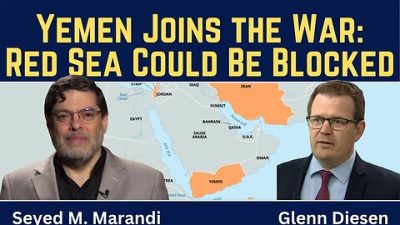
Yemen joins the war – Red Sea could be blocked next – Saudi regime at risk
or go to
Aletho News Archives – Video-Images
From the Archives
A superpower and “the world’s sickest warrior state”
By Paul J. Balles | March 8, 2010
Living through five or six major wars has hardened me to what I thought were the extremes of inhuman cruelty and brutality.
Two things made those extremes almost bearable: the brutality always revealed – at least according to the media coverage – the viciousness of the enemy. It was therefore quite understandable when our “brave men and women” pulverized the enemy.
Films of Japanese torturing captive Americans somehow justified holding Japanese Americans in internment camps during World War II; and only a small percentage of Americans found the bombing of Hiroshima and Nagasaki unreasonably vengeful at best, at worst, depraved.
The media giants in America portrayed the North Koreans as barbaric beasts with their captives, quite unlike their southern counterpoints – our allies during the Korean War. No one ever felt the need to explain how the South Koreans were a civilized breed while the North Koreans were absolute savages, at least according to the official line.
In Vietnam, our warriors justifiably (or so the media made us believe) dropped napalm on the North Vietnamese who had the gall to hide in villages and tunnels to ravage our invaders. At least it was accepted practice until some rogue photojournalist filmed a young girl screaming down a Vietnamese road in flames. … continue
Blog Roll
 Aletho News
- Russian tanker approaches Cuba despite US oil blockade
- Marandi: Yemen joins the war – Red Sea could be blocked next – Saudi regime at risk
- Pro-Palestinian French member of European Parliament denied entry to Canada
- Pakistan to Host US-Iran Talks
- How Indonesia’s tilt toward the US left it stranded in the Strait of Hormuz
- US has no choice but to retreat from Iranian borders: Top commander
- Iran Retaliation Strikes Chemical Plant Near Dimona
- AWACS’ Destruction is a Major Loss for US Military – Ex-DoW Analyst
- Israel’s Iran Strategy Uses US Military & Gulf States as Its Pawns
- Iran: Trump wanted regime change, now just begging for Hormuz to open
- If Americans Knew
- Israeli police block Catholic cardinal from entering Church of the Holy Sepulchre on Palm Sunday
- Israel is assassinating journalists again, more than any other nation, anywhere, ever – Not a ceasefire Day 170
- Over 300 US service members wounded, majority have brain injuries – Not a ceasefire Day 169
- Researchers at Human Rights Watch Resign Over Blocked Report on Palestinian Refugee Return
- Jewish Groups Are Backing a War Americans Don’t Want
- Eric Fingerhut Thinks He’s the President of the Jews
- Top Jewish Philanthropists, Rabbis Urge Israeli President to Take Action Against ‘Jewish Extremists’
- Don’t Be Fooled. Zionist Leaders Have Always Wanted to Control Southern Lebanon
- Israel’s widespread use of torture is a core element of its genocide against the Palestinian people
- In Israel’s War on Iran, Many Middle East US Bases Rendered “All But Uninhabitable”
- No Tricks Zone
- German Science Blog Accuses PIK Climate Institute Of Hallucinating Climate Tipping Points
- Devastating Assessment Of Comirnaty Vaccine By Former Senior Pfizer Europe Toxicologist
- New Study: CO2 Is ‘Effectively Negligible’ As An Explanatory Climate Change Factor Since 2000
- Former Pfizer Toxicologist Dr. Helmut Sterz Tells Bundestag Hearing Pfizer Vaccine Should Have Never Been Approved
- Energy Expert: Germany’s Nuclear Phaseout Was A “500 Billion Euro Mistake”
- New Research: South Australia’s Mid-Holocene Sea Surface Temperatures Were 4°C Warmer Than Today
- Storing Green Energy To Last Germany 10 Days Would Require A 60-Million Tonne Battery
- New Studies: UK Sea Levels Were 4 Meters Higher Than Today During The Mid-Holocene
- Destructive Green New Deal: German Energy And Metal Group Warns Of Drastic Crisis
- New Study Documents A 20-Year Pause In Arctic Sea Ice Decline – Driven By Internal Variability
 Aletho News