Colombian Army Escalates Attack on Communities near Tolemaida Military Base
By Luke Finn | Red Hot Burning Peace | May 14, 2014
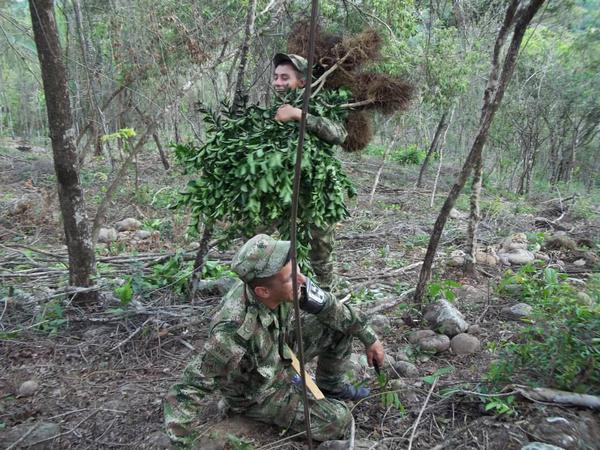
The communities of Yucala, Mesa Bajo, and Naranjala are facing a slow and deliberate process of displacement by a key army base used by the U.S. military in Colombia.
Seven military bases in Colombia fall under the U.S.-Colombia Defense Cooperation Agreement, which allows for U.S. Military access to Colombian bases, and one of those is Tolemaida, Cundinamarca. It was originally founded in 1954 by Colombia’s only ever dictator, General Gustavo Rojas Pinilla (though, of course, Colombia’s list of authoritarian rulers is much longer), and modeled on Fort Benning, Georgia, home of the School of the Americas (now WHINSEC), the infamous training ground for human rights abusers throughout the hemisphere. Like the School of the Americas, Tolemaida was to become primarily a center for training, here in anti-guerrilla (and more recently counter-insurgency) warfare, specifically through its lauded “Curso de Lanceros” course run by U.S. officers and taken by amongst others the armies of the United States, France, and Panama, as well as Colombians. Tolemaida has a permanent presence of U.S. soldiers.
The Tolemaida base is located on a plateau, overlooking the river Sumapaz, an area that amongst other things contains the largest páramo ecosystem in the world, noted even within Colombia for its bio-diversity. Prior to 1954, a community on the plateau, named their settlement “El Mirador,” or “La Mesa.” One man I met, who still remembered those days, told me proudly that they had both a butcher and a soccer field. But then came La Violencia and the new military base, and the communites moved further down the hillside to the veredas of Yucala, Naranjala, and Mesa Bajo, clearing the land and planting their crops.
The community has been in a state of near constant harassment ever since the base’s construction, and even more so as the base looks to expand. For example, back in the 1980’s the military cut electricity to the community. The 150 campesino families affected today, experience three main forms of harassment as part of the Colombian Army’s petty and vindictive campaign.
The first is the economic blockade of the community. The small road (in a state of severe disrepair) up the hillside, turns off the Pan-American highway, and Policía Militar from the base, are posted daily on the road. Thus, the military prevents the community’s access to large amounts of food, materials to repair houses, and materials to prepare their stable fruit crops. Not even a single bag of cement comes through. People are going hungry, there is no money coming into the community, and their houses are falling down around their ears.
The second is the deliberate destruction of community property. On a number of occasions over the last year soldiers have come down from the base and torn up irrigation systems and fruit trees. On June 19, 2013, over 150 fruit trees were uprooted. This carnage is a further attempt to put a stranglehold on the economic life of the community, and starve them out.

The third way, and perhaps the most shocking, is the deliberate contamination of the community’s water, constituting a sort of biological warfare. At the Cueca de la Quebrada Naranjala, the primary water source for the families, the Army has dumped the rubbish from the base, an estimated 30 tons. Battery packs, broken glass, and ceramics, slowly rotting camouflage patterned clothing and bedding, munitions boxes (labeled in English and produced in the United States), and electrical equipment of all sorts litters the fount of the stream, and in rainy season get washed down hill and collect in sodden clumps. The water is visibly toxic green in parts, orange in others, with an oily sheen, and chemical foam. The putrefaction fills your lungs and turns your stomach as you clamber over a mountain of rubbish in one of the most beautiful places in the country.
The charitable could imagine this to be merely neglectful and careless, were it not for the numerous complaints raised by the community, including two (ignored) petitions at local and national level, a new case in front of the Inter-American Commission on Human Rights, and the economic harassment they have faced. But rubbish is still being dumped, and as it stands this seems to be a deliberate attack on the psychological, moral, and physical well being of these fifth generation workers of this land.
The expanding military base (and not to mention the vacationing bogotanos who buy up fincas and build condominiums in the area) has squeezed the communities of Yucala, Naranjala, and Mesa Bajo from both sides in a campaign of outrageous malice. There is no explicit violence in the area, no guerrilla, paramilitary, or bandas criminales, just the economic and environmental violence of the state against this blameless community. The fatuous, meaningless motto of the Colombian Army is “Faith in the Cause”—but if we were to take this at face value, what cause is this? Another slogan is “Yes, there are Heroes in Colombia”—is poisoning wells ever heroic?
Luke Finn is a writer and international accompanier with Fellowship of Reconciliation Peace Presence in Colombia. He graduated from the Humanitarian and Conflict Response Institute, University of Manchester. Follow @Peace_Presence and on Facebook.
San Francisco Rides the $15 Wave
By Shamus Cooke | Worker’s Action | May 13, 2014
It seems that Seattle has officially passed the $15 baton to San Francisco, and they’re running with it. On May 5th San Francisco had its first public organizing meeting to prepare for a ballot measure to raise the minimum wage to $15. The Labor movement and broader community organizations were well represented, and with them all the potential to achieve a great victory.
The San Francisco $15 proposal is stronger than the Seattle mayor’s version: the time line to get to $15 is shorter, and there are fewer exceptions.
San Francisco companies with more than 100 employees would have until 2016 to raise wages to $15 an hour, but they must lift wages to $13 an hour by next January. Businesses with fewer than 100 employees have until 2017 to raise wages to $15 an hour, but must raise them to $13 an hour by 2015 and $14 by 2016.
Polling has already indicated overwhelming support (59 percent) for the initiative.
The process that San Francisco is using also has other advantages over Seattle’s. The unions and community groups are working as a united front in San Francisco, whereas in Seattle there was constant tension between the socialist city council member Kshama Sawant and her $15 Now group of supporters versus the unions: Sawant wanted a strong version of $15 and several of the unions just wanted a deal, seemingly more interested in working with the mayor towards “consensus” between the unions and the corporations.
In San Francisco “consensus” was thankfully blown to pieces. The ballot initiative process goes over the head of the City Hall corporate politicians, destroying the consensus that San Francisco mayor was desperately seeking between the Chamber of Commerce — representing the giant corporations — and the unions. This has infuriated the 1%.
The San Francisco Chronicle reports:
“The San Francisco Chamber of Commerce said it was ‘outraged by the preemptive minimum wage ballot measure’ designed by SEIU and its allies.”
This is exactly the kind of outrage that should warm the heart of all working people.
The ballot initiative is also superior because it opens up the doors to wider participation of various community groups, who can mobilize their members to collect signatures, organize rallies, etc., instead of simply having four or five union reps cut a backroom, watered-down deal with the mayor and corporations.
Which begs the question: why don’t unions and community groups work together on inspiring ballot initiatives more often? Half the states in the country and many municipalities have the legal authority to evoke this brand of direct democracy, yet it’s rarely done.
The answer is, sadly, that this weapon is rarely used in an inspirational way because of the “partnership” between unions and the Democratic Party. The Democrats are adversaries of anything potentially harmful to the big corporations, which any economic measure that inspires working people will inevitably be.
This is why — as Obama’s presidency proved yet again — the Democratic Party is where hope goes to die.
Which makes the events in San Francisco all the more important: the $15 dollar initiative is an example of the unions making a big break, in practice, from the Democrats, which hopefully others around the nation will follow.
And follow they must, since it would be suicide for the national labor movement to sit idly as the fight for $15 snowballs. Union and community groups should be working together across the country for similar ballot initiatives wherever possible.
For those states without ballot initiatives, $15 can still be used as a rallying cry and a mobilizing force for change. Wherever the Democratic Party blocks this process, unions should come together and form a labor party. Working people are tired of excuses.
The fight for $15 also gives a boost to organizing new workers into unions as well. For example, Wal-Mart workers would love to make $15 an hour and the labor movement has been trying in vain to organize them for years. The slogan “$15 and a union” would resonate far better with Wal-Mart workers than anything the unions have yet put forth.
There are also many other unions that have already-organized workers who don’t make $15, and now they can have the confidence to demand $15 at the bargaining table, knowing full well that the broader community will come to their aid.
The $15 demand is especially important because it’s the first time in decades that the labor movement is going on the offensive. This is crucial. Three decades of playing defense — and playing it poorly — has had a demoralizing effect on the entire working class. A big offensive victory opens the doors wide to new possibilities and new horizons. It boosts confidence. One year ago $15 seemed like a fantasy; in five years we’ll hopefully be looking back at $15 with nostalgia, having achieved many other offensive victories.
The possibilities for unions and community groups to organize around $15 are endless. And if other unions don’t follow the example of the San Francisco unions and community groups, they’ll be acting as willing participants to the ongoing corporate onslaught. Not fighting back is no longer an option.
Shamus Cooke is a social service worker, trade unionist, and writer for Workers Action. He can be reached at portland@workerscompass.org
UK grants Israel’s Livni diplomatic immunity ahead of diplomatic visit
Al-Akhbar | May 14, 2014
Israeli Justice Minister Tzipi Livni has been granted temporary diplomatic immunity for an upcoming visit to the United Kingdom, in order to protect her against arrest for her alleged war crimes, British media reported on Tuesday.
The British Foreign Office confirmed it had granted “special mission” status to Livni, The Guardian wrote, ahead of a planned meeting between the Israeli politician and Foreign Office ministers in London.
Livni’s office confirmed the news, Israeli newspaper Haaretz reported.
The Gaza-based NGO Palestinian Center for Human Rights (PCHR) and London law firm Hickman & Rose have been leading efforts to prosecute Israeli officials accused of breaching international law.
Livni had a key role in the 2008-2009 Israeli attack on Gaza, also known as Operation Cast Lead, in which more than 1,400 Palestinians were killed.
Raji Sourani, PCHR director, told The Guardian that he was very disappointed at the British government’s decision to grant immunity to Livni.
“The [British government’s] stated policy of ‘ending impunity for international crimes’ can only be properly pursued if the rule of law and due process is allowed to prevail, rather than Britain giving a safe haven to suspected war criminals, even for a few hours,” Sourani said.
He noted that a British judge had ruled in December 2009 that there was sufficient evidence to justify Livni’s arrest over her role in Operation Cast Lead.
The UK’s law on universal jurisdiction – which allows for foreign leaders to be arrested on British soil for breaches of international law – was changed in recent years to make approval from the Director of Public Prosecutions mandatory before an arrest warrant can be issued.
The change in legislation took place shortly after Livni canceled a visit in 2009 over fears of arrest. She has since been granted diplomatic immunity for an October 2011 visit to the UK.
In July 2013, Israel’s army chief, Lieutenant General Benny Gantz was also granted judicial immunity during a visit to the European country in order to discuss military cooperation. Gantz has been accused of involvement in the commission of war crimes, particularly in the November 2012 assault on the Gaza Strip, codenamed Operation Pillar of Defense.
Syria’s Aleppo faces deadly water shortage after rebels block supply
RT | May 14, 2014
Islamist militants from Syria’s opposition have cut off the water supply to most parts of the city of Aleppo by targeting pumping stations. The city has now been plunged into abject misery, as the government and NGOs race to find alternative sources.
More than two million people have been affected by the resulting water shortage after two pumping stations were shut down. Water has stopped flowing not only into government-held areas, as intended, but into practically every corner of Syria’s largest city, which is presently divided in two spheres of control.
Fighters of the Al-Nusra Front and related groups were interested in keeping the water flowing to east Aleppo and prevent it from flowing into the western parts, AFP reports. But the plan backfired, and now tons of water have been squandered irretrievably in the Quqayq river.
Both government media, and the pro-opposition Syrian Observatory for Human Rights are condemning the act and trading blame. The rebels say it was, in fact, a campaign by President Bashar Assad’s forces to bomb the water pumps. The Al-Nusra Front made no statements following the incident.
The misery is spreading, report various journalists on the scene.
In recent pictures from Aleppo, children can be seen scooping up water from puddles along the city’s roads, as others make use of jerry cans and various containers.
The residents queue up with all manner of receptacles in front of places like mosques, wells and ancient fountains, where the water isn’t safe for consumption, Lebanon’s Al-Akhbar daily says.
Residents have been without water for over ten days now. This comes as just last month the Al-Nusra Front targeted the electrical grid distributing power to Syria’s second city and its surroundings.
The situation in western Aleppo seems somewhat more stable, with the Red Crescent working with the government to provide a modicum of water for people.
“The situation signals a humanitarian and health disaster, but we are doing what we can to avert this risk,” a source in the Syrian Red Crescent told Al-Akhbar.
The source added it is only a temporary solution, as the water provided is not of the best quality for drinking. And the overall picture is unsanitary, as trucks normally used for waste-water disposal can be seen ferrying water around the city.
Locals have been digging wells themselves just to alleviate some of the stress on government and aid organizations, the Syrian Observatory for Human Rights said.
The latest news was that activists on Tuesday reported a slight reappearance of water pressure in one of the pumps. The cause of this is as yet unknown.
Aleppo has now become a key battleground once again, after the Al-Nusra Front and related gangs lost control of Homs to the Syrian army last week, and 1,200 of them escaped the fighting in a number of buses. Currently, the only area in Syria still more or less under terrorist control is to the northwest of the old battleground of Homs. But that appears to be a temporary situation, as government forces are moving in from different sides.
Before the northern city lost its water, the Syrian Red Crescent had to coordinate between the government and the rebels in sharing what water was available. The pumping station had been dependent on diesel fuel, which the government had agreed to provide in April in exchange for the insurgents turning the electricity back on. It remains unclear what caused the latest targeting of the water pumps, and whether that signaled the end of the precarious deal between the two sides.
Possible Iranian-Saudi rapprochement to impact region
By Elie Chalhoub | Al-Akhbar | May 14, 2014
Statements by Saudi Foreign Minister Saud al-Faisal on Tuesday point to a significant development in the relationship with Iran. Saudi’s so called “hawk” and Iran’s number one enemy in the kingdom is now welcoming a dialogue with the Islamic Republic. But the implications will not be felt in Tehran or Riyadh, but in Baghdad, Homs, Beirut, and Vienna.
Saudi Arabia’s call for a dialogue with Iran is no small matter, neither in its substance, “to settle differences and make the region safe and prosperous,” or in its timing, regionally, internationally, and in relation to the nuclear issue, or the fact that it was issued by one of the kingdom’s most hawkish members.
Information from Tehran maintains “the Iranian position did not change.” It indicated that, “ever since President Hassan Rouhani reached power, [Iran] declared its openness to dialogue with the Saudis and announced the issue publicly several times.” This included statements during the recent tour of Gulf countries by Iranian Foreign Minister Mohammed Javad Zarif, in which he kept hoping to visit Riyadh. However, “the rejection was also coming from the Saudis, despite all the openness to reconciliation expressed by Iran.”
According to the same sources, several mechanisms were proposed to start a constructive dialogue, following negotiations through Omani mediation. Muscat was later forced to suspend its role after its relations with Saudi Arabia began to falter. However, a few months ago, Kuwait took up the mantle and became the main mediator between the two sides. The sources revealed that one such mechanism was suggested by the Saudis and entailed parallel trust-building steps. They would begin with a meeting between representatives of both countries’ foreign ministers, then between the two actual foreign ministers, and then to ultimately have a visit by Rouhani to Saudi Arabia to meet with King Abdullah.”
The information, which was obtained from circles concerned with relations between Tehran and Riyadh, maintained that the Saudis recently proposed through the Kuwaitis a visit by assistant Iranian foreign minister, Amir Abdel-Lahian, to hold talks. However, “Iran was not satisfied with the suggestion. They believed the atmosphere in Saudi and that surrounding the proposal, its mechanisms, and the position and authority of negotiators from either side would not lead to a serious breakthrough.”
So why did the invitation come now, at this particular time? And what are the motives behind it?
The sources point to the wider picture. “The Iraqi elections show that [Prime Minister] Nouri al-Maliki will have a larger parliamentary bloc than in the previous parliament and it is certain that he will continue through a third term. This is in addition to the latest developments in Homs, which means that the axis supporting [Syrian] President [Bashar] al-Assad now has the upper hand on the ground. There is also the situation in Lebanon, which shows beyond doubt that there will be no presidential elections, without the consent of the axis of resistance. It seems all those factors, including pressure by the US and the push by Kuwait, led the Saudis to take such a step.”
US pressure was manifested in the visit by US Defense Minister Chuck Hagel to Saudi Arabia on Tuesday, meeting with the kingdom’s leadership to discuss the Syrian and Iranian files. Kuwait’s push, on the other hand, will be apparent during the visit by the Kuwaiti Emir to Tehran on June 1. He is expected to discuss bilateral relations, including disagreements concerning the continental shelf. But the essence of the meetings will be relations with the Gulf Cooperation Council (GCC) and the Saudis in particular, in addition to Syria and other matters.
The Saudi foreign minister had announced earlier that the kingdom sent out an invitation to Mohammed Javad Zarifi, “We want to meet with him. Iran is a neighbor with whom we have relations and we will conduct negotiations with Iran.”
Faisal was speaking at a press conference during the First Forum on Economy and Cooperation of Arab Countries with the Central Asian States and the Republic of Azerbaijan. “We will talk to them and if there are disagreements we will settle them in a manner that will satisfy both countries,” he explained. “We also hope that Iran would join the efforts to make the region safe and prosperous and not be part of the problem of a lack of security in the region.”
Saud al-Faisal also expressed the desire to resume contacts between the two countries as expressed by Iran’s president and foreign minister, “We sent out an invitation to the [Iranian] foreign minister to visit Saudi Arabia, but the will to make the visit has not become a reality yet. However, we will meet him anytime he wishes to come.”
Whether by coincidence or planning, Hagel’s visit and Faisal’s call coincided with the final phase of nuclear talks between Iran and the West. But it came at a time when Zarif had just arrived to Vienna to head the delegation to the nuclear talks.
What is certain, however, are the statements by Ali Khamenei on Tuesday and the several signals he gave, which aimed to provide an umbrella to the Vienna negotiations. He emphasized that the US is unable “to do anything rash, militarily or otherwise…We depend on our own powers, strengthening them and focusing our efforts on our own potential, which will defeat plans by the Americans and other powers to force the Iranian people to surrender through exerting pressures.”
Khamenei spoke in front of a large crowd of residents in the Ilam province on the anniversary of Imam Ali bin Abi Taleb’s birth. “The major powers ought to know that the Iranian people will not yield to their ambitions, because it is a living people and its youth are moving and acting in the right direction.”
These clear words are perhaps behind Zarif’s assertions from Vienna that “the difficult part” had only started and the desired deal might be aborted, even in the absence of a consensus on just “2 percent of the topics for discussion.” Iran’s negotiations with the P5+1 groups is entering a new highly sensitive phase, with the drafting of what has become known as the “final agreement.” Tuesday night, Zarif met with the EU Foreign Minister Catherine Ashton, on behalf of the P5+1 countries, over dinner. Actual negotiations will begin on May 14 and will continue until Friday.
Unlike previous sessions, Zarif and Ashton will be heading most of the meetings.
The most contentious issue in this round is the item related to the Arak heavy water reactor, which the West wants closed, and the ability to enrich uranium, which Iran hopes to keep.
The West’s belief that it could reach some kind of nuclear deal is probably due to both sides’ need for an agreement. In addition to building his foreign policy on reaching a settlement with Iran, US President Barack Obama has his hands tied in congressional midterm elections at the end of this year. It has become clear that he needs a foreign victory to ensure the victory of his party, especially after the collapse of his project for the Arab Spring and failing to reach a Palestinian-Israeli settlement or to topple Bashar al-Assad, not to mention his crisis in Ukraine.
Rouhani, on the other hand, seems to be betting on a nuclear deal that would lift the sanctions, and thus improve the economic situation inside Iran, which would give him leverage over his fundamentalist opponents. However, he realized, albeit late, that international sanctions are linked to four files, of which nuclear power is a minor issue. The other three are terrorism, human rights, and the rockets. The sanctions would only be lifted after closing all four files. And even if that happened, Obama has to solve his problems with the US Congress, which still rejects any lifting of sanctions against Iran.
‘No evidence of Berkut police behind mass killing in Kiev’ – probe head
RT | May 14, 2014
There is no forensic evidence linking the victims of mass killings in Kiev on February 20 with officers from the Berkut police unit, the head of the parliamentary commission investigating the murders told journalists.
The killings may have been committed by “members of public organizations, who went out of control,” Gennady Moskal reported, but the so-called ‘sniper case’ may end up with no airtight result, much like the assassination of US President John F. Kennedy.
The MP made the statements at a media conference on Tuesday gathered to announce preliminary results of his commission’s probe. He assured that despite the Ukrainian General Prosecutor’s office having arrested 12 Berkut officers on allegations of committing the mass killings, forensic evidence suggests their innocence.
He said the bullets that killed people in Kiev on the bloodiest day of confrontation between protesters seeking to oust President Viktor Yanukovich and riot police didn’t match any of the firearms issued to Berkut’s special unit, which, unlike the majority of riot police, was allowed to carry lethal weapons.
Moskal added that the first shot was fired at police, not the protesters. He alleged that the shooters were agents of the Ukrainian Security Service (SBU) acting from the ranks of the protesters, but admitted that genuine protesters could have been the culprits.
Earlier Moskal said that the investigation of the high-profile case was being stalled by the SBU and the Interior Ministry because the post-coup heads of the law enforcement don’t want to face the scandal which would ensue if the real perpetrators were exposed.
In early April, the Ukrainian authorities arrested 12 members of Berkut for alleged participation in the mass killings. The move sparked protest among their fellow officers, who picketed police HQ in Kiev, saying the arrests were made on poor evidence and accusing the authorities of denigrating them. The prosecutors called the suspects “Berkut black company” when announcing the arrest.
The sniper case is one of the hottest issues in Ukraine, where the new authorities accused the ousted president of ordering the mass killings. Both he and several former Ukrainian officials accused the new authorities of sending the snipers to provoke bloodshed and topple the government.
Yanukovich said he never ordered anyone to shoot at Ukrainian people.
The same version was voiced privately in a leaked conversation between EU foreign affairs chief Catherine Ashton and Estonian Foreign Minister Urmas Paet.
Russia says that activists of the radical Right Sector ultra-nationalists are the most likely culprits.
Ethnic Russians Are People, Too
By Robert Parry | Consortium News | May 13, 2014
So what does the New York Times have against Ukraine’s ethnic Russians? While the newspaper has fallen over itself insisting on the “legitimacy” of the coup regime in Kiev, despite its collaboration with neo-Nazis who spearheaded the Feb. 22 ouster of elected President Viktor Yanukovych, the Times editors can’t hurl enough insults at the ethnic Russians in the east who have resisted the regime’s authority.
For weeks, the Times has called the eastern Ukrainian rebel leaders “self-declared” and ridiculed the idea that there was any significant backing for the rejection of the Kiev-appointed regional leaders; all the trouble was simply stirred up by Vladimir Putin. Now, however, the referenda in the provinces of Donetsk and Luhansk have demonstrated what even a Times reporter acknowledged was “substantial popular support for the pro-Russian separatists in some areas.”
But the Times editors still won’t give up their prejudices. For instance, Tuesday’s lead editorial begins: “If there were questions about the legitimacy of the separatist referendums in eastern Ukraine, the farcical names of the entities on which people were asked to vote — the self-declared People’s Republics of Donetsk or Luhansk — surely answered them.”
So, the votes – and the desires – of eastern Ukrainians shouldn’t matter because the Times disapproves of “the farcical names of the entities” that people voted for.
The Times then suggests that violence that marred the referenda was the fault of the rebels, not the Kiev regime’s National Guard, which includes the neo-Nazi militias that threw fire bombs at police during the Maidan protests in February and are now carrying out the most lethal attacks against protesters in cities in the east and south.
Of course, according to the Times’ narrative, these neo-Nazis from western Ukraine don’t exist, so the violence must be palmed off on others or be treated like the natural occurrence of a spring thunderstorm. In Tuesday’s editorial, the Times wrote: “But the gathering rumble of violence accompanying the votes is serious and is driving the Ukrainian crisis in a direction that before long no one — not President Vladimir Putin of Russia, not authorities in Kiev, not the West — will be able to control.”
However, even the Times’ own field reporter noted that the violence during the referenda on Sunday was provoked by those new National Guard forces that attacked some polling places. The Times’ editors must assume that most of the newspaper’s readers aren’t paying close attention to the details.
The other part of the Times’ Ukraine narrative is that Putin provoked the unrest in Ukraine so he could seize territory, although no less an authority on power politics than former Secretary of State Henry Kissinger says that notion “isn’t possible,” adding that Putin simply was reacting to events that caught him off-guard as he was coming out of the Winter Olympics at Sochi.
Yet, the Times ignores this more realistic scenario – of a Western-pushed destabilization of the Yanukovych government that involved demands that Ukraine accept a harsh austerity plan from the International Monetary Fund and that spiraled into a violent “regime change” – and instead puts the blame on Putin, who – the Times says – must be told to get “his minions in southeastern Ukraine in line.”
Otherwise, the Times blusters “the European Union and the United States will impose sanctions that will cut Russia off for a long time from Western sources of technology, arms and finance.”
While the Times editorial accurately reflects the swaggering belligerence of Official Washington, the editors still refuse to see the Ukraine crisis in objective terms, in which both the western Ukrainians who favor closer ties with Europe and the eastern Ukrainians whose economy is dependent on trade with Russia have legitimate concerns.
The ethnic Russians in the east are not simply dupes who fall for clumsy propaganda and mindlessly follow the dictates of Vladimir Putin. They are human beings who have their own legitimate view of their political situation and who can make judgments about what course of action is best for their interests. As difficult as life in Ukraine is, it is sure to be worse once the IMF’s harsh austerity is imposed on the country’s population.
The Times and many others in the Western media insult these ethnic Russians with a disdainful treatment that treats them as lesser beings and assumes that only the pro-European Ukrainians in the west deserve respect for their opinions.
~
Investigative reporter Robert Parry broke many of the Iran-Contra stories for The Associated Press and Newsweek in the 1980s. You can buy his new book, America’s Stolen Narrative, either in print here or as an e-book (from Amazon and barnesandnoble.com).
Israeli Supreme Court to Hear Rachel Corrie Appeal on May 21
Rachel Corrie Foundation for Peace & Justice | May 12, 2014
Nine years after filing a civil suit against the State of Israel for the wrongful death of American peace activist Rachel Corrie, her family will have their appeal heard before the Israeli Supreme Court on May 21 at 11:30 a.m. in Jerusalem. The appeal, which will be argued by attorney Hussein Abu Hussein, challenges the Haifa District Court’s August 2012 ruling which concluded that the Israeli military was not responsible for Rachel’s death and that it conducted a credible investigation.
“During the past nine years, we have sought accountability in the Israeli courts for Rachel’s killing but were handed a verdict that showed blind indifference to the rights of the victim and little interest in seeking truth and justice,” said Craig Corrie, Rachel’s father.
The Corrie family appeal focuses on serious flaws in the lower court verdict which erred by ignoring and misinterpreting essential facts and misapplying legal norms. The appeal also challenges the lower court’s total disregard of international law obligations as well as procedural advantages that were regularly granted to the state during the proceedings. Lawyers for the Corries and the State of Israel have submitted their arguments in writing to the panel of three justices – Deputy-President of the Court Miriam Naor, Esther Hayut, and Zvi Zylbertal.
Speaking of his family’s hopes, Craig Corrie said, “It is a tragedy when the law is broken, but far, far worse when it is abandoned altogether. The Supreme Court now has a choice, to either show the world that the Israeli legal system honors the most basic principles of human rights and can hold its military accountable, or to add to mounting evidence that justice can not be found in Israel.”
Rachel, a 23-year-old human rights defender from Olympia, Washington, was crushed to death March 16, 2003, by an Israeli military bulldozer while nonviolently protesting demolition of Palestinian civilian homes in Rafah, Gaza. The following day, Israeli Prime Minister Ariel Sharon promised President George W. Bush a “thorough, credible, and transparent” investigation into Rachel’s killing. In 2004, Secretary of State Colin Powell’s Chief of Staff informed the Corrie family of the U.S. Government’s position that the Israeli investigation did not meet these standards and advised them to “use the Israeli court system.” The Corries filed suit in 2005, charging the State of Israel and its Ministry of Defense with responsibility for Rachel’s killing.
The civil trial before Haifa District Court Judge Oded Gershon began March 10, 2010, and 23 witnesses testified in 15 hearings, spread over 16 months. Each session was attended by the Corrie family, American Embassy officials, and numerous legal and human rights observers.
Testimony exposed serious chain-of-command failures in relation to civilian killings, as well as indiscriminate destruction of civilian property at the hands of the Israeli military in southern Gaza. Four eyewitnesses from the International Solidarity Movement (ISM) testified that Rachel was visible to soldiers in the bulldozer as it approached. Military witnesses testified that they saw ISM protesters in the area; and the on-site commander asked to stop operations due to their presence, but was ordered to continue working. An Israeli colonel testified that there are no civilians in war, and the lead military police investigator, himself, stated his belief that the Israeli military was at war with all in Gaza, including peace activists.
Testimony also revealed serious flaws in the military’s investigation into Rachel’s killing. Investigators failed to question key military witnesses, including those recording communications; failed to secure the military video, allowing it to be taken for nearly a week by senior commanders with only segments submitted to court; failed to address conflicting testimony given by soldiers; and ignored damning statements in the military log confirming a “shoot to kill” order and a command mentality to continue work in order to avoid setting a precedent with international activists.
On August 28, 2012, Judge Gershon ruled against the Corrie family, handing down a verdict stating the Israeli military was not to blame for Rachel’s death and that she alone was responsible for her demise. The Judge lauded the military police investigation and dismissed the case, adopting the Israeli Government’s position that the military should be fully absolved of civil liability, because soldiers were engaged in operational activities in a war zone.
The verdict was widely condemned by legal and human rights organizations monitoring the case, citing misrepresentation of facts and the fundamental principle of international humanitarian law – that in a time of war, military forces are obligated to take all measures to avoid harm to both civilians and their property. President Jimmy Carter stated that the court’s decision confirmed “a climate of impunity, which facilitates Israeli human rights violations against Palestinian civilians in the Occupied Territory.”
Seating in the courtroom is limited, and members of the press are advised to arrive early with press credentials. Proceedings will be in Hebrew. The family is seeking permission from the Court to provide simultaneous translation for court observers. However, pending the Court’s decision, journalists should make plans to bring their own translator. Cameras and audio recording equipment will not be permitted once proceedings begin. Photos may be taken before the judges enter the room.
A performance of My Name is Rachel Corrie, a play drawn from the diaries and e-mails of Rachel and staged around the world, will be presented in Hebrew on Monday, May 19 at 21:00 at the Arab-Hebrew Theatre in Jaffa. It will be followed by a panel discussion with the Corrie family, moderated by human rights lawyer Michael Sfard. For more information, visit The Coalition of Women for Peace, which is sponsoring the event.
For more information please visit http://rachelcorriefoundation.org/trial
The Government’s Antipathy Towards Transparency Has Made FOIA Lawsuits The Default Process
By Tim Cushing | Techdirt | May 12, 2014
This is default mode for the Freedom of Information Act.
In a federal FOIA complaint, the ACLU and University of Arizona Professor Derek Bambauer and Associate Professor Jane Yakowitz Bambauer claim that the Department of Homeland Security has failed to respond to requests made in January and February for records that may “shed light on Border Patrol’s extensive but largely opaque interior enforcement operations.”
The professors seek “records related to U.S. Border Patrol’s interior enforcement operations in Tucson and Yuma Sectors, including relevant agency policies, stop data, and complaint records.”
The CBP (Border Patrol) operates far inland these days with the blessing of the DHS. To live in states bordering Mexico is to have your freedom to travel within the country needlessly interrupted by uniformed officers inquiring about your country of origin.
The CBP’s surveillance technology has also wandered much further inland, far past the so-called “Constitution-Free Zone” that extends 100 miles in from the country’s borders. Its drones, which are specifically to be used for border surveillance, have been loaned out to an assortment of federal agencies and local law enforcement.
The CBP has also become a deadlier force, responsible for 27 fatalities in the last three years. This number has increased dramatically, in part because CBP agents seemed to be looking for reasons to open fire — like standing directly in the path of escaping vehicles.
But this isn’t so much about the CBP as it is about the government’s betrayal of the ideals behind the Freedom of Information Act.
“We shouldn’t have to go as far as filing a lawsuit to get these records,” Professor Bambauer said in a statement. “This is public information about a matter of pressing public concern. We cannot allow DHS and Border Patrol to continue operating in our communities without being subject to public scrutiny.”
No, citizens shouldn’t have to file lawsuits just to get the government to turn over responsive records. And, yet, this has become the expected route to freeing information. Nearly every document handed out by the Office of the Director of National Intelligence has been prompted by a lawsuit. The CBP drone documents mentioned above? Those are also tied to a FOIA lawsuit. Without the court’s prompting, it’s highly unlikely any of the documents the CBP “failed” to turn up during its first FOIA search would ever have been made public.
This is now the standard process for obtaining information from the government, whether at the federal level or below. There are many agencies that handle requests with few problems. But the agencies leaning towards the law enforcement/counterterrorism end of the spectrum are far from compliant. They resist, stall or simply ignore requests, pushing inquiring entities towards the courtroom.
This is completely wrong. A FOIA lawsuit is a remedy. Now, it’s just standard practice. And this goes far past simply unacceptable into sickening territory.
Government agencies are supposed to be accountable to the public that pays for everything they do. The FOIA law is simply a tool of accountability that can be wielded by any citizen. But these agencies have perverted the FOIA system so thoroughly that what was supposed to be a last resort (a lawsuit) is now just another step in the FOIA process.
The DOJ likely has no problem with the DHS, CBP and others blowing off FOIA requests until the judicial system orders them to turn over the requested info. After all, in its ridiculous argument for warrantless cellphone searches, it stated that if people felt the police shouldn’t have had access to their cellphone contents, they could always argue for suppression in court. This is the same mentality. Instead of respecting the limitations set by the Fourth Amendment, the DOJ suggests people should use a remedy (suppression) to hold cops accountable rather than expecting the police to police themselves and avoid violating citizens’ privacy and civil liberties.
These agencies know that not everyone has the time or money to battle for the release of documents, so their exposure is limited should they choose not to comply. It’s extremely hard for a nation’s citizens to hold its government accountable if the government is going to use the citizens’ own money against them.
ACLU, EPIC and the EFF have gone to court time and time again with no greater goal than getting government agencies to comply with a federal law. This ongoing subversion of the FOIA is completely unacceptable. This government is giving the public the finger, letting it know that it will only be accountable when forced to.
Freedom Flotilla Update: “We Will Sail in the Fall!”
Statement from the Freedom Flotilla Coalition regarding the attack on Gaza’s Ark | May 12, 2014
The Freedom Flotilla Coalition met in London over the last two days to discuss future plans in the wake of the terrorist attack on Gaza’s Ark in the port of Gaza, as well as future plans to struggle against the blockade of Gaza
The attack, which occurred on April 29th, caused substantial damage to the hull of the boat. These hull damages and others caused by the explosion need a minimum of 2 months work to repair at a cost of approximately US $30,000.
In response to this attack we will increase our efforts to challenge the blockade through non-violent direct action. We now plan to sail Gaza’s Ark early in the fall of 2014.
The authorities have not yet concluded their investigations of the incident, so it is premature to blame anyone, but it is well known who enforces the blockade on Gaza and who doesn’t want it challenged.
Preliminary results of the investigation and inspection by our partners indicate that the materials which were used in the attack are not readily found in Gaza.
Freedom Flotilla boats have been sabotaged before in the ports of Cyprus, Greece and Turkey, over the last 5 years, as they were preparing to sail to Gaza to challenge the blockade.
Boats that sailed to Gaza have been attacked by the Israeli Navy in international water, in one case lethally, and in others with force which caused a boat to sink. Boats that were not sabotaged (over half a dozen) were hijacked and towed to Ashdod.
This attack on Gaza’s Ark took place as Israel is under increased legal pressure for its deadly attack on the first Freedom Flotilla in 2010 at the International Criminal Court (ICC) and in Turkish courts.
It also happens as Israel is increasing pressure against all Palestinians in retaliation against efforts at national reconciliation between the West Bank and Gaza.
The Freedom Flotilla Coalition commits to continue its work against the blockade of Gaza in all ways and by all non-violent means possible, including supporting the May 31st International Freedom Day for Gaza.
For further information:
Ehab Lotayef +44 (753) 877 0353 or +1 (514) 941 9792
Ann Ighe +46 (70) 974 0739
Zaher Birawi +44 (785) 089 6057
Featured Video

Daniel Davis: U.S. Military Options & War Narrative Collapse
or go to
Aletho News Archives – Video-Images
Book Excerpt
“Vaccines Do Not Cause Autism!” The Science is Settled. Right?
ICAN urges the IACC to actually study infant vaccines and autism
 By Aaron Siri | Injecting Freedom | March 16, 2026
On behalf of ICAN, we just sent a copy of chapter 11 of Vaccines, Amen to the newly appointed members of the federal Interagency Autism Coordinating Committee (IACC).
If you haven’t already read this chapter, you can read the whole thing in the attached letter. I trust that after you read it, you’ll see why the statement “vaccines do not cause autism” is a belief, not science!

IACC Public Comment Letter
1.53MB ∙ PDF file
Includes chapter 11 of Vaccines, Amen
Blog Roll
 Aletho News
- Washington’s War on Cuba Is Older Than You Think
- Daniel Davis: U.S. Military Options & War Narrative Collapse
- Protesters call on Brussels university to cut partnership with Israeli defense-linked firm
- Weapons makers cash in on Trump’s Iran war
- Why Trump’s anti-Iran naval coalition in Strait of Hormuz is doomed to fail
- IRGC says regional energy sites linked to US will be reduced to ashes
- Qatar condemns ‘dangerous’ Israeli attack on gas field
- Iran made ‘unexpectedly substantial’ offer during Geneva talks, US envoys ‘dragged’ Trump into war: Report
- Russia condemns Israel’s attack near Bushehr plant, files complaint
- Russia Strongly Condemns Actions Aimed at Harming Health of Iranian Leadership – Kremlin
- If Americans Knew
- How ignorance, misunderstanding and obfuscation ended Iran nuclear talks
- Israeli media reports grotesque settler attack in West Bank
- UK security adviser attended US-Iran talks and judged deal was within reach
- Tucker Carlson says ‘neocons’ will try to destroy Joe Kent over resignation
- Lebanon death toll exceeds 900, another assassination in Iran, bombing in Gaza – Not a ceasefire Day 159
- Trump’s counterterrorism chief, whose own wife was killed by ISIS, quits over Iran War saying Tehran posed ‘no imminent threat’
- Here’s what US could fund instead of Bibi’s war on Iran
- Israel Killed Over a Dozen Lebanese Paramedics in Three Days, Now Claiming That Ambulances Are “Hezbollah” Targets
- War on Iran: These are the heritage sites devastated by US and Israeli attacks
- Four news stories from Israeli media that illustrate Israeli “justice”
- No Tricks Zone
- Energy Expert: Germany’s Nuclear Phaseout Was A “500 Billion Euro Mistake”
- New Research: South Australia’s Mid-Holocene Sea Surface Temperatures Were 4°C Warmer Than Today
- Storing Green Energy To Last Germany 10 Days Would Require A 60-Million Tonne Battery
- New Studies: UK Sea Levels Were 4 Meters Higher Than Today During The Mid-Holocene
- Destructive Green New Deal: German Energy And Metal Group Warns Of Drastic Crisis
- New Study Documents A 20-Year Pause In Arctic Sea Ice Decline – Driven By Internal Variability
- Wake-up Call: Survey Shows Majority Of Germans Now Favor Postponing Climate Targets!
- Televised! Leading German Political Candidate Tells Schoolchildren CO2 Makes Sun Hotter!
- New Study: A Century Warming Of 1.1°C Is ‘Commonplace’ And ‘Not Unusual’ During This Interglacial
- New Study: ‘Internal Noise’ And Volcanic Forcing Can Trigger 10-15°C Warming Within Decades
 Aletho News