Now Monbiot is smearing the BBC too
By Jonathon Cook | The Blog from Nazareth | October 16, 2014
Recently I criticised Guardian columnist George Monbiot for lavishing the term “genocide denier” on anyone who disagrees with him about the events in Rwanda 20 years ago. I described Monbiot as a “McCarthy of the left”, after he waged a campaign of vilification of prominent dissident intellectuals Ed Herman and David Peterson for seeking to critically re-examine the west’s official narrative about Rwanda – that the Hutu majority alone committed a genocide against the Tutsi minority – and questioning whether Rwanda’s current Tutsi president, Paul Kagame, and his RPF forces were not also deeply complicit in the slaughter.
Monbiot’s witch-hunt has also targeted others on the left, such as Noam Chomsky, who supported Herman and Peterson’s right to engage in the critical study of what they call the “politics of genocide”.
Monbiot’s efforts to silence these critical voices on the left was thrown a curveball this month when the BBC, one of the biggest enforcers of official narratives, broadcast a programme, Rwanda’s Untold Story, raising many of the same questions as Herman and Peterson. What would Monbiot do?
Well, I have to give him credit: he is consistent. He has joined other journalists, academics and activists deeply committed to the official Rwanda narrative in accusing the BBC and its programme-makers of genocide denial too. In fact, in their letter to the BBC’s director general, Tony Hall, they accuse the BBC team of genocide denial no less than 10 times!
For those who wish to follow the details of this correspondence, the letter from Monbiot et al can be found here. A reply from David Peterson is available here. And there are a further letters to Hall from Theogene Rudasingwa, who was once in Kagame’s inner circle, and from Christopher Black, the barrister for Augustin Ndindiliyimana, a Hutu general acquitted of genocide crimes at the International Criminal Tribunal for Rwanda.
In this increasingly polarised debate, I recommend reading Justin Podur’s interventions. He is a journalist with a deep interest in African politics who has been following both sides of the argument closely. He does not agree with all of Herman and Peterson’s conclusions but, importantly, he argues that the official narrative about Rwanda is inadequate and that it is vital to create space for a respectful debate about what really happened. That stands in stark contrast to Monbiot’s position, and illustrates my reasons for calling his campaign against Herman, Peterson, Chomsky and others McCarthyite.
On his blog, Podur makes the essential point that, despite the repeated smear from Monbiot and his allies in their letter to Hall, the BBC documentary does not deny Rwanda’s genocide: it simply makes the case that Kagame’s role in the genocide, entirely overlooked in the official narrative, needs reassessing and that his current regime, solidly backed by western powers, should be held to account for committing mass murder in neighbouring Congo and for its totalitarian rule inside Rwanda.
By creating a sacred narrative about Rwanda’s genocide, the BBC documentary suggests, Kagame has provided himself with the cover needed to continue with his rule of terror.
Podur quotes from Monbiot et al’s letter: “Denial… ensures the crime continues. It incites new killing. It denies the dignity of the deceased and mocks those who survived.”
And yet, the letter writers [including Monbiot] do all of those things. If the victims of the RPF don’t count, as they do not seem to to these writers, then what is this except denial? All of the victims in Central Africa – of the defeated Rwandan government, of the RPF, of the RPF’s proxies and of their opponents – all deserve to be acknowledged, not denied. The BBC documentary deserved better than shoddy arguments and mudslinging. Kagame is still in power, and the only function of this letter is to provide him with cover. Rather than a letter about ‘genocide denial’, the authors would have been more honest to write a manifesto of unconditional support for Rwanda’s dictator.
Zoabi appeals against Israeli ban on Palestinian women entering Al-Aqsa
MEMO | October 16, 2014
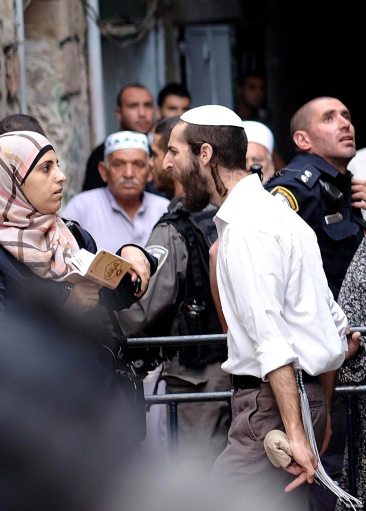 Arab Knesset Member Hanin Zoabi is to appeal against the Israeli police’s ban on Palestinian women from entering Al-Aqsa Mosque, the minister said today.
The Anadolu news agency reported a statement for Zoabi saying she had informed the Israeli police of her plan to appeal to the Israeli court against the “arbitrary” banning of women from entering the mosque.
She did not disclose with which court she was planning to file the appeal, but the process starts by filing an appeal to the magistrate court, then to the district court then to the High Court.
Zoabi described Israel’s ban on Palestinian women entering Al-Aqsa Mosque as a “dangerous precedent”, noting that the reason behind banning them is their role in “facing the settlers’ desecration of the mosque” in recent months.
For more than two months, Israeli police have banned women from entering the mosque from time to time. “They [Palestinian women] formed the front defence line against the Israeli violations and aggression on Al-Aqsa Mosque,” Zoabi said.
The Knesset member said she had sent a written letter to the Israeli Minister of Internal Security Yitzhak Aharonovich informing him of the “violations” committed by the Israeli police and Israeli border guards against women around and inside the holy site.
She noted in her letter that the violations and aggression on Palestinian women and banning them from entering into the mosque “undermines and ignores” their freedom. She also stressed that the lack of punishment against aggressors is a “green light” for more violations.
For about two months, the Israeli settlers, including extremist officials such as Knesset Deputy Speaker Moshe Feiglin have stormed Al-Aqsa Mosque on almost a daily basis.
Palestinians remain inside the mosque trying to prevent such aggressions, but the Israeli police and occupation forces took measures to secure the settlers including preventing women and men under the age of 50 from entering Al-Aqsa’s grounds.
Yesterday, 20 Palestinians, including women, were wounded in clashes in the mosque and seven others were arrested, including minors.
Maduro Hands Over Land Titles to Indigenous Communities, Creates Institute to Protect Native Languages
By Z.C. Dutka | Venezuelanalysis | October 15, 2014
On Monday, in celebration of the nationally acclaimed Day of Indigenous Resistance, Venezuelan president Nicolas Maduro established a presidential council for indigenous peoples, handed over collective land titles to 14 original communities, lowered the threshold age for indigenous pensioners, and announced the creation of an institute to protect the country’s 44 native languages.
The South American leader also pledged 5000 new homes for indigenous communities for 2015 through the national housing mission Mision Vivienda, and announced the investment of 575 million bolivars (about $7 million) to address extreme poverty in 396 of those communities.
Aloha Nuñez, the Indigenous Peoples’ Minister, noted that the presidential council was formed as a result of elections held in 2,194 indigenous communities after the idea was discussed in 1,589 countrywide assemblies.
Delia Gonzalez, a spokesperson for the Wayúu community of Zulia state, said that the debates leading up to the creation of the council were conducted with respect, tolerance and spirituality, in the interest of enabling diverse indigenous peoples to make significant contributions to the transition towards socialism.
Nuñez also explained how the language institute is the product of many years’ collective efforts. Of the 44 different original peoples that exist in Venezuela, Nuñez said, 34 speak their language and 10 have lost theirs through lack of use.
“We should immediately found and motivate a team systematically [that can] permanently, scientifically, register, rescue and revive all indigenous languages that exist in Venezuelan territory,” said Maduro from Miraflores presidential palace where Monday’s ceremony was held.
Shortly after, the Venezuelan president announced the incorporation of all indigenous above the age of 50 into the Amor Mayor mission for special elderly pensions. Nationwide, the mission applies to women over 55 and men over 60 who live in family homes maintained by minimum wage workers.
Land titles that encompass six ethnic groups and 14 communities of Anzoategui state were presented to community representatives; 1,891 hectares to the Guatacarito people, 438 to the Cumanagoto, 983 to the Capachal, 3,294 to the Pedregal, 657 to the Guayabal and 1,119 hectares to the Kariñas of Mapiricurito.
From 2011 to 2013 the Committee for the Demarcation of Land and Habitat, of the indigenous ministry, has signed 40 property titles for collective lands, including over 1.8 million hectares of land.
In a similar ceremony in July, Nuñez declared, “Today, the Bolivarian government recognizes the lands that ancestrally belonged to us and have been our home for many years.”
Panetta reveals US nuke strike plans on N. Korea, spurs controversy
RT | October 16, 2014
US war plans against North Korea recently included the option of a nuclear strike, former CIA Director and Defense Secretary Leon Panetta revealed in his memoirs, triggering major controversy.
Panetta described a 2010 briefing in Seoul by General Walter L. ‘Skip’ Sharp, the commander of US forces in South Korea, where it was made clear that the nuclear option was on the table if North Korean forces crossed into the demilitarized zone (DMZ) between the North and the South.
“If North Korea moved across the border, our war plans called for the senior American general on the peninsula to take command of all US and South Korea forces and defend South Korea— including by the use of nuclear weapons, if necessary,” Panetta wrote in ‘Worthy Fights: A Memoir of Leadership in War and Peace’.
Panetta added that he left the briefing with “the powerful sense that war in that region was neither hypothetical nor remote.”
Panetta’s revelations sparked various responses, ranging from surprise to indignation.
“Typical wooden-headedness on the part of a US official,” a former top CIA expert on Korea told Newsweek. “How in the world do we think South Koreans will react to the news that the US is prepared to use nuclear weapons on the peninsula? It doesn’t reassure them, only makes them think having the US bull in their china shop is maybe not such a good idea.”
Others said Panetta did not write anything unexpected. A ‘Joint Vision’ statement signed between US-South Korea in 2009 “references extended deterrence to include the nuclear umbrella … in many respects, the information is not new,” Korea expert at the Naval War College Terence Roehrig said. “The United States has long had a position that South Korea was under the US nuclear umbrella.”
The US sent over tactical nuclear weapons to the Korean Peninsula in 1958, but their deployment was only revealed in mid-1970s.
The Korean War took place in 1950-1953, with no peace deal ever signed between North and South Korea. Thus the two countries remain technically at war.
High-level military talks
Meanwhile, the relationship between the North and the South remain tense. On Wednesday senior-level military talks were held between them to resolve a series of recent live-fire incidents in South Korea and maritime borders, AFP quoted Seoul’s Defense Ministry as saying.
The meeting was referred to as the highest-level military exchange in seven years. It lasted for five hours and included officers up to the rank of general.
The main focus of the talks was Friday’s incident involving an exchange of gunfire after North Korea’s military shot at balloons launched by anti-Pyongyang activists. Tuesday’s fire exchange between North and South Korean naval patrol boats near the disputed Yellow Sea border was also discussed.
“Our side clarified our position that North Korea should respect (the maritime boundary) … and that as a democratic nation, we cannot regulate balloon launches by civilian groups,” South Korean Defense Ministry spokesman Kim Min-seok said.
Featured Video
US JET SHOT DOWN OVER IRAN /Lt Col Daniel Davis & Nima Alkhorshid
or go to
Aletho News Archives – Video-Images
From the Archives
Experts Warned For Years That A War With Iran Would Happen This Way
By Caitlin Johnstone | April 3, 2026
… It’s so wild how we keep seeing reports that Iran’s retaliation caught the US off guard. For all the years I’ve been paying attention to this issue I’ve been reading experts and analysts saying if the US attacks Iran, Iran can close the Strait of Hormuz and strike US bases and the energy infrastructure of US allies in the region.
A few examples:
A 2006 Oxford Research Group paper titled “Iran: Consequences of a War” warned that Iran has numerous options at its disposal in the event of a US attack, and that the “most significant of these would be any possible retaliatory Iranian action to affect the transport of oil and liquefied natural gas through the Straits of Hormuz,” adding that stopping Iran from doing this “would be difficult if not impossible to achieve, leading to a fear of attack which alone would have a formidable impact on oil markets.”
A 2007 Cato Institute paper titled “The Iraq War and Iranian Power” warns that “Iran possesses the largest ballistic-missile inventory in the Persian Gulf — missiles which can reach Israel, Saudi Arabia and US military bases in Iraq,” and that “experts argue Iran could also use the ’oil weapon’: blocking the 34km-wide Strait of Hormuz and conducting submarine and anti-ship missile attacks against ports and oil facilities in Saudi Arabia, Kuwait and other Gulf Cooperation Council states.”
A 2012 NPR article titled “Can Iran Close The World’s Most Important Oil Route?” features then-chairman of the Joint Chiefs of Staff acknowledging that Iran absolutely can block the Strait of Hormuz, saying Tehran has “invested in capabilities” which specifically enable them to do so.
A paper from the Columbia Center on Global Energy Policy and the Center for a New American Security titled “IN DIRE STRAITS? IMPLICATIONS OF US-IRAN TENSIONS FOR THE GLOBAL OIL MARKET” warns of a potential scenario “that includes damage to Gulf oil infrastructure and a temporary closure of the Strait of Hormuz.”
These weren’t a bunch of keffiyeh-wearing peaceniks making these assessments, they were deeply entrenched swamp monsters entirely loyal to the US empire. They opposed war with Iran not because it would be an evil act of unforgivable mass murder, but because it would be bad for the imperial power structure. … Full article
Blog Roll
 Aletho News
- US dismantling international law in its war against Iran while claiming ‘false’ victory: Legal scholar
- One martyr, 5 injuries in US attack on Iraqi border crossing with Iran
- ‘This war is Israel’s war’: World facing ‘security breakdown’, says Qalibaf
- IRGC decries attack on US embassy in Riyadh, says executed by ‘Israel’
- Iran blasts EU hypocrisy as EU invokes international law over Hormuz
- There is no military solution to Strait of Hormuz
- NATO’s structural collapse – the outcome of deviation from reality
- Poll finds world views China better than US
- One Of America’s Leading Neo-Cons Has Turned Against The Iran War And Israel
- Attack in the Bosphorus exposes NATO weaknesses and tensions among allies
- If Americans Knew
- US loses planes over Iran, Israel downgrades Lebanon war goals – Daily Update
- Israel Is Blocking Palestinians from Easter at Church Where Jesus Resurrected
- Plot to assassinate Palestinian activist follows harassment campaign promoted by Zionist groups and elected officials
- Prominent New York synagogue hosts presentation on why U.S. Jews should support the ethnic cleansing of Gaza
- Tapper vs. Piker: Is the CNN Anchor Auditioning for David Ellison?
- Shouldn’t Democrats Be Able to Condemn Genocide?
- Israel-US kill negotiators, destroy civilian structures, but Iran’s military capabilities still largely intact – Daily Update
- ‘War crime’: Global condemnation as Israeli ministers celebrate death penalty law targeting Palestinian prisoners
- 7 Ways Israel Is Turning Lebanon Into Gaza
- World’s Leading Football Bodies Under Fire Over Israel Policies
- No Tricks Zone
- New Study Reports A 60% Slowdown In Greenland’s Ice Loss Rate In The Last Decade
- Low Intensity Tornado Wrecks Major Solar Farm, Creating A Potential Toxic Dump
- New Study Finds Warming Saves Lives…Cold Temperatures 12 Times More Deadly Than Excess Heat
- German Science Blog Accuses PIK Climate Institute Of Hallucinating Climate Tipping Points
- Devastating Assessment Of Comirnaty Vaccine By Former Senior Pfizer Europe Toxicologist
- New Study: CO2 Is ‘Effectively Negligible’ As An Explanatory Climate Change Factor Since 2000
- Former Pfizer Toxicologist Dr. Helmut Sterz Tells Bundestag Hearing Pfizer Vaccine Should Have Never Been Approved
- Energy Expert: Germany’s Nuclear Phaseout Was A “500 Billion Euro Mistake”
- New Research: South Australia’s Mid-Holocene Sea Surface Temperatures Were 4°C Warmer Than Today
- Storing Green Energy To Last Germany 10 Days Would Require A 60-Million Tonne Battery
 Aletho News