Syria ‘Hero Boy’ Video Revealed to be Government Propaganda

By Daniel McAdams | Ron Paul Institute | November 14, 2014
A dramatic video clip showing a young boy heroically rescuing a young girl amid a hail of gunfire in Syria has racked up millions of YouTube viewings and has been trending heavily on other social media platforms.
The mainstream media and US government jumped on the video as evidence of the absolute depravity of the Assad regime. What kind of monster purposely targets children?
Wrote the International Business Times :
The incident certainly is not the first time that Pro-Assad gunmen have targeted children in the nearly four years of the bloody civil war in Syria.
Liz Sly, the Washington Post Beirut bureau chief covering Syria, Lebanon, Iraq — and presumably an expert in the area? — promoted the video on her Twitter page, adding “wow” in her comments. Sly’s reporting consistently agitates for more US involvement in Syria on the side of the rebels, her anti-Assad bias is solidly established.
Then the “experts” chimed in. According to the London Daily Telegraph (article since consigned to the memory hole), the experts have “confirmed the authenticity” of the video.
Then the US State Department chimed in to magnify and focus the propaganda, tweeting that a boy “hero” rescued a girl from an Assad regime sniper firing on civilians.
One problem: the whole thing was a fake. The Norweigan Film Institute, funded by the government of NATO-member Norway, chipped in $30,000 for the film to be produced in Malta and released publicly without informing viewers that it was not authentic footage.
The filmmakers made it clear to the Norwegian government in their funding application that they would not reveal that the footage was fake and authorities raised no objection to the operation.
The BBC wrote about how so many people were fooled by the film:
So once the film was made, how did it go viral? “It was posted to our YouTube account a few weeks ago but the algorithm told us it was not going to trend,” Klevberg said. “So we deleted that and re-posted it.” The filmmakers say they added the word “hero” to the new headline and tried to send it out to people on Twitter to start a conversation.
By the time its inauthenticity had been established, millions were outraged at the Assad government. Propaganda depends on framing the issue first. No one reads corrections once a false story is printed.
How convenient this is at a time when so many NATO member countries and the usual interventionist suspects are pushing hard for the US government to retool its Syria anti-ISIS campaign to first target the Assad government for destruction.
This episode should demonstrate how easy it is for governments to hide behind willing accomplices and the social media to produce and disseminate propaganda.
State Department Spokesperson Marie Harf recently drew some ridicule for stating that US evidence “proving” Russian involvement in the shoot-down of Malaysian Airlines flight MH17 over Ukraine came from “social media” sources. Perhaps those “social media” sources she urges us to rely upon are similarly supported and funded by governments with an agenda to push.
They are lying to us.
Anti-US military base candidate wins Okinawa governor race
RT | November 16, 2014
The fate of a contentious US military base, slated to be relocated on the Japanese prefecture of Okinawa, is now in doubt after exit polls showed a gubernatorial candidate deeply opposed to the plan emerged victorious in the election.
The national broadcaster NHK, news agency Kyodo, Jiji Press and private broadcaster Nippon Television all projected victory for Takeshi Onaga after polls closed on Sunday night. Going into the election, opinion polls put Onaga, the former mayor of Naha, Okinawa’s capital city, firmly ahead of incumbent Okinawa Governor Hirokazu Nakaima.
Nakaima had supported the relocation of US Marine Corps Air Station Futenma from Ginowan, a densely populated town in the island’s south. US military bases of various stripes currently occupy 38 percent of the town.
Onaga, who said his position was not anti-American, but rather about the people’s will, put the base’s future at the center of his political platform.
“We must not allow the construction (of the new base). Let’s show that the people of Okinawa Prefecture will not waver even if the governor and some other politicians are wavering,” Japan’s Asahi Shimbun daily cites projected victor Takeshi Onaga as saying on Saturday, during a last minute campaign speech.
Why should the burden fall on our shoulders?
The fifth gubernatorial held since the Japanese and US governments decided to relocate the base in December 1996, the Futenma relocation plan clearly dominated the election this time around.
Onaga had campaigned on moving the base outside Okinawa, forcing other parts of Japan to pull their weight in maintaining the security alliance between Japan and the US.
He further demanded the island house no new MV-22 Ospreys, a loud tilt-rotor aircraft that locals view as dangerous.
“Okinawa has suffered a lot. Why do we have to suffer more,” Onaga told The Washington Post before the election.
Last December, Nakaima green-lighted the transfer of the base to the city of Noga, in the island’s north. As part of the transfer, he approved the central government’s late-2013 application to reclaim the sea area off Nago’s Henoko Bay, sparking protests from those opposed to the relocation.
The move followed reports Japanese Prime Minister Shinzo Abe had pledged 348 billion yen (roughly 3 billion US) in financial assistance to Okinawa, which has Japan’s highest poverty rate.
“I’d like to convey the message to the governments of Japan and the United States… that the wishes of the people here are different from the administrative action in December last year,” AFP cites Onaga as telling reporters.
According to Jiji Press, Onaga said he would “act with determination” to rescind approval for the plan and preparatory work was already underway.
Will the election change anything?
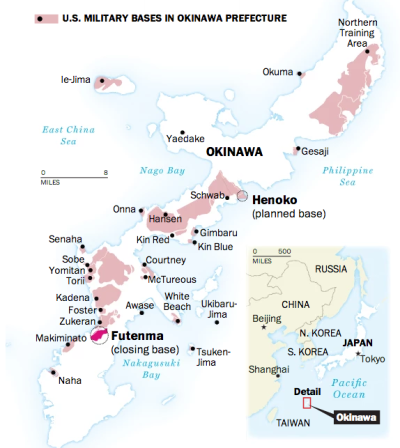 In August, Japan’s Ministry of Defense started a drilling survey in the area to prepare for the building of the base. The following month, 70 percent of Nago’s residents turned out to vote in a new municipal assembly, whose majority is opposed to the base relocation plan. Nago Mayor Susumu Inamine is strongly opposed to the construction of the new military complex in Nago’s Henoko Bay.
“Why should only Okinawa hold the burden for security of all of Japan, when the presence of US Marines doesn’t play a big role in deterring China?” Inamine said in May, echoing Onaga’s sentiments during a visit to Washington, DC. “I, as mayor, have operational control over two ports that are needed for use as construction landfill and I will exercise all powers in the municipality to block access.”
Currently, Okinawa houses 74 percent of all US bases in Japan, despite the fact the prefecture constitutes less than one percent of Japan’s total landmass. US military bases cover roughly one fifth of the island.
Their presence has served as a constant source of tension with locals due to crimes committed by servicemen, disruptions caused by military flights, noise, air pollution and massive land use by the US military.
While Onaga’s victory does not guarantee he will be able to hold up the $8.6 billion dollar relocation ($3.1 bill of which will be covered by Japan), it will likely string up Washington and Tokyo’s efforts to end years of deadlock over the issue.
If Abe attempts to veto local officials, his democratic credentials could be tarnished just days before he is expected to announce a snap general election.
Jewish settlers storm Al-Aqsa compound in Jerusalem
MEMO | November 16, 2014
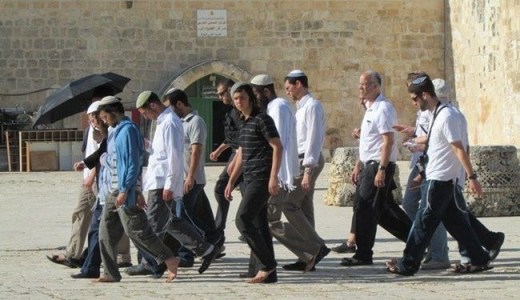
Scores of Jewish settlers on Sunday stormed the Al-Aqsa Mosque complex in occupied East Jerusalem, a Palestinian official said.
“As many as 59 settlers stormed the holy compound through Al-Magharbeh Gate under the protection of Israeli police,” Sheikh Azzam al-Khatib, director-general of the Organization for Muslim Endowments and Al-Aqsa Affairs, told Anadolu Agency.
The settlers wandered through the compound’s courtyards, passing through the Qibali and Marawani mosques inside the holy complex before departing through Al-Silsileh Gate, he added.
Meanwhile, Israeli police allowed Palestinian men to enter the compound while denying women’s entry.
“We performed the noon prayers outside the gates of the compound after we were denied access by Israeli police,” one of the women who had been barred from entering the complex told Anadolu Agency.
“At least 70 women were barred from entering the complex since the early morning,” the woman, who asked to remain anonymous, told AA.
Tension has been running high in East Jerusalem since Israel closed the Al-Aqsa Mosque compound late last month following the shooting of an extremist rabbi in West Jerusalem.
The closure of Al-Aqsa, along with the killing of a young Palestinian man suspected of shooting the rabbi, has fueled angry protests by Palestinians in East Jerusalem .
Earlier this month, an Israeli police officer was killed when a Palestinian driver ran over a group of Israeli pedestrians in East Jerusalem. The Palestinian motorist was shot and killed on the spot by Israeli police in the immediate wake of the attack.
For Muslims, Al-Aqsa represents the world’s third holiest site. Jews, for their part, refer to the area as the “Temple Mount,” claiming it was the site of two Jewish temples in ancient times.
Israel occupied East Jerusalem during the 1967 Middle East War. It later annexed the holy city in 1980, claiming it as the capital of the self-proclaimed Jewish state – a move never recognized by the international community.
In September 2000, a visit to the site by controversial Israeli politician Ariel Sharon sparked what later became known as the “Second Intifada,” a popular uprising against the Israeli occupation in which thousands of Palestinians were killed.
Israel Campaigns Against Global Free Speech
The Bilzerian Report | February 20, 2014
Alarmed at the rise of anti-Semitism and anti-Israeli sentiments on the internet, Israeli politicians recently called for nations around the world to enact legislation prohibiting criticism of Jews and Israel. Lobbying to outlaw global free speech is nothing new for Israel, however; it has been in the business of criminalizing speech for decades.
 Israel is in the precarious position of receiving tens of billions of dollars in aid every year from nations that purport to support democracy, while simultaneously oppressing the Palestinian people and perpetrating what Nobel Peace Prize winners Bishop Desmond Tutu and President Jimmy Carter deem an apartheid. If the American or European people ever knew that their tax dollars where being used in such a way they would surely cut Israel off. In order to conceal this truth and stifle any criticism, Israel and its lobbyists rely on sympathy from the Holocaust and labels of anti-Semitism to discredit critics. Even US Secretary of State John Kerry was recently called an anti-Semite for supporting a peaceful resolution to the Jewish/Palestinian conflict. Kerry is not alone however, President Obama, and just about anyone who has ever opposed an Israeli policy has been labeled anti-Semitic by his enemies. In order to add teeth to these labels, Israel lobbyists around the world lobby endlessly to criminalize anti-Semitism and Holocaust denial.
Israel’s threat of forcing world governments to enact new laws against free speech should not be taken lightly. Israel and its lobbyists have already succeeded in enacting stiff anti-racist laws in most Western countries. These laws have been used on numerous occasions to jail academics, pro-Palestinian activists, and also individuals who have spoken provable facts that are deemed anti-Semitic “canards.”
In Australia, Jewish groups lobbied successfully to outlaw holocaust study and “hate speech.” As with most laws regulating speech and academic study, it has been routinely abused, and is now on the list for repeal. In fact, the law is so tied to Jewish lobbying, that the Jewish newspaper Haaretz published an article: Australian Jews brace for a fight against the repeal of hate laws.
In Canada, Jewish groups lobbied for the enactment of hate speech regulation, and defend its use today. In 1983, Israel lobbyists filed a complaint against Ernst Zundal over a book he had written. He was tried several times, his citizenship application in Canada denied (even though he had resided there for decades), he was detained for two years without trial, and eventually deported to Germany where he was sentenced to 5 years imprisonment.
In France, Israel lobbyists publicly complained about comedian Dieudonne’s parodies of Israel and the holocaust. His home was raided, his shows banned, and hefty fines were imposed. England also followed suit and barred Dieudonne’s entrance into the country. In 2003, the French legislator and Israel lobbyist Pierre Lellouche managed to push through a law which extends the definition of discrimination to include nationalities so anti-Israel activists could be jailed. In 2009, the Lellouche law was used to convict 20 anti-Israel activists.
In England, Jewish lobbying efforts successfully enacted strict hate speech laws, and in Austria, acclaimed historian David Irving was incarcerated after Israel lobbyists complained about his academic work. The European Jewish Parliament and the chief Israel lobbyist in Belgium recently called for similar laws to stifle criticism of Israel. According to the Canadian Jewish News article French Vigilance on anti-Israel speech provoking backlash, Israel lobbyists are also attempting to enact similar legislation in the Netherlands.
In America, the Israel lobby has been fighting mightily for years to prohibit hate speech. Those efforts have been unsuccessful thus far, but they have managed to enact hate crime legislation. As Abe Foxman of the ADL noted, the social consequences in America for bigotry against Jews are so severe, (given disproportionate Jewish influence in government, media, finance, higher education, professional sports, etc…) that anti-Israel speakers often see graver consequences than the criminal sanctions they would face in Europe. For example, if one were to be labeled an “anti-Semite,” even if the allegations were wholly unsubstantiated, he would most likely be fired and ostracized from society.
One has to realize that Israel’s efforts having nothing to do with hate speech, anti-Semitism or holocaust denial, but are rather about stifling critical speech that affects Israel and its lobbyists. For example, we know that Israel and its lobbyists are not offended by holocaust denial because Israel and its lobbyists are the leading proponents of Armenian holocaust denial in the world today. Israel should also not be particularly offended by anti-Semitism, because Israel is actually one of the most racist and anti-Semitic nations on the planet.
Today, Israel is furiously enacting anti-free speech laws, hiring internet trolls to spread propaganda and disinformation, and even asking the Jewish owners of social media websites Facebook, Wikipedia, Google, and Youtube to remove material Israel does not like, regardless of its truth or merit. Israel has also campaigned against political parties it does not like in Greece, Hungary, and Ukraine. In Greece, the anti-Israel Golden Dawn Party was disbanded and its leaders arrested for no legal reason. This is a dangerous precedent that threatens world wide freedom and must be combated immediately, before speaking out against such Israeli efforts is also illegal.
Laws protecting free speech are put in place specifically to protect speech that powerful groups find objectionable. Otherwise, there is no free speech and it is just a matter of time before the list of prohibited phrases grows to include everything the powerful oppose. If it’s illegal to speak about certain races, the disabled or elderly, then why not government employees, and then the rich, or poor, and so on? Either speech is totally protected or it is not protected at all. The point of speech protection is to protect the most unpopular forms of speech. Popular forms of speech obviously need no protection.
Galilee Town Boils at Israeli Police “Execution”
Brutality from security forces and a sense of oppression connect Palestinians on both sides of Green Line
By Jonathan Cook | Dissident Voice | November 15, 2014
KAFR KANA, Galilee – Rauf Hamdan admitted to one small consolation as he sat in his mourning tent, greeting the steady stream of well-wishers paying condolences nearly a week after his son was gunned down in the street by Israeli police.
“At least his death was caught on camera,” he told Middle East Eye. “Otherwise the police would accuse me of lying when I said that he was executed in cold blood. The police can claim whatever they like. The truth is there for all to see.”
The killing of 22 year-old Kheir Hamdan – and the footage of it caught on security cameras that quickly went viral on social media – set off a firestorm of protests in Palestinian communities across Israel this past week that has yet to die down.
Hamdan instantly became a symbol: a victim of Israeli brutality and oppression, merging the experiences of Israel’s large minority of 1.5 million Palestinian citizens with those of their kin in the occupied territories of the West Bank, East Jerusalem and Gaza.
Although their inhabitants are disconnected politically and geographically, all these Palestinian areas currently simmer with a shared and barely suppressed rage that may yet erupt into a new uprising, or Intifada.
The Hamdan family home in Kafr Kana, a town of 22,000 Palestinians in northern Israel near Nazareth, is located in an overcrowded backstreet, close to a church over the site where Jesus supposedly performed his first miracle, turning water into wine at a wedding.
But Kafr Kana, like other Palestinian communities in Israel, feels like a community under an occupation of sorts.
Land and jobs scarce
Despite the flood of pilgrims, there are no hotels or major restaurants in the town. Israeli tour buses pay a flying visit that offers Kafr Kana none of the usual benefits of tourism.
Wadea Awawdy, a local journalist, pointed out that half of the town’s inhabitants were under 18. But jobs are scarce, as are the chances of finding land to build a home, usually a cultural pre-requisite here for getting married. None of that looks accidental to residents.
Kafr Kana’s only land reserves for housing and industry have been seized by the state and reassigned to Nazareth Ilit, a Jewish city built decades ago to “Judaise” Nazareth and its environs. “They have a large industrial zone on our land,” said Awawdy. “The only thing we get from it is pollution from a glass smelting factory.”
It is a picture of neglect and marginalisation common in Palestinian communities across the Galilee. Excluded from a meaningful Israeli identity, the minority increasingly feels it shares a common struggle with Palestinians across the Green Line.
The entrance to the Hamdan home hosts a martyr poster of the kind familiar when Palestinians are killed by the Israeli army in the occupied territories. Hamdan’s face is framed by the Palestinian flag.
The passage down to the mourning tent is adorned with images of the al-Aqsa mosque, the Islamic holy site regularly at the centre of Palestinian protests in occupied East Jerusalem.
Wrapped around 50 year-old Rauf Hamdan’s neck is a keffiyeh, a scarf that Yasser Arafat made a symbol of Palestinian resistance.
Concealing faces
Over the past week, such scarves have been concealing the faces of some of the thousands of youths who have clashed with police in Kafr Kana and elsewhere during protests against Hamdan’s killing. That has not stopped police arresting dozens of youths.
The keffiyeh has also been adopted by thousands of Palestinian children in Israeli schools as a visual protest. On Wednesday, a Palestinian Knesset member, Basel Ghattas, caused a flood of complaints when he donned it inside the Knesset.
“We are seen as the enemy by Israel because we are Palestinians,” said Rauf Hamdan. “Our citizenship makes no difference to the security forces.”
Hamdan’s assessment echoes that of an official inquiry into an earlier incident, 14 years ago, when the police fired live ammunition and rubber bullets at unarmed demonstrators in the Galilee at the start of the Second Intifada. Thirteen Palestinian citizens were killed and hundreds wounded in what have come to be known as the October 2000 events.
The Or Commission concluded that Israeli police related to the Palestinian minority “as an enemy.”
This week, one of the three members of that commission, Shimon Shamir, a noted history professor, said on Israeli radio that the police’s approach to the country’s Palestinian minority had only gotten worse in the intervening years.
That, said Awawdy, was how it looked to most Palestinian citizens too as they watched the video of Hamdan’s killing.
‘Sack of potatoes’
Hamdan’s final moments late on the night of 7 November were captured by cameras from several angles outside an electrical shop close to his home.
The store’s owner, Ehab Khoury, tutted angrily as he watched the video again. Like others, he was outraged by footage showing Hamdan being shot in the upper body from close range as he tried to flee from a police van.
Judging by Khoury’s reaction and the hushed conversations in the mourning tent, even more infuriating were the scenes of Hamdan, moments after he was severely wounded, being dragged along the ground by his arms and into the van.
“What is he?” said Khoury. “A citizen or a sack of potatoes? Why did they not call an ambulance when it was clear he was badly wounded?”
Police claim they fired a warning shot, though the cameras do not show the officer who fired on him doing so. But one of Khoury’s videos reveals the shadow of a policeman’s raised arm, holding a gun, from the far side of the van, out of the camera’s view.
That night, a bullet smashed through neighbour Edward Khoury’s bedroom window. If that was the warning shot, it looks suspiciously like it was fired with no regard to the safety of the residents close by.
Other details have further inflamed passions. The video shows the police van driving past the camera on its way out of Kafr Kana, having made a late-night arrest of Hamdan’s cousin following a domestic incident. Hamdan himself had been pepper-sprayed during the arrest.
Many seconds later, Hamdan comes into view chasing after the departing police. Then the van suddenly appears again in view of the camera, the police apparently having decided to return to deal with Hamdan.
Hospital trip delayed
The youth is seen banging on the window with an object police say was a knife. But he flees as the police emerge. According to medical reports, he was shot twice.
The cousin’s testimony to lawyers suggests the police drove around for some long minutes away from the nearest hospitals in Nazareth before heading for a much more distant one in Afula, losing vital time.
“His killing was pre-meditated,” said his father. “The police were leaving. They came back only to kill him.”
Human rights lawyers at Adalah, a legal centre for Israel’s Arab minority, believe the evidence suggests Hamdan was “executed.”
Unlawful killings by police have been a continuing occurrence since the 13 deaths in October 2000, said Jafar Farah of Mossawa, an advocacy group for the Palestinian minority.
Mossawa has identified 35 cases of Palestinian citizens being killed in similar circumstances by security forces since 2000, including previous incidents in Kafr Kana. Only in three cases were officers convicted, but the courts handed down short sentences.
“There is the same impunity for the security forces when it comes to using live ammunition against civilians, whether it is in Israel or the occupied territories,” said Farah.
Comments a few days before Hamdan’s killing by the police minister, Yitzhak Aharonovitch, that terrorists “should be sentenced to death” rather than arrested had, said Farah, given “a green light” to police to use live ammunition against civilians.
Sceptical of inquiry
Attorney-General Yehuda Weinstein has insisted on an investigation by a justice ministry unit known as Mahash, but few in the Palestinian minority expect it to be thorough.
“I have no trust that Mahash will get to the truth,” said Rauf Hamdan.
That scepticism is shared by human rights lawyers. A recent report by Adalah noted that Mahash had closed without action 93 per cent of complaints between 2011 and 2013, including in cases of clear breaches of police regulations.
Earlier, Mahash was accused of failing to properly investigate the police officers responsible for killing the 13 demonstrators in October 2000. None were ever indicted.
There are signs that the police are expecting similar lenience on this occasion. National Commissioner Yohanan Danino dismissed criticism of the police’s treatment of Hamdan as “unfounded” and “irresponsible.”
But the Palestinian minority’s concerns are not limited to police brutality. The political reaction has been equally disturbing.
Rauf Hamdan said no government official had visited the tent, or called to offer condolences. Instead, government leaders have used Hamdan’s death to further question the minority’s status as citizens.
Both Israeli Prime Minister, Benjamin Netanyahu, and his economics minister, Naftali Bennett, have suggested Hamdan was a “terrorist,” placing his fight with the police on a par with recent Palestinian attacks on Israeli civilians.
‘Move to Gaza’
But more worrying still, Netanyahu has exploited the outpouring of anger in the Galilee to confirm the Palestinian minority’s growing suspicion that the Israeli authorities see no future for them in a Jewish state.
Netanyahu has called on the interior minister to investigate stripping the protesters in Kafr Kana and elsewhere of their citizenship. He has also urged them to “move to the Palestinian Authority or to Gaza … Israel will not put any obstacles in your way.”
Foreign Minister, Avigdor Lieberman, leapt at the chance to promote again his plan to redraw Israel’s borders to expel a quarter of a million Palestinian citizens, saying: “It is clear that territorial and population swaps must be part of the solution. Us here and them there.”
A Palestinian Knesset member, Ahmed Tibi, said Netanyahu had “gone off the rails” in making his remarks, a view shared by the liberal daily Haaretz. An editorial accused Netanyahu of “exposing his nationalist face to the public.”
Since earlier in the year, Netanyahu and his government have been intensifying their efforts to silence the minority’s Palestinian representatives, both in and out of the parliament.
The electoral threshold was raised in March to a level that may ensure there are no Palestinian parties in the next Knesset. Meanwhile, Netanyahu used the protests over Hamdan’s killing to reiterate plans to outlaw the Islamic Movement, the minority’s most popular extra-parliamentary political faction.
Farah noted that clashes between police and the Palestinian minority were occurring more regularly and growing in intensity. “Once these crises occurred once every decade or more. But they are now a pattern. We saw violent confrontations over the summer during the attack on Gaza and only weeks later it’s happening again.”
There is deep distrust of the police and politicians, but Farah believes the anger is unlikely for the time being to translate into an Intifada. “The leadership here is opposed,” he said. “Despite the hostile atmosphere in the Israeli parliament, courts, media and public, there is still a preference to seek redress through political and legal channels.”
Awawdy, the journalist from Kafr Kana, is more pessimistic. “This government sees us at worst as enemies and at best as guests whose rights can be taken away at any moment. If things keep on this way, an explosion is coming. You can sense it in the air.”
Premature reporting tarnishes IAEA image: Iran
Press TV – November 14, 2014
A senior Iranian nuclear official has criticized the International Atomic Energy Agency (IAEA) for releasing its reports prematurely, warning that the move will tarnish the image of the UN nuclear agency.
“The IAEA reports should be submitted confidentially before they are finalized; therefore, the premature release [of reports] in the media will undermine its (IAEA’s) credibility,” said Behrouz Kamalvandi, the spokesman for the Atomic Energy Organization of Iran (AEOI), in a Friday interview.
He pointed to the correction of the IAEA’s latest report on Iran’s nuclear activities, saying, “It has not been the IAEA’s first mistake and if the present trend continues, it seems it would not be the last one either.”
On Thursday, the IAEA corrected its previous estimate of the size of Tehran’s low-enriched uranium stockpile, saying it is 8,290 kg.
This is while the agency had announced last week that Iran’s stockpile of low-enriched uranium had increased by 625 kg to around 8.4 tons since the IAEA’s September report, estimating the stock to be nearly 8,390 kg.
Kamalvandi noted that the IAEA’s final report on a country can be officially released only after it is discussed at the Board of Governors by the member states and the respective country.
“The release of these reports at certain websites linked to Western countries has been politically-motivated and aimed at influencing the process of [nuclear] talks [between Iran and P5+1 group of countries]…,” the AEOI spokesman pointed out.
The size of Tehran’s uranium stockpile is one of the moot points in the nuclear negotiations between Iran and the P5+1 group of world powers.
The IAEA correction came two days after top officials from Iran and the P5+1 group — the US, Britain, France, Russia, China and Germany – wrapped up talks over Iran’s nuclear program in the Omani capital city of Muscat on Tuesday.
The next round of nuclear talks between Iran and the world powers is set to be held in the Austrian capital, Vienna, on November 18-24.
Lockheed Used Taxpayer Money to Lobby for more Taxpayer Money
By Noel Brinkerhoff | AllGov | November 15, 2014
In the world of federal contracting, it takes taxpayer dollars to win more taxpayer dollars, or at least that’s how Lockheed Martin sees things.
Lockheed Martin for years has been running one of the government’s most important nuclear research facilities, Sandia National Laboratories. Five years ago, its lucrative contract with the Department of Energy (DOE) was coming to an end, so Lockheed Martin started to lobby officials to win an extension.
That lobbying included using some of the money paid by DOE for Lockheed Martin to run Sandia. Under federal law, this is a big no-no. Contractors are explicitly forbidden from using taxpayer money to lobby for more contracting work. But Lockheed Martin did it anyway, claiming they were just trying to better inform DOE managers when it came time to decide whether to give them another contract. The company hired a firm run by former Republican Congresswoman Heather Wilson to make its case.
“This is, after all, how Washington usually functions,” R. Jeffrey Smith wrote at the Center for Public Integrity.
The Energy Department’s inspector general, Gregory Friedman, said in a report (pdf) that Lockheed Martin broke the rules. He called the company’s actions “highly problematic” and “impermissible.”
Lockheed Martin did get a new deal, but it was for two years and $7.7 billion. It had sought a longer extension to keep running Sandia.
To Learn More:
Alleged Attempts by Sandia National Laboratories to Influence Congress and Federal Officials on a Contract Extension (Department of Energy Inspector General) (pdf)
Nuclear Weapons Lab Used Taxpayer Funds To Obtain More Taxpayer Funds (by R. Jeffrey Smith, Center for Public Integrity)
IG: Energy Contractor and Ex-Lawmaker Lobbied Officials for No-Bid Contract Worth $2.4 Billion Per Year (by Josh Hicks, Washington Post )
Violence in Iraq Means Profits for Beechcraft, Lockheed, Raytheon and other Weapons Makers (by Steve Straehley, AllGov )
Featured Video
The Source of America’s Wars – Kristol Clear
or go to
Aletho News Archives – Video-Images
From the Archives
Is Israel to blame for the Iraq War?
American Goy | March 10, 2008
I am so tired of this old canard that “Israel had nothing to do with USA’s war with Iraq – in fact, it officially advised America against it”.
Bullshit. … continue
Blog Roll
 Aletho News
- Ceasefire for all or for none: Iran shuts Hormuz over Lebanon attacks
- Strait of Hormuz is Iran’s ‘nuclear weapon’ that forced US retreat: Medvedev
- Energy crisis will last for months – Kremlin envoy
- Europe’s quiet role in the war on Iran
- Forty days that shook the Empire: How Iran turned the tables on US and prevailed
- Netanyahu unilaterally declares Lebanon outside of ceasefire deal
- Israeli leaders: ‘Not a single goal’ achieved in war with Iran
- What on earth just happened? Trump, Iran, and the unlikely ceasefire
- Alberta Bill Would Fine Political Deepfakes $10,000 Without Satire Exemptions
- Iran declares ‘historic victory’ over US, says enemy forced to accept its proposal
- If Americans Knew
- Gazans face a triple crisis: severe shortages of water and bread, healthcare in tatters
- NY Times reports how Netanyahu took the US into Iran War
- A sigh of relief over Iran, but Gaza and Lebanon in dire straits – Daily Update
- Thousands dead and neighborhoods razed to the ground: Aid agencies fear southern Lebanon is becoming the new Gaza
- The war the US is fighting for Israel could cost trillions
- ‘Cigarette Burns, Nail Wounds’: Toddler Tortured in Gaza to Coerce Father
- Trump Says US Sent ‘a Lot of Guns’ to Protesters in Iran
- Israeli forces destroy 17 UN peacekeeper cameras in south Lebanon
- US-Israeli strikes ‘completely destroy’ synagogue in Tehran
- Archbishop for US Military Says Iran War Is Unjust Under Catholic Teaching
- No Tricks Zone
- An Inconvenient Tree: Uncovered In Alps… Europe Much Warmer Than Today 6000 Years Ago
- New Study Reports A 60% Slowdown In Greenland’s Ice Loss Rate In The Last Decade
- Low Intensity Tornado Wrecks Major Solar Farm, Creating A Potential Toxic Dump
- New Study Finds Warming Saves Lives…Cold Temperatures 12 Times More Deadly Than Excess Heat
- German Science Blog Accuses PIK Climate Institute Of Hallucinating Climate Tipping Points
- Devastating Assessment Of Comirnaty Vaccine By Former Senior Pfizer Europe Toxicologist
- New Study: CO2 Is ‘Effectively Negligible’ As An Explanatory Climate Change Factor Since 2000
- Former Pfizer Toxicologist Dr. Helmut Sterz Tells Bundestag Hearing Pfizer Vaccine Should Have Never Been Approved
- Energy Expert: Germany’s Nuclear Phaseout Was A “500 Billion Euro Mistake”
- New Research: South Australia’s Mid-Holocene Sea Surface Temperatures Were 4°C Warmer Than Today
 Aletho News