EU Parliament cancels visit of Israeli official who has ‘blood on his hands’

MEMO | February 5, 2015
Left-wing politicians in the EU Parliament undermined a visit by Israeli Major General Yoav Mordechai because he has “blood on his hands” according to Northern Ireland MEP Martina Anderson.
Mordechai, who is one of the commanders of the Israeli elite force, is the coordinator for the Israeli government activities with the European Parliament regarding the Palestinian territories. His visit, which was due on Tuesday, was cancelled shortly before it was due to take place.
Portuguese parliamentarian Marisa Matias, from the European United Left–Nordic Green Left grouping, was quoted as saying that “giving him [Mordechai] a platform to host a lecture would legitimise his violations of international law and human rights”.
She pointed out: “Rather than giving a warm welcome to those, who stand for repression and apartheid, the EU institutions should pressure the Israeli government to abide by the rules of international law and UN resolutions.”
Calling for prosecuting him and his likes, she said: “We must bring to justice those responsible for human rights violations in the Occupied Palestinian Territories.”
Another member of the same political grouping, Northern Ireland MEP Martina, chairwoman of the Parliament’s Delegation for Relations with the Palestine Legislative Council, welcomed the cancellation, even though she said the reasons behind it were unclear.
However, she said: “We condemn the fact that it was set to go ahead in the first place. We cannot accept someone with such a track record being welcomed to the European Parliament. Put simply, this man has blood on his hands.”
Israeli war crime suspects may be able to run but they cannot hide
By Dr Daud Abdullah | MEMO | February 5, 2015
The resignation of William Schabas from his post as head of the UN commission to investigate possible war crimes during Israel’s 2014 onslaught on Gaza was always on the cards. From the time of his appointment in August last year, he has been subjected to a relentless campaign that questioned both his integrity and impartiality.
The manner and timing of his resignation, weeks before the commission presents its report to the UN Human Rights Council (UNHRC), recalls the case of Judge Richard Goldstone who was forced to disassociate himself from the findings of another UN enquiry into the 2008-09 war on Gaza. Instead of subjecting himself to similar humiliation, Schabas decided to throw in the towel sooner rather than later.
While Israeli officials may count this as a victory, it does not lift the spectre of war crimes charges against them. Nor will it alter Israel’s image as an international pariah. Whether Schabas stayed or resigned is, therefore, actually irrelevant. Israel has never, and never will, cooperate with an independent investigation into its wartime conduct. Hence, the claim that the UNHRC is innately biased must be seen for what it is — a rather pathetic attempt to evade accountability.
Lawyers acting on behalf of human rights organisations in Gaza point out that all the evidence presented to the UN suggests that there is a compelling a case for a formal investigation by the International Criminal Court (ICC). The character assassination of Schabas will not change the course of events.
What is at stake is whether or not Israel acted within the confines of the law that governs armed conflict. Prime Minister Benyamin Netanyahu’s claim that the UNHRC “is the same body that only in 2014 passed more resolutions against Israel than against Iran, Syria and North Korea combined” is immaterial; it’s simply an attempt to deflect world attention from the real issue.
Did the UNHRC set out deliberately to malign Israel as Netanyahu claims? On 23 July2014, Navi Pillay, the UN High Commissioner for Human Rights, reiterated the fact that war crimes and crimes against humanity are two of the most serious types of crimes in existence. She noted that in the case of Israel’s war on the Gaza Strip the “credible allegations that they have been committed must be properly investigated.”
A newly published survey by Chatham House — the Royal Institute of International Affairs — showed that 35 per cent of Britons said that they “feel especially unfavourable towards” Israel. The study, conducted in 2014, showed that the number of those viewing Israel unfavourably had actually increased by 18 points since 2012, presumably because of its military campaign in Gaza which led to thousands of casualties among Palestinian civilians.
Significantly, the categories of international crimes referred to by Pillay originated in the Nuremberg Tribunal of 1945-46. Though intended to deal with those responsible for the persecution of Jews in Europe, their writ was never confined to the Nazi leadership. Robert H Jackson, the former US Supreme Court Justice and prosecutor at Nuremberg, wanted to make it clear, “That if this law is first applied against German aggressors, the law includes, and if it is to serve a useful purpose it must condemn aggression by other nations, including those which sit here now in judgment.”
Given the circumstances which led to the tribunal it seems utterly mind-boggling that Israel should today seek to deny others the benefit and protection of the laws used at Nuremburg. As such, none of these laws will be worth the paper they are written on as long as Israeli officials continue to enjoy apparent impunity and evade accountability for their actions. The consequences of this selective approach to justice and the rule of law are already evident across the Middle East and beyond.
Moreover, not even the countries that support Israel have been spared the consequences of its disregard for the rule of law. Consider, for example, the 2010 assassination of a Hamas official, Mahmoud Al-Mabhouh, in a Dubai hotel. Several of the suspects involved used false passports of several European countries to carry out the operation. Apart from the expulsion of junior diplomats from Britain, Australia and Ireland, not one of the 29 Israeli suspects have been brought before a court of law.
More than anyone, Israelis who have hunted down Nazi war criminals for decades are well positioned to know that the pursuit and prosecution of those believed to have committed war crimes and crimes against humanity is relentless and not bound by time. Their perceived success in bringing down William Schabas will have absolutely no bearing on the Palestinian quest for justice. Israeli war crime suspects may be able to run but they cannot hide; they may continue to avoid arraignment at The Hague but they know for sure that they have already lost in the court of world opinion. In the grand scheme of things, it is perhaps this which matters most, for Israel must remain isolated and a pariah in the community of nations until justice is seen to be done.
Demonstrators face military violence for protesting Israeli President Rivlin’s visit
International Solidarity Movement | February 5, 2015
Hebron, Occupied Palestine – On Monday, February 2nd, Palestinian demonstrators faced military violence at the hands of Israeli forces in occupied Al-Khalil (Hebron). Protesters gathered in Bab Al-Zawiye, on the H1 (Palestinian administered) side of Shuhada checkpoint, to denounce Israeli president Reuven Rivlin’s visit to the illegal Israeli settlement of Beit Hadassah. Israeli sodliers and border police fired rounds of tear gas and numerous stun grenades, injuring at least two protesters.
The demonstration was organised by local Palestinian organisation Youth Against Settlements against the visit of the Israeli president to the settlement, which is illegal under international law and serves as a frequent source of oppression and violence against local Palestinians. Palestinians claimed their own rights, trampled by the military occupation, in the face of the visit’s attempt to legitimate the settler colonisation. Some signs called for opening the once vibrant and now closed Shuhada street, some for an end to the illegal settlements, some for President Rivlin to be brought before the International Criminal Court.
Around fifty Palestinians began the demonstration outside of Shuhada Checkpoint, holding signs and banners and hanging Palestinian flags on the fence. Israeli forces stopped them from passing through the checkpoint, preventing them from protesting on Shuhada street, near where the president was due to speak. As protesters continued to demonstrate, holding signs, waving flags and chanting for an end to occupation, a group of Israeli soldiers and border police exited the checkpoint and pushed protesters further back. Soldiers also occupied the roofs overlooking Bab Al-Zawiye “I just heard a soldier on a roof say ‘okay, enough’ and five minutes later they started throwing stun grenades and tear gas,” stated an ISM activist. “It was extremely sudden, and very scary.”
Israeli forces targetted Palestinian activists and organizers, hitting many in the legs with stun grenades and tear gas grenades. One man was hit directly with a stun grenade, which detonated right by his leg. “He screamed and fell down, rolling on the ground” one ISM activist recalled. Another man was also hit in the head with a stun grenade after the Israeli forces continued to use potentially lethal force against unarmed Palestinian protesters.
Demonstrators then attempted to continue the protest into the souq (Al-Khalil’s Old City market), but Israeli forces threatened them with stun grenades and prevented them from advancing. The protesters decided to go back after the army launched one stun grenade directly into the group of demonstrators. The protest eventually dispersed in Bab Al-Zawiye, after being targeted by a few more rounds of tear gas grenades.
Court presses US govt to act on withheld photos of post-9/11 detainee abuse
RT | February 5, 2015
A federal court insists it wants the Department of Defense to supplement the 2,100 pictures showing US military abuse of detainees in Iraq and Afghanistan with an individual reason for not making each of them public.
Judge Alvin Hellerstein gave a week to the government on Wednesday either to submit a written estimate of how long it might take to comply with the August 2014 ruling and list individual exemptions for the disclosure of the photographs, or to appeal the court’s decision.
“I have a feeling where we are at this point – to make up a phrase – at a line in the sand,” Hellerstein said, as cited by the Guardian.
The photographs in question depict abuse at US detention facilities in Iraq and Afghanistan following 9/11 attacks. They are believed to be more disturbing than the notorious images of torture and humiliation of detainees at Abu Ghraib prison.
The legal battle for making the classified cache of 2,100 abuse photos public has been led by the American Civil Liberties Union (ACLU) since 2004. The watchdog initiated the case after it was denied the release of photos under the Freedom of Information Act (FOIA).
Hellerstein ruled in 2005 that the government had to make the pictures public. The ruling was supported by the Second Circuit Court of Appeals in 2008.
However, a bill passed by the US Congress in 2009 made it possible for the Department of Defense to conceal images it deemed dangerous for Americans. That same year, President Obama denied the release of the photographs on the grounds they would “further inflame anti-American opinion and … put our troops in greater danger.”
The bulk concealment of abuse pictures is something judge Hellerstein believes wrong. That’s why he ruled in August 2014 that individual reasons should be given for the non-disclosure of each of the photos.
The government has not complied, providing instead a general assessment of the photos, done by associate deputy general counsel Megan M. Weis. She sorted the photos into three categories based on the extent of injury suffered by the detainee, if a US service member was depicted and the location of the photograph. Weis then took samples from each of the categories and showed them to a group of senior military officials, who recommended that CIA Director Leon Panetta keep the images secret.
“I could give you more time to satisfy my ruling…but I am not changing my view,” Hellerstein told the government on Wednesday, as cited by Newsweek.
“Some are harmless” he said of the pictures, while describing others as “highly prejudicial.”
Hellerstein also offered looking through the images with the government, as a way of complying with the court ruling.
In December, the intelligence committee of the US Senate released report detailing the CIA’s use of torture on prisoners in the wake of the September 11, 2001 terrorist attacks.
Sleep deprivation and the simulated-drowning practice known as waterboarding were listed among the so-called enhanced interrogation techniques used by the CIA.
The report released to the public consists of only a 524-page summary out of the full 6,000-page document. It has most of the details blacked out, such as the names of those involved.
The UN and major human rights groups have urged prosecution of those responsible US officials, listed in the Senate’s report. The Justice Department however said it would not pursue charges.
READ MORE:
Al-Qaeda, Saudi Arabia and Israel
By Robert Parry | Consortium News | February 4, 2015
The disclosure that convicted al-Qaeda operative Zacarias Moussaoui has identified leading members of the Saudi government as financers of the terrorist network potentially reshapes how Americans will perceive events in the Middle East and creates a risk for Israel’s Likud government which has forged an unlikely alliance with some of these same Saudis.
According to a story in the New York Times on Wednesday, Moussaoui said in a prison deposition that he was directed in 1998 or 1999 by Qaeda leaders in Afghanistan to create a digital database of the group’s donors and that the list included Prince Turki al-Faisal, then Saudi intelligence chief; Prince Bandar bin Sultan, longtime Saudi ambassador to the United States; Prince al-Waleed bin Talal, a prominent billionaire investor; and many leading clerics.
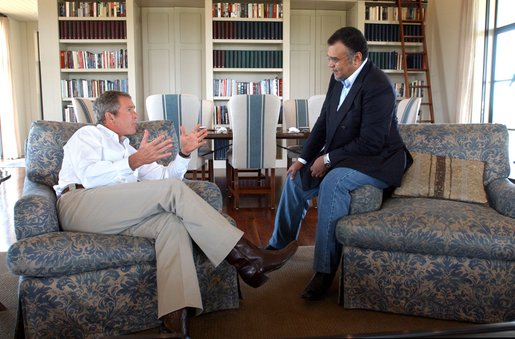
Prince Bandar bin Sultan, then Saudi ambassador to the United States, meeting with President George W. Bush in Crawford, Texas. (White House photo)
“Sheikh Osama wanted to keep a record who give money,” Moussaoui said in imperfect English — “who is to be listened to or who contributed to the jihad.”
Although Moussaoui’s credibility came under immediate attack from the Saudi kingdom, his assertions mesh with accounts from members of the U.S. Congress who have seen a secret portion of the 9/11 report that addresses alleged Saudi support for al-Qaeda.
Further complicating the predicament for Saudi Arabia is that, more recently, Saudi and other Persian Gulf oil sheikdoms have been identified as backers of Sunni militants fighting in Syria to overthrow the largely secular regime of President Bashar al-Assad. The major rebel force benefiting from this support is al-Nusra Front, al-Qaeda’s affiliate in Syria.
In other words, the Saudis appear to have continued a covert relationship with al-Qaeda-connected jihadists to the present day.
The Israeli Exposure
And, like the Saudis, the Israelis have sided with the Sunni militants in Syria because the Israelis share the Saudi view that Iran and the so-called “Shiite crescent” – reaching from Tehran and Baghdad to Damascus and Beirut – is the greatest threat to their interests in the Middle East.
That shared concern has pushed Israel and Saudi Arabia into a de facto alliance, though the collaboration between Jerusalem and Riyadh has been mostly kept out of the public eye. Still, it has occasionally peeked out from under the covers as the two governments deploy their complementary assets – Saudi oil and money and Israeli political and media clout – in areas where they have mutual interests.
In recent years, these historic enemies have cooperated in their joint disdain for the Muslim Brotherhood government in Egypt (which was overthrown in 2013), in seeking the ouster of the Assad regime in Syria, and in pressing for a more hostile U.S. posture toward Iran.
Israel and Saudi Arabia also have collaborated in efforts to put the squeeze on Russia’s President Vladimir Putin, who is deemed a key supporter of both Iran and Syria. The Saudis have used their power over oil production to drive down prices and hurt Russia’s economy, while U.S. neoconservatives – who share Israel’s geopolitical world view – were at the forefront of the coup that ousted Ukraine’s pro-Russian President Viktor Yanukovych in 2014.
The behind-the-scenes Israeli-Saudi alliance has put the two governments – uncomfortably at times – on the side of Sunni jihadists battling Shiite influence in Syria, Lebanon and even Iraq. On Jan. 18, 2015, for instance, Israel attacked Lebanese-Iranian advisers assisting Assad’s government in Syria, killing several members of Hezbollah and an Iranian general. These military advisors were engaged in operations against al-Qaeda’s Nusra Front.
Meanwhile, Israel has refrained from attacking Nusra Front militants who have seized Syrian territory near the Israeli-occupied Golan Heights. One source familiar with U.S. intelligence information on Syria told me that Israel has a “non-aggression pact” with these Nusra forces.
An Odd Alliance
Israel’s odd-couple alliances with Sunni interests have evolved over the past several years, as Israel and Saudi Arabia emerged as strange bedfellows in the geopolitical struggle against Shiite-ruled Iran and its allies in Iraq, Syria and southern Lebanon. In Syria, for instance, senior Israelis have made clear they would prefer Sunni extremists to prevail in the civil war rather than Assad, who is an Alawite, a branch of Shiite Islam.
In September 2013, Israel’s Ambassador to the United States Michael Oren, then a close adviser to Israeli Prime Minister Benjamin Netanyahu, told the Jerusalem Post that Israel favored the Sunni extremists over Assad.
“The greatest danger to Israel is by the strategic arc that extends from Tehran, to Damascus to Beirut. And we saw the Assad regime as the keystone in that arc,” Oren told the Jerusalem Post in an interview. “We always wanted Bashar Assad to go, we always preferred the bad guys who weren’t backed by Iran to the bad guys who were backed by Iran.” He said this was the case even if the “bad guys” were affiliated with al-Qaeda.
And, in June 2014, speaking as a former ambassador at an Aspen Institute conference, Oren expanded on his position, saying Israel would even prefer a victory by the brutal Islamic State over continuation of the Iranian-backed Assad in Syria. “From Israel’s perspective, if there’s got to be an evil that’s got to prevail, let the Sunni evil prevail,” Oren said.
Skepticism and Doubt
In August 2013, when I first reported on the growing relationship between Israel and Saudi Arabia in an article entitled “The Saudi-Israeli Superpower,” the story was met with much skepticism. But, increasingly, this secret alliance has gone public.
On Oct. 1, 2013, Israeli Prime Minister Netanyahu hinted at it in his United Nations General Assembly speech, which was largely devoted to excoriating Iran over its nuclear program and threatening a unilateral Israeli military strike.
Amid the bellicosity, Netanyahu dropped in a largely missed clue about the evolving power relationships in the Middle East, saying: “The dangers of a nuclear-armed Iran and the emergence of other threats in our region have led many of our Arab neighbors to recognize, finally recognize, that Israel is not their enemy. And this affords us the opportunity to overcome the historic animosities and build new relationships, new friendships, new hopes.”
The next day, Israel’s Channel 2 TV news reported that senior Israeli security officials had met with a high-level Gulf state counterpart in Jerusalem, believed to be Prince Bandar, the former Saudi ambassador to the United States who was then head of Saudi intelligence.
The reality of this unlikely alliance has now even reached the mainstream U.S. media. For instance, Time magazine correspondent Joe Klein described the new coziness in an article in the Jan. 19, 2015 issue.
He wrote: “On May 26, 2014, an unprecedented public conversation took place in Brussels. Two former high-ranking spymasters of Israel and Saudi Arabia – Amos Yadlin and Prince Turki al-Faisal – sat together for more than an hour, talking regional politics in a conversation moderated by the Washington Post’s David Ignatius.
“They disagreed on some things, like the exact nature of an Israel-Palestine peace settlement, and agreed on others: the severity of the Iranian nuclear threat, the need to support the new military government in Egypt, the demand for concerted international action in Syria. The most striking statement came from Prince Turki. He said the Arabs had ‘crossed the Rubicon’ and ‘don’t want to fight Israel anymore.’”
Though Klein detected only the bright side of this détente, there was a dark side as well, as referenced in Moussaoui’s deposition, which identified Prince Turki as one of al-Qaeda’s backers. Perhaps even more unsettling was his listing of Prince Bandar, who had long presented himself as a U.S. friend, so close to the Bush Family that he was nicknamed “Bandar Bush.”
Moussaoui claimed that he discussed a plan to shoot down Air Force One with a Stinger missile with a staff member at the Saudi Embassy in Washington, at a time when Bandar was the ambassador to the United States.
According to the New York Times article by Scott Shane, Moussaoui said he was assigned to “find a location where it may be suitable to launch a Stinger attack and then, after, be able to escape,” but that he was arrested on Aug. 16, 2001, before he could carry out the reconnaissance mission.
The thought of anyone in the Saudi embassy, then under the control of “Bandar Bush,” scheming with al-Qaeda to shoot down George W. Bush’s Air Force One is shocking, if true. The notion would have been considered unthinkable even after the 9/11 attacks, which involved 15 Saudis among the 19 hijackers.
After those terror attacks which killed nearly 3,000 Americans, Bandar went to the White House and persuaded Bush to arrange for the rapid extraction of bin Laden’s family members and other Saudis in the United States. Bush agreed to help get those Saudi nationals out on the first flights allowed back into the air.
Bandar’s intervention undercut the FBI’s chance to learn more about the ties between Osama bin Laden and the 9/11 perpetrators by giving FBI agents only time for cursory interviews with the departing Saudis.
Bandar himself was close to the bin Laden family and acknowledged having met Osama bin Laden in the context of bin Laden thanking Bandar for his help financing the jihad project in Afghanistan during the 1980s. “I was not impressed, to be honest with you,” Bandar told CNN’s Larry King about bin Laden. “I thought he was simple and very quiet guy.”
The Saudi government claimed to have broken ties with bin Laden in the early 1990s when he began targeting the United States because President George H.W. Bush had stationed U.S. troops in Saudi Arabia, but – if Moussaoui is telling the truth – al-Qaeda would have still counted Bandar among its supporters in the late 1990s.
Bandar and Putin
Bandar’s possible links to Sunni terrorism also emerged in 2013 during a confrontation between Bandar and Putin over what Putin viewed as Bandar’s crude threat to unleash Chechen terrorists against the Sochi Winter Olympics if Putin did not reduce his support for the Syrian government.
According to a leaked diplomatic account of a July 31, 2013 meeting in Moscow, Bandar informed Putin that Saudi Arabia had strong influence over Chechen extremists who had carried out numerous terrorist attacks against Russian targets and who had since deployed to join the fight against the Assad regime in Syria.
As Bandar called for a Russian shift toward the Saudi position on Syria, he reportedly offered guarantees of protection from Chechen terror attacks on the Olympics. “I can give you a guarantee to protect the Winter Olympics in the city of Sochi on the Black Sea next year,” Bandar reportedly said. “The Chechen groups that threaten the security of the games are controlled by us.”
Putin responded, “We know that you have supported the Chechen terrorist groups for a decade. And that support, which you have frankly talked about just now, is completely incompatible with the common objectives of fighting global terrorism.”
Bandar’s Mafia-like threat toward the Sochi games – a version of “nice Olympics you got here, it’d be a shame if something terrible happened to it” – failed to intimidate Putin, who continued to support Assad.
Less than a month later, an incident in Syria almost forced President Barack Obama’s hand in launching U.S. air strikes against Assad’s military, which would have possibly opened the path for the Nusra Front or the Islamic State to capture Damascus and take control of Syria. On Aug. 21, 2013, a mysterious sarin attack outside Damascus killed hundreds and, in the U.S. media, the incident was immediately blamed on the Assad regime.
American neocons and their allied “liberal interventionists” demanded that Obama launch retaliatory air strikes even though some U.S. intelligence analysts doubted that Assad’s forces were responsible and suspected that the attack was carried out by extremist rebels trying to pull the U.S. military into the civil war on their side.
Yet, pushed by the neocons and liberal war hawks, Obama nearly ordered a bombing campaign designed to “degrade” the Syrian military but called it off at the last minute. He then accepted Putin’s help in reaching a diplomatic solution in which Assad agreed to surrender his entire chemical weapons arsenal, while still denying any role in the sarin attack.
Later, the Assad-did-it case crumbled amid new evidence that Sunni extremists, supported by Saudi Arabia and Turkey, were the more likely perpetrators of the attack, a scenario that became increasingly persuasive as Americans learned more about the cruelty and ruthlessness of many Sunni jihadists fighting in Syria. [See Consortiumnews.com’s “The Mistaken Guns of Last August.”]
Targeting Putin
Putin’s cooperation with Obama to head off a U.S. military strike in Syria made the Russian president more of a target for the American neocons who thought they finally had reached the cusp of their long-desired “regime change” in Syria only to be blocked by Putin. By late September 2013, a leading neocon, National Endowment for Democracy President Carl Gershman, announced the goal of challenging Putin and recognizing his sore point in Ukraine.
Taking to the Washington Post’s op-ed page on Sept. 26, 2013, Gershman called Ukraine “the biggest prize” and an important step toward ultimately ousting Putin. Gershman wrote, “Ukraine’s choice to join Europe will accelerate the demise of the ideology of Russian imperialism that Putin represents. … Russians, too, face a choice, and Putin may find himself on the losing end not just in the near abroad but within Russia itself.” [See Consortiumnews.com’s “Neocons’ Ukraine-Syria-Iran Gambit.“]
However, in early 2014, Putin was obsessed with Bandar’s implicit threat of terrorism striking the Sochi Olympics, thus distracting him from the “regime change” – being pushed by NED and neocon Assistant Secretary of State for European Affairs Victoria Nuland – next door in Ukraine.
On Feb. 22, 2014, putschists, spearheaded by well-organized neo-Nazi militias, drove elected President Viktor Yanukovych and his government from power. Putin was caught off-guard and, in the resulting political chaos, agreed to requests from Crimean officials and voters to accept Crimea back into Russia, thus exploding his cooperative relationship with Obama.
With Putin the new pariah in Official Washington, the neocon hand also was strengthened in the Middle East where renewed pressure could be put on the “Shiite crescent” in Syria and Iran. However, in summer 2014, the Islamic State, which had splintered off from al-Qaeda and its Nusra Front, went on a rampage, invading Iraq where captured soldiers were beheaded. The Islamic State then engaged in gruesome videotaped decapitations of Western hostages inside Syria.
The Islamic State’s brutality and the threat it posed to the U.S.-backed, Shiite-dominated government of Iraq changed the political calculus. Obama felt compelled to launch airstrikes against Islamic State targets in both Iraq and Syria. American neocons tried to convince Obama to expand the Syrian strikes to hit Assad’s forces, too, but Obama realized such a plan would only benefit the Islamic State and al-Qaeda’s Nusra Front.
In effect, the neocons were showing their hand – much as Israeli Ambassador Oren had done – favoring the Sunni extremists allied with al-Qaeda over Assad’s secular regime because it was allied with Iran. Now, with Moussaoui’s deposition identifying senior Saudi officials as patrons of al-Qaeda, another veil seems to have dropped.
Complicating matters further, Moussaoui also claimed that he passed letters between Osama bin Laden and then Crown Prince Salman, who recently became king upon the death of his brother King Abdullah.
But Moussaoui’s disclosure perhaps cast the most unflattering light on Bandar, the erstwhile confidant of the Bush Family who — if Moussaoui is right — may have been playing a sinister double game.
Also facing potentially embarrassing questions is Israeli Prime Minister Netanyahu, especially if he goes through with his planned speech before a joint session of Congress next month, attacking Obama for being soft on Iran.
And, America’s neocons might have some explaining to do about why they have carried water not just for the Israelis but for Israel’s de facto allies in Saudi Arabia.
~
Investigative reporter Robert Parry broke many of the Iran-Contra stories for The Associated Press and Newsweek in the 1980s. You can buy his latest book, America’s Stolen Narrative, either in print here or as an e-book (from Amazon and barnesandnoble.com).
Saying “No” to Netanyahu
Israel’s demands are not good for Americans
By Philip Giraldi • Unz Report • February 3, 2015
Israeli Prime Minister Benjamin Netanyahu will be visiting Washington during the first week in March. His annual visit coincides with the American Israel Public Affairs Committee (AIPAC) summit in Washington, at which he is expected to speak. He will also be addressing a joint session of Congress on March 3 rd as a guest of the new Republican majority. Per Speaker of the House John Boehner, Netanyahu will be providing additional insights regarding the threats posed by Iran and by Islamic terrorism, which the president had “papered over” in his State of the Union address. Boehner has in mind promotion of policies that would be contrary to those embraced by the White House, most particularly President Barack Obama’s intention to continue negotiations to come to an understanding over Iran’s nuclear program. That would mean Congress’s imposing new and intentionally deal breaking sanctions on Iran just to show it we are serious and a possible demand that any agreement with Tehran be subject to legislative approval.
Netanyahu has frequently warned that Iran’s construction of a nuclear arsenal is just around the corner. He has been making that claim regularly since 1996 and apparently is not particularly bothered that his warning has proven to be inaccurate since the Mullahs have yet to develop the long anticipated weapon of mass destruction. He will no doubt again express his view that there is a secret Iranian weapons program that imminently threatens both Israel and the United States. It is not clear if he will produce a cartoon showing a ticking bomb as he famously did at the United Nations in 2012.
Concerning the terrorist threat, Netanyahu will undoubtedly play the Charlie Hebdo card, insisting that it is the duty of the West united with Israel to oppose Islamic barbarism. It will be convenient dodge as it allows him to avoid answering for what Israel is doing to the Palestinians and it conveniently conflates all believers in a specific religion with political violence. No matter what Netanyahu says he will undoubtedly be cheered both when he speaks to Congress and also by the 1,500 attendees at AIPAC, which will include many Congressmen, journalists, and even Supreme Court justices. He will be treated like visiting royalty even though his message is essentially one of hate.
It is my understanding that a number of groups are organizing to protest both AIPAC and the Netanyahu visit. I hope they will be highly visible and noisy as hell, possibly forcing some of the summit attendees to think about just what they are supporting. I also urge the demonstrators to focus on Netanyahu’s actual message because everything that he has come to Washington to sell is essentially false.
Starting with Iran, the entire narrative of Iran as a nuclear threat is bogus, largely invented in Israel and the United States and in part based on manufactured evidence. I am not suggesting for a moment that Iran is a friend to the American people, but its malignancy has been much overstated by the Israel Lobby and its friends. It does not threaten the United States in any way and it hardly impacts on the security of countries like Israel and Saudi Arabia, both of which should be worrying about their viability based on their own behavior rather than due to an exaggerated Iranian menace. The reality is that the United States government has twice in 2007 and 2011 confirmed that Iran has no nuclear weapons program. Even Israel’s Mossad agrees and both governments admit that Tehran has not made the essentially political decision to proceed with such a program.
Not only has Iran neither developed nor tested a nuclear device, she has never enriched her uranium stocks to anything approaching weapons-grade. Her Fordow “secret” plant and other nuclear sites now have IAEA inspectors in place, the heavy-water reactor at Arak is not operational and many centrifuges are not operating. Most Iranians and many Americans understand that a negotiated settlement over the program as an alternative to a major regional war is highly desirable.
Netanyahu’s second point will be that the world is threatened by Islamic terrorism, requiring democratic nations to stand by Israel. But standing by Israel and adopting the Israeli standards for dealing with terrorism are precisely the problem. The only places in the world where Islamists have the remotest ability to take power are in those countries where the United States adhered to the Israeli model and intervened militarily, leaving chaos in its wake. Today that would include Iraq, Libya, Somalia, Afghanistan and Syria. Highly publicized terrorist attacks in Europe and in the United States have killed relatively few people and produced a predictably panicked response but do not threaten either a national security crisis or the stability of any government. In the U.S. since 9/11 there have been 69 deaths, either terrorist or criminal, that can plausibly be linked to Muslims or Islamic sensibilities, less than five a year. During the same time period 200,000 Americans have been murdered, making terrorism by local Muslims pretty much a statistical anomaly. For what it’s worth, the policies being pursued overseas by Washington during the same time period directly or indirectly contributed to the killing of as many as half a million Muslims while turning at least three million more into refugees, which inevitably fuels terrorism.
A third point that Netanyahu will not be making as he is a beneficiary of it is the astonishing power of the Israel Lobby in the United States. As John Mearsheimer and Stephen Walt demonstrated in their book, the Lobby is in reality a loose aggregation that is bound together to promote what are perceived to be Israeli interests. It includes think tanks, PACS and other lobbying groups, journalists and media outlets, Christian evangelicals, leading figures in academia and it is all backed up by deep pocket donors who both fund political candidates and provide the fuel to keep everything moving. Pat Buchanan once described Congress as “Israeli occupied territory,” but to be sure he was being too kind and Tom Friedman’s observation that it is bought and paid for by the Lobby might actually be closer to the mark. In an actual occupation there would characteristically be at least some resistance but in the United States Congress there is virtually none now that Ron Paul is retired. If any daring congressmen stay home sick when Netanyahu speaks it will be a surprise and the only real question regarding the impending joint session address is how many standing ovations the Israeli leader will receive. Will it exceed the 29 he recorded last time around?
So there are three good reasons for saying “no” to Benjamin Netanyahu, or, even better, telling him to go away and stay away. First, he is striving mightily to involve the United States in a war with Iran for which there is no compelling national interest and which will cost Americans heavily in both lives and treasure. Second, he has poisoned Washington’s relationship with the Muslim world through the largely successful selling of his message that all believers in Islam are essentially terrorists. And third, he and his associates in the Israel Lobby are a cancer in our political system, using money and even coercion to bring about a “special relationship” that is hardly a relationship at all but is instead a mechanism to impel U.S. subordination to Israeli interests.
It is shameful that Netanyahu will be in Washington at all on a mission to tell the U.S. Congress what to do, but one can always hope that both he and Speaker Boehner have finally gone too far. Will this be a wake-up call for the American public, aware at last that it is being led by the nose by a foreign country aided by its own venal and corrupted quislings? One can always hope, and it might just be that Netanyahu will finally pay a price for his hubris with his own voters next month and be turned out of office. Wouldn’t it be nice to be able to say that we have seen the last of Benjamin Netanyahu?
230 Egyptian Activists, Including Ahmed Douma, Get Life Sentences

Leading Egyptian opposition campaigner Ahmed Douma
Al-Akhbar | February 4, 2015
An Egyptian court sentenced prominent activist Ahmed Douma along with 229 other anti-Mubarak activists to life in prison on Wednesday after the court held hearings for 269 people connected to “the cabinet headquarters events” of December 2011, judicial sources said.
Douma and 268 others were accused of staging “riots” outside central Cairo’s cabinet headquarters and assaulting policemen during a sit-in back in December 2011 against a decision by Egypt’s then-ruling military council to appoint as prime minister Kamal al-Ganzouri, who had served in this position under ousted autocrat Hosni Mubarak.
In addition to “rioting,” the activists were accused of possessing white arms like knives, attacking police officers and armed forces, burning the al-Majmaa al-Alami and attacking other government buildings including the cabinet headquarters.
Thirty-nine other defendants, all minors, were sentenced to 10 years in prison. All 269 defendants were found guilty of taking part in clashes with security forces near Cairo’s Tahrir Square in December 2011, the sources said.
In April, Douma along with two other prominent activists, were sentenced to three years in prison and ordered to pay a 10,000 Egyptian pound (around $1,300) fine. The fine was raised on Wednesday to 17 million Egyptian pounds (around $2 million).
In December an Egyptian court dismissed charges against Mubarak for ordering security forces to kill protesters during the 2011 uprising.
That verdict, and others handed down to Mubarak-era figures, has led some to conclude that the old regime that existed before the uprising has been reestablished under a different name.
Wednesday’s ruling, which can be appealed, is the harshest court order delivered so far against non-Islamist activists, amid a government crackdown on dissent overseen by President Abdel Fattah al-Sisi.
Authorities banned the Muslim Brotherhood following Mursi’s ouster and launched a heavy crackdown on its members, leaving at least 1,400 dead and 15,000 jailed, including hundreds sentenced to death for allegedly taking part in deadly riots in August 2013.
Egypt was brought in November in front of the UN’s top human rights body for a litany of rights abuses, including its crackdown, mass arrests and unfair trials targeting Mursi supporters, journalists and activists, described as “unprecedented in recent history.”
Besides the heavy crackdown on Muslim Brotherhood supporters, many of the leading secular activists behind the 2011 uprising have also found themselves on the wrong side of the new political leadership, getting locked up for taking part in peaceful demonstrations following the recent ban on unlicensed protests.
Critics accuse Sisi of taking Egypt back to authoritarian rule. Sisi says he is committed to democracy in Egypt, a strategic US ally with influence across the Arab world.
(Reuters, AFP, Al-Akhbar)
Donetsk Authorities Claim NATO Ammunition Found in Ukraine
Sputnik 03.02.2015
DONETSK — The Donetsk People’s Republic (DPR) forces have found ammunition used exclusively in NATO countries that the Ukrainian Army is not usually equipped with, Deputy Donetsk Militia Commander Eduard Basurin said Tuesday.
“These types of ammunition are designed for NATO countries. One of them [devices] is equipped with a base fuse. For instance, when this type of ammunition hits the wall, it blasts and destroys it [wall]. The Ukrainian forces do not have this type of ammunition,” Basurin said, demonstrating the ammunition to journalists.
DPR authorities have repeatedly claimed finding US-made weapons in the Donetsk Airport, previously occupied by the Ukrainian military. On January 19, Basurin said that DPR forces had found large quantities of US-made weapons, including M16-A5 assault rifles, grenades and communication devices. Prior to Basurin’s remarks, DPR leader Alexander Zakharchenko said that US-made weapons had been found in the airport.
On January 21, 2015 Russian Foreign Minister Sergei Lavrov harshly criticized the deliveries of weapons by a number of NATO members and European Union countries, saying this move went against EU and Organization for Security and Co-operation in Europe (OSCE) norms.
On Thursday, Ukrainian Prime Minister Arseniy Yatsenyuk said that no lethal weapons had been delivered to Kiev by the West, despite an announcement made by Ukrainian President Petro Poroshenko in September that a number of NATO countries had agreed to supply the country with modern weapons. Presidential adviser Yuri Lutsenko later claimed that an agreement on the supply of weapons from the United States, France, Poland, Norway and Italy had been reached at the NATO summit in Wales. However these countries denied the statement.
Cops Are Scanning Social Media to Assign You a “Threat Rating”
By Matt Agorist | The Free Thought Project | December 16, 2014
Police State, USA — Imagine the following scenario: You are on your way home from work, driving down the road, when you notice police lights in your rear view mirror. You are being pulled over.
As you sit there, on the shoulder, adrenaline rushing, simultaneously angry and nervous, the police officer, in his patrol car behind you, is sizing you up based on an algorithm that determines your “threat rating.”
Online activity, purchases, and “comments that could be construed as offensive,” all contribute to your threat score.
The officer enters your license plate into a mobile application on his laptop. In a matter of seconds, this application crawls over billions of records in commercial and public databases, including all available social media engagement, recent purchases and “any comments that could be construed as offensive.” The application then determines if your “threat rating” is green, yellow, or red.
Imagine that you are one of our informed and frequent readers and understand the importance of police accountability and are unafraid to voice your completely peaceful, yet strong opinion about police misconduct. Imagine that you left a comment on facebook this morning about a particular officer’s misconduct; imagine that it is this particular officer who just pulled you over.
Your rating just came back red.
Up until this point, you have never committed a crime, you have never been violent, you have never even so much as run a stop sign. However, this police officer now knows that you made a comment about him punching the (insert handcuffed and helpless victim example here) on facebook, and he literally sees red (your threat rating).
What happens next? Does a routine traffic stop for driving 10 miles over the speed limit morph into a situation in which you now have a Smith and Wesson M&P 9mm pistol with Streamlight TLR-2s laser site being aimed just above your left ear?
Do you receive multiple erroneous citations because this officer now has access to your personal life? Do you get cited where the officer would have otherwise let someone else go?
Or, maybe you are a cop or a judge, or the mayor, but this application confuses you with someone else and marks you as “red,” then what? What if you are driving someone else’s car?
The reality is, that any number of unimaginable things can and would happen next. And now, thanks to a particularly ominous product, by a company named Intrado, and the Orwellian nature of police in this country, those unimaginable situations are now a reality.
Intrado is one of many corporations thriving here in the US, from the creation and growth of the police industrial complex. The hypothetical “application” mentioned in the above scenario is a real product of Intrado, called Beware. Police departments nationwide have been purchasing and using this application since 2012.
Intrado is one of many companies who cater to the police state, giving police these ostensibly helpful tools which actually erode civil rights and leave a huge opening for corruption and abuse.
Private companies are currently, and have been acquiring large portions of your tax dollars from federal grants. These funds are in return being used to build and implement actual “Pre-crime” technologies.
No, not the psychic-based sci-fi pre-crime like in Minority Report, but actuary based mathematical and statistical assessments designed with the explicit goal to reduce future instances of criminality. This means that instead of sentencing people for crime already committed, sentences based on these risk assessments are instead sentencing people for crimes that they, or people like them, might commit.
In a society that claims justice to be blind, how does judging someone on what they might do fit in to the idea of freedom? The answer to that question is simple, it doesn’t.
Even if these “threat ratings” showed a statistical correlation to actually lower some instances of crime, which we have not seen, it’s not the right way to go about policing a people. Reason Magazine’s Peter Suderman sums this logic up quite eloquently:
By a roughly similar logic, we could lock up everyone—or even just everyone with the right risk profile, regardless of what crimes they have or have not already committed—from a high crime neighborhood, and call it a success when crime goes down.
The notion that this “surveillance grid” approach by police and their higher-ups, is for the safety of the people, is a total farce. It does little to nothing to protect society from a rogue criminal. What it does do, however, is protect the government by deeming large groups of people enemies of the state; regardless of whether or not the individuals in these arbitrary groups are peaceful or have committed a crime.
The bright side of this Orwellian nightmare of a total police state that locks us up for crimes we didn’t commit, is that it’s preventable. All we have to do is show this information to those who have yet to see the encroaching blue leviathan that is Orwell’s proverbial “boot stamping on a human face — forever.”
In fact we’ve already seen well informed communities stop their police departments from obtaining such equipment. The city council of Bellingham, Washington, recently rejected a proposed purchase of the Beware “threat rating” system.
Despsite the Bellingham police department receiving a $25,000 federal grant to cover most of the $36,000 annual cost of Beware, the citizens still said “nay.” At a mandatory hearing about the purchase from Intrado, Bellingham citizens discovered how Beware worked and opposed the purchase. … Full article
Did North Korea Really Hack Sony?
By James DiEugenio | Consortium News | February 3, 2015
One of the major problems with modern American democracy is the fact that the U.S. government has a serious credibility problem. This is not new of course. In its contemporary strain, it goes back at least to 1964 when two events focused and magnified the problem. The first was the Gulf of Tonkin incident, which was used to launch the Vietnam War. The second was the issuance of the Warren Report, the widely doubted official account of John F. Kennedy’s assassination.
As Kevin Phillips demonstrated with polling results in his book Arrogant Capital, that year marked the beginning of a long decline in the public’s trust in the government’s ability to do what is right most of the time. Prior to that year, the number hovered in the mid-70 percentile. After that, the figure began to drop steeply. It bottomed out at 19 percent in 1992. (This was clearly a large factor in boosting the presidential candidacy of Ross Perot that year.) It has failed to recover in any significant way since.
Historically speaking, it’s easy to name some of the causes for this headlong slide into skepticism and disbelief: the escalation in Vietnam, the assassinations of key leaders during the 1960s, Watergate, the Iran/Contra affair, the exposure of CIA drug-running during wars in Southeast Asia and Central America.
As Nicolas JS Davies has pointed out, some more recent examples would be the false reasons for the invasion of Iraq, the dubious attribution of imminent nuclear weaponry for Iran, the attempt to accuse President Bashar al-Assad of Syria of using sarin gas against civilians, and the attempt to blame Russia for the shoot-down of Malaysia Airlines Flight 17.
As the reader can see, many of these instances involve the effort of certain reactionary members of the Executive Branch in Washington and their allies in the media to use the American military abroad. One would have thought that after the disastrous results of the Tonkin Gulf Resolution, the major media would investigate more carefully what now seems to be a recurrent pattern of ersatz attribution to provoke American intervention. But, by and large, the doubts about these events have been expressed only in the alternative media.
The final incident Davies (briefly) mentioned was last year’s computer hacking of Sony/Columbia studios, which the FBI blamed on North Korea. The ostensible reason for this cyber-attack was the upcoming release of the comedy film, The Interview, which depicted an interview by a fictional American TV personality with Kim Jong-un, the actual leader of North Korea.
This interview becomes a pretext for an assassination attempt that goes awry. But, as the movie unfolds, the interview does happen and Kim does not come off well in it. This causes him to try to kill the Americans responsible. It backfires and he is killed instead.
Perhaps no film since Oliver Stone’s JFK generated as much pre-release controversy as The Interview. But unlike Stone’s picture, which created a sensation over its contrary-to-the-Establishment view of President Kennedy’s assassination, this particular brouhaha is largely based upon the alleged cyber-attack by North Korea.
When the FBI pointed the finger at Pyongyang, Sony/Columbia decided not to release the film, citing security concerns. Both people in the film colony and in the media met that decision with much derision. Therefore, Columbia reconsidered and did a limited theatrical run for the film, combined with a large online release. Due to the massive coverage of the controversy, the latter has been a big success. In fact, it has set records in that category.
‘The Interview’ as a Movie
The movie was co-directed by Seth Rogen and Evan Goldberg, who also had a hand in writing the story. Along with James Franco, Rogen also stars in the film. Rogen and Goldberg have been friends since childhood in Vancouver, Canada. Rogen’s career took off after he moved to Los Angeles and met writer-director Judd Apatow, who produced Anchorman: The Legend of Ron Burgundy and directed The 40 Year Old Virgin.
After first using Rogen in a TV series called Freaks and Geeks, Rogen starred in Apatow’s 2007 film Knocked Up. Apatow then produced two films written by Rogen and Goldberg, Pineapple Express and Superbad. Franco was also in Freaks and Geeks, and Pineapple Express with Rogen. Rogen and Goldberg then scripted The Green Hornet in 2011; they wrote and co-directed This Is the End in 2013.
Reportedly, Rogen once advised Apatow to make his work more “outrageously dirty.” [Los Angeles Times, May 13, 2007] And Apatow once said he wanted to include a penis in each of his films. [The Guardian. Aug. 26, 2008]
Well, we get those kinds of jokes in The Interview. The premise of the film revolves around Franco as a TV personality named Dave Skylark, the host of a rather lowbrow interview show titled Skylark Tonight. Rogen plays the producer-director of the program and has ambitions of doing something more socially and politically significant, a la 60 Minutes.
In one of the several unfathomable plot twists in the film, Kim likes Skylark Tonight so much that he wants to be a guest on the show and to arrange the guest spot through Rogen. But, in another hard to buy plot twist, Kim wants to arrange the interview in some sparsely populated rural area in China. (I think this segment was designed to generate laughs — which it does not.)
The visit to North Korea is now set up with a female military representative of Kim’s. Upon Rogen’s return, he and Franco celebrate and they announce the upcoming event on the air.
Now, another rather hard to believe strophe occurs. The CIA visits the two men and asks them to assassinate Kim. No specific reason is given as to why (though Kim is widely viewed in the West as a clownish and unstable dictator), or why they chose these two utter amateurs for such a daring, high-risk scheme.
The CIA wants them to kill Kim with a toxic poison attached to the palm of their hands. This strip is hidden in a pack of gum. But when they arrive in North Korea, one of their military guards takes out the pack and chews the strip. He spits it out, and in a rather unfunny follow-up, we later watch him die from the poison at a dinner.
Franco now meets Kim. The North Korean is on his best behavior and the two hit it off for a couple of days playing basketball and partying with some scantily clad girls.
Twisting the Plot
But now, another rather weird plot twist occurs. Franco wanders out of the presidential palace, going to what he thought was a grocery store nearby. He goes inside and discovers that the store is really a Potemkin village. That is, things like fruit and vegetables are really painted props.
Obviously, this scene is intended to highlight the shortage of food supplies in North Korea, but why the North Koreans would plant the store so close to the palace, why they would leave it unattended, and why they could not import real goods to stock it at this crucial time, these kinds of questions make this episode another head-scratcher. But the plot device explains why Franco turns on his new friend, Kim Jong-un.
In the meantime, Rogen has fallen for the female military attaché. It turns out she secretly hates Kim and now allies herself with the Americans. She says they cannot just kill him; they must humiliate him on TV so the Korean people will see him as a pretentious buffoon and charlatan.
So, Franco/Skylark decides to structure the interview to expose Kim. But the station technicians cut the feed. Rogen and his girlfriend then pull out firearms, touching off a bloody fight in the control room also involving Korean troops. Somehow, the amateur Americans kill all the Koreans. Franco is shot at, but he survives because he had a bulletproof vest on.
The trio manages to escape in a tank (no, I won’t explain how that happened) and are pursued by Kim and some soldiers in a helicopter. Kim orders preparations for a nuclear launch. But the tank fires a heat-seeking missile that takes out the chopper. Some CIA double agents then help Rogen and Franco escape the country.
At the end, we see Franco at a book reading about the whole affair as Rogen talks to his North Korean girlfriend via Skype. She stayed behind to democratize the country.
As the reader can see, the story is pretty much escapist, goofball fiction with a plot focused on murdering a real-life leader. But as bad as the script is, the direction by Rogen and Goldberg is even worse.
The Decline of Comedy
In 1965, before he retired from the field, illustrious film critic Dwight MacDonald wrote an essay entitled “Whatever Happened to Hollywood Comedy?” There, he lamented how low the genre had fallen from the Alpine peaks attained by the likes of Keaton, Chaplin, Lloyd and Langdon. Or even from the hills of Preston Sturges, Billy Wilder, Ernst Lubitsch and Howard Hawks.
MacDonald outlined three rules that comic films he was reviewing broke almost systematically. First, he wrote that most of the films had no appealing comic protagonists, which he felt was necessary in the genre. Second, he said they were overproduced and too Rube Goldberg-like in their construction and depiction. (Rogen and Goldberg shoot the helicopter exploding at the end in super-slow-motion.)
Finally, according to MacDonald, the sadism inherent in comedy could not be shown realistically, i.e., if the comic actually broke his back while slipping on a banana peel, that would not be funny.
Well, in the fight in the control room in The Interview, we watch as not one, but two fingers get bitten off. Apparently, no one on the set said to Rogen, “Uh Seth, is that really funny?” Rogen is an even worse director than he is an actor. And the man can’t act.
If MacDonald felt gloomy about the state of film comedy in 1965, one can imagine what he would have written in later years, which leads us to the first question about the hacking mystery: Unless the North Koreans are as imbecilic as the people depicted in the film, could they really have thought that such a frivolous production somehow imperiled the security or image of their country – and to such an extent that they went ahead and risked retaliation by hacking into a private company’s computer system?
To me, the risk simply does not equate with whatever reward was to be had. But there are other indications that the case against North Korea is not nearly as conclusive as the FBI wants us to think. President Barack Obama may have compounded the problem by announcing retaliatory sanctions on Jan. 2. Further, White House Press Secretary Josh Earnest implied there would be more of this because he called it “the U.S. government’s first action…”
The Facts of the Case
The controversy actually began to take shape last June when the North Korean ambassador to the United Nations — without seeing the movie in all of its silliness — condemned the film and urged the United States to cancel its distribution. Clearly, making light of assassinating a nation’s leader is problematic, whatever one may think of the leader, and the North Koreans made their disgust clear.
Then, on Nov. 24, 2014, Columbia discovered that its computers had been hacked. Their employees were locked out and an ugly caricature of a bright red skeleton popped up on their screens that morning. A message appeared which said, “Hacked by #GOP.” Later, personal information, e-mails and unreleased films were leaked online. The films included Still Alice, Annie and To Write Love on Her Arms.
In this context, GOP does not refer to the Republican Party but to a hacking group that calls themselves the Guardians of Peace. It’s interesting to note that although North Korea denies the attack, Guardians of Peace takes credit for it. In fact, the Guardians actually called the FBI a bunch of idiots because of the stupidity of their investigation.
As Kim Zetter pointed out in Wired, nation-states usually don’t announce themselves with images of blazing skeletons or criticize their victims for having poor cyber security, nor do they post stolen data to Pastebin, which is sort of the unofficial warehouse for heisted files on the cloud.
As Zetter writes, “These are all hallmarks of hacktivists — groups like Anonymous and LulzSec, who thrive on targeting large corporations for ideological reasons … or by hackers sympathetic to a political cause” (Wired, Dec. 17, 2014)
Cyber-security expert Marc Rogers agreed that the operation did not look like it was from a nation-state, and he criticized the FBI’s case on specific grounds, noting that because the malware was written in Korean means little, since programs exist to translate that code.
Rogers also said that whoever wrote the malware had extensive knowledge of hard-coded paths and passwords. This would suggest that whoever did the attack was somehow watching Sony/Columbia’s computer architecture for a long time or was a company insider because not only did the hackers know where certain files were located but they knew the access codes on them.
Third, Rogers wrote that when a hacker simply dumps this amount of material onto a public site, that has the earmarks of a hack job from some ideologically motivated group. There was much information North Korea could have garnered from the huge access they allegedly had. And this could have served them well in their intelligence files. Why make it public? (See Roger’s blog, “Marc’s Security Ramblings” entry dated Dec. 18, 2014)
More Skepticism
Rogers is backed up on his first point by Kurt Stammberger, senior vice-president of Norse, a company that provides computer intelligence systems and technology to both private corporations and the government.
Stammberger has been in possession of the specific malware used in the Sony hack as far back as last July, which can be secured by interested parties on the black market. His sample of the program is totally in English, not a trace of Korean.
The executive noted that specific Sony credentials, server address and digital codes and certificates were then written into the malware. As another authority in the field noted, certain malware behaves erratically. It just dives into a system, shuffles around the computer and spirals around looking for things to link to randomly. The Sony hack was more like a cruise missile.
“This stuff was incredibly targeted. That is a very strong signal that an insider was involved,” said Stammberger. (New York Post, Dec. 30, 2014) Thus, he concluded that “It’s virtually impossible to get that information unless you are an insider, were an insider, or have been working with an insider. That’s why we and so many other security professionals are convinced an insider played an important role.”
Furthering this belief is the fact that, last spring, Sony issued layoff notices to hundreds of employees. A private Facebook group made up of former Sony employees voted by a large majority that the hack was an inside job. An ex-employee said what makes this even more possible is that Sony’s security was not very tight or sophisticated, a point that was echoed by Rogers. (Dana Liebelson, Huffington Post, Jan. 6, 2015)
In fact, Norse, Stammberger’s computer-intelligence company, went even further. They named a former employee as a suspect, along with five accomplices. They did this by going through hacked personnel files and then locating a disgruntled employee online. (The Security Ledger Dec. 18, 2014)
In one message, for instance, one of Stammberger’s suspects identified as “lena” wrote :“Sony doesn’t lock their doors, physically, so we worked with other staff with similar interests to get in. I’m sorry I can’t say more, safety for our team is important.” (The Wrap, Dec. 30, 2014)
From this and other evidence, Stammberger deduces that the conspiracy was a collaboration between an employee or employees terminated early last summer and a hacking group involved in distributing pirated movies online, a group that has been pursued by Sony.
The FBI visited Norse to hear this presentation and seemed suitably impressed. But Stammberger said the FBI didn’t reveal anything from its inquiry to Norse.
Chronology Problems
What makes the whole operation even more puzzling is the fact that an e-mail was sent to Sony executives three days before the hack became public, on Nov. 21, 2014, addressed to top executives such as CEO Michael Lynton and Chairperson Amy Pascal (among others). It reads:
“Monetary compensation we want. Pay the damages, or Sony Pictures will be bombarded as a whole. You know us very well. We never wait long. You’d better behave wisely.”
Clearly, the fact that this was sent in advance indicates that whoever sent it knew what was about to happen. But the warning contains no mention, not even a hint, about censoring an about-to-be-released movie. The message appears to be pure and simple extortion, as is clearly denoted in the first sentence about money.
But what makes this piece of evidence ultimately confusing is that it was signed by “God’sApstls,” a rubric that also was in one of the malicious files used in the cyber attack. (ibid)
As Wired’s Zetter points out, it was only on Dec. 8, a week after a logjam of media stories appeared linking the attack to North Korea, that the attackers made a reference to the film in one of their announcements. And after this, the hackers made oblique terrorist threats against the film’s premiere in New York on Christmas Day.
In other words, it was after the finger-waving at North Korea had begun that “the GOP” began to explicitly link the film to the crime. To top that, as Sam Biddle noted in The Gawker on Dec. 22, the self-declared attackers — “the GOP” — then released a message declaring that Sony/Columbia had their permission to release The Interview anyway, which certainly implies that whoever did the hacking was simply bluffing about any terrorist attacks if the film were shown.
Lessons Not Learned
This points out another interesting aspect of the case, which Peter Singer, another security expert, expounded on at Motherboard. In an interview, he said: “This is not just now a case study in how not to react to cyber threats and a case study in how not to defend your networks; it’s now also a case study in how not to respond to terrorism threats.
“We have just communicated to any would-be attacker that we will do whatever they want. It’s mind-boggling to me, particularly when you compare it to real things that have actually happened. Someone killed 12 people and shot another 70 people at the opening night of Batman: The Dark Knight Rises. They kept that movie in the theater. You issue an anonymous cyber threat that you do not have the capability to carry out: We pulled a movie from 18,000 theaters.” (Sic, that number is exaggerated.)
Singer said whoever conducted the attack understood the American psyche and culture to the point of knowing that politicians like John McCain and Newt Gingrich would call it an attack of “cyber terrorism” and demand retaliation and that no one would ask: Why?
Would North Korea really commit its scarce resources and take this geopolitical risk over a witless, very bad comedy and think that a fitting retaliation would be to publicize how much money Sony executives make or that producer Scott Rudin thinks Angelina Jolie is only marginally talented?
Gauging by the U.S. overreaction, one is reminded of what Orson Welles did with a radio microphone, four actors, and some mood music in 1938 with his broadcast of H. G. Wells’ War of the Worlds.
Singer added that this image of Sony/Columbia as a frightened and intimidated victim benefits the company because it conceals the fact that it has been hacked before, going back to 2005, and more than once.
Yet, their whole computer architecture has been relatively unchanged, even though the previous hacks were not labeled as attacks from a nation-state. It’s fairly clear that Sony did not take the attacks seriously enough to do a major upgrade on their security system or to change passwords and pass codes every few months. Obviously, they could afford the financial outlay to do such things.
Obama’s Hypocrisy
On the day the FBI announced North Korea as the culprit, President Obama criticized Sony’s initial decision to pull the film from theaters. Echoing what Singer said, the President commented: “We cannot have a society in which some dictator in some place can start imposing censorship here in the USA. If somebody can intimidate folks out of releasing a satirical comedy, imagine what they’ll do when they see a documentary or political film they don’t like.”
He continued in this vein, “That’s not what we are, that’s not what America is about. I’m sympathetic that some private company was worried about liabilities. I wish they’d spoken to me first. Do not get into a pattern in which we’re intimidated by these kinds of criminal attacks.”
Obama did not seem aware of the irony, either in regards to his own participation in actual assassinations, i.e., “targeted killings” via drone attacks, or his administration’s aggressive effort to silence U.S. government whistleblowers through criminal prosecutions, examples of real censorship.
In response to Obama’s expressed disappointed that Sony had not come to him for help, Sony CEO Michael Lynton contradicted this observation the same day it was made on Dec. 19. In a statement made on CNN, the executive said, “We definitely spoke to a senior advisor in the White House … about the situation. The White House was certainly aware of the situation.”
Lynton added that Sony consulted with the State Department before the hacking to anticipate any political controversy the film could provoke. But Lynton went even further, saying Sony went to think tanks, foreign policy authorities, and the State Department “to get an understanding of whether or not there was a problem” with the film. The CEO said he was told by all that there was no problem, so they proceeded with the advertising rollout of the film.
Lynton said it really was not Sony that pulled the film from theatrical release but rather too many major exhibitors refused to show the film for fear of possible terrorist attacks. He concluded that he “had no alternative but to not proceed with the theatrical release on the 25th of December.” (Deadline, Dec. 19, 2014)
Weighing the Evidence
Of course, it is possible that these accusations against North Korea are correct. However, as of today, there is a large body of expert opinion that says the evidence so far is lacking. In fact, another expert, Robert Graham of Errata Security, was even more unimpressed than Rogers, calling the FBI’s evidence “nonsense.” (New York Post, Dec. 30, 2014)
If that is so, then the Sony hack may end up joining the long line of instances in which the U.S. government either jumped to misguided conclusions or intentionally misled the American people. Meanwhile, the real culprits escape and the real facts become harder to ascertain since the U.S. government hates to admit mistakes especially when the falsely accused have been thoroughly demonized and have few defenders.
If the truth is discovered many years down the line, the major news media usually ignores it or, in the rare case that the truth is acknowledged and accepted, it is way past the time for avoiding dangerous actions rationalized by the false allegations.
It took Professor Edwin Moise three decades to produce the definitive book on the Tonkin Gulf incident, showing that just about everything President Lyndon Johnson said about what happened there was wrong. By then, millions of Vietnamese and 58,000 Americans were dead.
~
James DiEugenio is a researcher and writer on the assassination of President John F. Kennedy and other mysteries of that era. His most recent book is Reclaiming Parkland.
The Rise of Yemen’s Houthis
By Michael Horton | CounterPunch | February 3, 2015
‘They move like ghosts through these canyons and caves. One minute we think we have their position on a hill side and moments later they’re firing on us from the opposite direction.’ This is how a senior Yemeni Army officer described what it was like to fight the Houthis when I visited the northwestern governorate of Hajjah in 2009, which was then the scene of a brutal war between the Houthis and the Yemeni government. By 2010 the Houthis had largely defeated both the Yemeni Armed Forces and elements of the Saudi Armed Forces that were sent across the Yemeni border. They showed themselves to be tenacious masters of guerrilla warfare. Since 2011, the Houthis have proved themselves to be just as adept at navigating Yemen’s labyrinthine politics.
The Houthis coalesced as a movement in the early 1990’s and were initially dedicated to reviving and defending the Zaidi sect of Shi’a Islam to which roughly thirty-percent of Yemenis belong. By 2004, the Houthis were at war with the Yemeni government, a conflict which would persist until 2011 when popular anti-government protests began. From their spiritual, martial, and political heartland in the governorate of Sa’da, the once fringe movement has determinedly and methodically expanded its power base and its territory. The capstone of the Houthis’ expansionist campaign was their largely uncontested seizure of Yemen’s capital, Sana’a, in September of 2014. Fast forward to 2015 and the Houthis are responsible for the resignation of Yemen’s president and his government. The Houthis are now first among Yemen’s power brokers.
How did a fringe movement come to control a significant percentage of northern Yemen and neuter the Yemeni government? In short, the answer is by applying what they learned during their prolonged war with the Yemeni government. First and foremost, the Houthis are a well-organized and capable fighting force, one that now has access to an abundance of heavy weaponry thanks to the effective dissolution of the Yemeni Army in late 2014. The Houthi leadership understands that the key to political success in Yemen, or at least in northern Yemen, is to make sure that you have the biggest stick. They have shown that the key to maintaining power and influence is to use the stick as carefully and as little as possible, something that former president Saleh forgot. To this end, the Houthi leadership has worked assiduously to build relationships with the leadership of many of Yemen’s northern based tribes.
The Houthis have also demonstrated that they can provide a measure of security and stability in the areas that they control. Houthi controlled governorates like Sa’da and al-Jawf, once the most restive governorate in Yemen, enjoy relative security. In the case of al-Jawf, the Houthis have largely eradicated al-Qaeda and are working to diffuse the blood feuds that were one of the primary sources of instability in the governorate. Via a growing and relatively sophisticated media network, the Houthis routinely highlight these successes.
However, the Houthis’ may benefit most from the sheer desperation of many Yemenis who have endured years of insecurity and declining standards of living. ‘The Yemeni people are exhausted. The economy is a disaster. More people than ever go hungry. With conditions like these, even some of those opposed to the Houthis are ready to give them a chance,’ says a Yemeni MP. ‘What choice do we have? There is no government and there is no army. Who’s going to stop the Houthis?’
In his speeches, Houthi leader Abdul Malik al-Houthi has emphasized that the Houthis do not want to rule Yemen. Given the moves on the ground this may be somewhat disingenuous, but Abdul Malik al-Houthi is an astute strategist who realizes that officially taking up the reins of power in Sana’a could well be ruinous for the Houthis. While the Houthis have broadened their power base to include many Sunni tribal leaders and politicians, both in the north and the south, they are still viewed by most Yemenis as a Shi’a organization. A Houthi led government would be viewed as a return to the Zaidi dominated imamate that ruled north Yemen up until the 1962 revolution, and, as such, it would be deeply unpopular with the majority of Yemeni who are Sunni. While senior Houthi leadership undoubtedly recognizes the dangers of officially leading some kind of future government, Hadi’s resignation and the power vacuum in the nation’s capital may leave the Houthis with no choice.
So what would a Houthi led government look like? It might be surprisingly diverse. The Houthi leadership has cultivated relations with segments of Yemen’s southern leadership, with youth groups, and of course with those power blocs associated with the Saleh regime. While the Houthis have never clearly articulated their political agenda, the leadership does back the strong federalization of Yemen. The federalization of Yemen has been demanded by southerners for nearly twenty years and is likely the only viable solution for keeping south and north Yemen together. One of the Houthis’ demands issued to the government of President Hadi was for the government to include more representatives from the south as well as more Houthi representation.
The Houthis’ journey from a poorly equipped and at times desperate band of guerrilla fighters to a group that now governs large swaths of north Yemen, has produced a leadership that is cautious and methodical. It would be a mistake to underestimate the Houthis’ political and martial acumen. It would also be a mistake to assume that the Houthis will only add to the chaos that threatens to engulf Yemen. Regardless, the international community and the West in particular will have to engage with what, for now at least, is the best organized and most cohesive power bloc in Yemen.
Michael Horton is a Yemen analyst with a decade of experience. I have written extensively on Yemen for numerous publications including: Jane’s Intelligence Review, The Economist, Intelligence Digest, and the Christian Science Monitor.
Featured Video
Laith Marouf: Hezbollah’s position on US-Iran ceasefire
or go to
Aletho News Archives – Video-Images
From the Archives
Is Israel to blame for the Iraq War?
American Goy | March 10, 2008
I am so tired of this old canard that “Israel had nothing to do with USA’s war with Iraq – in fact, it officially advised America against it”.
Bullshit. … continue
Blog Roll
 Aletho News
- Laith Marouf: Hezbollah’s position on US-Iran ceasefire: What you’re not being told
- Israel’s priority lies in destroying chances of peace between Iran, US: Ex-UN nuclear chief
- Ceasefire for all or for none: Iran shuts Hormuz over Lebanon attacks
- Strait of Hormuz is Iran’s ‘nuclear weapon’ that forced US retreat: Medvedev
- Energy crisis will last for months – Kremlin envoy
- Europe’s quiet role in the war on Iran
- Forty days that shook the Empire: How Iran turned the tables on US and prevailed
- Netanyahu unilaterally declares Lebanon outside of ceasefire deal
- Israeli leaders: ‘Not a single goal’ achieved in war with Iran
- What on earth just happened? Trump, Iran, and the unlikely ceasefire
- If Americans Knew
- Gazans face a triple crisis: severe shortages of water and bread, healthcare in tatters
- NY Times reports how Netanyahu took the US into Iran War
- A sigh of relief over Iran, but Gaza and Lebanon in dire straits – Daily Update
- Thousands dead and neighborhoods razed to the ground: Aid agencies fear southern Lebanon is becoming the new Gaza
- The war the US is fighting for Israel could cost trillions
- ‘Cigarette Burns, Nail Wounds’: Toddler Tortured in Gaza to Coerce Father
- Trump Says US Sent ‘a Lot of Guns’ to Protesters in Iran
- Israeli forces destroy 17 UN peacekeeper cameras in south Lebanon
- US-Israeli strikes ‘completely destroy’ synagogue in Tehran
- Archbishop for US Military Says Iran War Is Unjust Under Catholic Teaching
- No Tricks Zone
- An Inconvenient Tree: Uncovered In Alps… Europe Much Warmer Than Today 6000 Years Ago
- New Study Reports A 60% Slowdown In Greenland’s Ice Loss Rate In The Last Decade
- Low Intensity Tornado Wrecks Major Solar Farm, Creating A Potential Toxic Dump
- New Study Finds Warming Saves Lives…Cold Temperatures 12 Times More Deadly Than Excess Heat
- German Science Blog Accuses PIK Climate Institute Of Hallucinating Climate Tipping Points
- Devastating Assessment Of Comirnaty Vaccine By Former Senior Pfizer Europe Toxicologist
- New Study: CO2 Is ‘Effectively Negligible’ As An Explanatory Climate Change Factor Since 2000
- Former Pfizer Toxicologist Dr. Helmut Sterz Tells Bundestag Hearing Pfizer Vaccine Should Have Never Been Approved
- Energy Expert: Germany’s Nuclear Phaseout Was A “500 Billion Euro Mistake”
- New Research: South Australia’s Mid-Holocene Sea Surface Temperatures Were 4°C Warmer Than Today
 Aletho News