Japanese court rules against restart of 2 nuclear reactors
Press TV – April 14, 2015
A court in Japan has issued a landmark ruling against the resumption of activities by two atomic reactors at a nuclear power plant, overturning an approval by the country’s nuclear watchdog.
The district court in the central prefecture of Fukui issued the injunction on Tuesday to prohibit the restart of the number 3 and 4 reactors at the Takahama nuclear power plant.
Last December, Japan’s Nuclear Regulation Authority (NRA) gave the green light to switch the reactors back on, saying they met tougher safety standards introduced after Japan’s 2011 nuclear disaster at Fukushima Daiichi plant.
Disputing that ruling, a court official said, “The safety of the reactors hasn’t been secured,” adding that the watchdog’s new standards were “lacking rationality.”
Kansai Electric Power Company, which operates the plant, called the ruling “extremely regrettable and utterly unacceptable” and said it would appeal it.
Another court is slated to rule on the restart of two other reactors in southern Japan later this month.
Public sentiment over nuclear energy in Japan has been badly scarred following the country’s worst nuclear accident at Fukushima in 2011, when multiple reactors experienced meltdown after their cooling systems were disrupted by a magnitude-9 earthquake, which also triggered a devastating tsunami. The destroyed reactors have leaked radiation into air, soil and the Pacific Ocean ever since.
The incident, which is regarded as the world’s worst nuclear accident since the Chernobyl nuclear disaster in 1986, also led to the evacuation of 160,000 people from areas near the power plant.
All of Japan’s 48 reactors went offline following the Fukushima disaster.
Russia Iran oil-for-goods deal on – Kremlin

Russian President Vladimir Putin (R) and Iranian President Hassan Rouhani (RIA Novosti – Aleksey Nikolskyi)
RT | April 14, 2015
Russian President Vladimir Putin’s press secretary, Dmitry Peskov, confirmed the oil-for-goods deal between Moscow and Tehran is “absolutely” a reality and has begun.
Russia has started supplying grain, equipment and construction materials to Iran in exchange for crude oil under the barter deal announced by Russia’s Ministry of Foreign Affairs.
“Absolutely! Of course,” Kremlin spokesman Dmitry Peskov said when asked by reporters on Tuesday if the statement the Ministry of Foreign Affairs made on Monday was accurate, and the exchange had indeed started. “Focus on the statement of the Ministry of Foreign Affairs,” Peskov said.
On Monday, Russian Deputy Foreign Minister Sergei Ryabkov made the details of the trading partnership public.
Moscow and Tehran have been hashing out the deal’s small print since early 2014. A big step was taken in August when Russia’s Energy Minister Aleksey Miller and his Indian counterpart Bijan Namdar Zanganeh signed a five-year memorandum
According to Energy Minister Alexander Novak, Russia hasn’t yet received any Iranian oil.
Much of Iran’s oil reserves – the world’s fourth largest – remain untapped. Western sanctions put the brakes on discovery and exploration in the oil and gas industries.
Moscow may buy up to 500,000 barrels of Iranian oil per day, which would help Iran bring the 20-30 million barrels of crude oil they have in storage to market.
Iran, the third largest Russian grain customer, will ship wheat into the country. Russian state-run power utility Inter RAO and Inter RAO Export, as well as Technopromexport would supply equipment and help construct power stations in Iran, Russian Energy Minister Aleksandr Novak said previously.
On Monday, Russian President Vladimir Putin announced that Russia is lifting the ban on the delivery of S-300 missile rocket systems to Iran. The Kremlin canceled a 2010 self-imposed ban, suggested by the US and allies, not to sell Iran the artillery.
In April, Iran reached a nuclear agreement with the P5+1 countries to prevent Tehran from developing nuclear arms as long as the West lifted sanctions, which have been in place for nearly 40 years. By June 2015, a final agreement is expected to be reached, which will lift sanctions, including the oil embargo against Iran. After sanctions are loosened, Iran’s oil minister thinks the country can increase shipments by one million barrels a day.
UN sanctions Houthis in Yemen, ignores Russian calls for all-inclusive arms embargo
RT | April 14, 2015
The UN Security Council has imposes an arms embargo against the Houthi rebels in Yemen and blacklisted a Houthi leader and the
Fourteen members of the Security Council voted in favor of the resolution, Russia being the only abstention.
The Russian representative explained the move by saying that not all of Moscow’s proposals had been included in the final text drafted by Jordan and Gulf Arab states.
“The co-sponsors refused to include the requirements insisted upon by Russia addressed to all sides to the conflict to swiftly halt fire and to begin peace talks,” Russian UN Ambassador Vitaly Churkin told the council after the vote.
The resolution also blacklisted Houthi leader Abdel-Malek al-Houthi, as well as the son of Yemen’s former president, Ali Abdullah Saleh.
The Jordanian draft resolution was being debated alongside a separate Russian draft, which called for a “humanitarian pause” in airstrikes by the Saudi-led military coalition.
An all-inclusive arms embargo on all parties in the Yemeni conflict, suggested earlier by Russia as an amendment to the Arab draft, was rejected.
“We insisted that the arms embargo needs to be comprehensive; it’s well known that Yemen is awash in weapons,” Churkin said. “The adopted resolution should not be used for further escalation of the armed conflict.”
The Shiite Houthi rebels took control of Yemen’s capital, Sanaa, in September 2014, forcing President Abd-Rabbu Mansour Hadi to flee to Saudi Arabia. They are now fighting for the strategic port city of Aden.
The Houthi offensive is supported by soldiers loyal to Saleh, who was forced to give up power in Yemen after a 33-year rule in 2012.
Saudi Arabia and its Sunni Arab allies have been bombing the Houthi rebels since March 25, with over 1,000 people killed since the start of the conflict.
Al-Houthi and the ex-president’s eldest son, Ahmed Ali Abdullah Saleh, will face an asset freeze and travel ban in accordance with the sanctions.
Last November, UNSC imposed the similar sanctions on former president Saleh, the rebel group’s military commander Abd al-Khaliq al-Houthi and the Houthi’s second-in-command, Abdullah Yahya al Hakim.
The resolution also urged “Member States, in particular States neighboring Yemen, to inspect … all cargo to Yemen” if they have reasonable grounds to believe it contains weapons.
The document demanded all Yemeni parties to stop fighting, especially the Houthis, who are called upon to withdraw from Sanaa and other areas they have seized.
It also blamed ex-President Saleh for “destabilizing actions” in Yemen, including supporting the Houthi uprising.
Israel undermines Arab presence in Lod and Ramle
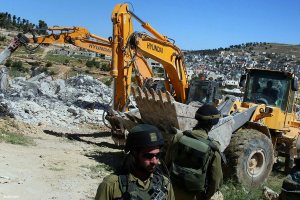
Israeli bulldozer demolishing houses. [File photo]
MEMO | April 14, 2015
The Israeli authorities have intensified a campaign which targets the presence of Arabs in two historic Palestinian cities. Lod (Al-Lod) and Ramle (Al-Ramlah), like many other places in occupied Palestine, were ethnically cleansed and turned into Jewish-majority cities following the creation of the state of Israel in 1948.
According to Jordan’s Al-Ghad newspaper, the Israelis have issued demolition orders for 30 homes in Ramle owned by Palestinians. The intention is to build Jewish-owned homes in their place.
The latest statistics show that more than 34,000 Palestinians still live in the two cities, split almost equally between Lod and Ramle. They have faced official and unofficial harassment and racial discrimination since 1948.
According to a source in Ramle municipality, the 30 homes targeted for demolition were built “without the necessary permission”. This is a common ploy by the Israeli government to evict Palestinians, which has been used frequently in occupied Jerusalem. The residents affected by the demolition orders have joined Palestinians facing similar anti-Arab discrimination in other cities to form a “Popular Committee” to stand up to the “aggression” of the Israeli authorities.
Some of the owners of the 30 houses in Ramle have filed complaints to the Israeli courts to delay the demolition of their homes; they hope to buy some time to fight the orders. The Popular Committee has set up a protest tent in the city and called for all Palestinians inside Israel to get involved until the demolition orders are cancelled.
The three Arab members of Ramle municipality said that they had a special meeting with the Jewish mayor. They got nothing positive out of the meeting. The mayor, they said, is insisting on carrying out the project to build 5,000 more Jewish residential units within three years.
Al-Ghad newspaper reported that Lod is facing an even fiercer Judaisation project. Maha Al-Naqib, an Arab member of Lod municipality, told the newspaper that the homes of 400 Arab families are threatened with demolition there. The Israeli authorities, she said, are planning to knock-down two complete Arab neighbourhoods in Lod — Karm Ein Al-Naqib and Bayarat Shneer — in addition to a number of Arab houses near Al-Mahattah neighbourhood.
Al-Naqib insisted that all the Arab houses in the city were built on Arab-owned land. She added that any Arab house in the city is in danger of being demolished at any time, despite the owners possessing all of the proper documentation.
A Shifting Narrative on Iran
Iran will always be the enemy
By Philip Giraldi • Unz Review • April 14, 2015
For more than twenty years the world has been hearing from Israeli Prime Minister Benjamin Netanyahu and his friends in the United States that Iran is a global threat because it is developing nuclear weapons. Netanyahu’s warning has been framed around his repeated prediction that if nothing were done to intercede in the process the Mullahs would have a weapon of mass destruction in their hands within six months or a year. Since that time numerous time spans of six months or a year have passed and no weapon has appeared, even though Israel did its best to provide forged intelligence to muddy the waters about what was actually occurring. In a notable scam, a lap top prepared by Mossad and delivered by an Iranian dissident group half convinced the International Atomic Energy Agency that Iran was up to something. Israel has also been adept at floating false “intelligence based” allegations that the Iranians were carrying out uranium enrichment in hidden, secret facilities.
But alas, the accepted narrative proved to be a bit creaky. In 2007 the United States intelligence community issued a joint assessment based on reliable information indicating that Iran did not have a nuclear weapons program, so the threat that was being described as imminent suddenly became purely speculative and speculative threats are a dime a dozen, paling before the reality of actual North Korean nuclear weapons and fifty or more nukes in the hands of an unstable Pakistan.
When the threat of Iran actually building a bomb in the near term became less credible, the narrative perforce shifted its focus. It became no longer a question of Iran actually constructing a nuclear weapon. The central bone of contention became their having the capability to do so at some future point. This became known as “breakout capability,” which was defined as the ability to use stockpiled low enriched uranium, enrich it to weapons grade, and engineer it into a weapon. Inevitably, the breakout time for Iran was again often described as six months to a year, demonstrating that no good phony narrative detail element should ever go to waste.
Netanyahu and a number of American congressmen then continued to tinker with their warning, still complaining about breakout but emphasizing that it was actually the capability part that was most troubling. Iran, though a signatory to the Nuclear Non-Proliferation Treaty, which nuclear armed Israel is not, should have no right to enrich any uranium at all and ought to be forced to get rid of any uranium in its stockpile. It would also have to dispose of the centrifuges and other equipment used for enrichment and shut down the Fordo facility which, it was alleged, might be able to secretly produce weapons grade enriched uranium.
Ironically, the demands of both Israel and Congress made no sense as Iran and at least fifty other countries already possessed “capability” to make a nuclear weapon as there are many trained engineers able to understand the technical information that is already publicly available to those who know where to look. And the narrative became even more suspect when, in 2010, U.S. intelligence reexamined its previous finding and stated again that Tehran was not developing a weapon at all, an assertion that was actually confirmed by Israel’s Mossad, making it even more difficult to maintain the fiction that Iran was a danger to world peace.
Other intelligence assessments suggested that even if Tehran were able to obtain one or two crude nuclear weapons the threat could easily be contained, all of which produced yet another reset among the anti-Iran claque. The new focus was on delivery systems. Reports that Iran was developing or possibly buying from North Korea a new longer range missile for its arsenal became a key issue and the Obama administration wasted considerable time and energy in first correctly asserting that the missiles were not part of the discussion before folding and including mentioning them in talks as a sop to Israel. The new missiles, per Netanyahu, could allegedly hit parts of Europe and might be improved to the point where they could become intercontinental. And if Iran could acquire a bomb from somebody or develop its own through breakout it would threaten the entire world. The fact that Iran had neither the missile nor the weapon was seemingly irrelevant.
So now we arrive at 2015 and a former Israeli intelligence chief has openly said what most of the rest of the world has long known: Netanyahu is a liar when he talks about Iran. Concurrently, the P5+1 group of negotiators have concluded a marathon 18 months negotiation by achieving a framework agreement with Iran which will substantially diminish its ability to enrich uranium at all, will greatly reduce its stockpile and will also subject all of its research facilities to intrusive inspections. In return sanctions on Iran will slowly be lifted, but it should be observed that most of the major concessions were made by the Islamic Republic, where there is considerable pressure from the public to make Iran again a normal member of the international community.
It is a good agreement for all parties, guaranteeing that Iran will not go nuclear in a bad way and offering a substantive reward for cooperation to the country’s people and government. Unfortunately, details of how an agreement will actually be implemented have yet to be worked out, meaning that a final document is not anticipated until the end of June. That means the troublemakers still have time to create mischief.
Of course Netanyahu and a large number of American Congressmen might be singled out as the aforementioned troublemakers and it has to be reported that they are clearly not happy with the Obama framework. As an agreement will basically eliminate the short term threat of an Iranian nuclear weapon, the initial kibitzing from the usual critics focused on what might happen after the ten years covered by the agreement. Netanyahu has averred that it would virtually guarantee an Iranian bomb after that point, but as his prescience is questionable and he has been wrong about everything else that argument did not obtain much traction, not even in the Washington Post or Wall Street Journal.
Sensing defeat, Netanyahu and his tame congressmen clearly decided a sharp change in direction would be necessary and, presumably guided by the warm and friendly hand of AIPAC, a new approach was concocted combining two essential elements. First, it was claimed that Iran cannot be trusted to abide by any agreement because, as Chief U.S. negotiator Wendy Sherman put it “deception” is in the Iranian leadership DNA. That would mean that Iran might appear to be going along with the agreement but it would secretly be manufacturing a weapon. Just exactly how that would take place under an intrusive inspections regime is not clear, but the idea is to plant the seed that Iranians are intrinsically deceitful and dangerous.
The second argument, which began to evolve before the framework agreement was announced and which not surprisingly has nothing to do with nuclear weapons, is that Iran is threatening and dangerous by virtue of its behavior beyond its nuclear program. Congressmen and pundits have begun to bleat that Iran “now dominates four Arab capitals” and it also “supports terrorism.” One op-ed writer who should know better has described the development of a new Persian Empire.
The first argument is sheer fantasy and racist to boot but the second argument, intended to shift the narrative in a new direction, is actually the more ridiculous. Iran has a struggling economy, a relatively weak military, and much of its outreach to Shi’a communities in neighboring states is in response to the hostility surrounding it engineered by the U.S., Israel and the Sunni ruled regimes in the Persian Gulf. Creating and exploiting a limited sphere of influence as a defensive measure is far from uniquely Iranian.
And the assertion that Iran is controlling four Arab capitals – Baghdad, Beirut, Damascus and Sanaa – is breathtaking in its audacity. Iran has friends and allies in all four states but it does not determine what the government does or does not do in any one of them. The close relationship of Iran with Syria and Iraq is largely defensive and can indeed be described as derived from the instability in the region that came about because of reckless American intervention against Saddam Hussein followed by Washington’s support of a roadmap to remove Bashir al-Assad.
As for the terrorism issue, one might reasonably argue that Iran has been on the receiving end more often than not. It has been subjected to bombing and shooting attacks carried out by armed separatists supported by Tel Aviv and Washington, its scientists and technicians have been assassinated by Israel and its computer systems have been attacked with Stuxnet, Duqu and Flame viruses. According to the annual State Department Countries Report on Terrorism, Tehran’s actual support of what the U.S. and Israel claim are terrorists consists of continuing “… support for Palestinian terrorist groups in Gaza, and for Hizballah. It has also increased its presence in Africa and attempted to smuggle arms to Houthi separatists in Yemen and Shia oppositionists in Bahrain. Iran used the Islamic Revolutionary Guard Corps-Qods Force (IRGC-QF) and its regional proxy groups to implement foreign policy goals, provide cover for intelligence operations, and create instability in the Middle East. The IRGC-QF is the regime’s primary mechanism for cultivating and supporting terrorists abroad. Iran views Syria as a crucial causeway in its weapons supply route to Hizballah, its primary beneficiary.”
The meddling by the Revolutionary Guards would appear to be small potatoes, largely defensive in nature and focused on specific regional interests and concerns, relatively minor in comparison with what the United States does globally. The two Palestinian groups cited by name later in the report, the Palestine Islamic Jihad (PIJ) and the Popular Front for the Liberation of Palestine-General Command (PFLP-GC), plus Hizballah in Lebanon, would be considered resistance organizations against Israeli occupation and aggression by many. None of them threatens the United States.
The sad reality is that the pro-Israel crowd wants a war with Iran to be fought exclusively by the United States no matter what Iran does to avoid an armed conflict and they will twist the narrative so that Tehran always represents a serious threat. Remember the lies that were concocted to justify invading Iraq? Iraq allegedly had weapons of mass destruction, it threatened the entire region, it supported terrorism… does that sound familiar? Even complete surrender by Tehran might not be enough to satisfy the hawks in Congress and in Israel because the fact that Iran is in terms of geography, resources and population a regional power is what disturbs psychopaths like Benjamin Netanyahu and his Foreign Minister Avigdor Lieberman. Hopefully the American public has finally developed enough savvy to see through the barrage of war talk and lies that it will be subjected to over the next two months. Hopefully Israel and its Lobby and its friends will go down in defeat one more time, perhaps a defeat decisive enough to convince them that their narrative shifting is not any longer working. Hopefully.
JOY OH JOY, HILLARY IS RUNNING

By John Chuckman | Aletho News | April 13, 2015
Yes, there is still bias “out there,” as some have written, about an American woman running for President, but I do not believe the bias is decisive: after all, America has broken what surely was its fiercest taboo with the election of a black man, twice. There is, however, another bias “out there,” and a decisive one: a bias against the Clintons, a ghastly pair in almost every respect, America’s contemporary version of the Borgias – both of them grasping, vicious, ruthless, two-faced, and lacking only the Borgias’ good taste in art and literature.
Among the distinguished achievements of Hillary’s husband are the bombing of Serbia’s capital, including the offices of journalists, and the bombing of a pharmaceutical plant in Sudan claimed to be a chemical weapons plant. President Clinton bragged of “ending welfare in our time,” quite the claim for a self-styled liberal. It was his blundering, belligerent FBI and ATF that committed the atrocities at Waco. He embarrassed everyone with his grotesque personal behavior, and he pardoned some ghastly criminals in return for huge contributions to his “foundation.” He is good friends with people like Jeffrey Epstein, a registered sex offender who solicited and kept underage girls to “service” guests on his private island or on the “Lolita Express,” nick-name for his private jet – both jet and island having Clinton recorded as a guest.
Bill Clinton failed every major undertaking of worth, including healthcare reform, Hillary playing a large role in that failure. Sometimes forgotten, he also frequently played the public coward, not standing behind appointments he made when they were attacked viciously in the Senate, allowing honorable people to be pilloried, then finally withdrawing their nominations. Perhaps his greatest act of cowardice involved the genocidal horrors of Rwanda. He was aware of them quite early, but his government was instructed not to use inflammatory language in public, and he made virtually no effort to save a million lives.
His contemptible behavior should, in theory, have nothing to do with Hillary, but in fact it very much does. They were the ones going around talking up the idea of getting “two for one” during his term of office. She still treats him as a confidant and advisor, having been photographed a number of times engaged in serious tête-à-têtes, and he has had several sessions with Obama, and big money sources, concerning Hillary’s ambitions.
Both Clintons have long records of chasing, indeed grovelling in much the same fashion as the smarmy Tony Blair, after big money – money for the foundation, money for elections, she having set an unenviable record for cancerous spending when running for the Senate in New York, and they have both been involved in at least as many questionable deals on the side as several former Israeli Prime Ministers combined.
I wish a woman could run for President, but must the candidate be someone who resembles Richard Nixon in drag and shares views the late ogre, J. Edgar Hoover? Everyone who doubts what a colossally unpleasant character Hillary has in private should read the memoirs of former secret service agents. Her behavior was appalling, tasking agents with things like holding her purse in public, and shouting a stream of “f–k off” invective at them if they declined.
She has always voted for war in the Senate, including the horrible war crime of invading Iraq. She goes around making speeches – at $300,000 a pop plus a whole printed list of demanded perquisites – about America’s need for a strong defense. Strong defense? America? How does one manage to spend more than America already spends on death and destruction? Park a nuclear-loaded B-52 at every civilian airport? Supply every Boy Scout troop with heavy machine guns and plenty of ammo? The woman borders on deranged here.
She has lied countless times in office and while running for office. The bloody mess at Benghazi was her baby, and she has done nothing but lie about its embarrassing and deadly failure. The last time she ran for President, in order to bolster her image for toughness, she bragged of coming under gunfire when she landed on a visit to Bosnia as First Lady, but a news video promptly appeared which showed nothing but a sweet little girl presenting flowers to her at the airport. Of course, she had to lie again when the video turned up, saying she hadn’t remembered events clearly, but no one ever forgets coming under gun fire. It is not possible unless your faculties are in such a jumbled state you should be disqualified from office.
Of course, in the end, Hillary’s mass of deceptions and terrible associations and rotten personality really do not matter because America’s real government, its ongoing unelected one, allows no President to depart much from the established script. The last one who made a serious try had half his head blasted into the streets of Dallas.
Anticipation and excitement about the first woman candidate reminds me of America’s electing and celebrating its first black – a seemingly charming and intelligent man at the time – and he has proved just another George Bush, giving ordinary Americans nothing, and especially his own people. He weekly approves extrajudicial killings in a half dozen places, behavior completely in keeping with former South American juntas who made thousands of people just disappear, and he happily does business with tyrants and absolute monarchs and madmen like Netanyahu. Hillary would do precisely the same.
In the end, the person America elects as President makes no appreciable difference to what America does in the world or how its wealthy rulers treat their own people, a presidential election being little more than the most costly theater performance in the world, “a tale / Told by an idiot, full of sound and fury, / Signifying nothing.”
Saudi Arabia’s Other War
By Eric Draitser | CounterPunch | April 13, 2015
The Saudi war on Yemen has understandably come to dominate the headlines since it began in late March 2015. The international scope of the conflict – nominally including the participation of nearly a dozen Gulf countries – coupled with the obvious political and geopolitical implications, all but assured that nearly all mention of Saudi Arabia in the news would be in the context of this war. However, there is another war being waged by Saudi Arabia, this one entirely within its own borders.
While Riyadh viciously, and illegally, bombs the people of Yemen, it also continues to wage a brutal war of repression against its own Shia population. A significant minority inside Saudi Arabia, the Shia community has been repeatedly victimized by the heavy-handed, often murderous, tactics of Saudi security forces in a desperate attempt by the House of Saud to maintain its iron grip on power. Rather than being challenged to democratize and respect the rights of a minority, the Saudi government has chosen violence, intimidation, and imprisonment to silence the growing chorus of opposition.
Were it only the Shia minority being targeted however, this overt repression might be crudely caricatured as sectarian conflict within the context of “Iranian influence” on Saudi domestic politics; Iran being the bogeyman trotted out by Riyadh to justify nearly all of its criminal and immoral actions, from financing terror groups waging war on Syria to the bombardment of the people of Yemen. However, the Saudi government is also targeting bloggers, journalists, and activists who, despite their small numbers in the oppressive kingdom, have become prominent defenders of human rights, symbolizing an attempt, fruitless though it may be, to democratize and bring some semblance of social justice to the entirely undemocratic monarchy.
At War Against Its Own People
It is a well understood fact, almost universally recognized, that Saudi Arabia is one of the principal instigators of sectarianism throughout the Muslim world. Using a “divide and conquer” strategy that has worked with insidious perfection in Iraq, Syria, Yemen and elsewhere, Saudi Arabia has managed to flex its geopolitical muscles and project its power without much threat to its own internal stability. However, there is increasingly a Shia movement within Saudi Arabia – we should not call it “sectarian” as it is about equality under the law – demanding its rights and legal protections that are undeniably incompatible with the absolutist, monarchical system that Saudi Arabia has erected.
Recent days have seen violent raids and clashes between Saudi security forces and residents throughout the overwhelmingly Shia Qatif province of Eastern Saudi Arabia, the most violent of which having taken place in the town of Awamiyah. In response to protests against Riyadh’s war on Yemen, the regime’s security forces unleashed a brutal crackdown that perhaps most accurately could be called violent suppression. As one activist and resident of Awamiyah told the Middle East Eye, “From 4pm until 9pm the gunfire didn’t stop… Security forces shot randomly at people’s homes, and closed all but one of the roads leading in and out of the village… It is like a war here – we are under siege.” A number of videos uploaded to YouTube seem to confirm the accounts of activists, though all eyewitness accounts remain anonymous for fear of government retribution.
Such actions as those described by activists in Awamiyah, and throughout Qatif, are nothing new. Over the last few years, the province has repeatedly seen upsurges of protests against the draconian policies of the government in Riyadh. Beginning in 2011, in concert with protests in Bahrain, Qatif became a hotbed of activism with increasingly significant demonstrations shaking the social foundations of the region, and rattling nerves in Riyadh which, with some justification, interpreted the growing democracy movement as a threat to its totalitarian control over the country. Responding to the “threat,” the Saudi government repeatedly unleashed its security forces to violently suppress the demonstrations, resulting in a number of deaths; the total remains unknown to this day as Saudi Arabia tightly controls the flow of such sensitive information.
Of course, these actions by the Saudi regime cannot be seen in a vacuum. Rather, they must be understood within the larger context of the events of the 2011 uprising, and ongoing resistance movement, in neighboring Bahrain. Long a vassal state of Saudi Arabia, the majority Shia Bahrain has been ruled by the al-Khalifa family, a Sunni dynasty that for years has lorded over the country in the interests of their patrons and protectors in Saudi Arabia. When in 2011, much of the country erupted in protests against the totalitarian Khalifa regime, it was Saudi Arabia which militarily intervened on behalf of their proxies.
Despite being the leading edge of what would come to be known as the “Arab Spring,” the uprising in Bahrain was largely forgotten amid the far more catastrophic events in Libya and Syria. Naturally, it should be noted that Saudi Arabia played a central in sponsoring both of those conflicts, as protests were transmogrified into terrorist wars backed by Saudi money and jihadi networks. In the midst of the regional instability, Saudi intervention in Bahrain became, conveniently enough for Riyadh, “lost in the shuffle.” So, while the world hemmed and hawed about “dictators” in Libya and Syria, and marshaled political, diplomatic, and military forces to bring regime change to both, the dictatorship in Saudi Arabia continued to prop up its proxies in Bahrain, while suppressing the uprisings at home.
But while many would claim that Saudi actions are dictated not by authoritarianism but a continuing geopolitical struggle with Shia Iran, such arguments seem frivolous when considering the repression of freedom of speech within Saudi Arabia.
It is not sectarianism and “Iranian meddling” that has caused the Saudi regime to convict Raif Badawi, a liberal blogger and independent journalist, for the crime of “insulting Islam” for daring to question the draconian laws enforced by the reactionary monarchy and its police state apparatus. Not only was Badawi sentenced to ten years in prison and 1000 lashes, he was also originally tried on the absurd charge of “apostasy” which could have carried a death sentence. Indeed, though these charges were thrown out, reports have emerged in recent months that the apostasy charge may be brought back in a second trial; the punishment for a conviction would be beheading. So, physical abuse, long-term imprisonment, and a possible death sentence for a blogger who had the temerity to voice his opinion about political and social issues. And this country has the gall to intervene in Yemen on behalf of “democracy”?
Speaking of death sentences handed down by Saudi authorities for publicly airing one’s beliefs, the case of Shia cleric Sheikh Nimr al-Nimr also highlights the deeply unjust policies of the regime. A vocal supporter of the Qatif protests, Nimr was convicted of the crime of “disobeying” the Saudi government by seeking “foreign meddling” in the country. An obvious reference to the ever-present bogeyman of Iran, the spurious charges have been widely interpreted as an attempt to silence a major critic of the regime, one who has the support of the significant Shia minority. Saudi courts have sentenced Nimr to death for the “crime” of supporting the protests seeking democratization and a respect for minority rights. That decision was appealed, and last month a Saudi court upheld the death sentence.
While the House of Saud might peddle its propaganda of Iranian meddling with regard to Sheikh Nimr with some success, what of Badawi? Is he also an “agent” working on behalf of Iran? What of the estimated 12,000-30,000 political prisoners held in Saudi jails under very dubious pretexts?
Rights? What Rights?
The Saudi regime attempts to frame all of its blatant human rights abuses in the context of legitimate law enforcement. But this is a poorly conceived illusion, and cruel insult to the very concept of human rights. While the Saudis attempt to lecture countries like Syria about “human rights” and treatment of the people, Saudi Arabia remains perhaps the world leader in systematic and institutional oppression of its own citizens.
The infamous repression of women in Saudi Arabia has earned the country international scorn, but the regime scoffs at such conclusions. As the Washington Post wrote in 2013:
Saudi Arabia’s restrictions on women go far, far beyond just driving, though. It’s part of a larger system of customs and laws that make women heavily reliant on men for their basic, day-to-day survival… each Saudi woman has a “male guardian,” typically their father or brother or husband, who has the same sort of legal power over her that a parent has over a child. She needs his formal permission to travel, work, go to school or get medical treatment. She’s also dependent on him for everything: money, housing, and, because the driving ban means she needs a driver to go anywhere, even the ability to go to the store or visit a friend… The restrictions go beyond the law: women are often taught from an early age to approach the world outside their male guardian’s home with fear and shame… [they are] warned against the “dangers that threaten the Muslim woman,” such as listening to music, going to a mixed-gender mall or answering the telephone.
It takes an unfathomable degree of hypocrisy to oppress women in this way, and then lecture Syria – a secular socialist country where women’s rights and freedoms are guaranteed, and where women have every educational and professional opportunity they might have in the West – about its treatment of its citizens. It is staggering the gall required of an unelected feudal monarchy to chastise the Yemeni rebels, and make a case for “legitimacy” in government.
Naturally, Saudi Arabia gets away with such egregious hypocrisy not because it isn’t obvious to the world, it most certainly is. Instead, the House of Saud is able to carry on its repression because of its powerful patron in Washington. Because the regime has for decades furthered the geopolitical agenda of the United States, it has managed to continue its brutal repression facing only minimal outcry. Though there is scrutiny from international human rights organizations, the government is not sanctioned; it is not isolated by the much touted “international community.” Instead it continues on with its oppressive policies and aggression against its neighbors.
Saudi bombs are falling on Yemen as you read this. Saudi-sponsored ISIS terrorists are waging war on Syria and Iraq as you read this. Saudi-sponsored terror groups all over the Middle East and Africa continue to destabilize whole corners of the globe. Activists in Bahrain and Saudi Arabia itself are being brutally oppressed by the Saudi regime and its proxies.
And yet, the House of Saud remains a US ally, while Assad or the Houthis or Iran or Hezbollah (take your pick) are the great villain? It is plainly obvious that right and wrong, good and evil, are mere designations of political expediency for Saudi Arabia and, taken more broadly, the US and the imperial system it leads.
Eric Draitser can be reached at ericdraitser@gmail.com.
Dozens of arrests as anti-nuclear protesters demand end to UK’s Trident sub program
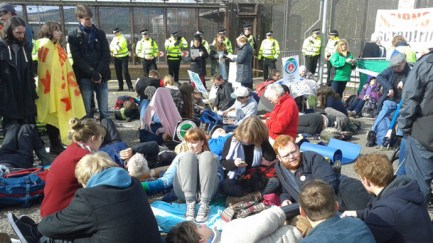
Anti-nuclear demonstrators at Faslane naval base, April 13 2015. (Photo by Veronika Tudhope)
RT | April 13, 2015
Some 36 anti-nuclear activists have been arrested at Faslane naval base in Scotland, according to organizers, as hundreds of protesters blockaded the home of Britain’s nuclear weapons system.
Workers at the naval facility were sent home after failing to gain access to the site due to the blockade, according to The Common Space journalist Liam O’Hare.
Scrap Trident, a coalition of organizations including the Scottish Campaign for Nuclear Disarmament (SCND) and Trident Ploughshares, have been demonstrating outside the facility since 7 a.m.
Protesters are demanding an end to the UK’s intercontinental ballistic missile program, which is up for renewal by the Westminster parliament in 2016.
Trident has become a contentious issue ahead of the general election in May, with Defense Secretary Michael Fallon pledging last week that a Conservative-led government would replace the Vanguard-class nuclear submarines with four new nuclear missile carriers.
Fallon’s election promise followed a statement by Scottish National Party (SNP) leader Nicola Sturgeon, in which she said Trident was a “red line” issue the SNP would not support.
In the event of a hung Parliament, Labour may seek to form a minority government in an informal coalition with SNP.
Critics, including Fallon of the Conservative Party, argue that Labour would abandon the UK’s nuclear weapons program to secure power.
Shadow Defense Secretary Vernon Coaker rejected the idea, insisting last week Labour was committed to renewing Britain’s nuclear weapons program, which is set to cost taxpayers £100 billion over the course of its deployment.
Labour leader Ed Miliband said in January he supported renewing Trident, adding he is “not in favor of unilateral disarmament.”
Monday’s blockade of Faslane naval base follows anti-Trident demonstrations in Glasgow and London over the weekend.
Scrap Trident organizers claim that 36 anti-nuclear activists were arrested in the blockade.
O’Hare, of The Common Space, reports that police have attempted to move anti-nuclear activists camped outside the naval facility’s south gate, while the majority of demonstrators are protesting outside the north gate.
Arthur West, chair of Scottish CND, said in a statement: “The purpose of the event is to draw attention to the fact that all Britain’s nuclear weapons are based just 25 miles away from our biggest city [Glasgow].”
“We say get rid of nuclear weapons and spend the money on decent things like housing, jobs and education.”
Speaking to RT, West added: “Scottish CND are campaigning in cities and towns across Scotland in the run-up to the general election.”
“Our main message to voters at the election is to only support candidates who have given a clear commitment that they will vote against Trident replacement when the issue comes up in the next parliament.”
Patrick Harvie, co-convenor of the Scottish Green Party, was among the demonstrators at Faslane on Monday.
Harvie, a member of the Scottish parliament, said in a statement: “Trident is an obscenity. Through direct action and through the ballot box we can make the case for the UK to play a new role on the world stage.”
He added: “By choosing to disarm Trident we can reskill workers on the Clyde to provide defense of the strategically important northern seas, and diversify our economy for social good.”
Putin lifts ban on delivery of S-300 missile systems to Iran
RT | April 13, 2015
The Russian president has repealed the ban prohibiting the delivery of S-300 missile air defense systems to Iran, according to the Kremlin’s press service. The ban was introduced by former President Dmitry Medvedev in 2010.
“[The presidential] decree lifts the ban on transit through Russian territory, including airlift, and the export from the Russian Federation to the Islamic Republic of Iran, and also the transfer to the Islamic Republic of Iran outside the territory of the Russian Federation, both by sea and by air, of air defense missile systems S-300,” says the information note accompanying the document, RIA Novosti reported.
The decree enters into force upon the president’s signature.
The contract for supplying S-300 missile systems to Iran was signed in 2007 and implied the delivery of five S-300 squadrons worth $800 million. But in 2010 the contract was put on hold due to the UN imposing sanctions on Iran.
Tehran answered with filing a nearly $4 billion lawsuit against Russia’s Rosoboronexport arms dealer company to a Geneva arbitration tribunal.
The question of S-300 supply to Tehran remained unsettled for years.
After years of negotiation, in February 2015, Moscow offered Tehran the chance to buy its latest Antey-2500 anti-aircraft and ballistic missile system, instead of the older S-300 system. Iran replied that it would consider the offer.
The last time Russia supplied S-300 systems abroad was in 2010, when 15 squadrons were delivered to China.
Since then production of S-300 systems has been suspended as the main producer of the Russian air defenses, concern Almaz-Antey, has launched production of the next generation systems, S-400. China has become the first country allowed to buy S-400 systems, Rosoboronexport chief Anatoly Isaykin told the Russian media.
As of today, S-300 systems have been operable in a number of countries, including Algeria, Azerbaijan, Belarus, Cyprus, Kazakhstan and Vietnam. There is a valid contract to deliver S-300 systems to Syria, but it was put on hold after the beginning of the civil war in the country.
The Washington Echo Chamber: Inflating the Importance of Cuban Dissidents
By Matt Peppe | Just the Facts Blog | April 12, 2015
The historic meeting between President Barack Obama and President Raúl Castro of Cuba at the Summit of the Americas in Panama over the weekend could be interpreted as a steppingstone toward the end of U.S. subversion and economic warfare relentlessly carried out since the success of the Cuban revolution 55 years ago. But it is questionable whether President Obama intends to transform relations, treating the government of Cuba as a sovereign equal and recognizing their right to choose different political and economic models, or merely to continue the same decades-old policy with a more palatable sales pitch – the way he has done with drones and extrajudicial surveillance. U.S. media, however, appear to have fully embraced the idea that Washington is acting in the best interests of the Cuban people to liberate them from political repression. The New York Times weighed in the day before the Summit by claiming that most Cubans identify not with the sociopolitical goals advanced by their country’s government, but rather with those supported by Washington.
In an editorial titled “Cuban Expectations in a New Era” (4/7/2015), the New York Times advances the proposition that engagement between the two governments will lead to Cuba’s integration (at least partially) into the global capitalist economy. This in turn will create increased financial prosperity as Cuba grows its private sector and turns away from the failed model the government has imposed since the start of the revolution.
The New York Times portrays the Cuban government as intransigent, stubbornly holding its citizens back from the inevitable progress that would result from aligning itself with Washington. The Times claims that the Cuban government maintains a “historically tight grip on Cuban society.” They may be alluding to a Cuban version of the U.S.’s political police, the FBI, who for decades spied on nonviolent activists representing African Americans, Puerto Rican nationalists, the anti-war movement, animal rights and environmental groups to prevent social change through political activities. Many of the activists illegally targeted by the FBI’s COINTELPRO program still remain incarcerated as political prisoners. But the Times doesn’t mention any such Cuban equivalent.
The fault of Cuba’s financial situation is placed squarely on the country’s government. The Times editorial only mentions the 51-year-old embargo by stating that “untangling the web of sanctions the United States imposes on Cuba will take years because many are codified into law.” Yet they then claim “the Obama administration’s gamble on engaging with Cuba has made it increasingly hard for [Cuba’s] leaders to blame their economic problems and isolation on the United States.”
They might have mentioned the embargo against Cuba cost the country $3.9 billion in foreign trade last year, bringing the inflation-adjusted total to $1.1 trillion since the policy was implemented. The embargo is still directly harming the Cuban economy and public health sector. The administrative measures implemented by Obama will provide, at most, minor relief. Extraterritorial provisions of the Helms-Burton Act that prevent Cuba from trading with 3rd countries remain firmly in place.
But the Times seems to believe the Cuban government is doing nothing more than making excuses when they complain about the devastating affects of the embargo on their economy and their population. They don’t mention that in October 187 other nations voted in the UN for the 23rd straight year to condemn the U.S. embargo against Cuba as illegal and demand that it end.
In her study “Unexpected Cuba,” economist Emily Morris rejects the argument that Cuba’s leaders have damaged their country’s economic performance and put its social progress at risk by failing to adopt capitalist reforms like privatization and liberalization.
“The problem with this account is that reality has conspicuously failed to comply with its predictions,” Morris writes. “Although Cuba faced exceptionally severe conditions – it suffered the worst exogenous shock of any of the Soviet-bloc members and, thanks to the long-standing US trade embargo, has confronted a uniquely hostile international environment – its economy has performed in line with the other ex-Comecon countries, ranking thirteenth out of the 27 for which the World Bank has full data.”
The New York Times then claims that the Cuban dissidents attending sideline events at the Panama Summit deserve to have regional leaders “amplify their voices.” They claim that such dissidents “have struggled for years to be heard in their own country, where those critical of the Communist system have faced repression.”
There is no evidence that the dissidents have struggled in Cuba because they have been repressed rather than that most of the population simply does not agree with their ideas or sympathize with them. In a presumptuous attempt to delegitimize the Cuban government, the Times claims it is actually the dissident contra-revolution that represents the majority of the Cuban people. “The government will have to reckon with the fact that many of the dissidents’ aspirations are shared by most Cubans,” the Times editorial states.
Again, there is no evidence that this is actually the case anywhere other than in Washington’s fantasies. The dissidents’ aspirations are not even stated. One assumes this refers to the objective of repealing socialism and instituting capitalism, which is also the official policy of the U.S. government. Mere changes to Cuba’s economy within the socialist structure is not a dissident position. Such changes and improvements are proposed and debated at all levels of Cuban politics, and have been openly embraced by Raúl Castro since he assumed the Presidency.
That the majority of the Cuban people share dissidents’ desire for capitalism is a bold claim. It infers that the Cuban government is not representative of its people, but rather forcibly imposes a socioeconomic system they oppose.
People familiar with Cuba have reached the opposite conclusion. Victor Rodriguez, a professor in the Ethnic Studies department of California State University Long Beach, recently returned from a visit to Cuba and had a different outlook.
“I spoke with at least 50 Cubans of all ages and walks of life,” he said. “Themes were that sovereignty, health care, and education are non-negotiable.” Rodriguez said that Cubans did have complaints about their system, with many stressing the need for higher salaries.
But the three areas he cites as resoundingly popular are the most basic hallmarks of the revolution. If Cuba were to abandon its socialist economic system – either willingly or under pressure from the United States – these would be the first areas to be sacrificed on the neoliberal altar. Dozens of countries in the global South from Africa, Latin America to Asia that now find themselves in the vice grip of suffocating debt can surely attest to this fact.
It is worth examining who are the voices that the New York Times claim deserve to be amplified. Among the “dissidents” are Guillermo Fariñas and Manuel Cuesta Morúa. Fariñas had fought in Angola against the racist South African apartheid regime and had supported Cuba’s revolutionary movement until a sudden change, notes Salim Lamrani, a French professor who specializes in Cuba-USA relations.
“It was only in 2003 that Fariñas made a 180 degree ideological switch and turned his back on the ideas he had defended in years past,” Lamrani writes. Contrary to representation in Western media, Fariñas had been sentenced to prison for crimes such as assaulting a colleague and an old man who had to have his spleen removed because of his injuries. Lamrani notes that Fariñas was admittedly financed by the US Interests Section in Havana. Perhaps not coincidentally, Fariñas became an outspoken critic of the Castro regime. Yet he was still permitted to speak freely with foreign media. His decision to express his political views, which happen to coincide with those of the interests that finance him, has paid handsomely.
“Guillermo Fariñas has chosen, as have those Cuban dissidents sensationalized by the western press, to live off his dissident activities, which offer undeniable financial opportunities and a standard of living much higher than other Cubans living in a context marked by economic difficulties and material scarcity,” Lamrani writes.
Cuesta Morúa is likewise a dissident who considers the Cuban revolution an abject failure, and who downplays any U.S. responsibility for the economic conditions Cuba faces.
Unlike dissidents in the United States, who cannot start a political organization or journalistic enterprise without concerning themselves with how it will impact their ability to pay for health care, a mortgage, food for their family or education, dissidents in Cuba do not have any of these worries. They enjoy a robust safety net that covers every single citizen, regardless of their view of the Cuban political system.
Many Cubans in attendance at the Summit in Panama had a different view of the dissidents than that espoused by the New York Times. They referred to the dissidents as mercenaries because of their financial links to a hostile foreign regime and coziness with anti-Castro exiles such as Luis Posada Carriles, the “Cuban bin Laden,” who has been implicated in numerous terrorist activities including the downing of a civilian airline and a string of hotel bombings in Havana.
The Cuban Web site Juventud Rebelde noted that the Cuban delegation, which represents more than 2,000 associations and Non-Governmental Organizations from the island, denounced the presence of people who are paid by interests seeking to destabilize Cuban society and the Cuban government.
Liaena Hernandez Martinez, of the National Committee of the Federation of Cuban Women, which represents more than 4 million Cubans said that: “For the Cuba dignified and sovereign that has resisted more than five decades of blockade it is inadmissible that people are here of such low moral character.”
The Times predictably aligns itself on the side of the U.S. government regarding their opinion of the true political aspirations of Cuban people. The idea that the U.S. is a disinterested observer nudging the Cuban government in the direction of greater democracy and human rights is nothing but pure propaganda, contradicted by more than half a century of history. The U.S. has always been the aggressor against Cuba, coercing it to become a neo-colony that could be exploited by the U.S. military and corporate interests from the time of the Platt amendment until the U.S.-backed dictator Fulgencio Batista was ousted in 1959.
It should be no surprise that the U.S. government and corporations like the New York Times still presumptuously attempt to delegitimize the Cuban revolution and pretend that the Cuban politics are best understood and articulated by those either outside Cuba or in their service as paid agents. The notion that a population can create a socioeconomic system representing the will of its people that starkly rejects the Washington Consensus is simply unthinkable. Anyone who agrees with the government’s official line, regardless of their questionable motives or failure to resonate inside the country, is seen as Cuba’s true political representative class. It may take another 55 years to realize this is simply not the case.
Featured Video
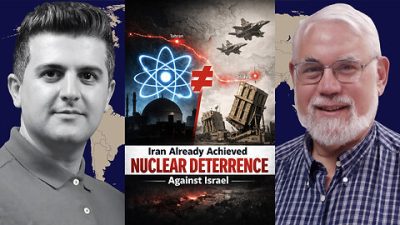
Prof. Ted Postol: Iran Already Achieved Nuclear Deterrence Against Israel
or go to
Aletho News Archives – Video-Images
From the Archives
How the occupied mentality syndrome works
Saudi Arabia on the American chessboard – Part 3
By B. J. Sabri | American Herald Tribune | June 27, 2016
Read part 2: “The occupied mentality Syndrome“
Previously I argued whether Saudi Arabia’s repeated involvements in U.S. interventions and wars stem from free national will or in response to a specific condition. For starters, in Saudi Arabia there is no national will. In Saudi Arabia, the national will is the will of the Al Saud clan. Still, when a major Arab state allies itself with a superpower that committed unspeakable crimes against humanity in almost every Arab country, then something is wrong. This fact alone should compel us to examine the U.S.-Saudi relation for one exceptional reason. As a result of the U.S.-Saudi wars, hundreds of thousands of people in Afghanistan, Iraq, Iran, Libya, Syria, Yemen, and Somalia have lost their lives. Millions became displaced in their own homelands. And millions more rendered refugees.
Attributing the Saudi policies to the bonds of “partnership” with the U.S. is frivolous. There are no bonds between these two thugs except those of business, military deals, secret plots, and wars. Proving this point, bonds such as these have no space for the American and Saudi peoples to share significant cultural or societal exchanges. If partnership is not the reason for the Saudi contribution to the U.S. strategy of empire and imperialism, then another reason must exist.
This leads to three possibilities. … continue
Blog Roll
 Aletho News
- NIAID/NIH and USDA Fund Bioengineered Chimeric Influenza Viruses Built Using Pandemic H1N1 Components: Journal ‘Science Advances’
- Hezbollah hits Israeli warship off Lebanon’s coast, sets it aflame
- Iran slams US strikes on B1 bridge, Mahshahr petrochemical plants as ‘blatant acts of state terrorism’
- In letter to UN chief, Araghchi warns of dire consequences of US-Israeli attacks on Iran’s nuclear facilities
- Why the CIA conspiracy to invade Iran with Kurdish militias failed
- Why Are Upbeat US Claims About Mission to Rescue Pilot ‘Highly Questionable’?
- Aircraft destroyed during US ‘rescue’ of downed F-15 pilot cost more than $100 million each
- Washington University removes professor who condemned US-Israeli war on Iran
- Russia Warns of Retaliation as UK Authorizes Seizure of Vessels
- Serbia thwarts plot to bomb Russia-Hungary gas pipeline – Vucic
- If Americans Knew
- In Iran, Israel-US take aim at “reason, research, and freedom of thought” – Daily Update
- US loses planes over Iran, Israel downgrades Lebanon war goals – Daily Update
- Israel Is Blocking Palestinians from Easter at Church Where Jesus Resurrected
- Plot to assassinate Palestinian activist follows harassment campaign promoted by Zionist groups and elected officials
- Prominent New York synagogue hosts presentation on why U.S. Jews should support the ethnic cleansing of Gaza
- Tapper vs. Piker: Is the CNN Anchor Auditioning for David Ellison?
- Shouldn’t Democrats Be Able to Condemn Genocide?
- Israel-US kill negotiators, destroy civilian structures, but Iran’s military capabilities still largely intact – Daily Update
- ‘War crime’: Global condemnation as Israeli ministers celebrate death penalty law targeting Palestinian prisoners
- 7 Ways Israel Is Turning Lebanon Into Gaza
- No Tricks Zone
- An Inconvenient Tree: Uncovered In Alps… Europe Much Warmer Than Today 6000 Years Ago
- New Study Reports A 60% Slowdown In Greenland’s Ice Loss Rate In The Last Decade
- Low Intensity Tornado Wrecks Major Solar Farm, Creating A Potential Toxic Dump
- New Study Finds Warming Saves Lives…Cold Temperatures 12 Times More Deadly Than Excess Heat
- German Science Blog Accuses PIK Climate Institute Of Hallucinating Climate Tipping Points
- Devastating Assessment Of Comirnaty Vaccine By Former Senior Pfizer Europe Toxicologist
- New Study: CO2 Is ‘Effectively Negligible’ As An Explanatory Climate Change Factor Since 2000
- Former Pfizer Toxicologist Dr. Helmut Sterz Tells Bundestag Hearing Pfizer Vaccine Should Have Never Been Approved
- Energy Expert: Germany’s Nuclear Phaseout Was A “500 Billion Euro Mistake”
- New Research: South Australia’s Mid-Holocene Sea Surface Temperatures Were 4°C Warmer Than Today
 Aletho News