Africa Must Leave the ICC
By Dr. David Hoile | Black Agenda Report | July 1, 2015

It has taken Africa just over a decade to conclude that the International Criminal Court (ICC), established in 2002 by the Rome Statute, is simply unfit for purpose. That certainly is the conclusion of the South African government following the recent African Union summit in Johannesburg. The institution African countries signed up for post 1998, a court that promised to pursue injustice without fear or favor, is not the one they see before them today. They were sold a false bill of goods. The ICC’s claims to international jurisdiction and judicial independence are institutionally flawed and the Court’s reputation has been irretrievably damaged by its racism, blatant double-standards, hypocrisy, corruption and serious judicial irregularities.
While the ICC presents itself as the world’s court this is simply not the case. Its members represent just over one quarter of the world’s population: China, Russia, the United States, India, Pakistan and Indonesia are just some of the many countries that have remained outside of the Court’s jurisdiction.
A court is also only as credible as its independence. Far from being an independent and impartial court, the ICC’s own statute grants special “prosecutorial” rights of referral and deferral to the Security Council – by default its five permanent members (three of which are not even ICC members). Political interference in the legal process was thus made part of the Court’s founding terms of reference. The Court is also inextricably tied to the European Union which provides over 60 percent of its funding. The expression “He who pays the piper calls the tune” could not be more appropriate. The fact that the big five ICC funders are Africa’s former colonial masters also sits uneasily with a continent suspicious of recolonization by questionable legal diktat. The EU is additionally guilty of blatant political and economic blackmail in tying aid for developing countries to ICC membership.
Africa is also correct when it points out that the ICC is self-evidently a racist court, in that it treats one race of people differently to all others. Instead of impartially enforcing the Rome Statute, the Europeans have chosen to focus the Court exclusively on Africa. African heads of state have spoken of “race hunting.” Despite having received almost 9,000 formal complaints about alleged war crimes in at least 139 countries, the ICC has chosen to indict 36 black Africans in eight African countries. In so doing the ICC has ignored all European or Western human rights abuses in conflicts such as those in Afghanistan and Iraq or human rights abuses by Western client states. While the ICC’s key first two cases were African “self-referrals” it is now clear that the African governments were made “an offer they could not refuse”: refer yourself and we will only indict your rebels – if not we will indict both government and rebels.
The ICC has emerged very much as a European-funded and directed instrument of European foreign policy. Broader western hypocrisy is all too evident. The United States has forcefully pointed out that the ICC is a kangaroo court, a travesty of justice open to political influence and that no American citizen will ever come before it. Washington is nonetheless very happy, for its own political reasons, to demand that black Africans appear before it.
Double standards and politics aside, the ICC has shown itself to be irretrievably dysfunctional. The court’s proceedings thus far have often been questionable where not simply farcical. Its judges – some of whom have never been lawyers, let alone judges – are the result of grubbily corrupt vote-trading amongst member states. Far from securing the best legal minds in the world this produces mediocrity. At least one elected “judge” had neither law degree nor legal experience but her country had contributed handsomely to the ICC budget. The Court has produced witnesses who recanted their testimony the moment they got into the witness box, admitting that they were coached by non-governmental organizations as to what false statements to make. Dozens of other “witnesses” have similarly disavowed their “evidence.” Most recently the ICC prosecutor had to admit that one of its own star witnesses in its case against Kenyan Vice-President Ruto was “a thoroughly unreliable and incredible” witness.
And then there has also been the ICC prosecutor who was not only seemingly unaware of the legal concept of presumption of innocence but also threatened to criminalize third-parties who might argue a presumption of innocence on the part of those indicted – and as yet unconvicted – by the Court. A clearer case of Alice in Wonderland justice, along the lines of “sentence first, verdict afterwards,” is difficult to find. There has been prosecutorial misconduct, not least of which hiding exculpatory evidence, which should have ended any fair trial because they would have compromised the integrity of any legal process. The ICC’s first trial proceeded erratically because of crass prosecutorial misbehavior and judicial decisions to add new charges half-way through proceedings, a move that was subsequently overturned. Simply put, the Court and the prosecutor have been making things up as they go along.
The ICC claims to be “economical” and to bring “swift justice,” yet it has consumed more than a billion Euros in its 13-year existence and has only secured two questionable convictions. The ICC claims to be victim-centered yet Human Rights Watch has publicly criticized the ICC’s ambivalence towards victim communities. The ICC claims to be fighting impunity, yet it has granted de jure immunity to the United States and afforded de facto immunity and impunity to NATO member states and several serial abusers of human rights who happen to be friends of the European Union and United States.
Far from bringing peace to Africa, the ICC’s double-standards and autistic legal blundering has derailed delicate peace processes across the continent – thereby prolonging devastating civil wars. The court is responsible for the death, injury and displacement of many thousands of Africans. The ICC’s involvement in Uganda, for example, destroyed peace talks in that country, intensifying the conflict which then spread into three neighboring countries.”
The reality is that the ICC is an inept, corrupt, political court that does not have Africa’s welfare at heart, only the furtherance of Western, and especially European, foreign policy and its own bureaucratic imperative – to exist, to employ more Europeans and North Americans and where possible to continue to increase its budget – all at the expense of African lives. Three cheers for South Africa pointing out that the Emperor is naked.
Dr. David Hoile is the author of Justice Denied: The Reality of the International Criminal Court, a 610-page study of the International Criminal Court published by the Africa Research Centre. The book is available to read or download at www.africaresearchcentre.org. The author can be contacted by email at africaresearchcentre@gmail.com.
Obama Signs Legislation Inhibiting Boycott of Israel
IMEMC News & Agencies | July 2, 2015
 President Obama has signed legislation which would tackle anti-Israel boycotts all over the world and would raise specific US priorities in roughly 150 trade objectives in its negotiations.
One of the main goals, according to World Bulletin/Al Ray, is to counter willingness to support “Boycott Divestment and Sanctions” movement against Israel within the European Union. The legislation was made by a group of congressmen and the American-Israel Public Affairs Committee (AIPAC).
The new US-Israel Trade and Commercial Enhancement Act is specifically targeted “to discourage politically motivated actions to boycott, divest from, or sanction Israel by states, non-member states of the United Nations, international organisations, or affiliated agencies of international organisations that are politically motivated and are intended to penalise or otherwise limit commercial relations specifically with Israel or persons doing business in Israel or in Israeli- controlled territories.”
The new legislation was signed in spite of numerous warnings from Obama’s advisors and officials, who said that such a law can seriously harm trade relations with the European Union members that favor “Boycott Divestment and Sanctions” movement and prohibit trading with Israeli companies that operate in the occupied territories.
Britain approved £4mn Israel arms sales in the months after Gaza war
RT | July 2, 2015
The UK government approved £4 million worth of arms sales to Israel in the immediate months following the Israeli government’s military bombardment of Gaza last summer, new research reveals.
Detailed analysis published Thursday indicates that the related arms licenses cover military hardware likely to be deployed if violence in the besieged coastal strip resumes.
Among the arms sales Britain presided over were special components for military helicopters and a range of hi-tech parts for guidance and navigation systems used by the Israeli Defense Force (IDF).
The former Conservative-Liberal Democrat coalition government also approved arms licenses for a slew of third-party states that sell weapons to Israel. These particular licenses covered the sale of components for military communications equipment, helicopters used in combat and ground-to-ground missiles.
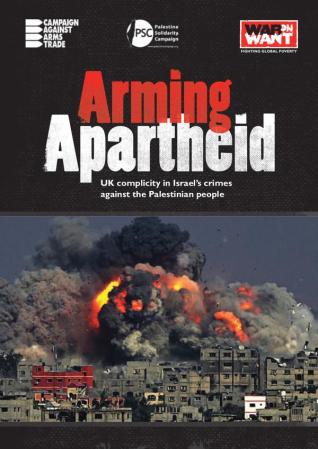 The controversial revelations formed part of a report authored by David Wearing, a researcher at the School of African and Oriental Studies (SOAS). A member of Campaign Against the Arms Trade’s (CAAT) steering committee, Wearing’s work focuses on domestic and international politics.
The research, “Arming Apartheid: UK Complicity in Israel’s Crimes Against the Palestinian People,” analyses how Britain’s arming of Israel renders it complicit in grievous human rights violations.
CAAT’s Andrew Smith said the revelations published in the report showed it was “business as usual” with Israel for the UK government.
“More than 2,000 people died in Israel’s bombardment of Gaza, and yet in the months immediately following the conflict it was business as usual for the UK government and the arms companies they support,” he said.
Smith said that Britain continues to sell arms to Israel, despite the Israeli administration’s continued violation of international law.
“The continuation of arms sales represents a form of political as well as material support from the UK to Israel despite the construction of the ‘apartheid wall’ in the Occupied Palestinian Territories, the expansion of illegal Israeli settlements there and the ongoing blockade of Gaza,” he said.
Palestine Solidarity Campaign director Sarah Colborne said the British state is arming an “apartheid” regime. She argued Palestinians will not be freed from Israeli occupation, discrimination, and bloodshed until sanctions are imposed on Israel.
Ryvka Barnard, a senior campaigner on militarism and security at War on Want, said the Arming Apartheid study highlights Britain’s complicity in “Israel’s oppression of the Palestinian people.”
She argued that the global campaign for boycott, divestment and sanctions (BDS) on Israel has become more vital than ever.
“Only a full two-way arms embargo can ensure the UK will no longer be complicit in Israeli state crimes and abuses,” he said.
Report author Wearing says ministers’ suggestion that British controls on arms exports are tightly controlled “do not stand up to scrutiny.”
“Any real restriction comes from the embarrassment of bad publicity, and then only in the wake of a conflict, too late for the Palestinians affected,” he added.
Britain has a history of unethical arms sales to Israel.
A ministerial statement issued in April 2009 by the then-Labour Foreign Secretary David Miliband confirmed that Israeli military wares used in the 2008-9 Gaza conflict “almost certainly” contained UK-supplied components.
The document was sent to the anti-arms charity after it launched a legal challenge against then-Secretary of State for Business, Innovations and Skills Vince Cable in 2014.
Last summer’s Israel-Palestine conflict culminated in the killing of an estimated 2,000 Palestinians [mostly civilians]. Israel, by contrast, suffered the deaths of 64 soldiers and three civilians during the conflict.
~~~
Take Action
 Act now to Stop Arming Israel. Help increase the pressure on the UK government to end its arms trade with Israel and its complicity in Israel’s occupation and war crimes.
1. Email your MP to demand a two-way arms embargo against Israel.
2. Order campaign materials and book a speaker.
3. Target the companies profiting from Israel’s occupation.
Find the suppliers on your doorstep
More than 100 companies supplying military and security equipment to Israel have bases in the UK. Find out about the suppliers on your doorstep.
Block the factory!
During last summer’s assault on Gaza, activists occupied Israeli arms company Elbit’s factory in Shenstone, causing its operations to grind to a halt and costing Elbit over £100,000. On 6th July, to mark the first anniversary of the assault on Gaza, groups and campaigners from across the UK are going back to Elbit’s factory to demand that the UK stops arming Israel. Join a day of creative action in solidarity with Palestine!
4. Support BDS
Support the Palestinian call for a global movement of Boycott, Divestment and Sanctions against Israel. Visit waronwant.org/BDS
The West’s Voluntary Blindness on Syria
By Eldar Mamedov | LobeLog | July 2, 2015
Recently Netherlands, Belgium and Luxembourg sent a letter to the UN Security Council demanding that Bashar Assad’s regime in Syria end the use of barrel bombs. The foreign ministry of a European country that still maintains a diplomatic presence in Damascus, one of the few, asked for the opinion of its embassy on the matter. The embassy recommended to sign the letter: barrel bombs are indiscriminate and kill an awful lot of civilians. But the embassy also advised its government to condemn the opposition’s use of improvised mortar bombs (known as “hell cannons”) against the neighborhoods under government control. Diplomats say that the rebels have specifically targeted Christian areas for their perceived support for the Assad regime. Back in Europe, the foreign ministry officials admitted that they “haven’t heard anything” about the “hell cannons.”
This is only one example of how dysfunctional EU policy toward Syria has become, as a European Parliament (EP) delegation that visited Lebanon in mid-June learned. An early EU decision to cut off all ties with the Assad regime has not been vindicated by the developments on the ground. Not only has the regime survived, but radical jihadist elements have increasingly dominated the opposition to Assad. The EU, however, failed to modify its strategy accordingly. As a result, regional actors with often disruptive and sectarian agendas have taken center stage. And individual EU member states have also pursued their own policies, which are not necessarily in the interests of the EU as a whole.
The latest example of the distorting influence of the regional actors is the Syrian opposition’s failure to accept the “freeze plan” in Aleppo and surrounding areas proposed by the UN Special Envoy for Syria Staffan De Mistura as a first step toward a negotiated solution. In the UN assessment, the opposition´s foreign sponsors—mainly Turkey, Saudi Arabia, Qatar, and Jordan—bear primary responsibility for this failure, because they have insisted on removing Assad from power as a pre-condition to any agreements.
Such a position is not new. What is new, however, is that these sponsors do not hide anymore that they work directly with Jabhat al-Nusra, al-Qaeda´s affiliate in Syria. They still pretend, however, that al-Nusra is the face of the “moderate opposition,” even though this assertion stems from a PR operation, widely believed to be Qatari-driven and carried out in Western mainstream media and think-tanks. An interview al-Nusra’s chief Al-Golani gave to the Qatar-based Al Jazeera was part of this PR campaign, but it backfired when Al-Golani made it clear that al-Nusra is al-Qaeda and expressed borderline genocidal views on Alawites.
The Dangers of Supporting Jihad
To make matters more complicated, even those rebel groups that are not part of al-Nusra, espouse deeply troubling views. According to a credible UN source in Damascus, a fighter from an obscure group Jaysh al-Ababil active in Syria´s south, has reported that “Syrian people deserve a democracy like in Saudi Arabia.” He boasted that the group “gets anything it needs” from Jordan and that a major offensive to take Damascus from the south, as well as the north, will be launched “very soon.”
If the US and EU had real strategy to end the war they would, in addition to pressuring Assad, demand that their regional allies curb the flow of weapons and recruits to terrorist groups. But they can’t credibly do that, since they are involved in this effort themselves. According to Conflicts Forum, the southern rebel front is managed from US Centcom’s Forward Command in Jordan, which is run jointly by American, Jordanian, Saudi, Qatari, and British officers. … Full article
Hillary Clinton’s emails reveal link with Qatari royal family
RT | July 2, 2015
Emails of former US Secretary of State Hillary Clinton published by the State Department expose that the Qatari Royal family made efforts to befriend the American politician through former British PM Tony Blair’s spouse, Cherie Blair.
Sheikha Mozah bint Nasser al-Missned, a wife of the former emir of Qatar and mother of the ruling emir, Sheikh Tamin bin Hamad Al-Thani, established contact with Clinton via Cherie Blair.
The Blair and Clinton families have been political and personal friends since the 1990s.
“Sheika Moser (Sheikha Mozah) has approached me privately saying they are keen to get their relationship with the USA onto a more positive footing and she was hoping for a ‘women to women’ one to one private meeting with you,” Cherie Blair wrote to Clinton in May 2009. “I am sure the conversation would not be confined to these issues but would be about the U.S./Qatar relationship generally,” Blair wrote, mentioning joint philanthropic interests among issues Clinton and Mozah could talk about.
Blair did her best to persuade Hillary Clinton to get acquainted with “someone who has real influence in Qatar,” the newly-released documents show.
“I could make time to meet in DC during the weeks of June 8th and 15th. Would that work?” Clinton gave in on May 26, promising to rearrange her schedule to “fit her time.”
Yet Sheikha Mozah was unable to meet with Clinton on suggested dates in June 2009 “due to prior commitments” and proposed to meet “immediately after Ramadan/Eid week of September 27, 2009.”
Altogether, on Tuesday the State Department released over 1,900 of Clinton’s emails (3,000 pages). Within this bulk of information, there are 19 emails that have to do with Clinton/ Mozah getting acquainted with each other.
The royal Al-Thanis family of Qatar is known for its fabulous wealth gathered on the back of the petroleum and liquefied natural gas trade. Over the last decades, Qatar rulers spent billions on increasing its influence in Western capitals. The Al-Thanis invested particularly heavily in London, the Guardian claims.
The scale of the Qatar royal family’s investment in the British capital remains largely unknown. Al-Thanis own Harrods, the Olympic village and Shard completely, along with certain property in Hyde Park. A quarter of Sainsbury’s, large share of Barclays and 8 percent of the London Stock Exchange all belong to them, as well as the US embassy building in Grosvenor Square.
Earlier this year it emerged that the Clinton Foundation allegedly received multiple foreign donations during Hillary Clinton’s tenure as secretary of state.
A newly-released book accused the Clinton Foundation, run by presidential candidate Hillary Clinton, her husband Bill Clinton, and their daughter Chelsea, of accepting quid pro quo donations from foreign sources while Hillary was secretary of state.
It was revealed that governments that had received frequent criticism from the State Department for repressive policies – countries like Algeria, Saudi Arabia, Kuwait, the United Arab Emirates, Oman and Qatar – had donated to the Clinton Foundation and gained State Department clearance to buy caches of American-made weapons.
In late May, the FIFA corruption scandal also cast its shadow over the Clintons, as it emerged that the Clinton Foundation received at least $50,000 and as much as $100,000 from the football governing body.
“I don’t think there’s anything sinister in trying to get wealthy people in countries that are seriously involved in development to spend their money wisely in a way that helps poor people and lifts them up,” Hillary Clinton told NBC News in May.
The Guardian reports that the Blair family has done some favors for Qatar’s rulers, too.
Although Tony Blair stepped down from his post as PM in 2007, his influence remains in place. In 2012 he brokered a $50-billion commodities deal between Glencore and Xstrata, which brought him $1 million.
Later the same year the former Labor leader assisted the Qataris in getting a share in a £1-billion-valued group owning such prestigious hotel as Berkeley, Claridge’s and Connaught, the Guardian claims.
The Blairs’ charitable Faith Foundation, aimed at combating religious extremism, does not hesitate to accept donations from anyone, be it Rupert Murdoch or Ukrainian oligarchs.
In this regard, the Faith Foundation mirrors the Clinton Foundation, set up by the former US President Bill Clinton after leaving his post in 2001.
From 2009 up to 2013, the year the Ukrainian crisis erupted, the Clinton Foundation received at least $8.6 million from the Victor Pinchuk Foundation, which is headquartered in the Ukrainian capital of Kiev, a new report claims.
The Clinton Foundation’s donor list includes some 200,000 names, among them foreign financial institutions and Wall Street-based financial organizations, international energy conglomerates and governments, the government of Qatar included, which allegedly has given between $1 million and $5 million in donations to the Clintons.
Read more:
‘Clinton Cash’ book alleges foreign donations to family foundation linked to political favors
Ukraine oligarch ‘top cash contributor’ to Clinton Foundation prior to Kiev crisis
Von Hippel’s “Really Good Idea” to Resolve the Nuclear Impasse Was Actually Iran’s Idea First
By Nima Shirazi | Wide Asleep in America | July 1, 2015
Yesterday in The National Interest, Frank von Hippel, co-director of the Program on Science and Global Security at Princeton University’s Woodrow Wilson School of Public and International Affairs, floats the possibility of opening Iran’s domestic uranium enrichment program to international investment. Doing so, Von Hippel contends, would automatically “add a multinational layer of supervision to the program,” as countries that “buy shares in its enrichment program” would do so “in exchange for having full access to all the associated facilities and a say in how they are managed.”
For those who still insist on pretending that Iran’s legal, safeguarded nuclear energy program is “a threat to regional stability” that will be summarily unleashed from the tethers of agreed-to restrictions after the imminent multilateral deal allegedly sunsets a decade from now, Von Hippel’s suggestion should inspire confidence. With foreign investment and multinational involvement in the entire nuclear fuel cycle, coupled with the IAEA’s strict monitoring and inspection regime which has already long been in place, the potential for Iran’s program to ever be secretly militarized is virtually nil.
Furthermore, according to Von Hippel, offering such foreign stake in this Iranian industry “would mitigate the pressure on Saudi Arabia and other regional rivals of Iran to assert their own rights to ‘peaceful’ enrichment programs. Indeed, the door should be open for them to buy a share in the multinational program as well.”
The article’s headline calls Von Hippel’s proposal to open up Iran’s enrichment program to multinational partnerships, “A Really Good Idea.”
And it is.
Except, while certainly a good idea, this isn’t actually a new idea. In fact, this very offer was made over a dozen years ago – by Iran.
It is true that Von Hippel, whose National Interest post is a pared down version of a longer, more detailed (and less alarmist) article he co-authored in the June 19 issue of Science magazine, does make passing reference to the fact that “[s]enior Iranian officials have expressed openness to discussing multi-nationalization.” But this is a gross understatement considering Iran’s leadership and consistency on this issue.
Since its early stages, in fact, Iran has offered specifically to restrict its enrichment program and to open it up to international cooperation, thereby making in it literally impossible for the diversion of fissile material to weaponization efforts to take place unnoticed. As I have noted before, Iran was already making such gestures nearly a quarter century ago, only to be rebuffed, denied, ignored and dismissed by the United States.
In October 1992, for instance, in response to American concern over indications that Iran was pursuing a domestic enrichment program, Iran not only “repeatedly denied any non-peaceful intentions, stating that it accepts full-scope IAEA safeguards,” but also “indicated it is prepared to accept enhanced safeguards measures on both nuclear cooperation agreements with Russia and China, as well as having no objections to the return of the spent fuel to the country of origin as a similar agreement had been concluded with Germany during the 1970s.”
On July 1, 2003 – exactly 12 years ago today – Reuters reported that none other than Hassan Rouhani, then Secretary-General of Iran’s Supreme National Security Council, said Iran was “ready to accept the participation of other big industrialized countries in its [uranium] enrichment projects,” specifically as a means to resolve any questions over whether its nuclear program was peaceful and civilian in nature.
Following its voluntary suspension of uranium enrichment and implementation of the Additional Protocol as confidence-building measures during negotiations with the EU-3, Iran again raised the prospect of multinational collaboration. On March 23, 2005, the Iranians presented a four-phase plan to their European negotiating partners intended to end the nuclear impasse once and for all. It called for Iran to resume uranium enrichment, with EU cooperation, and for the Majlis (Iranian parliament) to begin the process of approving legislation that would permanently ban the “production, stockpiling, and use of nuclear weapons.”
Iran’s offer came on the heels of the IAEA’s own expert endorsement of multinational investment in enrichment programs.
This was not merely the stance of the reformist government of Mohammad Khatami, either. In his first address before the United Nations General Assembly in September 2005, newly-inaugurated Iranian President Mahmoud Ahmadinejad said that, as a “confidence building measure and in order to provide the greatest degree of transparency, the Islamic Republic of Iran is prepared to engage in serious partnership with private and public sectors of other countries in the implementation of uranium enrichment program in Iran. This represents the most far reaching step, outside all requirements of the NPT, being proposed by Iran as a further confidence building measure.”
In early November 2005 it was widely reported that “the Iranian government is allowing the country’s atomic energy agency to seek local or foreign investors for its currently suspended uranium enrichment activities.” Such investment, directed toward the Natanz facility then under construction in central Iran, would be sought “from the public or private sectors.”
Days later, Iranian state-run television stated that Iran would offer the international community “a 35% share in its uranium enrichment programme as a guarantee” that its nuclear program “won’t be diverted toward weapons.” This investment would allow “foreign countries and companies a role in Iran’s uranium enrichment programme,” providing the opportunity for such entities and organizations to “practically contribute in and monitor the uranium enrichment in Natanz.” Gholamreza Aghazade, an Iranian vice president and head of the Atomic Energy Organisation of Iran, told the press that this offer was “maximum concession” Tehran could offer for transparency. “The 35% share is not only investment,” he said. “They will have a presence in the process (of uranium enrichment) and production (of nuclear fuel).”
“It’s the best kind of international supervision totally negating any possibility of diversion (toward weapons),” Aghazade explained.
Later that month, on November 18, 2005, in yet another publicly presented proposal, the Iranian government repeated the offer set forth earlier that year, reiterating its willingness to officially ban nuclear weapons development through legislation, cap its level and scope of enrichment, immediately covert its enriched uranium to fuel rods “to preclude even the technical possibility of further enrichment” towards weapons-grade and “to provide unprecedented added guarantees” to the IAEA that its program would remain peaceful. The proposal, issued by Iran’s permanent mission to the United Nations, reiterated Iran’s “[a]cceptance of partnership with private and public sectors of other countries in the implementation of uranium enrichment program in Iran which engages other countries directly and removes any concerns.”
Iran’s offers were routinely rejected by the United States government, which maintained the absurd position that Iran capitulate to its demand of zero enrichment on Iranian soil. “We cannot have a single centrifuge spinning in Iran,” declared George W. Bush’s undersecretary of state for arms control Robert Joseph in early 2006.
In an April 5, 2006 oped in the New York Times, Iran’s then UN ambassador Javad Zarif laid out a number of proposals for resolving the nuclear standoff. In addition to affirming Iran’s continued commitment to the NPT, acceptance of limitations on enrichment, and its stance against “the development, production, stockpiling and use of nuclear weapons,” Zarif stated Iran’s willingness to “[a]ccept foreign partners, both public and private, in our uranium enrichment program.” He continued:
Iran has recently suggested the establishment of regional consortiums on fuel-cycle development that would be jointly owned and operated by countries possessing the technology and placed under atomic agency safeguards.
In an article for the Los Angeles Times at the end of that same year, Zarif reminded readers of these overtures, none of which were ever responded to by the United States.
Multinational investment in Iran’s enrichment program was endorsed by nuclear experts and MIT researchers Geoff Forden and John Thomson in various articles and reports in 2006 and 2007, as well as by former American diplomats Thomas R. Pickering and William Luers and nuclear expert Jim Walsh in an essay for the New York Review of Books in early 2008. Wholly in line with what Iranian officials had been saying for years, Pickering, Luers and Walsh wrote that a “jointly managed and operated on Iranian soil by a consortium including Iran and other governments… provides a realistic, workable solution to the US–Iranian nuclear standoff.” Such a program, they wrote, “will reduce the risk of proliferation and create the basis for a broader discussion not only of our disagreements but of our common interests as well.”
“Given the enhanced transparency of a multilateral arrangement and the constant presence in Iran of foreign monitors that such a plan would require,” the authors added, any “diversion of material or technology to a clandestine program” would be easily detected. Senators Chuck Hagel and Dianne Feinstein both responded positively to the proposal. The Bush administration dismissed it out of hand.
Iranian officials again endorsed the concept of opening its nuclear program to international investment and collaboration in during a March 2008 conference in Tehran.
In a comprehensive package proposed to the United Nations on May 13, 2008, Iran’s foreign minister Manuchehr Mottaki wrote that Iran was still ready to consider, among a great many other things, “Establishing enrichment and nuclear fuel production consortiums in different parts of the world – including in Iran.”
Reporting on the proposal shortly thereafter, The Guardian‘s Julian Borger noted that while the consortium idea was gaining traction in American “foreign policy circles,” it was still “resisted by the US, French and British governments.” An unnamed “British official” told Borger, “We would be ready to discuss it, as soon as Iran does what it knows it has to,” that is, suspend its enrichment program, an obvious and long-known nonstarter for post-2005 negotiations.
By resurrecting the notion of multinational investment in Iran’s enrichment program, Von Hippel does the conversation over nuclear negotiations a great service. Despite past difficulties regarding Iran’s stake in the Eurodif consortium and a history of American deception and deliberate denialism in breach of its NPT obligations, the prospect of international acceptance and cooperation in Iran’s nuclear industry is still an excellent way out of this manufactured crisis.
But by leaving out the fact that Iran itself has long been the leading champion of such a proposal unfortunately doesn’t give credit where credit is due.
Both Major U.S. Parties are Plagues on Humanity
By Glen Ford | Black Agenda Report | July 1, 2015
There has never been a dime’s worth of difference between the Clintons (Bill and Hillary) and Barack Obama, and less than ten cents separates the worldviews of these Democratic political twins from the Bush wing of the Republican Party.
 Each has their individual quirks. Barack destroys international order and the rule of law while dabbling at song; Bill dismantled the U.S. manufacturing base and threw record numbers of Blacks in prison as he toyed with his trumpet; George W. played the fool who would Shock and Awe the world into obedience; and Hillary is the evil crone that curses the dead while screaming “We are Woman” like a banshee. But they are all the same in their corporate soullessness.
They all lie for a living, and they live to lie. Hillary Clinton commingled official and personal criminality through the medium of email. Knowing that, in a life dedicated to crime, she could never successfully sequester her private and public conspiracies, Hillary privatized all of her email correspondence during her tenure as Obama’s Secretary of State (in the perfect spirit of neoliberalism). The fate of millions of Haitians whose country’s earthquake and development “aid” are under the Clinton family thumb were doubtless bundled into the tens of thousands of messages she erased on leaving Foggy Bottom.
Republicans have harassed her ever since, seeking an electronic smoking gun to show Clinton’s cowardice or lack of resolve to “stand up for America” and “our troops” or some other nonsense. What the Benghazi affair actually proves is that the Obama administration was just as intent as the Republicans to maintain the fiction that the “rebels” put in power by seven months of NATO bombing of Libya were not various flavors of Islamic jihadists – some of whom were already turning on their erstwhile masters. The U.S.-Saudi project to create and nurture the international jihadist network is a bipartisan venture that dates back to Jimmy Carter’s presidency – and, therefore, nothing for Democrats and Republicans to fight about. However, the GOP’s churning of Clinton’s emails does provide a glimpse into her quest to run for president in 2016 as the woman who vanquished Muammar Gaddafi (“Qaddafi” or simply “Q” in Clinton’s usage).
A number of Clinton’s correspondences were with Sidney Blumenthal, a former Clinton family spin-master who wrote nasty things about Barack Obama while working for Hillary’s 2008 presidential campaign – which made it impossible for her to hire him at the State Department. Nevertheless, Clinton needed his talents for hype for the campaign ahead. Their emails in the summer of 2011 discussed how Hillary’s status as stateswoman could soar when the Libyan leader was finally eliminated. “This is a historic moment and you will be credited for realizing it,” wrote Blumenthal, feeding the crone’s huge gizzard of ego, according to an article in Monday’s New York Times. “You must go on camera,” wrote Blumenthal. “You must establish yourself in the historical record at this moment.” Hillary was anxious to seize the time to establish what Blumenthal described as “the Clinton Doctrine.”
The Times piece somehow concludes that Obama stole Clinton’s thunder with an 1,100-word speech, in late August, declaring: “The Gaddafi regime is coming to an end, and the future of Libya is in the hands of its people.” But Hillary best expressed the ghoulishness of America’s ruling duopoly two months later, in October, when Gaddafi was savagely butchered by screaming jihadists. “We came, we saw, he died,” cackled the banshee.
In the annals of global diplomacy, no more vulgar words have been spoken by a major power foreign minister or head of state. Yet, Clinton’s calculated quip perfectly encapsulates the bloodlust that is the common characteristic of both the governing duopoly of the United States and their suckling children in ISIS and the other proliferating al Qaida factions.
Thanks to Seymour Hersh, we now have a much more plausible scenario for the May 2, 2011, demise of Osama bin Laden, the “OG” of the U.S.-Saudi spawned global jihad, whose body will never be located. Virtually the entire U.S. account of his death is a lie, repeatedly contradicted on its own terms – another layer of fictional Americana in the age of empire in decline.
Clinton was hard-pressed to imagine how she might trump the president’s bin Laden death-watch extravaganza. Her opportunity came five months later, when she delivered her gruesome paraphrase of Julius Caesar on the occasion of Col. Gaddafi’s murder. In the context of Washington’s deeply racist foreign policy, Gaddafi and bin Laden were equally deserving of death, although Gaddafi was among the most fervent and effective fighters against Islamic jihadists: his government was the first in the world to request a global arrest warrant against bin Laden.
The Libyan Islamists were quickly transferred to the new U.S.-NATO-Saudi-Qatari front lines in Syria. The CIA station in Benghazi was at the center of the action – and got burned in the wild and unwieldy process of herding jihadists, who find it difficult to take orders from “infidels,” even when the “Crusaders” are paying the bills and supplying the weapons.
The U.S. consulate and CIA station in Benghazi were attacked on September 11, 2012. The next day, the Pentagon’s intelligence agency issued a report predicting that a “Salafist principality” – another term for an Islamic State – would likely arise in Syria as a result of the war, and that “Western countries, the Gulf States and Turkey are supporting these efforts.” Moreover, the establishment of such an Islamic “principality” would create “the ideal atmosphere for AQI [al Qaida in Iraq, which became ISIS, ISIL and the Islamic State] to return to its old pockets in Mosul and Ramadi” in Iraq – events that have since transpired.
The Defense Intelligence Agency report didn’t say so, but the “Western Powers” included the United States, through its CIA.
The document was declassified this year as the result of a suit by a libertarian right-wing legal outfit. The people of the world continue to be fed the fiction that the U.S. is engaged in a long, twilight struggle against al Qaida Salafists whose international network was created by, and continues to benefit from, “Western countries, the Gulf States and Turkey.”
However, the 2012 Pentagon warning about the rise of an Islamic State may have had some effect on U.S. policy in Syria. One year later, in September of 2013, President Obama backed off from his threat to bomb Syria in “retaliation” for a chemical missile attack against civilians – a crime much more likely committed by western-backed Salafists. The conventional wisdom is that the Russians tricked a hapless Secretary of State John Kerry into agreeing to the peaceful, internationally supervised destruction of Syria’s chemical arsenal; or that the refusal of Britain’s Parliament to go along with an air assault on Syria made the U.S. position untenable; or that Obama feared losing a vote on the issue in the U.S. Congress. None of this rings true to me. The United States is not easily deterred by the opinions of Europeans, who in the end accept Washington’s acts as a fait accompli. And, it was not clear that Obama would have lost the vote in Congress – a vote that he requested, while at the same time declaring that he did not need the legislature’s permission to “punish” Syria for crossing his “red line.”
I think that high Pentagon officials and elements of the Obama administration – probably including the president, himself – took the Benghazi disaster and the Defense Intelligence Agency report to heart, and decided that it was better to keep bleeding the Syrians and their Russian, Lebanese and Iranian allies through a prolonged war, than to bomb al Qaida into power. For the U.S., regional chaos is preferable to the triumph of the, ultimately, unmanageable Salafists – unchained.
The thirty-plus year war against Iran would, however, be ratcheted up. The Bush administration was snatched back from the brink of a military assault against Teheran in 2007 when – to the great consternation of Vice President Dick Cheney – all 16 U.S. intelligence agencies declared, publicly and unanimously, that Iran had abandoned its nuclear weapons program, years before.
The spooks reaffirmed their consensus in the 2010 National Intelligence Estimate – again, that there was no evidence Iran has any intention of making a bomb. The Obama administration has since avoided asking the intelligence agencies for their analysis on the issue, knowing they would get the same answer. Instead, they rely on Israeli propaganda, pick and choose various “experts” from inside and outside the arms control “community,” or simply put forward unsupported statements on Iran’s capabilities and intentions: the Big Lie. While Bush was humiliated by facts supplied by his own intelligence experts, Obama has escalated the confrontation with Iran, applying crippling sanctions and the whole range of low-level warfare, in close collaboration with Israel – proving, once again, that Obama is the “more effective evil.”
Obama has nearly completed knocking off victims on the “hit list” of countries that George Bush was working on when General Wesley Clark ran across it in 2002. Iraq, Syria, Libya, and Somalia have been invaded since then, and Sudan was stripped of a third of its territory. Only Iran and Lebanon remain intact and outside the U.S. imperial umbrella.
The Republican-Democratic duopoly plays tag-team in promoting the Project for a New American Century – a doctrine promulgated by neo-conservatives in 1997 that has served as the guiding light of both the Bush and Obama administrations. The differences between the two teams are merely rhetorical. The Bush regime is described as “unilateralist,” although it employed the same “Coalition of the Willing” approach to aggressive war as does the Obama administration. President Obama claims the right to disregard and methodically undermine international law through “humanitarian” military intervention, whereas Bush claimed to be “spreading democracy.” Same weapons systems, same mass murder, same objective: U.S. domination of the planet.
There’s nothing democratic or humanitarian about the U.S. imperial project. Therefore, its maintenance requires the deployment of 24-7 psychological operations worldwide, but directed primarily against the U.S. public.
Republican strategist Karl Rove was far more honest than his Democratic counterparts when he explained to a reporter, back in 2004:
We’re an empire now, and when we act, we create our own reality. And while you’re studying that reality—judiciously, as you will—we’ll act again, creating other new realities, which you can study too, and that’s how things will sort out. We’re history’s actors … and you, all of you, will be left to just study what we do.
Election seasons are reality-creation festivals, during which the two corporate parties pretend to put forward different visions of the national and global destiny – when, in fact, they answer to the same master and must pursue the same general strategy.
The continuity of GOP-Democratic rule – the near-identical depravity – is horrifically evident in the Democratic Republic of Congo, where six million people have been slaughtered by U.S. surrogates since 1996: the largest genocide since World War II. Successive U.S. administrations – Bill Clinton, George W. Bush, and Barack Obama, assisted by Secretary of State Hillary Clinton and Susan Rice, the high U.S. official most deeply implicated in the entirety of the genocide – have armed, financed, and covered up the Congolese holocaust. Each administration has collaborated with its predecessor to hide the crime and obscure the question of guilt – and then to continue the killing.
Decent people do not vote for political parties that produce such fiends, who deserve Nuremburg justice of the capital kind. Any talk of “lesser evils” is both stupid and obscene.
BAR executive editor Glen Ford can be contacted at Glen.Ford@BlackAgendaReport.com.
‘Donbas is Returning to its Russian Roots’
By SERGEI BARYSHNIKOV | CounterPunch | July 1, 2015
The following is the transcript of a talk by Sergei Baryshnikov, professor of political science and former rector of the National University of Donetsk in the Donetsk People’s Republic. The talk was delivered on April 16, 2015 to a group of foreign writers and journalists visiting Donetsk at the invitation of the Russian/German media NGO ‘Europa Objektiv’. The transcript includes answers to questions from the audience. Translation and editing by NewColdWar.org.
***
During the events of spring 2014 [in eastern and southern Ukraine] known as the ‘Russian Spring’ (a metaphorical name first used by a Russian journalist), intellectuals in Donetsk, especially those in humanities studies, did not participate actively. Active participants could be counted on the fingers on one hand.
From the vantage point of classical theory, it is still difficult to explain the class or social character of these events. None of the classical theories proved with a suitable explanation.
As we look back today, one year later, there were two social forces driving events forward. One was young people with different professional backgrounds, including high school students, university students and unemployed youth. These were the most active participants due to their unstable social situations. The second was people of the so called third age–the elderly. These two polar groups were the most active, driving forces of the Russian Spring in Donbas.
Initial responses to the rise of the Euromaidan movement in Kyiv
The first timid and not well organized attempts to offer an alternative to the Maidan movement that was already a fact in Kyiv took place in November/December of 2013. At the time, we did not yet fully understand the degree of the threat emanating from Kyiv. We hoped that President Yanukovich would be a more firm and adequate leader. But after the beginning of the new year, during the first weeks of January, the picture became clearer. Authorities in Kyiv were reacting less and less adequately to events.
The starting point of our consolidation here was the 25th of January, 2014. On that day, activists of several dozens of organizations, not large, rather marginal by their size and influence, created the movement called anti-Maidan. Regardless of some contradictions and disagreements within the ‘pro-Russian’ movement here in the east of ex-Ukraine, including that each leader wanted to be the chief, common ground which united all was found. This was based on the ideological and political rejection of those values that were being promoted under the slogans of Maidan.
The first occasion of direct action was on March 1 when opponents of the self-proclaimed government in Kyiv gathered at the central Square in Donetsk city named after Lenin. They gathered at the fountain (then not working due to the winter season) wearing St. George ribbons as a distinctive feature of the pro-Russian movement. Some stayed at the square and continued with the rally while the most active ones headed in a column towards the regional administration building. There, authorities were trying to organize their own rally, neither in support of Kyiv nor in support of the outraged masses. They tried to maneuver and survive in the difficult situation that came to be. The rally was organized by former leaders from the Party of Regions and the former governor. All official representatives were there – representatives of the church, social organizations, and so on.
It was during the rally at Lenin Square that Pavel Gubarev was proclaimed people’s governor. The most active participants there were small networks such as the Donetsk Republic, Russian Bloc, the South-East Movement and, a little later, the Eastern Front, Donbas Rus’, the Patriotic Forces of Donbas and so on. We marched in columns with Andrey Purgin, one of the leaders of Donetsk Republic. Many people carried Russian flags or self-made banners. The main slogans were: ‘Russia’, ‘Putin’, ‘Referendum’.
There was also a slogan about federalization. With time, that slogan vanished because even then it was clear that any ‘federalization’ would be with the puppets in Kyiv who had seized power.
Why ‘Russia’, ‘Putin’, ‘referendum’? Because here we were all really inspired by the example of Crimea. We hoped that we would also organize such a quick referendum.
We basically drowned out the organizers of that official rally on March 1 because we were more numerous and because the ordinary people that were brought to the official rally joined us and began rallying under our slogans.
Demands for election, referendum
The referendum question for us was one of the most important ones then. We wanted to obtain approval from the Donetsk Regional Council/ deputies to hold a referendum, like the one held in Crimea. We counted on the deputies’ support because we thought that if they represented the interests of people or territorial community of the Donetsk Region, then they must listen to and support people’s demands.
Unfortunately, none of them turned out to be ready to take the people’s side. That’s why we began putting forward our own leaders, in place of relying on deputies who proved incapable of rising to the occasion.
The whole power structure was paralyzed and that’s why it was not capable of using force against the protestors during those first days. Essentially, Donetsk became one permanent rally. Every day, during weekdays and weekends, people would come to Lenin Square for rallies. There were tens of thousands of people. It was a scale of activism I have never seen ever before.
Not a single participant of the rallies and meetings was armed. It was a peaceful, mass, civic protest. But Kyiv authorities had more or less settled in and become stronger over time and they did not wish to hear or notice us. They used the most primitive and ineffective methods of repression – terror. Those who rose as leaders during March were arrested, including the previously mentioned Pavel Gubarev (a former student of mine and a graduate of the Faculty of History, he has three young children) and Mikhail Chumachenko (my good friend).
Later, these two were freed through a prisoner exchange and returned after the Donetsk People’s Republic was formed. However, during those days, their destiny was an example of what could have happened to any of us, that any of us could have been administratively punished or repressed by the authorities.
The culminating point of this first stage of the development of the events was the night of April 6-7, when people lost hope in the capabilities and willingness of the authorities to negotiate and hold peaceful dialogue. For the third time since March 1, they entered the building of the former state regional administration. This time for good.
Donetsk Peoples Republic
Myself, I did not take part in these events in the late evening of April 6 because by request of Purgin, I was preparing for a meeting that would take place on April 7 with a representative of the Organisation for Security and Cooperation in Europe, to whom I was to explain our position, our issues and our version of events. This was a political-diplomatic mission.
After that meeting with them, around 12 pm, I entered the building and saw a picture of mass, revolutionary activity. There were young soldiers of the internal security forces with frightened faces who were huddling on the staircases. No one hurt them and they realized that it was useless for them to do anything.
At 12 pm, elections took place, based on the decisions made during rallies by the participants of the first revolutionary authority, which was first called People’s Council and later renamed Supreme Council. And this People’s Council of approximately 150 people proclaimed the Donetsk People’s Republic.
During the overnight and early morning of April 7, in accordance with international legal acts and other documents, the declaration of independence of the DPR was drawn up and proclaimed. This is how the first political, institutional representative organ of the self-proclaimed republic began its work.
Development of the DPR
In April, our events began attracting attention. Political activists and leaders began appearing here who, in Ukraine, expressed support for developing relations with Russia and the Eurasian Economic Union. One of the most prominent figures who got ambiguous reactions from the activists of the first wave was the then-deputy (not any longer) of the Supreme Council of Ukraine (Verkhovna Rada), Oleg Tsarev. He became a prominent figure in April. Tsarev’s situation was a little ambiguous, because he is not from Donetsk region but from the neighbouring Dnepropetrovsk region.
It was unavoidable that people began appearing from other regions or other places because the Party of Regions and its leaders had fully discredited themselves as politicians and people’s servants. The visitors tried to become prominent figures and even lead the protest movement here.
Konstantin Dolgov showed a lot of interest. He is from Kharkov. Representatives of Kharkov came here regularly, as did representatives of large southern centres, including Nikolaev, Kherson, Crimea and, until their tragic events in May, Odessa.
Gradually, a common political course of the young DPR developed. It is still in the stage of development.
The process of forming political and government structure here turned out to be very long and uneasy. There was lack of experience and a lack of true leaders with sufficient charisma and capability for serious, positive action. It is a problem when people are active and there is an absence or lack of true leaders. It is still a serious problem. That is why support from Moscow and Russia was very important to us. But only political and ideological support, not military.
In May, also due to lack of experience, we didn’t stop Kyiv’s landing operation in the airport area. (Maybe we couldn’t have stopped them, regardless of the lack of experience.) Military action started in Donetsk itself. Even earlier, as of April 12, in the north of Donetsk region, military actions started around Slavyansk, Kramatorsk, and then Druzhkovka. Gradually, the DPR was being drawn into military confrontation.
The events at Slavyansk are associated directly with the name Igor Strelkov, who was at that moment the most known and most popular military leader. However, he didn’t have the necessary experience, he is mostly a theorist-idealist, not a politician or military. I, for example, would never take on leadership in a military campaign because I am also a theorist-idealist. I can only lecture or give talks and make speeches.
Reactions at the university
All this time, the DPR didn’t have enough time to reach out to higher educational institutions. Even though at the end of May, beginning of June, I tried explaining to Purgin that we needed to enter the university and take control because students could potentially rally to either side–Kyiv or the Donetsk people. It would all depend upon what DPR could offer them and how it could show itself. But no one would listen to me. Everyone was occupied with other issues, they didn’t have time for this.[1]
During June-July the situation would exacerbate with each day. Unexpectedly for us, Igor Strelkov and his military forces withdrew from Slavyansk and came here to Donetsk. Along with the insurgency troops and their families and wives came refugees. In the beginning of July, they inhabited the whole of the university residencies.
The previous university authorities could do nothing better than to call upon all professors and university staff to leave for ‘vacation’, in other words leave the city.
The shelling of the city began from the other side of the airport, an area that we missed and were not capable of forcing out the paratroopers of the Ukrainian Army. They began getting on our nerves and getting in the way of everything by shelling even some areas in the centre of the city.
But the technical staff of the university–workers, mechanics, plumbers and janitors–continued to work here all this time. The infrastructure of the university, which is a complex unit, had to be maintained.
(Professor Baryshnikov explained more of how the university functioned during the summer of 2014, including how he came to be appointed rector.)
The staff that worked throughout the whole summer didn’t get a penny of their wages for July, August and September. For three months, people didn’t get any pay. Only in October did we manage to get funds, but we could not pay salaries, only social allowances of some two, three or four thousand hryvnia [in the few hundreds of dollars]…
Today, we are transitioning to a dual currency system of rubles and hryvnia. Our students have begun getting their first bursaries. We are gradually entering, de facto, the Russian financial and economical space. This is more important, even, than our international recognition. Even though we are waiting and hoping that soon we will be both officially and legally recognized. But in order for this to happen, we need to strengthen our potential and expand our borders to those administrative borders that Donetsk Region previously had.
The Minsk ceasefire agreement of February 12, 2015
The agreement is not being respected either way. There wasn’t a day when its conditions were fulfilled. Primarily, it is the Ukrainian side which is failing to do so.
We are inevitably committed to expansion to regain the historic territory of Donetsk and Lugansk presently occupied by Kyiv forces… I want you to understand and pass on to your readers and your audiences that the objective picture, the objective reality, forces us to begin the liberation of those territories. You can call that expansion, but we must do it.
We need to control our water resources, which are in our north. We have deposits of salt, a strategic product which will help us enter not only the Russian market but the world market. The Severskiy Donetsk Channel supplies our whole former territory with water, and near Artemovsk there are huge deposits of salt. We could have a monopoly in the whole of Eurasia. And, of course, in the south we have the metallurgical plants and an exit to the sea through Mariupol.
Ideally, we need to consolidate all of Donbas. During June and July of last year, the first attempts were made to consolidate the DPR and Lugansk People’s Republic. Oleg Tsarev proposed a scheme to create a coordinating representative body that would act on behalf of both republics. Later, if everything went well, it could act on behalf of other republics. It was named the Parliament of Novorossiya.[2]
Political parties in Donetsk
There isn’t a single political party in DPR today. Today we have only social movements and socio-political associations—’proto-parties’. Based on the social organization called ‘Donetsk Republic’, it has been decided to create a party which would probably dominate here. Some leaders of the DPR have such plans in mind. They are planning a project to create a party similar to the Communist Party of Soviet Union during Soviet times. It will be a leading party called ‘Donetsk Republic’.
I am personally against this project. Because we will repeat the same mistakes and repeat the sad experience and therefore the unfortunate destiny of the late Soviet epoch and the fairly recent experience that we had here of one party [Party of Regions] monopoly and domination.
The intellectual level is not sufficient. There are not enough experts and professionals. A lot of former activists of the Party of Regions are already in Donetsk Republic taking leading or secondary positions.
I would, instead, like to see a truly democratic system, so that initiatives would come from the bottom, from territorial communities and even from working collectives. There should be political representation of all basic social groups of the population–from businessmen to farmers and workers. Otherwise, we will once again have a monopolist party which will control the main trade unions and professional associations–where all people will be administratively ‘invited’ to be members–and it will be in charge of youth movements. There will be a vertical range of power but not a horizontal one.
To follow the Chinese path [of one party rule], we need to be Chinese. The whole world divides into the Chinese and the rest. No, we are not trying to adapt the Chinese system. We need a democracy which, according to the before-revolution experience, will have horizontal lines of power and representation of territorial communes as well as vertical power representing those of the political right, left and centre.
State intervention in the economy
At the beginning of the events I have mentioned, socialist and semi-socialist ideas were very strong. But as of now, I believe that a mixed economy will be developed because that’s the only option. Private property and private business within certain borders are essential in the modern world.
We managed to achieve military success. Not victory, but certain success. We have resisted. We all understand that it would not be possible without Russia’s help. But Putin’s politics, I mean politics by Putin personally, turned out to be so unique, exclusive and subtle that Russia is not a direct participant of the conflict. And at the same time, it provides us with protection. We are under Russia’s protection. This is a very interesting fact for future historians.
Donbas as part of Ukraine?
In conclusion, I would like to say and emphasize, and maybe you can pass this on to your readers, that almost 24 years ago, Moscow, as the capital of the Soviet Empire, let Ukraine go and obtain its sovereignty: That was done without a single drop of blood spilled.
Therefore, Ukraine, the Ukrainian people, should treat Donbas as they were treated 24 years ago. They should act peacefully. If Donbas wants to live without Ukraine, either as part of Russia or with its own sovereignty, let it be. There is no point in trying to forcefully keep us as part of Ukraine.
Since Kyiv has not done this, which should have been done in the spring or beginning of summer one year ago, now we are objectively interested in the disintegration of Ukraine and a construction of Novorossiya on part of its former territories…
I, personally, was dissatisfied with the whole 23 years of our existence within Ukraine. I didn’t conduct any kind of subversive activities, didn’t form any subversive organizations, but I always believed that we would not stay as part of Ukraine for long.
Overall, the territory of current Ukraine–more precisely, Ukraine before Euromaidan–is a result of totalitarianism, of Bolshevik, communist, totalitarian policy. They are destroying monuments of Lenin, but he created Ukraine in its modern borders. One hundred years ago, Lenin said that Donbas should forget about being Russian. There is documented evidence of this, But the events we discussed before simply confirm that even after 100 years, Donbas hasn’t forgotten that it’s Russian.
This is not about ethnic purity or belonging, it is about historical truth. Donbas appeared as an historical product of the politics of Russia, as its economic, geopolitical and geographic product. Now Donbas is going through a difficult process of returning back to Russia, of that I am sure.
Sergei Baryshnikov is a professor of political science and former rector of the National University of Donetsk in the Donetsk People’s Republic.
Notes:
[1] The National University of Donetsk formerly had around 16 000 students. Today, there are some 8,000. The largest decline of enrolment was in the departments of the humanities.
[2] Read more about the Parliament of Novorossiya in an April 2015 interview with one of its deputies, Aleksander Kolesnik.
FBI Claims it Doesn’t Have to Share Records with Justice Dept. Inspector General
By Noel Brinkerhoff and Steve Straehley | AllGov | June 29, 2015
The Federal Bureau of Investigation (FBI) has continued to stonewall requests by the Department of Justice’s inspector general for records pertaining to multiple investigations by the internal watchdog.
The FBI has contended since 2010 that the IG’s office lacks the legal authority to see documents related to certain matters, including grand juries, Title III electronic surveillances and Fair Credit Reporting Act information.
FBI officials also claim they don’t have to share documents related to two investigations of alleged whistleblower retaliation, or those pertaining to an IG review of the FBI’s use of telephonic metadata collected under Section 215 of the Patriot Act, according to the Project on Government Oversight.
The IG said in a report “delaying or denying access to agency documents imperils an IG’s independence and impedes our ability to provide the effective and independent oversight that saves taxpayers money and improves the operations of the federal government.”
“Actions that limit, condition, or delay access have profoundly negative consequences for our work: they make us less effective, encourage other agencies to take similar actions in the future, and erode the morale of the dedicated professionals that make up our staffs,” the report stated.
And it might become even more difficult for the inspector general to get information from the FBI. The 2016 Justice Department budget proposal does not include the section that now forces the Bureau to cooperate with requests from the IG.
Inspector General Michael Horowitz said such a move “could lead the FBI to believe that its conduct has been sanctioned and could cause other department components to conclude that it is acceptable to ignore the Appropriations Act and clear requirements of the IG Act and raise legal objections to the OIG’s access to certain records necessary to perform our important oversight function.”
To Learn More:
Watchdog Barks for Access to FBI Records (by Michael Smallberg, Project on Government Oversight)
Justice Watchdog Continues to Clash with FBI Over Access to Documents (by Charles Clark, Government Executive )
180 Day Report to Congress on the Impact of Section 218 of the Department of Justice Appropriations Act for Fiscal Year 2015 (Department of Justice Inspector General) (pdf)
Justice Dept. Report Details Clashes between FBI and Organized Crime Drug Task Force (by Noel Brinkerhoff, AllGov )
After 8 Years of Delay, EPA Finally Agrees to Test Dangers of Monsanto’s Favorite Pesticide
By Steve Straehley | AllGov | June 29, 2015
 Glyphosate, which is the active ingredient in Monsanto’s Roundup herbicide, will finally undergo analysis for its effects on endangered species by the Environmental Protection Agency (EPA), thanks to the persistence of the Center for Biological Diversity (CBD).
The group has been trying for eight years to get the EPA to look at glyphosate, along with atrazine and two chemicals similar to atrazine: propazine and simazine. Glyphosate was found two months ago by the World Health Organization’s International Agency for Research on Cancer to be a probable human carcinogen and was banned for sale in garden centers in France earlier this month.
“This settlement will finally force the EPA to consider the impacts of glyphosate—widely known as Roundup—which is the most commonly used pesticide in the United States, on endangered species nationwide,” said Brett Hartl, CBD’s endangered species policy director. “With more than 300 million pounds of this stuff being dumped on our landscape each year, it’s hard to even fathom the damage it’s doing.”
Roundup appears to be responsible for the 90% drop in the number of monarch butterflies in the United States. The butterflies feed on milkweed, which has been just about eliminated because of Roundup use in fields near butterflies’ habitats.
Monsanto spokesman Robb Fraley said Roundup meets standards set by regulatory and health authorities. However, the EPA hasn’t ever taken a close look at glyphosate’s effect on endangered species.
Atrazine chemically castrates frogs and may be linked to increased risks of thyroid cancer, reproductive harm and birth defects in humans, according to CBD. “The EPA should have banned this years ago,” Hartl said. Up to 80 million pounds of atrazine are used each year in the United States on corn, sugarcane and sorghum, as well as lawns and golf courses.
The EPA’s agreement is only the beginning of a long, slow process. The agency has agreed to complete its assessments by 2020.
To Learn More:
Big Win for Environmentalists Will Force EPA to Study Glyphosate (by Elizabeth Warmerdam, Courthouse News Service )
Settlement: EPA to Analyze Impacts of World’s Two Most Widely Used Pesticides on 1,500 Endangered Species (Center for Biological Diversity)
UN Report Links California’s Favorite Herbicide, Monsanto’s Roundup, to Cancer (by Ken Broder, AllGov California )
EPA Sued over Not Protecting Decimated Monarch Butterflies from Monsanto (by Noel Brinkerhoff and Ken Broder, AllGov California )
EPA Approves Rise in Glyphosate Residue for Monsanto’s Herbicide (by Noel Brinkerhoff, AllGov )




 Aletho News