NYT Hypes Russian Threat to the Internet
By Ben Schreiner | Working Left | October 25, 2015
As if Americans didn’t already have enough to worry about in regards to the recently resurrected Red Menace, we can now add the fear that those devious Russians are threatening to–horror of horrors–bring down the Internet.
As the New York Times‘ David Sanger and Eric Schmitt report, “Russian submarines and spy ships are aggressively operating near the vital undersea cables that carry almost all global Internet communications, raising concerns among some American military and intelligence officials that the Russians might be planning to attack those lines in times of conflict.”
As Navy spokesman Cmdr. William Marks adds, “It would be a concern to hear any country was tampering with communication cables.”
Indeed. Well, unless those tampering with international communication cables happen to be working on behalf of the “good guys” in the National Security Agency, or their equally good partners in Britain’s GCHQ. In that case, don’t consider it “tampering,” but rather something more akin to protecting the homeland from 21st century threats.
Of course whenever official Washington warns of a looming foreign cyber threat (China and Iran being the other favorite punching bags of the Times in this regard), it’s worth remembering that it was in fact the U.S., in partnership with Israel, that was the first state to actually launch a major offensive cyber attack on a sovereign nation. The attack being the Stuxnet virus set loose back in 2009 on Iran’s peaceful nuclear program. Such aggression was codified earlier this year when the Pentagon formally unveiled a cyber warfare doctrine sanctioning the use of preemptive strikes. But down the memory hole, it appears, with all that.
And so with all that out of mind, it’s back to Russia’s rising “aggression.” At least as the paper of record would have it.
As Sanger and Schmitt continue, “American concern over cable-cutting is just one aspect of Russia’s modernizing Navy that has drawn new scrutiny.”
Adm. Mark Ferguson, commander of American naval forces in Europe, speaking in Washington this month, said the proficiency and operational tempo of the Russian submarine force was increasing.
Citing public remarks by the Russian Navy chief, Adm. Viktor Chirkov, Admiral Ferguson said the intensity of Russian submarine patrols had risen by almost 50 percent over the last year. Russia has increased its operating tempo to levels not seen in over a decade. Russian Arctic bases and their $2.4 billion investment in the Black Sea Fleet expansion by 2020 demonstrate their commitment to develop their military infrastructure on the flanks, he said.
Left unmentioned by either Adm. Ferguson or the Times is the fact that the U.S. Navy’s fiscal year 2016 budget comes in at an astounding $161 billion. (For comparison, the entire Russian military’s FY 2016 budget is projected to come in just over $90 billion.) If scrutiny then is to be applied, one would think that the U.S. Navy’s budgetary windfall would offer plenty of fodder. For starters, it’s worth considering just how many food-insecure American children could be fed with $161 billion.
Capturing the essence of the official propaganda campaign seeking to depict Russia as some sort of dangerously revisionist power, Sanger and Schmitt go on in their piece to quote Adm. James Stavridis, NATO’s former top military commander and current dean of the Fletcher School of Law and Diplomacy. As Stavridis puts it, Russia’s supposed stepped up surveillance of undersea cables offers “yet another example of a highly assertive and aggressive regime seemingly reaching backwards for the tools of the Cold War, albeit with a high degree of technical improvement.”
Russia has indeed deployed its military forces in the last year to both Ukraine and Syria. (A fact Times readers are certainly well aware of.) But if that is a sign of a “highly assertive and aggressive regime,” what are we to make of a regime that in the past decade alone invaded and toppled governments in Afghanistan, Iraq, and Libya? What shall we call a regime that has bombed Afghanistan, Iraq, Somalia, Libya, Yemen, Syria, and Pakistan? What about a regime that unleashed a preemptive cyber attack on Iran? How about a regime with over 800 foreign military bases? Or one that exported nearly $50 billion in arms in the last year alone?
Global public opinion has of course already settled on what we are to call such a regime. According to a 2013 WIN/Gallop poll surveying the opinions of individuals from 65 nations around the world, it is the U.S. that constitutes “the greatest threat to peace in the world.” Russia didn’t register in the poll.
The recent historical record, then, reveals the latest Russian hit piece offered by the Times to be little more than Washington projection. The Russian Navy, all propaganda aside, hardly poses much of a noteworthy threat to the U.S. Navy, let alone global Internet communications. To find the greatest threat to global Internet communications we must once again heed global public opinion and come face to face with the menace within.
The Arab Spring: Made in the USA
By Stuart Jeanne Bramhall | Dissident Voice | October 25, 2015
Arabesque$: Enquête sur le rôle des États-Unis dans les révoltes arabes (Investigation into the US Role in the Arab Uprisings) is an update of Ahmed Bensaada’s 2011 book L’Arabesque Américaine. It concerns the US government role in instigating, funding and coordinating the Arab Spring “revolutions.” Obviously most of this history has been carefully suppressed by the western media.
The new book devotes much more attention to the personalities leading the 2011 uprisings. Some openly admitted to receiving CIA funding. Others had no idea because it was deliberately concealed from them. A few (in Egypt and Syria) were officially charged with espionage. In Egypt, seven sought refuge in the US embassy in Cairo and had to be evacuated by the State Department.
Democracy: America’s Biggest Export
According to Bensaada, the MENA Arab Spring revolutions have four unique features in common:
- None were spontaneous – all required careful and lengthy (5+ years) planning, by the State Department, CIA pass through foundations, George Soros, and the pro-Israel lobby.1
- All focused exclusively on removing reviled despots without replacing the autocratic power structure that kept them in power.
- No Arab Spring protests made any reference whatsoever to powerful anti-US sentiment over Palestine and Iraq.
- All the instigators of Arab Spring uprisings were middle class, well educated youth who mysteriously vanished after 2011.
Nonviolent Regime Change
Bensaada begins by introducing non-violent guru Gene Sharp (see The CIA and Nonviolence), his links with the Pentagon and US intelligence, and his role, as director of the Albert Einstein Institution, in the “color” revolutions.2 in Eastern Europe and the attempted coup against Hugo Chavez in 2002.))
 The US goal in the Arab Spring revolutions was to replace unpopular despotic dictators while taking care to maintain the autocratic US-friendly infrastructure that had brought them to power. All initially followed the nonviolent precepts Sharp outlines in his 1994 book From Dictatorship to Democracy. In Libya, Syria and Yemen, the US and their allies were clearly prepared to introduce paid mercenaries when their Sharpian “revolutions” failed to produce regime change.
Follow the Money
Relying mainly on Wikileaks cables and the websites of key CIA pass through foundations (which he reproduces in the appendix), Bensaada methodically lists every State Department conference and workshop the Arab Spring heroes attended, the dollar amounts spent on them by the State Department and key “democracy” promoting foundations3, the specific involvement of Google, Facebook, Twitter and Obama’s 2008 Internet campaign team in training Arab Spring cyperactivists in encryption technologies and social media skills, US embassy visits, and direct encounters with Hillary Clinton, Condoleezza Rice, John McCain, Barack Obama and Serbian trainers from CANVAS (the CIA-backed organization that overthrew Slobodan Milosevic in 2000).
Bensaada focuses most heavily on the Tahrir Square uprising in Egypt. The Washington Post has estimated approximately 10,000 Egyptians took part in NED and USAID training in social media and nonviolent organizing techniques. For me the most astonishing information in this chapter concerned the role of an Egyptian exile (a former Egyptian policeman named Omar Afifi Suleiman) in coordinating the Tahrir Square protests from his office in Washington DC. According to Wikileaks, NED paid Suleiman a yearly stipend of $200,000+ between 2008-2011.
When Nonviolence Fails
Arabesques$ devotes far more attention to Libya, Syria and Yemen than Bensaada’s first book.
In the section on Libya, Bensaada zeroes in on eleven key US assets who engineered the overthrow of Gaddafi. Some participated in the same State Department trainings as the Middle East opposition activists and instigated nonviolent Facebook and Twitter protests to coincide with the 2011 uprisings in Tunisian and Egypt. Others, in exile, underwent guerrilla training sponsored by the CIA, Mossad, Chad and Saudi Arabia. A few months after Gaddafi’s assassination, some of these same militants would lead Islamic militias attempting to overthrow Assad in Syria.
Between 2005 and 2010, the State Department funneled $12 million to opposition groups opposed to Assad. The US also financed Syrian exiles in Britain to start an anti-government cable TV channel they beamed into Syria.
In the section on Syria, Bensaada focuses on a handful of Syrian opposition activists who received free US training in cyberactivism and nonviolent resistance beginning in 2006. One, Ausama Monajed, is featured in the 2011 film How to Start a Revolution about a visit with Gene Sharp in 2006. Monajed and others worked closely with the US embassy, funded by the Middle East Partnership Initiative (MEPI). This is a State Department program that operates in countries (such as Libya and Syria) where USAID is banned.
In February 2011, these groups posted a call on Twitter and Facebook for a Day of Rage. Nothing happened. When Sharpian techniques failed to produce a sizable nonviolent uprising, as in Libya, they and their allies (Saudi Arabia, Turkey, Qatar and Jordan) were all set up to introduce Islamic mercenaries (many directly from Libya) to declare war on the Assad regime.
- I was astonished to learn that Forum Fikra, a forum for Arab activists working against authoritarian governments, was mainly funded by the Nathan and Esther K Wagner Family Foundation. The latter also funds numerous pro-Israel groups and projects, as well as the Washington Institute for Near East Policy (a pro-Israel group with close ties to AIPAC).
- The color revolutions were CIA-instigated uprisings that replaced democratically elected pro-Russian governments with equally autocratic governments more friendly to US corporate interests:
Serbia (2000) – Bulldozer Revolution
Georgia (2002) – Rose Revolution
Ukraine (2004) – Orange Revolution
Kyrgyzstan (2005) – Tulip Revolution - Democracy promoting foundations (as used here, “democracy” is synonymous with capitalism, ie favorable to the interests of US investors). Here are seven of the main ones involved in funding and training Arab Spring activists:
• USAID (US Agency for International Development) – State Department agency charged with economic development and humanitarian aid with a long history of financing destabilization activities, especially in Latin America.
• NED (National Endowment for Democracy) – national organization supported by State Department and CIA funding dedicated to the promotion of democratic institutions throughout the world, primary funder of IRI and NDI.
• IRI (International Republican Institute) – democracy promoting organization linked with the Republican Party, currently chaired by Senator John McCain and funded by NED.
• NDI (National Democratic Institute for International Affairs) – democracy promoting organization linked with the Democratic Party, currently chaired by Madeline Albright and funded by NED.
• OSI (Open Society Institute) – founded by George Soros in 1993 to help fund color revolutions in Eastern Europe. Also contributed major funding to Arab Spring revolutions.
• Freedom House – US organization that supports nonviolent citizens initiatives in societies were liberty is denied or threatened, financed by USAID, NED and the Soros Foundation.
• CANVAS (Center for Applied Non Violent Action and Strategies) – center originally founded by the Serbian activists of Otpor who the US funded and trained to over throw Slobodan Milosevic and who were instrumental in training Arab Spring activists. Funded by Freedom House, IRI and George Soros
Dr. Bramhall is a retired American psychiatrist and political refugee in New Zealand. She has published a free, downloadable non-fiction ebook 21st Century Revolution. Her first book The Most Revolutionary Act: Memoir of an American Refugee describes the circumstances that led her to leave the US in 2002. Email her at: stuartbramhall@yahoo.co.nz.
The Importance of the Official 9/11 Myth
By Kevin Ryan | Dig Within | October 26, 2015
People sometimes wonder why is it important to investigate the alleged hijackers and others officially accused of committing the 9/11 crimes. After all, the accused 19 hijackers could not have accomplished most of what happened. The answer is that the official accounts are important because they are part of the crimes. Identifying and examining the people who created the official 9/11 myth helps to reveal the ones who were responsible overall.
The people who actually committed the crimes of September 11th didn’t intend to just hijack planes and take down the buildings—they intended to blame others. To accomplish that plan the real criminals needed to create a false account of what happened and undoubtedly that need was considered well in advance. In this light, the official reports can be seen to provide a link between the “blaming others” part of the crimes and the physical parts.
 Pushing the concept of “Islamic Terrorism” was the beginning of the effort to blame others, although the exact 9/11 plan might not have been worked out at the time. This concept was largely a conversion of the existing Soviet threat, which by 1989 was rapidly losing its ability to frighten the public, into something that would serve more current policy needs. Paul Bremer and Brian Jenkins were at the forefront of this conversion of the Soviet threat into the threat of Islamic terrorism. Both Bremer and Jenkins were also intimately connected to the events at the World Trade Center.
The concerted effort to propagandize about Al Qaeda and Osama bin Laden (OBL) seems to have begun in earnest in 1998. That’s when the African embassy bombings were attributed to OBL and the as-yet unreported group called Al Qaeda. The U.S. government responded with bombings of Sudan and Afghanistan and, with help from the New York Times, began to drum up an intense myth about the new enemy.
“This is, unfortunately, the war of the future,” Secretary of State Madeleine Albright said. “The Osama bin Laden organization has basically declared war on Americans and has made very clear that these are all Americans, anywhere.”
In retrospect, it is surprising that this was the first reference to Al Qaeda in the New York Times, coming only three years before 9/11. More surprising is that The Washington Post did not report on Al Qaeda until June 1999, and its reporting was highly speculative about the power behind this new threat.
“But for all its claims about a worldwide conspiracy to murder Americans, the government’s case is, at present, largely circumstantial. The indictment never explains how bin Laden runs al Qaeda or how he may have masterminded the embassy bombings.”
Despite this skepticism from The Post, the reports about Al Qaeda continued in an odd mixture of propaganda and doubt. For example, The Times reported on the trial of the men accused of the African embassy attacks in May 2001. That article contradicted itself saying that “prosecutors never introduced evidence directly showing that Mr. bin Laden ordered the embassy attacks” and yet that a “former advisor” to Bin Laden, one Ali Mohamed, claimed that Bin Laden “pointed to where a truck could go as a suicide bomber.” The fact that Mohamed had worked for the U.S. Army, the FBI, and the CIA was not mentioned.
Other facts were ignored as well. That OBL had worked with the CIA and that Al Qaeda was basically a creation of CIA programs like Operation Cyclone were realities that began to fade into the background. By the time 9/11 happened, those facts were apparently forgotten by a majority of U.S. leaders and media sources. Also overlooked were the histories of people like Frank Carlucci and Richard Armitage, who played major roles in Operation Cyclone and who remained powerful players at the time of the 9/11 attacks.
In the two years before 9/11, the alleged hijackers were very active within the United States. They traveled extensively and often seemed to be making an effort to be noticed. When they were not trying to be noticed, they engaged in distinctly non-Muslim behavior. Mohamed Atta’s actions were erratic, in ways that were similar to those of Lee Harvey Oswald, and Atta appeared to be protected by U.S. authorities.
Meanwhile, leading U.S. terrorism experts seemed to be facilitating Al Qaeda terrorism. Evidence suggests that U.S. intelligence agency leaders Louis Freeh and George Tenet facilitated and covered-up acts of terrorism in the years before 9/11. Both of their agencies, the CIA and FBI, later took extraordinary measures to hide evidence related to the 9/11 attacks. And both agencies have made a mockery of the trial of those officially accused of helping OBL and the alleged hijackers.
Counter-terrorism leader Richard Clarke inexplicably helped OBL stay out of trouble, protecting him on at least two occasions. Clarke blatantly failed to follow-up on known Al Qaeda cells operating within the United States. After 9/11, Clarke was among those who falsely pointed to Abu Zubaydah as a top leader of Al Qaeda. Zubaydah’s torture testimony was then used as the basis for the 9/11 Commission Report.
Former CIA operative Porter Goss created the first official account of what happened on 9/11, along with his mentor Bob Graham. This was the report of the Joint Congressional Inquiry, produced by the intelligence oversight committees of the U.S. Congress. It was greatly influenced by people who should have been prime suspects. For example, Richard Clarke was the one in charge of the secure video conference at the White House that failed miserably to connect leaders and respond to the attacks. In the Joint Inquiry’s report, Clarke was cited as an authoritative reference 46 times. CIA director George Tenet was cited 77 times, and Louis Freeh was cited 31 times.
Therefore it is imperative that the people who worked to create the background story behind OBL and the accused hijackers be investigated for their roles in the 9/11 crimes. This includes not only those who were figureheads behind the official reports, but more importantly the ones who provided the evidence and testimony upon which those reports were built. The alleged hijackers and their associates should also be of considerable interest to 9/11 investigators. That’s because what we know about them was provided by people who we can assume were connected to the crimes and what we don’t yet know about them can reveal more of the truth.
The Preposterous Green Institute and the IPCC
The man now in charge at the IPCC belongs to a privileged, protected, secretive entity headed by the UN’s former top climate official.
By Donna Laframboise | No Frakking Consensus | October 19, 2015
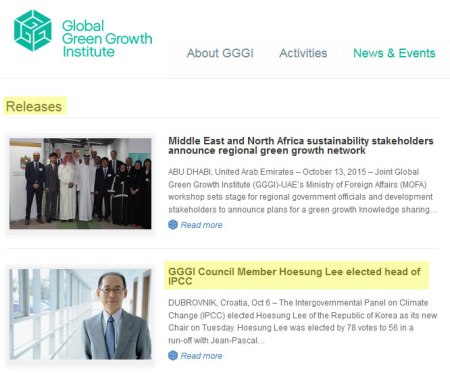
When Hoesung Lee was elected head of the Intergovernmental Panel on Climate Change (IPCC) recently, the Seoul-based Global Green Growth Institute (GGGI) issued a celebratory press release. Lee – who hails from South Korea – has a seat on one of the GGGI’s governing bodies.
But this little-known entity is no mere institute. In fact, it’s another creature of the United Nations. As a headline on the GGGI website makes clear, an international treaty was required to bring it into existence. Membership is restricted to UN-recognized countries. Its stated purpose is “the successful outcome of the United Nations process on sustainable development.” Its Director-General, Yvo de Boer, used to be the UN’s top climate official.
GGGI appears to have begun life in 2010 as a bona fide South Korean non-profit foundation, before throwing itself into the arms of the UN two years later. Documents connected to its 2012 transformation can be downloaded from its website (see this 33-page PDF). The GGGI immodestly claims to be devising “a new model of economic growth,” which it considers “essential for the future of humankind.” Some of the planet’s least developed nations have signed up to act as guinea pigs for projects administered by the GGGI and funded by Australian, Danish, Norwegian, and British taxpayers.
There are plenty of good people working on important issues, some of whom are employed by research institutes. But when it comes to perqs and privileges, the GGGI leaves everyone them in the dust. Calling the GGGI an institute is like calling Unilever – the multinational corporation that owns the Ben & Jerry’s, Lipton, Bertolli, Hellman’s, Becell, Knorr, and Dove brands – a soap company.
In actual fact, the GGGI enjoys a preposterous array of protections and immunities. We’re talking about the kinds of privileges normally reserved for nation states. Korea’s government has signed a document in which it has agreed to treat GGGI headquarters like an embassy. Korean authorities have no jurisdiction on its premises or over its records:
The Headquarters shall be inviolable. No person exercising any public authority within the Republic of Korea shall enter the Headquarters to perform any duties except with the express consent of the Director-General…The archives of the GGGI…shall be inviolable wherever located….The property of the GGGI…shall be immune from search, requisition, confiscation, expropriation and any other form of interference, whether by executive, administrative, judicial or legislative action. [pp. 1, 5, 6]
The GGGI and its staff enjoy “immunity from every form of legal process,” except in rare circumstances. The GGGI is exempt from taxation and customs duties, and may transfer funds in and out of Korea at will. The salaries of the roughly 100 people who comprise the GGGI staff are – drumroll, please – tax free.
People visiting the GGGI from outside Korea don’t need to produce passports as do mere mortals, since Korea’s government has agreed to treat GGGI-issued “travel certificates” as the equivalent of national passports. GGGI staff, their spouses, and their dependents are immune from “immigration restrictions” and baggage inspection “except in doubtful cases.” In the event of an international crisis, Korea will treat GGGI personnel and their families on a par with “diplomatic envoys.”

As if all of the above weren’t sufficiently bizarre, we read that:
The GGGI shall have the right to use codes and to dispatch and receive official communications by courier or in sealed bags, which shall have the same privileges and immunities as are accorded to diplomatic couriers and bags. [bold added, p. 6]
So the police can’t touch you. The courts can’t touch you. Customs officials have been instructed to treat you like royalty. Your pay cheque is tax free, and there’s almost no risk of being caught should you choose to smuggle items in or out of the country.
Pardon me, but I have a few questions:
- What’s really going on here?
- What is so special about these people that they warrant
requiresuch extraordinary protections and immunities? - What
unwholesome activitiesis the UN undertaking via the GGGI that it considers sealed diplomatic pouches remotely necessary?
Circling back to Hoesung Lee, the person now in charge of the IPCC also belongs to a secretive entity headed by the UN’s former top climate official.
Translation #1: Lee is a UN insider. There isn’t a chance in a thousand that he’ll institute meaningful reform.
Translation #2: The IPCC is merely one bauble in the UN’s burgeoning toy box.
Saudi Supreme Court approves Sheikh Nimr death penalty
Press TV – October 25, 2015
Saudi Arabia’s Supreme Court has approved the death penalty for prominent Shia cleric Sheikh Nimr al-Nimr, his brother says.
Mohammad al-Nimr, the prominent cleric’s brother, said in a message on social media on Sunday that the Saudi Supreme Court and an appellate court had approved the execution of the Shia cleric and authorized the Saudi Interior Ministry to carry out the sentence.
The execution warrant has been reportedly sent to Muhammad bin Naif bin Abdulaziz Al Saud, the Saudi crown prince, who is also the first deputy prime minister and the minister of interior of Saudi Arabia.
The warrant will now be sent to Saudi Arabia’s ruler Salman bin Abdulaziz Al Saud after the approval of the Interior Ministry.
To be implemented, the warrant must be approved by the Saudi king.
The execution of the Shia cleric can be carried out by the Interior Ministry without any prior warning if the Saudi king signs the order.
Nimr was attacked and arrested in the Qatif region, east of Saudi Arabia, in July 2012, and has been charged with undermining the kingdom’s security, making anti-government speeches, and defending political prisoners. Nimr has denied the accusations.
In October 2014, a Saudi court sentenced Sheikh Nimr to death, provoking huge condemnations and criticism in the Middle East and the world.
Ali Mohammed Baqir al-Nimr, the nephew of the prominent Saudi Shia cleric, has also been also sentenced to death over his alleged role in anti-regime protests in 2012, when he was 17 years old.
“We don’t want anything to happen to him or to Ali or the other young men,” Mohammed al-Nimr said.
Ali Mohammad was arrested during an anti-government protest in Qatif and was later convicted of alleged criminal activities and handed down a death penalty by Saudi Arabia’s Specialized Criminal Court in May 2015.
Peaceful demonstrations erupted in Saudi Arabia’s Eastern Province in February 2011, with protesters demanding reforms, freedom of expression, the release of political prisoners and an end to widespread discrimination against people of the oil-rich region. Several people have been killed and many others have been injured or arrested during the demonstrations.
International rights bodies, including Amnesty International, have criticized Saudi Arabia for its grim human rights record, arguing that widespread violations continue unabated in the oil-rich country even though a new ruler, King Salman bin Abdulaziz Al Saud, has taken the helm of the absolute monarchy.
Trident trap: Replacement of UK’s nuclear subs ‘to cost £167 billion, exceeding all expectations’
RT | October 25, 2015
The overall cost of replacing and maintaining Britain’s nuclear submarine fleet will reach 167 billion pounds ($256 billion), far exceeding initial expectations, Cameron’s Conservative party lawmakers told Reuters.
The final decision on replacing the UK’s four aging nuclear subs is due to be made in 2016, with Prime Minister David Cameron being a strong backer of continuing the country’s at-sea nuclear deterrent.
The British government had said earlier that the purchase of new Vanguard-class vessels, which are capable of carrying Trident missiles, would require around 15-20 billion pounds, without specifying estimated maintenance costs.
However, Minister of State for Defense Procurement Philip Dunne said on Friday that the price tag for the state-of-the-art submarines will come in at around 25 billion pounds.
The new figures were revealed in Dunne’s written parliamentary response to fellow Conservative party lawmaker Crispin Blunt’s request.
According to the response, the in-service costs would amount to about 6 percent of the annual defense budget, which now stands at around 34 billion pounds, over the vessels’ lifetime.
Blunt used the data provided by the Defense Ministry to calculate the total cost of the project, which he said will be “167 billion pounds.”
“My office’s calculation based on an in-service date of 2028 and a missile extension until 2060,” the MP told Reuters.
“The successor Trident program is going to consume more than double the proportion of the defense budget of its predecessor… The price required, both from the UK taxpayer and our conventional forces, is now too high to be rational or sensible,” Blunt stressed.
The lawmaker’s figure was based on the presumption that the UK will spend 2 percent of its annual GDP on defense, as Cameron has promised, and a forecast that the country’s GDP will grow 2.48 percent on average every year between 2020 and 2060.
Reuters said that they had repeated the calculations using the same numbers and conditions and also come to the same result – 167 billion pounds.
The Defense Ministry defended the rise in cost, saying that there was no alternative to the Trident-based nuclear deterrent in terms of both price and capability.
“At around 6 percent of the annual defense budget, the in-service costs of the UK’s national deterrent … are affordable and represent an investment in a capability which plays an important role in ensuring the UK’s national security,” the ministry stressed.
However, there is strong opposition to prolonging the Trident program in Britain, with critics suggesting that the money would better spent on families facing austerity.
The main Labour Party remains split on the issue, as its new leader, Jeremy Corbyn, doesn’t share the majority’s support for replacing the nuclear subs.
In late-September, Corbyn said he was “opposed to using nuclear weapons” and wouldn’t use the Trident system even if it was at his disposal.
The leader of the Scottish Nationalist Party (SNP), Nicola Sturgeon, has said that the renewal of Trident “is unjustified. It is unaffordable. It is immoral.”
READ MORE: ‘Get rid of Trident or back Tory WMD’: SNP calls on Scottish Labour ‘to be straight with people’
“Be in no doubt. The SNP will stand against Trident – today, tomorrow and always,” Sturgeon promised at the party’s conference earlier this month.
Last year, a poll by the Guardian newspaper revealed that 79 percent of British voters believe that UK shouldn’t renew its Trident program.
New nuclear: Finland’s cautionary tale for the UK
By Sophie Yeo | Carbon Brief | October 20, 2015
Finland has a 15-year-old problem called Olkiluoto 3. This nuclear plant was once the bright star of Finland’s energy future and Europe’s nuclear renaissance.
It was seen as a key component in Finland’s plans to reduce greenhouse gas emissions by 80% by 2050 and end reliance on foreign imports of electricity, even during its long, dark Arctic winters. It is supposed to provide Finland with a low-carbon source of electricity for at least 60 years.
A 2006 article in the Telegraph spoke of the rebirth of Finnish love for nuclear power, describing the Olkiluoto site in phrases that could have been lifted from a pastoral poem: a “Baltic island of foraging swans”, “pine-scented” air and “unusually large salmon.”
But this source of hope has turned sour. Olkiluoto 3 — almost unpronounceable to non-Finns — is now nine years behind schedule and three times over budget.
It has been subject to lawsuits, technology failure, construction errors and miscommunication. A rift between the companies behind the plant has been described as “one of the biggest conflicts in the history of the construction sector”.
At best, it has been a turbulent lift-off to the lauded rebirth of nuclear power in western Europe. For the UK, which hopes to be a part of this renaissance, the story of Olkiluoto 3 offers a cautionary tale.
Background
The story of Olkiluoto 3 began in 2000, when Finnish utilities company TVO first applied to build a new nuclear power unit, in an attempt to wean the country off foreign imports of electricity and supply a new source of low-carbon energy.
In 2002, Finland’s parliament granted its permission, voting 107-92 in favour of the new unit. And in December 2003, Finland became the first country in Western Europe to order a new nuclear reactor in 15 years.
This was welcome news to nuclear supporters. Nuclear power stagnated in the 1990s, with accidents in Three Mile Island and Chernobyl in the ’70s and ’80s creating jitters about the risks of the industry, while the economic costs of building plants created nervousness among investors in newly liberalised energy markets. Olkiluoto 3 was seen as the sign that European nuclear was set for a revival.
With its new-and-improved Generation III+ technology, Olkiluoto 3 was meant to be safer and more efficient, as well as cheaper and faster to build than its predecessors — an ageing European fleet of Generation II plants built in the 1970s and 80s.
The 2014 World Nuclear Industry Status report points out that the former enthusiasm surrounding Generation III reactors has “dissolved”. Some proponents of nuclear power have argued that even these supposedly new-and-improved plants ought to be put aside for an even more modern round of Generation IV plants — technology that is still being developed, with China currently planning the world’s first in the province of Jiangxi.
It was decided that Olkiluoto Island in western Finland would host the new plant, where the Gulf of Bothnia could cool the steam used to turn the turbines and generate electricity. It would sit alongside two of Finland’s four existing nuclear plants (intuitively called Olkiluoto 1 and 2).
Olkiluoto 3 would use a new type of technology called a European Pressurised Reactor (EPR), which France has also since adopted for a new nuclear plant. China is building two EPRs, as well.
The plan was that Olkiluoto 3 should have a capacity of 1,600 megawatts. It would cost €3bn and come online in 2009.
Animation illustrating the operating principles of nuclear power plant units. Source: TVO.
Construction problems
It is now 2015, and Finland still does not have its new nuclear plant.
The companies behind the project are at loggerheads. TVO is seeking compensation from Areva in court, the company responsible for supplying the reactor and turbine, and Areva is pursuing a counterclaim.
Herkko Plit, the deputy director of Finland’s energy department, tells Carbon Brief:
“I don’t think there’s anybody who can say they are pleased with the project.”
Construction started in August 2005. The problems started early, with the incorrect laying of the concrete base slab — a structure that is supposed to be able to withstand the weight of the entire power plant collapsing on it.
This was accompanied by errors in the manufacture of the steel liner — the part of the unit that is responsible for preventing the release of radioactive materials into the environment, and is supposed to be able to withstand forces such as an aeroplane crash.
In 2006, the Finnish Radiation and Nuclear Safety Authority (STUK) conducted an investigation into the construction of the plant, following concerns about its safety culture.
The resulting report gives a variety of reasons for the problems encountered. Top of that hefty list comes problems with subcontractors responsible for carrying out much of the manufacturing work.
Many of the organisations chosen to work on the different parts of the plant did not have any experience in nuclear, and little understanding of the safety requirements.
One of the people interviewed for that report said that, “as safety culture is a concept usually associated with plants that are in operation, it has been difficult for them to understand what it could mean at the construction stage”.
While such issues had not compromised the safety of the plant, the report concluded that they were responsible for some of the first delays to the plant.
“The nervous system”
Later came problems with the instrumentation and control system, which is for monitoring and control. The International Atomic Energy Agency describes it as “the nervous system” of the plant.
This was finally approved in 2014, after four years of “exchanges” with TVO, as Areva put it. In August 2015, these cabinets were finally delivered to the site. Pasi Tuohimaa, TVO’s head of communications, tells Carbon Brief :
“Now we can see the trail towards the end. This autumn, we will have all this automation installed, and next year we apply to have it opened, and then we start testing it and loading the fuel.”
The good news precipitated a rare moment of harmony in the bitter feud between Areva and TVO. The rivals held their first joint press conference to mark the occasion. “It’s such a big milestone for both of us,” TVO’s Tuohimaa adds.
Who will suffer?
TVO signed a contract with Areva for the plant — a one-off payment of €3.2bn, covering the EPR and other costs. Such contracts are rare in nuclear power plants, due to the construction risks associated with the technology.
At the time, it was seen as an expression of confidence in the industry. For Areva, the opportunity to build an EPR in Finland offered a chance to show that nuclear could survive and become competitive in the liberalised Scandinavian energy market — a boost for the company, which has not managed to sell a reactor since 2007.
The turnkey contract meant spiralling costs of the Olkiluoto 3 plant have fallen at Areva’s door. This has been the subject of a bitter dispute between TVO and Areva.
Areva maintains that TVO’s “inappropriate behaviour” has been responsible for the delays, and that the utility company should, therefore, be liable for the multi-billion euro cost overruns. Meanwhile, TVO says Areva is responsible for failing to build the plant according to schedule. It has called the delays “hard to accept.”
The compensation claims, as well as the costs of the plant itself, keep spiralling upwards. In August 2015, TVO raised its claim against Areva to €2.6bn from its previous €2.3bn, and €1.8bn before that. In October 2014, Areva raised its own claim against TVO to €3.5bn from €2.6bn. The case is being dealt with in the International Chamber of Commerce‘s arbitration court.
Nonetheless, Areva has been forced to accept losses. The company, which hasn’t turned a profit since 2010, recorded net losses of €4.8bn in 2014, largely due to Olkiluoto. It has agreed to sell a majority stake in its nuclear reactor business to EDF.
If the lawsuit turns against TVO, it could be Finland’s industry that feels the pain. The utilities company is owned by shareholders that buy the right to use the electricity produced by the power station.
Its majority shareholder, for instance, is Pohjolan Voima Oy — a Finnish energy company that provides power to its shareholders, including two pulp and paper manufacturers, which pay for the production cost of the electricity.
Such industries could buckle under the inflated costs of electricity, which could end up more expensive than the electricity bought from the joint Nordic “pool”, says Stephen Thomas, professor of energy policy at the University of Greenwich. He tells Carbon Brief :
“It’s a big problem, because if you put up the price for householders, they will squeal and complain, but they’ll probably pay. If you’re an aluminium smelter and 60% of your costs is buying electricity, if that electricity is 50% too expensive, you’re out of business.”
Future of Finnish nuclear
Despite the trials and tribulations of Olkiluoto 3, Finland does not seem to have been swerved from its nuclear path.
Another nuclear power plant is planned for the north of Finland. Hanhikivi 1 will be the first nuclear power plant from another power consortium Fennovoima, and is due to come online in 2024.
The project is already facing controversy. Its reliance on Russian investment at a time when other countries have sought to isolate Moscow due to its invasion of Ukraine has raised eyebrows, while a Croatian investor was rejected by the government in Helsinki following suspicions that it was also being controlled from within Russia.
Construction work has also begun on a megaproject to store nuclear waste. Onkalo, which translates as “cavity”, is an underground tunnel built 520m into the Finnish bedrock. A project of Posiva, a company jointly owned by TVO and Fortum, it is located at the site of Olkiluoto.
Onkalo is designed to protect nuclear waste for 100,000 years. The timespan, almost impossible to conceptualise, caught the imagination of Danish director Michael Madsen, who made a documentary about the project, and the difficulty of communicating danger millennia down the line.
The possibility of a fourth reactor at the Olkiluoto site proved to be one too many, however. For now, TVO has given up on plans on Olkiluoto 4.
Plit, from Finland’s energy department, remains cheerful in the face of 15 years of difficulties and delays. He tells Carbon Brief:
“One has to remember that Olkiluoto 3 was the first western unit to be constructed in the nuclear sector for 20 years. Unfortunately, this know-how that used to exist in the 80s was no longer there, and you had to create everything from scratch, more or less. That has taken time.”
Prof Thomas at University of Greenwich is not so sure that the loss of knowledge since the last burst of nuclear construction can be entirely blamed. He points out that none of the four EPRs under construction have gone to plan so far, so to say that Olkiluoto is suffering only because of its novelty is oversimplistic. He tells Carbon Brief:
“Areva was so confident that they gave a fixed price, so they weren’t expecting first-of-a-kind problems.”
A cautionary tale
Some are already seeing Finland’s troubled relationship with new nuclear as a cautionary tale for the current UK government, which hopes to oversee its own nuclear renaissance.
The energy company EDF plans to build two new reactors at Hinkley Point. These will be the same design as Olkiluoto 3 — Areva’s EPR. The project will cost £24.5bn, and has already been subject to numerous delays.
The government has shown itself to be a devoted fan of the project, most recently offering a £2bn guarantee to smooth along the path to construction.
Despite this, it has been difficult to secure investors, who continue to be spooked by the ghosts of Flamanville in France and Olkiluoto, admitted the chief executive of EDF recently. Jean-Bernard Levy told French Financial daily Les Echos that, for those who have witnessed the spiralling costs and delays to date, it is “difficult to commit”.
The UK government hopes to confirm Chinese funding during a state visit by President Xi Jinping this week, which would prove instrumental in making the project happen.
EDF has insisted that it has learnt from the past, but Prof Thomas at the University of Greenwich is not so sure. The EPR is a “lousy design” that has not only tripped up the Finns, but also the French and Chinese. He tells Carbon Brief:
“If you look at the problems of Olkiluoto and Flamanville, they have been basic site work quality issues… It’s not as if there was a simple fault you could identify and make sure you didn’t do the same again. It’s not like they made a mess with this particular operation and this caused all the problems. There have been hundreds of different issues.
“That’s what’s most striking at the experience of Olkiluoto — just how many different things have gone wrong.”
Gaza journalists say Israeli forces ‘deliberately target’ media

Ma’an – October 25, 2015
GAZA CITY – Palestinian journalists across the Gaza Strip, who work for different Palestinian, Arab and international news agencies, are reporting that Israeli troops have “deliberately targeted” media while covering clashes between young Palestinian men and Israeli forces near the border fence between the coastal enclave and Israel.
Palestine TV reporter Sali al-Sakni told Ma’an on Sunday she and her crew had deliberately stayed away from the center of clashes near al-Bureij refugee camp, but that they were still “showered with tear gas” while covering the clashes.
She added that dozens of other reporters and photojournalists “wearing helmets and flak-jackets with ‘PRESS’ marked clearly,” were also attacked with tear gas in the area. Al-Sakni said three tear gas canisters were fired directly at her crew.
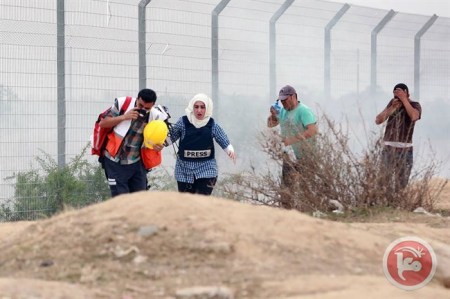
Similarly, cameraman of Palestine Today news agency Dawood Abu al-Kas was hit with a rubber-coated bullet in the foot while covering clashes near the border opposite to the Israeli Kibbutz of Nahal Oz in the northeast Gaza Strip.
“I was trying to capture photos while standing near an ambulance more than 300 meters away from the border fence when I was shot,” al-Kas told Ma’an.
Al-Kas highlighted that he was wearing a flak-jacket marked “PRESS” during the incident.
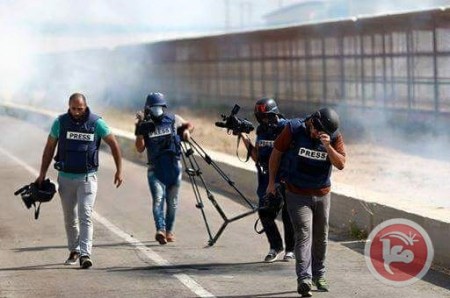
Al-Kas said that having been shot would not deter his efforts to “expose the crimes Israeli occupation commits against the Palestinian people.”
The deputy speaker of the Union of Gaza Journalists, Tahsin al-Astal, said Israeli assaults against journalists are consistent with Israeli violations of Palestinian rights in general.
“The Israeli occupation carries out systematic assaults against journalists who work in the field to prevent them from telling the truth about the crimes the occupation forces are committing against the Palestinian people,” al-Astal said.
“These serious breaches are classified war crimes and violations to international treaties and conventions,” he said.
Al-Astal added that the Union of Gaza Journalists, “has updated the International Federation of Journalists of the terrorism against Palestinian journalists at the hands of Israeli occupation forces.”
The IFJ, he said, is expected to issue a press release condemning “Israeli crimes and breaches against our people.”
Settler shoots, critically injures Palestinian near Gush Etzion
Ma’an – October 25, 2015
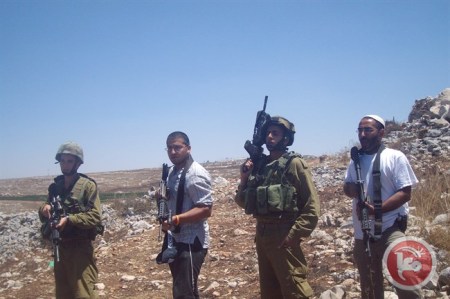
BETHLEHEM – An Israeli settler shot and seriously injured a young Palestinian man on Sunday morning in the Wadi Sair area near the illegal Israeli settlement bloc of Gush Etzion and Sair village, east of Hebron, Palestinian security sources said.
Additionally, the mayor of nearby Sair village reported that seven Palestinians in the village had been shot and injured following the incident.
The settler who shot and critically injured the Palestinian man claimed, according to Israeli reports, that a Palestinian attacked him with a knife.
Palestinian security sources told Ma’an that an Israeli settler shot 20-year-old Azzam Azmi Shalalda four times while he was in his agricultural field, after the actual person suspected of carrying out the alleged attack had reportedly already fled the scene.
After the shooting, Shalalda was evacuated to al-Mamoon clinic in nearby Sair for first aid, before he was taken to al-Ahli Hospital in Hebron. Medics say he is in a critical condition. Shalalda is from the Sair village.
An Israeli army spokesperson said a Palestinian suspect attacked a 40-year-old Israeli after the Israeli man had stepped out of his car to confront Palestinians who were allegedly throwing stones at passing vehicles.
Israeli media outlets reported that the 40-year-old settler was evacuated to Hadassah Hospital in Ein Karem after he was stabbed. He reportedly sustained moderate wounds.
An Israeli army spokesperson said that the alleged Palestinian “assailant fled from the scene,” adding that the reports were initial. The spokesperson had no information of a Palestinian shot or detained during the incident.
Mayor of Sair village, Kayed Jradat, told Ma’an that following the incident, Israeli forces raided Sair village and shot and injured seven Palestinians during the raid.
Doctor Zuheir Jaradat, who works at the town’s al-Mamoon clinic, said one of the victims sustained serious wounds as he was shot in the eye, while another man was hit with a live round in his thigh and was taken to hospital as well.
During the raid, Israeli forces inspected cars and checked the identities of villagers.
Jradat added that Palestinians in the village closed their stores out of fear of attacks by Israeli forces.
An Israeli police spokesperson said the area had been closed off.
Palestinian witnesses told Ma’an that Israeli forces chased a Palestinian vehicle between the southern West Bank towns of Sair and al-Shuyoukh after the incident. They highlighted that the alleged stabber had fled the scene, and an Israeli settler shot another young Palestinian man who had been working in nearby fields.
Hamas: Kerry’s statements boost Israeli hegemony over al-Aqsa
Palestine Information Center – October 25, 2015
GAZA – Hamas has deemed remarks by U.S. Secretary of State, John Kerry, an attempt to quell the ongoing Palestinian intifada and consolidate Israeli domination over the holy Al-Aqsa Mosque.
On Saturday, the Islamic Resistance Movement, Hamas, slammed Kerry’s remarks in which he signaled Netanyahu’s commitment to allow Muslims to pray at Al-Aqsa Mosque while granting non-Muslims the right to visit the holy site.
The group said Kerry’s remarks come as an attempt on part of the United States to help the Israeli occupation find a way out of the crisis it faces as a result of the Palestinian uprising.
The Movement noted that the declaration equates Muslim prayer rights with visitation rights for non-Muslims and could be used to justify provocative and sacrilegious break-ins by Israeli extremist settlers.
Hamas added that the vague language of the declaration gives Netanyahu the opportunity to maneuver and renege on any commitments in an attempt to pave the way for grabbing hold of the holy Mosque.
Hamas urged the PA president Mahmoud Abbas and the Jordanian authorities to turn down any compromise that gives the occupation the opportunity to violate Palestinian rights at Al-Aqsa or that limits Palestinians’ ability to protect the Mosque.
Hamas called on all Palestinians to watch out for attempts to abort the Jerusalem Intifada and to protect Al-Aqsa Mosque no matter the prices that might have to be paid.
Syria’s president ready to take part in new election: Russian MP
Press TV – October 25, 2015
A Russian legislator says Syrian President Bashar al-Assad has expressed preparedness to run for another seven-year term in office in the future presidential election should the Arab nation support such a move.
“He is ready to conduct elections with the participation of all political forces who want Syria to prosper,” Russian lawmaker, Alexander Yushchenko, said following talks with Assad in Syria’s capital, Damascus, on Sunday.
Yushchenko added that the Syrian leader is ready to take part in the polls “if the people are not against it.”
“At our meeting, Mr. Assad announced his readiness to discuss changes to the Constitution of Syria, as well as hold free parliamentary elections with the participation of all political forces committed to the prosperity of the Syrian Republic,” the Russian parliamentarian pointed out.
He noted that Assad drew a parallel between the ongoing events in Ukraine, and the current situation in Syria, saying, “Although these countries are different, the architect behind what is happening today is the same. Nationalists in Ukraine and Daesh terrorists are receiving orders from one center.”
Assad secured a landslide victory in Syria’s last presidential elections on June 3, 2014. The poll was held in government-held areas, and amid high security.
Syria’s parliament speaker, Jihad al-Laham, said Assad had garnered 88.7 percent of the votes, while his two challengers, Hassan al-Nouri and Maher Hajjar, won 4.3 percent and 3.2 percent respectively. The supreme constitutional court put turnout at 73.42 percent.
The foreign-sponsored conflict in Syria, which flared in March 2011, has claimed the lives of more than 250,000 people and left over one million injured, according to the United Nations.
The world body says 12.2 million people, including more than 5.6 million children, remain in need of humanitarian assistance. The foreign-sponsored militancy has displaced 7.6 million people.
Featured Video

Chinese jet fuel and the myth of energy independence
or go to
Aletho News Archives – Video-Images
From the Archives
The Dirty Little Secret behind the “Global Terrorism Index”
The Omission of Israeli Terrorism in the Occupied Palestinian Territories
By Karin Brothers | Global Research | December 6, 2014
… The Israeli settlements — all of which are illegal – have been identified as a major impediment to peace. The refusal of a major “global” terrorism report to name the Israeli settlers as one of the groups most responsible for terrorism not only misrepresents a major source of regional violence but exposes the Global Terrorism Index as a propaganda tool that supports a U.S. agenda.
In recent years, governments have been attempting to thwart terrorism by blocking supportive fund-raising. When it comes to Israeli settlements, however, the US and Canada actually encourage fund-raising by giving organizations (such as Christian Friends of Israeli Communities (CFOIC) and the Jewish National Fund) financial support in the form of donor tax-deductions.
Charities which provide funds for the Israeli settlements should be regarded as terror-financing organizations. They should not only lose their tax-deductible status, but they should be banned because they support the violation of international humanitarian law. The terror-financing laws that are being strictly enforced for Muslim charities should be applied to Christian and Jewish charities as well. … Read full article
Blog Roll
 Aletho News
- Chinese jet fuel and the myth of energy independence
- Ukraine Sea Drone Fired From Libya Hit Russian Tanker in Mediterranean
- IRGC: Iranian forces launched no attacks during ceasefire hours
- Trump Administration Moves To Automate U.S. Military Draft Registration
- Spain orders reopening of Tehran embassy, condemns Israel’s carpet bombing of Lebanon
- Israel faces ‘unsustainable’ strategic crisis following 40-day war against Iran: Analyst
- Iran restricts Hormuz access to 15 vessels per day under ceasefire terms: Report
- The ‘Opposition Party’ Has Done Nothing to Stop the Iran War and Much to Goad Trump Into Continuing It
- Moscow backs Tehran on status of Lebanon in US-Iran deal
- How UK Regulator Ofcom Quietly Bypassed International Law to Police American Speech
- If Americans Knew
- Amnesty: Urgent – Protect Lebanese civilians from brutal escalation in Israeli attacks
- Is The War Against Iran Over?
- Inside the Israeli army’s propaganda wing
- Hundreds of Gaza Amputees Stranded in Legal Limbo
- The gallows law: Israel moves toward executing Palestinian children
- Tucker Carlson: The Path to Peace requires ending ‘special alliance’ with Israel
- This is ceasefire? Israel’s biggest massacre yet in Lebanon, another journalist killed in Gaza – Daily Update
- Tucker Carlson on Israel: This Is the Behavior of an Ally? Really?
- Gazans face a triple crisis: severe shortages of water and bread, healthcare in tatters
- NY Times reports how Netanyahu took the US into Iran War
- No Tricks Zone
- An Inconvenient Tree: Uncovered In Alps… Europe Much Warmer Than Today 6000 Years Ago
- New Study Reports A 60% Slowdown In Greenland’s Ice Loss Rate In The Last Decade
- Low Intensity Tornado Wrecks Major Solar Farm, Creating A Potential Toxic Dump
- New Study Finds Warming Saves Lives…Cold Temperatures 12 Times More Deadly Than Excess Heat
- German Science Blog Accuses PIK Climate Institute Of Hallucinating Climate Tipping Points
- Devastating Assessment Of Comirnaty Vaccine By Former Senior Pfizer Europe Toxicologist
- New Study: CO2 Is ‘Effectively Negligible’ As An Explanatory Climate Change Factor Since 2000
- Former Pfizer Toxicologist Dr. Helmut Sterz Tells Bundestag Hearing Pfizer Vaccine Should Have Never Been Approved
- Energy Expert: Germany’s Nuclear Phaseout Was A “500 Billion Euro Mistake”
- New Research: South Australia’s Mid-Holocene Sea Surface Temperatures Were 4°C Warmer Than Today
 Aletho News