Israeli Woman Stabbed in Retaliation for Killing of Palestinian Girl
Al-Manar | November 23, 2015
A Palestinian man stabbed and killed an Israeli woman on Sunday, after occupation police and settlers shot and ran over a Palestinian girl on the same day.
The attack took place near the so-called Gush Etzion block of settlements south of al-Quds.
The Palestinian attacker was shot dead by occupation forces afterwards, Israeli police said. He was identified as Issam Thawabteh, 34, from Beit Fajjar near Bethlehem.
The Israeli woman was stabbed in retaliation for the brutal killing of a 16-year-old Palestinian girl who was shot and run over by occupation police and Zionist settlers earlier on Sunday.
Also on Sunday another Palestinian was shot dead by occupation police, who claimed he was attempting a stabbing attack against occupation forces.
Guardian admits its cowardice over Paris
By Jonathon Cook | The Blog From Nazareth | November 23, 2015
From the horse’s mouth: For fear of upsetting readers, the paper silenced any commentary in the first days after the Paris attacks that might have suggested there was a causal relationship between western foreign policy in the Middle East and those events.
Instead, writes the Guardian reader’s editor Chris Elliott, the paper waited several days before giving some limited space to that viewpoint:
On the Opinion pages, one factor taken into consideration was timing – judging when readers would be willing to engage with an idea that in the first 24 hours after the attacks may have jarred. The idea that these horrific attacks have causes and that one of those causes may be the west’s policies is something that in the immediate aftermath might inspire anger. Three days later, it’s a point of view that should be heard.
In other words, the liberal Guardian held off offering a counter-narrative about the attacks, and a deeply plausible one at that, until popular opinion had hardened into a consensus manipulated by the rightwing media: “the terrorists hate us for our freedoms”, “we need to bomb them even harder”, “Islam is a religion of hatred” etc.
Excluding legitimate analyses of profoundly important events like those in Paris when they are most needed is not responsible, careful journalism. It is dangerous cowardice. It is most definitely not a politically neutral position. It provides room for hatred and bigotry to take root, and allows political elites to exploit those debased emotions to justify and advance their own, invariably destructive foreign policy agendas.
In the paragraph above, Elliott happily concedes that this is the default position of mainstream liberal media like the Guardian.
South Korea Holds Live-Fire Drill Near Disputed Border With North
Sputnik – 23.11.2015
South Korea conducted artillery exercises on Monday near a disputed Yellow Sea border with North Korea, despite Pyongyang’s promise to retaliate for the drill, media reported.
According to South Korea’s Yonhap news agency, live-fire artillery drills were conducted near the front-line islands of the inter-Korean maritime border.
On the eve of the artillery exercises Pyongyang warned Seoul that it would retaliate if South Korea dropped shells in North Korean territorial waters.
Current artillery drills coincide with the 5th anniversary of North Korea’s attack on South Korean front-line Yeonpyeong Island that left two soldiers and two civilians dead. Pyongyang announced at the time that it had been provoked by similar live-fire drills in the area.
The United Nations named the Yeonpyeong exchange one of the most serious incidents since the end of the Korean War in 1953. The two countries, still legally at war since that time, have only an armistice in place following the collapse of peace treaty negotiations.
Global gas demand to grow 32% by 2040 – Putin
RT | November 23, 2015
World demand for gas is growing faster than any other energy source, and will grow by a third in the next 25 years, according to Russian President Vladimir Putin.
“The growing demand opens up great opportunities for increasing production and exports of gas. At the same time, it’s a major challenge, because there’s a need to dramatically accelerate the development of new deposits, modernize the refining capacities, expand gas transportation infrastructure, bring into operation additional pipelines and make new LNG routes”, said Putin at a Gas Exporting Countries Forum in Tehran on Monday.
According to Putin, Russia seeks to increase its gas output by 40 percent by 2035, reaching 885 billion cubic meters. One of the biggest tasks ahead of Russia is to boost the supplies of gas to China, India and other Asian countries from the current 6 percent to 30 percent, said Putin. Kremlin also intends to triple the LNG supplies. He added that Russia would be able to deal with all these tasks.
During his visit, Putin is meeting with Iranian leaders. He’s talked to Supreme Leader Ali Khamenei about energy cooperation, Syria and other key issues. Putin’s also meeting Iran’s President Hassan Rouhani.
Argentina’s New President Poised to Roll Back Gains for Multipolar World
Sputnik – November 23, 2015
On Sunday, Argentina held a runoff vote to pick its next president, resulting in a narrow victory for conservative Let’s Change coalition candidate Mauricio Macri over his center-left Front for Victory coalition opponent, Daniel Scioli. The question on everybody’s mind now is: what should Argentinians, and the world, expect from the new government?
An estimated 80% of Argentina’s 32 million eligible voters went to the polls on Sunday to elect their next president, in a runoff vote between the two leading candidates from the first round of voting, held in late October. With 51.5% of the votes cast in favor of conservative candidate Mauricio Macri, the favorite of the country’s big business and private media, the country is set for a hard right turn.In the run up to the election, analysts in both Latin America and across the loose global coalition of countries opposed to a unipolar world order had worryingly suggested that a Macri victory would result in a rollback to the policies pursued by Buenos Aires over the past decade aimed at challenging US hegemony, both in the region and around the world.
Daniel Scioli, the candidate of the Peronist, center-left Front for Victory electoral alliance, had promised to continue outgoing President Cristina Fernandez’ center-left-oriented politics domestically, and to pursue an independent foreign policy course abroad.
Throughout Fernandez’ tenure (she was elected in 2007) and that of her late husband, Nestor Kirchner (elected in 2003), Argentina had aligned itself with the string of left-wing Latin American governments emerging in the region in the early 2000s, while pushing for new economic and political ties with the BRICS countries, including Russia and China. Now, with Macri’s victory, the country’s multipolar outlook is under threat.
At the moment, Russian-Argentinian political and economic ties are believed to be at historic highs, characterized by the Russian ambassador to Buenos Aires as “excellent” and “extremely constructive and trusting.” Earlier this year, ahead of Fernandez’ official state visit to Moscow in April, Argentina’s Ambassador to Russia, Pablo Anselmo Tettamanti, went so far as to describe relations to be at the highest levels they have ever been in the countries’ 130-year-long history of bilateral relations.
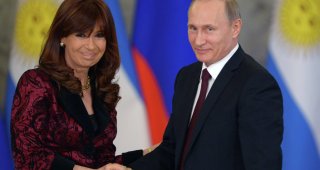 During her visit to Russia, President Fernandez met with President Vladimir Putin, signing over 20 memorandums on economic cooperation, said to amount to an “all-encompassing strategic partnership.”
The agreements included joint projects on the development of hydroelectric, nuclear and fossil-based energy in Argentina, including the construction of the sixth bloc at the Atucha nuclear power plant, along with a $2 billion memorandum on the construction of a new hydroelectric dam. Meanwhile, Russian energy giant Gazprom signed a memorandum on the exploration and development of gas fields with Argentine state gas company YPF, a deal amounting to $1 billion in investments. Russian company Uralmash was also tapped to build a plant manufacturing oil extraction equipment, amounting to an additional $1.9 billion in investments.
In the course of the visit, the two sides promised to conduct consultations on the use of each other’s national currencies for trade, pledging to increase cooperation in the military-technical sphere, accelerating construction of the GLONASS satellite navigation systems, and negotiating on the prospects of increasing bilateral food trade (presently amounting to about $1.3 billion).In the sphere of political cooperation, President Fernandez voiced her support for Moscow’s position that the situation in Ukraine could only be resolved by peaceful means, with the Russian president, for his part, pledging support for “Argentina’s striving for direct talks with Britain to achieve prompt resolution to the Mavinas [Falklands] Islands dispute.”
Visiting Moscow in July, Argentinian Vice President Amado Boudou emphasized that Argentina’s diplomatic moves toward improving relations with Russia were based on the fact that the two countries “share a very strong position with a common vision of the need for a multipolar world to ensure the existence of an inclusive and autonomous policy.”
Now, following Macri’s election victory, Argentina’s strategy of promoting regional integration in Latin America, and a multipolar world order, may be coming to an end. With Mexican economist Ariel Noyola Rodriguez suggesting only months ago that the Russian-Argentinian partnership signaled “Washington’s incapacity to sabotage the construction of a multipolar world,” it seems that the analyst may have spoken too soon.
With Fernandez (and her husband before her) becoming a major thorn in Washington’s side, the latter unhappy over the Peronists’ efforts to extract the country and the region from its subservient position in the US’s so-called ‘backyard’, the election of Macri, who promised to immediately improve relations with Washington, must come as a welcome change.
The conservative politican has already hinted that he would give less weight to Mercosur –the South American trade bloc aimed at ensuring regional economic integration and development, and shift the country’s diplomacy away from close cooperation with the leftist governments of Venezuela, Bolivia, Ecuador and Brazil.
And while his victory may not nullify the economic and other cooperation agreements reached with Russia, China, and other BRICS countries over the past decade, it does threaten Buenos Aires’ general trajectory of development –the country’s moves toward regional integration and a multipolar world independent of Washington’s influence.
For the Argentinian People: A Return to Neoliberalism?
As far as the Argentinian people are concerned, Macri’s victory is feared by his critics to mark a throwback to neoliberal dogmas which plagued the country prior to Kirchner’s 2003 election victory.
For their part, the British and American business press couldn’t help but gloat in the moment, with Financial Times suggesting it was “the beginning of a new political era for South America’s second-largest economy,” and The Wall Street Journal trash-talking Fernandez and her party, and suggesting that her economic policies, “uncivil rants against her political opponents, and a substantial loss of judicial independence and press freedom during kirchnerismo” contributed to Scioli’s defeat. Bloomberg Business, naturally, focused on the election’s effects on the markets, finding it crucial to point out that “in anticipation of a Macri victory, bond yields fell to an eight-year low and the local stock market rallied to a record high.”
But not everyone is convinced that this ‘new political era’ will bring positive changes, at least for ordinary Argentinians. In the run up to the voite, Scioli and his supporters warned that Macri’s proposals, which promised a return to neoliberal economic policies, would amount to “savage capitalism,” eroding social welfare and creating an economy which catered to a wealthy minority.
It’s worth recalling that before the Kirchners, Argentina was viewed as a textbook example of a developing country enveloped by the so-called Washington Consensus, a set of neoliberal economic dogmas which resulted in extremely high unemployment (over 25% in 2003), high poverty rates (nearly 55%), and a high Gini index.Under Kirchner and Fernandez, the country pursued social and economic policies that amounted to the creation of a mixed Keynesian economy, promoting government intervention where necessary, support for medium and small businesses, and a push for export growth via regional economic integration.
According to pan-Latin American news channel Telesur, these efforts resulted in the reduction of unemployment to 6.6% in 2015 (with 5 million jobs created over the past ten years), the reduction of poverty from over 50% to 6.5%, the creation of 50,000 small and medium-sized businesses, a major industrialization drive via the Industrial Parks National Program, increases in the share of GDP spent on education and pensions (from 3.6% and 4.1% in 2003 to 6.5% and 7.7% of GDP in 2013, respectively), and the near doubling of public investment, all the while reducing the national debt from 166% of GDP in 2003 to 41%.
In the areas of social policies, Kirchner and Fernandez began a comprehensive reform of the country’s justice system (making the Supreme Court independent), while annulling the ‘laws of pardon’ which gave immunity to the leaders of the country’s military dictatorship of 1976-1983 accused of crimes against humanity. The country also became the first in Latin America, and the tenth in the world, to pass equal marriage laws, in 2010.
Now, these gains, which came at a cost of high inflation (offset to an extent by annual negotiations between unions, employers and employees on adjusting wages) are under threat, with Macri’s critics saying his policies (including tax cuts, social spending cuts, and privatization schemes) will favor big business and the country’s oligarchs, sidelining the problems of social inequality, and reverting the country to its 90s’ era social and economic malaise.
Critics have also pointed to Macri’s promises of beginning negotiations with the predatory ‘vulture fund‘ creditors that rejected the debt restructuring which took place following the country’s default in 2002, giving an indication not only of his upcoming domestic economic policy, but also his possible subservience to the Western-dominated economic institutions which Argentina rejected under the Kirchners.Ultimately, only time will tell whether Argentina’s new government will continue to pursue policies based on economic and political pragmatism which have brought Buenos Aires closer to those countries looking to challenge global unipolarity (with some analysts already suggesting that they will).
As far as Argentina itself is concerned, it remains unclear how a return to the neoliberalism which devastated the country’s economy in the early 2000s will do it any good. As Russian social media users commenting on the election results lamented, it seems that too many Argentinians have forgotten the neoliberal catastrophe and ‘de-sovereignization’ of the 90s, processes which Russians themselves know all too well.
Cheap Gas Is Killing Nuclear Power, and the Outlook is Grim
Nuclear’s greatest hope may be the ‘Clean Power Plan’
By Thomas Overton – POWER magazine– 11/17/2015
Another month, another premature nuclear plant retirement.
About two weeks ago, Entergy finally threw in the towel on the James A. FitzPatrick Nuclear Power Plant in Scriba, N.Y., a move that came as a surprise to exactly no one who has been paying attention to the merchant nuclear business in the U.S. the past few years. FitzPatrick joined the long-troubled Pilgrim plant in Plymouth, Mass., which Entergy gave up on in October, and Vermont Yankee, which it shut down in late 2014.
Since the end of 2012, the U.S. has lost an astonishing eight nuclear reactors to premature retirements: Kewaunee, San Onofre (2), Crystal River, and Vermont Yankee (all now shut down); FitzPatrick (retiring in late 2016); and Pilgrim and Oyster Creek (both retiring in 2019, well ahead of their planned lifetimes).
Several other reactors are on life support. Exelon’s R. E. Ginna plant in Ontario, N.Y., has been fighting to secure a rate support agreement that would keep it running a few more years, while the company’s Quad Cities and Byron plants got a reprieve after they unexpectedly cleared PJM auctions this fall. Industry observers see anywhere from five to 10 other plants as being at risk of premature retirement.
Death Knell?
What’s remarkable about this trend is how it’s come about not from government pressure or mandates as in Germany or Japan—where nuclear is also in retreat—but from pure market pressures. In mid-2013, I wrote a post asking, “Is Cheap Gas Killing Nuclear Power?” Two years later, I’m prepared to answer that question in the affirmative.
In the case of Pilgrim, FitzPatrick, and Vermont Yankee, Entergy specifically named wholesale power prices driven to record low levels by cheap shale gas as one factor in its decisions. As my colleague Kennedy Maize has noted, observers now strongly suspect that Entergy is planning to exit the merchant nuclear business altogether—because it’s clearly become a big money-loser.
If you look at the list of retired and most at-risk plants, one common element jumps out immediately. Most of them exist in deregulated markets where power prices are largely set by the price of natural gas: ISO-New England (Vermont Yankee and Pilgrim), New York ISO (FitzPatrick and Ginna), and PJM (Oyster Creek, Byron, and Quad Cities). The other two plants, San Onofre and Crystal River, operated in more regulated markets, and while both were retired because of mechanical defects that were too expensive to repair, competition from gas-fired generation factored into both decisions to some degree.
Since 2012, when the problems for merchant nuclear really began, natural gas spot prices have stayed below $4/MMBtu except for a brief period last year, when a bitterly cold winter led to low stocks that pushed things up for a few months.
Since then, prices have fallen consistently, flirting with sub-$2 levels this fall. With gas in storage hitting a record high at the end of this year’s injection season, a repeat of 2014 seems unlikely. Meanwhile, gas production hit another record high in August at 81.3 Bcf/day. None of this, according to Energy Information Administration projections, seems likely to change in the short term, as production stubbornly continues climbing ahead of demand growth.
Where is nuclear still viable? That’s best answered by looking at the three states where a total of five nuclear plants are under construction: Georgia, South Carolina, and Tennessee. The common denominator there is clear. All three projects are being built in tightly regulated markets where the utility building them enjoys a government-sanctioned monopoly and the ability to recover costs in advance of operation.
Killing Nuclear
The problem for nuclear is that momentum in the electricity markets over the past couple of decades has been toward flexibility and competition and away from monopolies and subsidies.
At the state level, attempts by Exelon and others to secure changes in the law to provide greater support for nuclear have been given the cold shoulder, while solar advocates are prying open previously closed markets like the Carolinas and Florida. Despite the challenges for merchant nuclear plants, no states are even considering an exit from problematic wholesale power markets, and independent system operators like PJM have shown no interest in rigging the game for nuclear either.
At the federal level, the Production Tax Credit and Investment Tax Credit, which provided enormous support for renewable generation, appear on their way out one way or another. The odds that the current Congress might pass some sort of nuclear production credit (an idea I mentioned in my 2013 post) would seem to be close to zero.
Nuclear’s greatest hope may be the Clean Power Plan (CPP)—which was revised in its final form to give more credit to nuclear generation—but that is far from a done deal. Even if the Democrats retain control of the White House in 2016, control of Congress is another matter, and the Supreme Court could still throw out or handicap the CPP on a variety of grounds.
Cheap gas is not going away. Greater state-level regulatory support seems highly unlikely. Even if the CPP survives in its current form, it won’t substantially change the economics of merchant nuclear.
The impending loss of nuclear generation presents a problem for a variety of reasons. Loss of generation diversity is never a good thing, and the loss of low-carbon electricity will complicate efforts to reduce carbon dioxide emissions. But the solution remains elusive.
—Thomas W. Overton, JD is a POWER associate editor (@thomas_overton, @POWERmagazine).
‘Ukrainian PM should be tried for war crimes’ – Russian investigators
RT | November 23, 2015
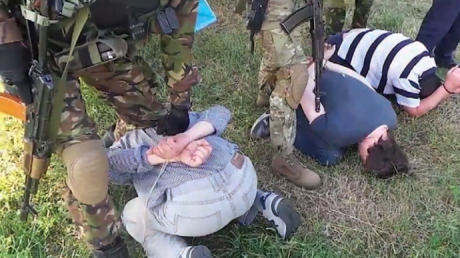
Prime Minister Arseny Yatsenyuk is responsible for numerous war crimes committed by the Ukrainian military and law enforcement and sooner or later will face a trial, the spokesman for Russia’s Investigative Committee has said.
“Yatsenyuk was among many well-known persons, including top military officers, who personally issued orders to fire upon the civilian population of Donbass,” Vladimir Markin said in an interview with Zvezda television.
The Russian official also said that he hoped people from southeast regions of Ukraine would sooner or later put those responsible for war crimes on trial, noting that the trials should take place in the same places where the crimes had been committed. “The very just trial is where the crimes took place,” he said.
Markin added that PM Yatsenyuk must share responsibility with other Ukrainian politicians and businessmen who helped to unleash and wage the war in Donbass. He named the former head of Ukrainian Security Service, Valentin Nalivaychenko, and oligarch Igor Kolomoisky as prime candidates for the war crimes tribunal.
The Russian official also reminded the reporters that the Investigative Committee had already begun a criminal investigation into the Donbass events, charging the yet-unnamed suspects with the genocide of Russian-speaking residents in the Donetsk and Lugansk regions of Ukraine. “The events in Donbass cannot be described by any other term than genocide. This was the reason why we started our probe, including into the genocide which is a crime under Russian criminal law. International law and the Russian criminal code allow us to instigate and investigate criminal cases, to bring to justice people who commit such crimes,” Markin said.
In September this year, the head of the Investigative Committee, Aleksandr Bastrykin, said in an interview to the media that his agency had started a criminal case into Yatsenyuk’s alleged participation in the war in Chechnya on the side of terrorists, as well as in tortures and executions of Russian prisoners.
In March last year, the Investigative Committee began a criminal investigation into Dmitry Yarosh, the leader of the Ukrainian extreme nationalist movement Right Sector, which was one of the main driving forces behind the Maidan unrest and the subsequent war in Donbass. In Russia, Yarosh faces charges of publicly calling for extremist activities.
BBC: Inform, Educate And Confuse
Global Warming Policy Forum – 18/11/15
It was with a sense of optimism tinged with experience that I sat down to listen to BBC Environment Analyst Roger Harrabin’s first of his three part series on the climate timed to coincide with forthcoming Paris talks. I know how such programmes are put together, how interviews are solicited, conducted, edited and juxtaposed to form a narrative. I also know the subjectivity involved.
At the start we get an American politician who doesn’t believe that mankind has any influence on the climate and who is also a creationist. Her inclusion concatenated climate change “sceptism” with a denial of evolution. There was no need to have her in the programme at its start except to place in the listener’s minds such an association, which was not shared by anyone else in the programme.
Near the beginning of the programme Roger Harrabin said; “Out and out rejection of climate science has mostly passed.” This is a straw man. In reality, only a very few rejected climate science, and they were regarded by most who took an interest in climate science as being eccentric, irrelevant and wrong. Their importance was often exaggerated as many in the media paraded them as being representative of the “sceptic” movement. For many years anyone who was regarded as having non-mainstream views (often arbitrarily judged) was obliged to go through the ritual of admitting that the world has warmed, that carbon dioxide was a greenhouse gas and that mankind was responsible for the carbon dioxide increase, despite these being commonly accepted and not part of the real debate. A few years ago the presenter on a BBC TV programme introduced Lord Lawson and added that for the purposes of the discussion they are all assuming that carbon dioxide is a greenhouse gas! Thankfully that loaded question had been assigned to the past until Roger Harrabin’s programme that is when Matt Ridley went through this credo.
Matt Ridley is described as a lukewarmer in that he favours the lower end of estimate of transient climate response, TCR (1.5°C – 4.0°C). There is nothing unusual in holding that view as it is held by many “mainstream” climate scientists. So much so that the IPCC reduced the lower bound of TCR from 2.0°C to 1.5°C in response to debates about TCR in the scientific and “sceptic” community.
Later in the programme another contributor introduced another illogical twist. She said she prefers “lukewarmist to climate denial,” as if there was a choice between the two. The implication is that deniers have become lukewarmists which is absurd. Roger Harrabin says Ridley now finds himself inside the IPCC’s big tent but misses the point that it was the IPCC that changed. Interesting isn’t it, Matt Ridley is still a lukewarmer, and not acknowledged as being within the mainstream even when Ridley’s views agree with the IPCC (the epitome of “mainstream” science opinion and “consensus”). Being a “sceptic” or a “lukewarmer” seems to be more about where you come from than the scientific views you hold.
Stubborn, Simplistic
It was also said that the debate about climate science has moved on from the stubborn and simplistic and onto what to do about it. Again, this is incorrect. The main motivation for scientists and “sceptics” is to find out what is exactly going on, and as we find out more we realise that some of we thought was wrong and that there is so much more we don’t know. For example, today we have a different view of decadal climatic variations compared to forced variations than we did a decade ago, and improving our understanding of such variations is essential to contemplating what to do. If anyone thinks the debate has been “stubborn and simplistic” they are mistaken.
Then we have a nice example of doublespeak. A professor states an opinion about climate science and then says there is too much uncertainty to decide if his opinion is correct! Another point is that lukewarmers do not, as a whole, say that the “pause” in annual average surface temperature is because we exaggerated the heating effect of carbon dioxide in the atmosphere. Another contributor was irked by the “media focus” on the “pause.” Presumably she is also somewhat irritated by those scientists who are constantly coming up with explanations for it, more than 35 at my last count, most of which are unreported by the media. She adds that she always knew it would rise in fits and starts so perhaps the real problem was that there was not enough media focus on this in the 1990′s when the world warmed fairly rapidly!
Then we have reference to the loss of sea ice in the Arctic referring to the 2007 low. Perhaps the contributor and the programme’s editor is unaware with what has been happening to Arctic ice cover in the past few years?
Roger Harrabin then talks of those suffering from extreme weather events after the 1°C increase already experienced. This is a controversial area in the journals but is also a subject on which the IPCC has already proclaimed: There is no increase in extreme weather events as a result of climate change.
Roger Harrabin concluded the programme by saying that the world’s warming is largely driven by humans. Yet the IPCC AR5 says; “It is extremely likely that more than half of the observed increase in global average surface temperature from 1951 to 2010 was caused by the anthropogenic increase in greenhouse gas concentrations and other anthropogenic forcings together. The best estimate of the human induced contribution to warming is similar to the observed warming over this period.”
The observed warming since 1950 is about half of the warming observed since pre-industrial times so without mentioning timescales Roger Harrabin’s statement is misleading. It seems that one can refer to post-1950 or pre-industrial periods without qualification to get a good quote.
Thus at the end Roger Harrabin abandons mainstream science and consensus altogether in a programme supposed to be about the science of climate change. Overall the broadcast was an intellectual shambles. It is a rewriting of history worthy of the reporting of the war between Oceania and Eurasia.
Feedback: david.whitehouse@thegwpf.com
Climate talks in Paris: India to stay firm on use of coal
By Amitabh Sinha | The Indian Express | November 19, 2015
While India has embarked on an ambitious renewable energy pathway, coal is likely to remain its primary source of energy for the next couple of decades at least.
India will not agree to any proposal at the climate change negotiations that will seek to restrict the use of coal as a source of energy in the near term, a key member of the country’s negotiating team said on Wednesday.
More than 190 countries will gather in Paris later this month for a two-week annual climate change conference that is expected to deliver a global agreement this year.
“We cannot agree to any proposal that will restrict our ability to generate energy from coal or inhibit our efforts to ensure energy access to all our people in an accelerated manner,” Ajay Mathur, director general of Bureau of Energy Efficiency, told The Indian Express.
While India has embarked on an ambitious renewable energy pathway, coal is likely to remain its primary source of energy for the next couple of decades at least.
In a recent projection, the government had said it hoped to bring down its dependence on coal for electricity production from the current 61 per cent to 57 per cent by 2031-32. By that year, the contribution of renewable energy — solar, wind and biogas — in total electricity generation was projected to grow to 29 per cent from the current 12 per cent.
“There is no looking away from it. Coal is going to remain India’s primary source of electricity generation for some time. We cannot agree to anything that restrains us from using coal,” he said.
Mathur said that in Paris, India will ask for a more stringent international mechanism to ensure that the developed countries deliver on the commitments they have made to reduce their greenhouse gas emissions. In the last few months, countries have submitted their climate action plans — steps that they intend to take to deal with climate change — up to the year 2032. There is debate over the mechanism to be adopted to assess whether all the actions are consistent with the objective of keeping the rise of global average temperatures within 2 degree celsius compared to pre-industrial times.
The climate change negotiations accept a principle of differentiation in the responsibilities of developed and developing countries in dealing with climate change. Mathur said this differentiation must extend to the compliance process as well.
“The assessment of the developed countries’ actions must be subjected to a stronger review as compared to other countries,” Mathur said.
Time to Defund the International Criminal Court
By David Hoile | Dissident Voice | November 22, 2015
The Assembly of States Parties is meeting this month in The Hague to review the work of the International Criminal Court and to discuss the ICC’s budget. The ASP is the International Criminal Court’s management oversight and legislative body. The Assembly also elects the judges and prosecutors and decides the Court’s budget. The court’s proposed budget for 2016 amounts to €153.32 million, representing an increase of €22.66 million, or 17.3 per cent, over the 2015 approved budget. At face value, far from increasing the budget for the ICC, the Assembly of State Parties should be demanding a refund.
Established in 2002, the ICC is an impotent billion euro white elephant. 2015 has been a particularly bad year for the court. It has botched the Kenyan cases it has undertaken and its continuing alienation from Africa was centre-stage internationally when South Africa, previously a keen member, publicly ignored ICC arrest warrants and appears on the verge of withdrawal from the organisation – something seen by observers as a death knell for the court.
The International Criminal Court has self-evidently failed across the board. In 2010 the ICC-friendly Economist had already found it necessary to publish an article about the ICC entitled “International justice: Courting disaster?” Things have worsened considerably since then. The ICC has consumed more than a billion euros in its 13-year existence and has only secured two deeply questionable convictions. The ICC’s claims to international jurisdiction and judicial independence are institutionally flawed and the court’s reputation has been irretrievably damaged by its racism, blatant double standards, hypocrisy, corruption and serious judicial irregularities. The Assembly of State Parties should also accept that it has grotesquely neglected its responsibility to manage the court. The ASP has turned a blind eye to systemic failure on the part of the ICC.
While the ICC pretends to be the world’s court this is simply not the case. Its members, however, represent under one-third of the world’s population: China, Russia, the United States, Pakistan and Indonesia are just some of the many countries that have remained outside the court’s jurisdiction. India, the world’s largest democracy, has chosen not to join the ICC because the court is subordinate to the United Nations Security Council and because it does not criminalise terrorism and the use of nuclear weapons. The United States has forcefully pointed out that the ICC is a kangaroo court, a travesty of justice open to political influence, and has said that no American citizen will ever come before it. That said, Washington is perfectly happy when it suits American foreign policy objectives to demand that black Africans appear before a deeply flawed court peddling sub-prime justice.
The ICC pretends to be independent. Far from being an independent and impartial court, the ICC grants special “prosecutorial” rights of referral and deferral to the UN Security Council – by default its five permanent members (three of which are not even ICC members). The court is also inextricably tied to the European Union which provides over 60 percent of its funding. The ICC has come to be seen within Africa very much as a European-funded and directed instrument of European foreign policy. The Office of the Prosecutor, for example, has to date received approximately 9,000 complaints about alleged crimes in 139 countries. From these almost nine thousand alleged instances of serious abuses of human rights, the ICC has acted in eight African “situations”, and indicted 39 Africans, to the exclusion of any complaints implicating white Europeans and North Americans or their protégés. The ICC has turned a blind eye to self-evident human rights abuses well within its jurisdiction in Iraq and Afghanistan. Afghanistan is an ICC member state. As a result the court can investigate alleged war crimes committed by citizens of any country, ICC Member State or not, within its borders. Tens of thousands of civilians have died and well over one hundred thousand have been injured in the conflict in Afghanistan, many of them at the hands of NATO and US forces. The ICC has however ignored any allegations of war crimes by NATO, US or EU citizens in Afghanistan.
The ICC promised “swift justice” but took several years to bring the first accused to trial for allegedly using child soldiers. The Nuremberg trials, which addressed infinitely more serious charges, were over and done within a year. The ICC pretends to be victim-centred yet Human Rights Watch has publicly criticised the ICC’s ambivalence toward victim communities. The court promised to usher in a new era of gender justice. Women’s rights specialists such as Professor Louise Chappell have noted that the ICC’s record in this respect “has been partial and inconsistent”, and that “The ICC’s legitimacy is fragile.”
Despite having consumed more than one billion euros the ICC has also shown itself to be stunningly dysfunctional. The court’s proceedings thus far have often been questionable where not simply farcical. At the heart of any judicial process is testimony provided by witnesses. The court has produced witnesses who recanted their testimony the moment they got into the witness box, admitting that they were coached by non-governmental organisations as to what false statements to make. In its first trial, that of Thomas Lubanga, a process that lasted seven years, the judges found all but one of the alleged former child soldiers presented as witnesses by the Prosecution to be unreliable. Dozens of other “witnesses” have either been similarly discredited or disavowed their “evidence”. This hallmark of incompetence continues to this day. Most recently the ICC prosecutor had to admit that one of its own star witnesses in its case against Kenyan Vice-President Ruto was “thoroughly unreliable and incredible”. In reality it is the Office of the Prosecutor that has been revealed to be thoroughly unreliable and unprofessional.
There have been scandalous examples of prosecutorial misconduct, not least of which the ICC Chief Prosecutor hiding hundreds of items of exculpatory evidence, which should have ended any trial because they would have compromised the integrity of any legal process. The ASP has simply stood by doing nothing.
That the International Criminal Court is corrupt is also self-evident. The Shorter Oxford English Dictionary defines “corrupt” as “destroyed in purity, debased; vitiated by errors or alterations.” The Assembly of State Parties is responsible for the appointment of judges to the ICC. It is in the selection of judges that the ASP and ICC have been at their most corrupt. ICC judges – some of whom have never been lawyers, let alone judges – are the result of grubbily corrupt vote-trading within the Assembly of State Parties amongst member states and delegates. The relationship between appointments to the ICC and vote trading between states is an open secret. Selecting International Judges: Principle, Process, and Politics, a ground-breaking study of international judicial appointments, written by Professor Philippe Sands QC, and others as part of Oxford University Press’ International Courts and Tribunals Series, concluded that “the evidence leads unequivocally to the conclusion that merit is not the main driving factor in the election processes.” The study also revealed that “[m]any individuals who participate in the ICC process believe it to be even more politicized than other international judicial elections.” The sheer corruption of the process aside, the reality is that vote-trading results in mediocre judges which in turn leads to a dysfunctional, politicised court.
It is clear that the both the Assembly of States Parties and the International Criminal Court are simply unfit for purpose. Far from granting the ICC yet more money, both the ASP and the ICC should be defunded and disbanded.
Dr David Hoile is the Director of the Africa Research Centre and author of Justice Denied: the Reality of the International Criminal Court, a 610-page study of the ICC. The book is available to read or download at www.africaresearchcentre.org. The author can be contacted by email at africaresearchcentre@gmail.com.
Featured Video

The Source of America’s Wars – Kristol Clear
or go to
Aletho News Archives – Video-Images
From the Archives
Is Israel to blame for the Iraq War?
American Goy | March 10, 2008
I am so tired of this old canard that “Israel had nothing to do with USA’s war with Iraq – in fact, it officially advised America against it”.
Bullshit. … continue
Blog Roll
 Aletho News
- Ceasefire for all or for none: Iran shuts Hormuz over Lebanon attacks
- Strait of Hormuz is Iran’s ‘nuclear weapon’ that forced US retreat: Medvedev
- Energy crisis will last for months – Kremlin envoy
- Europe’s quiet role in the war on Iran
- Forty days that shook the Empire: How Iran turned the tables on US and prevailed
- Netanyahu unilaterally declares Lebanon outside of ceasefire deal
- Israeli leaders: ‘Not a single goal’ achieved in war with Iran
- What on earth just happened? Trump, Iran, and the unlikely ceasefire
- Alberta Bill Would Fine Political Deepfakes $10,000 Without Satire Exemptions
- Iran declares ‘historic victory’ over US, says enemy forced to accept its proposal
- If Americans Knew
- NY Times reports how Netanyahu took the US into Iran War
- A sigh of relief over Iran, but Gaza and Lebanon in dire straits – Daily Update
- Thousands dead and neighborhoods razed to the ground: Aid agencies fear southern Lebanon is becoming the new Gaza
- The war the US is fighting for Israel could cost trillions
- ‘Cigarette Burns, Nail Wounds’: Toddler Tortured in Gaza to Coerce Father
- Trump Says US Sent ‘a Lot of Guns’ to Protesters in Iran
- Israeli forces destroy 17 UN peacekeeper cameras in south Lebanon
- US-Israeli strikes ‘completely destroy’ synagogue in Tehran
- Archbishop for US Military Says Iran War Is Unjust Under Catholic Teaching
- Iranian leaders’ Open Letters to the American People
- No Tricks Zone
- An Inconvenient Tree: Uncovered In Alps… Europe Much Warmer Than Today 6000 Years Ago
- New Study Reports A 60% Slowdown In Greenland’s Ice Loss Rate In The Last Decade
- Low Intensity Tornado Wrecks Major Solar Farm, Creating A Potential Toxic Dump
- New Study Finds Warming Saves Lives…Cold Temperatures 12 Times More Deadly Than Excess Heat
- German Science Blog Accuses PIK Climate Institute Of Hallucinating Climate Tipping Points
- Devastating Assessment Of Comirnaty Vaccine By Former Senior Pfizer Europe Toxicologist
- New Study: CO2 Is ‘Effectively Negligible’ As An Explanatory Climate Change Factor Since 2000
- Former Pfizer Toxicologist Dr. Helmut Sterz Tells Bundestag Hearing Pfizer Vaccine Should Have Never Been Approved
- Energy Expert: Germany’s Nuclear Phaseout Was A “500 Billion Euro Mistake”
- New Research: South Australia’s Mid-Holocene Sea Surface Temperatures Were 4°C Warmer Than Today
 Aletho News