Saudi, UAE Ask Their Citizens to Leave Lebanon
Al-Manar | February 23, 2016
Saudi Arabia has advised its citizens Tuesday against travel to Lebanon and urged those already in the country to leave it, citing “safety” concerns, a few days after it halted military aid to Lebanon.
“The Foreign Ministry calls on all citizens not to travel to Lebanon for their own safety,” the Saudi news agency SPA quoted a ministry official as saying.
“It also urges citizens residing in Lebanon or visiting it to leave and not to stay there unless for utmost urgency while observing vigilance and caution,” the official added.
The ministry also called on Saudis in Lebanon to contact the kingdom’s embassy in Beirut for “the necessary help and attention.”
UAE has also banned its citizens from traveling to Lebanon and decided to downsize its diplomatic mission in the country, according to AFP.
Mogherini warns of possible Turkey-Russia ‘hot war’ over Syria
Press TV – February 23, 2016
The European Union (EU) foreign policy chief has cautioned against the risk of a war with active military hostilities between Turkey and Russia over Syria, where regional powers have sided with warring sides to the conflict gripping the Arab country.
Federica Mogherini issued the warning during a debate at the European Parliament’s Foreign Affairs Committee in the Belgian capital city of Brussels on Tuesday.
“We are always referring to Syria as a proxy war among regional actors,” Mogherini said, adding, however, that the current situation in Syria risks becoming “something bigger”.
“I’m not thinking of a cold war. No, we risk a hot war among different actors than the one we always think of. Not necessarily Russia and the United States, but Russia and Turkey, could be,” she said.
Russia launched its own anti-terror campaign in Syria on September 30, 2015, upon a request from the Damascus government. The airstrikes have expedited the advances of Syrian forces against militants.
On the contrary, Turkey is among the main supporters of militants fighting to topple Syrian President Bashar al-Assad. Ankara has also been accused on numerous occasions of being involved in illegal oil trade with the Takfiri Daesh terrorist group.
All sides to Syria conflict should respect truce
In another development on Tuesday, the Arab League urged all sides to the conflict in Syria to adhere to the terms of a ceasefire deal announced by the United States and Russia the previous day.
The 22-member body said in a statement that Arab League Secretary General Nabil Elaraby believes that the truce will be “an important step towards a political settlement of the Syrian crisis.”
On Monday, Washington and Moscow said the ceasefire has been planned to take effect in Syria on February 27.
Over the past few weeks, Syrian government forces, backed by Russia’s air cover, have managed to gain major positions from the foreign-backed militants.
Netanyahu demands anti-Zionist posters be removed from London Underground
RT | February 23, 2016
Israeli Prime Minister Benjamin Netanyahu has reportedly asked the UK government to have hundreds of posters protesting Israeli occupation of Palestine removed from the Tube.
The Haaretz newspaper reported Tuesday that the Israeli prime minister himself had asked that the posters, which may have been posted in their hundreds, be removed.
The posters appeared on Sunday as part of a mass fly-posting effort to mark the annual Israeli Apartheid Week.
The posters on the London Underground trains hit out at a number of targets, including controversial UK private military firm G4S, which is involved in the running of Israeli prisons.
Transport for London (TfL) said that the posters would be taken down.
“It is flyposting and therefore an act of vandalism, which we take extremely seriously,” A TfL spokesman told the Evening Standard.
“Our staff and contractors are working to immediately remove any found on our network,” the spokesman added.
Some Jewish community groups said that the posters amounted to “smears” against Israel.
“These posters are awful smears that do nothing to contribute to peace and dialogue, placing significant strains on inter-community relations across London,” a London Jewish Forum spokesman told Haaretz.
“They are an act of vandalism, seeking to undermine the UK’s relationship with Israel and designed to foster discomfort. We welcome Transport for London’s commitment to quickly remove them.”
The posters were reported Monday as the Palestinian envoy to the UK Manuel Hassassian told the Independent newspaper that the decision to invite Israeli parliament speaker Yuli Edelstein to address an event held in the UK Parliament risked legitimizing Israeli expansionism, given Edelstein’s background.
“Mr Edelstein lives on an illegal Israeli settlement built on Palestinian land and he publicly opposes Palestinian statehood,” Hassassian said.
Edelstein is due to address the British Group Inter-Parliamentary Union in March.
Hillary Clinton, The Council on Foreign Relations and The Establishment
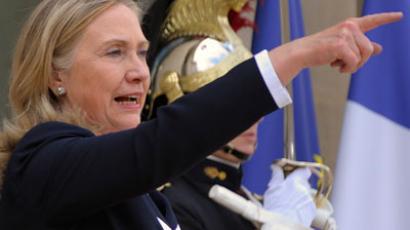
By Matt Peppe | Just the Facts | February 22, 2016
When asked by Wolf Blitzer in January if she was “the establishment,” Hillary Clinton replied: “I just don’t understand what that means. He’s been in Congress, he’s been elected to office a lot longer than I have.” Several weeks later, her Democratic primary opponent Sen. Bernie Sanders made the case in a debate that the issue was who had the support of more powerful elected officials, arguing that Clinton has the support of “more governors, mayors, members of the House.”
Clinton framed the notion of “the establishment” as consisting solely of political bodies of elected officials. Sanders simply argued that a better indicator of the establishment is one’s power and influence within political circles.
As part of the “two for the price of one” that Bill Clinton promised during his rise to the Presidency, Hillary is forced to hide from her role in the creation of the neoliberal New Democrats, the dominant faction of the party. During their joint reign in the White House, the Clintons steered the party far to the right with their draconian criminal justice measures, assault on welfare, liberalization of trade, and deregulation of banking. Their cronies continue to staff the highest ranks of the party and the Obama administration.
Clinton, in a desperate piece of deflection, resorted to playing the gender card: “Senator Sanders is the only person who I think would characterize me, a woman running to be the first woman president, as exemplifying the establishment.” This fatuous identity politics is meant to distract from her decades-long tenure at the top of the political system and collusion with those who exercise control over it. Of course, as Bernie points out, Hillary most represents and enjoys the support of the Democratic faction of the political establishment.
But framing the issue as simply a matter of party politics and the electoral system misses the point. Elected officials are merely the public face of the establishment. The broader establishment is the elite class that determines economic policy.
There is no building that says “Establishment” on the door, but there is a century-old institution made up of wealthy and influential representatives of business, Wall Street, corporate law, academia and government. It is a creation of the elite ruling class to ensure their control over shaping policy for their own benefit. Their decisions result in funneling money – and, hence, power – into the hands of a small percentage of capitalists who exercise control over the political process in a positive feedback loop.
In their book Imperial Brain Trust, Laurence Shoup and William Minter write that: “The Council on Foreign Relations is a key part of a network of people and institutions usually referred to by friendly observers as ‘the establishment.’ ” [1]
The Council was founded after World War I in response to growing domestic social tensions and labor unrest. Socialism was gaining in popularity among the American public in an economic environment marred by exploitative working conditions and skyrocketing inequality.
The Council’s mission was to carry out long-term planning for a national agenda. The agenda was meant to undermine a domestic-oriented program that would involve collective decision making to achieve self-sufficiency, and thereby reduce the country’s dependence on foreign resources, trade, and other governments.
Some of the many multinationals that subscribed to the CFR’s Corporation Service included General Motors, Exxon, Ford, Mobil, United States Steel, Texaco, First National City Bank and IBM. [2]
“The Council, dominated by corporate leaders, saw expansion of American trade, investment, and population as the solution to domestic problems. It thought in terms of preservation of the status quo at home, and this involved overseas expansion,” Shoup and Minter write. [3]
This imperialist agenda was achieved through manufacturing the consent of the masses (what they called “public enlightenment”), as well as developing foreign policies and ensuring government officials supported and executed these policies.
The Council has been remarkably successful in its mission. It has achieved a monopoly over foreign policy planning, and become thoroughly integrated with the government that carries out policy prescriptions. Entire administrations have drawn their foreign policy officials from the ranks of the Council. There is a steady two-way flow of personnel between the Council and government.
Both Bill and Chelsea are current members of the CFR. While Hillary herself is not a member, she is no doubt influenced by her immediate family’s ties to the Council. Additionally, her role as Secretary of State involved close collaboration with the Council, as she made clear in a 2009 speech at the Council’s office in Washington:
“I am delighted to be here in these new headquarters. I have been often to – I guess – the mothership in New York City. But it’s good to have an outpost of the Council right here down the street from the State Department. We get a lot of advice from the Council, so this will mean I won’t have as hard a go to be told what we should be doing, and how we should think about the future.” One of many people whose career was launched by his association with the Council was Henry Kissinger. In the late 1950s, he was appointed the director of a study group on nuclear weapons, in collaboration with several of the Council’s directors. The result was a book authored by Kissinger, Nuclear Weapons and Foreign Policy.
Kissinger went on to serve as possibly the most influential foreign policy official in history under Richard Nixon (and later Gerald Ford), as both Secretary of State and National Security Adviser. He helped carry out war crimes when he transmitted President Nixon’s order “anything that flies on anything that moves” to General Alexander Haig, directing a massive, secret bombing campaign of Cambodia hidden from Congress and the American public.
Kissinger’s tenure also saw him intimately involved with the military coup led by General Pinochet to overthrow and kill democratically-elected President Salvador Allende in Chile in 1973; the invasion by Indonesia of East Timor in 1975 and the subsequent genocide against the native East Timorese; the South African invasion of Angola in 1975 and attempted installation of a puppet ruler amenable to the apartheid regime; and the Dirty War in Argentina in which leftist opposition members were killed an disappeared.
Rather than being subjected to prosecution, or even suffering a loss of prestige, Kissinger has seen his reputation rise in the decades following his genocidal actions, whose strategy was in line with the designs peddled by the Council.
Clinton wrote that “Kissinger is a friend, and I relied on his counsel when I served as secretary of state.” She noted that they share “a belief in the indispensability of continued American leadership in service of a just and liberal order.”
Clinton’s abstract and idealistic rhetoric exemplifies the bipartisan, imperialist agenda formulated and propagated by the Council on Foreign Relations. The humanitarianism is a guise for the pursuit of United States political and economic hegemony across the world. The people who belong to this elite club have internalized the imperialist worldview that the U.S. is an “indispensable nation” that upholds “a just and liberal” world order, and use this belief to rationalize their Machiavellian exertions of power abroad.
The establishment is not made up of any one party, gender, or government organization. It is made up of people who are involved, directly or peripherally, in formulating and carrying out the plans of a tiny elite class – plans that ignore the 99 percent of the Americans in whose names they act, and the billions of people whose lives their decisions impact. There is no one whose social relationships and professional career typifies this more than Hillary Rodham Clinton.
References
[1] Shoup, Laurence H. and William Minter. Imperial Brain Trust: The Council on Foreign Relations & United States Foreign Policy. Lincoln, NE: Authors Choice Press, 1977/2004. (pg. 9)
[2] Ibid. (pg. 50)
[3] Ibid. (pg. 23)
Jamaica: Judge Orders ‘Death Squad’ Records Turned Over
teleSUR – February 23, 2016
Jamaica’s Police Commissioner Carl Williams has been ordered by a justice of the country’s Supreme Court to turn over the personnel records of officers accused of forming part of a “death squad,” The Gleaner reported Monday.
Jamaica’s Independent Commission of Investigations, took Commissioner Williams to the Supreme Court in order to obtain the records of 11 officers charged with murder in connection to suspicious deaths at the hands of police.
The investigation stems from homicides in the Clarendon Parrish, which had originally been reported as civilian deaths.
The commission had been trying to negotiate the release of the records but faced stiff opposition from Williams, who argued that the officers were entitled to professional privilege and protected by a constitutional right to privacy.
“Between the (national police force) and us, there was a respectful disagreement as regards what information we could get regarding the disciplinary records of their men, of reviews done of shootings, of plans for planned operations,” commission head Terrance Williams told The Gleaner.
The commission is interested in the records in order to determine if superior officers were complicit or connected to the alleged murders of civilians.
“That is, did they plan the operations properly? Did they review the operations properly? Did they select members of teams properly?” asked Terrance Williams.
Supreme Justice Bryan Sykes said Commissioner Williams has 120 days to hand over the files.
Organizations such as Jamaicans for Justice have denounced brutality and the widespread use of what has been described as “extra-judicial killings” at the hands of Jamaican police.
The Independent Commission of Investigations was established in 2010 in response to these allegations.
Obama Administration Fails to Make Progress on Reforming US Drone Program
Sputnik — February 23, 2016
US President Barack Obama’s administration has failed to implement reforms regarding the controversial drone policy to make it more transparent, accountable and consistent with national security interests, according to a report by the US think tank Stimson Center published Tuesday.
“Little progress has been made during the past year and a half to enact reforms that establish a more sensible US drone policy consistent with America’s long-term security and economic interests. The lack of a clear drone policy risks leaving a legacy on drone use that is based on secrecy and a lack of accountability that undermines efforts to support the international rule of law,” the report reads.
In 2014, the Stimson Task Force, comprising senior military and intelligence officials, recommended public disclosure of targeted drone strikes, thorough review of past and present drone strikes and their effectiveness and detailed reports explaining the legal basis of the US lethal drone program, among other recommendations.
The proposals were later backed by UN experts, including the adviser to Special Rapporteur on extrajudicial killings, Sarah Knuckey.
The US military has increasingly relied on drones to conduct operations in Afghanistan, Pakistan, Libya, Syria and Iraq. Critics have slammed the practice for resulting in a significant number of civilian deaths and the destruction of infrastructure unrelated to terrorists.
Data collected by the Bureau of Investigative Journalism shows that US drone strikes have killed up to 1,000 civilians in Afghanistan, Pakistan, Somalia and Yemen over the past 10 years.
Scotland’s Anti-Colonial Struggle
By Craig Murray | February 22, 2016
I have a meeting today in London with the Ambassadors of Venezuela, Bolivia, Cuba, Nicaragua and Ecuador to brief them on Scotland’s continuing struggle for Independence. These nations have been at the forefront of the international movement against colonialism, and know all about the sharp end of neo-Imperialism and the evil-doing of the CIA and other western security agencies.
The test of the Independence of a state is nothing to do with domestic or regional government, or even with bilateral arrangements with the state from which it secedes. The test of Independence is, purely and simply, whether or not you are recognised by other states as independent. That is the very clear cut position in international law. For this reason, it is essential that Scotland reaches out, not just within the EU but to the entire international community. Ultimately we need these people to vote and lobby for us in the United Nations and other international institutions.
Frankly, the SNP is rubbish at this. I am doing this meeting because the hierarchy of the SNP spurned the approach from the Ambassadors, as previously detailed on this blog. This reluctance seems part of the hierarchy’s effort to be NATO friendly and thus CIA friendly. The Ambassadors would far rather be meeting with an official SNP representative than a nobody like me. Unfortunately the SNP won’t do it. That is a disgrace.
I can increasingly foresee, as Westminster governments move ever further to the right and encroach more and more on civil liberties, a situation arising where Scotland wishes to claim its independence without the consent of Westminster. In that situation, we will need all the international support we can get, just as the Palestinians have been making headway in UN institutions. Work needs to be put now into laying the foundations for that support. Personally I would characterise Scottish Independence as an anti-colonial struggle; use of Scots as British cannon fodder and integration of the Scots elite into the Metropolitan elite does not make Scotland any less a colony. Rome had an African Emperor, but still her African possessions were colonies.
But even for those who do not accept that analysis, there is no doubt that Scottish Independence would have a highly beneficial impact on the global balance of power. The weakening of the USA’s most powerful sidekick; the lessening of the UK’s ability to participate in illegal neo-imperial invasions and to host weapons of mass destruction; the re-opening of the question of the undemocratic Security Council structure at the UN.
Then there is also the positive role Scotland can play as a major contributor to UN Peacekeeping Forces, and a voice for sanity, reason, human rights and the pre-eminence of international law. An independent Scotland as a state party will be able to request the International Criminal Court to lay war crime charges against Blair and Straw for the illegal invasion of Iraq, which would be a powerful deterrent to future aggressive war.
I am but one man and a private individual. Everything I can do, I shall.
Killing by Sanctions
By Philip Giraldi • Unz Review • February 23, 2016
While Secretary of State, Madeleine Albright, who is currently advising presidential candidate Hillary Clinton, famously said that the estimated 500,000 children who died as a result of U.S. sanctions on Iraq was “worth it.” It was, perhaps, a rare moment of candor from a politician, an admission that Washington is willing to support ostensibly non-lethal measures in such an all-encompassing fashion as to produce mass deaths of people who have no ability to influence the actions undertaken by their government. Sanctions are collective punishment, a blunt edged weapon used all too frequently by Washington to compel foreign governments to submit without having to go to war. There is nothing benign about them and Americans should regard them as potentially just as deadly as direct military intervention.
There are currently a number of countries that are subject to U.S. enforced sanctions but only three fall under the category of “state sponsors of terrorism.” They are Iran, Syria and Sudan. That status entails a number of U.S. Government sanctions including a ban on arms-related exports and sales; controls over exports of dual-use items; prohibitions on economic assistance; and imposition of miscellaneous financial and other restrictions. The financial measures require the United States to oppose loans by the World Bank or other international financial institutions and prohibit any U.S. person from engaging in a financial transaction with a terrorism-list government without a Treasury Department license issued by the Office of Foreign Assets Control (OFAC). The license and other approvals are reported to be complicated and the process is extremely difficult to navigate, discouraging anyone from having business dealings with the targeted countries.
Other sanctions are not always directly related to terrorism. They sometimes target select individuals and organizations that are considered by the U.S. government to be focal points of some aberrant behavior. A number of Russian officials have been sanctioned over Ukraine and even over the functioning of the country’s judiciary while the Iranian Revolutionary Guard has been sanctioned both for its involvement with radical groups and its support of Tehran’s missile program. But the most devastating sanctions are those which are directed against a country and nearly everything that it does economically, which was the case with Iraq under Saddam Hussein. Currently, Sudan falls under that category.
I recently spent a week in Sudan as the guest of a NGO. The objective was to show a group of hopefully influential foreign visitors the devastating effect of sanctions on the local economy. We visitors were of course aware that we were being fed a line that was most favorable to the government position so we also spoke to other Sudanese who were not necessarily part of the program as well as to United States government officials working at the Embassy.
The status of state sponsor of terrorism was bestowed on Sudan back in 1993 after the Sudanese government invited Osama bin Laden to stay in the country. Subsequently it was also claimed that Khartoum was supporting radical groups in Africa and elsewhere, to include Boko Harum, Uganda’s Lord’s Resistance Army and Egyptian Islamic Jihad. Since that time the conditions that led to the designation have changed dramatically. Bin Laden was asked to leave and relations with a number of militant groups were severed. Sudan has even severed diplomatic relations with Iran.
The latest edition of the State Department’s annual Country Reports on Terrorism states that “Sudan remained a generally cooperative partner of the United States on counterterrorism. During the past year, the Government of Sudan continued to support counterterrorism operations to counter threats to U.S. interests and personnel in Sudan.” Beyond that, the Sudanese intelligence service has been active in sharing information on terrorists in neighboring countries, to include Yemen, Uganda, Eritrea, Somalia, Chad and Libya. The information has been of such value that in 2010 the United States intelligence community advocated decoupling intelligence sharing from restrictions imposed on bilateral contact due to concerns over developments in Darfur.
In 2010 John Kerry, then Chairman of the Senate Foreign Relations committee, pledged to the Sudanese government that the terrorism designation would be lifted but failed to follow through. Later, in 2013, as Secretary of State, he was reminded of his promise by his Sudanese counterpart but apparently was thwarted in taking any action by advisers around President Barack Obama, most notably Susan Rice and Samantha Power. Both had in part made their reputations by writing and speaking to condemn Sudan. They were among the first to describe the conflict in Darfur as a genocide and are correctly perceived as hostile to any change in Sudan’s status.
The other sanctions on Sudan, referred to as a “comprehensive trade embargo,” blend claims of terrorism support with alleged human rights violations. They were imposed by Bill Clinton in 1997 and supplemented under George W. Bush in 2006. The last of these were linked to what has been described as a civil war starting in 2003 pitting the mostly Arabic speaking north of the country against the mostly indigenous black African south and west. The western media depicted the conflict in a racial context as well as in terms of religion, with Muslim pitted against Christian and animist, but the reality was much more complex than that with groups also dividing along linguistic, tribal and even occupational lines, sometimes featuring nomadic herdsmen against farmers.
Most sources agree that the various wars in and around Sudan have cost the lives of hundreds of thousands of Sudanese as well as between 14,000 and 200,000 who were reportedly “enslaved” in abductions carried out by both sides. The conflict in Darfur has been described as a genocide with a government supported militia known as Janjaweed and the rebels together having been accused of carrying out numerous atrocities. As a consequence, Sudan’s then-and-now president Omar Hassan al-Bashir has been on the receiving end of an arrest warrant from the International Criminal Court.
Al-Bashir, it should be noted became president by virtue of a military coup, though he has now been elected to office three times, once in an uncontested election in 1996 and in 2010 in a multiparty election that was described as “highly chaotic, non-transparent and vulnerable to electoral manipulation.” The most recent election took place on April 2015 and was strongly criticized by the U.S., Britain and Norway, all of whom had sent observers. Al-Bashir heads the ruling National Congress Party, but in fact he rules largely by fiat. He is either very popular or very unpopular with the Sudanese people depending on whom one talks to.
Genuine moves towards Sudanese democracy through the mechanism of a currently ongoing National Discussion are promising but are likely to slowly evolve in reality. The country’s legal system is based on Sharia but there is general tolerance of other religions in practice if not in law. The National Museum has a section relating to Christianity in Sudan and there is a Christian hour on television every Sunday. The Roman Catholic cathedral is located near the government center and there is also an active Coptic community. Christian community leaders openly support the existing government, just as they do in Syria, perhaps recognizing that available alternatives might be much worse.
A cease fire with the southern states in Sudan in 2005 led to the involvement of a United Nations Mission and a referendum in 2011 resulted in secession from the north. South Sudan is now an independent country that is enduring its own birth pangs. There are some reports of continued violence possibly instigated by Khartoum as well as little noticed government repression in the southern Blue Nile and South Kordofan states, which have been largely closed to the media and foreign NGOs pending yet another referendum to determine their future status.
Darfur followed with its own peace agreement in 2006. It is relatively quiet though military operations against a final hold out group of rebels in the region continue. Humanitarian and UN affiliated groups are in Darfur to monitor the process of reconciliation and it is expected that there will be another referendum to determine the region’s final status. At least some of the continuing unrest has been attributed to the activity of radicals from Chad, who are able to freely cross the open 600 mile long border to enter Darfur.
Business leaders in Khartoum note that there has been considerable economic growth in Sudan in spite of sanctions, concentrated in the sectors of oil, agriculture and mining. Since 1997, Sudan has been working with the International Monetary Fund (IMF) to initiate reforms and create sustainable growth. There is, however, considerable official corruption and across the board poverty, largely among those engaged in agriculture.
In spite of some positive developments, Washington’s sanctions have blocked almost all business with Sudan. Selling or buying anything to or from Sudan requires clearance by OFAC and is largely limited to agricultural, communications or medical products. The paperwork requires months to complete and the actual purchases have to be made through third parties, meaning that everything costs more and comes without warranties, service or support. This is because the United States has effectively shut down any banking transactions or extensions of credit with Sudan and when no one can get paid except by suitcases full of cash it becomes impossible to conduct business. Few foreign banks exist in Sudan and they are very careful about how they operate. Even the IMF is reportedly having difficulty in funding its own projects in country. It all means that Sudan cannot pay its bills through conventional correspondent banking arrangements as foreign banks are fearful of being fined by the United States. No one is willing to take that risk.
To be sure, part of Sudan’s economic woes come from its sustaining a war economy in response to the unrest in several regions. But beyond that no investment money coming in due to sanctions means no improvement in agricultural technology, which would benefit the poorest part of the population, or in health care or in education. Poverty has been increasing due to sanctions and attempts to evade the restrictions have resulted in smuggling, money laundering and an increase in unconventional banking to include hawala transfers that are not subject to normal bank controls. Because Sudan is currently not integrated into the international banking system its transactions cannot be monitored to prevent terrorist money transfers.
And there is also a human price to pay for inability to move money. Sudanese health care providers believe that many preventable deaths are attributable to persistent lack of medicinal supplies or diagnostic equipment due to sanctions. Even if the numbers are overstated, that is almost certainly true. In a recent case three patients in Darfur died for lack of renal dialysis solutions.
I oppose sanctions in principle because I believe they are a blunt instrument that punishes innocent civilians when broadly construed while having no effect at all when directly targeting the country’s relatively wealthy and unreachable government officials. If sanctions are to make any sense they should be designed to achieve a quantifiable result but that is rarely the case and they frequently serve no purpose whatsoever beyond dishing out punishment. It has been claimed that sanctions actually worked in Sudan because its government has moved to meet some of Washington’s demands over Darfur and South Sudan, but that is a simplistic explanation for rather more complex phenomena that were likely driven by multiple constituencies and interests.
More often than not, sanctions harden a government’s resolve to resist, as they did in Cuba, and even become useful to the regime as an excuse for government failures. The explanation provided by George W. Bush’s special envoy to Sudan, Andrew Natsios, that sanctions “send a message… to start behaving differently when they deal with their own people. That’s what this is all about,” is hubristic imperialism at its finest. It is reported in Sudan that many young Sudanese hate the United States and it is not difficult to understand why.
And there are good selfish reasons for the United States to lift sanctions and normalize relations with Khartoum. Sudan is an autocracy but no worse than American allies like Saudi Arabia, the Emirates and Egypt. It is active in fighting alleged rebels but is far more restrained than the current Saudi military intervention in Yemen. And though Khartoum has had sometimes ambivalent relationships with Islamic radicals it has been far less engaged in that fashion than Pakistan, Qatar and Saudi Arabia. So Sudan passes the smell test for being a disagreeable regime that is compatible with the United States’ broader interests.
And those broader interests are clear, including allowing American companies to participate in the future development of the country. U.S. sanctions have forced the Sudanese to turn to Moscow and Beijing for assistance. Russia is involved in gold mining and China is increasingly engaged in transportation, communications and energy projects. The Sudanese rail network and its international air carrier Sudan Air have collapsed due to lack of spare parts for their U.S. made hardware, an opportunity for American suppliers to quickly reenter the market. It is not in the U.S. national interest to create conditions favorable to competitors seeking to dominate the potentially large and developing Sudanese economy, ceding to them a significant foothold in East Africa by default.
Furthermore, Sudan is a bridge between Africa and the Arab world. It harbors no international terrorists and is a relative oasis of calm in a region in turmoil, well placed to monitor developments in neighboring Egypt, Chad, Libya, Somalia, Eritrea, Zaire, Central African Republic, Uganda and Yemen. It has made a significant contribution in counterterrorism and could do even better if properly motivated and provided with the tools needed, potentially playing a major role in the U.S. sponsored Partnership for Regional East Africa Counterterrorism. Normalizing relations with Sudan’s banks could, inter alia, stop money laundering and shut down possible terrorist money transfers.
There is, in short, no good reason to continue the status quo apart from the objections of two Obama advisers who have a personal stake in depicting Sudan in the most negative fashion. Unfortunately U.S. foreign policy has drifted away from supporting actual national interests and is mired in responding to various constituencies, in Obama’s case the “responsibility to protect” advocates. One can quite imagine that with something like a Marco Rubio it would revert to the mindless belligerency mode, but as both models seek to remake foreign governments they should equally be eschewed. Countries like Sudan and Iran should not be made to feel that they are permanently under the heel of the American jackboot. Nor should Washington feel compelled to play that role. Except in those rare situations where trade embargoes can inhibit flows of weapons to belligerents in a hot war, sanctions are useless, diminishing both those who apply the punishment and those who are on the receiving end. They should never be considered a serious instrument for foreign policy.
Breaking down the US-Russia ceasefire plan for Syria
RT | February 22, 2016
Following Moscow and Washington’s announcement of a joint ceasefire deal for Syria, the war-torn country may be on the verge of the biggest peacemaking breakthrough since fighting broke out there five years ago. Here is how the proposed truce should work:
When does it start?
The ceasefire will become official at midnight Damascus time on Saturday, February 27 (or on Friday at 22:00 GMT). Those who subscribe to the agreement have to publicly declare that they will desist from hostilities by a deadline 12 hours before the ceasefire comes into effect, and inform the White House or the Kremlin.
Who does it apply to?
It is clearer which parties it doesn’t apply to: “‘Daesh’ [Islamic State], ‘Jabhat al-Nusra’ [an al-Qaeda offshoot], or other terrorist organizations designated by the UN Security Council,” according to the Joint Statement. The Syrian government, as well as the oft-mentioned “moderate opposition” factions and the Kurds, will have to take it upon themselves to put down arms – or face consequences.
If the sides agree, what will be expected of them?
Participants are obligated to “cease attacks with any weapons, including rockets, mortars, and anti-tank guided missiles” and “refrain from acquiring or seeking to acquire territory from other parties to the ceasefire.” They must also allow “unhindered and sustained” access to humanitarian assistance missions and employ only “proportional force” in self-defense against those not party to the agreement.
How will the ceasefire function in practice?
Moscow and Washington will “work together to exchange pertinent information,” such as up-to-date maps indicating which sides have agreed to the ceasefire, and where they are located. The parties that are confirmed to have agreed to the ceasefire conditions should no longer come under fire from either side. The firepower is then expected to be concentrated on Islamic State and other jihadists.
How will it be monitored?
A Task Force will be set up, co-chaired by Moscow and Russia, which will “promote compliance and rapidly de-escalate tensions,” serve as an arbiter to “resolve allegations of non-compliance,” and refer “persistent” truce-breakers to senior officials to “determine appropriate action, including the exclusion of such parties from the arrangements of the cessation of hostilities.” A direct hotline will be set up between Moscow and Washington to avoid internal squabbles and improve contact inside the Task Force. The statement also leaves a role for public institutions and journalists in keeping the peace, promising that the ceasefire “will be monitored in an impartial and transparent manner and with broad media coverage.”
Read more:
Featured Video
Iran’s Next Strike May Not Explode. It Could Shut You Down
or go to
Aletho News Archives – Video-Images
From the Archive
Zionism’s Violent Legacy
By Donald Neff | Washington Report On Middle East Affairs | January 1996
On January 4, 1948, Jewish terrorists drove a truck loaded with explosives into the center of the all Arab city of Jaffa and detonated it, killing 26 and wounding around 100 Palestinian men, women and children.[1] The attack was the work of the Irgun Zvai Leumi – the “National Military Organization,” also known by the Hebrew letters Etzel – the largest Jewish terrorist group in Palestine. The Irgun was headed by Revisionist Zionist Menachem Begin and had been killing and maiming Arabs, Britons and even Jews for the previous ten years in its efforts to establish a Jewish state.
This terror campaign meant that at the core of Revisionist Zionism there existed a philosophical embrace of violence. … continue
Blog Roll
 Aletho News
- Riyadh Says Its Oil System Is Intact. The Numbers Say Otherwise.
- Trump and Netanyahu Want to “Finish the Job” on Iran
- US ‘one-sided dictation’ not Iran’s beliefs makes rational talks impossible: Baghaei
- Iran’s Next Strike May Not Explode. It Could Shut You Down /Col Doug Macgregor
- Iran: US political targets legitimate if assassinations return
- Iraq shuts key border crossing with Iran under US pressure: Report
- Undersea Internet cables could be targeted in retaliation for attacks on Iran: IRGC deputy chief
- EU sending ‘biased’ observers to interfere in Serbian election – president
- White House envoy declares kinetic action against Yemen ‘fruitless’
- Ukraine deployed thousands of microdrones in Iraqi Kurdistan: Tasnim
- If Americans Knew
- Americans at National Conservatism Conference held in Israel this year criticize Israel
- Christiane Amanpour exits CNN with a legacy shaped by the debate over Israel
- Israel’s war on Iran is the final move in a decades-old strategy
- Israel Denies Entry to French Journalist, U.S. Researcher Amid Rise in Entry Denials
- Gaza’s hospitals are running out of life-saving fuel – Daily Update
- Mysterious bot accounts reportedly spread fake ‘man on the street’ videos for Michigan Senate candidate
- Israeli Defense Minister Katz Says Over 60 Lebanon Villages Have Been Destroyed
- Why Is Israel Running TV Ads in Iowa Ahead of the Midterms?
- Hind Rajab’s Alleged Killer Is in the United States. HRF Demands His Arrest.
- US Officials Face Fresh Pressure After Another American ‘Brutalized’ by Israeli Settlers in West Bank
- No Tricks Zone
- E-Cars Reduce CO2 Emissions By Only 41% Compared To Internal Combustion Engine Vehicles
- Predictions Made By Renowned Climate Professor Over Past Decades Have Been Proven To Be Poor
- New Study Suggests Large Regions Of The Pacific Ocean Have Been Cooling For The Last 80 Years
- Germany’s Green Energy Debacle: High Energy Costs Force Kahla Porzellan to Close After 182 Years!
- New Study: 50 Years Of The Most Aggressive ‘Net Zero’ Policies Can Only Affect The Global Climate By 0.03°C
- US September “Heat” Was No Record…Many Records Set Decades Ago
- Latest European Green Energy Debacle; Portugal’s Largest Flagship Solar Park Insolvent!
- Green Energy Debacle: German Expert Professor Fritz Vahrenholt Warns Of Severe Economic And Social Consequences
- Two More Paleo Reconstructions Affirm Meters-Higher Sea Levels Across Ireland, Brazil 7000-6000 Years Ago
- New Study: Earth And Venus Surface Warmth Largely Explained By Convection And Lapse Rate, Not CO2 Or Radiation

