A George Washington University professor has overtly suggested that Israel should “flatten Beirut” — Lebanon’s capital with around 1 million people — in order to allegedly destroy the missiles of Lebanon-based resistance group Hezbollah.
Professor Amitai Etzioni, the prominent American scholar who teaches international relations — and who has taught at a variety of prestigious US universities, including Columbia, Harvard and Berkeley, and who served as a senior advisor in President Jimmy Carter’s administration — made this proposal in an op-ed in Haaretz, the leading English-language Israeli newspaper.
The newspaper, also known as “The New York Times of Israel” represents the liberal wing of Israel’s increasingly far-right politics.
The author wrote a few op-eds that held blunt and aggressive titles; the latest of which originally used the headline, “Should Israel Flatten Beirut to Destroy Hezbollah’s Missiles?” but then was modified to “Should Israel Consider Using Devastating Weapons against Hezbollah Missiles?”
Etzioni cites Israel’s chief of staff, who claims that most of Hezbollah’s missiles are in private homes, an accusation that Israel alleges against all resistance groups in the region to justify Israel’s attacks on civilian areas. But this claim, according to sources, is to justify any Israeli attack on civilian areas, adding that “it has been proven numerous occasions that there were no weapons in the civilian areas Israel bombed in Gaza for instance.”
Etzioni suggests that there can be many Israeli casualties in case Israeli soldiers take part in raids on the alleged houses, explaining “I asked two American military officers what other options Israel has. They both pointed to Fuel-Air Explosives (FAE). These are bombs that disperse an aerosol cloud of fuel which is ignited by a detonator, producing massive explosions. The resulting rapidly expanding wave flattens all buildings within a considerable range.”
Etzioni concludes his piece implying Israel has no other option but to bomb the city of Beirut. “In this way, one hopes, that there be a greater understanding, if not outright acceptance, of the use of these powerful weapons, given that nothing else will do,” he pointed out.
Such claims are similar to the ones Israel used during its 2006 aggression on Lebanon, in which it justified killing large numbers of civilians and dropping over a million cluster bombs by dubiously claiming innocents were being used as human shields.
The article triggered the fury of several Lebanese authors and activists who know the truth is otherwise. “I’m just speechless. It sounds ISIS-like, just eradicating an entire community of people,” wrote Kareem Chehayeb, a Lebanese journalist and founder and editor of the website Beirut Syndrome.
Also, Belén Fernández published an article responding to Etzioini’s op-ed, titled “No, Israel Should Not Flatten Beirut.” In which she pointed out “that Israel has already flattened large sections of Lebanon, in Beirut and beyond.”
She recalls visiting a young man in a south Lebanon village near the Israeli border who “described the pain in 2006 of encountering detached heads and other body parts belonging to former neighbors, blasted apart by bombs or crushed in collapsed homes.”
Etzioni is considered to be one of the prominent American scholars; he was among the 100 most-cited American intellectuals. He has also served as the president of the American Sociological Association. Etzioni served in the Haganah — the army that formed Israel after violently expelling three-quarters of the indigenous Palestinian population — from 1946 to 1948, and then served in the Israeli military from 1948 to 1950.
Hezbollah, the Islamic Resistance group in Lebanon, on the contrary to the claims of Etzion, does not involve civilians and civilian areas in war. The resistance movement does not justify deliberate attacks on civilian areas in wars and does not overpass ethics of war.
Also today, the same group that has been inscribed on the US and Europe black list is the same group that has been protecting the Syrian civilians and fighting a pre-emptive war to prevent Lebanon from being trapped.
In 2014, an anonymous European intelligence officer had said in an interview with al-Akhbar newspaper that “Hezbollah is fighting a battle against terrorism on behalf of the world, so it must be supported, at least in this confrontation”.
“I can say today that the resistance fighters are defending Europe,” he added.
February 22, 2016
Posted by aletho |
Ethnic Cleansing, Racism, Zionism, Militarism, Timeless or most popular, War Crimes | Hezbollah, Israel, Lebanon, United States, Zionism |
Leave a comment

The United States has expanded its weapons business, increasing its global arms sales amid rising imports by Africa, Asia and the Middle East.
According to a new study published Monday by the Stockholm International Peace Research Institute (SIPRI), the volume of international transfers of major weapons, including sales and donations, was 14 percent higher in 2011-2015 than over the five previous years, with the US and Russia doing most of the exporting.
The biggest importers were India, Saudi Arabia, China and the United Arab Emirates (UAE).
The report pointed to the Saudi-led war on Yemen, where Saudi Arabia has been seeking to reinstate the country’s fugitive former president Abd Rabbuh Mansur Hadi and undermine the Yemeni Ansarullah movement.
“A coalition of Arab states is putting mainly US- and European-sourced advanced arms into use in Yemen,” senior SIPRI researcher Pieter Wezeman said in the report.
The report also said US arms went to more than 90 countries.
The United States has sold or donated major arms to a diverse range of recipients across the globe, the report said.
“As regional conflicts and tensions continue to mount, the USA remains the leading global arms supplier by a significant margin,” said Aude Fleurant, director of the SIPRI Arms and Military Expenditure Program.
“The USA has sold or donated major arms to at least 96 states in the past five years, and the US arms industry has large outstanding export orders,” including for over 600 F-35 combat aircraft, said Fleurant.
The biggest chunk of US major arms, 41 percent, went into Saudi Arabia and the rest of the Middle East.
Now Scott Bennett, former US Army psychological warfare officer, says the trend does not come as a surprise “because it indicates a pattern that we’ve long seen, but has really quickened since the September 11th wars were initiated by the United States.”
Bennett told Press TV on Monday that the US governments “simply followed a policy of igniting fires around the world and then selling the equipment to put them out.”
Meanwhile, the latest report adds that Russia remains in second place on the SIPRI exporters list, with its share of the total up three points to 25 percent, though the levels dropped in 2014 and 2015 — coinciding with Western sanctions against Moscow over the Ukraine conflict.
India took the largest chunk of Russian weaponry, AFP reported.
While the flows of weapons to Africa, Asia and Oceania and the Middle East all increased between 2006-10 and 2011-15, there had been a sharp fall in the flow to Europe and a minor decrease in the volume heading to the Americas, according to SIPRI.
The overall transfer of arms has been upwards this century after a relative drop in the previous 20 years.
China leapfrogged both France and Germany over the past five years to become the third-largest source of major arms globally, with an 88-percent rise in exports. Most of the Chinese weapons went to other Asian countries, with Pakistan the main recipient.
India remains by far the biggest importer of major arms, accounting for 14 percent of the total; twice as much as second-placed Saudi Arabia and three times as much as China.
February 22, 2016
Posted by aletho |
Militarism | China, India, Middle East, Russia, Saudi Arabia, United States |
Leave a comment
The Colombian army killed at least seven ELN guerrillas in a special operation Saturday that took place near its border with Venezuela – an attack that is sure to have repercussions for the preliminary peace negotiations between the rebel group and the Colombian government.
Two other ELN (National Liberation Army) members were captured in Sunday’s offensive in the northern department of Arauca.
The Colombian Defense Ministry later tweeted that six rebels were successfully “neutralized” in the special operation. Meanwhile, the presidency tweeted a special congratulations to its troops for the “strong blow against the ELN in Arauca.”
According to Army Commander, General Alberto Mejia, the attack was a joint operation between army intelligence, the national air force, the national police and had the full support of the attorney general.
However, the attacks come as the ELN and the government have been trying to undergo preliminary peace discussions in an effort to end the ongoing fighting in the country. The talks have been tense in past weeks as both sides have accused the other of stalling negotiations while aggression on the ground continues.
The ongoing hostilities threaten to put in jeopardy the peace talks between the government and the FARC (Revolutionary Armed Forces of Colombia) rebels – Colombia’s largest guerrilla group – who are aiming to sign a final peace deal by their self-imposed deadline of March 23.
The two sides have been undergoing negotiations in Havana, Cuba, for over three years in an attempt to bring the five decades of fighting to an end, which has seen over 220,000 people killed and millions more displaced or disappeared.
However, there remain several critical factors to actually reaching peace in the country, which include making peace with the second largest guerrilla group in the country, the ELN.
February 22, 2016
Posted by aletho |
Militarism | Colombia, Latin America |
Leave a comment
It seems that Nigerians have to fear not only the extremist group Boko Haram, but also official soldiers who have proved to carry out extrajudicial killings, where the soldiers act as merciless as insurgents that have been spreading death and destruction in the African country.
According to the Associated Press, farmers and villagers across Nigeria are being arrested upon allegations that they belong to the extremist group Boko haram. The stunning part of the story is that many of these detained people disappear and do not return.
According to the source, Nigerian soldiers detained a teacher and two middle-aged farmers in Duhu village. Some residents, who knew the men, insisted they did not belong to the extremist group, and marched to a nearby military base to demand their release.
The military denied detaining elementary school teacher Habu Bello and farmers Idrisa Dele and Umaru Hammankadi even though several villagers told the news agency they watched as the men were taken away by uniformed soldiers.
“If you have a problem with someone, you can influence the military to pick them up and then you will never hear about them again,” human rights lawyer Sunday Joshua Wugira told AP from his offices in the northeastern city of Yola, where police are investigating the January killings of three brothers from the Fulani tribe.
In one act of terror, AP reported that a teenager said she was captured last year by Boko Haram fighters who attacked her village and killed her father.
“Soldiers arrived to hunt down extremists, but interrogated my three brothers instead. Vigilantes then seized and killed them,” she said.
The girl did not only suffer from Boko Haram’s terror, but even worse from the terror of the Nigerian soldiers as well. The 16-year old girl was kidnapped by Boko Haram at 16 and raped in captivity; she was freed in November when soldiers attacked the extremist camp where she was being held. She tried to return to her home village, but had to flee again because vigilantes threatened to kill her unborn child, calling it a “terrorist baby,” she said.
“I don’t have any figures, but I can confirm to you that there have been a series of complaints about extrajudicial killings,” Duhu district leader Mustapha Sanusi said.
Since 2011, the military has been responsible for the deaths of some 8,000 detainees who were shot, starved or tortured, which counts more than a third of the estimated 20,000 people killed during the 6-year-old insurgency.
The AP report also said that refugees panicked in January when they found the trussed-up body of a refugee with his head bashed in at the Shettima Ali Monguno Teachers Village camp on the outskirts of Maiduguri.
“We now fear more for our safety because we cannot tell who is good or bad among us,” said one young refugee, insisting on anonymity for safety. “Our camp is well fenced and secured, yet one of us was murdered over the night.”
“People are living in fear and believe that at the end of the day they will never get justice,” said lawyer Wugira, who underlined that he has been offering free services yet due to this fear most disappearances go unchallenged.
February 22, 2016
Posted by aletho |
Civil Liberties, Subjugation - Torture, Timeless or most popular | Africa, Boko Haram, Human rights, Nigeria |
Leave a comment
The New York Times vendetta against Donald Trump continues with its latest theme that The Donald is “vulgar.” This highly newsworthy charge recently made it to the front page with the headline, “With a Slur for Ted Cruz, Donald Trump Further Splits Voters.” The Times tells us that the slur involved a “vulgar word.” How this “splits voters” is not made clear – but never mind.
Not until paragraph ten, after a boring slog through nine paragraphs of gratuitous anti-Trump invective do the two intrepid reporters required to track down this momentous story inform us what the “vulgar word” is, thus: “In New Hampshire on Monday, Mr. Trump shared with an audience a supporter’s comment about Mr. Cruz. “She said, ‘He’s a pussy,’” he told the crowd.
Turning quickly to Wikipedia we find: “Common meanings of the noun include ‘cat,’ ‘coward or weakling’ and ‘the human vulva or vagina.’” Leaving ‘cat’ out of the matter, we can turn to the idea of “weakling” to describe Cruz although that lets him off lightly. This is clearly the idea that Trump’s supporter meant to convey. Not especially vulgar to the mind of this writer.
But let us turn to the third meaning “vagina.” This indeed would be considered a vulgarity in many quarters although that is not what the female Trump supporter meant. Where might we find “pussy” used in that vulgar way? The name of the all female group “Pussy Riot” surely qualifies. And how has the Times treated Pussy Riot? The enthusiasm of the Gray Lady for the “punk” group has bordered on the ecstatic over the years. One small example is this: “… Pussy Riot? You couldn’t ask for more appealing activists.… they were young and attractive and intelligent…”
Pussy Riot claims to be feminist, anarchist, anti-capitalist; and all that may well be true. (Certainly many progressives believe that to be the case, and this writer heard a paean to Pussy just the other day on KPFA.) But what is indisputable is that by the Times professed standards of vulgarity these days, Pussy Riot is right up there — and not only by virtue of its name. This description of their breakthrough performance is but one example, “On January 20, 2012, in what the Associated Press described as their ‘breakthrough performance, eight members of the group performed a song on the Lobnoye Mesto in Red Square, entitled ‘Putin Zassal’. The title has been variously translated by English language media as ‘Putin has Pissed Himself’, ‘Putin Chickened Out’, ‘Putin Got Scared’ or ‘Putin is Wetting Himself’”.
Nothing happened as a result of this crude insult – nor should it have. Speech on the street should be as free as possible. But the next day the group entered an Orthodox Church, doffed their winter clothes and started dancing on the altar and singing. Continuing from the same source, “They used the crude epithet ‘Sran Gospodnya’ which has been used to translate ‘holy shit’ in Hollywood movies, but it is rarely used in idiomatic Russian; it literally translates as ‘shit of the Lord’. … They referred to Russian Orthodox Patriarch Kirill as a ‘suka’ (bitch) and accused him of believing more in Putin than God.’”
That got them in trouble and some even landed several of their “collective” in jail until Putin issued a pardon releasing them. (Putin and Medvedev had both been on record opposing the jail terms meted out to the two women. Patriarch Krill, the “suka,’ felt otherwise.)
But the NYT has been unable to praise Pussy Riot highly enough and they were in fact the toast of Manhattan on their U.S. tour in 2014. You see, at the Times there is good pussy and bad pussy. And if the “pussy” is anti-Putin it is good. But if it is pro-Trump, it is bad.
John V. Walsh can be reached at john.endwar@gmail.com.
February 21, 2016
Posted by aletho |
Mainstream Media, Warmongering | KPFA, New York Times |
Leave a comment
CIA-linked private “security” companies are fighting in Yemen for the US-backed Saudi military campaign. Al-Qaeda-affiliated mercenaries are also being deployed. Melding private firms with terror outfits should not surprise. It’s all part of illegal war making.
Western news media scarcely report on the conflict in Yemen, let alone the heavy deployment of Western mercenaries in the fighting there. In the occasional Western report on Al-Qaeda and related terror groups in Yemen, it is usually in the context of intermittent drone strikes carried out by the US, or with the narrative that these militants are “taking advantage” of the chaos “to expand” their presence in the Arabian Peninsula, as reported here by the Washington Post.
This bifurcated Western media view of Yemen belies a more accurate and meaningful perspective, which is that the US-backed Saudi bombing campaign is actually coordinated with an on-the-ground military force that comprises regular troops, private security firms and Al-Qaeda type mercenaries redeployed from Syria.
There can be little doubt in Syria – despite Western denials – that the so-called Islamic State (IS, formerly ISIS/ISIL)) jihadists and related Al-Qaeda brigades in Jabhat al-Nusra, Jaish al-Fateh, Ahrar ash-Sham and so on, have been infiltrated, weaponized and deployed for the objective of regime-change by the US and its allies. If that is true for Syria, then it is also true for Yemen. Indeed, the covert connection becomes even more apparent in Yemen.
Last November, the New York Times confirmed what many Yemeni sources had long been saying. That the US-backed Saudi military coalition trying to defeat a popular uprising was relying on mercenaries supplied by private security firms tightly associated with the Pentagon and the CIA.
The mercenaries were recruited by companies linked to Erik Prince, the former US Special Forces commando-turned businessman, who set up Blackwater Worldwide. The latter and its re-branded incarnations, Xe Services and Academi, remain a top private security contractor for the Pentagon, despite employees being convicted for massacring civilians while on duty in Iraq in 2007. In 2010, for example, the Obama administration awarded the contractor more than $200 million in security and CIA work.
Erik Prince, who is based primarily in Virginia where he runs other military training centers, set up a mercenary hub in the United Arab Emirates five years ago with full support from the royal rulers of the oil-rich state. The UAE Company took the name Reflex Responses or R2. The NY Times reported that some 400 mercenaries were dispatched from the Emirates’ training camps to take up assignment in Yemen. Hundreds more are being trained up back in the UAE for the same deployment.
This is just one stream of several “soldiers of fortune” going into Yemen to fight against the uprising led by Houthi rebels, who are in alliance with remnants of the national army. That insurgency succeeded in kicking out the US and Saudi-backed president Abed Rabbo Mansour Hadi in early 2015. Hadi has been described as a foreign puppet, who presided over a corrupt regime of cronyism and vicious repression.
Since last March, the Saudis and other Persian Gulf Arab states have been bombing Yemen on a daily basis in order to overthrow the Houthi-led rebellion and reinstall the exiled Hadi.
Washington and Britain have supplied warplanes and missiles, as well as logistics, in the Saudi-led campaign, which has resulted in thousands of civilian deaths. The involvement of Blackwater-type mercenaries – closely associated with the Pentagon – can also be seen as another form of American contribution to the Saudi-led campaign.
The mercenaries sent from the UAE to Yemen are fighting alongside other mercenaries that the Saudis have reportedly enlisted from Sudan, Eritrea and Morocco. Most are former soldiers, who are paid up to $1,000 a week while serving in Yemen. Many of the Blackwater-connected fighters from the UAE are recruited from Latin America: El Salvador, Panama and primarily Colombia, which is considered to have good experience in counter-insurgency combat.
Also among the mercenaries are American, British, French and Australian nationals. They are reportedly deployed in formations along with regular troops from Saudi Arabia, Qatar, Bahrain and the UAE.
In recent months, the Houthi rebels (also known as Ansarullah) and their allies from the Yemeni army – who formed a united front called the Popular Committees – have inflicted heavy casualties on the US-Saudi coalition. Hundreds of troops have been reportedly killed in gun battles in the Yemeni provinces of Marib, in the east, and Taiz, to the west. The rebels’ use of Tochka ballistic missiles has had particularly devastating results.
So much so that it is reported that the Blackwater-affiliated mercenaries have “abandoned the Taiz front” after suffering heavy casualties over the last two months. “Most of the Blackwater operatives killed in Yemen were believed to be from Colombia and Argentina; however, there were also casualties from the United States, Australia and France,” Masdar News reports.
Into this murky mix are added extremist Sunni militants who have been dispatched to Yemen from Syria. They can be said to be closely related, if not fully integrated, with Al-Qaeda or IS in that they profess allegiance to a “caliphate” based on a fundamentalist Wahhabi, or Takfiri, ideology.
These militants began arriving in Yemen in large numbers within weeks of Russia’s military intervention in Syria beginning at the end of September, according to Yemeni Army spokesman Brigadier General Sharaf Luqman. Russian air power immediately began inflicting severe losses on the extremists there. Senior Yemeni military sources said that hundreds of IS-affiliated fighters were flown into Yemen’s southern port city of Aden onboard commercial aircraft belonging to Turkey, Qatar and the UAE.
Soon after the militants arrived, Aden residents said the city had descended into a reign of terror. The integrated relationship with the US-Saudi coalition can be deduced from the fact that Aden has served as a key forwarding military base for the coalition. Indeed, it was claimed by Yemen military sources that the newly arrived Takfiri militants were thence dispatched to the front lines in Taiz and Marib, where the Pentagon-affiliated mercenaries and Saudi troops were also assigned.
It is true that the Pentagon at times wages war on Al-Qaeda-related terrorists. The US airstrike in Libya on Friday, which killed some 40 IS operatives at an alleged training camp, is being trumpeted by Washington as a major blow against terrorism. And in Yemen since 2011, the CIA and Pentagon have killed many Al-Qaeda cadres in drone strikes, with the group’s leader being reportedly assassinated last June in a US operation.
Nevertheless, as the broader US-Saudi campaign in Yemen illustrates, the outsourcing of military services to private mercenaries in conjunction with terrorist militia is evidently an arm of covert force for Washington.
This is consistent with how the same groups have been deployed in Syria for the purpose of regime change there.
The blurring of lines between regular military, private security contractors with plush offices in Virginia and Abu Dhabi, and out-and-out terror groups is also appropriate. Given the nature of the illegal wars being waged, it all boils down to state-sponsored terrorism in the end.
Finian Cunningham (born 1963) has written extensively on international affairs, with articles published in several languages. Originally from Belfast, Northern Ireland, he is a Master’s graduate in Agricultural Chemistry and worked as a scientific editor for the Royal Society of Chemistry, Cambridge, England, before pursuing a career in newspaper journalism. For over 20 years he worked as an editor and writer in major news media organizations, including The Mirror, Irish Times and Independent. Now a freelance journalist based in East Africa, his columns appear on RT, Sputnik, Strategic Culture Foundation and Press TV.
February 21, 2016
Posted by aletho |
Deception, Militarism, Timeless or most popular, War Crimes | Academi, al-Qaeda, Blackwater, Central Intelligence Agency, CIA, Qatar, Saudi Arabia, Syria, Turkey, UAE, Xe Services, Yemen |
Leave a comment
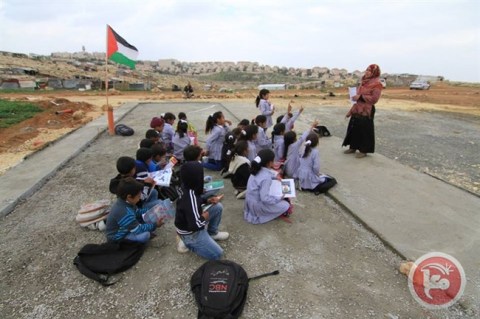
JERUSALEM – Israeli forces on Sunday demolished a Bedouin school for children in the Abu al-Nuwaar community near the town of al Eizariya in the occupied West Bank, a spokesperson for the Al-Jahalin Bedouin community said.
Atallah al-Jahalin told Ma’an that Israeli forces, accompanied by 30 vehicles and a delegation from Israeli’s Civil Administration, raided the area and destroyed the sole school in the community.
Residents said Israeli forces told them the school was demolished because concrete structures were forbidden in the area.
Israeli forces also reportedly seized the contents of the school.
Al-Jahalin added that Israeli forces briefly detained two youths who were protesting the demolition, both of whom were released after the demolition.
After the demolition, primary students held a “sit-in” where the school once stood while wearing their uniforms and holding school books in protest.
On Wednesday, the Coordinator for Humanitarian and UN Development Activities for the occupied Palestinian territory Robert Piper said the number of Palestinians displaced in 2016 is already equivalent to over half of the total number displaced in all of 2015.
Piper called on Israel to immediately halt all demolitions in the occupied West Bank, which he said were in violation of international law.
“Most of the demolitions in the West Bank take place on the spurious legal grounds that Palestinians do not possess building permits,” Piper said.
“But, in Area C, official Israeli figures indicate only 1.5 percent of Palestinian permit applications are approved in any case. So what legal options are left for a law-abiding Palestinian?”
The UN documented 283 homes and other structures destroyed, dismantled, or confiscated between Jan. 1 and Feb. 15.
The measures displaced 404 Palestinians, including 219 children. Another 1,150 Palestinians were also affected after losing structures related to their source of income, according to the UN.
The destruction was focused in 41 locations, many in Palestinian Bedouin or herder communities in Area C, the over 60 percent of the West Bank under full Israeli military control.
Piper highlighted previous statements by UN Secretary-General Ban Ki-Moon that Israeli zoning and planning policies are “restrictive and highly discriminatory.”
“International law is clear — Palestinians in the West Bank have the right to adequate housing and the right to receive humanitarian assistance,” said Piper.
“As the occupying power, Israel is obliged to respect these rights,” the UN official said.
Repeated calls by international bodies for Israel to cease the displacement of Palestinians living in the occupied Palestinian territory have done little in the past to stop ongoing demolitions or settlement expansion onto Palestinian land.
The EU earlier this week condemned Israeli policy regarding demolition and settlement expansion that the body said made the possibility for an independent Palestinian state impossible.
February 21, 2016
Posted by aletho |
Ethnic Cleansing, Racism, Zionism, Subjugation - Torture | Human rights, Israel, Palestine, West Bank, Zionism |
Leave a comment
Maidhc Ó Cathail: Do you see Cologne, 2015 as a turning point or the beginning of the end for European civilization?
Jean Bricmont: I am not sure what European civilization means, but if it survived the two World Wars, it will survive Cologne 2015. One should not exaggerate what happens with the refugees. I am of two minds about that. On the one hand, I don’t think it is such a big deal; what are a few million refugees among 500 million Europeans? On the other hand, polls show that a majority of people in European countries do not want to “welcome” more refugees and I think it is their right to do so (even if personally I don’t think it is such a big deal).
What I call the moral left wants to force the population to be altruistic with respect to the refugees. But the population who is never consulted on the issue of refugees and who is constantly asked to make sacrifices because “there is no money” understandably does not accept this moral discourse.
Maidhc Ó Cathail: How is what you wrote in Humanitarian Imperialism related to the current refugee crisis?
Jean Bricmont: Well, the same people who encouraged “humanitarian” interventions and “support” for armed insurrections abroad, that have led to perpetual wars, generating a constant flow of refugees, are now demanding that the population of our countries “welcome the refugees”. They first generate chaos there, then they applaud chaos here. It cannot last forever. One can see signs of widespread popular revolt against that. Now, I am not optimistic about the way this revolt will go, because, since the left has been almost totally won over to the cause of humanitarian interventions and its corollary of welcoming the refugees, this revolt will almost certainly benefit mostly the (far) right.
Maidhc Ó Cathail: Do you believe that guilt over the Holocaust is the driving force behind Germany’s decision to accept over a million refugees?
Jean Bricmont: It was not “Germany” that made that decision but Mrs. Merkel, to the consternation of many and perhaps most Germans. Her personal motives are unclear. For a minority of Germans who actively welcome the refugees, the Holocaust is no doubt a factor. But the younger generations, all over Europe, are fed up with this artificial guilt (how can anyone be guilty of events that occurred before their birth?). So, also in Germany, there is a lot of negative feelings with respect to the refugees.
Maidhc Ó Cathail: Do you think that one can be against US wars and Israeli occupation and at the same time have reservations about Muslim immigration to Europe?
Jean Bricmont: Yes, of course. But I am very reluctant to see this immigration (as several people do) as a “plot” from the US and Israel to “Islamize” Europe. For one thing, the Zionists here are divided: it is true that some of them are for more open borders, but others are afraid of the “Islamisation” of Europe, since they know that Muslims are not exactly fond of the “Jewish state”. I don’t believe such Islamisation takes place, but I think one should be pragmatic about immigration. We will never have really open borders, unlike what some of the far left demands (otherwise we would really be quickly overwhelmed and a far right reaction would occur to stop that), nor will we have completely closed ones. It is only a question of degree. The problem is that some of our “elites” live in a dream world where more globalization is always viewed as good and the wishes of the population are despised and ignored. That creates the risk of a dangerous backlash.
JEAN BRICMONT teaches physics at the University of Louvain in Belgium. He is author of Humanitarian Imperialism. He can be reached at Jean.Bricmont@uclouvain.be
MAIDHC Ó CATHAIL is a widely published writer and political analyst. In addition to having written a monthly column for Beo!, his work has been published by Antiwar.com, Arab News (Saudi Arabia), Consortium News, Forward Magazine (Syria), Journal of Turkish Weekly, Khaleej Times (UAE), Ma’an News Agency (Palestine), Middle East Monitor, Palestine Chronicle, Ron Paul Institute for Peace and Prosperity, RT, Tehran Times, The Nation (Pakistan), The Unz Review, Washington Report on Middle East Affairs and many more.
February 21, 2016
Posted by aletho |
Militarism, Timeless or most popular | Africa, European Union, Human rights, Middle East |
Leave a comment
Turkish President’s comments expressing regret for Turkey’s refusal to join US-led coalition which invaded Iraq cast doubt on his grasp of reality.
Anyone who worries about Turkish President Erdogan’s uncertain grip on reality will have had those worries confirmed by comments he has recently made about Turkey’s role in the 2003 Iraq invasion.
If there is one thing most people around the world agree about it is that George W. Bush’s war against Iraq was a disaster.
Leaders and countries that involved themselves in the war today regret doing so. In Britain former Prime Minister Tony Blair has seen his reputation destroyed because of his role in the war.
By contrast US allies who held aloof from the war thank their lucky stars they did so, whilst in the US Obama’s successful run for the Presidency was in part at least because of his opposition to the war.
One world leader begs to differ: Step forward Turkish President Recep Tayyip Erdogan.
He says he regrets the Turkish parliament’s vote in 2002 in the run-up to the 2003 war to block the US military’s invasion of Iraq through Turkey.
He says Turkey made a mistake by not joining the US-led coalition which in 2003 invaded Iraq.
That must make Erdogan the one leader in the world sorry his country was not part of a disaster – and to say so after it happened!
February 21, 2016
Posted by aletho |
Militarism, Timeless or most popular, War Crimes | Erdogan, Iraq, Syria, Turkey, United States |
Leave a comment
Turkey has the right to carry out military operations not only in Syria, but in any other country, which is hosting terror groups that threaten the Turkish state, Turkey’s President Recep Tayyip Erdogan said.
“Turkey has every right to conduct operations in Syria and the places where terror organizations are nested with regards to the struggle against the threats that Turkey faces,” Erdogan was cited as saying by the Hurriyet newspaper Sunday.
Ankara’s stance has “absolutely nothing to do with the sovereignty rights of the states that can’t take control of their territorial integrity,” the president insisted.
“On the contrary, this has to do with the will Turkey shows to protect its sovereignty rights,” he added.
The Turkish president used an unexpected platform to make his hawkish remarks as he visited an event celebrating the inclusion of Turkey’s southeastern province of Gaziantep on the list of UNESCO’s Creative Cities Network in the gastronomy category.
Erdogan warned that his government will treat “attitudes to prevent our country’s right [to self-defense] directly as an initiative against Turkey’s entity – no matter where it comes from.”
“No one can restrict Turkey’s right to self-defense in the face of terror acts that have targeted Turkey; they cannot prevent [Turkey] from using it,” he added.
The Turkish forces have been shelling Kurdish People’s Protection Units (YPG) forces, which Ankara views as a terrorist organization, as well as government troops on Syrian territory since mid-February.
The bombings of YPG targets, the military wing of the Democratic Union Party (PYD), continue despite Turkey’s ally, the US, considering the Kurdish fighters an important partner in fighting Islamic State (IS, Daesh, formerly ISIS/ISIL) .
There were also reports of dozens of Turkish military vehicles crossing into Kurdish northern Syria, with servicemen digging tranches in the area.
In December, Ankara also deployed 150 soldiers backed by artillery and around 25 tanks to northern Iraq, without consent from the government in Baghdad.
“Turkey will use its right to expand its rules of engagement beyond [responding to] actual attacks against it and to encompass all terror threats, including PYD and Daesh, in particular,” Erdogan said Sunday as cited by Anadolu news agency.
28 people, mainly Turkish military, were killed and 61 other injured in a suicide bombing Ankara on Wednesday.
Despite the Kurdistan Freedom Hawks (TAK) militants group claiming responsibility for the attack, Turkey claims that YPG was also involved.
In an attempt to protect itself, Turkey will treat anyone, who opposes it as a “terrorist and treat them accordingly,” the President said.
“I especially want this to be known this way,” he added.
Erdogan also slammed the countries, who criticized Ankara for their incursion into Iraq and Syria, calling them “disingenuous” due to “preaching only patience and resoluteness” to Turkey, but acting in a completely different manner when attacked themselves.
February 21, 2016
Posted by aletho |
Illegal Occupation, Militarism, Timeless or most popular, War Crimes | Syria, Turkey, YPG |
Leave a comment
So, how did America’s poor fare under Bill Clinton’s White House reign? Better than George W. Bush — at least that seems to be the common belief among Democratic voters today, especially those lining up behind Madam Hillary. However, the economy under Clinton in the 1990s may not have been as robust and healthy as many would like to believe.
As economist Robert Pollin of the University of Massachusetts at Amherst explains in Contours of Descent: US Economic Fractures and the Landscape of Global Austerity, Clintonomics was not all it was cracked up to be. “The distribution of wealth in the US became more skewed than it had at any time in the previous forty years,” he argues. “No question, an increasing number of US jobs began to be outsourced at an unprecedented rate as well.”
“Unlike Clinton, Bush is unabashed in his efforts to mobilize the power of government to serve the wealthy,” he continues. “But we should be careful not to make too much of such differences in the public stances of these two figures, as against the outcomes that prevail during their terms of office … the ratio of wages for the average worker to the pay of the average CEO rising astronomically from 113-to-1 in 1991 under Bush-1 to 449-to-1 when Clinton left office in 2001.”
Pollin points out that while Clinton’s tax policy reversed some of the regressive taxation that occurred under Ronald Reagan, it certainly did not reverse the brunt of it. And, as Pollin contends, “The fact is that, insofar as the end of the Cold War yielded any peace dividend under Clinton, it took the form of an overall decrease in the size of the federal government rather than an increase in federal support for the programs supposedly cherished by Clinton, such as better education, improved training, or poverty alleviation.”
Was Clintontime even a boom-era after all? Pollin doesn’t think so. “Under the full eight years of Clinton’s presidency, even with the bubble ratcheting up both business investment and consumption by the rich average real wages remained at a level 10 percent below that of the Nixon-Ford peak period, even though productivity in the economy was 50 percent higher under Clinton than under Nixon and Ford. The poverty rate through Clinton’s term was only slightly better than the dismal performance attained during the Reagan-Bush years.”
Bargaining power for low-wage workers during the 1990s decreased tremendously as well. Wall Street scion Alan Greenspan in fact did not want the unemployment rate to drop below 6 percent because he feared that inflation would skyrocket. Greenspan also did not want workers to increase their bargaining power, which could possibly benefit their organizing strength in the work place. The majority of workers during Clintontime were not happy with their occupations. As Pollin writes, “Wage gains for average workers during the Clinton boom remained historically weak, especially in relationship to the ascent of productivity. These facts provide the basis for the poll findings reported in Business Week at the end of 1999 that substantial majorities of US citizens expressed acute dissatisfaction with various features of their economic situation.”
Pollin also shows that the Earned Income Tax Credit (EITC), the most significant economic initiative under Clinton, more than doubled from $9.3 billion to $26.8 billion during Clinton’s two terms. But food stamps “dropped by $8.5 billion reflecting a large increase in the percentage of households who are not receiving food assistance even though their income level is low enough for them to qualify. Under the Clinton Administration, the decline in the number of people receiving food stamps — 9.8 million — was 17% greater than the decline in the number of people officially defined as impoverished and was accompanied by a dramatic increase in the pressure on private soup kitchens and food pantries.
“And while the EITC does correct some of the failings of the old welfare system, it has created new, and equally serious, problems. Moving poor and unskilled women from welfare onto the labor market exerts a downward pressure on wages, and the national minimum wage itself is too low to allow even a full-time worker to keep just herself and only one child above the official poverty line.”
Poverty did decline under Clinton by almost 4 percentage points. Yet, as Pollin explains, in the prosperity of the 1990s, this small drop back to 1974 levels is reprehensible: “Per capita GDP in 2000 was 70% higher than it was in 1974, productivity was 61% higher, and the stock market was up 603%.”
Clinton’s presidency did see a stop in wage decline from 1993 to 1996, however. And in the next three years wages rose sharply. But “the real wage gains were also, in turn, largely a result of the stock market bubble. The Clinton economy of the late 1990s, whose successes were so heavily dependent on the stock market, offers little guidance as to what such an alternative path to sustained improvements in real wages might be.
“Moreover, conditions under Clinton worsened among those officially counted as poor. This is documented through data on the so called ‘poverty gap,’ which measures the amount of money needed to bring all poor people exactly up to the official poverty line. The poverty gap rose from $1,538 to $1,620 from 1993-99 (measured in 2001 dollars).”
Pollin continues, “Because workers had experienced the ‘heightened sense of job insecurity’ under most of Clinton’s tenure, when wages did finally start to rise significantly in 1997, this was from an extremely low base. Moreover, the injection of increased spending under Clinton that produced low unemployment came from the stock market bubble, which, as has now become transparently clear, was unsustainable. In the 1960s, the catalyst driving the economy to full employment was government spending on the Vietnam war — that is, a source of economic stimulus that was also unsustainable and even more undesirable than the 1990s market bubble.
“The central challenge for an employment-targeted policy in the US today would therefore be to identify alternative sources of job expansion that do not require waging war or destabilizing the financial system. The Bush-2 plan for huge military spending increases obviously does not qualify any more than the Vietnam War as a desirable source of job expansion.”
In other words, even though jobs were plentiful in the 1990s, poverty was widespread and, in fact, increasing. All this before the effects of NAFTA and welfare reform reared their ugly heads. But this was all by design. Clinton, et al., knew exactly what it was they were doing. No question Hillary’s neoliberal agenda will follow suit.
February 21, 2016
Posted by aletho |
Economics, Militarism, Timeless or most popular | NAFTA, United States |
Leave a comment
 Aletho News
 Aletho News