Justice for the Women of Sepur Zarco
Indigenous women win precedent-setting case against former soldiers in sex slavery trial in Guatemala
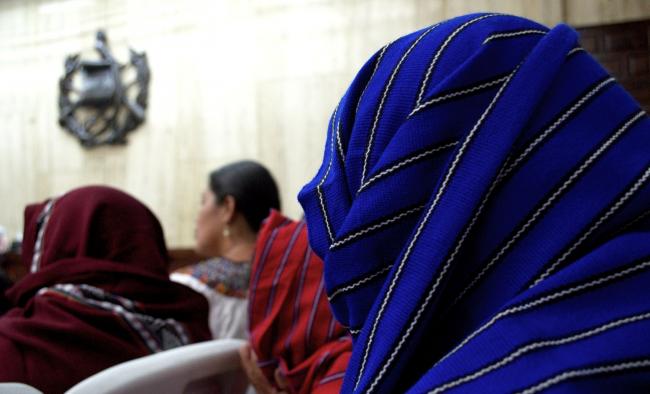
Women of Sepur Zarco, forced into sex slavery at the hands of the Guatemalan military in 1982, listen to trial proceedings at the Guatemalan Supreme Court (Photo by Quimy de Leon)
By Jeff Abbott and Julia Hartviksen – NACLA – 03/11/2016
Nearly 20 years since the signing of Guatemala’s 1996 Peace Accords, justice has finally been served for 15 Indigenous Q’eqchi’ Mayan women of Sepur Zarco, who were forced to become sex slaves for members of Guatemala’s military during the country’s long civil war.
On February 26, Guatemala’s Supreme Court sentenced two former military members, former Lieutenant Coronel Esteelmer Reyes and former Military Commissioner Heriberto Valdez Asij, to prison terms of 120 and 240 years, respectively, for crimes against humanity. Reyes was also found guilty of three assassinations, while Asij was deemed guilty for the forced disappearances of seven men. (Despite the significance of the guilty verdict, prosecutors from the Guatemalan Public Ministry had initially requested that Reyes and Asij be sentenced with 1290 years in prison for war crimes, plus 50 years in prison for each assassination charge.)
On March 2, the perpetrators were also ordered to pay reparations to the victims. Reyes will owe 500,000 Quetzales (about US $65,000) to each of the victim-survivors, and Asij has been ordered to pay 250,000 Quetzales (about US $32,500) for each of the seven forcibly disappeared men.
Judge Yassmín Barrios of the Guatemalan Supreme court made the historic decision following a short, emotional trial, which began February 1 in the Guatemalan Supreme Court in Guatemala City. The case, the first time in the world where a case of wartime sexual violence was tried in the national courts of the country where the violence occurred, represents a landmark legal decision in Guatemala and a major victory against the impunity for war crimes in the country.
The charges against Reyes and Asij relate to crimes committed in the year 1982, a time when both men were stationed at the Sepur Zarco military base in Alta Verapaz. During this period, the soldiers murdered men in the community, and forced women in the area to work as domestic servants and sexual slaves, subjecting them to degradation, abuse, and rape. In 2010, 12 of those women, all of Mayan Q’eqchi’ descent, brought the case before a mock tribunal meant to address sexual violence during Guatemala’s 36-year-long war. In 2011, the case was brought before a criminal court. Grassroots organizations and international NGOs alike fought to bring the case to the Guatemalan Supreme Court, amidst repeated attempts to derail their efforts.
Lily Muñoz, a sociologist who worked as an independent consultant assisting the legal organization, Mujeres Transformando el Mundo (MTM) on the case, explained the significance of the historic ruling. “It represents justice for war crimes that were committed against women,” she said.
Though the case represents a landmark legal decision for Guatemala, Sepur Zarco is not an exceptional case of sexual violence perpetrated by the military during the war. “This case serves as a precedent not only here in Guatemala, but also on the global scale,” said Lily Muñoz, a sociologist who worked as an independent consultant assisting the legal organization, Mujeres Transformando el Mundo (MTM) on the case.
The case’s success has led to more than 30 Achi’ women from the community of Rabinal, Baja Verapaz, who also suffered from sexual violence at the hands of the military, to begin mobilizing for legal justice for crimes of sexual violence as a tactic of war.
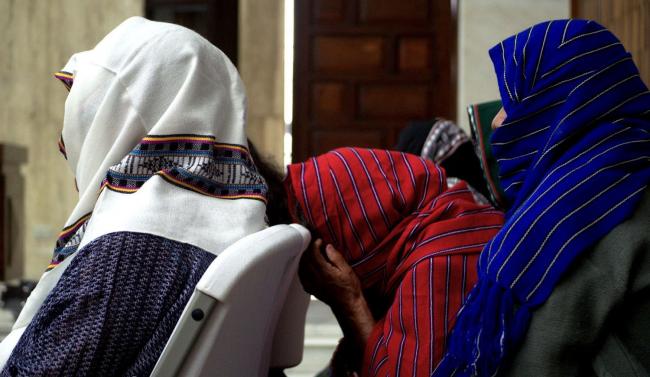
Survivors of the Sepur Zarco sex slavery case at the Supreme Court trial (Photo by Quimy de Leon)
This case also illustrates the gendered dimensions of such brutality – a brutality that preyed upon the vulnerability of indigenous women in rural Guatemala at the height of the internal armed conflict. “It is particularly interesting that sexual violence against women was a part of the sentence, and in the context of an armed conflict. This marks such violence as a war crime, as a crime against humanity. It’s a war crime, but it is a specifically gendered crime, that was tried in the national court of the country where the crimes were committed,” Muñoz said.
She continued: “The military men created conditions of extreme vulnerability for the women of Sepur Zarco. They took their husbands away from them, and they robbed them of their lands and livelihoods – in short, everything they required for social reproduction – and then later, of their sexuality and their ownership over their own bodies.”
As Muñoz explained, Judge Barrios drew on the testimony of a Brazilian anthropologist, Dr. Rita Laura Segato in coming to a decision in the case. Dr. Segato had argued in her testimony that “In the context of the Guatemalan internal armed conflict, women’s bodies were converted into military objects.”
The anthropologist argued that, in this way, that women’s bodies came to represent the “social body,” and for that reason, “the soldiers violated and ‘profaned’ women’s bodies.”
Following Dr. Segato, Muñoz explained that the military sought to “break the community, physically and morally” and did so through sexual violence against women. In this sense, the violence perpetrated against women carried lasting physical, emotional and psychological aspects, and also symbolic meaning for the victim-survivors and other community members. In reading the sentence, Judge Barrios recognized these long-term, destructive impacts the violence of the Sepur Zarco base had on the women who brought the case forward.
The case itself represents a historic shift for the Guatemalan courts, whereby claims of violence brought forth by indigenous women have been recognized by the mainstream justice system, a system that has consistently silenced their voices. “This case has shown that we can trust the testimonies of the (indigenous) women,” said Ada Valenzuela, the director of the Union Nacional de Mujeres Guatemaltecas (UNAMG). “Even 30 years later, the testimonies of the women were supported through other testimonies, and evidence.”
Despite the fact that the women’s faces were covered during the trial for the purposes of anonymity, it was the women themselves who pushed for the case to move forward, despite being told that it would likely not win. “The women from Sepur Zarco said that if this case were to go to court, then they wanted to go,'” Valnezuela said. “And we decided that we were going to accompany these women in this process. This was a very valiant decision.”
The women were also accompanied by a coalition of Guatemalan feminist organizations in Guatemala, known as the Alliance to End Silence and Impunity, which includes UNAMG, MTM and the Equipo de Estudios Comunitarios y Acción Psicosocial (ECAP). UNAMG and ECAP have worked to provide psychological support for the victims of the internal armed conflict and the women of Sepur Zarco since 2004.
The case also complicates the characterization of the simplified but still all too common narrative of Guatemala’s civil war in which Marxist guerrillas are presented as fighting against state. In fact, in many cases, it was poor rural campesinos, organizing to gain ownership of their own land who suffered the most intense brutality of the conflict.
According to Muñoz, all of the women’s husbands were involved in negotiations with the National Institute for Agrarian Transformation (INTA) to gain legal ownership over land they had lived on for centuries. Many of these lands have since been transformed into fincas for the production of sugar cane and oil palm.
“The conditions that began the war have been maintained today,” said Valenzuela. “The inequality, the question of land, the question of opportunity, (among others), are continuing today. According to Valenzuela, Sepur Zarco “has woken up the women of Guatemala. [It] represents hope for justice for other women who suffered violence during the war.”
Jeff Abbott is an independent journalist currently based out of Guatemala. He has covered human rights and social moments in Central America and Mexico. His work has appeared at VICE News, Truthout, and the Upside Down World. Follow him on twitter @palabrasdeabajo.
Julia Hartviksen is a PhD Candidate at the Gender Institute, at the London School of Economics and Political Science. Her research focuses on the materiality of violences against women, and the gendered impacts of oil palm in Guatemala’s Northern Transversal Strip. Follow her on twitter @_yulinka_.
Colombia, Honduras Are Most Unequal Countries in Latin America
teleSUR – March 10, 2016
Latin America has five of the world’s most unequal countries, with Honduras and Colombia being the region’s top two, according to statistics released by the World Bank Wednesday.
Using data from December, the World Bank calculated that Latin America is not the poorest region in the world, but is home to some of the world’s most unequal countries.
Among them are Honduras (6), Colombia (7), Brazil (8), Guatemala (9) and Panama (10), which all rank within the world’s top 10 most unequal countries.
The results were found by calculating each country’s Gini coefficient, what measures the income distribution in each nation, whereby nations approaching 0 have total equality and those approaching 100 have total inequality.
Colombia’s Gini coefficient ranked at 53.5, the same as 2012, while Honduras’ was 53.7 and plummeting dramatically, according to news reports.
In the current situation, the top 10 percent of Colombia’s richest people earn four times more than the bottom 40 percent of the population. Additionally, 77.6 percent of land in the country is owned by only 13.7 percent of the country’s inhabitants.
In Honduras, 64.5 percent of the population is living in poverty while 42.6 percent live in extreme poverty (less than US$2.5 a day), according to World Bank statistics.
Muslim student reported to UK terror police for pro Palestine activism
Rahmaan Mohammadi, a 17 year old student from Luton, explains how he was reported to the counter terrorism police for his pro Palestine activism. Mohammadi was speaking at a Stop the War Coalition event in London on March 10.
Israeli Army Shuts Down “Palestine Today TV” In Ramallah, Kidnaps Three Journalists
IMEMC – March 11, 2016
Dozens of Israeli soldiers invaded the main headquarters of Palestine Today TV, in the al-Biereh city, in the Ramallah and al-Biereh District in the occupied West Bank, and shut it down on Friday at dawn. The army also kidnapped its director, a cameraman and a Technician.
Palestine Today said in a statement that the soldiers stormed and searched the home of its director, Farouq ‘Oleyyat, in Birzeit City, and kidnapped him.
The agency stated that the soldiers also confiscated equipment from ‘Oleyyat’s home, after violently searching it.
It added that dozens of soldiers also invaded Palestine Today’s headquarters, in the Tahouna area, in al-Biereh, after completely surrounding the area, and confiscated broadcast equipment.
The soldiers also invaded Transmedia Productions and News Services Company, in al-Biereh, and kidnapped a cameraman man, identified as Mohammad ‘Amro, and Broadcast Technician Shabeeb Shbeib.
Transmedia is a Media Company that provides satellite TV service to various stations, including Palestine Today.
Two nights ago, the Israeli Cabinet, headed by Prime Minister Benjamin Netanyahu, held a meeting and came up with a list of punitive measures against the Palestinian people and various media agencies.
The cabinet decided to shut down many TV stations and media agencies, for what it called “broadcasting incitement materials,” referring to their covering of the Israeli assaults and violations against the Palestinian people, in occupied Palestine.
In related news, Israeli soldiers detained eight Palestinians near the Halamish illegal colony, built on Palestinian lands belonging to Nabi Saleh villagers, northwest of Ramallah on Thursday at night.
Media sources said the soldiers interrogated the eight Palestinians, from Beit Rima and Deir Ghassana towns, and detained them for several hours. The soldiers said “they were searching for knives,” no arrests were made.
Russian Ties in Central Asia Threaten US Interests – CENTCOM Chief Nominee
Sputnik – 09.03.2016
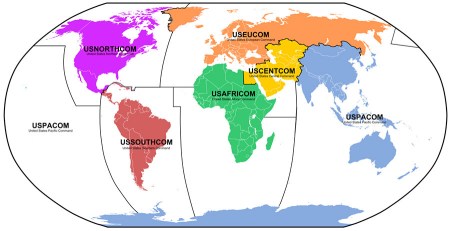
WASHINGTON — CENTCOM commander nominee General Joseph Votel said that Russia’s trade and military relationships with neighboring Central Asian states threaten US interests in the region.
Russia’s trade and military relationships with neighboring Central Asian states threaten US interests in the region, US Central Command (CENTCOM) commander nominee General Joseph Votel said in testimony to the Senate Armed Services Committee on Wednesday.
“Russia has moved to assert itself in Central Asia through a combination of military, economic and informational means in an effort to resurrect its great power status and hedge against perceived instability emanating from Afghanistan,” Votel stated.
After 14 years, the United States has reduced its military presence in Afghanistan to 9,800 troops, with plans to reduce troop levels to 5,500 by 2017. In the past year, Taliban militants and Daesh terrorist fighters have been on the rise in Afghanistan, prompting US commander of operations there, General John Nicholson, to describe the conditions in the country as “deteriorating.”
Votel further argued that Russian security partnerships with former Soviet states in Central Asia “make it difficult for the United States” to deepen defense ties in the region, which he described as a “key US interest.”
Since 1992, Russia has partnered with neighboring nations in the Collective Security Treaty Organization (CSTO). Russia also founded the Eurasian Economic Union in 2014, to further regional economic development among member nations including Armenia, Belarus, Kazakhstan and Kyrgyzstan.
Inside the twisted, racist, anti-Semitic mind of the Jewish Daily Forward
Another classic example of the perp posing as victim
By Kevin Barrett | Veterans Today | March 10, 2016

The Forward tries to silence critics of Jewish-Zionist power by name-calling and denigration. Don’t expect them to debate the facts.
The Jewish Daily Forward is sometimes called America’s leading Jewish newspaper. But that is not, strictly speaking, true.
America’s leading Jewish newspaper is the New York Times. Runners-up include most of the other big newspapers, including the former WASP bastions the Chicago Tribune and Los Angeles Times.
They’re all “Jewish newspapers” in the sense that that a disproportionate number of their key positions are filled by Jews, many if not most of whom consciously or unconsciously support Jewish tribal interests.
It is just a simple fact, not an “anti-Semitic conspiracy theory,” that Jews “Dominate in American Media – and So What if We Do?” It is a simple fact that Jews totally control Hollywood. It is a simple fact that Jews, who make up less than 2% of the population, are wildly over-represented in big finance in general, and the bribery-based system of political finance in particular.
And it is a simple fact that virtually all wealthy, powerful Jews are pro-Zionist…and that many are fanatically dedicated to using their wealth and power to support the Zionist entity occupying and genociding Palestine. (Yes, there are many Jews who are not Zionist, but few of them are wealthy or powerful.)
If you don’t believe me, please consult sociologist James Petras’s The Power of Israel in the United States. Additional required reading includes Petras’s essay in Another French False Flag, which explains how “the Zionist faction” of the US militarist elite has been responsible for America’s catastrophic wars in the Middle East.
But anyone who notices any of this, and recognizes that Jewish-Zionist power is what dragged the US into the quagmire in the Middle East — notably by way of the 9/11 inside/outside job — is setting themselves up for a witch-hunt.
The latest victim is professor Joy Karega of Oberlin College, who is being inundated with insults because she has dared to breathe a word or two of truth via social media. In a classic case of Zionist blame-the-victim-for-precisely-what-we-perpetrators-are-doing tactics, the racists at the Forward are accusing their victim, Karega, of racism.
The Jewish Daily Forward’s article “Inside the Twisted Anti-Semitic Mind of Professor Joy Karega” inadvertently exposes the twisted, racist, anti-Semitic minds of its author and publishers. These people simply take it for granted that the truth is an “anti-Semitic conspiracy theory” and that anyone who defends it is a lesser being who deserves to be insulted, but needs not be rationally or empirically refuted.
The anti-Karega lynch mob, led by Jewish Zionists, is trying to assassinate her professionally. Yet they deny that they are trying to silence her! From The Forward : “… of course the question here is not whether Karega should be ‘silenced,’ but rather whether she should be funded as a professor at one of the leading liberal arts colleges in the U.S.”
So The Forward insists that working to get Karega fired and destroy her ability to make a living is not an attempt to silence her! Such arrogance is well-nigh unbelievable.
The Forward’s anti-conspiracy-theory tropes are drenched in racism. As a white guy who has brought up conspiracy issues with fellow white folks, I have heard more times than I can count some variation on “So what if 80% of Muslims are 9/11 conspiracy theorists? Who cares what those paranoid wogs think?” Or: “So what if black people believe these conspiracy theories, they’re just not as smart and educated as us white people.”
Pakistanis know “al-Qaeda” better than anyone, and only 3% of them believe the official story of 9/11. But whenever I bring that up with white Americans, their superiority complex kicks in and they dismiss the far-more-informed perspective from Pakistan… for no particular reason, except maybe that the people over there have a bit too much skin pigmentation.
The Forward article fairly drips with that kind of implicitly racist condescension toward proud African-American intellectual Joy Karega. It begins by describing Jewish anti-conspiracist Isabel Sherrel contacting Karega in an arrogant attempt to bully her back into line – not by citing any evidence against Karega’s position, but by calling Karega “not educated” and saying Karega’s views stem from “ignorance.”
To an unconscious exponent of Jewish superiority like Sherrel, her own 100%-evidence-free name-calling is “honest, respectful, and open-hearted.” She is so permeated by her own sense of tribal and/or racial superiority that she cannot even entertain the idea that she ought to be arguing with Karega as an equal, using logic and evidence, rather than bullying her and calling her names.
The Jewish Daily Forward article, citing Karl Popper, suggests that we “demand evidence for the conspiracy theory.” Yet it buries Popper’s legitimate call for a debate based on logic and evidence beneath an avalanche of implicit and explicit ad hominems.
The Jewish Daily Forward’s article attacking Karega is not just arrogantly, condescendingly racist, but anti-Semitic as well. Its rhetorical purpose is to cover up the truth about the so-called “war on terror” and thereby perpetuate that war, which has mainly targeted Arabs, the only major group of Semites on earth.
As I wrote to Oberlin College President Marvin Krislov:
You write that you are similarly nonplussed by “anti-Semitic conspiracy theories.” Are you referring to the theory that 19 young Semites, led by an older Semite on dialysis in a cave in Afghanistan, blew up the World Trade Center by using box-cutters to kindle minor office fires?
I, too, am outraged by anti-Semitic conspiracy theories. Today virtually all of the world’s Semites are the speakers of Arabic. (“Semite” is a linguistic category, not a racial one.) And I am outraged by the way Arabic Semites have been falsely blamed for the controlled demolition of the World Trade Center, the murders of innocents by large white paramilitary professionals in Paris and San Bernadino, and many similar false flag incidents. These false flag public relations stunts have triggered the murder of more than 1.5 million people and the destruction of the homes and lives of tens of millions more. THIS is the real, indisputable and ongoing Holocaust; you and your colleagues are perpetrating it right now with your tax money, your silences and your lies. The blood of more than a million innocents is on your hands.
So while I appreciate your support for academic freedom, I respectfully request that you take the next step and sponsor a debate or symposium on false flags in general and 9/11 and the 2015 Paris attacks in particular. If you or anyone else believes they can defend the 9/11 Commission Report, or the official versions of the Paris attacks, in a debate, they should be not just willing but actually eager to put the “conspiracy theories” to rest.
I will be happy to travel to Oberlin at my own expense to participate in any such debate. Meanwhile, I am sending my three books Questioning the War on Terror, We Are NOT Charlie Hebdo, and ANOTHER French False Flag as a gift to the Oberlin College Library, where faculty and students can refer to them to understand the positions of Professor Karega and the hundreds of millions of people around the world who share her interpretations of current events.
Sincerely,
Dr. Kevin Barrett
Britain sets ‘bad example’ on surveillance, says UN privacy rapporteur
RT | March 10, 2016
Britain is setting a bad example by legitimizing rather than outlawing mass surveillance, according to the UN’s privacy rapporteur, Joseph Cannataci.
The criticism comes in a report to the UN Human Rights Council examining mass surveillance around the world.
Britain is singled out as setting a bad example because of the government’s attempt to bring into law a number of new spying measures.
Cannataci claims the Investigatory Powers Bill, which will be debated for a second time in parliament next week, legitimizes mass surveillance when bulk collection should in fact be outlawed.
He argues the British security state should stop “setting a bad example to other states” by pursuing measures like “bulk interception and bulk hacking.”
He said that enshrining such surveillance into law undermined “the spirit of the very right to privacy.”
Cannataci has been an outspoken critic of UK surveillance measures for some time. In 2015 he called for a Geneva Convention for the internet, while arguing UK oversight was “a joke.”
On the lack of proper scrutiny on intelligence agencies, he told the Guardian: “That is precisely one of the problems we have to tackle. That if your oversight mechanism’s a joke, and a rather bad joke at its citizens’ expense, for how long can you laugh it off as a joke?”
The Investigatory Powers Bill was partially informed by the revelations of mass surveillance by NSA whistleblower Edward Snowden.
In his 2015 interview, Cannataci put aside the hero/traitor debate on the former contractor, telling the paper “his revelations confirmed to many of us who have been working in this field for a long time what has been going on, and the extent to which it has gone out of control.”
Cannataci’s concerns are shared by some civil liberties groups.
Jim Killock, director of the Open Rights Group, said the report showed that the “bill does not comply with recent human rights rulings” and that the negative impact of the legislation would “be felt around the world, and copied by other countries.”
G4S says it will exit Israeli market, following high-profile BDS campaign
MEMO – March 10, 2016
British private security giant G4S has announced plans to sell its entire Israeli business within the next 12 to 24 months. The news has been welcomed by activists in the Palestinian Boycott, Divestment, and Sanctions (BDS) campaign, for whom G4S has been a long-standing target.
The decision to leave Israel was revealed in the company’s full-year results released Wednesday, when the company reported a 40 per cent fall in its pre-tax profits.
The company said its plans to exit Israel were part of a “continuing portfolio management programme” designed to “materially improve our strategic focus.” The Israeli business employs 8,000 people with a turnover of £100 million.
According to the Financial Times, G4S “is extracting itself from reputationally damaging work, including its entire Israeli business”, noting that human rights campaigners and BDS activists “have repeatedly attacked G4S’s work in [Israel].”
G4S provides equipment and services to Israeli prisons and detention centres, in which thousands of Palestinian prisoners are tortured and held – including without charge or trial. Israel also violates international law by jailing Palestinians outside of the occupied territory.
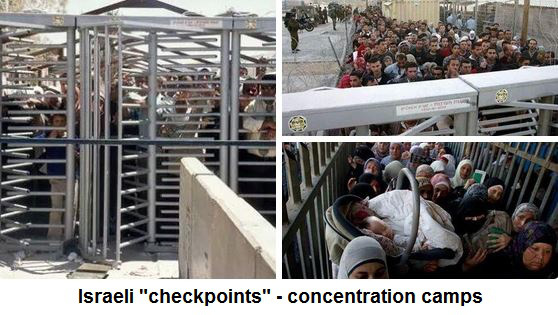
The company also has contracts with the Israeli authorities to provide equipment and services to Israeli checkpoints in the Occupied West Bank that form part of illegal Apartheid Wall.
In 2012, Palestinian groups “called for action to hold G4S accountable for its role in Israel’s prisons”, and since then, the campaign has inflicted growing economic and PR damage on the company. Activists say that G4S has since lost contracts worth millions of dollars around the world, with lost clients including private businesses, universities, trade unions, and United Nations bodies.
In 2014, the Bill Gates Foundation divested its $170m stake in the company following international protests. In the UK, at least five student unions voted to cancel contracts with G4S, and students successfully pressured two other universities not to renew contracts with the company.
The United Methodist Church, the largest protestant church in the USA, divested from G4S after coalition campaigning brought the issue to a vote. Just recently, as reported by Middle East Monitor, G4S lost a major contract in Colombia and a contract with UNICEF in Jordan, in both cases following campaigns by BDS activists.
Responding to the news of G4S’s planned withdrawal from Israel, Palestinian BDS National Committee spokesperson Mahmoud Nawajaa compared the pressure being felt by Israel to the boycott of Apartheid South Africa, and stated that BDS “is making some of the world’s largest corporations realize that profiting from Israeli apartheid and colonialism is bad for business.”
He added: “investment fund managers are increasingly recognizing that their fiduciary responsibility obliges them to divest from Israeli banks and companies that are implicated in Israel’s serious human rights violations, such as G4S and HP, because of the high risk entailed. We are starting to notice a domino effect.”
Nawajaa said the BNC was grateful “to all of the dedicated grassroots organizers around the world who are working in solidarity with Palestinians seeking freedom, justice, and equality”, but noted that the boycott of G4S “will remain among the BDS movement’s top priorities until we actually see its back out of the door of Israel’s regime of occupation, settler-colonialism and apartheid.”
The caution is well-founded; G4S announced in 2013 that it would end its role in illegal Israeli settlements, checkpoints and one Israeli prison by 2015, but did not follow through. In 2014, G4S announced it “did not intend to renew” its contract with the Israeli Prison Service when it expired in 2017 but is yet to implement that decision.
In addition, Nawajaa claimed that owing to G4S’s involvement in the “racist mass incarceration business” in countries such as South Africa, UK, and USA, the BNC is “determined to work closely with partners to hold G4S to account for its participation in human rights abuses.”
In the last eight months, French multinationals Veolia and Orange and CRH, Ireland’s biggest company, have all exited the Israeli market. In January, the United Methodist Church put five Israeli banks from Israel on a “blacklist” due to their complicity in human rights violations, including the financing of illegal Israeli settlements.
Nawajaa said Israel is unable to “stop the impressive growth of BDS”, despite its efforts “to smear and delegitimize our nonviolent movement, including with anti-democratic laws in Europe and the US aimed at silencing dissent and suppressing our freedom of speech.”
“We believe strongly that our ethical approach and just cause will prevail, as this latest G4S announcement shows.”
White House: US Continues National Emergency Over Iran
Sputnik — 09.03.2016
The United States extended the national emergency vis-a-vis Tehran despite the recent lifting of nuclear-related sanctions stipulated in Iran’s agreement with the P5+1 group of countries, President Barack Obama told the Speaker of the US House of Representatives in a letter on Wednesday.
On July 14, 2015, Iran and the P5+1 group of negotiators, comprising China, France, Russia, United Kingdom, United States plus Germany, signed a historic accord to guarantee the peaceful nature of Tehran’s nuclear activities in exchange for the lifting of sanctions.
“The national emergency with respect to Iran that was declared on March 15, 1995, is to continue in effect beyond March 15, 2016,” Obama stated.
“Though lifting of nuclear-related sanctions constitutes a significant change in our sanctions posture [with Iran], non-nuclear related sanctions remain in place.”
The United States, Obama explained, lifted nuclear-related sanctions against Iran after the International Atomic Energy Agency issued a report in January verifying that Iran implemented key nuclear-related steps specified in the JCPOA.
“Nevertheless, certain actions and policies of the government of Iran are contrary to the interests of the United States in the region and continue to pose an unusual and extraordinary threat to the national security, foreign policy and economy of the United States,” Obama claimed.
Earlier this week, according to reports, Iran carried out ballistic missile tests that Washington vowed to raise with the UN Security Council if confirmed.
Featured Video
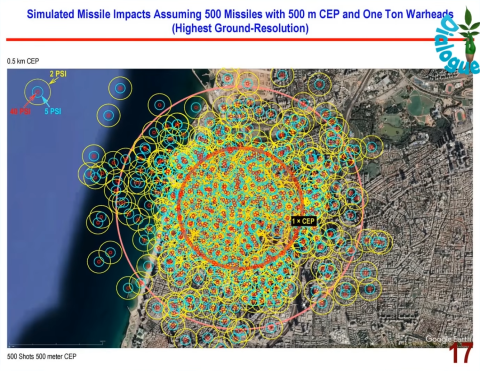
Prof. Ted Postol: US–Iran War? Israel’s Fatal Gamble
or go to
Aletho News Archives – Video-Images
From the Archives
Neocon Max Boot: Legal and illegal aliens need to enlist in the US army and die for Israel
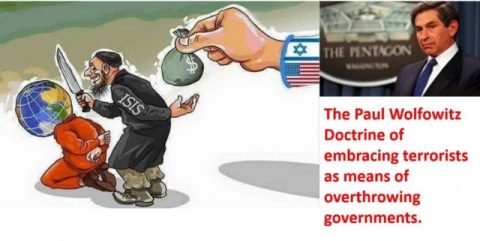
By Jonas E. Alexis | Veterans Today | October 16, 2107
In 1973 Irving Kristol, the godfather of the Neoconservative movement, made a stunning statement which is still relevant to understanding the Israeli influence in US foreign policy. Kristol said:
“Senator McGovern is very sincere when he says that he will try to cut the military budget by 30%. And this is to drive a knife in the heart of Israel… Jews don’t like big military budgets. But it is now an interest of the Jews to have a large and powerful military establishment in the United States…
“American Jews who care about the survival of the state of Israel have to say, no, we don’t want to cut the military budget, it is important to keep that military budget big, so that we can defend Israel.”
Read the statement again very carefully. A big military budget, said Kristol, is only good for Israel, not America or much of the Western World. In other words, precious American soldiers who go to the Middle East to fight so-called terrorism are just working for Israel, not for America.
So, whenever the Neocons use words such as “democracy” or “freedom,” they are essentially conning decent Americans to support Israel’s perpetual wars. … continue
Blog Roll
 Aletho News
- The Only Motive Behind The ‘Imminent’ U.S. War With Iran Is The Zionist Lobby
- Trump eyes 350-acre US military base housing 5,000 troops in Gaza
- Israel Pushing US Toward a Big and Damaging War With Iran – Ex-Pentagon Analyst
- Meet The Liberal Zionist And Ukraine War Supporter Advising AOC On Foreign Policy
- Buck Dancing for Zion: Kenya’s and Nigeria’s Growing Love Affair With Israel
- Israel installed, oversaw security system at Barak-Epstein residence in New York: Report
- ‘Britain’s Index of Repression’ documents 964 incidents of anti-Palestinian crackdown
- Prof. Ted Postol: US–Iran War? Israel’s Fatal Gamble
- UK prosecutors drop aggravated burglary charges against 24 Palestine Action activists
- Unidentified drone downed over Lebanon airbase, US forces block authorities from crash site
- If Americans Knew
- The Lancet: Gaza death toll far higher than reported – Not a ceasefire Day 132
- Compliant aid: Who are the Israel-approved NGOs scaling up in Gaza?
- Why won’t Trump’s “Board of Peace” bring peace? – Not a ceasefire Day 131
- Help end the injustice against Shadi
- Israel’s Favorite American President
- Israel’s “Yellow Line” Is a Death Trap for Palestinians. We Drove Into It.
- Why Israel’s expanding occupation in Syria presents a critical legal test
- Gaza is not a natural disaster. It is the victim of genocide enabled by global inaction
- Netanyahu’s plan to “end” US aid to Israel is to give even more money under a different name
- Israel ceased firing on Gaza for just 15 days of the “ceasefire” – Not a ceasefire Day 130
- No Tricks Zone
- Coal Power Back In Trend As Globe Tries To Keep Pace With Growing Demand For Power
- New Study: A 4°C Warmer Beaufort Sea Had ‘No Sea Ice’ 11,700 – 8200 Years Ago
- Unfudging The Data: Dutch Meteorological Institute Reinstates Early 20th Centruy Heat Waves It Had Erased Earlier
- German Gas Crisis…Chancellor Merz Allegedly Bans Gas Debate Ahead of Elections!
- Pollen Reconstructions Show The Last Glacial’s Warming Events Were Global, 10x Greater Than Modern
- Germany’s Natural Gas Storage Level Dwindles To Just 28%… Increasingly Critical
- New Study Rebuts The Assumption That Anthropogenic CO2 Molecules Have ‘Special’ Properties
- Climate Scientist Who Predicted End Of “Heavy Frost And Snow” Now Refuses Media Inquiries
- Polar Bear Numbers Rising And Health Improving In Areas With The Most Rapid Sea Ice Decline
- One Reason Only For Germany’s Heating Gas Crisis: Its Hardcore-Dumbass Energy Policy
 Aletho News